COA literacy / educational guide
How to identify a fake COA
A Certificate of Analysis should be checkable, not merely convincing. The useful question is whether the original laboratory record can be connected to the product and batch being offered.
We deliberately altered copies of our own BPC-157 report to show how easily details can be hidden and branding added.
Find the original
Check a laboratory record, not just a polished screenshot.
Trace the sample
Connect the tested sample and batch to the stock offered.
Read the amount
Compare measured milligrams as well as the purity percentage.
1 / Start with the complete report
A report must be checkable, not just persuasive
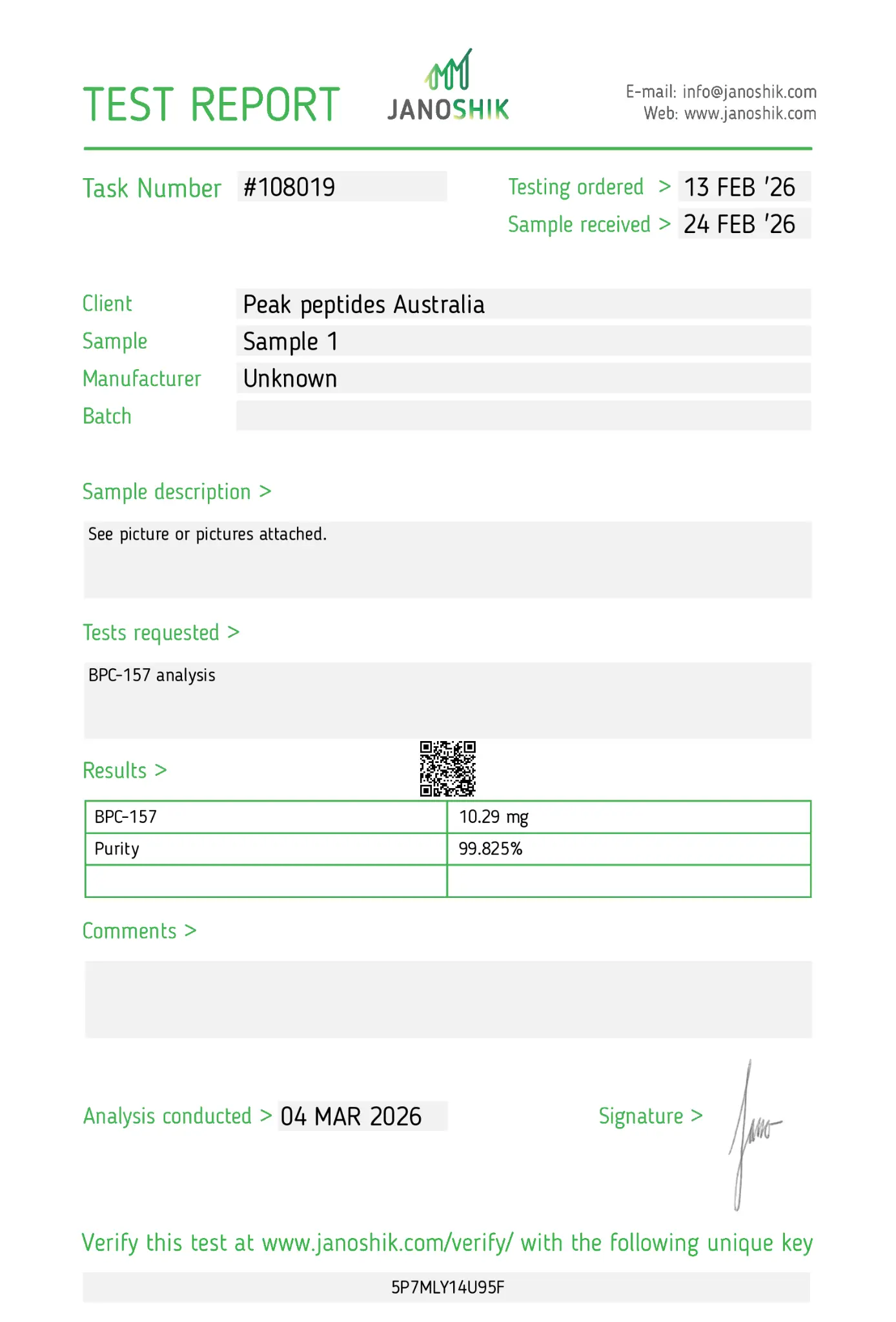
The original, unedited example shows a client, task number, sample, date, measured quantity, purity, QR code and verification key. Laboratory formats differ, but usable details give you a record to compare.
Here, the client is Peak peptides Australia. Task 108019 reports 10.29mg BPC-157 and 99.825% purity. The sample is “Sample 1”, manufacturer “Unknown” and batch blank. A Sample 1 / Unknown / blank batch report is not automatically fake; the seller still needs to connect that sample to supplied product and batch.
2 / Redaction can hide the connection
What remains verifiable?
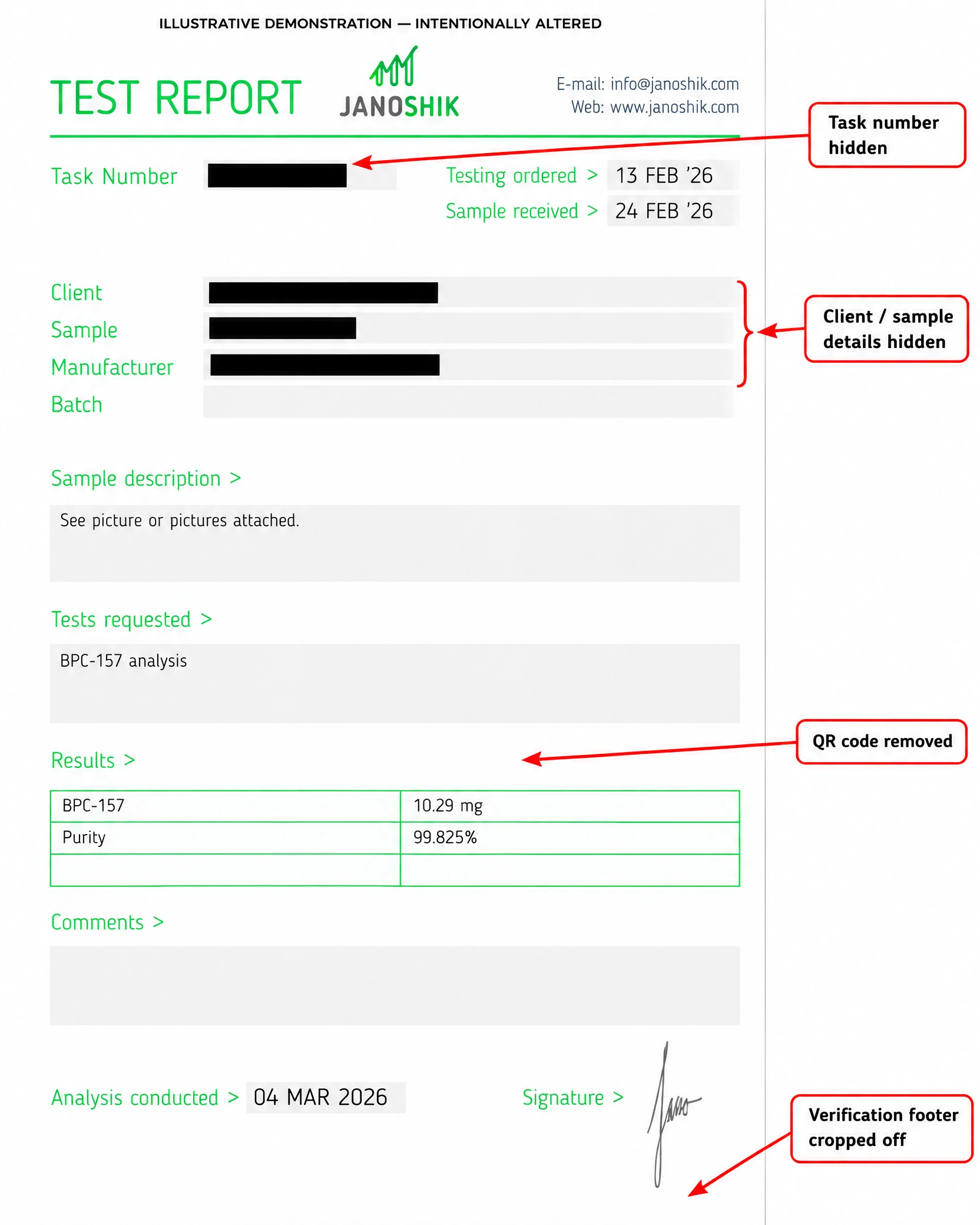
This intentionally altered copy blacks out the task number, client, sample and manufacturer, and removes the QR code and verification footer. Hiding who commissioned a genuine-looking report does not connect it to stock for sale.
Redaction is a warning sign, not proof of forgery. Laboratories can issue private, group or authorised additional reports. Ask for a laboratory-verifiable copy and documented sample-to-product connection. A missing QR code alone is not decisive if another verification route exists.
3 / A compound name is not a traceable identity
Blank fields leave the important question unanswered
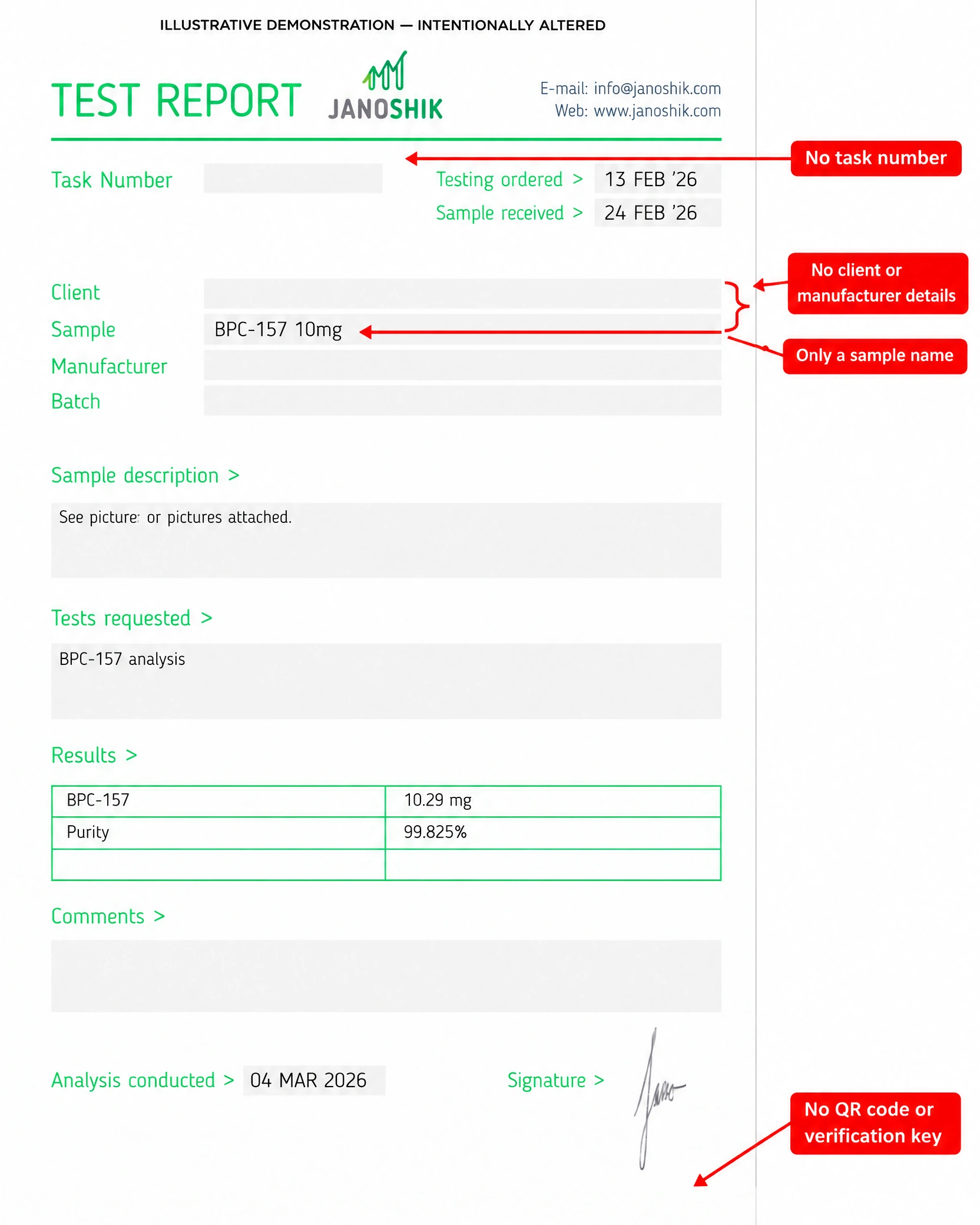
This intentionally altered example calls the sample “BPC-157 10mg” but leaves the task number, client and manufacturer blank; its QR code and footer are absent. That name does not identify the submitter, tested batch or current stock.
Where a QR code, task number and unique key are available, use the laboratory’s official verification service or inspect the QR destination. A QR image is not proof unless it leads to the correct record. Compare client, sample, date, amount and purity; private details may require client permission to disclose.
If every usable verification route is removed, treat the copy as unverified. Ask the laboratory whether the displayed details and results match its original record.
4 / A watermark is not laboratory verification
Branding does not prove ownership or testing
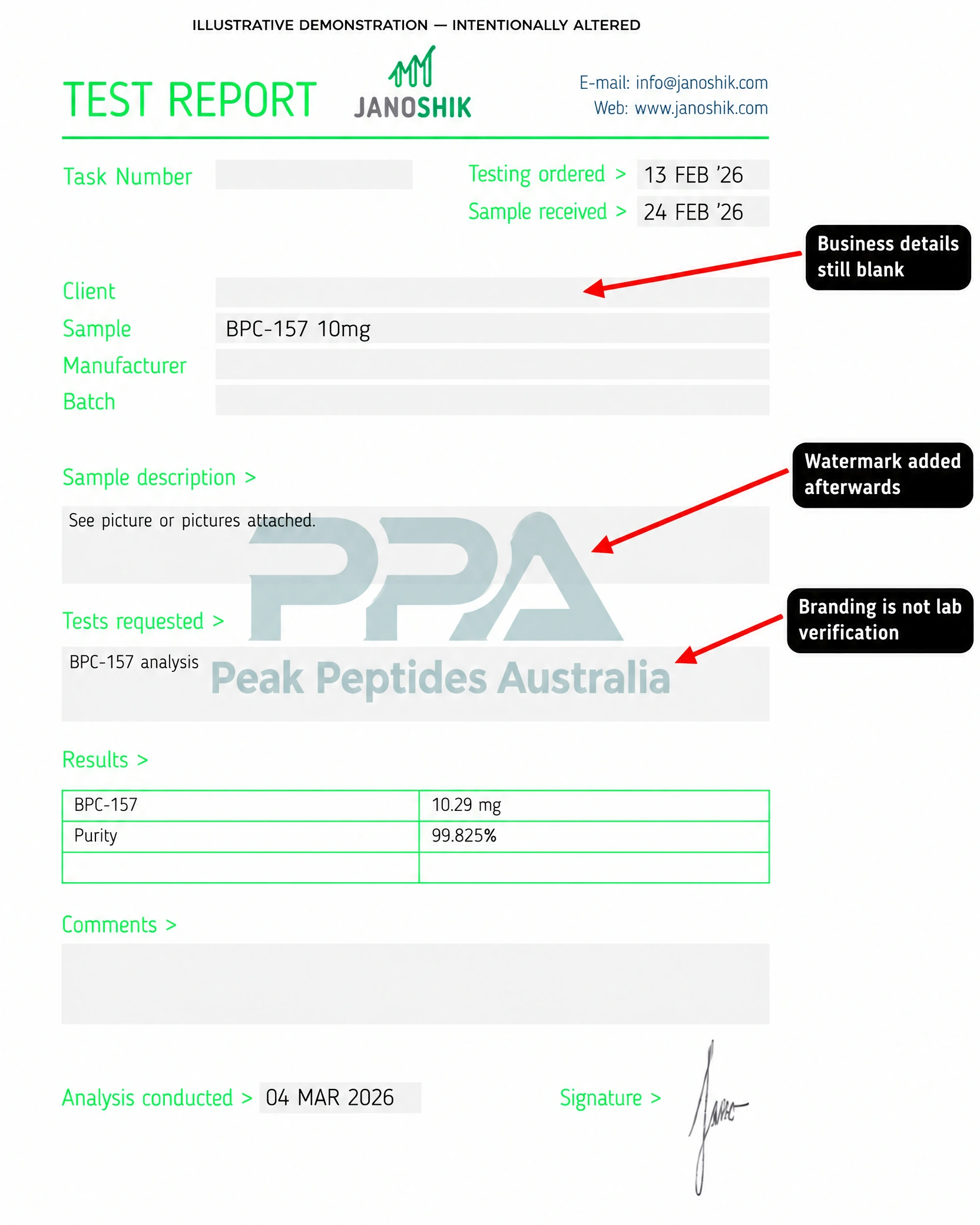
Businesses may watermark reports to discourage copying, but a watermark does not prove ownership, authenticity or testing. This intentionally altered demonstration adds a see-through logo after identifying information was removed.
A watermark is not proof. Verify the underlying record and traceable sample-to-product link, not the branding.
5 / Compare the report with the advertised strength
Purity is not the same as amount
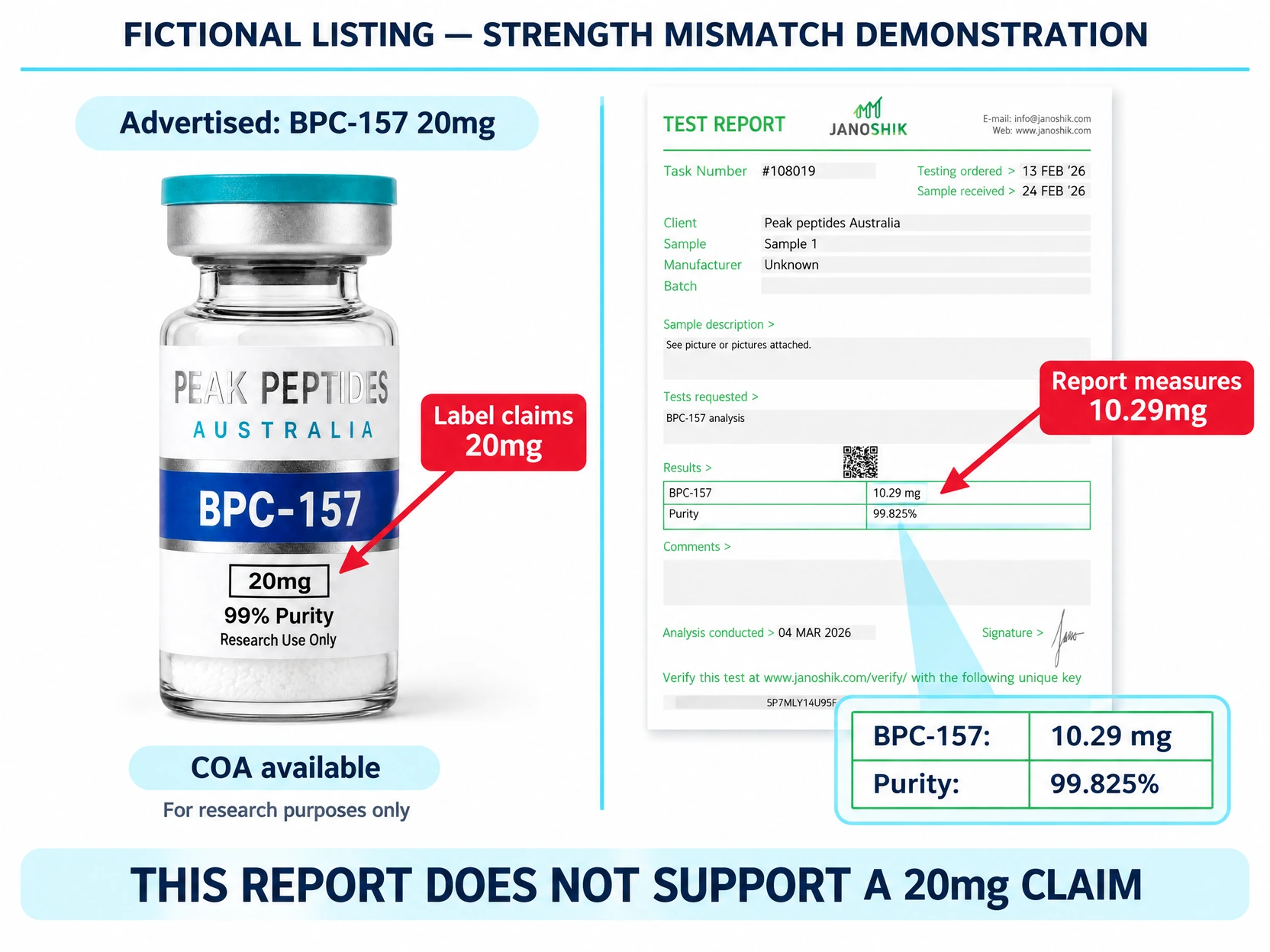
The final image is a deliberately fictional “BPC-157 20mg” advert beside this 10.29mg report. It does not substantiate 20mg and is not a real listing.
Check measured milligrams, not only purity. A 99.825% purity result does not mean a vial contains 20mg. A mismatched report may be attached to the wrong listing; it does not prove all stock is underfilled. But a roughly 10mg report does not support a 20mg claim; ask for evidence of the correct strength and batch.
Before relying on a COA
Use a short traceability checklist
- Can you authenticate it through the laboratory’s official system or direct confirmation?
- Can you identify the client or obtain documented evidence connecting the report to the seller?
- Do the compound, advertised strength, tested amount and batch correspond to the product?
- Do the dates and results match the original laboratory record?
- Are you reading the measured quantity rather than mistaking purity for strength?
The main test is traceability: the original laboratory record must support the product claim. A genuine report can still be misleading when used for a different strength or batch.
Sources
- Janoshik report verification — task number and unique key verification route .
- Janoshik BPC-157 analysis — amount per vial, purity and authorised additional reports .
All altered pictures and the fictional mock advertisement are clearly labelled educational demonstrations. Research products are for research purposes only.