
Vial Cap Types: How to Identify & Open Correctly
Not all vial caps open the same way. Using the wrong technique can damage the aluminium seal, compromise the rubber stopper, and ruin your vial. This guide shows you how to identify which cap type you have and the correct way to open each one.
For research purposes only. All peptides are intended for laboratory research use.
Why This Matters
Research peptides are supplied in sealed glass vials with a rubber stopper held in place by an aluminium crimp ring. On top of this assembly sits a coloured plastic cap — but not all caps are the same. There are two distinct types, and each requires a different opening technique.
Using the wrong method — such as trying to pull off a hinge cap or prying a flip-off cap with a tool — can bend or crack the aluminium crimp ring. Once the crimp is damaged, the rubber stopper may no longer form a proper seal. This allows air, dust, and microorganisms to enter the vial, compromising the integrity of the contents.
Taking 10 seconds to identify your cap type before opening will protect your vial and ensure the contents remain uncontaminated for the duration of use in test subjects.
Identifying Your Cap Type
Before opening any vial, examine the cap carefully. The two types look similar at first glance but have distinct visual indicators that tell you exactly how they should be opened.
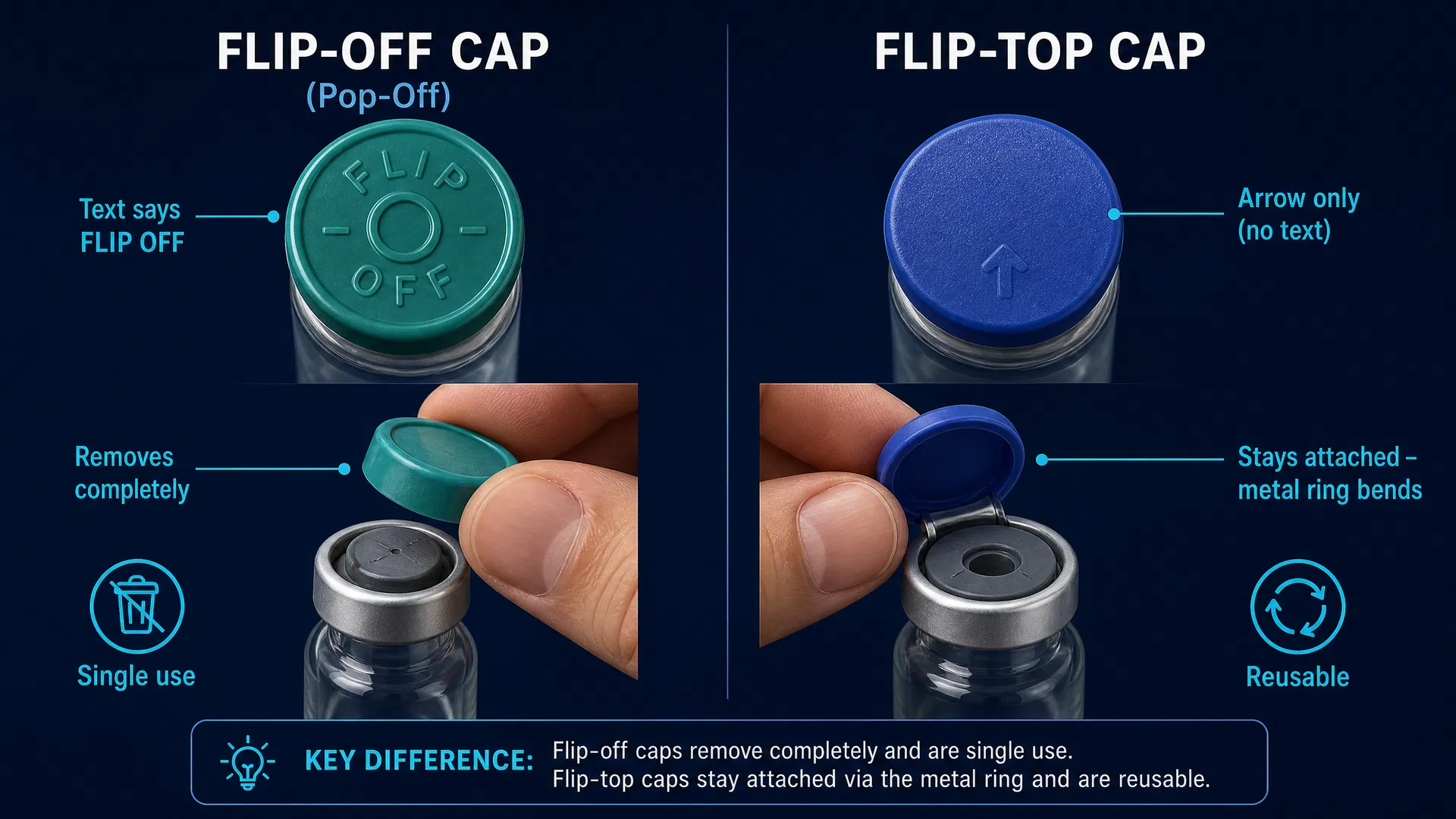
Flip-Off Cap
Pop-Off / Fully Removable
- Smooth, flat plastic disc on top
- Often has "FLIP OFF" text embossed on surface
- No visible tab, hinge, or seam on the edge
- Removes completely — discard after opening
Flip-Top Cap
Hinge Cap / Stays Attached
- Small arrow embossed on top surface — points toward pull direction
- Smooth edge all around — no visible hinge (the metal ring itself bends)
- No "FLIP OFF" text — the arrow is the only marking
- Stays attached — flips up 90° on hinge, can be closed again
Tip: The easiest way to tell them apart is to look at the top of the cap. A flip-off cap will say "FLIP OFF" in embossed text. A flip-top (hinge) cap will have a small embossed arrow on the surface instead — this arrow points toward the side you should pull from. If you see an arrow, it's a hinge cap.
How to Open: Flip-Off Cap (Pop-Off)
The flip-off cap is the most common type found on research peptide vials. It is a single-use, tamper-evident seal — once removed, it cannot be reattached. The plastic disc pops off completely, leaving the aluminium crimp ring and rubber stopper in place.
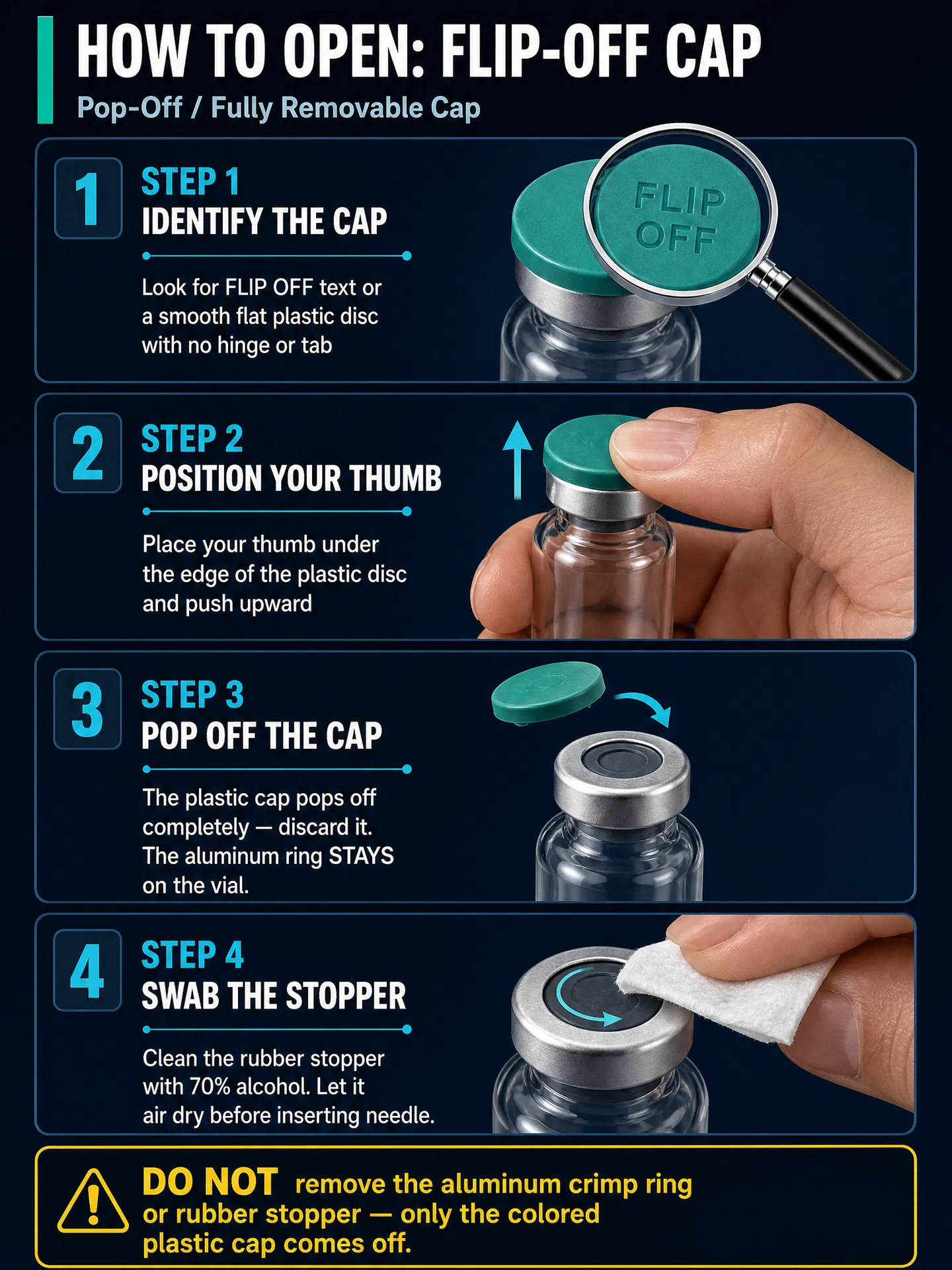
Identify the Cap
Confirm you have a flip-off cap by looking for "FLIP OFF" text embossed on the top surface, or a smooth flat plastic disc with no tab or hinge visible on the edge.
Position Your Thumb
Hold the vial securely in one hand. Place the pad of your thumb against the edge of the coloured plastic disc. You are going to push upward and outward to pop it off.
Pop Off the Cap
Push firmly with your thumb. The plastic disc will pop off cleanly and separate completely from the vial. Discard it — it is single-use. The aluminium crimp ring remains on the vial, holding the rubber stopper in place.
Swab the Rubber Stopper
Immediately clean the exposed rubber stopper with a 70% isopropyl alcohol swab. Use firm circular motions for at least 10 seconds. Allow the stopper to air dry completely before inserting any needle.
Important: Do not attempt to remove the aluminium crimp ring or rubber stopper. Only the coloured plastic cap comes off. The crimp ring and stopper must remain in place for the life of the vial.
How to Open: Flip-Top Cap (Hinge)
The flip-top cap is designed to stay permanently attached to the aluminium crimp ring. There is no separate hinge part — the aluminium ring itself has a thin section that bends, allowing the cap to flip up approximately 90 degrees to expose the rubber stopper. From the outside, the cap looks smooth all the way around. It can be closed again after use to provide ongoing dust protection between accesses.
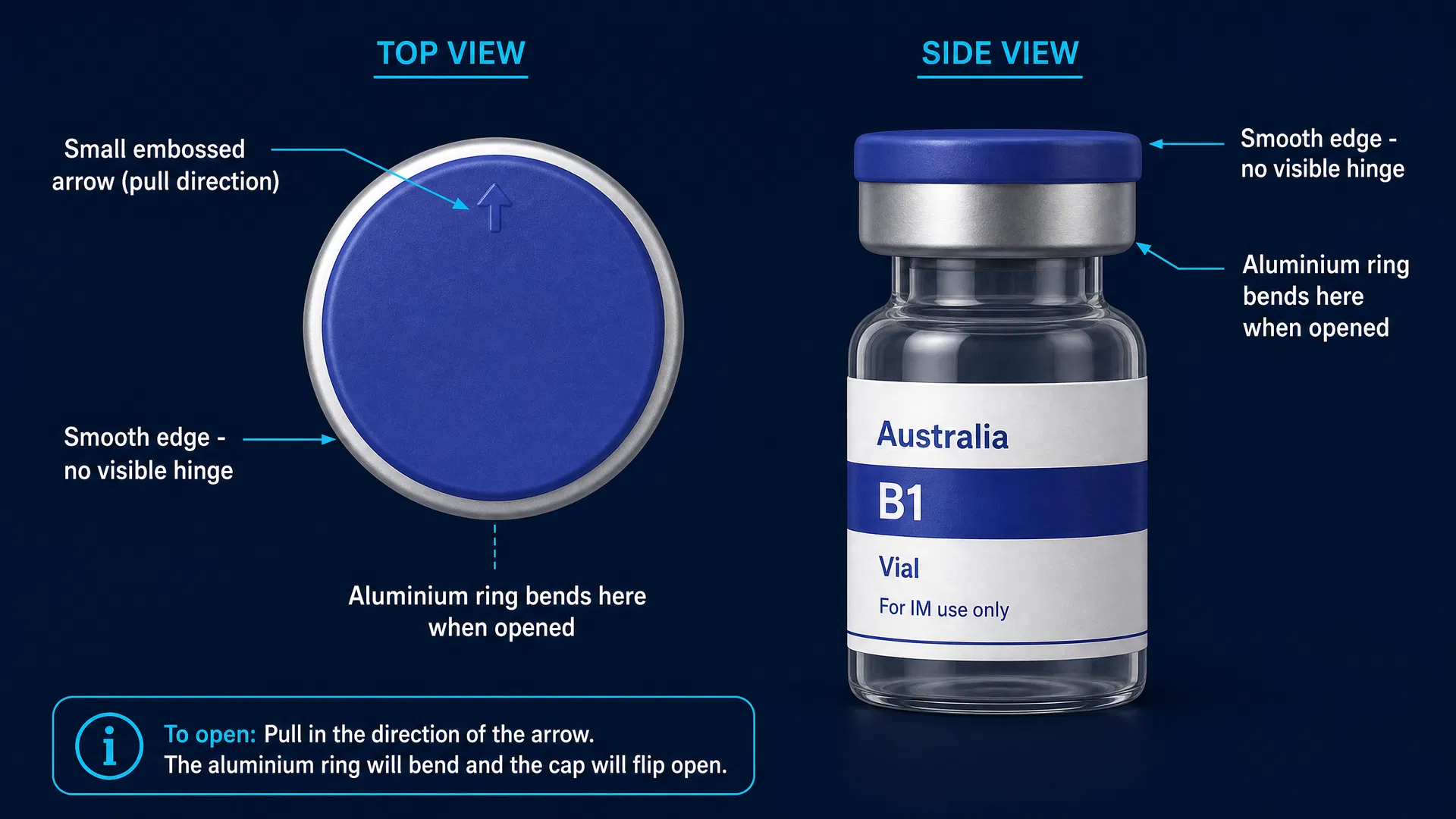
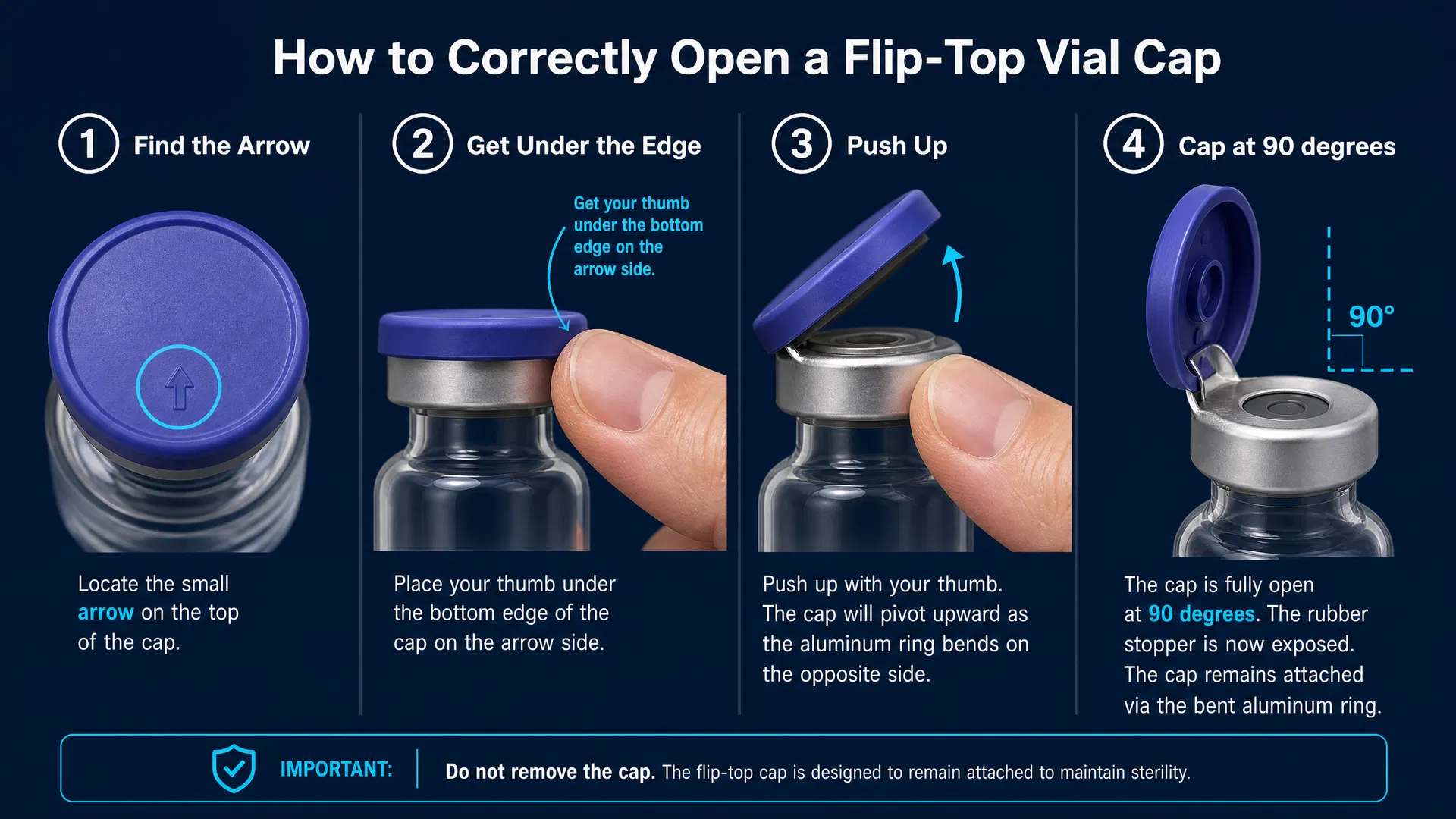
Locate the Arrow
Look at the top surface of the cap. You will see a small embossed arrow. This arrow points toward the side you should pull from — it indicates the direction to flip the cap open. The opposite side is where the metal bends (acts as the pivot point).
Get Under the Edge
On the arrow side, use your thumbnail or the pad of your thumb to get under the bottom edge of the plastic cap. Push upward from underneath. Do not try to pull from the top.
Flip Up to 90°
The cap will pivot upward as the aluminium ring bends on the opposite side. Continue until it reaches approximately 90 degrees (straight up). It will stay in this position on its own. Do not try to pull it off completely — it is permanently attached to the aluminium crimp ring.
Stopper Exposed — Swab & Access
With the cap flipped up, the grey rubber stopper is now visible through the centre hole in the aluminium crimp ring. Clean it with a 70% isopropyl alcohol swab and let it air dry completely. After you are finished, flip the cap back down to protect the stopper from dust until next use.
Do not force this cap off. If you try to pull or pry a flip-top cap completely off the vial, you will bend and damage the aluminium crimp ring. This can compromise the seal between the stopper and the vial, potentially allowing contamination.
Common Mistakes to Avoid
These are the most frequent errors that lead to damaged vials and compromised contents. Each one is easily preventable by identifying your cap type first.
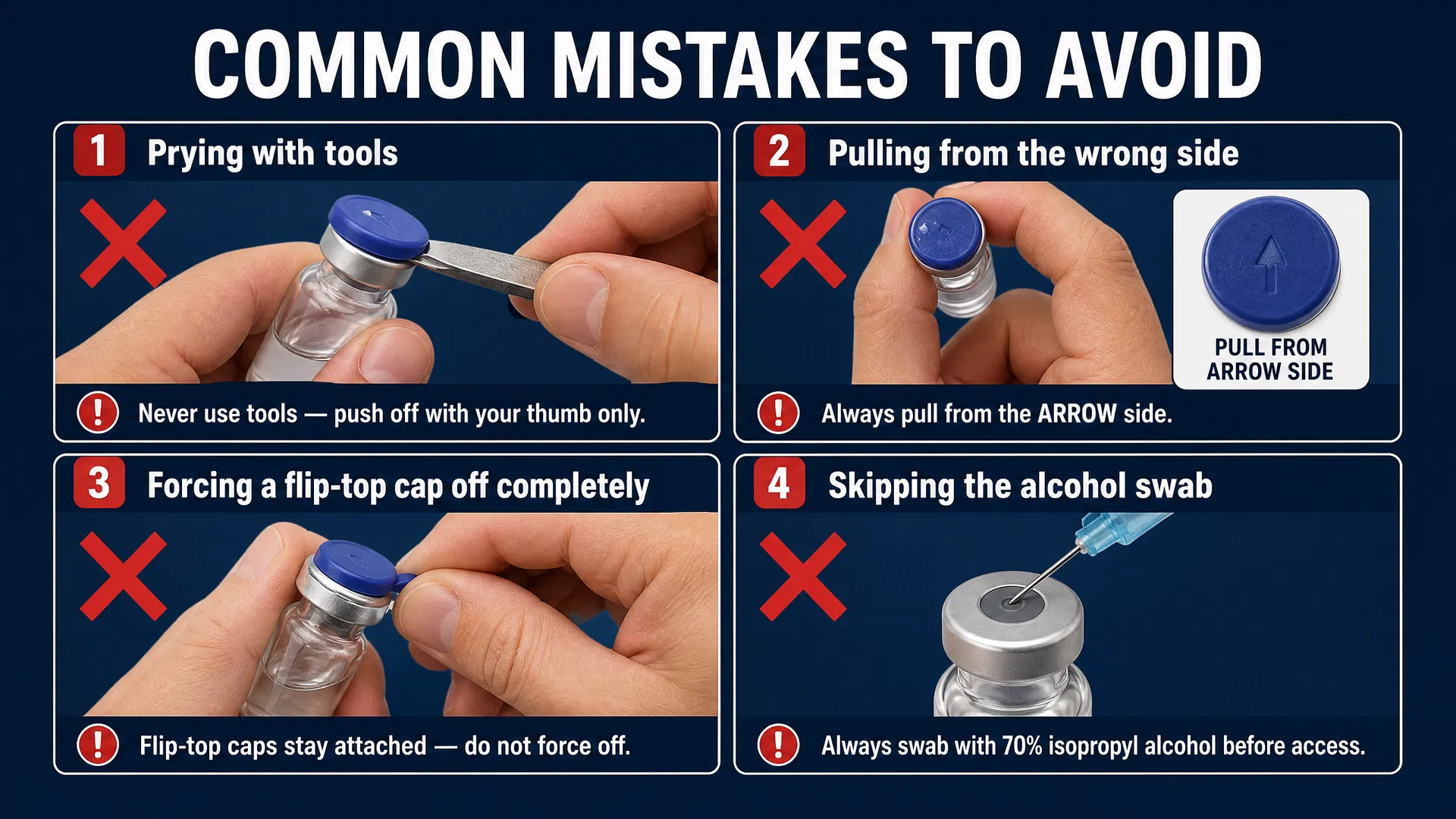
Pulling off a hinge cap
Forcing a flip-top cap off completely will bend the aluminium crimp ring, potentially cracking the seal and allowing contaminants into the vial. If you feel resistance, stop — it is a hinge cap.
Removing the rubber stopper
The rubber stopper is your sterile barrier. Removing it exposes the entire contents to airborne bacteria, dust, and moisture. Access the vial contents only by inserting a needle through the stopper.
Using tools to pry the cap
Knives, scissors, or flat tools can slip and damage the aluminium ring or scratch the glass. Flip-off caps are designed to pop off with thumb pressure alone — no tools required.
Skipping the alcohol swab
The cap is classified as a "dust cover" only — it does not maintain sterility. Even on a brand-new vial, the rubber stopper must be cleaned with 70% isopropyl alcohol before needle insertion. Let it air dry completely.
After Opening: The Alcohol Swab Step
Regardless of which cap type your vial has, the step after opening is always the same: clean the rubber stopper with alcohol. This is a non-negotiable step that applies every single time you access the vial — not just the first time.
Correct Swabbing Technique
Open a fresh 70% isopropyl alcohol prep pad
Press the pad firmly onto the rubber stopper
Wipe in firm circular motions for at least 10 seconds
Allow the stopper to air dry completely (do not blow on it)
Insert your sterile needle only after the stopper is fully dry
Why every time? According to APIC (Association for Professionals in Infection Control) and ISMP (Institute for Safe Medication Practices), the vial cap is a "dust cover" only and does not maintain sterility of the rubber stopper. The stopper must be disinfected before every access, including the first time on a new vial.
Quick Reference Table
Use this table as a quick visual reference when you receive a new vial and need to determine the correct opening method.
| Feature | Flip-Off (Pop-Off) | Flip-Top (Hinge) |
|---|---|---|
| Top appearance | Smooth, flat plastic disc | Cap with small arrow embossed on top surface |
| Markings | Often says "FLIP OFF" embossed on top | Small embossed arrow on top (no text) |
| How it opens | Push off with thumb — removes completely | Push up from arrow side — metal ring bends, cap flips up 90° |
| After opening | Discard the cap (single use) | Stays attached — flip closed between uses |
| Reusable? | No | Yes — provides ongoing dust protection |
| Tamper evidence | Cap is gone = vial has been accessed | First-open seal may be present |
| Common mistake | Prying from side with a tool | Trying to pull it off completely, or pulling from the hinge side |
Frequently Asked Questions
What is the difference between a flip-off cap and a flip-top cap?
A flip-off (pop-off) cap is a smooth plastic disc that removes completely from the vial when pushed off with your thumb. A flip-top cap has a small embossed arrow on the top surface and flips up 90 degrees — the aluminium ring itself bends to act as a pivot. There is no separate hinge part visible on the outside. It stays permanently attached.
How do I know which type of cap my vial has?
Look at the top of the cap. Flip-off caps often have 'FLIP OFF' text embossed on the surface. Flip-top caps have a small embossed arrow on the top surface instead of text — this arrow points toward the side you pull from. The cap looks smooth all around with no visible hinge. If you see an arrow, it's a flip-top cap.
Can I remove the rubber stopper from my vial?
No. The rubber stopper must never be removed. It maintains the sterile barrier of the vial contents. You access the contents by inserting a needle through the rubber stopper after cleaning it with alcohol. Only the coloured plastic cap should be removed or opened.
Do I need to swab the stopper with alcohol even on a new vial?
Yes. The vial cap (whether flip-off or flip-top) is classified as a dust cover only — it does not maintain sterility of the rubber stopper. You must always swab the rubber stopper with 70% isopropyl alcohol and let it air dry before inserting a needle, even on a brand new, unopened vial.
What happens if I damage the aluminium crimp ring?
The aluminium crimp ring holds the rubber stopper securely in place. If it is bent, cracked, or damaged, the stopper may no longer form a proper seal. This can allow air, dust, and contaminants to enter the vial. A damaged crimp ring compromises the integrity of the vial contents and the vial should not be used.
Can I close a flip-top cap after use?
Yes. The flip-top cap is designed to be opened and closed repeatedly. After accessing the vial, you can flip the cap back down to provide dust protection for the rubber stopper between uses. You must still swab with alcohol before each subsequent access.
My flip-off cap won't come off easily. What should I do?
Apply firm, upward thumb pressure to the edge of the plastic disc. If it resists, try pressing from a different angle. Do not use tools, knives, or pliers — these can damage the aluminium ring. If the cap truly will not budge, double-check that it is not actually a flip-top (hinge) cap by looking for a tab on the edge.
Ready to Reconstitute?
Now that you know how to open your vial correctly, learn the full reconstitution process — from adding BAC water to calculating your dose.
Disclaimer: All information provided on this page is for research and educational purposes only. This content is not intended to diagnose, treat, cure, or prevent any disease. All peptides sold by Peak Peptides Australia are for research purposes only and are not for human consumption. Always consult with a qualified healthcare professional before making any decisions involving peptides.