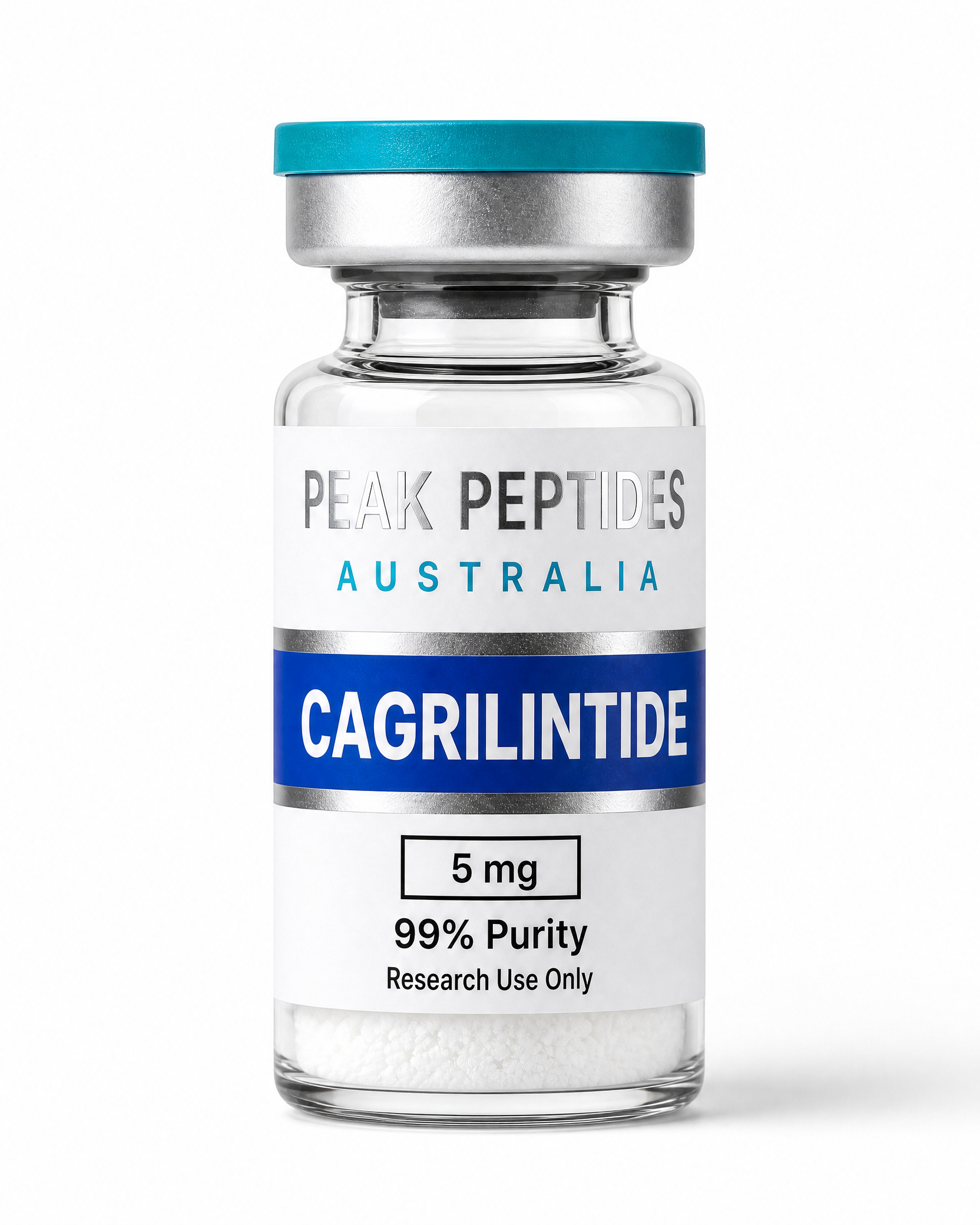
Cagrilintide (AM833) is a long-acting amylin analogue supplied here as a nominal 5mg research vial. In-stock orders receive same-day dispatch from Victoria after payment confirmation, with tracked Australia Post Express shipping Australia-wide.
Product Specifications
Full NameCagrilintide (Long-Acting Amylin Analog)
Vial Size5mg
Purity99.07% HPLC (LD-5S5D, 4.49mg sample)
Legal Disclaimer
This product is sold strictly for in-vitro laboratory research purposes only. It is not a therapeutic good, is not approved by the TGA, and is not intended for human or animal consumption, injection, or any diagnostic or therapeutic use.
Cagrilintide 5mg · AM833 research context
Cagrilintide (5mg) for amylin-receptor research
The existing /peptides/cagrilintide-10mg address is retained for continuity, but this listing is Cagrilintide (5mg): a nominal 5mg research vial. The label quantity is a mass claim, not a concentration, dose or measured-content claim. Cagrilintide is also identified as AM833 in published pharmacology literature.
Cagrilintide is an investigational, long-acting analogue of amylin. Research describes activity across the amylin-receptor and calcitonin-receptor family, making it relevant to receptor-binding and metabolic-signalling studies. This listing is for in-vitro laboratory research only, not for human or animal use.
Also referred to in research or catalogue references as Cagrilintide, AM833.
Amylin-analogue identity
Amylin is a pancreatic peptide hormone. Cagrilintide is a stable, lipidated long-acting amylin analogue developed for clinical research; it is not native amylin. Scientific literature and product-development research use the identifier AM833 for cagrilintide.
Receptor-family research
Cagrilintide/AM833 has been characterised as a non-selective agonist at amylin receptors and calcitonin receptors. Amylin receptors are complexes of a calcitonin receptor with receptor activity-modifying proteins. This receptor-family context is why cagrilintide appears in amylin/calcitonin receptor-binding and metabolic-signalling research.
What makes it long-acting
The development paper describes an N-terminal C20 fatty-acid modification and other sequence changes intended to improve stability, reduce fibril formation and prolong in-vivo exposure. The authors describe reversible albumin binding as the most likely basis for its protracted action. These molecule-design findings are not a storage, preparation or handling protocol for this vial.
Clinical research is context, not a product claim
A multicentre phase 2 study evaluated once-weekly cagrilintide in adults with overweight or obesity over 26 weeks, with body-weight change, safety and tolerability assessed under controlled trial conditions. That study concerned defined participants, monitored treatment and specified protocol arms. It does not establish an outcome, safety profile or suitability for this laboratory listing or any individual.
Not the same as CagriSema
Cagrilintide is the single amylin analogue. CagriSema refers to a cagrilintide–semaglutide combination research programme, so it is not an alternative name for cagrilintide and its combination-study findings must not be attributed to cagrilintide alone. This listing contains no semaglutide.
5mg nominal vial; legacy 10mg URL
Despite the cagrilintide-10mg legacy URL, the catalogue listing identify this product as Cagrilintide (5mg). Treat 5mg as the nominal label quantity. It does not specify concentration, a protocol amount or a measured content result for every vial.
Available LabDoc sample record
LabDoc report LD-5S5D records a Cagrilintide sample received and tested on 18 September 2026. The report describes the tested sample as lyophilised powder in a vial and records LC-MS identity as confirmed, HPLC purity of 99.07%, and HPLC content of 4.49mg against a 5mg manufacturer claim (89.8% of label claim). Its displayed overall assessment is Pass.
What the report can and cannot show
The report states that it covers the tested sample only, and its batch is recorded as not stated. It is useful analytical documentation for that sample, but it does not demonstrate that all present or future inventory is the same batch, has the same content or has identical results. No product-specific stability, storage, reconstitution or handling protocol is established by the reviewed sources.
Why does the URL say cagrilintide-10mg when the product is 5mg?
The legacy URL is preserved so existing links continue to work. The catalogue product label identifies the item as Cagrilintide (5mg), and all current content refers to its nominal 5mg label quantity. The URL must not be read as evidence of a 10mg vial.
What are the factual alternative names for cagrilintide?
AM833 is the published research identifier for cagrilintide. Cagrilintide 5mg is a useful search description for this nominal vial size. CagriSema is not an alias: it denotes a cagrilintide–semaglutide combination programme.
What does the 5mg label quantity mean?
It is the nominal peptide-mass claim for the vial. By itself, it does not state a concentration, prescribe an amount or verify the measured content of every vial.
What did the LabDoc report find for the tested sample?
Report LD-5S5D records confirmed LC-MS identity, 99.07% HPLC purity and 4.49mg HPLC content against a 5mg manufacturer claim, or 89.8% of label claim. The report has no stated batch and expressly applies only to the tested sample.
Can phase 2 study findings be treated as results for this vial?
No. Published phase 2 findings arose from a controlled clinical study with defined participants, trial monitoring and specific protocol arms. They do not verify this item, predict an individual response or establish a clinical use for a research vial.
Is cagrilintide the same as tirzepatide or retatrutide?
No. They are separate catalogue molecules with different research descriptions and separate documentation. They should not be substituted for one another or combined on the basis of this page.
Scientific background is educational and separate from product-specific documentation. Neither establishes personal-use suitability or a clinical result for this research material.