Tirzepatide 10mg is a freeze-dried, dual GIP/GLP-1 receptor agonist research peptide. In-stock orders receive same-day dispatch from Victoria after payment confirmation, with tracked Australia Post Express shipping Australia-wide.
Dual GIP/GLP-1 receptor research information · Updated 24 October 2026
Tirzepatide 10mg — What It Is, SURMOUNT Results & How to Reconstitute It
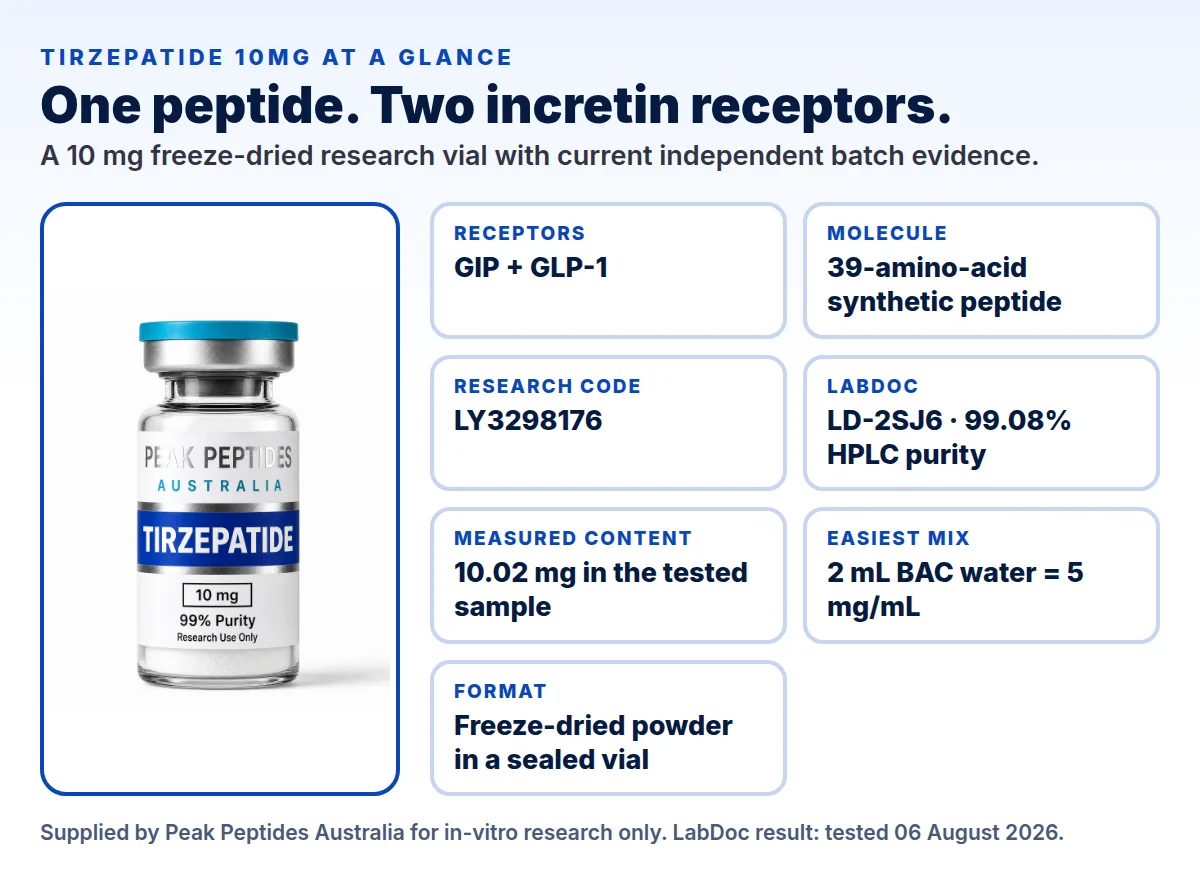
Tirzepatide is a synthetic, 39-amino-acid peptide that activates two gut-hormone receptors: GIP and GLP-1. It is one molecule, not a blend of two peptides. The branded medicines Mounjaro® and Zepbound® contain Tirzepatide, while this page concerns a 10mg freeze-dried research vial supplied by Peak Peptides Australia for in-vitro research only. Below, you can see what the dual mechanism means, the real numbers from the SURMOUNT trials, a direct comparison with Semaglutide, and why Retatrutide is different. You will also find the current vial’s LabDoc report, Janoshik history, an eight-step photo reconstitution guide and a BAC-water chart with the exact 1 mL, 2 mL and 3 mL measurement relationships. Also known on our site as GLP2 (GLP-2), Tirzepatide was previously listed under that product label; it is not the naturally occurring GLP-2 hormone.
Also referred to in research or catalogue references as Tirzepatide, Tirzepatide peptide, Tirzepatide 10mg, Tirzepatide 10 mg, Tirzepatide 10-mg, LY3298176, LY-3298176, Mounjaro active ingredient, Zepbound active ingredient, GLP2 (former site label only; not the GLP-2 hormone), GLP-2 (former site label only; not the GLP-2 hormone).
Tirzepatide 10mg at a glance
Name
Tirzepatide (research code LY3298176)
Former site label
GLP2 or GLP-2; not the naturally occurring GLP-2 hormone
What it is
One synthetic dual GIP/GLP-1 receptor agonist peptide
Structure
39 amino acids with a C20 fatty-diacid side chain
Formula and size
C225H348N48O68 · 4,813.53 Da
CAS number
2023788-19-2
Elimination half-life
About 5–6 days for regulated Tirzepatide medicine
SURMOUNT-1 10 mg group
−19.5% mean body-weight change at 72 weeks; placebo −3.1%
FDA and TGA status
Approved branded medicine; this vial is in-vitro research material, not a branded presentation
Upright at 2–8 °C, dark, about four weeks; do not freeze
Dispatch
Same-day from Victoria for in-stock orders once payment is confirmed, tracked Australia Post Express, tracking number emailed
One molecule, two incretin receptors
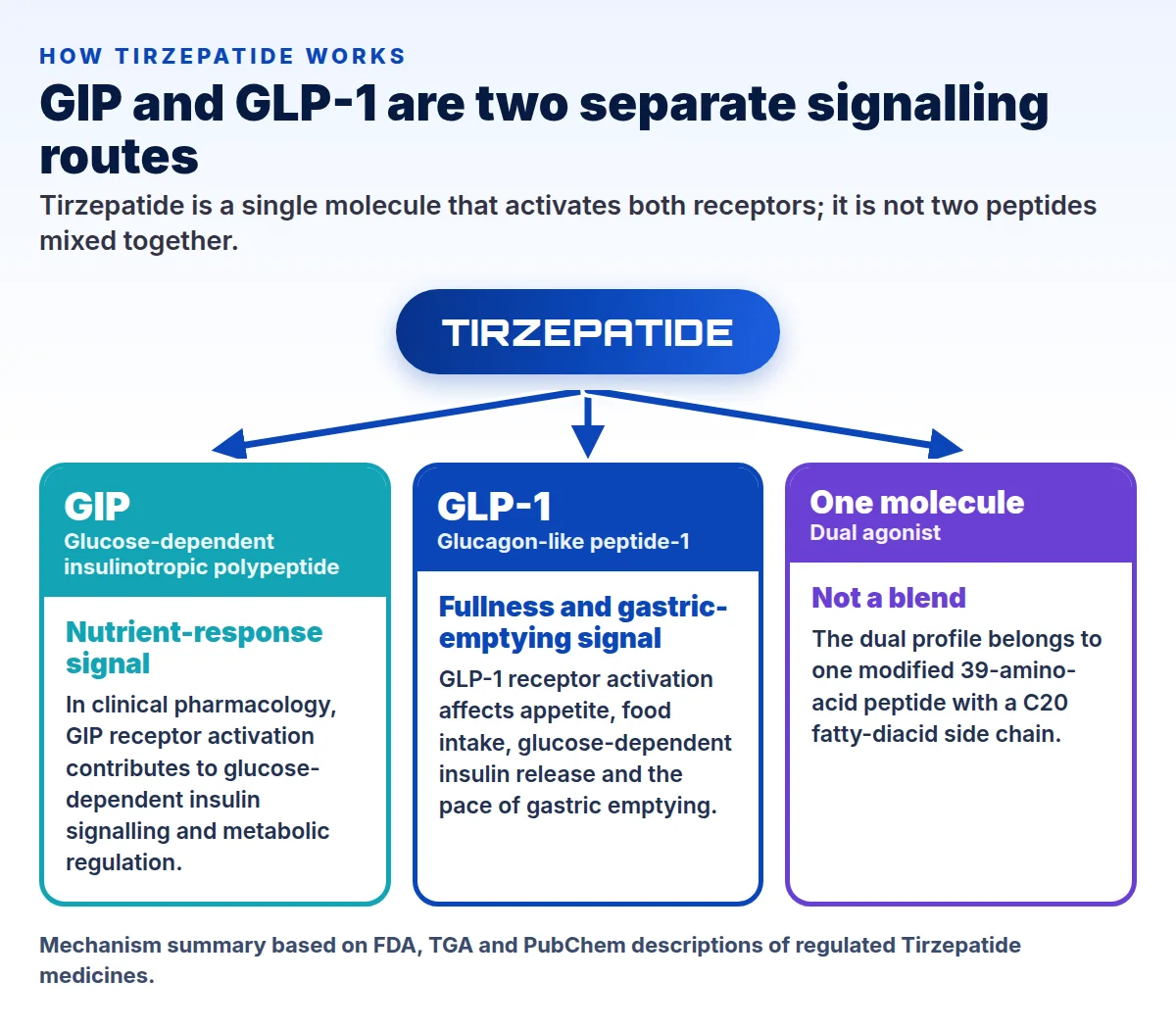
Tirzepatide activates the glucose-dependent insulinotropic polypeptide (GIP) receptor and the glucagon-like peptide-1 (GLP-1) receptor. GIP and GLP-1 are gut-hormone signalling pathways involved in the body’s response to nutrients. Dual agonist means one molecule switches on both receptors.
What makes the molecule last
Tirzepatide is a 39-amino-acid synthetic peptide with a C20 fatty-diacid side chain. That side chain binds albumin, a protein in blood, and slows removal of the molecule. The current US prescribing information describes an elimination half-life of about 5–6 days for regulated Tirzepatide medicine.
SURMOUNT-1: real 72-week results
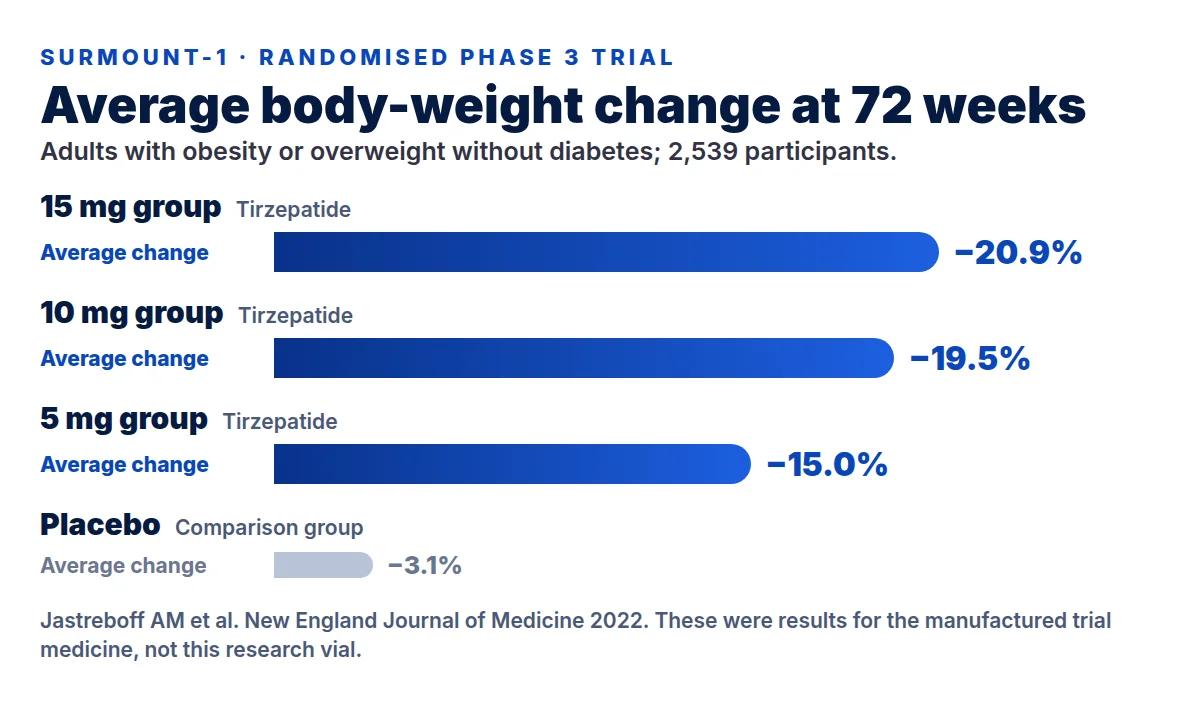
SURMOUNT-1 enrolled 2,539 adults with obesity or overweight and without diabetes. At 72 weeks, mean body-weight change was −15.0% in the 5 mg group, −19.5% in the 10 mg group and −20.9% in the 15 mg group, compared with −3.1% with placebo. These results belong to the manufactured medicine studied in that trial.
A direct Semaglutide comparison exists
SURMOUNT-5 directly compared Tirzepatide and Semaglutide in 751 adults with obesity and without type 2 diabetes. At 72 weeks, average body-weight change was −20.2% with Tirzepatide and −13.7% with Semaglutide. This is stronger evidence than comparing results from separate trials, because both groups were studied in the same trial.
How 10mg relates to the mixing chart
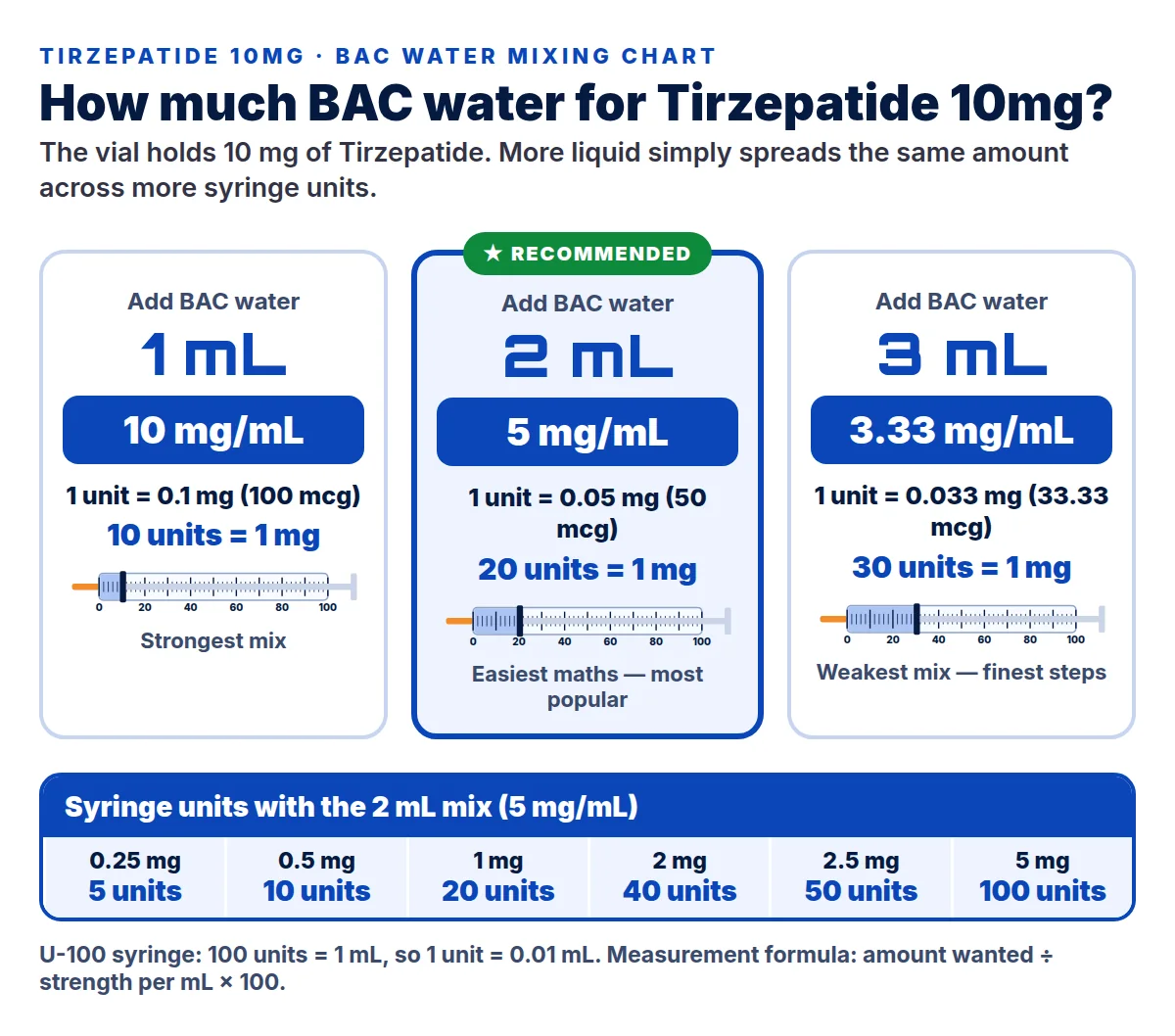
10mg is the total labelled peptide quantity in this vial. Adding 2 mL of BAC water produces 5 mg/mL: a U-100 syringe unit then represents 0.05 mg (50 mcg), and 20 units represent 1 mg. The chart also shows the exact relationships for 1 mL and 3 mL final volumes.
Independent LabDoc evidence for this vial
LabDoc report LD-2SJ6, tested 06 August 2026, records identity confirmed by LC-MS, 99.08% purity by HPLC and 10.02mg measured content against the 10mg label claim. Related impurities were recorded as 0.92%, and the report assessment was Pass. The report is available through the LabDoc verification link.
Janoshik history is a separate test
The public Quality page also lists Janoshik task #135349 for Tirzepatide, dated 01 June 2026, with 11.49mg and 99.724% purity. That historical public result is separate from the current LabDoc submission LD-2SJ6, so both report IDs and test dates should be read with their own sample results.
Approved medicine versus this research vial
Tirzepatide is an approved medicine when supplied as the regulated brands Mounjaro® and Zepbound®: FDA approval covers Mounjaro for type 2 diabetes and Zepbound for chronic weight management, while the TGA states Mounjaro is approved in Australia for both type 2 diabetes and chronic weight management. This freeze-dried research vial is not a regulated branded presentation.
Tirzepatide is a synthetic peptide that activates the GIP and GLP-1 receptors with one molecule. GIP means glucose-dependent insulinotropic polypeptide, while GLP-1 means glucagon-like peptide-1. Both are hormones released in response to nutrients, and both are part of the incretin system — signals that connect the gut, pancreas, brain and other tissues after eating.
The word dual means that Tirzepatide has two receptor targets, rather than GIP plus GLP-1 as two ingredients. PubChem describes Tirzepatide as a 39-amino-acid linear synthetic peptide, based on the endogenous GIP sequence and modified with a C20 fatty-diacid moiety. The molecule has formula C225H348N48O68, molecular weight 4,813.53 Da and CAS number 2023788-19-2.
Tirzepatide is also known by Eli Lilly’s research code LY3298176. The former Peak Peptides site label GLP2 or GLP-2 is only a historical store label. It does not identify the naturally occurring GLP-2 hormone and does not change the peptide’s GIP/GLP-1 pharmacology. This Tirzepatide 10mg vial is supplied as freeze-dried powder for in-vitro research only.
Tirzepatide 10mg: one dual-receptor peptide, independently documented batch results and clear mixing arithmetic.
How does Tirzepatide work?
Tirzepatide works by activating GIP and GLP-1 receptors. A receptor is a protein on or in a cell that recognises a chemical signal and starts a biological response. GIP and GLP-1 are different receptors, so the dual design gives researchers a way to investigate two incretin pathways through a single peptide.
GLP-1 receptor activity is associated with glucose-dependent insulin release, reduced glucagon secretion when glucose is high, slower gastric emptying and changes in appetite and food intake. GIP receptor activity also contributes to glucose-dependent insulin signalling and nutrient-response biology. FDA, TGA and the current product information identify Tirzepatide as a GIP receptor and GLP-1 receptor agonist.
A fatty-acid side chain is attached to the peptide through a linker. This lets Tirzepatide bind to albumin, an abundant blood protein. Albumin binding slows clearance and supports the 5–6-day elimination half-life reported for regulated Tirzepatide medicine. That pharmacokinetic fact describes branded clinical formulations and should not be used as a stability claim for a freeze-dried research vial.
GIP receptor: a nutrient-response route involved in glucose-dependent insulin signalling.
GLP-1 receptor: a route associated with fullness, food intake, gastric emptying and glucose-dependent insulin signalling.
C20 fatty-diacid side chain: the albumin-binding feature that prolongs the molecule’s circulation time.
Dual agonist: one molecule acting at two receptors, not two peptides combined.
Tirzepatide is one molecule with two incretin receptor targets: GIP and GLP-1.
What did the SURMOUNT trials find?
The SURMOUNT programme studied manufactured Tirzepatide medicine in large controlled trials. The numbers below are trial findings, not results for this research vial. The clearest headline data come from SURMOUNT-1, a randomised, double-blind phase 3 trial of 2,539 adults with obesity or overweight and without diabetes.
At week 72 in SURMOUNT-1, mean body-weight change was −15.0% in the 5 mg group, −19.5% in the 10 mg group and −20.9% in the 15 mg group. The placebo group changed by −3.1%. At least 20% body-weight reduction was reached by 50% of people in the 10 mg group and 57% in the 15 mg group, versus 3% with placebo. Gastrointestinal effects were the most common adverse events and were mostly mild to moderate, particularly during escalation.
SURMOUNT-2 tested Tirzepatide in adults with obesity or overweight and type 2 diabetes. At 72 weeks, mean body-weight change was −12.8% in the 10 mg group, −14.7% in the 15 mg group and −3.2% with placebo. The lower group averages compared with SURMOUNT-1 show why trial population matters: separate studies should be read in the context of who took part and how outcomes were analysed.
SURMOUNT-4 examined what happened after a 36-week open-label lead-in. From randomisation to week 88, people continuing Tirzepatide changed by −5.5%, while people switched to placebo changed by +14.0%. In that withdrawal period, 89.5% of the continued-Tirzepatide group maintained at least 80% of the loss achieved during lead-in, compared with 16.6% in the placebo-switch group.
SURMOUNT-1: average body-weight change at 72 weeks in the published trial of manufactured Tirzepatide medicine.
Selected published Tirzepatide body-weight results from the SURMOUNT programme
Selected published Tirzepatide body-weight results from the SURMOUNT programme
Study
Population
Length
Tirzepatide result
Placebo result
SURMOUNT-1
2,539 adults with obesity or overweight, without diabetes
72 weeks
10 mg group: −19.5%; 15 mg group: −20.9%
−3.1%
SURMOUNT-2
938 adults with obesity or overweight and type 2 diabetes
72 weeks
10 mg group: −12.8%; 15 mg group: −14.7%
−3.2%
SURMOUNT-4
670 adults after a 36-week Tirzepatide lead-in
Weeks 36–88
Continued group: −5.5% from randomisation
Placebo switch: +14.0% from randomisation
SURMOUNT-1 and SURMOUNT-2 report mean change from baseline. SURMOUNT-4 reports change from the later randomisation point. Each result relates to the manufactured study medicine.
Tirzepatide vs Semaglutide vs Retatrutide
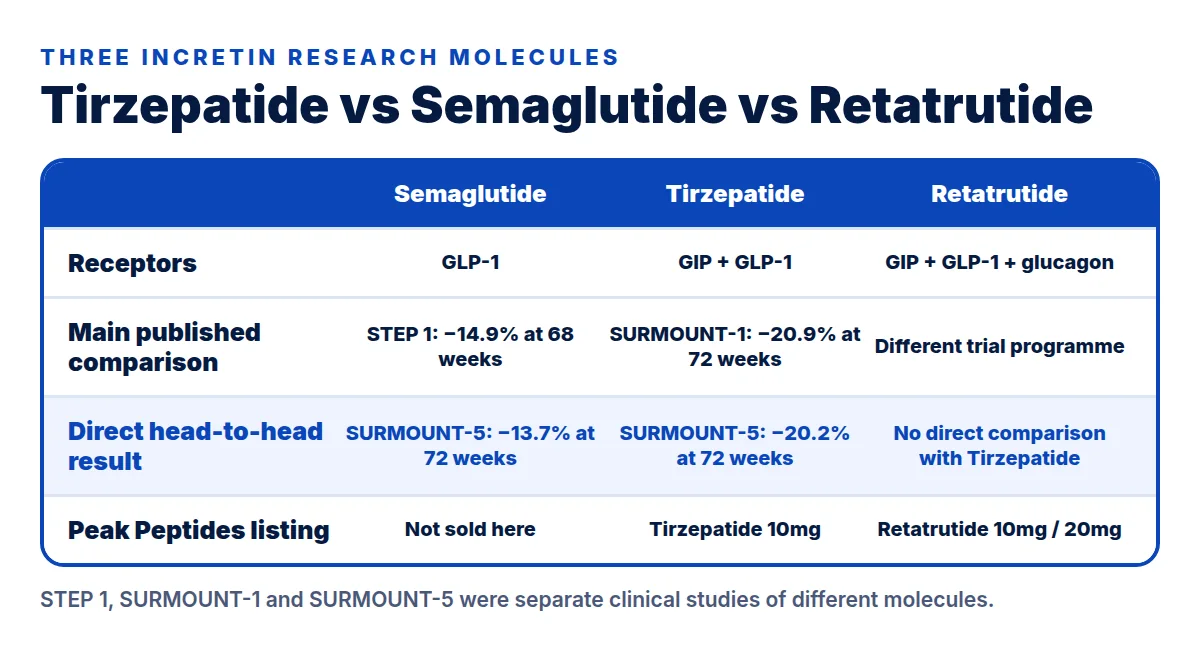
Tirzepatide, Semaglutide and Retatrutide are different molecules. Semaglutide acts at GLP-1. Tirzepatide acts at GIP and GLP-1. Retatrutide adds a third target, the glucagon receptor, so it acts at GIP, GLP-1 and glucagon. Counting receptors is useful for explaining the molecular design, but it does not make milligram amounts or trial findings interchangeable.
For a separate-trial reference point, the STEP 1 Semaglutide trial reported −14.9% mean body-weight change at 68 weeks, while SURMOUNT-1 reported −20.9% in Tirzepatide’s 15 mg group at 72 weeks. Those studies had different medicines, duration and trial programmes, so they are not a direct head-to-head answer.
A direct comparison does exist for Tirzepatide and Semaglutide. In the 72-week SURMOUNT-5 trial of 751 adults with obesity and without type 2 diabetes, mean body-weight change was −20.2% with Tirzepatide and −13.7% with Semaglutide. Mean waist-circumference change was −18.4 cm and −13.0 cm respectively. Semaglutide is not sold by Peak Peptides Australia and is shown here only as a scientific comparison.
There is no equivalent direct head-to-head trial placing Retatrutide beside Tirzepatide in the same way. Retatrutide is therefore best compared by its receptor profile and by reading its own clinical programme rather than treating its published results as a direct substitute for Tirzepatide data.
Tirzepatide has two receptor targets; Retatrutide has three. Only SURMOUNT-5 directly compared Tirzepatide with Semaglutide.
Research comparison: receptor targets and selected clinical-trial context
Research comparison: receptor targets and selected clinical-trial context
Feature
Semaglutide
Tirzepatide
Retatrutide
Receptors
GLP-1
GIP + GLP-1
GIP + GLP-1 + glucagon
Separate main obesity trial
STEP 1: −14.9% at 68 weeks
SURMOUNT-1: −20.9% at 72 weeks in the 15 mg group
Different clinical programme
Direct comparison with Tirzepatide
SURMOUNT-5: −13.7% at 72 weeks
SURMOUNT-5: −20.2% at 72 weeks
No direct trial identified
Peak Peptides listing
Not sold here
Tirzepatide 10mg
Retatrutide 10mg and 20mg
The SURMOUNT-5 result is the direct Tirzepatide–Semaglutide comparison. STEP 1 and SURMOUNT-1 are separate trials and are included only for context.
Independent lab test for this Tirzepatide 10mg vial
Tirzepatide 10mg is backed by LabDoc report LD-2SJ6. The report records a sample received and tested on 06 August 2026. It lists identity as Confirmed by LC-MS, purity as 99.08% by HPLC, measured content as 10.02mg against a 10mg label claim, related impurities as 0.92% and overall assessment as Pass.
Each measurement answers a different question. LC-MS is an identity method: it checks whether the mass pattern matches Tirzepatide. HPLC purity measures the portion assigned to the principal compound within the tested material. Content testing measures how much material was measured in the submitted vial. A purity percentage is not the same number as measured content, and neither result is a sterility claim.
The public Quality page carries an earlier, separate record: Janoshik task #135349, dated 01 June 2026, states 11.49mg and 99.724% purity for Tirzepatide. It is useful historical third-party evidence, but it must not be blended with LD-2SJ6. The current sample’s report number, methods, date and values are the details that belong together.
LabDoc report ID: LD-2SJ6.
Test date: 06 August 2026.
Identity: Confirmed by LC-MS.
Purity: 99.08% by HPLC.
Measured content: 10.02mg against a 10mg claim.
Related impurities: 0.92%; overall assessment: Pass.
Separate historical record: Janoshik task #135349, 01 June 2026, 11.49mg and 99.724% purity.
Buying Tirzepatide 10mg in Australia
Tirzepatide 10mg is supplied by Peak Peptides Australia as freeze-dried material for in-vitro research only. It is not presented as Mounjaro®, Zepbound® or any other regulated prescription presentation. The distinction matters because the FDA and TGA approvals apply to branded medicines with their own manufacturing, labelling, device and product-information systems.
Same-day dispatch from Victoria for in-stock orders once payment is confirmed, tracked Australia Post Express, tracking number emailed. The listing has organic-only promotion status and is not intended for shopping-ad placement. Use the LabDoc batch page and the Quality page to inspect the current independent evidence and the separate Janoshik history.
For the handling visual on this page, add the bacteriostatic-water listing if a BAC-water chart is needed, then use the reconstitution calculator for transparent measurement arithmetic. The 10mg label means total vial content.
Step-by-step guide · About 10 minutes
How to reconstitute Tirzepatide 10mg (step-by-step with photos)
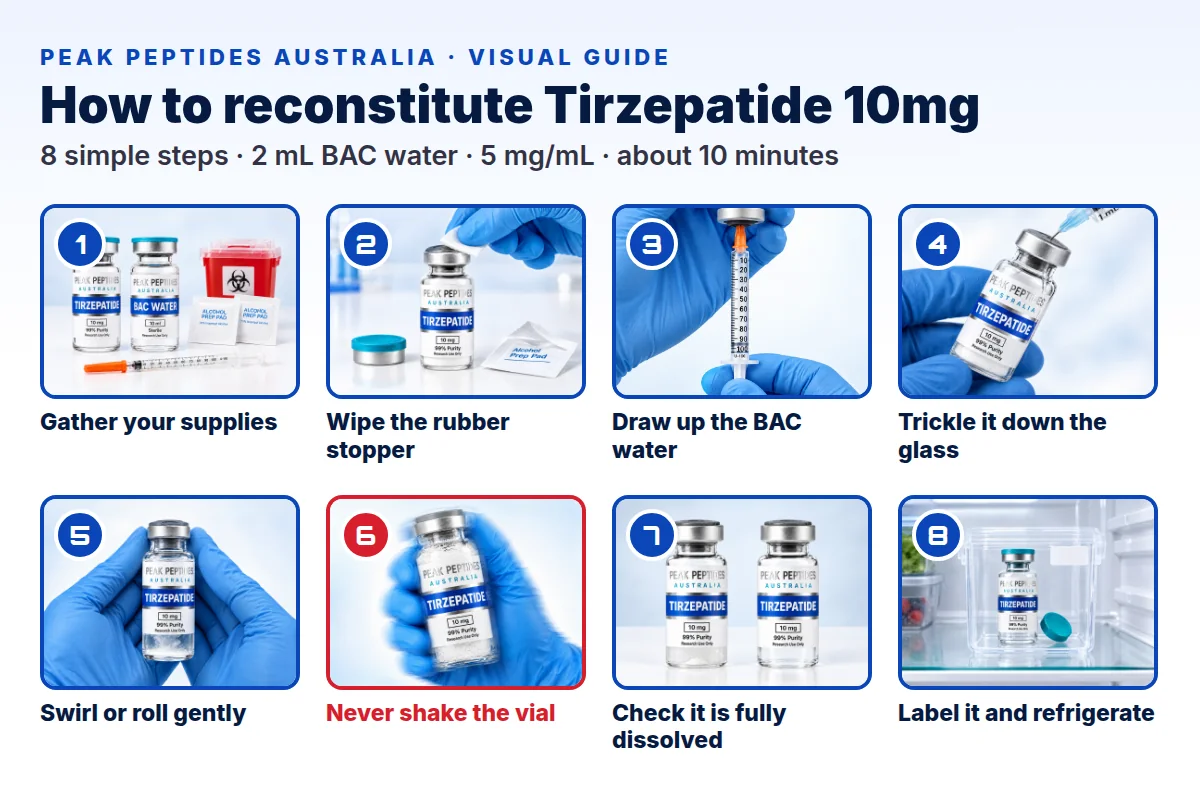
Tirzepatide 10mg arrives as a dry freeze-dried powder. Reconstitution means adding BAC water so the powder dissolves into a clear liquid and the vial can be measured consistently in an in-vitro research workflow. The illustrated guide below uses a 2 mL final volume because the arithmetic is simple: 5 mg/mL, 0.05 mg (50 mcg) per U-100 unit and 20 units per 1 mg. It takes about 10 minutes. This is a handling and measurement guide.
Tirzepatide 10mg reconstitution workflow at a glance: eight photo-led handling steps.
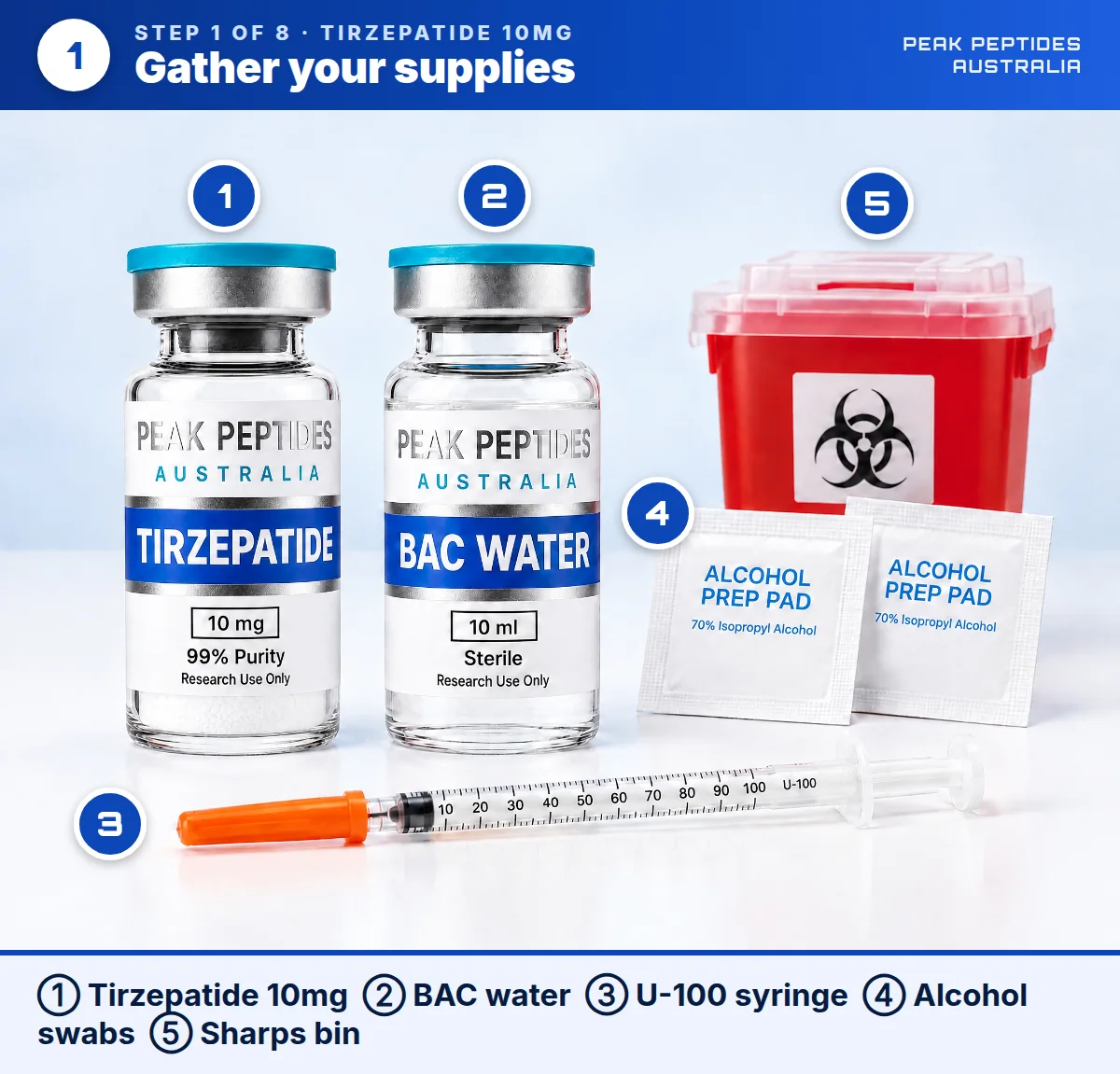
What you need
Tirzepatide 10mg vialFreeze-dried powder in a sealed clear-glass vial with the royal-blue TIRZEPATIDE label band.
Bacteriostatic waterBAC water is the documented diluent used for this page’s multi-use measurement example.
1 mL U-100 syringeA U-100 scale has 100 units per 1 mL, so one unit equals 0.01 mL.
Alcohol swabsFor preparing vial stoppers in the visual handling workflow.
Sharps containerFor safe disposal of used needles and syringes.
How much BAC water for Tirzepatide 10mg?
The vial’s 10 mg total stays constant regardless of final volume. Adding more BAC water does not add peptide; it lowers the concentration and means each U-100 unit represents less material. The exact table below uses 1 mL, 2 mL and 3 mL final volumes so the calculation stays visible rather than hidden.
The 2 mL option is highlighted because it produces 5 mg/mL. At that strength, 1 unit is 0.05 mg (50 mcg), 5 units are 0.25 mg, 10 units are 0.5 mg, 20 units are 1 mg, 40 units are 2 mg, 50 units are 2.5 mg and 100 units are 5 mg. Formula: amount wanted ÷ strength per mL × 100.
At 1 mL, the chart gives 10 mg/mL, 0.1 mg (100 mcg) per unit and 10 units per 1 mg. At 3 mL, it gives 3.33 mg/mL, 0.033 mg (33.33 mcg) per unit and 30 units per 1 mg. Use the final volume actually recorded on the vial; never transfer units from a differently concentrated preparation.
Tirzepatide 10mg mixing maths: 2 mL gives 5 mg/mL and the simplest U-100 unit relationships.
2 mL is highlighted because it gives the simplest numbers: 5 mg/mL and 20 units for 1 mg.
Syringe units with the 2 mL mix (5 mg/mL)
Syringe units with the 2 mL mix (5 mg/mL)
Amount
Units on a U-100 syringe
Volume
0.25 mg
5 units
0.05 mL
0.5 mg
10 units
0.1 mL
1 mg
20 units
0.2 mL
2 mg
40 units
0.4 mL
2.5 mg
50 units
0.5 mL
5 mg
100 units
1 mL
The 8 steps
1Step 1: Gather your supplies
Set out the sealed Tirzepatide 10mg vial, BAC water, a new 1 mL U-100 syringe, alcohol swabs and a sharps container on a clean research workspace. Check the vial label, record the planned final volume and make sure all items needed for the documented handling workflow are ready before opening anything.
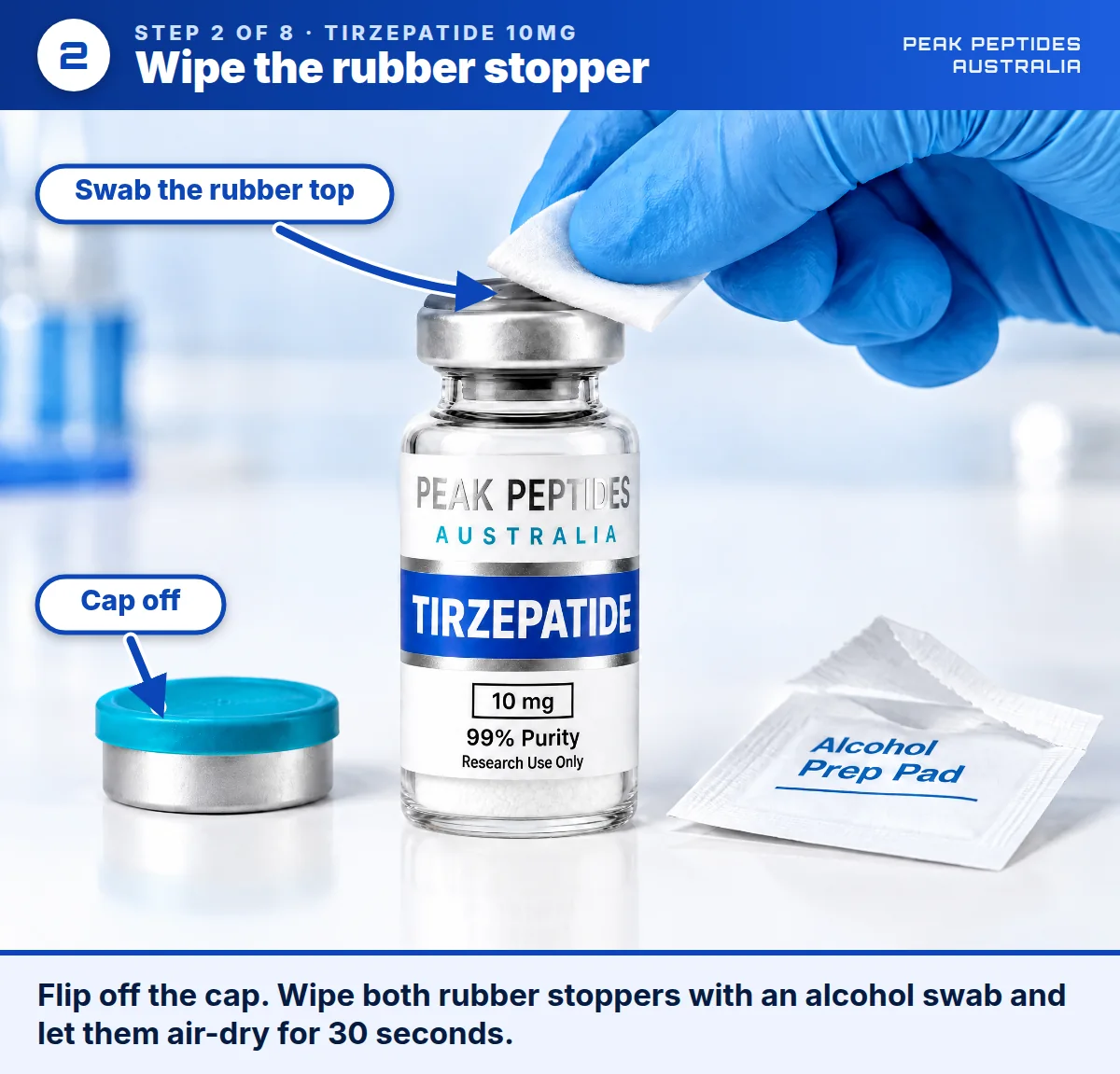
2Step 2: Wipe the rubber stopper
Remove the flip-off cap from each vial without touching the rubber stopper. Wipe both stoppers with separate alcohol swabs and allow them to air-dry for about 30 seconds. Once a stopper is cleaned, keep it clear of hands and surfaces so the prepared access point stays clean for the next step.
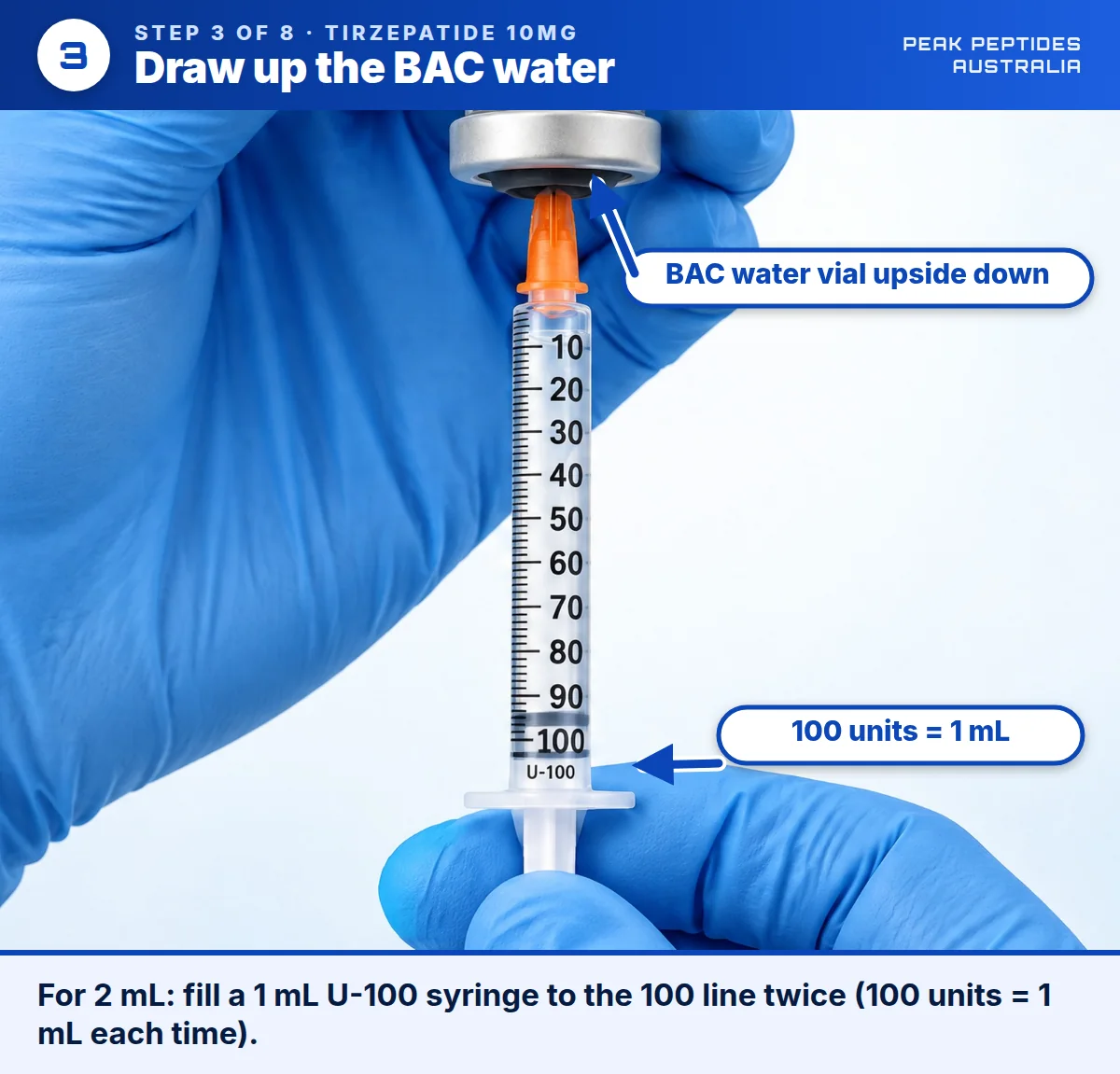
3Step 3: Draw up the BAC water
Use the U-100 syringe to draw the recorded BAC-water volume. One millilitre equals 100 U-100 units, so the illustrated 2 mL final volume is two separate 1 mL draws. Keep the syringe markings visible while measuring and remove large air bubbles before moving the measured liquid to the Tirzepatide vial.
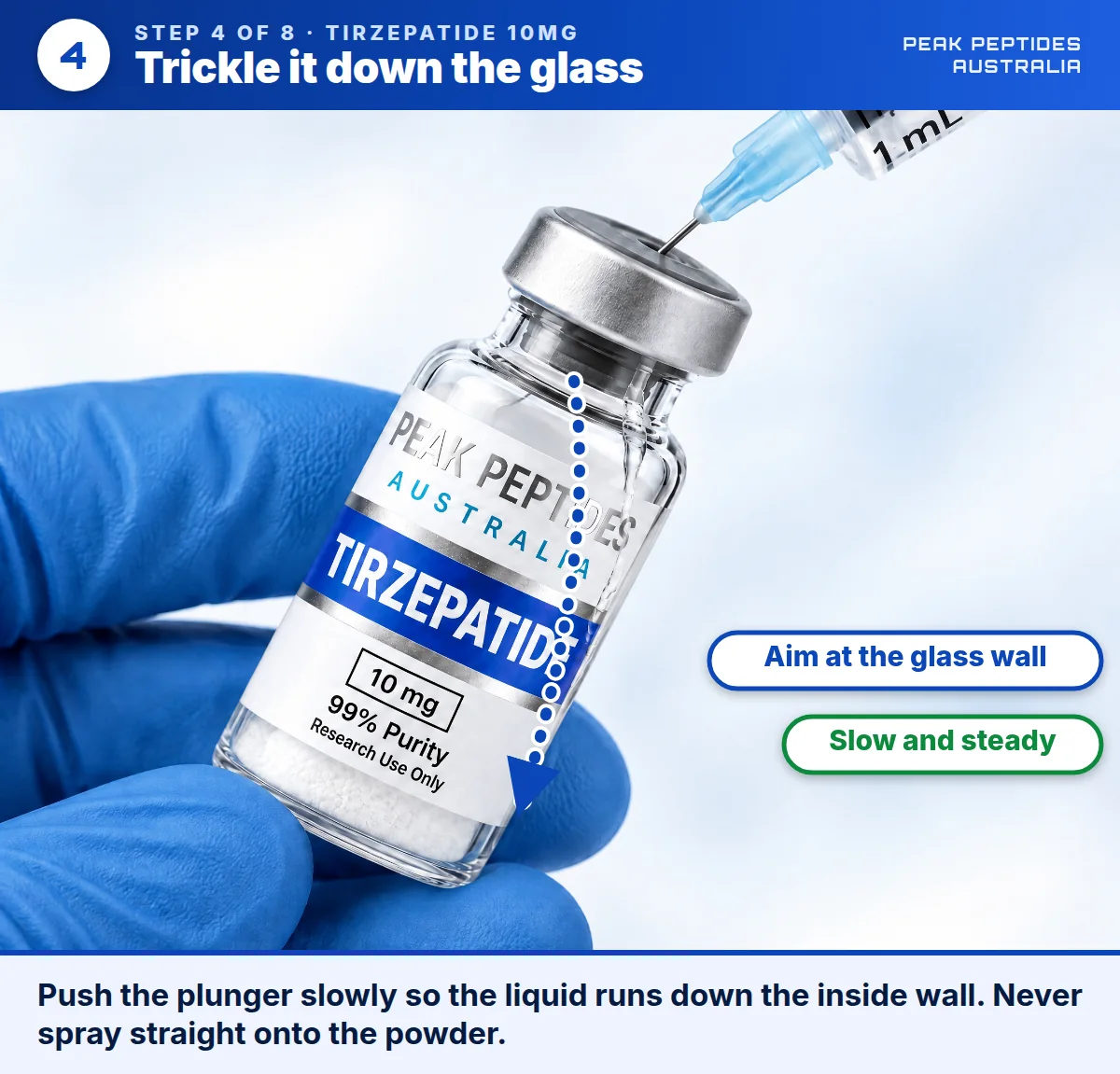
4Step 4: Trickle it down the glass
Place the needle through the Tirzepatide stopper at an angle so the tip is directed at the inner glass wall. Add the measured liquid slowly and let it run down the side rather than striking the powder directly. For the 2 mL chart example, repeat the measured draw and slow wall-running transfer a second time.
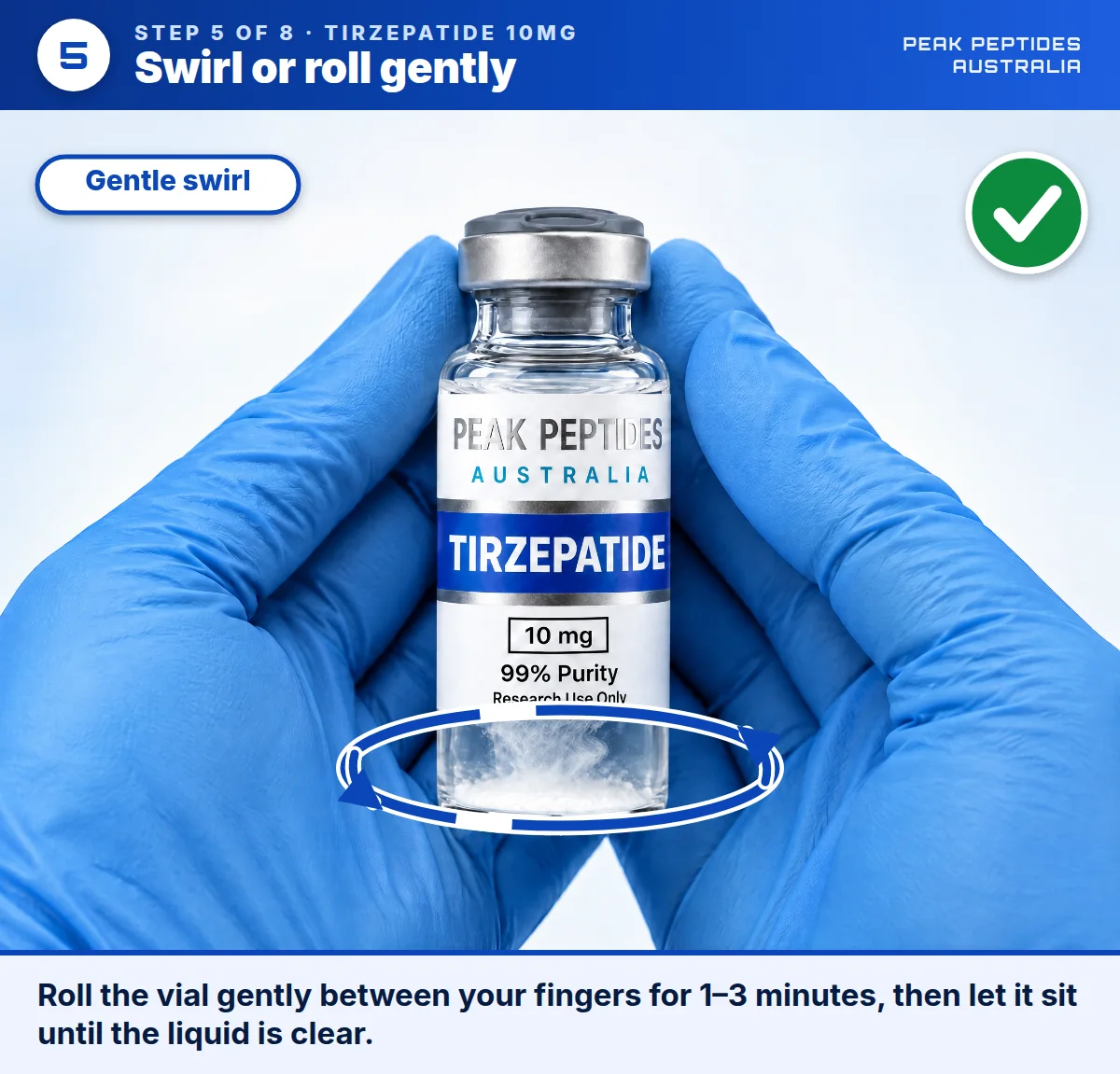
5Step 5: Swirl or roll gently
Roll the vial gently between fingers or swirl it in slow circles. The powder should dissolve gradually without forceful agitation. A small amount of powder can remain at first; allow time for it to hydrate, then continue a gentle swirl until the liquid moves toward a clear, colourless appearance.
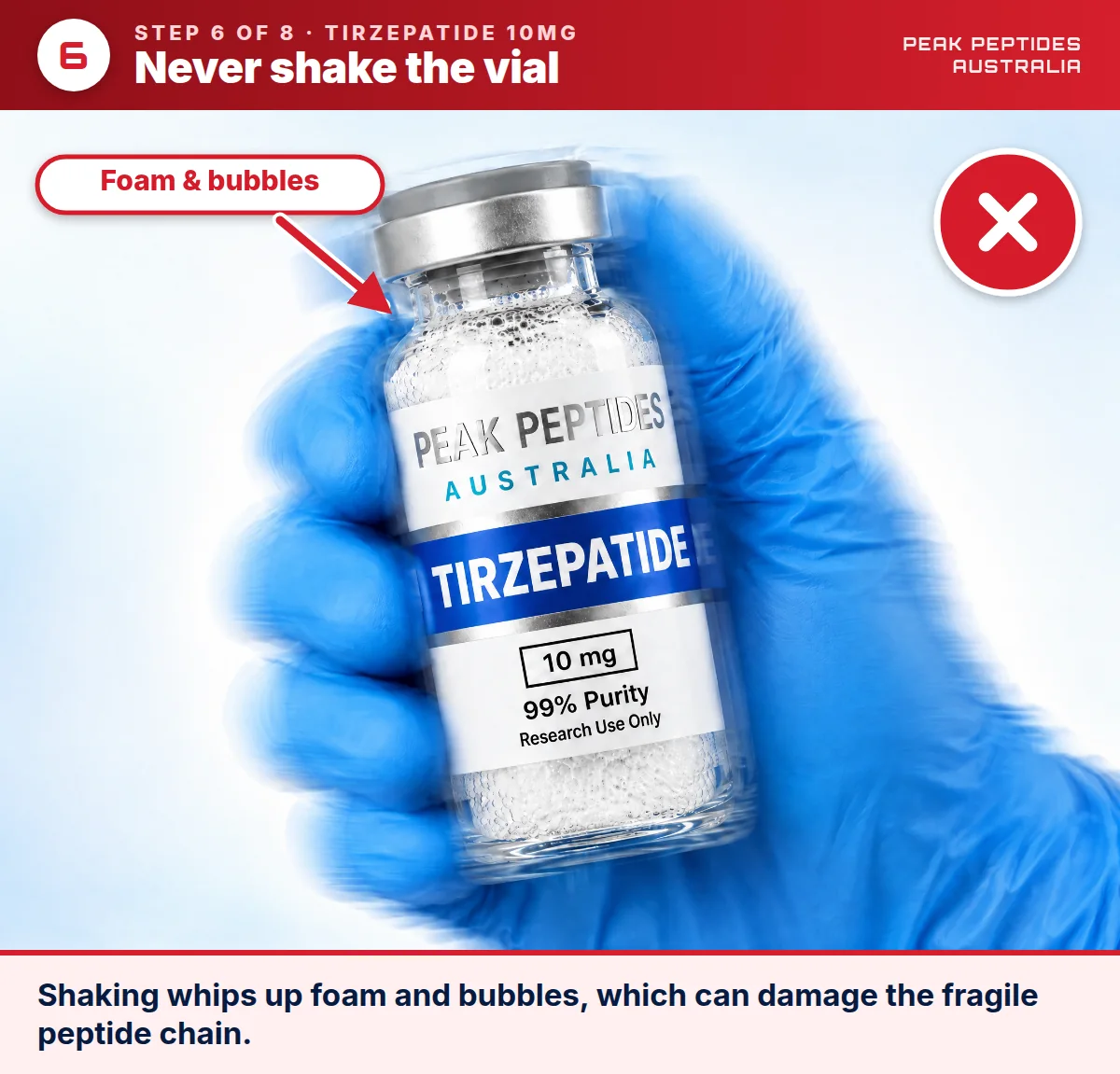
6Step 6: Never shake the vial
Do not shake the vial. Shaking creates foam and bubbles, makes the liquid harder to inspect and adds unnecessary mechanical stress to a peptide preparation. If bubbles appear, stand the vial upright and let the foam settle before checking clarity. Gentle swirling is the handling action shown in this guide.
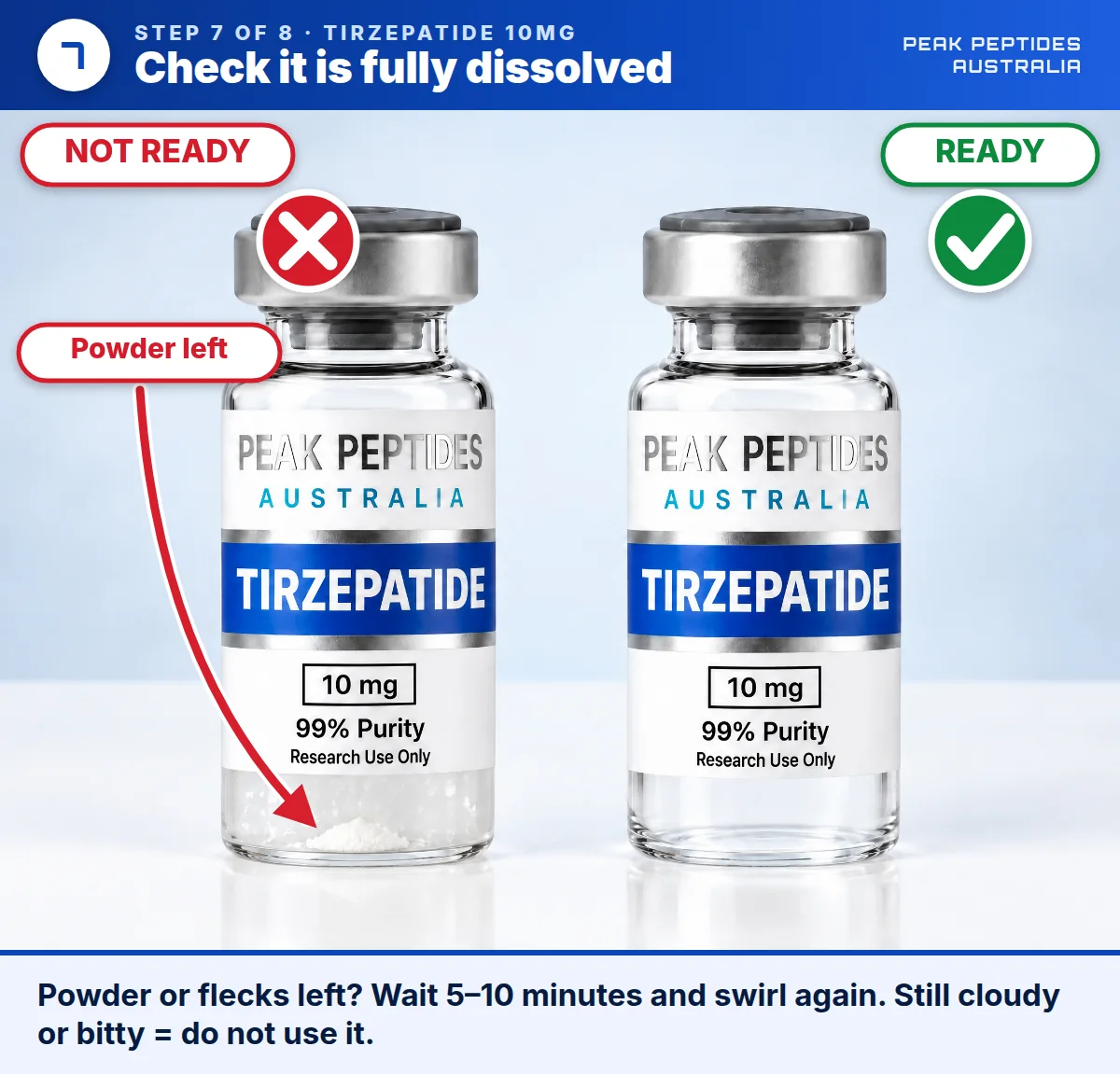
7Step 7: Check it is fully dissolved
Hold the vial against a good light source and inspect it closely. The finished guide example is clear and colourless, without powder, flakes or cloudiness. If powder remains, let the vial stand for 5–10 minutes and swirl gently again. A vial that stays cloudy or visibly particulate does not match the clear ready image.
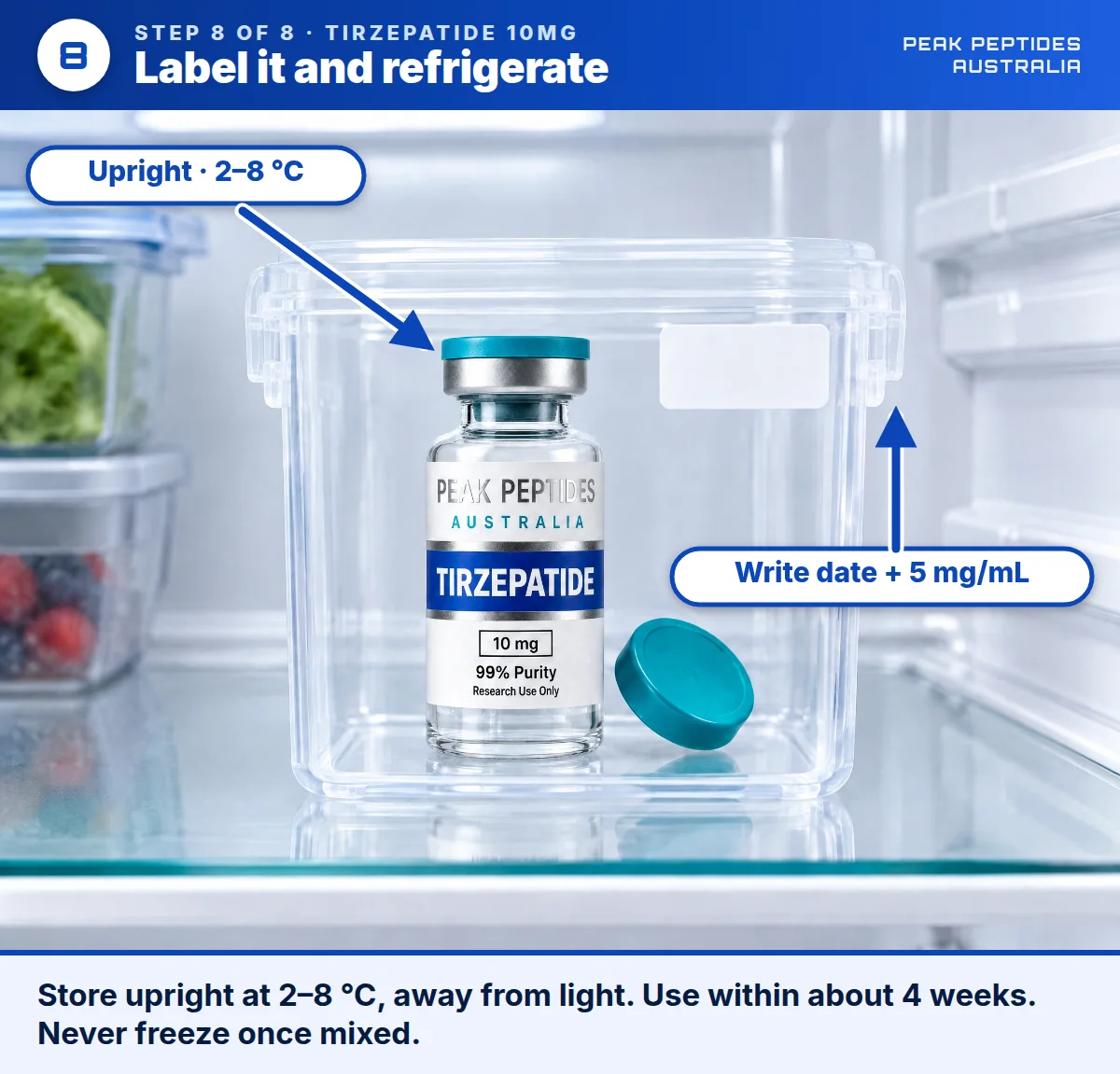
8Step 8: Label it and refrigerate
Write the preparation date and final concentration on the storage label; the 2 mL chart example is 5 mg/mL. Keep the vial upright, protected from light and refrigerated at 2–8 °C. The page uses an about-four-week BAC-water guide convention and says not to freeze a mixed vial; the actual material documentation remains the controlling record.
Tirzepatide 10mg storage guide
Storage distinctions for dry research material, the BAC-water guide example and regulated branded medicine
Storage distinctions for dry research material, the BAC-water guide example and regulated branded medicine
Material or presentation
Storage point
What this page says
Dry Tirzepatide 10mg research vial
Protect from light; follow actual supplied documentation
Until the printed expiry
Mixed vial in this BAC-water photo guide
Upright, dark, 2–8 °C; do not freeze
About four weeks is the page’s normal BAC-water guide convention.
Regulated Mounjaro® or Zepbound® medicine
Follow its approved product information
A branded liquid medicine is a different formulation and presentation.
Keep these three situations separate. The graphics describe a research-vial BAC-water workflow; they do not replace storage rules printed for a regulated branded Tirzepatide medicine.
Tirzepatide 10mg FAQs — Clear Answers and Measurement Maths
What is Tirzepatide?
Tirzepatide is a lab-made 39-amino-acid peptide that activates the GIP and GLP-1 receptors. It was developed as one dual-receptor molecule, not as a combination of two separate peptides. Mounjaro® and Zepbound® are regulated medicines containing Tirzepatide; this product is a freeze-dried in-vitro research vial.
What does dual GIP/GLP-1 receptor agonist mean?
A dual GIP/GLP-1 receptor agonist is one molecule that activates the receptors for glucose-dependent insulinotropic polypeptide and glucagon-like peptide-1. These are two incretin pathways involved in nutrient-response signalling. Dual describes receptor activity, not a two-peptide blend.
What is Tirzepatide used for in research?
Tirzepatide is studied in incretin signalling, glucose-dependent insulin responses, appetite and food-intake pathways, gastric emptying, body weight and cardiometabolic measures. Human trials of manufactured Tirzepatide medicines measured these outcomes in defined participant groups. This listing is supplied for in-vitro research only.
How does Tirzepatide work?
Tirzepatide activates both GIP and GLP-1 receptors. GLP-1 activity is linked with appetite, food intake, gastric emptying and glucose-dependent insulin release. GIP activity contributes to nutrient-response and insulin signalling. A C20 fatty-diacid side chain enables albumin binding, which slows clearance of the molecule.
What did SURMOUNT-1 find for Tirzepatide?
SURMOUNT-1 followed 2,539 adults with obesity or overweight and without diabetes for 72 weeks. Mean body-weight change was −15.0% in the 5 mg group, −19.5% in the 10 mg group and −20.9% in the 15 mg group, compared with −3.1% with placebo. The trial used a manufactured clinical medicine.
What happened in the 10 mg group in SURMOUNT-1?
In SURMOUNT-1, the 10 mg Tirzepatide group had a mean body-weight change of −19.5% at week 72, while the placebo group changed by −3.1%. Fifty percent of people in the 10 mg group reached at least 20% body-weight reduction. These are group averages from the trial, not a promise for an individual.
What did SURMOUNT-2 find in people with type 2 diabetes?
SURMOUNT-2 studied adults with obesity or overweight and type 2 diabetes for 72 weeks. Mean body-weight change was −12.8% in the 10 mg group, −14.7% in the 15 mg group and −3.2% with placebo. Nausea, diarrhoea and vomiting were among the frequent gastrointestinal events reported in the study.
What did SURMOUNT-4 find after treatment was withdrawn?
SURMOUNT-4 had a 36-week open-label lead-in before a 52-week randomised withdrawal period. From randomisation to week 88, the group continuing Tirzepatide changed by −5.5%, while the group switched to placebo changed by +14.0%. The result describes the regulated trial medicine and trial setting.
What side effects were reported in Tirzepatide trials?
The most common effects in SURMOUNT trials were gastrointestinal: nausea, diarrhoea, constipation, vomiting and stomach discomfort. In SURMOUNT-1, most gastrointestinal events were mild to moderate and occurred mainly during escalation. Regulated product information also lists warnings and contraindications that belong to the branded medicines.
What is the half-life of Tirzepatide?
The current US prescribing information gives Tirzepatide an elimination half-life of about 5–6 days in people with overweight or obesity and in people with obstructive sleep apnoea and obesity. Its C20 fatty-diacid side chain supports albumin binding, which prolongs the molecule’s time in circulation.
Is Tirzepatide the same as Semaglutide?
No. Semaglutide activates GLP-1 only, while Tirzepatide activates both GIP and GLP-1. In the direct SURMOUNT-5 trial, average body-weight change at 72 weeks was −20.2% with Tirzepatide and −13.7% with Semaglutide. They are different molecules, so their milligrams don’t compare one-for-one.
Is Tirzepatide better than Semaglutide?
In SURMOUNT-5, a direct 72-week comparison in adults with obesity and without type 2 diabetes, Tirzepatide produced a larger average body-weight change than Semaglutide: −20.2% versus −13.7%. That trial result is specific to its two regulated treatments, study population and methods; it does not make research-vial quantities equivalent.
How is Tirzepatide different from Retatrutide?
Tirzepatide activates GIP and GLP-1 receptors. Retatrutide activates GIP, GLP-1 and glucagon receptors, so it is a different triple-receptor molecule. Retatrutide’s glucagon activity is not part of Tirzepatide. Their trial programmes, molecular structures and measurement relationships are different.
Is Tirzepatide approved by the FDA or TGA?
Yes, Tirzepatide is an approved medicine in branded forms. In the United States, Mounjaro® is approved for type 2 diabetes and Zepbound® is approved for chronic weight management. In Australia, the TGA states Mounjaro® is approved for both type 2 diabetes and chronic weight management. This research vial is not a branded regulated medicine.
Can I buy Tirzepatide 10mg online in Australia?
Tirzepatide 10mg is listed by Peak Peptides Australia as an in-vitro research product. Same-day dispatch from Victoria for in-stock orders once payment is confirmed, tracked Australia Post Express, tracking number emailed. The product is supplied for in-vitro research only and is not presented as a regulated prescription medicine.
How fast is Tirzepatide shipping in Australia?
Same-day dispatch from Victoria for in-stock orders once payment is confirmed, tracked Australia Post Express, tracking number emailed. Delivery timing after dispatch depends on the Australia Post route and destination. This page does not make a delivery-time guarantee.
How do I know a Tirzepatide vial is real?
Look for an independent report that identifies the tested material, report number, laboratory method, test date and numerical results. For this product, LabDoc LD-2SJ6 records LC-MS identity confirmation, 99.08% HPLC purity and 10.02mg measured content. Verify the report through the official LabDoc batch link.
How is this Tirzepatide 10mg sample verified?
LabDoc report LD-2SJ6 was tested on 06 August 2026. It records identity confirmed by LC-MS, purity of 99.08% by HPLC, 10.02mg measured content against a 10mg claim, 0.92% related impurities and a Pass assessment. The product also has a separate public Janoshik history: task #135349.
What does the Janoshik #135349 report show?
The Peak Peptides Australia Quality page lists Tirzepatide Janoshik task #135349 dated 01 June 2026. It reports 11.49mg and 99.724% purity. It is a historical public test record, not the same submitted sample as the current LabDoc LD-2SJ6 report, which has its own date and results.
How much BAC water is used for Tirzepatide 10mg measurement maths?
The page shows three final-volume options. One mL gives 10 mg/mL, 2 mL gives 5 mg/mL, and 3 mL gives 3.33 mg/mL. The 2 mL option gives easy arithmetic: one U-100 unit represents 0.05 mg (50 mcg), while 20 units represent 1 mg.
How many units represent 1 mg with a Tirzepatide 10mg vial?
The answer depends on final volume. With 1 mL total volume, 1 mg represents 10 units. With 2 mL total volume, 1 mg represents 20 units. With 3 mL total volume, 1 mg represents 30 units.
How many mg are in 10 units with the 2 mL mix?
With a 2 mL final volume, the strength is 5 mg/mL. A U-100 syringe unit is 0.01 mL, so 10 units equal 0.1 mL and represent 0.5 mg. In the same mix, 5 units represent 0.25 mg and 20 units represent 1 mg.
How do I reconstitute Tirzepatide 10mg for the photo guide?
The page’s visual guide shows a clean workspace, alcohol-swabbed stoppers, BAC water drawn into a U-100 syringe, liquid allowed to run down the vial wall, gentle swirling, no shaking, a clear-solution check and refrigerated storage. The guide is a handling visual for in-vitro research material and measurement preparation.
Can sterile water or tap water replace BAC water?
Tap water, distilled water and saline are not substitutes in this guide. BAC water is the documented diluent used for the page’s multi-use measurement example because it contains 0.9% benzyl alcohol. Plain sterile water does not have that preservative, so it does not support the same guide convention.
What if the powder does not dissolve?
Let the vial stand for 5–10 minutes, then swirl or roll it gently again. Do not shake it, because shaking creates foam and unnecessary agitation. The solution should be clear and free of visible powder or particles before it is placed into the page’s labelled storage workflow.
Should reconstituted Tirzepatide look cloudy?
No. In the photo guide, a fully dissolved Tirzepatide solution is clear and colourless. Cloudiness, remaining powder, visible flecks or particles indicate that the guide’s fully dissolved visual state has not been reached. The side-by-side image shows the difference between powder remaining and a clear result.
How long does reconstituted Tirzepatide last?
The BAC-water photo guide uses an about-four-week (28 days) refrigerated handling period for a normal peptide vial, upright at 2–8 °C and protected from light. Once mixed, never freeze it; write the date and strength on the vial.
How should dry Tirzepatide powder be stored?
Keep the dry research vial protected from light and follow the storage documentation supplied for the actual material. The regulated branded liquid medicine has its own labelled storage rules and is a different presentation. The guide separates dry-vial handling from the refrigerated mixed-vial visual convention.
Can reconstituted Tirzepatide be frozen?
No. Do not freeze a mixed Tirzepatide vial. Freezing and thawing damages the dissolved peptide. Keep the mixed vial upright in the fridge at 2–8 °C, away from light, and use it within about 4 weeks (28 days).
What does a Tirzepatide COA or lab report show?
A useful report separates identity, purity and content. LC-MS identity confirmation checks the molecule’s mass pattern; HPLC purity measures the percentage assigned to the main compound; content testing measures material quantity. For this vial, LabDoc LD-2SJ6 reports all three: confirmed identity, 99.08% purity and 10.02mg content.