An accessory, not a peptide
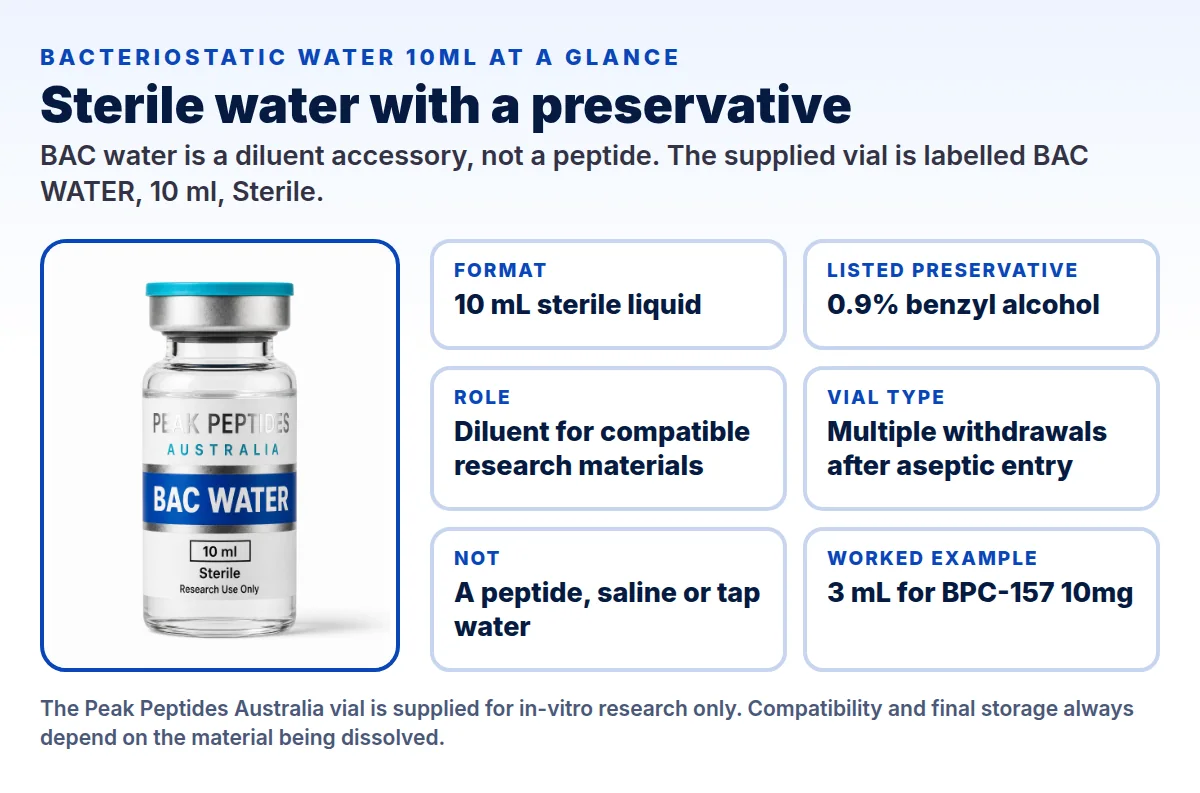
Bacteriostatic Water 10mL is a diluent accessory. It has no amino-acid sequence, receptor target or peptide mass. Its job is to provide sterile liquid for a compatible research material that needs dissolving.
Bacteriostatic Water for Injection
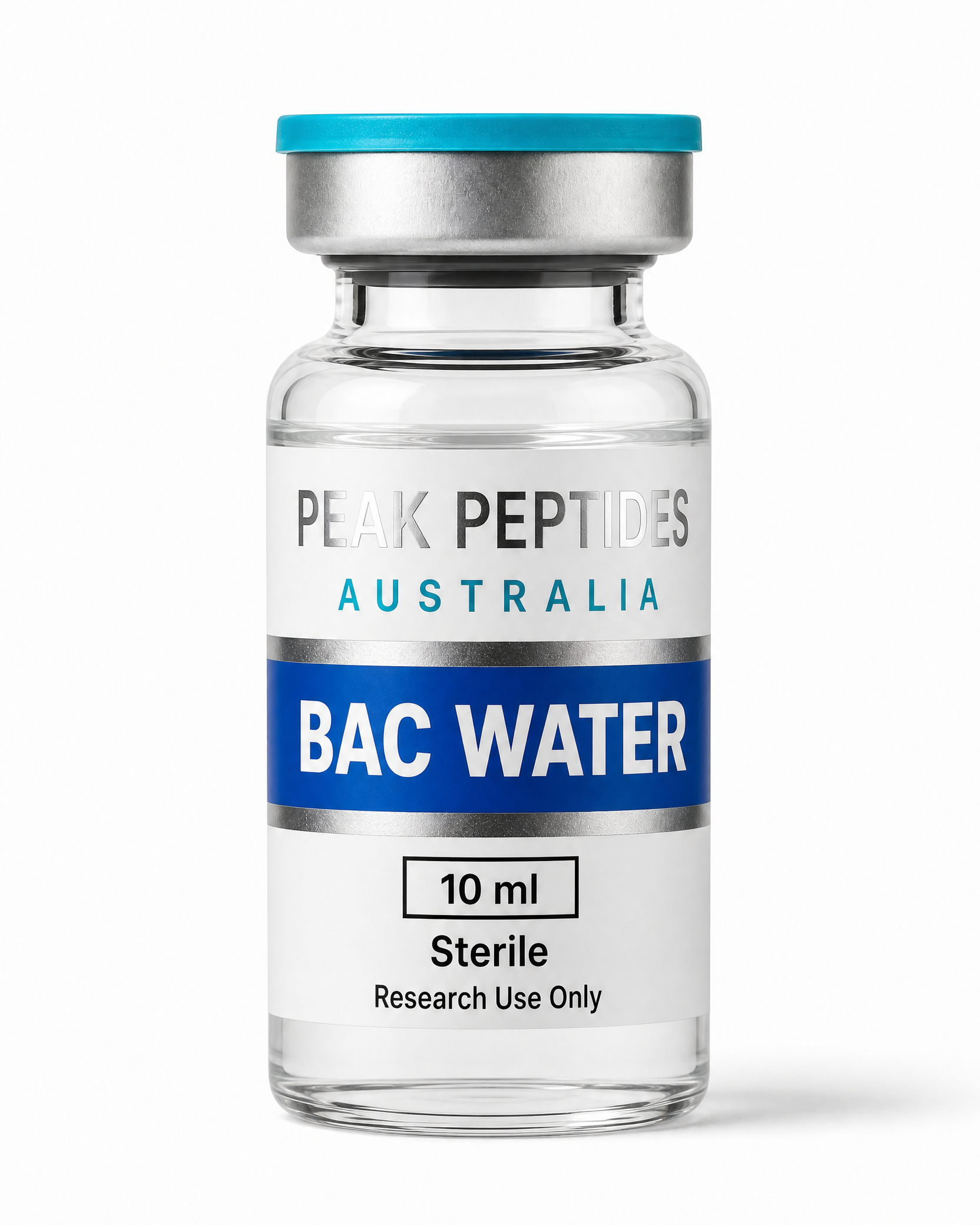
Bacteriostatic Water 10mL, often called BAC water, is a sterile-water accessory with a listed 0.9% benzyl alcohol preservative. It is used as a diluent for compatible research materials, not as a peptide. In-stock orders receive same-day dispatch from Victoria after payment confirmation, with tracked Australia Post Express shipping Australia-wide.
Bacteriostatic Water 10mL research accessory guide
Bacteriostatic Water 10mL, also called BAC water, is a sterile-water accessory rather than a peptide. The Peak Peptides Australia vial is labelled BAC WATER, 10 ml and Sterile; the listing states 0.9% benzyl alcohol. In regulated Bacteriostatic Water for Injection products, benzyl alcohol is added as a bacteriostatic preservative, which is why the vial format can support repeated withdrawals when it is handled aseptically. BAC water provides liquid for a compatible freeze-dried research vial; it does not add peptide, change the amount of material in that vial, or prove compatibility. This guide explains exactly what BAC water is, why it differs from plain sterile water, saline and tap water, how much of a 10 mL bottle is used in common mixing maths, and a photo-led BPC-157 10mg example. Peak Peptides Australia supplies this accessory for in-vitro research only.
Also referred to in research or catalogue references as Bacteriostatic Water, Bacteriostatic Water for Injection, BAC water, BAC Water, BAC water 10mL, BAC water 10 ml, bacteriostatic water 10mL, bacteriostatic water 10ml, bacteriostatic water for injection 10mL.
Bacteriostatic Water 10mL is a diluent accessory. It has no amino-acid sequence, receptor target or peptide mass. Its job is to provide sterile liquid for a compatible research material that needs dissolving.
The listing states 0.9% benzyl alcohol. A current regulated Bacteriostatic Water for Injection label describes 0.9% as 9 mg of benzyl alcohol per mL, added as a bacteriostatic preservative.
Bacteriostatic water is designed as a multiple-dose vehicle. Benzyl alcohol helps limit bacterial growth after entry, but it does not replace clean preparation, a fresh syringe, an alcohol-swabbed stopper or a clear, intact vial.
How many vials one bottle mixes depends on the chosen volume. In the BPC-157 10mg worked example, 3 mL per vial allows three full mixes from 10 mL, leaving 1 mL. At 2 mL, it covers five full mixes; at 4 mL, two full mixes with 2 mL left.
The charts and eight photo steps use BPC-157 10mg solely to show mixing maths and technique. The cited PeptideDosages BPC-157 page uses 3 mL and produces 3.33 mg/mL, or about 33.33 mcg per U-100 syringe unit.
No product-specific LabDoc report is published for this BAC water listing. A LabDoc report for a peptide identifies that separate peptide sample. Available supplier quality information is on the Quality page.
Date the vial when first entered. CDC multi-dose-vial guidance says to discard an opened vial within 28 days unless its manufacturer states another opened-vial date, and never use a vial if sterility is questionable.
Bacteriostatic Water 10mL is a sterile liquid accessory for diluting or dissolving a compatible research material. It is not a peptide and it does not contain a peptide sequence. The Peak Peptides Australia vial is visibly labelled BAC WATER, 10 ml and Sterile. The product listing states a 0.9% benzyl alcohol preservative.
The word bacteriostatic describes the preservative function. The FDA-submitted Bacteriostatic Water for Injection label from Hospira describes sterile, nonpyrogenic water containing 0.9% benzyl alcohol, or 9 mg/mL, and supplied in a multiple-dose container from which repeated withdrawals can be made. That regulated label gives a useful definition of the category; it does not replace this listing’s packaging information.
In practical research terms, BAC water is the measured liquid placed into a compatible freeze-dried vial. The amount of dry material stays fixed. Choosing a larger liquid volume makes the resulting solution less concentrated; choosing a smaller one makes it more concentrated. The liquid must be compatible with the specific material being prepared.
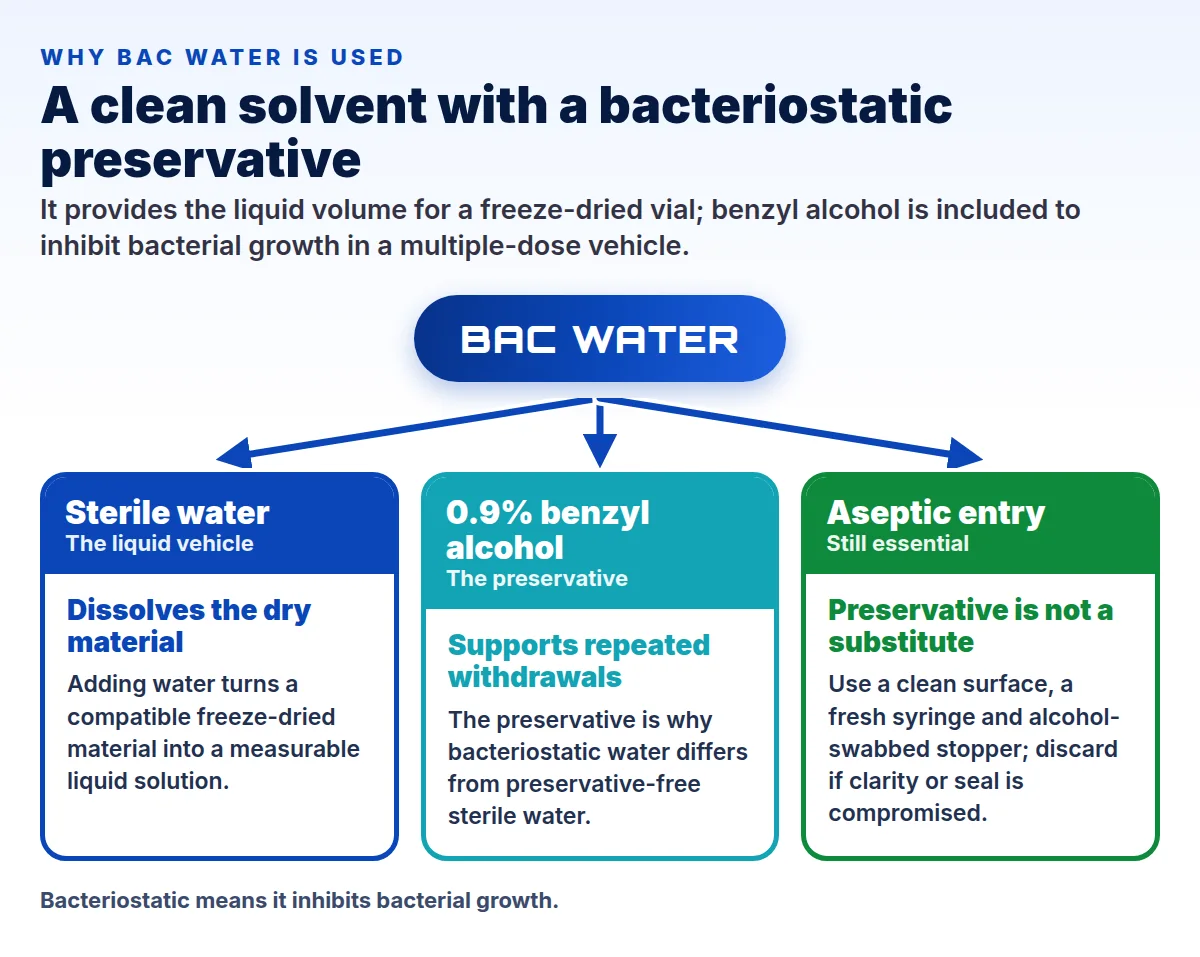
BAC water is used because it is a sterile liquid vehicle with a bacteriostatic preservative. When a compatible freeze-dried material needs to become a solution, the water supplies the volume. The benzyl alcohol distinguishes it from preservative-free sterile water. A multiple-dose format can support repeated entries when every entry is clean and the container remains suitable.
The preservative does not make a vial indestructible or make every research material compatible. The official Bacteriostatic Water label calls for aseptic technique, a clear solution and intact seal. It also says the choice of vehicle, volume and storage of a dissolved material follow the directions for the material itself. Those are separate questions from the identity of the BAC water accessory.
For the worked visual example below, BAC water turns the white BPC-157 10mg freeze-dried cake into a clear solution. The example exists to show volume and concentration maths. It is not a use schedule and it does not state that every peptide should use the same water volume.
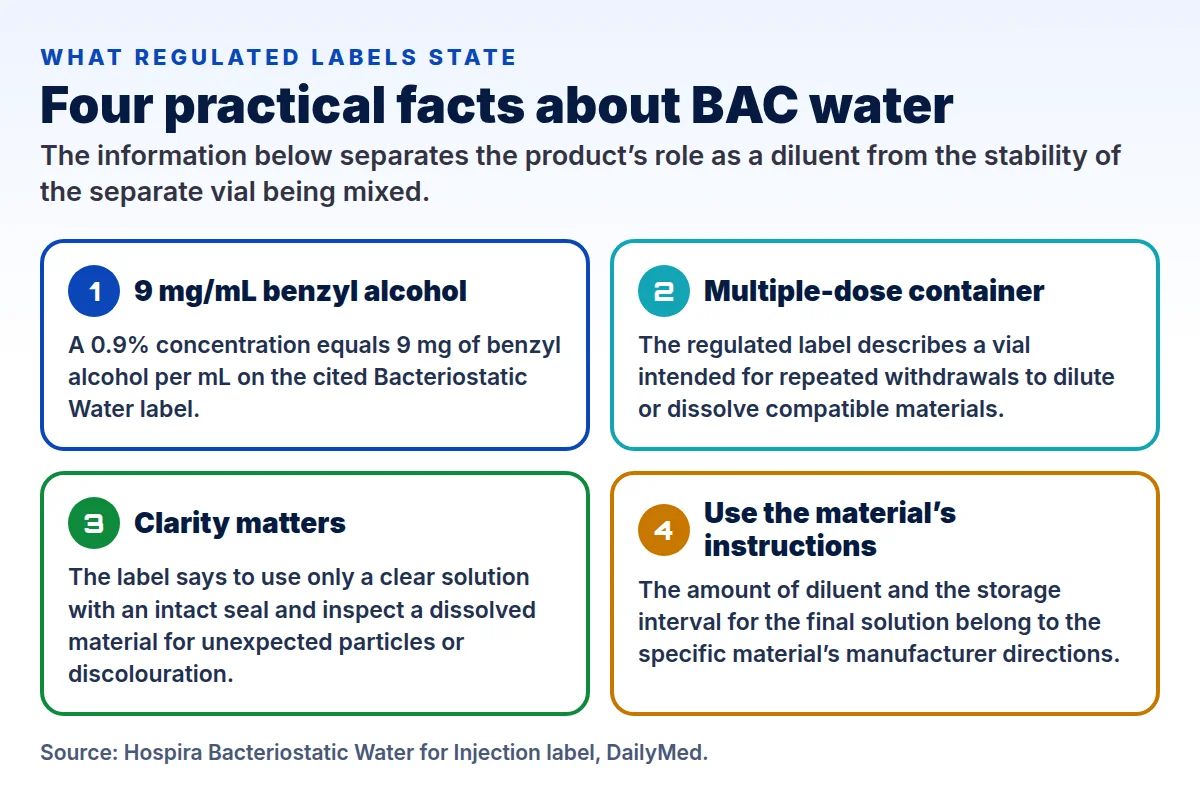
Bacteriostatic Water for Injection labels describe a clear distinction between water and the preservative added to it. On the Hospira DailyMed label, each mL contains water plus 9 mg benzyl alcohol for the 0.9% presentation. The same label describes the product as a multiple-dose container intended to dilute or dissolve materials according to their own manufacturer information.
That distinction matters when reviewing a research setup. BAC water can be named accurately as a solvent or diluent accessory. It cannot be treated as evidence that the separate peptide is authentic, stable or appropriate for a particular experiment. The identity and quality record for a peptide belong to that peptide’s own batch documentation.
No product-specific LabDoc report is published for this Bacteriostatic Water 10mL listing. The Quality page has available supplier documentation. Reports for BPC-157, TB-500 or another material cover those materials.
Bacteriostatic water, preservative-free sterile water, saline and tap water are different liquids with different handling conditions. Use the liquid specified by the individual research material.
Plain Sterile Water for Injection is sterile water without bacteriostat, antimicrobial agent or added buffer on the cited DailyMed label. It is supplied in a single-dose container, and that label says to use it promptly, avoid storing a dissolved material unless directed, and discard the unused portion. The absence of benzyl alcohol is the key difference from BAC water.
Normal 0.9% saline contains sodium chloride. Its cited label lists 900 mg sodium chloride per 100 mL, with no bacteriostat or antimicrobial agent, and identifies it as a single-dose solution. Saline’s dissolved salt changes the vehicle chemistry. Tap water is not sterile pharmaceutical water and is never a replacement for any of these labelled diluents.
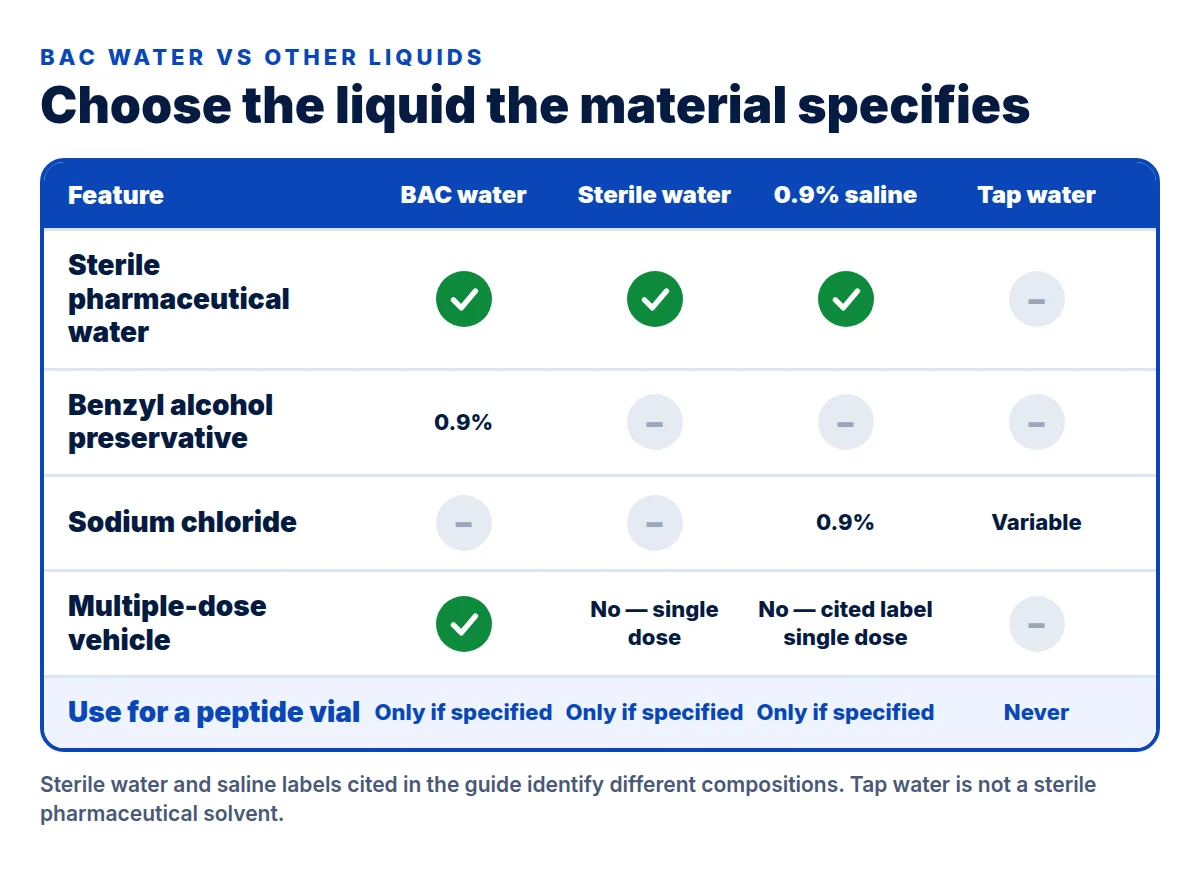
| Liquid | What it contains | Preservative | Container role | Research preparation |
|---|---|---|---|---|
| Bacteriostatic water | Sterile water + listed 0.9% benzyl alcohol | Yes | Multiple-dose vehicle on cited label | Use only if the material specifies it |
| Sterile water | Sterile water only | No | Single-dose on cited label | Use only if the material specifies it |
| 0.9% saline | Sterile water + 0.9% sodium chloride | No | Single-dose on cited label | Use only if the material specifies it |
| Tap water | Variable minerals and microorganisms | No | Not a pharmaceutical solvent | Never use for research-vial preparation |
The first three rows reflect the opened DailyMed labels. Compatibility and final-solution stability belong to the separate material.
Bacteriostatic water is a multiple-dose liquid accessory, so the first entry matters. Write the date directly on the vial or its secondary container when it is first punctured. Keep the stopper protected from contamination, use a new sterile syringe for each entry, and never leave a needle sitting in the stopper between uses.
CDC guidance for a multi-dose vial says to date it when opened and discard it within 28 days unless the manufacturer gives another opened-vial date. The beyond-use date cannot run past the manufacturer’s original expiry. The same CDC guidance explains that an antimicrobial preservative helps limit bacterial growth but does not give complete protection against contamination and has no effect on viruses.
For this specific Peak BAC WATER vial, follow any storage and opened-vial directions printed on the outer packaging because the vial photo itself shows no storage statement. The cited regulated Bacteriostatic Water label stores its unopened product at controlled room temperature. Discard a vial whenever the seal is compromised, the liquid is not clear or contamination is suspected.
| Situation | What to do | Why it matters |
|---|---|---|
| Unopened vial | Follow the storage conditions on the container and outer packaging | The product label sets the specific storage condition and expiry |
| First stopper entry | Write the date opened | Starts the opened-vial interval |
| After opening | Use clean preparation, a fresh sterile syringe and a swabbed stopper | Preservative is not complete contamination protection |
| Opened vial interval | Discard within 28 days unless manufacturer directions state another interval | CDC multiple-dose-vial guidance |
| Cloudiness, particles or broken seal | Discard the vial | Clear liquid and intact seal are baseline label checks |
| Dissolved peptide vial | Follow that peptide’s own final-solution storage information | Peptide stability is separate from BAC water’s opened-vial date |
The 28-day entry is a CDC multi-dose-vial benchmark. A container that specifies a different opened-vial interval takes priority.
Bacteriostatic Water 10mL is a Peak Peptides Australia research accessory for use alongside compatible in-vitro research materials. It is not a peptide and should not be described as evidence of a peptide’s quality. Check the vial label, volume, seal and the separate research material’s own documentation before preparing a solution.
In-stock orders receive same-day dispatch from Victoria once payment is confirmed, tracked Australia Post Express, with the tracking number emailed. This page uses BPC-157 10mg as a clear worked example because the product index contains that separate vial and the preferred PeptideDosages reference gives 3 mL mixing maths. The example does not replace the directions for other vials.
For regulatory context, Bacteriostatic Water for Injection is an FDA-labelled prescription diluent category in the United States. This Peak Peptides Australia accessory is supplied for in-vitro research only. In Australia, the TGA states that the ARTG is the public database for therapeutic goods legally supplied in Australia; this page does not present this research accessory as an ARTG-listed medicine.
Step-by-step guide · About 10 minutes
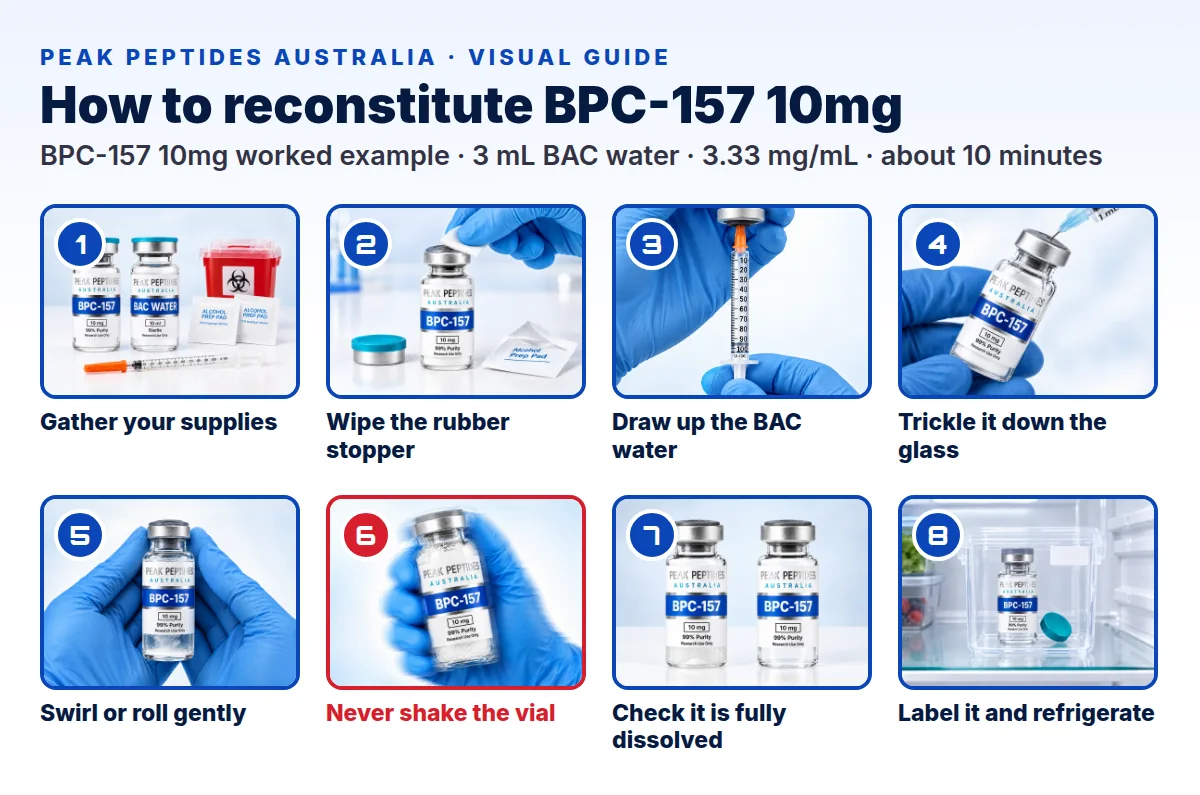
These eight photos use BPC-157 10mg as the worked example and keep the BAC WATER 10 mL vial visible in the supplies image. Reconstitution means adding a measured liquid to a freeze-dried vial until it becomes a clear solution. The cited PeptideDosages example places 3 mL of BAC water into a 10mg BPC-157 vial, giving 3.33 mg/mL. This illustrates concentration maths for in-vitro research. The same clean process applies when a separate material’s instructions name BAC water as the correct vehicle.
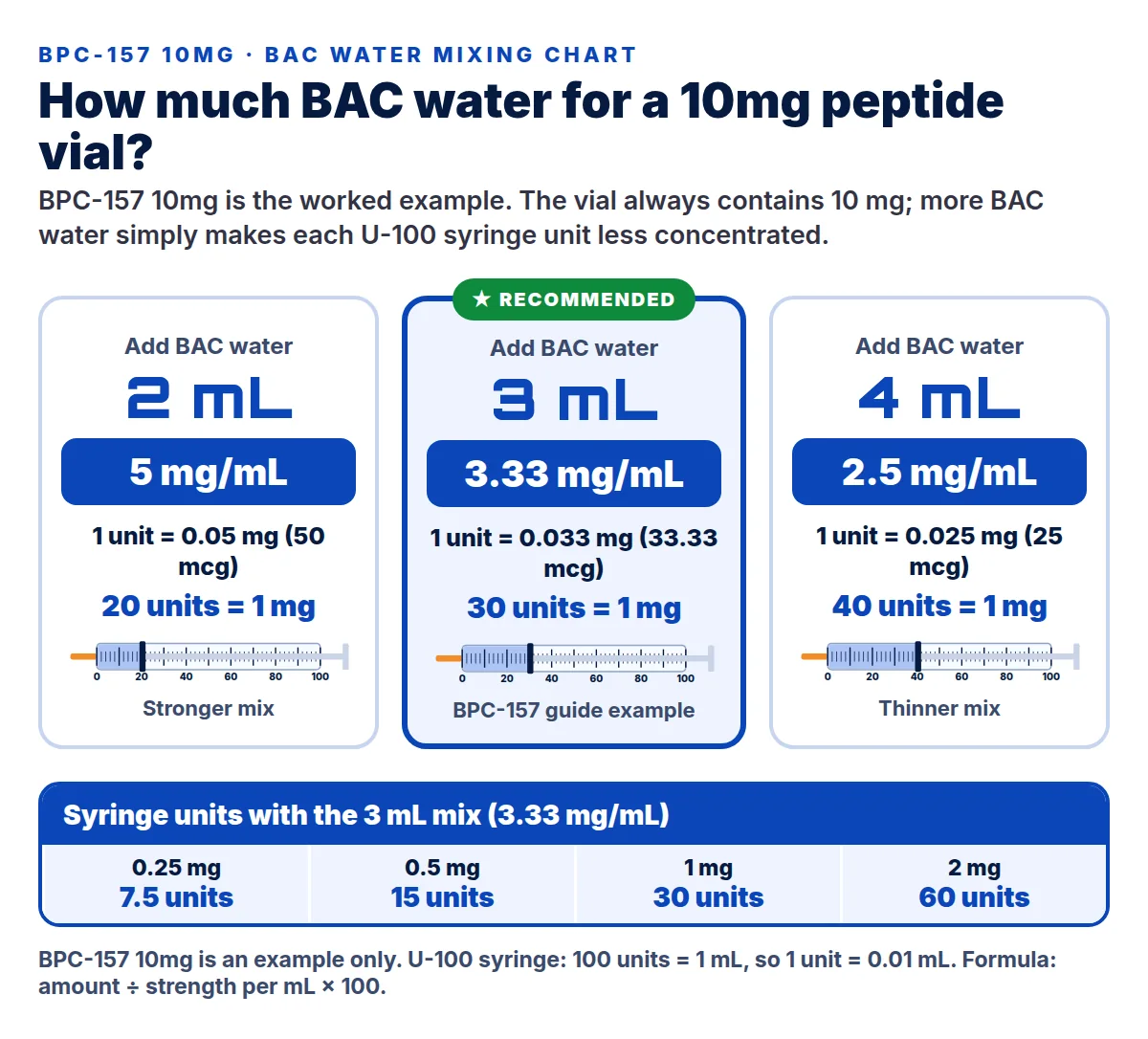
BPC-157 10mg is the worked example for this BAC water chart. The 10mg amount in the vial does not change when the liquid volume changes. With 2 mL, the example is 5 mg/mL and 1 mg equals 20 U-100 units. With 3 mL, it is 3.33 mg/mL and 1 mg equals 30 units. With 4 mL, it is 2.5 mg/mL and 1 mg equals 40 units.
The cited PeptideDosages BPC-157 10mg page uses 3 mL, which is why the chart highlights it. Three mL allows three full BPC-157 example mixes from a 10mL BAC water bottle, leaving 1mL. Other peptide vials can call for another vehicle or another volume, so use the separate vial’s own mixing information rather than copying this example automatically.
A U-100 syringe is a volume scale: 100 units equals 1 mL and one unit equals 0.01 mL. The concentration formula is total amount divided by liquid volume. The unit formula is the amount being measured divided by strength per mL, multiplied by 100.
| BAC water added | Strength | 1 unit holds | Units for 1 mg | Whole vial |
|---|---|---|---|---|
| 2 mL | 5 mg/mL | 0.05 mg (50 mcg) | 20 units | 200 units |
| 3 mL | 3.33 mg/mL | 0.033 mg (33.33 mcg) | 30 units | 300 units |
| 4 mL | 2.5 mg/mL | 0.025 mg (25 mcg) | 40 units | 400 units |
3 mL is highlighted because it gives the simplest numbers.
| Amount | Units on a U-100 syringe | Volume |
|---|---|---|
| 0.25 mg | 7.5 units | 0.075 mL |
| 0.5 mg | 15 units | 0.15 mL |
| 1 mg | 30 units | 0.3 mL |
| 2 mg | 60 units | 0.6 mL |
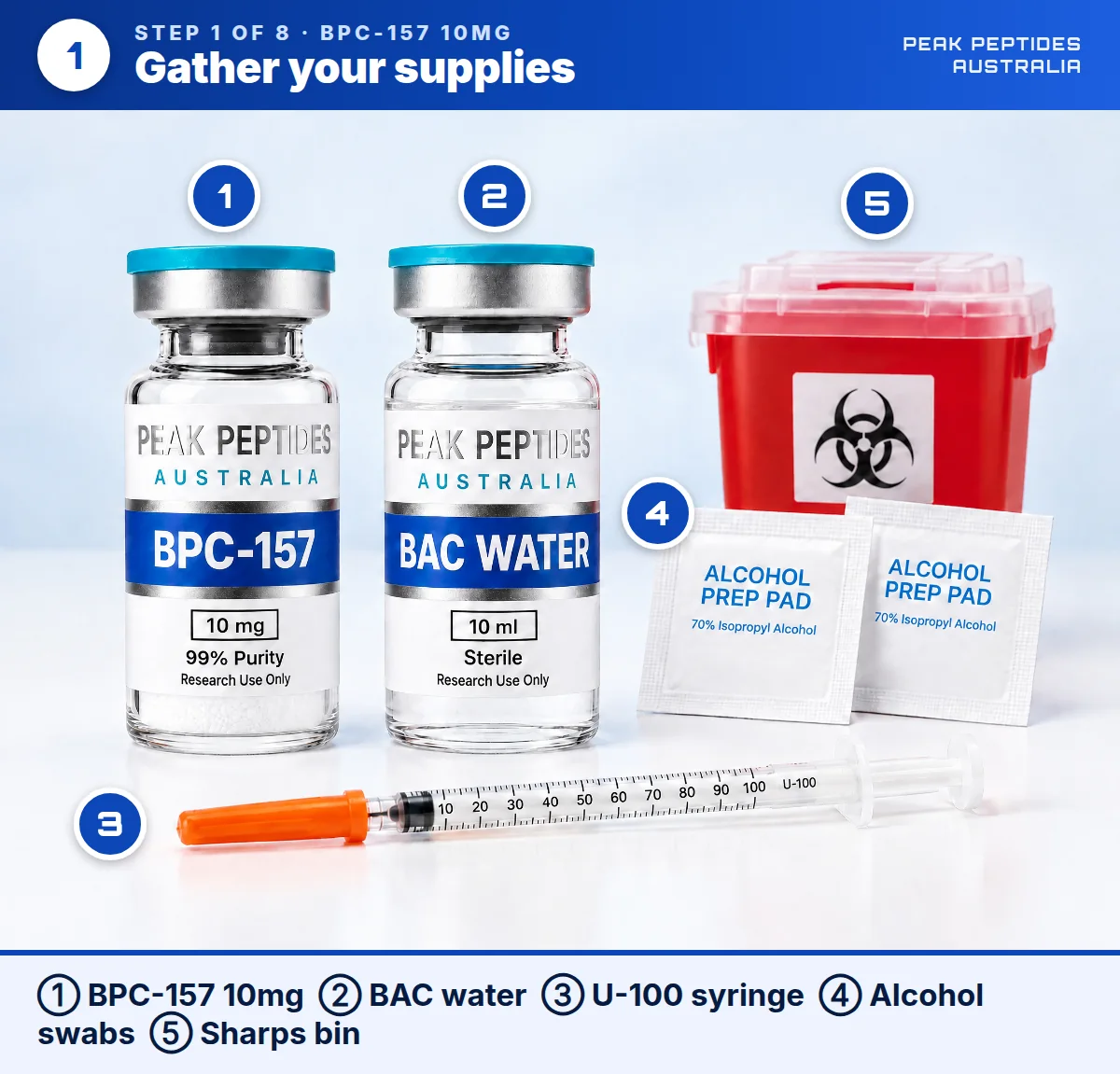
Set out the BPC-157 10mg example vial, the BAC WATER 10mL accessory, a new U-100 syringe, alcohol swabs and a sharps container on a clean preparation surface. Check that each vial is intact and the liquid accessory is clear. This image uses BPC-157 10mg only as the worked example.
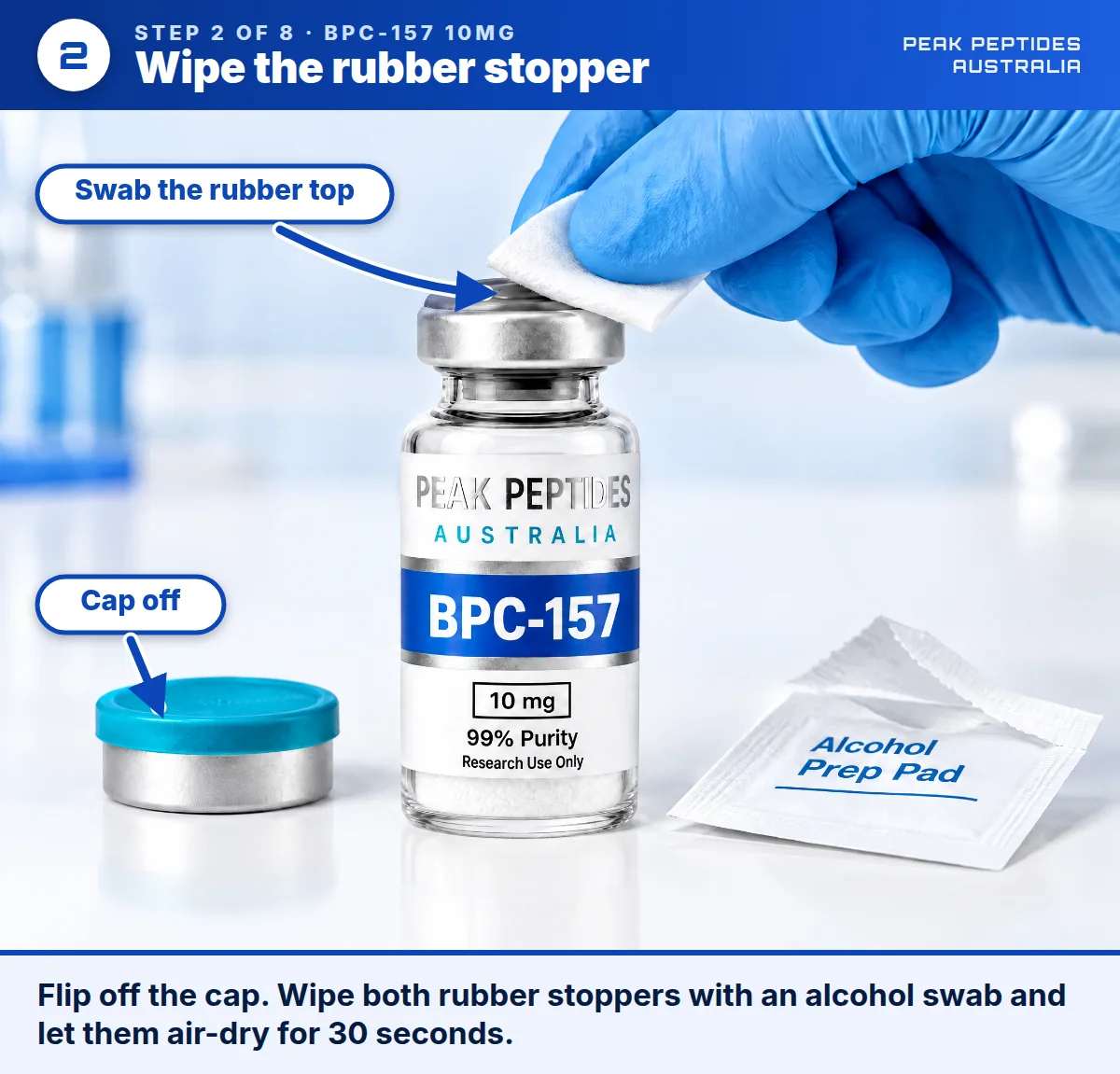
Remove the flip-off cap only when ready to prepare the example vial. Wipe the rubber stopper with a fresh alcohol swab and let it air-dry. Do the same for the BAC water stopper before drawing liquid. Avoid touching either stopper after it has been cleaned.
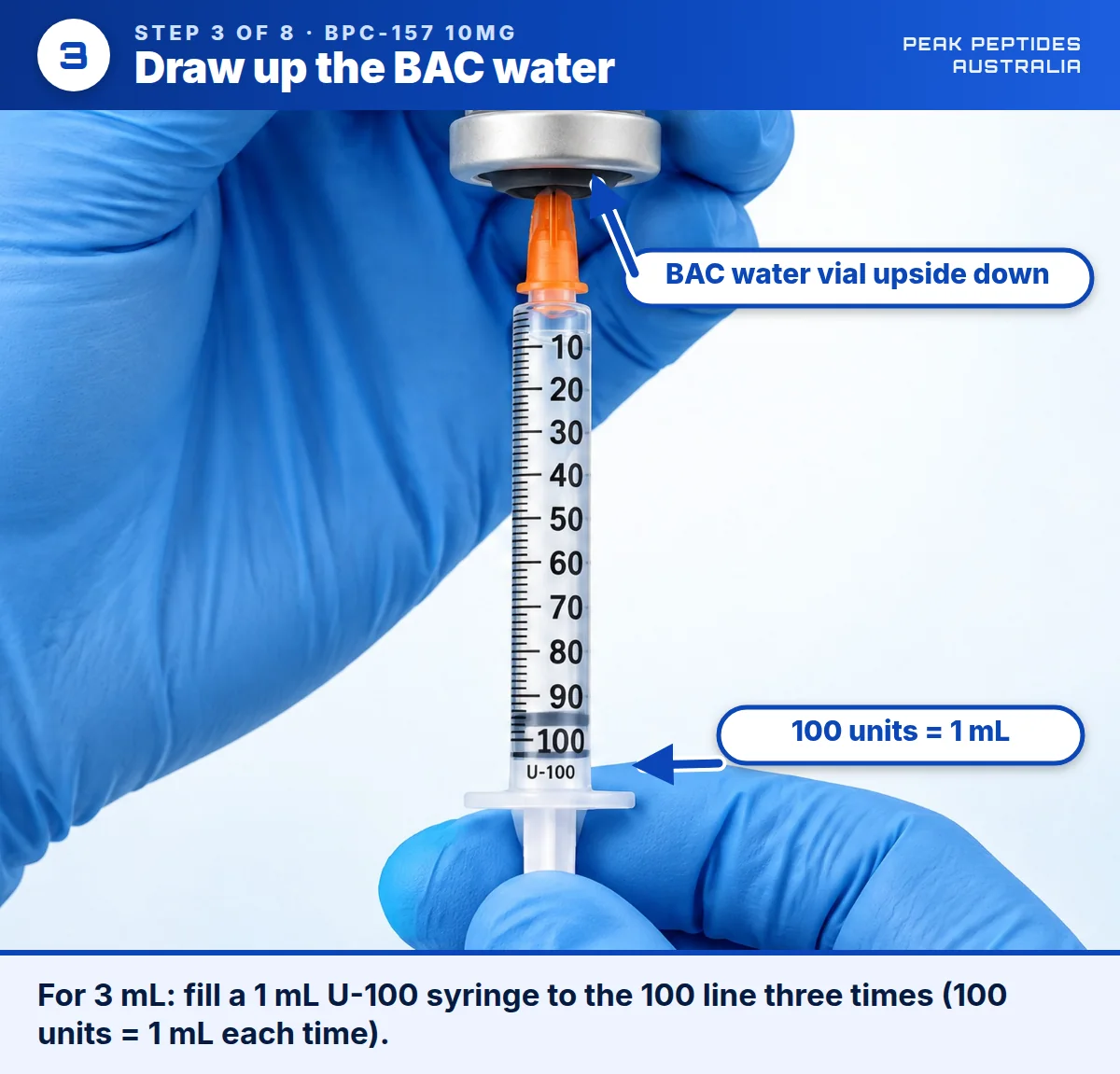
For the 3 mL BPC-157 example, fill a 1mL U-100 syringe to the 100-unit line three times. Keep the BAC water vial inverted while drawing and remove visible air bubbles before transferring the liquid. One hundred units is 1mL, so three full draws total 3mL.
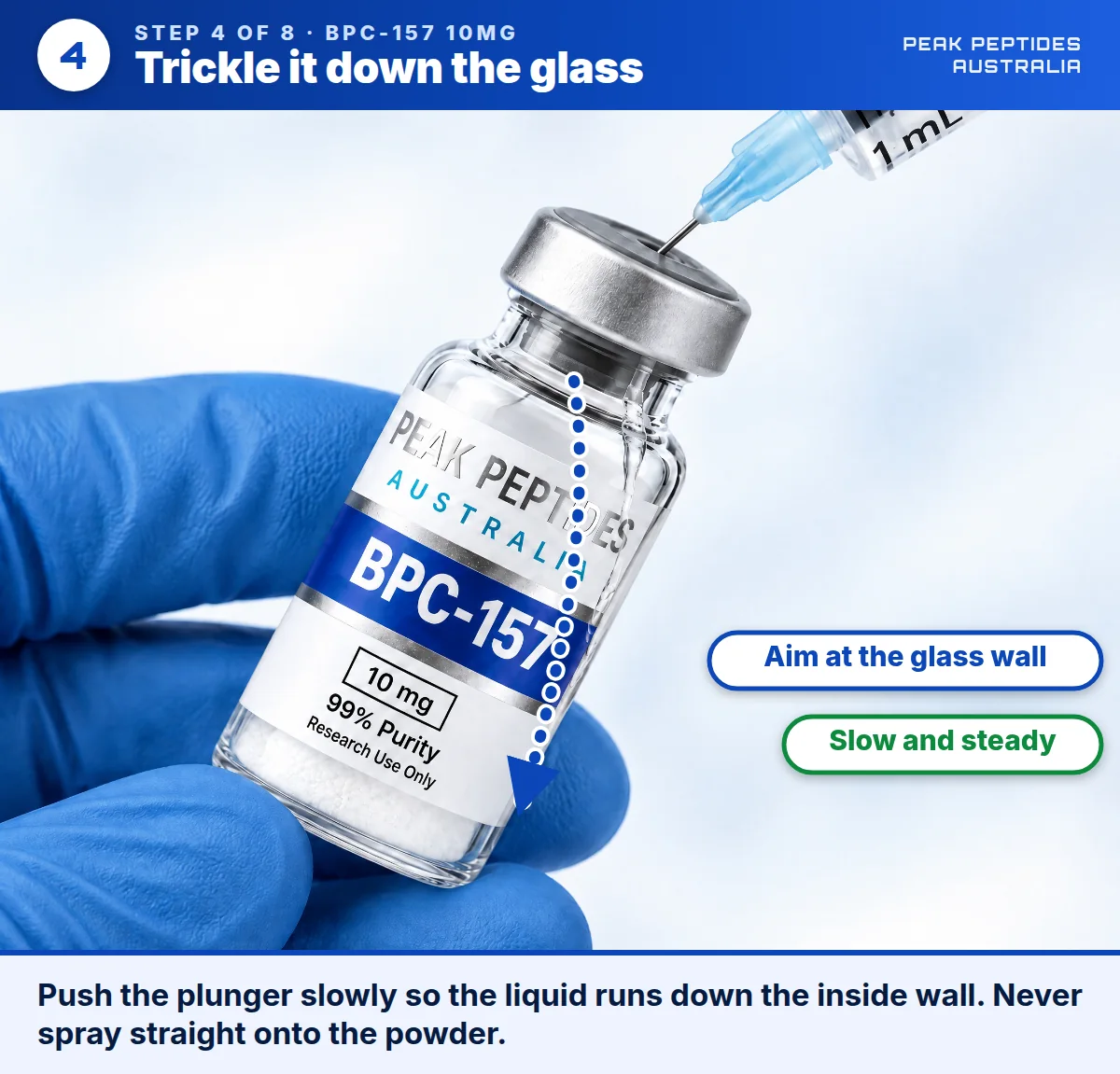
Hold the BPC-157 example vial at an angle and place the needle tip against the inner glass wall. Press slowly so the BAC water runs down the glass rather than striking the freeze-dried material with a direct stream. Repeat until the full 3mL example volume is transferred.
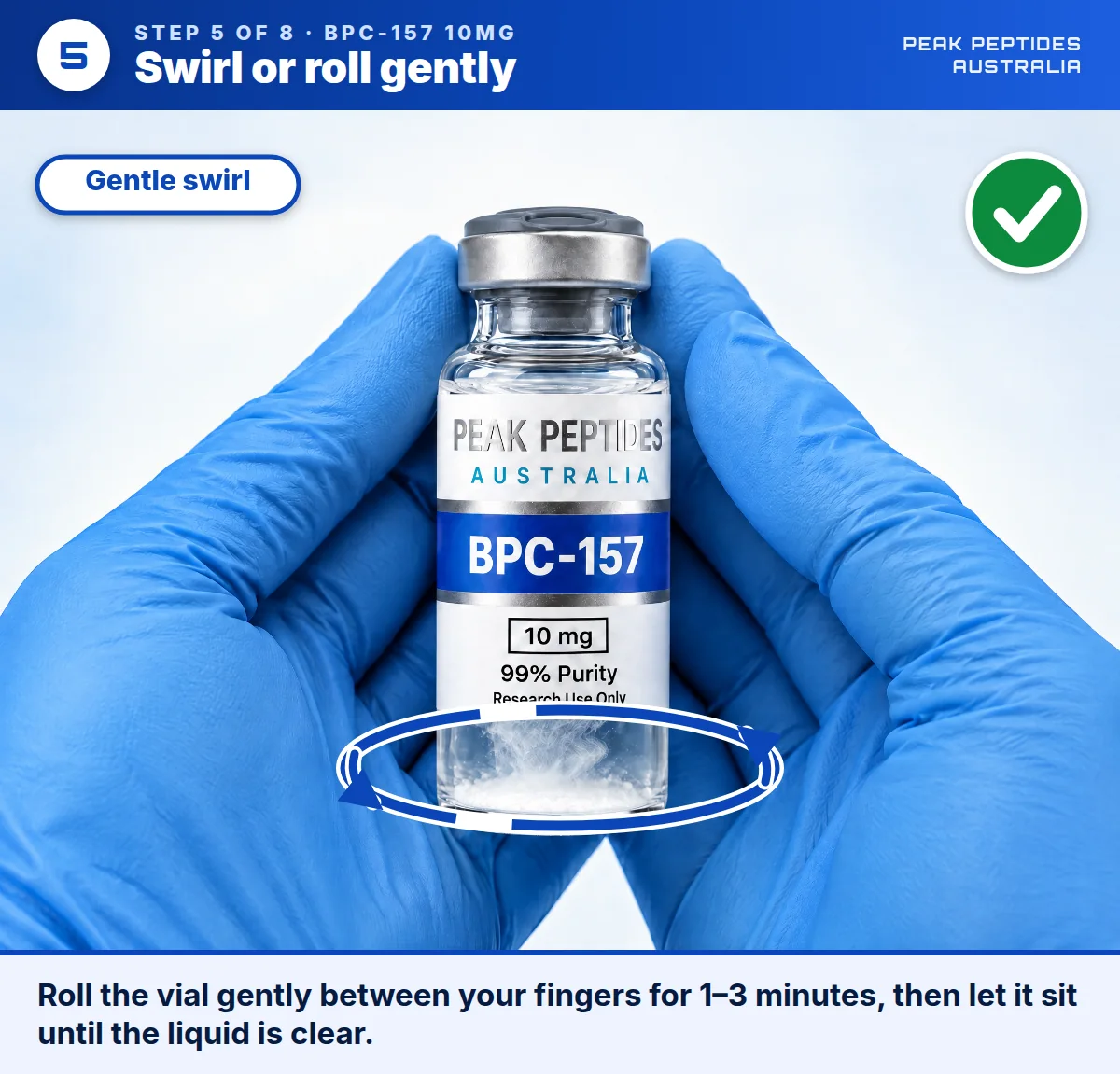
Gently swirl or roll the BPC-157 example vial between your fingers and allow time for the white freeze-dried material to dissolve. The visual shows a small amount still at the bottom, so it is not ready yet. Gentle motion helps avoid unnecessary foam while the liquid clears.
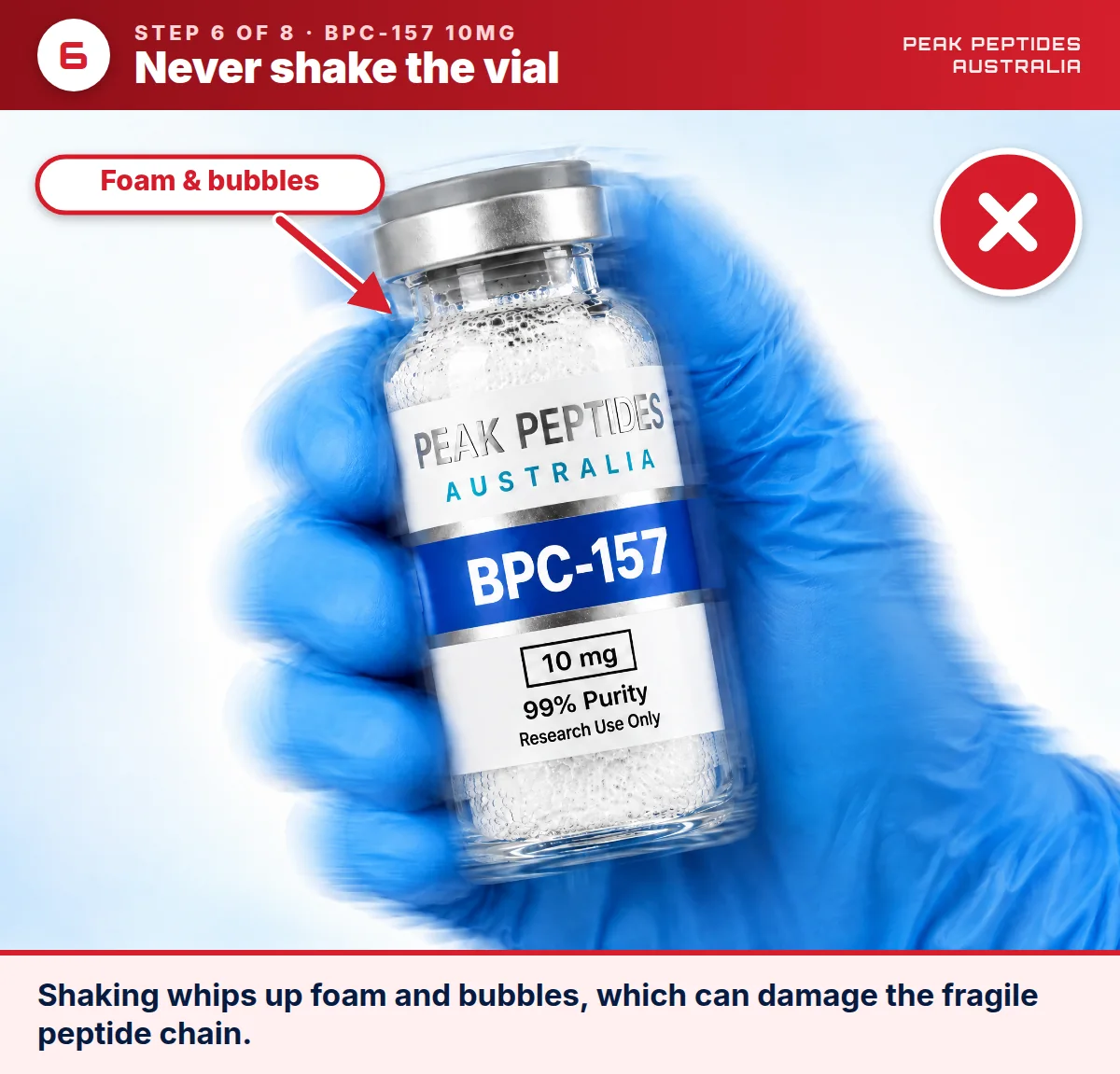
Do not shake the BPC-157 example vial. Shaking can produce foam and bubbles, making it harder to inspect the liquid clearly. If bubbles form, stand the vial upright and allow them to settle before checking whether the dissolved material is fully clear and free of particles.
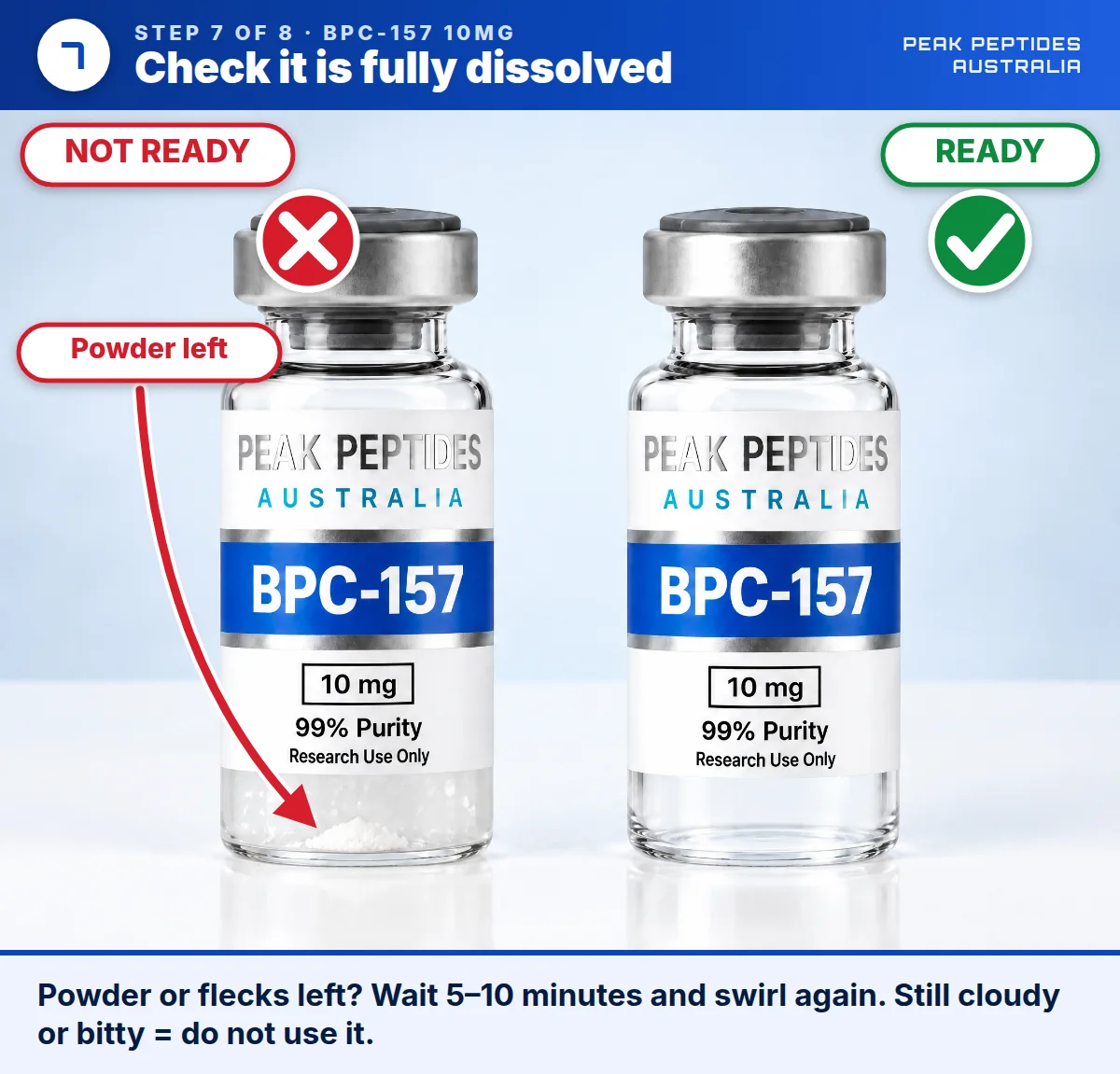
Hold the BPC-157 example vial against good light. A vial with powder left at the bottom is not ready; a fully dissolved soluble material should look clear, without unexpected flecks or cloudiness. Let it stand, then swirl again if material remains. Do not use a persistently cloudy solution.
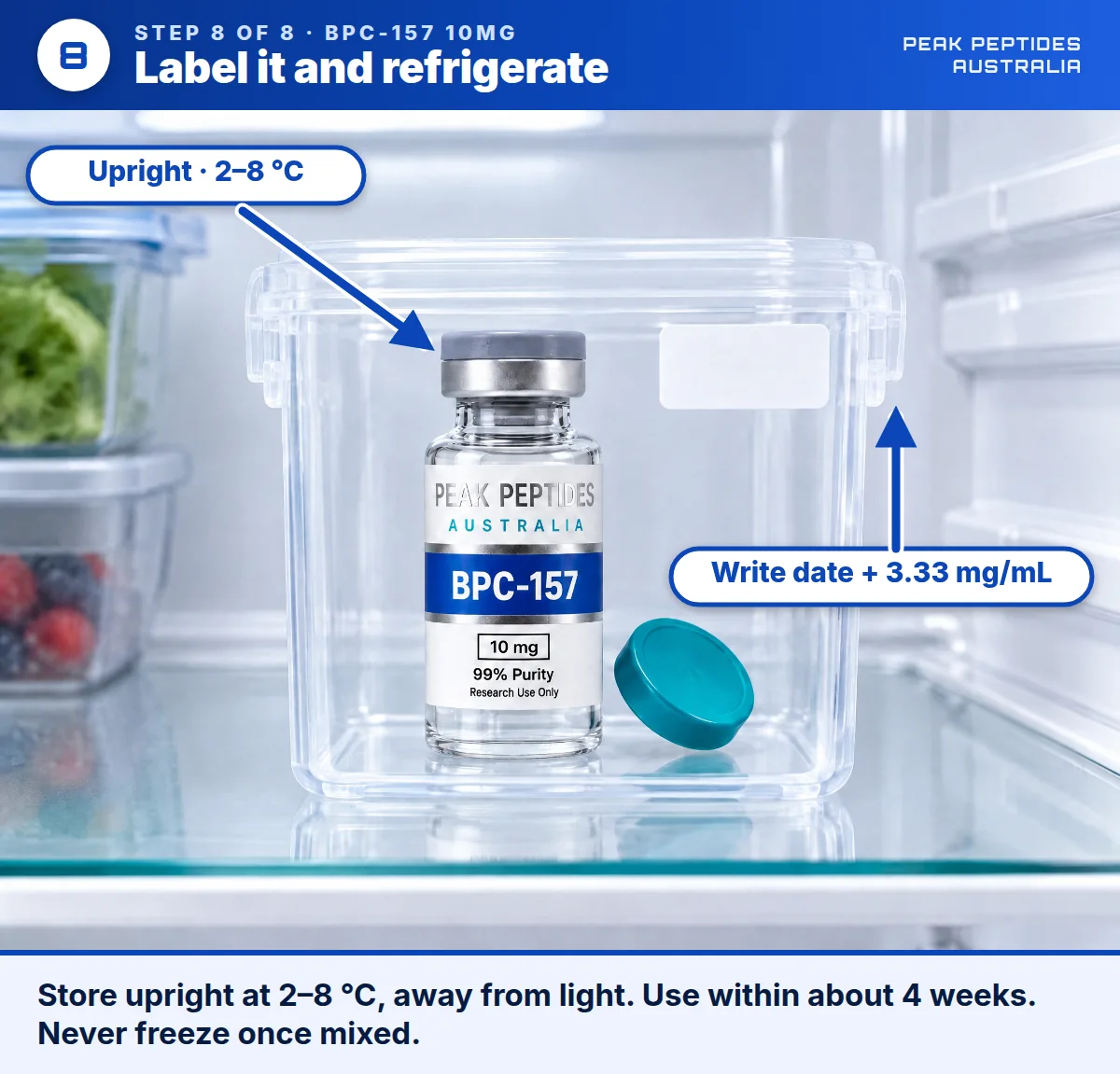
Label the BPC-157 example vial with the preparation date and final strength: 3.33 mg/mL for the 3mL example. Store the final dissolved vial according to the separate peptide’s material information. The BAC water bottle itself follows its own container directions and opened-vial interval.
| Item | Storage and handling | Key time point |
|---|---|---|
| Unopened BAC WATER 10mL | Follow the vial and outer-package storage instructions | Use before the printed expiry |
| BAC water at first entry | Write the date opened; use clean technique and a fresh sterile syringe | Starts the opened-vial interval |
| Opened BAC water | Protect the stopper; discard if clarity, seal or sterility is compromised | CDC: 28 days unless the manufacturer specifies another date |
| BPC-157 10mg worked example | Label 3.33 mg/mL after adding 3mL BAC water; protect according to the separate material information | BPC-157 example only |
| Any other dissolved material | Follow its own vehicle, storage and stability instructions | Not set by BAC water alone |
The BAC water bottle and the final dissolved peptide vial are different items with different labels. Never use the vehicle’s 28-day opened-vial benchmark as a substitute for a peptide’s own stability information.
Bacteriostatic Water 10mL is a sterile liquid accessory used as a diluent for compatible research materials. It is not a peptide. This listing states water with 0.9% benzyl alcohol, and the vial label reads BAC WATER, 10 ml and Sterile.
BAC water is the common short name for bacteriostatic water. Bacteriostatic means the liquid contains a preservative intended to inhibit bacterial growth. The vial requires clean technique when handled.
This listing states sterile water plus 0.9% benzyl alcohol. A regulated Bacteriostatic Water for Injection label describes 0.9% as 9 mg benzyl alcohol per mL. The benzyl alcohol is the bacteriostatic preservative.
BAC water provides a sterile liquid vehicle for a compatible freeze-dried peptide vial. Adding a chosen volume changes the final concentration, making the dissolved material measurable by volume. It does not change the total amount of peptide in the vial.
No. Bacteriostatic Water 10mL is an accessory, not a peptide. It has no peptide sequence, receptor action or milligram peptide content. It is a liquid diluent used alongside a separate compatible research vial.
Bacteriostatic water contains benzyl alcohol preservative and is labelled as a multiple-dose vehicle on the cited regulated label. Preservative-free Sterile Water for Injection contains no bacteriostat or antimicrobial agent and is supplied in single-dose containers on its label.
Only use the solvent specified for the particular material. Plain sterile water is chemically different because it has no benzyl alcohol preservative and its cited label says to use promptly, not reuse the single-dose container and discard the unused portion.
BAC water is water with benzyl alcohol preservative. Normal 0.9% saline is water containing sodium chloride: the cited label lists 900 mg sodium chloride per 100 mL and no bacteriostat. They are different vehicles.
No. Tap water is not a sterile pharmaceutical solvent and its mineral and microbial content varies. It is not a replacement for BAC water, sterile water or saline in research preparation. Use the specific vehicle named for the material being dissolved.
It depends on the liquid volume chosen per vial. At 2 mL, a 10 mL bottle covers five full mixes. At 3 mL, it covers three full mixes with 1 mL left. At 4 mL, it covers two full mixes with 2 mL left.
For the BPC-157 10mg worked example, the cited PeptideDosages page uses 3 mL of BAC water. That makes 3.33 mg/mL, so a U-100 syringe unit represents about 0.033 mg or 33.33 mcg.
Three mL placed in a 10mg BPC-157 vial produces 3.33 mg/mL. On a U-100 syringe, where 100 units equals 1 mL, one unit represents about 0.033 mg or 33.33 mcg of the dissolved material.
In the BPC-157 10mg example mixed to 3 mL, 1 mg is 30 units on a U-100 syringe and represents 0.3 mL. The page chart also shows 0.25 mg as 7.5 units, 0.5 mg as 15 units and 2 mg as 60 units.
The photo guide uses BPC-157 10mg as an example: prepare a clean workspace, wipe both stoppers, draw the chosen BAC water volume, let it run slowly down the inside wall, swirl gently, check that it is clear, then label the final concentration and date.
Letting liquid run gently down the inside wall avoids a forceful stream directly onto a freeze-dried cake. The BPC-157 reference from PeptideDosages describes slow addition down the vial wall, followed by gentle swirling or rolling rather than shaking.
No. The illustrated BPC-157 example uses a gentle swirl or roll. Shaking creates foam and bubbles, which makes visual inspection harder and can be unsuitable for fragile dissolved materials. Let the vial stand if bubbles need time to settle.
For a soluble material, the final liquid should be clear and free of unexpected particles, precipitation or discolouration. The regulated diluent labels direct users to inspect dissolved products for clarity. Do not treat persistent cloudiness or visible particles as fully dissolved.
Write the opening date on the vial, protect the stopper from contamination and follow the storage instructions on the container. CDC multi-dose-vial guidance uses 28 days after first opening unless the manufacturer states another interval; discard sooner if the seal or clarity is compromised.
No single time applies to every material. The 28-day CDC rule is an opened multi-dose-vial rule for the vehicle, not proof that every dissolved peptide remains stable for 28 days. The final solution follows the stability information for the separate peptide.
Use the storage conditions printed on the container or outer packaging. The cited regulated Bacteriostatic Water label stores the unopened product at controlled room temperature, while an opened-vial date and clean handling remain essential. Do not freeze unless the product label directs it.
Follow the container’s storage directions. The cited regulated Bacteriostatic Water label specifies controlled room temperature. The Peak BAC WATER vial photo does not show storage instructions, so the outer packaging takes priority for this specific accessory.
Dating records the first entry so the opened-vial interval can be followed. CDC guidance says an opened multi-dose vial should be dated and discarded within 28 days unless the manufacturer specifies a different date, and never used if sterility is questionable.
No. Use a new sterile syringe and needle for each entry. CDC guidance says not to enter a medication vial with a syringe or needle already used elsewhere, because that can contaminate the vial even when a bacteriostatic preservative is present.
Bacteriostatic Water for Injection is an FDA-labelled prescription diluent category in the United States; the cited DailyMed label is marketed under an NDA. This Peak Peptides Australia 10mL accessory is supplied for in-vitro research only and is not presented here as a TGA- or FDA-approved medicine. The TGA says the ARTG is the public database for therapeutic goods approved for supply in Australia.
No product-specific LabDoc report is published for this listing. A peptide’s report verifies the separate peptide sample. Review available supplier documentation on the Quality page and check the accessory packaging, lot and seal before use.
Bacteriostatic Water 10mL is available from Peak Peptides Australia as an in-vitro research accessory. In-stock orders receive same-day dispatch from Victoria once payment is confirmed, tracked Australia Post Express, with the tracking number emailed to you.
In-stock orders receive same-day dispatch from Victoria once payment is confirmed. They are sent by tracked Australia Post Express and the tracking number is emailed. Delivery timing after dispatch is determined by Australia Post and the destination.
Scientific background reference
Research and regulatory references
Science sections summarise the published studies listed above. Test results for this product come from its own lab report.