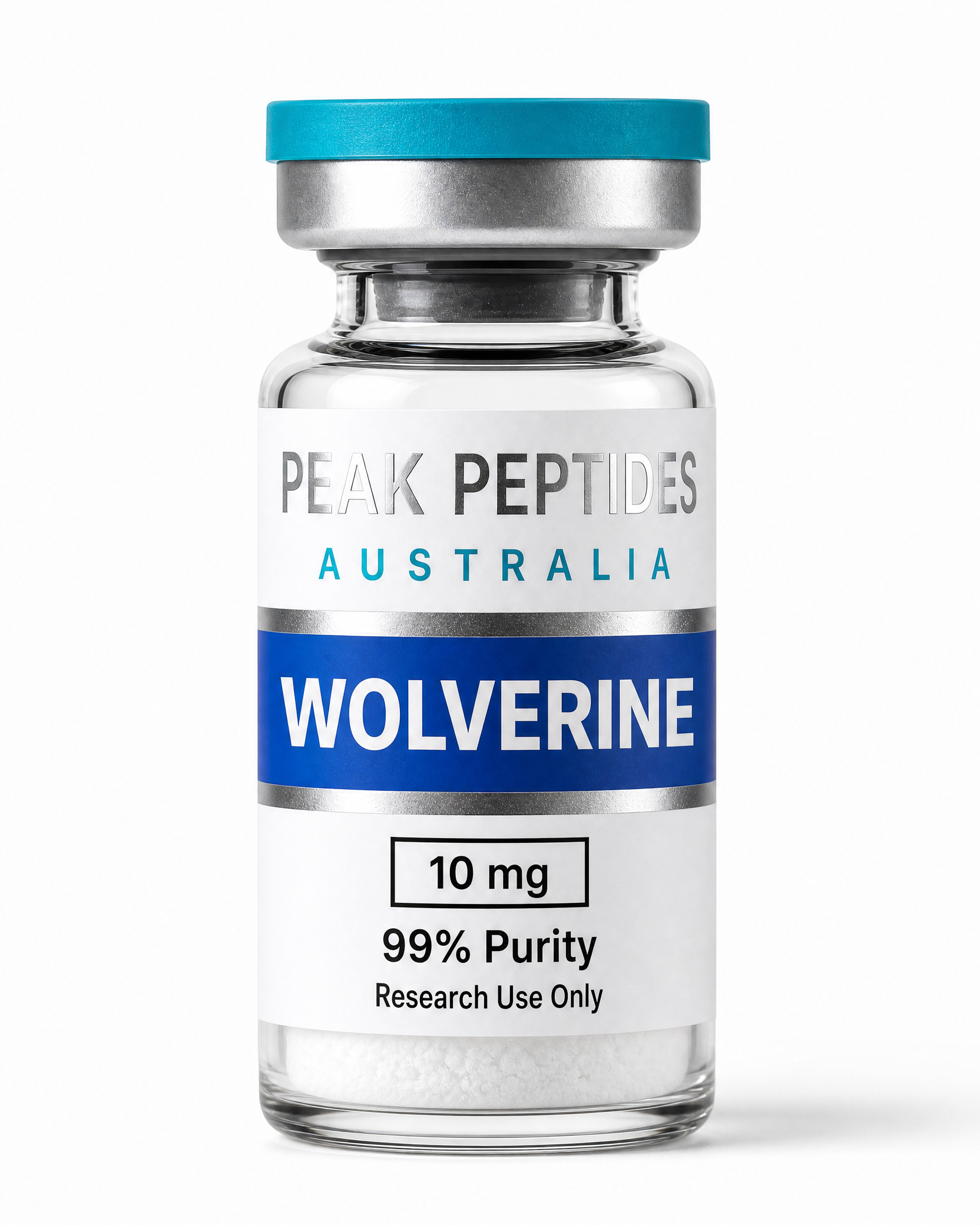
Wolverine Stack 10mg is a fixed-ratio research blend containing BPC-157 5mg and TB-500 5mg in one freeze-dried vial. LabDoc report LD-ZACL records 99.79% whole-vial HPLC purity, LC-MS confirmation of both compounds and per-compound content results. The page includes a blend breakdown, source-backed research context, an eight-step photo reconstitution guide and a component-by-component BAC water chart. In-stock orders receive same-day dispatch from Victoria after payment confirmation, with tracked Australia Post Express shipping Australia-wide.
Product Specifications
Full NameBPC-157 (5mg) + TB-500 (5mg) Research Blend
Vial SizeBPC-157 (5mg) + TB-500 (5mg)
Purity99.79% HPLC (LD-ZACL, whole-blend sample)
Legal Disclaimer
This product is sold strictly for in-vitro laboratory research purposes only. It is not intended for human or animal consumption, injection, or any diagnostic or therapeutic use.
BPC-157 + TB-500 fixed-ratio research blend · Updated 24 October 2026
Wolverine Stack 10mg is a two-component research blend: BPC-157 5mg plus TB-500 5mg in one freeze-dried vial. It is not a new single peptide and the 10mg label is the combined claim, not 10mg of each component. The fixed 1:1 ratio is useful when both named materials are to stay together in a sample; it is less flexible than separate vials when a component needs to be considered on its own. LabDoc report LD-ZACL records 99.79% whole-vial HPLC purity, LC-MS confirmation for both compounds, BPC-157 content of 4.69mg and TB-500 content of 4.659mg for batch CP012606261810L. This guide explains the blend, separates component research from blend claims, shows the LabDoc result, and gives an eight-step photo guide plus a component-by-component BAC water chart. Peak Peptides Australia supplies this material for in-vitro research only.
Also referred to in research or catalogue references as BPC-157 + TB-500, BPC-157/TB-500 research blend, Wolverine Stack, Wolverine peptide stack, BPC 157 TB 500 blend, BPC157 TB500 blend, BPC-157 TB-500 10mg, BPC 157 + TB 500, 5mg BPC-157 5mg TB-500.
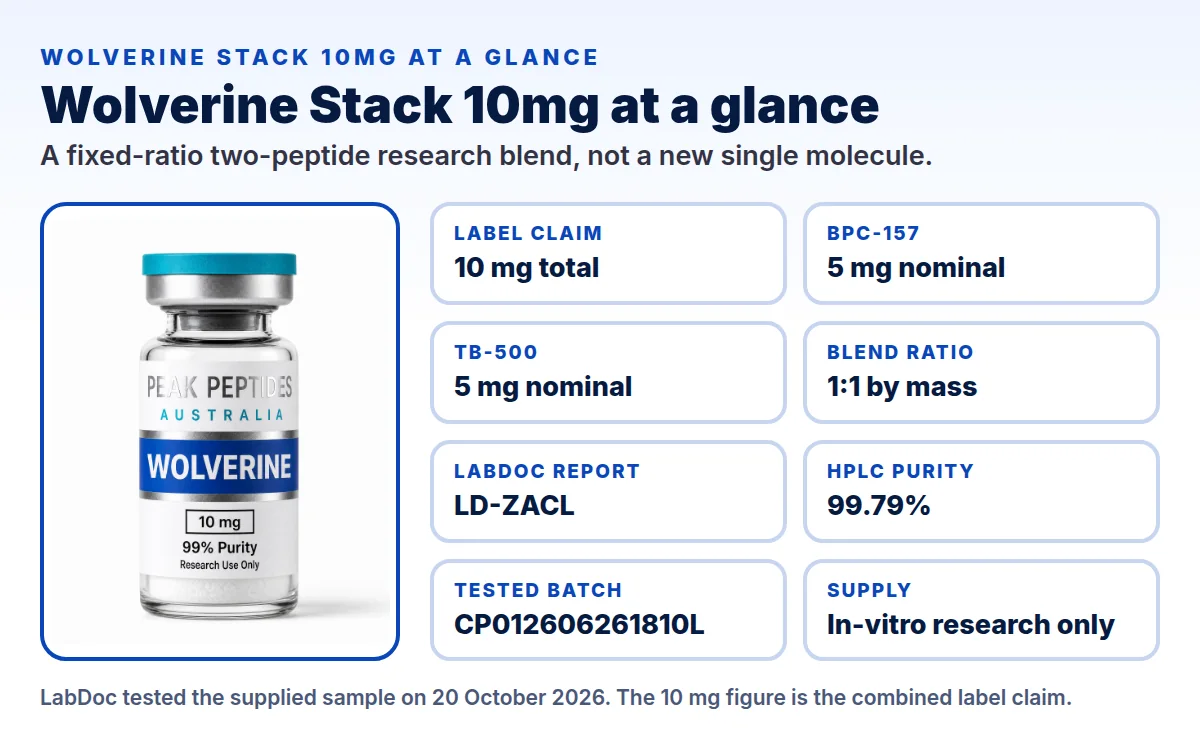
Wolverine Stack 10mg at a glance
Product
Wolverine Stack 10mg
What it is
A fixed-ratio BPC-157 + TB-500 research blend, not a single new peptide
Label composition
BPC-157 5mg + TB-500 5mg = 10mg total nominal material
Ratio
1:1 by mass; the components stay linked in every measured volume
BPC-157 context
15-amino-acid synthetic peptide studied in laboratory and preclinical tissue research
TB-500 context
FDA describes TB-500 free base as an acetylated seven-amino-acid thymosin beta-4 fragment
LabDoc report
LD-ZACL · tested 20 October 2026 · batch CP012606261810L
Lab test result
99.79% whole-vial HPLC purity · both identities confirmed by LC-MS · overall Pass
Measured BPC-157
4.69mg against the 5mg label claim in the tested sample
Measured TB-500
4.659mg against the 5mg label claim in the tested sample
3mL reference mix
3.33mg/mL total blend; 10 U-100 units = 0.167mg of each component
Regulatory status
Not an approved medicine in Australia; neither component is part of an FDA-approved drug
Dispatch
Same-day from Victoria for in-stock orders once payment is confirmed, tracked Australia Post Express
A 5mg + 5mg blend, not 10mg of each
Wolverine Stack is labelled as BPC-157 5mg plus TB-500 5mg: 10mg total nominal material. Each component represents half of the label claim. Any prepared volume keeps that 1:1 mass ratio, so 10 units from the 3mL reference mix contains 0.167mg BPC-157 and 0.167mg TB-500.
BPC-157 is a 15-amino-acid research peptide
BPC-157 is commonly expanded as Body Protection Compound-157. It is a synthetic pentadecapeptide, meaning it has 15 amino acids. A tendon-explant study examined tendon outgrowth, cell survival and cell migration in laboratory conditions; those findings describe that experiment, not an established outcome from this blend in people.
TB-500 is not automatically full-length thymosin beta-4
Full-length thymosin beta-4 has 43 amino acids. FDA describes TB-500 free base as an acetylated seven-amino-acid fragment from positions 17–23 of thymosin beta-4, and notes inconsistent commercial use of the TB-500 name. A paper using full-length thymosin beta-4 is biological context, not direct evidence for every TB-500-labelled material.
The ratio is locked inside one vial
A premixed Wolverine Stack vial always keeps BPC-157 and TB-500 together at equal labelled masses. Separate BPC-157 and TB-500 vials allow component-level comparison and independent amounts. The blend is the simpler format when the fixed relationship itself is part of the research question.
Independent LabDoc result: LD-ZACL
LabDoc report LD-ZACL received the BPC-157 + TB-500 sample on 16 October 2026 and tested it on 20 October 2026. It records 99.79% HPLC purity for the whole vial, LC-MS identity confirmation for 2 of 2 compounds and an overall Pass for batch CP012606261810L.
Per-compound content is reported separately
The LabDoc result reports BPC-157 at 4.69mg against a 5mg claim and TB-500 at 4.659mg against a 5mg claim. The 10mg on the label is the combined nominal claim. It is not a measured total in the report, which is why the two content values are shown separately.
Regulatory position is plain
Wolverine Stack is not an approved medicine in Australia. The TGA lists BPC-157 and TB-500 among unapproved peptide products not included in the ARTG. FDA states that neither BPC-157 nor TB-500 is a component of an FDA-approved drug; its BPC-157 assessment also states no approved BPC-157 product existed in any country at the time of review.
Sport rules name both components
The WADA 2026 Prohibited List names BPC-157 in S0, non-approved substances, and names thymosin-beta4 and derivatives such as TB-500 in S2.3. Both categories are prohibited at all times under that list. That rule is separate from the material’s research context and lab report.
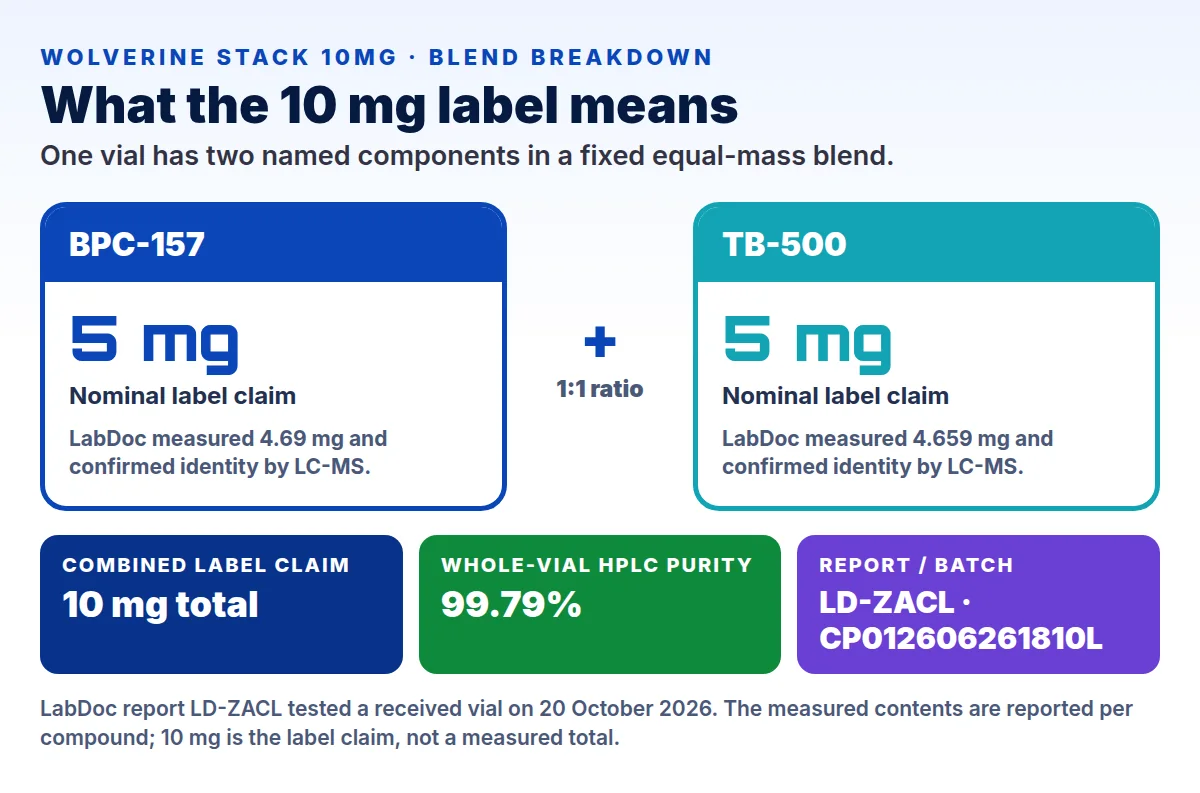
Wolverine Stack 10mg is a premixed two-peptide research vial containing BPC-157 5mg and TB-500 5mg. The “10mg” is the total label claim across both peptides. That total matters for sample documentation and concentration arithmetic.
The blend has a fixed 1:1 mass ratio. Once diluent is added, every measured volume contains equal masses of the two labelled components. A 3mL reference mix, for example, has 3.33mg/mL total blend: 1.67mg/mL BPC-157 and 1.67mg/mL TB-500. The ratio stays fixed while the total concentration changes with volume.
The product name is shorthand, not a scientific class. Wolverine Stack is neither a single 10mg molecule nor a replacement name for full-length thymosin beta-4. It is supplied for in-vitro research only. The most useful way to read its literature is component by component, then ask whether a source actually tested this same fixed blend.
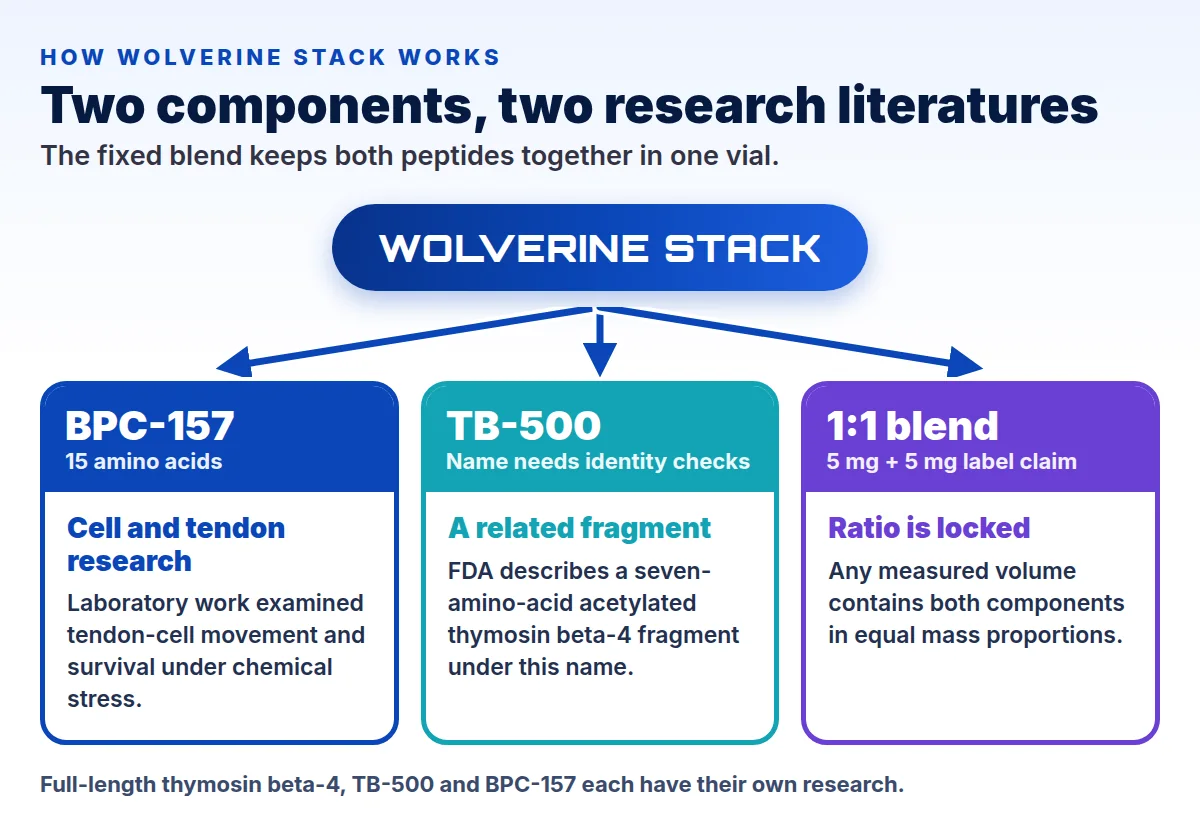
One vial, two named components: 5mg BPC-157 plus 5mg TB-500 is the 10mg total label claim.
How do the two components fit into research?
BPC-157 is a synthetic 15-amino-acid peptide. A 2011 tendon-explant experiment reported more tendon outgrowth, cell survival and cell migration under the laboratory conditions used in that study. Those endpoints are useful because they name what was measured. They do not show that a fixed BPC-157 plus TB-500 blend has the same effect in another system.
TB-500 and full-length thymosin beta-4 are different compounds. Full-length thymosin beta-4 is a 43-amino-acid peptide with a broad literature on actin binding, cell migration, angiogenesis and tissue-repair models. FDA describes TB-500 free base as an acetylated seven-amino-acid fragment from positions 17–23 of thymosin beta-4. A full-length thymosin beta-4 paper gives biological background.
This is why an independent identity test matters. A shared nickname is not enough to match a study to a vial. For this sample, LabDoc records LC-MS confirmation for both named compounds. That confirms what the test found in the sample; it does not turn component research into a claim for the blend.
The blend contains two research materials with different literature and a permanently fixed equal-mass ratio.
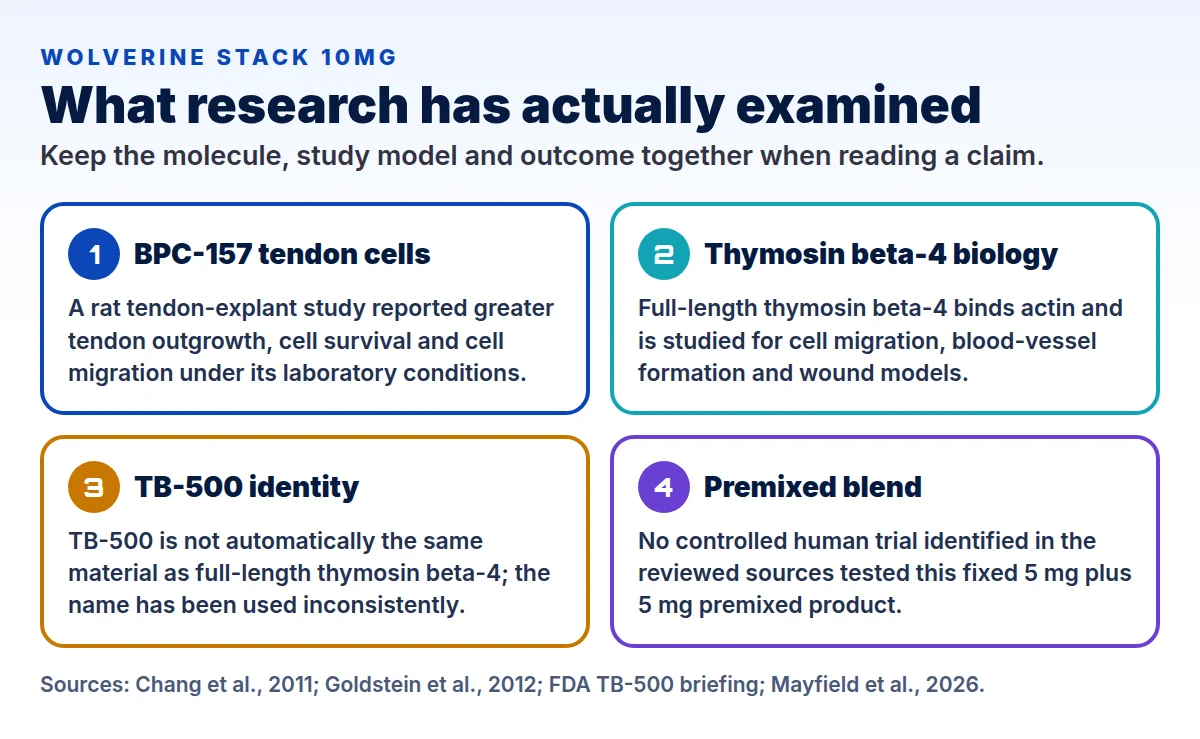
What did the research actually examine?
The BPC-157 tendon-explant paper studied tendon tissue and cells under laboratory conditions. It measured outgrowth, survival and migration. The 2026 orthopaedic review reports that BPC-157 findings in tendon and muscle repair are largely unconfirmed in human trials.
For thymosin beta-4, a review describes actin binding and migration of cells involved in repair processes. It also discusses new blood-vessel formation and wound research. Yet the same question remains: was the work done with full-length thymosin beta-4, a defined fragment, or a product called TB-500? The answer changes what a result can support.
No controlled human trial identified in the PeptideDosages blend review tested a premixed BPC-157 5mg plus TB-500 5mg vial. The correct page claim is therefore specific: each component has research context, but this fixed blend has not been demonstrated as a clinically established combination.
The visual separates laboratory observations from the distinct question of whether the premixed blend itself has been tested.
What the cited research can and cannot describe
What the cited research can and cannot describe
Source material
What was examined
Research scope
BPC-157 tendon-explant study
Tendon outgrowth, cell survival and cell migration in a laboratory experiment
A result from Wolverine Stack in people or from every BPC-157 formulation
Full-length thymosin beta-4 literature
Actin binding, cell migration, vascular and wound-model biology
That full-length thymosin beta-4 is interchangeable with TB-500
FDA TB-500 assessment
TB-500 as a seven-amino-acid acetylated fragment and identity concerns around the common name
That any product using the name has the same exact active material
BPC-157 + TB-500 blend review
A fixed 5mg + 5mg, 1:1 mass-ratio vial and its concentration maths
A controlled human result for this premixed blend
Reading the molecule and model together prevents a component paper from being overstated as a blend result.
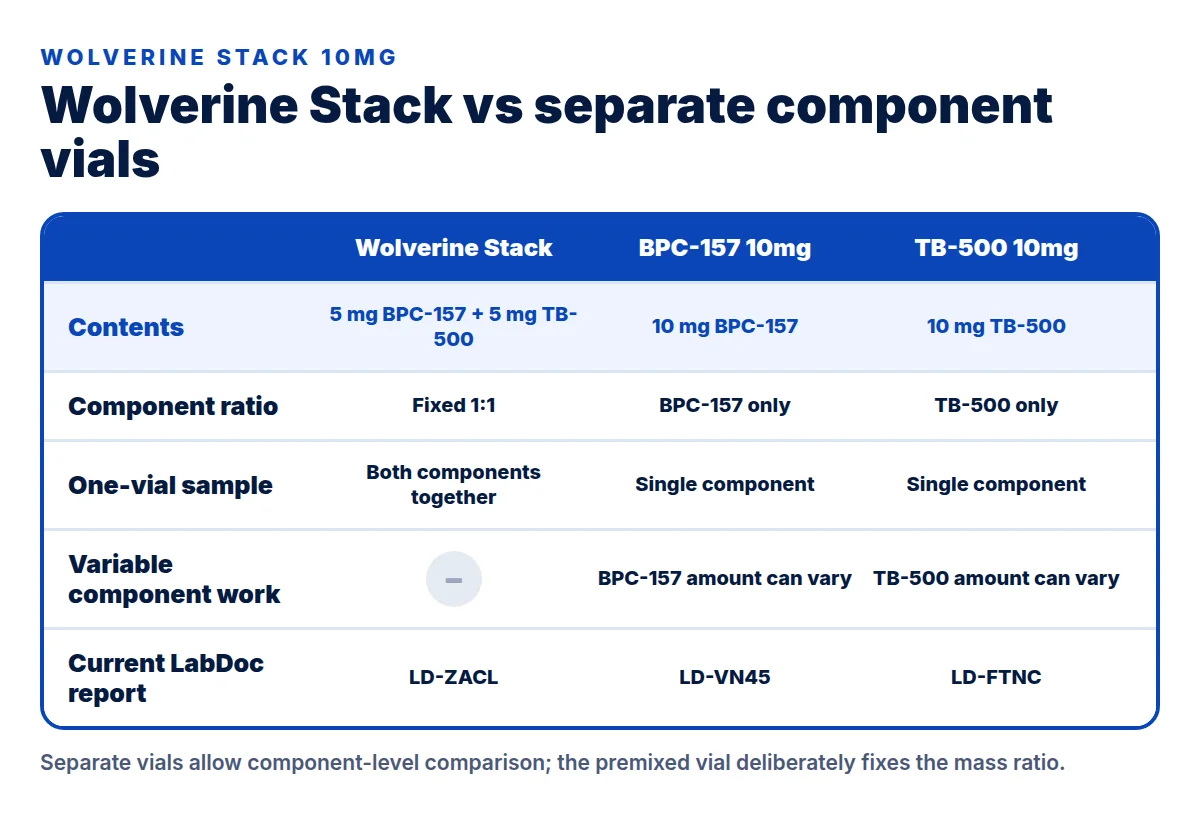
Wolverine Stack vs separate BPC-157 and TB-500 vials
Buying the blend and buying separate vials answer different research design questions. Wolverine Stack puts both labelled materials into the same vial at a fixed 5mg plus 5mg ratio. It reduces the number of containers and ensures the components remain equal by mass within a measurement.
Separate BPC-157 10mg and TB-500 10mg vials make it possible to compare component-specific behaviour or hold one component out of a sample. They also have their own test reports: the catalogue lists LD-VN45 for BPC-157 10mg and LD-FTNC for TB-500 10mg. Those reports belong to their own tested samples, not to Wolverine Stack.
Neither arrangement proves that one component adds to the other. A controlled experiment would need a blend group, each component alone and an appropriate comparison. The important practical point is simpler: a premix locks the ratio; separate vials keep the variables independent.
The blend fixes BPC-157 and TB-500 together; separate vials allow each component to be considered independently.
Independent lab test for this Wolverine Stack vial
LabDoc report LD-ZACL is the product-specific verification record for the tested BPC-157 + TB-500 sample. The report says LabDoc received the vial on 16 October 2026, analysed it through its partner lab on 20 October 2026, and compiled the result on 21 October 2026. The listed batch is CP012606261810L.
The report uses LC-MS for identity and HPLC for purity and content. It records 2 of 2 compounds confirmed by LC-MS, 99.79% HPLC purity for the whole vial, and an overall Pass. HPLC content is recorded per compound: BPC-157 measured 4.69mg against the 5mg claim (93.8%) and TB-500 measured 4.659mg against the 5mg claim (93.18%).
Those last two numbers explain why “10mg” should be read carefully. It is the combined label claim. LabDoc does not present it as a measured total. The report also states that it covers the tested sample only. Janoshik #108020 is a second, independent test report for this blend, shown on our Quality page.
Identity: LC-MS confirmed BPC-157 and TB-500, listed as 2 of 2 compounds confirmed.
Purity: HPLC reported 99.79% for the whole vial.
Content: HPLC reported 4.69mg BPC-157 (93.8% of claim) and 4.659mg TB-500 (93.18% of claim) against 5mg claims each.
Traceability: report LD-ZACL, batch CP012606261810L, received 16 October 2026 and tested 20 October 2026.
Scope: LabDoc states that the result covers the tested sample only.
LD-ZACL reports the two compounds separately: 4.69mg BPC-157 and 4.659mg TB-500 in the tested sample.
Wolverine Stack in Australia: regulatory position and dispatch
Wolverine Stack is not an approved medicine in Australia. In June 2026, the TGA described products containing BPC-157 and TB-500 as examples of unapproved peptide products not included in the Australian Register of Therapeutic Goods. The TGA says such products have not been evaluated by it for safety, quality or effectiveness.
The United States position is also direct. FDA’s 2026 BPC-157 assessment says neither BPC-157 free base nor acetate is a component of an FDA-approved drug and says no approved BPC-157 product existed in any country at the time of its review. Its TB-500 assessment says neither TB-500 free base nor TB-500 acetate is a component of an FDA-approved drug.
Peak Peptides Australia supplies Wolverine Stack for in-vitro research only. Same-day dispatch from Victoria applies to in-stock orders once payment is confirmed. Parcels travel via tracked Australia Post Express and the tracking number is emailed. This dispatch information describes fulfilment, not regulatory approval or a use claim.
Step-by-step guide · About 10 minutes
How to reconstitute Wolverine Stack 10mg (step-by-step with photos)
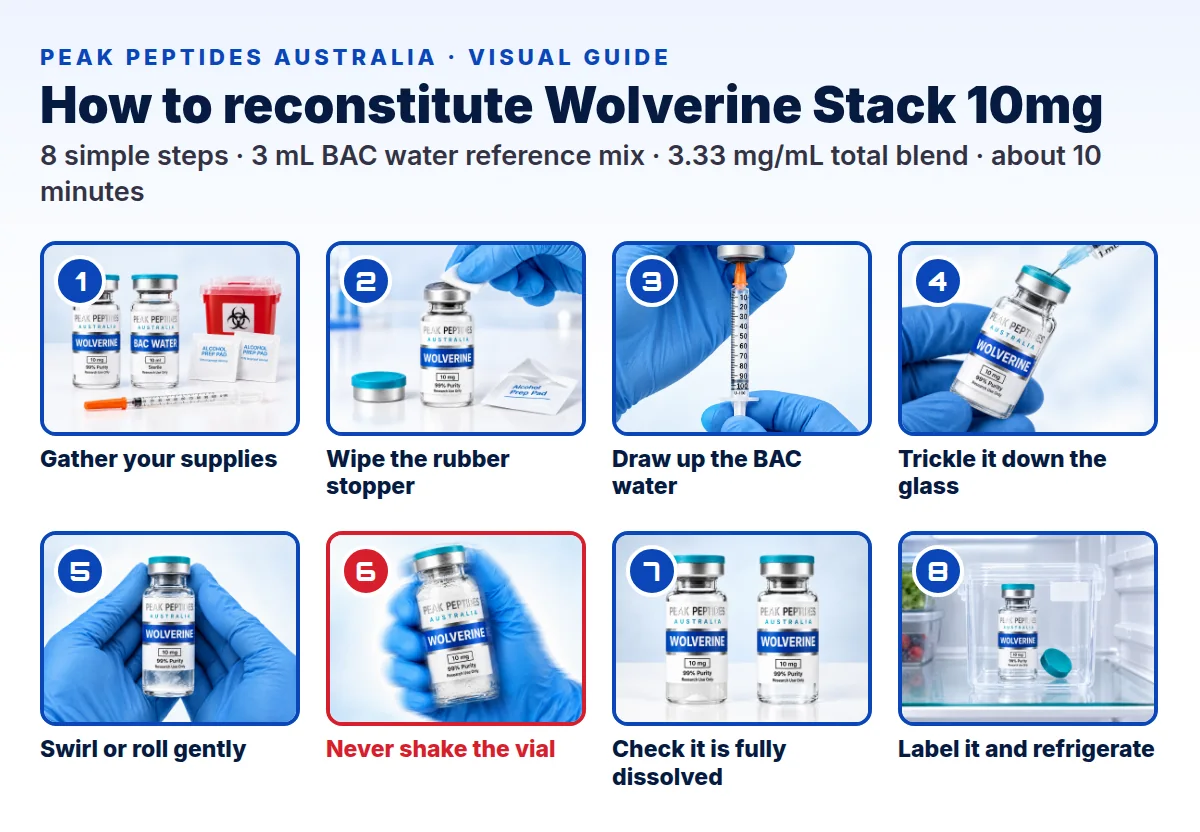
Wolverine Stack 10mg arrives as freeze-dried material. Reconstitution means adding a specified diluent so the powder forms a measurable solution. The PeptideDosages blend reference uses 3mL bacteriostatic water, producing 3.33mg/mL total blend: about 1.67mg/mL BPC-157 and 1.67mg/mL TB-500. The 3mL reference mix gives 0.167mg of each component in 10 U-100 units. Use clean equipment, follow the eight visual stages and record the actual volume used.
The visual sequence: prepare, add the measured diluent slowly, gently mix, inspect and document the preparation.
What you need
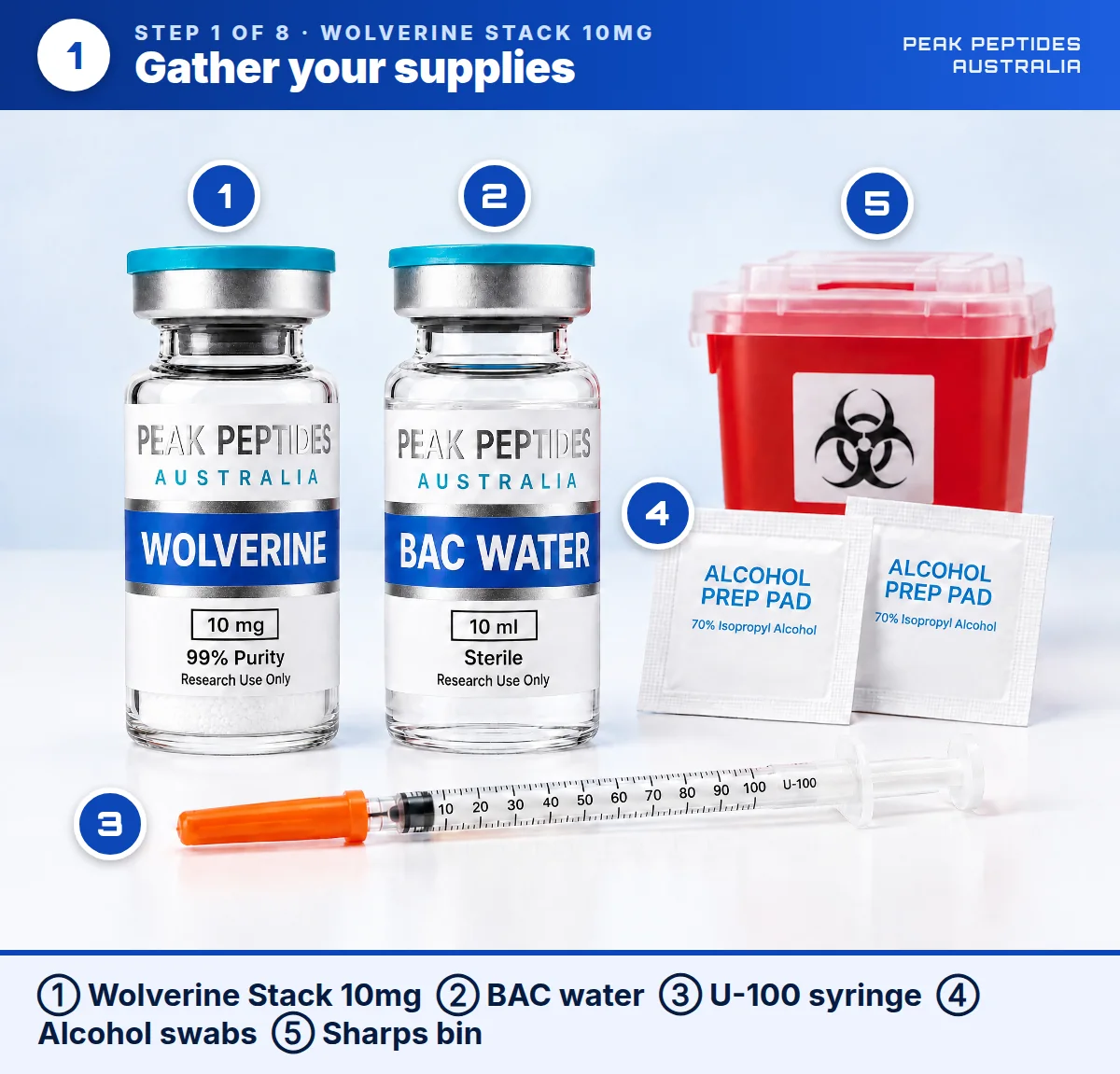
Wolverine Stack 10mg vialFreeze-dried BPC-157 5mg + TB-500 5mg blend in a sealed glass vial.
1mL U-100 syringeA U-100 syringe has 100 volume markings per mL; 100 units equals 1mL.
Alcohol swabsFor cleaning vial stoppers and allowing the surface to air-dry before entry.
Sharps containerFor immediate safe disposal of used needles and syringes.
How much BAC water to add to Wolverine Stack 10mg
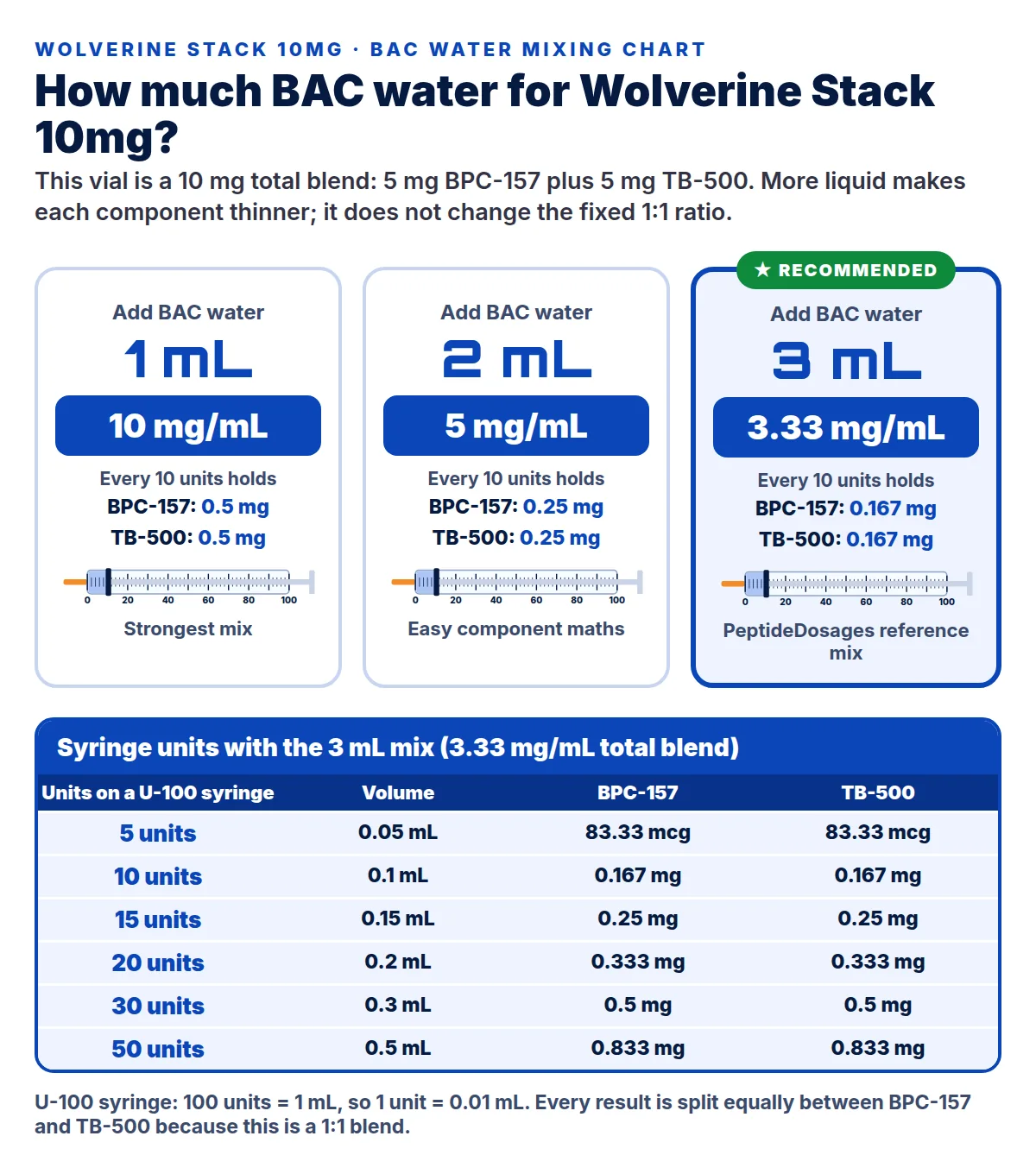
The vial’s label claim remains 5mg BPC-157 plus 5mg TB-500 whichever volume is selected. More BAC water spreads both components into a larger liquid volume; it does not change the fixed equal-mass relationship. The chart shows the arithmetic for 1mL, 2mL and the 3mL reference mix used by PeptideDosages for this exact 10mg blend format.
With 3mL, the total blend concentration is 3.33mg/mL. Every 10 U-100 units is 0.1mL and contains 0.167mg BPC-157 plus 0.167mg TB-500. With 2mL, every 10 units contains 0.25mg of each component; with 1mL, every 10 units contains 0.5mg of each.
The components remain equal in every measured volume because the product is a 5mg plus 5mg fixed-ratio blend.
3 mL is highlighted because it gives the simplest numbers.
Syringe units with the 3 mL mix (3.33 mg/mL total blend)
Syringe units with the 3 mL mix (3.33 mg/mL total blend)
Units on a U-100 syringe
Volume
BPC-157
TB-500
5 units
0.05 mL
83.33 mcg
83.33 mcg
10 units
0.1 mL
0.167 mg
0.167 mg
15 units
0.15 mL
0.25 mg
0.25 mg
20 units
0.2 mL
0.333 mg
0.333 mg
30 units
0.3 mL
0.5 mg
0.5 mg
50 units
0.5 mL
0.833 mg
0.833 mg
100 units
1 mL
1.67 mg
1.67 mg
The 8 steps
1Step 1: Gather your supplies
Place the Wolverine Stack 10mg vial, bacteriostatic water, a new 1mL U-100 syringe, alcohol swabs and a sharps container on a clean, stable surface. Check the vial label and the diluent label before starting. Record the batch and the intended total volume so the final concentration can be checked later.
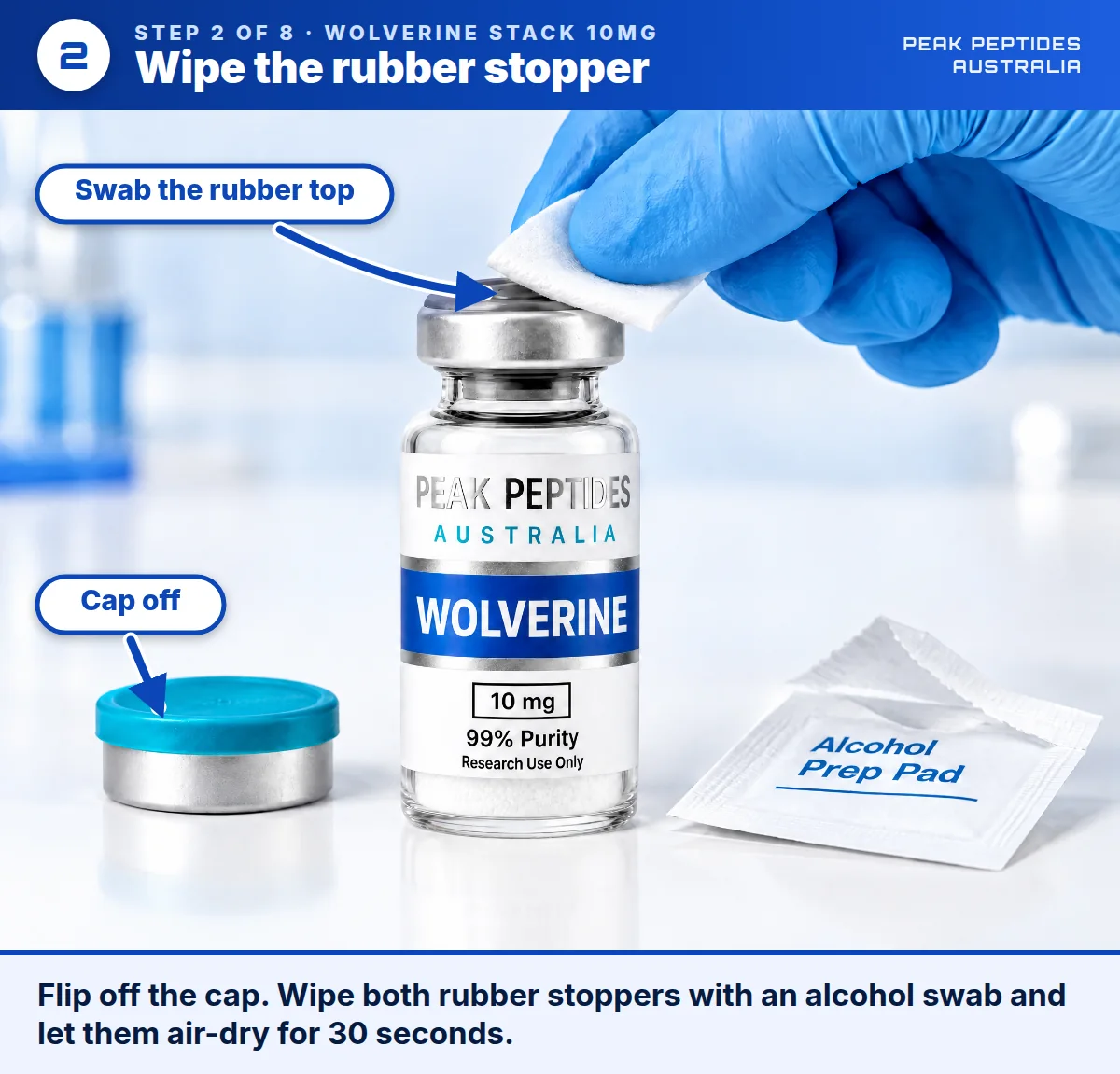
2Step 2: Wipe the rubber stopper
Remove the flip-off caps as applicable. Wipe each rubber stopper with a fresh alcohol swab and allow the surfaces to air-dry for about 30 seconds. Do not touch the cleaned stopper after it dries. Use a new sterile needle and syringe for each vial entry.
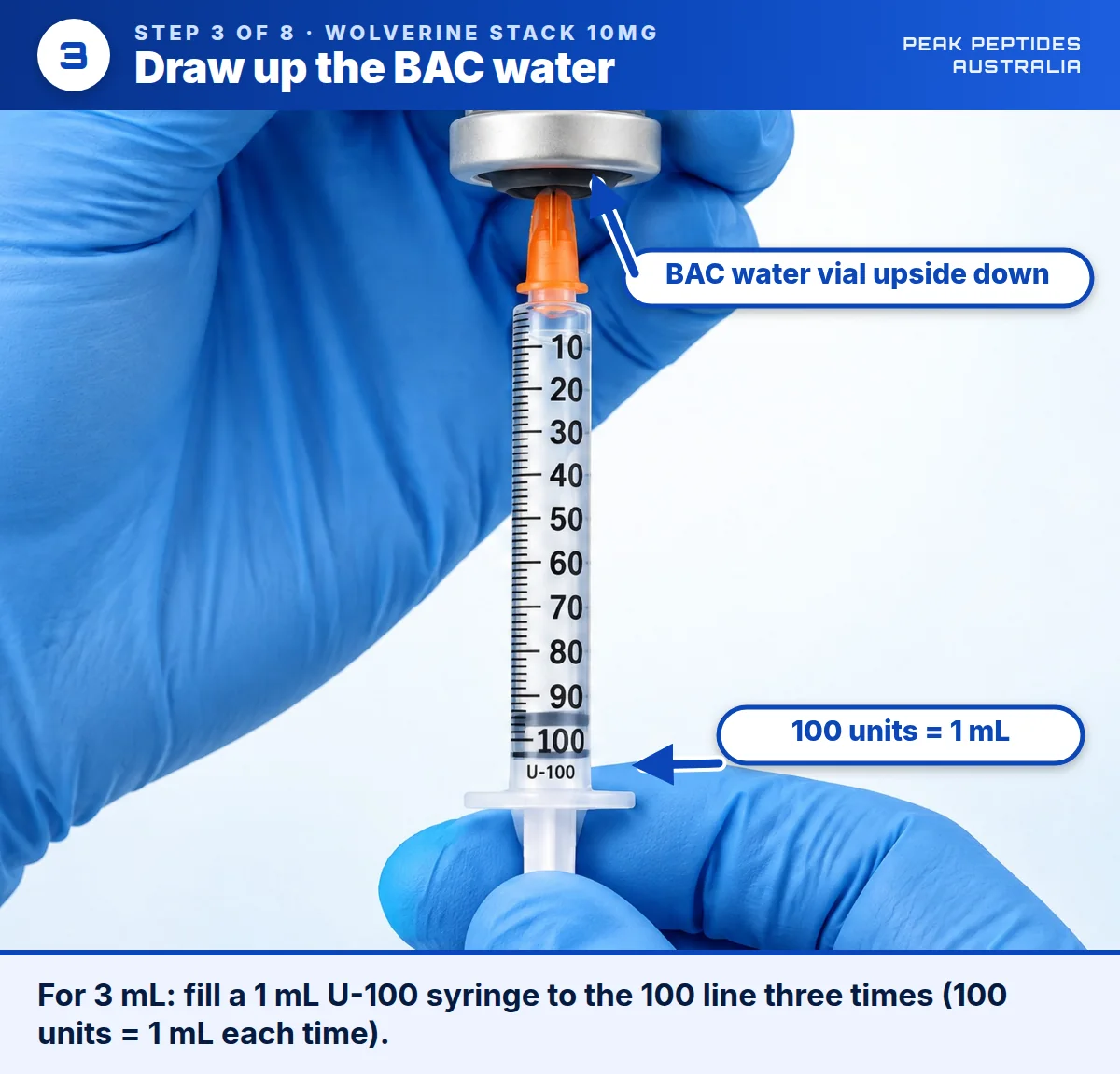
3Step 3: Draw up the BAC water
Use the U-100 scale to measure the required liquid volume. One full 100-unit syringe equals 1mL. For the 3mL reference concentration, measure three separate 1mL portions rather than drawing beyond the syringe scale. Remove large air bubbles and check the liquid level at eye height.
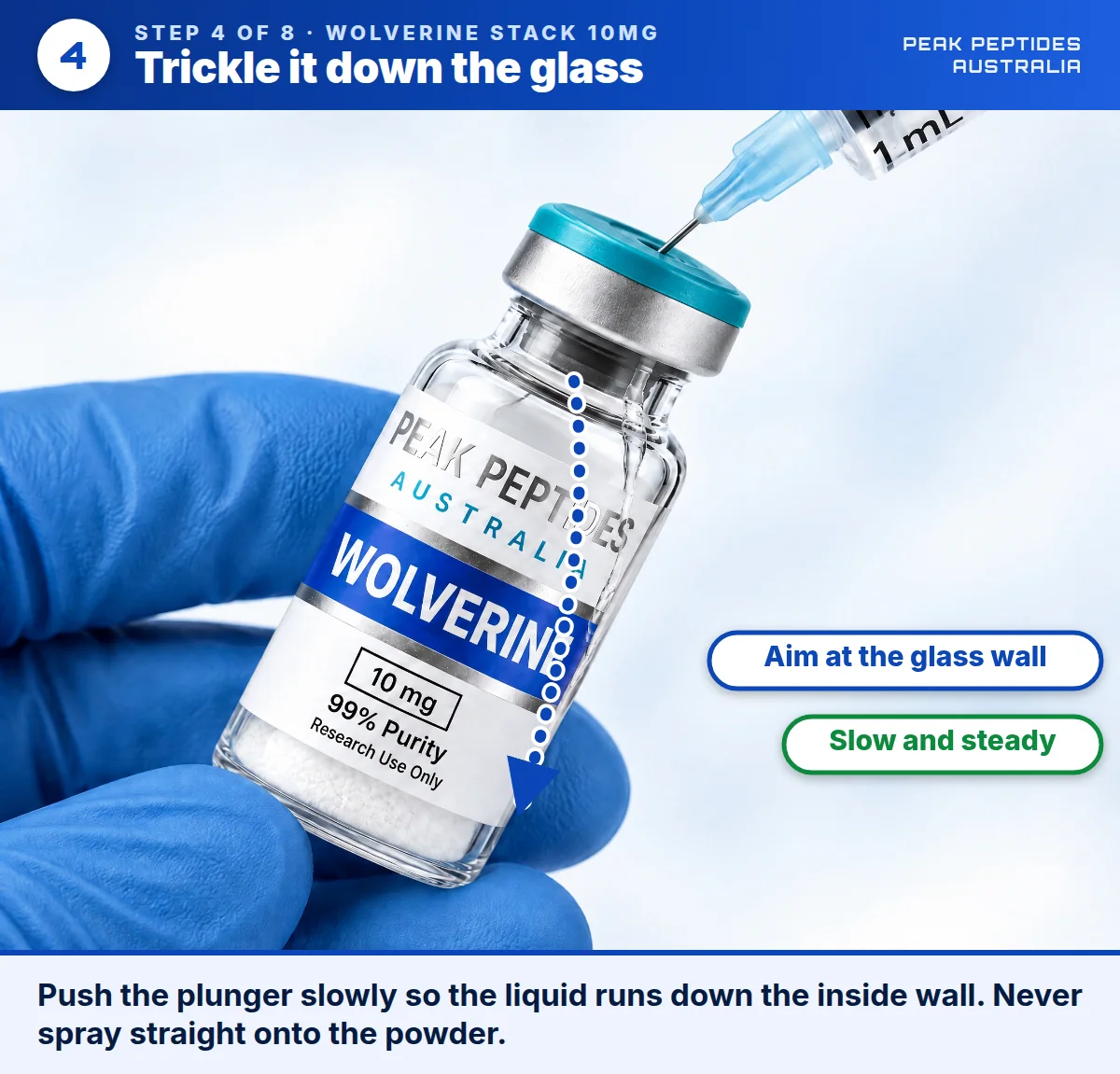
4Step 4: Trickle it down the glass
Insert the needle through the Wolverine Stack stopper and add the measured liquid slowly against the inside glass wall. Aiming at the wall reduces splashing and forceful agitation. Repeat with the remaining measured portions if using the 3mL reference volume. Do not force the plunger if resistance or leakage occurs.
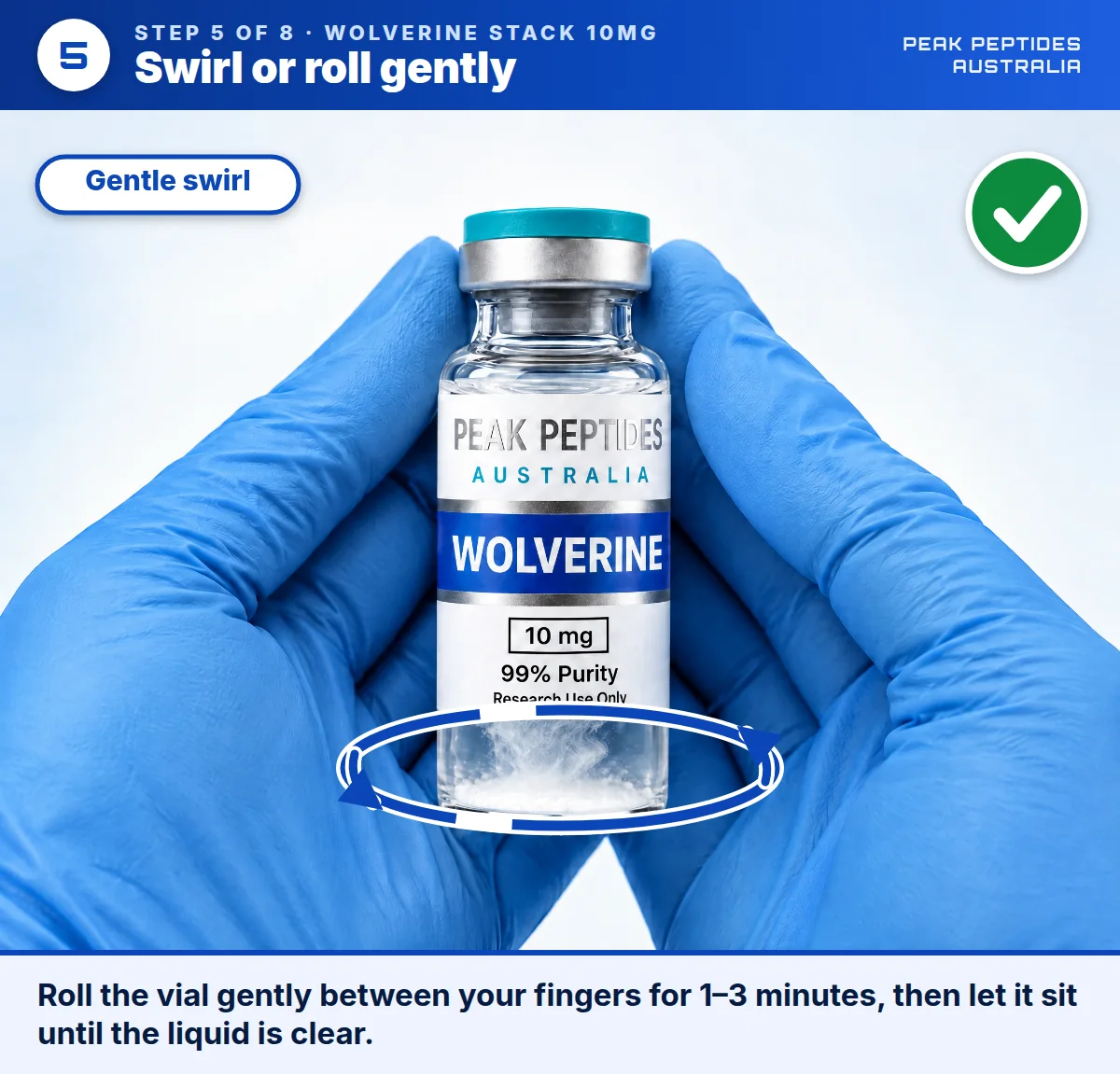
5Step 5: Swirl or roll gently
Allow the material to wet, then gently swirl or roll the vial between your fingers. This step uses gentle movement rather than vigorous agitation. The time to dissolve can vary by formulation, temperature and volume, so inspect the solution rather than relying on a fixed time alone.
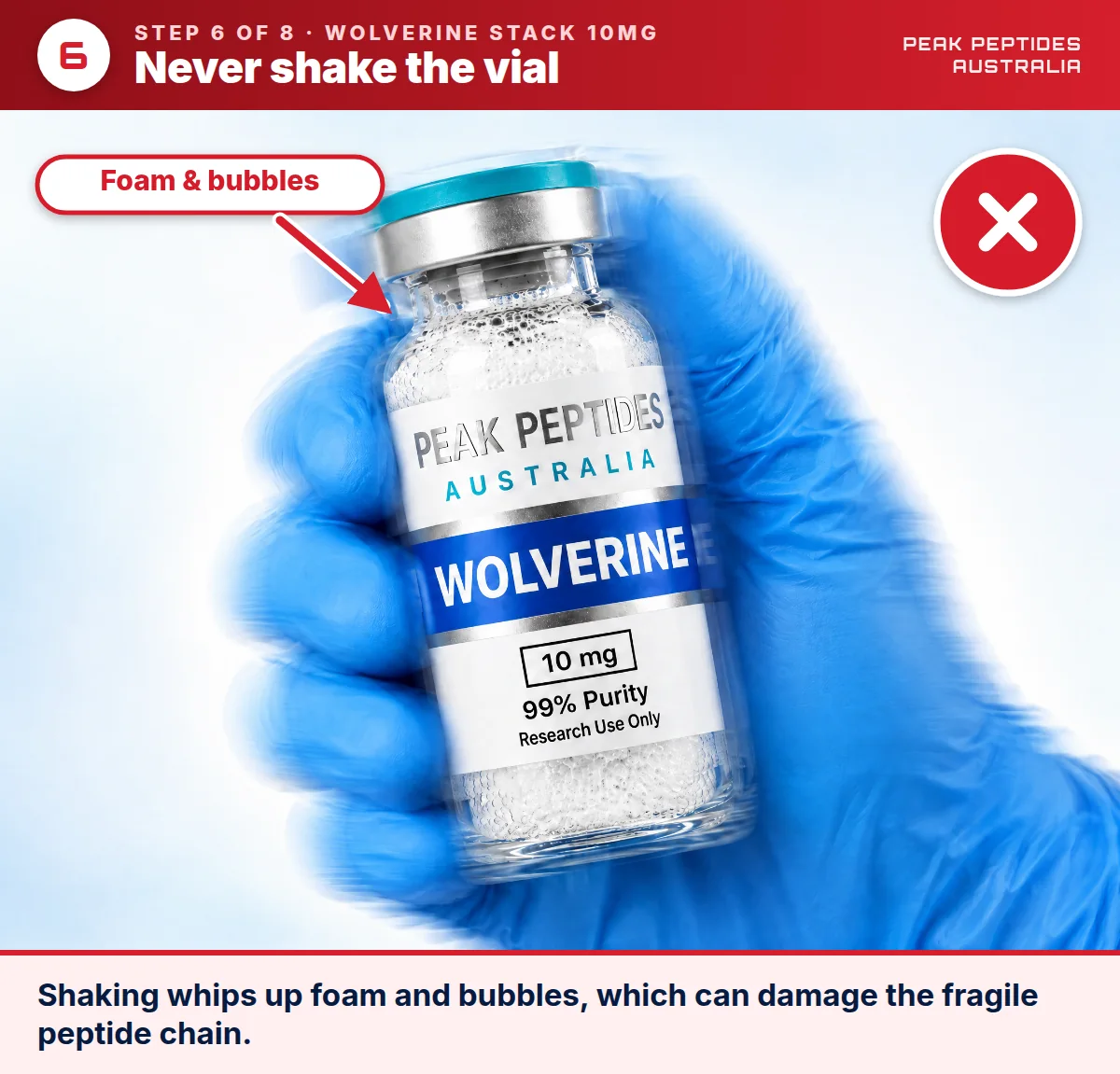
6Step 6: Never shake the vial
Do not shake the vial. Vigorous motion can create foam and unnecessary stress in peptide formulations. If foam or bubbles appear, stop agitating the vial and allow it to stand. Continue only with the permitted gentle mixing method and inspect the solution before proceeding.
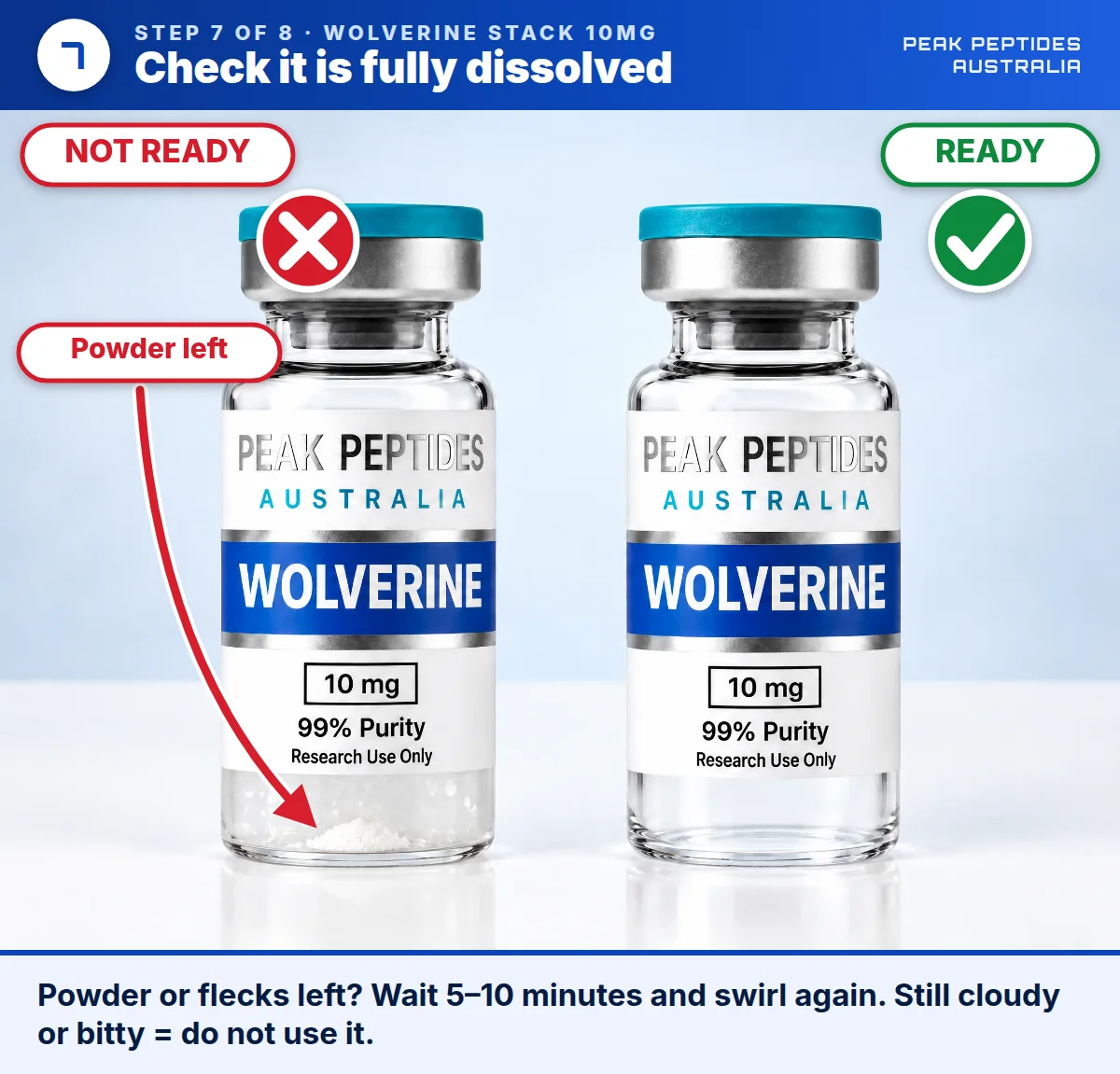
7Step 7: Check it is fully dissolved
Hold the vial under good light and compare the solution with the expected appearance. The illustrated ready vial is clear, without visible powder, flecks or unexpected cloudiness. If material remains at the base, allow more time and swirl gently again. Do not try to filter or salvage a questionable vial.
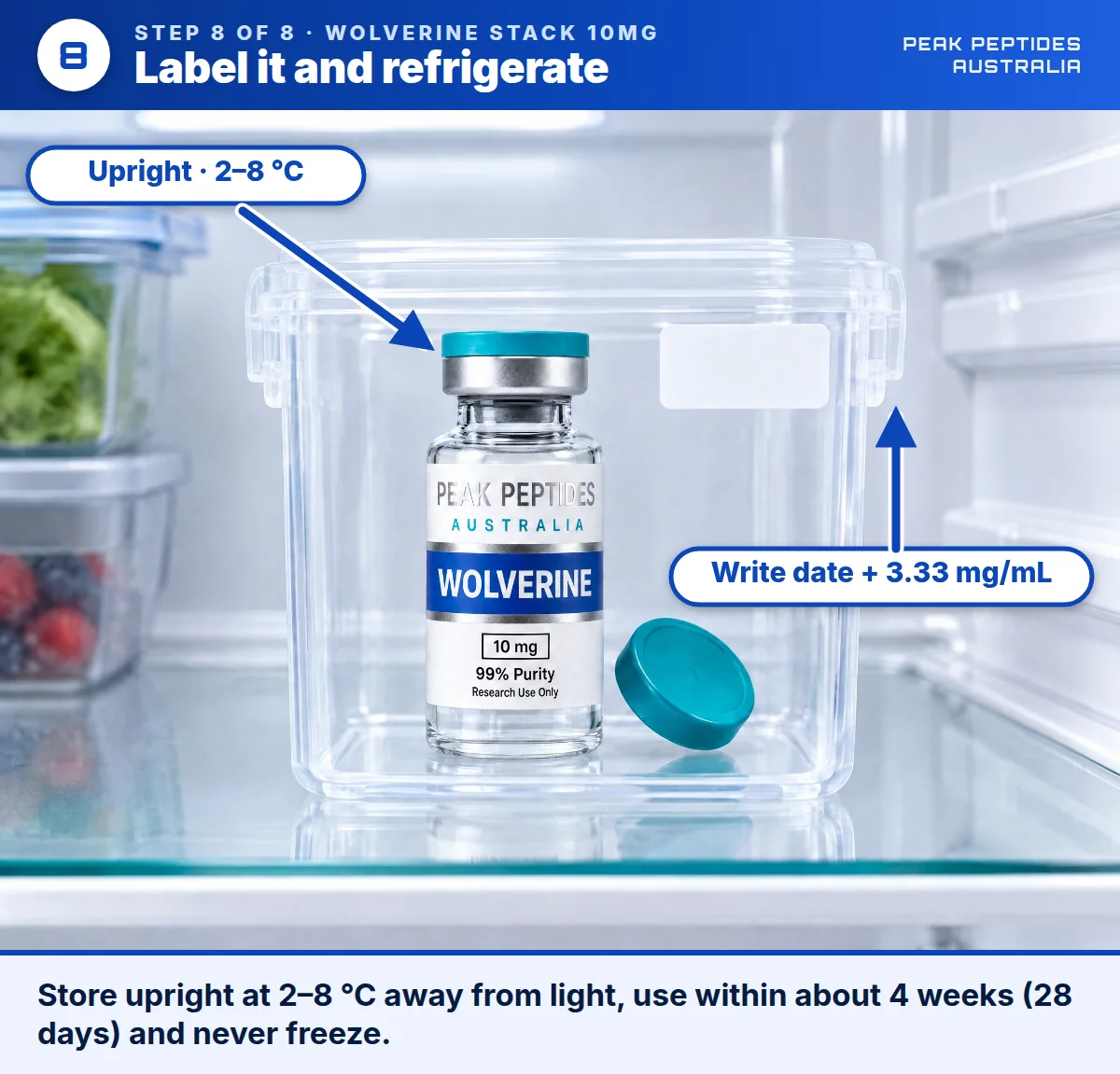
8Step 8: Label it and refrigerate
Write the preparation date, diluent, total volume and strength on the vial or its container. The 3mL reference mix is 3.33mg/mL total blend. Store upright at 2–8 °C away from light, use within about 4 weeks (28 days) and never freeze it.
How to store Wolverine Stack
Wolverine Stack storage and handling guide
Wolverine Stack storage and handling guide
Form
Handling position
What the reviewed sources support
Unopened freeze-dried vial
Keep sealed; protect from moisture, light and repeated temperature changes
Within about 4 weeks (28 days)
After adding the stated diluent
Refrigerate at 2–8 °C and protect from light
Within about 4 weeks (28 days), following the PeptideDosages blend reference handling direction.
Prepared solution
Label date, diluent and actual total volume
This records the concentration used and supports traceability
Prepared solution and freezing
Never freeze it.
Never freeze it.
Once mixed with bacteriostatic water, keep the vial upright in the fridge at 2–8 °C, away from light. Use within about 4 weeks (28 days) and never freeze it. Write the date and strength on the vial.
Wolverine Stack 10mg is a fixed-ratio research blend in one vial. Its label claim is BPC-157 5mg plus TB-500 5mg, for 10mg total nominal material. It is not a new single molecule and it is supplied for in-vitro research only.
Does Wolverine Stack 10mg mean 10mg of each peptide?
No. The 10mg label means 10mg combined: 5mg BPC-157 and 5mg TB-500. Each component is half of the nominal total. It is a 1:1 mass-ratio blend, not two separate 10mg component amounts.
What is in the Wolverine Stack blend?
The listed blend contains two named components: BPC-157 at a 5mg label claim and TB-500 at a 5mg label claim. LabDoc LD-ZACL measured the compounds separately, recording 4.69mg BPC-157 and 4.659mg TB-500 in the tested sample.
Why is it called a Wolverine Stack?
Wolverine Stack is a product nickname for a BPC-157 plus TB-500 blend. The name does not describe a new receptor, a new molecule or an approved clinical formulation. The useful scientific description is the fixed 5mg BPC-157 plus 5mg TB-500 composition.
What is BPC-157 used for in research?
BPC-157 is a 15-amino-acid synthetic peptide studied in laboratory and preclinical tissue-repair settings. One tendon-explant study examined cell movement, cell survival and tendon outgrowth.
What is TB-500 used for in research?
TB-500 is discussed in research alongside thymosin beta-4 biology, including actin binding, cell migration and wound-model work. The exact material matters: FDA describes TB-500 as a seven-amino-acid acetylated fragment, whereas much published work uses full-length thymosin beta-4.
Is TB-500 the same as full-length thymosin beta-4?
No. Full-length thymosin beta-4 contains 43 amino acids. FDA describes TB-500 free base as an acetylated seven-amino-acid fragment, Ac-LKKTETQ. They are related research materials, but a finding for full-length thymosin beta-4 does not automatically describe a TB-500-labelled component.
Does research on BPC-157 and TB-500 prove a result from the blend?
No. Component papers provide context only. The PeptideDosages blend review identified no controlled human trial that tested this fixed BPC-157 5mg plus TB-500 5mg premixed product. A blend would need its own controlled comparison to show a result specific to the combination.
How does Wolverine Stack work?
Wolverine Stack is not one mechanism. It combines BPC-157 research context with TB-500-related research context in a fixed ratio. BPC-157 laboratory work has examined tendon-cell behaviour. Thymosin beta-4 literature has examined actin binding and cell migration. Neither description turns the blend into a proven treatment.
What side effects have been reported for BPC-157 and TB-500?
No side-effect rates have been published for this blend. FDA’s BPC-157 and TB-500 assessments identify questions about product identity, peptide impurities, aggregation and immune responses. The TGA says unapproved peptide products have not been evaluated for safety, quality or effectiveness.
What is BPC-157 vs TB-500?
BPC-157 is a 15-amino-acid synthetic peptide. TB-500 is commonly described as an acetylated seven-amino-acid thymosin beta-4 fragment, although the name has been used inconsistently. They are different research materials. Wolverine Stack combines nominally equal masses; separate vials keep them independent.
Why buy the blend instead of separate BPC-157 and TB-500 vials?
The blend keeps both components in a fixed 1:1 mass ratio in a single vial. Separate BPC-157 and TB-500 vials are better suited to work that needs the components compared, varied or documented independently. Neither format makes findings from one component automatically apply to the other.
Is Wolverine Stack approved by the TGA or FDA?
No. Wolverine Stack is not an approved medicine in Australia. The TGA lists BPC-157 and TB-500 among unapproved peptides not included in the ARTG. FDA states that BPC-157 and TB-500 are not components of FDA-approved drugs, and its BPC-157 review reported no approved product in any country at that time.
Are BPC-157 and TB-500 prohibited in sport?
Yes under the WADA 2026 Prohibited List. BPC-157 is named in S0 for non-approved substances. Thymosin-beta4 and derivatives such as TB-500 are named in S2.3 for growth factors and growth-factor modulators. Both categories are prohibited at all times.
Can I buy Wolverine Stack 10mg online in Australia?
Wolverine Stack 10mg is listed online by Peak Peptides Australia as material supplied for in-vitro research only. Same-day dispatch from Victoria applies to in-stock orders once payment is confirmed. Orders are sent tracked via Australia Post Express and a tracking number is emailed.
How fast is Wolverine Stack dispatched in Australia?
For in-stock orders, same-day dispatch is from Victoria once payment is confirmed. The service is tracked Australia Post Express, and the tracking number is emailed. Dispatch timing is separate from Australia Post delivery transit after the parcel enters its network.
How do I know a Wolverine Stack vial is real?
Match the vial label and strength, then check the independent report identifier, batch and test methods. For this product, LabDoc LD-ZACL names BPC-157 + TB-500, batch CP012606261810L, LC-MS identity testing, HPLC purity and per-compound HPLC content.
How is this Wolverine Stack sample verified?
LabDoc report LD-ZACL received the sample on 16 October 2026 and tested it on 20 October 2026. It records 99.79% whole-vial HPLC purity, LC-MS confirmation for both compounds, 4.69mg BPC-157 (93.8% of its 5mg claim) and 4.659mg TB-500 (93.18% of its 5mg claim), with an overall Pass.
What does Janoshik #108020 mean for Wolverine Stack?
Janoshik #108020 is a second, independent test report for Wolverine Stack, shown on our Quality page. The product-specific LabDoc report is LD-ZACL, which supplies the public batch, identity, purity and per-compound content details shown on this page.
How much BAC water for Wolverine Stack 10mg?
The PeptideDosages 10mg blend reference uses 3mL bacteriostatic water, which makes 3.33mg/mL total blend. At that concentration, 10 units on a U-100 syringe is 0.1mL and contains 0.167mg BPC-157 plus 0.167mg TB-500. The chart also shows 1mL and 2mL maths.
How many mg are in 10 units of Wolverine Stack?
With the 3mL reference mix, 10 U-100 units is 0.1mL. It holds 0.167mg BPC-157 plus 0.167mg TB-500, or about 0.333mg total blend. With 2mL, 10 units holds 0.25mg of each component; with 1mL, 0.5mg of each.
How many mg are in 15 units of Wolverine Stack?
With the 3mL reference mix, 15 U-100 units is 0.15mL. It contains 0.25mg BPC-157 and 0.25mg TB-500, which is 0.5mg total blend. This is measurement arithmetic for the fixed 1:1 blend.
How do I reconstitute Wolverine Stack 10mg?
Prepare a clean surface, wipe the rubber stoppers with alcohol and let them dry. Add the measured diluent slowly down the vial wall. Swirl or roll gently and inspect for a clear solution. Label the date and strength. Keep upright at 2–8 °C, away from light, use within about 4 weeks (28 days) and never freeze. The eight photos show each stage.
Can I use sterile or tap water instead of bacteriostatic water?
Do not use tap water. Bacteriostatic water is the solvent used in the chart on this page. Plain sterile water has different preservative characteristics. Once mixed, keep upright in the fridge at 2–8 °C, away from light, use within about 4 weeks (28 days) and never freeze.
What if Wolverine Stack powder does not dissolve?
Check the diluent and measured volume, and mix gently. Do not add extra liquid just to force dissolution, because that changes the calculated concentration. Avoid shaking. If particles, leakage or unexpected appearance persist, set the vial aside.
Should reconstituted Wolverine Stack be cloudy?
The guide’s visual check is for a clear solution without visible powder, flecks or unexpected cloudiness. Persistent cloudiness can reflect incomplete dissolution, particles, aggregation or incompatibility. Appearance alone cannot identify the cause, so do not treat a questionable vial as acceptable merely because the label is present.
How long does reconstituted Wolverine Stack last?
The PeptideDosages blend reference says to refrigerate after preparation at 2–8 °C and protect from light. Keep it upright, use it within about 4 weeks (28 days), never freeze it, and write the date and strength on the vial.
How should unopened Wolverine Stack powder be stored?
Follow the sealed vial label and lot-specific documentation for the unopened powder. Keep the vial protected from moisture, light and repeated temperature changes.
Can reconstituted Wolverine Stack be frozen?
Freeze-thaw stress can destabilise peptide formulations (PeptideDosages reconstitution guide). After mixing with BAC water, refrigerate upright at 2–8 °C, away from light; use within about 4 weeks (28 days). Never freeze. Record any temperature excursion.
What does the Wolverine Stack COA show?
A certificate of analysis records what a tested sample showed under named methods. LabDoc LD-ZACL lists LC-MS identity confirmation for BPC-157 and TB-500, 99.79% whole-vial HPLC purity, per-compound HPLC content, sample dates and batch CP012606261810L. It applies to the tested sample only.
How much BAC water for BPC-157 10mg or TB-500 10mg separately?
Those are different products with their own total mass and chart. The phrase “how much BAC water for BPC-157 10mg” refers to the separate BPC-157 listing, not this 5mg BPC-157 plus 5mg TB-500 blend. Use the separate product’s chart when the components are not premixed.