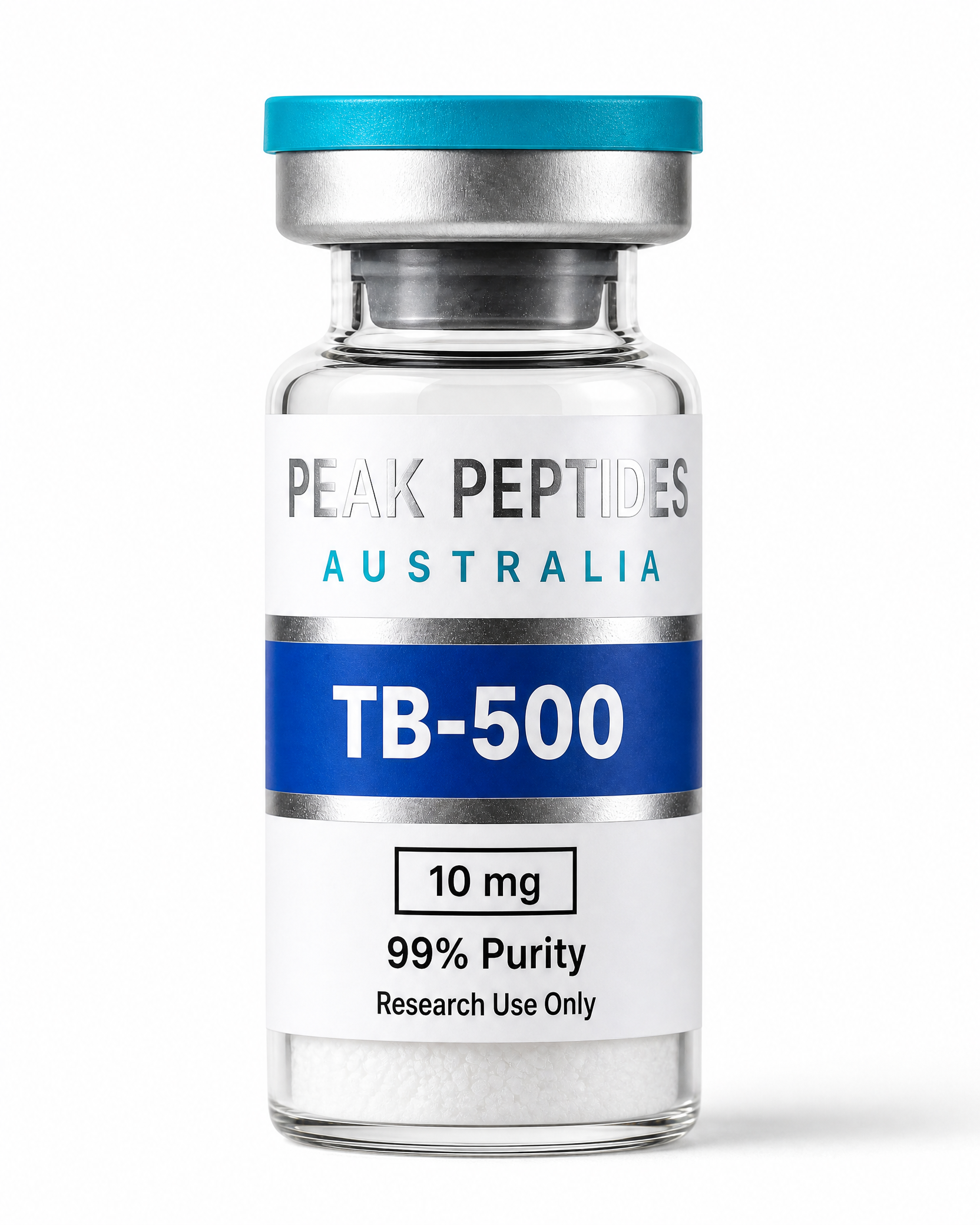
TB-500 10mg is a thymosin beta-4 fragment research vial. The name needs careful reading: the analytically identified TB-500 fragment is Ac-LKKTETQ, while much of the published wound and migration literature used full-length thymosin beta-4, a different 43-amino-acid material. This sample is backed by LabDoc report LD-FTNC for LC-MS identity, 99.49% HPLC purity and 9.47 mg measured content. In-stock orders receive same-day dispatch from Victoria after payment confirmation, with tracked Australia Post Express shipping Australia-wide.
Product Specifications
Full NameThymosin Beta-4 Fragment
Vial Size10mg
Purity99.49% HPLC (LD-FTNC, 9.47mg sample)
Legal Disclaimer
This product is sold strictly for in-vitro laboratory research purposes only. It is not a therapeutic good, is not approved by the TGA, and is not intended for human or animal consumption, injection, or any diagnostic or therapeutic use.
TB-500 identity, research and reconstitution guide · Updated 24 October 2026
TB-500 10mg — Fragment Identity, Research Context & Reconstitution Guide
TB-500 10mg is a freeze-dried research vial sold as a thymosin beta-4 fragment. The important point is identity: TB-500 has been analytically identified as Ac-LKKTETQ, an acetylated seven-amino-acid fragment corresponding to positions 17–23 of thymosin beta-4. It is not the same molecule as full-length thymosin beta-4, which has 43 amino acids. That distinction changes how published papers should be read. This page separates fragment evidence from full-length Tβ4 studies, records the independent test for this sample, compares the related BPC-157, Wolverine Stack and KLOW listings, and gives a concentration-maths photo guide using BAC water. Peak Peptides Australia supplies this material for in-vitro research only, not for human or animal use.
Also referred to in research or catalogue references as TB-500, TB 500, TB500, TB-500 peptide, TB500 peptide, Thymosin beta-4 fragment, Thymosin Beta 4 fragment, Tβ4 fragment, Ac-LKKTETQ, Ac LKKTETQ, LKKTETQ peptide.
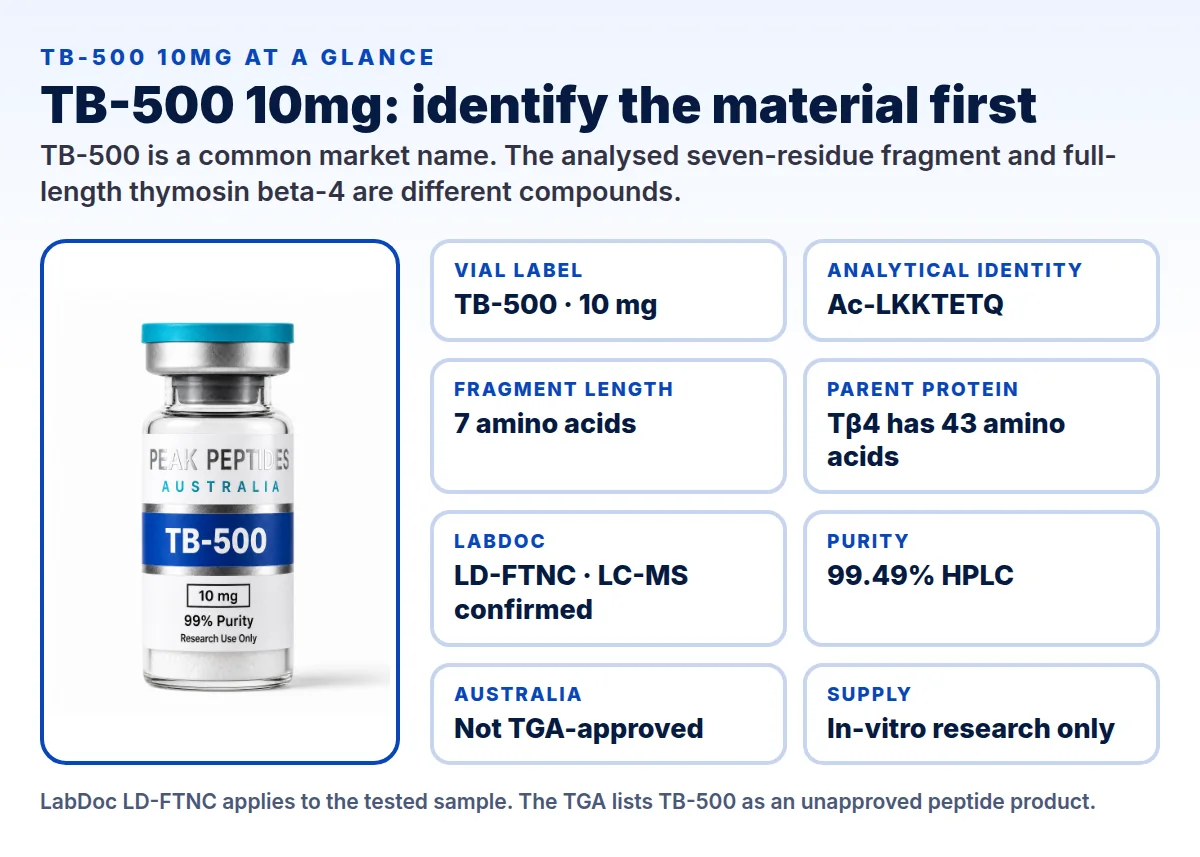
TB-500 10mg at a glance
Name on vial
TB-500 · 10 mg nominal manufacturer claim
Identity used in this guide
Ac-LKKTETQ, an N-terminally acetylated seven-residue fragment
Full sequence
Ac-Leu-Lys-Lys-Thr-Glu-Thr-Gln-OH
Relationship to Tβ4
Corresponds to residues 17–23 of full-length thymosin beta-4
Full-length Tβ4
A distinct 43-amino-acid peptide
CAS number
885340-08-9 for TB-500 free base
Human TB-500 evidence
FDA identified no clinical studies or human-exposure data for TB-500
Australia status
TGA lists TB-500 as an unapproved peptide product, not in the ARTG
This sample’s LabDoc report
LD-FTNC · tested 11 September 2026 · LC-MS identity Confirmed
This sample’s HPLC results
99.49% purity · 9.47mg content · 94.7% of the 10mg claim
Preparation chart example
3 mL BAC water = 3.33 mg/mL = 30 U-100 units for 1mg
Dispatch
Same-day from Victoria for in-stock orders after payment is confirmed, tracked Australia Post Express
TB-500 is Ac-LKKTETQ, not full-length thymosin beta-4
FDA material and analytical literature identify TB-500 free base as Ac-LKKTETQ: an N-terminally acetylated seven-amino-acid fragment corresponding to positions 17–23 of thymosin beta-4. Full-length thymosin beta-4 (Tβ4) is a separate 43-amino-acid peptide. A paper about one is not automatically evidence about the other.
Why the name needs an identity check
TB-500 is a common name rather than a standard drug name. FDA notes that different salts, derivatives and active moieties have been sold under that name. A 2023 analytical study also found that internet products called TB500 or TB1000 were not systematically consistent with former descriptions. Sequence and analytical documentation matter more than a label name alone.
What the 2003 motif study actually tested
Philp and colleagues studied full-length Tβ4, its fragments and synthetic peptides in human endothelial-cell migration and chick-aortic-arch sprouting assays. The LKKTETQ actin-binding motif showed near-identical activity to full-length Tβ4 at about 50 nM in those assays. These were cell and tissue-model observations, not a trial of a commercial 10mg TB-500 vial.
What the 1999 wound study actually tested
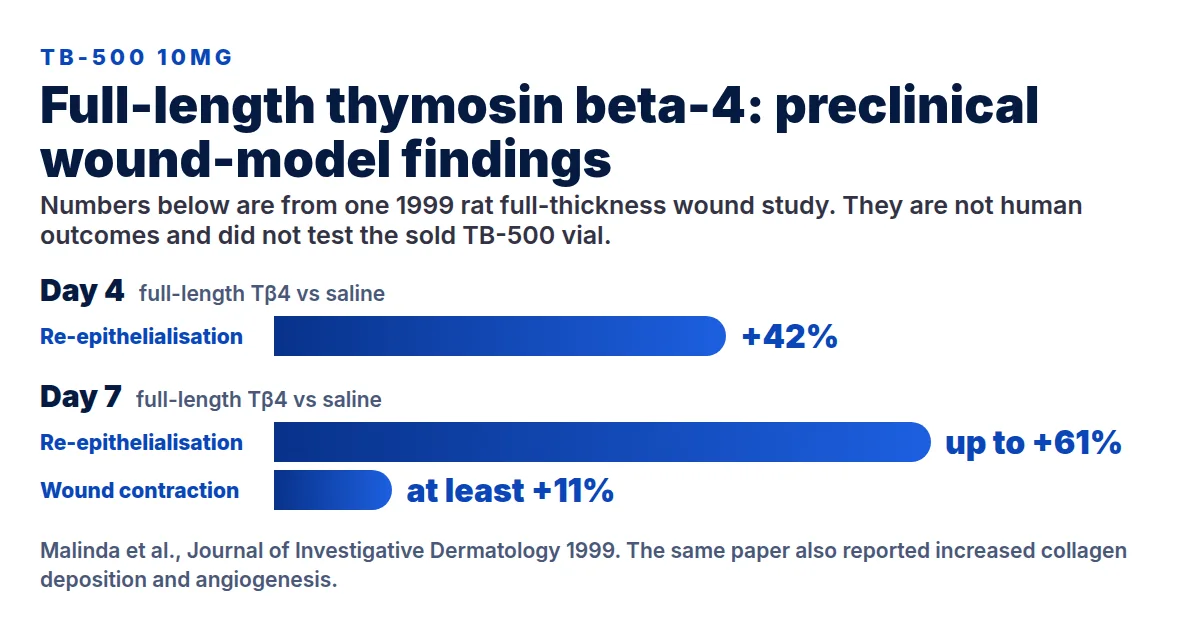
Malinda and colleagues used full-length thymosin beta-4 in a rat full-thickness wound model. They reported 42% more re-epithelialisation at day 4, up to 61% at day 7, and at least 11% more wound contraction by day 7 than saline controls. The study also reported increased collagen deposition and angiogenesis. It did not test Ac-LKKTETQ TB-500.
No FDA or TGA approval for TB-500
The TGA names TB-500 as an example of an unapproved peptide product, meaning it is not included in the Australian Register of Therapeutic Goods. FDA material says TB-500 free base and TB-500 acetate are not components of FDA-approved drugs. The FDA review also found no clinical studies or human-exposure data for TB-500 by any route.
Independent test for this TB-500 sample
LabDoc report LD-FTNC records a TB-500 (Thymosin Beta-4) sample received and tested on 11 September 2026. The report states LC-MS identity Confirmed, 99.49% purity by HPLC and 9.47mg HPLC content against the 10mg manufacturer claim, or 94.7% of claim. Its overall assessment is Pass. The report has no stated batch and covers the tested sample only.
3mL is the recommended mix
PeptideDosages uses 3 mL of bacteriostatic water for a 10mg TB-500 calculation example. That makes 3.33 mg per mL. On a U-100 syringe, 100 units equal 1 mL, so 10 units represent about 0.33mg and 30 units represent about 1mg.
Related listings are different products
BPC-157 10mg is a separate individual listing. Wolverine Stack is listed as a BPC-157 plus TB-500 blend. KLOW is a multi-component blend. Different ingredients, amounts and test records mean those formats are not the same material as this individual TB-500 10mg research vial.
TB-500 is a research name used for a thymosin beta-4 fragment. The precise identity matters because “TB-500” is not a standard drug name. FDA material describes TB-500 free base as Ac-Leu-Lys-Lys-Thr-Glu-Thr-Gln-OH, abbreviated Ac-LKKTETQ. It is seven amino acids long and has an acetyl group on its first amino acid.
The name points back to thymosin beta-4, a naturally occurring 43-amino-acid peptide. Ac-LKKTETQ corresponds to positions 17 through 23 inside that longer peptide. A fragment can share a sequence region with a larger peptide without becoming the same molecule. It has a different size, formulation and study history.
That is why this guide uses the phrase “the analysed TB-500 fragment” for Ac-LKKTETQ and “full-length Tβ4” for the 43-amino-acid peptide. The distinction keeps the page useful: it shows where the fragment is directly represented and where a paper is background from a related but different material.
TB-500 10mg at a glance: an analytically identified seven-residue fragment, distinct from full-length Tβ4.
TB-500, LKKTETQ and full-length thymosin beta-4: what is the difference?
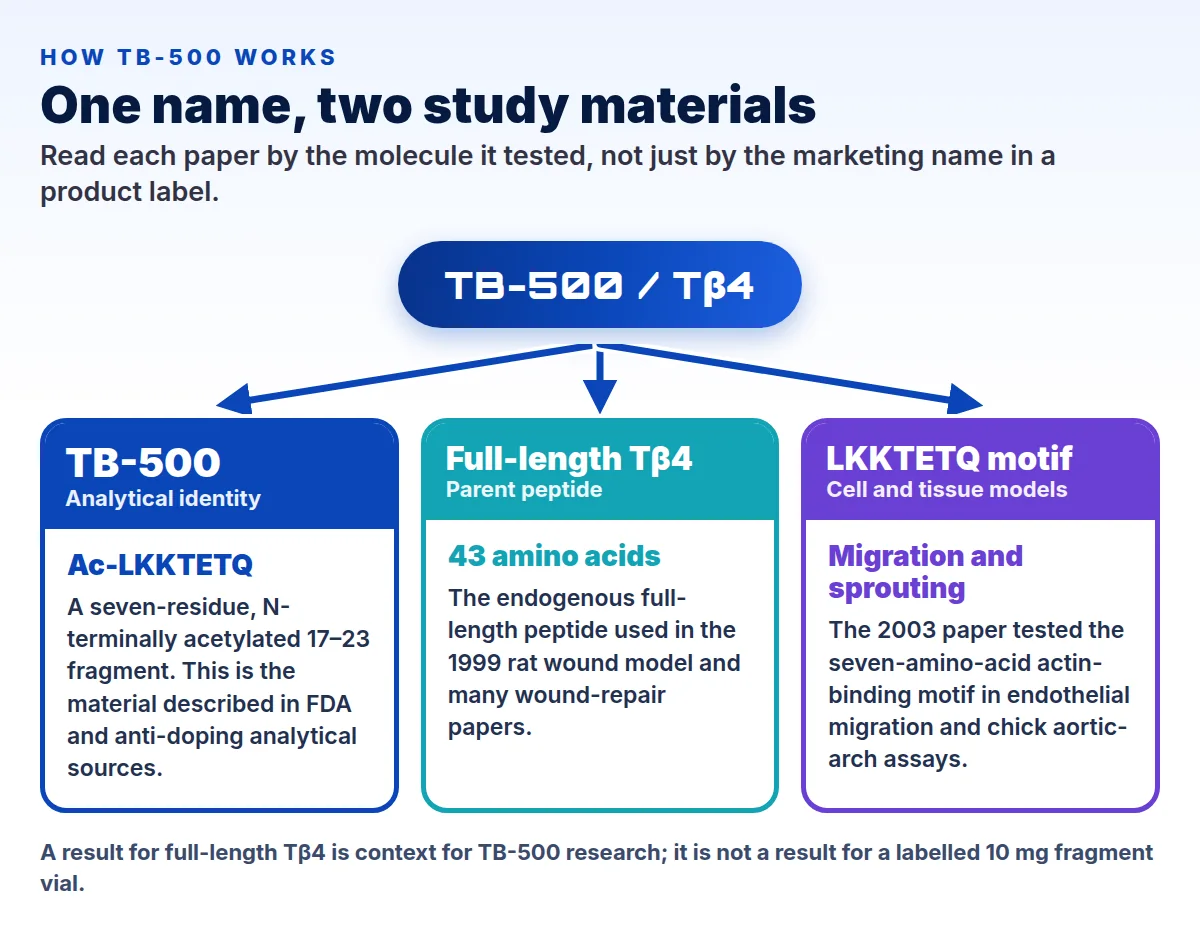
TB-500 as sold has been analytically identified as Ac-LKKTETQ. The “Ac” means N-terminal acetylation. LKKTETQ is the seven-amino-acid sequence. FDA identifies that sequence as a synthetic thymosin beta-4 fragment covering amino acids 17–23, while the FDA Global Substance Registration System lists the sequence as LKKTETQ with N-terminal acetylation.
Full-length thymosin beta-4 is a 43-amino-acid peptide. In the 2003 Philp paper, full-length Tβ4 and the seven-residue actin-binding motif were both tested in specific laboratory assays. In the 1999 Malinda paper, the material was full-length Tβ4 in a rat wound model. Those studies should not be retitled as trials of a commercial TB-500 10mg vial.
The distinction is also practical. FDA says TB-500 is a common name and notes different salts, derivatives and active moieties under that name. A 2023 analytical investigation found TB500/TB1000 products were not systematically consistent with earlier descriptions. For research records, identify the molecule, sample, method and lot-specific evidence before transferring conclusions from a paper.
One name can lead to two different study materials. The molecule used in each paper determines what its result means.
What did the research find?
The research most often cited in TB-500 discussions comes from two different experimental settings. First, Philp and colleagues used naturally occurring Tβ4, fragments and synthetic peptides in human endothelial-cell migration assays and chick-aortic-arch vessel-sprouting assays. The seven-amino-acid actin-binding motif showed near-identical activity to full-length Tβ4 at about 50 nM in those assays. That directly connects the LKKTETQ region to those laboratory observations.
Second, Malinda and colleagues used full-length Tβ4 in a rat full-thickness wound model. The paper reported 42% more re-epithelialisation than saline at day 4, up to 61% at day 7 and at least 11% more contraction by day 7. It also described increased collagen deposition and angiogenesis. Those are specific preclinical results for full-length Tβ4 in a specified model, not results for the seven-residue fragment or a human outcome.
FDA’s 2026 TB-500 review draws the line plainly: it found a lack of evidence to evaluate TB-500 effectiveness for wound healing and did not identify clinical studies or human-exposure data for TB-500. Reading the research accurately therefore means keeping sequence, model and material beside every claim.
Preclinical figures from one full-length Tβ4 rat wound study, not outcomes for TB-500 fragment or people.
What each frequently cited TB-500-related source actually studied
What each frequently cited TB-500-related source actually studied
Source
Material
Setting
What it reported
Philp et al., 2003
Full-length Tβ4 and synthetic/fragments including the LKKTETQ motif
Human endothelial-cell migration and chick-aortic-arch sprouting assays
The seven-amino-acid actin-binding motif had near-identical activity to full-length Tβ4 at about 50 nM in these assays.
Malinda et al., 1999
Full-length Tβ4
Rat full-thickness wound model
42% more re-epithelialisation at day 4; up to 61% at day 7; at least 11% more contraction at day 7.
FDA review, 2026
TB-500 free base and acetate
Regulatory evidence review
No clinical studies or human-exposure data identified; lack of evidence to evaluate effectiveness for wound healing.
The rows are intentionally separated by material. A full-length Tβ4 result is not a result for Ac-LKKTETQ unless the study tested Ac-LKKTETQ.
TB-500 vs BPC-157, Wolverine Stack and KLOW
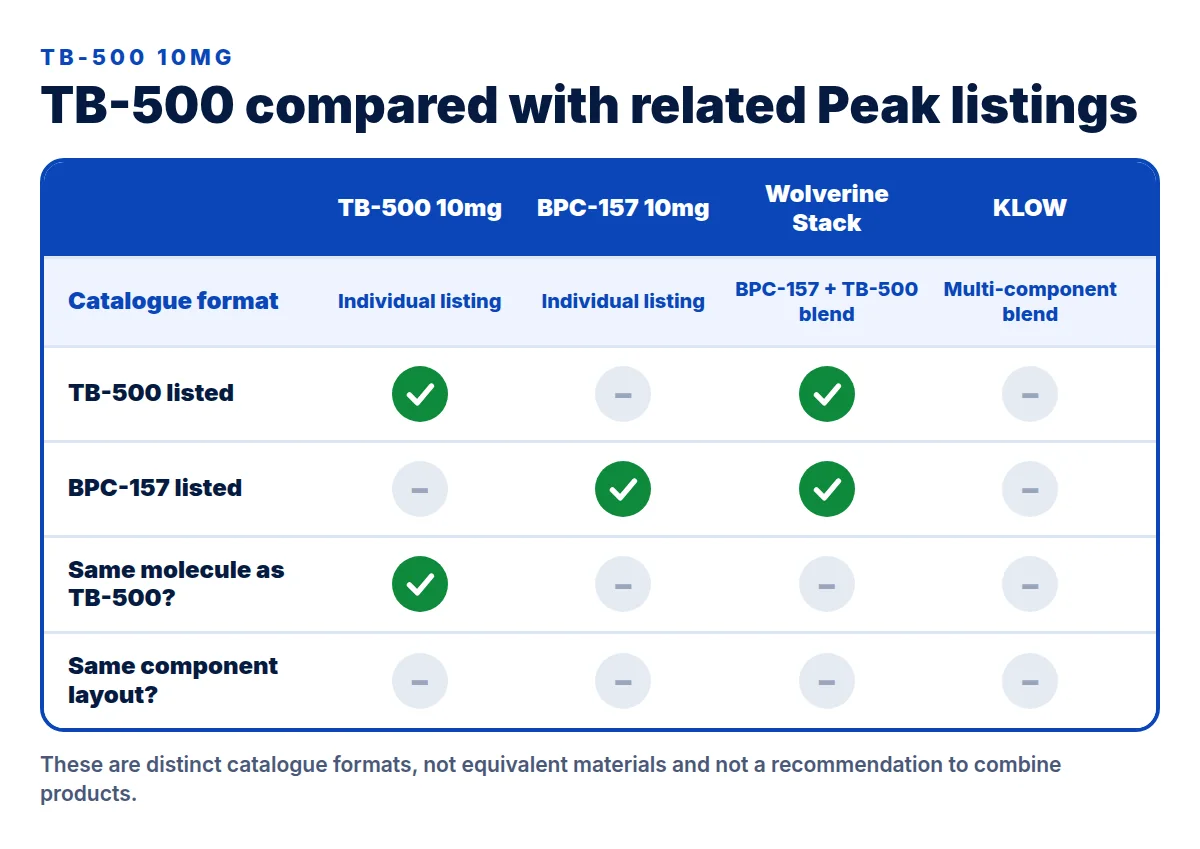
TB-500 10mg is an individual research listing. BPC-157 10mg is another individual listing, but it is not the same peptide and has its own sequence, literature and LabDoc record. Matching the milligram number on two labels does not make two peptides chemically or biologically equivalent.
Wolverine Stack is a different format because it is listed as a BPC-157 plus TB-500 blend. Its stated component layout is therefore different from one vial containing an individual TB-500 listing. KLOW is a multi-component blend and is different again. Each product should be read through its own stated composition and its own analytical record.
The comparison below is a catalogue-format map, not a recommendation to combine materials. It exists to answer a common search question clearly: a blend, a separate peptide and a multi-component product cannot stand in for the identity or testing record of this TB-500 10mg sample.
Related listings have different component layouts and are different research materials.
TB-500 10mg and related Peak Peptides Australia listings
TB-500 10mg and related Peak Peptides Australia listings
Listing
Format
Key identity point
Same material as this TB-500 vial?
TB-500 10mg
Individual listing
Research guide uses Ac-LKKTETQ fragment identity
Yes — this page
BPC-157 10mg
Individual listing
Different peptide with its own documentation
No
Wolverine Stack
Blend
Listed as BPC-157 plus TB-500
No — different component layout
KLOW
Multi-component blend
Different set of stated components
No
The table describes catalogue format only. It does not rank products or suggest a combination.
Independent lab test for this TB-500 10mg sample
LabDoc report LD-FTNC is the independent record linked for this listing. It identifies the tested sample as “TB-500 (Thymosin Beta-4)”, received and tested on 11 September 2026. The sample description is lyophilised powder in a vial. The report states that no batch was provided.
The report records LC-MS identity as Confirmed. LC-MS, short for liquid chromatography–mass spectrometry, separates a sample and checks its mass pattern. It records 99.49% purity by HPLC and 9.47mg content by HPLC against the 10mg manufacturer claim. That works out to 94.7% of the label claim. The overall assessment is Pass.
A report is strongest when it is read for the exact sample it covers. LabDoc states that LD-FTNC covers the tested sample only. It is analytical documentation, not an approval decision, a sequence certificate for every TB-500-labelled vial, or a finding that every vial has identical content or condition.
Report ID: LD-FTNC.
Sample received and tested: 11 September 2026.
Sample name: TB-500 (Thymosin Beta-4).
Identity: Confirmed by LC-MS.
Purity: 99.49% by HPLC.
Content: 9.47mg by HPLC; 94.7% of the 10mg manufacturer claim.
Overall assessment: Pass.
Batch: not stated; report covers the tested sample only.
Buying TB-500 10mg in Australia
Peak Peptides Australia supplies TB-500 10mg for in-vitro research only. The TGA names TB-500 among unapproved peptide products. It says an unapproved peptide product is not included in the Australian Register of Therapeutic Goods and has not been evaluated by the TGA for safety, quality or effectiveness. FDA materials also say TB-500 free base and acetate are not components of FDA-approved drugs.
For operational details, in-stock orders receive same-day dispatch from Victoria once payment is confirmed, travel with tracked Australia Post Express and have a tracking number emailed. The product page should be read alongside its independent report: LabDoc LD-FTNC names the tested sample, methods, dates and analytical results.
If the research task needs a related but distinct catalogue material, compare the individual BPC-157 10mg listing, Wolverine Stack and KLOW by stated ingredients and their own documentation. Do not transfer the Ac-LKKTETQ identity or LD-FTNC result to a different listing.
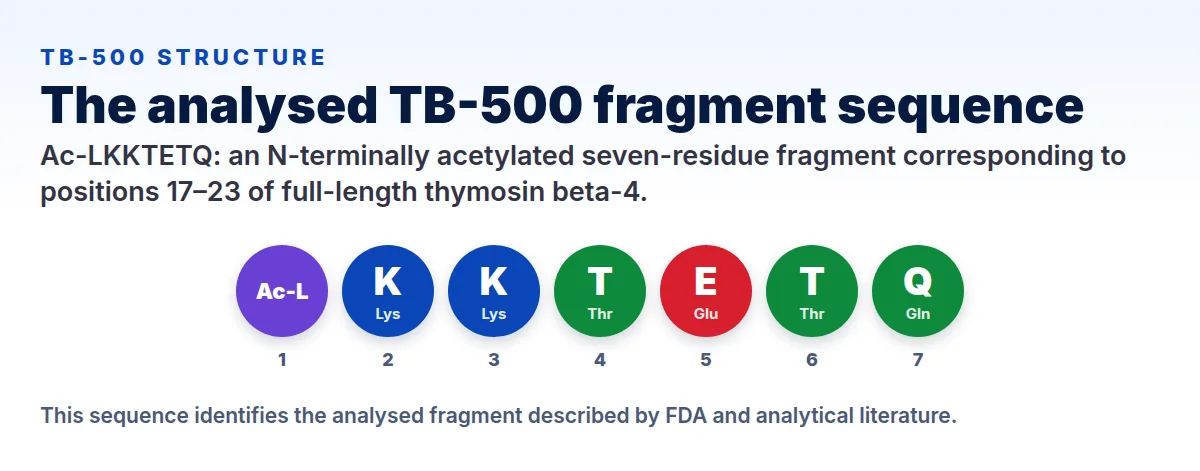
The Ac-LKKTETQ fragment sequence
The sequence in the graphic is the analysed TB-500 free-base fragment described by FDA: Ac-LKKTETQ. The seven sequence letters are L, K, K, T, E, T and Q. Ac marks the acetyl group at the N-terminal leucine. This is a compact way to identify a study material more accurately than a broad market name.
The fragment is a run of residues 17 through 23 within full-length thymosin beta-4. It therefore contains the actin-binding motif described in the 2003 paper. The position inside a parent peptide explains the relationship; it does not erase the difference between a seven-residue fragment and a 43-residue full-length molecule.
This structure section describes the analytically identified TB-500 fragment cited by FDA and published analytical literature. LabDoc LD-FTNC records LC-MS identity Confirmed for the sample it tested.
Ac-LKKTETQ is the analysed seven-residue fragment described as TB-500 free base.
Step-by-step guide · About 10 minutes
How to reconstitute TB-500 10mg (8-step photo guide)
TB-500 10mg arrives as dry, freeze-dried powder. Reconstitution means adding bacteriostatic (BAC) water to make a measurable reference solution. PeptideDosages uses 3 mL for a 10mg TB-500 calculation example, giving 3.33 mg/mL. The steps below illustrate clean handling and concentration maths. Record the final volume, calculated concentration, preparation date and sample documentation with the vial.
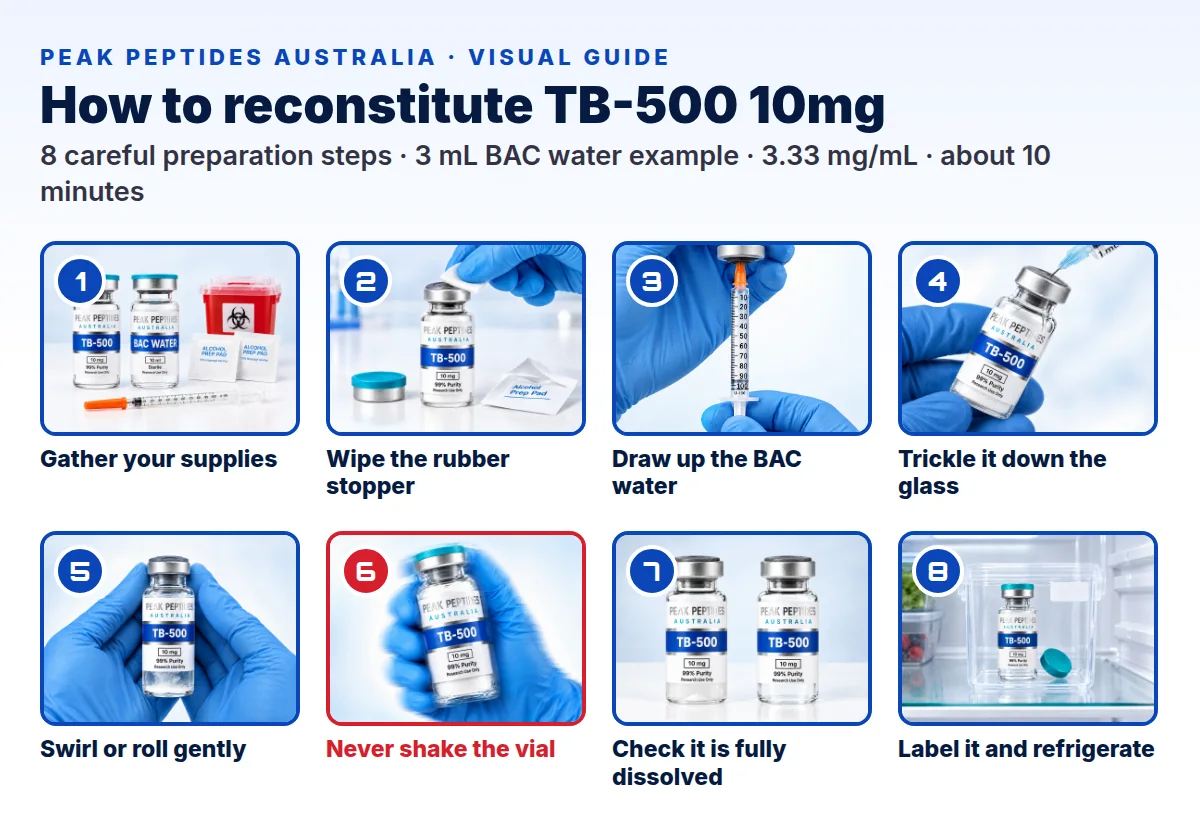
The complete TB-500 10mg preparation sequence at a glance.
What you need
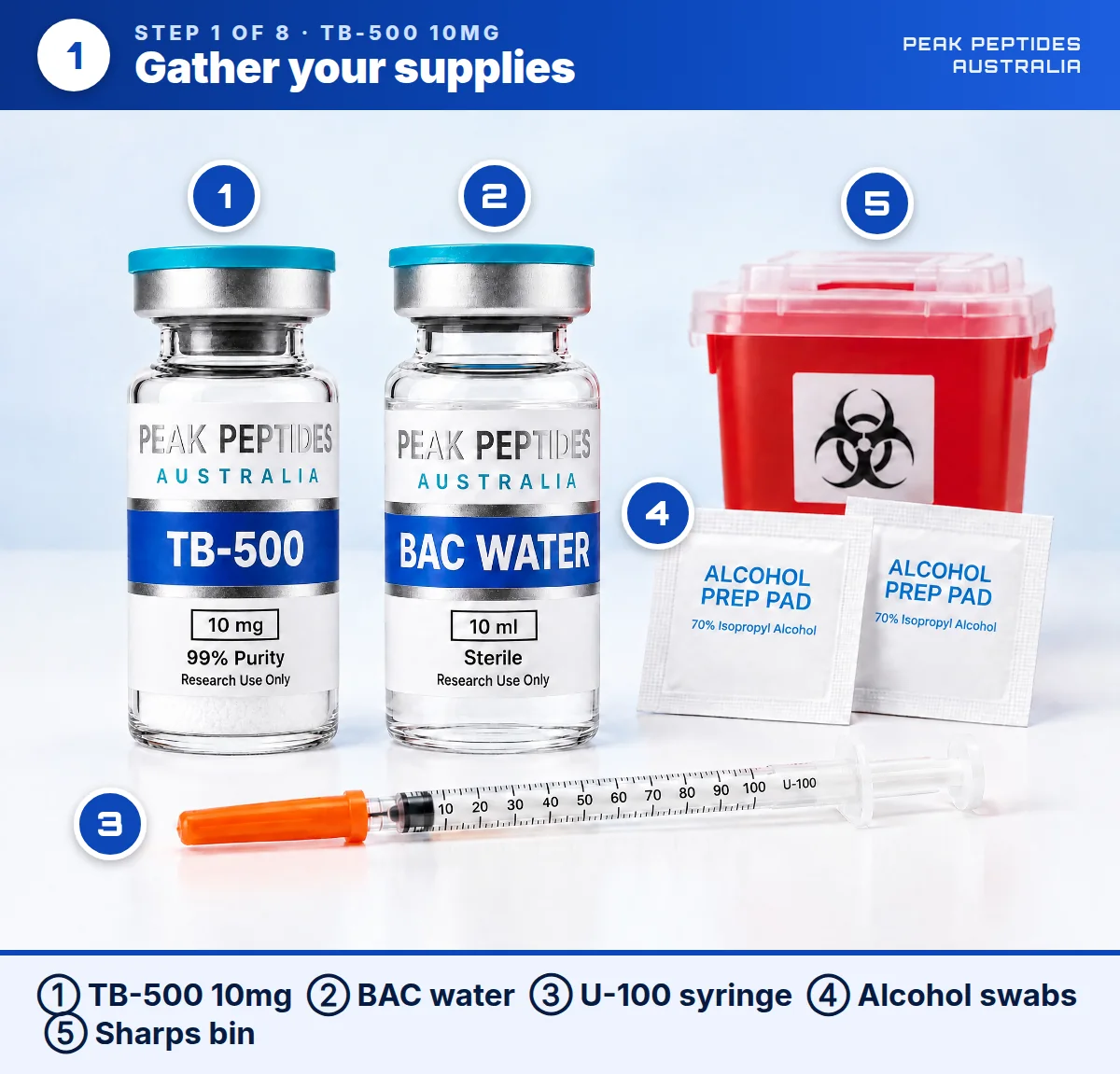
TB-500 10mg vialFreeze-dried powder in a sealed glass vial; retain the linked LabDoc sample record.
Bacteriostatic waterThe diluent used in the PeptideDosages 3mL TB-500 calculation example.
1mL U-100 syringeA measurement tool: 100 units equals 1mL, so 1 unit equals 0.01mL.
Alcohol swabsFor cleaning the vial stoppers before preparation.
Preparation recordWrite the final volume, concentration, date and sample identifier alongside the vial.
How much BAC water for TB-500 10mg?
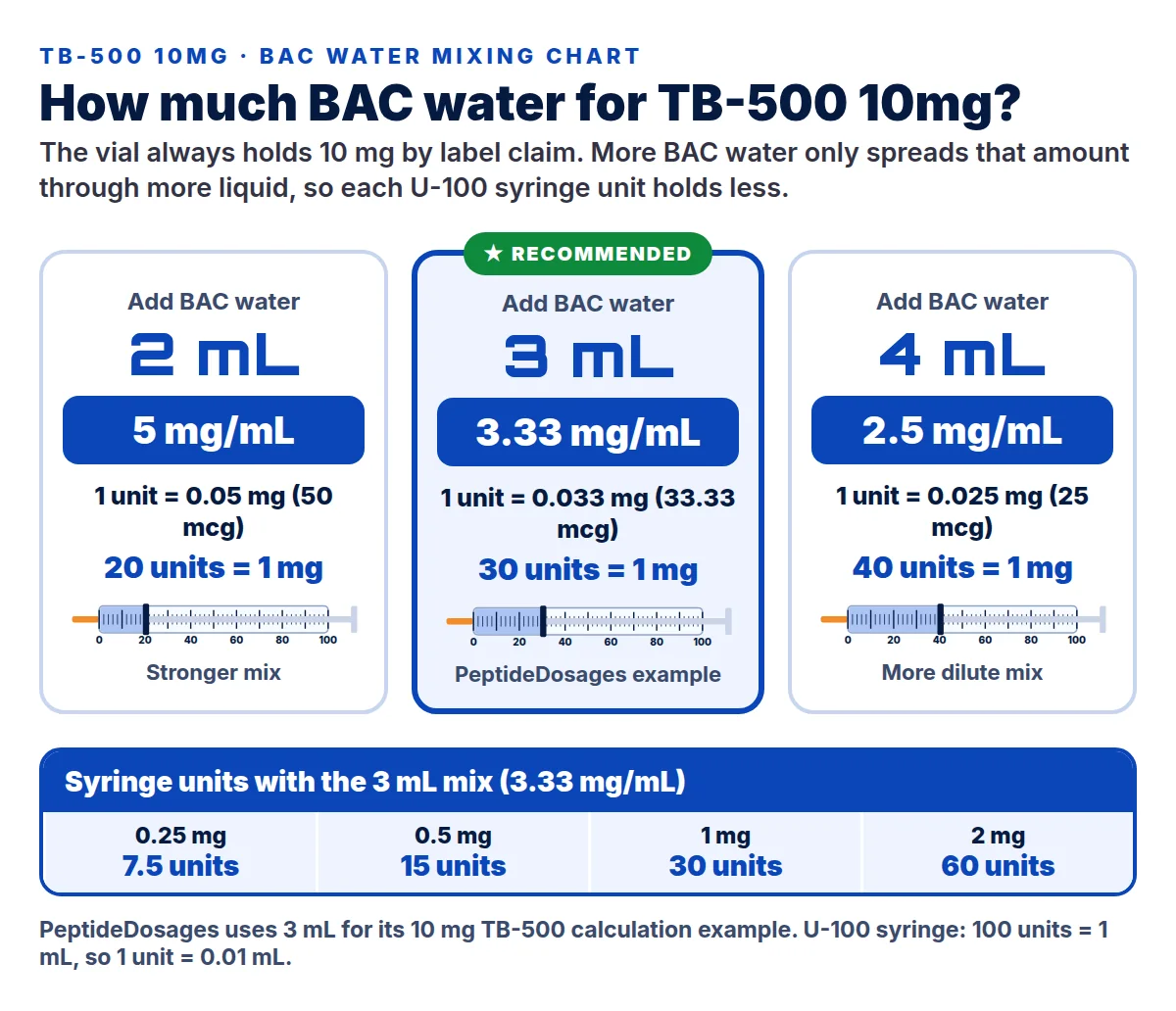
The 10mg label claim does not change when water volume changes. Adding more BAC water spreads the same stated mass through more liquid. The key calculation is concentration: 10mg divided by final volume. On a U-100 syringe, 100 units equal 1mL, so one unit is 0.01mL.
PeptideDosages uses 3mL BAC water for its TB-500 10mg calculation example. That produces 3.33 mg/mL. With this mix, 1mg equals 30 units, 0.5mg equals 15 units, 0.25mg equals 7.5 units and 2mg equals 60 units. The chart uses those exact concentration figures.
TB-500 10mg concentration chart. The 3mL example produces 3.33 mg/mL.
3 mL is highlighted because it gives the simplest numbers.
Syringe units with the 3 mL mix (3.33 mg/mL)
Syringe units with the 3 mL mix (3.33 mg/mL)
Amount
Units on a U-100 syringe
Volume
0.25 mg
7.5 units
0.075 mL
0.5 mg
15 units
0.15 mL
1 mg
30 units
0.3 mL
2 mg
60 units
0.6 mL
The 8 steps
1Step 1: Gather your supplies
Set out the TB-500 10mg vial, BAC water, a clean 1mL U-100 syringe, alcohol swabs and a preparation record on a clean surface. Check the vial label and retain the linked LD-FTNC report details with the sample record. For the illustrated 3mL example, the final concentration will be 3.33 mg/mL.
2Step 2: Wipe the rubber stopper
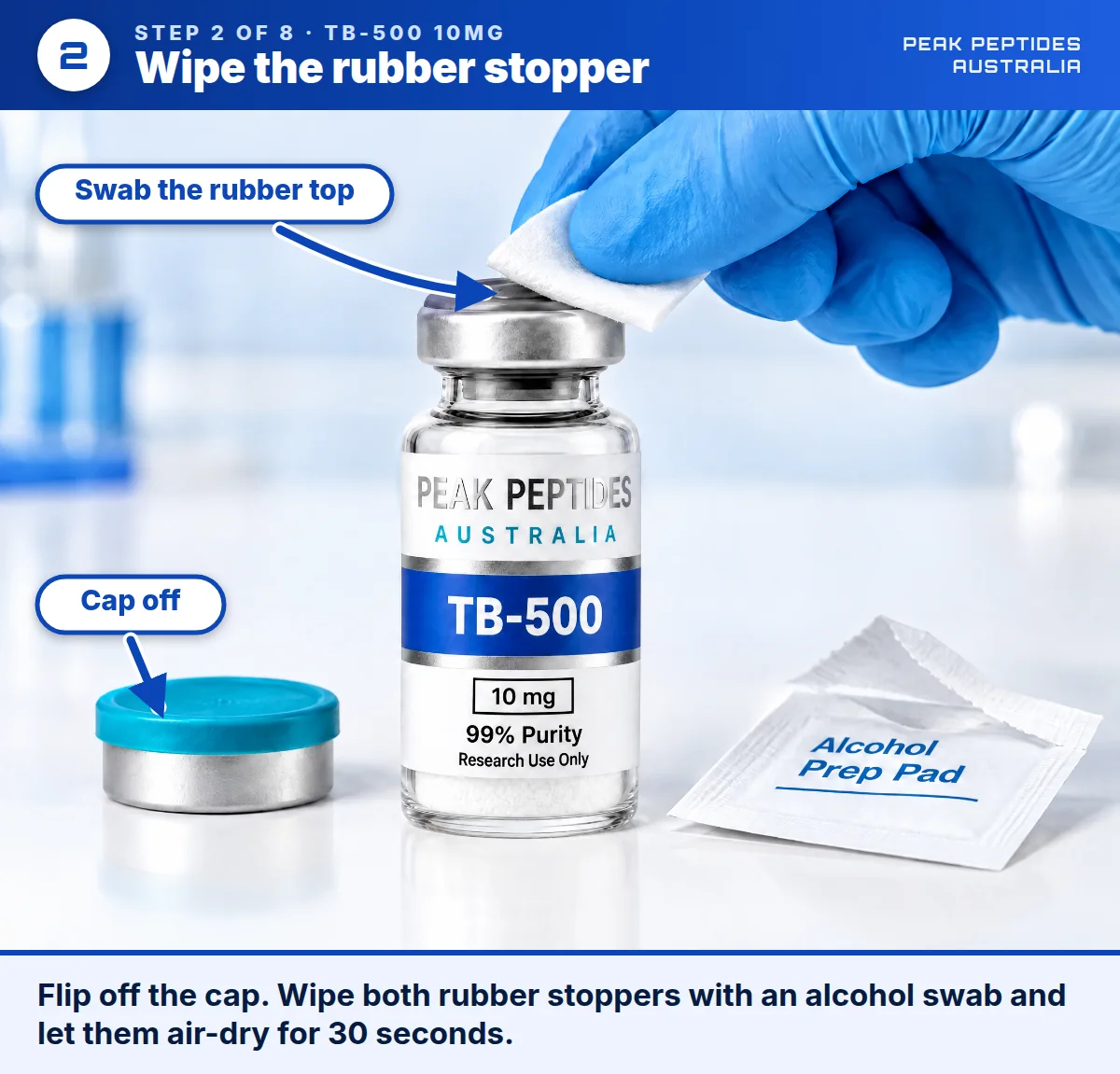
Remove the flip-off cap if present. Use a fresh alcohol swab on the rubber stopper of the TB-500 vial and the BAC-water vial, then let both surfaces air-dry. Avoid touching the cleaned stopper afterwards. This keeps the preparation sequence orderly and leaves the vial label and sample record easy to check.
3Step 3: Draw up the BAC water
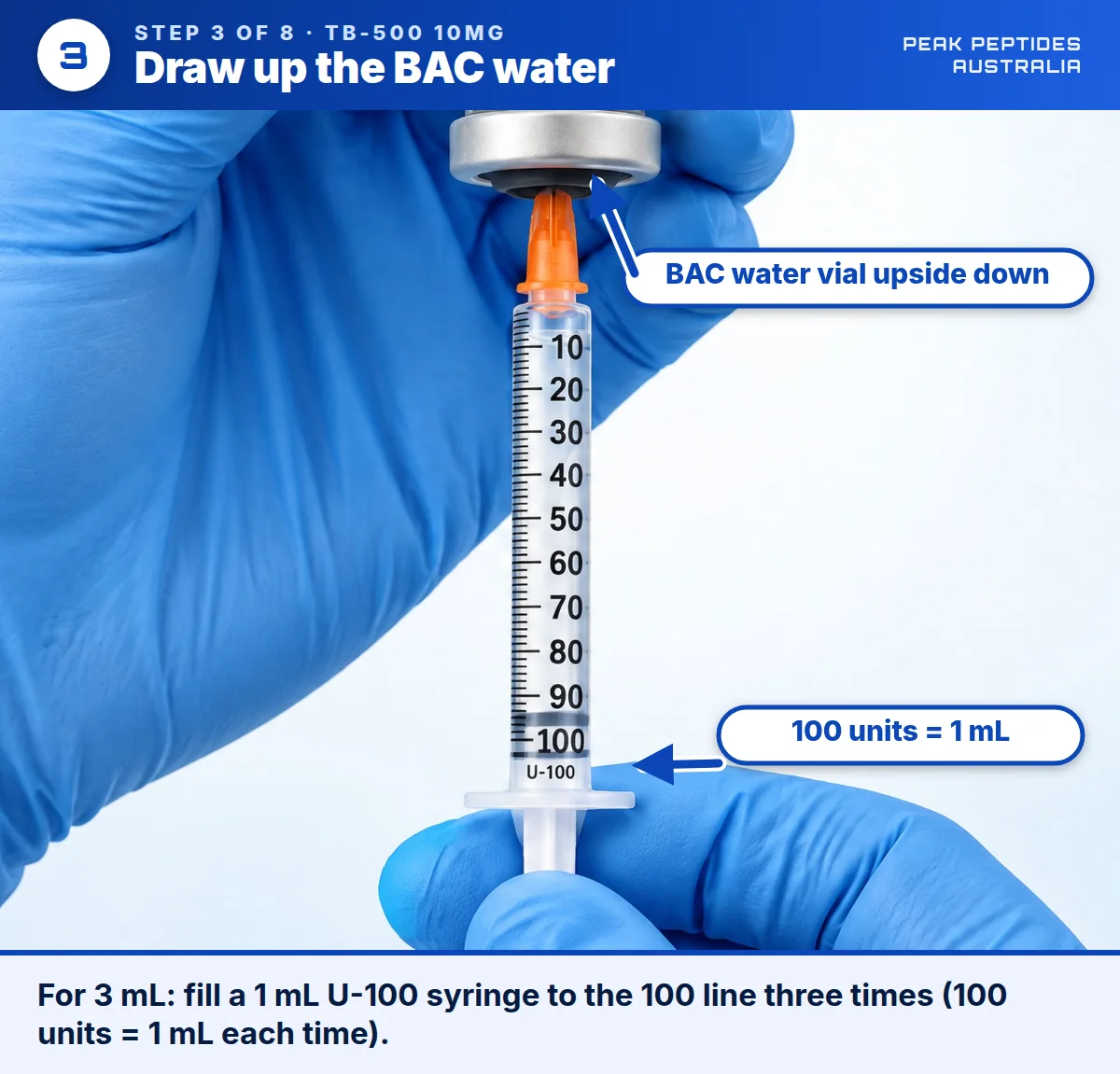
Use the syringe as a volume measure. A 1mL U-100 syringe has 100 units, so the 100-unit line is 1mL. The illustrated 3mL calculation example requires three separate 1mL fills. Keep the total final volume in the preparation record, because it sets every later concentration calculation.
4Step 4: Trickle it down the glass
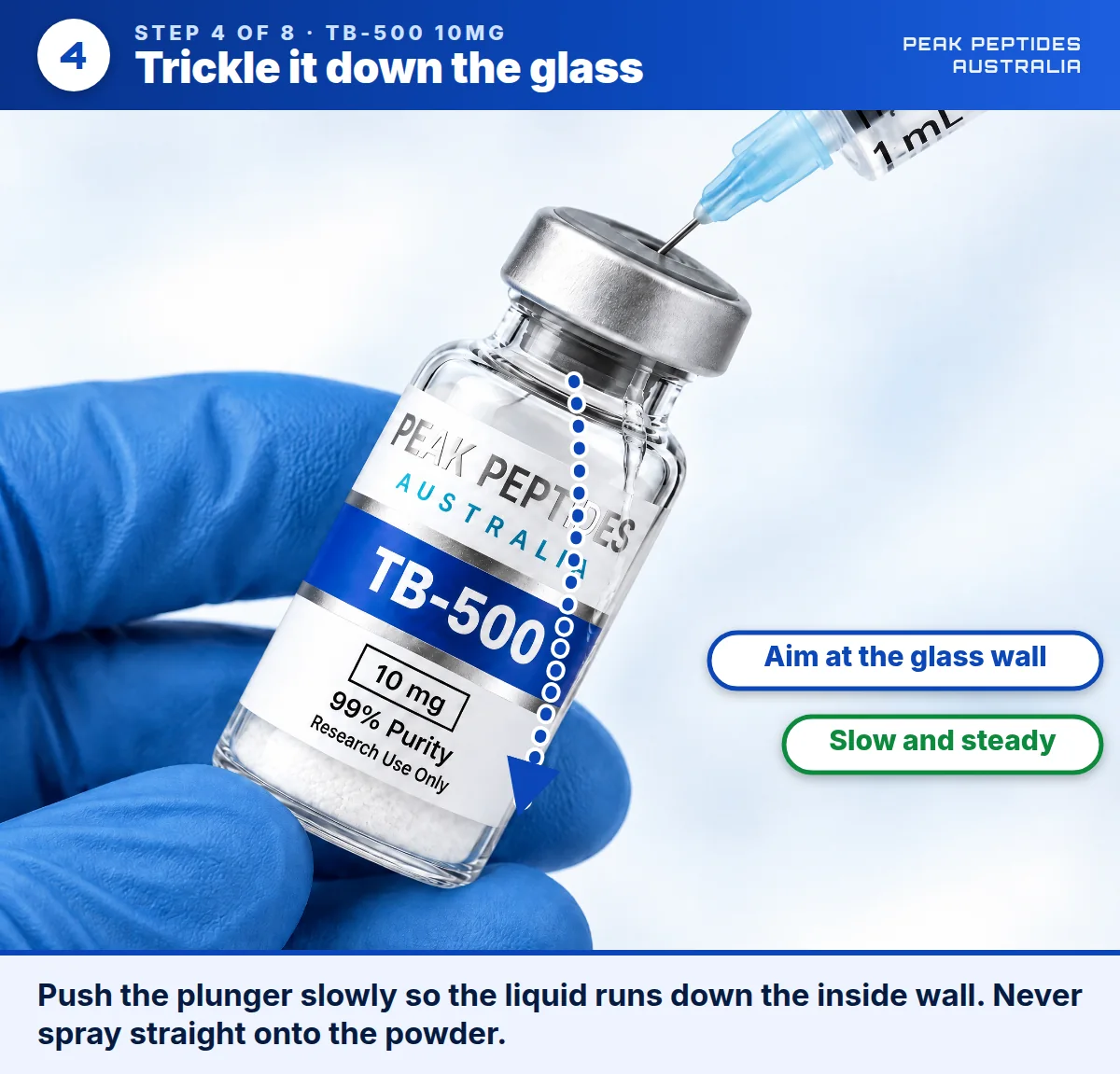
Place the needle through the TB-500 stopper at an angle so the liquid runs down the inside glass wall. Add the water slowly rather than directing a hard stream onto the powder. Repeat the measured addition until the chosen total volume is reached. The concentration chart on this page uses 3mL as the reference example.
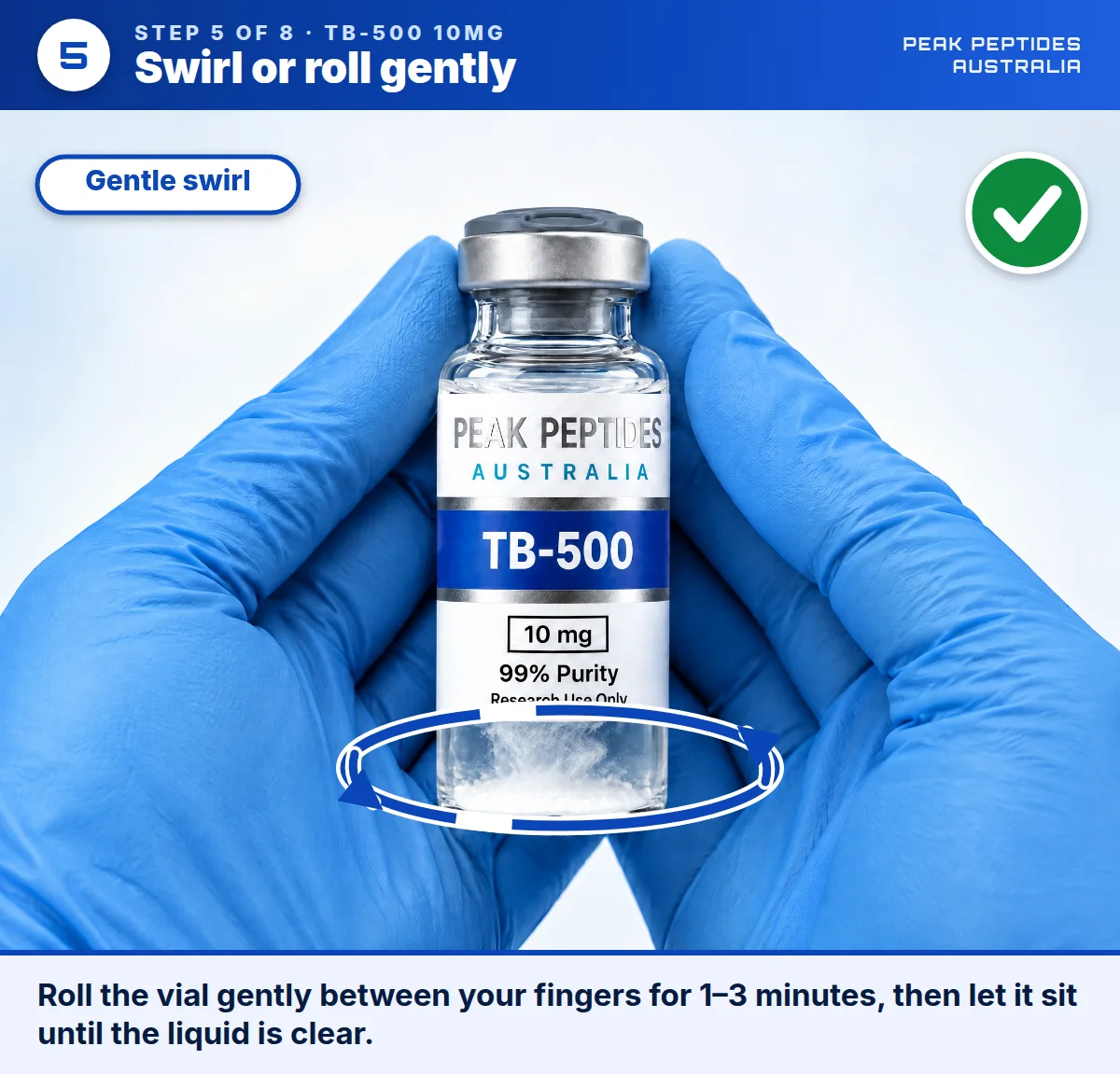
5Step 5: Swirl or roll gently
Gently swirl or roll the vial so the powder can dissolve. Avoid vigorous movement. A little white material may remain while the solution is dissolving, so give it time and repeat the gentle swirl. Keep the sample’s preparation record with the vial rather than relying on a concentration remembered later.
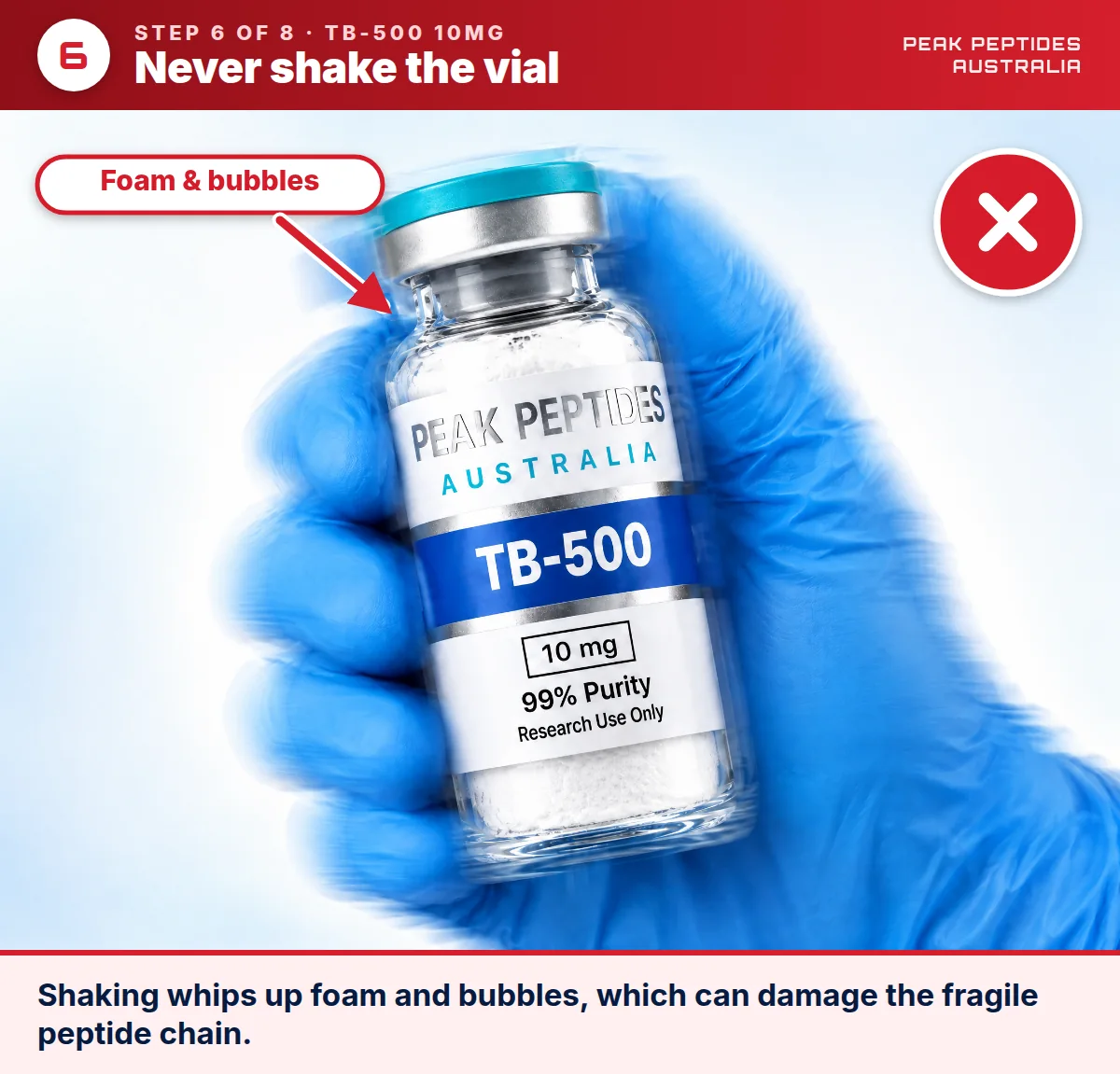
6Step 6: Never shake the vial
Do not shake the vial. Shaking can create foam and bubbles, which makes visual inspection harder and can stress a peptide solution. If foam appears, stand the vial upright and allow it to settle before checking clarity. A clear visual result is the preparation endpoint shown in the next step.
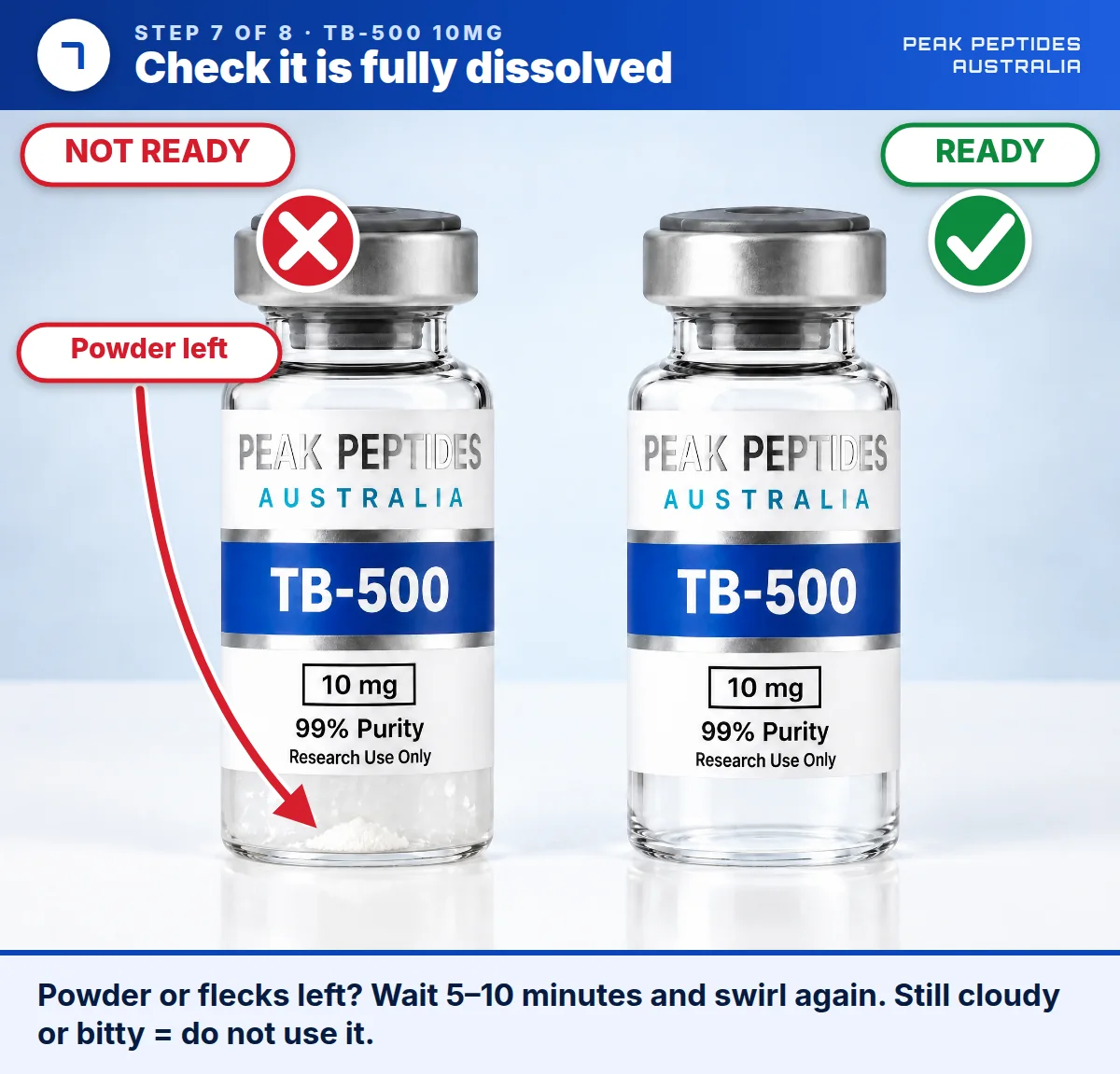
7Step 7: Check it is fully dissolved
Hold the vial up to good light and inspect it. The ready reference solution should be clear, without visible powder, flecks or cloudiness. If material remains, wait briefly and swirl gently again. Unexpected particles, persistent cloudiness, discoloration, leakage or a damaged container are integrity issues, not a clear preparation endpoint.
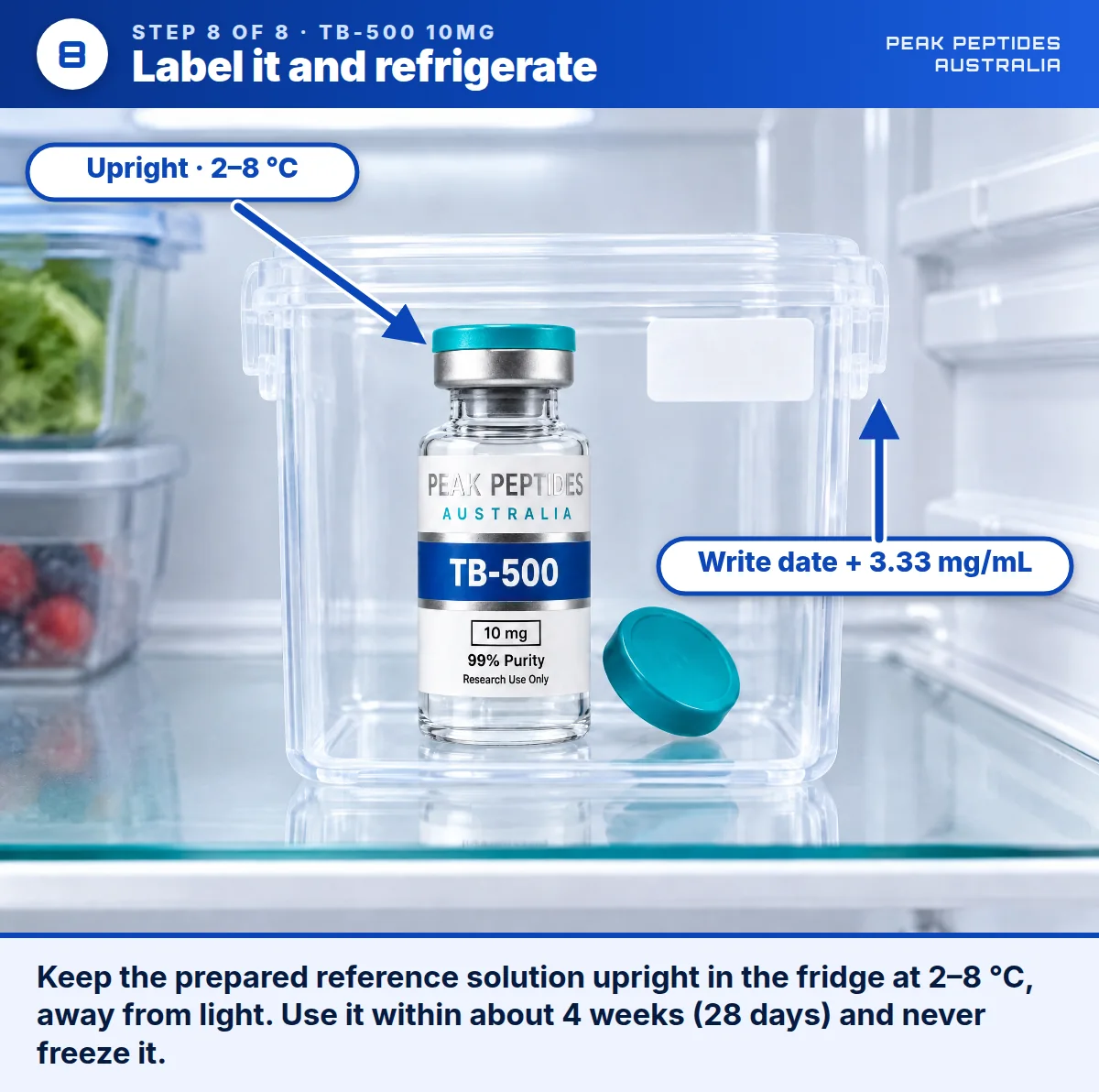
8Step 8: Label it and refrigerate
Write the date, final volume and calculated strength on the vial: 3.33 mg/mL for the 3mL example. Keep the mixed solution upright in the fridge at 2–8 °C, away from light. Use it within about 4 weeks (28 days) and never freeze it.
TB-500 10mg storage and handling record
TB-500 handling information supported by the available sources
TB-500 handling information supported by the available sources
Stage
Supported direction
What is not claimed
Tested sample
LabDoc describes LD-FTNC as lyophilised powder in a vial.
No batch identifier. Use within about 4 weeks (28 days).
Before preparation
Keep sample label and analytical record together; mixed vial upright at 2–8 °C, away from light; use within about 4 weeks (28 days); never freeze.
Keep unopened powder in the fridge at 2–8 °C in the dark (freezer −20 °C for long-term).
Prepared reference solution
PeptideDosages describes refrigeration at 2–8 °C and protection from light.
Within about 4 weeks (28 days)
Solution inspection
Check for a clear solution without unexpected particles, discoloration, leakage or lost container integrity.
Visual inspection is not analytical confirmation of identity or purity.
FDA notes peptide stability depends on formulation, process, temperature, concentration, impurities and environmental stress. Once mixed with BAC water, keep upright at 2–8 °C away from light; use within about 4 weeks (28 days). Never freeze.
TB-500 is a common research name for an N-terminally acetylated seven-amino-acid fragment of thymosin beta-4: Ac-LKKTETQ. FDA describes it as a synthetic fragment spanning positions 17–23 of the full-length protein. It is not the same molecule as full-length thymosin beta-4.
Is TB-500 the same as thymosin beta-4?
No. TB-500 as analytically identified is Ac-LKKTETQ, a seven-amino-acid acetylated fragment. Full-length thymosin beta-4, often written Tβ4, is a 43-amino-acid peptide. The molecules share a sequence region but have different size, structure and research histories.
What does Ac-LKKTETQ mean?
Ac-LKKTETQ is a sequence name. Ac means an acetyl group is attached at the N-terminus. The seven letters name the amino-acid sequence: leucine, lysine, lysine, threonine, glutamic acid, threonine and glutamine. FDA identifies this sequence as TB-500 free base.
What is TB500 peptide also called?
Common search variants are TB-500, TB 500, TB500, TB-500 peptide and thymosin beta-4 fragment. Ac-LKKTETQ and LKKTETQ identify the sequence family more precisely. Thymosin beta-4 without the word fragment normally means the full-length 43-amino-acid peptide in scientific papers.
What is TB-500 used for in research?
TB-500 is discussed in actin-binding, cell migration, vessel-sprouting and wound-repair research because LKKTETQ is the actin-binding region of thymosin beta-4. The published studies must be read by material: some tested the seven-residue motif, while many wound-model studies tested full-length Tβ4 instead.
How does the TB-500 fragment relate to actin?
The LKKTETQ region is described as the actin-binding motif of thymosin beta-4. In the 2003 Philp study, this seven-amino-acid motif was essential for the angiogenic activity reported in endothelial migration and chick-aortic-arch sprouting assays. That is a laboratory mechanism finding, not a human outcome.
What did studies find for the TB-500 fragment itself?
The 2003 study found that a seven-amino-acid actin-binding motif of thymosin beta-4 produced near-identical activity to full-length Tβ4 at about 50 nM in human endothelial-cell migration and chick-aortic-arch sprouting assays. It did not study a labelled 10mg vial or human outcomes.
What did full-length thymosin beta-4 studies find?
A 1999 rat full-thickness wound study of full-length Tβ4 reported 42% more re-epithelialisation at day 4, up to 61% at day 7, and at least 11% more contraction by day 7 than saline controls. Those figures belong to full-length Tβ4 in that preclinical model, not TB-500 fragment.
Have human studies established TB-500 fragment use?
No. The FDA’s 2026 review states it did not identify clinical studies or human-exposure data for TB-500 through any route. Human studies of full-length or recombinant thymosin beta-4 used different material and formulations from this fragment vial.
What side effects were reported in TB-500 studies?
FDA states that it did not identify clinical studies or human-exposure data for TB-500, so there is no published human side-effect profile for the fragment. The TGA says unapproved peptide products have not been evaluated for safety, quality or effectiveness and notes risks such as uncertain ingredients, contamination and inaccurate labelling.
What is the half-life of TB-500?
No verified half-life is stated for this product in the supplied documentation, so this page does not assign one. A half-life depends on the exact molecule, formulation, route and study conditions. Full-length thymosin beta-4 data should not be presented as a half-life for Ac-LKKTETQ.
Is TB-500 approved by the TGA or FDA?
No. The TGA names TB-500 as an unapproved peptide product, meaning it is not included in the Australian Register of Therapeutic Goods. FDA material says TB-500 free base and TB-500 acetate are not components of FDA-approved drugs. This vial is supplied for in-vitro research only.
Can I buy TB-500 10mg online in Australia?
TB-500 10mg can be ordered online from Peak Peptides Australia when available as a research material. Same-day dispatch from Victoria applies to in-stock orders once payment is confirmed. Orders travel by tracked Australia Post Express and the tracking number is emailed. It is supplied for in-vitro research only.
How fast is TB-500 shipping in Australia?
In-stock orders receive same-day dispatch from Victoria once payment is confirmed. Peak Peptides Australia sends them with tracked Australia Post Express and emails the tracking number. Delivery timing after dispatch is handled by Australia Post and depends on the destination and their network.
How do I know TB-500 is real?
Start with identity evidence, not a label alone. A useful record names the tested material, identifies the method and can be verified at the reporting organisation. This listing links LabDoc report LD-FTNC, which states LC-MS identity Confirmed, 99.49% HPLC purity and 9.47mg HPLC content for the tested sample.
How is this TB-500 10mg sample verified?
LabDoc report LD-FTNC records a sample named TB-500 (Thymosin Beta-4), received and tested 11 September 2026. It reports identity Confirmed by LC-MS, 99.49% purity by HPLC and 9.47mg content by HPLC against a 10mg claim. The report’s overall assessment is Pass and it covers the tested sample only.
What does the 10mg label mean?
The 10mg label is the manufacturer’s nominal mass claim for the vial. LabDoc LD-FTNC measured 9.47mg by HPLC in its tested sample, equal to 94.7% of that claim. Milligrams describe mass. TB-500 and full-length Tβ4 are different compounds.
How does TB-500 compare with BPC-157?
TB-500 and BPC-157 are different research peptides. TB-500 is identified as the Ac-LKKTETQ thymosin beta-4 fragment, whereas BPC-157 is a separate peptide with its own literature and LabDoc record. They have different names, sequences, reported research and milligram quantities.
What is the difference between TB-500 and Wolverine Stack?
TB-500 10mg is an individual listing. Wolverine Stack is listed as a blend containing BPC-157 and TB-500, with a different composition and its own documentation. A blend cannot be treated as the same material as a single-component TB-500 vial, even where both names include TB-500.
What is the difference between TB-500 and KLOW?
TB-500 10mg is an individual thymosin beta-4 fragment listing. KLOW is a multi-component blend. It is therefore a different catalogue format with different stated ingredients and an independent report. Neither its total milligrams nor its research context should be substituted for the TB-500 10mg facts on this page.
How much BAC water for TB-500 10mg?
PeptideDosages uses 3 mL bacteriostatic water for its 10mg TB-500 calculation example. That concentration is 3.33 mg/mL. The chart also shows 2 mL and 4 mL alternatives: 5 mg/mL and 2.5 mg/mL. The amount of material by label claim remains 10mg whichever volume is used.
How many units is 1mg of TB-500?
It depends on the final volume. With the 3 mL example, the concentration is 3.33 mg/mL, so 1mg is 30 units on a U-100 syringe. With 2 mL it is 20 units, and with 4 mL it is 40 units. These are volume conversions only.
How many mg are in 10 units of TB-500?
With the 3 mL example, 10 units are 0.10 mL and contain about 0.33mg. With 2 mL, 10 units contain 0.5mg. With 4 mL, 10 units contain 0.25mg. A U-100 unit is a volume marking: 100 units equal 1mL.
How do I reconstitute TB-500 10mg?
The illustrated laboratory-preparation sequence is: clean the stoppers, measure BAC water, let it run gently down the vial wall, then swirl rather than shake until the solution is clear. The page’s 3mL chart gives 3.33 mg/mL. Record the final volume, concentration, date and sample record.
Can I use sterile or tap water instead of BAC water?
Do not use tap water. PeptideDosages’ TB-500 preparation example specifies bacteriostatic water. Plain sterile water and BAC water are different materials because BAC water contains a preservative. Once mixed, keep it upright in the fridge at 2–8 °C, away from light, use it within about 4 weeks (28 days) and never freeze it.
What if TB-500 powder does not dissolve?
Let the vial stand and swirl gently again. Do not shake it because shaking creates foam and can stress a peptide solution. The photo guide uses a clear solution with no visible particles as the inspection point. If unexpected cloudiness, particles, discoloration, leakage or lost container integrity are present, do not treat the preparation as acceptable.
Should reconstituted TB-500 be cloudy?
No. The handling guide uses a clear solution with no visible powder, flecks or cloudiness as the endpoint for a fully dissolved preparation. Persistent cloudiness or visible particles can mean the material has not dissolved or the solution has an integrity problem.
How long does reconstituted TB-500 last?
Keep material mixed with BAC water upright in the fridge at 2–8 °C, away from light. Use it within about 4 weeks (28 days) and never freeze it. Write the date and strength on the vial. PeptideDosages says to refrigerate prepared material at 2–8 °C and protect it from light. FDA notes that peptide stability depends on formulation, process and environmental conditions.
How should unopened TB-500 powder be stored?
The product-specific LabDoc record describes the tested sample as lyophilised powder. Keep the record and label with the sample. Store unopened powder in the fridge at 2–8 °C in the dark (freezer −20 °C for long-term). PeptideDosages describes refrigeration at 2–8 °C and protection from light for prepared material.
Can reconstituted TB-500 be frozen?
Once mixed with BAC water, keep it upright in the fridge at 2–8 °C, away from light, use it within about 4 weeks (28 days) and never freeze it. FDA says peptide stability can be affected by formulation, temperature, concentration, impurities and stress.
What does a TB-500 COA or LabDoc report show?
A useful report identifies the tested sample, methods and results. LabDoc LD-FTNC states HPLC content of 9.47mg, HPLC purity of 99.49% and LC-MS identity Confirmed for a TB-500 (Thymosin Beta-4) sample tested 11 September 2026. It also says the report covers the tested sample only.