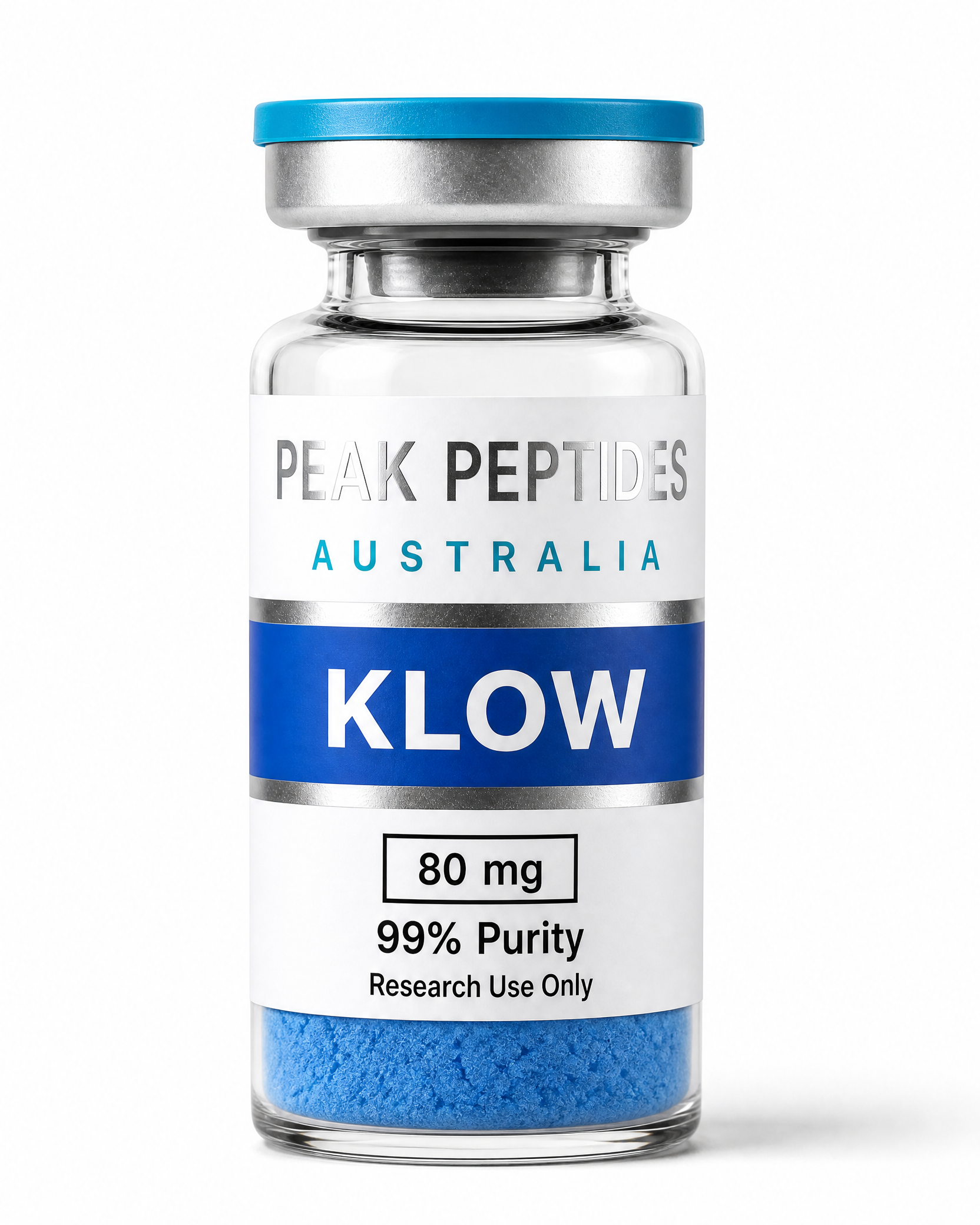
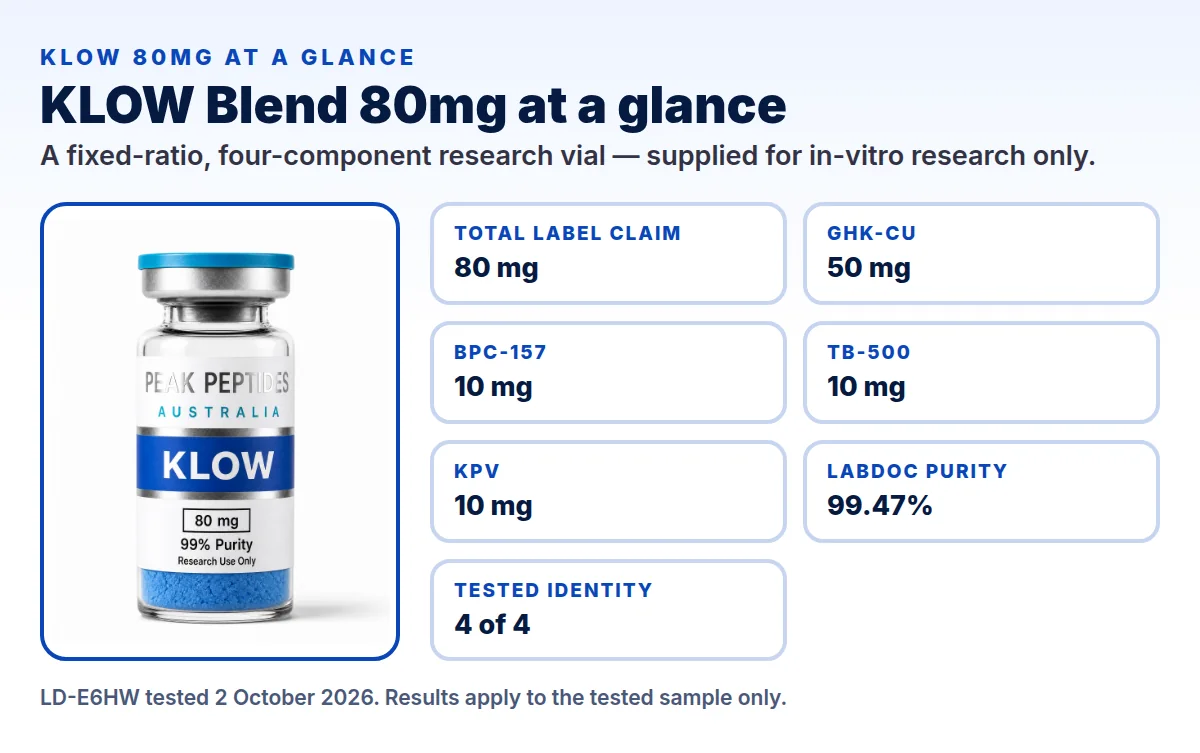
KLOW Blend 80mg combines 50mg GHK-Cu with 10mg each of BPC-157, TB-500 and KPV in one fixed-ratio research vial. LabDoc report LD-E6HW confirms all four identities by LC-MS and records 99.47% HPLC purity for the tested sample. In-stock orders receive same-day dispatch from Victoria after payment confirmation, with tracked Australia Post Express shipping Australia-wide.
Product Specifications
Full NameBPC-157 (10mg) + TB-500 (10mg) + GHK-Cu (50mg) + KPV (10mg) Comprehensive Research Stack
This product is sold strictly for in-vitro laboratory research purposes only. It is not intended for human or animal consumption, injection, or any diagnostic or therapeutic use.
Four-component research blend · LabDoc LD-E6HW
KLOW Blend 80mg — Ingredients, Research & Reconstitution Guide
KLOW is a fixed-ratio, four-component research blend containing 50mg GHK-Cu, 10mg BPC-157, 10mg TB-500 and 10mg KPV. The label claim is 80mg in total, with four stated components in a 5:1:1:1 mass ratio. GHK-Cu is the largest share. BPC-157, thymosin beta-4 literature associated with TB-500, GHK-Cu and KPV have each been studied separately in different laboratory, preclinical and limited clinical settings. This page explains the ingredients, the exact LabDoc result for the tested sample, the separate Janoshik #135352 record, 3 mL BAC-water concentration maths and an eight-step photo guide. Peak Peptides Australia supplies KLOW for in-vitro research only, not for human or animal use.
Also referred to in research or catalogue references as KLOW, KLOW blend, KLOW peptide blend, KLOW 80mg, KLOW 80 mg, KLOW peptide 80mg, GHK-Cu BPC-157 TB-500 KPV blend, GHK Cu BPC 157 TB 500 KPV blend.
KLOW Blend 80mg at a glance
Product
KLOW Blend 80mg — a four-component, fixed-ratio research blend
Janoshik #135352, dated 01 June 2026, appears on the Quality page
Reference mix
3 mL BAC water = 26.67 mg/mL total blend; 300 U-100 units in the vial
Storage once mixed
Upright at 2–8 °C and away from light; never freeze the mixed vial
Dispatch
Same-day from Victoria for in-stock orders after payment is confirmed, tracked Australia Post Express
What KLOW 80mg contains
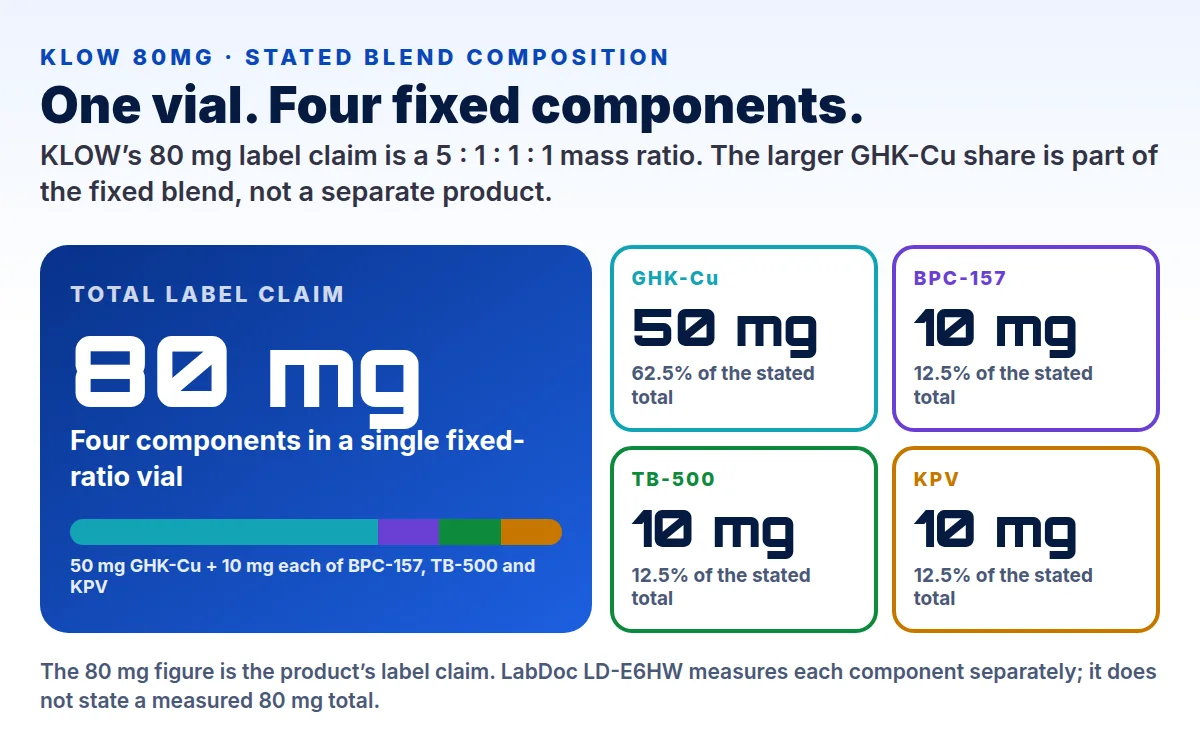
KLOW is one vial with four stated components: 50mg GHK-Cu, 10mg BPC-157, 10mg TB-500 and 10mg KPV. That is 80mg as a label claim and a 5:1:1:1 mass ratio. GHK-Cu represents 62.5% of the stated total; each 10mg component represents 12.5%.
A blend, not one molecule
KLOW is a fixed-ratio formulation, not a single peptide. Changing the measured volume of the mixed vial changes all four components together. It cannot vary BPC-157, TB-500, GHK-Cu or KPV independently. Separate component papers are useful context but do not become a study of KLOW when placed beside one another.
GHK-Cu is the main stated component
GHK-Cu is a copper complex of the GHK tripeptide, glycyl-L-histidyl-L-lysine. PubChem lists the complex at about 744.3 g/mol. Published cell work examines collagen and elastin signals, and one 40-participant topical facial-serum study examined wrinkle measures. Those topical findings did not test KLOW.
BPC-157 is a 15-amino-acid peptide
BPC-157 has the sequence GEPPPGKPADDAGLV and a PubChem molecular weight of about 1,419.5 g/mol. A 2025 systematic review located 35 preclinical studies and one small clinical study. Its musculoskeletal literature includes tendon, ligament, muscle and bone models.
TB-500 needs precise language
TB-500 is listed as a KLOW component, while published thymosin beta-4 work examines wound-model processes such as cell movement, collagen deposition and angiogenesis.
KPV research focuses on signalling models
KPV is the Lys-Pro-Val tripeptide. In a 2008 paper, researchers studied PepT1-mediated uptake in intestinal and immune cells and examined two mouse-colitis models. KPV reduced NF-kB and MAP kinase signalling in those experiments. FDA’s 2026 KPV evaluation found no clinical studies or human exposure data for KPV by any route.
Independent tested-sample record
LabDoc report LD-E6HW lists a KLOW lyophilised vial received on 09 September 2026 and tested on 02 October 2026. It records 4 of 4 component identities confirmed by LC-MS, 99.47% whole-vial HPLC purity and a Pass assessment. The report applies to the tested sample only; its batch field says Not stated.
Measured components, not an invented total
LD-E6HW measured GHK-Cu at 46.19mg, TB-500 at 9.39mg, BPC-157 at 9.33mg and KPV at 9.5mg. These are separate HPLC content values. The report calls 80mg the label claim; it does not claim that 80mg is a measured total. The Quality page also records Janoshik #135352, dated 01 June 2026, as a separate KLOW report.
KLOW Blend 80mg is a fixed-ratio research formulation of four named components: 50mg GHK-Cu, 10mg BPC-157, 10mg TB-500 and 10mg KPV. The 80mg number describes their total label claim. The four components have different chemical structures, research histories and mechanisms.
The ratio is 5 parts GHK-Cu to 1 part each of BPC-157, TB-500 and KPV. That ratio stays the same throughout the vial. More or less liquid taken from a mixed vial changes the amount of every component together. It cannot isolate one component or make a component-specific comparison within that same vial.
The vial is supplied as lyophilised, or freeze-dried, blue powder. In the photographed preparation guide it becomes a clear light-blue solution after complete dissolution. KLOW is supplied for in-vitro research only. It is not an approved medicine or a demonstrated treatment for injury, inflammation, skin conditions or gastrointestinal disease.
KLOW is a fixed 50mg GHK-Cu plus 10mg each of BPC-157, TB-500 and KPV.
KLOW blend breakdown: the 5:1:1:1 stated ratio
KLOW’s proportions are simple to read when the 80mg label claim is separated into its four components. GHK-Cu contributes 50mg, or 62.5% of the stated total. BPC-157, TB-500 and KPV each contribute 10mg, or 12.5%. The larger GHK-Cu figure represents the copper-peptide complex, not elemental copper.
The components have different literature. BPC-157 is a 15-amino-acid peptide whose commonly listed sequence is GEPPPGKPADDAGLV. GHK-Cu is a copper complex of the GHK tripeptide. KPV is the Lys-Pro-Val tripeptide. The supplied record names TB-500 without listing its precise sequence.
The composition card below also distinguishes the label claim from tested content. LabDoc LD-E6HW tested each component separately. Its four measured values should be read individually, rather than added and substituted for the stated 80mg label quantity.
The product label claim is 80mg total in a fixed 5:1:1:1 stated mass ratio.
How are the KLOW components studied?
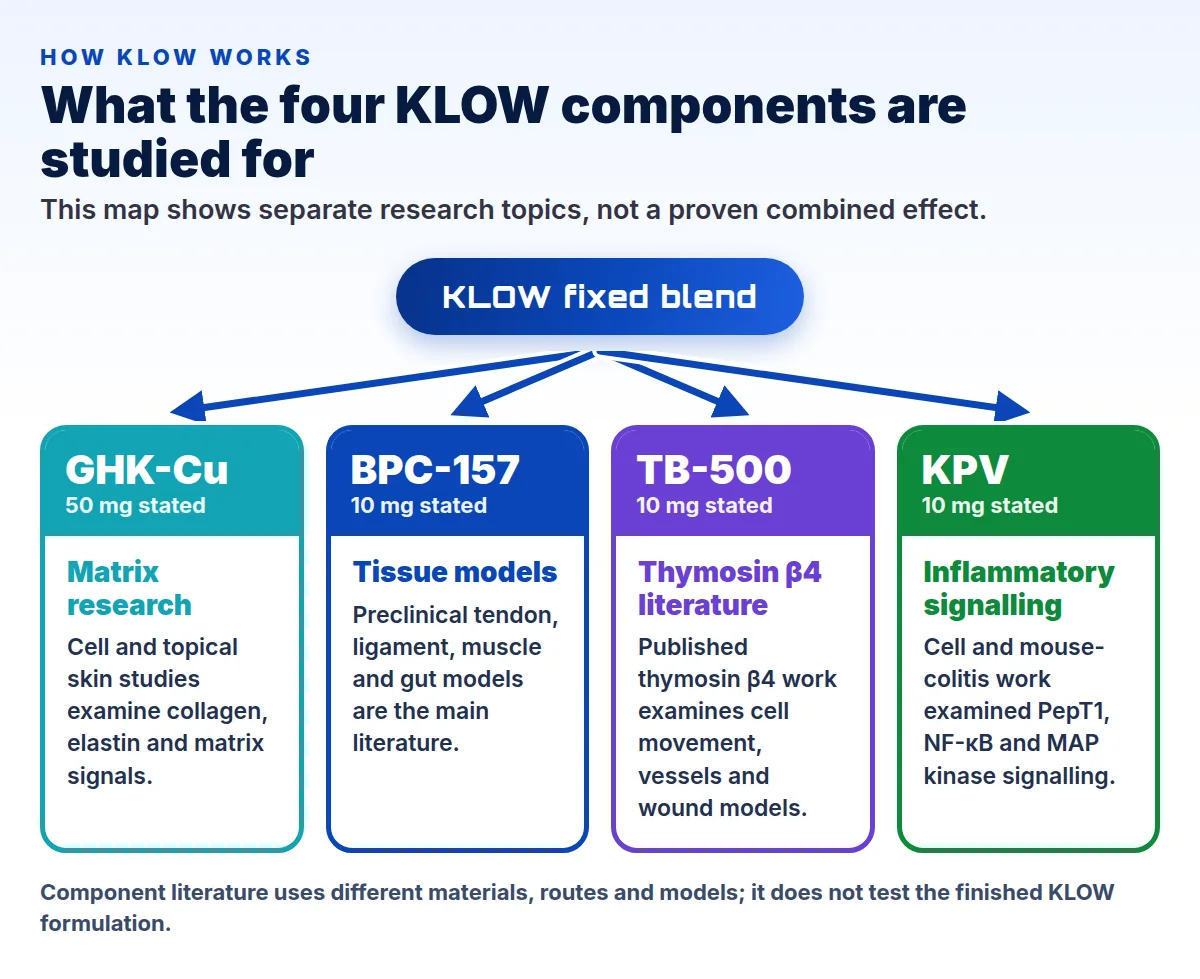
KLOW has no one-pathway explanation because it is a mixture. The useful approach is to separate the four strands of research. GHK-Cu research includes cultured skin cells and topical formulations. BPC-157 papers focus heavily on preclinical tissue, gut and musculoskeletal models. Published thymosin beta-4 work includes cell migration, wound closure and vessel-related observations. KPV research includes epithelial and immune-cell signalling work.
For GHK-Cu, a 2016 study measured collagen and elastin production in cultured human dermal fibroblasts. Its clinical part was an eight-week topical facial-serum experiment in 40 women. For BPC-157, a 2025 systematic review found 35 preclinical studies and one clinical study among its included literature. For KPV, a 2008 study found PepT1-mediated uptake and lower NF-kB and MAP kinase activity in stimulated cells, alongside mouse-colitis experiments.
None of those component studies tested this KLOW vial. They vary in material, formulation, route, model and endpoint. A four-component label does not turn four separate studies into one combined study. This distinction matters when evaluating statements about recovery, skin quality, inflammation or digestive research.
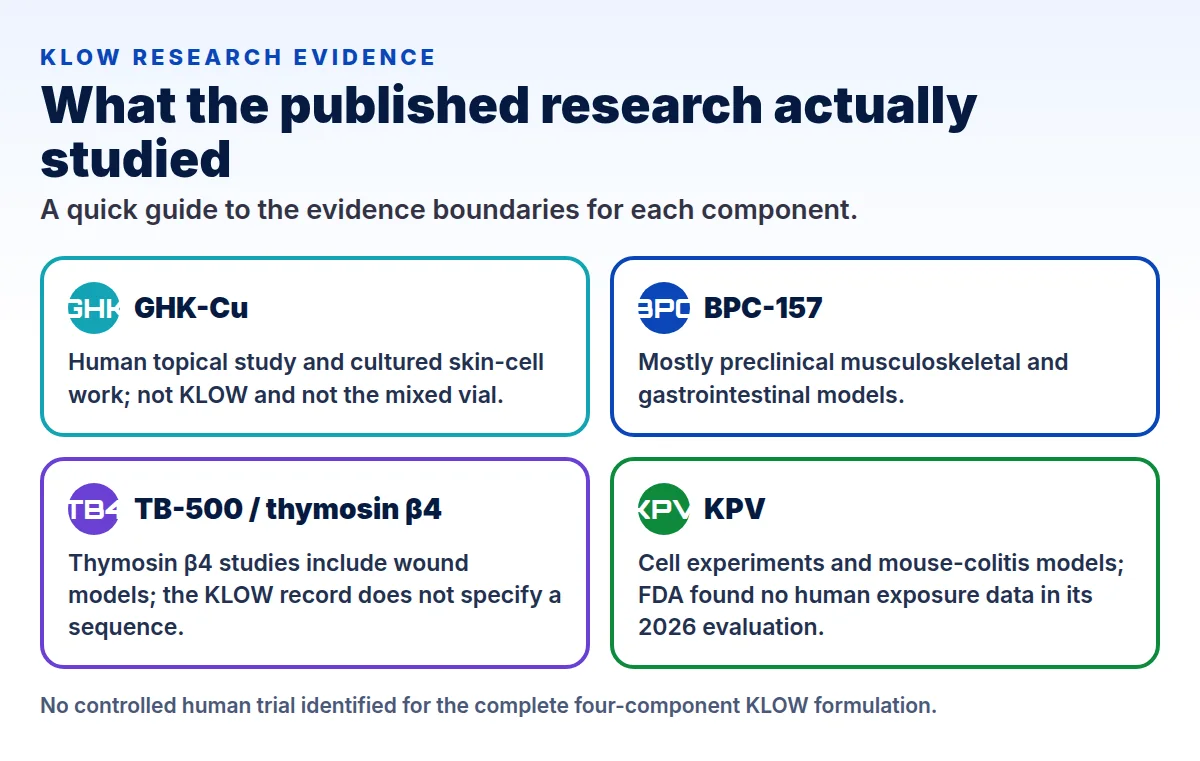
GHK-Cu: extracellular-matrix, collagen and elastin-related cell work; a separate topical study.
BPC-157: predominantly preclinical tendon, ligament, muscle, bone and gastrointestinal models.
TB-500: KLOW’s listed component is discussed here alongside clearly identified thymosin beta-4 literature, not as a confirmed sequence match.
KPV: PepT1 transport and inflammatory-signalling experiments in cells, plus preclinical colitis models.
Each card represents a separate research area; the diagram does not imply a proven combined effect.
What did the research find, and what did it not test?
The clearest finding is about the scope of evidence. A 2003 BPC-157 Achilles-tendon study reported improvements in a rat tendon-transection model and cultured tendocytes. A thymosin beta-4 wound-model paper reported higher re-epithelialisation, more contraction, collagen deposition and angiogenesis in its mouse model. Those are preclinical findings for individual materials, not KLOW results.
GHK-Cu has a different evidence setting. The 2016 paper found increases in collagen and elastin production in cultured human dermal fibroblasts and studied a topical nano-carrier product for eight weeks. The research did not examine the KLOW formulation. For KPV, the 2008 paper used cell systems and two mouse-colitis models. FDA’s May 2026 evaluation found no clinical studies or human exposure data for KPV by any route.
No controlled human trial identified in the reviewed sources tested GHK-Cu, BPC-157, TB-500 and KPV together in KLOW’s stated 5:1:1:1 ratio. There is therefore no blend-specific clinical result, interaction profile, side-effect rate or time-to-effect to report as an established KLOW outcome.
The research record is component-specific and model-specific; it does not report a controlled trial of the four-component KLOW formulation.
Selected evidence context for KLOW’s individual components
Selected evidence context for KLOW’s individual components
Component
Source setting
What was examined
Scope
GHK-Cu
Cultured dermal cells and a topical eight-week study
Collagen, elastin and facial-wrinkle parameters
Result for KLOW or a mixed vial
BPC-157
Preclinical tendon model and systematic review
Tendon-related structural and biomechanical measures
Result for KLOW or a four-component formulation
Thymosin beta-4 literature
Mouse wound model and cell-migration assay
Re-epithelialisation, contraction and angiogenesis
Exact KLOW TB-500 sequence or KLOW outcome
KPV
Intestinal/immune cells and mouse-colitis models
PepT1 uptake and inflammatory signalling
Human exposure or KLOW blend result
The table separates each source material and study context. It does not rank components or imply a clinical use.
KLOW fixed blend vs separate component vials
KLOW and four separate products answer different laboratory-format questions. KLOW keeps the listed ratio together in one vial. That gives one preparation and a constant relative composition. It also means that changing the volume of KLOW changes GHK-Cu, BPC-157, TB-500 and KPV together. There is no way to adjust one ingredient alone from that vial.
Separate component vials allow individual materials to be prepared and varied independently. That is a format difference, not a statement that either option is clinically superior or that the combination has been evaluated. It can matter when a project needs component-specific controls, material identity records or separate preparation conditions.
KLOW’s LabDoc report is specific to the tested KLOW sample. Each individual Peak Peptides product page has its own documentation context.
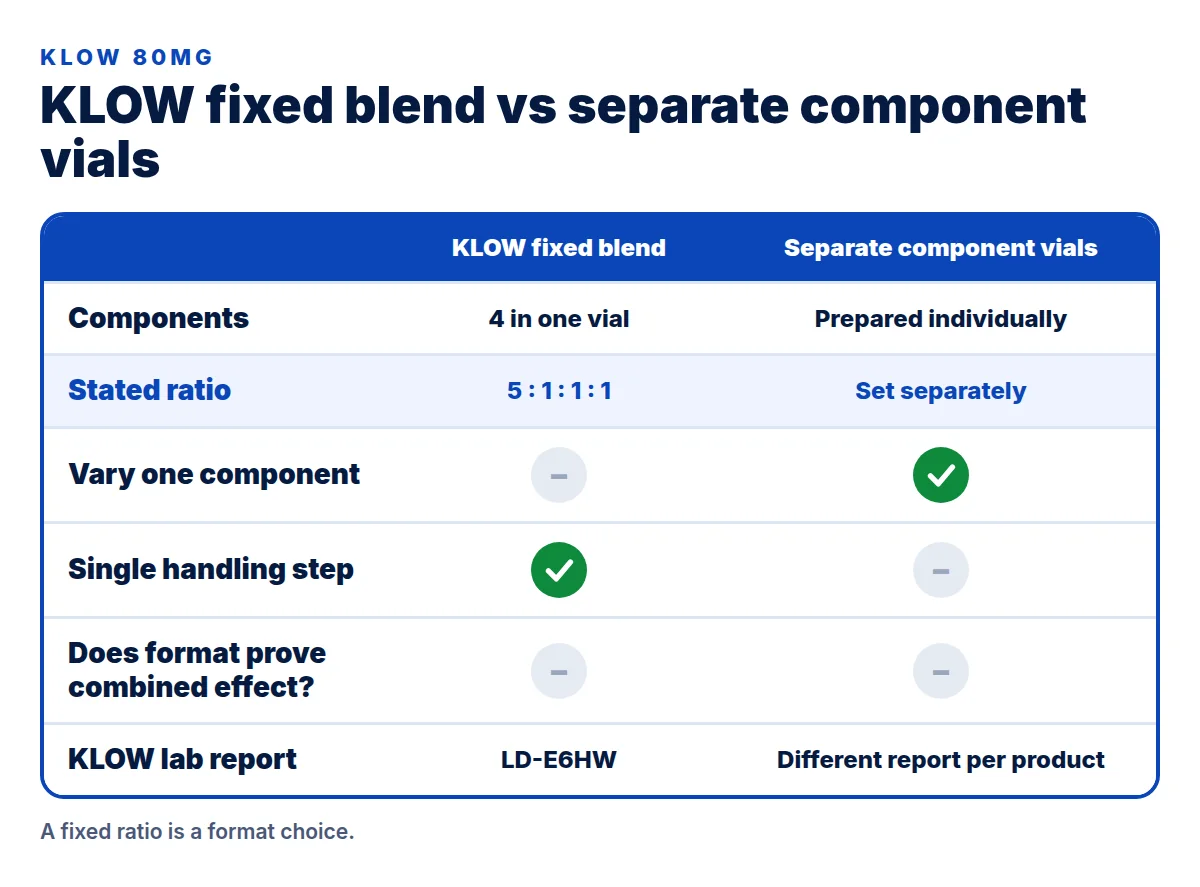
A fixed blend holds the ratio constant; separate vials allow components to be varied individually.
Format comparison: KLOW and individually prepared components
Format comparison: KLOW and individually prepared components
Question
KLOW fixed blend
Separate component vials
Components
All four in one vial
One named material per vial
Stated ratio
5:1:1:1
Set individually
Can one component vary alone?
No
Yes
Single handling step
Yes
No
Does the format establish a combined effect?
No
No
Test-document context
LD-E6HW for the tested KLOW sample
Individual product report context
Independent lab test for this KLOW 80mg sample
LabDoc report LD-E6HW identifies the tested material as “klow”, a lyophilised powder vial from Peak Peptides Australia. The report says the sample was received on 09 September 2026 and analysed on 02 October 2026. The requested tests were identity by LC-MS, purity by HPLC and per-compound content by HPLC. Its overall assessment is Pass.
The LabDoc page records 4 of 4 compounds confirmed by LC-MS and 99.47% HPLC purity for the whole vial. Its separate content table records GHK-Cu at 46.19mg against a 50mg claim, TB-500 at 9.39mg against a 10mg claim, BPC-157 at 9.33mg against a 10mg claim and KPV at 9.5mg against a 10mg claim. This page preserves that wording because separate assay results are more useful than collapsing them into a number the report did not state.
The LabDoc report has no batch identifier: its batch field says Not stated. It expressly covers the tested sample only. The Peak Peptides Quality page separately lists Janoshik #135352, dated 01 June 2026, for KLOW and displays its component findings. These two reports are separate records and should not be substituted for one another.
Identity: LC-MS confirmed 4 of 4 listed compounds in the tested KLOW sample.
Purity: 99.47% whole-vial HPLC purity reported by LabDoc.
Scope: LabDoc LD-E6HW was received 09 September 2026, tested 02 October 2026, and applies to the tested sample only.
Additional record: Janoshik #135352 is listed on the Quality page as a separate KLOW report dated 01 June 2026.
KLOW Blend 80mg in Australia
KLOW is supplied by Peak Peptides Australia for in-vitro research only. It is not an approved medicine in Australia. The TGA’s June 2026 statement names unapproved products containing BPC-157, GHK-Cu and TB-500 and says products not included in the Australian Register of Therapeutic Goods have not been evaluated by the TGA for safety, quality or effectiveness.
The US position is also clear. FDA says compounded drugs are not FDA-approved and are not verified by FDA for safety, effectiveness or quality before marketing. FDA’s 2026 KPV evaluation says it identified no clinical studies or human exposure data for KPV by any route. WADA’s current Prohibited List places BPC-157 in S0, Non-Approved Substances, prohibited at all times.
For in-stock orders, Peak Peptides Australia uses same-day dispatch from Victoria once payment is confirmed. Parcels travel by tracked Australia Post Express, with the tracking number emailed. For research preparation, the related pages below include the BAC-water listing, calculator, general reconstitution guide and quality-information resources.
Step-by-step guide · About 10 minutes
How to reconstitute KLOW Blend 80mg (step-by-step with photos)
KLOW Blend 80mg arrives as blue freeze-dried powder. Reconstitution means dissolving it in bacteriostatic (BAC) water so the fixed-ratio blend can be measured as a liquid. The PeptideDosages KLOW chart uses a 3 mL BAC-water reference mix, giving 26.67 mg/mL total blend and 300 U-100 units in the final vial. The blue powder should become a clear light-blue liquid. Allow about 10 minutes for clean preparation, gentle mixing and visual inspection.
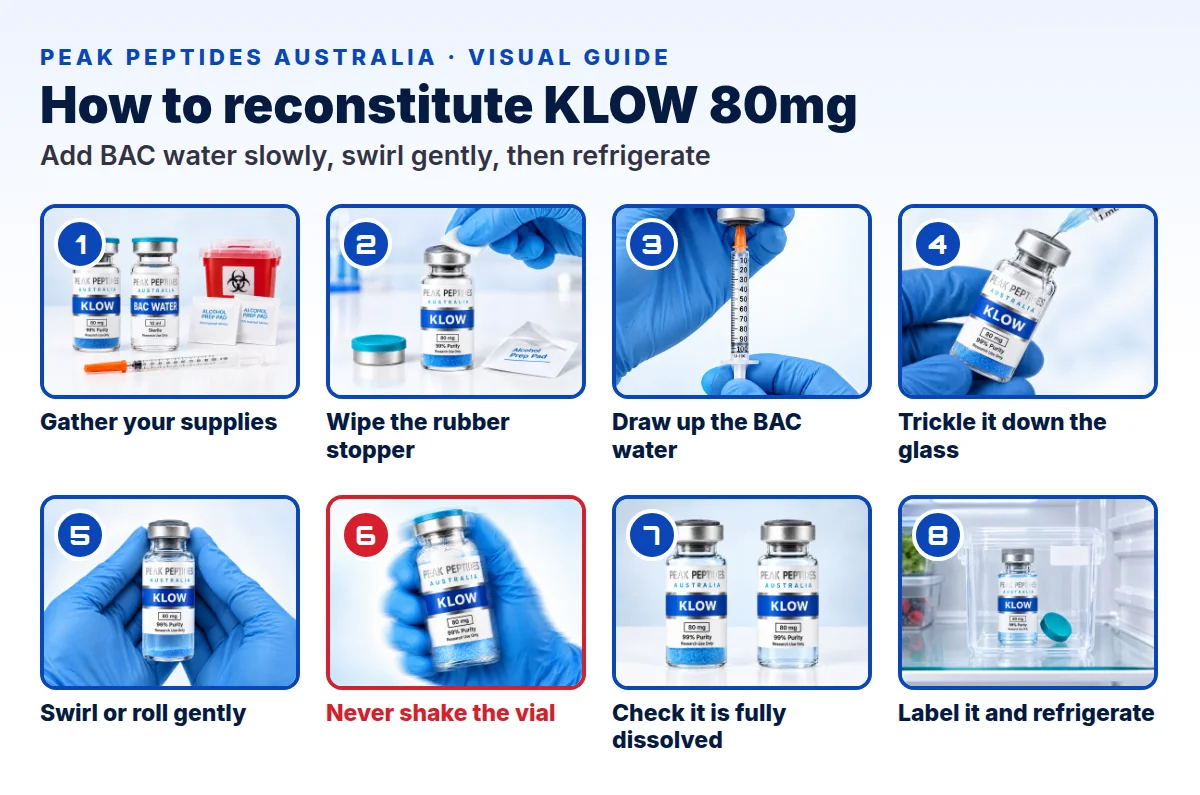
KLOW’s eight-step visual sequence: work cleanly, add BAC water slowly, swirl gently, inspect and refrigerate.
What you need
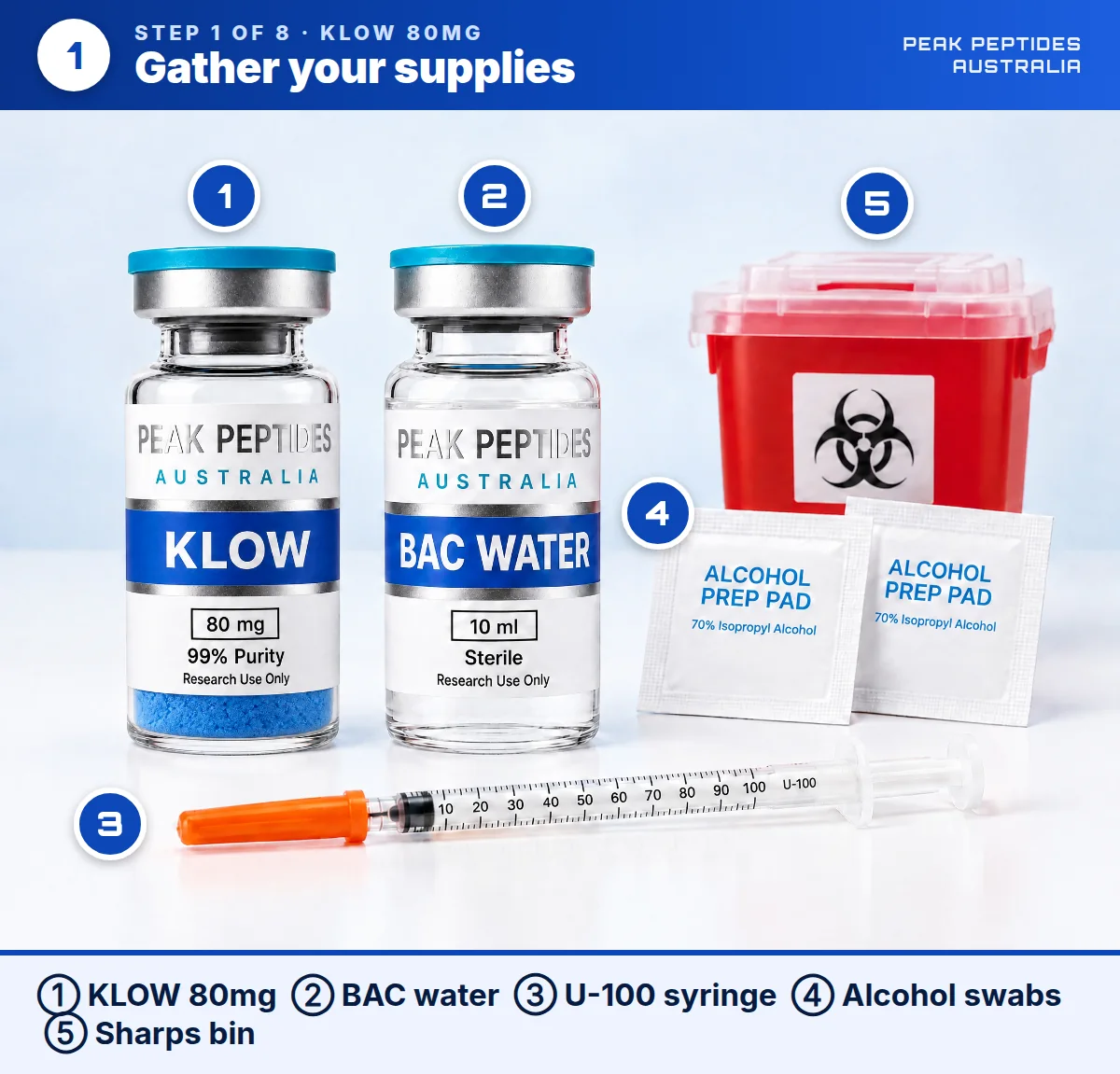
KLOW Blend 80mg vialSealed KLOW vial containing blue lyophilised powder and the stated 80mg four-component blend.
Bacteriostatic waterSterile, identified diluent used by the KLOW reference chart.
1 mL U-100 syringeA volume-marked syringe: 100 units equals 1 mL.
Alcohol swabsUse separate fresh swabs for the two rubber stoppers.
Sharps containerA suitable container for used needles and syringes.
How much BAC water to add to KLOW Blend 80mg
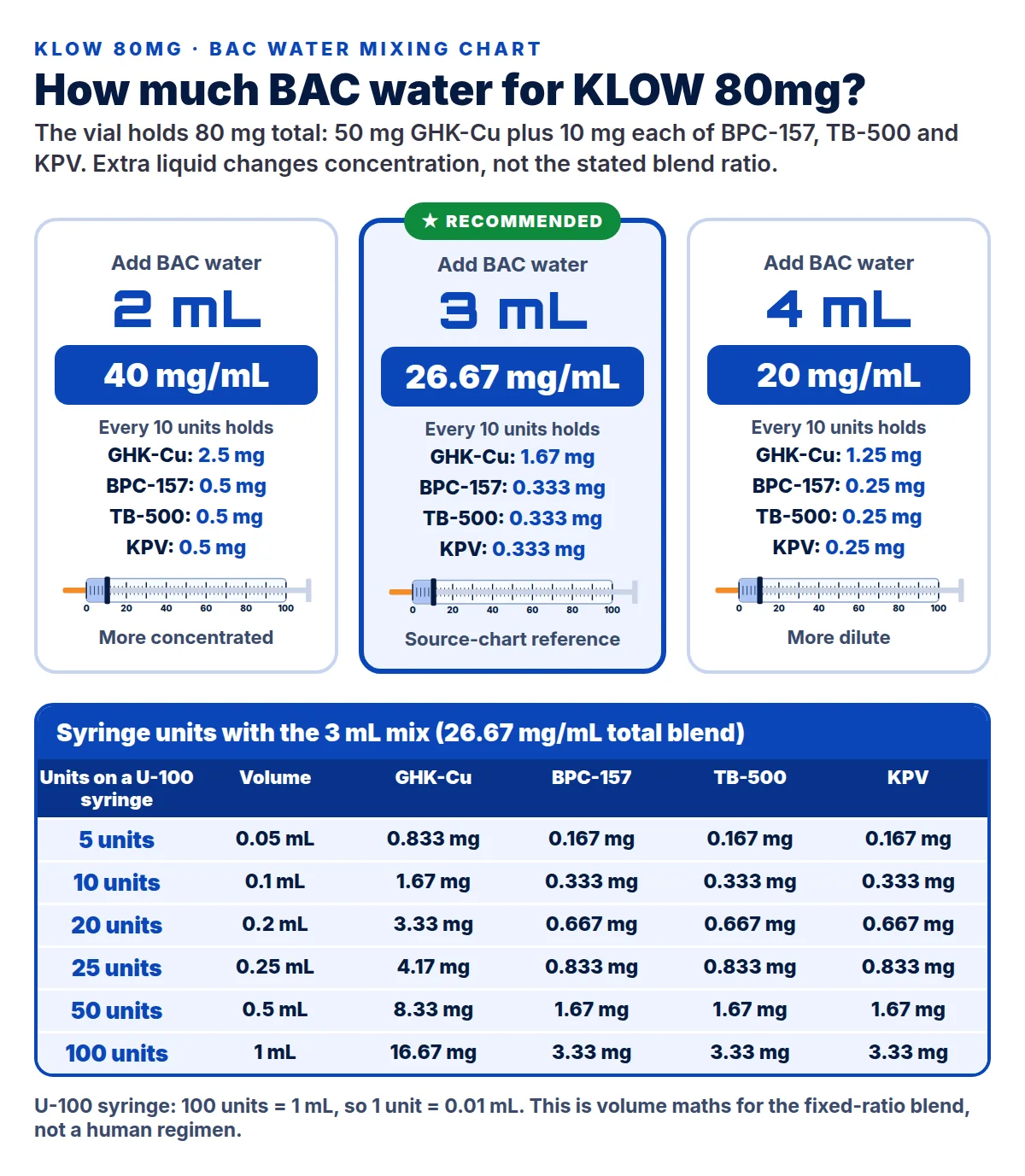
The KLOW vial always has the same 80mg stated total: 50mg GHK-Cu plus 10mg each of BPC-157, TB-500 and KPV. BAC-water volume changes the concentration, not the fixed 5:1:1:1 component ratio. The PeptideDosages KLOW chart uses 3 mL, which gives 26.67 mg/mL total blend.
With the 3 mL reference mix, every 10 units on a U-100 syringe is 0.1 mL and holds 1.67mg GHK-Cu plus 0.333mg each of BPC-157, TB-500 and KPV. The vial holds 300 U-100 units at that volume. The chart also shows the exact per-component conversion for 2 mL and 4 mL mixes. These are concentration and volume calculations for the fixed blend, not a human regimen.
The 3 mL reference mix produces 26.67 mg/mL total KLOW blend and preserves the stated ratio in every unit.
3 mL is highlighted because it gives the simplest numbers.
Syringe units with the 3 mL mix (26.67 mg/mL total blend)
Syringe units with the 3 mL mix (26.67 mg/mL total blend)
Units on a U-100 syringe
Volume
GHK-Cu
BPC-157
TB-500
KPV
5 units
0.05 mL
0.833 mg
0.167 mg
0.167 mg
0.167 mg
10 units
0.1 mL
1.67 mg
0.333 mg
0.333 mg
0.333 mg
20 units
0.2 mL
3.33 mg
0.667 mg
0.667 mg
0.667 mg
25 units
0.25 mL
4.17 mg
0.833 mg
0.833 mg
0.833 mg
50 units
0.5 mL
8.33 mg
1.67 mg
1.67 mg
1.67 mg
100 units
1 mL
16.67 mg
3.33 mg
3.33 mg
3.33 mg
The 8 steps
1Step 1: Gather your supplies
Lay out the sealed KLOW Blend 80mg vial, BAC water, a clean 1 mL U-100 syringe, alcohol swabs and a sharps container on a clean, well-lit surface. Check the KLOW label reads 80mg and inspect the vial before opening. The starting powder is blue. Wash and dry hands before beginning.
2Step 2: Wipe the rubber stopper
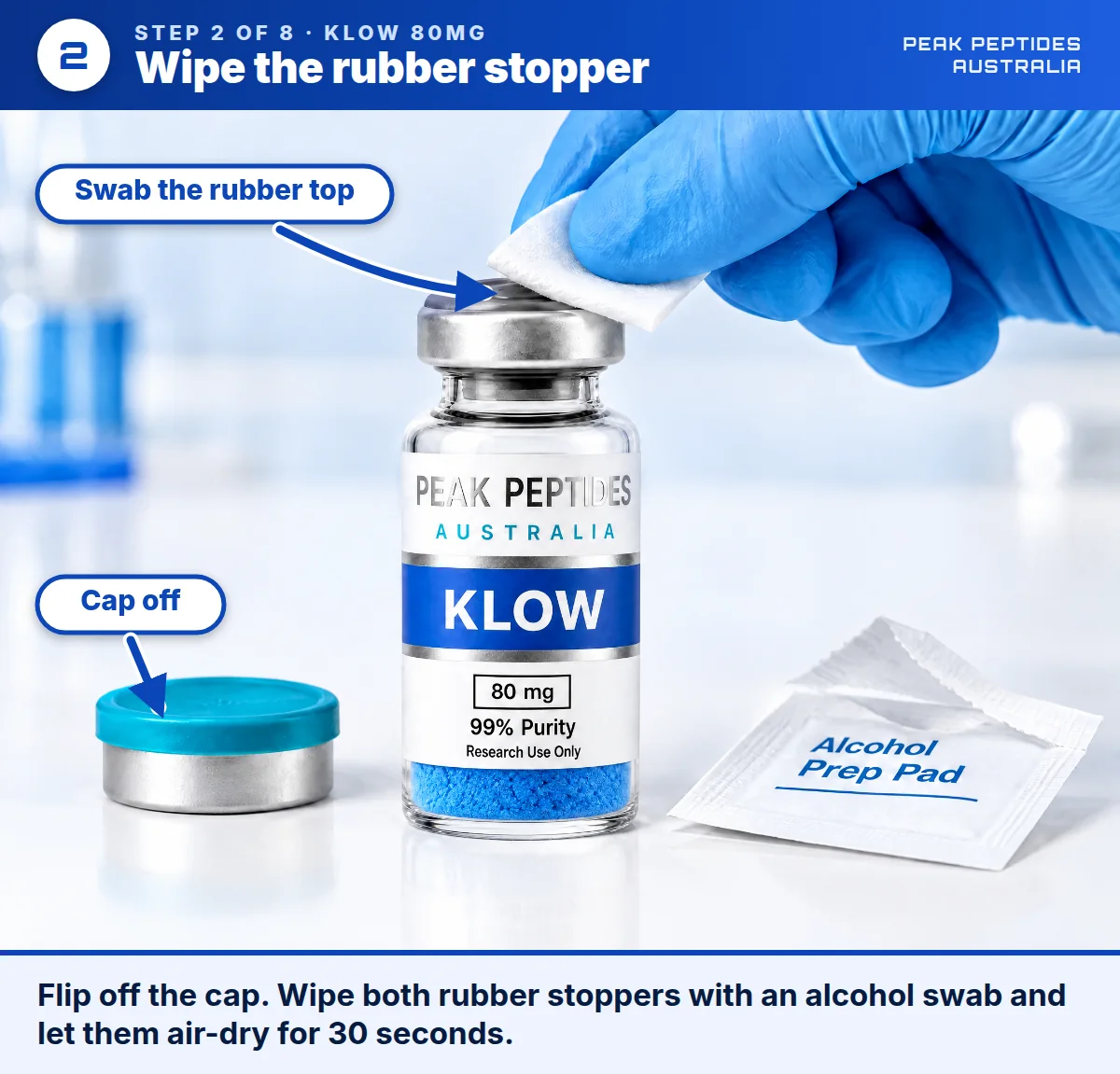
Remove the flip-off cap from both the KLOW and BAC-water vials. Wipe each rubber stopper with a fresh alcohol swab and allow it to air-dry for about 30 seconds. Do not touch either cleaned stopper after swabbing. This keeps the preparation surface and vial entry points clean.
3Step 3: Draw up the BAC water
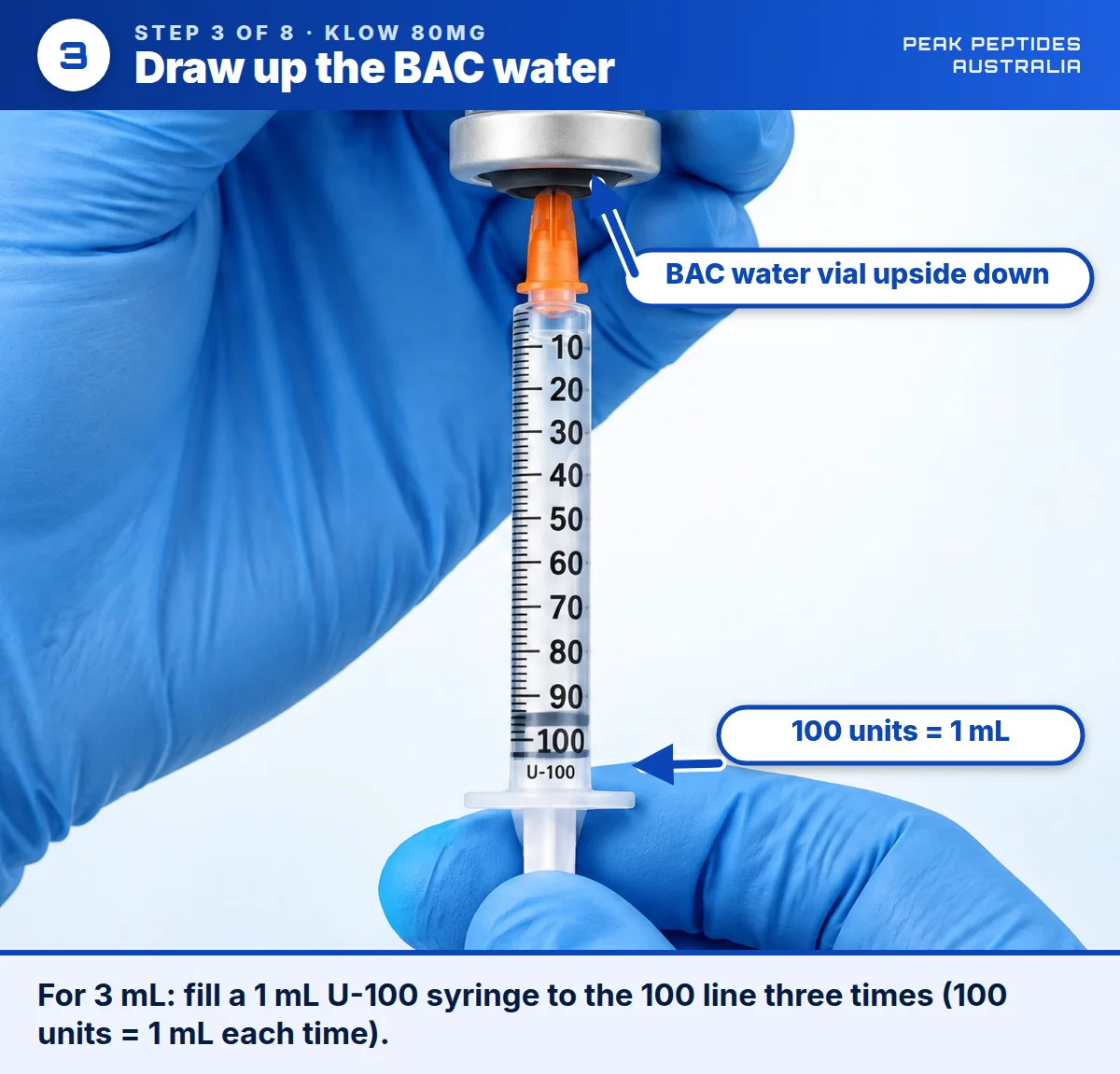
Use the U-100 syringe scale to draw BAC water. The KLOW reference chart uses 3 mL in total. A 1 mL U-100 syringe reaches 1 mL at the 100-unit mark, so this reference volume requires three measured 1 mL fills. Check the liquid level against the syringe markings and remove large air bubbles.
4Step 4: Trickle it down the glass
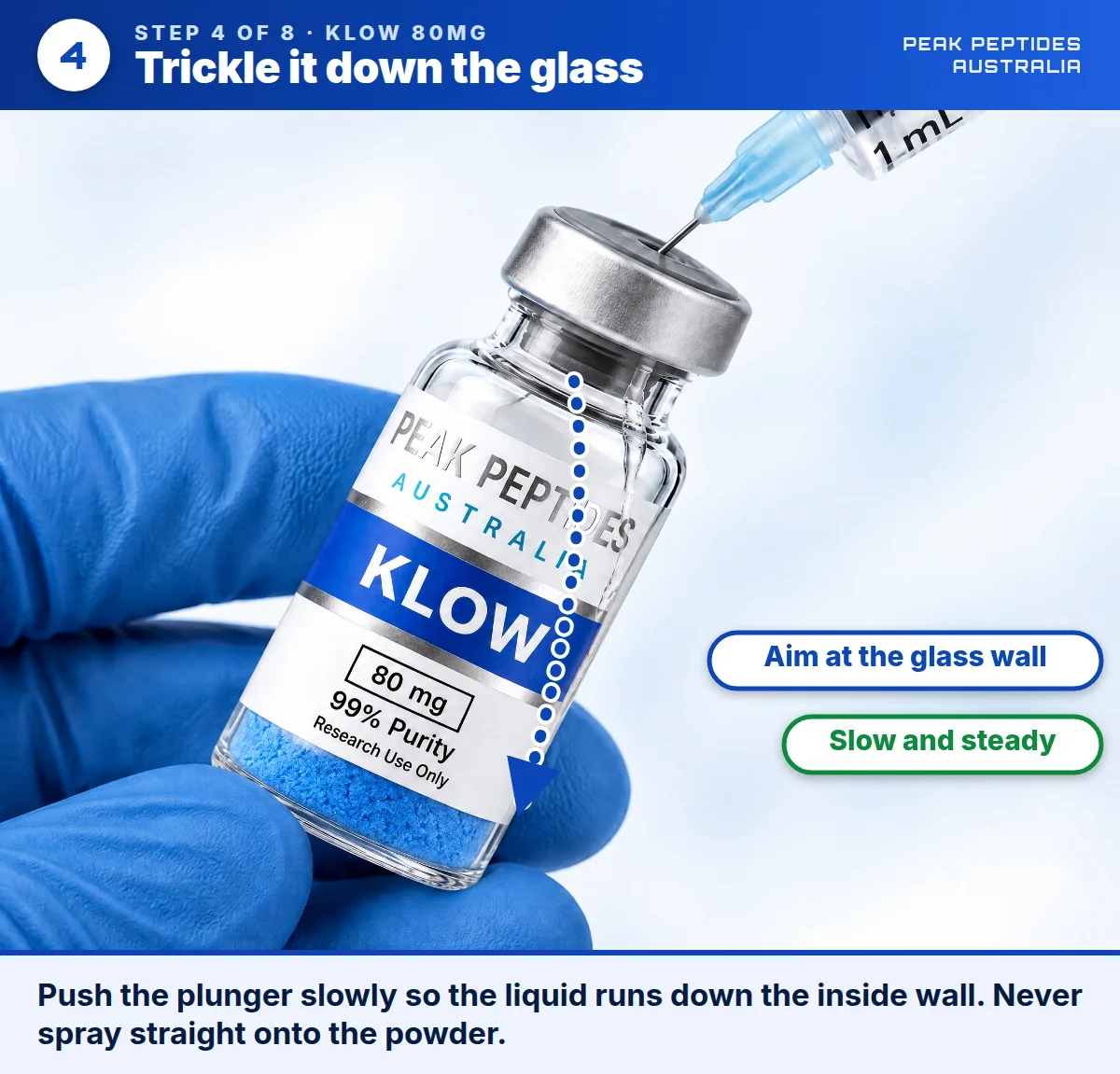
Angle the KLOW vial so the needle tip directs BAC water against the inside glass wall. Press the plunger slowly and let the liquid run down the glass rather than striking the blue powder directly. Repeat until the planned total volume is in the vial. Slow wall addition reduces forceful agitation.
5Step 5: Swirl or roll gently
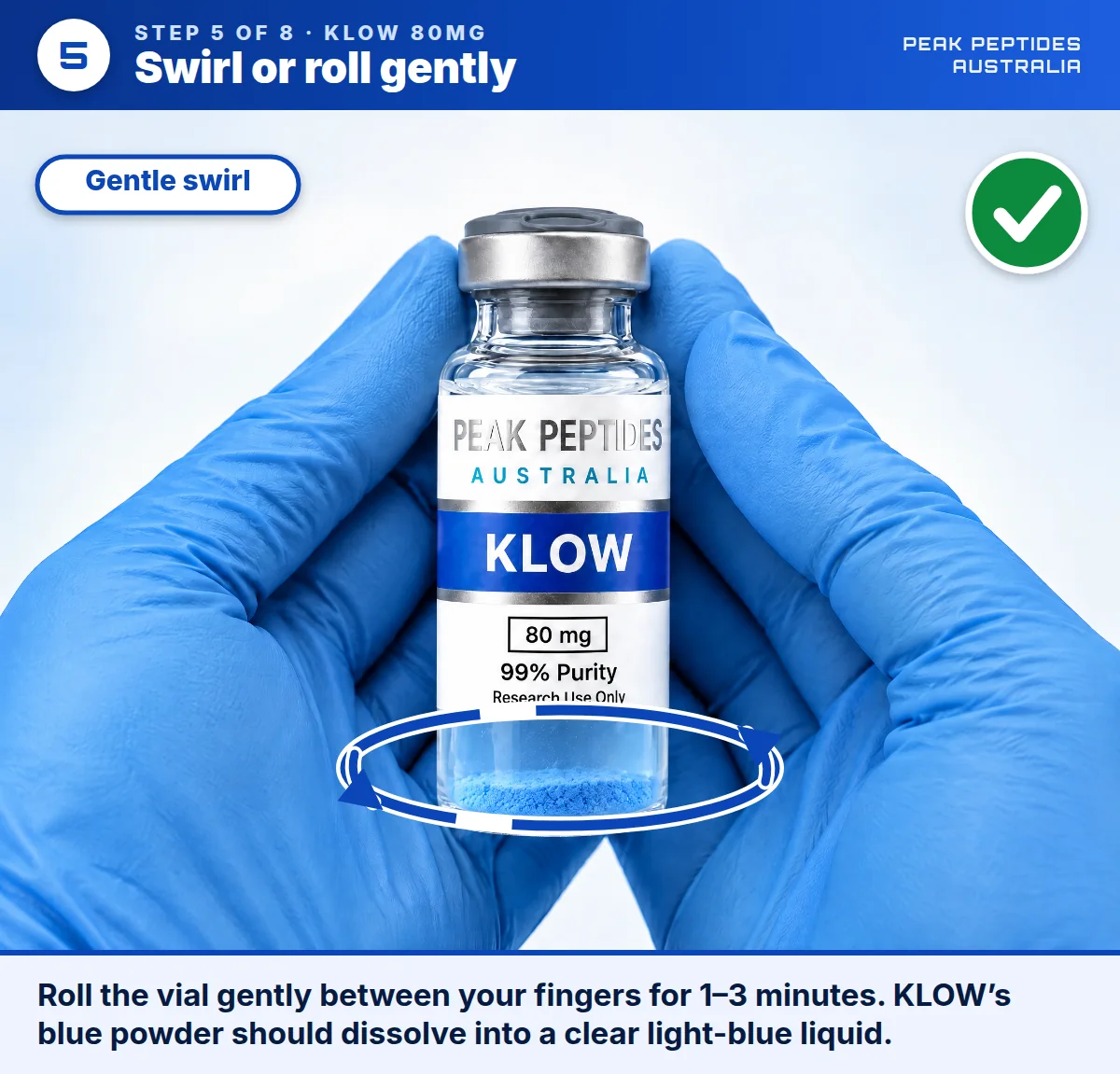
Gently roll the vial between your fingers or swirl it in small circles for 1–3 minutes. Do not force the process. KLOW’s blue powder gradually dissolves into clear light-blue liquid. If material remains at the bottom, let the vial stand briefly and swirl again instead of using vigorous movement.
6Step 6: Never shake the vial
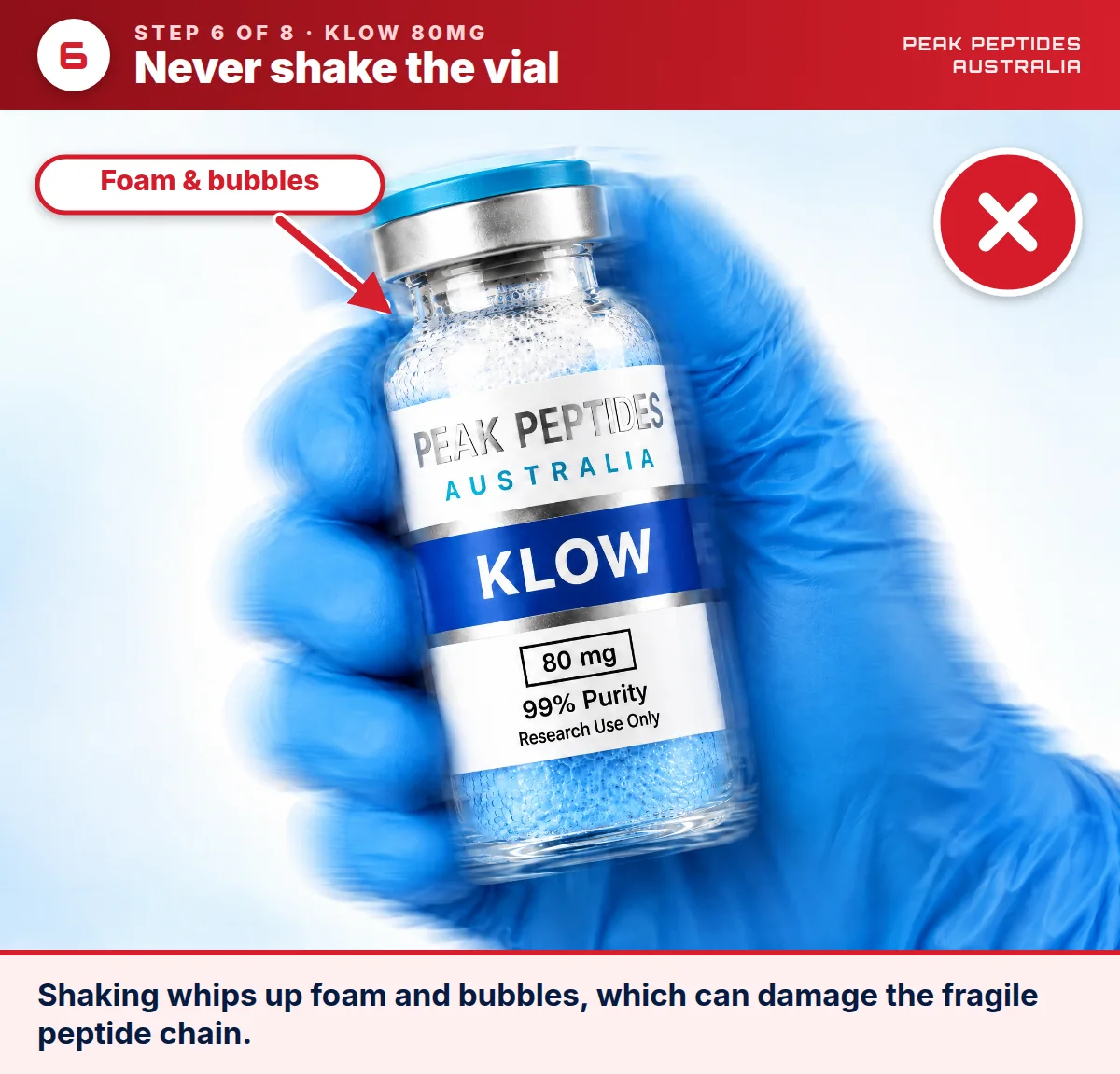
Never shake the KLOW vial. Vigorous shaking can make foam and bubbles, obscuring the appearance check and stressing a peptide preparation. If foam appears, place the vial upright and allow it to settle. Return to slow swirling only if undissolved blue powder remains visible.
7Step 7: Check it is fully dissolved
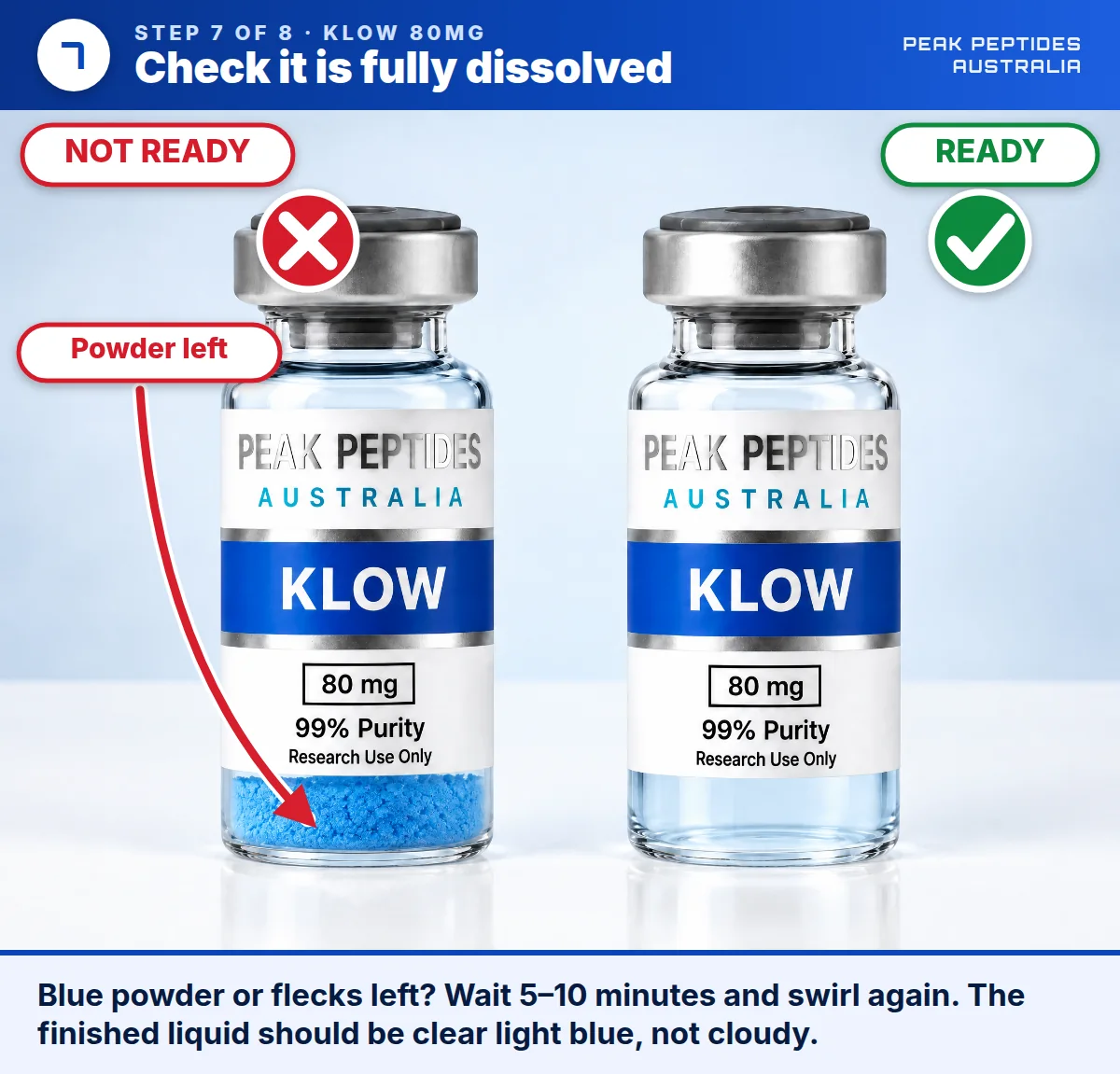
Hold the KLOW vial under good light and compare it with the ready side of the photo guide. The completed solution should be clear light blue, with no blue powder, flecks or persistent cloudiness. If material remains, wait 5–10 minutes and swirl gently again. Do not treat a cloudy or particle-containing solution as ready.
8Step 8: Label it and refrigerate
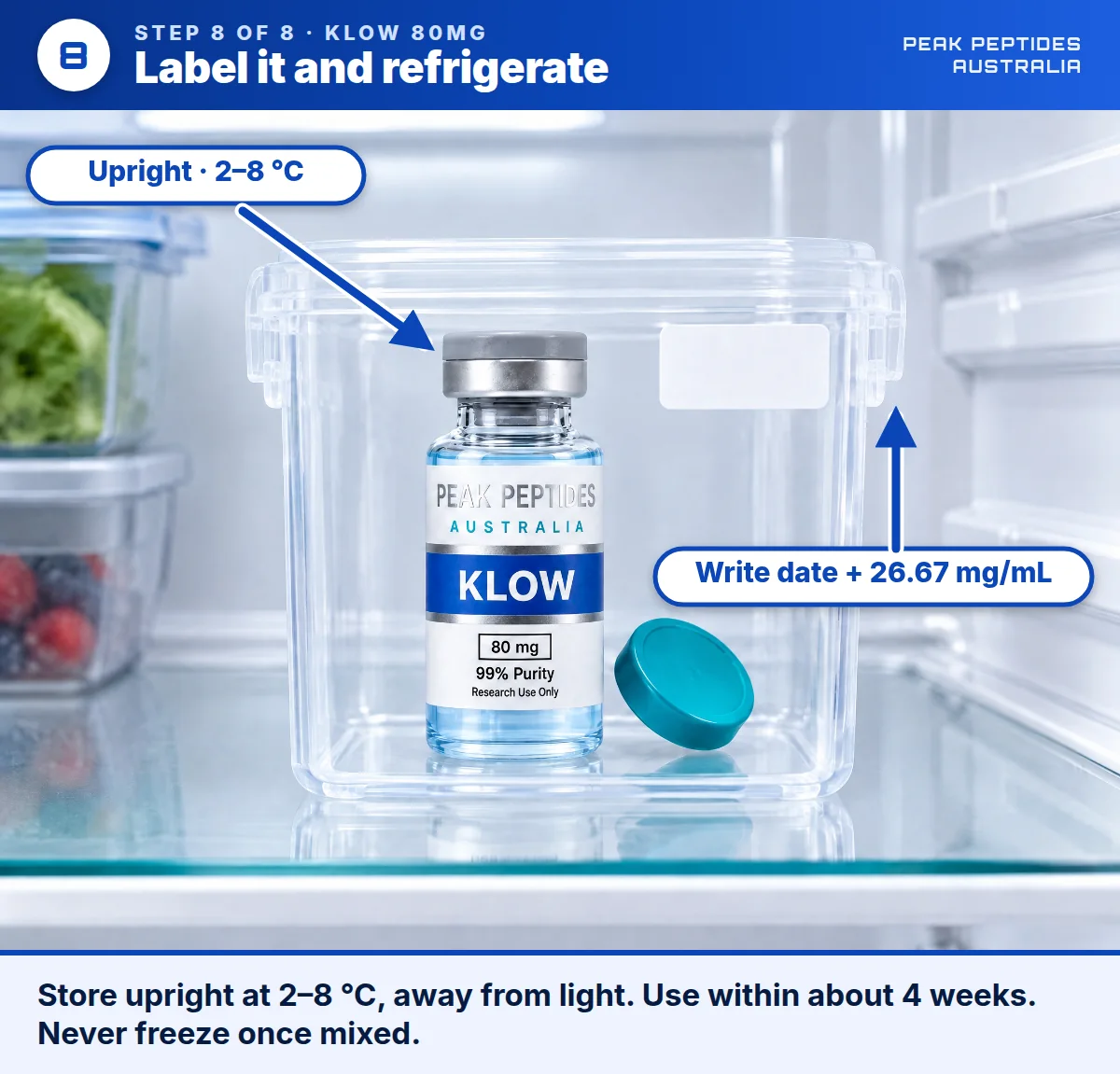
Write the preparation date, BAC-water volume and total concentration on the label. For the 3 mL reference mix, write 26.67 mg/mL total blend. Store the vial upright at 2–8 °C, protected from light, and do not freeze it once mixed. The visual guide uses about four weeks as its BAC-water handling window.
How to store KLOW Blend 80mg
KLOW storage and handling guide
KLOW storage and handling guide
Form
Where to keep it
Key rule
Lyophilised KLOW powder
Fridge 2–8 °C, in the dark; KLOW source chart states −20 °C
Keep sealed, dry and protected from light; avoid freeze–thaw cycles
Mixed KLOW with BAC water
Refrigerator, 2–8 °C, upright and dark
The KLOW visual guide uses about four weeks as its handling window
Mixed KLOW with BAC water
Freezer
Never freeze once mixed
BAC water after opening
Follow its manufacturer-labelled in-use period
Swab the stopper before every entry and keep the liquid clear
The KLOW source chart specifies −20 °C for its lyophilised material and 2–8 °C after mixing. Once mixed with BAC water, keep it upright, away from light, use it within about 4 weeks (28 days) and never freeze it. Write the date and strength on the vial.
KLOW Blend 80mg is a fixed-ratio research vial with four stated components: 50mg GHK-Cu plus 10mg each of BPC-157, TB-500 and KPV. It is a blend rather than one molecule, so a measured volume contains all four components in the same 5:1:1:1 stated mass ratio.
What is in the KLOW blend?
The KLOW 80mg label claim is 50mg GHK-Cu, 10mg BPC-157, 10mg TB-500 and 10mg KPV. GHK-Cu is 62.5% of the stated total. BPC-157, TB-500 and KPV are each 12.5%. The 80mg number is the stated total, not a measured total from the LabDoc report.
Is KLOW a single peptide?
No. KLOW is a four-component formulation in one vial. A single molecule has one defined chemical structure; this vial has GHK-Cu, BPC-157, TB-500 and KPV. The fixed ratio means one component cannot be varied separately within the vial.
What is KLOW used for in research?
KLOW groups components that appear separately in research on extracellular matrix signals, tissue models and inflammatory signalling. GHK-Cu has cell and topical skin literature; BPC-157 has mostly preclinical tissue literature; thymosin beta-4 papers examine wound models; KPV has cell and mouse-colitis work. No controlled human trial identified here tested the finished KLOW formulation.
How does KLOW work?
KLOW does not have one confirmed mechanism because it is a mixture. GHK-Cu research examines collagen and elastin-related signals. BPC-157 research examines tissue-repair pathways in preclinical models. Thymosin beta-4 literature examines cell movement and vessel formation. KPV cell work examined PepT1 transport, NF-kB and MAP kinase signalling.
What did studies find for BPC-157?
A 2025 systematic review located 35 preclinical BPC-157 studies and one clinical study. A 2003 rat Achilles-tendon experiment reported stronger biomechanical measures, smaller defects and more collagen-related repair features than controls. Those studies examined BPC-157, not KLOW or the four-component ratio.
What did studies find for GHK-Cu?
A 2016 study found that GHK-Cu increased collagen and elastin production in cultured human dermal fibroblasts. Its separate eight-week trial used a topical nano-carrier formulation in 40 women and reported wrinkle-measure changes. The trial studied a topical formulation.
What did studies find for KPV?
In a 2008 study, KPV was taken up through PepT1 in intestinal epithelial and immune cells and reduced NF-kB and MAP kinase inflammatory signalling. The same paper studied KPV in drinking water in two mouse-colitis models. These were cell and preclinical studies, not a study of people or the KLOW blend.
What is the difference between KLOW and a peptide stack?
KLOW is a premixed blend: all four listed components are already in one vial at a stated 5:1:1:1 mass ratio. A stack commonly means separate products considered together. Separate vials make it possible to vary a component independently, while a fixed KLOW vial changes every component together. Neither format proves a combined effect.
Is KLOW approved by the TGA or FDA?
No. KLOW is not an approved medicine in Australia or the United States. The TGA states that unapproved products containing BPC-157, GHK-Cu and TB-500 are not evaluated by it for safety, quality or effectiveness. FDA states that compounded drugs are not FDA-approved and are not premarket-verified for safety, effectiveness or quality.
Is BPC-157 prohibited in sport?
Yes. WADA lists BPC-157 under S0, Non-Approved Substances, and says that category is prohibited at all times. KLOW contains BPC-157. WADA updates its Prohibited List at least annually, so sport participants should use the current official list for their competition context.
Can I buy KLOW online in Australia?
KLOW can be ordered online from Peak Peptides Australia when available for laboratory research. In-stock orders receive same-day dispatch from Victoria once payment is confirmed, with tracked Australia Post Express and the tracking number emailed. It is supplied for in-vitro research only.
How fast is KLOW dispatch in Australia?
For in-stock orders, Peak Peptides Australia uses same-day dispatch from Victoria after payment is confirmed. Parcels travel with tracked Australia Post Express, and the tracking number is emailed. Carrier delivery timing varies by destination, so the dispatch commitment and the transport time are different things.
How do I know a KLOW sample is real?
Match the vial label with the listing, then check independent documentation that identifies the tested material, method and results. KLOW has LabDoc report LD-E6HW with LC-MS identity confirmation, HPLC purity and separate HPLC component measurements. The Quality page also lists the separate Janoshik #135352 KLOW report.
How is this KLOW 80mg sample verified?
LabDoc LD-E6HW says the sample was received on 09 September 2026 and tested on 02 October 2026. It records 4 of 4 compounds confirmed by LC-MS, 99.47% whole-vial HPLC purity and a Pass assessment. It measured 46.19mg GHK-Cu, 9.39mg TB-500, 9.33mg BPC-157 and 9.5mg KPV.
What does the 80mg KLOW label claim mean?
It means the stated vial composition adds to 80mg: 50mg GHK-Cu plus 10mg each of BPC-157, TB-500 and KPV. It is not one 80mg ingredient. LabDoc reports component results separately and describes 80mg as the label claim, rather than reporting a measured 80mg total.
How much BAC water for KLOW 80mg?
The PeptideDosages KLOW vial chart uses a 3 mL BAC-water reference mix. That produces 26.67 mg/mL total blend concentration. A 2 mL mix gives 40 mg/mL total; a 4 mL mix gives 20 mg/mL total. Extra liquid changes concentration and U-100 volume maths, not the stated component ratio.
How many units are in the KLOW 3 mL mix?
A 3 mL final volume equals 300 units on a U-100 syringe because 100 units equals 1 mL. With that 3 mL KLOW mix, 10 units equals 0.1 mL and contains 1.67mg GHK-Cu plus 0.333mg each of BPC-157, TB-500 and KPV. These are measurement conversions for the fixed blend.
How much is in 10 units of KLOW?
With the 3 mL reference mix, 10 U-100 units is 0.1 mL. It contains 1.67mg GHK-Cu, 0.333mg BPC-157, 0.333mg TB-500 and 0.333mg KPV, or about 2.67mg total blend. The component ratio stays fixed in every measured volume.
How do I reconstitute KLOW 80mg?
Prepare a clean surface, swab both rubber stoppers, measure BAC water, and add it slowly down the inside wall of the KLOW vial. Gently swirl or roll instead of shaking. KLOW begins as blue powder and the finished solution should be clear light blue without undissolved powder, flecks or cloudiness. The photo guide shows all eight steps.
Can I use tap water or sterile water instead of BAC water?
Do not use tap water, consumer distilled water or another unidentified liquid. The KLOW chart and photo guide use bacteriostatic water. The PeptideDosages reconstitution guide says a diluent must be sterile, compatible, in date and identified for the intended preparation; sterile water has no antimicrobial preservative for repeated access.
What if KLOW powder does not dissolve?
Allow the vial to stand for 5–10 minutes, then swirl gently again. Do not shake it. The KLOW visual guide distinguishes blue undissolved powder from a ready, clear light-blue solution. Persistent cloudiness, visible particles, leakage, stopper damage or an uncertain storage history means the solution should not be treated as acceptable.
Should reconstituted KLOW be blue?
Yes. KLOW’s vial has blue powder because it contains GHK-Cu, and the completed liquid should be clear light blue. It should not be cloudy and should not have visible powder or flecks. A colour shift, persistent cloudiness or particles does not match the finished appearance shown in the KLOW photo guide.
How long does mixed KLOW last?
The KLOW visual guide uses about four weeks as its BAC-water handling window and shows refrigeration at 2–8 °C. Once mixed, keep the vial upright in the fridge, away from light, use it within about 4 weeks (28 days) and never freeze it. Write the date and strength on the vial and discard a questionable vial.
How should I store KLOW powder before mixing?
The PeptideDosages KLOW chart says to freeze the lyophilised material at −20 °C and to avoid freeze–thaw cycles. Its wider storage guide says the sealed powder should follow product-specific instructions, stay dry and be protected from light. Keep the original crimp and stopper intact until preparation.
Can reconstituted KLOW be frozen?
No. The KLOW visual guide says never freeze the mixed vial. Store the completed clear light-blue solution upright at 2–8 °C and away from light. PeptideDosages explains that freeze–thaw stress can destabilise peptide formulations.
What does a KLOW COA show?
A certificate of analysis reports the particular tested sample and methods used. LabDoc LD-E6HW lists LC-MS identity confirmation, HPLC purity and per-compound HPLC content. It records 99.47% whole-vial purity and separately reports 46.19mg GHK-Cu, 9.39mg TB-500, 9.33mg BPC-157 and 9.5mg KPV.
Does a lab result prove every KLOW vial is identical?
No. LD-E6HW expressly covers the tested sample only and its batch field is Not stated. It is strong documentation of identity, purity and component content for that sample. It does not replace checking the current vial label, storage history and associated documentation for any separate sample.