GHK-Cu 50mg is a blue, freeze-dried copper-peptide research vial containing the glycyl-histidyl-lysine copper complex. It is independently tested by LabDoc for LC-MS identity, HPLC purity and content, with a photo preparation guide and BAC water concentration chart below. In-stock orders receive same-day dispatch from Victoria after payment confirmation, with tracked Australia Post Express shipping Australia-wide.
Product Specifications
Full NameCopper Peptide GHK-Cu
Vial Size50mg
Purity99.77% HPLC (LD-2CGW, 48.43mg sample)
Legal Disclaimer
This product is sold strictly for in-vitro laboratory research purposes only. It is not a therapeutic good, is not approved by the TGA, and is not intended for human or animal consumption, injection, or any diagnostic or therapeutic use.
Copper tripeptide · matrix and topical-formulation research
GHK-Cu 50mg — What It Is, Research Background & Reconstitution Guide
GHK-Cu is the copper complex of the three-amino-acid sequence glycyl-histidyl-lysine, usually shortened to GHK. It is also called copper peptide, copper tripeptide-1 or GHK copper complex. This GHK-Cu 50mg vial contains blue freeze-dried powder; once dissolved, the expected liquid is clear light blue. Published work examines copper binding, extracellular-matrix turnover, collagen-related measurements and topical skin formulations. It is not the same format as a ready-made serum or cream. This page explains the molecule, the published research, the difference between GHK-Cu vs KLOW, the LabDoc record for this sample, and how concentration arithmetic works after adding BAC water. Peak Peptides Australia supplies this material for in-vitro research only, not for human or animal use.
Also referred to in research or catalogue references as GHK-Cu, GHK Cu, GHKCU, GHK copper complex, Copper peptide GHK-Cu, Copper peptide, Copper tripeptide-1, Glycyl-L-histidyl-L-lysine copper complex, Gly-His-Lys:Cu, GHK-Cu 50mg, GHK Cu 50 mg, Copper tripeptide GHK-Cu.
Add 3mL BAC water = 16.67mg/mL; 6 U-100 units = 1mg
Regulatory status
TGA lists GHK-Cu as an unapproved peptide product, not included in the ARTG
Dispatch
Same-day from Victoria for in-stock orders once payment is confirmed, tracked Australia Post Express
A copper-bound tripeptide
GHK-Cu is glycyl-histidyl-lysine bound to copper. GHK is the three-amino-acid sequence Gly–His–Lys, and scientific sources describe its strong affinity for copper. The copper-bound complex is what the name GHK-Cu normally means. It should not be confused with GHK alone, a copper serum or a finished topical cosmetic product.
Blue powder is normal for this listing
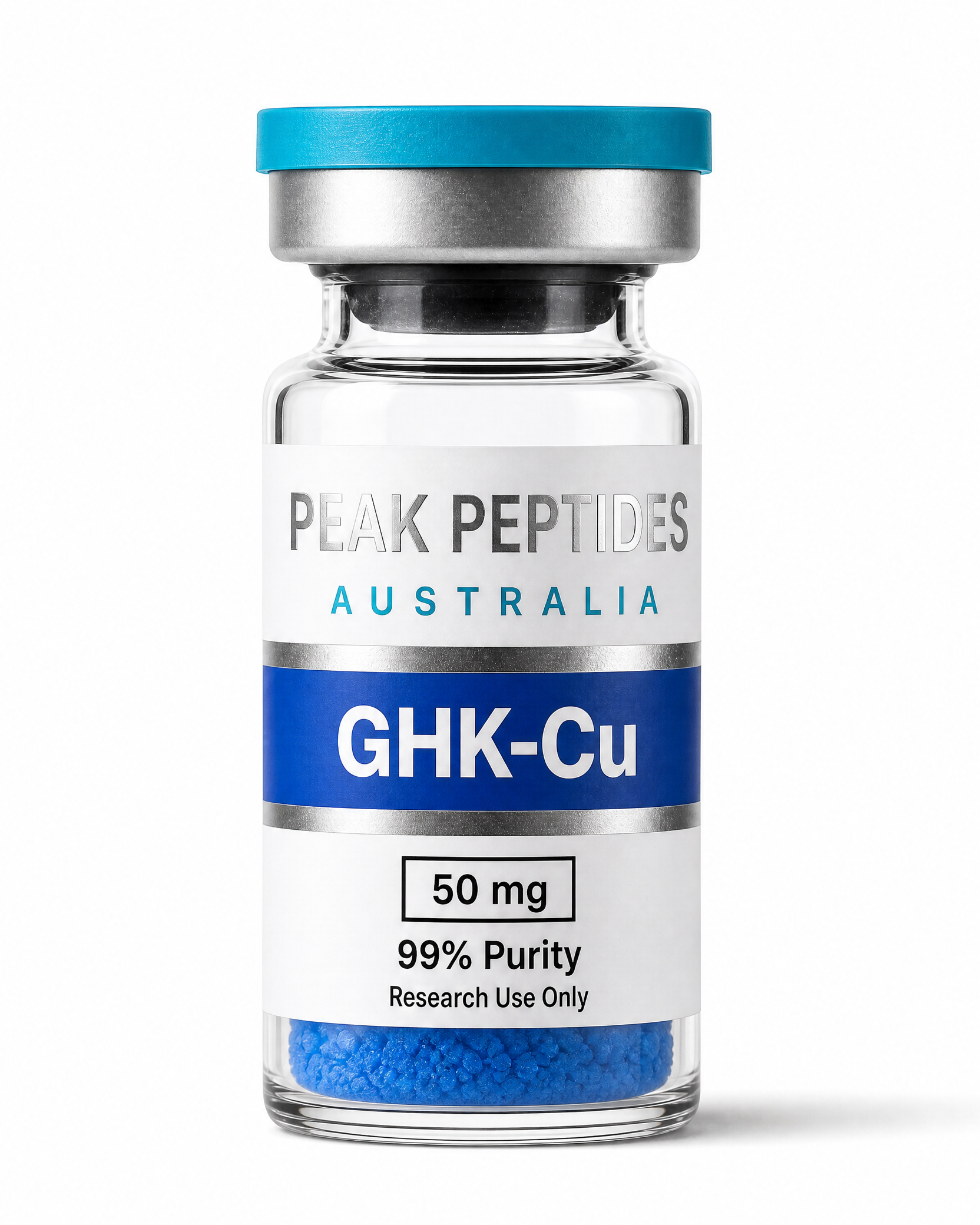
The supplied vial photo shows vivid blue lyophilised powder under a teal cap. In the photo guide, partially dissolved and fully dissolved material is shown as light-blue liquid. Colour is a visual feature of a copper complex; it is not a substitute for independent identity testing, purity testing or a complete quality record.
What published research examines
Laboratory studies have measured collagen, glycosaminoglycans, decorin and matrix metalloproteinases after GHK-Cu exposure in defined cell or wound systems. Reviews also discuss fibroblast, keratinocyte and gene-expression observations. These are research endpoints in named models, not a promise of a result from this vial.
Topical studies are a separate format
The human work discussed in the reviewed literature used topical creams, eye creams or other skin preparations. A topical product has its own vehicle, concentration and surface exposure. This lyophilised vial and a cosmetic serum are different preparations.
What the 50mg label means
50mg is the nominal mass printed on this vial label. It is not a concentration. After liquid is added, concentration comes from mass divided by final volume. The recommended mix below uses 3mL of BAC water, which gives 16.67mg per mL and about 0.167mg per U-100 unit.
Independent GHK-Cu sample record
LabDoc report LD-2CGW records a GHK-Cu lyophilised-vial sample received and tested on 17 September 2026. It reports confirmed LC-MS identity, 99.77% HPLC purity, 48.43mg HPLC content against the 50mg claim, 96.86% of label claim and an overall Pass assessment.
Why identity and content are different checks
LC-MS identity confirms the material matched the named molecule in the tested sample. HPLC purity reports the measured proportion attributed to the target material. HPLC content reports the mass measured in the vial. A single purity percentage does not answer the content question, and neither result is a sterility result.
Australian regulatory position
GHK-Cu is not an approved medicine in Australia. The TGA names GHK-Cu as an example of an unapproved peptide product and explains that unapproved goods are not included in the ARTG. This material is supplied for in-vitro research only.
GHK-Cu is a copper complex of the tripeptide glycyl-histidyl-lysine. A tripeptide is simply a chain of three amino acids. In this case they are glycine, histidine and lysine, usually written as Gly–His–Lys or GHK. Scientific sources describe GHK as having a strong affinity for copper, and the copper-bound complex is the material generally called GHK-Cu.
You may also see the name copper peptide, copper tripeptide-1, GHK copper complex or Gly-His-Lys:Cu. These are useful search terms, but they do not make every GHK-related product the same. GHK without copper, a topical GHK-Cu cream, a cosmetic serum, a blend and a lyophilised vial are different formats. The material on this page is a 50mg blue lyophilised research vial.
PubChem lists a GHK-Cu record with glycyl-L-histidyl-L-lysine as parent compound. Janoshik’s GHK-Cu analytical listing uses the sequence Gly-His-Lys-Cu. The different formula conventions encountered online are a reason to retain the sample-specific identity report rather than relying on a name alone.
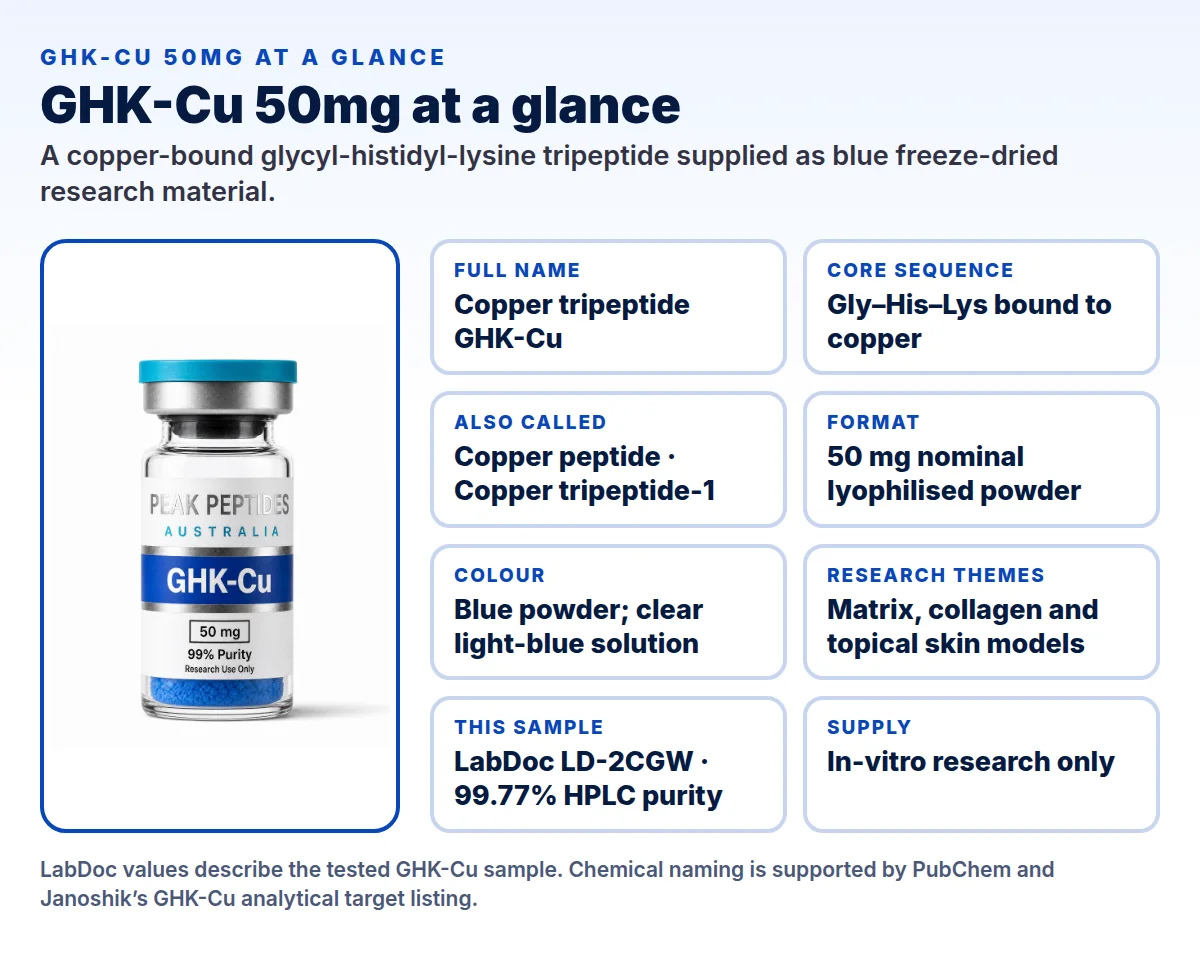
The key identifiers for the GHK-Cu 50mg research vial, including its blue powder and independent sample record.
GHK-Cu structure: three amino acids plus copper
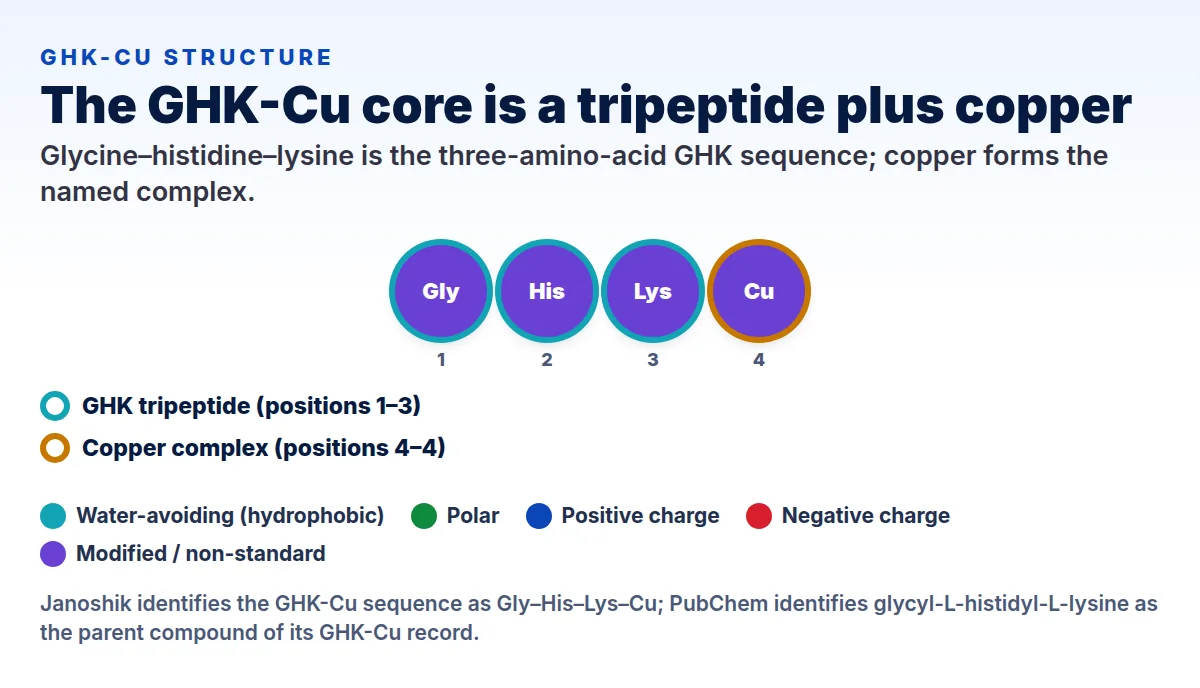
GHK is a tripeptide, meaning it has three amino-acid building blocks: glycine, histidine and lysine. The short sequence is written Gly–His–Lys or GHK. When the sequence binds copper it is called GHK-Cu, the copper peptide described by this page.
The structure diagram makes the name easier to read. The first three markers are the GHK tripeptide. The fourth marker represents the copper complex. The diagram is an identifier, not a claim that a visual structure alone verifies a vial. For the tested sample, identity is the LC-MS result recorded in LabDoc report LD-2CGW.
Naming conventions vary across databases and analytical services, especially where copper-to-peptide complex ratios are represented differently. This guide therefore uses the clear sequence description Gly–His–Lys bound to copper, while retaining both PubChem and Janoshik references in the source list.
GHK-Cu is the three-amino-acid GHK sequence, Gly–His–Lys, in a copper complex.
How is GHK-Cu studied?
GHK-Cu is studied as a copper-bound signalling compound in laboratory systems that examine tissue-matrix organisation. The extracellular matrix is the network of proteins and sugars around cells that gives tissue structure. Collagen, glycosaminoglycans and proteoglycans are some of its parts. Studies have measured these materials after GHK-Cu exposure in cell cultures and wound-related models.
Several papers also examine matrix metalloproteinases, often shortened to MMPs. These are enzymes involved in matrix turnover: they help break down and remodel proteins around cells. A finding about MMP activity is a defined biochemical observation.
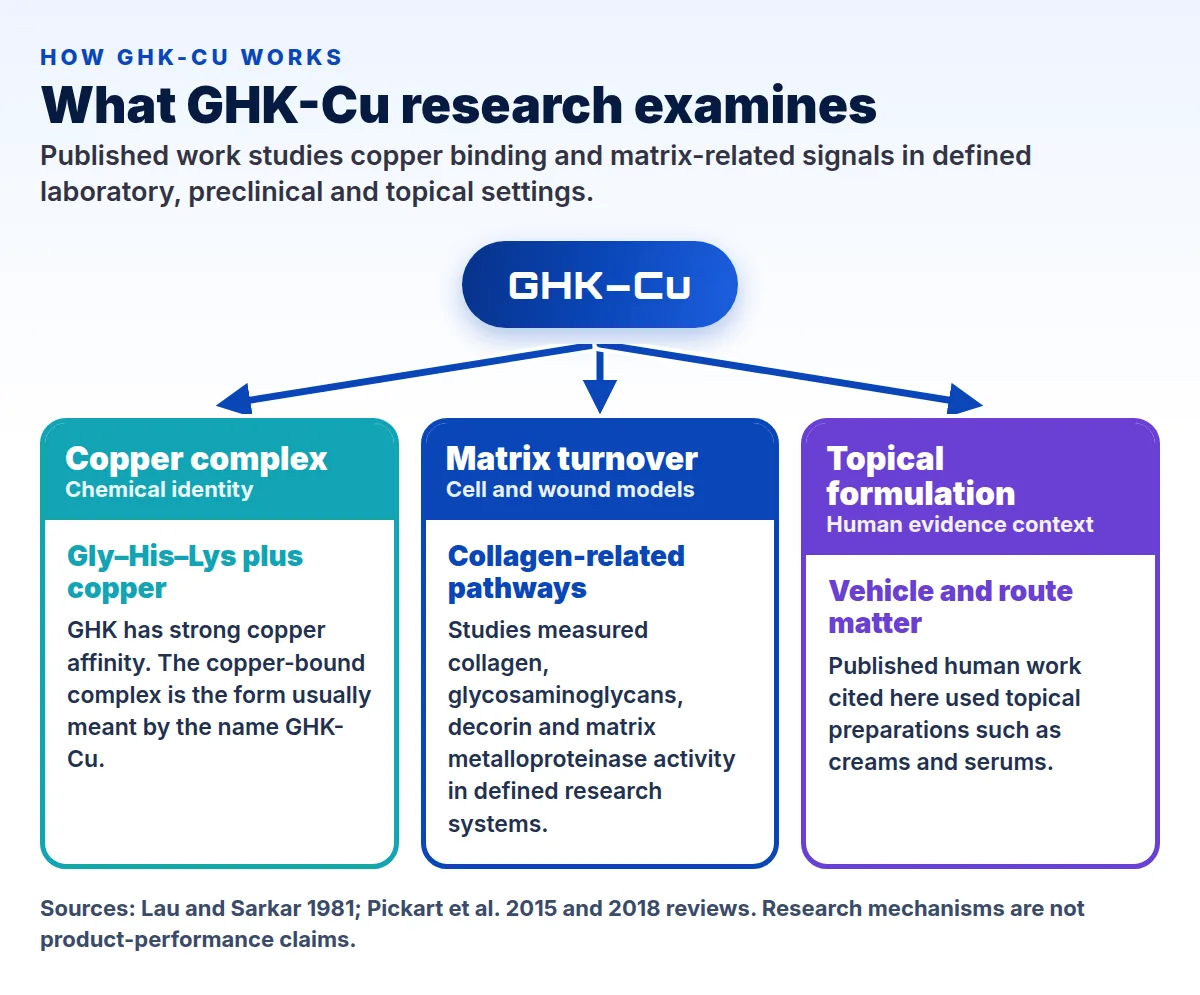
Copper is central to the name and chemistry of GHK-Cu. The GHK portion binds copper, and researchers have explored how that complex relates to cellular defence, matrix markers and gene-expression observations. The diagram below separates the chemical identity, matrix-focused study endpoints and topical-formulation context so they are not treated as one claim.
GHK-Cu research spans copper binding, matrix-related laboratory measurements and formulation-specific topical studies.
What did GHK-Cu research find?
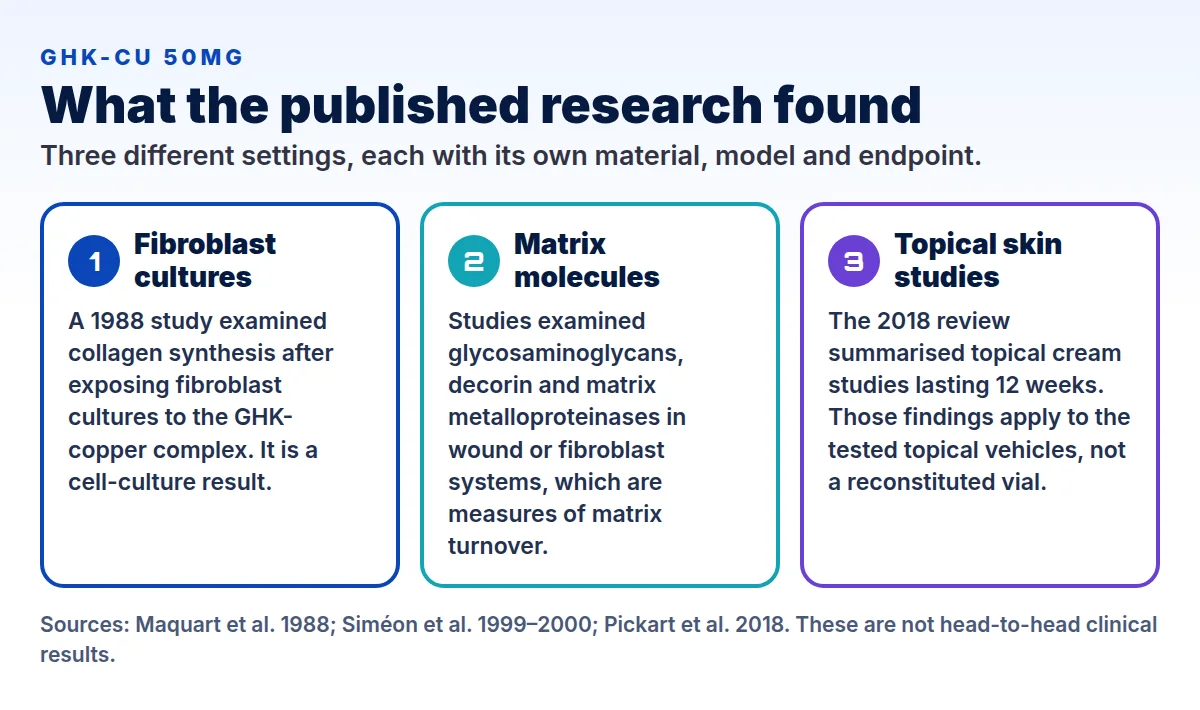
GHK-Cu research has produced several different kinds of findings. In fibroblast cultures, a 1988 paper examined collagen synthesis after exposure to the tripeptide-copper complex. Other work examined glycosaminoglycans, small proteoglycans such as decorin, and MMP activity in wound or fibroblast settings. Those are laboratory measures that help researchers investigate matrix turnover.
The 2018 review also summarised topical skin studies. It describes a 12-week facial cream study involving 71 women, an around-the-eye preparation studied in 41 women, and a topical thigh-skin comparison that reported collagen production in 70% of the GHK-Cu cream group. Those figures belong to the particular topical products and study designs described in the review.
The useful conclusion is precise: GHK-Cu has a long research history in matrix-related laboratory systems and topical formulations. It is not precise to transfer a cell-culture measurement or a topical-cream result to a separate lyophilised vial. The formulation, concentration, route and endpoint remain part of every result.
Three recurring GHK-Cu research settings: laboratory cultures, matrix measurements and topical formulations.
Examples of GHK-Cu research settings and what was measured
Examples of GHK-Cu research settings and what was measured
Research setting
What was examined
How to read the result
Fibroblast cultures
Collagen synthesis after GHK-copper-complex exposure
A cell-culture measurement
Wound and matrix systems
Glycosaminoglycans, decorin, MMPs and inhibitors
A matrix-turnover research question
Topical preparations
Skin-density, appearance and other topical study endpoints
A result for the tested cream or topical vehicle
This product listing
LC-MS identity, HPLC purity and HPLC content
An analytical record for the tested lyophilised sample
The first three rows summarise published research contexts. The final row describes the independent analysis for this listing’s tested sample.
GHK-Cu vs KLOW
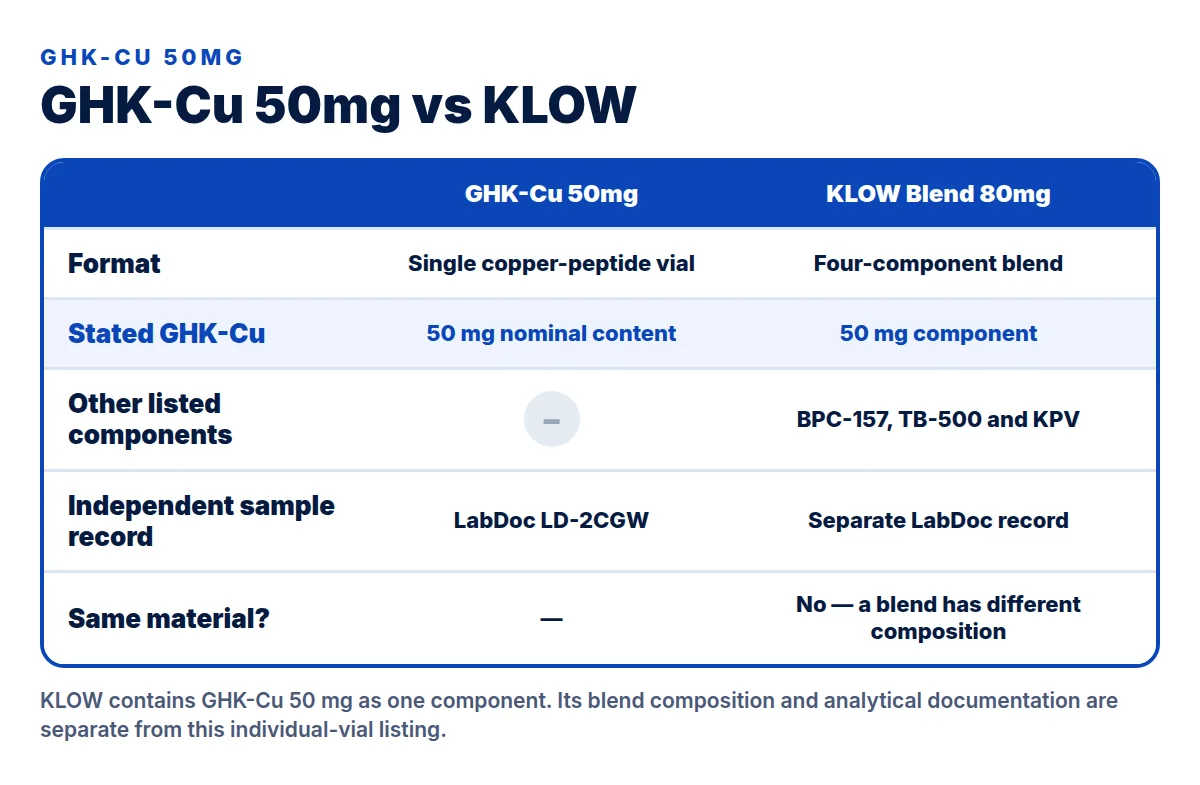
GHK-Cu 50mg and KLOW are not the same product. This listing is an individual copper-peptide vial labelled 50mg. KLOW is a separately labelled blend that includes stated GHK-Cu 50mg together with BPC-157, TB-500 and KPV. A blend has more than one active component, so its identity, concentration arithmetic and research interpretation are different.
The stated GHK-Cu amount is 50mg in both comparisons, but that is not a reason to treat them as interchangeable. The KLOW vial also contains other named materials. It therefore answers a different research question and needs its own report, preparation record and component-aware concentration calculation.
For a direct individual-material study, this GHK-Cu 50mg vial keeps the copper-peptide material separate. For the exact KLOW composition and its sample evidence, use the KLOW product page. The comparison below makes the format difference visible before any preparation maths is considered.
GHK-Cu 50mg is an individual vial; KLOW is a separate four-component blend that includes GHK-Cu.
GHK-Cu 50mg and KLOW compared
GHK-Cu 50mg and KLOW compared
Feature
GHK-Cu 50mg
KLOW Blend 80mg
Product format
Individual copper-peptide vial
Four-component blend
Stated GHK-Cu
50mg nominal content
50mg component
Other listed components
None
BPC-157, TB-500 and KPV
Analytical record
LabDoc LD-2CGW
Separate KLOW documentation
Product format and stated label composition only. Separate listings require separate analytical and preparation records.
Independent lab test for this GHK-Cu 50mg vial
GHK-Cu 50mg is backed by LabDoc report LD-2CGW. The report identifies the sample as GHK-Cu and describes it as lyophilised powder in a vial. It records a sample-received date and test date of 17 September 2026, an origin of Peak Peptides Australia and a batch field marked Not stated.
The reported analytical results are confirmed identity by LC-MS, 99.77% purity by HPLC and 48.43mg content by HPLC. The report compares that content with the manufacturer’s 50mg claim and records 96.86% of label claim. It also records related impurities of 0.23% and an overall Pass assessment.
Each test answers a different question. LC-MS checks molecular identity. HPLC purity measures the percentage assigned to the target material in the tested sample. HPLC content measures mass in that tested vial. LabDoc says the report covers the tested sample only, and it does not present the report as a sterility, stability or batch-wide guarantee.
Report ID: LD-2CGW.
Sample received and tested: 17 September 2026.
Identity: confirmed by LC-MS.
Purity: 99.77% by HPLC.
Content: 48.43mg by HPLC against a 50mg claim, or 96.86% of label claim.
Overall assessment: Pass; batch field: Not stated.
GHK-Cu in Australia: regulatory status and dispatch
GHK-Cu is not an approved medicine in Australia. In its 13 April 2026 safety advisory, the TGA names GHK-Cu as an example of an unapproved peptide product. The TGA defines unapproved peptide products as goods not included in the Australian Register of Therapeutic Goods, known as the ARTG, and says they have not been evaluated by the TGA for safety, quality or effectiveness.
The TGA also says that a research-use disclaimer does not by itself change regulatory status or remove supply and advertising obligations. The FDA page opened for this guide discusses compounded injectable GHK-Cu as a substance with potential aggregation and peptide-related impurity concerns, and says human data are limited for safety considerations. This page therefore describes the material as supplied for in-vitro research only.
Peak Peptides Australia dispatches in-stock orders from Victoria on the same day once payment is confirmed. They are sent by tracked Australia Post Express and the tracking number is emailed. That dispatch process does not change the research-only status or the need to keep the product label and independent test record with laboratory documentation.
Step-by-step guide · About 10 minutes
How to reconstitute GHK-Cu 50mg (step-by-step with photos)
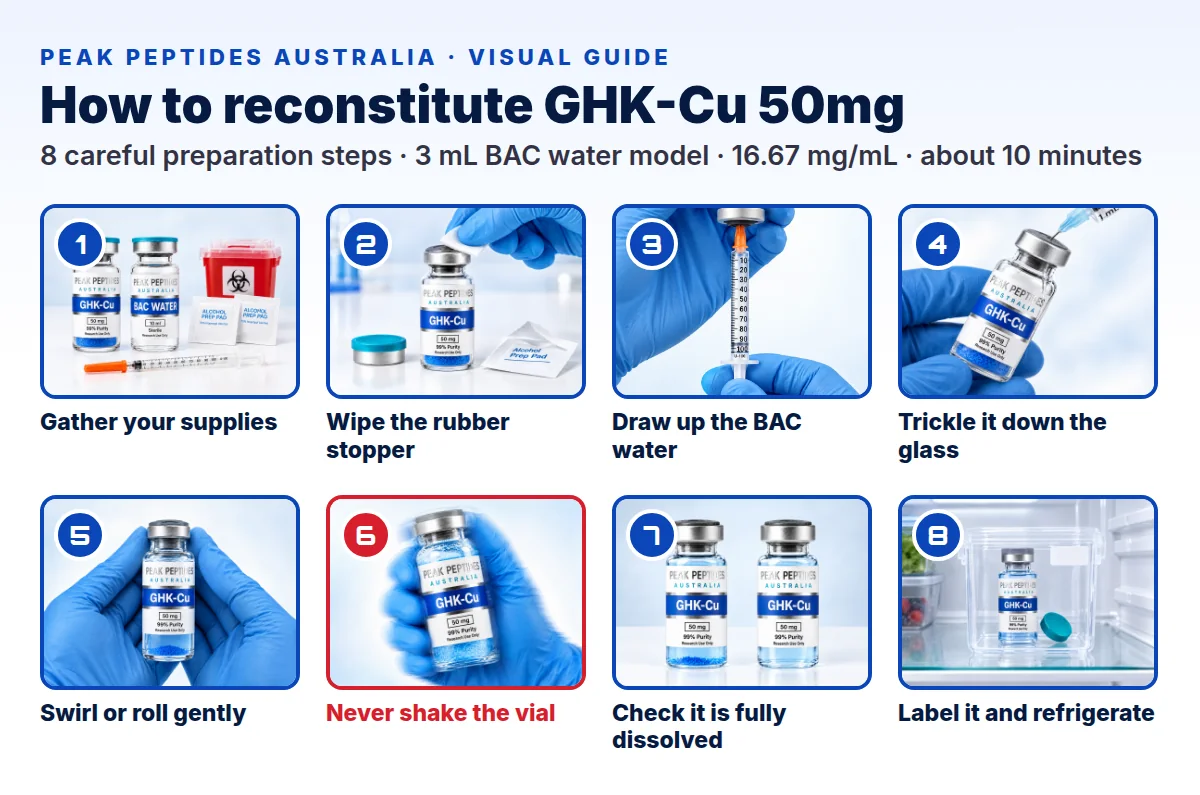
GHK-Cu 50mg arrives as blue freeze-dried powder. Reconstitution means adding a measured volume of bacteriostatic water so a research solution can be recorded by concentration. The PeptideDosages reference model uses 3mL final volume, which gives 16.67mg/mL and simple U-100 volume maths. The visual cue for fully dissolved GHK-Cu is clear light-blue liquid with no blue powder, cloudiness or particles. The preparation sequence below takes about 10 minutes; record the selected final volume and concentration with the vial.
The complete GHK-Cu 50mg preparation sequence: work cleanly, add liquid slowly, swirl gently and verify the clear light-blue solution.
What you need
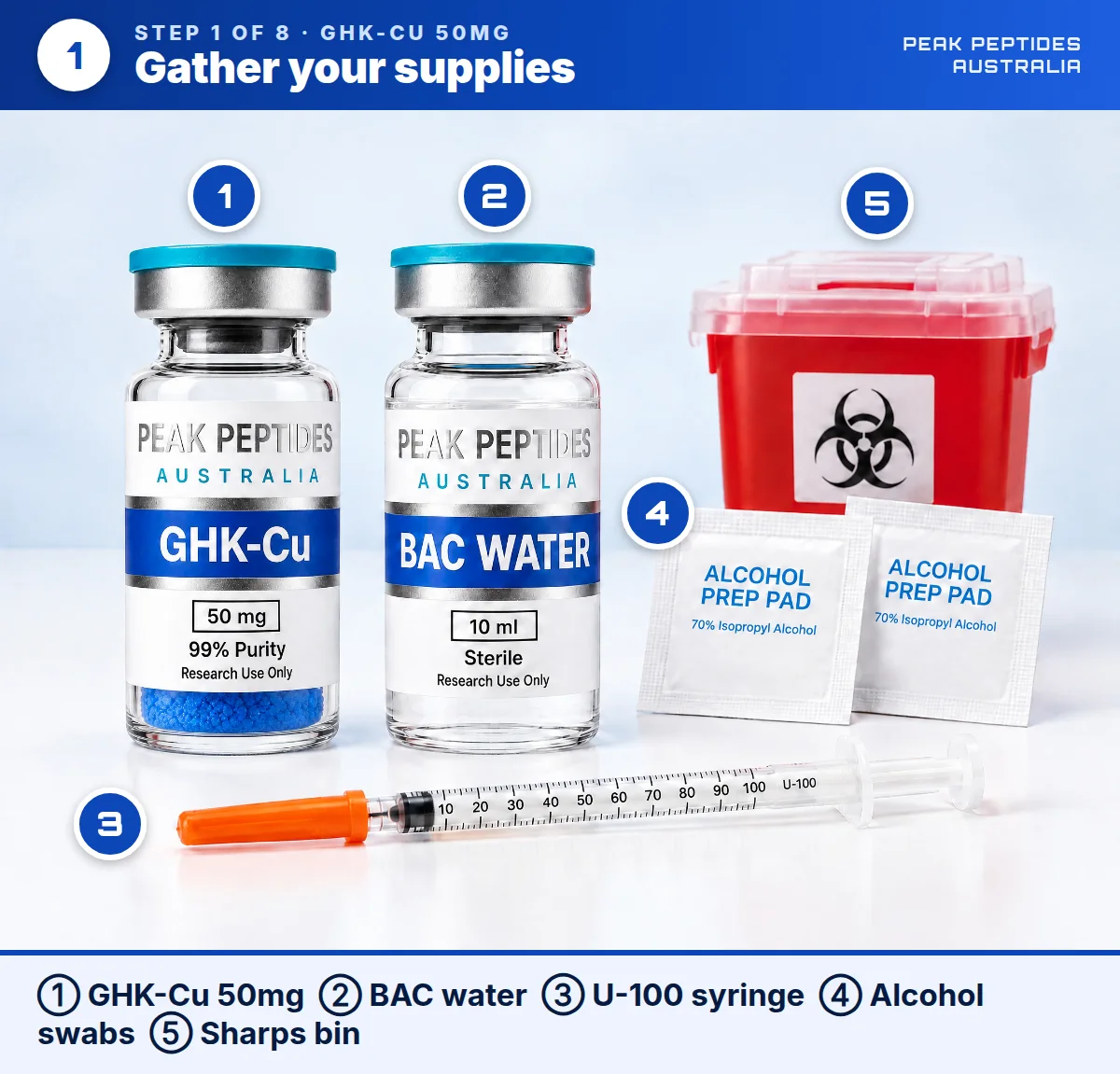
GHK-Cu 50mg vialBlue freeze-dried copper-peptide material in a sealed glass vial.
Bacteriostatic waterThe solvent used in this page’s 3mL reference concentration model.
1mL U-100 syringeA volume-measurement tool: 100 units equals 1mL.
Alcohol swabsFor cleaning the rubber stoppers before preparation.
Sharps containerFor safe disposal of used sharp laboratory items.
How much BAC water to add to GHK-Cu 50mg
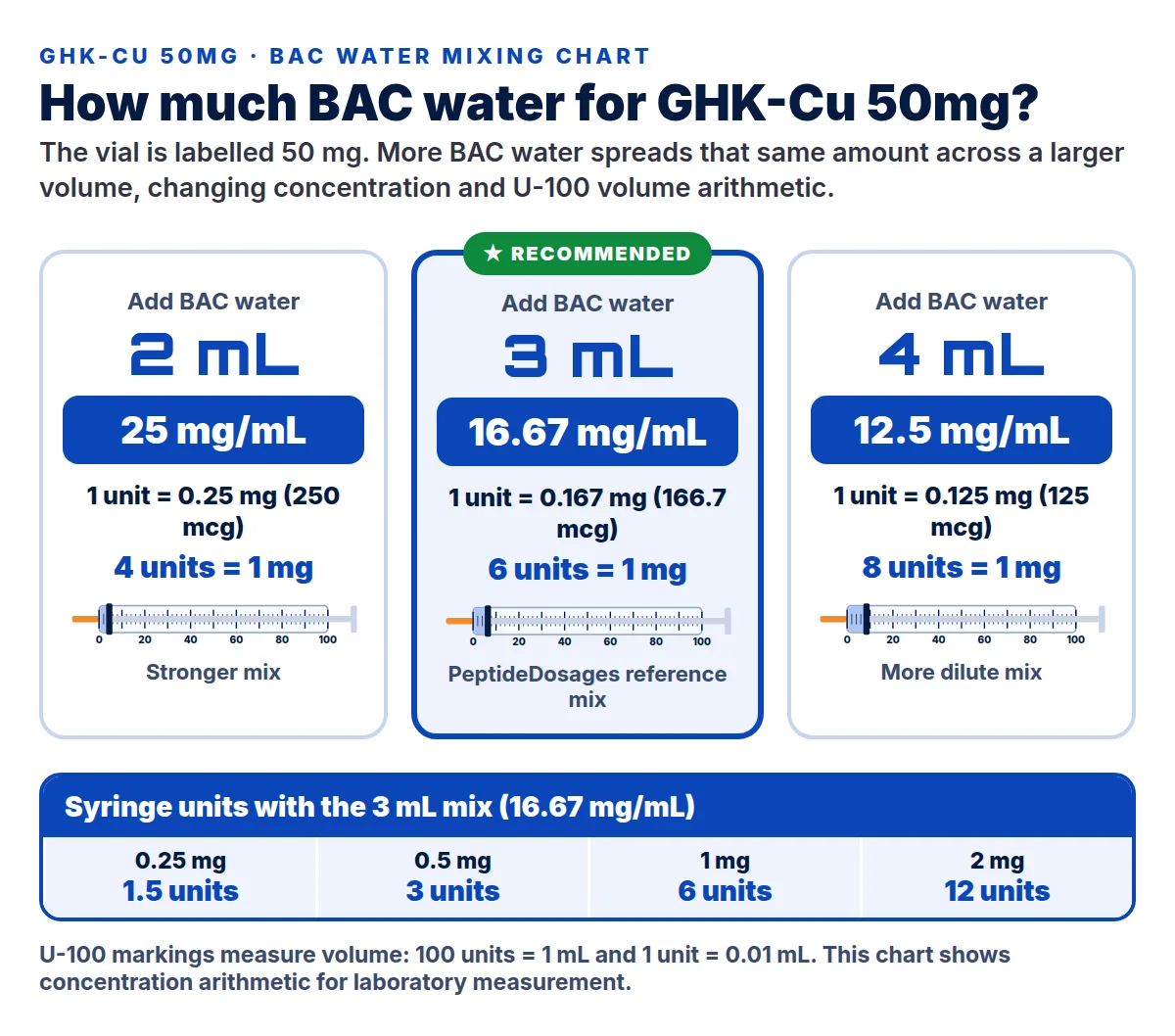
How much BAC water for GHK-Cu 50mg depends on the concentration needed for the laboratory record. The vial is labelled 50mg in every option. Adding more liquid does not add more GHK-Cu; it spreads the same labelled mass across a greater volume. Concentration is mass divided by final volume.
The PeptideDosages reference model uses 3mL, giving 16.67mg/mL. In that model, 1 U-100 unit is about 0.167mg and 6 units are 1mg. A 2mL final volume gives 25mg/mL, so 1mg is 4 units. A 4mL final volume gives 12.5mg/mL, so 1mg is 8 units. These are concentration conversions for laboratory measurement.
GHK-Cu 50mg concentration chart: the 3mL reference model gives 16.67mg/mL and 6 U-100 units per 1mg.
3 mL is highlighted because it gives the simplest numbers.
Syringe units with the 3 mL mix (16.67 mg/mL)
Syringe units with the 3 mL mix (16.67 mg/mL)
Amount
Units on a U-100 syringe
Volume
0.25 mg
1.5 units
0.015 mL
0.5 mg
3 units
0.03 mL
1 mg
6 units
0.06 mL
2 mg
12 units
0.12 mL
The 8 steps
1Step 1: Gather your supplies
Set out the GHK-Cu 50mg vial, BAC water, a new 1mL U-100 syringe, alcohol swabs and a sharps container on a clean laboratory surface. Keep the product label and LabDoc record available. The supplied vial contains blue freeze-dried powder; note its condition before adding any liquid and record the final volume selected for the preparation.
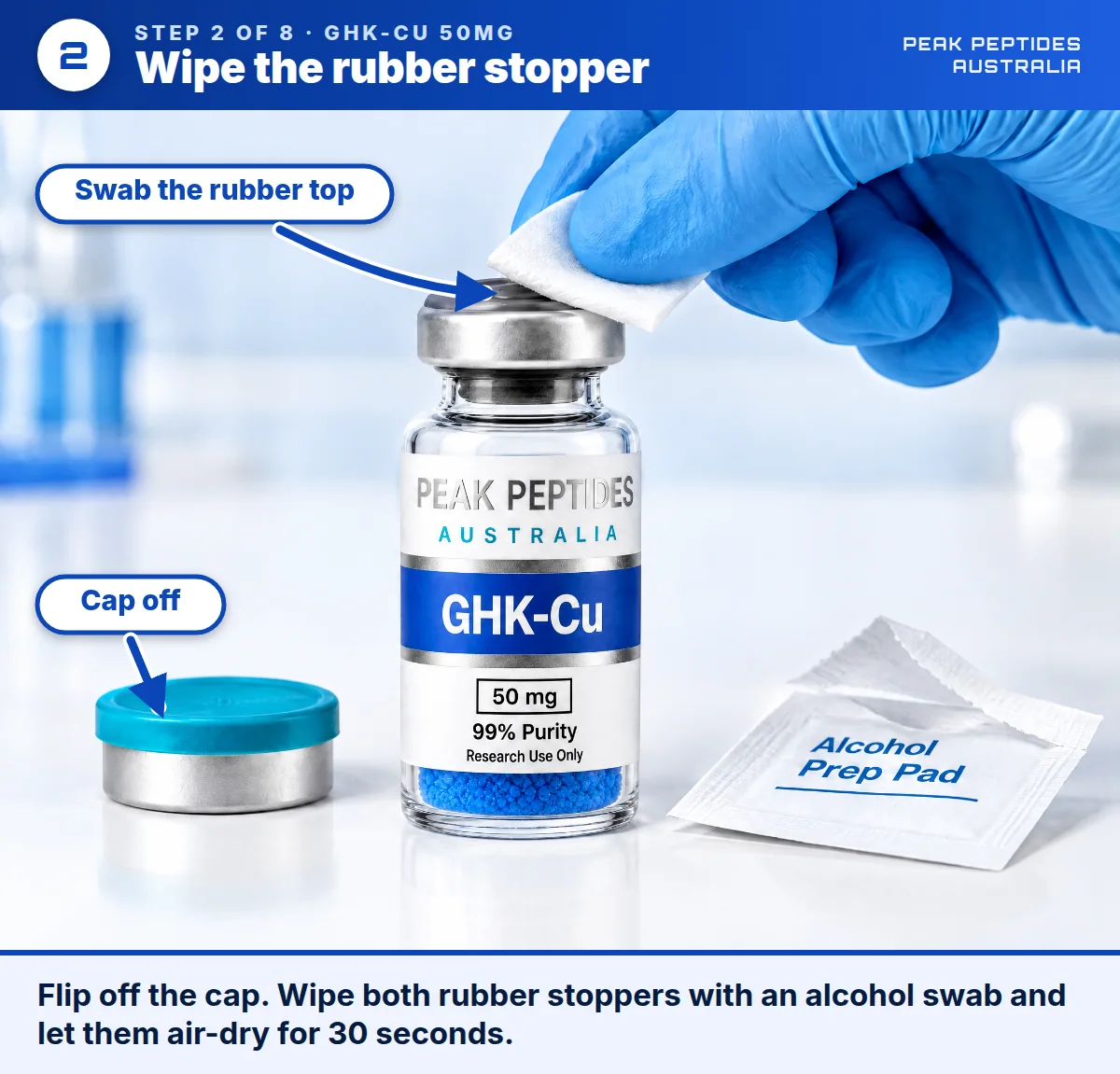
2Step 2: Wipe the rubber stopper
Remove the flip-off cap without touching the rubber stopper. Wipe the stopper with a fresh alcohol swab and allow it to air-dry. Do the same for the BAC water vial. Once cleaned, avoid touching either stopper. This step helps keep the preparation record focused on the material and volume intended for the laboratory solution.
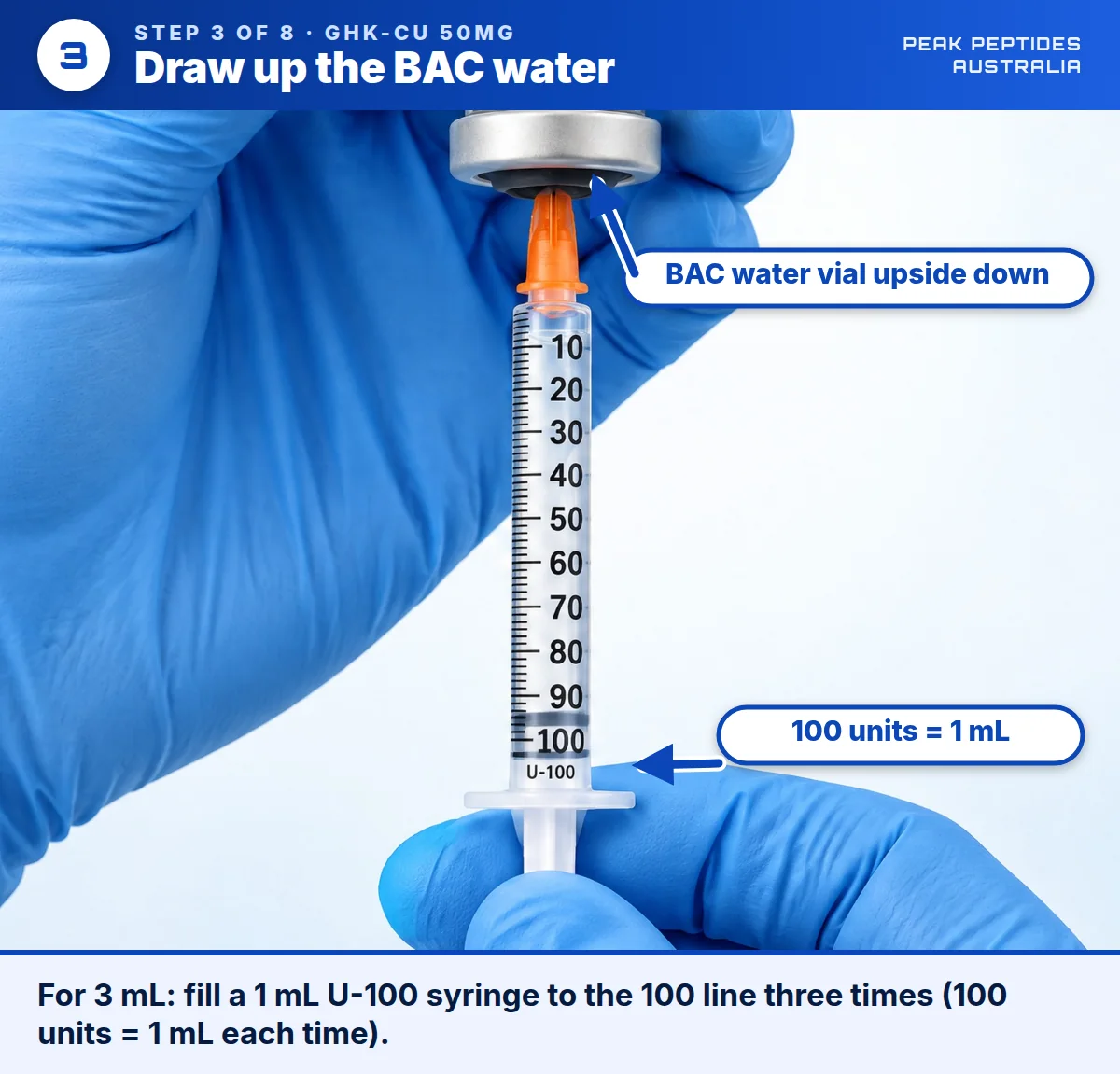
3Step 3: Draw up the BAC water
Measure BAC water using the syringe’s volume scale. A 1mL U-100 syringe holds 100 units, which equals 1mL. The reference model on this page has a 3mL final volume, so it uses three measured 1mL portions. Record the actual final volume used because concentration and all unit conversions depend on that number.
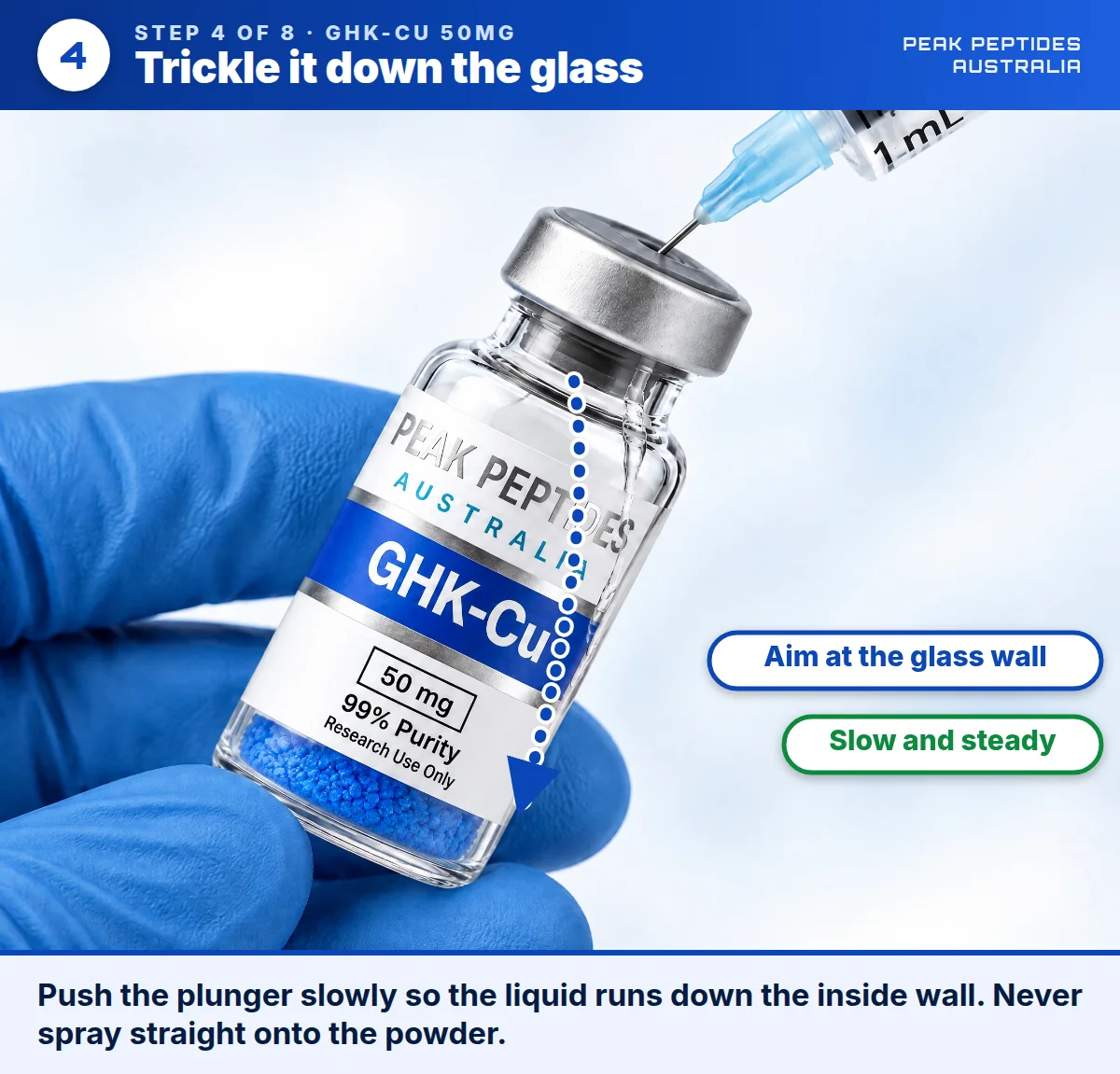
4Step 4: Trickle it down the glass
Place the needle so the liquid can run slowly down the inside wall of the GHK-Cu vial instead of striking the blue powder directly. Add each measured portion slowly. This visual guide follows the handling sequence described by the PeptideDosages reference: add liquid down the vial wall, then swirl or roll gently rather than shaking.
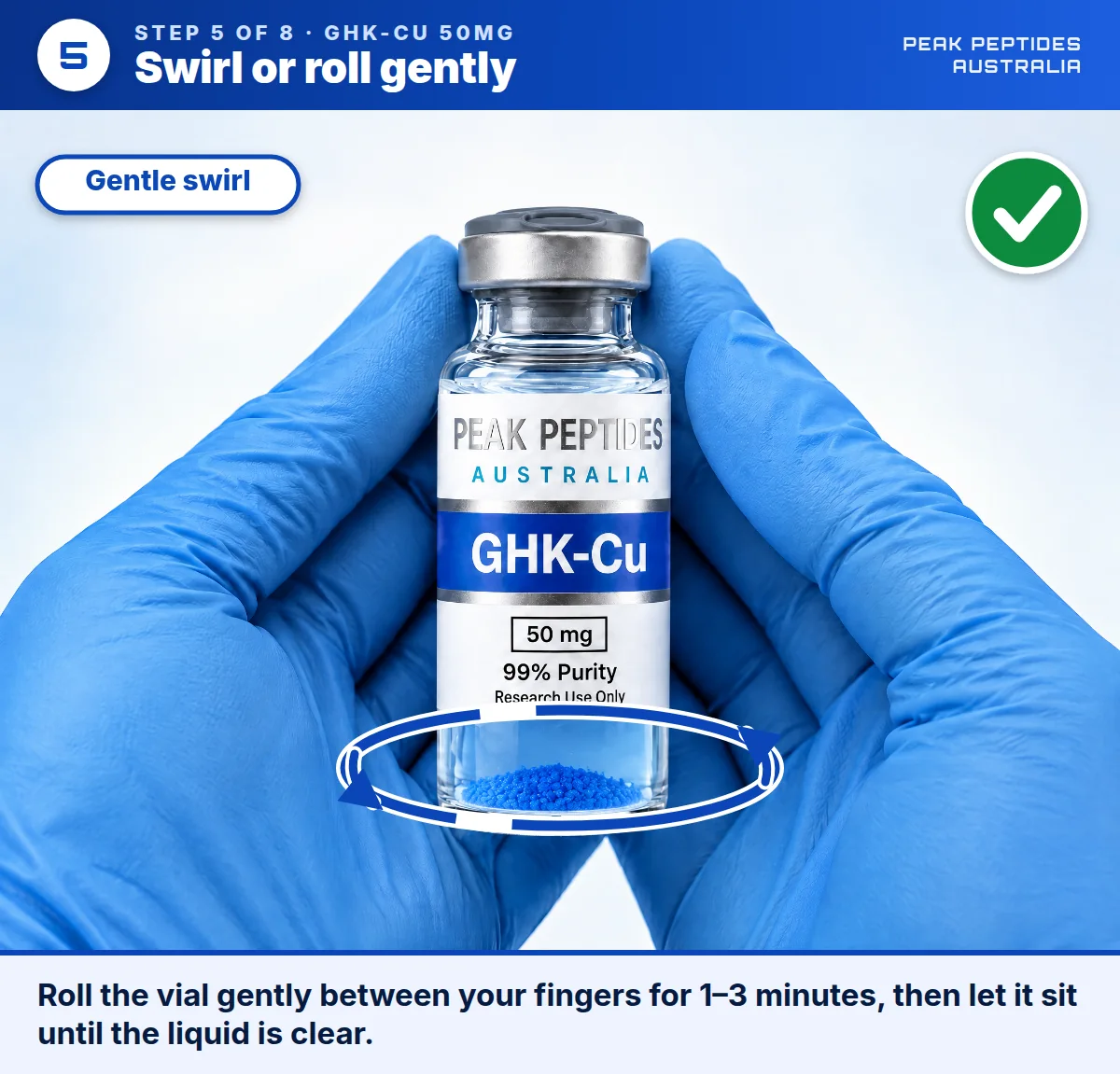
5Step 5: Swirl or roll gently
Gently swirl or roll the vial between gloved fingers. The blue powder begins to disperse through a light-blue solution. Do not force the process. Allow the vial to stand briefly if blue material remains at the bottom, then swirl again. The goal is a uniform clear light-blue liquid, not foam or a violently mixed solution.
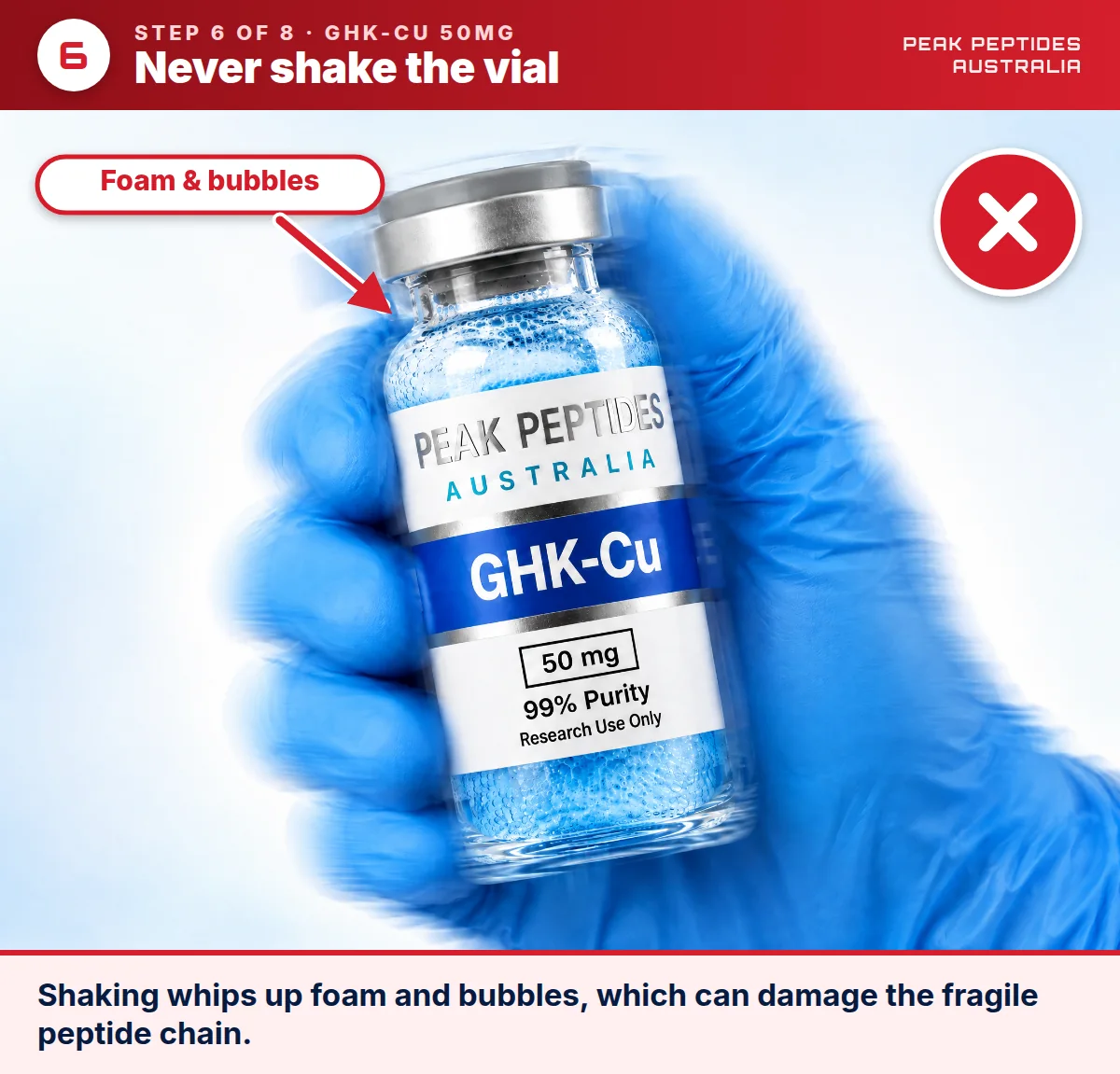
6Step 6: Never shake the vial
Do not shake the vial. Shaking creates foam and bubbles, making visual inspection harder and can damage the peptide. If bubbles appear, stand the vial upright and allow them to settle before checking the liquid again. Swirl gently instead.
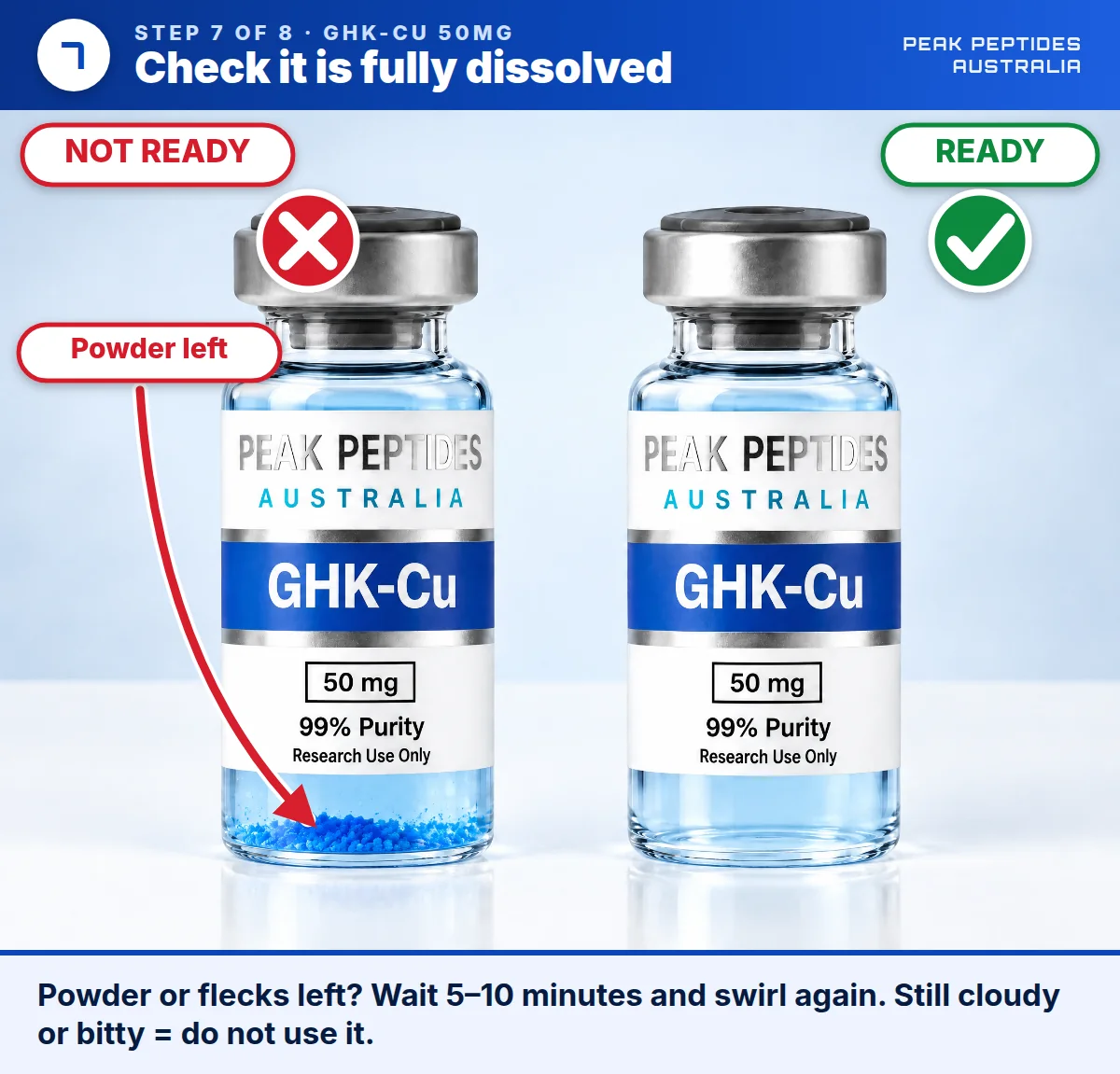
7Step 7: Check it is fully dissolved
Inspect the vial against a light background. For GHK-Cu, the ready visual state is clear light-blue liquid with no remaining blue powder, visible flecks or cloudiness. The left vial in the photo still has blue powder and is not ready. The right vial shows the fully dissolved appearance used by this preparation guide.
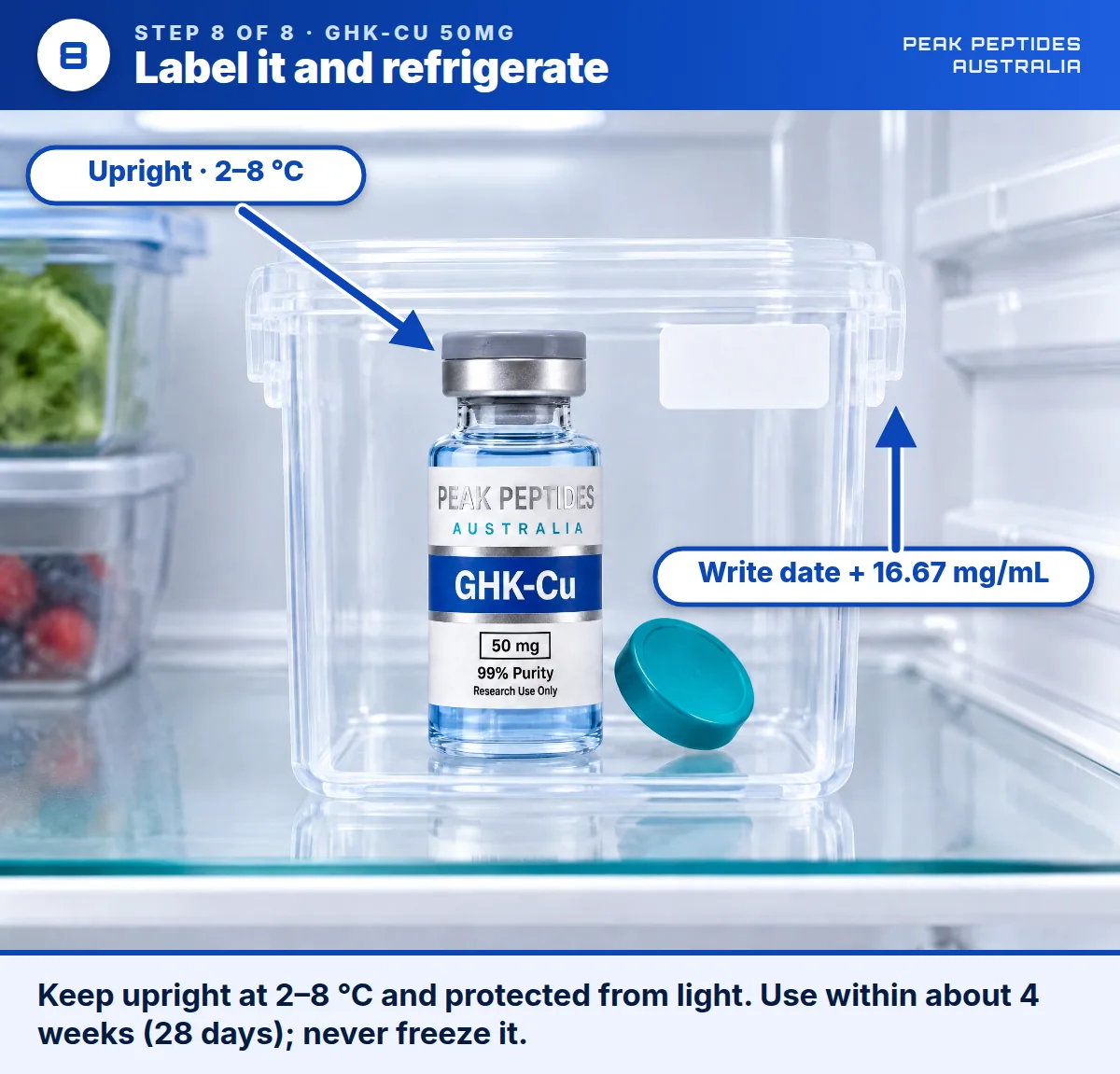
8Step 8: Label it and refrigerate
Label the preparation with GHK-Cu, the final volume, calculated concentration and preparation date. Keep it upright in the fridge at 2–8°C, protected from light, use it within about 4 weeks (28 days) and never freeze it.
GHK-Cu 50mg storage record
What to record for GHK-Cu 50mg storage and preparation
What to record for GHK-Cu 50mg storage and preparation
Stage
Record
Why it matters
Unopened vial
Keep the sealed product and lot documentation with the vial
Unopened powder: fridge 2–8 °C, in the dark; freezer −20 °C for long-term.
Preparation
Final volume, calculated mg/mL, date and visual appearance
These values define the laboratory solution and its concentration arithmetic
Mixed material
Upright storage at 2–8°C, protected from light; avoid freeze–thaw cycles
Within about 4 weeks (28 days)
Inspection
Clear light-blue liquid with no blue powder, cloudiness or particles
This is the visual state shown by the GHK-Cu preparation guide
Once mixed with BAC water, keep it upright in the fridge at 2–8 °C, away from light, use it within about 4 weeks (28 days) and never freeze it. Write the date and strength on the vial.
GHK-Cu is a copper complex made from the tripeptide glycyl-histidyl-lysine, abbreviated GHK. The sequence is Gly–His–Lys, and the copper-bound complex is also called copper peptide or copper tripeptide-1. Published research examines its chemistry, matrix-related cell signals, wound models and topical skin formulations.
What is GHK-Cu used for in research?
GHK-Cu research commonly examines extracellular-matrix turnover, collagen and glycosaminoglycan measurements, fibroblast and keratinocyte responses, matrix metalloproteinases, copper binding and topical skin formulations. Each result belongs to the study model, concentration and formulation used. This GHK-Cu 50mg listing is supplied for in-vitro research only.
Is GHK-Cu the same as copper peptide?
Usually, yes. Copper peptide is a common search name for GHK-Cu, also called copper tripeptide-1 or GHK copper complex. The exact formulation still matters. A copper-peptide cream, serum, lyophilised vial and blend can use related terminology while being different products with different quality records and research contexts.
What does Gly-His-Lys:Cu mean?
Gly-His-Lys:Cu is shorthand for the GHK sequence complexed with copper. Gly means glycine, His means histidine and Lys means lysine. Janoshik’s GHK-Cu analytical listing gives the sequence as Gly-His-Lys-Cu. It is a short chemical description, not a separate product name.
Why is GHK-Cu blue?
The blue colour comes from copper in the GHK-Cu complex. The supplied vial photo shows blue freeze-dried powder. In the reconstitution photos, fully dissolved material is shown as clear light-blue liquid. Colour alone cannot verify identity, purity, content, sterility or suitability; use the independent report for the tested-sample results.
What did GHK-Cu studies find?
Published laboratory studies measured collagen synthesis, glycosaminoglycans, decorin and matrix metalloproteinase activity in defined cell and wound systems. The 2018 review also summarised topical 12-week skin preparations. These findings describe the particular experimental or topical formulation.
What side effects were reported in GHK-Cu studies?
The topical studies cited on this page focus on skin and cosmetic endpoints, not a side-effect profile for this lyophilised vial. For injectable compounded GHK-Cu, the FDA identifies potential immunogenicity risk from aggregation and peptide-related impurities and says human safety data are limited. Topical findings do not answer route-specific safety questions.
What is the half-life of GHK-Cu?
No half-life is stated on this page because the opened product, PubChem, review, TGA and FDA sources did not provide a verified pharmacokinetic half-life for this exact GHK-Cu vial. A half-life depends on the molecule, formulation, route and study design, so a number from another product should not be transferred here.
Is GHK-Cu the same as a GHK-Cu serum or cream?
No. A GHK-Cu serum or cream is a finished topical formulation with its own vehicle, concentration and skin-exposure conditions. This listing is a 50mg lyophilised research vial. The reviewed human studies used topical preparations, so their findings belong to those particular products rather than this vial format.
What is the difference between GHK-Cu and KLOW?
GHK-Cu 50mg is an individual copper-peptide vial. KLOW is a four-component blend that includes stated GHK-Cu 50mg together with BPC-157, TB-500 and KPV. The products have different components, concentration arithmetic and separate analytical records. See the GHK-Cu vs KLOW comparison on this page.
Is GHK-Cu approved by the TGA or FDA?
GHK-Cu is not an approved medicine in Australia. The TGA names it as an example of an unapproved peptide product, meaning it is not included in the ARTG. The FDA source opened for this page addresses compounded injectable GHK-Cu safety concerns; it does not present an approved GHK-Cu medicine.
Can I buy GHK-Cu 50mg online in Australia?
GHK-Cu 50mg can be ordered online from Peak Peptides Australia when available. Same-day dispatch from Victoria applies to in-stock orders once payment is confirmed. Parcels are sent with tracked Australia Post Express and the tracking number is emailed. The material is supplied for in-vitro research only.
How fast is GHK-Cu shipping in Australia?
In-stock orders receive same-day dispatch from Victoria once payment is confirmed. They are sent by tracked Australia Post Express, and the tracking number is emailed. Delivery timing depends on the Australia Post network and destination, so this dispatch statement is not a delivery-date promise.
How do I know GHK-Cu is real?
Check a sample-specific independent report that identifies the material, names the testing methods, gives a report identifier and can be opened from the laboratory’s verification page. For this listing, LabDoc report LD-2CGW records LC-MS identity as confirmed, 99.77% HPLC purity and 48.43mg HPLC content for the tested sample.
How is this GHK-Cu 50mg sample verified?
LabDoc report LD-2CGW records a GHK-Cu sample received and tested on 17 September 2026. The report records confirmed identity by LC-MS, 99.77% purity by HPLC and 48.43mg content by HPLC against the 50mg manufacturer claim. It also records 96.86% of label claim and an overall Pass assessment.
What does LabDoc LD-2CGW show?
LD-2CGW is the independent LabDoc report for the tested GHK-Cu sample. It describes lyophilised powder in a vial, lists Peak Peptides Australia as origin, states batch not stated, and records 48.43mg content, 99.77% HPLC purity and confirmed LC-MS identity. LabDoc states its report covers the tested sample only.
Is there also a Janoshik GHK-Cu report?
The product brief identifies Janoshik report #108022 as an additional GHK-Cu record. The result values are not repeated on this page because that individual report was not opened. Janoshik’s public GHK-Cu analytical service page confirms that it tests GHK-Cu for identity, amount and purity using HPLC.
How much BAC water for GHK-Cu 50mg?
The PeptideDosages reference model for a 50mg GHK-Cu vial uses 3mL final volume. That gives 16.67mg/mL. This page also shows 2mL and 4mL concentration options: 2mL gives 25mg/mL and 4mL gives 12.5mg/mL. The mass in the vial stays 50mg; only the concentration changes.
How many units is 1mg of GHK-Cu?
With the 3mL reference mix, the concentration is 16.67mg/mL, so 1mg corresponds to 6 units on a U-100 syringe, or 0.06mL. With a 2mL mix, 1mg is 4 units. With a 4mL mix, 1mg is 8 units. These are volume-conversion figures for laboratory measurement.
How many mg are in 10 units of GHK-Cu?
With the 3mL reference mix, 10 U-100 units equal 0.10mL and hold about 1.67mg of GHK-Cu. With a 2mL mix, 10 units hold 2.5mg. With a 4mL mix, 10 units hold 1.25mg. The result changes because the concentration changes with final volume.
How do I reconstitute GHK-Cu 50mg?
On a clean laboratory surface, prepare the vial and BAC water, wipe rubber stoppers, measure the selected liquid volume, and let it run slowly down the inside glass wall. Swirl or roll gently rather than shaking. When fully dissolved, the guide shows clear light-blue liquid with no remaining blue powder or particles.
Can sterile or tap water replace BAC water?
Do not use tap water. The chart on this page is built around BAC water because that is the solvent specified in its reference model. Plain sterile water and BAC water are different materials with different preservation properties. Once mixed with BAC water, keep it upright in the fridge at 2–8 °C, away from light, use it within about 4 weeks (28 days) and never freeze it. Write the date and strength on the vial.
What if GHK-Cu powder will not dissolve?
Let the vial stand for several minutes, then swirl gently again. Do not shake it. The visual target for the GHK-Cu guide is clear light-blue liquid with no blue powder, visible flecks or cloudiness. If material remains visibly undissolved or unexpected particles appear, record the observation and do not treat it as fully dissolved.
Should reconstituted GHK-Cu be cloudy?
No. The expected visual state in this guide is clear light-blue liquid. Remaining blue powder, cloudiness, flakes or unexpected particles mean the material is not visually fully dissolved. Visual appearance does not replace analytical testing, but it is a useful preparation check before a research solution is recorded as ready.
How long does mixed GHK-Cu last?
Once mixed with BAC water, keep GHK-Cu 50mg upright in the fridge at 2–8 °C, away from light. Use it within about 4 weeks (28 days) and never freeze it. Write the preparation date and strength on the vial.
How should unopened GHK-Cu powder be stored?
Keep unopened powder in the fridge at 2–8 °C in the dark (freezer −20 °C for long-term). Keep the product label, lot information and any supplier stability documentation together with the laboratory record.
Can reconstituted GHK-Cu be frozen?
Once mixed with BAC water, keep the vial upright in the fridge at 2–8°C, protected from light. Use it within about 4 weeks (28 days) and never freeze it. Write the date and strength on the vial.
What does a GHK-Cu COA show?
A certificate of analysis identifies the sample and reports methods and results. For this listing, LabDoc LD-2CGW records LC-MS identity, HPLC purity and HPLC content.