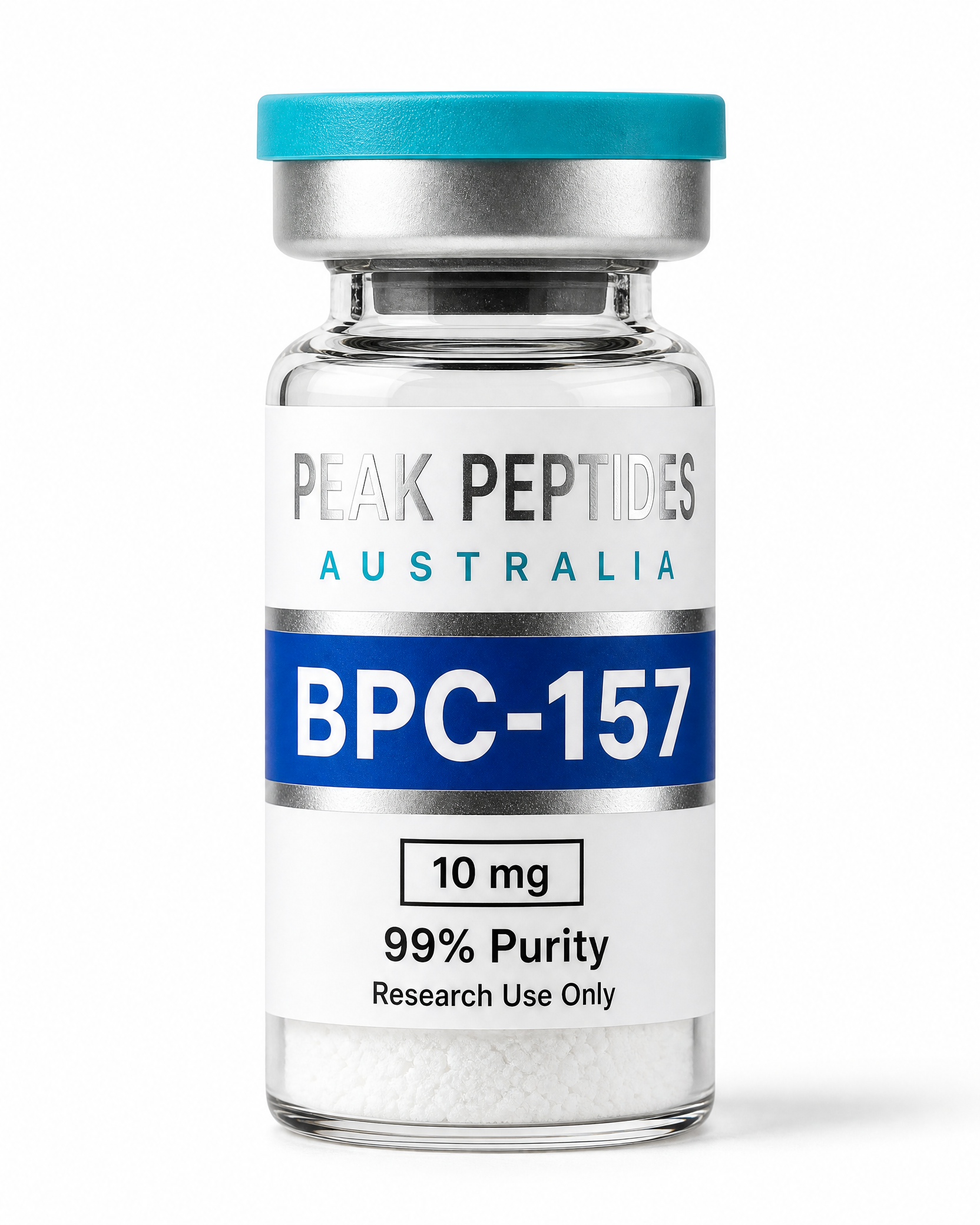
BPC-157 10mg is a synthetic 15-amino-acid peptide supplied as freeze-dried research material. In-stock orders receive same-day dispatch from Victoria after payment confirmation, with tracked Australia Post Express shipping Australia-wide.
Product Specifications
Full NameBody Protection Compound-157
Vial Size10mg
Purity99.56% HPLC (LD-VN45, 9.79mg sample)
Legal Disclaimer
This product is sold strictly for in-vitro laboratory research purposes only. It is not a therapeutic good, is not approved by the TGA, and is not intended for human or animal consumption, injection, or any diagnostic or therapeutic use.
BPC-157 10mg research guide · Updated 24 October 2026
BPC-157 10mg — What It Is, Research Findings & Reconstitution Guide
BPC-157, short for Body Protection Compound-157, is a synthetic 15-amino-acid peptide. Its reported sequence is GEPPPGKPADDAGLV. Researchers have examined it in preclinical tendon, ligament, muscle, gut and wound models, plus cell studies of blood-vessel and fibroblast signalling. That research context is not a proven human treatment result. This 10 mg vial is supplied as freeze-dried research material for in-vitro research only. The tested sample is backed by LabDoc report LD-VN45: identity confirmed by LC-MS, 99.56% purity by HPLC and 9.79 mg HPLC content against a 10 mg claim. This guide covers the molecule, research findings, comparisons with TB-500, Wolverine Stack and KLOW, 3 mL BAC-water measurement maths, storage and an eight-step photo guide.
Also referred to in research or catalogue references as BPC-157, BPC 157, BPC157, BPC-157 peptide, Body Protection Compound-157, Body Protection Compound 157, Bepecin, PLD-116, PL 14736, PL-14736.
Same-day from Victoria for in-stock orders once payment is confirmed, tracked Australia Post Express
A 15-amino-acid peptide
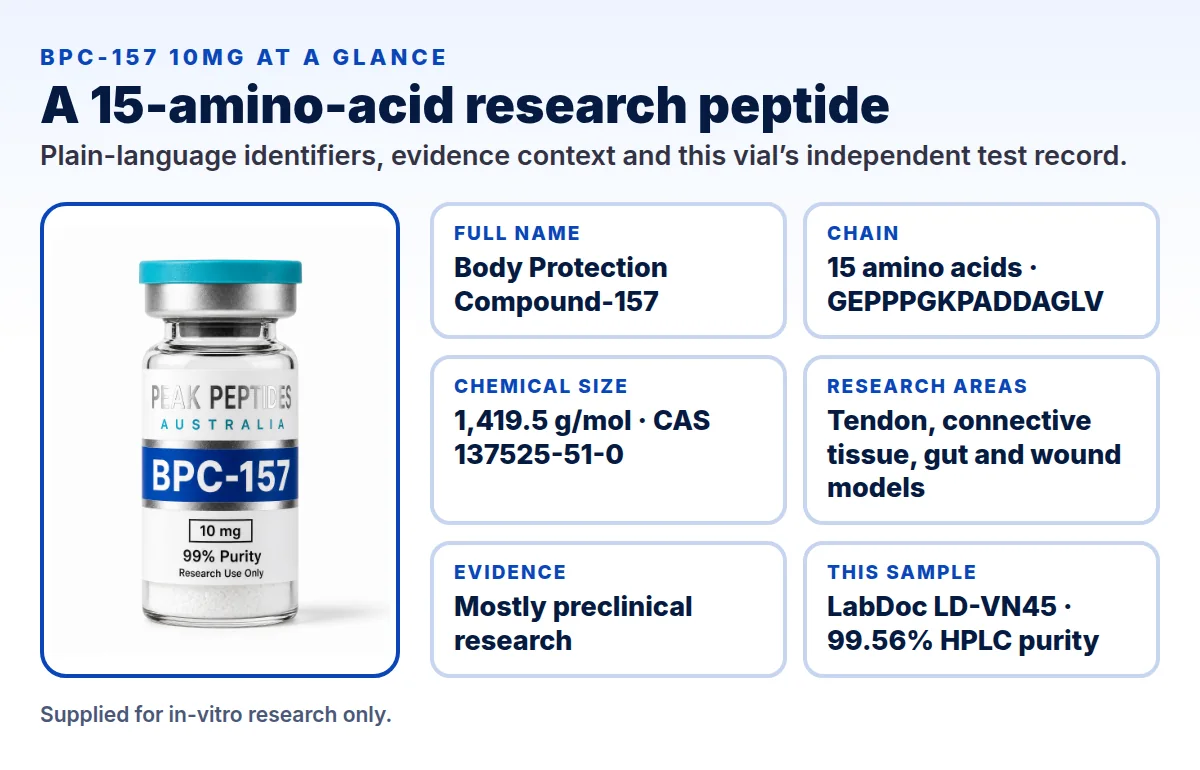
BPC-157 is a pentadecapeptide, meaning a chain of 15 amino acids. PubChem records the sequence GEPPPGKPADDAGLV, formula C62H98N16O22, molecular weight 1,419.5 g/mol and CAS number 137525-51-0. BPC 157, BPC157 and Body Protection Compound 157 are common search variants for the same named molecule.
What BPC-157 is studied for
BPC-157 is studied in laboratory and preclinical models involving tendons, ligaments, muscle, gastrointestinal tissue and wound repair. Reviews also discuss cultured fibroblasts, blood-vessel formation and nitric-oxide signalling. Each finding belongs to its specific model, endpoint and material; it is not a clinical claim for this vial.
How the proposed mechanism is described
There is no single proven human mechanism. Preclinical work has examined VEGFR2–Akt–eNOS signalling, nitric-oxide-system modulation and FAK–paxillin signalling in tendon fibroblasts. In plain English, those studies look at cell movement, tissue organisation and blood-vessel-related signals during experimental repair models.
What research found in tendon models
A 2003 study of transected Achilles tendons in rats reported stronger biomechanical measures, higher functional-index values and differences in collagen and fibroblast findings in the BPC-157 groups. The same paper also examined cultured tendon cells. This is a defined preclinical result, not a human outcome.
Human evidence is not a product claim
Human BPC-157 research so far is small, according to recent reviews. A registered Phase I record covers oral tablets; its study status is unknown. The FDA briefing reports insufficient clinical safety information to characterise the safety profile of BPC-157 free base or acetate. This material is supplied for in-vitro research only.
What the 10 mg label means
10 mg is the stated mass in this vial. When 3 mL of BAC water is used as the measurement model, the label mass gives 3.33 mg/mL; 1 U-100 unit is a 0.01 mL volume mark and represents about 0.033 mg.
Independent test for this BPC-157 sample
LabDoc report LD-VN45 records a Peak Peptides Australia BPC-157 lyophilised-vial sample tested on 11 September 2026. It reports LC-MS identity confirmed, HPLC purity of 99.56%, HPLC content of 9.79 mg against a 10 mg manufacturer claim, 97.9% of label claim, and an overall Pass. The Quality page also publishes Janoshik Analytical task #108019, dated 4 March 2026, listing BPC-157 10.29 mg and 99.825% purity; it is a separate published certificate, not the LabDoc tested sample.
What a LabDoc report does and does not show
LD-VN45 documents identity, purity and content for its tested sample. It does not state a batch, and LabDoc says the report covers the tested sample only. Identity, sterility, stability, formulation, clinical safety and effectiveness are separate questions. Read the verification report itself before relying on any analytical claim.
BPC-157 is a synthetic peptide made from 15 amino acids. Its full name is Body Protection Compound-157. A 15-amino-acid chain is also called a pentadecapeptide. The short forms BPC 157 and BPC157 refer to the same named molecule.
PubChem lists the amino-acid sequence as GEPPPGKPADDAGLV. It also lists a molecular formula of C62H98N16O22, a molecular weight of 1,419.5 g/mol and CAS number 137525-51-0. Those chemical identifiers describe BPC-157 itself, not the quality result of an individual vial.
BPC-157 is usually discussed in connection with laboratory and preclinical work on connective tissue, gastrointestinal tissue, wound models and vascular signalling. Peak Peptides Australia supplies this BPC-157 10mg material for in-vitro research only. It is not an approved medicine or a clinical formulation.
BPC-157 in one view: molecular identifiers, preclinical research context and the tested-sample LabDoc result.
How is BPC-157 studied?
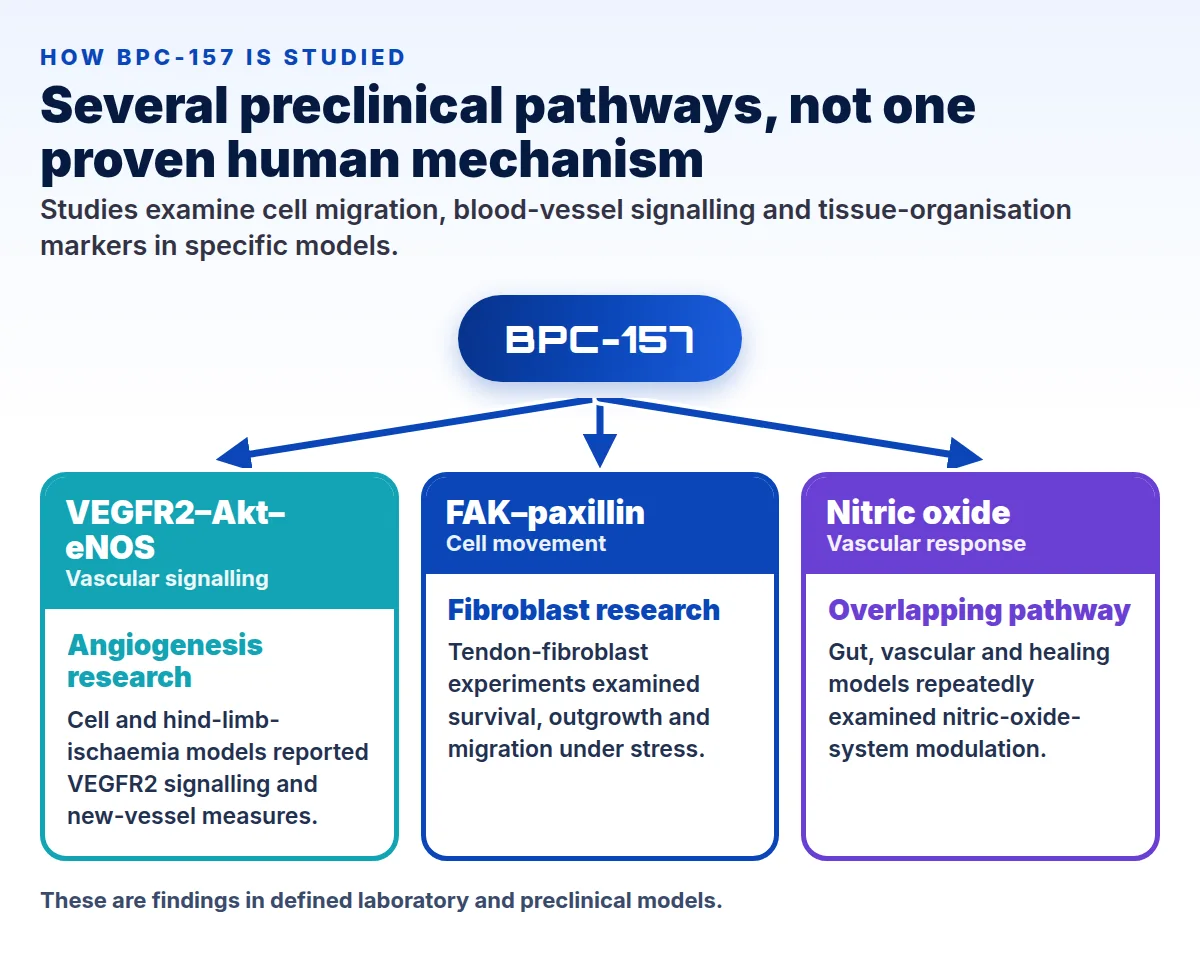
BPC-157 is studied through several overlapping biological pathways. The literature does not identify one confirmed human mechanism. Instead, it reports different molecular and cell-level observations in particular laboratory and preclinical models.
One group of studies examined VEGFR2–Akt–eNOS signalling. VEGFR2 is a receptor involved in blood-vessel biology; Akt and eNOS are downstream signalling proteins. In cell and preclinical hind-limb-ischaemia experiments, researchers reported changes in vascular signalling, tube formation, blood-flow recovery and vessel-number measures.
Another line of work examined tendon fibroblasts. Fibroblasts are cells that help make and organise connective tissue. Studies of tendon explants and cultured cells reported changes in outgrowth, migration and stress survival associated with FAK–paxillin signalling. These are research observations, not a claim of human repair.
VEGFR2–Akt–eNOS: examined in endothelial-cell and vascular preclinical research.
FAK–paxillin: examined in cultured tendon-fibroblast migration and outgrowth work.
Nitric oxide: repeatedly examined in gut, vascular and wound-model research.
BPC-157 has several reported preclinical research pathways rather than one proven human mechanism.
What did BPC-157 research find?
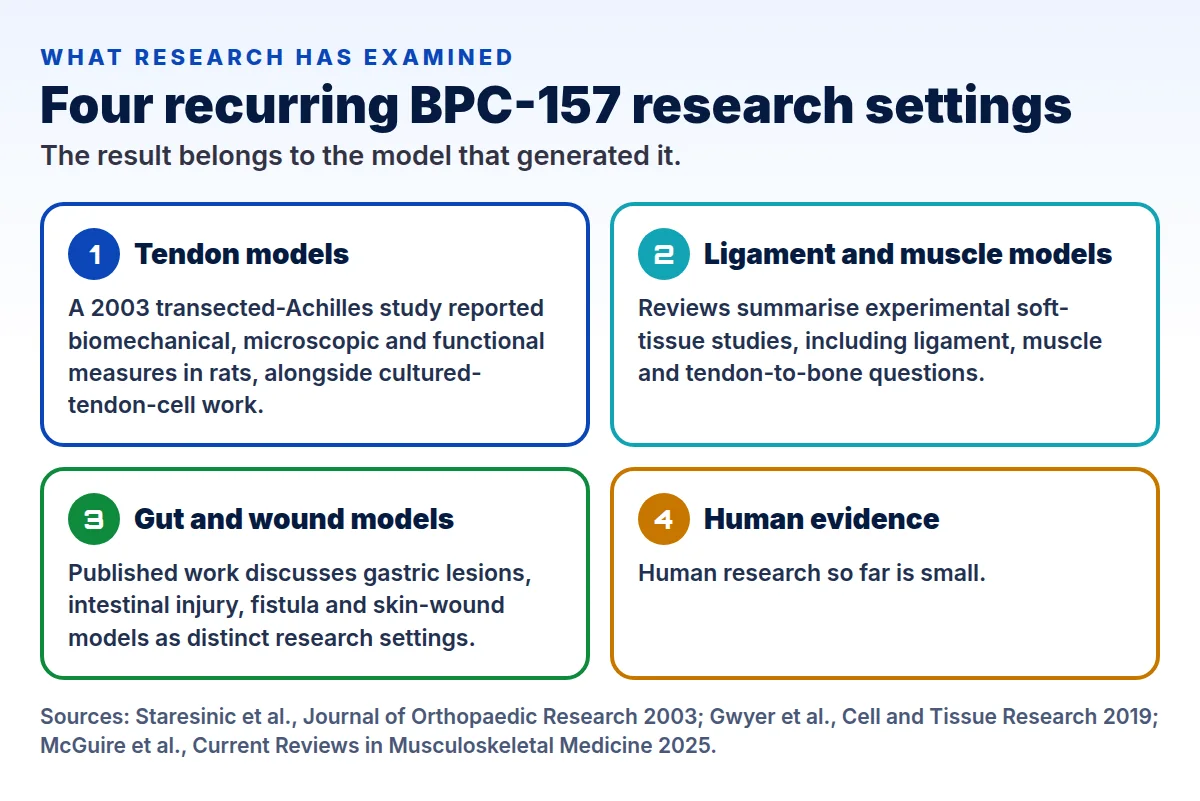
BPC-157 research spans several experimental settings. The strongest way to read it is model by model: a finding in cultured cells answers a different question from a finding in a tendon-transection model, a gut model or a human study record.
In the 2003 Journal of Orthopaedic Research paper, investigators studied a transected Achilles tendon model in rats and cultured tendon cells. The paper reported higher load-to-failure, load-per-area and Young’s-modulus measures, plus higher Achilles functional-index values and microscopic differences in fibroblasts, reticulin and collagen in the BPC-157 groups.
Reviews have collected other preclinical studies of ligaments, muscle, tendon-to-bone healing, gastric lesions, intestinal injury, fistulas and skin wounds. The 2019 review notes that most of this work was done in rats and mice, and the 2025 review counts only a handful of small human studies so far.
Four recurring research settings in the BPC-157 literature, with human evidence kept separate from preclinical findings.
Examples of BPC-157 research contexts and what they establish
Examples of BPC-157 research contexts and what they establish
Research setting
What was examined
What the result means
Cultured tendon cells
Cell growth, outgrowth, migration and stress response
A cell-level finding in a controlled laboratory system
Transected Achilles model
Biomechanical, functional and microscopic tendon measures
A preclinical tendon-model finding
Gut and wound models
Lesion, fistula, skin-wound and inflammatory measures
Separate preclinical questions with their own endpoints
Human records
Small reports and registered studies
Not a completed clinical validation for this vial
Results from a specific model should not be presented as a proven human outcome.
BPC-157 vs TB-500, Wolverine Stack and KLOW
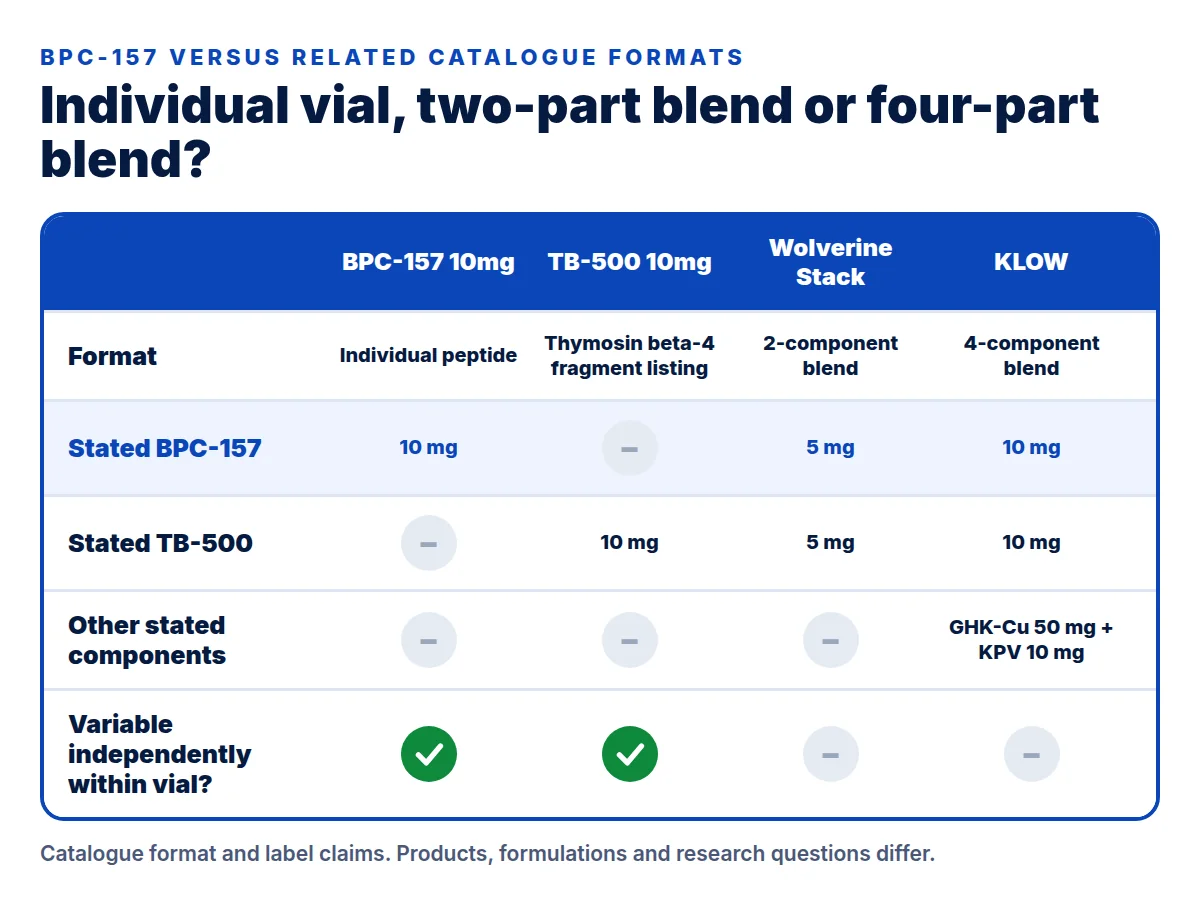
BPC-157 10mg is an individual research-peptide listing. TB-500 10mg is a separate listing described as a thymosin beta-4 fragment. They are two different molecules with their own research, so results for one do not apply to the other.
Wolverine Stack is a distinct fixed-ratio blend. Its listed composition is BPC-157 5mg plus TB-500 5mg, which is 10mg total stated material. KLOW is a larger four-component blend listed as GHK-Cu 50mg, BPC-157 10mg, TB-500 10mg and KPV 10mg, or 80mg total stated material.
A blend answers a different laboratory question because its components are fixed together. Individual components cannot be changed independently within the same blend vial.
A format comparison: individual BPC-157, individual TB-500, a two-component blend and a four-component blend.
Catalogue comparison: BPC-157 and related listings
Catalogue comparison: BPC-157 and related listings
Product
Listed format
Stated BPC-157
Stated TB-500
Other stated components
BPC-157 10mg
Individual peptide
10 mg
—
—
TB-500 10mg
Thymosin beta-4 fragment listing
—
10 mg
—
Wolverine Stack
Fixed two-component blend
5 mg
5 mg
—
KLOW
Fixed four-component blend
10 mg
10 mg
GHK-Cu 50 mg; KPV 10 mg
Listed quantities describe catalogue formats. They do not make the products interchangeable.
BPC-157 structure and sequence
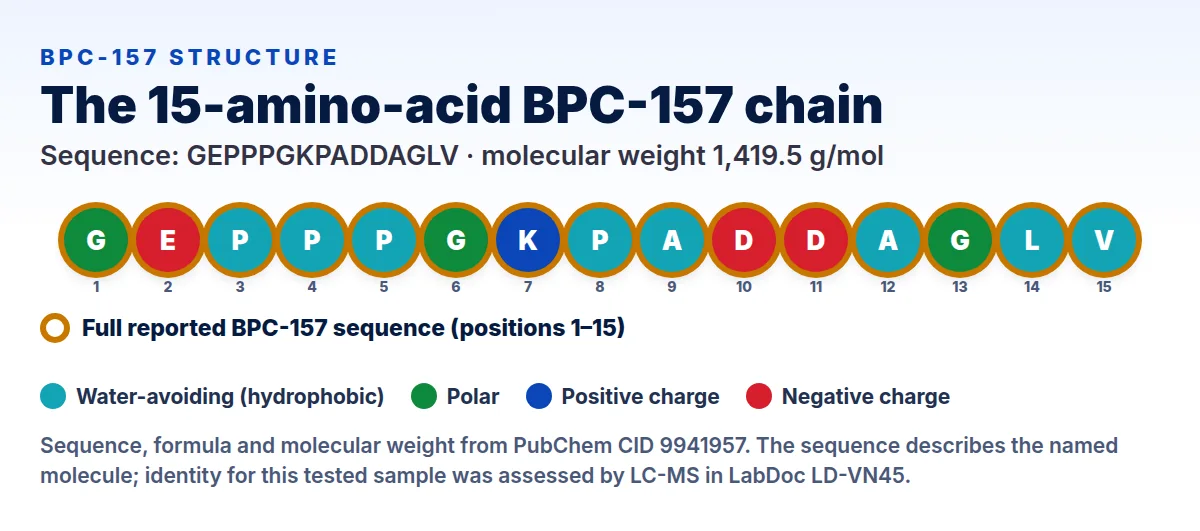
BPC-157 is named for a 15-amino-acid sequence: GEPPPGKPADDAGLV. Read left to right, the one-letter codes are glycine, glutamic acid, proline, proline, proline, glycine, lysine, proline, alanine, aspartic acid, aspartic acid, alanine, glycine, leucine and valine.
PubChem lists the molecule as C62H98N16O22 with a molecular weight of 1,419.5 g/mol. A molecular weight and sequence help identify a named chemical entity, but they do not replace an analytical test of a physical sample.
For this product, the analytical link is LabDoc LD-VN45. It reports that its BPC-157 tested sample had LC-MS identity confirmed. LC-MS compares a material’s mass signal with the expected identity information; HPLC was used in the report for purity and content measurement.
The reported 15-amino-acid BPC-157 sequence, shown as a chain of one-letter amino-acid codes.
Independent lab test and Australian regulatory status
BPC-157 10mg is linked to LabDoc report LD-VN45. The report identifies the sample as BPC-157 from Peak Peptides Australia, describes it as lyophilised powder in a vial, and lists testing on 11 September 2026. It records LC-MS identity as confirmed, 99.56% purity by HPLC and 9.79 mg content by HPLC against a 10 mg manufacturer claim, or 97.9% of label claim. The overall assessment is Pass.
Those figures are for the submitted tested sample. The report lists the batch as not stated and says it covers the tested sample only. It is useful evidence for identity, purity and content, but it is not a sterility result, stability programme, approval decision or clinical claim. Separately, the Quality page lists Janoshik Analytical task #108019, dated 4 March 2026, reporting BPC-157 10.29 mg and 99.825% purity. That is a separate published certificate and should not be substituted for LabDoc LD-VN45.
In Australia, Sport Integrity Australia states that BPC-157 is not listed on the Australian Register of Therapeutic Goods. Its BPC-157 information page also says the experimental peptide is not approved by any regulatory agency worldwide and is prohibited at all times under S0 Non-Approved Substances on the World Anti-Doping Code Prohibited List.
Identity: LC-MS confirmed in LabDoc LD-VN45.
Purity: 99.56% by HPLC in LabDoc LD-VN45.
Content: 9.79 mg by HPLC, 97.9% of the stated 10 mg claim.
Report scope: the tested sample only; batch not stated.
Australian status: not listed on the ARTG according to Sport Integrity Australia.
Step-by-step guide · About 10 minutes
How to reconstitute BPC-157 10mg (step-by-step with photos)
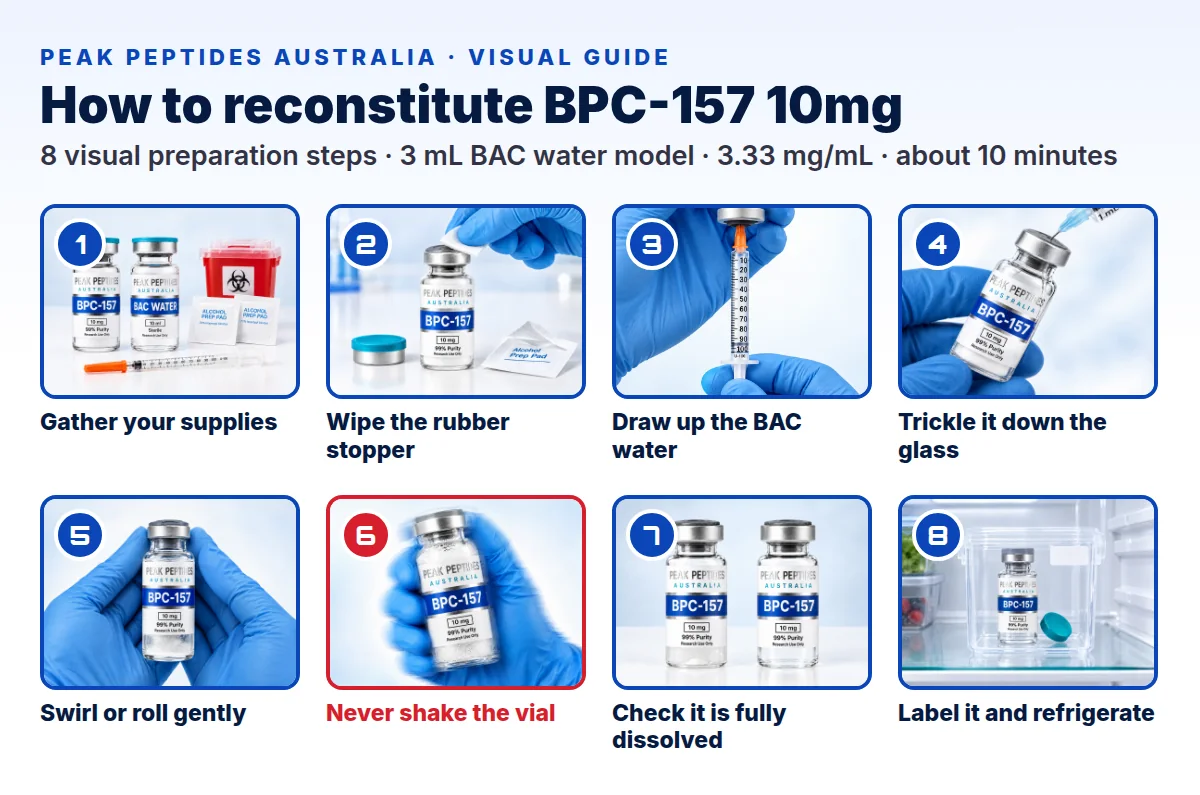
BPC-157 10mg is supplied as freeze-dried powder. Reconstitution means adding a measured liquid so the powder becomes a clear solution for a documented research workflow. The preferred PeptideDosages 10 mg guide uses 3 mL of bacteriostatic water, producing 3.33 mg/mL. The photo guide below shows the physical preparation steps, from clean supplies through the clear-solution check and refrigerated storage. It takes about 10 minutes.
The eight visual preparation checks for BPC-157 10mg at a glance.
What you need
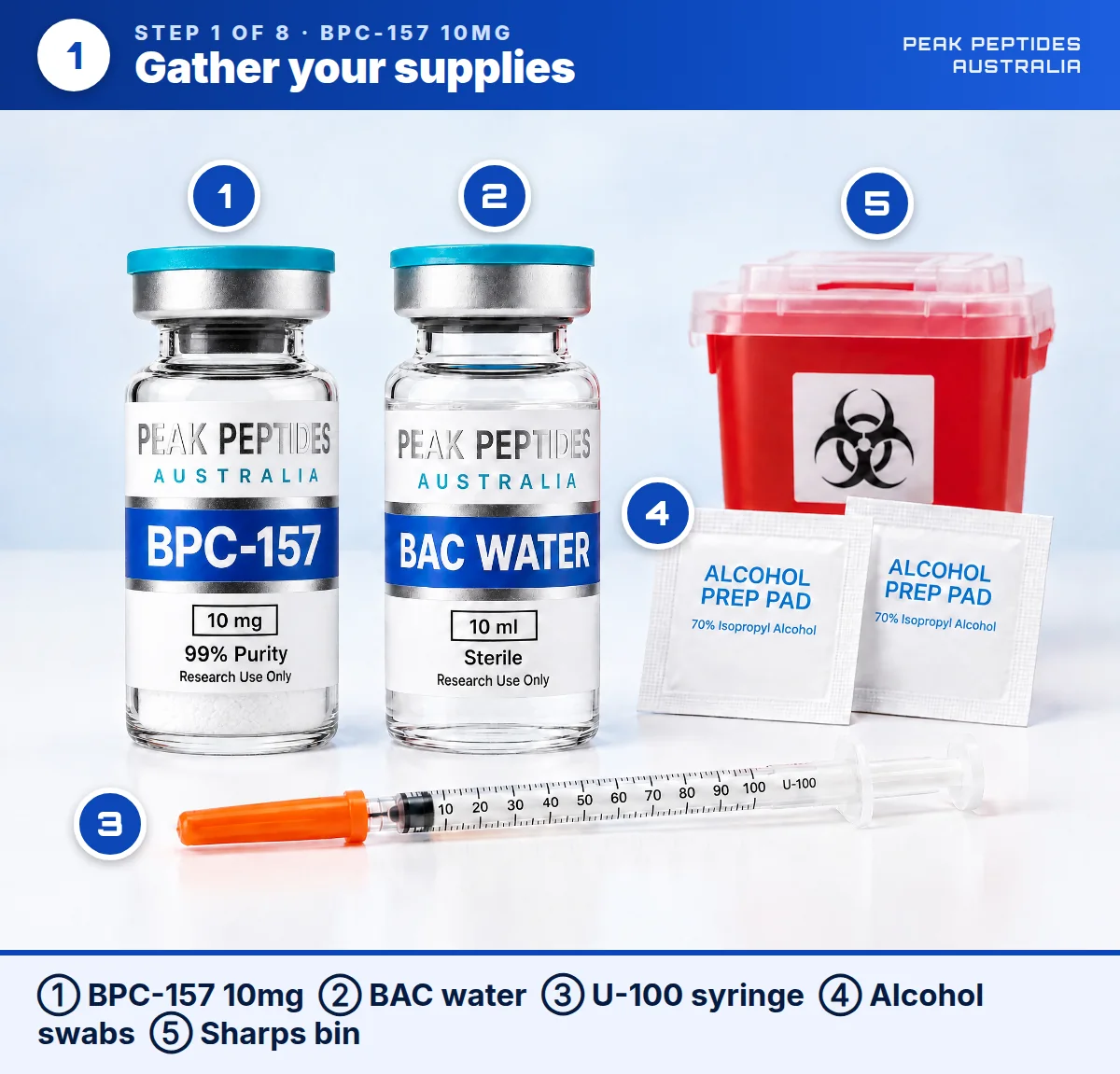
BPC-157 10mg vialFreeze-dried BPC-157 research material in a sealed vial.
Bacteriostatic waterThe preferred 10 mg measurement guide uses a 3 mL BAC-water model.
1 mL U-100 syringeA volume-measuring tool: 100 units equals 1 mL and 1 unit equals 0.01 mL.
Alcohol swabsFor cleaning the vial stoppers before the preparation steps.
Sharps containerFor safe disposal of used sharp tools in an appropriate laboratory workflow.
How much BAC water to add to BPC-157 10mg
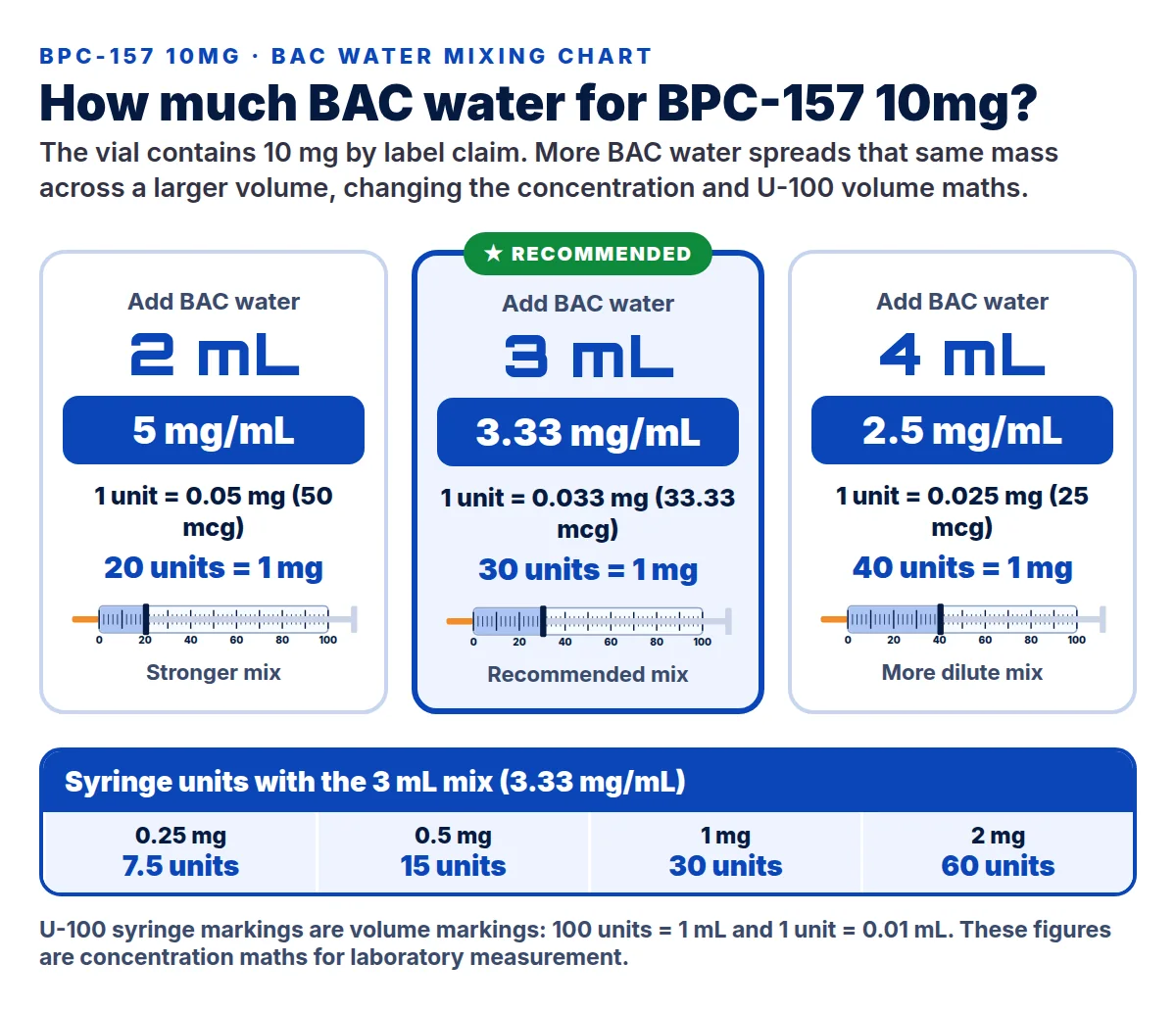
The stated 10 mg mass does not change when the liquid volume changes. BAC water determines the concentration: 2 mL gives 5 mg/mL, 3 mL gives 3.33 mg/mL, and 4 mL gives 2.5 mg/mL. The preferred PeptideDosages BPC-157 10 mg guide uses the 3 mL model.
With 3 mL, 1 mg is 30 units on a U-100 syringe, which is 0.3 mL. At this concentration, 10 units is 0.1 mL and holds about 0.33 mg. The simple laboratory formula is units = target mass ÷ concentration in mg/mL × 100.
BPC-157 10mg concentration models. The 3 mL BAC-water mix is the recommended option.
3 mL is highlighted because it gives the simplest numbers.
Syringe units with the 3 mL mix (3.33 mg/mL)
Syringe units with the 3 mL mix (3.33 mg/mL)
Amount
Units on a U-100 syringe
Volume
0.25 mg
7.5 units
0.075 mL
0.5 mg
15 units
0.15 mL
1 mg
30 units
0.3 mL
2 mg
60 units
0.6 mL
The 8 steps
1Step 1: Gather your supplies
Set out the BPC-157 10mg vial, BAC water, a new 1 mL U-100 syringe, alcohol swabs and a sharps container on a clean surface. Check that the vial is intact and the powder appears dry before beginning the preparation sequence.
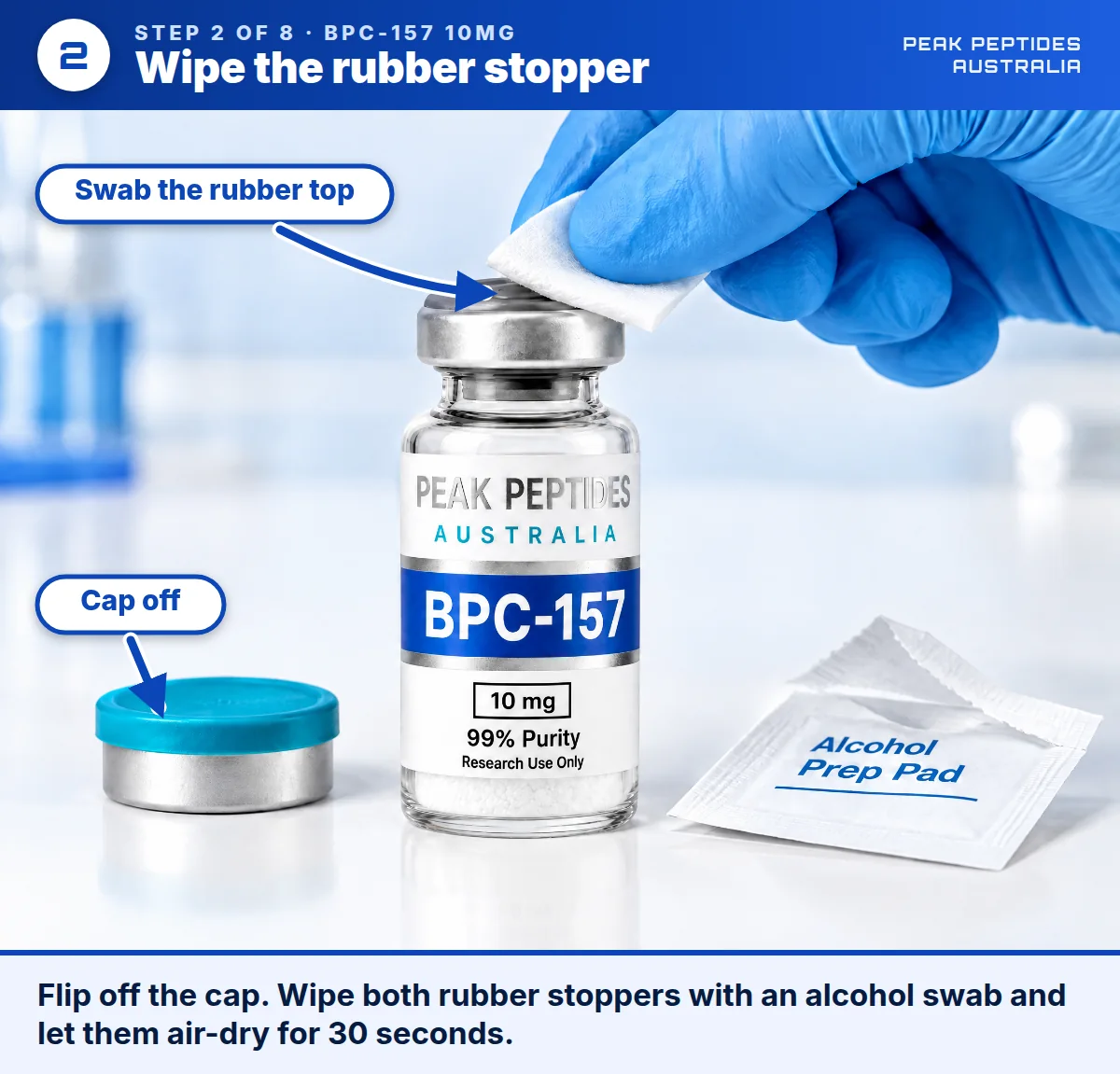
2Step 2: Wipe the rubber stopper
Remove the flip-off caps if present. Wipe the BPC-157 and BAC-water rubber stoppers with fresh alcohol swabs, then let the surfaces air-dry for about 30 seconds. Avoid touching the cleaned stopper surfaces before the next preparation step.
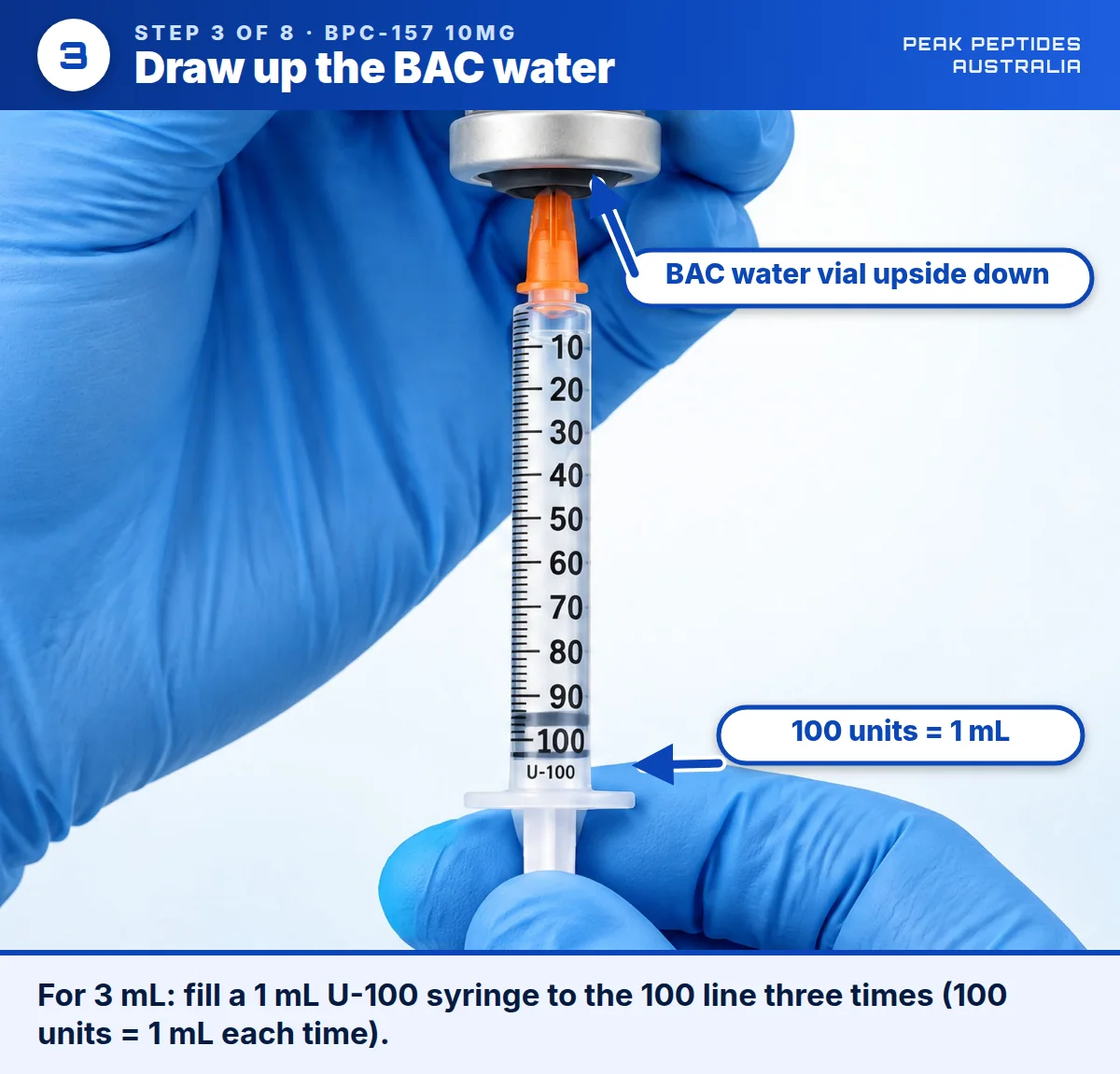
3Step 3: Draw up the BAC water
For the 3 mL measurement model, use the 1 mL U-100 syringe to draw 1 mL at a time. A full 100-unit syringe equals 1 mL, so the process is repeated three times to reach the 3 mL total.
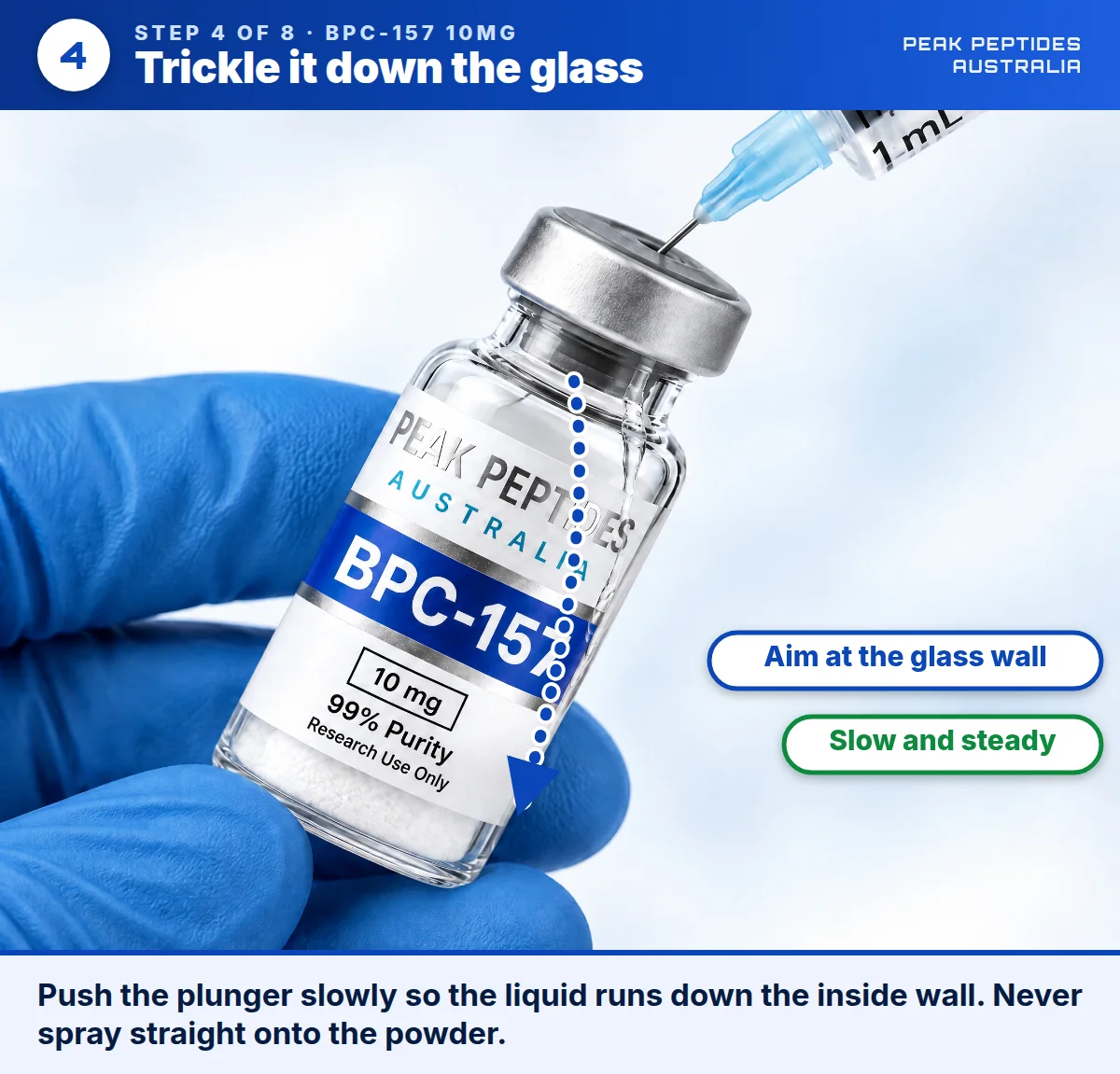
4Step 4: Trickle it down the glass
Place the needle through the BPC-157 stopper so the tip is against the inside glass wall. Press slowly and let the liquid run down the wall rather than striking the freeze-dried powder directly. Repeat the measured transfer until the total volume is complete.
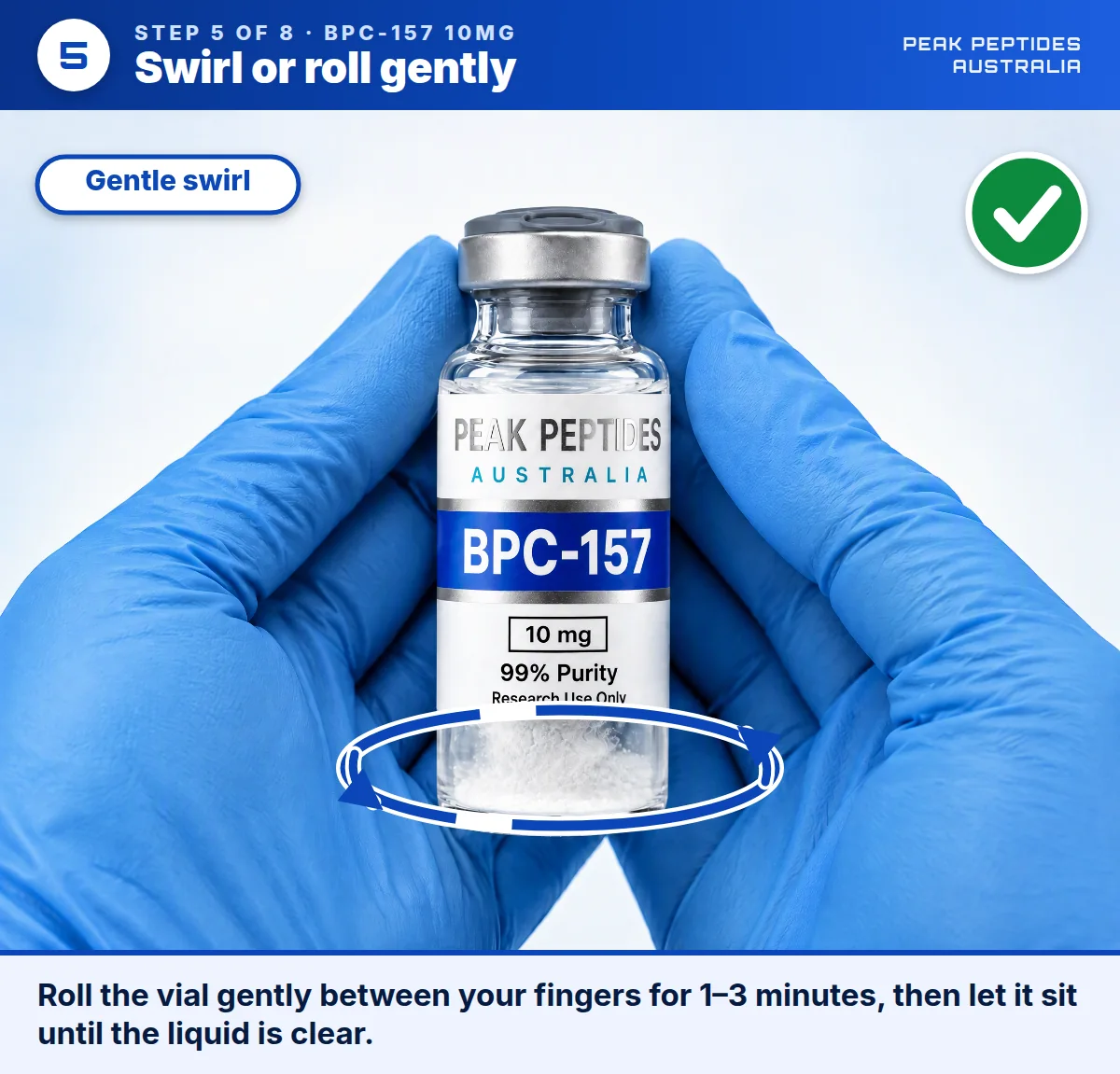
5Step 5: Swirl or roll gently
Hold the vial upright and swirl it in slow circles or roll it gently between your fingers. Give the powder time to dissolve. Gentle movement limits foam and keeps the visual check straightforward while the remaining powder clears.
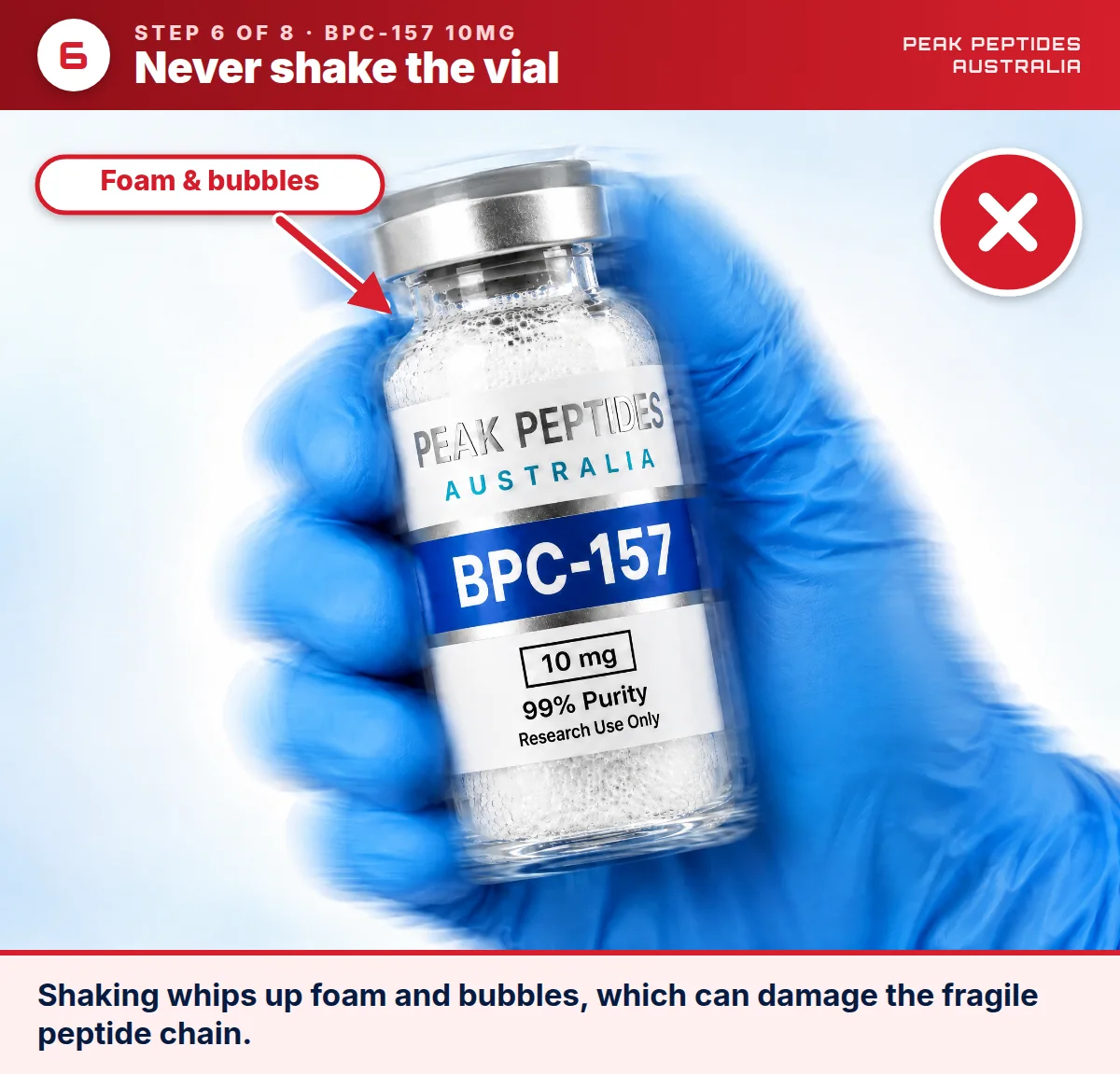
6Step 6: Never shake the vial
Do not shake the BPC-157 vial. Vigorous shaking produces foam and bubbles, making the liquid harder to inspect and potentially stressing a peptide preparation. If foam appears, stand the vial upright and allow the bubbles to settle before checking clarity.
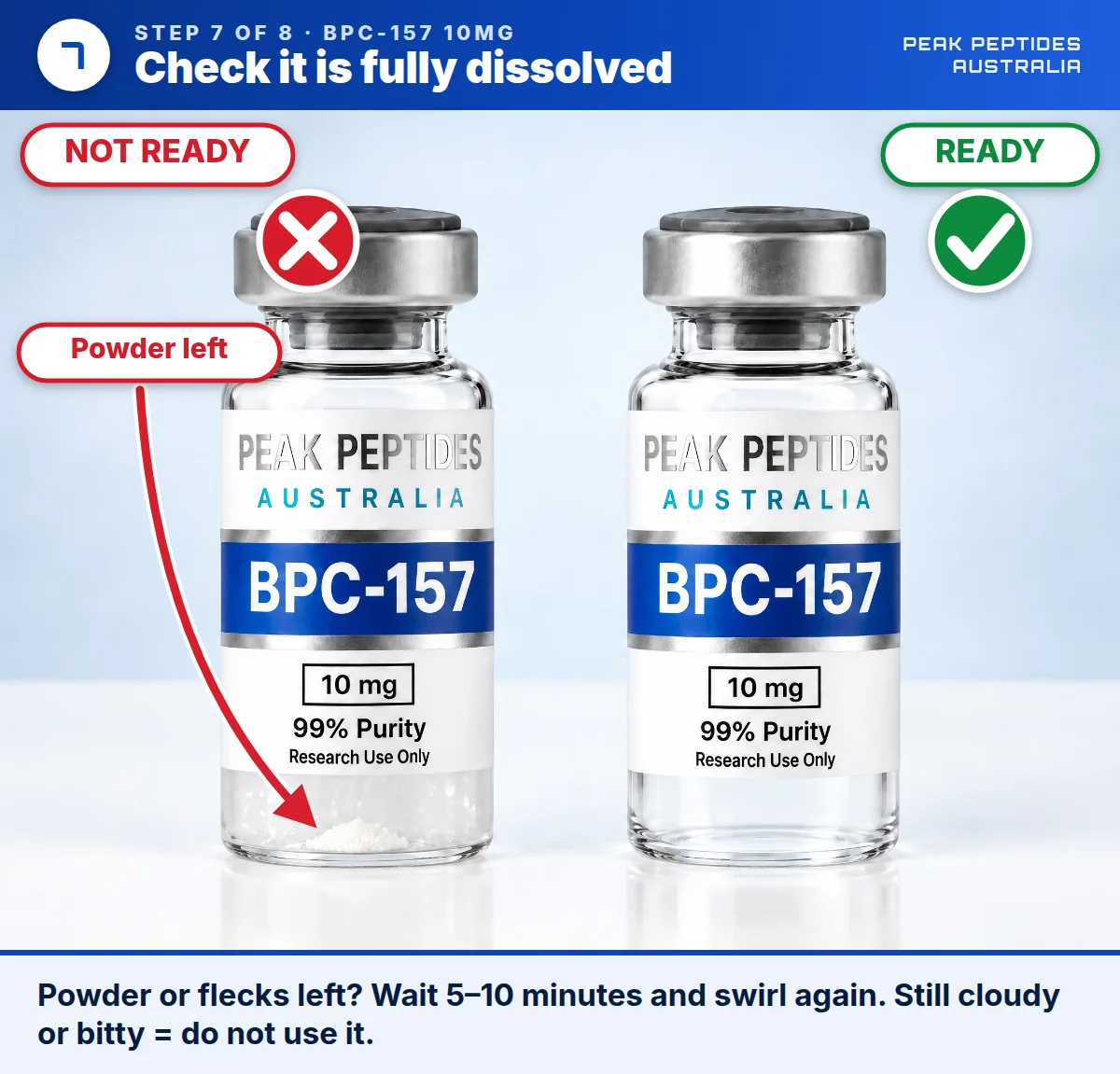
7Step 7: Check it is fully dissolved
Hold the vial against a light background and inspect the liquid. The ready state is clear, without visible powder, flecks or cloudiness. If particles remain, let it stand for 5–10 minutes and swirl again gently before repeating the clear-solution check.
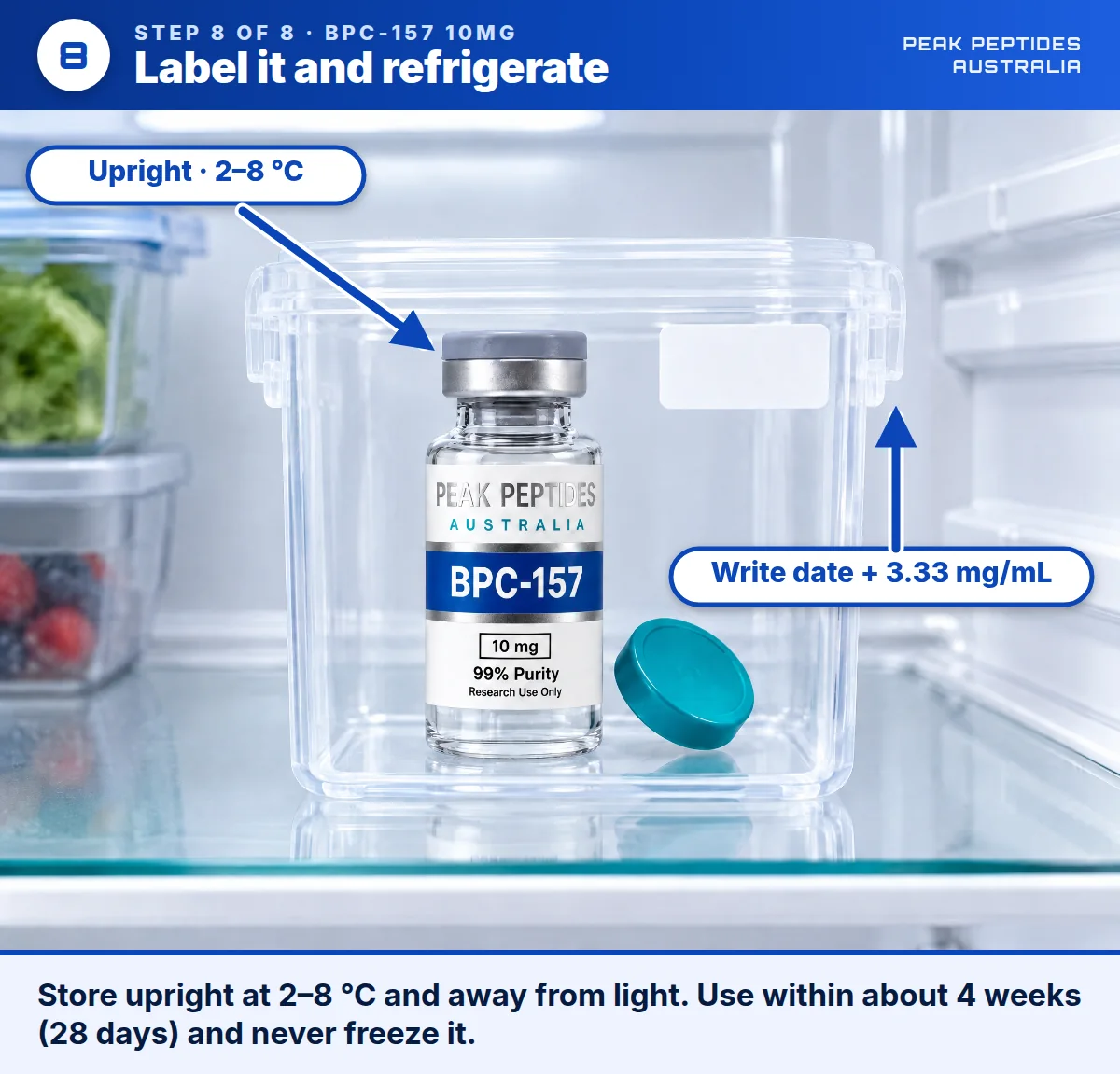
8Step 8: Label it and refrigerate
Label the vial with the preparation date, final volume and resulting concentration. For the 3 mL model, write 3.33 mg/mL. Store the prepared vial upright at 2–8 °C away from light, use it within about 4 weeks (28 days) and never freeze it.
How to store BPC-157 10mg
BPC-157 10mg storage guide
BPC-157 10mg storage guide
Material state
Storage approach
Key point
Sealed freeze-dried powder
Dry, protected from light, at the labelled temperature
Until the printed expiry
Lyophilised storage model in the preferred guide
−20 °C
The guide lists this temperature for lyophilised BPC-157
Prepared material
Refrigerate at 2–8 °C and protect from light
The preferred guide gives this post-preparation temperature
Prepared material
Avoid freeze–thaw cycles
Temperature cycling can complicate stability and appearance checks
Prepared material discard date
Within about 4 weeks (28 days)
Within about 4 weeks (28 days)
Store the vial upright in a closed container where practical. The preparation date, final volume and concentration should be recorded with the material.
BPC-157 10mg FAQs — Clear Answers to Common Questions
What is BPC-157?
BPC-157 is a synthetic 15-amino-acid peptide also called Body Protection Compound-157. Its reported sequence is GEPPPGKPADDAGLV. It is studied in preclinical tendon, connective-tissue, gut and wound models. BPC-157 is not an approved medicine.
What does BPC 157 mean?
BPC 157 is a spacing variant of BPC-157. The name expands to Body Protection Compound-157. You may also see BPC157, Bepecin, PLD-116 and PL 14736 in search results or older research records.
What is BPC-157 used for in research?
BPC-157 is examined in cell, tissue and preclinical models involving tendon, ligament, muscle, gastric and intestinal tissue, skin wounds and blood-vessel signalling.
How does BPC-157 work?
BPC-157 is studied through several overlapping preclinical pathways rather than one confirmed human mechanism. Research examines VEGFR2–Akt–eNOS signalling, nitric-oxide-system activity and FAK–paxillin signalling in tendon fibroblasts, alongside migration and angiogenesis markers.
What did BPC-157 studies find?
In lab studies, BPC-157 was associated with changes in tendon, ligament, muscle, gastrointestinal and wound-model measures. A transected-Achilles study in rats reported biomechanical, functional and microscopic differences.
Are there human BPC-157 studies?
There are limited reports and a registered Phase I oral-tablet study. The ClinicalTrials.gov record has unknown status and describes a different oral formulation.
What side effects have BPC-157 studies reported?
A reliable side-effect rate cannot be drawn from the small and mixed human record. The FDA briefing says clinical safety information is insufficient to characterise the safety profile and discusses possible immunogenicity, peptide impurities and aggregation concerns.
What is the BPC-157 half-life?
No human half-life is established in the sources used here. A 2022 pharmacokinetic study reported that parent BPC-157 had an elimination half-life below 30 minutes in rats and beagle dogs after the tested administrations.
Is BPC-157 approved by the TGA or FDA?
No. Sport Integrity Australia says BPC-157 is not listed on the Australian Register of Therapeutic Goods and is not approved for use by any regulatory agency worldwide. The FDA briefing describes insufficient clinical safety information for BPC-157 free base and acetate.
Is BPC-157 banned in sport?
Yes. Sport Integrity Australia lists BPC-157 under S0 Non-Approved Substances on the World Anti-Doping Code Prohibited List. It is prohibited at all times and listed as a specified substance in the 2025 information page.
Can I buy BPC-157 10mg online in Australia?
BPC-157 10mg can be ordered online from Peak Peptides Australia when available. It is supplied for in-vitro research only. Same-day dispatch from Victoria applies to in-stock orders once payment is confirmed, using tracked Australia Post Express.
How fast is BPC-157 shipping in Australia?
For in-stock orders once payment is confirmed, dispatch is the same day from Victoria by tracked Australia Post Express. A tracking number is emailed. Delivery time depends on Australia Post and the destination, so a delivery date is not promised.
How do I know BPC-157 is real?
Check that an independent report names the sample, supplier, analytical methods, test date and result. This listing links LabDoc report LD-VN45, which records LC-MS identity confirmed, HPLC purity and HPLC content for a tested BPC-157 sample.
How is this BPC-157 10mg sample verified?
LabDoc report LD-VN45, tested 11 September 2026, records confirmed identity by LC-MS, 99.56% purity by HPLC and 9.79 mg content by HPLC against a 10 mg claim. The report gives an overall Pass for the tested sample.
What does the LabDoc report LD-VN45 show?
LD-VN45 describes a lyophilised BPC-157 vial from Peak Peptides Australia. It records 9.79 mg HPLC content, 97.9% of label claim, 99.56% HPLC purity, LC-MS identity confirmed and Pass. Its stated batch is not provided. The Quality page also lists Janoshik task #108019, dated 4 March 2026, with BPC-157 10.29 mg and 99.825% purity as a separate certificate.
What is BPC-157 vs TB-500?
BPC-157 and TB-500 are distinct research listings. BPC-157 is the named 15-amino-acid peptide described on this page. The TB-500 listing is described as a thymosin beta-4 fragment, and its listing does not provide an exact product sequence.
What is the Wolverine Stack?
Wolverine Stack is a separate fixed-ratio research blend listed as BPC-157 5mg plus TB-500 5mg. Its 10 mg is the combined stated amount, not 10 mg of each component. It has its own LabDoc report, LD-ZACL.
What is KLOW compared with BPC-157?
KLOW is a four-component research blend listed as GHK-Cu 50mg, BPC-157 10mg, TB-500 10mg and KPV 10mg. It is not one molecule, and its fixed-ratio formulation does not allow its components to be varied independently.
How much BAC water for BPC-157 10mg?
The preferred PeptideDosages BPC-157 10 mg guide uses 3 mL of BAC water, producing 3.33 mg/mL. This page also shows 2 mL and 4 mL concentration models. More liquid changes concentration, not the stated 10 mg mass.
How many units is 1 mg of BPC-157?
With the 3 mL mix shown here, the strength is 3.33 mg/mL and 1 mg is 30 units on a U-100 syringe, or 0.3 mL. With 2 mL it is 20 units; with 4 mL it is 40 units.
How many mg are in 10 units of BPC-157?
At the 3 mL model, 10 U-100 units equals 0.1 mL and holds about 0.33 mg of BPC-157. The 2 mL model holds 0.5 mg in 10 units, while the 4 mL model holds 0.25 mg.
How do I reconstitute BPC-157 10mg?
Wipe the vial stoppers, draw the measured BAC water, let it run slowly down the inside glass wall, then swirl or roll gently until clear. Do not shake. Label the prepared vial and refrigerate it at 2–8 °C away from light.
Can I use sterile or tap water instead of BAC water?
Do not use tap water. The preferred BPC-157 guide uses bacteriostatic water for its 3 mL preparation model. Once mixed, keep it upright in the fridge at 2–8 °C, away from light, use it within about 4 weeks (28 days) and never freeze it. Write the date and strength on the vial.
What if BPC-157 powder does not dissolve?
Let the vial stand for 5–10 minutes, then swirl gently again. Do not shake it. If material remains cloudy, has visible particles or does not become clear after gentle handling, set it aside rather than treating it as fully dissolved.
Should reconstituted BPC-157 be cloudy?
The preparation guide uses a completely clear appearance as the visual check for fully dissolved material. Visible powder, flecks or cloudiness indicate that the vial is not ready for the clear-solution check shown in the photo steps.
How long does mixed BPC-157 last?
Once mixed with BAC water, keep it upright in the fridge at 2–8 °C, away from light. Use it within about 4 weeks (28 days) and never freeze it. Write the date and strength on the vial.
How should BPC-157 powder be stored before mixing?
Keep sealed freeze-dried material dry, protected from light and at the labelled temperature. The preferred guide lists −20 °C for lyophilised BPC-157.
Can mixed BPC-157 be frozen?
Avoid freeze–thaw cycles after preparation. The preferred guide says to refrigerate prepared material at 2–8 °C and avoid temperature cycling. The correct stability decision is the one supported by the documentation for the exact research material.
What does a BPC-157 COA show?
A certificate or analytical report can show the methods and results for a specific tested sample. LD-VN45 records LC-MS identity, HPLC purity and HPLC content. It does not by itself establish sterility, stability, clinical safety or results for every vial.