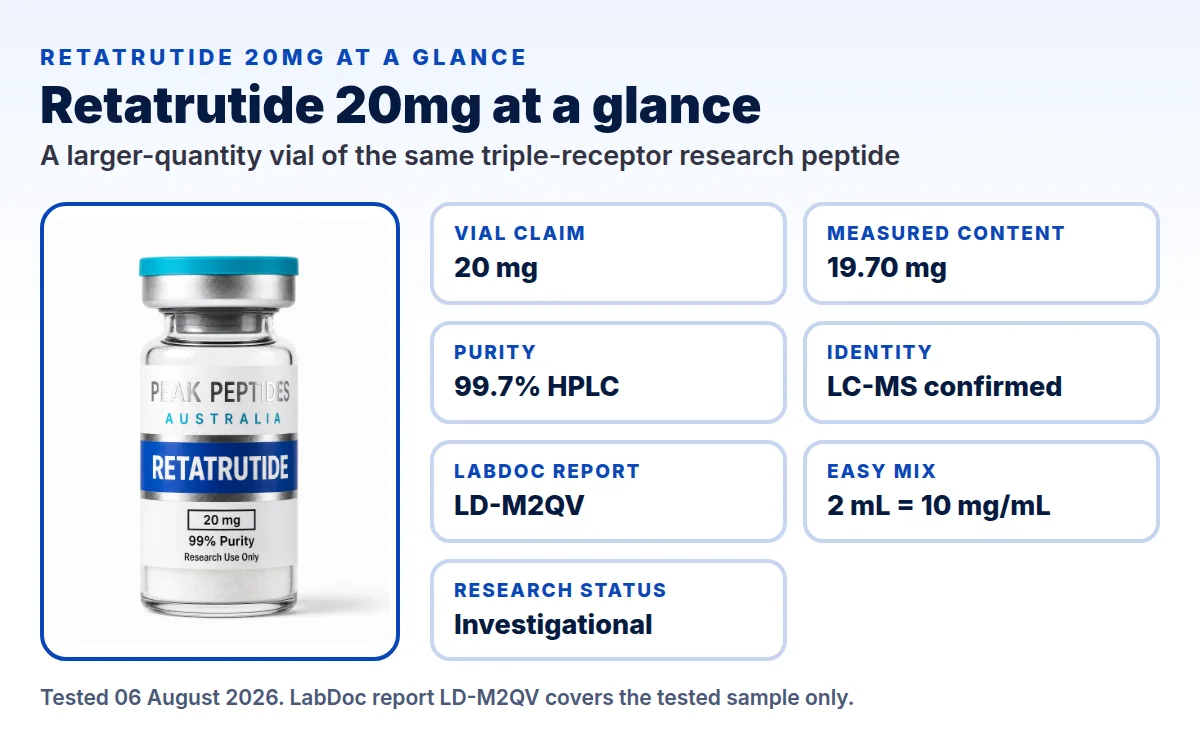
Retatrutide 20mg is a larger-quantity vial of the same GLP-1, GIP and glucagon receptor research peptide as Retatrutide 10mg. This vial has its own LabDoc report, LD-M2QV: LC-MS identity confirmed, 99.7% HPLC purity and 19.70mg measured content. Peak Peptides Australia supplies this material for in-vitro research only. In-stock orders receive same-day dispatch from Victoria after payment confirmation, with tracked Australia Post Express shipping Australia-wide.
Larger-quantity Retatrutide research vial · Updated 24 October 2026
Retatrutide 20mg — Vial Difference, Lab Test & BAC Water Mixing Chart
Retatrutide 20mg is a larger-quantity vial of Retatrutide, the single research peptide also known as LY3437943, Reta and Triple G. It is the same molecule as our Retatrutide 10mg vial: it activates the GLP-1, GIP and glucagon receptors. What changes is the vial quantity and the concentration maths. With 2 mL of bacteriostatic (BAC) water, this 20mg vial makes 10 mg per mL, exactly double the 10mg vial’s 5 mg per mL with the same water volume. This page focuses on those 20mg differences, the separate LabDoc report LD-M2QV, and a complete photo guide. Read the Retatrutide 10mg page for the full science overview. Peak Peptides Australia supplies this material for in-vitro research only. Also known on our site as GLP3 (GLP-3), which was the former store label for Retatrutide. GLP3 is not a separate receptor name or a different molecule.
Also referred to in research or catalogue references as Retatrutide, Retatrutide peptide, Retatrutide 20mg, Retatrutide 20 mg, Retatrutide-20mg, LY3437943, LY-3437943, Reta, Triple G, GLP3 (former site label for Retatrutide), GLP-3 (former site label for Retatrutide).
Retatrutide 20mg at a glance
Name
Retatrutide (research code LY3437943)
Also called
Reta, Triple G, Retatrutide peptide, GLP-3 (former site label)
What this vial is
20mg nominal quantity of freeze-dried Retatrutide in a sealed glass vial
Same molecule as
Retatrutide 10mg — GLP-1, GIP and glucagon receptor agonist
What changes at 20mg
Twice the nominal vial quantity and double the concentration with the same water volume
Tested sample report
LabDoc LD-M2QV · tested 06 August 2026 · batch 30/07/2026
Identity
Confirmed by LC-MS
Purity
99.7% by HPLC · 0.30% related impurities
Measured content
19.70mg by HPLC · 98.5% of the 20mg claim
Easiest mix
2 mL BAC water = 10 mg/mL = 10 units for 1 mg on U-100
Storage once mixed
Upright, dark and refrigerated at 2–8 °C for about 4 weeks; never freeze
Regulatory status
Investigational; not an approved medicine in Australia or the United States
Dispatch
Same-day from Victoria for in-stock orders after payment confirmation, tracked Australia Post Express
20mg means a larger vial quantity
The 20mg label is the nominal amount of Retatrutide powder in this vial. Retatrutide 20mg and Retatrutide 10mg are the same molecule with the same receptor action; the 20mg vial simply begins with twice the nominal quantity.
Double concentration with the same 2 mL mix
Add 2 mL of BAC water to this 20mg vial and the concentration is 10 mg/mL. On a U-100 syringe, 10 units is 1 mg. The same 2 mL volume in a 10mg vial makes 5 mg/mL, where 20 units is 1 mg.
A choice for larger-quantity research work
Researchers comparing vial formats choose the 20mg option when their documented work needs a larger nominal quantity or a more concentrated 2 mL preparation. The choice changes material allocation and measurement maths, not Retatrutide’s GLP-1, GIP and glucagon receptor profile.
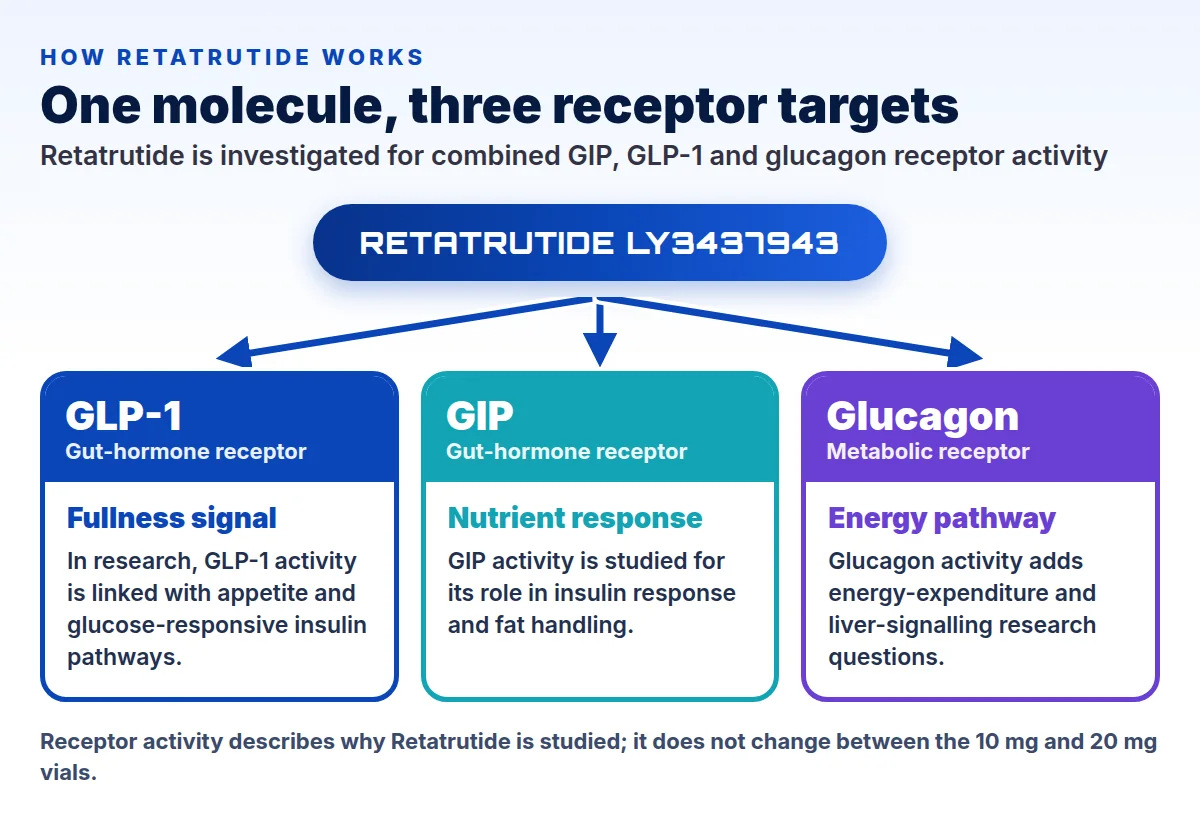
One molecule, three receptor targets
Retatrutide is a single investigational peptide, not a blend. Published work identifies activity at the GIP, GLP-1 and glucagon receptors. GLP-1 and GIP relate to nutrient-response signalling; glucagon adds an energy-use and liver-signalling pathway to the research profile.
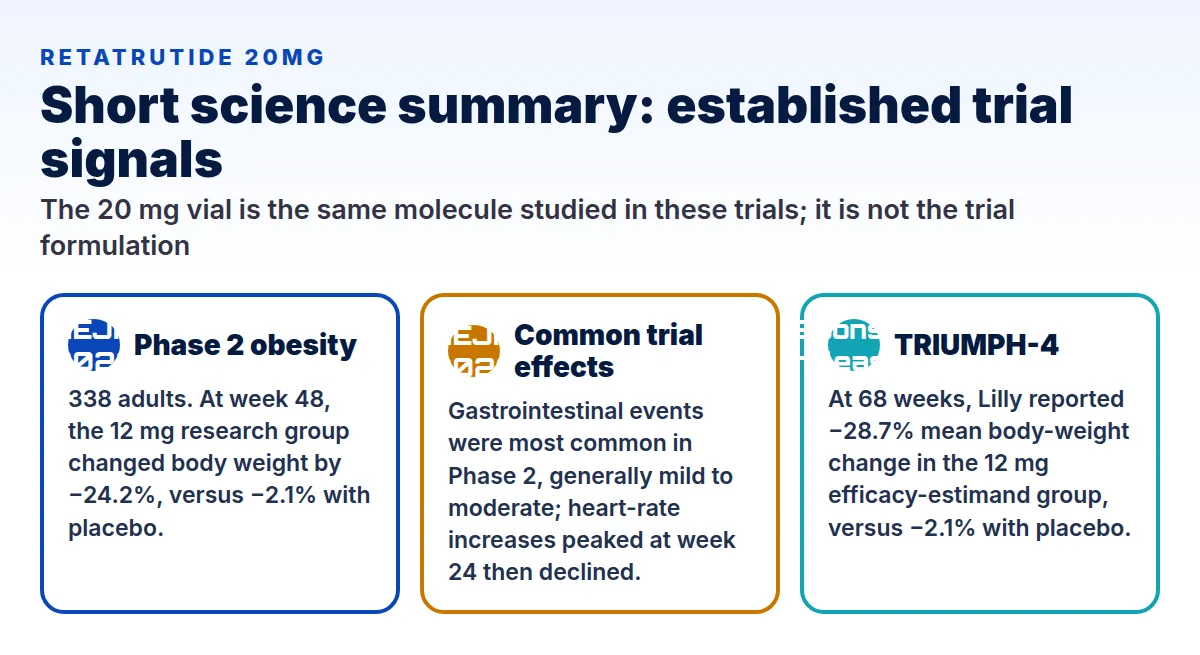
Short science summary; full science is on the 10mg page
In the 2023 Phase 2 obesity study, the 12mg research group changed body weight by an average of −24.2% at 48 weeks, versus −2.1% with placebo. Gastrointestinal events were the most common reported events. The separate 20mg vial is not the trial formulation.
Independent result for this 20mg sample
LabDoc report LD-M2QV, tested 06 August 2026, records Retatrutide identity confirmed by LC-MS, 99.7% purity by HPLC and 19.70mg measured content against a 20mg label claim. The report also records 0.30% related impurities and an overall assessment of Pass.
Why the separate LabDoc report matters
A report belongs to the submitted sample, not to every vial strength with the same name. LD-M2QV is the report for Retatrutide 20mg. It shows identity, purity and measured content for that tested sample; it is not a substitute for the Retatrutide 10mg report LD-VF7M.
Research-only format and Australian dispatch
This is freeze-dried Retatrutide powder in a sealed vial, not a ready-to-use medicine. Peak Peptides Australia supplies it for in-vitro research only. Same-day dispatch from Victoria for in-stock orders once payment is confirmed, tracked Australia Post Express, tracking number emailed.
Retatrutide 20mg is the larger-quantity version of the same Retatrutide molecule sold in the 10mg vial. The molecule, aliases and three receptor targets do not change. The useful difference is arithmetic: there is twice the nominal peptide amount available to divide across a final liquid volume.
The clearest comparison uses the same 2 mL BAC-water volume. Retatrutide 10mg at 2 mL is 5 mg/mL, while Retatrutide 20mg at 2 mL is 10 mg/mL. That means 1 mg corresponds to 20 U-100 units in the 10mg chart and 10 units in this 20mg chart. The unit marking measures volume, so it changes when concentration changes.
Choose the 20mg listing when a larger nominal vial quantity or the 10 mg/mL two-millilitre mix fits the documented research workflow. The larger vial does not create a different compound, increase receptor count or turn Retatrutide into a ready-to-use medicine. It remains freeze-dried material supplied for in-vitro research only.
This 20mg sample’s own LabDoc figures, plus the 2 mL mixing result.
What the Retatrutide 20mg label changes
What the Retatrutide 20mg label changes
Question
Answer
Molecule
The same Retatrutide molecule as the 10mg vial
Nominal vial quantity
20mg rather than 10mg
With 2 mL BAC water
10 mg/mL rather than 5 mg/mL
U-100 units for 1 mg at 2 mL
10 units rather than 20 units
Verification report
LabDoc LD-M2QV, not the 10mg vial’s LD-VF7M
The concentration comparison assumes the same 2 mL BAC-water volume in both vial sizes.
How does Retatrutide work?
Retatrutide is a single peptide investigated as an agonist at three receptors: GLP-1, GIP and glucagon. An agonist is a molecule that switches a receptor on. This triple action is why Retatrutide is often called Triple G. It is not a mixture of three separate peptides.
The GLP-1 and GIP parts are studied for nutrient-response and glucose-responsive insulin signalling. The glucagon part adds an energy-expenditure and liver-signalling pathway. The early mechanism paper describes balanced activity at glucagon and GLP-1 receptors with higher GIP-receptor activity. The 20mg label changes none of this biology; it only changes vial quantity and concentration calculations.
GLP-1 receptor: researched for fullness, stomach emptying and glucose-responsive insulin pathways.
GIP receptor: researched for insulin response and how the body handles nutrients and fat.
Glucagon receptor: researched for energy use and liver-metabolism signalling.
One molecule, three research targets — exactly the same profile in the 10mg and 20mg vials.
What did Retatrutide research find?
Retatrutide’s clinical research is substantial, but this 20mg page keeps the summary short because the Retatrutide 10mg page carries the fuller science guide. The key point is that published trial outcomes describe the study medicine and supervised study setting, not this separately tested research vial.
In the 338-person Phase 2 obesity trial, mean body-weight change at week 48 was −24.2% in the 12mg group and −2.1% with placebo. The peer-reviewed 2026 TRIUMPH-1 trial enrolled 2,339 adults without diabetes; its treatment-regimen estimate at 80 weeks was −25.0% in the 12mg group and −3.9% with placebo. TRIUMPH-2 studied a different population with type 2 diabetes and reported −18.8% and −5.1%, respectively, using the same analysis approach.
Gastrointestinal events were the most commonly reported events in the Phase 2 and Phase 3 reports. In a magnetic-resonance-imaging substudy published in Nature Medicine, the 12mg group had an 86.0% relative liver-fat reduction at week 48, compared with 4.6% in the placebo group. These are named study results, not a promise for a vial or an individual.
A short, source-linked study summary; the separate Retatrutide 10mg page contains the broader clinical overview.
Selected Retatrutide clinical findings from distinct studies
Selected Retatrutide clinical findings from distinct studies
Study
Population and duration
Retatrutide group
Placebo
Phase 2, NEJM 2023
338 adults with obesity or overweight; 48 weeks
−24.2% body-weight change, 12mg group
−2.1%
TRIUMPH-1, NEJM 2026
2,339 adults with obesity without diabetes; 80 weeks
−25.0% treatment-regimen estimate, 12mg group
−3.9%
TRIUMPH-2, Lancet 2026
1,152 adults with obesity and type 2 diabetes; 80 weeks
−18.8% treatment-regimen estimate, 12mg group
−5.1%
Different trial populations and statistical estimands mean the rows are context, not a head-to-head ranking.
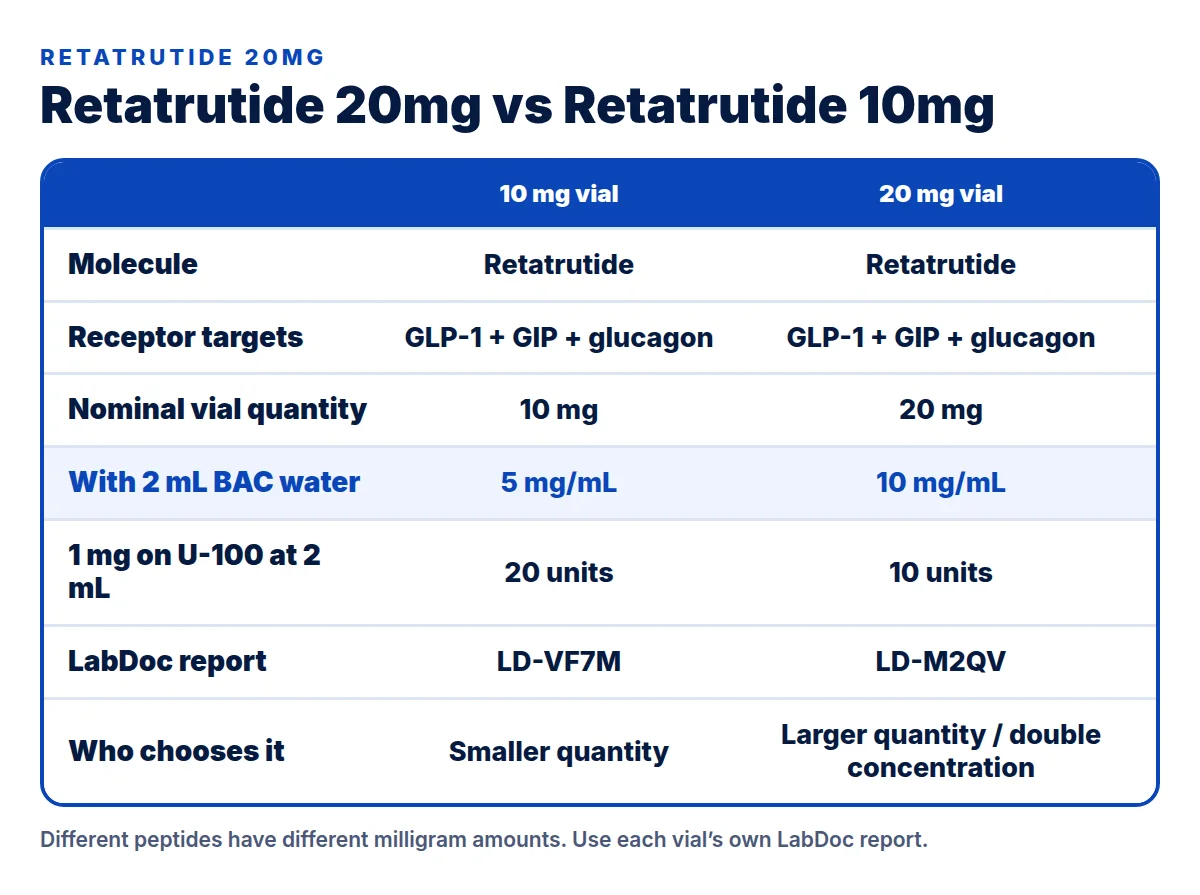
Retatrutide 20mg vs Retatrutide 10mg
Retatrutide 20mg and Retatrutide 10mg have the same peptide identity, receptor profile and research context. The decision between them is about nominal vial quantity, preparation concentration and which separate sample report needs checking. It is not a choice between a basic and advanced form of Retatrutide.
At the commonly shown 2 mL BAC-water volume, the 20mg vial produces 10 mg/mL, while the 10mg vial produces 5 mg/mL. That single difference explains every unit conversion difference. For this 20mg chart, 5 units is 0.5 mg, 10 units is 1 mg and 20 units is 2 mg. For the 10mg vial at 2 mL, those same unit marks represent half those amounts.
The lab evidence differs too. Retatrutide 10mg is associated with LabDoc LD-VF7M. Retatrutide 20mg is associated with LD-M2QV, tested 06 August 2026, with 99.7% HPLC purity and 19.70mg measured content. Compare like with like: use the report named for the vial strength being reviewed.
The 20mg vial doubles nominal quantity and the 2 mL concentration; it does not change the Retatrutide molecule.
Independent LabDoc test for this Retatrutide 20mg vial
Retatrutide 20mg has its own independent verification record at LabDoc: report LD-M2QV. The report identifies the tested sample as Retatrutide, origin as Peak Peptides Australia and batch as 30/07/2026. The sample was received and tested on 06 August 2026 as lyophilised powder in a vial.
The result separates three useful questions. LC-MS identity is recorded as Confirmed, meaning the laboratory method matched the analysed sample to Retatrutide. HPLC purity is 99.7%, with 0.30% related impurities recorded. HPLC content is 19.70mg, or 98.5% of the 20mg manufacturer claim. The report’s overall assessment is Pass.
Those results describe the submitted sample only. Identity confirmation is different from a biological-performance claim, and purity is different from measured content. Use the report ID, date, sample name and strength claim together when checking a quality record. The LabDoc result does not carry across automatically to a different vial size.
Report ID: LD-M2QV.
Date tested: 06 August 2026.
Identity: Confirmed by LC-MS.
Purity: 99.7% by HPLC.
Content: 19.70mg by HPLC, 98.5% of the 20mg claim.
Related impurities: 0.30%; overall assessment: Pass.
Retatrutide 20mg in Australia
Retatrutide is investigational and is not an approved medicine in Australia. The Australian Register of Therapeutic Goods is the TGA’s public database for therapeutic goods that can be supplied in Australia; the current Retatrutide search does not show an approved Retatrutide medicine. The FDA likewise states that Retatrutide is not a component of an FDA-approved drug and has not been found safe and effective for any condition.
Peak Peptides Australia supplies Retatrutide 20mg for in-vitro research only. The product is freeze-dried powder in a sealed vial rather than a pre-filled pen or ready-to-use medicine. Clear separation between research material, a trial medicine and an approved medicine matters when reading claims online.
For in-stock orders once payment is confirmed, Peak Peptides Australia provides same-day dispatch from Victoria, tracked Australia Post Express and a tracking number emailed after dispatch. Add bacteriostatic water if the documented workflow requires it, use the reconstitution calculator for arithmetic, and compare the product with its own LabDoc report LD-M2QV.
Step-by-step guide · About 10 minutes
How to reconstitute Retatrutide 20mg (step-by-step with photos)
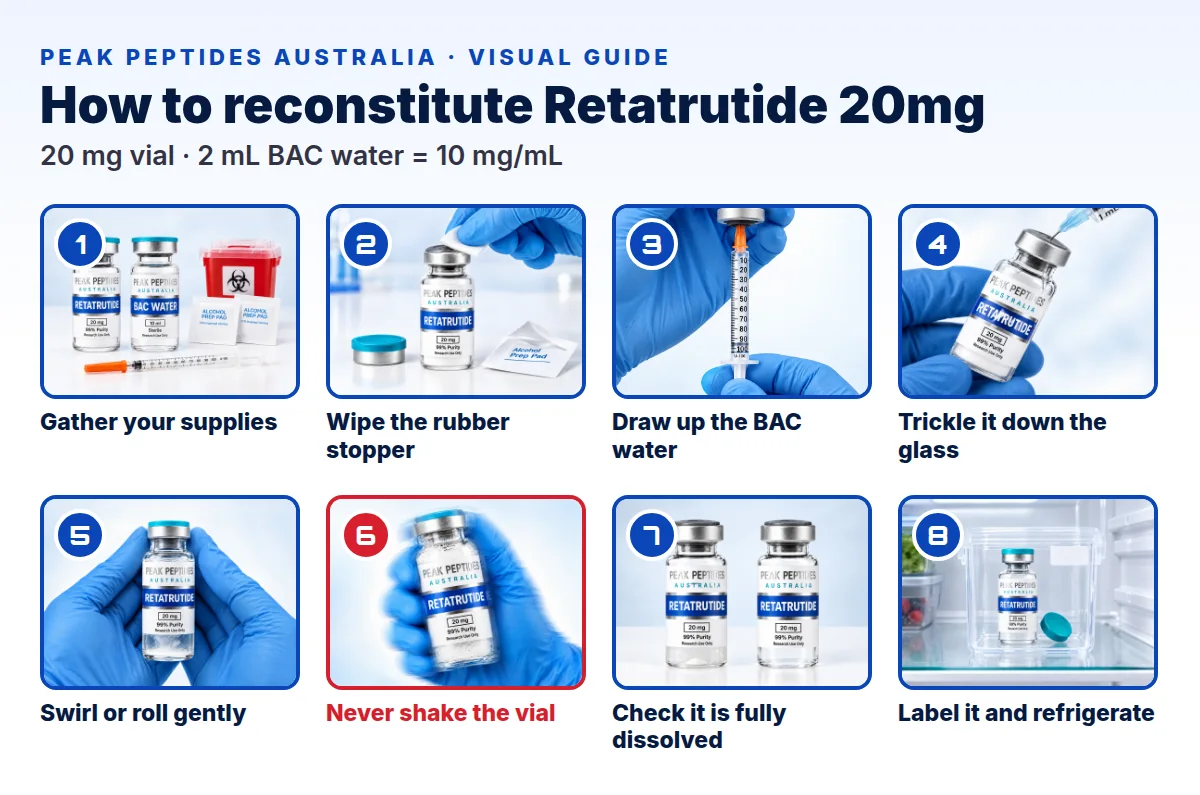
Retatrutide 20mg arrives as dry, freeze-dried powder. Reconstituting means adding bacteriostatic (BAC) water to make a measured liquid concentration. The 20mg PeptideDosages vial reference uses 2 mL of BAC water, making 10 mg/mL. That is the highlighted chart on this page: 10 U-100 units equals 1 mg. Work through the eight photos slowly, use clean supplies and record the final volume and calculated concentration on the label.
The Retatrutide 20mg process at a glance — a 2 mL BAC-water mix makes 10 mg/mL.
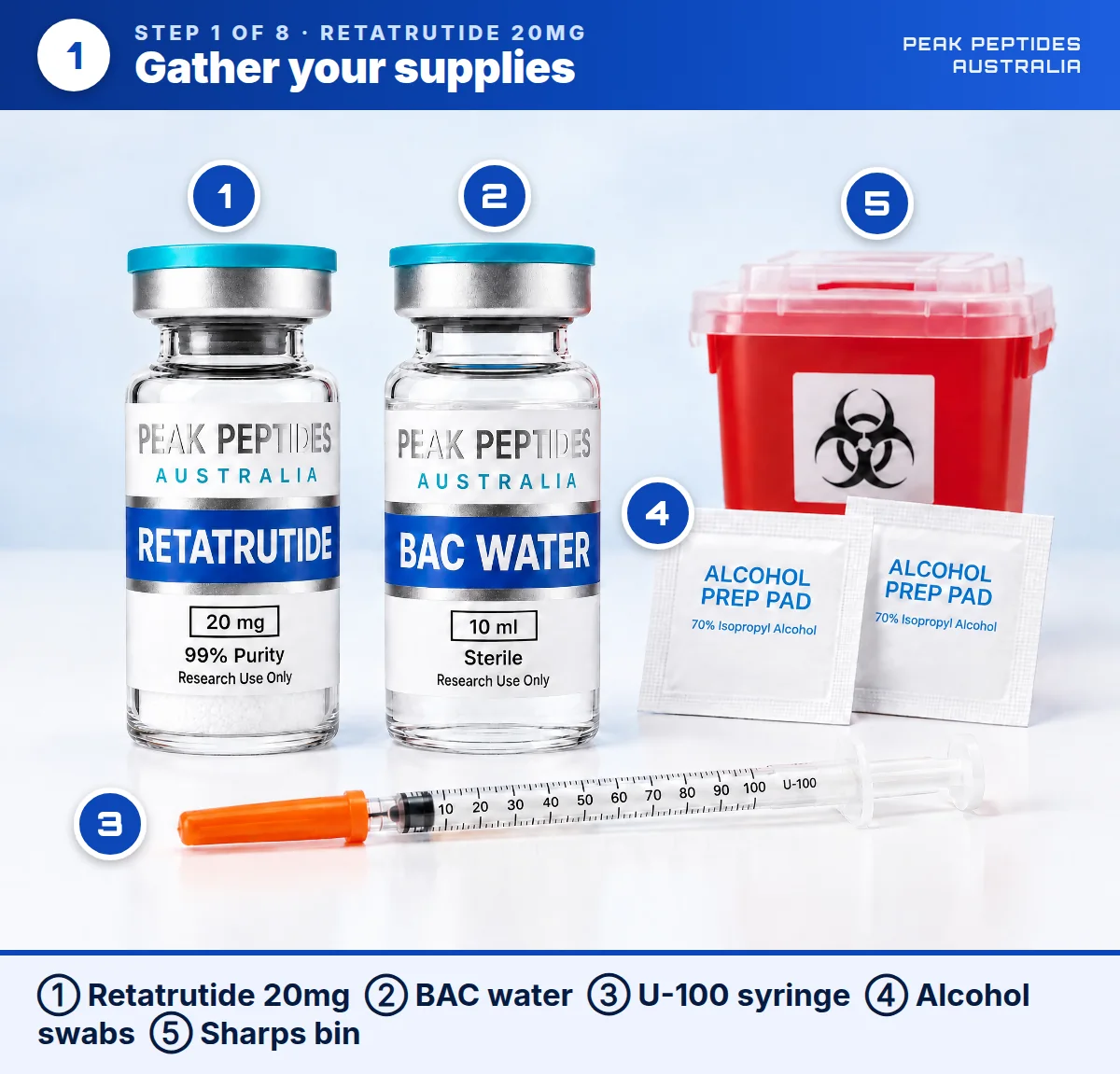
What you need
Retatrutide 20mg vialA sealed vial of freeze-dried powder with a 20mg nominal label claim.
1 mL U-100 insulin syringeThe chart uses 100 units = 1 mL, so one unit is 0.01 mL.
Alcohol swabsUse fresh swabs to disinfect the rubber stoppers and allow them to air-dry.
Sharps containerA puncture-resistant container for used needles and syringes.
How much BAC water to add to Retatrutide 20mg
The vial starts with 20mg of Retatrutide whichever final volume you choose. More BAC water does not increase the peptide amount; it spreads the same 20mg across more millilitres. Concentration is total milligrams divided by final millilitres, and a U-100 unit is always 0.01 mL.
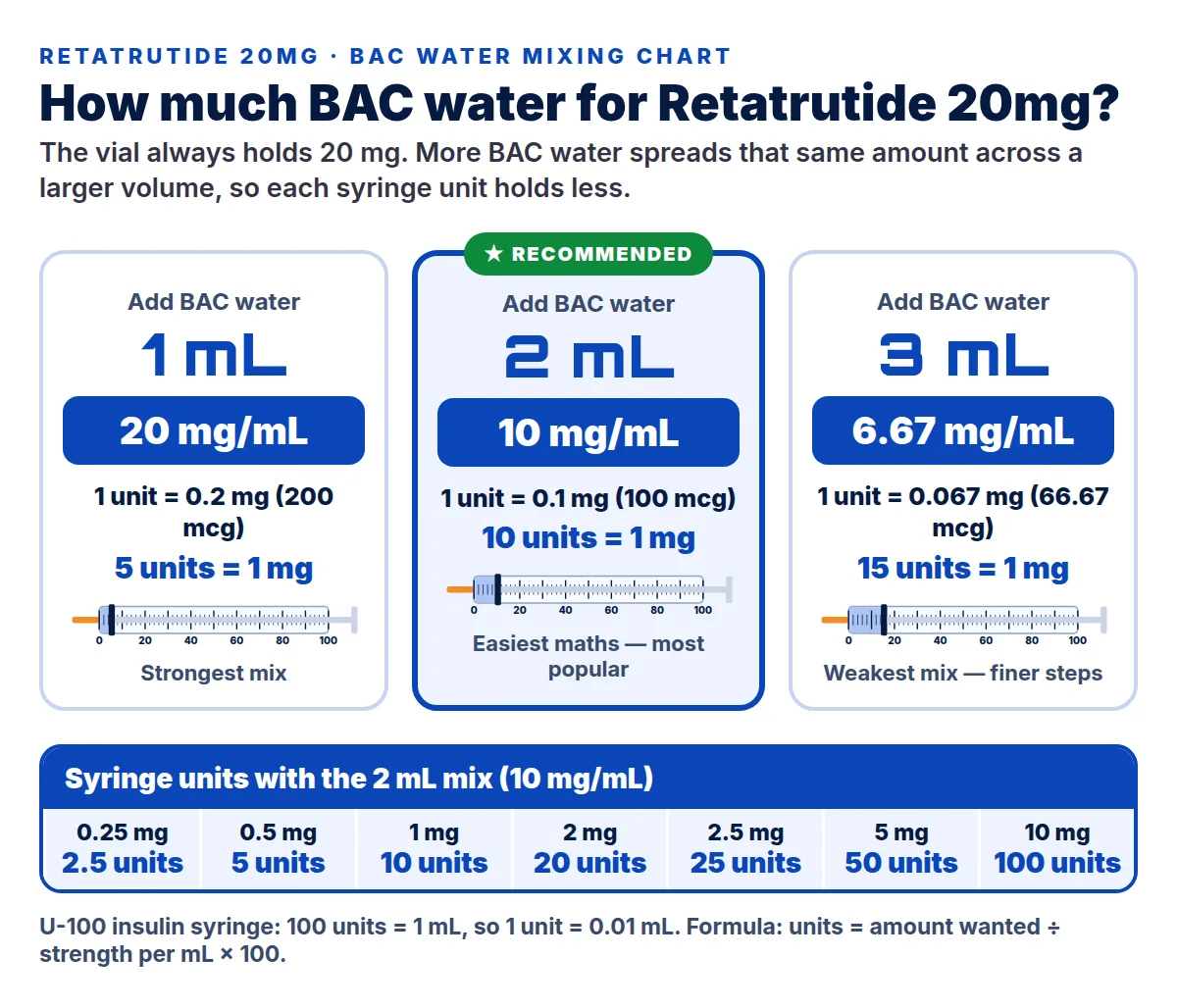
The highlighted 2 mL mix is 10 mg/mL. Each unit holds 0.1 mg (100 mcg), 5 units holds 0.5 mg, 10 units holds 1 mg, 20 units holds 2 mg, 25 units holds 2.5 mg, 50 units holds 5 mg and 100 units holds 10 mg. The 1 mL option is 20 mg/mL, where 1 mg is 5 units. The 3 mL option is 6.67 mg/mL, where 1 mg is 15 units.
Retatrutide 20mg mixing chart — 2 mL BAC water gives 10 mg/mL and 10 units for 1 mg.
2 mL is highlighted because it gives the simplest numbers.
Syringe units with the 2 mL mix (10 mg/mL)
Syringe units with the 2 mL mix (10 mg/mL)
Amount
Units on a U-100 syringe
Volume
0.25 mg
2.5 units
0.025 mL
0.5 mg
5 units
0.05 mL
1 mg
10 units
0.1 mL
2 mg
20 units
0.2 mL
2.5 mg
25 units
0.25 mL
5 mg
50 units
0.5 mL
10 mg
100 units
1 mL
The 8 steps
1Step 1: Gather your supplies
Lay out the Retatrutide 20mg vial, BAC water, a new 1 mL U-100 syringe, alcohol swabs and a sharps container on a clean surface. Confirm the vial label and record the intended 2 mL final volume before beginning. The highlighted chart makes 10 mg/mL, so two full 1 mL syringe fills are required.
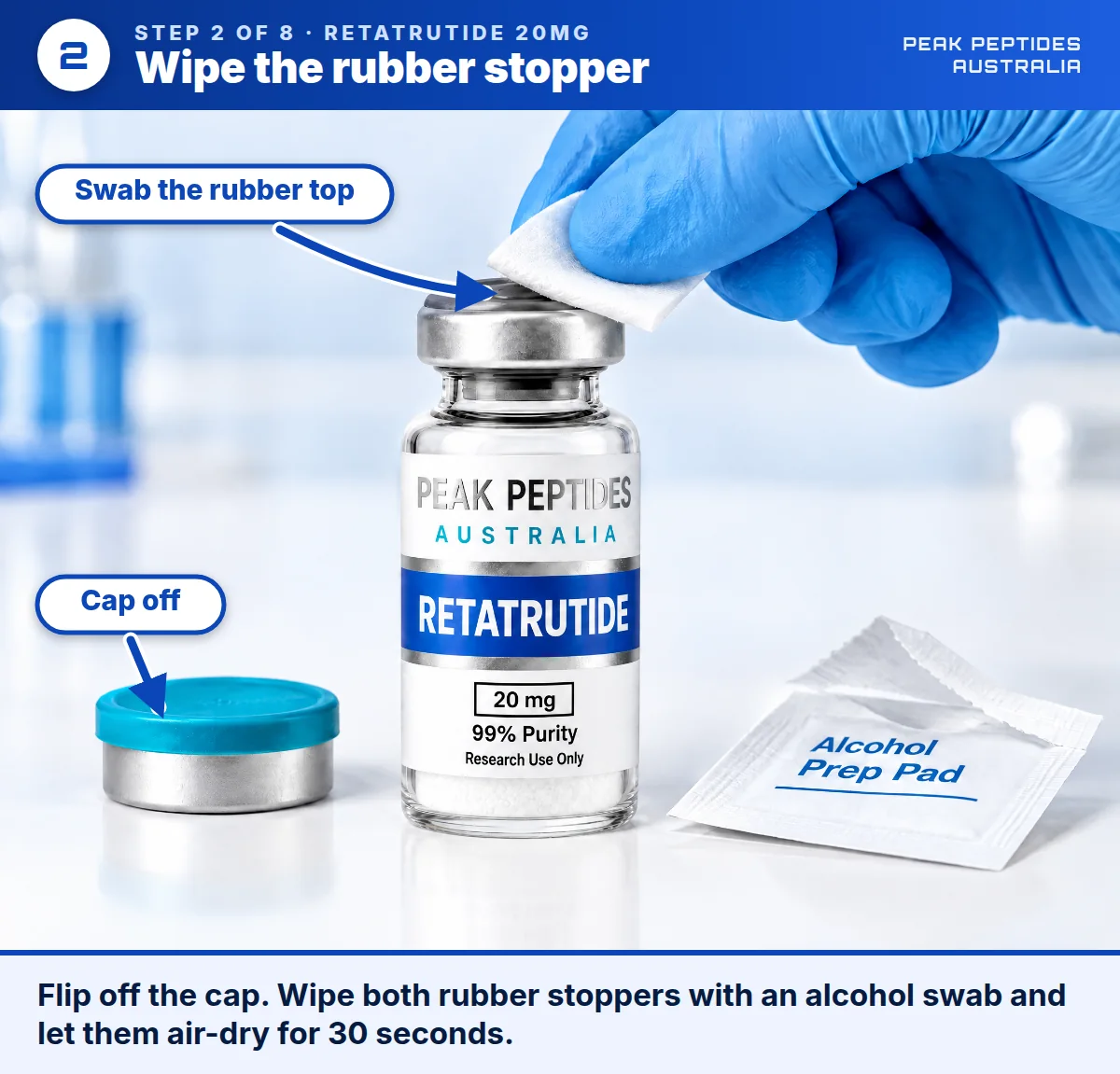
2Step 2: Wipe the rubber stopper
Remove the flip-off caps without disturbing the rubber stoppers. Wipe the Retatrutide and BAC-water stoppers with fresh alcohol swabs, then let both surfaces air-dry for about 30 seconds. Do not touch a stopper after it has been disinfected. Use a fresh swab for each stopper rather than reusing one pad.
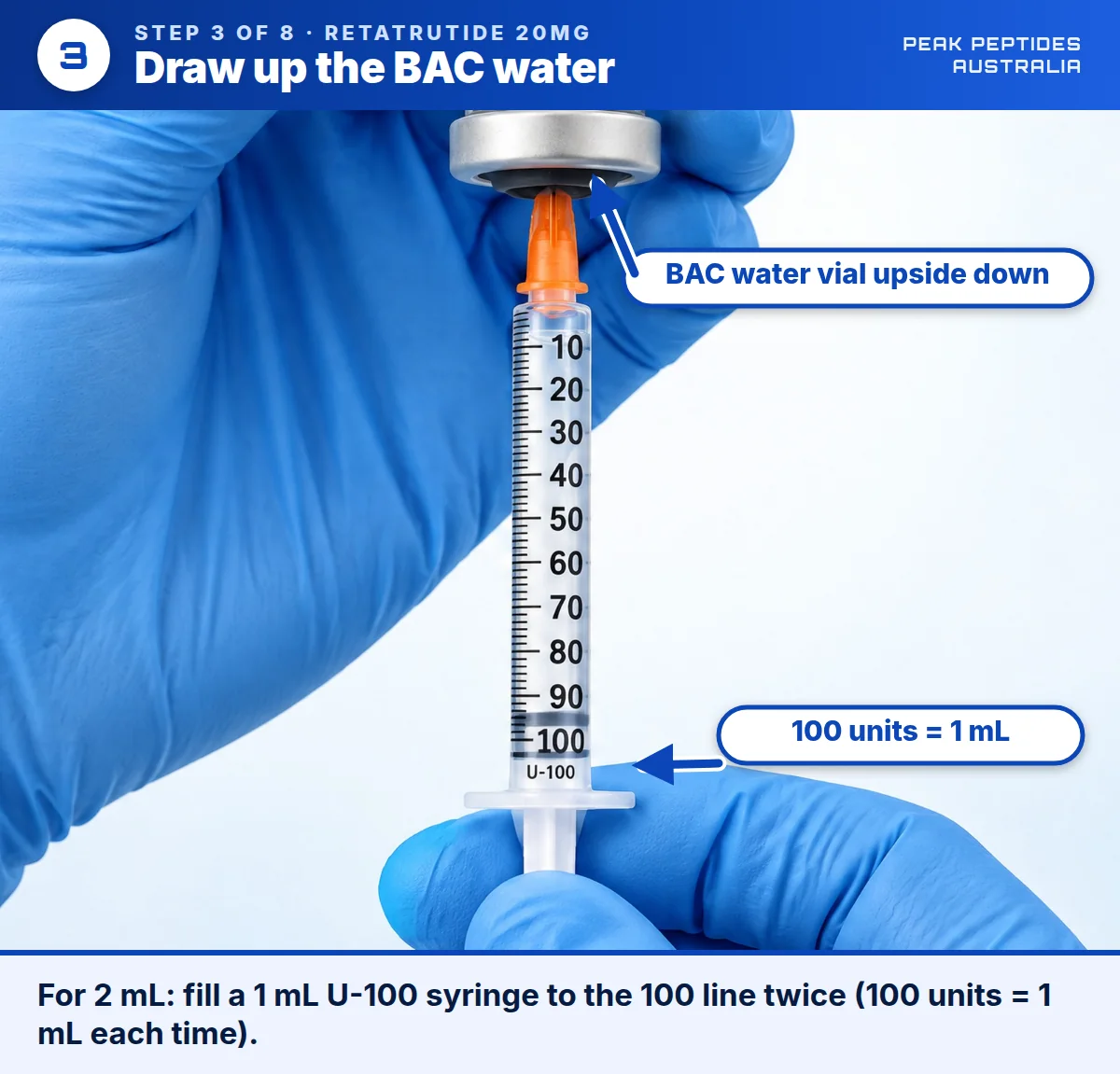
3Step 3: Draw up the BAC water
Use a new U-100 syringe to draw BAC water to the 100-unit line, which is 1 mL. Check the liquid level at eye height and remove large air bubbles before transferring it. The highlighted 2 mL mix uses two measured 1 mL transfers. Do not pull beyond the syringe’s marked capacity.
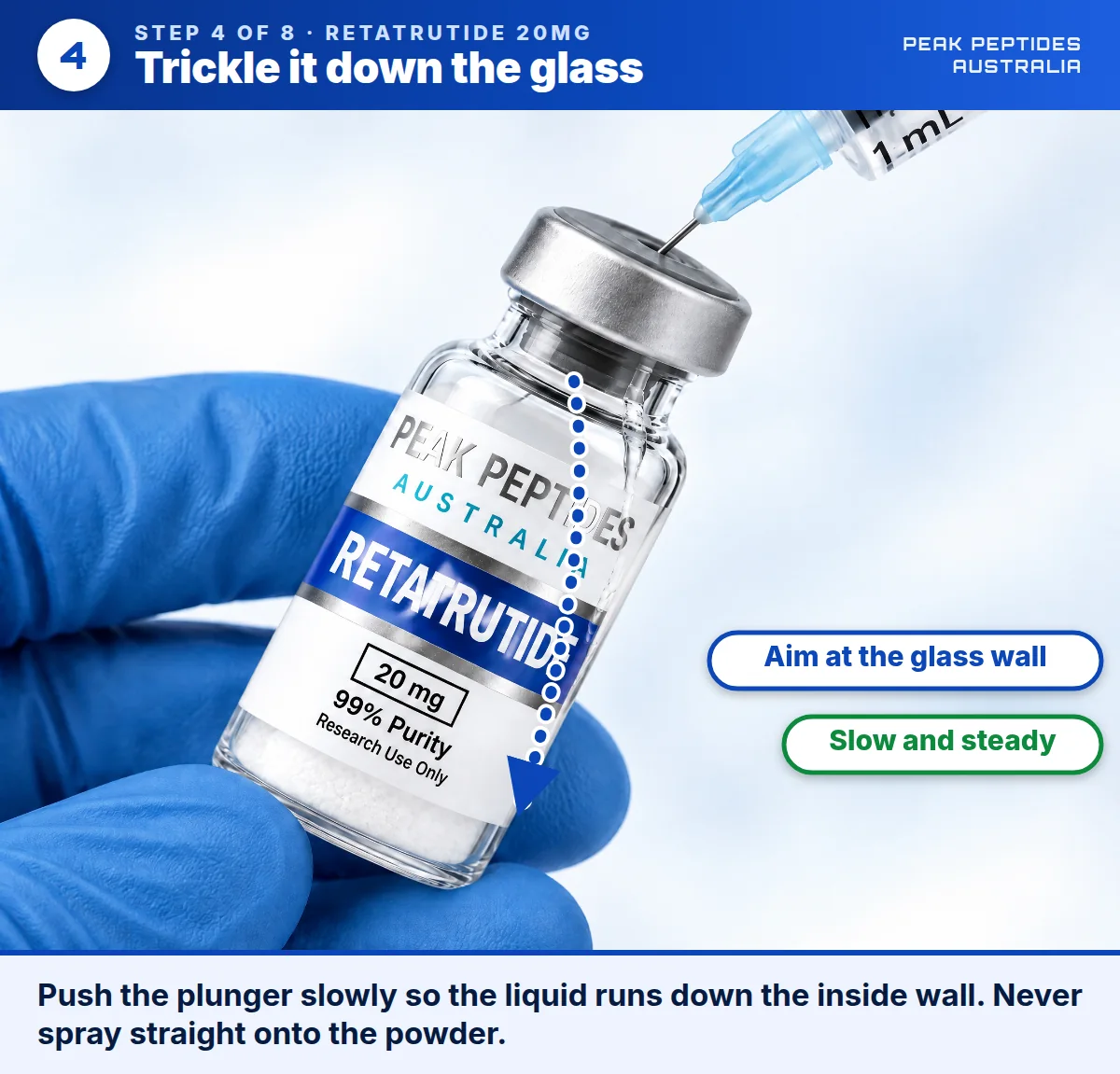
4Step 4: Trickle it down the glass
Insert the needle through the Retatrutide stopper and angle the tip toward the inside glass wall. Press the plunger slowly so the water runs down the glass instead of striking the powder as a forceful stream. Repeat the measured transfer for the second 1 mL, keeping the total added volume at 2 mL.
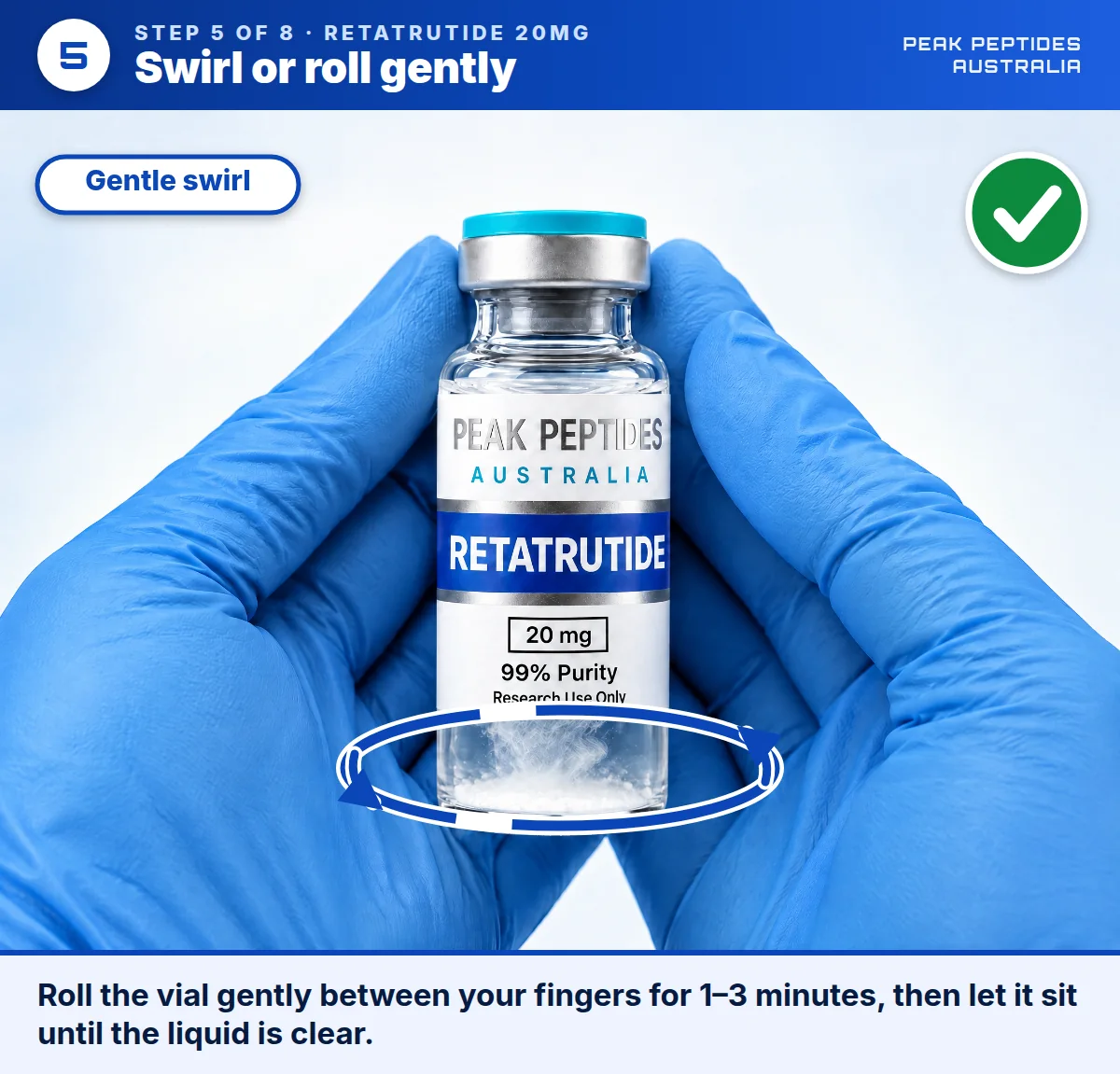
5Step 5: Swirl or roll gently
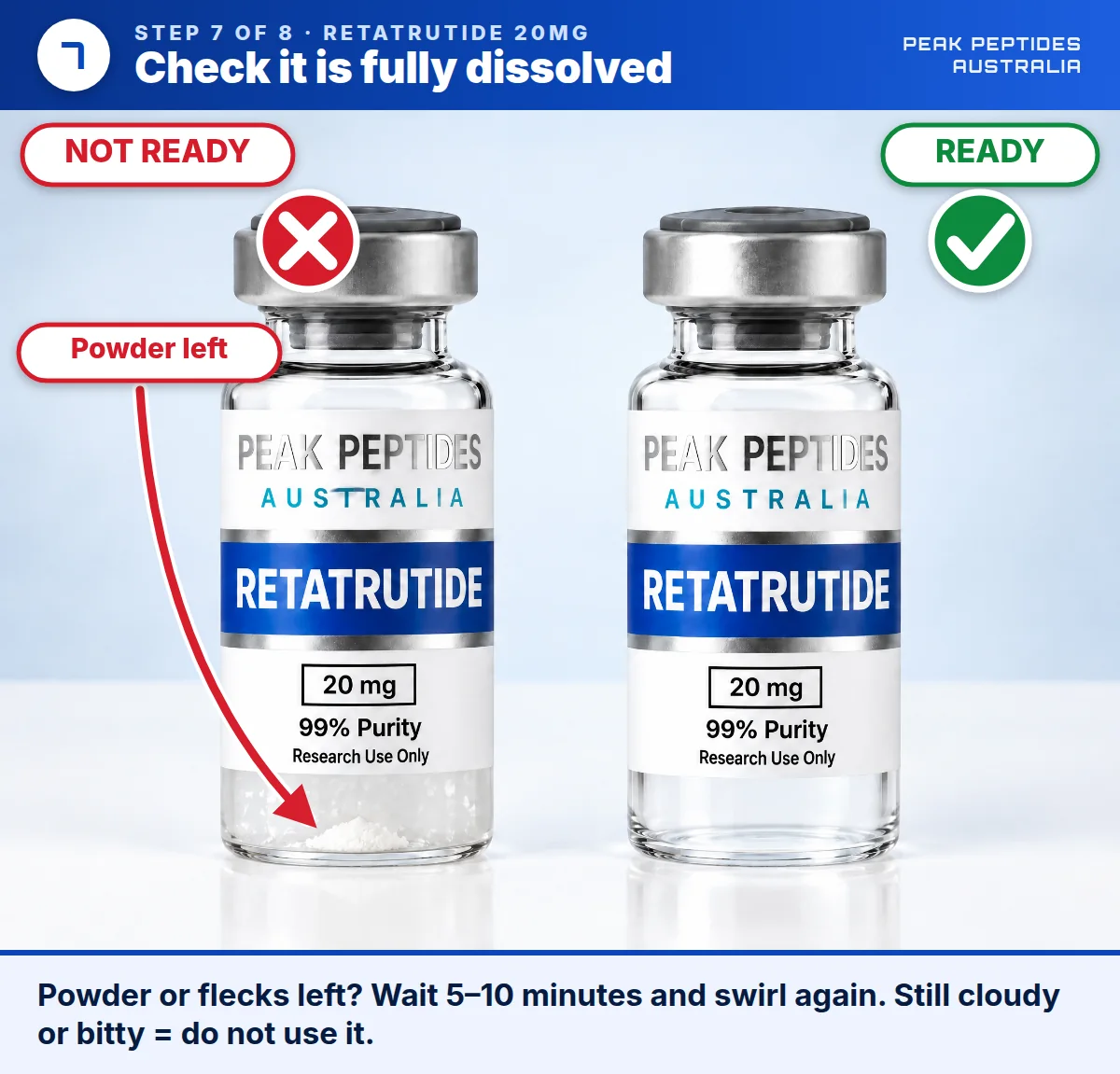
Gently roll the vial between your fingers or swirl it in slow circles while the powder dissolves. Do not force the process by vigorous movement. Give the solution time to become clear, and let it stand briefly if a small amount of powder remains at the bottom. Gentle mixing limits unnecessary foam and agitation.
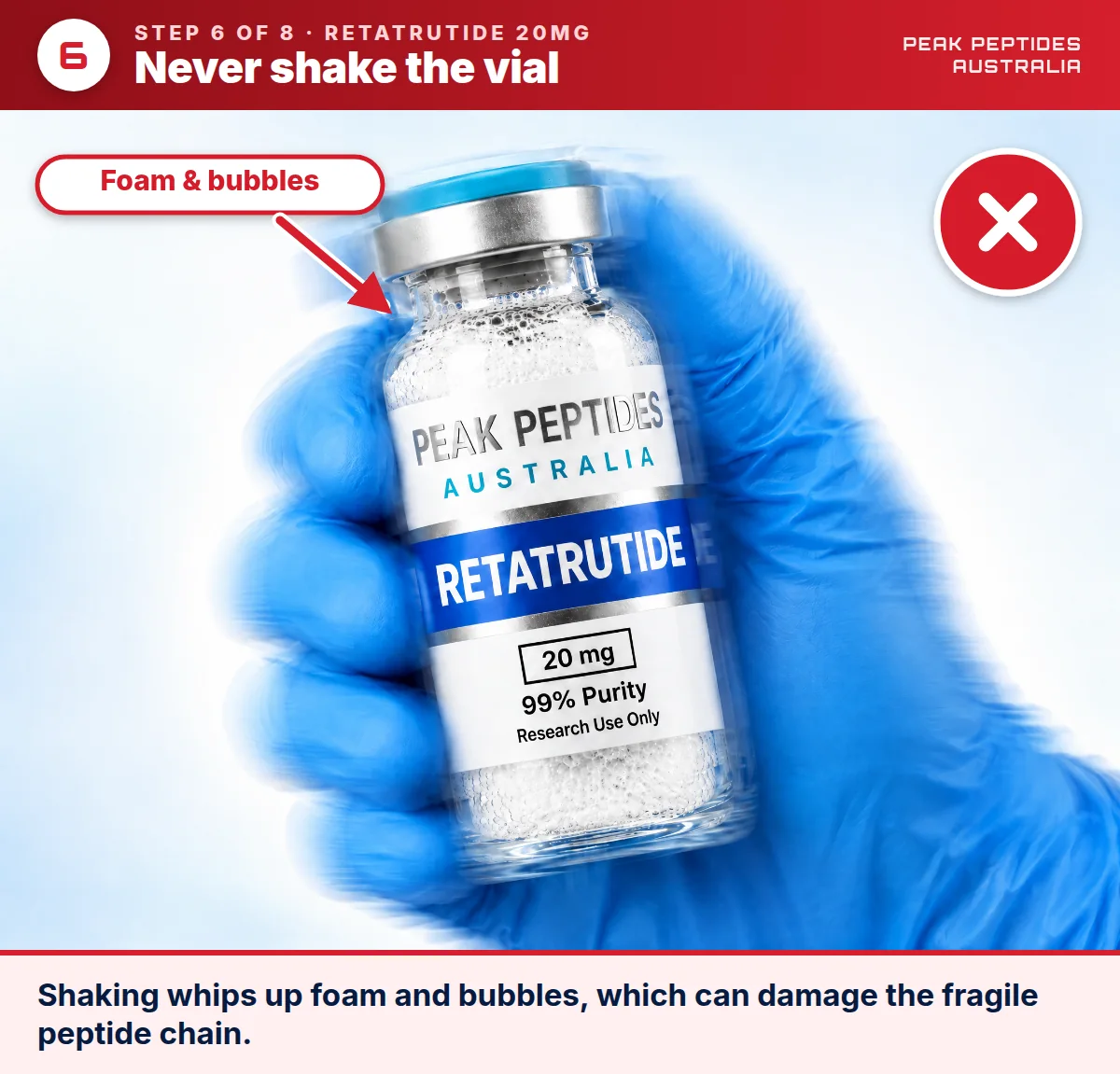
6Step 6: Never shake the vial
Do not shake the vial. Shaking creates foam and bubbles and adds unnecessary mechanical stress to a peptide solution. If foam appears, stand the vial upright and allow it to settle rather than trying to clear it with more shaking. Use gentle swirling only while waiting for the powder to dissolve.
7Step 7: Check it is fully dissolved
Hold the Retatrutide 20mg vial under good light. A finished solution should be clear and colourless, with no remaining powder, flecks or persistent cloudiness. If powder remains, wait and swirl gently again. If the liquid still looks cloudy, coloured or particulate, set it aside rather than treating the appearance as acceptable.
8Step 8: Label it and refrigerate
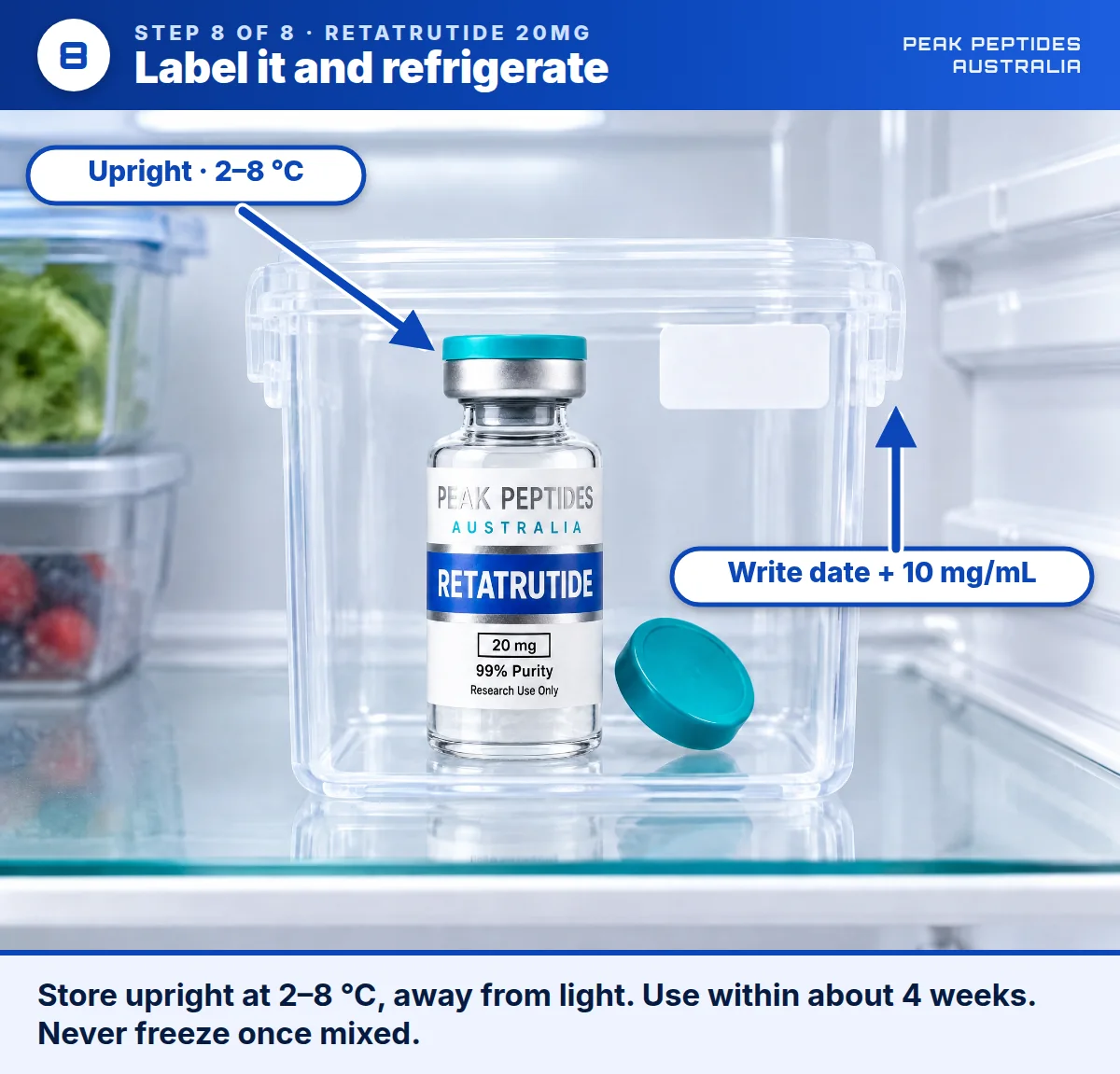
Write the preparation date, BAC-water volume and calculated strength on the vial. With the highlighted 2 mL mix, write 10 mg/mL. Store the vial upright, protected from light, in the refrigerator at 2–8 °C. Use within about four weeks for this BAC-water guide and never freeze once mixed.
How to store Retatrutide 20mg
Retatrutide 20mg handling and storage guide
Retatrutide 20mg handling and storage guide
Form
Where to keep it
Key handling point
Unopened freeze-dried powder
Sealed, dry, dark and refrigerated at 2–8 °C
Protect from moisture and leave the crimp seal intact
Unopened freeze-dried powder
Freezer −20 °C for long-term storage
Keep sealed and avoid repeated temperature cycling
Mixed with BAC water
Upright, dark and refrigerated at 2–8 °C
Label the date, 2 mL volume and 10 mg/mL strength; use within about 4 weeks
Mixed with BAC water
Freezer
Never freeze once mixed
Keep a mixed vial upright and protected from light. Cloudiness, particles, unexpected colour or a damaged stopper means the appearance no longer matches the clear solution shown in the photo guide.
Retatrutide 20mg is a vial containing a nominal 20mg quantity of freeze-dried Retatrutide. Retatrutide, also called LY3437943 or Reta, is one investigational peptide that activates the GLP-1, GIP and glucagon receptors. It is supplied by Peak Peptides Australia for in-vitro research only.
What is the difference between Retatrutide 10mg and 20mg?
They contain the same Retatrutide molecule. The 20mg vial starts with twice the nominal quantity, so the concentration is double when both vials are prepared with the same volume of BAC water. Each size also has its own LabDoc report: LD-VF7M for 10mg and LD-M2QV for 20mg.
Does Retatrutide 20mg mean a stronger peptide?
No. The 20mg label describes nominal vial quantity, not a different or stronger molecule. Retatrutide’s three receptor targets stay the same at either vial size. Concentration changes only when the total amount is divided by a chosen final liquid volume.
Who chooses a Retatrutide 20mg vial?
The 20mg vial suits research work that needs a larger nominal quantity in one vial or prefers the 10 mg/mL concentration created by 2 mL of BAC water. It changes material allocation and U-100 measurement maths; it does not change the molecule’s research mechanism.
How does Retatrutide work in research?
Retatrutide activates three receptors with one molecule: GLP-1, GIP and glucagon. Published mechanism work links GLP-1 and GIP to nutrient-response and glucose-responsive insulin signalling, while glucagon adds energy-expenditure and liver-signalling questions. See the Retatrutide 10mg page for the longer explanation.
What did Retatrutide trials find?
In the 2023 Phase 2 obesity trial, the 12mg research group had a mean body-weight change of −24.2% at 48 weeks, compared with −2.1% with placebo. In the 2026 TRIUMPH-1 study, the treatment-regimen estimate at 80 weeks was −25.0% versus −3.9%.
What side effects were reported in Retatrutide trials?
Gastrointestinal events were the most common reported events in the Phase 2 and Phase 3 trials. The Phase 2 paper describes them as mostly mild to moderate and dose-related. Nausea, diarrhoea, constipation and vomiting were reported in Phase 3 work; altered skin sensation and lower blood pressure were also reported more often in some groups.
What is Retatrutide’s half-life?
Mechanism and early clinical work describe an extended pharmacokinetic profile that supported the schedule used in clinical trials. The main Retatrutide 10mg guide provides the fuller pharmacokinetic discussion. A vial’s 10mg or 20mg label does not change the molecule’s half-life.
Is Retatrutide approved by the TGA or FDA?
No. Retatrutide is not an approved medicine in Australia or the United States. The FDA states that Retatrutide is not a component of an FDA-approved drug and has not been found safe and effective for any condition. The Australian ARTG search does not show an approved Retatrutide medicine.
Can I buy Retatrutide 20mg online in Australia?
Retatrutide 20mg can be ordered online from Peak Peptides Australia when it is available. It is supplied for in-vitro research only. Same-day dispatch from Victoria applies to in-stock orders once payment is confirmed, with tracked Australia Post Express and a tracking number emailed.
How fast is Retatrutide 20mg dispatched in Australia?
For in-stock orders once payment is confirmed, Peak Peptides Australia provides same-day dispatch from Victoria. Parcels are sent by tracked Australia Post Express and the tracking number is emailed. Transit time depends on the Australia Post service route and destination.
How is this Retatrutide 20mg sample verified?
LabDoc report LD-M2QV was tested on 06 August 2026. It records identity confirmed by LC-MS, 99.7% purity by HPLC, 19.70mg HPLC content against the 20mg claim, 0.30% related impurities and an overall assessment of Pass. The report covers the tested sample only.
What does LabDoc LD-M2QV show?
LD-M2QV is the independent verification record for the Retatrutide 20mg submitted sample. It names Retatrutide as the sample, Peak Peptides Australia as origin, batch 30/07/2026, and 06 August 2026 as the tested date. It records LC-MS identity confirmation and 99.7% HPLC purity.
Why can’t I use the Retatrutide 10mg report for this 20mg vial?
A certificate or independent test result is evidence for the submitted sample it describes. Retatrutide 10mg has LabDoc LD-VF7M; this 20mg listing has LD-M2QV. Their reported purity and measured content are separate results, so the 20mg vial should be checked against LD-M2QV.
How much BAC water for Retatrutide 20mg?
The 20mg PeptideDosages vial guide uses 2 mL of BAC water, making 10 mg/mL. This page also shows 1 mL and 3 mL options: 1 mL makes 20 mg/mL, while 3 mL makes 6.67 mg/mL. The total vial amount remains 20mg at every volume.
Why is 2 mL of BAC water highlighted for Retatrutide 20mg?
With 2 mL of BAC water, Retatrutide 20mg becomes 10 mg/mL. That makes the U-100 arithmetic simple: each unit is 0.1 mg and 10 units is 1 mg. The 2 mL choice is highlighted because it gives clean, easy-to-check numbers.
How many units is 1 mg of Retatrutide 20mg?
With the highlighted 2 mL mix, the concentration is 10 mg/mL and 1 mg equals 10 units on a U-100 syringe. With 1 mL, 1 mg equals 5 units. With 3 mL, 1 mg equals 15 units. Units are volume markings, not peptide IU.
How many mg are in 10 units of Retatrutide 20mg?
With the highlighted 2 mL mix, 10 units contains 1 mg because the concentration is 10 mg/mL. With a 1 mL mix, 10 units contains 2 mg. With a 3 mL mix, 10 units contains about 0.67 mg.
How do I reconstitute Retatrutide 20mg?
Prepare a clean workspace, disinfect the vial stoppers, draw the chosen BAC-water volume and add it slowly down the inside wall of the vial. Swirl or roll gently rather than shaking. Inspect for a clear solution, then label the vial with the date, volume and calculated concentration. The eight photos on this page show the sequence.
Can I use sterile or tap water instead of BAC water?
Do not use tap water. The 20mg mixing chart and photo guide are built for BAC water. Plain sterile water has no antimicrobial preservative, so it is not the same handling choice for a repeatedly accessed vial. Use the diluent specified by the documented research procedure.
What if Retatrutide powder does not dissolve?
Allow time for the material to dissolve, then use only gentle swirling or rolling. Do not add extra liquid merely to force dissolution because that changes the concentration. Persistent particles or cloudiness mean the appearance does not match a clear solution; set the vial aside rather than trying to filter or salvage it.
Should reconstituted Retatrutide look cloudy?
No. The finished solution shown in the photo guide is clear and colourless. Visible powder, flecks, unexpected colour or persistent cloudiness means it has not reached that appearance. Inspect it in good light and do not treat a questionable appearance as acceptable.
How long does reconstituted Retatrutide 20mg last?
For the BAC-water visual guide on this page, write the preparation date and strength on the vial. Keep it upright in the fridge at 2–8 °C, away from light, use it within about four weeks (28 days) and never freeze it.
How should I store Retatrutide powder before mixing?
Keep the unopened lyophilised powder sealed, dry and in the dark in the fridge at 2–8 °C, or in the freezer at −20 °C for long-term storage. Protect it from moisture and light, and avoid repeated temperature cycling.
Can mixed Retatrutide be frozen?
No. The visual guide directs users not to freeze a mixed vial. Freezing and thawing can stress peptide solutions and create ice-crystal damage. Keep a BAC-water preparation upright in the refrigerator at 2–8 °C, protected from light, rather than in the freezer.
What does a Retatrutide COA or LabDoc report show?
A quality report can identify the submitted sample, testing date, claimed strength, identity method, purity result and measured content. For this Retatrutide 20mg sample, LabDoc LD-M2QV records LC-MS identity confirmation, 99.7% HPLC purity and 19.70mg HPLC content. Check the report ID against the product listing.