Retatrutide 10mg is a freeze-dried “Triple G” peptide that activates the GLP-1, GIP and glucagon receptors, independently lab tested and LabDoc verified for identity, purity and content. In-stock orders receive same-day dispatch from Victoria after payment confirmation, with tracked Australia Post Express shipping Australia-wide.
Primary Retatrutide research page · Updated 16 October 2026
Retatrutide 10mg — What It Is, How It Works & How to Reconstitute It
Retatrutide, also identified in research as LY3437943 and often shortened to Reta or “Triple G”, is a synthetic peptide that switches on three hormone receptors at once: GLP-1, GIP and glucagon. Also known on our site as GLP3 (GLP-3), Retatrutide was previously listed under that product label; GLP3 is not a separate receptor name. Each vial holds 10mg of freeze-dried (lyophilised) Retatrutide powder, independently tested for identity, purity and content, with a LabDoc verification report. Below you’ll find a plain-English explanation of how it works, what the human trials found, how it compares with Tirzepatide and Semaglutide, and an 8-step photo guide to reconstituting it with bacteriostatic water. Peak Peptides Australia supplies this material for in-vitro research only, not for human or animal use.
Also referred to in research or catalogue references as Retatrutide, Retatrutide peptide, LY3437943, LY-3437943, Triple G, Reta, GLP3 (former site label for Retatrutide), GLP-3 (former site label for Retatrutide).
Retatrutide 10mg at a glance
Name
Retatrutide (research code LY3437943)
Also called
Reta, Triple G, Retatrutide peptide, GLP-3 (our former site label)
What it is
A synthetic “triple agonist” peptide that switches on GLP-1, GIP and glucagon receptors
Developed by
Eli Lilly — investigational, Phase 3 TRIUMPH trials
Size
39 amino acids · formula C221H342N46O68 · about 4,731 g/mol
CAS number
2381089-83-2
Half-life
About 6 days, so trials give it once a week
Headline trial results
28.3% average body-weight loss over 80 weeks (TRIUMPH-1) and 28.7% over 68 weeks (TRIUMPH-4), 12mg group
What you get
10mg freeze-dried (lyophilised) powder in a sealed glass vial
This product’s lab test
LabDoc LD-VF7M · identity confirmed by LC-MS · 99.3% purity by HPLC · 9.05mg measured
Easiest mix
Add 2 mL bacteriostatic water = 5 mg per mL (20 units = 1 mg)
Storage once mixed
Fridge, 2–8 °C, upright and dark, for about 4 weeks — never freeze
Dispatch
Same-day from Victoria for in-stock orders after payment confirmation, tracked Australia Post Express
One molecule, three receptors
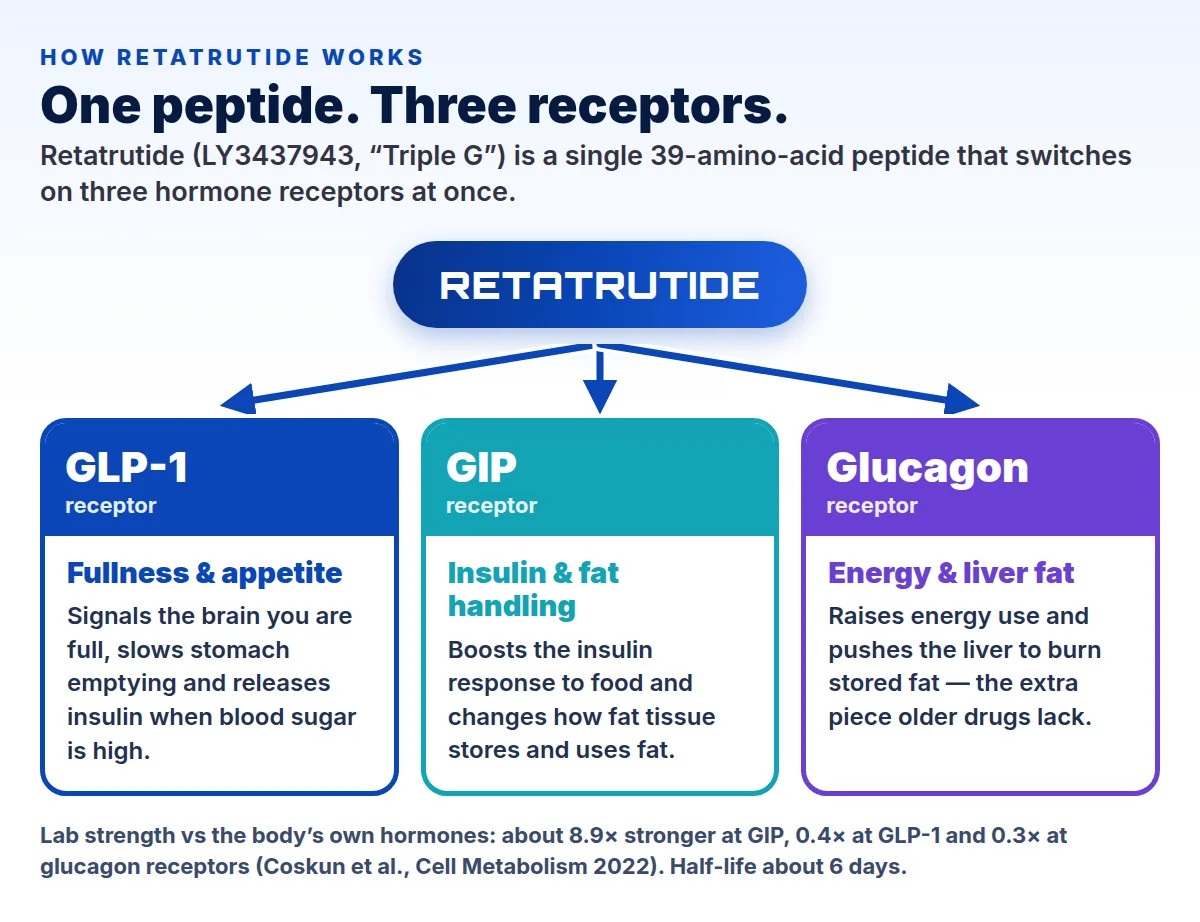
Retatrutide is a single 39-amino-acid peptide, not a blend. It activates the GLP-1 receptor (fullness and appetite), the GIP receptor (insulin and fat handling) and the glucagon receptor (energy use and liver fat). That triple action is why it’s called a triple agonist.
Why the glucagon receptor matters
Semaglutide works on GLP-1 only and Tirzepatide on GLP-1 and GIP. Retatrutide adds glucagon, which raises the energy the body burns and pushes the liver to break down stored fat. In a 2024 Nature Medicine study, liver fat dropped by 86% at 48 weeks on the top amount.
Bigger weight loss than Semaglutide or Tirzepatide trials
In Eli Lilly’s TRIUMPH-1 trial, adults on the 12mg amount lost an average of 28.3% of their body weight over 80 weeks, compared with 2.2% on placebo. TRIUMPH-4 recorded 28.7% over 68 weeks. Both are bigger averages than the main Semaglutide (14.9%) and Tirzepatide (20.9%) obesity trials reported.
Built to last about 6 days
A fatty-acid side chain lets Retatrutide bind to albumin in the blood, which slows its breakdown. Its half-life is about 6 days, and every human trial has given it once a week as a small injection under the skin.
What 10mg means
10mg is the total amount of Retatrutide powder in the vial. Add 2 mL of bacteriostatic water and you get 5 mg per mL, so 20 units on a U-100 insulin syringe holds 1 mg. The 20mg vial is the same peptide in a larger quantity.
Independent Retatrutide 10mg batch evidence
LabDoc report LD-VF7M, tested 11 September 2026, records confirmed identity by LC-MS, 99.3% purity by HPLC and 9.05mg measured content against a 10mg label claim. Use the LabDoc Verification tab to read the report and follow the official verification link.
Why the LC-MS identity check matters
In September 2026 the TGA reported a product sold as Retatrutide that contained no Retatrutide — just undeclared Semaglutide at about eight times the usual amount. An LC-MS result proves the molecule in the vial is Retatrutide by its exact mass, which is why every one of our vials is backed by a LabDoc report you can verify.
Storage at a glance
Keep the unopened powder in the fridge (2–8 °C) and out of light. Once mixed with bacteriostatic water, keep it upright in the fridge and use it within about 4 weeks. Never freeze a mixed vial.
Retatrutide is a lab-made peptide — a short chain of 39 amino acids — created by Eli Lilly under the code LY3437943. It copies the body’s own gut and pancreas hormones that control appetite, blood sugar and how the body uses stored fat.
What makes it different is that one molecule switches on three hormone receptors at the same time: GLP-1, GIP and glucagon. That is why it is called a “triple agonist” and nicknamed “Triple G”. It is not a mix of three peptides and it is not Semaglutide or Tirzepatide with something added — it is its own molecule.
A fatty-acid chain attached to the peptide lets it ride on albumin, a protein in the blood. That slows its breakdown and gives it a half-life of about 6 days, which is why every human trial has given it just once a week.
How does Retatrutide work?
Think of the three receptors as three switches. Older peptides flip one or two of them. Retatrutide flips all three, and each one does a different job:
GLP-1 receptor — the “I’m full” signal. It tells the brain you have eaten enough, slows how fast the stomach empties and helps release insulin when blood sugar rises.
GIP receptor — the insulin helper. It boosts the insulin response to food and changes how fat tissue stores and uses fat. In lab tests Retatrutide is about 8.9 times more potent at this receptor than the body’s own GIP hormone.
Glucagon receptor — the energy booster. It raises the amount of energy the body burns and pushes the liver to break down stored fat. This is the piece Semaglutide and Tirzepatide do not have, and it is the main reason Retatrutide is studied for liver fat.
One peptide, three receptors — GLP-1 for fullness, GIP for insulin and fat handling, glucagon for energy and liver fat.
What did the human trials find?
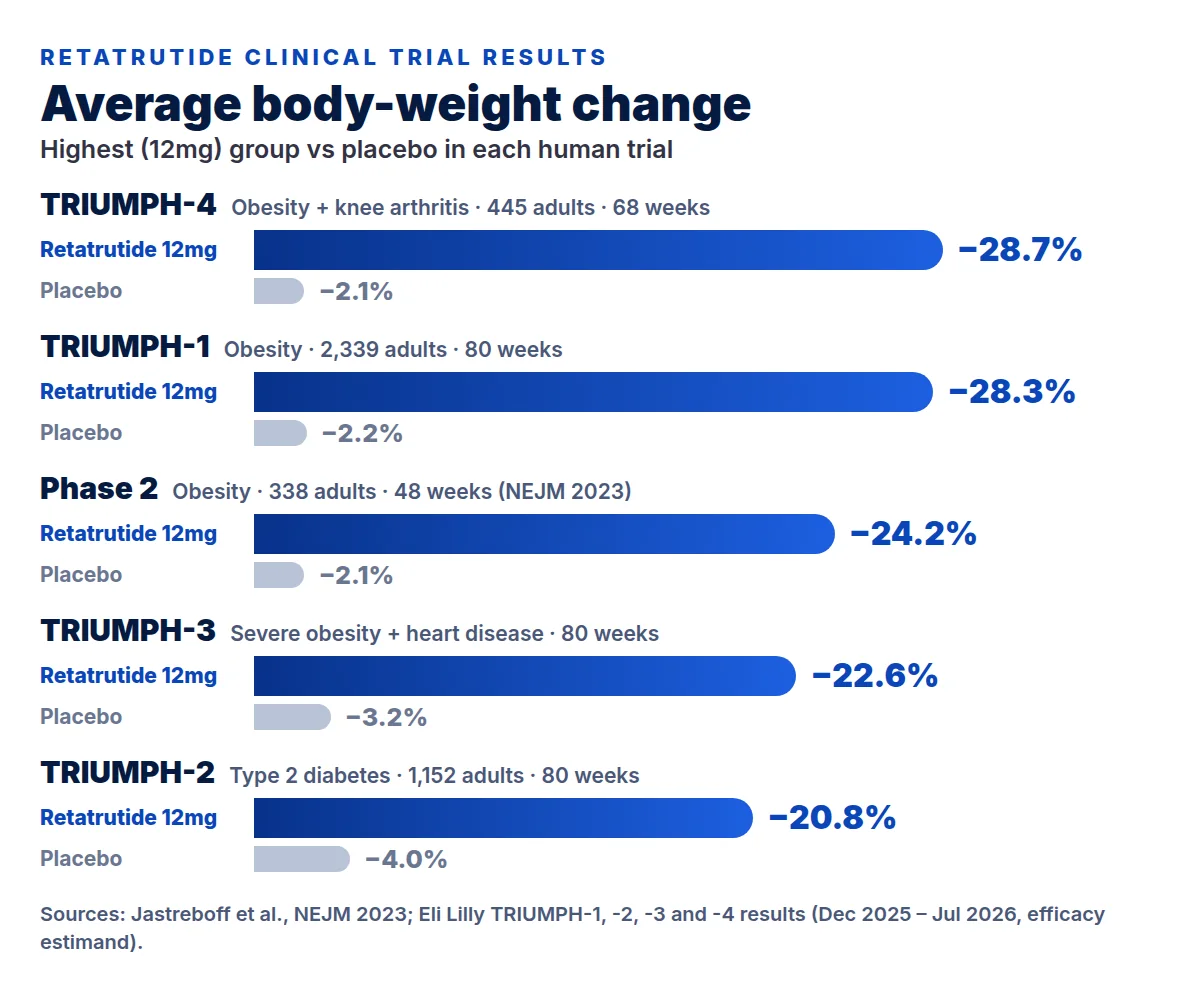
Retatrutide has now enrolled more than 5,800 people across Eli Lilly’s TRIUMPH Phase 3 programme, after a Phase 2 study published in the New England Journal of Medicine in 2023. In every trial, people on the highest (12mg) amount lost far more weight than people on placebo.
In TRIUMPH-1, adults with obesity or overweight (without diabetes) lost an average of 28.3% of their body weight over 80 weeks — about 31.9 kg — and 45% of people on the top amount lost 30% or more. In TRIUMPH-4, adults with obesity or overweight and knee osteoarthritis lost 28.7% over 68 weeks, and their knee-pain scores fell by about 74% on the 12mg amount (about 76% on 9mg).
Beyond weight, the trials recorded smaller waists (down 24 cm on average in TRIUMPH-1), lower blood pressure, lower triglycerides and a lower inflammation marker called high-sensitivity C-reactive protein (hsCRP). A 2024 Nature Medicine study found liver fat fell by 86% at 48 weeks on the top amount, and about 9 in 10 people on the 8mg and 12mg amounts ended up with normal liver fat (under 5%).
Average body-weight change on Retatrutide (12mg group) versus placebo in each human trial.
Retatrutide human trial results (highest-amount group vs placebo)
Retatrutide human trial results (highest-amount group vs placebo)
Trial
Who was studied
Length
Retatrutide
Placebo
TRIUMPH-4
445 adults with obesity or overweight and knee osteoarthritis
68 weeks
−28.7%
−2.1%
TRIUMPH-1
2,339 adults with obesity or overweight plus a weight-related condition, no diabetes
80 weeks
−28.3%
−2.2%
Phase 2 (NEJM 2023)
338 adults with obesity or overweight, no diabetes
48 weeks
−24.2%
−2.1%
TRIUMPH-3
1,949 adults with severe obesity and heart disease
80 weeks
−22.6%
−3.2%
TRIUMPH-2
1,152 adults with type 2 diabetes
80 weeks
−20.8%
−4.0%
Figures are the average change in body weight for the 12mg group. Phase 3 results are Eli Lilly’s efficacy-estimand figures; Phase 2 results are from the NEJM paper.
Retatrutide vs Tirzepatide vs Semaglutide
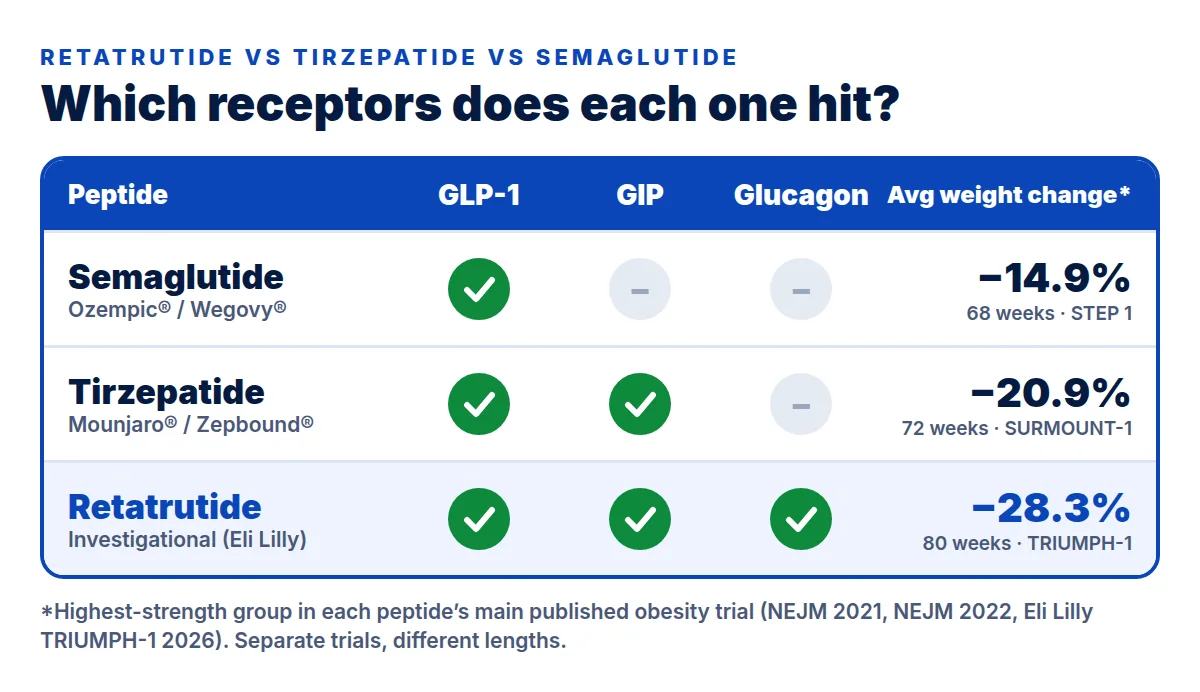
Semaglutide (the peptide in Ozempic® and Wegovy®) works on one receptor: GLP-1. Tirzepatide (Mounjaro® and Zepbound®) works on two: GLP-1 and GIP. Retatrutide works on three: GLP-1, GIP and glucagon.
Each step up has shown bigger average weight loss in its main obesity trial: about 15% for Semaglutide, about 21% for Tirzepatide and about 28% for Retatrutide. The trials were separate and ran for different lengths, so treat the numbers as a guide rather than a head-to-head race. The milligram amounts are not interchangeable between the three peptides.
Which receptors each peptide activates, and the average weight change in its main published obesity trial.
Retatrutide compared with Tirzepatide and Semaglutide
Retatrutide compared with Tirzepatide and Semaglutide
Semaglutide
Tirzepatide
Retatrutide
Receptors
GLP-1
GLP-1 + GIP
GLP-1 + GIP + glucagon
Main obesity trial
STEP 1 (68 weeks)
SURMOUNT-1 (72 weeks)
TRIUMPH-1 (80 weeks)
Average weight change (top group)
−14.9%
−20.9%
−28.3%
Half-life
About 7 days
About 5 days
About 6 days
Peak Peptides listing
—
Tirzepatide 10mg
Retatrutide 10mg / 20mg
Independent lab test for this Retatrutide 10mg
Retatrutide 10mg is backed by an independent LabDoc verification report. Report LD-VF7M (tested 11 September 2026) confirmed by LC-MS that the peptide in the vial is Retatrutide, measured 99.3% purity by HPLC and found 9.05mg of peptide in the vial. You can scan the report or open it at labdoc.org to check it belongs to us.
That identity check matters in Australia right now. In September 2026 the TGA reported testing a product sold as Retatrutide that contained no Retatrutide at all — it held undeclared Semaglutide at about eight times the level found in TGA-approved Semaglutide products. An LC-MS identity result is how a lab confirms which molecule is actually in the tested vial.
Identity (LC-MS): confirms the molecule is Retatrutide by its exact mass.
Purity (HPLC): 99.3% of the tested material was Retatrutide; the remaining 0.7% was recorded as related impurities.
Content: 9.05mg of peptide measured in the 10mg vial.
Buying Retatrutide 10mg in Australia
You can order Retatrutide 10mg online from Peak Peptides Australia — the official Peak Peptides Australia site. In-stock orders receive same-day dispatch from Victoria after payment confirmation, with tracked Australia Post Express shipping Australia-wide and a tracking number emailed to you. Payment is by bank transfer at checkout.
Need bacteriostatic water and want to work out a different mix? Add our 10 mL bacteriostatic water to your order and use the free reconstitution calculator. Retatrutide 10mg is supplied for in-vitro research only.
Step-by-step guide · About 10 minutes
How to reconstitute Retatrutide 10mg (step-by-step with photos)
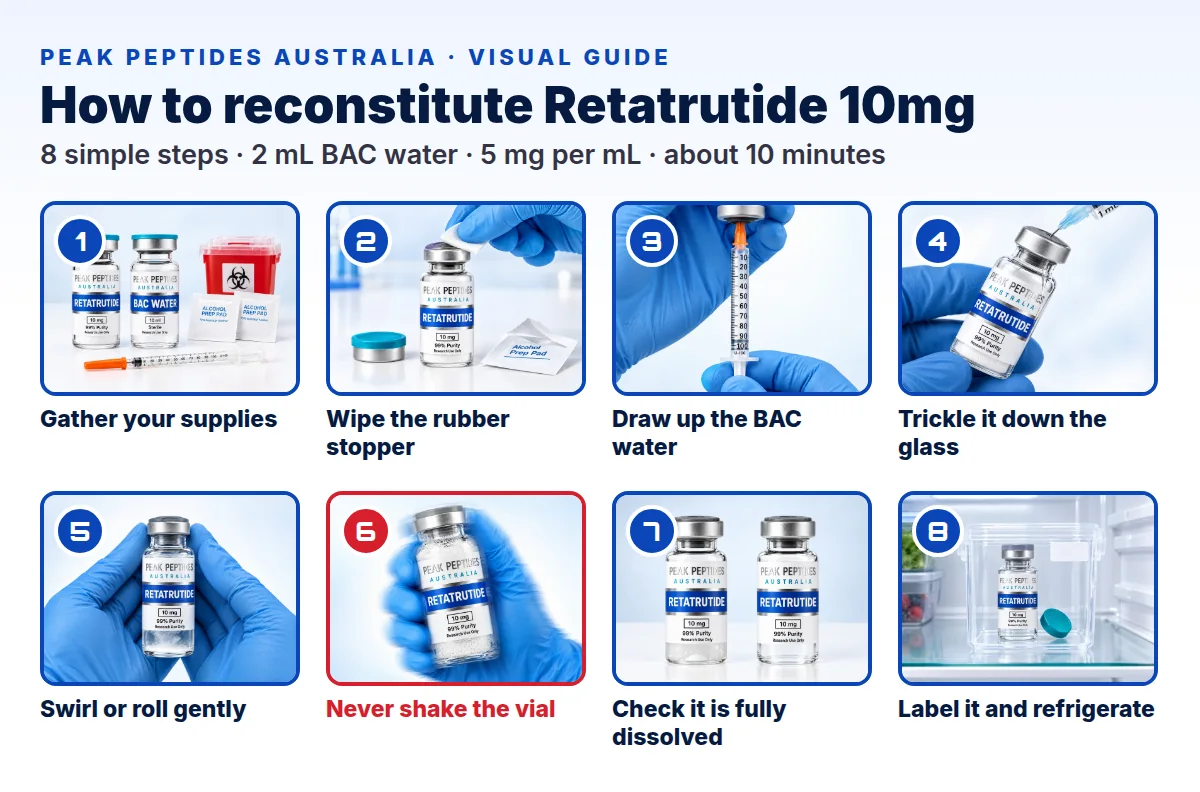
Retatrutide 10mg arrives as a dry, freeze-dried powder. Reconstituting just means adding bacteriostatic (BAC) water so the powder dissolves into a clear liquid that can be measured accurately. It takes about 10 minutes. The most popular mix is 2 mL of BAC water, which gives 5 mg per mL and the easiest maths. Follow the 8 steps below.
The whole process at a glance — 8 simple steps.
What you need
Retatrutide 10mg vialFreeze-dried powder, sealed under a flip-off cap.
Bacteriostatic waterSterile water with 0.9% benzyl alcohol so a mixed vial keeps for weeks.
1 mL U-100 insulin syringe100 units = 1 mL. Use a new one every time.
Alcohol swabs70% isopropyl alcohol prep pads for the rubber stoppers.
Sharps containerFor safe disposal of used needles.
How much BAC water to add to Retatrutide 10mg
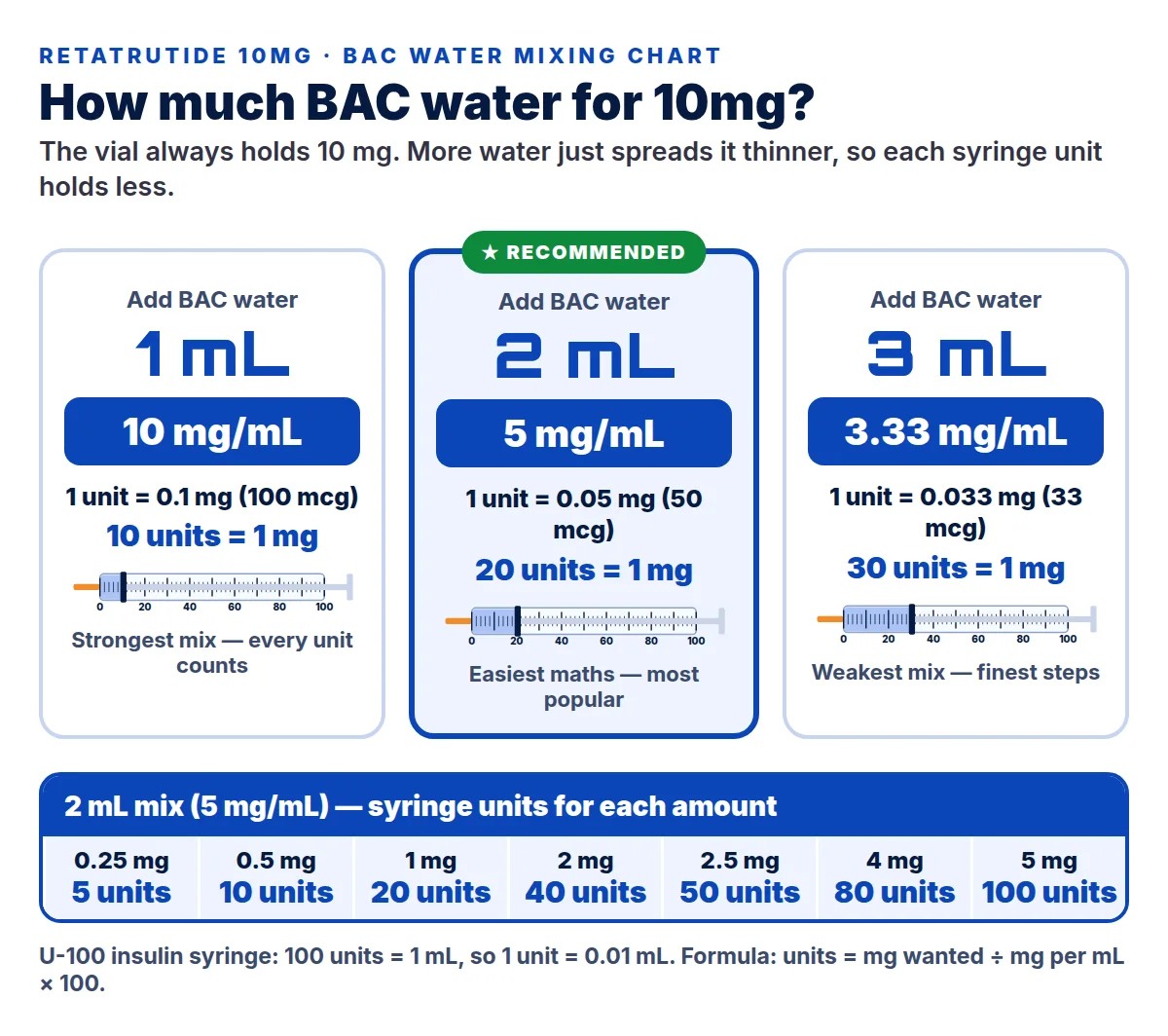
The vial’s 10 mg of Retatrutide stays the same whatever volume you choose. Adding more water does not add more peptide — it just spreads it thinner, so each unit on the syringe holds less. Pick a volume that makes your maths easy.
2 mL is the most popular choice: it gives 5 mg per mL, so every 10 units on a U-100 syringe holds 0.5 mg and 20 units holds 1 mg. 1 mL gives a stronger mix (10 mg per mL); 3 mL gives a weaker one (3.33 mg per mL) for finer steps. The formula is simple: units = mg wanted ÷ mg per mL × 100.
BAC water mixing chart for Retatrutide 10mg — 2 mL gives the easiest maths.
2 mL is highlighted because it gives the simplest numbers.
Syringe units with the 2 mL mix (5 mg per mL)
Syringe units with the 2 mL mix (5 mg per mL)
Amount
Units on a U-100 syringe
Volume
0.25 mg
5 units
0.05 mL
0.5 mg
10 units
0.10 mL
1 mg
20 units
0.20 mL
2 mg
40 units
0.40 mL
2.5 mg
50 units
0.50 mL
4 mg
80 units
0.80 mL
5 mg
100 units
1.00 mL
The 8 steps
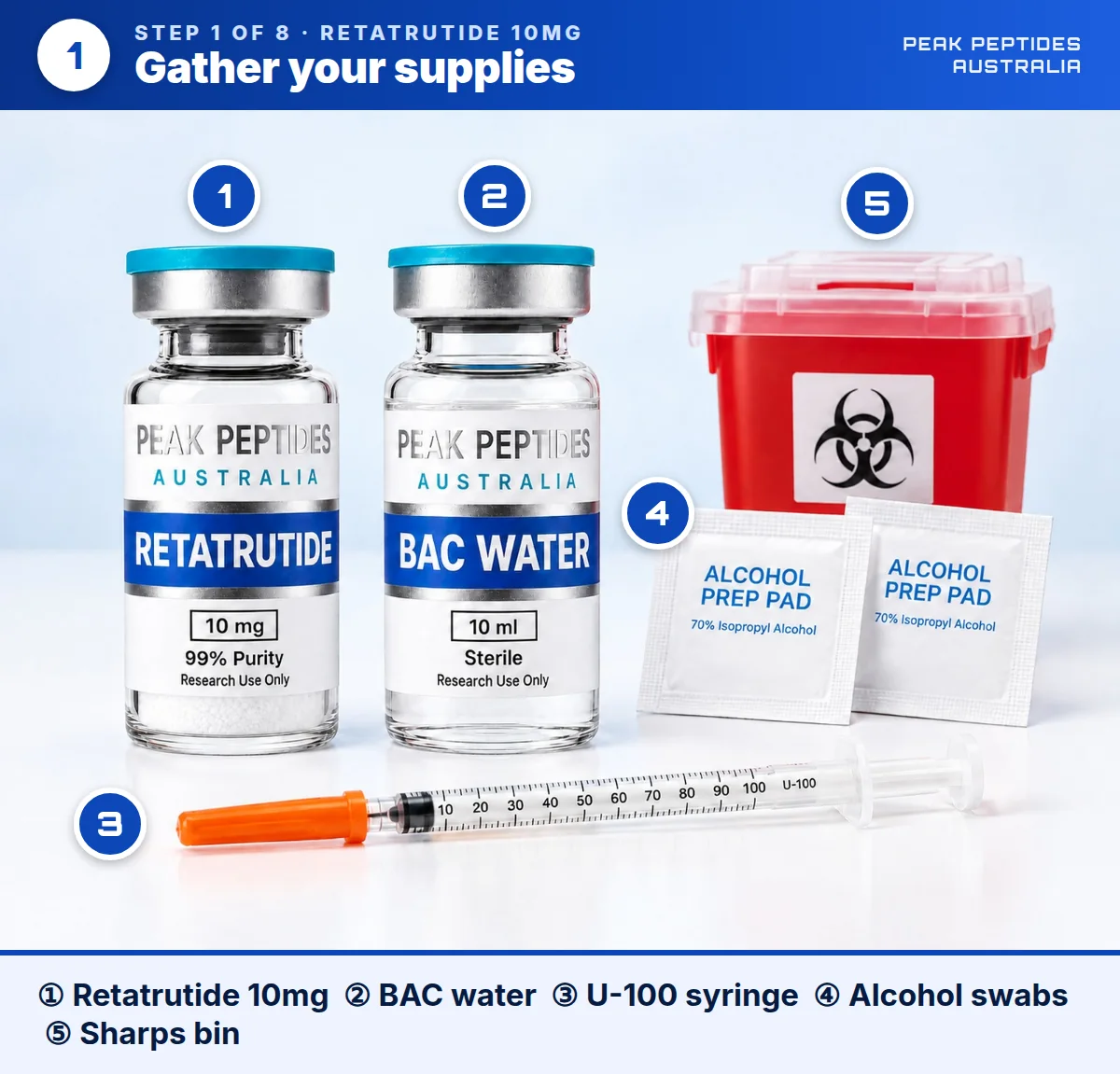
1Step 1: Gather your supplies
Lay out the Retatrutide 10mg vial, bacteriostatic water, a new 1 mL U-100 insulin syringe, alcohol swabs and a sharps container on a clean surface, and wash your hands. If the vial has been in the fridge, let it sit for 10–15 minutes so it reaches room temperature.
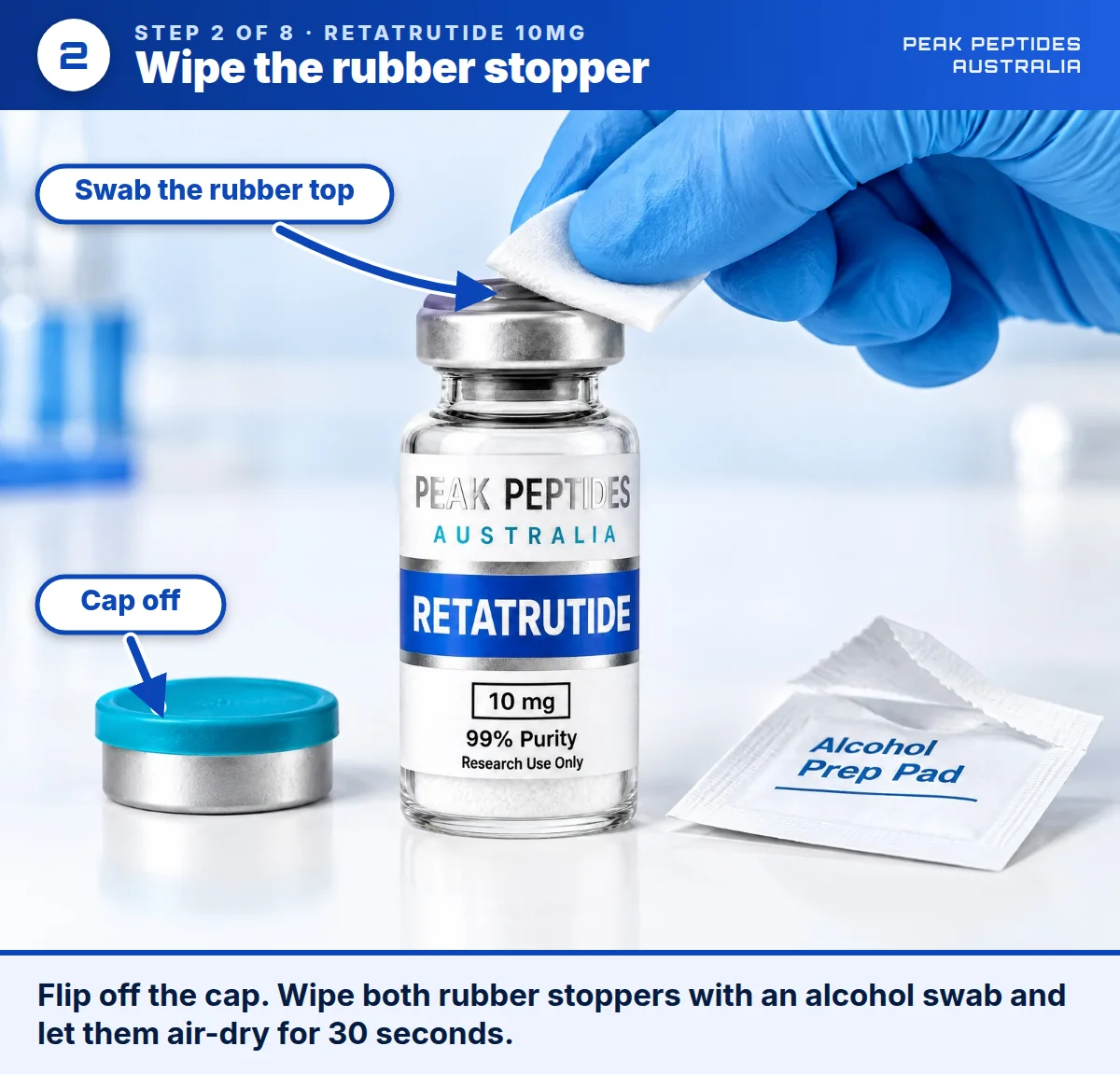
2Step 2: Wipe the rubber stoppers
Flip the plastic cap off both vials. Wipe each rubber stopper with a fresh alcohol swab and let it air-dry for about 30 seconds. Don’t touch the stoppers after wiping.
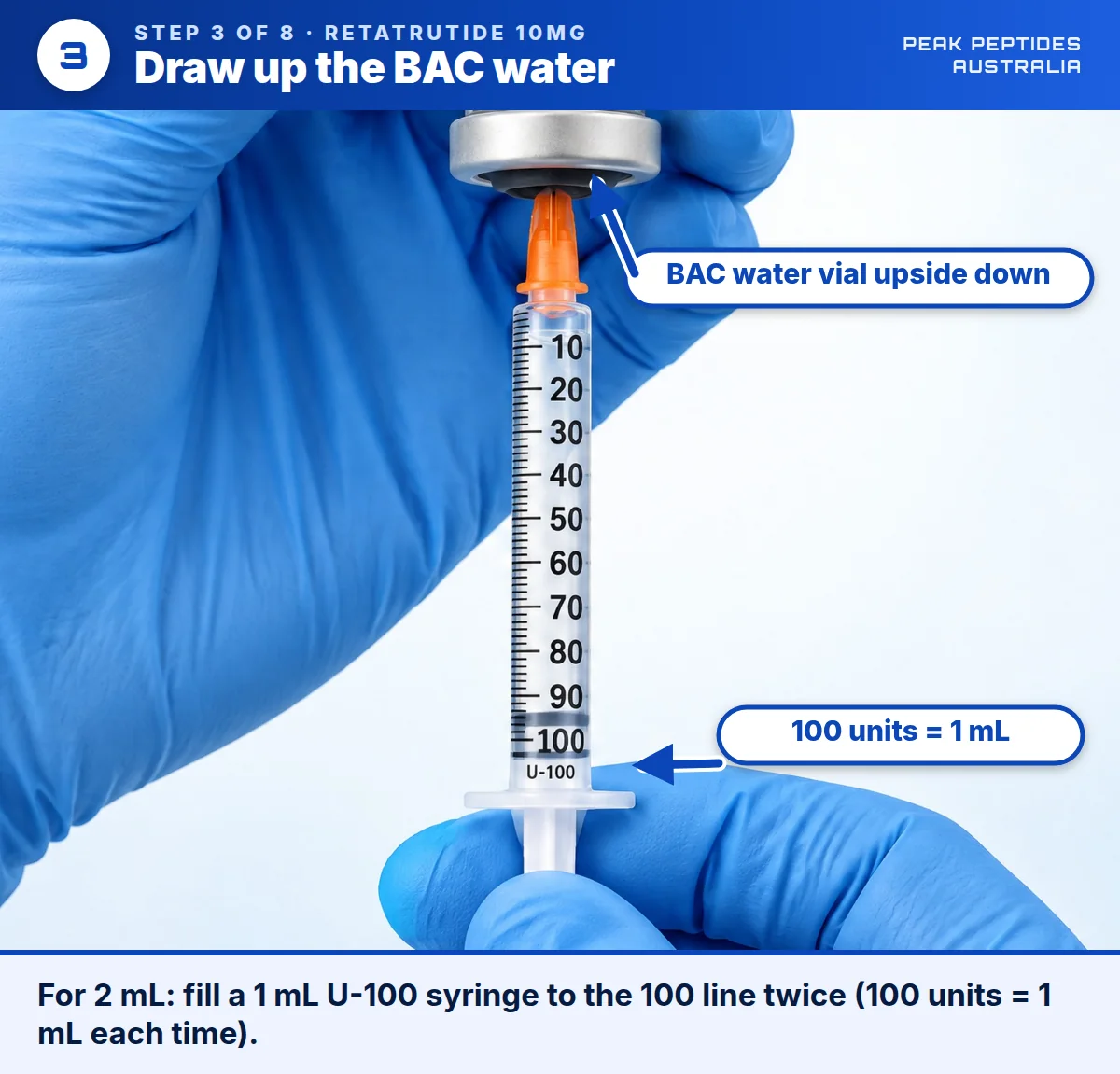
3Step 3: Draw up 1 mL of BAC water
Pull the syringe plunger back to the 100-unit line to fill it with air, push the needle through the BAC water stopper and press the air in. Turn the vial upside down and slowly draw the water to the 100 line (100 units = 1 mL). Flick out any air bubbles. For the 2 mL mix you will do this twice.
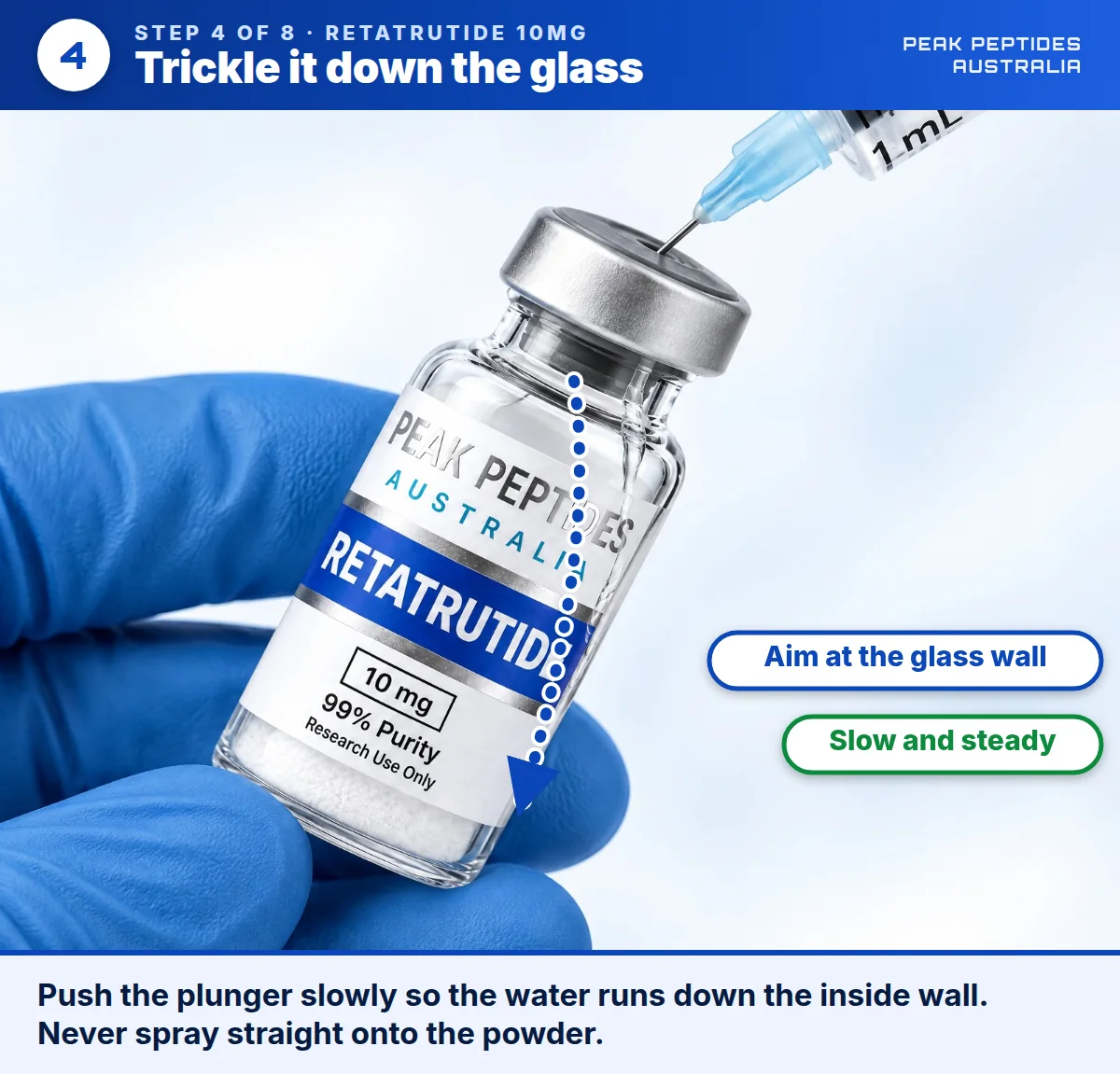
4Step 4: Trickle it down the inside of the glass
Push the needle through the Retatrutide stopper at an angle so the tip touches the inside wall. Press the plunger slowly so the water runs down the glass. Never squirt it straight onto the powder — a hard jet can damage the peptide. Repeat steps 3 and 4 for the second 1 mL.
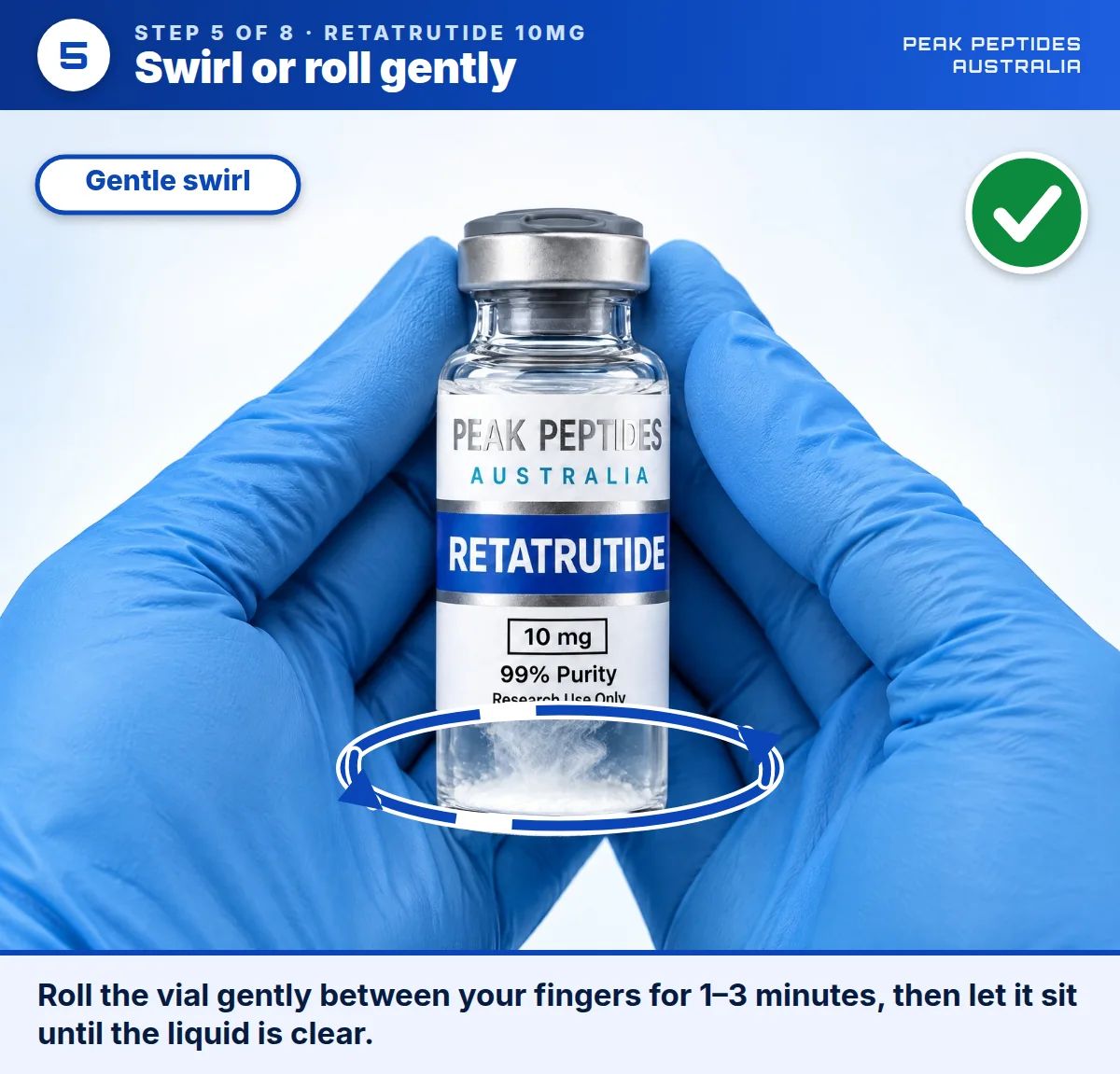
5Step 5: Swirl or roll gently
Gently roll the vial between your fingers or swirl it in slow circles for 1–3 minutes. Most of the powder dissolves within a few minutes.
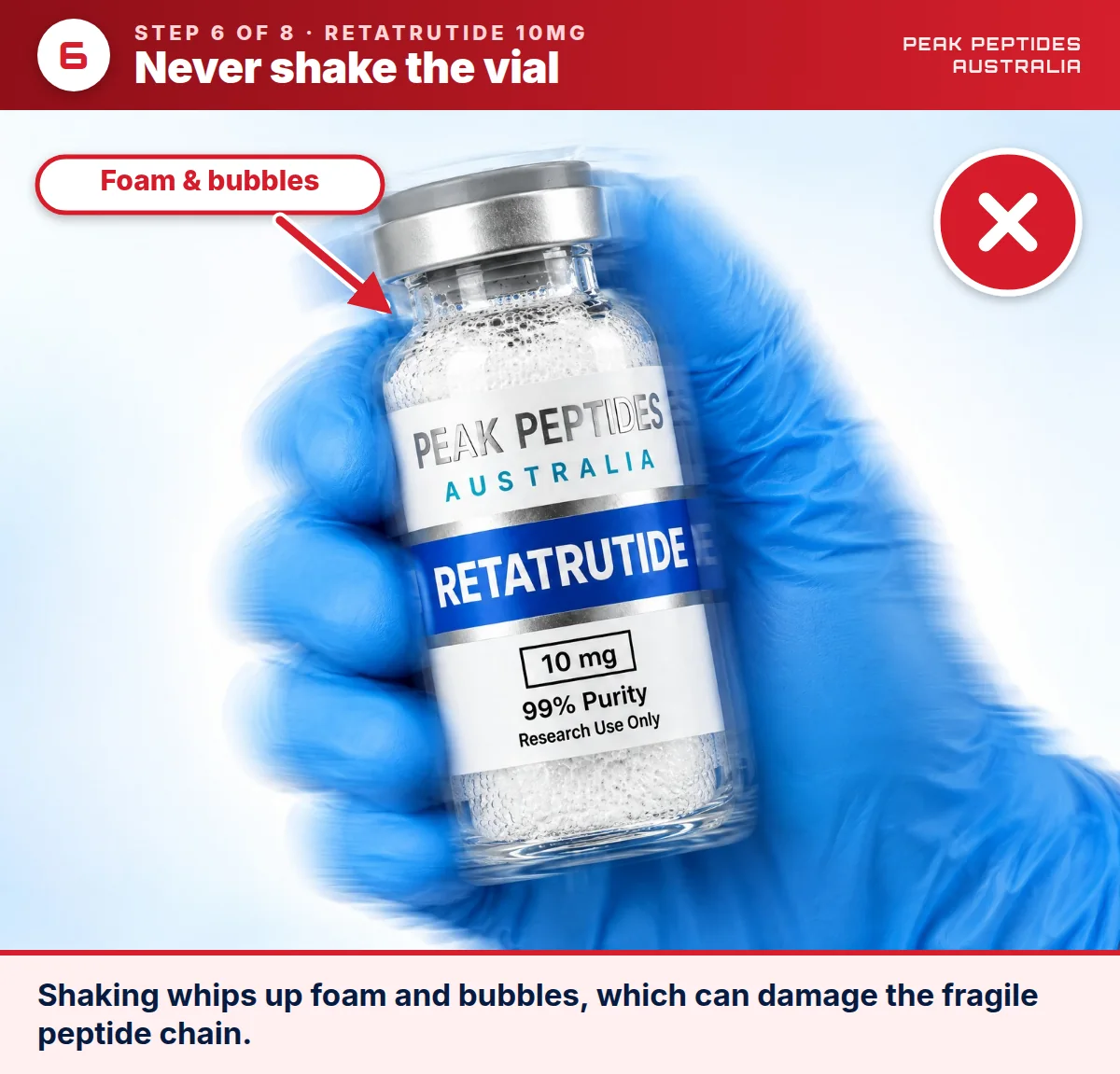
6Step 6: Never shake the vial
Do not shake it. Shaking whips up foam and bubbles and can break apart the fragile peptide chain. If foam appears, stand the vial upright and let it settle.
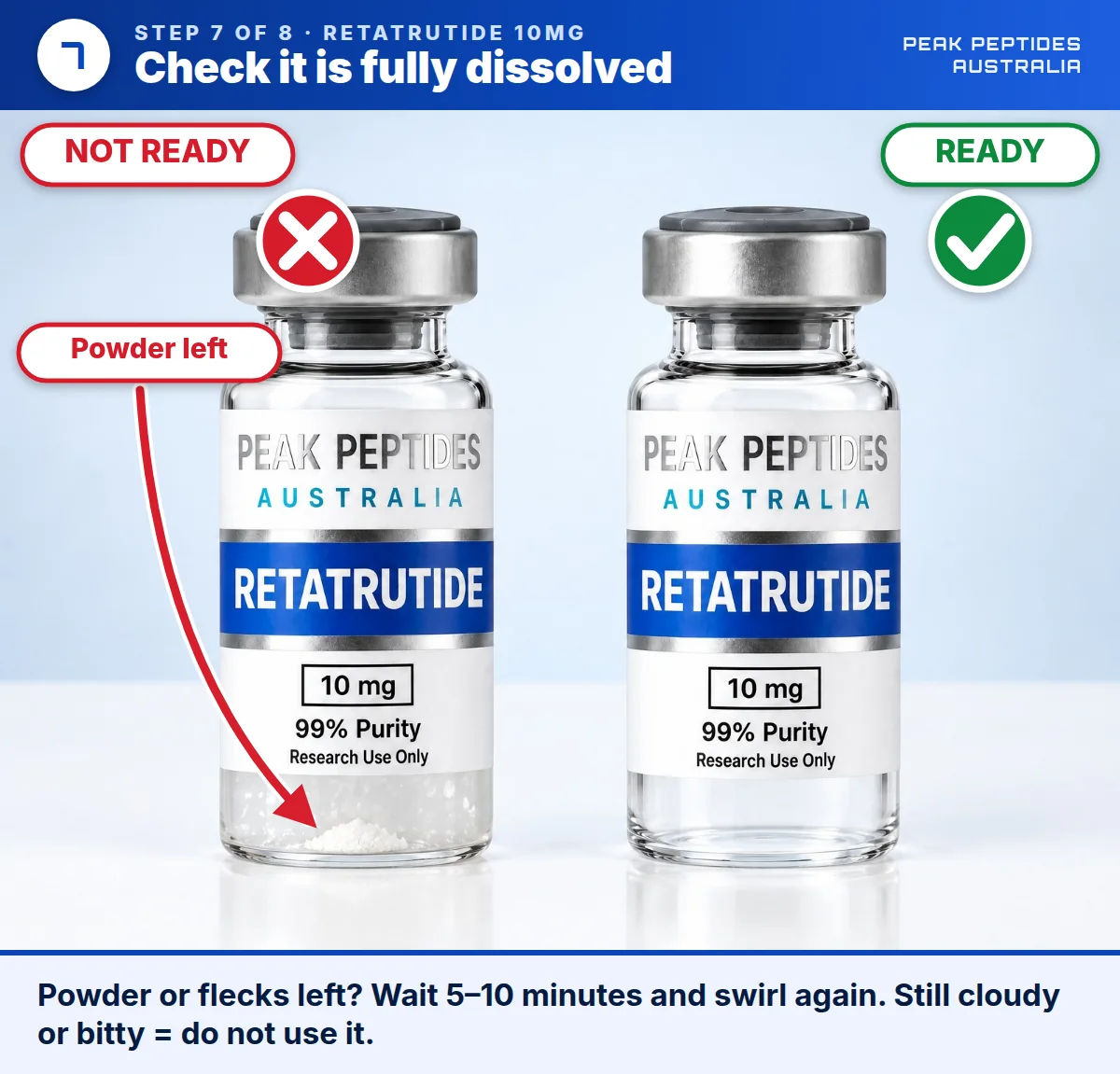
7Step 7: Check it is fully dissolved
Hold the vial up to the light. The liquid should be completely clear, with no powder, flecks or cloudiness. If powder is still sitting in the bottom, let it stand for 5–10 minutes and swirl gently again — don’t put it in the fridge until it has fully dissolved. If it stays cloudy or has particles, don’t use it.
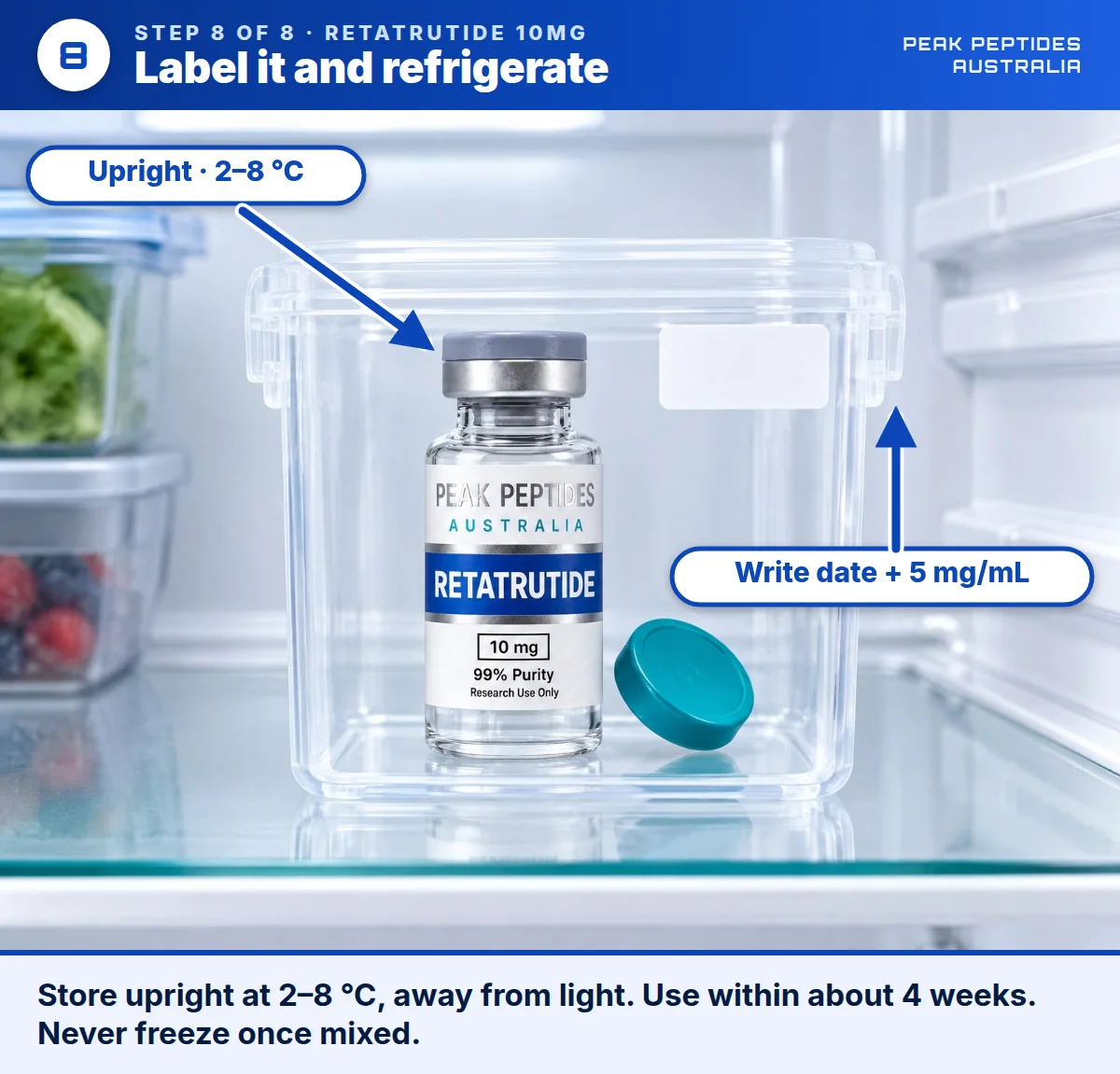
8Step 8: Label it and refrigerate
Write the date and the strength (5 mg/mL for the 2 mL mix) on the vial. Store it upright in the fridge at 2–8 °C, away from light. Use it within about 4 weeks and never freeze it once mixed.
How to store Retatrutide
Retatrutide storage guide
Retatrutide storage guide
Form
Where to keep it
How long
Unopened powder
Fridge, 2–8 °C, in the dark
Up to 2 years
Unopened powder
Freezer, −20 °C
Long-term
Unopened powder
Cool and dark, below 25 °C
Up to 90 days (for example, in transit)
Mixed with BAC water
Fridge, 2–8 °C, upright and away from light
About 4 weeks (25–30 days)
Mixed with BAC water
Freezer
Never — freezing damages the mixed peptide
Light and heat break peptides down faster, so keep the vial in its box or a closed container in the fridge, not in the door.
Retatrutide 10mg FAQs — Your Questions Answered
What is Retatrutide?
Retatrutide is a synthetic peptide developed by Eli Lilly (code LY3437943) that activates three hormone receptors — GLP-1, GIP and glucagon — with a single molecule. It is studied for appetite, blood sugar, body weight and liver fat.
What is Reta peptide?
Reta is the common short name for Retatrutide. You’ll also see it called Triple G or by its research code LY3437943. On our site it was previously listed as GLP-3 — a nickname, not a scientific name.
Why is Retatrutide called Triple G?
Because it hits three “G” receptors at once: GLP-1, GIP and glucagon. Semaglutide hits one and Tirzepatide hits two.
How does Retatrutide work?
GLP-1 activity signals fullness and slows stomach emptying, GIP activity boosts the insulin response and changes how fat is stored, and glucagon activity raises energy use and helps the liver burn stored fat. Together they reduce appetite and increase fat burning.
How much weight did people lose on Retatrutide in trials?
On the highest (12mg) amount, average weight loss was 28.3% over 80 weeks in TRIUMPH-1, 28.7% over 68 weeks in TRIUMPH-4, 24.2% over 48 weeks in the Phase 2 trial, 22.6% in TRIUMPH-3 and 20.8% in people with type 2 diabetes in TRIUMPH-2. Placebo groups lost 2–4%.
What are the side effects of Retatrutide in trials?
The most common were stomach-related — nausea, diarrhoea, constipation and vomiting — mostly mild to moderate and most frequent early on. Some people also reported dysaesthesia (an unusual skin sensation) and a temporary rise in heart rate.
Is Retatrutide better than Tirzepatide?
Retatrutide adds a third receptor (glucagon) and its top trial results are higher: about 28% average weight loss versus about 21% for Tirzepatide in its main obesity trial. The trials were run separately, so they are not a direct head-to-head comparison.
Is Retatrutide the same as Tirzepatide or Semaglutide?
No. They are three different molecules. Semaglutide works on GLP-1, Tirzepatide on GLP-1 and GIP, and Retatrutide on GLP-1, GIP and glucagon. Their milligram amounts are not interchangeable.
Is Retatrutide approved by the TGA or FDA?
Not yet. Retatrutide is still investigational. Eli Lilly has completed several Phase 3 TRIUMPH trials and plans to apply for US approval in early 2027. In Australia it is not an approved medicine.
Can I buy Retatrutide 10mg online in Australia?
Yes. You can order Retatrutide 10mg online from Peak Peptides Australia when it is in stock. In-stock orders receive same-day dispatch from Victoria after payment confirmation, with tracked Australia Post Express shipping Australia-wide. It is supplied for in-vitro research only.
How fast is shipping on Retatrutide in Australia?
In-stock orders are dispatched the same day from Victoria once payment is confirmed, sent tracked via Australia Post Express, and your tracking number is emailed to you.
How do I know my Retatrutide is real?
Check for an independent lab report that names the supplier, has a scannable QR code or verification code, and confirms identity by LC-MS. Our Retatrutide 10mg is backed by LabDoc report LD-VF7M, which you can verify at labdoc.org. See our guide on spotting fake COAs for more.
How is the Retatrutide 10mg sample verified?
LabDoc report LD-VF7M, tested 11 September 2026, records confirmed identity by LC-MS, 99.3% purity by HPLC and 9.05mg measured content against a 10mg label claim. Use the LabDoc Verification tab to read the report and follow the official verification link.
What is the difference between Retatrutide 10mg and 20mg?
Both vials hold the same peptide. The 20mg vial simply contains twice as much powder. With the same amount of water, a 20mg vial is twice as strong per mL. Each strength has its own LabDoc report.
How much bacteriostatic water do I add to Retatrutide 10mg?
Most people add 2 mL, which makes 5 mg per mL — the easiest maths. 1 mL makes 10 mg per mL and 3 mL makes 3.33 mg per mL. The amount of Retatrutide in the vial stays 10mg whichever you choose.
How many units is 1 mg of Retatrutide?
It depends on how much water you added. With 2 mL in a 10mg vial (5 mg/mL), 1 mg is 20 units on a U-100 insulin syringe. With 1 mL it is 10 units, and with 3 mL it is 30 units.
How many units is 2.5 mg of Retatrutide?
With the 2 mL mix (5 mg/mL), 2.5 mg is 50 units on a U-100 syringe, which is 0.5 mL. With a 1 mL mix it is 25 units.
How many mg are in 10 units of Retatrutide?
With the 2 mL mix, 10 units holds 0.5 mg. With the 1 mL mix, 10 units holds 1 mg. With the 3 mL mix, 10 units holds about 0.33 mg.
How do I reconstitute Retatrutide 10mg?
Wipe both rubber stoppers with an alcohol swab, draw bacteriostatic water into a U-100 syringe, then push it slowly down the inside wall of the Retatrutide vial. Swirl or roll gently — never shake — until the liquid is completely clear, then label it and store it in the fridge. The photo guide on this page shows each step.
Can I use sterile or tap water instead of bacteriostatic water?
Never use tap or distilled water. Plain sterile water has no preservative, so a vial mixed with it should be used promptly rather than kept for weeks. Bacteriostatic water contains 0.9% benzyl alcohol, which keeps a mixed vial usable for about 4 weeks in the fridge.
What if the powder doesn’t dissolve?
Let the vial stand for 5–10 minutes, then swirl gently again. Don’t shake it and don’t refrigerate it until it is fully dissolved. If it stays cloudy or has particles after that, don’t use it.
Should reconstituted Retatrutide be cloudy?
No. Properly mixed Retatrutide is completely clear and colourless. Cloudiness, flecks or particles mean it hasn’t fully dissolved or may be damaged.
How long does reconstituted Retatrutide last?
About 4 weeks (25–30 days) when mixed with bacteriostatic water and kept upright in the fridge at 2–8 °C, away from light. Write the mixing date on the vial.
How should I store Retatrutide powder before mixing?
Keep the unopened vial in the fridge at 2–8 °C for up to 2 years, or in the freezer at −20 °C for long-term storage. It handles normal shipping times at room temperature without problems.
Can you freeze reconstituted Retatrutide?
No. Freezing and thawing a mixed peptide can break it down. Keep mixed Retatrutide in the fridge only.
What does a COA (certificate of analysis) show?
A COA is the lab’s report on a tested sample. It confirms identity by LC-MS, purity by HPLC and how much peptide is actually in the vial. A genuine COA names the supplier who sent the sample and has a QR code or verification code so you can trace it back to the lab. Ours for Retatrutide 10mg is LabDoc LD-VF7M, supplied for in-vitro research.