Research Use Only. For laboratory research use only. Not for human or animal consumption.
AOD 9604 (Anti-Obesity Drug 9604 / hGH Fragment 177-191)
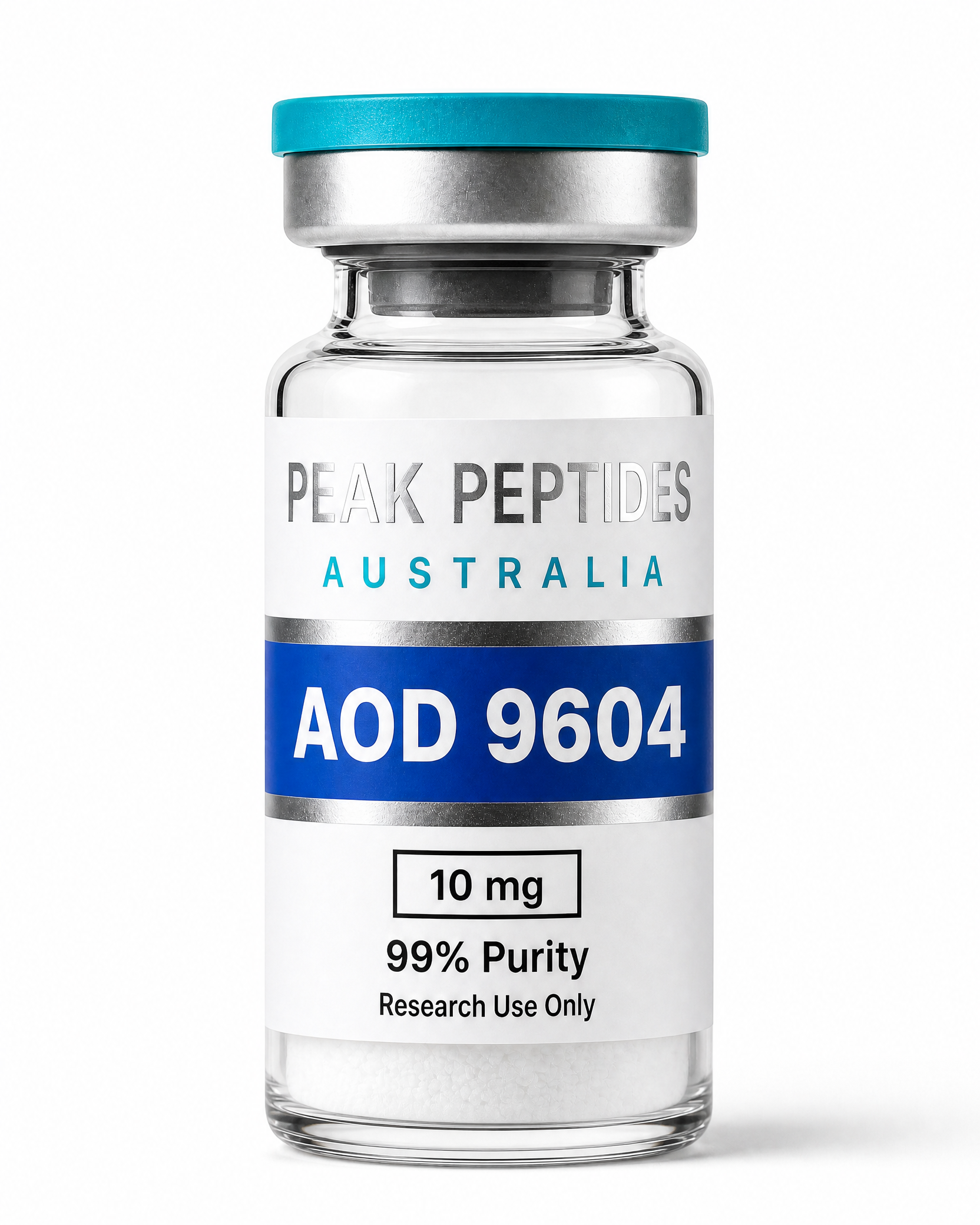
AOD 9604 10mg is a lyophilised modified hGH-fragment research peptide, supplied with acidic solution for this product format. LabDoc report LD-9KXJ records LC-MS identity confirmation, 98.96% HPLC purity and 9.13mg content for the submitted sample. In-stock orders receive same-day dispatch from Victoria after payment confirmation, with tracked Australia Post Express shipping Australia-wide.
Product Specifications
Full NameAOD 9604 (Anti-Obesity Drug 9604 / hGH Fragment 177-191)
Vial Size10mg
Purity98.96% HPLC (LD-9KXJ, 9.13mg sample)
Legal Disclaimer
This product is sold strictly for in-vitro laboratory research purposes only. It is not intended for human or animal consumption, injection, or any diagnostic or therapeutic use.
Modified hGH-fragment research · LabDoc LD-9KXJ · Updated 24 October 2026
AOD 9604 10mg — Research Background, Lab Test & Acidic-Solution Guide
AOD 9604, also called AOD-9604, AOD9604, Tyr-hGH 177-191 and LAT8881, is a modified 16-amino-acid fragment associated with human growth hormone research, distinct from full-length human growth hormone. Researchers examined lipid metabolism, lipolysis and energy-use endpoints in preclinical models, then studied oral and intravenous formulations in human obesity-development programmes. The later phase 2b programme did not demonstrate significant weight loss, and development for that indication stopped. This 10mg listing is a lyophilised research vial: mix it only with the supplied acidic solution. It is supplied for in-vitro research only, not for human use. This guide explains the molecule, the research record, the submitted sample’s LabDoc results and the exact concentration maths for 1, 2 or 3 mL of supplied acidic solution.
Also referred to in research or catalogue references as AOD-9604, AOD 9604, AOD9604, Tyr-hGH 177-191, hGH fragment 177-191, LAT8881, AOD 9604 peptide, AOD-9604 peptide, AOD 9604 10mg, AOD 9604 10 mg, Tyr hGH 177 191.
AOD 9604 10mg at a glance
Research name
AOD 9604 / AOD-9604 / AOD9604
Also called
Tyr-hGH 177-191, hGH fragment 177-191, LAT8881
What it is
Modified 16-amino-acid C-terminal fragment related to hGH research
Sequence
YLRIVQCRSVEGSCGF with a cysteine-to-cysteine disulphide link
Chemical record
AOD-9604 acetate: C78H123N23O23S2 · 1815.1 g/mol
Labelled amount
10mg lyophilised powder
Product-specific solution
Supplied acidic solution only; one 3 mL vial is included
Easiest chart
2 mL supplied acidic solution = 5 mg/mL; 20 units = 1 mg by label maths
Human research
Six historical randomised studies, 893 adults; oral and intravenous study products
Later obesity programme
24-week phase 2b programme did not demonstrate significant weight loss
9.13mg by HPLC against a 10mg claim · tested 2 October 2026
Regulatory position
Not FDA-approved; ARTG search reviewed did not show an AOD 9604 medicine entry
Dispatch
Same-day from Victoria for in-stock orders once payment is confirmed, tracked Australia Post Express
A modified hGH fragment, not full hGH
AOD 9604 is Tyr-hGH 177-191: a 16-amino-acid peptide based on the C-terminal region of human growth hormone. It has an added N-terminal tyrosine and a disulphide bond between two cysteines. Full-length hGH has 191 amino acids, so it is a different molecule with a different research record.
The sequence is published
PubChem lists the AOD-9604 acetate sequence as YLRIVQCRSVEGSCGF. Its listed molecular formula is C78H123N23O23S2 and listed molecular weight is 1815.1 g/mol. AOD 9604 is a single peptide, not a blend of several peptides.
What preclinical studies examined
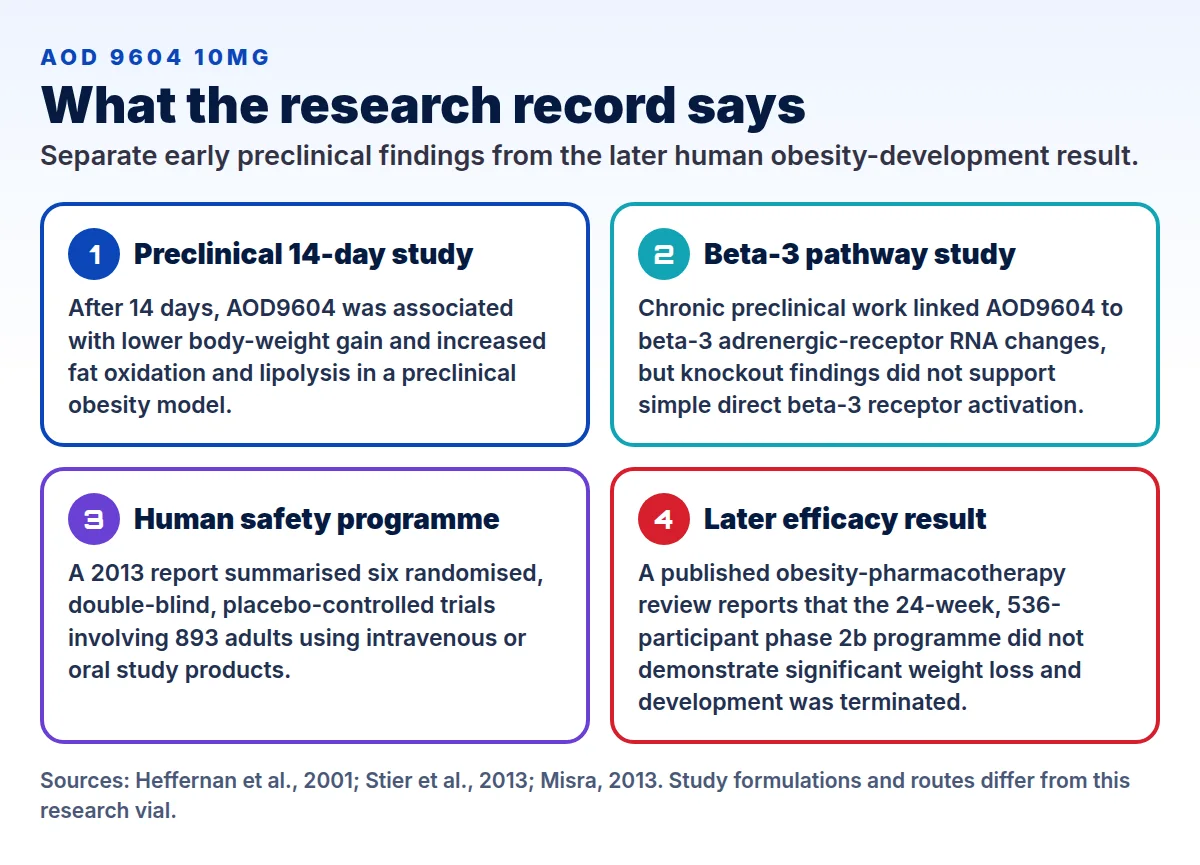
Published preclinical studies examined fat oxidation, lipolysis, body-weight gain, body-fat measures and beta-3 adrenergic-pathway signals. In 14-day obesity-model studies, AOD9604 was associated with lower body-weight gain and greater fat oxidation. Those findings are preclinical results, not human outcomes for this vial.
What the human development record found
A 2013 paper summarised six randomised, double-blind, placebo-controlled AOD9604 studies involving 893 adults using intravenous or oral study products. A later obesity-pharmacotherapy review reports that a 24-week, 536-participant phase 2b programme did not demonstrate significant weight loss, and the obesity programme was terminated.
This format uses supplied acidic solution
This AOD 9604 10mg format must be mixed with the supplied acidic solution, not a substitute solvent. One 3 mL acidic-solution vial is supplied with each AOD 9604 vial. The 1, 2 and 3 mL charts below are concentration calculations within that supplied volume.
What the 10mg label means
10mg is the labelled total amount of lyophilised AOD 9604 in the vial. With 2 mL of supplied acidic solution, the label maths is 5 mg/mL; 1 mg corresponds to 20 units on a U-100 syringe.
Independent test for this submitted sample
LabDoc report LD-9KXJ, tested 2 October 2026, records AOD-9604 identity confirmed by LC-MS, 98.96% purity by HPLC and 9.13mg content by HPLC against a 10mg label claim. The sample was received 9 September 2026 and the reported overall assessment is Pass.
Research-only and regulatory position
AOD 9604 is not an FDA-approved medicine. The Australian ARTG search reviewed for this guide did not show an AOD 9604 medicine entry. FDA also identifies safety-information gaps and peptide-characterisation concerns for certain compounded AOD-9604 products. This material is supplied for in-vitro research only.
AOD 9604 is a lab-made, modified peptide based on the C-terminal region of human growth hormone. It is also written AOD-9604 or AOD9604 and has historical research names Tyr-hGH 177-191 and LAT8881. The name Anti-Obesity Drug 9604 describes its development history, not an approved use.
The peptide has 16 amino acids. Its first residue is an added tyrosine, which is why its sequence begins with Y, and its two cysteines form a disulphide link. Full-length human growth hormone contains 191 amino acids. That difference matters: AOD 9604 is not hGH in a smaller vial, and hGH research should not be transferred to it.
This page separates three things that searches often mix together: the compound’s published research background, the labelled 10mg vial and the tested sample’s LabDoc results. Peak Peptides Australia supplies AOD 9604 10mg for in-vitro research only.
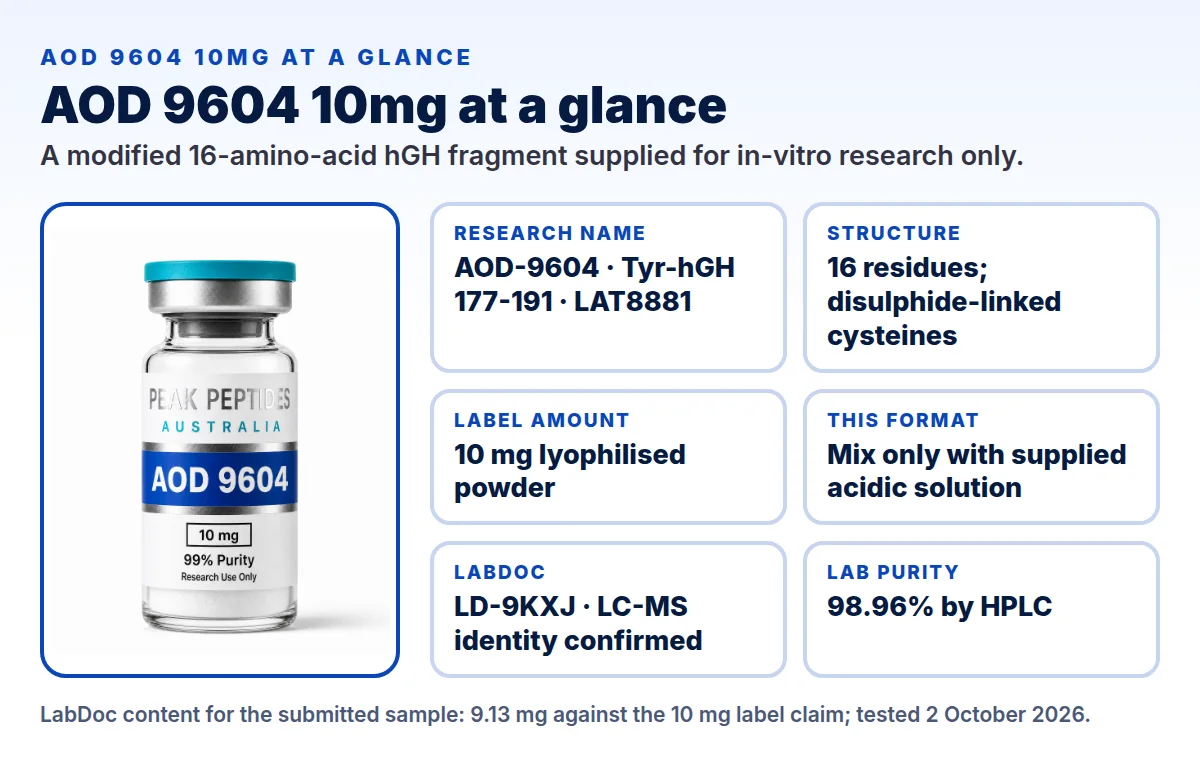
AOD 9604 10mg at a glance: the molecule, supplied acidic-solution format and submitted-sample lab record.
AOD 9604 structure and sequence
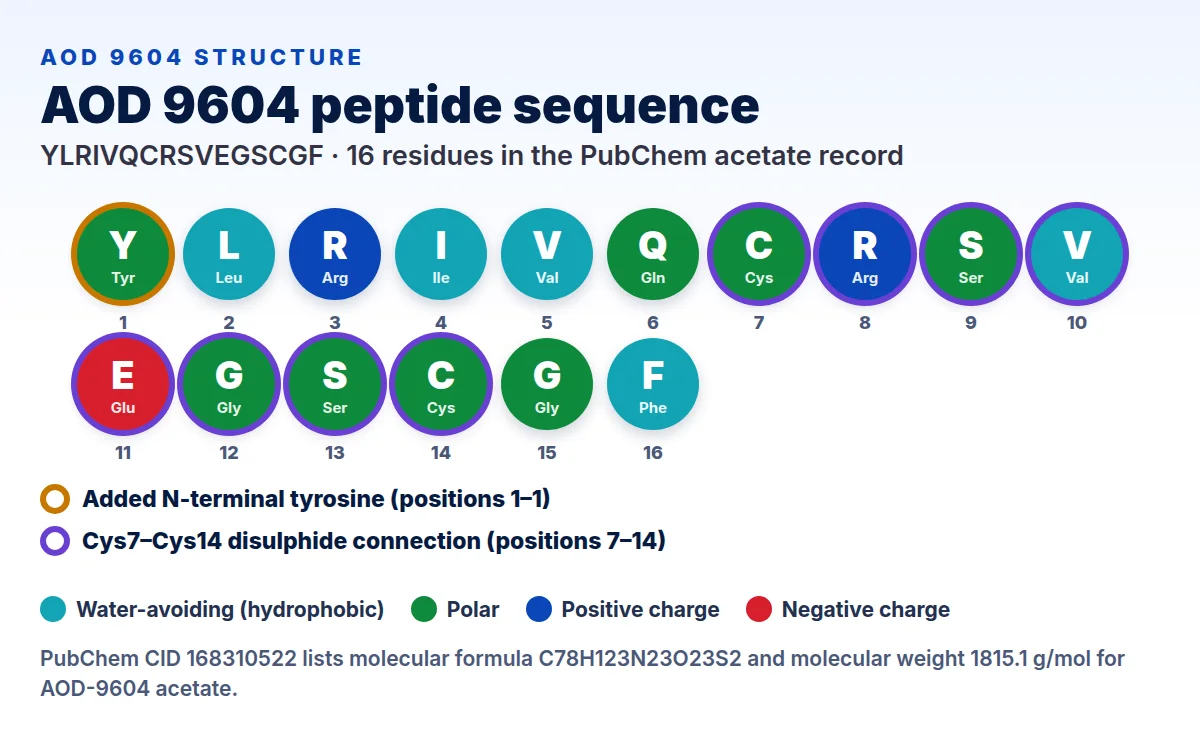
AOD 9604 is a peptide: a short chain built from amino acids. PubChem’s AOD-9604 acetate record gives the one-letter sequence YLRIVQCRSVEGSCGF. In plain English, the molecule begins with tyrosine, then contains leucine, arginine, isoleucine, valine and the remaining residues shown in the sequence diagram.
The modified fragment covers the hGH 177-191 region with an extra N-terminal tyrosine. The cysteine at position 7 is connected to the cysteine at position 14 by a disulphide bond. That link folds the chain into a loop and is part of the described AOD9604 structure.
PubChem lists a molecular formula of C78H123N23O23S2 and a molecular weight of 1815.1 g/mol for AOD-9604 acetate. A chemical record identifies a compound entry; it does not replace a report on the contents of a specific vial. That is why the LabDoc identity, purity and content results are presented separately below.
The 16-residue sequence listed in the PubChem AOD-9604 acetate record.
How AOD 9604 research models work
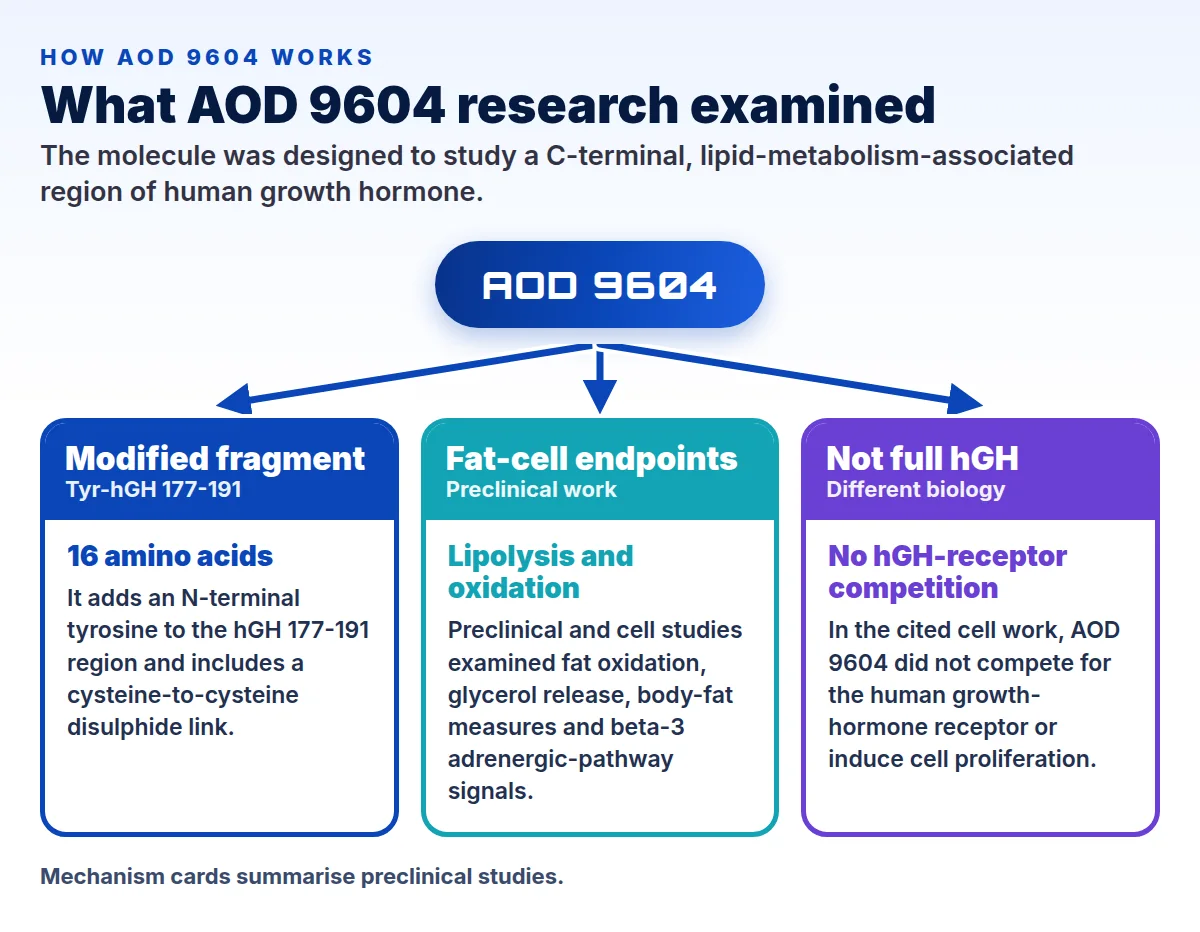
AOD 9604 research began with a question about the C-terminal region of hGH: could that region be studied apart from the growth-promoting activity associated with the complete hormone? Researchers examined lipid-metabolism-related endpoints rather than treating AOD 9604 as identical to full-length hGH.
The published work measured fat oxidation, glycerol release, lipolysis, body-weight gain, body-fat measures and beta-3 adrenergic-pathway signals. Lipolysis means the breakdown of stored fats. Fat oxidation means using fat-derived fuel in energy metabolism. These are measurable laboratory endpoints, not a guarantee of a human result.
A key comparison study found that AOD9604 did not compete for the hGH receptor and did not induce cell proliferation in the tested hGH-receptor cell system. In a separate beta-3 knockout experiment, effects on energy expenditure and fat oxidation were still seen, which is why a simple claim that it directly switches on beta-3 receptors is not accurate.
AOD 9604 research focused on a modified hGH fragment and preclinical lipid-metabolism endpoints.
What did AOD 9604 research find?
AOD9604 has a mixed research history. The early preclinical papers reported changes in lipid-related and body-composition endpoints. In one 14-day comparison study, AOD9604 reduced body-weight gain in obese models and was associated with increased fat oxidation and plasma glycerol, an index of lipolysis. In the same paper, it did not compete for the hGH receptor in the described cell assay.
A second 14-day chronic study reported reductions in body weight and body fat in obese models, alongside increased beta-3 adrenergic-receptor RNA expression. The knockout findings showed that the lipolytic actions were not explained by direct beta-3 receptor activation alone. These two studies are useful for understanding what was measured in preclinical research; neither is a human efficacy trial.
Human development used different formulations and routes. The safety publication describes six randomised, double-blind, placebo-controlled studies from 2001 to 2006, with 893 adults and intravenous or oral study products. It reported no treatment-related serious adverse event or withdrawal in those studies. The later phase 2b obesity-development result is also essential: the 24-week, 536-participant programme did not demonstrate significant weight loss, and the programme was terminated.
The research record in context: early preclinical findings, historical human safety studies and the later phase 2b efficacy result.
Selected AOD 9604 research record
Selected AOD 9604 research record
Study type
What was examined
Reported finding
How to read it
Heffernan et al., 2001
14-day obesity-model and cell comparison
Lower body-weight gain, more fat oxidation and glycerol; no hGH-receptor competition in the cell assay
Preclinical and cell evidence
Heffernan et al., 2001
14-day chronic obesity-model and beta-3 knockout work
Body-weight and body-fat changes; beta-3 RNA findings; no simple direct beta-3 explanation
Preclinical mechanism evidence
Stier et al., 2013
Six randomised, double-blind human safety studies; 893 adults
No treatment-related serious adverse event or withdrawal reported; IV and oral study products
Historical safety record for those formulations and routes
Did not demonstrate significant weight loss; programme terminated
Human efficacy-development result
The human study products and routes described in the papers are not the same as this lyophilised research vial with supplied acidic solution.
AOD 9604 vs full-length human growth hormone
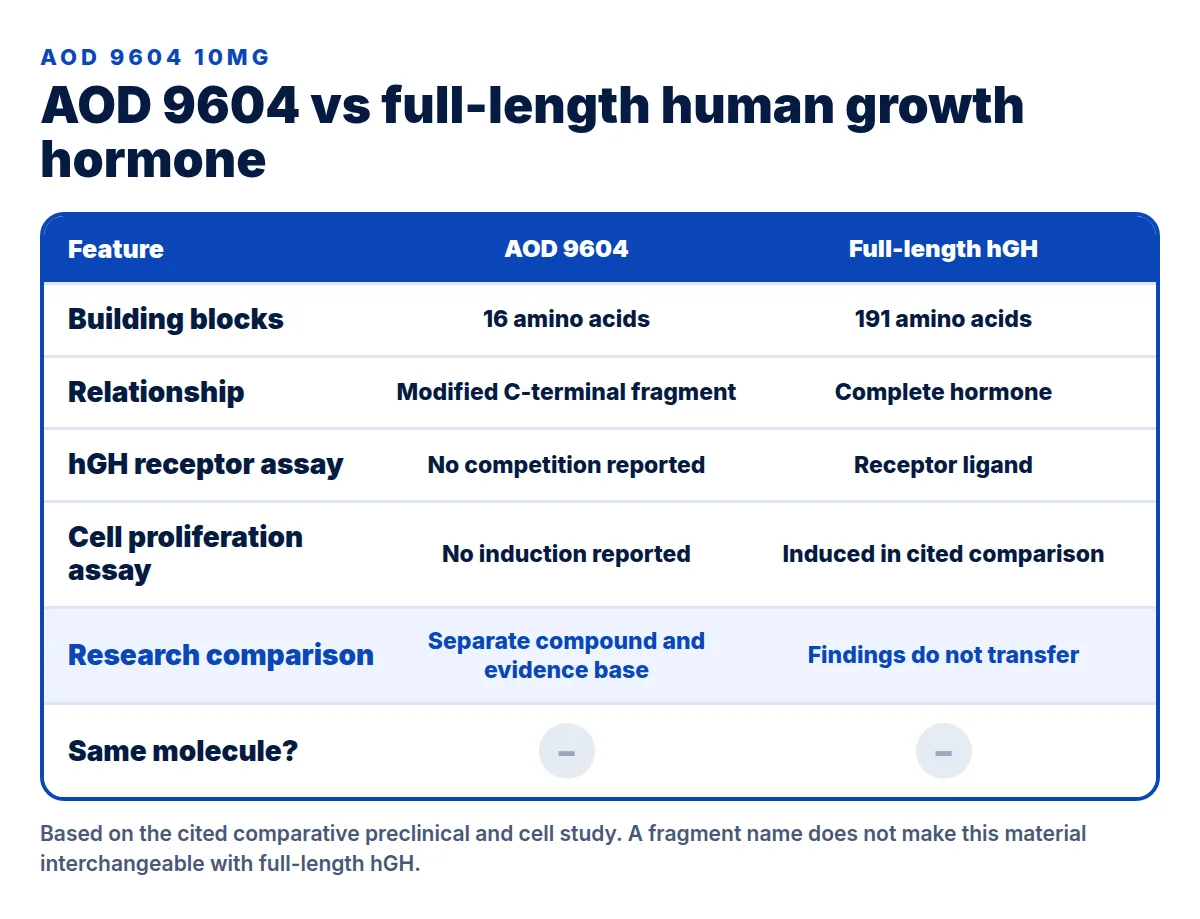
AOD 9604 and full-length human growth hormone are related by sequence history, but they are not the same molecule. Full-length hGH is a 191-amino-acid hormone. AOD 9604 is a 16-amino-acid modified fragment made from the C-terminal 177-191 region plus an added tyrosine.
That structural difference is visible in the research. The cited comparison paper reported that AOD9604 did not compete for the hGH receptor and did not cause cell proliferation in the tested hGH-receptor assay. Full-length hGH was the comparison compound in those experiments. AOD 9604 should therefore not be described as an abbreviated form of hGH activity.
Full-length hGH and AOD 9604 are different compounds. The product-specific LabDoc report covers the tested vial sample.
AOD 9604 is a modified 16-residue fragment, not full-length 191-residue hGH.
Independent lab test and AOD 9604 in Australia
The sample-specific record for this listing is LabDoc LD-9KXJ. The report records a submitted AOD-9604 lyophilised-powder vial with a 10mg label claim. It was received on 9 September 2026 and tested on 2 October 2026. LC-MS identity was confirmed, HPLC purity was 98.96%, HPLC content was 9.13mg and the report’s overall assessment was Pass. The batch is stated as not stated.
These are separate analytical questions. LC-MS checks molecular identity. HPLC purity measures the proportion reported as the target material in the tested sample. HPLC content measures the amount reported in the submitted vial. Together they provide more useful sample evidence than a label alone.
AOD 9604 is not an FDA-approved medicine. The Australian Register of Therapeutic Goods is the TGA register of medicines and other therapeutic goods that can be supplied within Australia; the AOD 9604 search reviewed for this guide did not show an AOD 9604 medicine entry. FDA also lists safety-information and peptide-characterisation concerns for certain compounded AOD-9604 products. Peak Peptides Australia supplies this material for in-vitro research only.
For Australian dispatch, in-stock orders receive same-day dispatch from Victoria once payment is confirmed, tracked Australia Post Express, and a tracking number is emailed. That shipping information describes dispatch only; it does not change the research-only status of the material.
Report ID: LD-9KXJ.
Identity: confirmed by LC-MS.
Purity: 98.96% by HPLC.
Content: 9.13mg by HPLC against a 10mg label claim.
Test date: 2 October 2026.
Scope: submitted sample only.
Step-by-step guide · About 10 minutes
How to reconstitute AOD 9604 10mg with supplied acidic solution
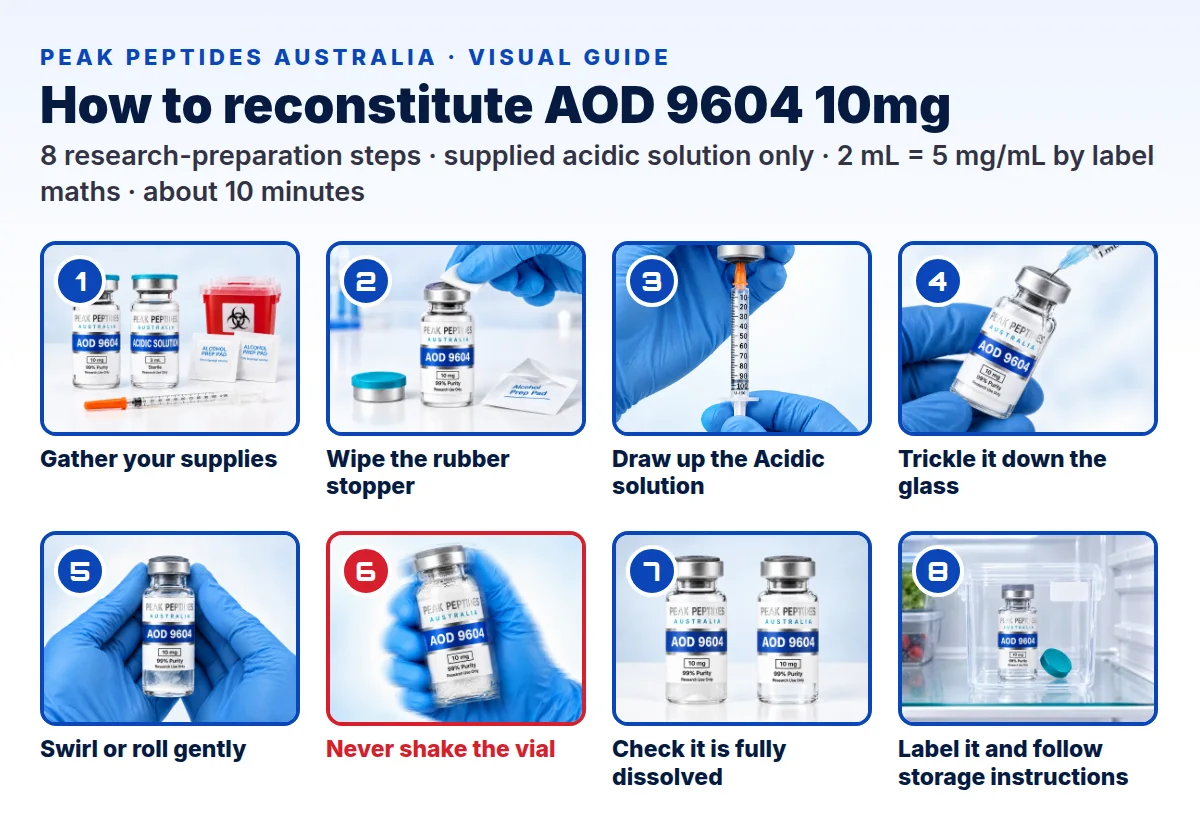
AOD 9604 10mg arrives as a dry, lyophilised powder. For this product format, reconstitution means adding only the supplied acidic solution so the powder becomes a clear liquid for research measurement. The supplied acidic-solution vial contains 3 mL. The 2 mL chart is highlighted because its label maths is simple: 5 mg/mL, or 20 U-100 units for 1 mg. These are concentration calculations, not dosing advice. Follow the eight visual steps, use clean equipment and use the supplied solution rather than substituting another solvent.
AOD 9604 10mg research preparation at a glance: supplied acidic solution only, then gentle handling and a clear-liquid check.
What you need
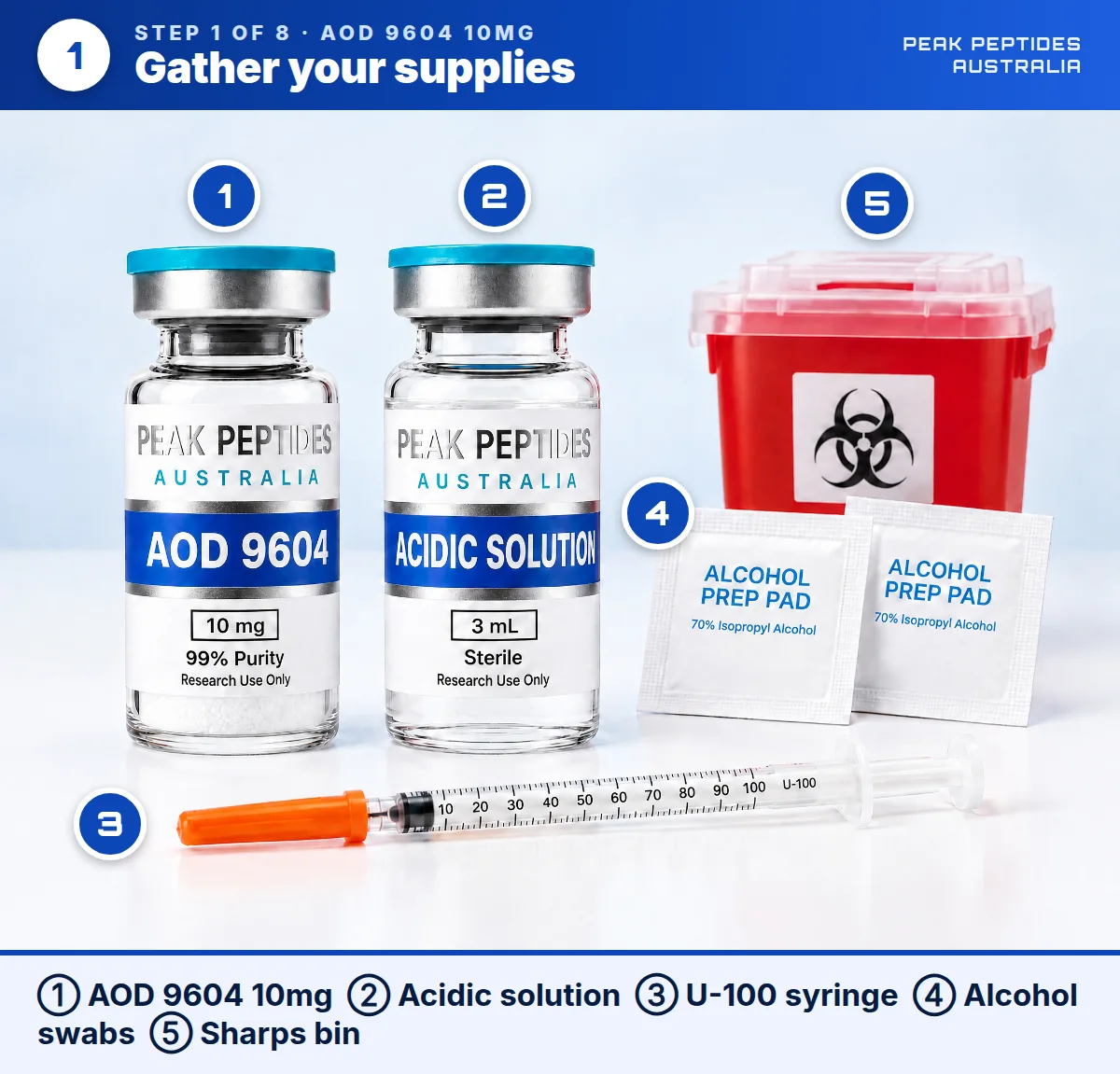
AOD 9604 10mg vialLyophilised powder in a sealed glass vial.
Supplied acidic solutionProduct-specific solution supplied in a 3 mL vial; use only this supplied solution for this AOD 9604 format.
1 mL U-100 syringe100 units equals 1 mL. A new syringe provides the measured liquid volume.
Alcohol swabsFor cleaning both rubber stoppers before drawing or transferring liquid.
Sharps containerFor disposal of used needles and syringes.
How much acidic solution for AOD 9604 10mg?
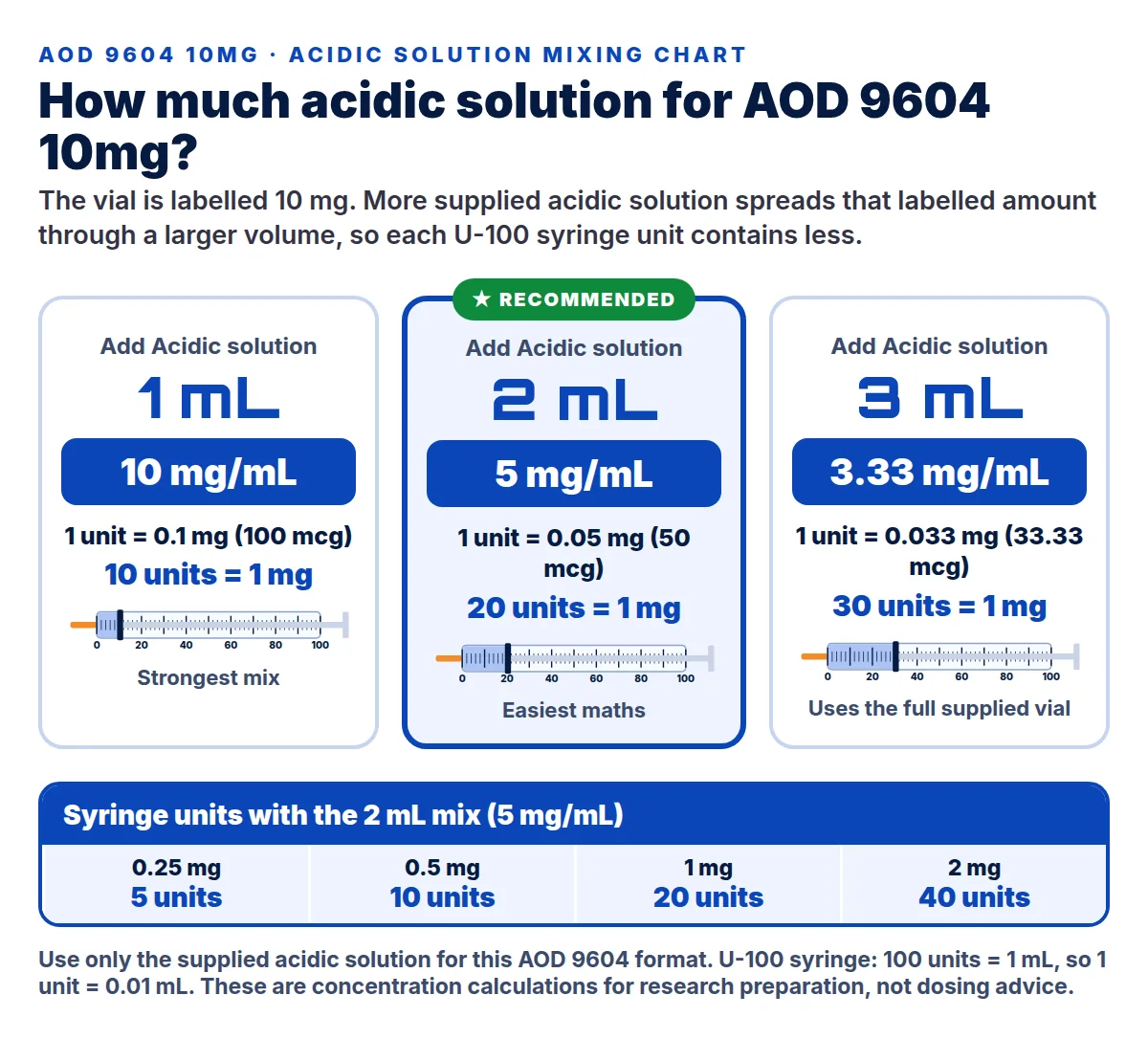
This chart uses the 10mg vial label amount and only the supplied acidic solution. Adding 1 mL gives 10 mg/mL, adding 2 mL gives 5 mg/mL, and adding the full supplied 3 mL gives 3.33 mg/mL. The labelled amount does not change; the final liquid volume changes the concentration.
The 2 mL option gives the simplest arithmetic: one U-100 unit equals 0.05 mg (50 mcg), 10 units equals 0.5 mg and 20 units equals 1 mg. With 1 mL, 10 units equals 1 mg. With 3 mL, 30 units equals 1 mg. These figures match the chart and are concentration calculations for research preparation.
The supplied acidic-solution vial holds 3 mL, so 3 mL is the maximum shown for the supplied format. Do not treat a chart for another product, another peptide or another solvent as interchangeable with this AOD 9604 format.
AOD 9604 10mg concentration chart using supplied acidic solution only; 2 mL gives 5 mg/mL by label maths.
2 mL is highlighted because it gives the simplest numbers.
Syringe units with the 2 mL mix (5 mg/mL)
Syringe units with the 2 mL mix (5 mg/mL)
Amount
Units on a U-100 syringe
Volume
0.25 mg
5 units
0.05 mL
0.5 mg
10 units
0.1 mL
1 mg
20 units
0.2 mL
2 mg
40 units
0.4 mL
The 8 steps
1Step 1: Gather your supplies
Place the AOD 9604 10mg vial, the supplied acidic-solution vial, a new 1 mL U-100 syringe, alcohol swabs and a sharps container on a clean working surface. Check that the acidic solution is the supplied 3 mL product-specific vial before preparing any concentration. Do not substitute another solvent.
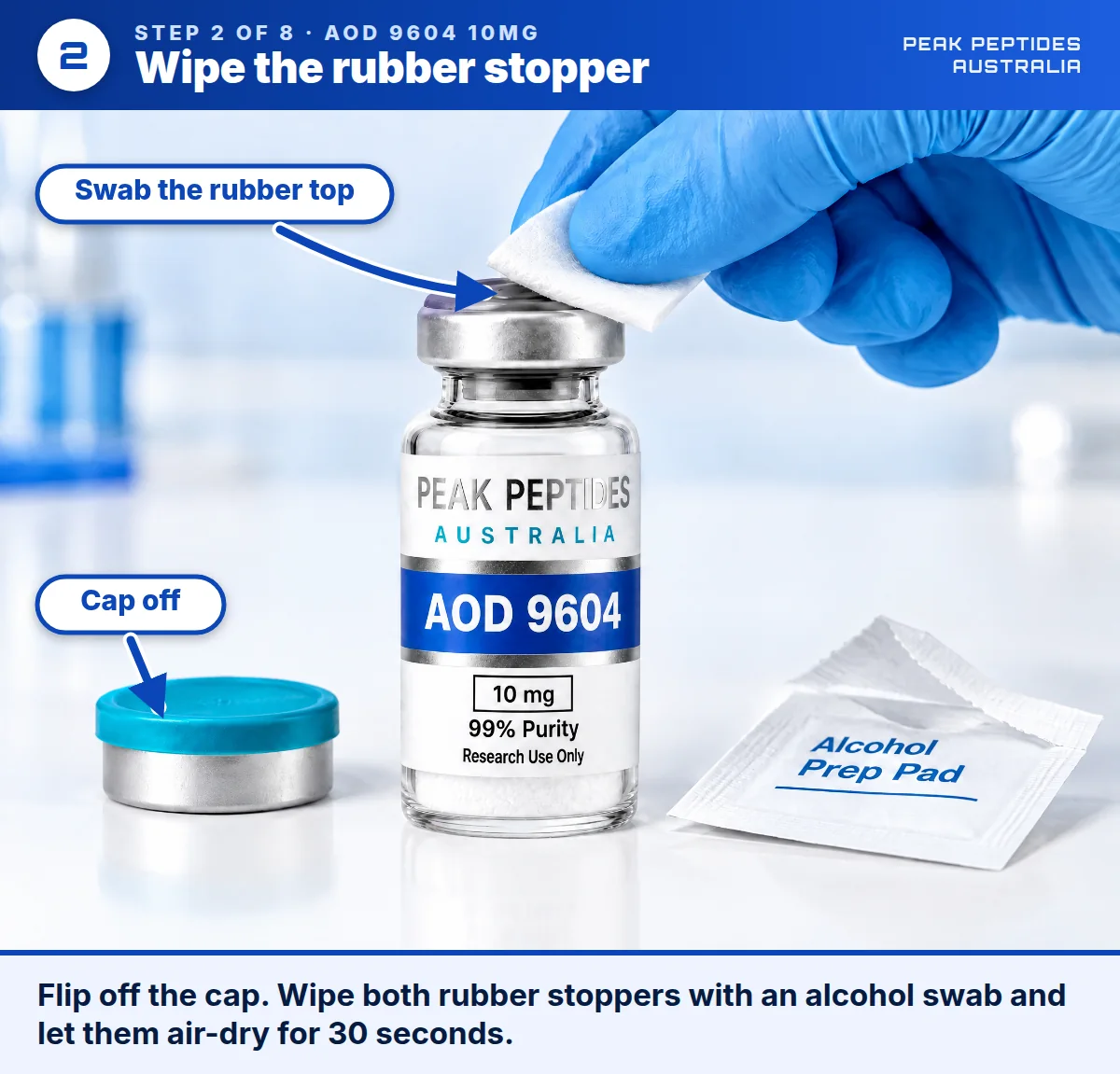
2Step 2: Wipe the rubber stopper
Remove the flip-off caps from the AOD 9604 vial and the supplied acidic-solution vial. Wipe each rubber stopper with a fresh alcohol swab and allow it to air-dry for about 30 seconds. Keep fingers away from the cleaned stoppers once they are dry.
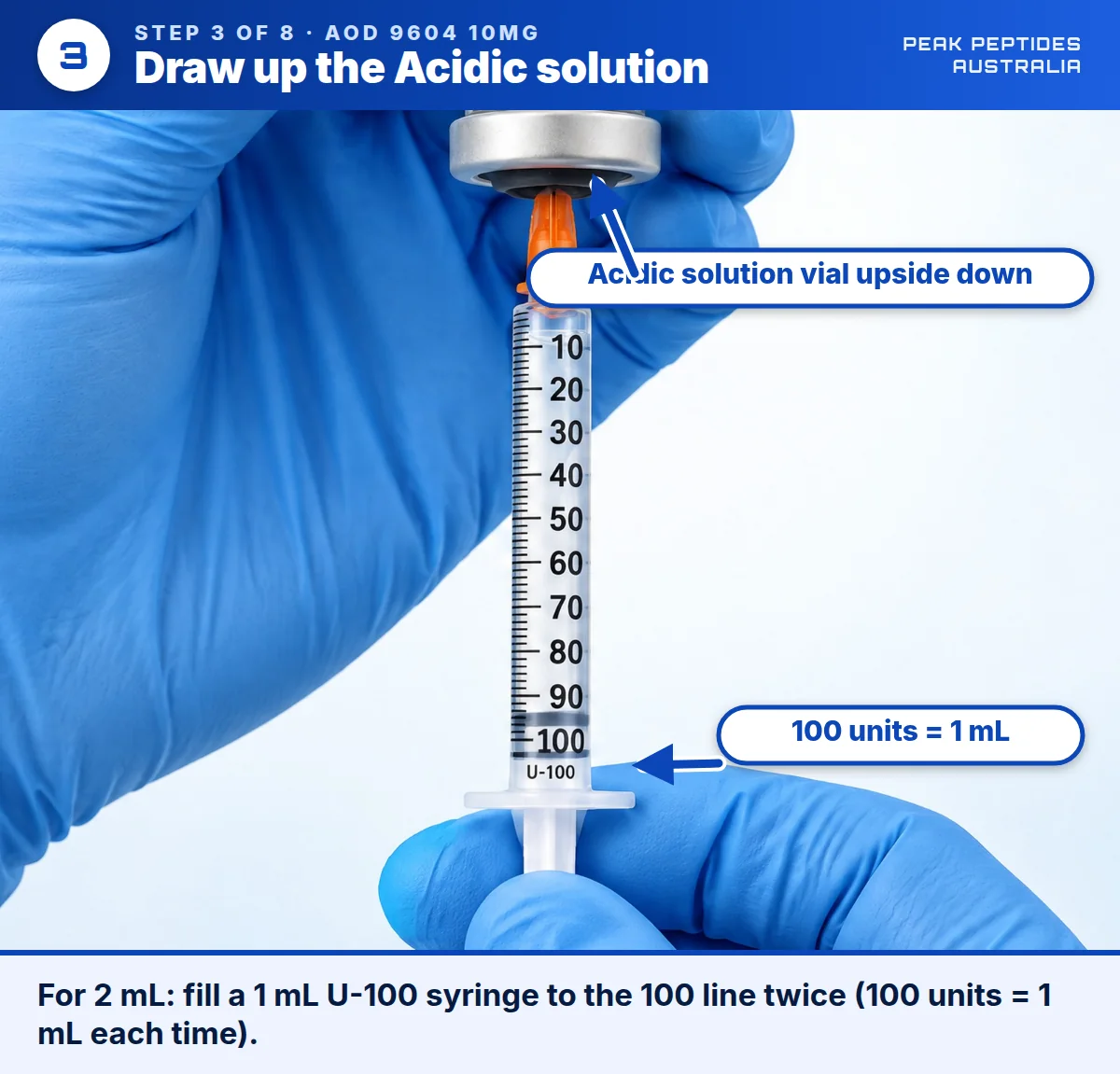
3Step 3: Draw up the Acidic solution
Use a new U-100 syringe to measure the supplied acidic solution. A U-100 syringe holds 1 mL at the 100-unit line. For the highlighted 2 mL concentration, measure 1 mL twice. Keep the drawn volume aligned with the concentration chart you selected.
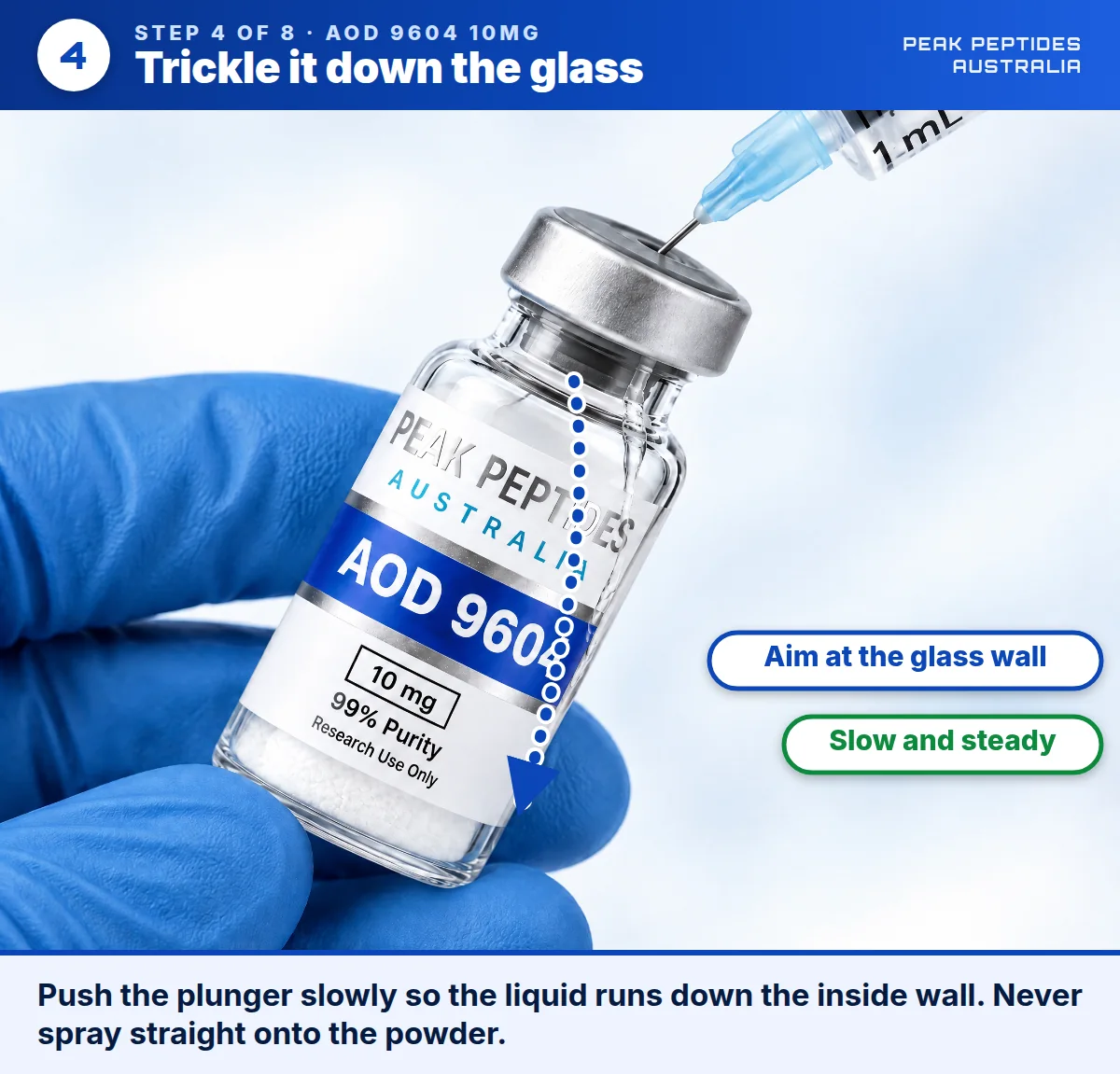
4Step 4: Trickle it down the glass
Pierce the AOD 9604 stopper and direct the needle tip towards the inside wall of the glass vial. Press the plunger slowly so the acidic solution runs down the wall rather than striking the lyophilised powder directly. Repeat the measured transfer until the chosen final volume is reached.
5Step 5: Swirl or roll gently
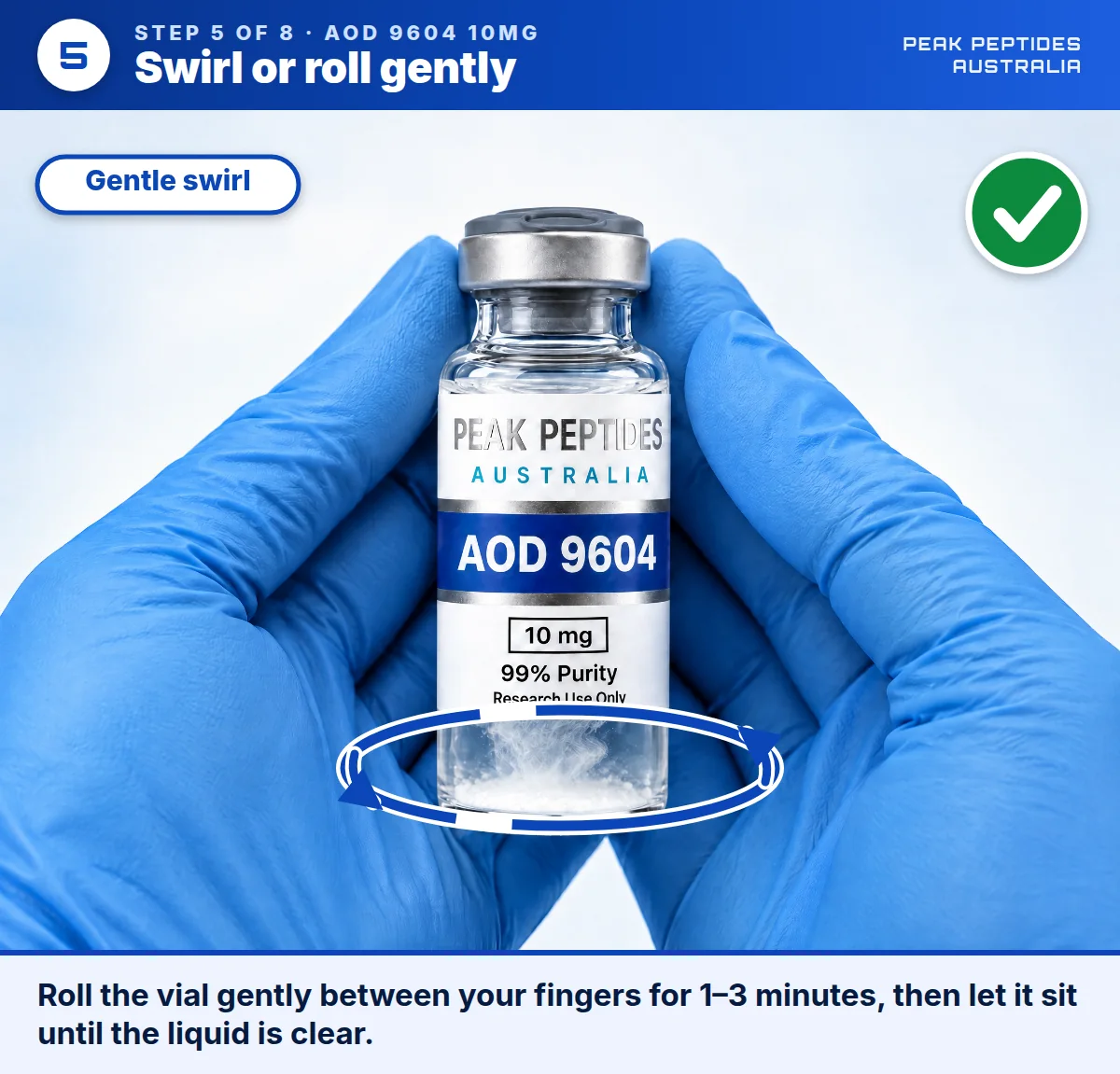
Gently swirl the AOD 9604 vial in slow circles or roll it carefully between fingers. The aim is to bring the liquid and powder together without creating foam. A small amount of powder can remain at first; allow time for it to dissolve before deciding whether the preparation is clear.
6Step 6: Never shake the vial
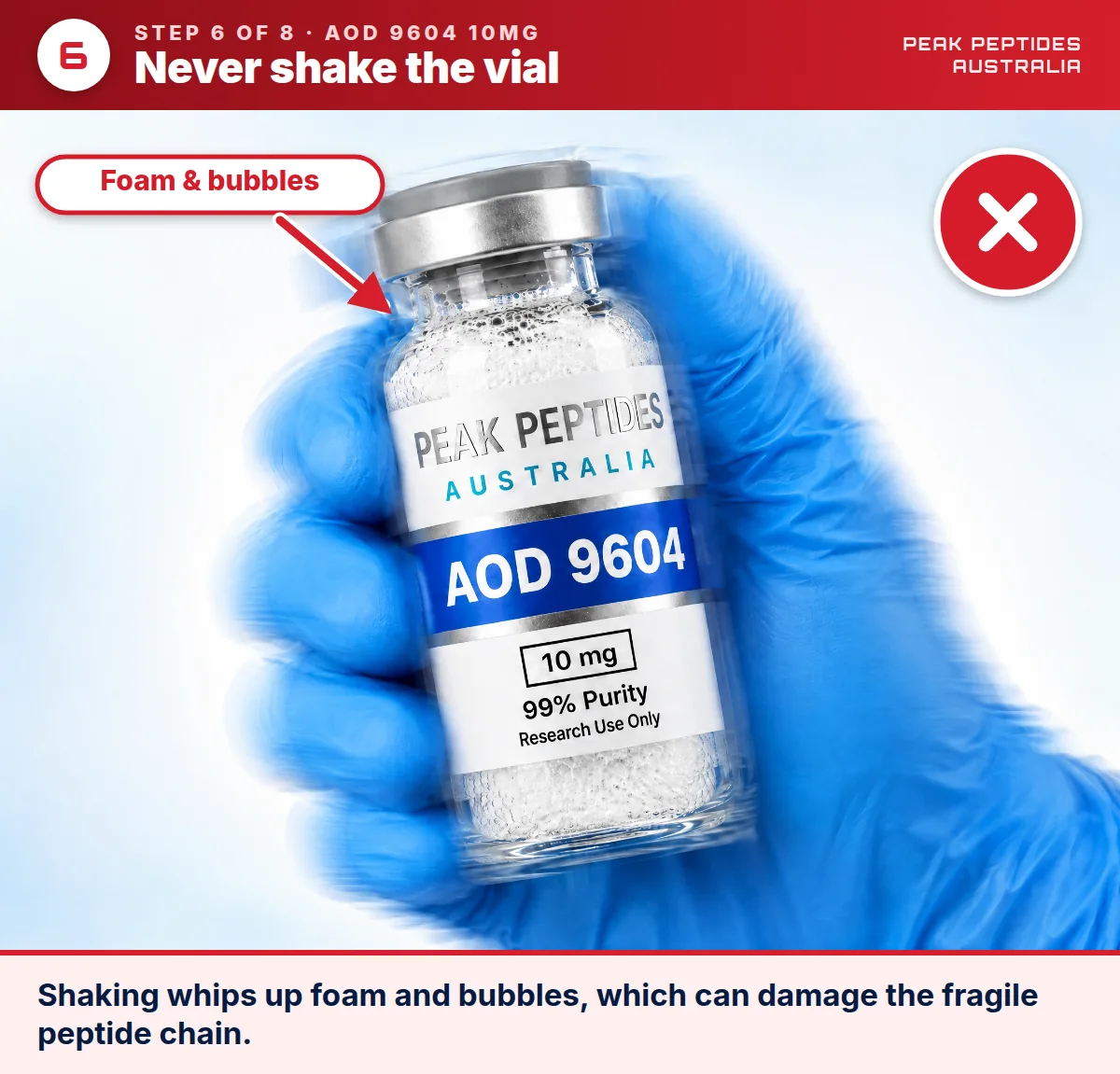
Do not shake the vial. Shaking creates foam and bubbles, which makes it harder to inspect the liquid and can stress a peptide preparation. If foam appears, stand the vial upright and allow the bubbles to settle before continuing the clarity check.
7Step 7: Check it is fully dissolved
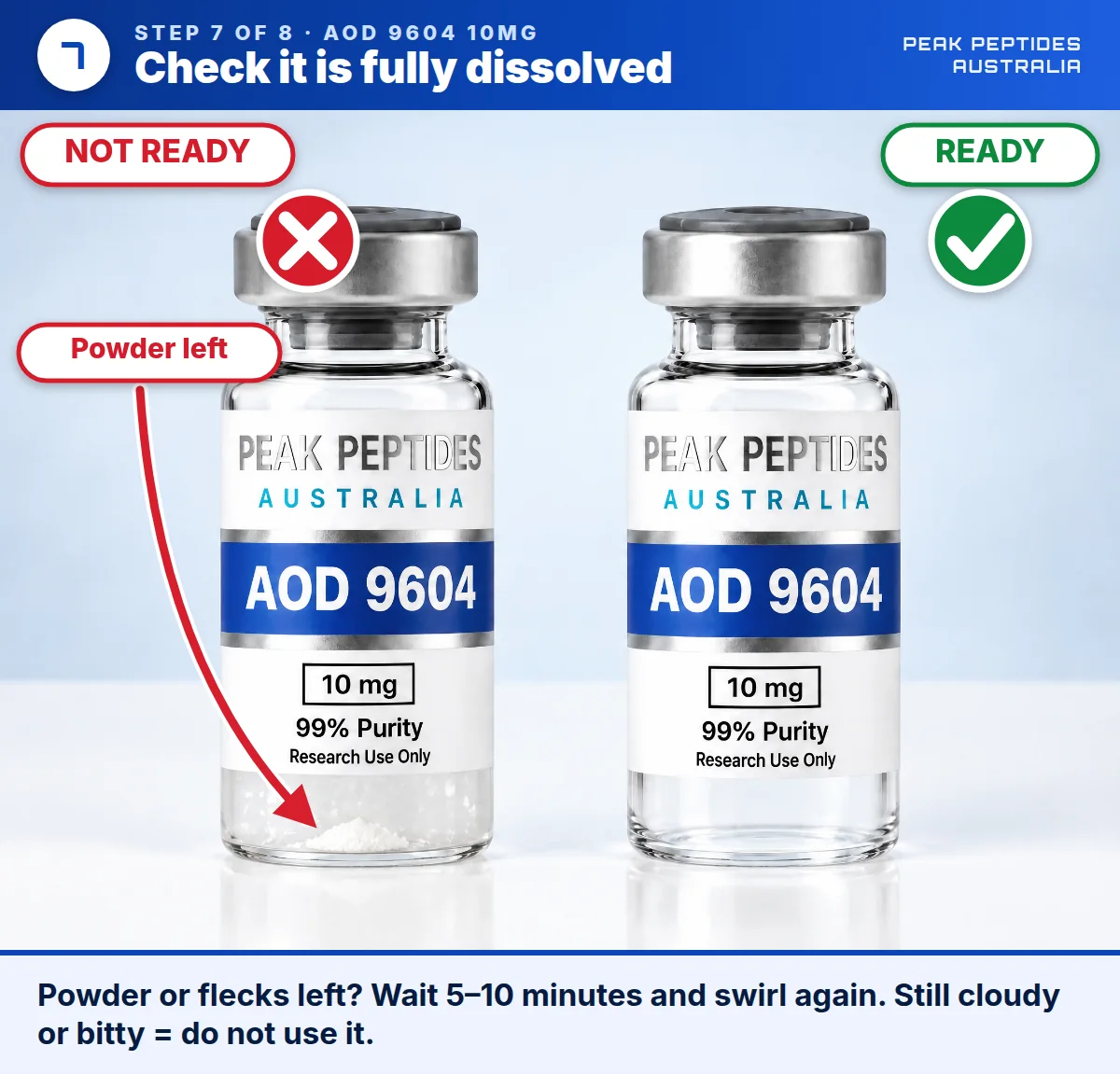
Hold the vial up to good light and look for remaining powder, flecks or cloudiness. The ready comparison is a clear liquid without visible particles. If powder remains, let the vial stand for 5 to 10 minutes and swirl gently again. Do not treat a cloudy preparation as fully dissolved.
8Step 8: Label it and follow storage instructions
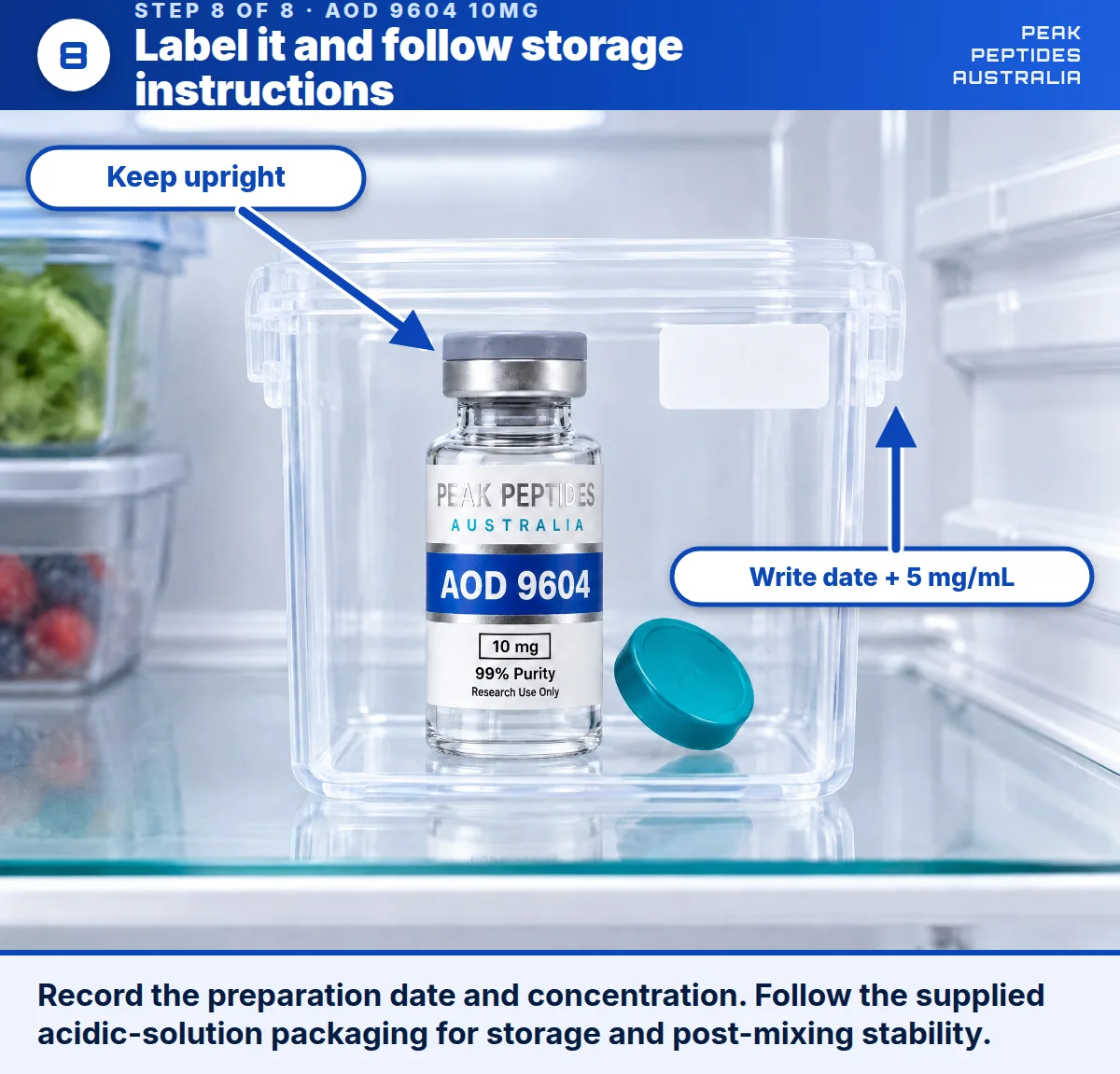
Record the preparation date and the calculated concentration on the vial or container, such as 5 mg/mL for the highlighted 2 mL chart. Follow the storage and post-mixing stability directions on the supplied acidic-solution packaging.
How to store AOD 9604
AOD 9604 storage guide
AOD 9604 storage guide
Form
Where to keep it
How long
Unopened AOD 9604 powder
Fridge, 2–8 °C, in the dark (freezer −20 °C for long-term)
Until the printed expiry
Supplied 3 mL acidic solution
Sealed, cool and dark, as printed on its vial
Until the printed expiry
Mixed with the acidic solution
Fridge, 2–8 °C, upright and away from light
Write the mixing date on the vial; never freeze
LabDoc LD-9KXJ
Identity, purity and content result for the tested sample
See the LabDoc section above
Mix AOD 9604 only with the supplied acidic solution, not BAC water. Light and heat break peptides down faster, so keep the vial in a closed box in the fridge, not in the door.
AOD 9604 is a modified 16-amino-acid peptide based on the C-terminal 177-191 region of human growth hormone. It is also called AOD-9604, AOD9604, Tyr-hGH 177-191 and LAT8881. It is a fragment research compound, not full-length human growth hormone.
What is AOD 9604 also called?
AOD 9604 is commonly written as AOD-9604, AOD9604, Tyr-hGH 177-191, hGH fragment 177-191 and LAT8881. The names refer to the same research peptide family. They do not make it interchangeable with full-length hGH or another hGH-derived fragment.
Is AOD 9604 the same as human growth hormone?
No. AOD 9604 is a 16-amino-acid modified C-terminal fragment, while full-length human growth hormone is a 191-amino-acid hormone. In the cited comparison work, AOD9604 did not compete for the hGH receptor or induce cell proliferation in the way tested for full-length hGH.
What is AOD 9604 used for in research?
AOD 9604 research examined lipid metabolism, lipolysis, fat oxidation, body-fat measures and body-weight gain in preclinical models. Historical human development work examined obesity using oral and intravenous study products. This 10mg listing is supplied for in-vitro research only.
How does AOD 9604 work in research models?
The research rationale focused on a C-terminal region of hGH associated with lipid metabolism. Preclinical work measured fat oxidation, glycerol release, beta-3 adrenergic-pathway signals and body-fat endpoints. The published knockout findings show the explanation is more complex than simple direct beta-3 receptor activation.
What did preclinical AOD 9604 studies find?
In published 14-day obesity-model studies, AOD9604 was associated with lower body-weight gain, higher fat oxidation and increased lipolysis. Another study linked chronic exposure with beta-3 adrenergic-receptor RNA changes. These are preclinical findings and are not human efficacy results.
What did human AOD 9604 studies find?
A 2013 paper summarised six randomised, double-blind, placebo-controlled studies involving 893 adults. Those studies used intravenous or oral study products. A later 24-week phase 2b obesity programme involving 536 participants did not demonstrate significant weight loss, and development for that indication ended.
Does AOD 9604 research prove weight loss?
No. Preclinical work reported lipid-metabolism and body-weight findings, but the later 24-week phase 2b human obesity programme did not demonstrate significant weight loss. The published development history does not support a weight-loss claim for this research vial.
What side effects were reported in AOD 9604 studies?
The 2013 safety paper reports that the six historical trials found no treatment-related withdrawal or serious adverse event and describes tolerability as indistinguishable from placebo. Those results apply to the oral and intravenous study products and monitoring used in those trials, not to this research vial.
What is the AOD 9604 half-life?
This guide does not state a half-life because the opened authoritative sources did not provide a verified half-life that transfers to this supplied acidic-solution research format. The human studies reported in the literature used intravenous or oral study products, not this vial format.
What is the AOD 9604 sequence?
PubChem lists the AOD-9604 acetate sequence as YLRIVQCRSVEGSCGF. That is 16 amino acids. The first residue is the added N-terminal tyrosine, and the two cysteines are shown as a disulphide-linked pair in the published chemical record.
What are the AOD 9604 molecular formula and molecular weight?
PubChem lists AOD-9604 acetate as C78H123N23O23S2 with a molecular weight of 1815.1 g/mol. These chemical-record values identify the acetate entry. A product-specific lab report measures identity, purity and content.
Is AOD 9604 approved by the FDA or TGA?
AOD 9604 is not FDA-approved. The ARTG search reviewed for this guide did not show an AOD 9604 medicine entry, so it is not an approved Australian medicine. FDA’s compounding material also identifies limited safety information and peptide-characterisation concerns for certain compounded AOD-9604 products.
Can I buy AOD 9604 10mg online in Australia?
AOD 9604 10mg can be ordered online from Peak Peptides Australia when available. In-stock orders receive same-day dispatch from Victoria once payment is confirmed, tracked Australia Post Express, and a tracking number is emailed. The material is supplied for in-vitro research only.
How fast is AOD 9604 shipping in Australia?
In-stock orders receive same-day dispatch from Victoria once payment is confirmed. They are sent by tracked Australia Post Express, and the tracking number is emailed. Delivery timing after dispatch is determined by the carrier and destination.
How do I know an AOD 9604 sample is real?
Look for a report that identifies the tested sample, names the identity method, reports purity and content, gives a test date and can be checked at the issuing laboratory. This AOD 9604 10mg listing links to LabDoc report LD-9KXJ for the submitted sample.
What does LabDoc report LD-9KXJ show?
LabDoc LD-9KXJ records AOD-9604 identity confirmed by LC-MS, 98.96% purity by HPLC and 9.13mg content by HPLC against a 10mg label claim. The sample was received 9 September 2026 and tested 2 October 2026, with an overall assessment of Pass.
What does 10mg mean on an AOD 9604 vial?
The 10mg label is the stated total amount of lyophilised peptide in the vial. The submitted LabDoc sample measured 9.13mg by HPLC against that 10mg label claim.
What solution is used for this AOD 9604 10mg format?
This AOD 9604 10mg format must be mixed only with the supplied acidic solution. One 3 mL acidic-solution vial is supplied with each AOD 9604 vial. Do not substitute a different solvent, because the supplied format is product-specific.
How do I reconstitute AOD 9604 10mg?
Start with the AOD 9604 vial, supplied acidic solution, a new U-100 syringe, alcohol swabs and a sharps container. Wipe the rubber stoppers, add the supplied acidic solution slowly down the vial wall, swirl gently rather than shaking, and check that the liquid is clear before recording the preparation details.
How much acidic solution can I add to AOD 9604 10mg?
The supplied acidic-solution vial holds 3 mL. The chart on this page shows 1, 2 and 3 mL options. By label maths, 1 mL gives 10 mg/mL, 2 mL gives 5 mg/mL and 3 mL gives 3.33 mg/mL.
How many units is 1 mg of AOD 9604?
It depends on the final acidic-solution volume. With 1 mL, 1 mg equals 10 units on a U-100 syringe. With 2 mL, 1 mg equals 20 units. With 3 mL, 1 mg equals 30 units. These are volume-conversion calculations only.
How many mg are in 10 units of AOD 9604?
With the 2 mL mix, 10 units is 0.5 mg because the labelled concentration is 5 mg/mL. With 1 mL, 10 units is 1 mg. With 3 mL, 10 units is about 0.33 mg. These are concentration calculations, not dosing advice.
What if AOD 9604 powder does not dissolve?
Let the vial stand for 5 to 10 minutes, then swirl gently again. Do not shake the vial. If the liquid remains cloudy or contains visible particles after gentle mixing and standing, do not treat it as fully dissolved.
Should reconstituted AOD 9604 be cloudy?
No. The visual check in this guide is a clear liquid without remaining powder, flecks or cloudiness. Visible powder means the material is not fully dissolved. If cloudiness or particles remain after standing and gentle swirling, do not treat the preparation as clear.
How should AOD 9604 powder be stored before mixing?
Keep the unopened AOD 9604 vial in the fridge at 2–8 °C, in the dark, or in the freezer at −20 °C for long-term storage. Keep the supplied acidic-solution vial sealed with it.
How long does AOD 9604 last after mixing?
Keep mixed AOD 9604 upright in the fridge at 2–8 °C, away from light, and write the mixing date on the vial. Use it within the time printed on the supplied acidic-solution packaging.
Can a mixed AOD 9604 vial be frozen?
No. Never freeze a mixed AOD 9604 vial — freezing and thawing can break the peptide down. Keep it in the fridge at 2–8 °C instead.
What does an AOD 9604 certificate of analysis show?
A certificate of analysis records the methods and results for a tested sample. LabDoc LD-9KXJ reports LC-MS identity confirmation, 98.96% HPLC purity and 9.13mg HPLC content. A useful report also gives the test date and a verification link.
Does LabDoc LD-9KXJ prove sterility or stability?
No. LD-9KXJ measures identity, purity and content for the submitted AOD-9604 sample. Sterility and shelf life are checked with separate tests, not this report.