SLU-PP-332 5mg is a synthetic small-molecule pan-ERR agonist for in-vitro research — it is not a peptide. LabDoc LD-ZLZU confirmed its identity by LC-MS with 99.6% HPLC purity. It is dissolved in DMSO first, then diluted with BAC water. In-stock orders receive same-day dispatch from Victoria after payment confirmation, with tracked Australia Post Express shipping Australia-wide.
Product Specifications
Full NameSLU-PP-332 (ERR Agonist)
Vial Size5mg
Purity99.6% HPLC (LD-ZLZU, 4.63mg sample)
Legal Disclaimer
This product is sold strictly for in-vitro laboratory research purposes only. It is not intended for human or animal consumption, injection, or any diagnostic or therapeutic use.
Experimental small-molecule ERR research compound · Updated 24 October 2026
SLU-PP-332 5mg — What It Is, ERR Research & How to Mix It With DMSO and BAC Water
SLU-PP-332 is a synthetic small molecule that switches on the estrogen-related receptors ERRα, ERRβ and ERRγ. It is not a peptide, even though people often search for “SLU-PP-332 peptide”. Researchers call it an exercise mimetic: in cell and mouse studies it boosted mitochondrial function, built more oxidative (endurance-type) muscle fibres, raised energy expenditure and improved running endurance. This 5mg page explains what the molecule is, what the studies found, how it compares with SLU-PP-915 and MOTS-C, and what LabDoc LD-ZLZU measured in the tested sample. Because it is a small molecule, SLU-PP-332 will not dissolve in BAC water on its own: it is dissolved in DMSO first and then diluted with BAC water — the photo guide and mixing chart below show exactly how. Peak Peptides Australia supplies this material for in-vitro research only.
Also referred to in research or catalogue references as SLU PP 332, SLU PP-332, SLU-PP 332, SLUPP332, SLUPP-332, ERR pan agonist 332, ERR alpha beta gamma agonist, 303760-60-3, SLU PP 332 peptide.
SLU-PP-332 5mg at a glance
What it is
Synthetic small-molecule pan-ERR agonist — not a peptide
Named under S4.4 in the 2027 List, effective 1 January 2027
Dispatch
Same-day dispatch from Victoria for in-stock orders once payment is confirmed, tracked Australia Post Express, tracking number emailed
A small molecule, not a peptide
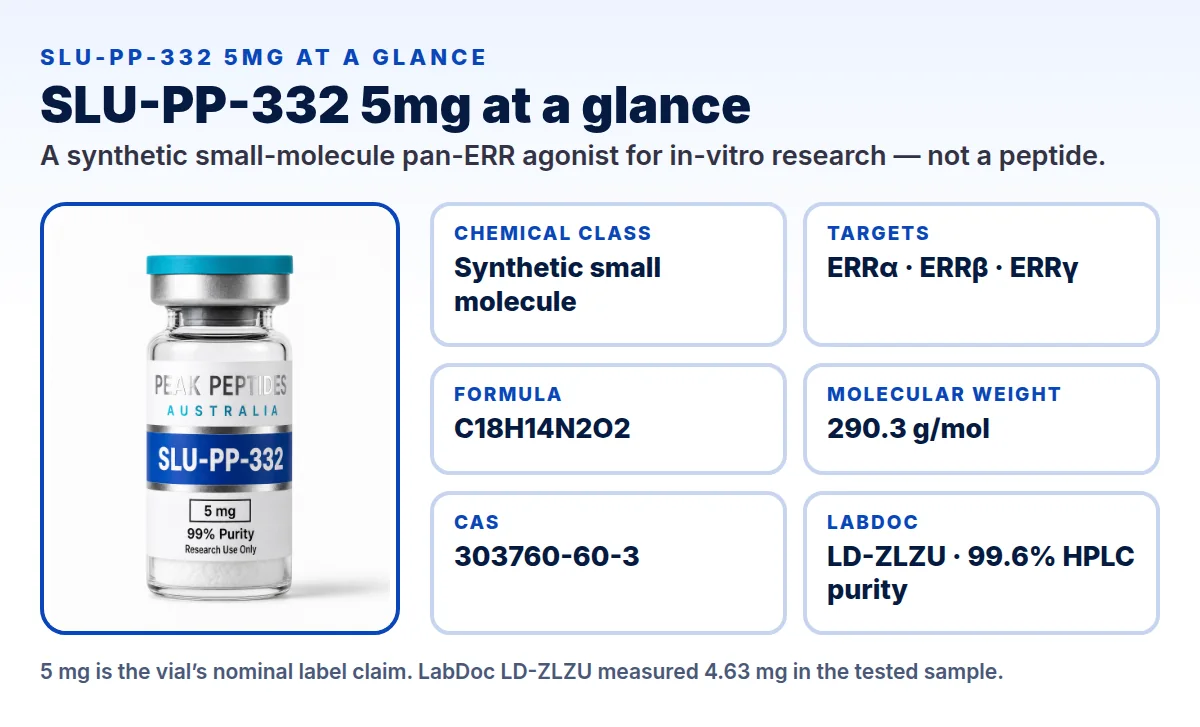
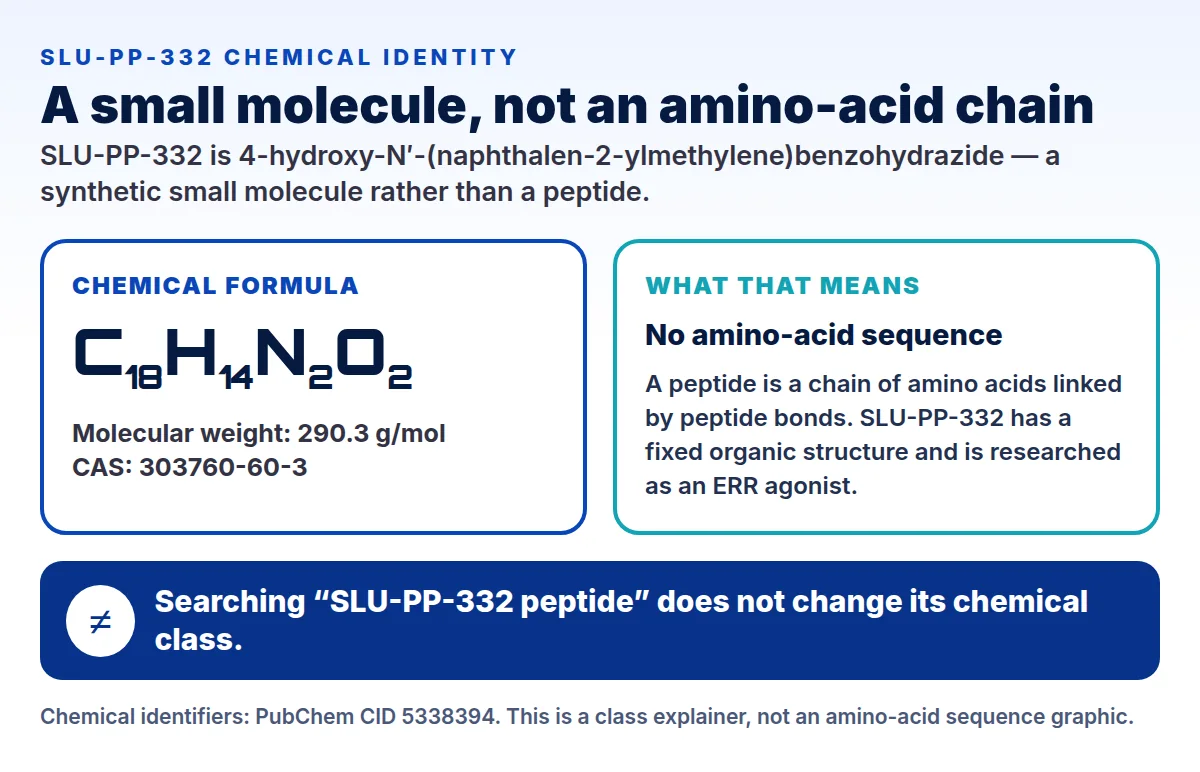
SLU-PP-332 is a synthetic small molecule. PubChem identifies it as 4-hydroxy-N′-(naphthalen-2-ylmethylene)benzohydrazide, with formula C18H14N2O2 and molecular weight 290.3 g/mol. It has no amino-acid sequence. The search phrase “SLU-PP-332 peptide” is common, but it is chemically inaccurate.
A pan-ERR agonist
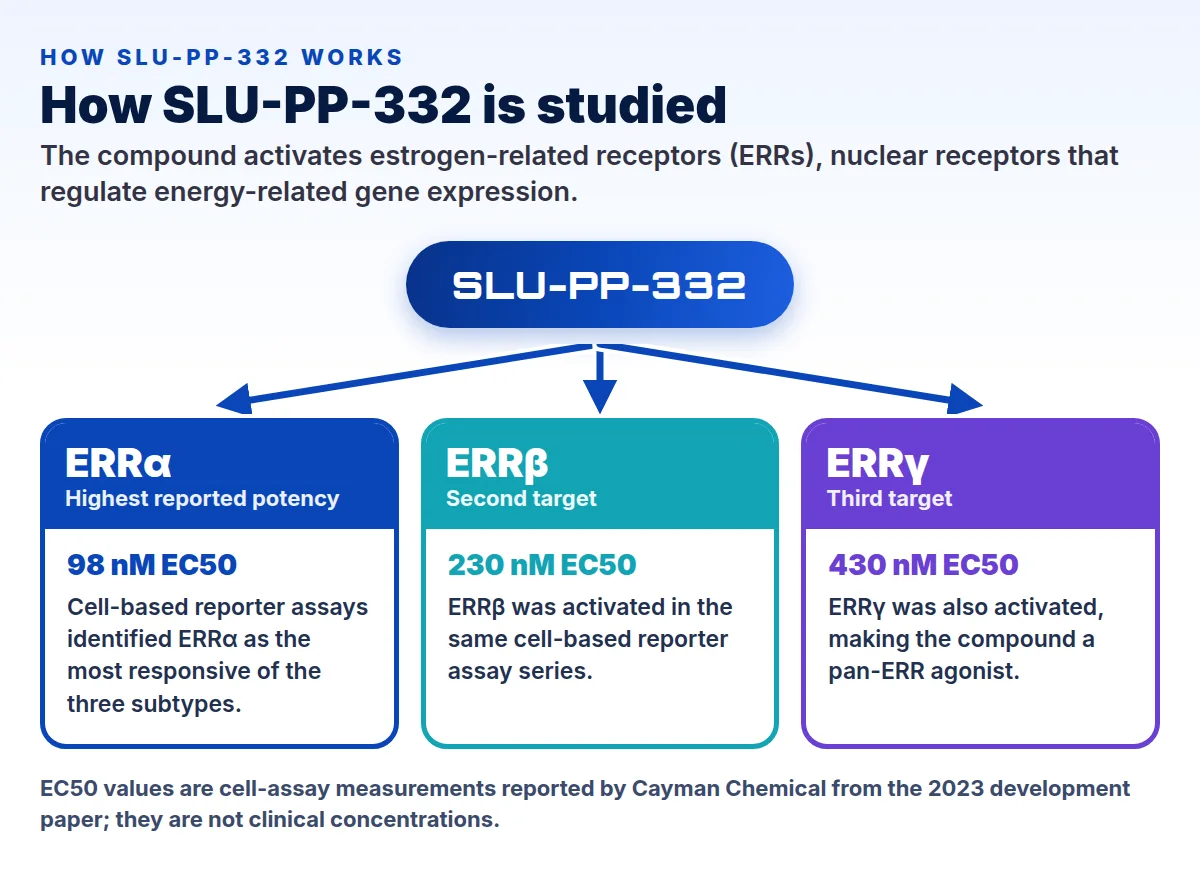
An agonist is a substance that activates a target. SLU-PP-332 activated ERRα, ERRβ and ERRγ in cell-based assays. Cayman Chemical reports EC50 values of 98 nM for ERRα, 230 nM for ERRβ and 430 nM for ERRγ, so ERRα had the highest reported potency in that assay series.
What “estrogen-related” means
ERR stands for estrogen-related receptor. These nuclear receptors are related in name and structure to estrogen receptors, but SLU-PP-332 is not estrogen, a steroid, a selective androgen receptor modulator or a selective estrogen receptor modulator. In this research area, ERRs are studied because they regulate energy-related gene expression.
Cell and mouse research findings
The 2023 development paper reported increased mitochondrial function and cellular respiration in a skeletal-muscle cell line. In mice, it reported more type IIa oxidative muscle fibres and greater exercise endurance. The authors found that ERRα activation was critical for the endurance finding in their model.
Model-specific metabolic findings
A 2024 study examined diet-induced obesity and ob/ob mouse models. It reported higher resting energy expenditure, greater fatty-acid oxidation and lower adiposity measures. The same paper reported no improvement in glucose metabolism in chow-fed mice. The model is part of the result, not a detail to drop.
DMSO first, then BAC water
SLU-PP-332 is oily (hydrophobic) and does not dissolve in water, so BAC water on its own leaves a cloudy suspension. Cayman Chemical lists it at 1–10 mg/mL in DMSO and 0.1–1 mg/mL in ethanol. The method that works is to dissolve it completely in DMSO, then dilute it slowly with BAC water.
What 5mg on the label means
The 5mg on the label is the amount of SLU-PP-332 powder in the vial. It only becomes a strength once you add liquid: 0.5 mL of DMSO followed by 1.5 mL of BAC water gives 2 mL at 2.5 mg/mL.
Independent tested-sample report
LabDoc report LD-ZLZU, tested 06 October 2026, recorded confirmed identity by LC-MS, 99.6% purity by HPLC and 4.63mg HPLC content against the 5mg claim. The report’s overall assessment is Pass. It names no batch identifier and says the results apply to the submitted sample only.
SLU-PP-332 is a synthetic small molecule made for research on estrogen-related receptors, usually shortened to ERRs. It is not a peptide. A peptide is a chain of amino acids; SLU-PP-332 has the fixed chemical formula C18H14N2O2 and a molecular weight of 290.3 g/mol.
The compound is also called ERR pan-Agonist 332 and has CAS number 303760-60-3. Its formal chemical name is 4-hydroxy-N′-(naphthalen-2-ylmethylene)benzohydrazide. The molecule is an organic hydrazide structure, not a sequence of biological building blocks.
That difference matters in practice. Peptides are mixed with BAC water alone, but SLU-PP-332 is an oily small molecule that will not dissolve in water. It is dissolved in DMSO first and then thinned with BAC water. It also has no amino-acid sequence, so peptide sequence charts do not apply to it.
SLU-PP-332 is a 290.3 g/mol synthetic small molecule that activates ERRα, ERRβ and ERRγ. It is not a peptide.
How does SLU-PP-332 work in research?
SLU-PP-332 is studied as a pan-ERR agonist. ERRs are nuclear receptors: proteins inside cells that help regulate which genes are switched on. In the cited work, the relevant subtypes are ERRα, ERRβ and ERRγ, each linked to energy-related gene expression.
The original development work used cell-based reporter assays. Cayman Chemical reports that SLU-PP-332 activated ERRα with an EC50 of 98 nM, ERRβ at 230 nM and ERRγ at 430 nM. EC50 is the concentration that produced half of the maximal assay response; it is an experimental measurement, not a clinical concentration.
In skeletal-muscle cell research, the compound was associated with increased mitochondrial function and cellular respiration. Mitochondria are the cell structures that help convert fuel into usable energy. The paper then used mouse models to test whether ERR activation altered oxidative muscle features and endurance.
The published cell assays describe one small molecule activating three ERR subtypes, with the strongest reported potency at ERRα.
What did the published research find?
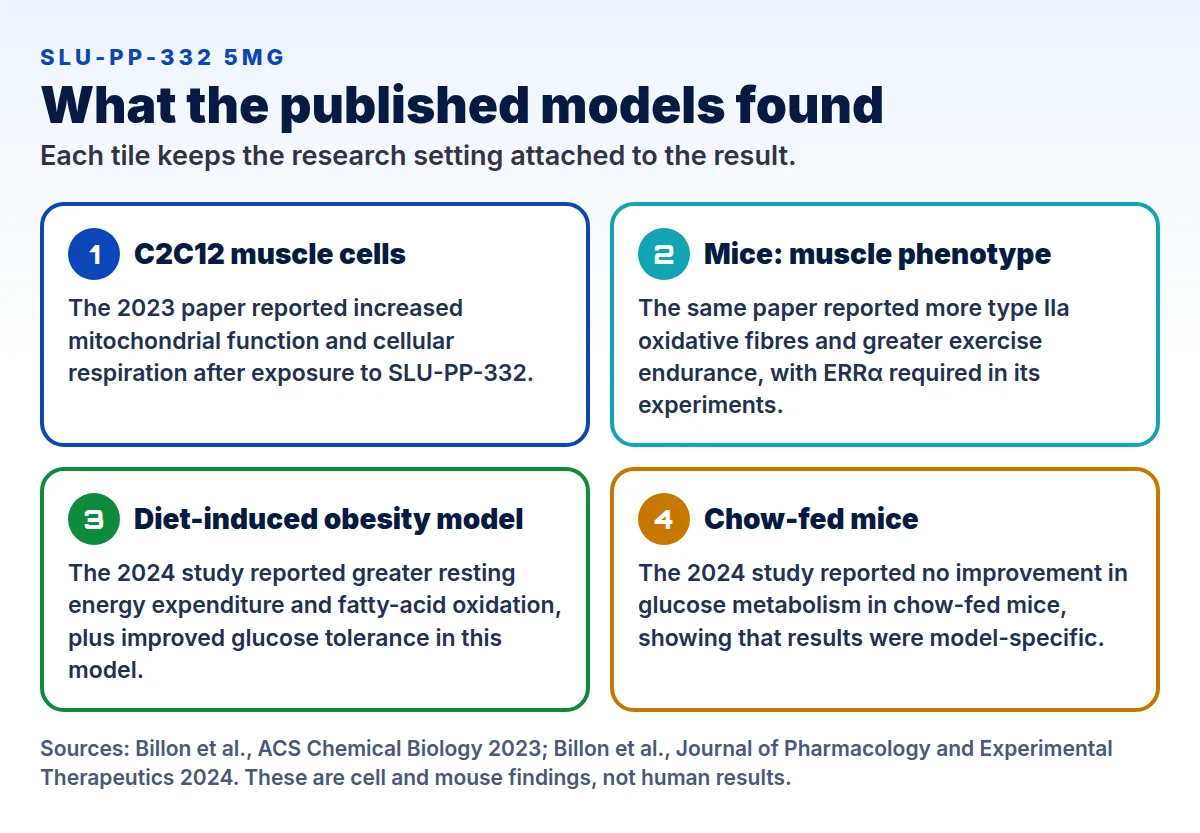
The clearest published findings come from cell and mouse models. The 2023 ACS Chemical Biology paper reported greater mitochondrial function and cellular respiration in C2C12 skeletal-muscle cells. In mice, the authors reported an increase in type IIa oxidative muscle fibres and greater endurance, and their experiments identified ERRα activity as critical for that endurance response.
A separate 2024 study tested SLU-PP-332 in diet-induced obese and ob/ob mouse models. It reported greater resting energy expenditure and fatty-acid oxidation, alongside favourable adiposity and glucose-tolerance findings in the diet-induced obesity model. It also reported that chow-fed mice did not show improved glucose metabolism in vivo.
Those last findings are useful because they show why research claims need their model. “Improved glucose metabolism” is not a general result for every model in the paper. The sources opened for this page do not provide human clinical trial outcomes, human pharmacokinetics or human adverse-event rates for SLU-PP-332.
The setting stays attached to the finding: muscle cells, mice and specific metabolic models are not human clinical outcomes.
Published SLU-PP-332 findings by research setting
Published SLU-PP-332 findings by research setting
Research setting
What was reported
Scope
C2C12 skeletal-muscle cells
Higher mitochondrial function and cellular respiration
A human health or performance outcome
Mice, 2023 development study
More type IIa oxidative fibres and greater endurance
Human endurance improvement
Diet-induced obesity mice, 2024
Higher energy expenditure and fatty-acid oxidation; improved glucose tolerance
A general effect across all models or people
Chow-fed mice, 2024
No improved glucose metabolism in vivo
That every metabolic measure changes with the compound
Sources: Billon et al., 2023 and 2024. Results are summarised as reported in the named experimental settings.
SLU-PP-332 versus SLU-PP-915 and mitochondrial peptides
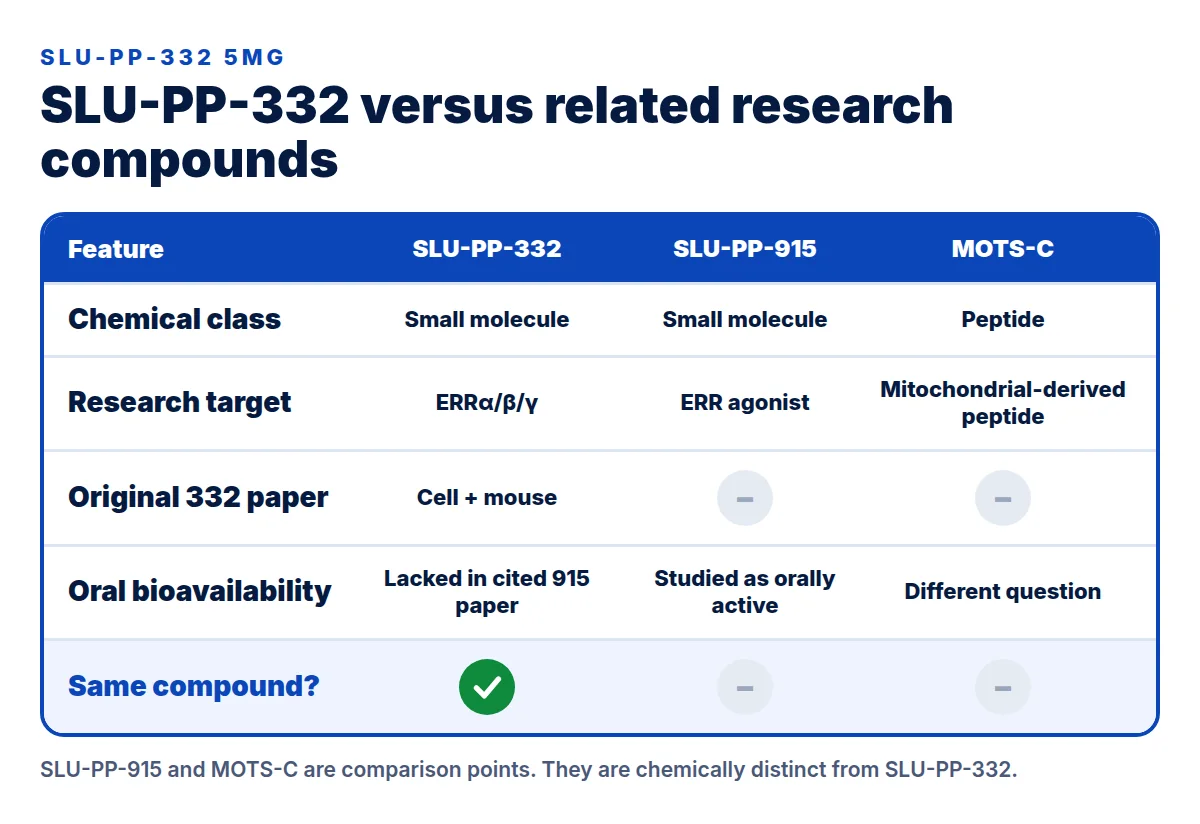
SLU-PP-332, SLU-PP-915 and MOTS-C are often grouped together in metabolic or endurance discussions. They are different compounds. SLU-PP-332 is a small-molecule pan-ERR agonist. SLU-PP-915 is a chemically distinct small molecule studied later for oral activity. MOTS-C is a mitochondrial-derived peptide with a different structure and research literature.
PeptideDosages notes that SLU-PP-332 lacked oral bioavailability in the research context used to distinguish it from SLU-PP-915. That is a direct reason not to move oral findings for 915 across to 332. The names share a research programme, not a chemical identity.
SS-31 and MOTS-C are useful nearby catalogue links for mitochondrial research, but they are peptides and have different targets, chemistry and handling considerations. Comparing a research theme can be helpful; substituting evidence across compounds is not.
Related research names are not the same molecule: SLU-PP-332 is a small molecule, SLU-PP-915 is distinct, and MOTS-C is a peptide.
Research comparison — not a substitution chart
Research comparison — not a substitution chart
Feature
SLU-PP-332
SLU-PP-915
MOTS-C
Chemical class
Small molecule
Small molecule
Peptide
Main research description
Pan-ERR agonist
Orally active ERR agonist research
Mitochondrial-derived peptide
Same compound as 332
Yes
No
No
Use 915 results for 332
No transfer needed
No
No
This is a classification and evidence-boundary comparison, not a claim of equal activity or handling.
SLU-PP-332 structure and chemical class
SLU-PP-332 has no peptide sequence to display. PubChem lists its molecular formula as C18H14N2O2, molecular weight as 290.3 g/mol and CAS number as 303760-60-3. Its IUPAC name is 4-hydroxy-N-[(E)-naphthalen-2-ylmethylideneamino]benzamide, with related formal-name variants used by suppliers.
PubChem gives it a calculated XLogP3 of 3.7, which means it prefers oils and organic solvents over water. That is exactly why SLU-PP-332 is dissolved in DMSO first and only then diluted with BAC water.
The label’s apparent white solid and the LabDoc description of a lyophilised-powder vial do not turn the molecule into a peptide. The relevant question is the molecule’s chemical identity, which is why the page uses a structure-and-class explainer rather than an amino-acid graphic.
Chemical identity, not a peptide sequence: SLU-PP-332 is a fixed small-molecule structure.
Independent lab test for this SLU-PP-332 5mg vial
This listing has an independent LabDoc report for a tested sample. Report LD-ZLZU was tested on 06 October 2026 and records the submitted sample name as “slu-pp-332” with a 5mg label claim. Its overall assessment is Pass.
The report records identity as confirmed by LC-MS. LC-MS combines liquid chromatography with mass spectrometry and is used to check a compound’s identity by its mass-related analytical signal. It records 99.6% purity by HPLC and 4.63mg content by HPLC, equal to 92.6% of the 5mg claim.
No batch identifier is stated in the report, and the results apply to the tested sample only. Analytical documentation supports traceability for that sample.
Report: LD-ZLZU; test date: 06 October 2026; overall assessment: Pass.
Identity: confirmed by LC-MS.
Purity: 99.6% by HPLC.
Content: 4.63mg by HPLC against the nominal 5mg claim (92.6%).
Scope: the report states that the batch was not stated and results apply to the tested sample only.
Buying SLU-PP-332 5mg in Australia
Peak Peptides Australia supplies SLU-PP-332 5mg for in-vitro research only. The page identifies its real chemical class rather than calling it a peptide, gives the published research setting for each claim, and links the independent LabDoc result for the tested sample.
Same-day dispatch from Victoria for in-stock orders once payment is confirmed, tracked Australia Post Express, with a tracking number emailed. Delivery does not convert an experimental research material into an approved medicine. The ARTG and Drugs@FDA checks described above identify no approved SLU-PP-332 medicine.
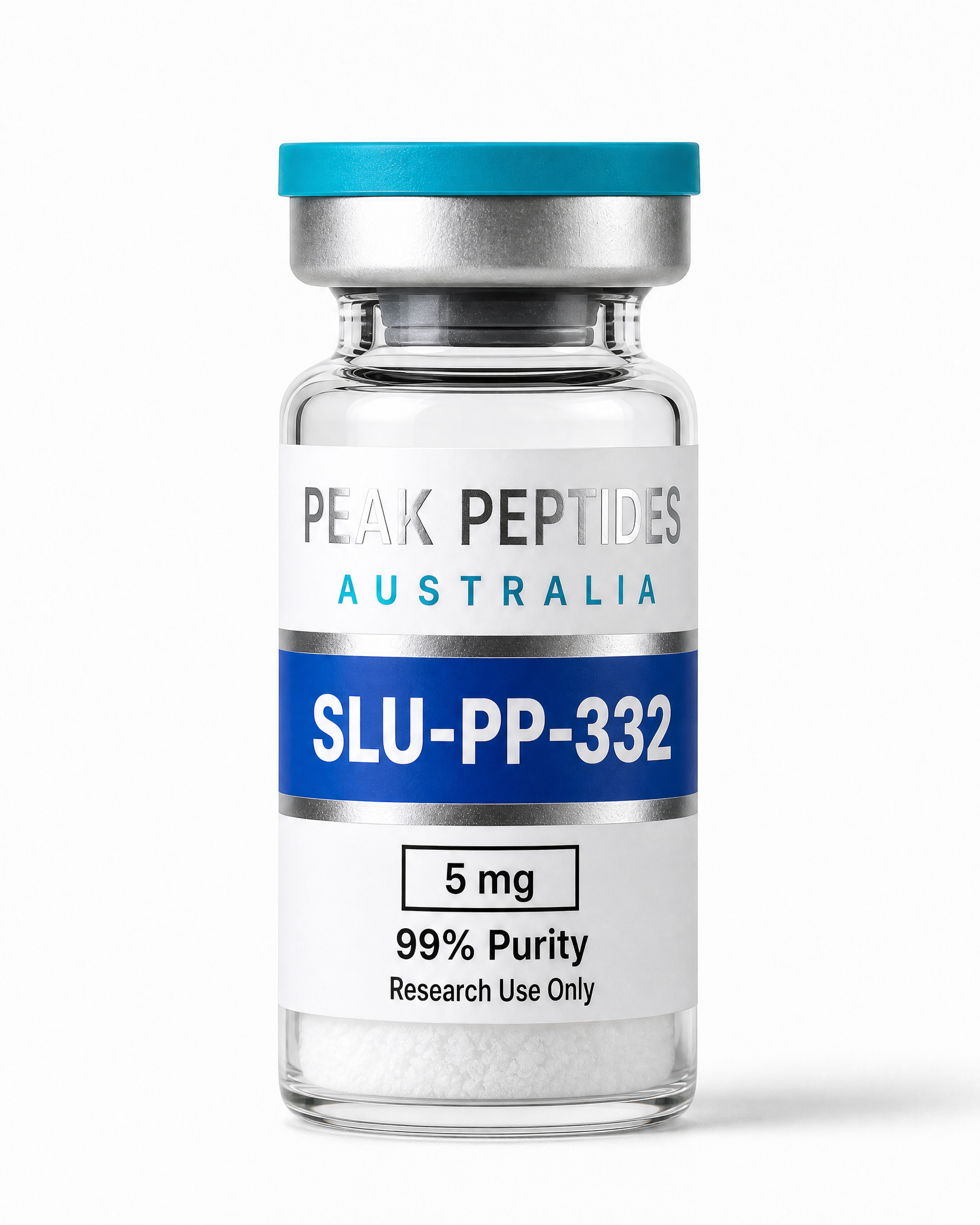
Each vial carries the Peak Peptides Australia label with the product name and 5mg strength, and the matching LabDoc report LD-ZLZU is linked on this page so you can check the result yourself.
Step-by-step guide · About 25 minutes, including 15–20 minutes of warm-up
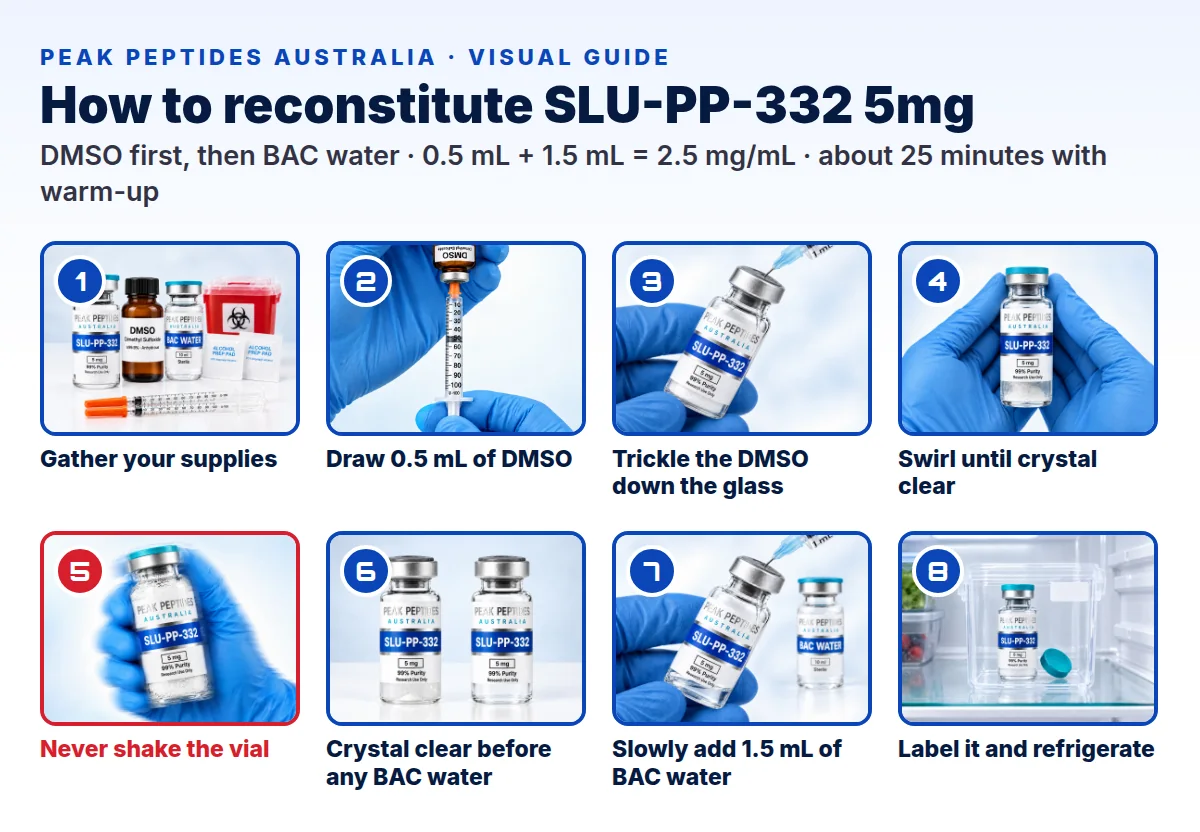
How to reconstitute SLU-PP-332 5mg with DMSO and BAC water (step-by-step photo guide)
SLU-PP-332 is a small molecule, not a peptide, and it will not dissolve in water. The method that works has two stages: dissolve the powder completely in DMSO, then dilute it slowly with BAC water. The recommended mix for a 5mg vial is 0.5 mL of DMSO followed by 1.5 mL of BAC water — 2 mL at 2.5 mg/mL with a 25% DMSO share, so 40 units on a U-100 syringe holds 1mg.
All eight steps on one card — 0.5 mL DMSO first, then 1.5 mL BAC water = 2.5 mg/mL.
What you need
SLU-PP-332 5mg vialLet it sit at room temperature for 15–20 minutes before mixing — cold powder is much harder to dissolve.
DMSO (dimethyl sulfoxide), 99.9% or higherPharmaceutical-grade, anhydrous (dry) DMSO. Keep the bottle tightly closed — DMSO soaks up moisture from the air.
Two 1 mL U-100 syringesOne for the DMSO and one for the BAC water, so neither bottle gets contaminated. 100 units = 1 mL.
Alcohol swabsFor wiping the rubber stoppers before you go through them.
Sharps binFor used needles and syringes.
Label or markerTo write the date, the liquids used and the strength on the vial.
How much DMSO and BAC water for SLU-PP-332 5mg? (mixing chart)
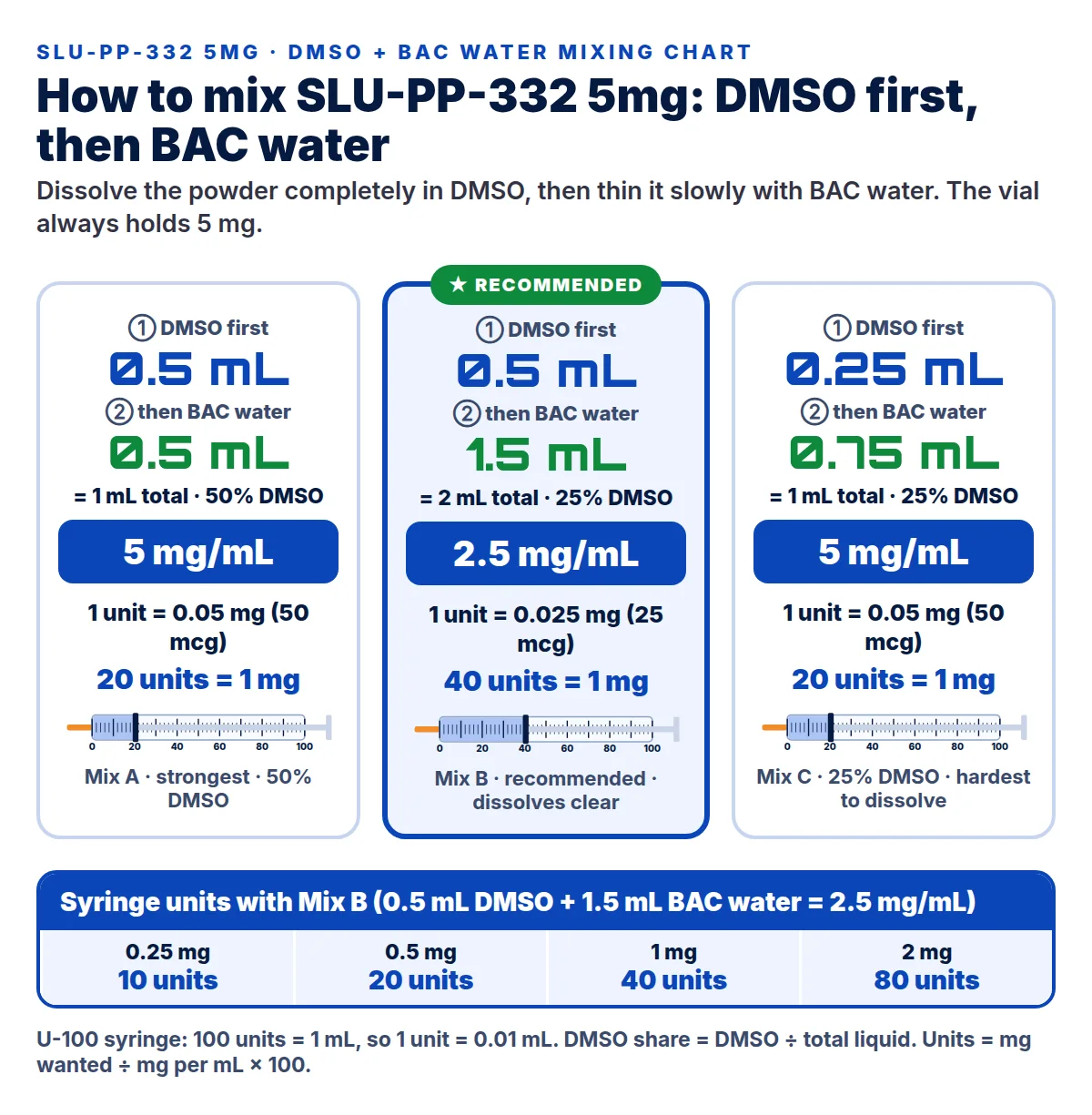
Mixing SLU-PP-332 is a two-stage job. The DMSO dissolves the powder; the BAC water then thins it out and brings the DMSO share down. The vial always holds 5mg, so the total liquid sets the strength, and the DMSO share is simply the DMSO volume divided by the total.
Mix B is the recommended mix: 0.5 mL of DMSO dissolves the 5mg crystal clear (10 mg/mL, the top of Cayman’s listed DMSO range), then 1.5 mL of BAC water takes it to 2 mL at 2.5 mg/mL with 25% DMSO. Each unit on a U-100 syringe then holds 0.025mg (25mcg): 10 units = 0.25mg, 20 units = 0.5mg, 40 units = 1mg and 80 units = 2mg.
Why not leave it in pure DMSO, or go 50/50? Concentrated DMSO is a harsh solvent, so the lower the DMSO share, the gentler the mix. Mix B brings it to 25%, and PeptPath’s guidance is to go lower still — 10% or less — as long as the solution stays clear. Labs that need a very low share use a four-part vehicle — 5% DMSO, 30% PEG300, 5% Tween 80 and 60% saline.
Mix B: 0.5 mL DMSO + 1.5 mL BAC water = 2.5 mg/mL, so 40 units = 1mg.
SLU-PP-332 5mg mixing chart: DMSO first, then BAC water (U-100 syringe, 1 unit = 0.01 mL)
SLU-PP-332 5mg mixing chart: DMSO first, then BAC water (U-100 syringe, 1 unit = 0.01 mL)
Mix
DMSO first
Then BAC water
Total liquid
Strength
DMSO share
Units for 1 mg
Mix A
0.5 mL
0.5 mL
1 mL
5 mg/mL
50%
20 units
Mix B (recommended)
0.5 mL
1.5 mL
2 mL
2.5 mg/mL
25%
40 units
Mix C
0.25 mL
0.75 mL
1 mL
5 mg/mL
25%
20 units
Mix B is recommended: 0.5 mL of DMSO dissolves the 5mg crystal clear, and 1.5 mL of BAC water brings the DMSO share down to 25%.
Syringe units with Mix B (0.5 mL DMSO + 1.5 mL BAC water = 2.5 mg/mL)
Syringe units with Mix B (0.5 mL DMSO + 1.5 mL BAC water = 2.5 mg/mL)
Amount
Units on a U-100 syringe
Volume
0.25 mg
10 units
0.1 mL
0.5 mg
20 units
0.2 mL
1 mg
40 units
0.4 mL
2 mg
80 units
0.8 mL
The 8 steps
1Step 1: Gather your supplies
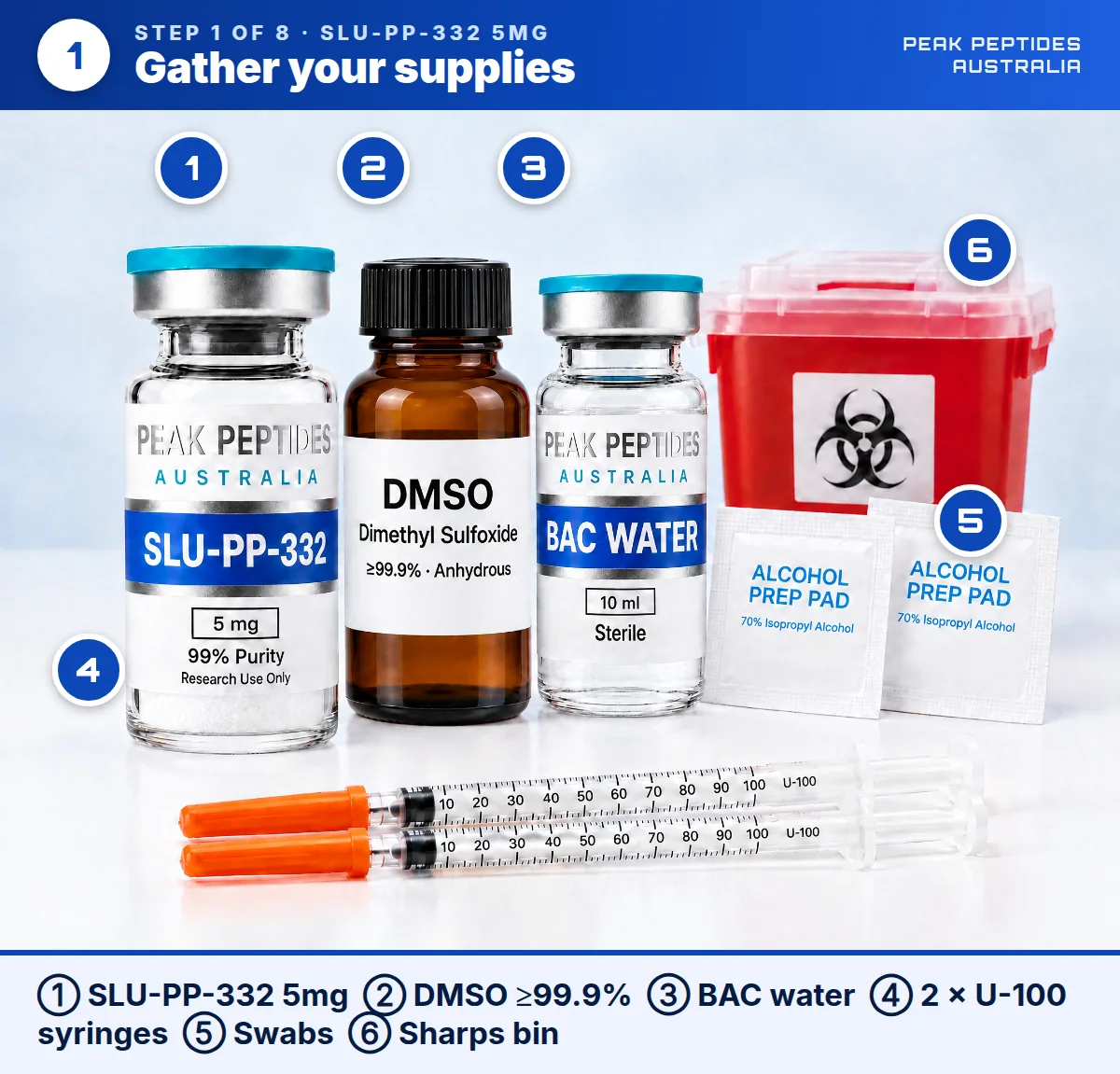
Set out the SLU-PP-332 5mg vial, pure DMSO (99.9% or higher), BAC water, two 1 mL U-100 syringes, alcohol swabs and a sharps bin. Take the vial out of the fridge or freezer and let it sit at room temperature for 15–20 minutes — cold powder is much harder to dissolve.
2Step 2: Draw 0.5 mL of DMSO
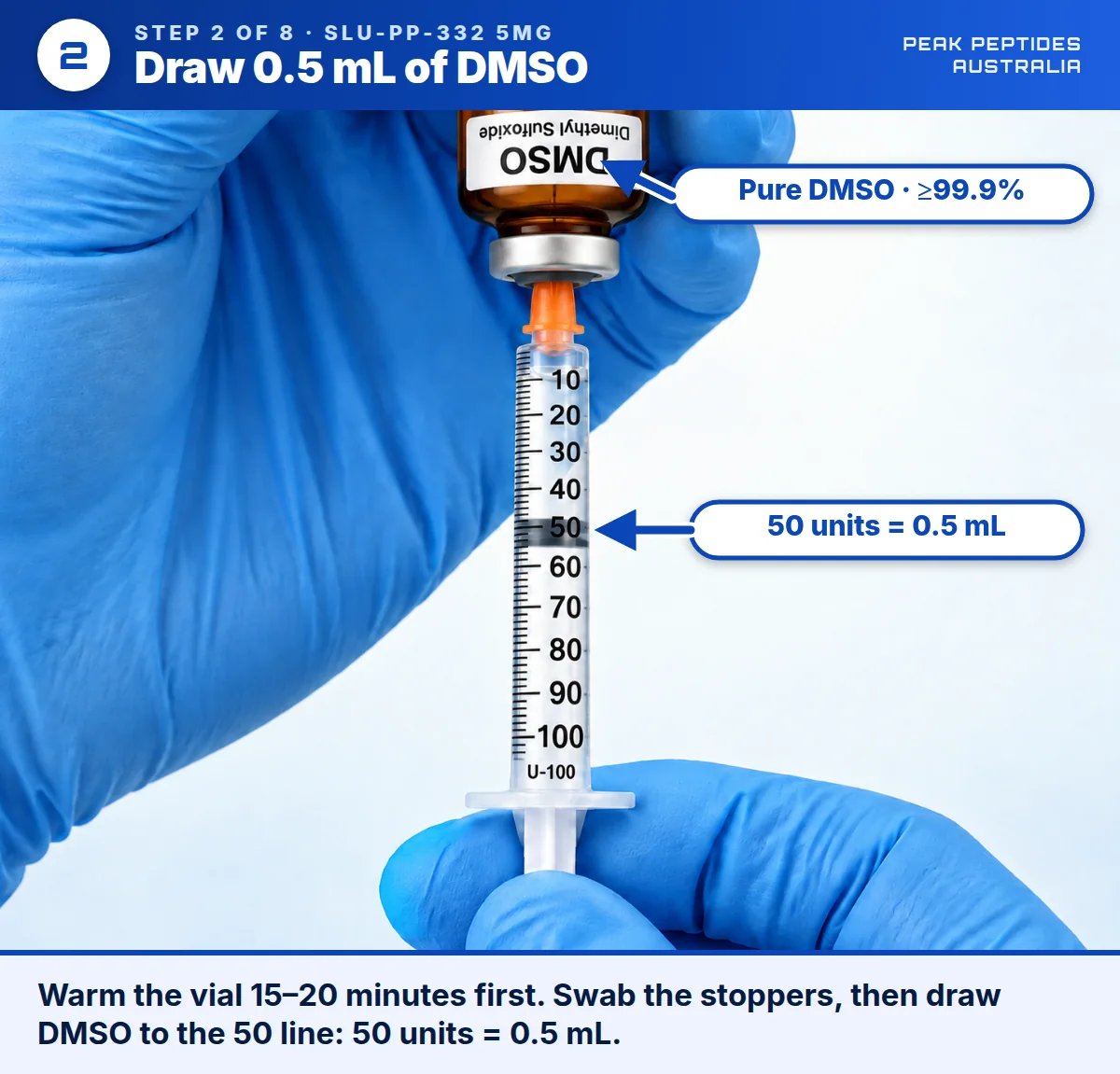
Flip off the vial cap and wipe the rubber stoppers on the vial and both bottles with an alcohol swab, then let them air-dry. With the first syringe, slowly draw 0.5 mL of DMSO — the 50 line on a U-100 syringe. DMSO turns solid below about 18 °C, so warm the bottle in your hand first if the room is cold.
3Step 3: Trickle the DMSO down the glass
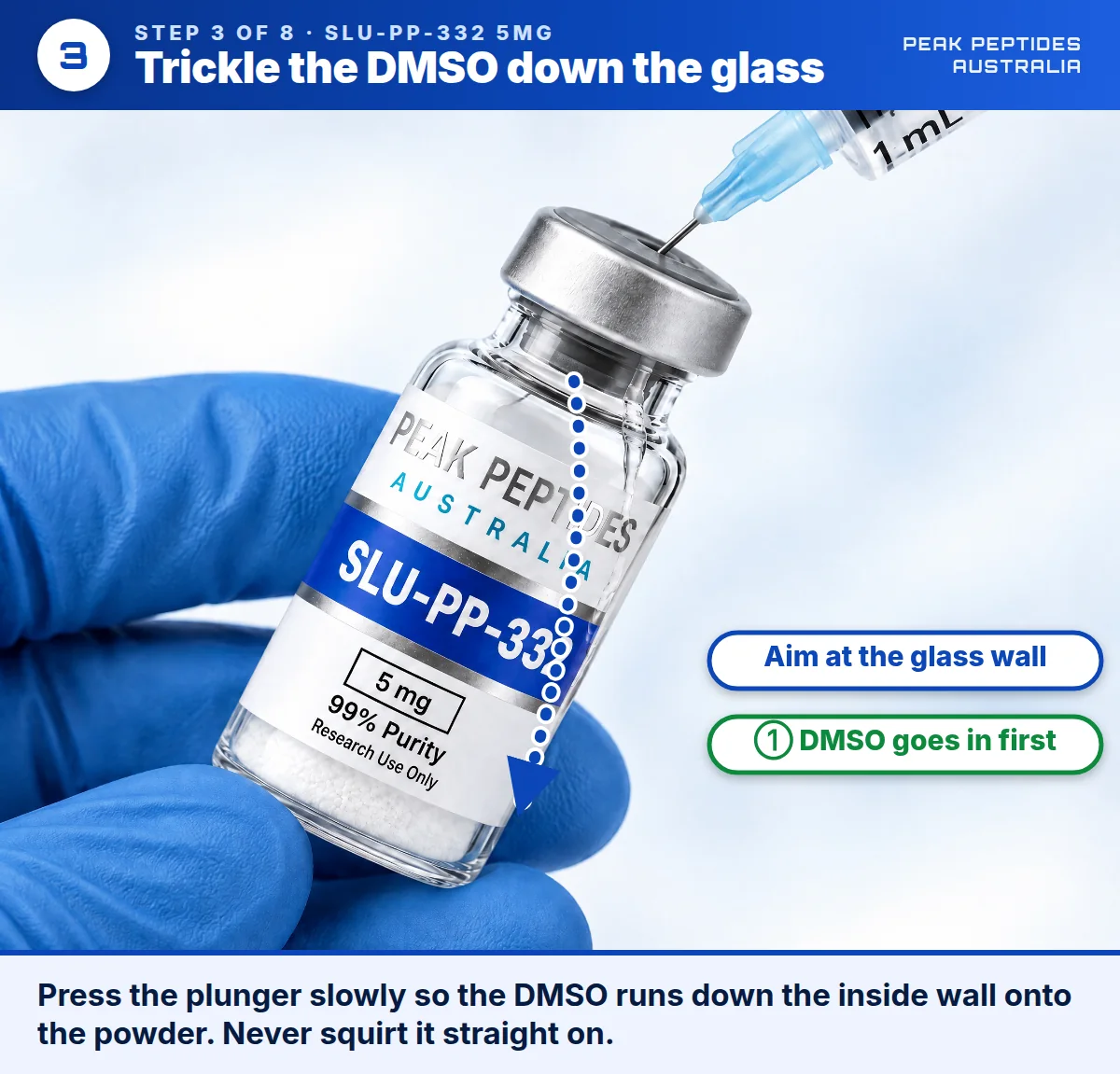
Push the needle through the SLU-PP-332 stopper at an angle and press the plunger slowly so the DMSO runs down the inside wall and gently wets the powder. Never squirt it straight onto the powder — that splashes it up the glass where the small amount of liquid can’t reach it.
4Step 4: Swirl until crystal clear
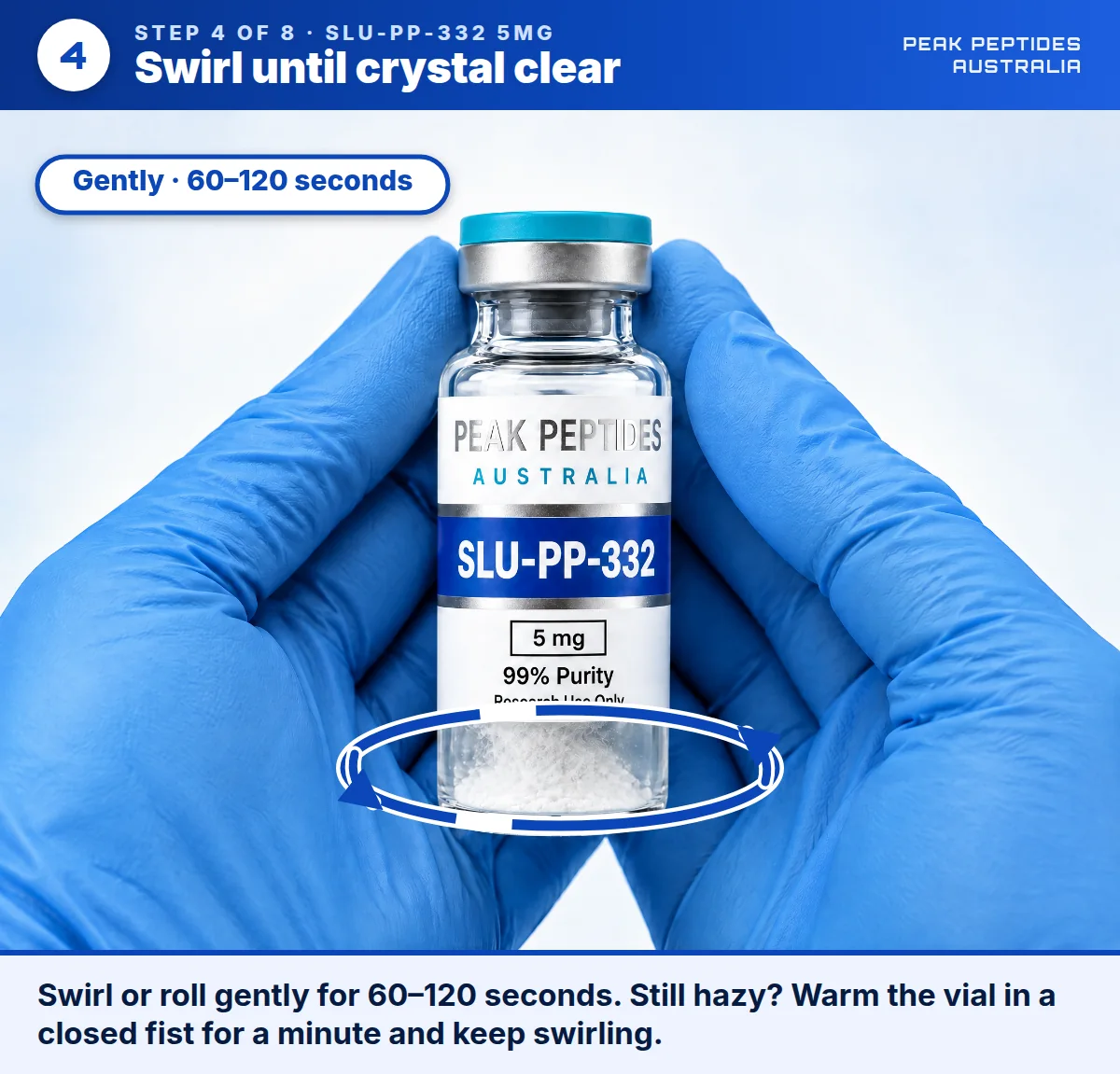
Swirl or slowly roll the vial. SLU-PP-332 takes about 60–120 seconds to fully dissolve in DMSO. If it still looks hazy after that, hold the vial in a closed fist for a minute to warm it, then keep swirling until the powder is gone.
5Step 5: Never shake the vial
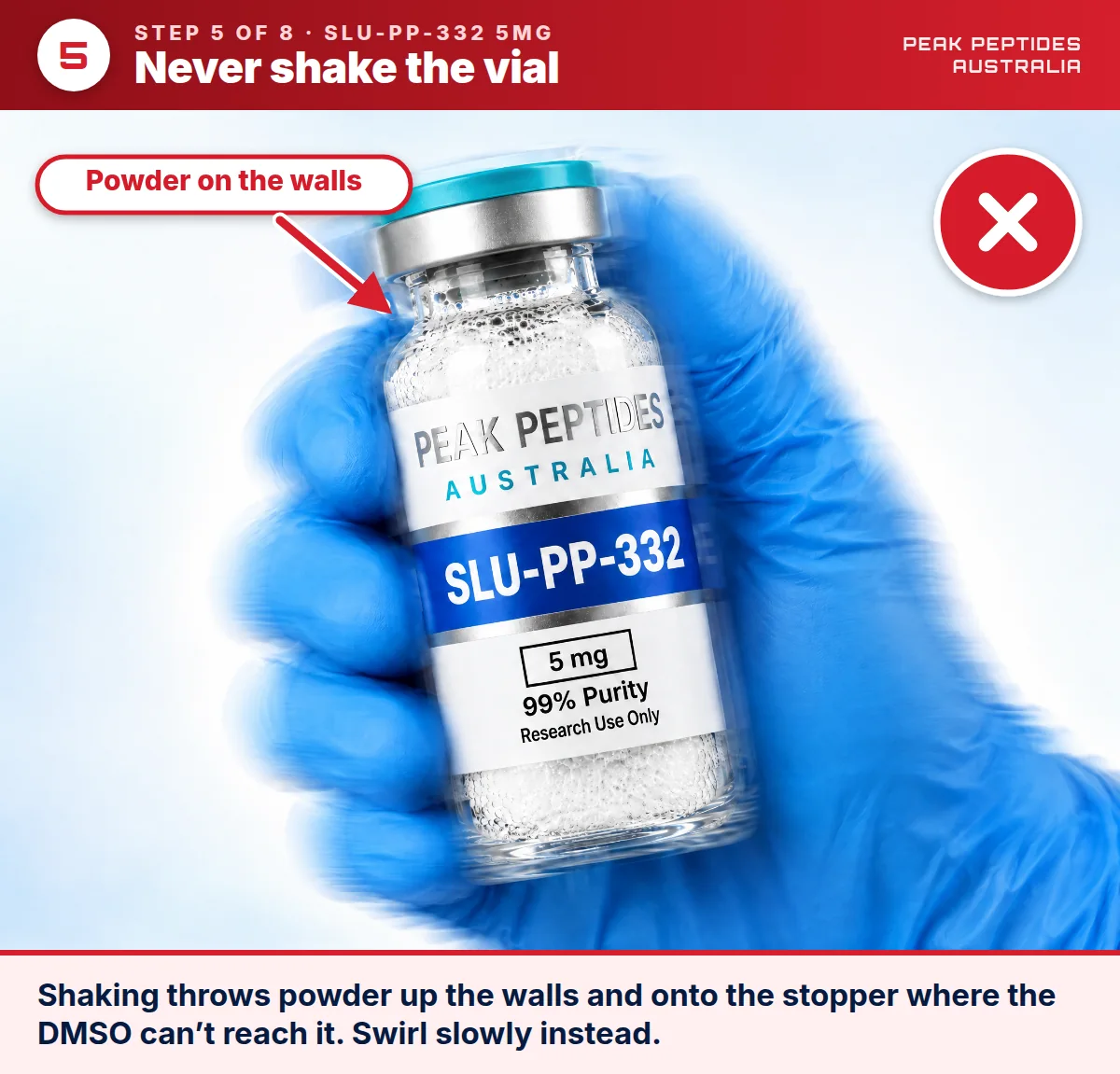
Don’t shake the vial. Shaking throws powder onto the stopper and up the walls, where the small amount of DMSO can’t reach it, and it whips air into the solution. Slow swirling dissolves it fully.
6Step 6: Crystal clear before any BAC water
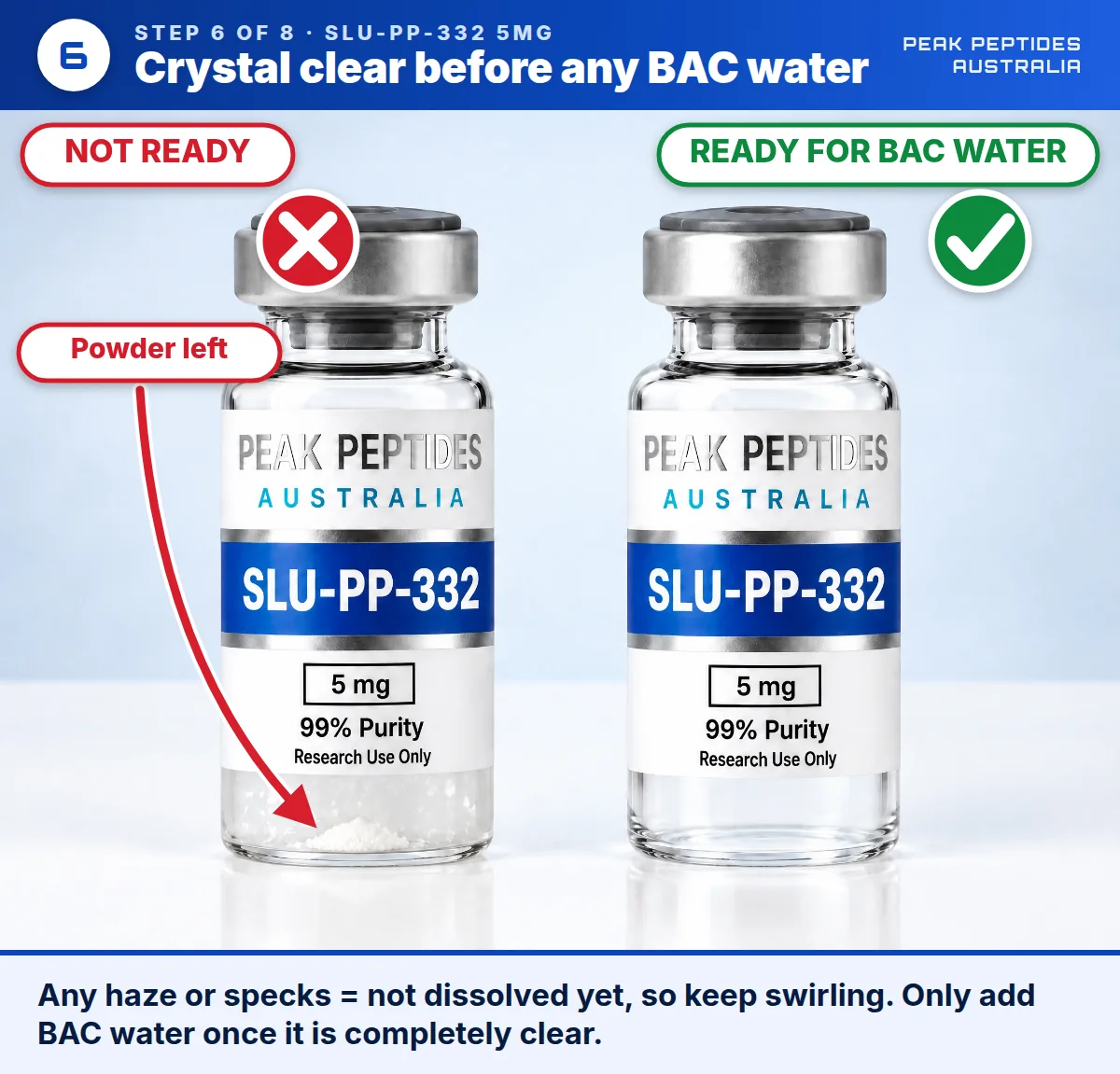
Hold the vial up to the light. The DMSO solution must be crystal clear with no specks or haze. If it is still cloudy, the powder has not fully dissolved — keep swirling and warming. Do not add any BAC water until it is completely clear, because once water goes in, any powder that has not dissolved stays undissolved.
7Step 7: Slowly add 1.5 mL of BAC water
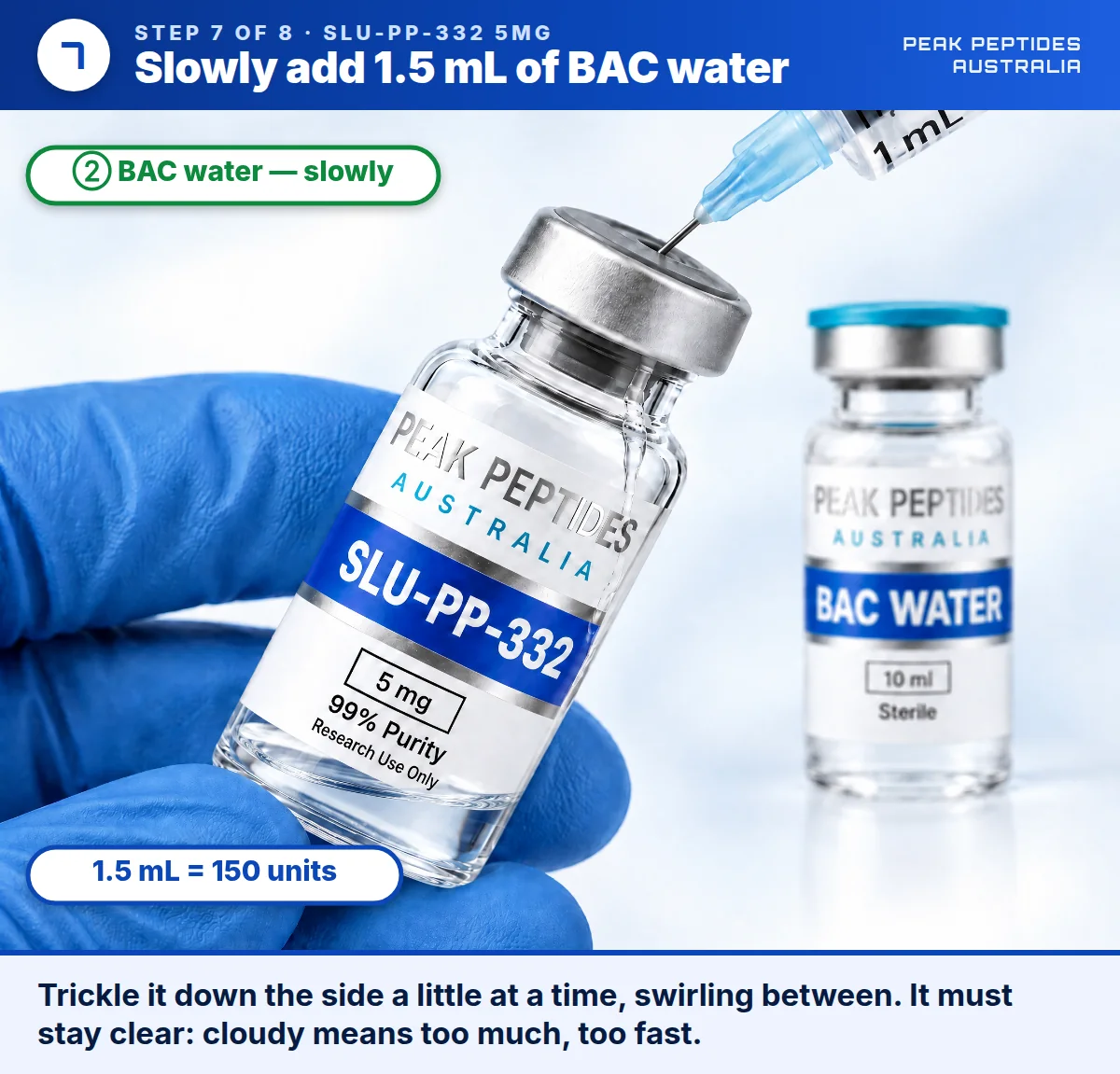
With the second syringe, draw 1.5 mL of BAC water — a full 100-unit syringe, then 50 units more. Trickle it slowly down the side of the vial a little at a time, swirling gently between additions. It should stay clear. If it turns cloudy, the SLU-PP-332 has crashed out of solution: stop adding water, and next time add it more slowly or use less.
8Step 8: Label it and refrigerate
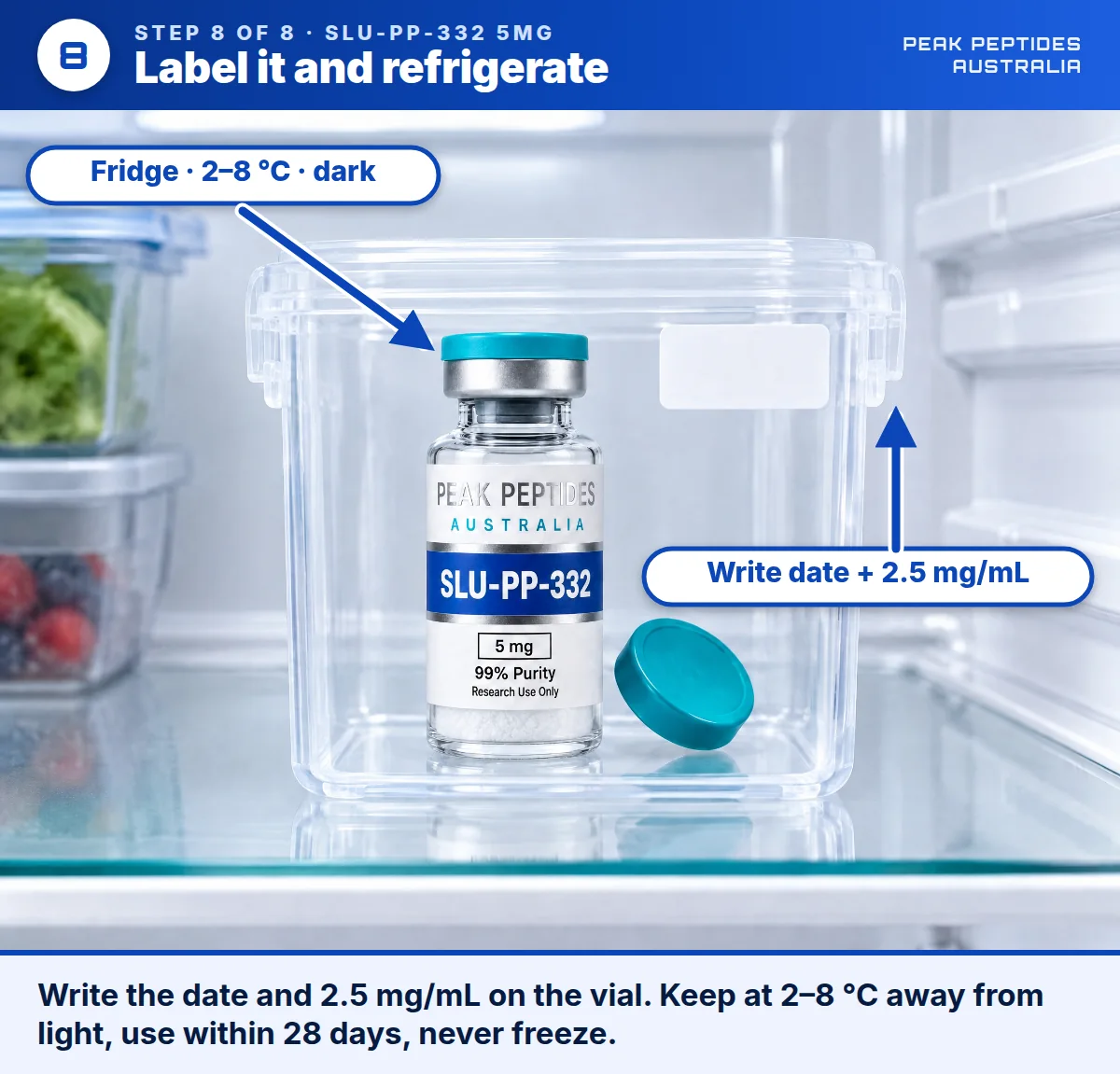
Write the date, DMSO + BAC water and 2.5 mg/mL on the vial. Store it upright in the fridge at 2–8 °C in a dark container, because light speeds up breakdown in DMSO solutions. Use it within 28 days and never freeze it — freezing can make SLU-PP-332 crash out of solution for good.
How to store SLU-PP-332
SLU-PP-332 storage
SLU-PP-332 storage
Form
Where
How long
Unopened powder
Freezer, −20 °C
12 months or more
Mixed (DMSO + BAC water)
Fridge, 2–8 °C, in the dark
Use within 28 days
Mixed (DMSO + BAC water)
Freezer
Never — it can crash out of solution
Hazy from the cold
Room temperature, swirl
Use once it is clear again
Once mixed with DMSO and BAC water, SLU-PP-332 lives in the fridge, not the freezer. Keep it in its box or a dark container, because light speeds up breakdown in DMSO solutions, and let it warm up and swirl it if the cold has made it hazy.
SLU-PP-332 5mg FAQs — Research, Lab Testing, Mixing and Storage
What is SLU-PP-332?
SLU-PP-332 is a synthetic small-molecule research compound that activates all three estrogen-related receptor subtypes: ERRα, ERRβ and ERRγ. It is studied in cell and mouse models of energy metabolism, mitochondrial function and oxidative muscle biology. This listing is supplied for in-vitro research only.
Is SLU-PP-332 a peptide?
No. SLU-PP-332 is not a peptide. PubChem lists the small-molecule formula C18H14N2O2 and molecular weight 290.3 g/mol. A peptide is an amino-acid chain; SLU-PP-332 is 4-hydroxy-N′-(naphthalen-2-ylmethylene)benzohydrazide, which has no amino-acid sequence.
Why do people search for SLU-PP-332 peptide?
Because it is sold alongside peptides and studied in the same fitness and metabolism research, people lump it in with peptides. Chemically it is a small molecule, which is why it has no amino-acid sequence and is dissolved in DMSO first before any BAC water goes in.
What does pan-ERR agonist mean?
Pan-ERR agonist means that SLU-PP-332 activated the three estrogen-related receptor subtypes—ERRα, ERRβ and ERRγ—in the reported cell-based assays. The term “agonist” means it activates the receptor. The original research found the highest reported potency at ERRα.
Does estrogen-related mean SLU-PP-332 is estrogen?
No. ERRs are called estrogen-related receptors because of their structural relationship to estrogen receptors. SLU-PP-332 is not estrogen and does not supply estrogen.
What did the 2023 SLU-PP-332 study find?
The 2023 ACS Chemical Biology paper reported increased mitochondrial function and cellular respiration in a skeletal-muscle cell line. In mice, it reported more type IIa oxidative skeletal-muscle fibres and better exercise endurance. The authors described the endurance response as ERRα-dependent in their experiments.
What did the 2024 metabolic study find?
The 2024 Journal of Pharmacology and Experimental Therapeutics study reported greater resting energy expenditure and fatty-acid oxidation in mouse models of obesity and metabolic syndrome. It also reported lower adiposity measures. Chow-fed mice did not show improved glucose metabolism in vivo, so the findings were model-specific.
Does exercise mimetic mean SLU-PP-332 replaces exercise?
No. “Exercise mimetic” describes selected molecular and physiological signals observed in experimental models. The published SLU-PP-332 studies measured cell and mouse outcomes.
Are there human trials or a human dose for SLU-PP-332?
No. All published SLU-PP-332 research so far is in cells and mice, so there is no human dose. The 5mg on the label is simply the amount of powder in the vial.
What are the reported side effects of SLU-PP-332 in people?
There is no human side-effect data yet because SLU-PP-332 has only been studied in cells and mice. Side-effect lists you see online come from anecdotes, not controlled studies.
Is SLU-PP-332 the same as SLU-PP-915?
No. SLU-PP-915 is a distinct small molecule studied later as an orally active ERR agonist. PeptideDosages describes SLU-PP-332 as lacking oral bioavailability in that research context. Findings for 915 cannot be transferred to SLU-PP-332 simply because the names and research area are similar.
Is SLU-PP-332 a steroid or a SARM?
No. The cited research describes SLU-PP-332 as an ERR agonist. It is not described as a steroid or a selective androgen receptor modulator. Those labels refer to different chemical classes and receptor systems.
Is SLU-PP-332 approved by the TGA or FDA?
No. The ARTG is the TGA’s register of therapeutic goods that can be supplied in Australia, and no SLU-PP-332 medicine is listed in the ARTG search reviewed for this page. Drugs@FDA is the FDA database for approved human drugs, and no FDA-approved SLU-PP-332 product is identified there.
Is SLU-PP-332 on the WADA Prohibited List?
WADA’s 2027 Prohibited List takes effect on 1 January 2027. It names SLU-PP-332, SLU-PP-915 and related substances under S4.4 metabolic modulators, which are prohibited at all times. WADA’s explanatory note says they were added as examples acting particularly on oxidative metabolism.
Can I buy SLU-PP-332 5mg online in Australia?
SLU-PP-332 5mg can be ordered online from Peak Peptides Australia when available. It is supplied for in-vitro research only. Check the LabDoc report, product label and published research context.
How fast is SLU-PP-332 dispatch in Australia?
Same-day dispatch from Victoria for in-stock orders once payment is confirmed, tracked Australia Post Express, with a tracking number emailed. That dispatch information concerns delivery only; it does not change the product’s research-only status.
How is this SLU-PP-332 5mg sample verified?
LabDoc report LD-ZLZU was tested on 06 October 2026. It records identity confirmed by LC-MS, 99.6% purity by HPLC and 4.63mg content by HPLC against the 5mg label claim. The report’s overall assessment is Pass and the batch is not stated.
What does LabDoc LD-ZLZU prove?
LD-ZLZU documents analytical results for the submitted sample: confirmed LC-MS identity, 99.6% HPLC purity and 4.63mg HPLC content. It does not name a batch identifier.
What does the 5mg label mean?
It is the amount of SLU-PP-332 powder in the vial. LabDoc LD-ZLZU measured 4.63mg in the tested sample, which is 92.6% of the 5mg claim. It turns into a strength only once you add liquid — 0.5 mL of DMSO plus 1.5 mL of BAC water gives 2.5 mg/mL.
Can I mix SLU-PP-332 with BAC water?
Not on its own. SLU-PP-332 is insoluble in water, so BAC water alone gives a milky suspension that settles out and clogs fine needles. Dissolve it in DMSO first until it is crystal clear, then add BAC water slowly to dilute it — that is the method that works.
What does SLU-PP-332 dissolve in?
DMSO (dimethyl sulfoxide). Cayman Chemical lists SLU-PP-332 at 1–10 mg/mL in DMSO and 0.1–1 mg/mL in ethanol, and it is insoluble in water. In practice it is dissolved in DMSO first and then diluted with BAC water.
How much DMSO and BAC water do I add to SLU-PP-332 5mg?
The recommended mix is 0.5 mL of DMSO first, then 1.5 mL of BAC water: 2 mL in total at 2.5 mg/mL with a 25% DMSO share. Two other options: 0.5 mL DMSO plus 0.5 mL BAC water (5 mg/mL, 50% DMSO), or 0.25 mL DMSO plus 0.75 mL BAC water (5 mg/mL, 25% DMSO). Mix C asks 0.25 mL of DMSO to hold 20 mg/mL, double Cayman’s listed 10 mg/mL limit, so it is the hardest to get clear.
Why does the DMSO go in before the BAC water?
Because SLU-PP-332 dissolves in DMSO but not in water. Pure DMSO dissolves the powder completely; once it is in solution, BAC water can be added slowly to thin it out. Add BAC water first and the powder just forms a cloudy suspension that will not clear.
How much SLU-PP-332 is in 10 units on a U-100 syringe?
With the recommended 2 mL mix (2.5 mg/mL), 10 units = 0.10 mL = 0.25mg. With either 1 mL mix (5 mg/mL), the same 10 units hold 0.5mg.
How many units is 1mg of SLU-PP-332?
With the recommended 2 mL mix (0.5 mL DMSO + 1.5 mL BAC water = 2.5 mg/mL), 1mg is 40 units on a U-100 syringe. With a 1 mL mix (5 mg/mL) it is 20 units. The formula is: units = mg wanted ÷ mg per mL × 100.
What should I write on a mixed SLU-PP-332 vial?
Write the date you mixed it, the liquids used (DMSO + BAC water) and the strength, for example 2.5 mg/mL. Keep the LabDoc report ID LD-ZLZU with your notes so anyone using the vial knows exactly what is in it.
What if my SLU-PP-332 mix is cloudy?
It depends when it went cloudy. Milky straight away: BAC water went in before the powder had dissolved in DMSO, so start again with DMSO first. Clear in DMSO but cloudy once BAC water went in: too much water, too fast — add it more slowly and use less. Never clears even in DMSO: the vial or DMSO was cold, or the DMSO is not pure enough, so warm it to room temperature and use 99.9% DMSO. Hazy after time in the fridge: let it reach room temperature and swirl until clear.
How should unopened SLU-PP-332 powder be stored?
Keep unopened SLU-PP-332 powder in the freezer at −20 °C. Cayman Chemical and MedChemExpress both list −20 °C, and MedChemExpress gives up to three years for its powder.
How should mixed SLU-PP-332 be stored?
Once mixed with DMSO and BAC water, keep it in the fridge at 2–8 °C in a dark container, because light speeds up breakdown in DMSO solutions. Use it within 28 days.
Can I freeze mixed SLU-PP-332?
No. Freezing a mixed DMSO and BAC water solution can make SLU-PP-332 crash out of solution for good. Keep it in the fridge at 2–8 °C and use it within 28 days. Only the dry, unmixed powder goes in the freezer.
What does a certificate of analysis show for a research compound?
A certificate of analysis or independent report identifies the tested material and method, then records analytical measurements such as identity, purity and content. For this listing, LabDoc LD-ZLZU reports confirmed identity by LC-MS, 99.6% HPLC purity and 4.63mg HPLC content for the submitted sample.
How do I know the SLU-PP-332 label matches the report?
Check that the vial name and strength match the listing, then open LabDoc LD-ZLZU. The report identifies the sample as “slu-pp-332” with a 5mg claim. It also notes that no batch identifier was stated, so traceability should be checked against the physical product records.