Research Use Only. For laboratory research use only. Not for human or animal consumption.
Mitochondrial Open Reading Frame of the 12S rRNA-c — 20mg Research Vial
MOTS-C 20mg is a larger labelled quantity of the same 16-amino-acid mitochondrial signalling peptide supplied as lyophilised research material. This vial has its own LabDoc report, LD-WPTB, recording confirmed LC-MS identity, 99.49% HPLC purity and 18.14mg measured content in the submitted sample. Peak Peptides Australia supplies it for in-vitro research only. In-stock orders receive same-day dispatch from Victoria after payment confirmation, with tracked Australia Post Express shipping Australia-wide.
Product Specifications
Full NameMitochondrial Open Reading Frame of the 12S rRNA-c — 20mg Research Vial
Vial Size20mg
Purity99.49% HPLC (LD-WPTB sample)
Legal Disclaimer
This product is sold strictly for in-vitro laboratory research purposes only. It is not a therapeutic good, is not approved by the TGA, and is not intended for human or animal consumption, injection, or any diagnostic or therapeutic use.
Mitochondrial-derived peptide · 20 mg labelled research vial
MOTS-C 20mg — Research, Lab Test & BAC Water Mixing Guide
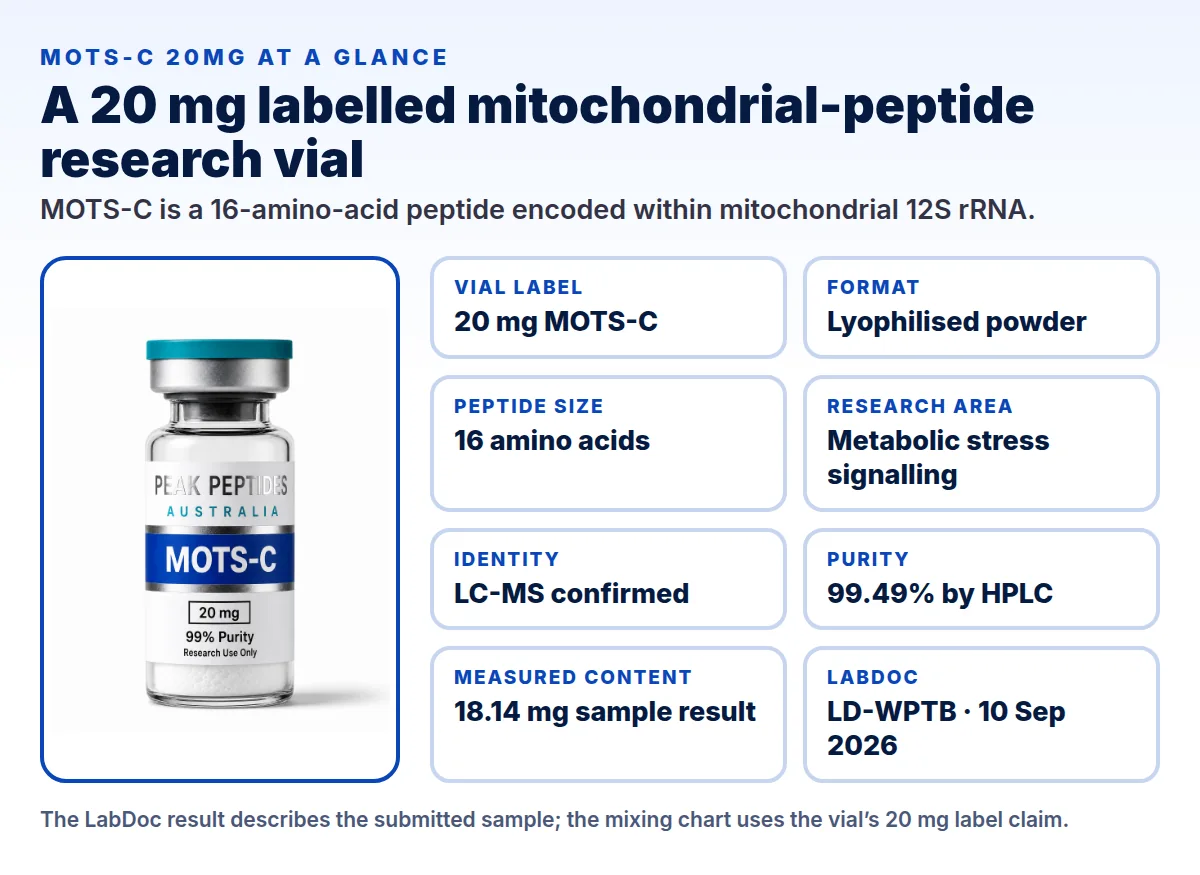
MOTS-C is a 16-amino-acid mitochondrial-derived peptide encoded within the mitochondrial 12S rRNA region. It is studied as a cell-to-nucleus metabolic stress signal, particularly in research on folate and purine pathways, AICAR and AMPK. This 20mg listing is a larger labelled quantity of the same molecule as the MOTS-C 10mg vial, not a different peptide. Its submitted sample has a separate LabDoc report: LD-WPTB recorded confirmed identity by LC-MS, 99.49% purity by HPLC and 18.14mg measured content on 10 September 2026. This page separates those sample findings from the 20mg label claim used in the BAC water concentration chart. Peak Peptides Australia supplies MOTS-C 20mg for in-vitro research only, not for human or animal use.
Also referred to in research or catalogue references as MOTS-C, MOTS-c, MOTS C, MOTSC, Mitochondrial Open Reading Frame of the 12S rRNA-c, Mitochondrial open reading frame of the 12S rRNA type-c, MOTS-C peptide, MOTS C peptide, MOTS-c 20mg, MOTS C 20mg, MOTS-C 20 mg.
MOTS-C 20mg at a glance
Name
MOTS-C — mitochondrial open reading frame of the 12S rRNA-c
What it is
A 16-amino-acid mitochondrial-derived peptide studied in metabolic-stress signalling
Sequence
MRWQEMGYIFYPRKLR
Vial label
20mg lyophilised MOTS-C powder
Research mechanisms
Folate and purine pathways, AICAR, AMPK and stress-responsive nuclear signalling
Human research context
Exercise observation measured endogenous MOTS-C; no established administered clinical regimen
This vial’s LabDoc report
LD-WPTB · 10 September 2026 · overall assessment: Pass
Identity / purity
Confirmed by LC-MS · 99.49% by HPLC
Measured submitted-sample content
18.14mg against a 20mg label claim, or 90.7% of claim
Source-described mix
3mL BAC water = 6.67mg/mL by the 20mg label-claim calculation
Mixed-vial storage
2–8°C, away from light; use within about 4 weeks (28 days)
Dispatch
Same-day dispatch from Victoria for in-stock orders once payment is confirmed, tracked Australia Post Express, tracking number emailed
A 16-amino-acid mitochondrial peptide
MOTS-C stands for mitochondrial open reading frame of the 12S rRNA-c. The original 2015 paper identified it as a 16-amino-acid peptide produced from a short open reading frame within mitochondrial 12S rRNA. Its one-letter sequence is MRWQEMGYIFYPRKLR. It is a single peptide, not a blend.
What the 20mg label means
The 20mg label is the nominal peptide quantity in this vial. It changes the concentration calculation after a chosen volume of BAC water is added, but it does not change MOTS-C’s molecular identity or turn it into a different compound. The 20mg mixing chart on this page uses the label claim and clearly separates it from the measured LabDoc sample content.
Studied in metabolic-stress signalling
In cell and preclinical work, MOTS-C has been linked to folate-cycle and de novo purine-biosynthesis changes, accumulation of AICAR and activation of AMPK. AMPK is a cellular energy sensor. A separate cell study found that metabolic stress can move MOTS-C into the nucleus, where it influenced stress-responsive gene expression.
What human research has actually measured
A 2021 exercise study measured the body’s own MOTS-C in 10 healthy young men after high-intensity cycling. Skeletal-muscle MOTS-C rose 11.9-fold from the pre-exercise value, while circulating levels rose during and immediately after exercise. That observation did not administer this product or test a 20mg vial.
No approved medicine
MOTS-C is not an FDA-approved medicine. The FDA’s 2026 technical review states that neither MOTS-C free base nor MOTS-C acetate is a component of an FDA-approved drug. An ARTG search for MOTS-C did not return a MOTS-C medicine listing when checked for this guide.
This 20mg vial’s independent LabDoc result
LabDoc report LD-WPTB, tested 10 September 2026, records confirmed identity by LC-MS, 99.49% purity by HPLC and 18.14mg measured content against the 20mg label claim. The report records a Pass assessment. Open the LabDoc verification link on this page to view the sample report.
Purity and content are separate measurements
The 99.49% HPLC result describes the purity of the submitted sample. The 18.14mg result describes its measured peptide content, equal to 90.7% of the 20mg label claim. These figures cannot be substituted for one another, and they describe the submitted sample rather than a universal result for every vial.
A 3mL BAC water concentration chart
The recommended mix for the 20mg vial is 3mL of bacteriostatic water. Using the 20mg label claim, that makes 6.67mg/mL: a U-100 syringe unit is 0.01mL and holds 0.067mg, or 66.67mcg.
MOTS-C is a mitochondrial-derived peptide: a short chain of amino acids encoded by mitochondrial DNA rather than by the cell’s nuclear DNA. Its name expands to mitochondrial open reading frame of the 12S rRNA-c. The discovery paper found a 51-base-pair short open reading frame inside mitochondrial 12S rRNA that translates to a 16-amino-acid peptide.
The full human sequence is MRWQEMGYIFYPRKLR. In the resting-cell experiments, MOTS-C was largely associated with mitochondria. That mitochondrial origin makes it useful for research into how mitochondria communicate information about cellular energy and stress to other parts of the cell.
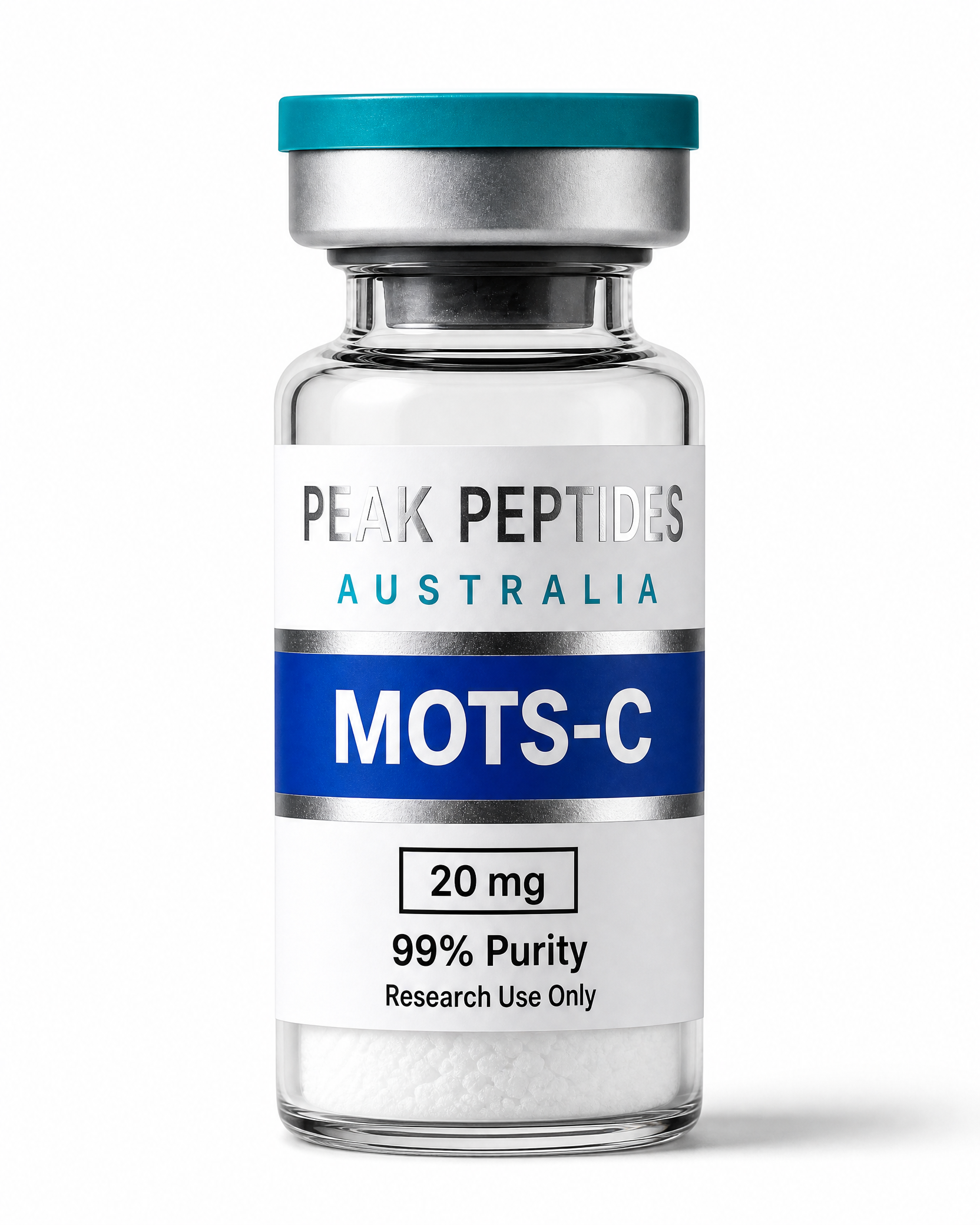
MOTS-C 20mg is a labelled lyophilised research vial. Lyophilised means the peptide is supplied as a dry powder after water removal. The 20mg label identifies the nominal quantity in this vial. This material is supplied for in-vitro research only.
MOTS-C 20mg at a glance — the 20mg label claim and the submitted-sample LabDoc measurements are shown separately.
How does MOTS-C work in research?
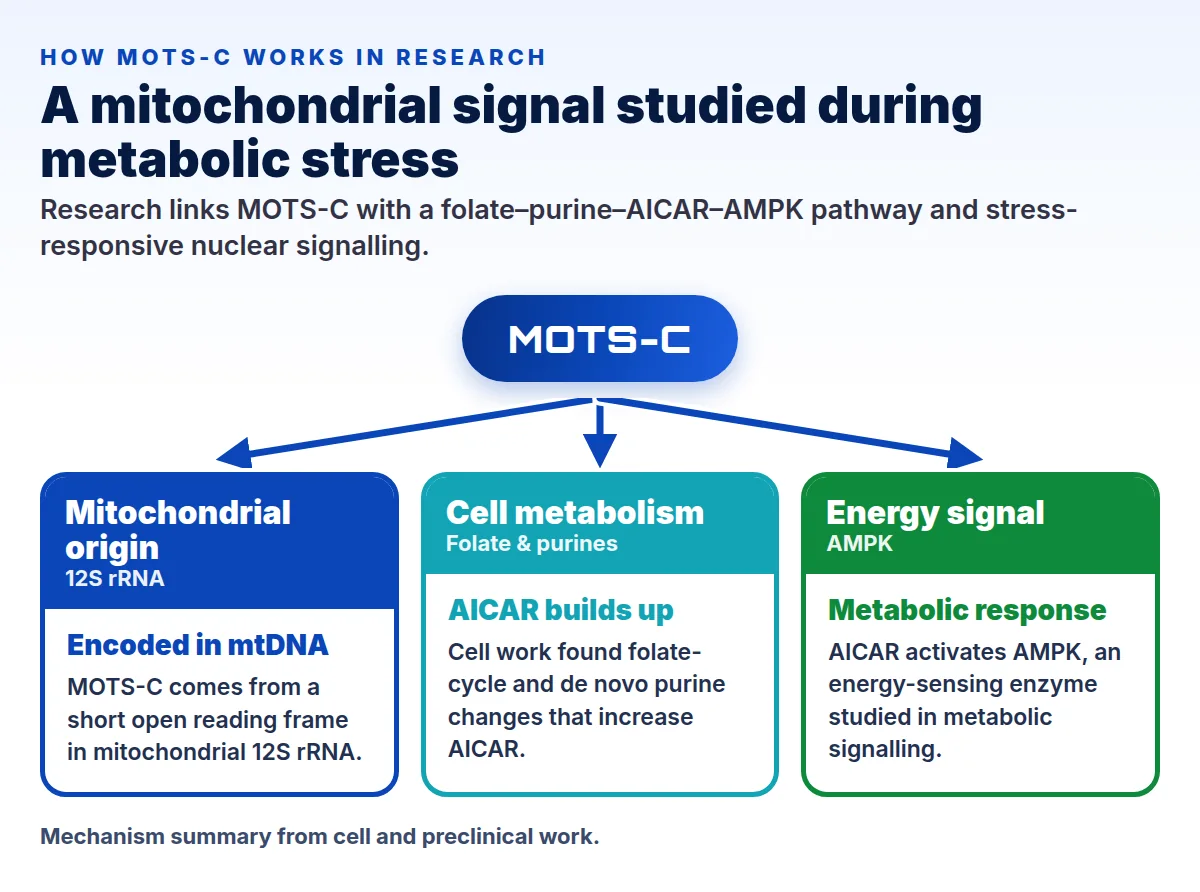
MOTS-C is studied as a metabolic-stress signal. The original Cell Metabolism paper reported that it affects the folate cycle and the linked de novo purine-biosynthesis pathway in cells. Those pathway changes cause AICAR to accumulate. AICAR is a naturally occurring metabolic intermediate that can activate AMPK.
AMPK, or AMP-activated protein kinase, is an enzyme that helps a cell adapt when energy availability changes. The 2015 work connected the folate–purine–AICAR pathway to AMPK activation and examined metabolic effects in skeletal muscle, cultured cells and laboratory models. This is the basis for the frequent link between MOTS-C and energy-sensing research.
A later cell study added a second part of the picture. Under metabolic stress, MOTS-C moved into the nucleus in an AMPK-dependent way. In the nucleus it regulated a broad set of genes during glucose restriction and interacted with stress-responsive transcription factors. The diagram summarises those research pathways; it is not a therapeutic claim for this vial.
Mitochondrial 12S rRNA: the genomic region that encodes MOTS-C.
Folate and purine pathways: cellular pathways examined in the 2015 discovery work.
AICAR: the intermediate that accumulated in the reported pathway model.
AMPK: an enzyme that responds to cellular energy status.
Nuclear translocation: movement of MOTS-C to the nucleus under metabolic stress in cell experiments.
The core published pathway model: mitochondrial origin, folate and purine changes, AICAR and AMPK.
What has MOTS-C research found?
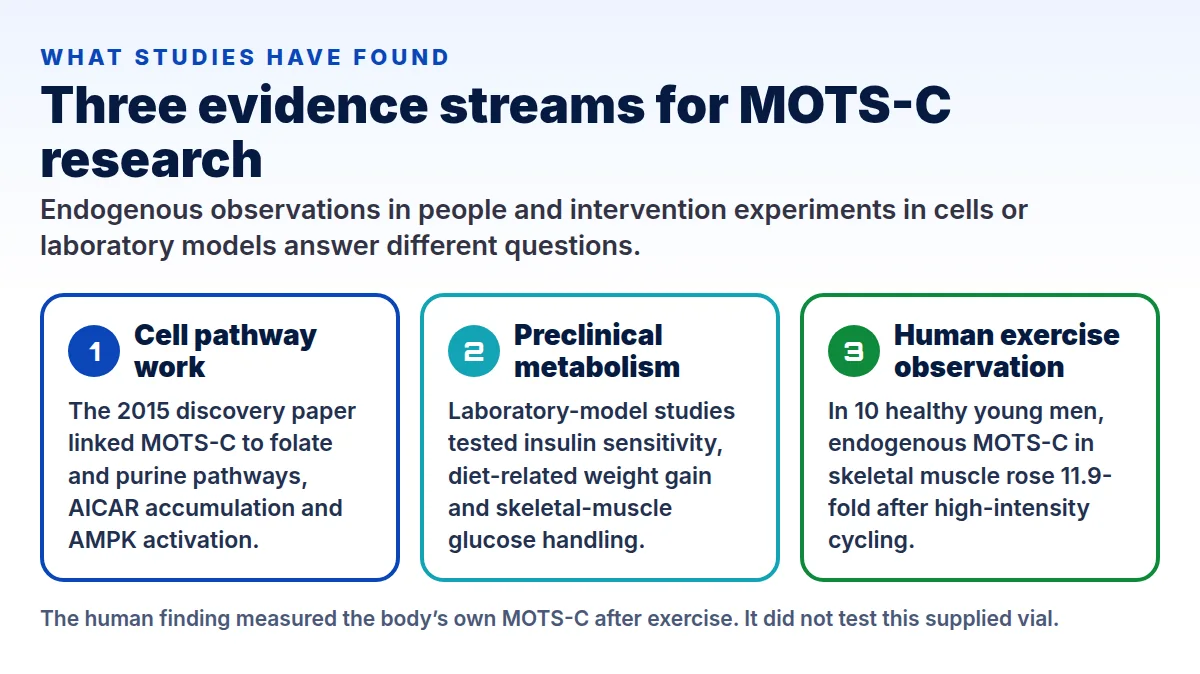
MOTS-C research has three distinct evidence streams. The first is cell-pathway work, which asks what a peptide does inside a cell. The second is preclinical work, which tests biological responses in laboratory models. The third is human observational work, which measures naturally occurring MOTS-C rather than supplying it as a research material. Keeping these streams separate is essential.
In the original 2015 study, researchers described MOTS-C as a 16-amino-acid mitochondrial peptide and connected it with skeletal-muscle glucose metabolism, insulin sensitivity and the folate–purine–AICAR–AMPK pathway. The same paper included laboratory-model findings related to diet-induced insulin resistance and obesity.
The 2021 Nature Communications paper studied endogenous MOTS-C in a small human exercise experiment. Ten sedentary, healthy young men completed high-intensity cycling. Relative skeletal-muscle MOTS-C rose 11.9-fold after exercise and remained elevated after four hours of rest, while the blood measurement rose 1.6-fold during exercise and 1.5-fold immediately after. This was an observation of the body’s own peptide, not a trial of administered MOTS-C.
MOTS-C evidence is strongest when the research setting is named: cells, laboratory models or endogenous measurement in people.
Examples of MOTS-C research and what each design can answer
Examples of MOTS-C research and what each design can answer
Study
Setting
Finding reported
Research scope
Lee et al. 2015
Cells and laboratory models
Identified 16-amino-acid MOTS-C; linked folate and purine pathways, AICAR and AMPK
A human clinical use or a concentration for this vial
Kim et al. 2018
Cell metabolic-stress experiments
MOTS-C moved into the nucleus and regulated stress-responsive gene expression
An approved medical indication
Reynolds et al. 2021
10 healthy young men after high-intensity cycling
Endogenous skeletal-muscle MOTS-C rose 11.9-fold after exercise
The effect of a supplied 20mg vial
The study design determines what the result means. Endogenous measurement, cell work and laboratory-model intervention are different study approaches.
MOTS-C 20mg vs MOTS-C 10mg
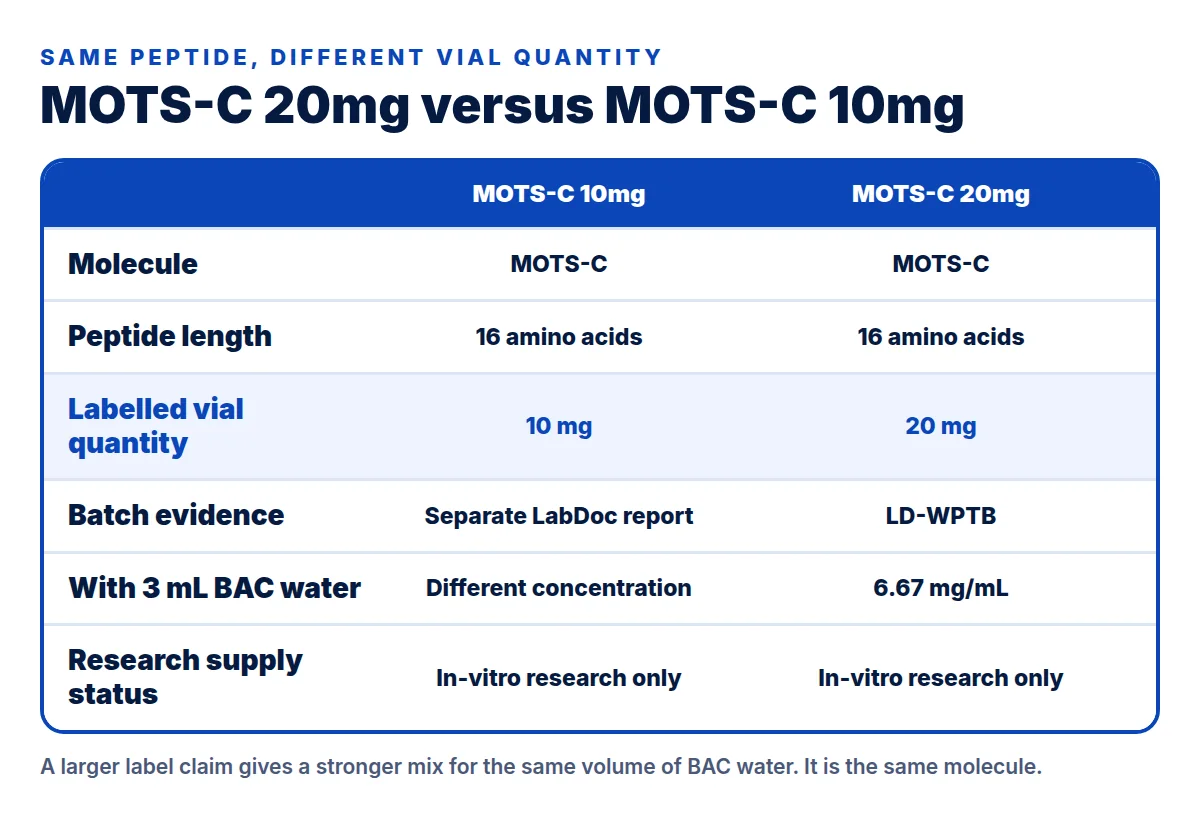
MOTS-C 20mg and MOTS-C 10mg contain the same named peptide. Both are intended as in-vitro research materials. The difference is nominal vial quantity. A 20mg label claim divided by the same final liquid volume gives twice the concentration of a 10mg label claim divided by that volume.
For example, the source-described 3mL preparation gives 6.67mg/mL when calculated from a 20mg label claim. That concentration is specific to the 20mg calculation. It must not be copied onto a 10mg vial, because its starting quantity is different. The 20mg label also does not override the actual submitted-sample LabDoc content finding.
This 20mg listing is connected to LabDoc report LD-WPTB. The 10mg listing has a separate sample report. Each product-specific report measures identity, purity and content.
The same peptide, different labelled quantity — and each strength has its own evidence record.
Milligram label claims, batch evidence and final concentration calculations must stay associated with the correct product strength.
MOTS-C structure and sequence
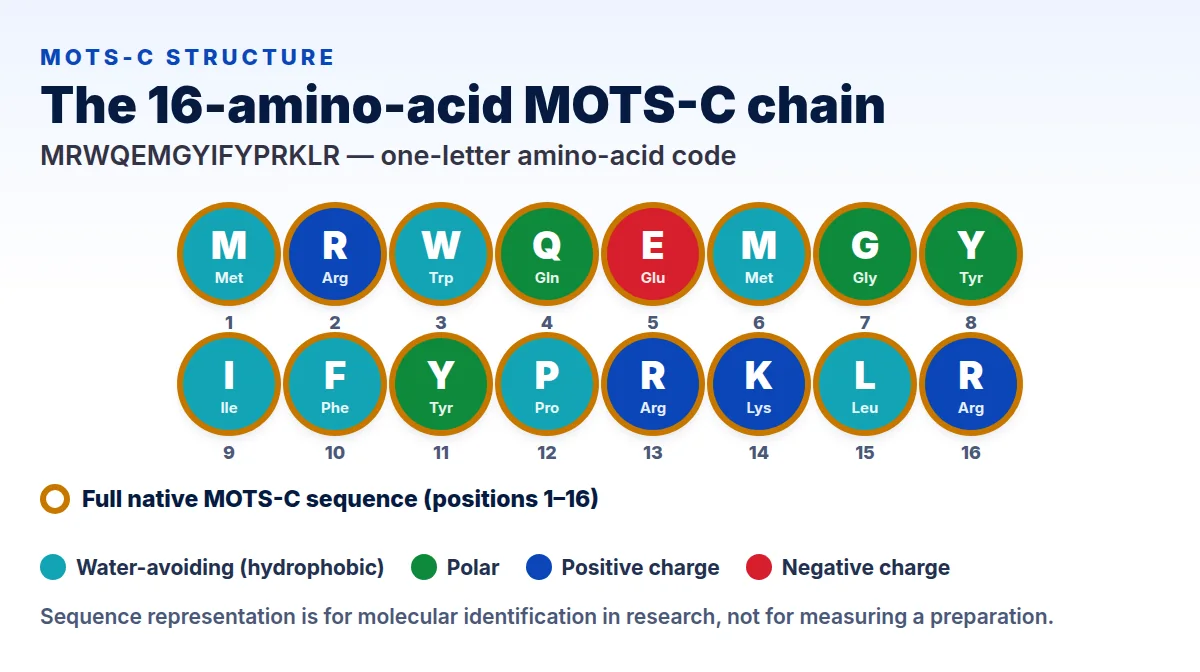
MOTS-C is short by peptide standards: its human sequence has 16 amino acids. Written in the standard one-letter amino-acid code, it is MRWQEMGYIFYPRKLR. The 2015 discovery paper described the sequence as arising from a 51-base-pair short open reading frame inside mitochondrial 12S rRNA.
The one-letter code provides a compact way to identify a peptide chain. M means methionine, R means arginine, W means tryptophan and so on. The visual sequence card expands each letter into an amino-acid name and shows its position in the 16-residue chain.
Sequence identity, purity and vial content answer different quality questions. A sequence describes the intended molecule. LC-MS identity testing checks the molecule in a submitted sample. HPLC purity estimates how much of the tested material matches the main peptide peak. A content result estimates how much peptide was measured in the vial.
MOTS-C’s published 16-amino-acid sequence: MRWQEMGYIFYPRKLR.
Independent lab test for this MOTS-C 20mg vial
MOTS-C 20mg is backed by LabDoc report LD-WPTB. The report records a 10 September 2026 test date and an overall Pass assessment. Its identity section says Confirmed by LC-MS, its HPLC result records 99.49% purity, and its content result records 18.14mg against the 20mg label claim.
These terms should not be merged. LC-MS, or liquid chromatography–mass spectrometry, checks identity by separating material and measuring molecular mass information. HPLC, or high-performance liquid chromatography, measures the main peptide peak relative to related material. The content assay reports the quantity found in the submitted vial sample.
LD-WPTB’s 18.14mg measured content equals 90.7% of the 20mg label claim. The source-described 3mL chart on this page still shows the standard label-claim calculation because that is how the 20mg reference expresses its vial math. The page labels that distinction every time: 6.67mg/mL is based on 20mg divided by 3mL, while 18.14mg is the independent submitted-sample result.
Report ID: LD-WPTB.
Tested: 10 September 2026.
Identity: Confirmed by LC-MS.
Purity: 99.49% by HPLC.
Measured content: 18.14mg against a 20mg label claim.
Related impurities: 0.51%.
Overall LabDoc assessment: Pass.
LabDoc LD-WPTB submitted-sample results
LabDoc LD-WPTB submitted-sample results
Test area
Result
Meaning
Identity
Confirmed by LC-MS
The submitted sample matched the MOTS-C identity test
Purity
99.49% by HPLC
Purity measurement for the submitted sample
Content
18.14mg
Measured peptide content in the submitted sample
Label-claim proportion
90.7% of 20mg
Content result divided by the nominal 20mg label claim
Related impurities
0.51%
Related material recorded in the HPLC result
A LabDoc result documents the submitted sample. It is not a statement of sterility, medicine approval or clinical suitability.
Buying MOTS-C 20mg in Australia
MOTS-C 20mg is supplied by Peak Peptides Australia for in-vitro research only. The page provides the product-specific LabDoc evidence and a visual preparation guide so the 20mg label claim, the submitted-sample results and the concentration maths are easy to distinguish. It is not an approved medicine.
Same-day dispatch from Victoria for in-stock orders once payment is confirmed, tracked Australia Post Express, with the tracking number emailed. The relevant local product choices are the MOTS-C 10mg listing for the smaller labelled quantity, Bacteriostatic Water 10ml for the shown mixing medium, and the reconstitution calculator for checking volume calculations.
Confirm the report ID, sample name, test date, identity method, purity result and content result. For this 20mg page the relevant report is LD-WPTB, not the 10mg report. The LabDoc link gives the direct product-specific verification record.
Step-by-step guide · About 10 minutes
How to reconstitute MOTS-C 20mg (step-by-step with photos)
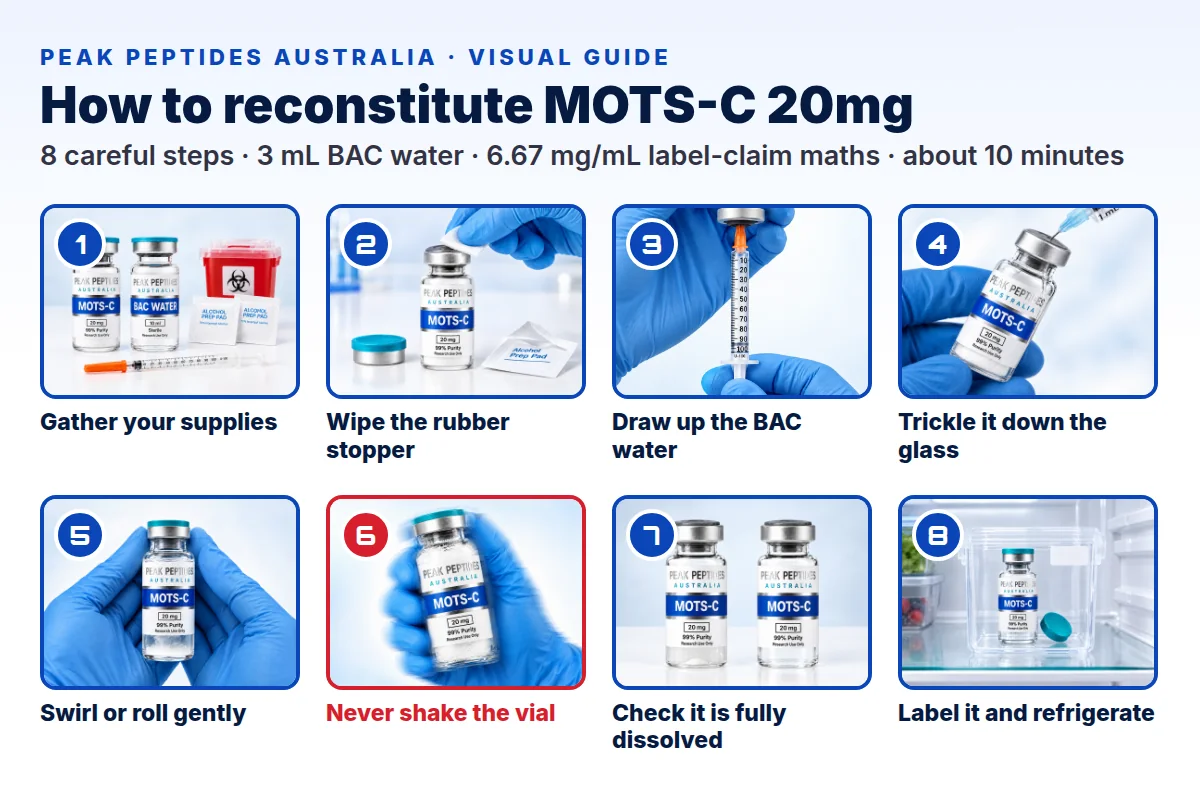
MOTS-C 20mg is supplied as a dry, lyophilised powder. Reconstitution means adding a defined volume of bacteriostatic water to make a measured liquid preparation. The preferred 20mg reference describes 3mL BAC water. Calculated from the vial’s 20mg label claim, that gives 6.67mg/mL and 15 U-100 units per 1mg. The LabDoc submitted-sample content result is 18.14mg, so do not present label-claim maths as a substitute for that measured result. The visual sequence below shows slow wall-side addition, gentle swirling and a clear visual end point.
The MOTS-C 20mg visual preparation sequence — use the 3mL source-described label-claim mix only as measurement maths.
What you need
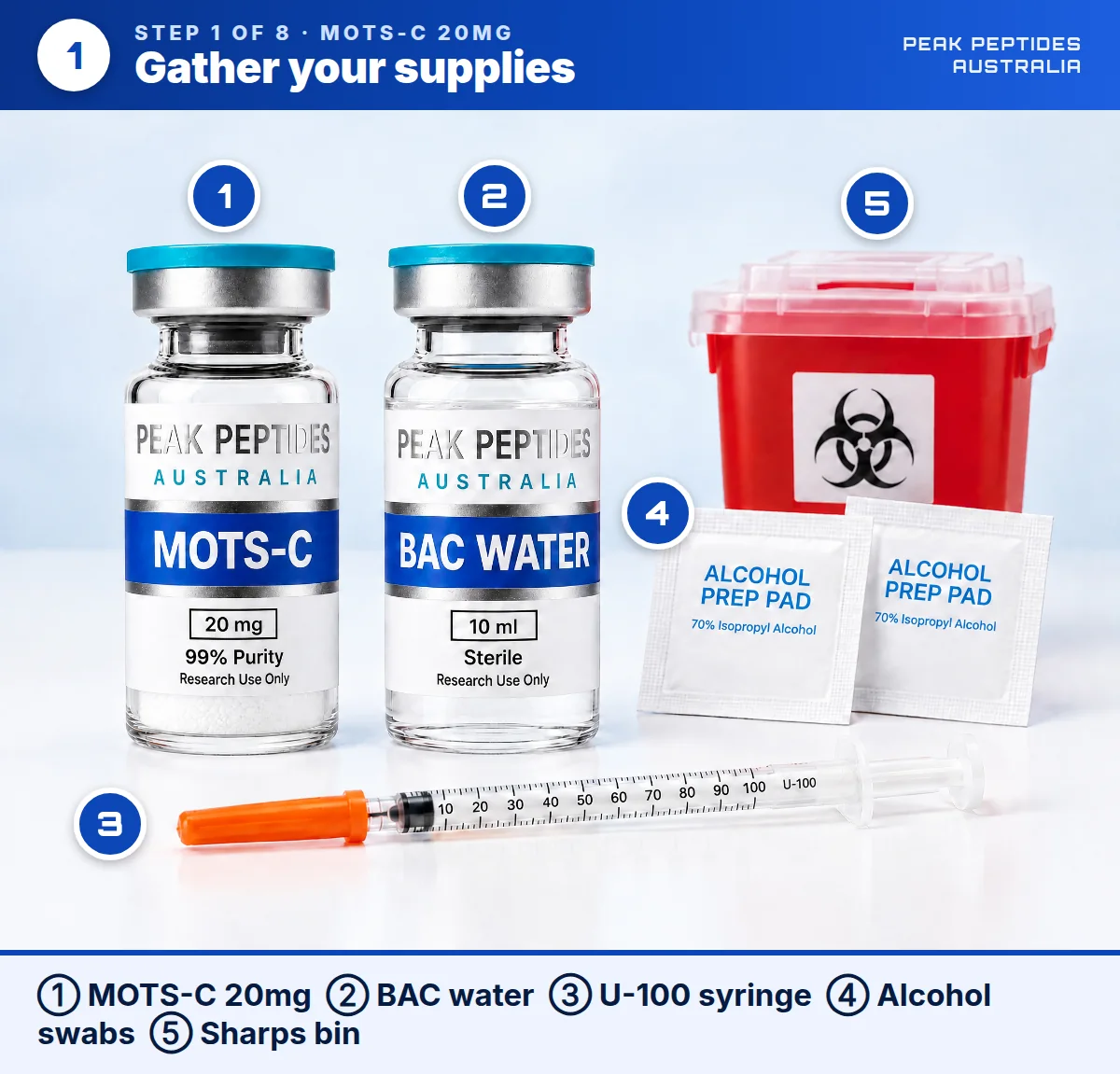
MOTS-C 20mg vialLabelled lyophilised research material; this page uses LD-WPTB for submitted-sample evidence.
Bacteriostatic waterThe mixing reference on this page specifies BAC water and describes a 3mL preparation.
New sterile 1mL U-100 syringeA U-100 scale has 100 units per 1mL, so one unit is 0.01mL.
Alcohol swabsFor cleaning the vial stoppers before preparation.
Clean work surfaceUse the laboratory cleanliness and documentation requirements that apply to the research method.
Sharps containerFor safe disposal of used needles in the laboratory setting.
How much BAC water to add to MOTS-C 20mg
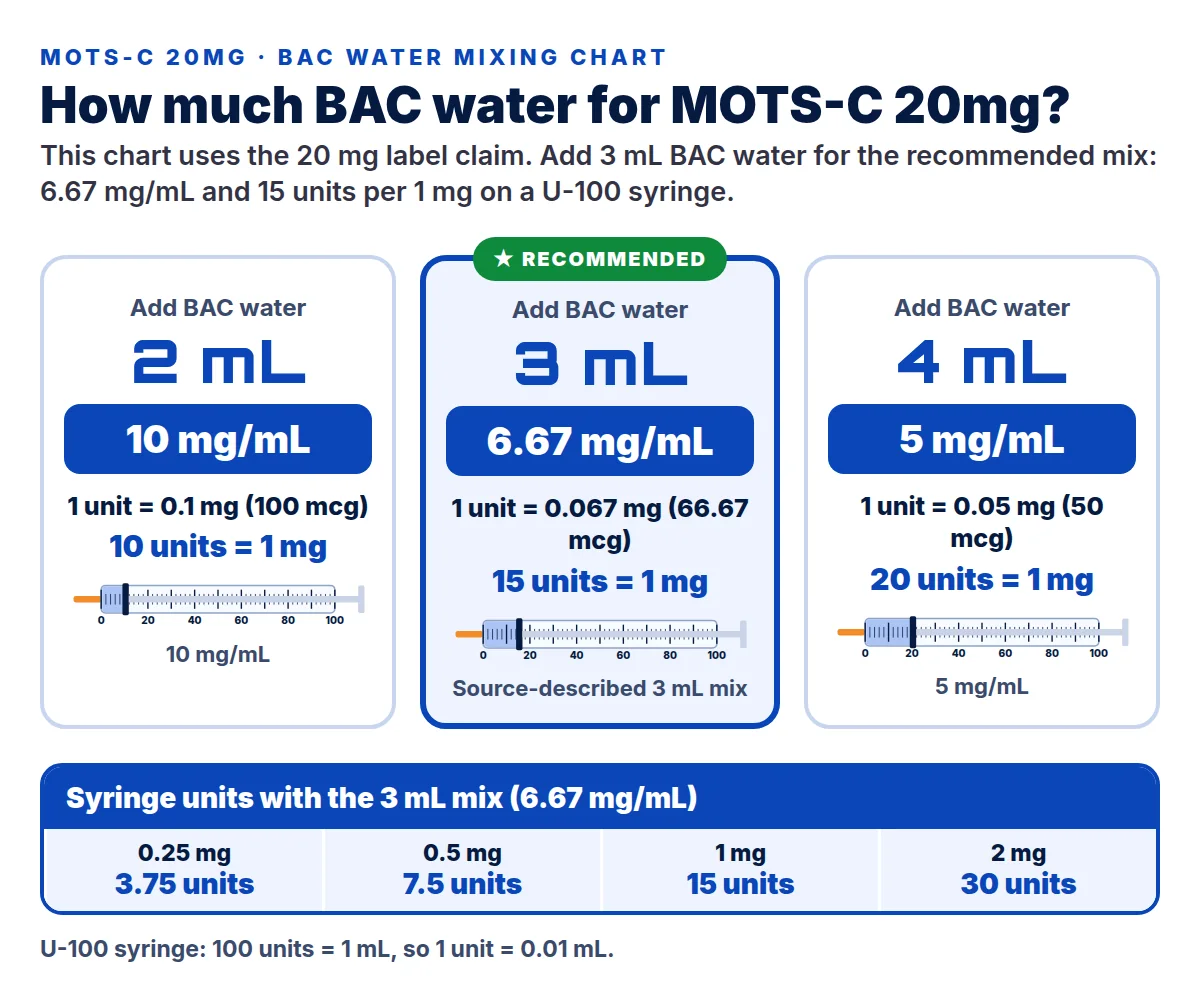
The 20mg label claim is the fixed starting amount in the chart. Adding a larger volume does not add peptide; it lowers the concentration. The preferred MOTS-C 20mg reference describes adding 3mL BAC water, producing 6.67mg/mL when calculated from a 20mg label claim. On a U-100 scale, that is 0.067mg, or 66.67mcg, per unit and 15 units per 1mg.
The alternate chart examples show the same label claim with 2mL and 4mL. Two millilitres produces 10mg/mL, where one unit holds 0.1mg and 1mg is 10 units. Four millilitres produces 5mg/mL, where one unit holds 0.05mg and 1mg is 20 units.
The LabDoc content result is separate: LD-WPTB measured 18.14mg in the submitted sample. The 3mL, 6.67mg/mL and 15-unit figures remain clearly identified as calculations using the vial’s nominal 20mg label claim.
MOTS-C 20mg label-claim mixing chart — 3mL BAC water gives 6.67mg/mL and 15 U-100 units per 1mg.
3 mL is highlighted because it gives the simplest numbers.
Syringe units with the 3 mL mix (6.67 mg/mL)
Syringe units with the 3 mL mix (6.67 mg/mL)
Amount
Units on a U-100 syringe
Volume
0.25 mg
3.75 units
0.037 mL
0.5 mg
7.5 units
0.075 mL
1 mg
15 units
0.15 mL
2 mg
30 units
0.3 mL
The 8 steps
1Step 1: Gather your supplies
Arrange the MOTS-C 20mg vial, BAC water, a new sterile 1mL U-100 syringe, alcohol swabs and a sharps container on a clean work surface. Confirm the vial label reads MOTS-C and 20mg. Keep the LabDoc report ID, LD-WPTB, with the preparation record so sample evidence remains traceable.
2Step 2: Wipe the rubber stopper
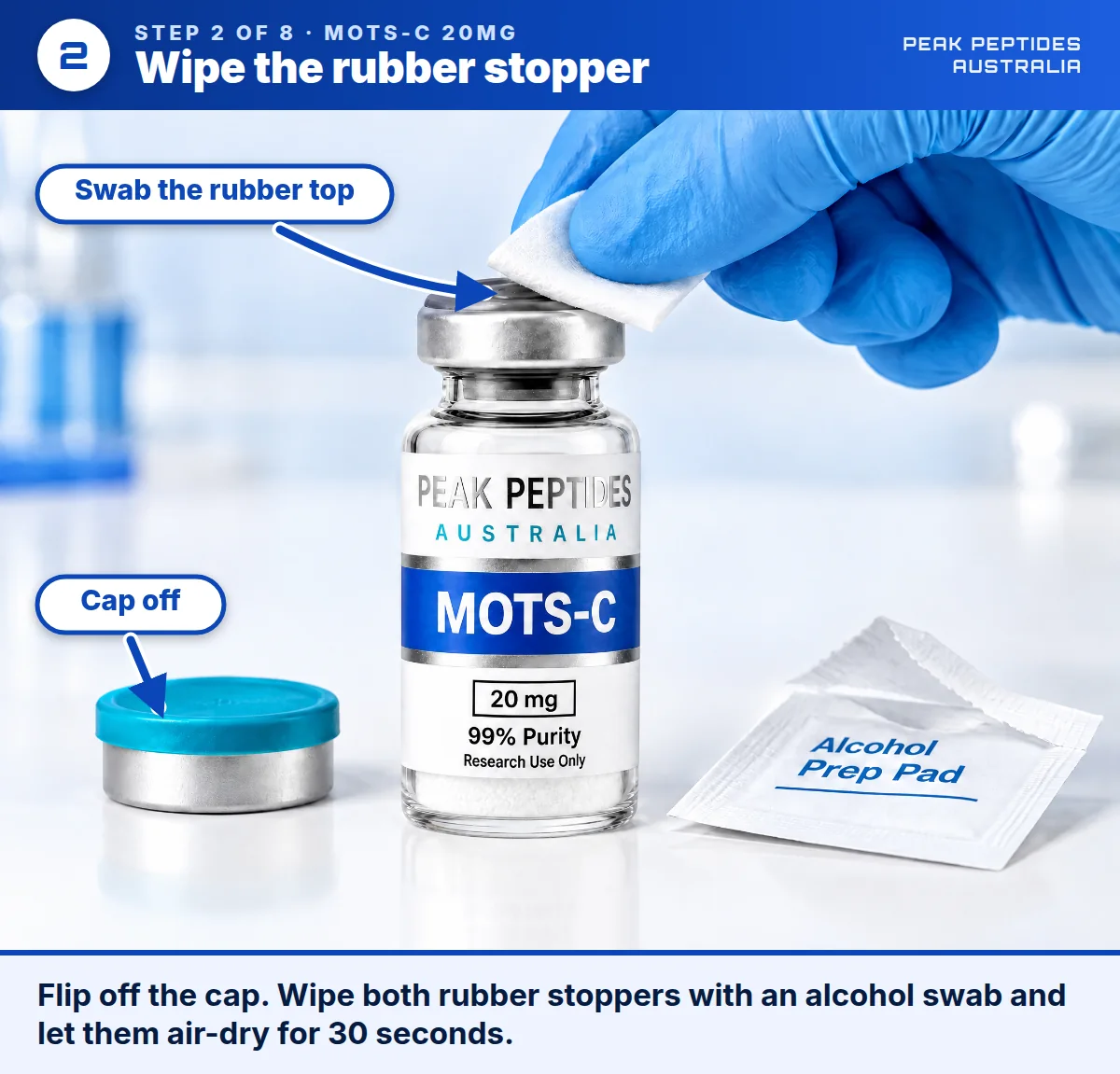
Remove the flip-off caps without touching the exposed rubber stoppers. Wipe the rubber stopper on the MOTS-C 20mg vial and the BAC water vial with separate alcohol swabs. Let both surfaces air-dry before continuing. A dry, cleaned stopper supports careful laboratory handling and avoids carrying swab liquid into the vial.
3Step 3: Draw up the BAC water
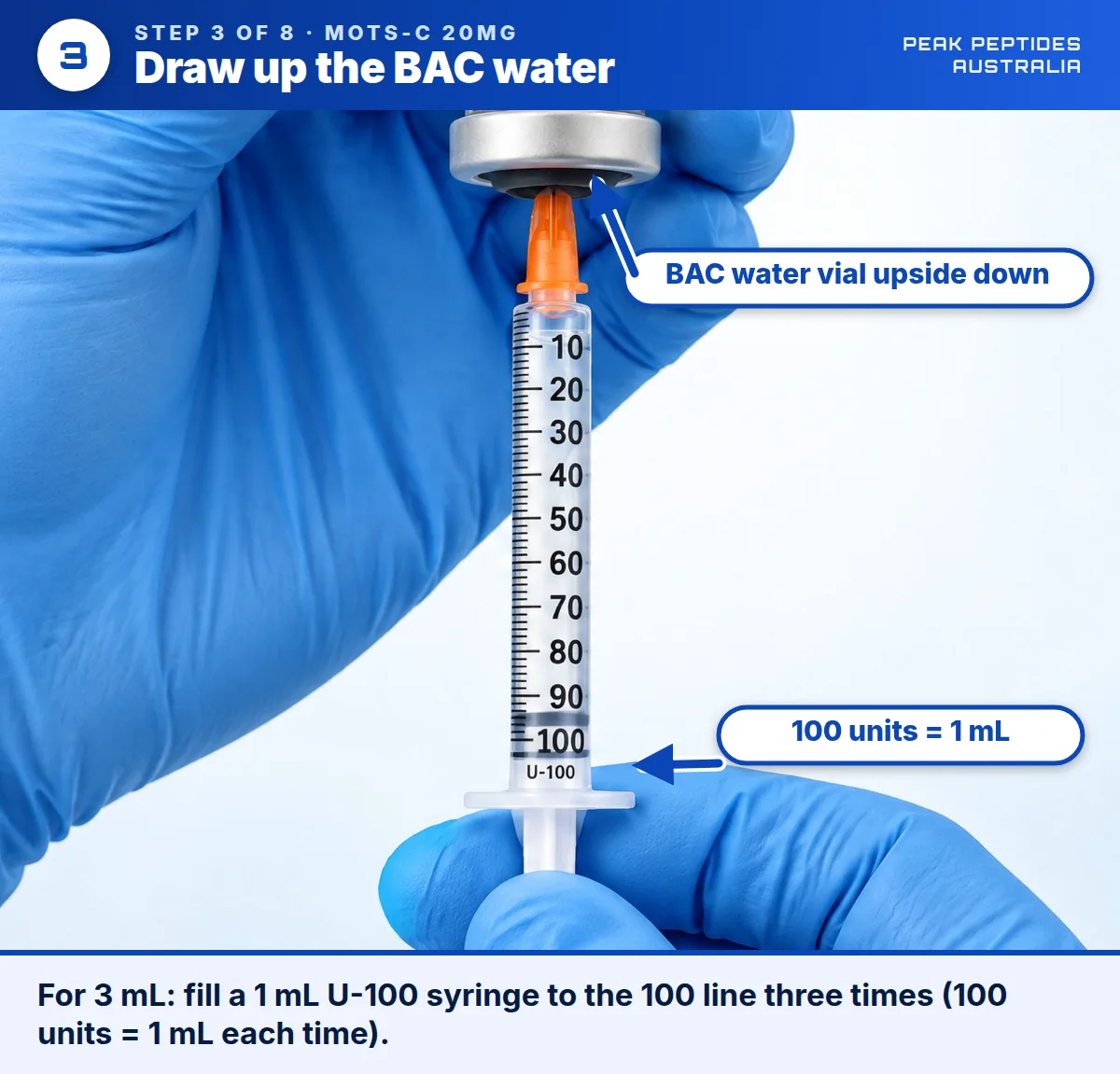
Use a new sterile 1mL U-100 syringe to draw 1mL, or 100 units, of BAC water. The source-described 3mL label-claim mix uses three 1mL draws in total. Check the liquid level against the scale and remove large air gaps before transferring the water to the MOTS-C vial.
4Step 4: Trickle it down the glass
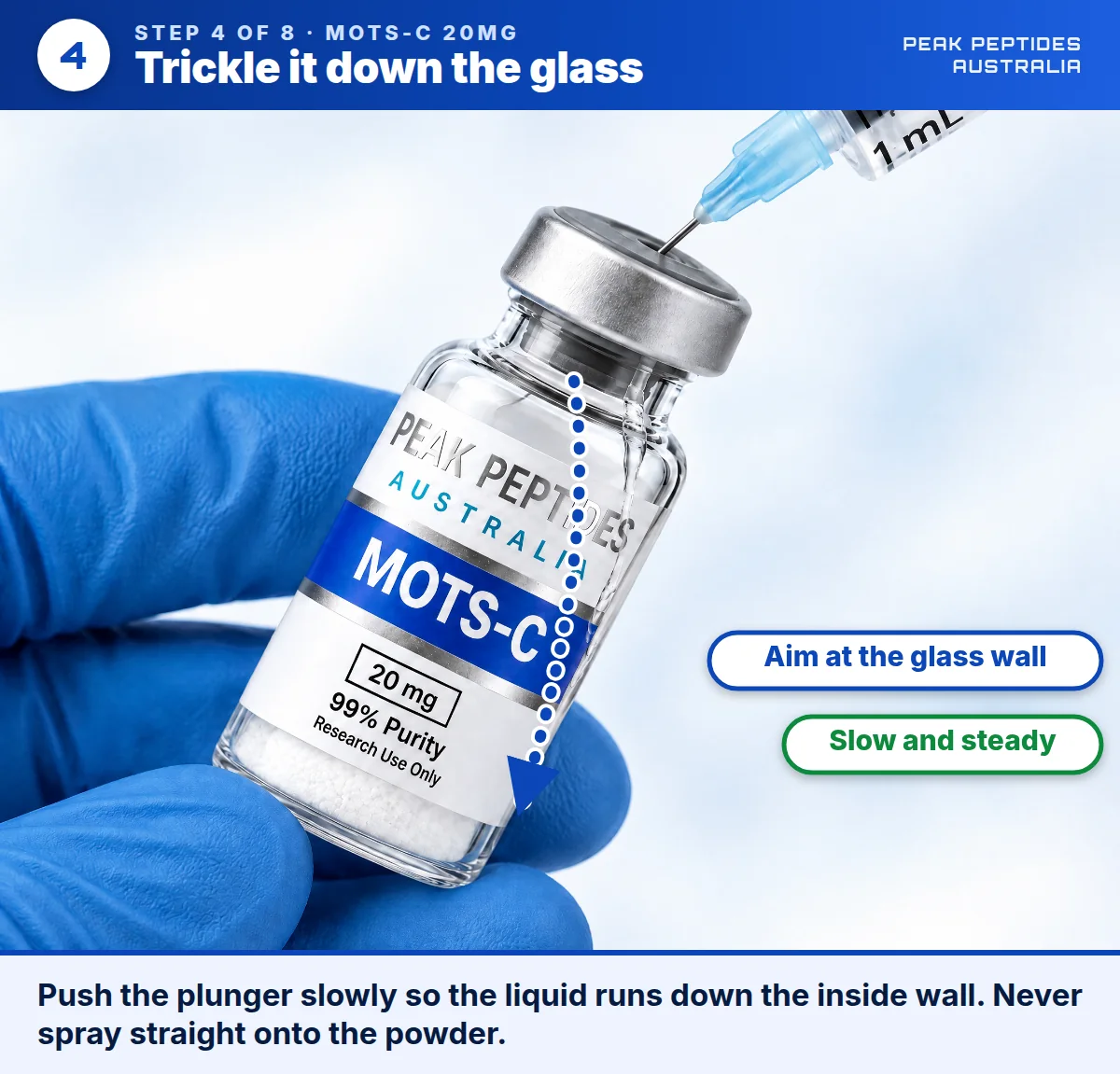
Hold the MOTS-C 20mg vial at an angle and place the needle tip against the inside wall of the glass. Depress the plunger slowly so BAC water runs down the wall rather than striking the powder directly. Repeat the slow transfer until the total chosen volume has been added.
5Step 5: Swirl or roll gently
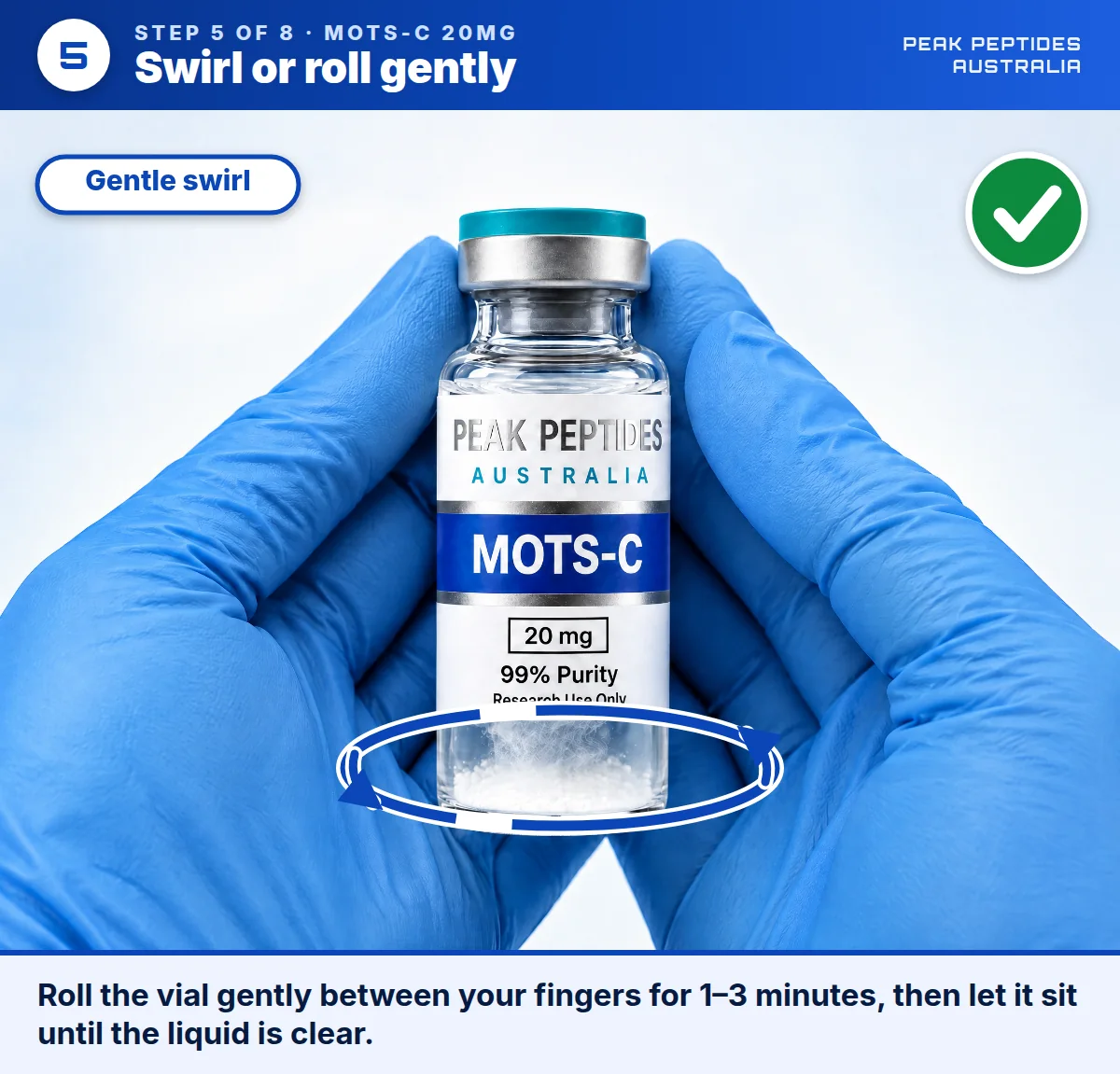
Gently swirl the MOTS-C 20mg vial in slow circles or roll it carefully between the fingers. This lets liquid contact the powder without creating unnecessary foam. Continue only until the material has had time to dissolve. The goal is a clear, evenly mixed appearance, not a forceful agitation step.
6Step 6: Never shake the vial
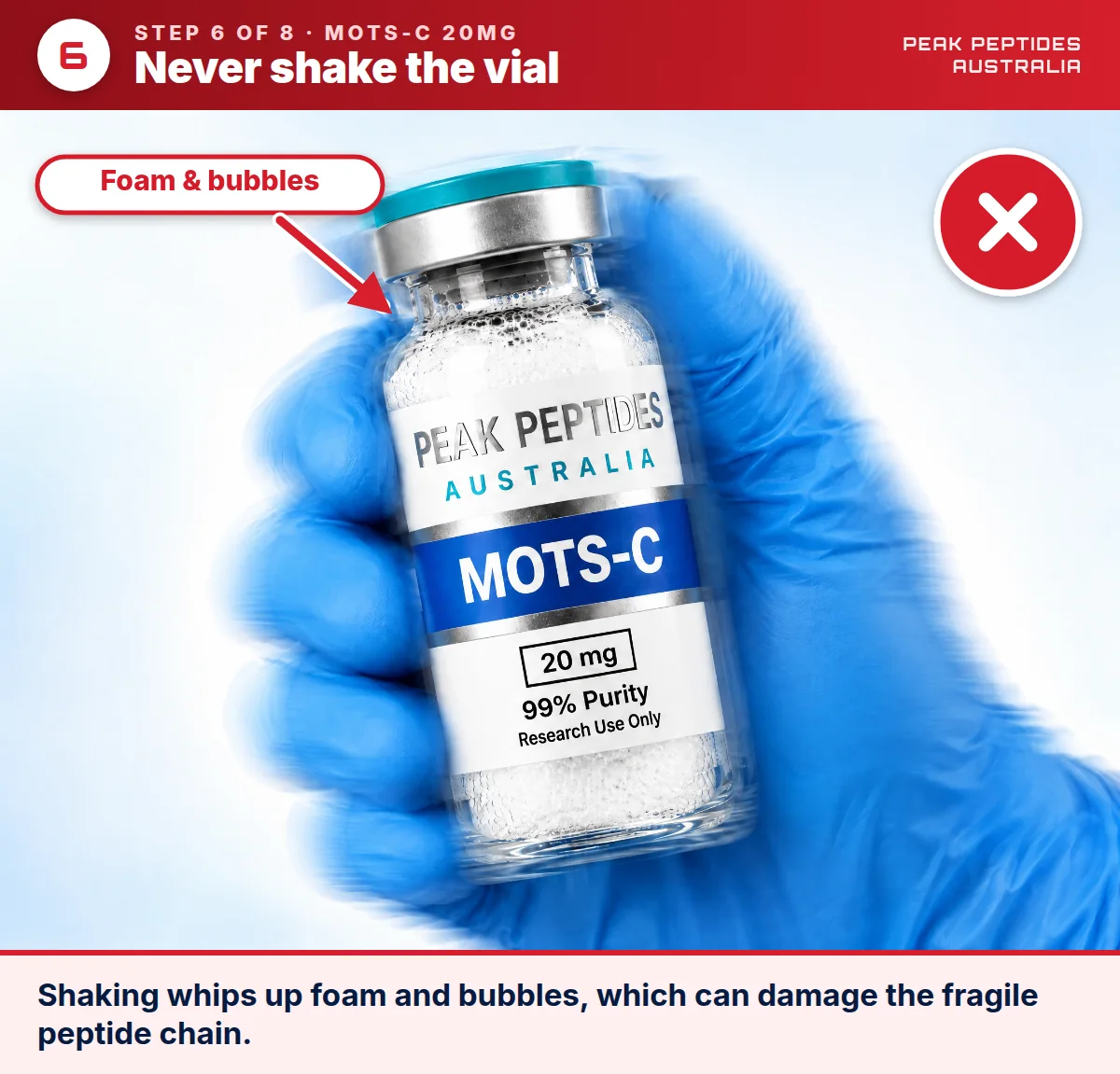
Do not shake the vial to speed up dissolution. Vigorous shaking produces foam and bubbles, which makes the visual quality check difficult and can disrupt careful peptide handling. If foam has formed, stand the vial upright and allow the bubbles to settle before assessing whether the material has fully dissolved.
7Step 7: Check it is fully dissolved
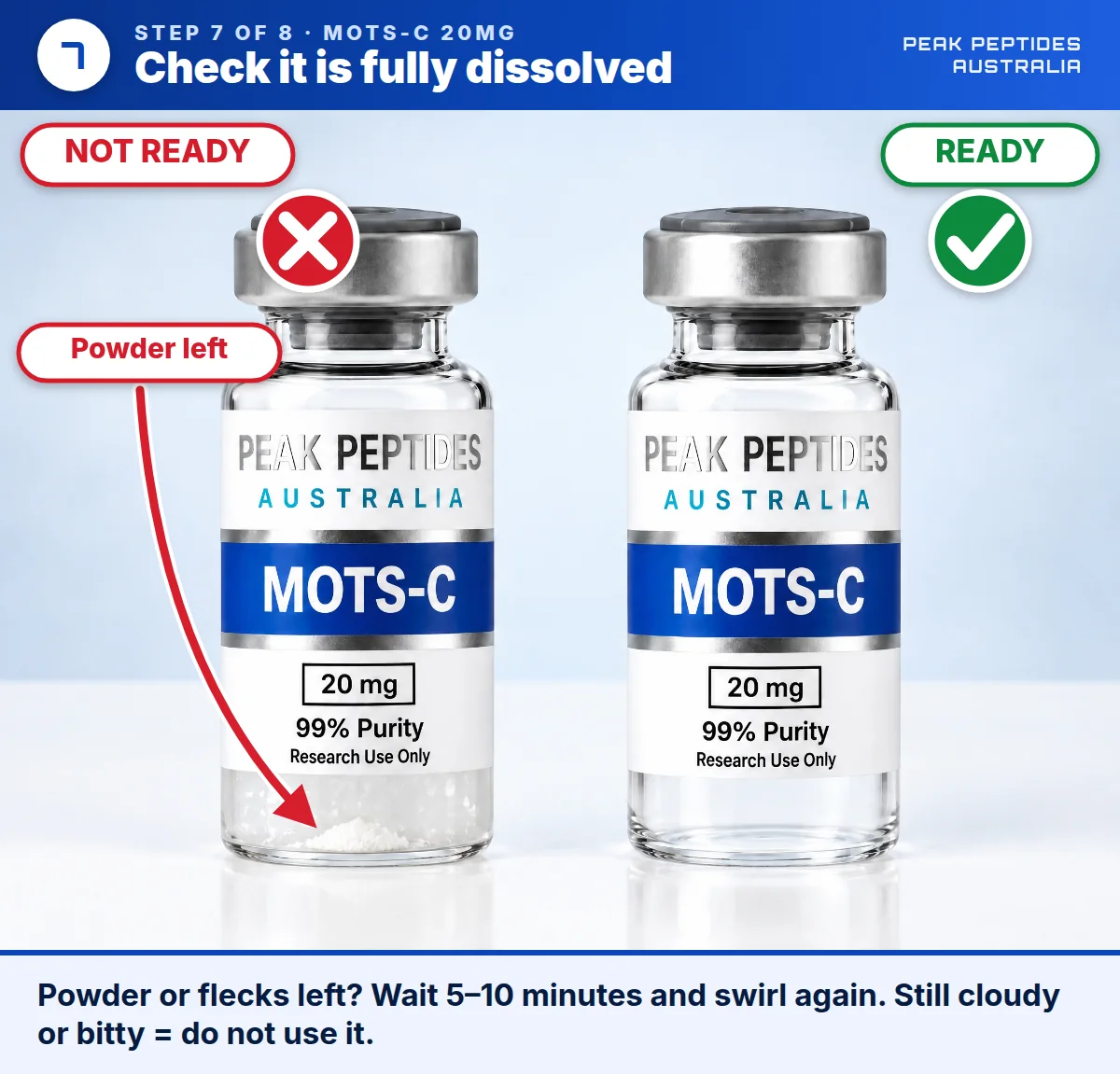
Inspect the vial against a well-lit background. The finished preparation should look clear, without visible powder, flecks, cloudiness or unexpected colour. If material remains at the bottom, allow more time and swirl gently again. Record unresolved cloudiness or particles under the relevant laboratory quality procedure rather than treating the vial as clear.
8Step 8: Label it and refrigerate
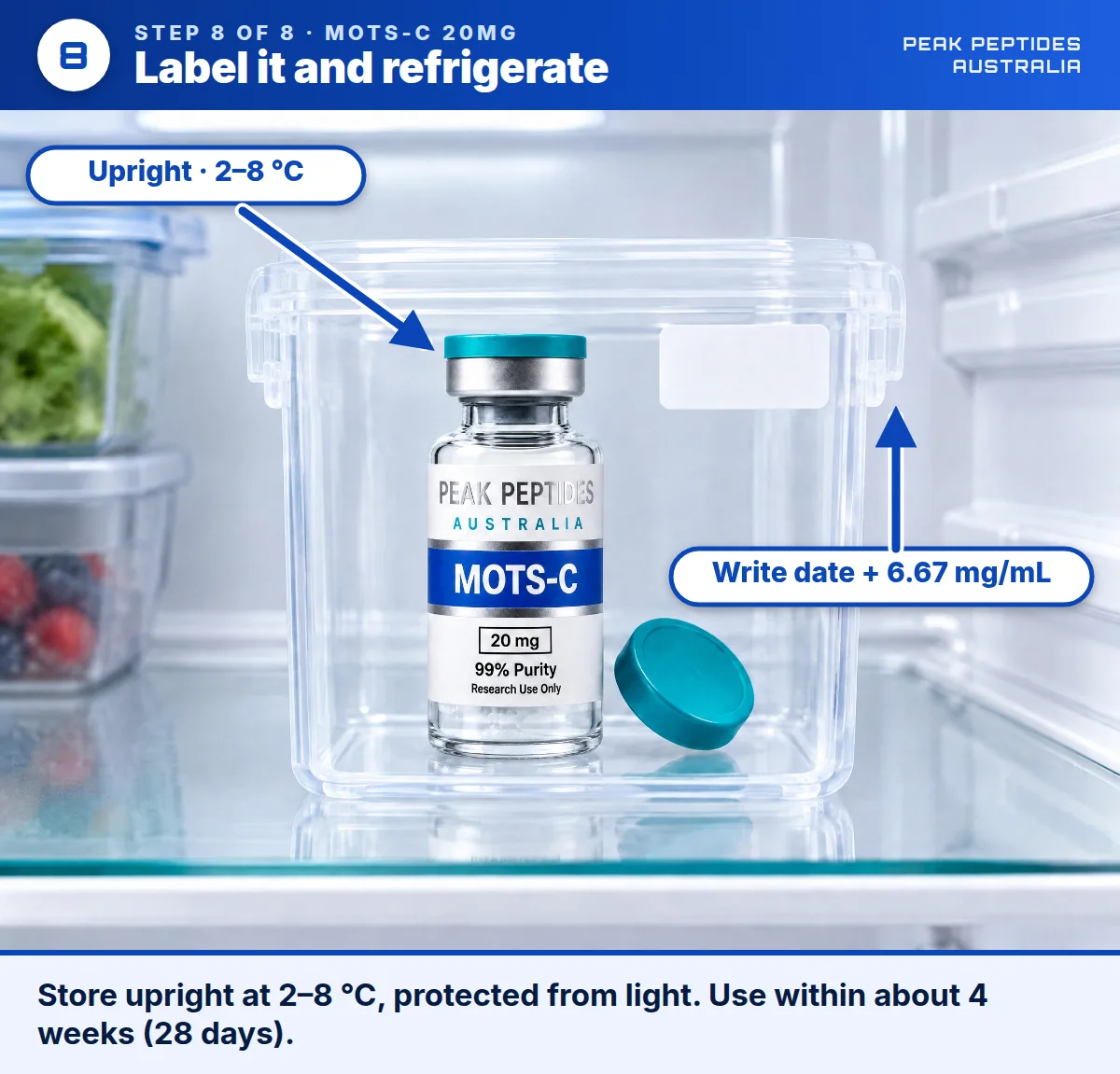
Label the prepared vial with the preparation date, chosen final volume and calculated label-claim concentration. For the source-described 3mL mix, write 6.67mg/mL. Store upright in the fridge at 2–8°C, away from light. Use within about 4 weeks (28 days) and never freeze it.
MOTS-C 20mg storage
Storage context from the opened MOTS-C references
Storage context from the opened MOTS-C references
Form
Where to keep it
How long
Freeze-dried MOTS-C
Freezer, −20 °C or colder, dry and in the dark
Long-term
Mixed with BAC water
Fridge, 2–8 °C, upright and away from light
About 4 weeks (28 days)
Mixed with BAC water
Freezer
Never — freezing damages the mixed peptide
Do not carry the dry-powder storage statement over to a mixed preparation. The relevant sources distinguish lyophilised storage from refrigerated mixed-vial handling.
MOTS-C is a 16-amino-acid mitochondrial-derived peptide. Its full name is mitochondrial open reading frame of the 12S rRNA-c. Researchers study it as a signal involved in cellular energy balance, metabolic stress responses and communication between mitochondria and the nucleus.
What is MOTS-C used for in research?
MOTS-C is used in research on metabolic signalling. The main published areas include skeletal-muscle glucose handling, folate and purine pathways, AICAR, AMPK activation and stress-responsive nuclear gene expression. These are research topics, not approved therapeutic uses.
Is MOTS-C 20mg a different or stronger peptide than MOTS-C 10mg?
No. Both listings refer to the same MOTS-C molecule. The 20mg vial has a larger label claim, so the same volume of BAC water makes a stronger concentration than a 10mg vial. The molecule, 16-amino-acid sequence and research background stay the same.
What does 20mg mean on the MOTS-C vial?
20mg is the nominal amount printed on the vial label. It is the starting value for the concentration chart: 20mg divided by 3mL gives 6.67mg/mL.
How does MOTS-C work in laboratory studies?
The original MOTS-C paper linked its cellular action to inhibition of the folate cycle and connected de novo purine synthesis. That increased AICAR, a metabolite that activates AMPK. AMPK is an enzyme that helps cells respond to energy availability.
What is the link between MOTS-C and the nucleus?
In a Cell Metabolism study, metabolic stress caused MOTS-C to move from mitochondria into the nucleus in an AMPK-dependent way. There it influenced stress-responsive nuclear genes and interacted with transcription-factor systems that recognise antioxidant response elements.
What did the 2015 MOTS-C study find?
The 2015 Cell Metabolism paper identified MOTS-C as a 16-amino-acid peptide encoded within mitochondrial 12S rRNA. In cell and preclinical studies, the team linked it with skeletal-muscle metabolism, insulin sensitivity, diet-related weight gain and AMPK signalling.
What did the human exercise study find about MOTS-C?
A 2021 study measured endogenous MOTS-C in 10 healthy young men completing high-intensity cycling. Skeletal-muscle MOTS-C rose 11.9-fold after exercise, while circulating MOTS-C rose 1.6-fold during exercise and 1.5-fold immediately after. It did not test supplied MOTS-C.
Are there human trials of administered MOTS-C?
No completed clinical trial has established an administered MOTS-C regimen. The preferred 20mg reference describes human exercise observations rather than treatment studies, and the FDA’s 2026 review reported that it did not identify clinical studies evaluating the proposed MOTS-C uses.
What side effects have been reported in MOTS-C studies?
No standardised human study has established a side-effect profile for administered MOTS-C. The FDA’s 2026 review found no human exposure data for compounded MOTS-C drug products and discussed impurities, aggregation, immunogenicity and product characterisation.
What is the half-life of MOTS-C?
The sources used for this page provide no established human pharmacokinetic half-life. The FDA review identified no human exposure data for compounded MOTS-C products.
Is MOTS-C approved by the TGA or FDA?
No. MOTS-C is not an FDA-approved medicine; the FDA says MOTS-C free base and MOTS-C acetate are not components of FDA-approved drugs. The ARTG is Australia’s register of products that can be supplied as therapeutic goods, and a MOTS-C search did not return a MOTS-C medicine listing when checked for this guide.
Can I buy MOTS-C 20mg online in Australia?
MOTS-C 20mg can be ordered online from Peak Peptides Australia when available. It is supplied for in-vitro research only. Same-day dispatch from Victoria for in-stock orders once payment is confirmed, tracked Australia Post Express, with the tracking number emailed.
How fast is MOTS-C 20mg dispatched in Australia?
Same-day dispatch from Victoria for in-stock orders once payment is confirmed, tracked Australia Post Express, with the tracking number emailed. Delivery timing after dispatch depends on the Australia Post Express network and the destination.
How is this MOTS-C 20mg sample verified?
This listing is backed by LabDoc report LD-WPTB. Tested on 10 September 2026, it records confirmed identity by LC-MS, 99.49% purity by HPLC and 18.14mg measured content against the 20mg label claim. The report is available through the LabDoc verification link.
Why does the LabDoc report show 18.14mg rather than 20mg?
20mg is the nominal vial label claim. LabDoc measured 18.14mg in the submitted sample and recorded that as 90.7% of the label claim. That content result is separate from the 99.49% HPLC purity result. The report’s findings apply to the submitted sample.
Can I use the MOTS-C 10mg COA for this 20mg vial?
No. MOTS-C 10mg and MOTS-C 20mg have separate submitted samples and separate LabDoc reports. This 20mg page uses LD-WPTB. The 10mg listing has its own report, so its measured content and purity should not be represented as 20mg results.
How much BAC water for MOTS-C 20mg?
The preferred MOTS-C 20mg reference describes 3mL BAC water. Using the 20mg label claim, 3mL makes 6.67mg/mL. This page also shows 2mL, which makes 10mg/mL, and 4mL, which makes 5mg/mL. The amount of labelled peptide stays 20mg.
How many U-100 units is 1mg with the 3mL MOTS-C 20mg mix?
With the 3mL label-claim mix, the strength is 6.67mg/mL and 1mg equals 15 units on a U-100 syringe. A U-100 scale has 100 units per millilitre, so 15 units equals 0.15mL.
How many milligrams are in 10 U-100 units with the 3mL mix?
The chart gives 0.067mg, or 66.67mcg, per U-100 unit with the 3mL mix. Ten units therefore represent about 0.67mg by the label-claim calculation. The same chart shows that 15 units represent 1mg.
How do I reconstitute MOTS-C 20mg?
The source-described preparation is 3mL BAC water added slowly down the inside vial wall, followed by gentle swirling or rolling until the liquid is clear. The eight photo cards on this page show the handling sequence, including the instruction not to shake the vial.
Can I use sterile water or tap water instead of BAC water?
The preferred 20mg MOTS-C reference specifies bacteriostatic water for its reconstitution calculation. Tap water has no place in sterile laboratory preparation. Plain sterile water and bacteriostatic water are different materials.
What if the MOTS-C powder does not dissolve?
The visual guide uses slow wall-side addition and gentle swirling because that limits foaming. Allow time for material to dissolve and visually inspect the vial. Do not use shaking to force dissolution, because it creates foam and makes visual inspection harder.
Should reconstituted MOTS-C be cloudy?
The reconstitution guide uses a fully clear liquid as its visual end point. Cloudiness, visible particles, unexpected colour or an incompletely dissolved appearance mean the preparation has not met that visual check. Record the observation and follow the applicable laboratory quality procedure.
How long does mixed MOTS-C last?
Keep mixed MOTS-C in the fridge at 2–8°C, away from light, and use it within about 4 weeks (28 days).
How should MOTS-C powder be stored before mixing?
The FDA’s 2026 MOTS-C review states that lyophilised MOTS-C is expected to be stable below −20°C when desiccated and protected from light. That is a storage statement for lyophilised material. Keep the sealed vial frozen at −20 °C, dry and out of light; once mixed, keep it in the fridge at 2–8 °C.
Can reconstituted MOTS-C be frozen?
The sources used here specify refrigerated reconstituted storage at 2–8°C and do not provide a universal freeze–thaw stability claim for a mixed MOTS-C preparation. Do not infer freeze–thaw performance from the storage statement for dry lyophilised material.
What does a MOTS-C COA or LabDoc report show?
A report can distinguish identity, purity and content. For this listing, LD-WPTB records identity confirmed by LC-MS, 99.49% purity by HPLC, 18.14mg measured content and a Pass assessment. It documents the submitted sample.
Is MOTS-C the same as SS-31?
No. MOTS-C and SS-31 are different mitochondrial research peptides with different sequences and research questions. MOTS-C is the 16-amino-acid peptide encoded within mitochondrial 12S rRNA, whereas SS-31 is a separately designed peptide. Their vial quantities and concentration maths are different.