Mitochondrial Open Reading Frame of the 12S rRNA-c
MOTS-C 10mg is a freeze-dried, 16-amino-acid mitochondrial-derived peptide for in-vitro research into cellular energy signalling and metabolic stress. This 10 mg research vial is supported by LabDoc report LD-X67V for identity, purity and content. In-stock orders receive same-day dispatch from Victoria after payment confirmation, with tracked Australia Post Express shipping Australia-wide.
Product Specifications
Full NameMitochondrial Open Reading Frame of the 12S rRNA-c
Vial Size10mg
Purity98.86% HPLC (LD-X67V sample)
Legal Disclaimer
This product is sold strictly for in-vitro laboratory research purposes only. It is not intended for human or animal consumption, injection, or any diagnostic or therapeutic use.
Mitochondrial-derived peptide · 10 mg research vial
MOTS-C 10mg — Research Guide, Mixing Chart & Lab Test
MOTS-C is a 16-amino-acid peptide encoded by a short reading frame in mitochondrial 12S rRNA. Its full name is mitochondrial open reading frame of the 12S rRNA-c. Researchers study it as a signal that links mitochondrial activity with cellular energy handling, AMPK signalling and stress-responsive gene expression. This page explains the 10 mg vial label, the 3 mL BAC water reference mix, and what published studies measured. It also records this sample’s independent LabDoc analysis: LC-MS identity confirmed, 98.86% HPLC purity and 9.69 mg measured content. Peak Peptides Australia supplies MOTS-C 10mg for in-vitro research only.
Also referred to in research or catalogue references as MOTS-C, MOTS-c, MOTS C, MOTSC, MOTS C peptide, MOTS-C peptide, Mitochondrial Open Reading Frame of the 12S rRNA-c, Mitochondrial ORF of the 12S rRNA type-c, Mitochondrial Open Reading Frame of the 12S rRNA-c peptide.
MOTS-C 10mg at a glance
Full name
Mitochondrial open reading frame of the 12S rRNA-c
Also written
MOTS-C, MOTS-c, MOTS C and MOTSC
What it is
A 16-amino-acid mitochondrial-derived peptide for in-vitro research
Encoded within
A 51-base-pair short reading frame in mitochondrial 12S rRNA
Human sequence
MRWQEMGYIFYPRKLR
Core research areas
Cellular energy signalling, metabolic stress, AMPK and adaptive gene expression
Nominal vial quantity
10 mg freeze-dried MOTS-C powder
Reference mix on this page
3 mL BAC water = 3.33 mg/mL = 30 U-100 units per 1 mg
Identity
Confirmed by LC-MS in LabDoc report LD-X67V
Purity
98.86% by HPLC in LabDoc report LD-X67V
Measured content
9.69 mg against the 10 mg label claim in LD-X67V
Sample test date
11 September 2026
Regulatory and sport status
Not FDA or TGA approved; named on WADA’s 2026 Prohibited List
Dispatch
Same-day from Victoria for in-stock orders once payment is confirmed, tracked Australia Post Express, tracking number emailed
A mitochondrial 16-mer
MOTS-C is a 16-amino-acid peptide encoded within mitochondrial 12S rRNA, rather than a conventional nuclear-gene peptide. The human sequence recorded in GenBank is MRWQEMGYIFYPRKLR. Its mitochondrial genetic origin is the feature that drives research into mitochondria-to-nucleus communication.
What AMPK means here
AMPK is a cell’s energy-sensing enzyme. In the original cell research, MOTS-C changed folate and purine-pathway intermediates, increased AICAR and was associated with AMPK phosphorylation. This is a laboratory mechanism, not a demonstrated outcome from a supplied vial.
A signal that can reach the nucleus
A 2018 Cell Metabolism study found that MOTS-C moved to the nucleus during metabolic stress in studied cells. There it affected adaptive nuclear gene expression, including antioxidant-response programmes. This is why MOTS-C is studied as a mitochondrial signal rather than simply an energy ingredient.
Separate endogenous observations from material studies
Human exercise research measured naturally occurring MOTS-C. In one small exercise study, endogenous MOTS-C rose in skeletal muscle and circulation. Those observations describe the body’s own signal.
What the 10 mg label means
10 mg is the nominal total quantity of freeze-dried MOTS-C stated on the vial label. It is not a ready-made concentration. Concentration appears only after a laboratory preparation volume is chosen. This page puts the 3 mL BAC water reference at the centre: it gives 3.33 mg/mL and 30 U-100 units per 1 mg.
Independent analysis for this sample
LabDoc report LD-X67V, tested 11 September 2026, records identity confirmed by LC-MS, 98.86% purity by HPLC and 9.69 mg measured content against the 10 mg claim. The report records 1.14% related impurities and an overall Pass assessment.
Purity and content are different measurements
The 98.86% purity figure is the HPLC result for the submitted sample. The 9.69 mg result is the measured peptide content against the vial’s 10 mg claim. LC-MS answers the separate identity question. Reading all three results together is more useful than treating one percentage as a complete quality record.
Not an approved medicine
MOTS-C is not approved as a medicine by the FDA or TGA. FDA’s 2026 briefing states it had not identified clinical studies or human exposure data for MOTS-C drug products by any route. The 2026 WADA Prohibited List also names MOTS-c under S4.4.1 AMPK activators.
MOTS-C is a mitochondrial-derived peptide: a short chain of amino acids encoded by mitochondrial DNA. Its full name, mitochondrial open reading frame of the 12S rRNA-c, describes where researchers found the coding sequence. The human record is a 51-base-pair short reading frame within mitochondrial 12S rRNA that translates in the cytoplasm into a 16-amino-acid peptide.
The published human sequence is MRWQEMGYIFYPRKLR. That compact sequence distinguishes MOTS-C from a blend, a vitamin or a generic mitochondrial supplement. Its unusual mitochondrial origin makes it useful for research into how mitochondria communicate with the rest of a cell.
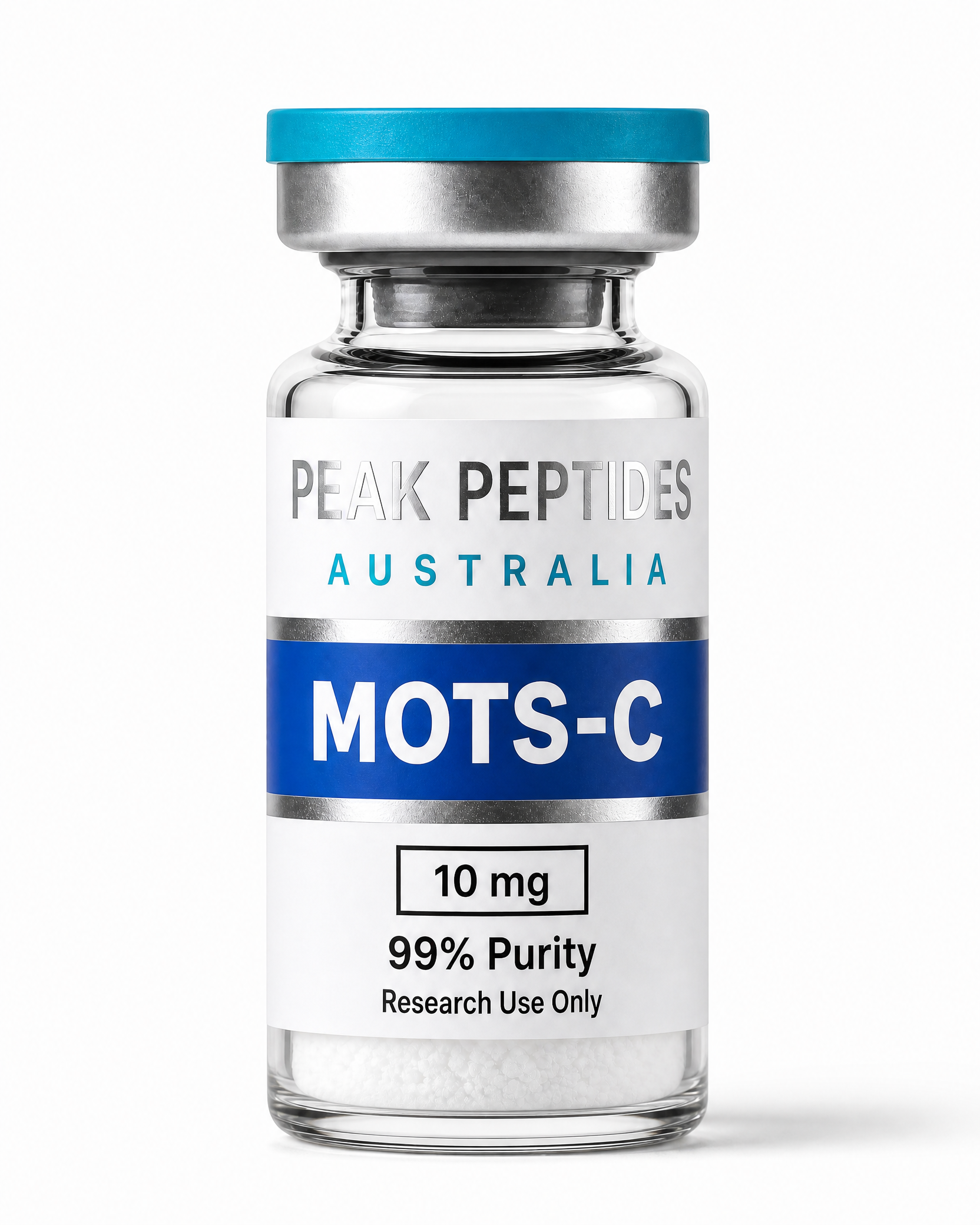
This listing is MOTS-C 10mg: a nominal 10 mg quantity of freeze-dried material in a sealed vial. The label does not describe a liquid strength until a final laboratory volume is selected. The 3 mL BAC water reference mix is the central preparation example on this page because it maps the label amount into clear concentration and U-100 volume maths.
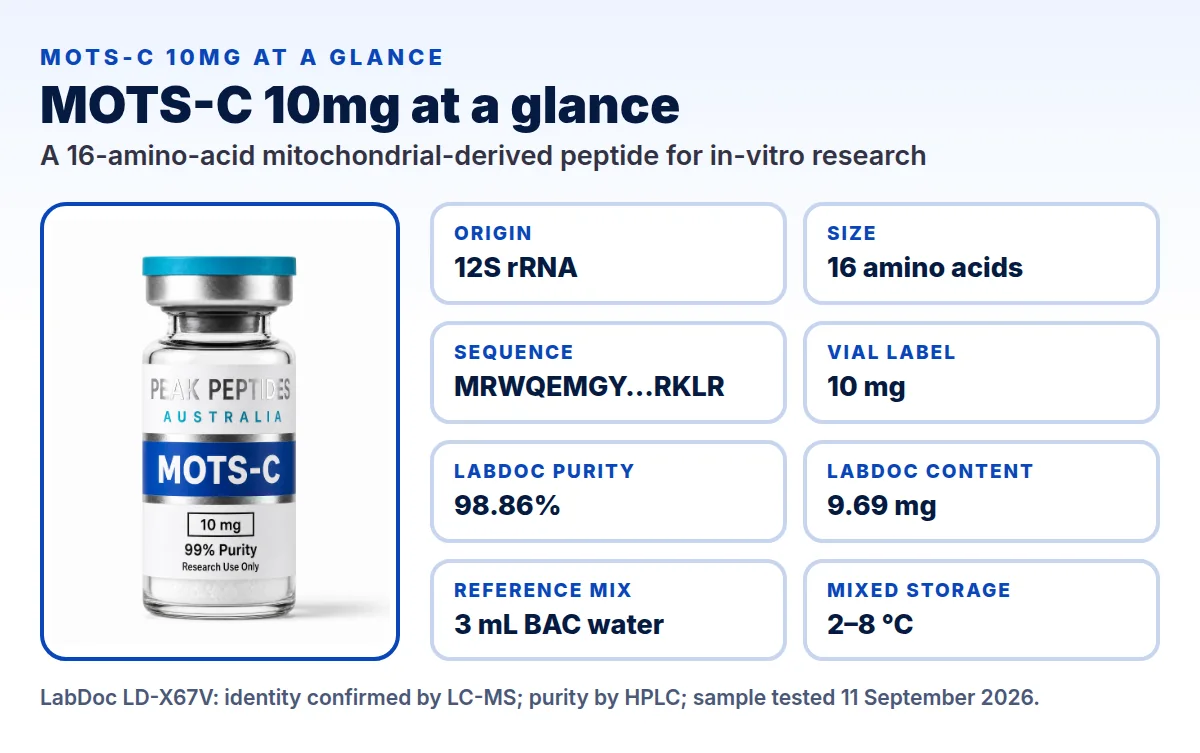
MOTS-C 10mg in one view: its mitochondrial origin, 16-residue size, sample-specific LabDoc result and the 3 mL reference mix.
How does MOTS-C work in cell research?
MOTS-C is studied as a metabolic-stress signal. In the 2015 discovery work, researchers found changes in the folate–methionine cycle and connected de novo purine pathway. Those changes increased AICAR, a purine-pathway intermediate. In the studied cell systems, that was followed by phosphorylation of AMPK, a kinase that helps cells respond to energy status.
The pathway summary matters because it keeps the mechanism specific. MOTS-C is not described as simply supplying energy. It is studied for how it changes cellular signalling when energy and nutrient conditions are under stress. The original paper identified effects in cell experiments and preclinical models; those are the appropriate boundaries for the findings shown here.
A second key result came from the 2018 Cell Metabolism study. Under metabolic stress, MOTS-C moved from the mitochondrial area into the nucleus in studied cells. The researchers reported AMPK-dependent movement and regulation of adaptive nuclear genes, including programmes associated with antioxidant response elements and the transcription factor NRF2.
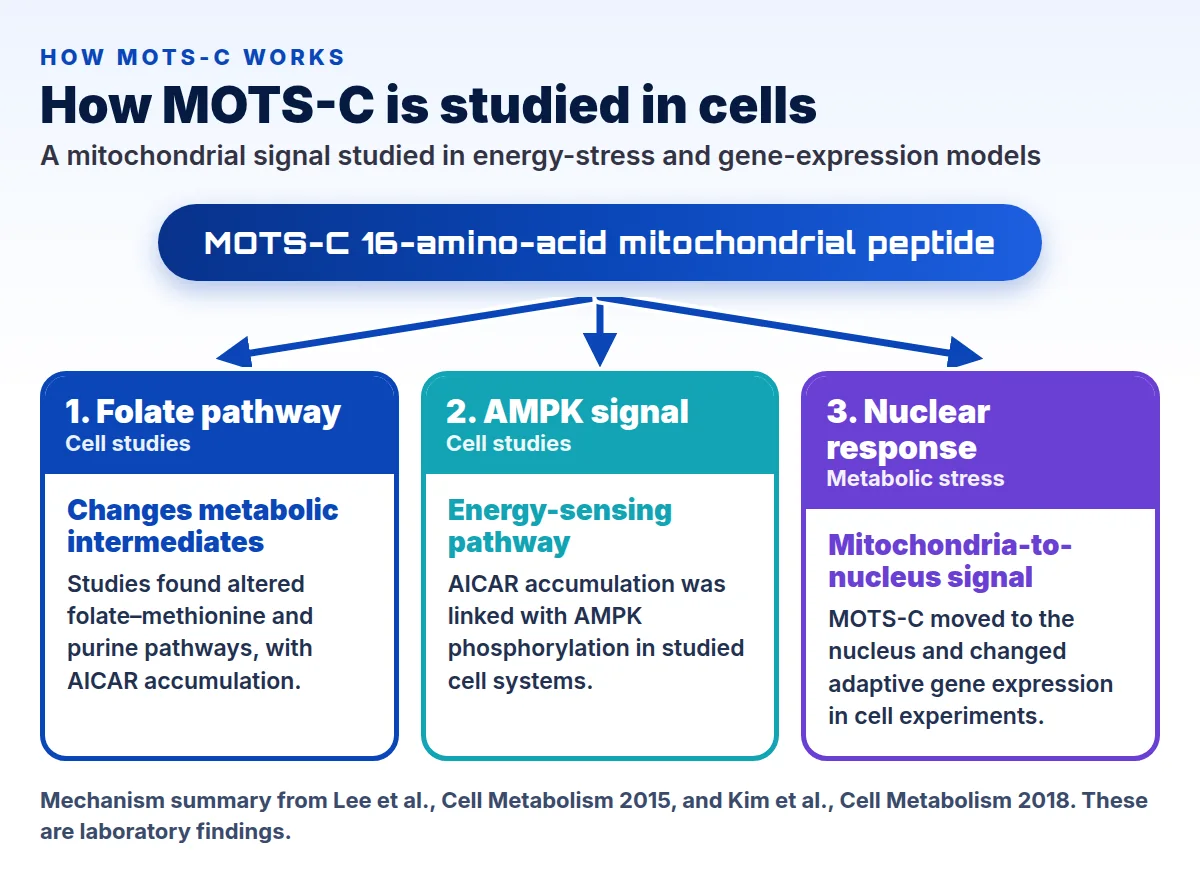
Folate and purine pathways: the original cell work recorded altered intermediates and AICAR accumulation.
AMPK: an energy-sensing kinase whose phosphorylation increased in the studied cell system.
Nuclear response: MOTS-C translocated to the nucleus during metabolic stress and influenced adaptive gene expression in cell experiments.
The cell-research model: metabolic pathway changes, AMPK signalling and stress-linked mitochondrial-to-nuclear communication.
What has MOTS-C research found?
MOTS-C research has three distinct evidence layers. The first is laboratory work, where investigators can measure pathway intermediates, AMPK phosphorylation, nuclear translocation and gene expression under controlled conditions. The second is preclinical research, where the original 2015 paper reported metabolic findings in whole-organism models. The third is human observational research, which has measured naturally occurring MOTS-C rather than a MOTS-C drug product.
The most useful human number is from the 2021 exercise paper because it clearly states what was measured. In healthy young men completing stationary-bike exercise, relative endogenous MOTS-C in skeletal muscle rose 11.9-fold after exercise. Circulating endogenous levels rose 1.6-fold during exercise and 1.5-fold after exercise before returning to baseline after four hours. These observations concern the body’s own peptide signal.
FDA’s 2026 briefing provides the equally important boundary: it had not identified clinical studies or human exposure data for MOTS-C drug products by any route. So the page separates endogenous exercise measurements, laboratory mechanisms and preclinical findings instead of presenting any of them as a demonstrated effect of this research vial.
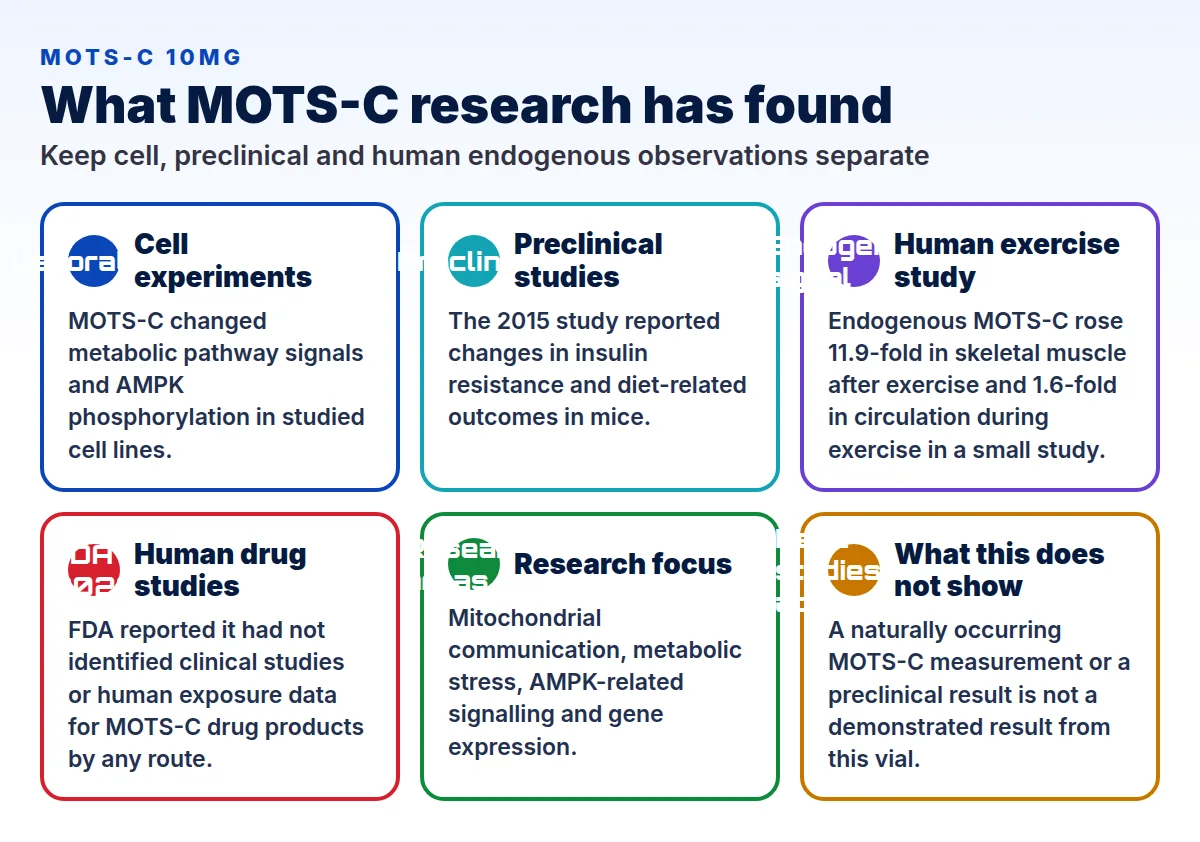
A clear reading frame for MOTS-C research: cell experiments, preclinical work, endogenous human observations and FDA’s clinical-data statement.
MOTS-C research findings by study type
MOTS-C research findings by study type
Study type
What was measured or reported
What that finding means
Cell research — Lee et al., 2015
Folate and purine pathway changes, AICAR accumulation and AMPK phosphorylation
A proposed cellular mechanism under controlled laboratory conditions
Cell research — Kim et al., 2018
Stress-linked nuclear movement and adaptive nuclear gene regulation
A model of mitochondrial-to-nuclear signalling in studied cells
Human exercise observation — Reynolds et al., 2021
Endogenous skeletal-muscle MOTS-C rose 11.9-fold after exercise; circulation rose 1.6-fold during exercise
A measurement of naturally occurring MOTS-C, not a MOTS-C drug-product result
FDA briefing, 2026
No clinical studies or human exposure data for MOTS-C drug products identified
No completed clinical drug-product dataset.
Study type is essential: laboratory mechanisms, preclinical outcomes and endogenous human measurements answer different questions.
MOTS-C vs SS-31 vs SLU-PP-332
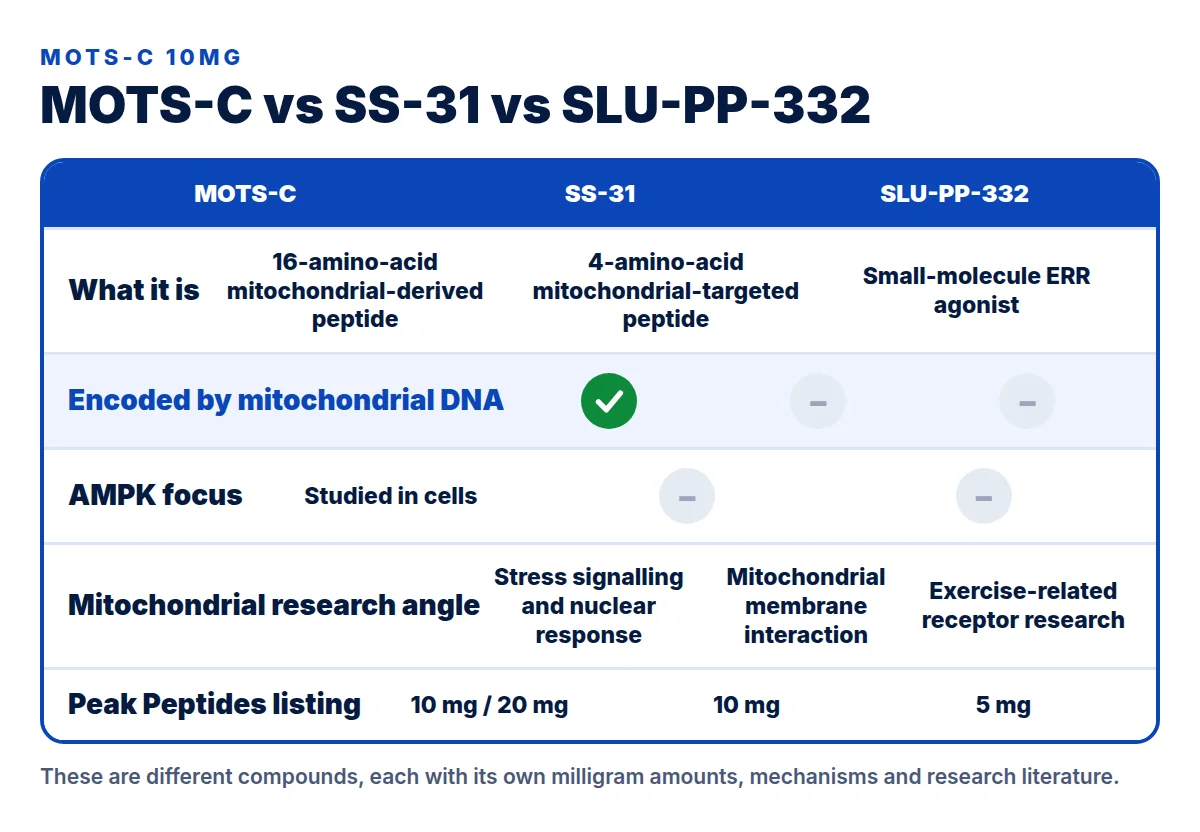
MOTS-C, SS-31 and SLU-PP-332 appear in neighbouring mitochondrial or metabolic research conversations, but they are different materials. MOTS-C is a 16-amino-acid peptide encoded within mitochondrial DNA. SS-31 is a synthetic four-amino-acid peptide designed to target the inner mitochondrial membrane. SLU-PP-332 is not a peptide at all; it is a synthetic small-molecule pan-agonist of the estrogen-related receptors ERRα, ERRβ and ERRγ.
The original MOTS-C work centres on mitochondrial-derived signalling, folate and purine metabolism, AMPK-related cell responses and adaptive nuclear gene expression. SS-31 literature focuses on its interaction with mitochondrial membranes. SLU-PP-332 research focuses on ERR-driven transcriptional programmes and exercise-related metabolic work in cell and preclinical studies.
Their milligram labels refer to different materials. Start a comparison with structure and research question, then look at each product’s own analytical report and preparation maths. The visual below gives a quick structural comparison.
Three different research materials: MOTS-C is a mitochondrial-derived 16-mer, SS-31 is a mitochondrial-targeted tetrapeptide, and SLU-PP-332 is a small molecule.
MOTS-C structure and sequence
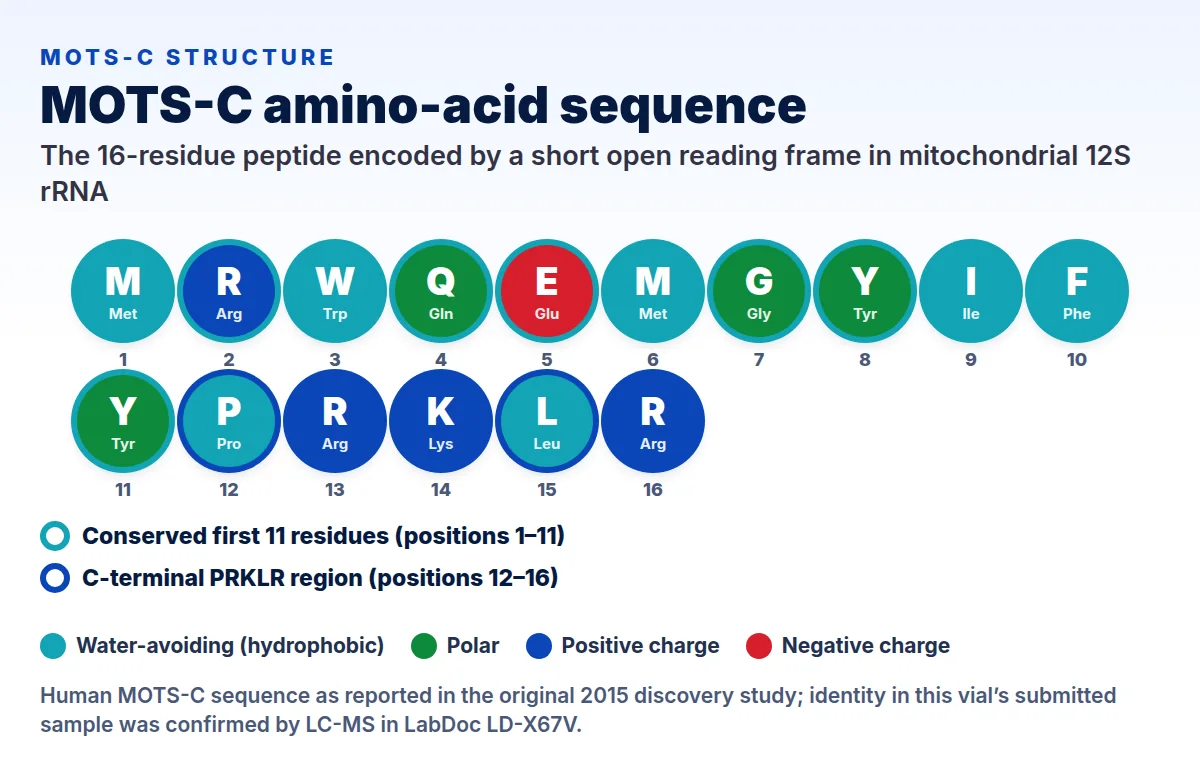
MOTS-C has 16 amino acids. GenBank record KP715230 gives the translated human sequence as MRWQEMGYIFYPRKLR. The first 11 residues were described as strongly conserved across the species alignment reported in the discovery paper. The C-terminal PRKLR segment carries positively charged residues that are shown separately in the sequence visual.
A sequence diagram is useful for identity work because it puts the name MOTS-C beside its actual molecular building blocks. It does not replace a laboratory identity result. For the submitted sample used for this product page, LabDoc LD-X67V records that identity was confirmed by LC-MS, which tests the molecule by mass-spectrometry evidence.
The 16-residue length also explains why MOTS-C is described as a peptide rather than a full protein. Its mitochondrial coding origin remains its defining feature: the short sequence is encoded within mitochondrial 12S rRNA but is translated in the cytoplasm using the standard genetic code.
The human MOTS-C 16-mer sequence recorded in GenBank, with the conserved first 11 residues and C-terminal PRKLR region highlighted.
Independent lab test and research status for this MOTS-C 10mg
MOTS-C 10mg is backed by LabDoc report LD-X67V. The submitted sample was received and tested on 11 September 2026. The report records identity confirmed by LC-MS, 98.86% purity by HPLC, 1.14% related impurities and 9.69 mg measured content against the 10 mg label claim. It assigns an overall Pass assessment. The batch field is not stated in the report.
Each result answers a different quality question. LC-MS identity confirmation supports that the tested sample matched MOTS-C by mass. HPLC purity reports the proportion attributed to the principal material in the chromatographic analysis. Content measures the quantity found against the nominal vial claim. The printed vial artwork says 99% Purity, while the page uses the exact independently reported 98.86% figure for the submitted sample.
Supplementary Janoshik report #108025 is also named for this product. The linked numerical quality details presented here come from LabDoc LD-X67V, where the report identifier can be checked directly. Neither an analytical report nor a research label makes MOTS-C an approved medicine. FDA states it had not identified clinical studies or human exposure data for MOTS-C drug products by any route.
LabDoc report: LD-X67V.
Tested sample: MOTS-c; sample received and tested 11 September 2026.
Identity: confirmed by LC-MS.
Purity: 98.86% by HPLC; related impurities: 1.14%.
Content: 9.69 mg measured against the 10 mg claim; overall assessment: Pass.
Medicine status: not approved by FDA or TGA; supplied for in-vitro research only.
Obtaining MOTS-C 10mg in Australia
MOTS-C 10mg is available through Peak Peptides Australia as an in-vitro research material. The key product-page information includes the vial’s nominal 10 mg label, the linked lab record and the explicit 3 mL BAC water reference chart.
Same-day dispatch from Victoria for in-stock orders once payment is confirmed, tracked Australia Post Express, tracking number emailed. The linked product resources include bacteriostatic water, a reconstitution calculator and the quality area. Use the comparison link if the separate MOTS-C 20mg page is the more relevant nominal vial quantity for a documented laboratory workflow.
MOTS-C is not TGA- or FDA-approved as a medicine. It is also named by WADA in the 2026 Prohibited List under S4.4.1 AMPK activators. Those points belong alongside the product’s research-only status and quality documentation, not in the background of the page.
Step-by-step guide · About 10 minutes
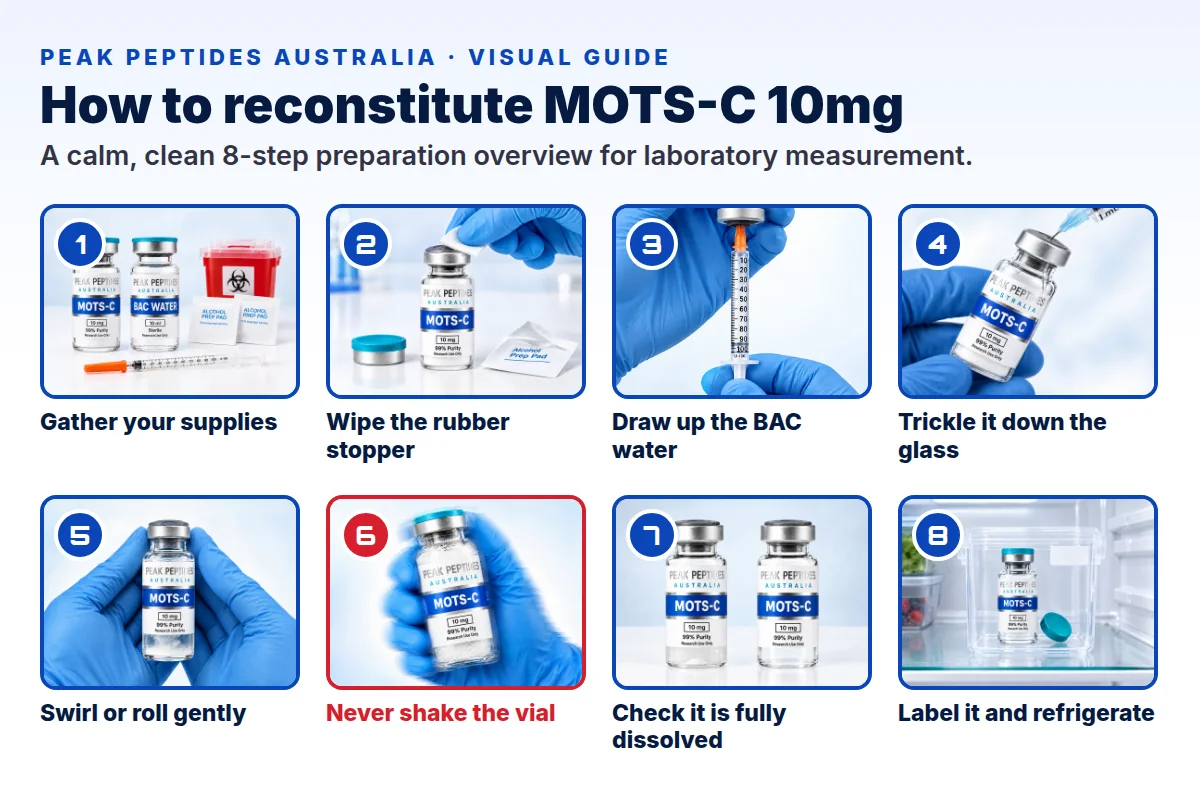
How to reconstitute MOTS-C 10mg for laboratory measurement (8 steps with photos)
MOTS-C 10mg is supplied as a dry, freeze-dried powder. Reconstitution means adding a measured volume of bacteriostatic (BAC) water to make a clear liquid sample for laboratory measurement. The PeptideDosages MOTS-C 10 mg reference uses 3 mL of BAC water, which gives 3.33 mg/mL and makes 30 U-100 units equal 1 mg. The preparation sequence below is a handling and concentration guide for in-vitro research.
The MOTS-C 10mg laboratory preparation sequence at a glance, built around the 3 mL BAC water reference.
Bacteriostatic waterThe mixing medium used by the 3 mL reference chart on this page.
1 mL U-100 syringeA volume-measuring tool: 100 units equals 1 mL and 1 unit equals 0.01 mL.
Alcohol swabsFor preparing the rubber stopper surfaces before handling.
Clean work surfaceA stable, uncluttered area for documenting the selected preparation volume and date.
Label or laboratory recordTo record the final concentration, preparation date, vial identifier and discard requirement.
How much BAC water for MOTS-C 10mg? The 3 mL reference chart
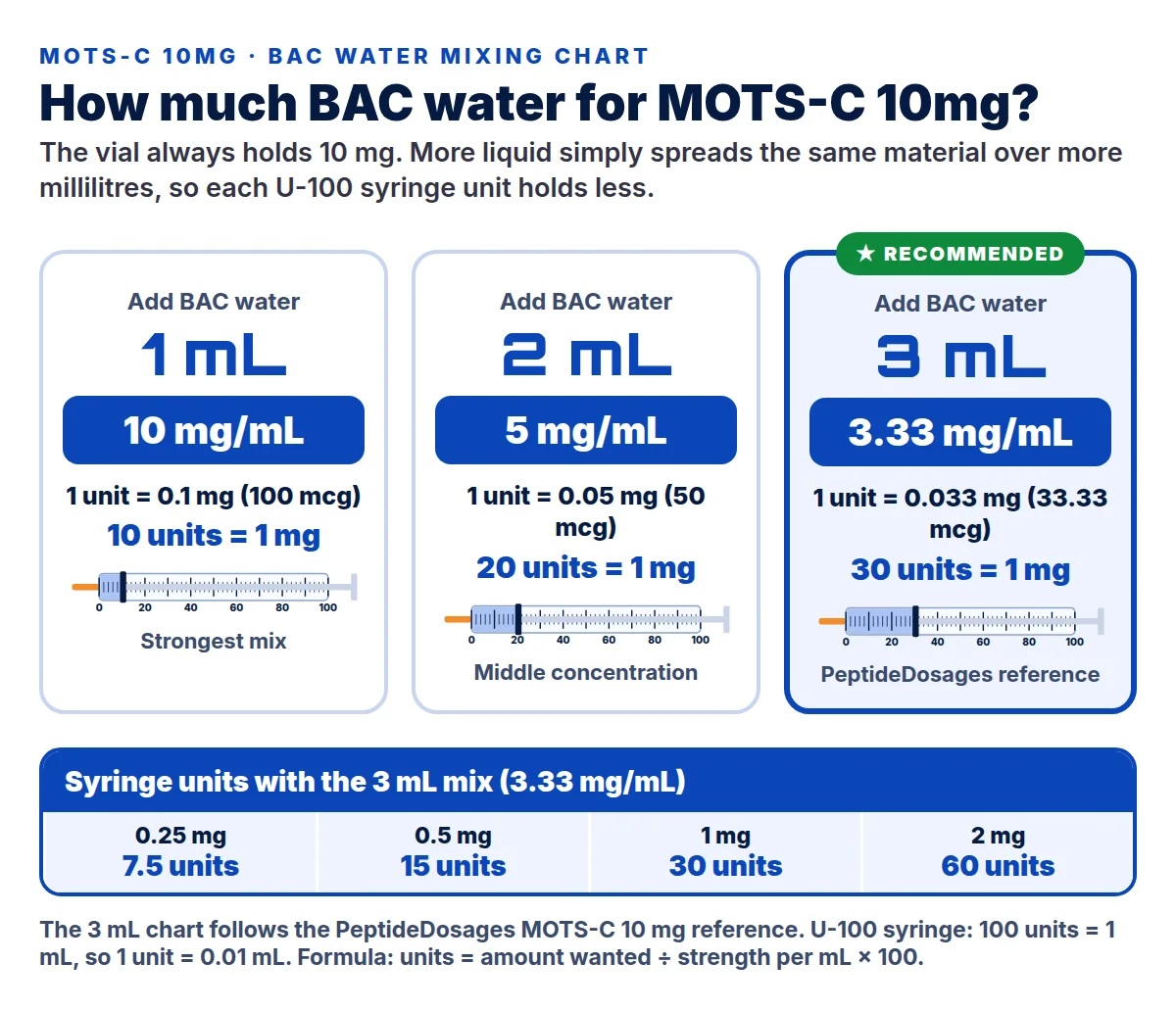
The vial’s nominal 10 mg quantity does not change when more or less BAC water is added. The final volume changes the concentration only. The PeptideDosages MOTS-C 10 mg reference uses 3 mL, which gives 3.33 mg/mL. On a U-100 syringe, 1 unit is 0.01 mL, so 1 unit holds 0.033 mg (33.33 mcg) and 30 units equals 1 mg at this concentration.
The chart also shows the arithmetic for 1 mL and 2 mL final volumes: 1 mL produces 10 mg/mL and 10 units per 1 mg; 2 mL produces 5 mg/mL and 20 units per 1 mg. The highlighted 3 mL row is the recommended mix for this 10mg vial.
For any selected final volume, the calculation is units = amount wanted ÷ strength per mL × 100. Record the volume and calculated concentration with the sample. A U-100 marking is a volume marking, not an international-unit potency statement.
MOTS-C 10mg concentration chart — the highlighted 3 mL BAC water reference makes 3.33 mg/mL and 30 U-100 units per 1 mg.
3 mL is highlighted because it gives the simplest numbers.
Syringe units with the 3 mL mix (3.33 mg/mL)
Syringe units with the 3 mL mix (3.33 mg/mL)
Amount
Units on a U-100 syringe
Volume
0.25 mg
7.5 units
0.075 mL
0.5 mg
15 units
0.15 mL
1 mg
30 units
0.3 mL
2 mg
60 units
0.6 mL
The 8 steps
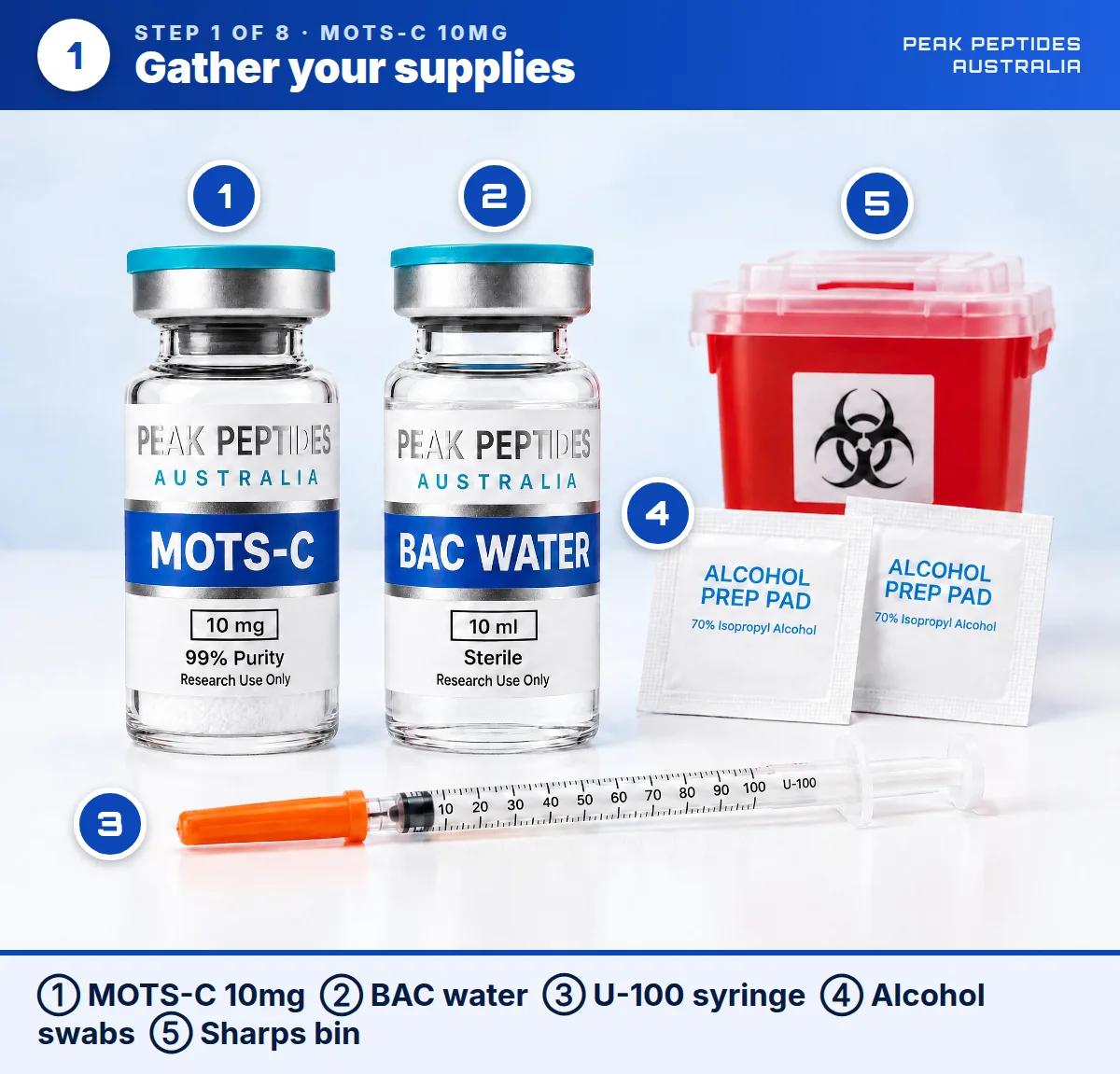
1Step 1: Gather your supplies
Set out the MOTS-C 10mg vial, BAC water, a clean 1 mL U-100 syringe, alcohol swabs and a laboratory label or record on a clean work surface. Confirm the intended final volume before beginning. The reference chart on this page uses 3 mL in total, so plan three separate 1 mL draws.
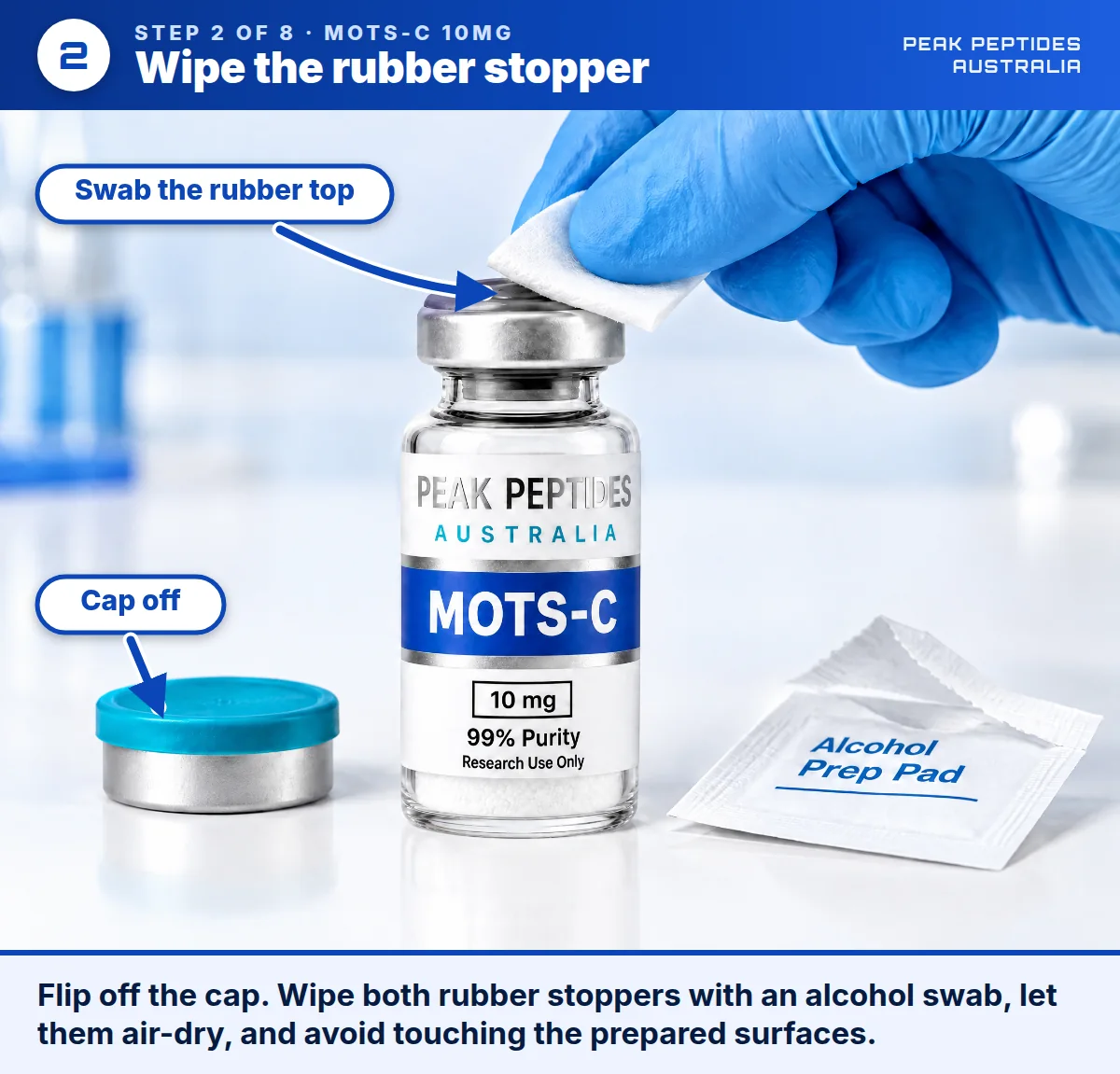
2Step 2: Wipe the rubber stopper
Remove the flip-off caps as required to expose the rubber stoppers. Wipe the stopper surfaces with fresh alcohol swabs, allow them to air-dry and avoid touching the prepared surfaces. Clean stopper handling keeps the process orderly and makes the photo guide’s next measurement steps easier to follow.
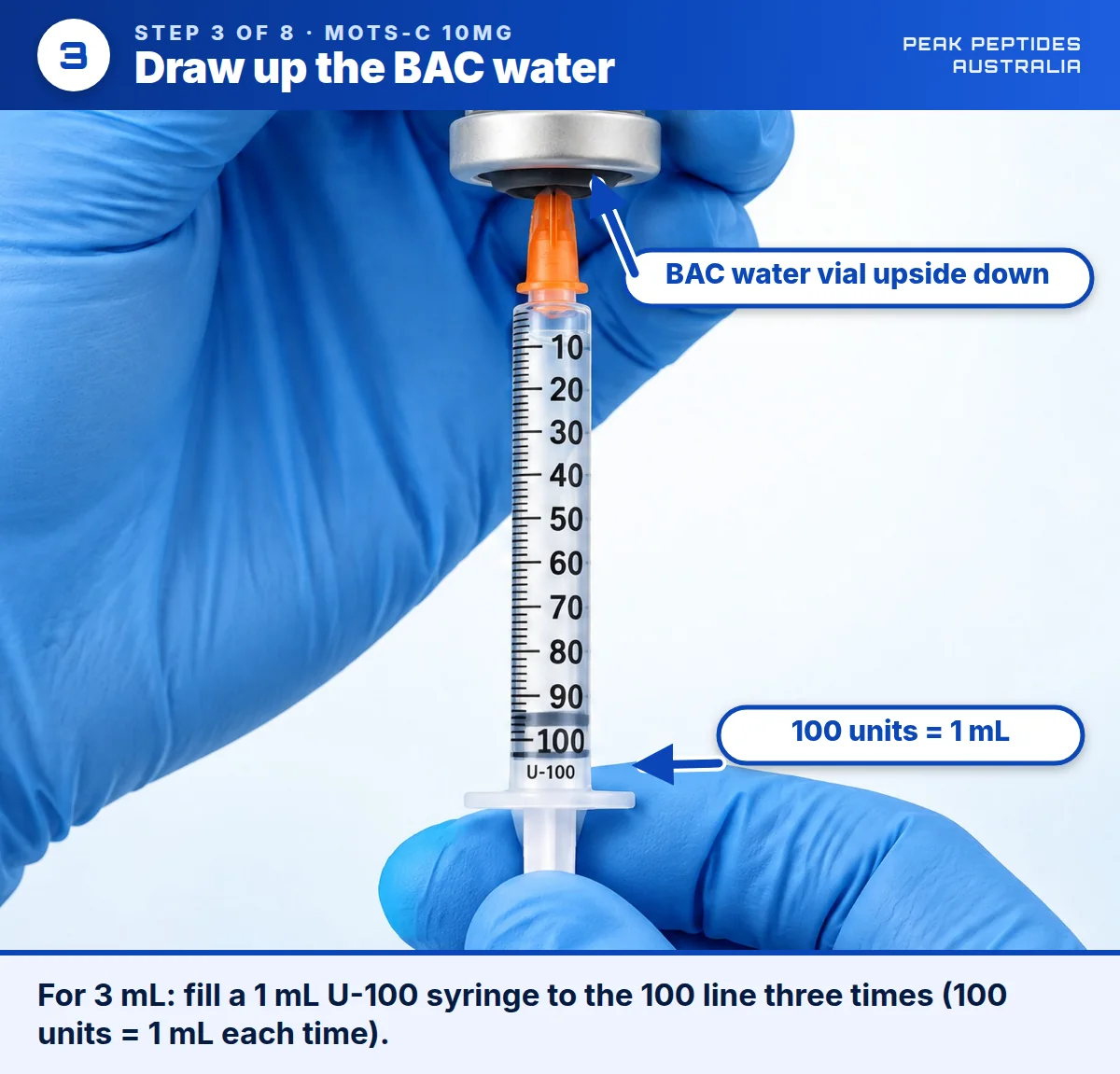
3Step 3: Draw up the BAC water
For the 3 mL reference, draw BAC water to the 100-unit line of a 1 mL U-100 syringe. That line represents 1 mL because 100 U-100 units equals 1 mL. Repeat the one-millilitre measurement three times to reach the chosen 3 mL final preparation volume.
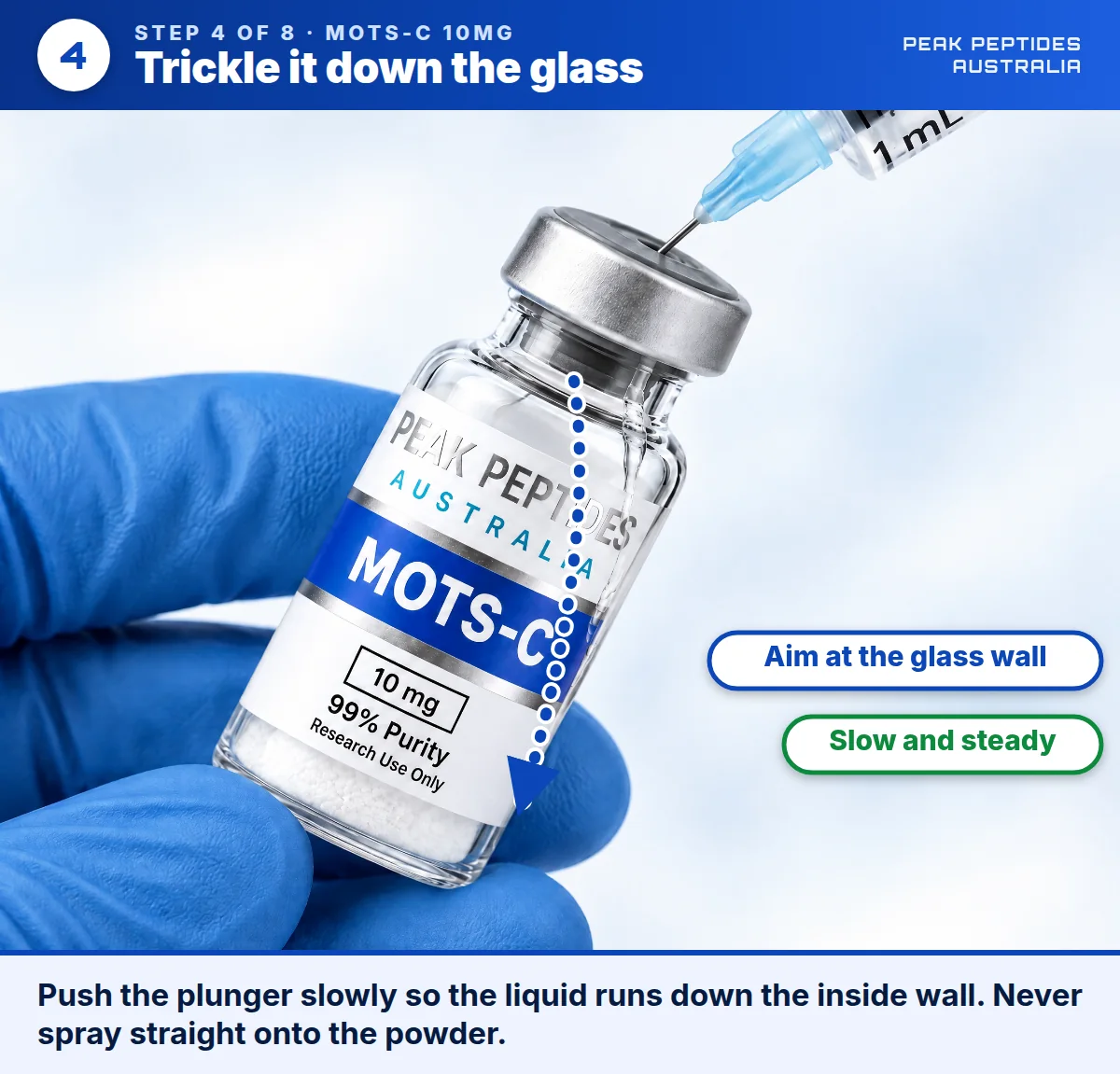
4Step 4: Trickle it down the glass
Guide the water slowly down the inside glass wall rather than directing a hard stream onto the freeze-dried powder. This is the handling method shown in the PeptideDosages preparation sequence. Repeat the measured transfer until the selected final volume has been added, keeping the volume record with the vial.
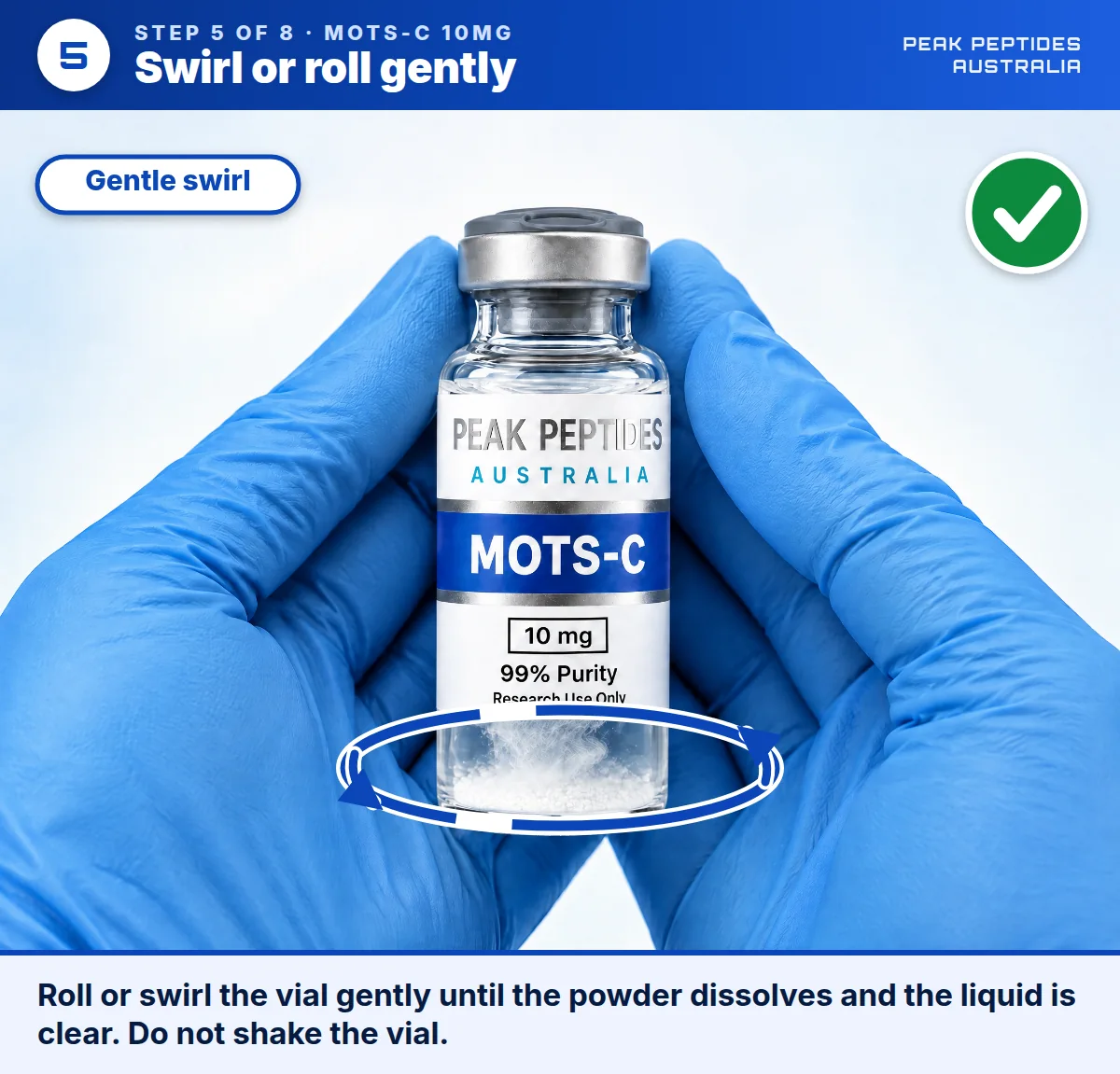
5Step 5: Swirl or roll gently
Roll or swirl the vial gently so the powder dissolves into the liquid. Do not shake it. The aim is a clear preparation with no visible powder remaining. If material is still present at the bottom, set the vial aside and use further gentle swirling rather than forceful agitation.
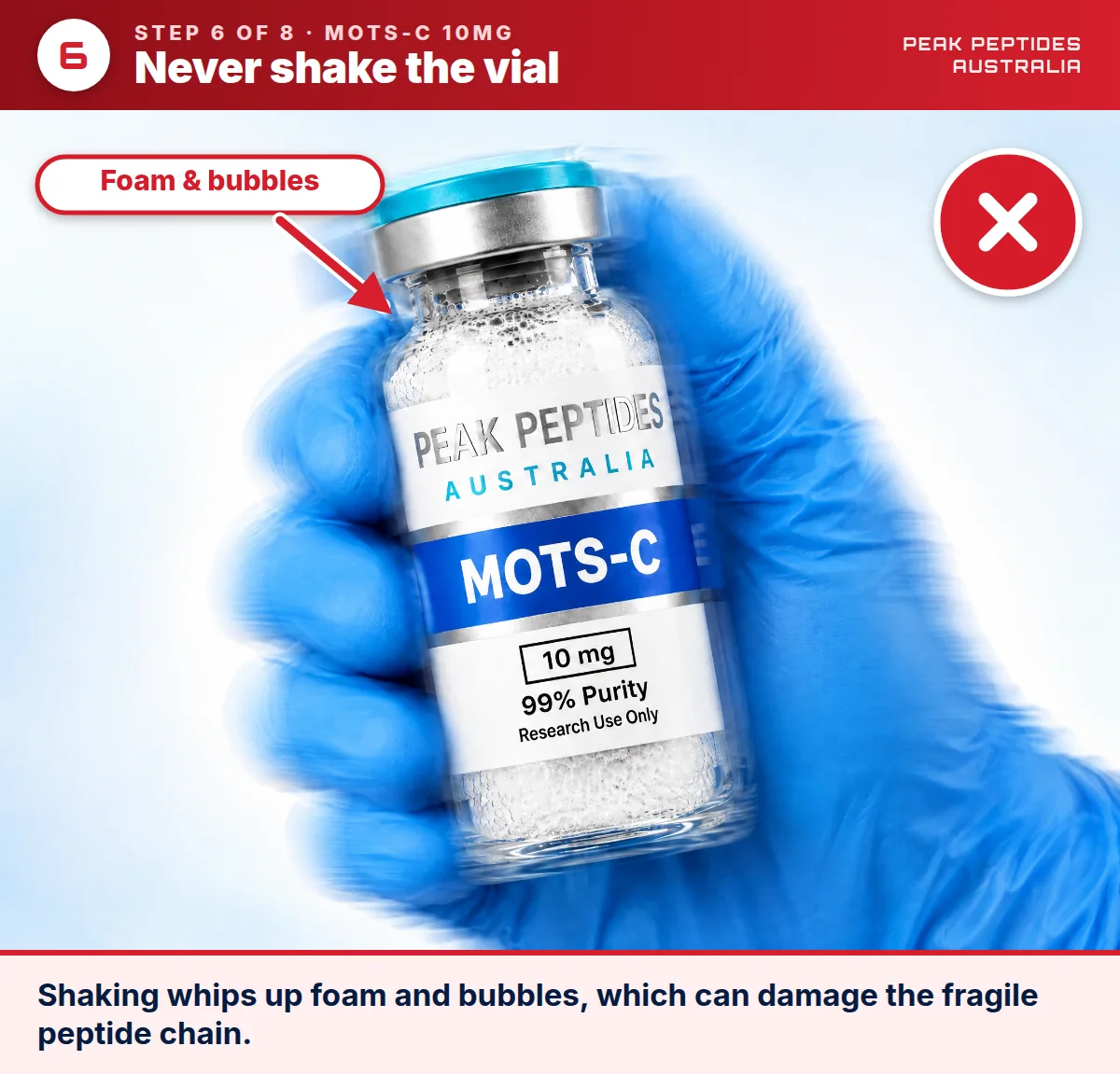
6Step 6: Never shake the vial
Do not shake the vial. The preparation guide uses a deliberate swirl or roll because shaking creates foam and bubbles. If foam is visible, place the vial upright and allow it to settle before judging the clarity of the liquid sample or recording the preparation state.
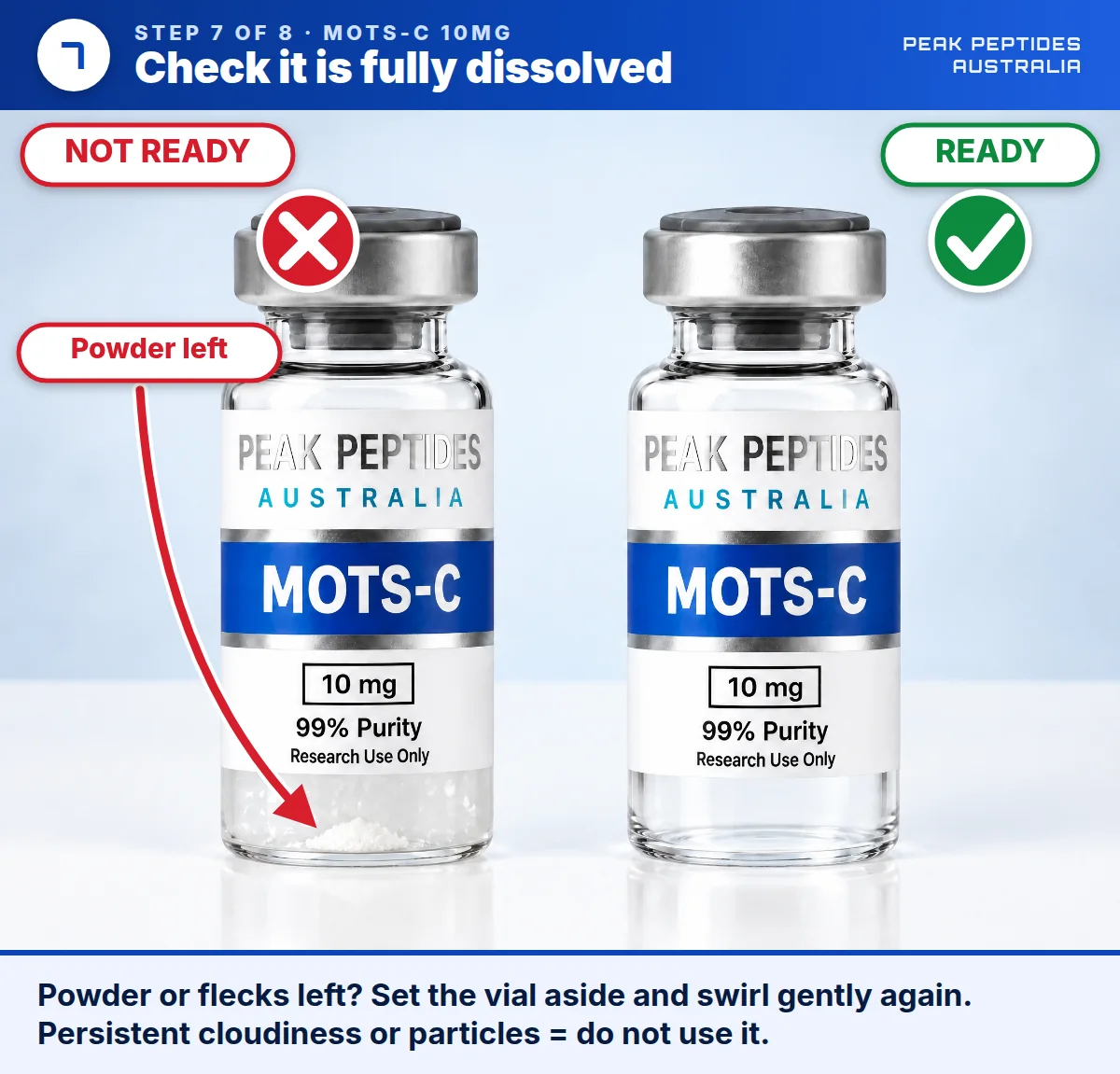
7Step 7: Check it is fully dissolved
Inspect the vial under good light. The ready state is a clear liquid without visible powder, flecks or cloudiness. If material remains, set the vial aside and swirl gently again. Persistent cloudiness or particles means the preparation has not passed this visual check and should not be used.
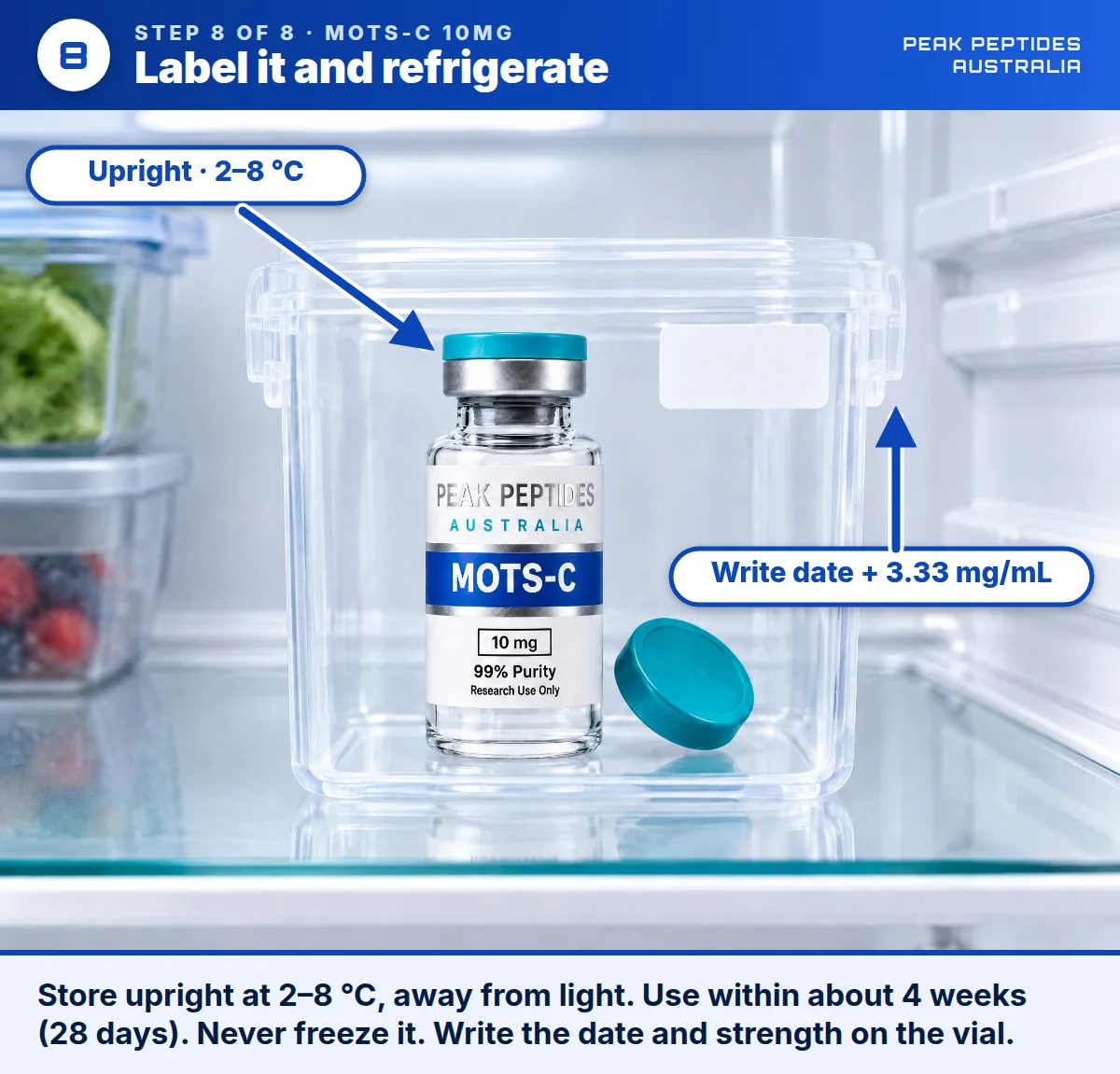
8Step 8: Label it and refrigerate
Write the preparation date, final volume and calculated concentration on the vial. The 3 mL reference is 3.33 mg/mL. Keep the mixed sample upright in the fridge at 2–8 °C, away from light. Use it within about 4 weeks (28 days) and never freeze it.
How to store MOTS-C 10mg
MOTS-C 10mg storage and documentation guide
MOTS-C 10mg storage and documentation guide
Form
Where and how
Record or limit
Sealed freeze-dried vial
Keep dry, protected from light and at the temperature stated on the actual vial label
Retain the vial label and LabDoc report identifier with the material
Mixed sample
Refrigerate at 2–8 °C and protect from light
Record the preparation date, final volume and calculated concentration
Mixed sample
Avoid freezing and unnecessary temperature cycling
Within about 4 weeks (28 days)
Any preparation with particles or persistent cloudiness
Set aside; it has not met the guide’s clear-solution visual check
Do not use the preparation
The 2–8 °C mixed-sample instruction comes from the opened PeptideDosages reference. A nominal vial quantity does not create a universal stability period after mixing.
MOTS-C is a 16-amino-acid mitochondrial-derived peptide. Its name expands to mitochondrial open reading frame of the 12S rRNA-c. Researchers study it in models of cellular energy handling, metabolic stress, AMPK signalling and mitochondria-to-nucleus communication.
What does MOTS-C stand for?
MOTS-C stands for mitochondrial open reading frame of the 12S rRNA-c. The name points to a short protein-coding region within mitochondrial 12S ribosomal RNA. The human gene record is GenBank accession KP715230.
Are MOTS-C, MOTS-c, MOTS C and MOTSC the same peptide?
Yes. MOTS-C, MOTS-c, MOTS C and MOTSC are common spelling or spacing variants for the same named peptide. The 10 mg and 20 mg listings differ in their nominal vial quantity and product-specific documentation, not in the name of the peptide.
What is MOTS-C used for in research?
MOTS-C is used in research on mitochondrial signalling, cellular energy sensing, folate and purine metabolism, AMPK-related pathways, stress responses and adaptive nuclear gene expression. These are research topics; the vial is supplied for in-vitro research only.
How does MOTS-C work in cell research?
In the original cell work, MOTS-C altered folate–methionine and de novo purine pathway signals. AICAR accumulated and AMPK phosphorylation increased in studied cell systems. A 2018 study also found stress-linked movement of MOTS-C into the nucleus, where it influenced adaptive gene-expression programmes.
What are AICAR and AMPK in MOTS-C studies?
AICAR is a purine-pathway intermediate. AMPK is a protein kinase that senses cellular energy status. Lee and colleagues reported increased AICAR and AMPK phosphorylation in their MOTS-C cell work, which is why these two terms appear together in descriptions of its proposed laboratory mechanism.
Does MOTS-C enter the nucleus?
In the 2018 Cell Metabolism study, MOTS-C translocated to the nucleus in studied cells exposed to metabolic stress. The researchers reported AMPK-dependent nuclear movement and changes in adaptive gene expression, including genes associated with antioxidant response elements.
What did the original MOTS-C study find?
The 2015 Cell Metabolism paper identified MOTS-C as a 16-amino-acid mitochondrial peptide and reported laboratory and preclinical metabolic findings. It described folate and purine pathway changes, AMPK activation in cell systems, and preclinical observations related to insulin resistance and diet-related outcomes.
What did human MOTS-C exercise research measure?
A Nature Communications exercise study measured endogenous MOTS-C in healthy young men. Relative skeletal-muscle levels rose 11.9-fold after exercise, while circulating levels rose 1.6-fold during exercise and 1.5-fold after it. It measured the body’s own peptide, not a supplied MOTS-C drug product.
What side effects have been reported in MOTS-C clinical studies?
FDA states it had not identified clinical studies or human exposure data for MOTS-C drug products by any route in its 2026 briefing. That means there is no completed clinical side-effect dataset for a MOTS-C drug product to report from that FDA review.
What is the half-life of MOTS-C?
This guide does not state a human half-life because FDA reported it had not identified human exposure data for MOTS-C drug products by any route. A half-life for a particular research preparation needs direct pharmacokinetic evidence for that preparation.
Is MOTS-C the same as SS-31 or SLU-PP-332?
No. MOTS-C is a 16-amino-acid peptide encoded by mitochondrial DNA. SS-31 is a synthetic four-amino-acid mitochondrial-targeted peptide. SLU-PP-332 is a small-molecule agonist of estrogen-related receptors. Their mechanisms, structures and research literature are different.
Is MOTS-C approved by the FDA or TGA?
No. MOTS-C is not FDA-approved, and a search of the Australian Register of Therapeutic Goods did not return a MOTS-C medicine listing. FDA’s 2026 briefing also states it had not identified clinical studies or human exposure data for MOTS-C drug products.
Is MOTS-C prohibited in sport?
Yes. The 2026 WADA Prohibited List names mitochondrial open reading frame of the 12S rRNA-c, MOTS-c, under S4.4.1 AMPK activators. USADA states that it is prohibited at all times, not only during competition.
Can I buy MOTS-C 10mg online in Australia?
MOTS-C 10mg can be ordered online from Peak Peptides Australia when available. It is supplied for in-vitro research only. The page provides the product-specific LabDoc result, a 3 mL BAC water measurement chart and an eight-step photographic preparation guide.
How fast is MOTS-C 10mg dispatched in Australia?
Same-day dispatch from Victoria for in-stock orders once payment is confirmed, tracked Australia Post Express, tracking number emailed. The shipping statement applies to the order process; MOTS-C 10mg itself is supplied for in-vitro research only.
How do I know whether a MOTS-C sample is properly documented?
Start with an independent report that identifies the tested material and separates identity, purity and content. For this sample, LabDoc report LD-X67V records LC-MS identity confirmation, 98.86% HPLC purity and 9.69 mg measured content. Check the report identifier at labdoc.org.
How is this MOTS-C 10mg sample verified?
LabDoc report LD-X67V records a sample received and tested on 11 September 2026. It lists identity confirmed by LC-MS, 98.86% purity by HPLC, 1.14% related impurities and 9.69 mg measured content against the 10 mg claim, with an overall Pass assessment.
What is the difference between MOTS-C 10mg and MOTS-C 20mg?
They are listings for the same named mitochondrial-derived peptide at different nominal vial quantities. A 20 mg vial contains a larger labelled total quantity, not a different mechanism. Each page should be read with its own product image, mix calculations and independent analytical documentation.
What is Janoshik report #108025 for MOTS-C?
Janoshik report #108025 is additional quality documentation named for this product. The product-specific numerical results presented on this page come from the independently linked LabDoc report LD-X67V, so the identity, purity and content figures can be checked directly at labdoc.org.
How much BAC water is used in the MOTS-C 10mg reference mix?
The PeptideDosages MOTS-C 10 mg reference uses 3 mL of BAC water. That makes a 3.33 mg/mL concentration. The full chart also shows the fixed calculation outcomes for 1 mL and 2 mL volumes, but the 3 mL reference is highlighted on this page.
How many U-100 units equal 1 mg in the 3 mL MOTS-C mix?
With 10 mg in a final 3 mL volume, the concentration is 3.33 mg/mL. On a U-100 syringe, 100 units equals 1 mL, so 1 mg corresponds to 30 units, or 0.30 mL. This is concentration mathematics for laboratory measurement.
How many mg are in 10 U-100 units with the 3 mL mix?
With the 3 mL reference mix, 10 U-100 units is 0.10 mL. At 3.33 mg/mL, that volume holds about 0.33 mg, or 33.33 mcg. The chart states the same relationship as 1 unit holding 0.033 mg.
How do I reconstitute MOTS-C 10mg for laboratory measurement?
Use the page’s eight-step photo guide: gather clean supplies, prepare the stoppers, draw BAC water, let it run slowly down the inside glass wall, swirl rather than shake, inspect for a clear solution, label the preparation and refrigerate at 2–8 °C away from light.
Can I use sterile water or tap water instead of BAC water?
The MOTS-C 10 mg chart on this page is specifically calculated for BAC water. Do not use tap water. Plain sterile water is a different preparation medium with different handling and storage requirements, so this guide does not assign it the BAC-water chart or a storage time.
What if the MOTS-C powder does not dissolve?
Set the vial aside and swirl or roll it gently again; do not shake it. Inspect the solution under good light. If powder, flecks, cloudiness or particles persist, do not use the preparation. Record the observation in the laboratory workflow.
Should reconstituted MOTS-C look cloudy?
No. The preparation guide uses a clear liquid as the ready visual state. Visible cloudiness, particles or undissolved material means it has not reached that state. Set it aside and recheck after gentle swirling; persistent particles mean do not use it.
How long does mixed MOTS-C last?
PeptideDosages advises refrigeration at 2–8 °C and protection from light after mixing. Once mixed with BAC water, keep the vial upright, use it within about 4 weeks (28 days) and never freeze it. Write the date and strength on the vial.
How should unopened MOTS-C powder be stored?
Keep the sealed lyophilised vial dry, protected from light and at the temperature stated on its actual label. Retain the product and quality documentation with the vial so the laboratory can trace the nominal claim, preparation date and report identifier.
Can mixed MOTS-C be frozen?
Keep the mixed sample upright in the fridge at 2–8 °C, away from light. Use it within about 4 weeks (28 days) and never freeze it. Avoid unnecessary temperature cycling. Write the date and strength on the vial.
What does a MOTS-C COA show?
A useful certificate of analysis distinguishes identity, purity and content. For this submitted MOTS-C sample, LabDoc LD-X67V records identity confirmed by LC-MS, 98.86% purity by HPLC, 1.14% related impurities and 9.69 mg measured content. It does not turn the material into an approved medicine.