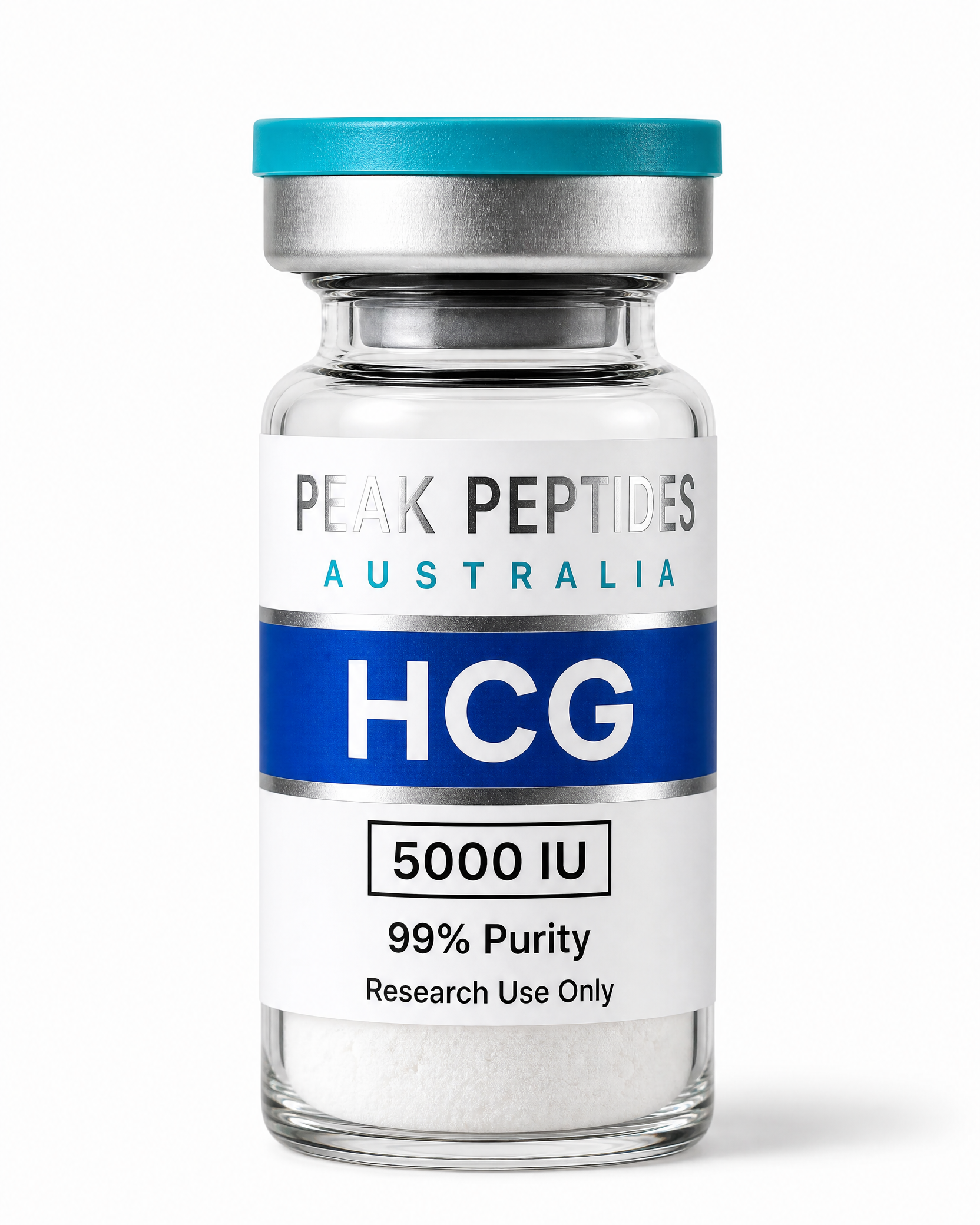
HCG 5000 IU is a labelled human chorionic gonadotropin research vial for LH/CG receptor and gonadotropin-signalling work. It is a two-subunit glycoprotein hormone, not a short synthetic peptide. Peak Peptides Australia supplies this material for in-vitro research only. The Quality page records Janoshik Task #135353 at 4,556 IU. In-stock orders receive same-day dispatch from Victoria after payment confirmation, with tracked Australia Post Express shipping Australia-wide.
Product Specifications
Full NameHuman Chorionic Gonadotropin
Vial Size5000iu
PurityRefer to available COA documentation
Legal Disclaimer
This product is sold strictly for in-vitro laboratory research purposes only. It is not a therapeutic good, is not approved by the TGA, and is not intended for human or animal consumption, injection, or any diagnostic or therapeutic use.
Human chorionic gonadotropin · LH/CG receptor signalling research
HCG 5000 IU — What It Is, How It Works & How to Reconstitute It
HCG, also written hCG, means human chorionic gonadotropin. It is a glycoprotein hormone made from two linked protein parts, called alpha and beta subunits, with carbohydrate groups attached. That makes HCG different from the short synthetic peptides often sold beside it. HCG and luteinising hormone (LH) use the same LH/CG receptor, so it is used in laboratory work on gonadotropin binding and signalling. This vial is labelled 5,000 IU, which is a biological-activity unit rather than a milligram weight or a liquid volume. Peak Peptides Australia supplies HCG 5000 IU for in-vitro research only, not as a prescription medicine or clinical formulation. This guide explains the molecule, medicine context, Quality-page result, IU mixing maths and an eight-step photo reconstitution workflow.
Also referred to in research or catalogue references as HCG, hCG, human chorionic gonadotropin, HCG 5000 IU, HCG 5000iu, hCG 5000 IU, human chorionic gonadotropin 5000 IU, chorionic gonadotropin, choriogonadotropin, gonadotropin chorionic human.
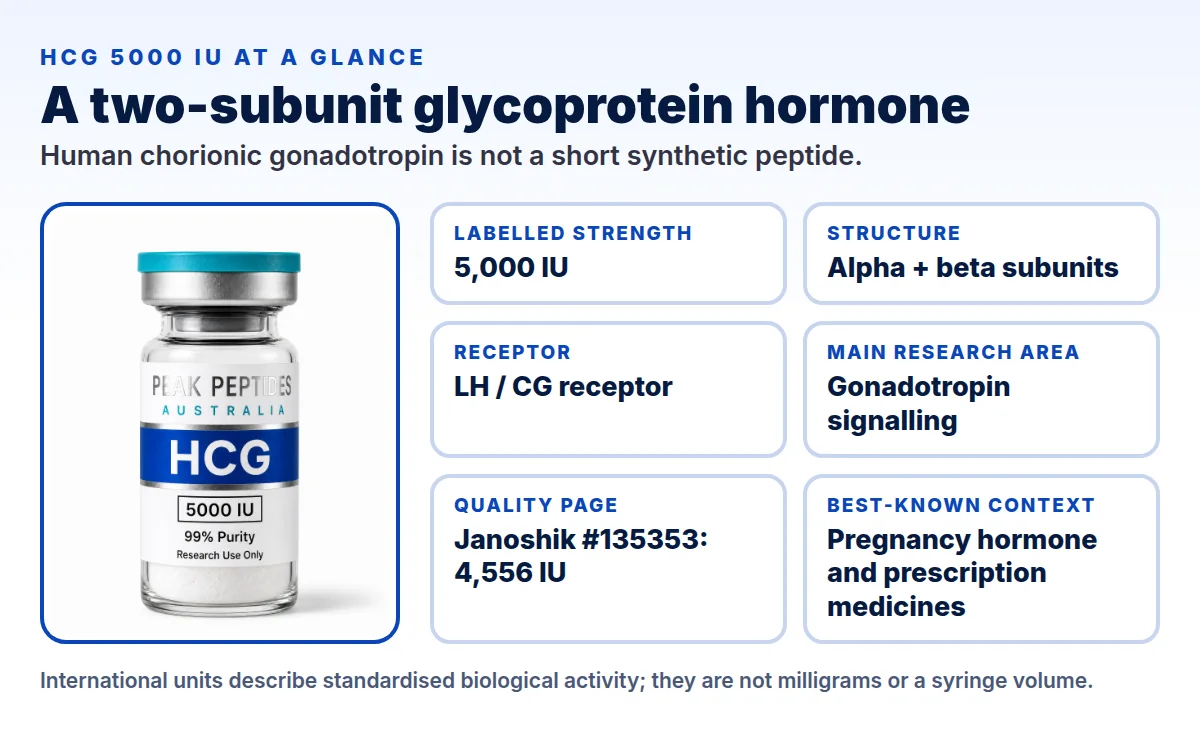
HCG 5000 IU at a glance
Name
Human chorionic gonadotropin (HCG or hCG)
What it is
A glycoprotein hormone with alpha and beta subunits; not a short synthetic peptide
Labelled strength
5,000 IU — a biological-activity unit, not a mg weight
Receptor context
HCG and LH bind the same LH/CG receptor
Reported molecular mass
About 36,700–38,000 Da; carbohydrate groups contribute substantially
Research area
Gonadotropin binding, LH/CG receptor signalling and cAMP-response studies
Published quality evidence
Janoshik Task #135353 · 29 May 2026 · HCG: 4,556 IU
LabDoc
No product-specific LabDoc is published for this listing
Easiest chart mix
2 mL BAC water = 2,500 IU/mL; 1 U-100 unit = 25 IU
FDA medicine context
Pregnyl is an FDA-listed prescription HCG medicine; this research vial is not Pregnyl
Australian position
This listing is not a TGA-approved therapeutic medicine; CHORIOMON 5000 I.E. has a separate current Section 19A approval
Dispatch
Same-day from Victoria for in-stock orders after payment confirmation, tracked Australia Post Express
A glycoprotein hormone, not a short peptide
HCG is a protein hormone with attached carbohydrate groups. It has alpha and beta subunits, rather than one short synthetic amino-acid chain. The carbohydrate portion is functionally important: a receptor-binding form with carbohydrates removed can bind but does not produce the usual cAMP signal.
HCG and LH share the LH/CG receptor
HCG and luteinising hormone are different hormones, but both bind the LH/CG receptor. The shared alpha-subunit form helps explain that relationship; their beta subunits have different amino-acid sequences. Receptor binding is useful context for gonadotropin-signalling experiments, not a claim that the hormones are interchangeable.
What 5,000 IU means
The 5,000 IU on this vial is its labelled International Unit activity strength. IU is not a mass such as mg and is not a liquid volume such as mL. If 2 mL of BAC water is used for the chart shown here, the resulting calculated concentration is 2,500 IU/mL and one U-100 unit represents 25 IU.
Independent Quality-page result
There is no LabDoc report for this listing. The Peak Peptides Australia Quality page records Janoshik Task #135353, dated 29 May 2026, as HCG: 4,556 IU. Janoshik describes its HCG service as HPLC ID-and-amount analysis with lyophilised results reported in IU per vial; it does not describe this result as a peptide-purity percentage.
Prescription HCG medicines are a different product class
FDA-approved Pregnyl is a prescription chorionic-gonadotropin medicine supplied as a sterile dried powder with a defined solvent and excipients. Its label describes selected medical uses and storage for that exact formulation. A research vial with the same hormone name is not the same medicine, formulation, quality system or clinical product.
Australian regulatory position
This HCG 5000 IU research listing is not a TGA-approved therapeutic medicine. The TGA lists CHORIOMON 5000 I.E. as a current Section 19A approved medicine until 31 August 2027 in the shortage context for Pregnyl 5000 IU. That approval is product-specific.
The weight-loss claim has been tested
A 1995 meta-analysis located eight controlled and 16 uncontrolled HCG-obesity studies. Its conclusion was that HCG did not produce weight loss, fat redistribution, reduced hunger or improved wellbeing. The FDA likewise says HCG is not approved for weight loss.
Storage
Keep the research vial and its records together. Store unopened powder at 2–8 °C in the dark (−20 °C long-term). Once mixed with BAC water, keep upright at 2–8 °C, away from light; use within about 4 weeks (28 days). Never freeze it. Label the date and strength. Pregnyl has its own storage limits.
HCG is human chorionic gonadotropin, a hormone best known for its role in pregnancy and for appearing in pregnancy tests. In a laboratory setting, its key identity is a glycoprotein hormone. A glycoprotein is a protein with carbohydrate groups attached. HCG is made from two linked parts: an alpha subunit and a beta subunit.
That architecture matters. HCG should not be described as a conventional short-chain peptide merely because it appears in peptide-research catalogues. The complete hormone has a reported molecular mass around 36.7–38 kDa, and carbohydrate groups make up a substantial part of that mass. The beta subunit distinguishes HCG from related glycoprotein hormones.
This product is labelled HCG 5000 IU. International units express standardised biological activity, not a milligram mass and not a final concentration. Once liquid is added, the concentration is calculated by dividing the 5,000 IU label by the added volume. Peak Peptides Australia supplies this material for in-vitro research only.
HCG 5000 IU is a two-subunit glycoprotein hormone. IU states labelled activity, not milligram mass or liquid volume.
How does HCG work in receptor research?
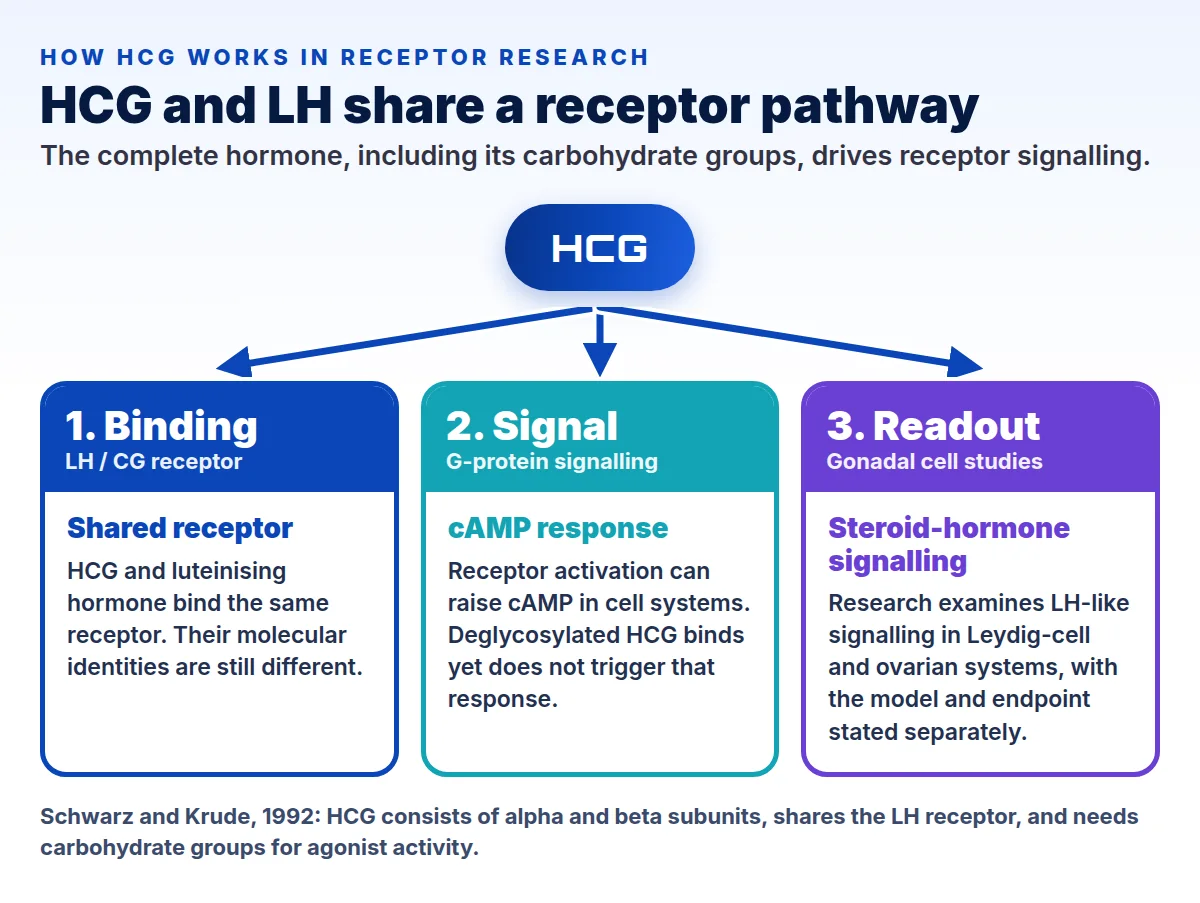
HCG works by binding the LH/CG receptor, a G-protein-coupled receptor also used by luteinising hormone. This shared-receptor relationship is why HCG is often described as having LH-like activity. It does not make HCG and LH the same hormone: their beta subunits have different amino-acid sequences.
The receptor response depends on the complete glycoprotein structure. The published receptor review reports that both subunits interact with the receptor and that carbohydrate groups are necessary for agonist activity. In that work, HCG with carbohydrates removed still bound with high affinity but did not produce the biological cAMP increase.
For research design, separate the question being asked: receptor binding, cAMP signalling, steroid-hormone output, immunoassay detection and potency are distinct readouts. A result from one readout does not stand in for all the others.
Binding question: does the material interact with the LH/CG receptor?
Signalling question: does receptor activation generate a measurable cAMP response?
Analytical question: does the submitted sample match the stated HCG identity and IU amount?
Product question: do the actual vial, formulation, records and storage history match the work being performed?
HCG and LH share the LH/CG receptor. HCG's subunits and carbohydrate groups together support agonist signalling.
What did HCG research and medicine evidence find?
HCG has a real prescription-medicine history, but that history needs to stay attached to the named medicine and its supervised clinical setting. The FDA lists Pregnyl as a prescription chorionic-gonadotropin product. Its label identifies selected indications and describes a sterile dried-powder formulation with specific excipients and a supplied solvent.
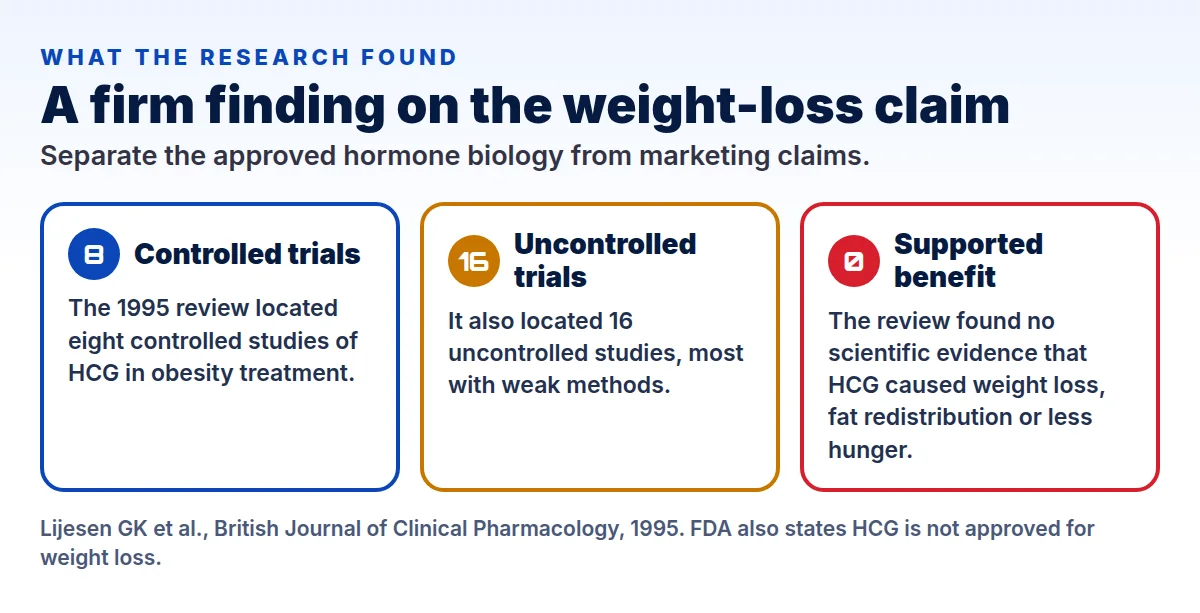
The evidence is equally clear on the common weight-loss claim. Lijesen and colleagues reviewed eight controlled and 16 uncontrolled HCG-obesity studies. Their conclusion was that HCG did not cause weight loss, fat redistribution, reduced hunger or a better sense of wellbeing. The FDA states that HCG is not approved for weight loss.
Those two findings fit together without contradiction: a hormone can have specific biological and medical roles while a different marketing claim fails testing. This HCG 5000 IU research vial is not presented as a prescription medicine, diagnostic test or weight-management product.
The 1995 meta-analysis found no scientific evidence that HCG caused weight loss, fat redistribution or less hunger.
HCG evidence: keep the product context attached to the finding
HCG evidence: keep the product context attached to the finding
Question
What the opened source says
Why it matters here
What is HCG structurally?
It is a glycoprotein with alpha and beta subunits.
Do not reduce it to a short synthetic peptide.
What receptor does HCG use?
HCG and LH bind the same receptor.
Use LH/CG receptor language for mechanism work.
Does HCG cause weight loss?
The 1995 meta-analysis found no scientific evidence for weight loss, fat redistribution or hunger reduction.
Do not make weight-management claims for this item.
Is a named HCG medicine approved in the US?
FDA Drugs@FDA lists Pregnyl as prescription HCG medicine.
Approval applies to that named product and its formulation.
This table separates molecule biology, clinical medicine evidence and the research-vial context.
HCG vs luteinising hormone (LH)
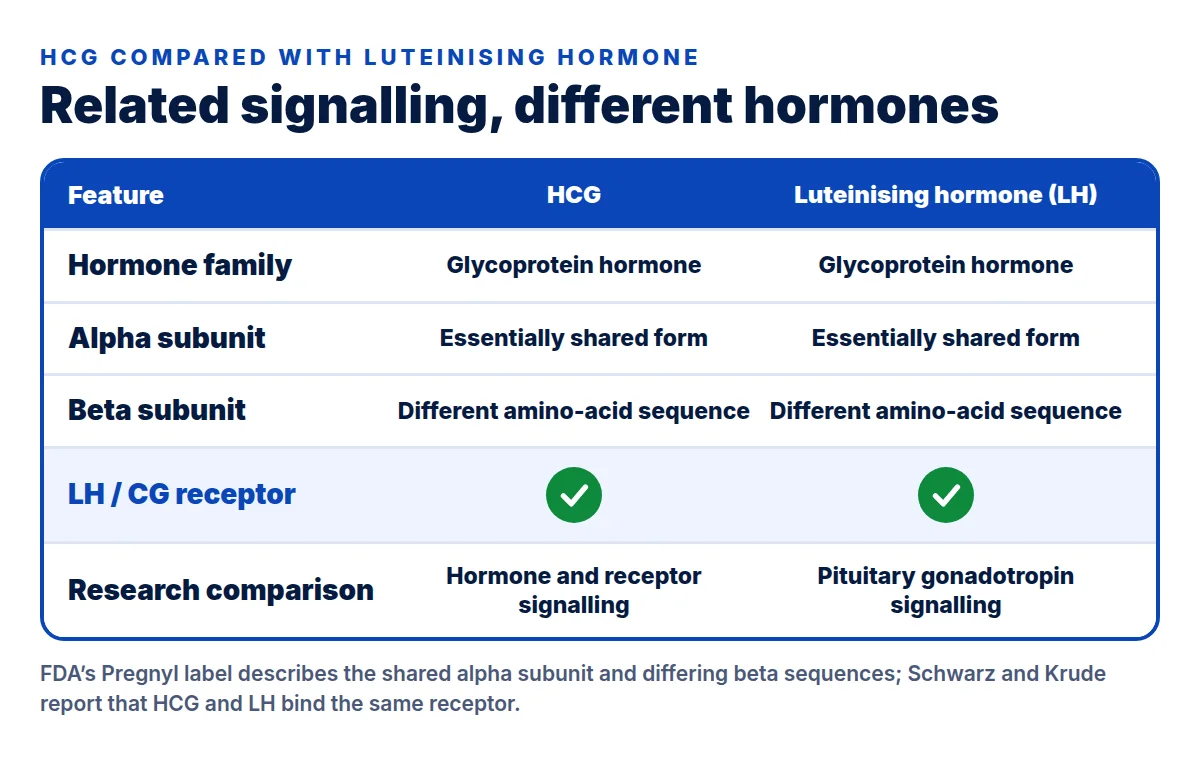
HCG and LH are related glycoprotein hormones with distinct molecular identities. Both have an alpha subunit of essentially the same form and both act at the LH/CG receptor. Their beta subunits differ in amino-acid sequence.
This distinction improves research reporting. Say whether the experiment uses HCG or LH, name the receptor and assay, and report the test material's stated activity and preparation. Avoid transferring a result from one hormone to the other without stating the exact model and endpoint.
The comparison is also a reminder that an IU label is not a universal cross-hormone conversion. IU is tied to a biological standard for the named material. A 5,000 IU HCG label should be discussed as HCG activity, not converted into a generic milligram amount.
HCG and LH share the LH/CG receptor but remain different glycoprotein hormones with different beta-subunit sequences.
HCG and LH: shared receptor, different molecular identity
HCG and LH: shared receptor, different molecular identity
Feature
HCG
LH
Hormone family
Glycoprotein hormone
Glycoprotein hormone
Alpha subunit
Essentially shared form
Essentially shared form
Beta subunit
Different sequence
Different sequence
LH/CG receptor
Binds
Binds
Useful research wording
HCG receptor signalling
LH receptor signalling
Shared receptor binding does not make HCG and LH the same hormone or make their labelled amounts interchangeable.
Independent HCG 5000 IU quality result
This listing does not have a LabDoc report. Its published product-specific quality evidence appears on the Peak Peptides Australia Quality page. The page records HCG (5000iu), Janoshik Task #135353, dated 29 May 2026, with the result: HCG: 4,556 IU.
That wording matters. Janoshik's HCG service says it performs HPLC ID-and-amount analysis and reports lyophilised results in IU per vial. The service page also says peptide purity is not determined with HCG. Therefore, the Quality-page entry supports the stated HCG result in IU for that submitted sample; it is not an HPLC purity percentage and it is not a LabDoc certificate.
Identity asks what molecule was detected. Amount or activity asks what IU result was measured. Purity describes a different analytical question. Sterility, endotoxin, container integrity and storage history are separate questions. Open the Quality page.
Published source: Peak Peptides Australia Quality page.
Laboratory entry: Janoshik Task #135353.
Date shown: 29 May 2026.
Reported result: HCG: 4,556 IU.
Method context from Janoshik: HPLC ID-and-amount analysis, with lyophilised result format in IU per vial.
No product-specific LabDoc is published for this listing.
HCG 5000 IU in Australia: research vial and medicine status
HCG exists in more than one product context. Pregnancy tests detect HCG. Prescription products use HCG in tightly defined medical settings. This listing is a research vial, supplied for in-vitro research only.
For Australian regulation, the distinction is direct. This listing is not a TGA-approved therapeutic medicine. The TGA currently lists CHORIOMON 5000 I.E. as a Section 19A approved medicine until 31 August 2027 in the shortage context for Pregnyl 5000 IU. That named approval is not a blanket approval for products labelled HCG.
For orders from Peak Peptides Australia, same-day dispatch from Victoria for in-stock orders once payment is confirmed, tracked Australia Post Express, tracking number emailed. Add bacteriostatic water separately if your laboratory workflow requires the illustrated 2 mL chart, and retain the concentration calculation with the vial record.
Step-by-step guide · About 10 minutes
How to reconstitute HCG 5000 IU (step-by-step with photos)
HCG 5000 IU is shown as a dry, freeze-dried powder. Reconstitution means adding a measured diluent so the labelled 5,000 IU is distributed through a known volume. The visual workflow below uses 2 mL of bacteriostatic water, which calculates to 2,500 IU/mL and gives straightforward U-100 measurement maths. Once mixed, keep it in the fridge at 2–8 °C and use it within about 4 weeks.
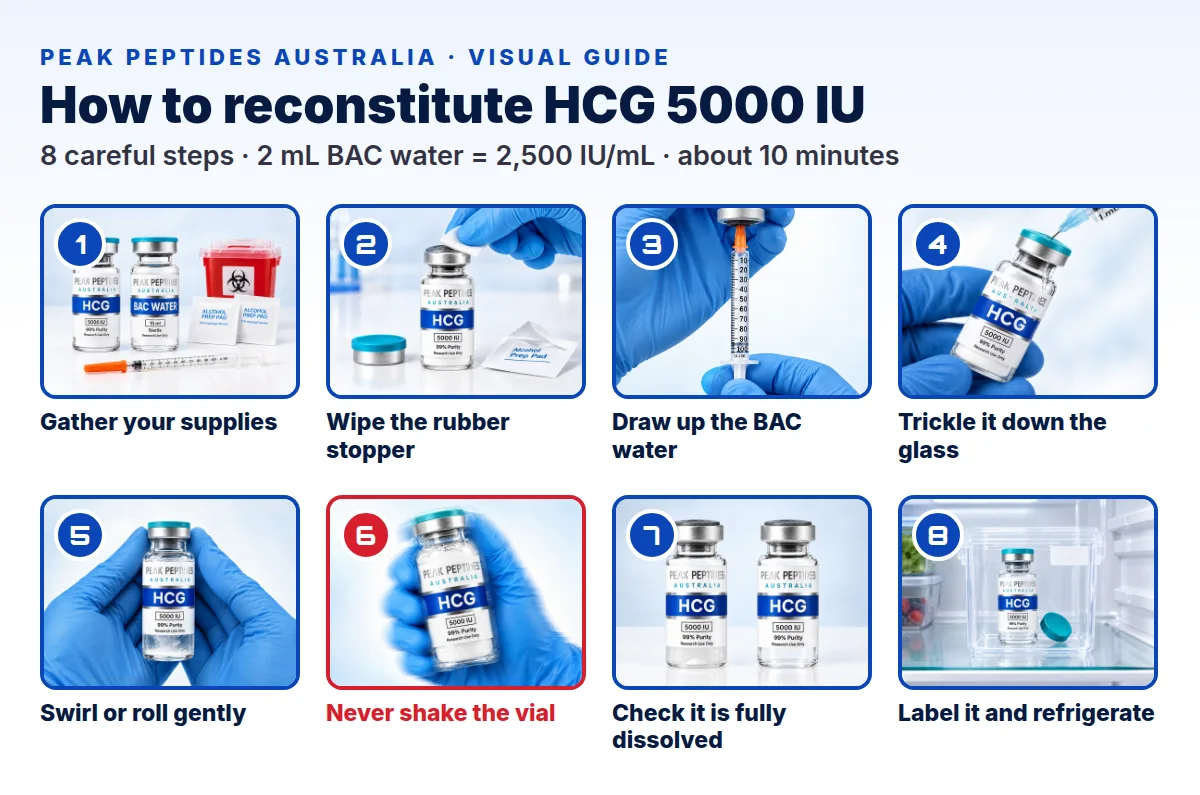
The HCG 5000 IU workflow at a glance: calculate, add slowly, swirl gently, inspect, label and store upright in the fridge at 2–8 °C.
What you need
HCG 5000 IU vialThe labelled freeze-dried HCG research vial, retained with its batch records.
Bacteriostatic waterThe mixing liquid used in this chart: sterile water with 0.9% benzyl alcohol.
1 mL U-100 syringeA U-100 scale has 100 units in 1 mL, so one unit equals 0.01 mL.
Alcohol swabsFor cleaning the vial stoppers and allowing them to air-dry before entry.
Sharps containerFor immediate disposal of used needles and syringes.
How much BAC water to add to HCG 5000 IU
The HCG vial label remains 5,000 IU whichever listed BAC water volume is used. Adding more BAC water spreads that stated IU amount through more liquid. It changes IU per mL and IU per syringe unit; it does not add activity to the vial.
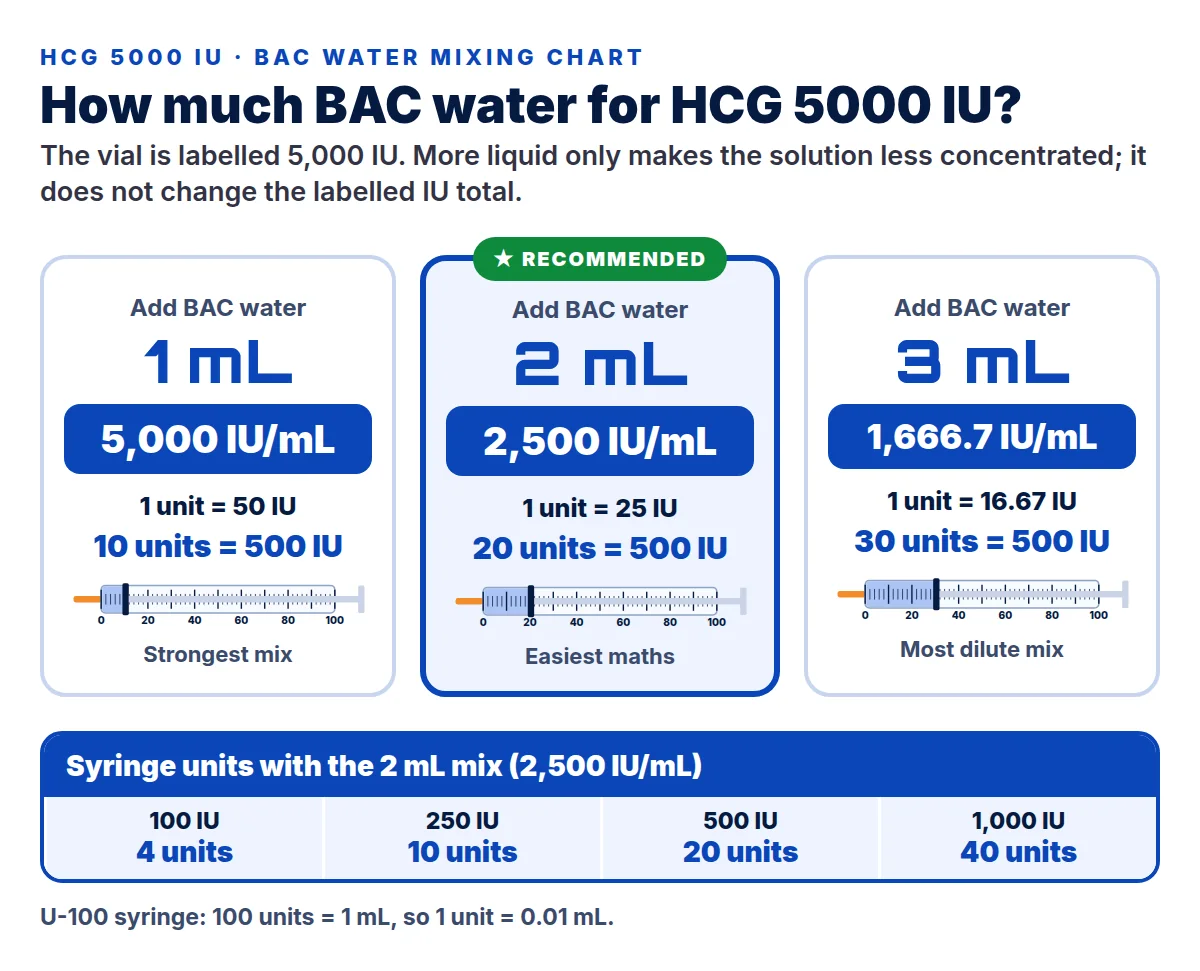
The 2 mL chart is the simplest: 5,000 IU ÷ 2 mL = 2,500 IU/mL. A U-100 syringe has 100 units per mL, so 2,500 IU ÷ 100 = 25 IU per unit. That makes 10 units 250 IU, 20 units 500 IU, 40 units 1,000 IU and 0.20 mL 20 units. The formula is units = desired IU ÷ IU per mL × 100.
The 1 mL option calculates to 5,000 IU/mL and 50 IU per unit. The 3 mL option calculates to about 1,666.67 IU/mL and about 16.67 IU per unit. Record the actual BAC water volume beside every derived measurement so the calculation can be checked.
HCG 5000 IU mixing chart: 2 mL BAC water gives 2,500 IU/mL and 25 IU per U-100 unit.
HCG 5000 IU reconstitution chart (U-100 syringe, 1 unit = 0.01 mL)
HCG 5000 IU reconstitution chart (U-100 syringe, 1 unit = 0.01 mL)
BAC water added
Strength
1 unit holds
Units for 500 IU
Whole vial
1 mL
5,000 IU/mL
50 IU
10 units
100 units
2 mL
2,500 IU/mL
25 IU
20 units
200 units
3 mL
1,666.7 IU/mL
16.67 IU
30 units
300 units
2 mL is highlighted because it gives the simplest numbers.
Syringe units with the 2 mL mix (2,500 IU/mL)
Syringe units with the 2 mL mix (2,500 IU/mL)
Amount
Units on a U-100 syringe
Volume
100 IU
4 units
0.04 mL
250 IU
10 units
0.1 mL
500 IU
20 units
0.2 mL
1,000 IU
40 units
0.4 mL
The 8 steps
1Step 1: Gather your supplies
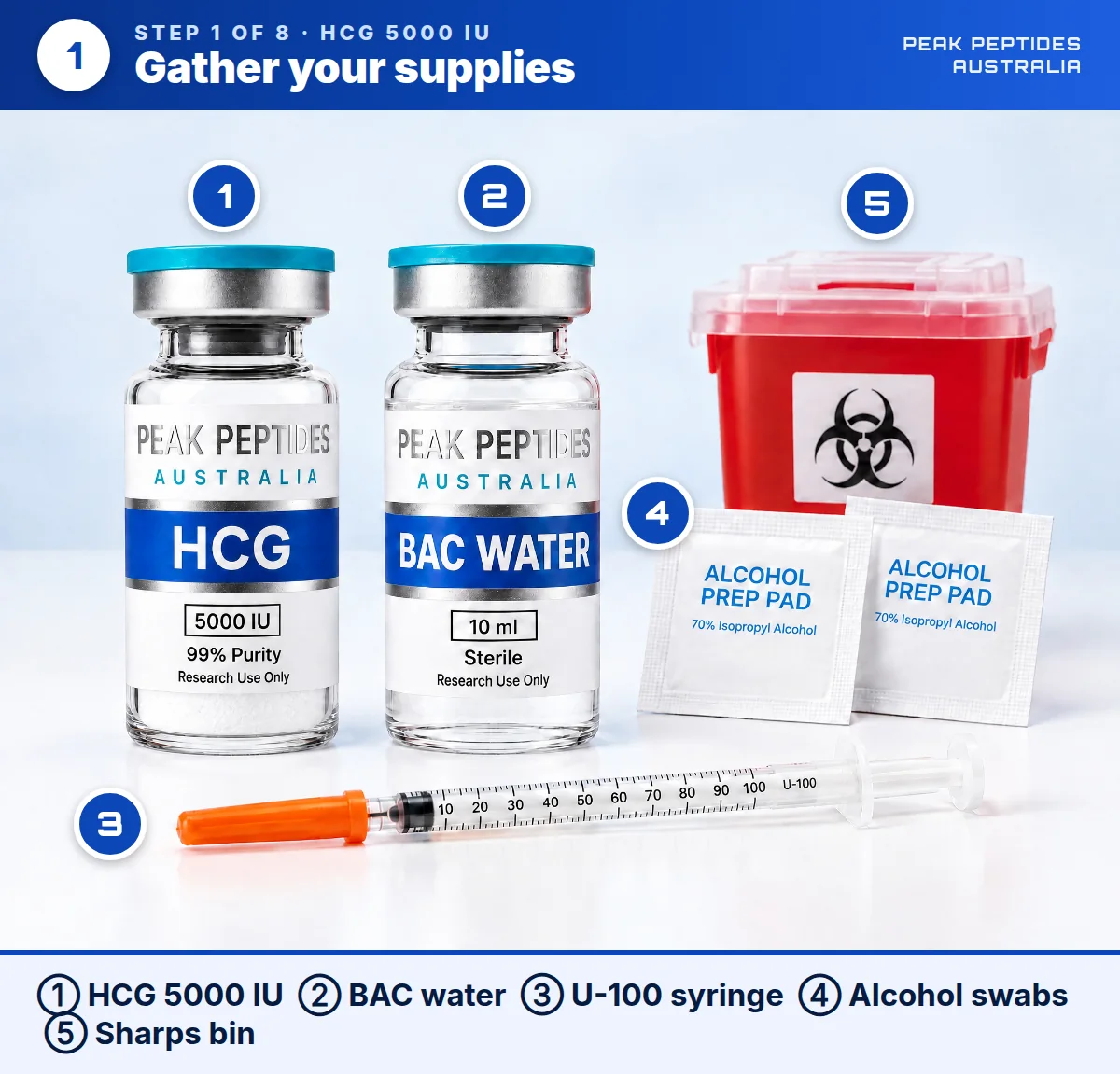
Lay out the HCG 5000 IU vial, the selected diluent, a new 1 mL U-100 syringe, alcohol swabs and a sharps container on a clean work surface. Read the vial and batch documentation first. Decide the total liquid volume before opening anything; this guide’s chart uses 2 mL of BAC water.
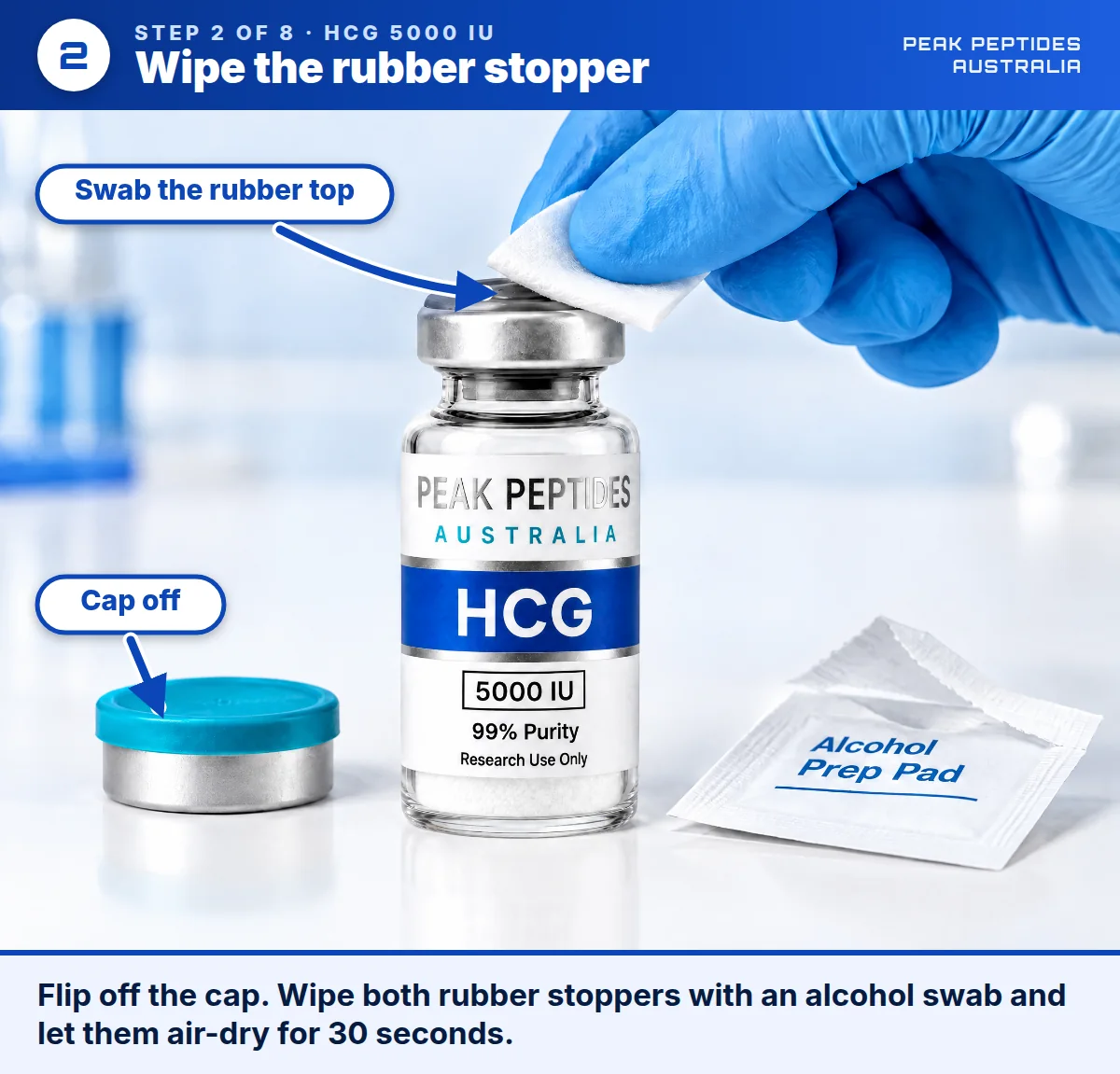
2Step 2: Wipe the rubber stopper
Remove the flip-off cap if present. Wipe the rubber stopper of the HCG vial and the diluent vial with a fresh alcohol swab. Let each stopper air-dry for about 30 seconds. Do not touch the cleaned stopper or needle shaft before the next step.
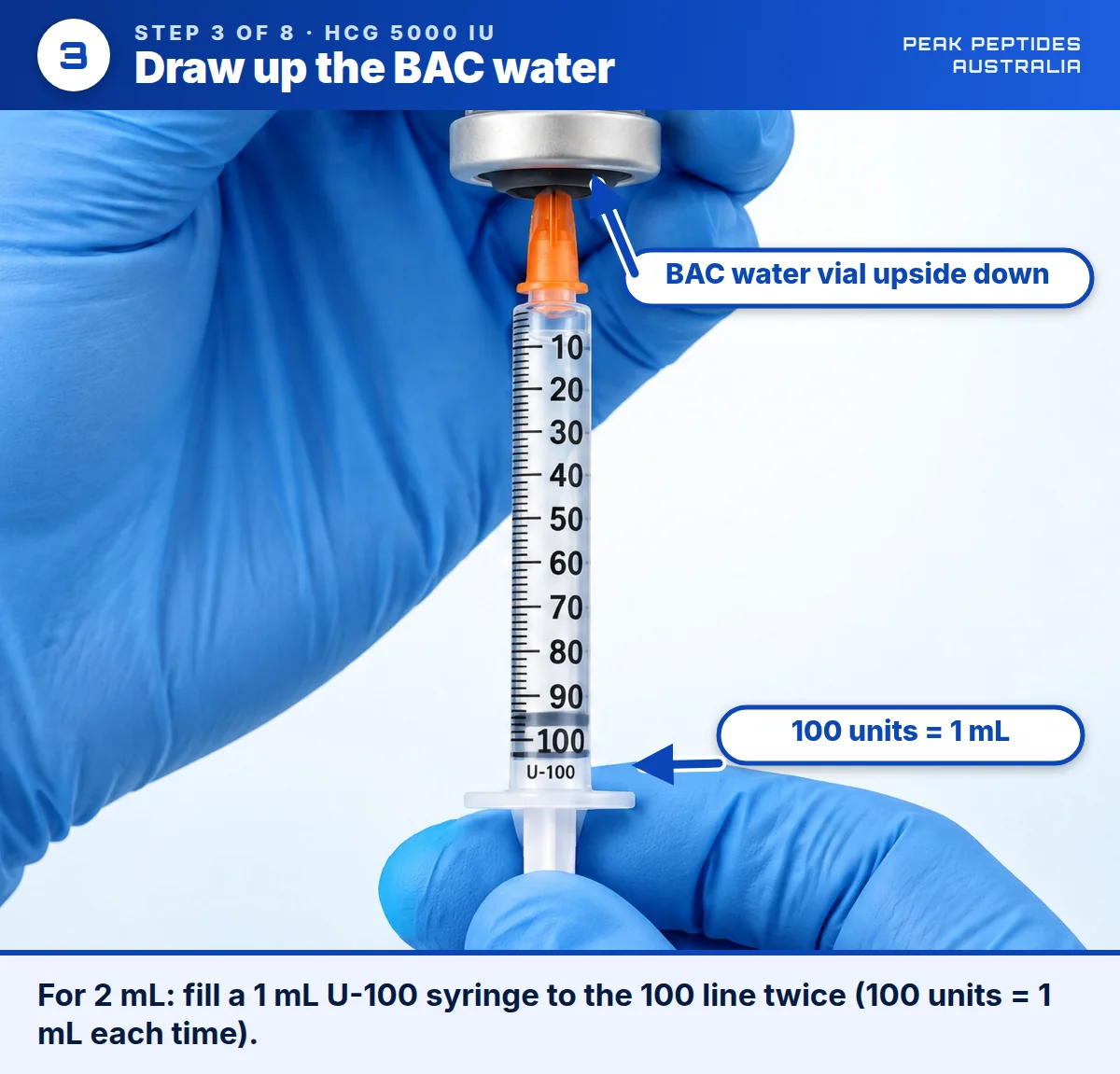
3Step 3: Draw up the BAC water
For the illustrated 2 mL chart, measure 1 mL of BAC water into a new U-100 syringe, which is the 100-unit mark. Check the liquid level at eye height and remove large bubbles. Repeat with a fresh measured fill for the second millilitre so the total added volume is 2 mL.
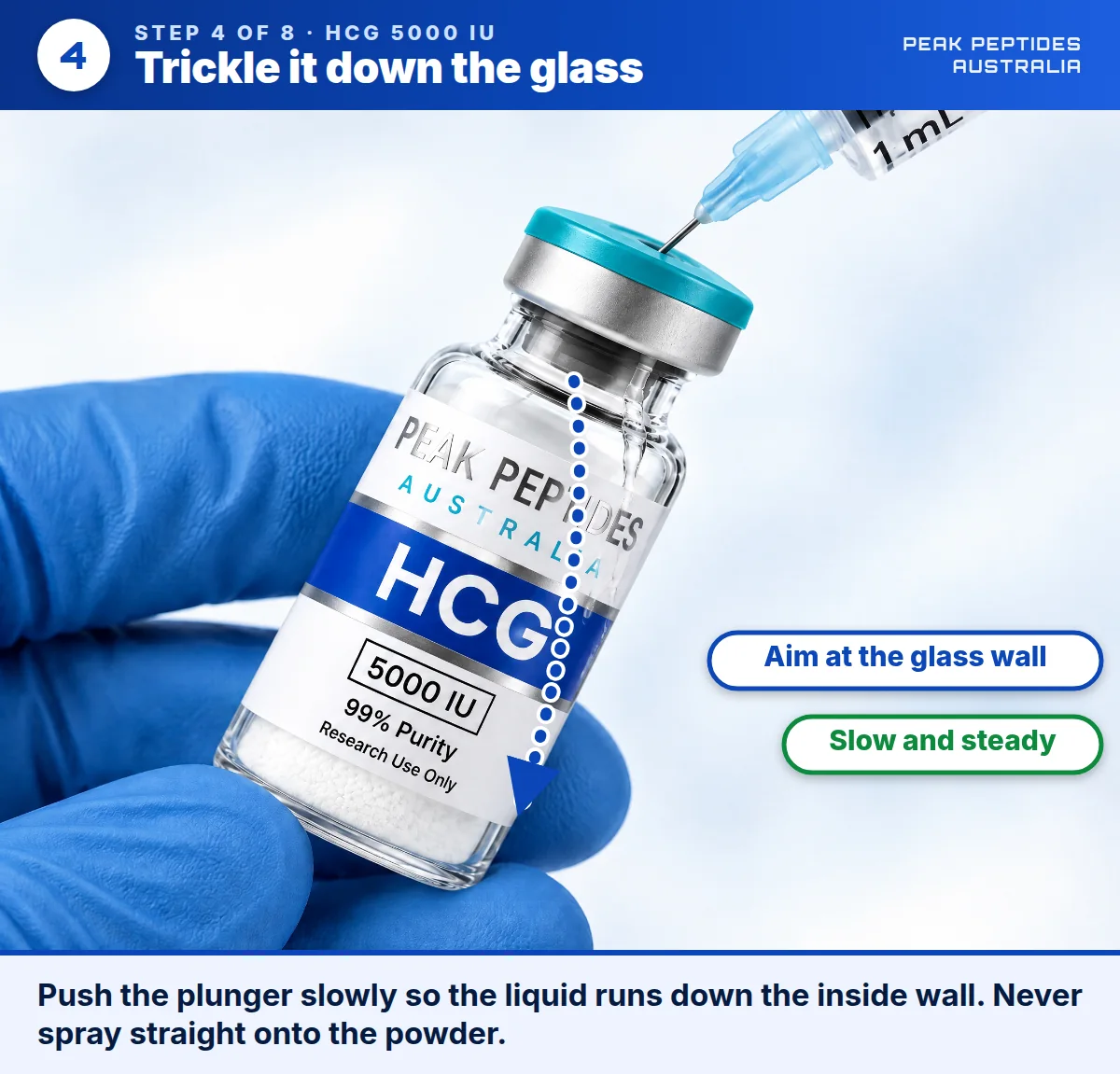
4Step 4: Trickle it down the glass
Insert the needle through the HCG stopper and aim the tip toward the inside glass wall. Add the measured liquid slowly so it runs down the wall rather than striking the powder in a forceful stream. Repeat for the second measured millilitre when following the 2 mL chart.
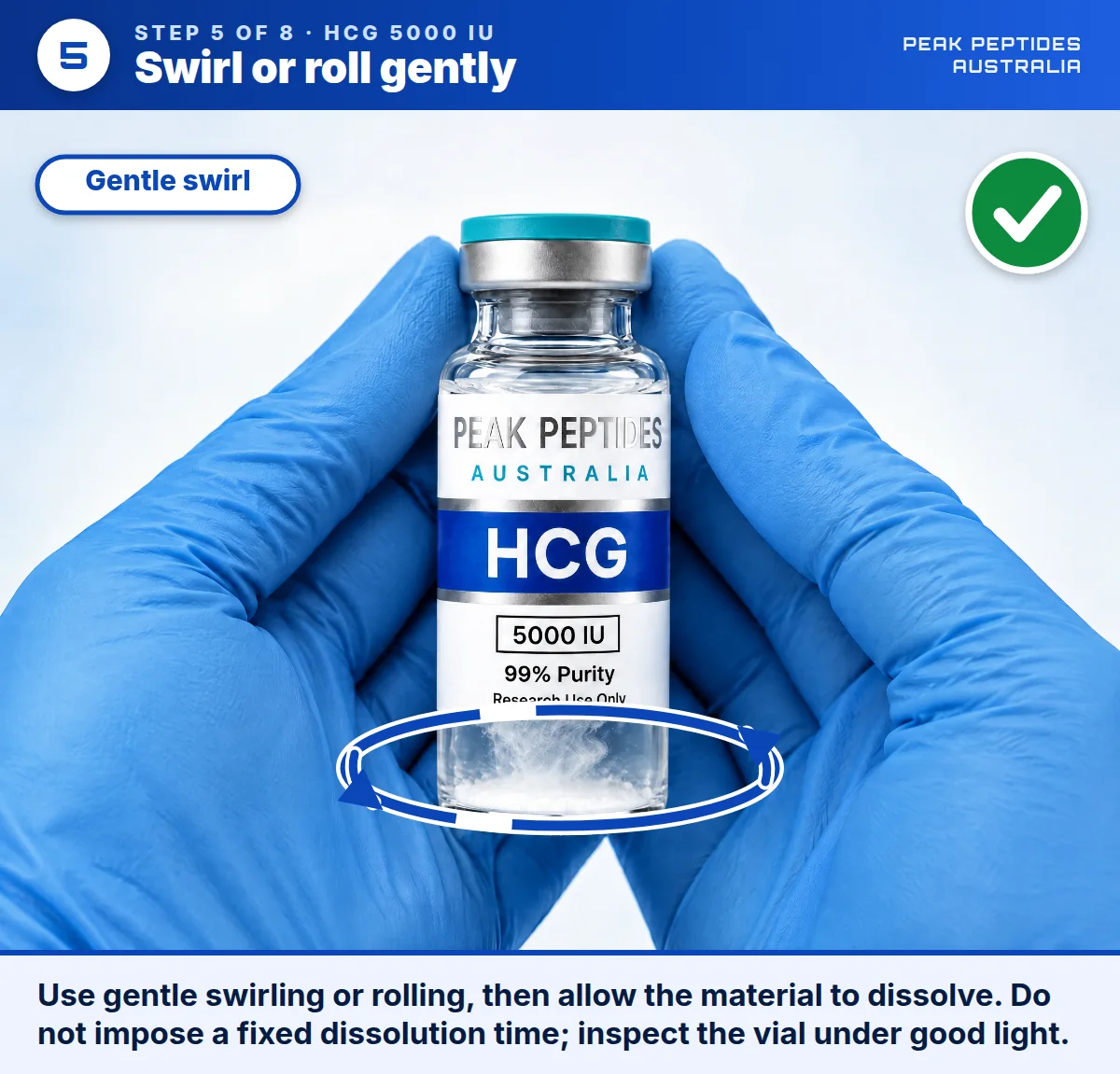
5Step 5: Swirl or roll gently
Gently roll the HCG vial between the fingers or swirl it in slow circles. Do not force a fixed dissolution time: watch the vial and use only the permitted gentle mixing method. A little undissolved material may settle at the bottom before the solution becomes clear.
6Step 6: Never shake the vial
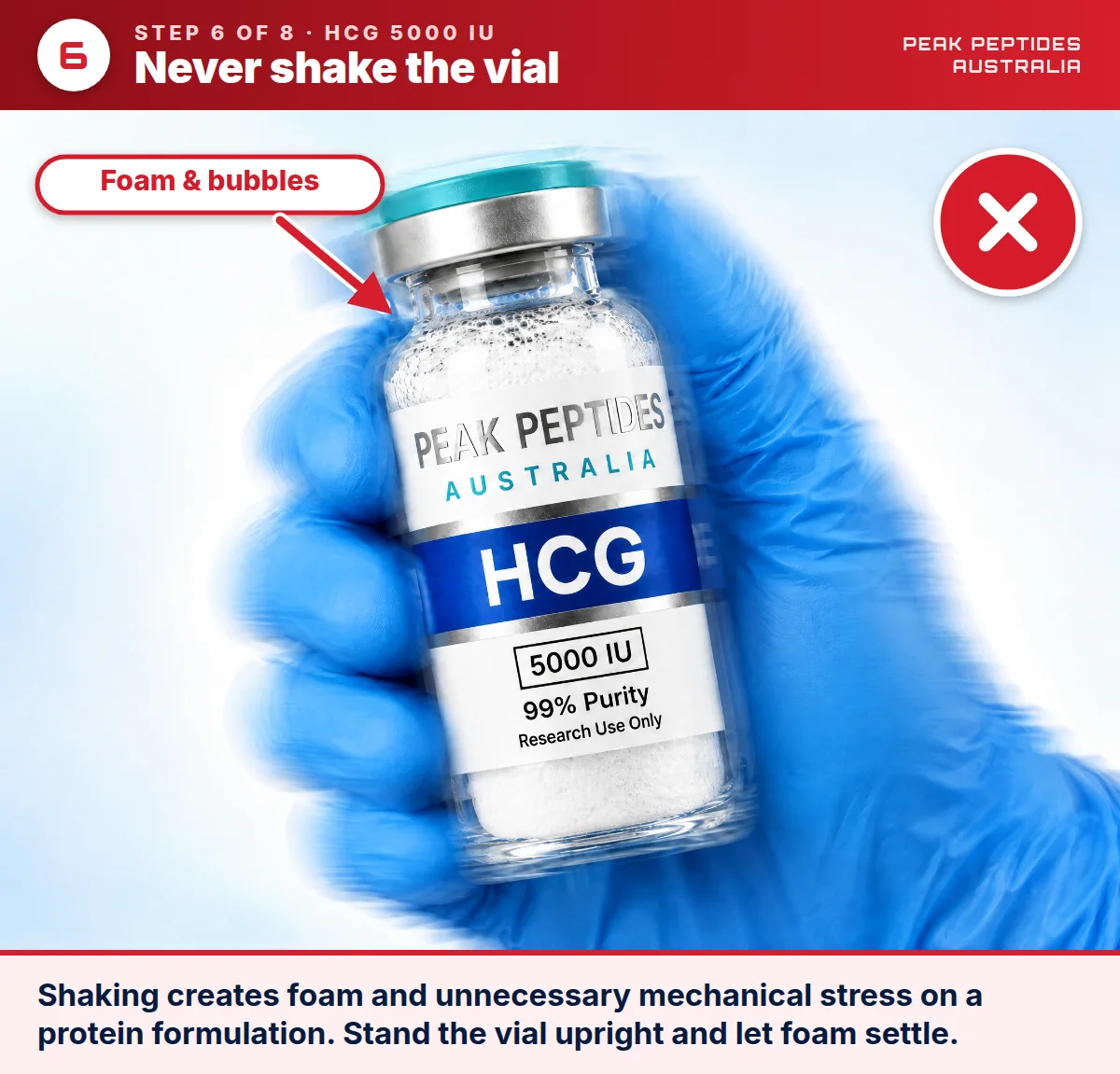
Do not shake the HCG vial. Vigorous shaking creates foam and increases mechanical stress on protein formulations. If foam appears, stand the vial upright and allow it to settle. Gently swirl or roll the vial between your fingers until the powder has fully dissolved.
7Step 7: Check it is fully dissolved
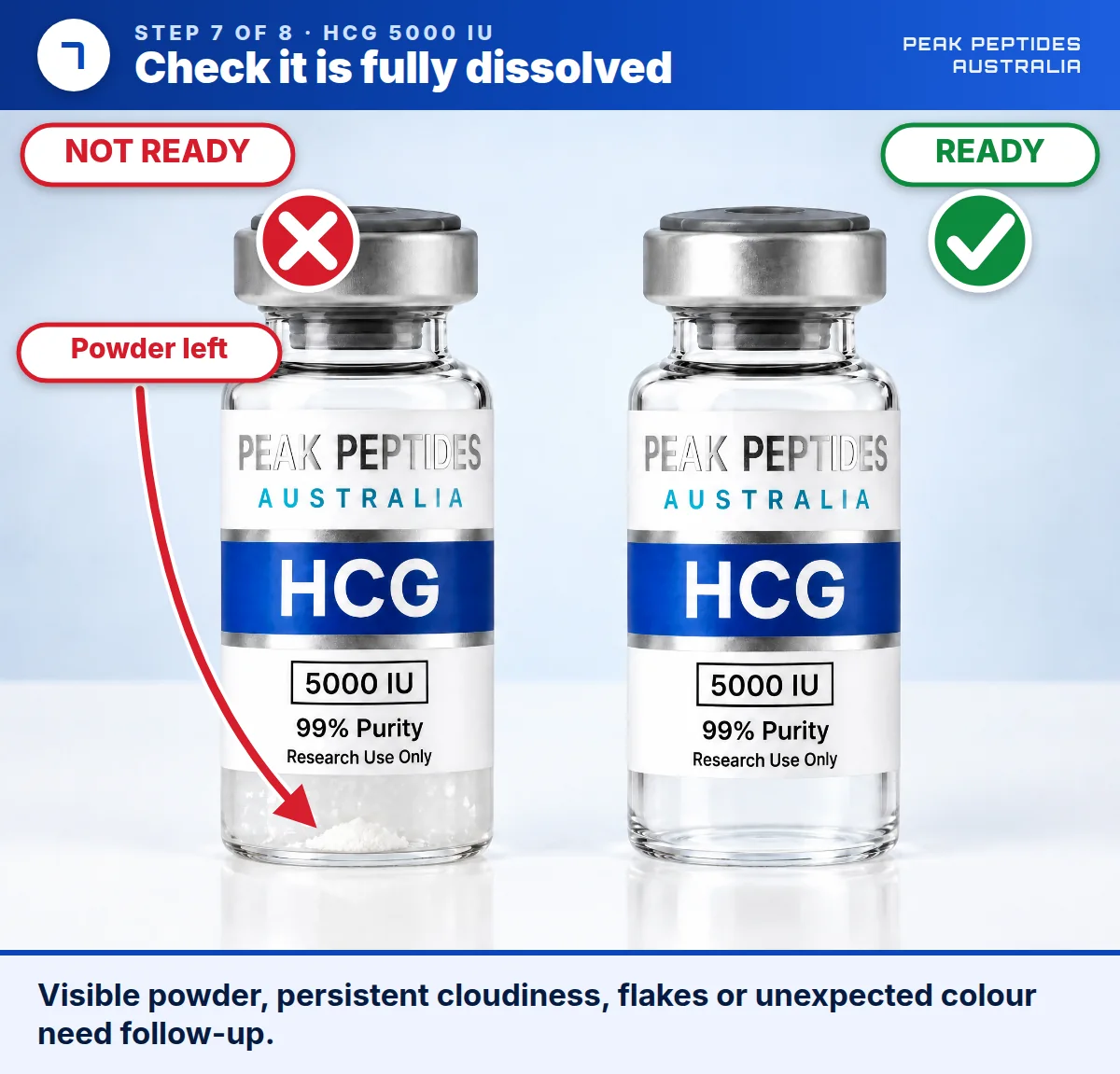
Inspect the vial under good light. The illustrated finished solution is clear and should not have visible powder, flakes, cloudiness or unexpected colour. If material remains, allow the vial to stand and swirl gently again. Persistent cloudiness, particles, leakage or stopper damage require the vial to be isolated for assessment.
8Step 8: Label it and refrigerate
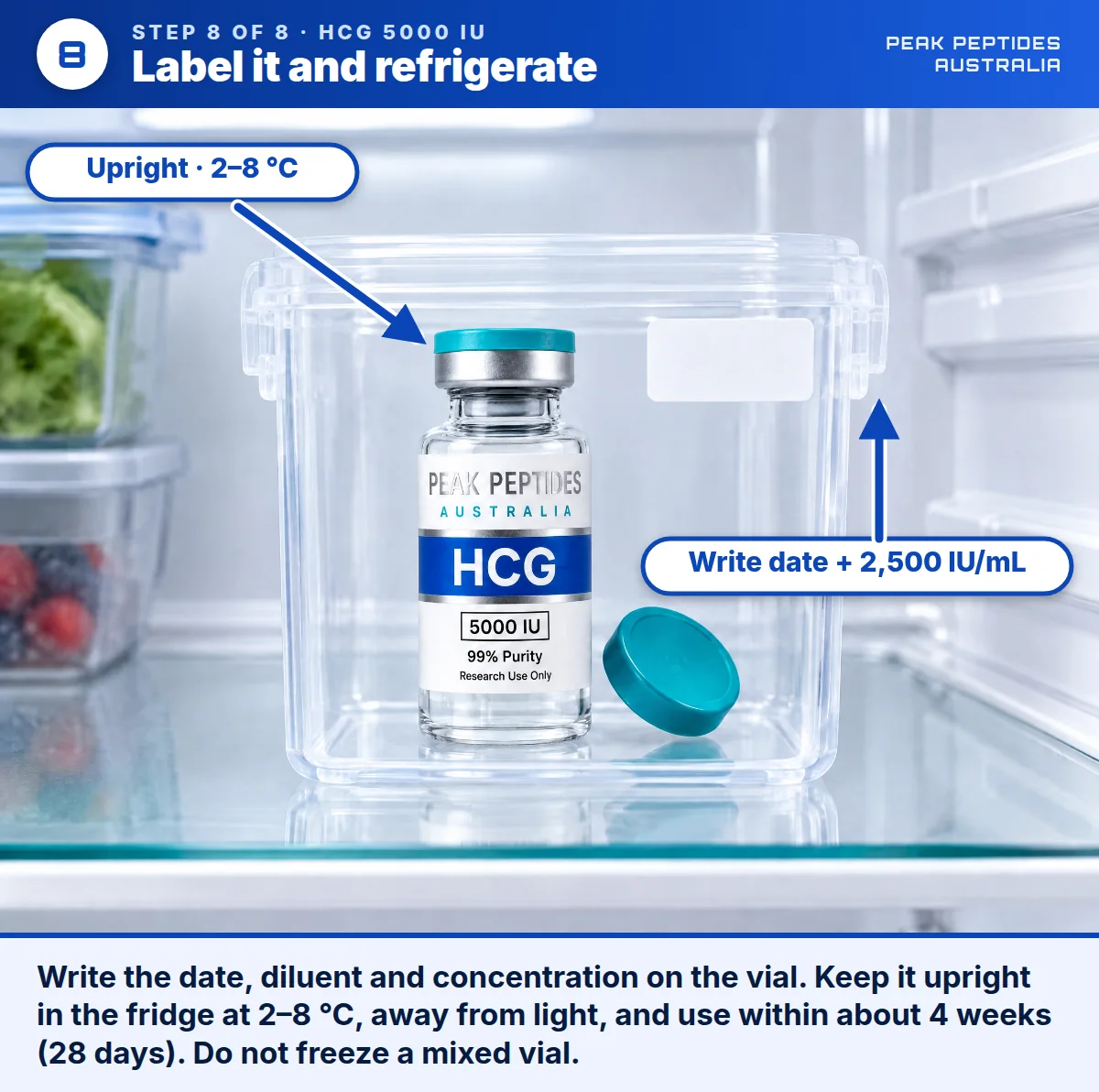
Write the preparation date, diluent, total volume and calculated concentration on the vial record. For the illustrated chart, 2 mL gives 2,500 IU/mL. Keep the mixed vial upright in the fridge at 2–8 °C, away from light, and use within about 4 weeks (28 days). Never freeze it.
How to store HCG 5000 IU
HCG storage: separate this research vial from named medicine instructions
HCG storage: separate this research vial from named medicine instructions
Material
Storage basis
What to record
Unopened HCG 5000 IU research vial
Keep in the fridge at 2–8 °C, dry and out of light, until the printed expiry.
Batch identifier, expiry, storage location and any excursion.
Mixed HCG 5000 IU research vial
Refrigerate at 2–8 °C; use within about 4 weeks (28 days).
Preparation date, diluent, added volume, calculated IU/mL and discard record.
Mixed HCG 5000 IU research vial
Never freeze it.
Any temperature excursion and the action taken.
Pregnyl 10,000-unit medicine
Its FDA label states 15–30 °C unopened and 2–8 °C after reconstitution, with a 60-day refrigerated period.
Treat as Pregnyl-specific medicine information, not as this vial's specification.
Once mixed with BAC water, keep the vial upright at 2–8 °C, away from light. Use within about 4 weeks (28 days), never freeze it, and write the date and strength on the vial.
HCG 5000 IU FAQs — Research, Quality & Reconstitution
What is HCG 5000 IU?
HCG 5000 IU is a vial labelled with 5,000 International Units of human chorionic gonadotropin. HCG is a glycoprotein hormone made of alpha and beta subunits with carbohydrate groups attached. This Peak Peptides Australia listing is supplied for in-vitro research only.
Is HCG the same as hCG?
Yes. HCG and hCG are capitalisation variants of human chorionic gonadotropin. You may also see the full name chorionic gonadotropin or choriogonadotropin. They describe the same hormone name, not separate molecules.
Is HCG a peptide?
HCG is better described as a glycoprotein hormone. It contains protein subunits, so it belongs in peptide-hormone discussions, but it is not an ordinary short synthetic peptide. Its two linked subunits and carbohydrate groups are part of its structure and receptor activity.
What does 5,000 IU mean on an HCG vial?
The 5,000 IU label states biological-activity strength. IU does not mean 5,000 mg, 5,000 mL or 5,000 syringe units. A concentration exists only after a known liquid volume is added, which is why the BAC water volume must always be stated beside the IU calculation.
How does HCG work in research?
HCG binds the LH/CG receptor, the same receptor used by luteinising hormone. Receptor activation can trigger signalling such as cAMP responses in laboratory systems. Researchers use this biology to examine gonadotropin binding, receptor activity and downstream signalling in defined models.
Is HCG the same as luteinising hormone?
No. HCG and luteinising hormone are different glycoprotein hormones. They share the LH/CG receptor and have essentially the same alpha-subunit form, but their beta subunits differ in amino-acid sequence. Shared receptor biology does not make their identity, formulation or labelled IU interchangeable.
What did studies find about HCG and weight loss?
The 1995 meta-analysis of HCG for obesity found no scientific evidence that HCG caused weight loss, fat redistribution, reduced hunger or improved wellbeing. The FDA says HCG is not approved for weight loss and identifies severe calorie restriction, not HCG, as the reason behind advertised losses.
What side effects are reported for prescription HCG medicines?
The FDA label for prescription Pregnyl lists reactions including headache, fatigue, oedema, injection-site reactions and hypersensitivity. In fertility treatment it also carries major warnings including ovarian hyperstimulation syndrome and multiple gestation. Those warnings belong to supervised use of that exact medicine and do not turn this research vial into a medicine.
What is the half-life of HCG?
The HCG 5000 IU listing does not publish a product-specific pharmacokinetic study. Half-life values reported for prescription or clinical HCG preparations describe those exact preparations and study settings.
Is HCG approved by the FDA?
Yes, prescription HCG medicine exists in the United States. FDA Drugs@FDA lists Pregnyl, gonadotropin chorionic, 10,000 units per vial, with prescription marketing status. FDA approval applies to Pregnyl and its labelled formulation, not to a separate research-use product.
Is HCG approved by the TGA in Australia?
This HCG 5000 IU research listing is not a TGA-approved therapeutic medicine. The TGA does list a current Section 19A approval for CHORIOMON 5000 I.E. until 31 August 2027 in the Pregnyl 5000 IU shortage context. That is a named medicine approval and does not apply to this listing.
Can I buy HCG 5000 IU online in Australia?
HCG 5000 IU may be ordered through Peak Peptides Australia when available. It is supplied for in-vitro research only. Same-day dispatch from Victoria for in-stock orders once payment is confirmed, tracked Australia Post Express, tracking number emailed.
How fast is HCG 5000 IU dispatched in Australia?
Same-day dispatch from Victoria for in-stock orders once payment is confirmed, tracked Australia Post Express, tracking number emailed. Dispatch timing describes the sending process; transit time depends on Australia Post and the delivery location.
How is this HCG 5000 IU sample verified?
The published product-specific evidence is on the Peak Peptides Australia Quality page. It records Janoshik Task #135353, dated 29 May 2026, with HCG: 4,556 IU. Janoshik describes the relevant HCG service as HPLC identity-and-amount analysis reported in IU per vial.
Is there a LabDoc report for HCG 5000 IU?
No. A product-specific LabDoc report is not published for this HCG 5000 IU listing. The available product-specific result is the Janoshik entry on the Quality page: Task #135353, dated 29 May 2026, recording HCG: 4,556 IU.
What does a COA show for HCG?
A certificate or laboratory result must be read for its exact sample, method and reported unit. For HCG, activity or amount in IU, identity, peptide purity, sterility and endotoxin are separate questions. Janoshik says its HCG HPLC service reports lyophilised results in IU per vial and does not determine peptide purity.
How much BAC water for HCG 5000 IU?
The HCG 5000 IU chart uses 2 mL of BAC water because it gives 2,500 IU/mL and simple measurement maths. The same 5,000 IU label divided by 1 mL gives 5,000 IU/mL; divided by 3 mL it gives about 1,666.67 IU/mL. Liquid volume changes concentration, not total labelled IU.
How many units is 500 IU of HCG?
With the 2 mL HCG 5000 IU chart, concentration is 2,500 IU/mL. A U-100 syringe has 100 units per mL, so one unit represents 25 IU and 500 IU corresponds to 20 units, or 0.20 mL. This is measurement arithmetic for the stated concentration.
How many IU are in 10 units of HCG?
With the 2 mL mix shown in this guide, 10 U-100 units equal 0.10 mL. At 2,500 IU/mL, that volume contains 250 IU. With a different BAC water volume, the IU in 10 units changes because the concentration changes.
How do I reconstitute HCG 5000 IU?
The photo guide shows the handling sequence: prepare a clean workspace, wipe stoppers, measure the chosen BAC water volume, add it slowly down the vial wall, swirl gently, never shake and inspect for complete dissolution. Label with the date and strength, keep upright at 2–8 °C away from light, use within about 4 weeks (28 days) and never freeze. It illustrates 2 mL for 2,500 IU/mL.
Can I use sterile water or tap water instead of BAC water?
Tap water is not an acceptable laboratory diluent. Sterile water and bacteriostatic water are different materials, and the chosen diluent must match the actual vial documentation. This guide illustrates BAC water because the HCG 5000 IU calculation chart is built around that stated solvent.
What if the HCG powder does not dissolve?
Do not add extra liquid just to force dissolution, because that changes the concentration. Let the vial stand, use only gentle mixing, and inspect it under good light. Persistent particles, cloudiness, unusual colour or stopper damage mean the material should be isolated and assessed against its product-specific documentation.
Should reconstituted HCG be cloudy?
The illustrated mixed solution should be clear and free from visible particles. Check for persistent cloudiness, flakes, unexpected colour, leakage or stopper damage. Compare the vial against its actual product description and laboratory records.
How long does mixed HCG last?
For HCG 5000 IU mixed with BAC water, use within about 4 weeks (28 days). Pregnyl's 60-day refrigerated period applies to its specified 10,000-unit medicine formulation and supplied solvent.
How should HCG 5000 IU powder be stored before mixing?
Keep unopened powder in the fridge at 2–8 °C in the dark, or at −20 °C long-term. Keep the vial’s expiry information and batch documentation. The current listing publishes no product-specific storage study or time limit. Pregnyl's room-temperature storage statement applies to Pregnyl.
Can reconstituted HCG be frozen?
Never freeze a mixed HCG vial. The FDA label for Pregnyl says not to freeze its reconstituted solution. Record any temperature excursion.
Why does HCG appear in pregnancy tests and medicines?
HCG is produced by placental tissue in pregnancy, so pregnancy tests detect it in urine or blood. Prescription HCG products use the same hormone name in specific clinical contexts. A test result, a named prescription medicine and a research vial are separate product contexts with different intended uses and evidence.