NAD+ 1000mg is nicotinamide adenine dinucleotide in its oxidised form: a coenzyme rather than a peptide for cellular redox and NAD-dependent enzyme research. The amber glass vial label identifies 1000 mg nominal content and 99% Purity. LabDoc report LD-QCYH records LC-MS-confirmed identity, 98.37% HPLC purity and 938.49mg measured content. A photo-led preparation guide and BAC water concentration chart explain the 3 mL, 5 mL and 10 mL calculation options for laboratory work. Peak Peptides Australia supplies NAD+ for in-vitro research only. In-stock orders receive same-day dispatch from Victoria after payment confirmation, with tracked Australia Post Express shipping Australia-wide.
Product Specifications
Full NameNicotinamide Adenine Dinucleotide
Vial Size1000mg
Purity98.37% HPLC (LD-QCYH, 938.49mg sample)
Legal Disclaimer
This product is sold strictly for in-vitro laboratory research purposes only. It is not a therapeutic good, is not approved by the TGA, and is not intended for human or animal consumption, injection, or any diagnostic or therapeutic use.
NAD+ 1000mg · Nicotinamide adenine dinucleotide research guide
NAD+ 1000mg — What It Is, How It Works & Preparation Guide
NAD+ 1000mg is nicotinamide adenine dinucleotide in its oxidised form. It is a coenzyme, not a peptide. In cells, NAD+ accepts electrons to become NADH, making the NAD+/NADH pair central to redox chemistry and metabolic research. It is also used by NAD-dependent enzymes such as sirtuins, PARPs and CD38. The supplied amber/brown glass vial is labelled NAD+, 1000 mg and 99% Purity. LabDoc report LD-QCYH tested this listing’s sample: identity confirmed by LC-MS, 98.37% HPLC purity and 938.49mg measured content, an overall Pass. This page explains the molecule, the difference between NAD+, NADH, NR and NMN, what direct human research did and did not test, and how the 3 mL, 5 mL and 10 mL BAC-water concentration calculations work for a large research vial. NAD+ 1000mg is supplied for in-vitro research only, not for human or animal use.
Also referred to in research or catalogue references as NAD+, NAD plus, NAD plus 1000mg, NAD+ 1000mg, NAD 1000 mg, nicotinamide adenine dinucleotide, nicotinamide-adenine-dinucleotide, oxidised nicotinamide adenine dinucleotide, NAD oxidised form, NAD(+), Nadide, DPN, diphosphopyridine nucleotide.
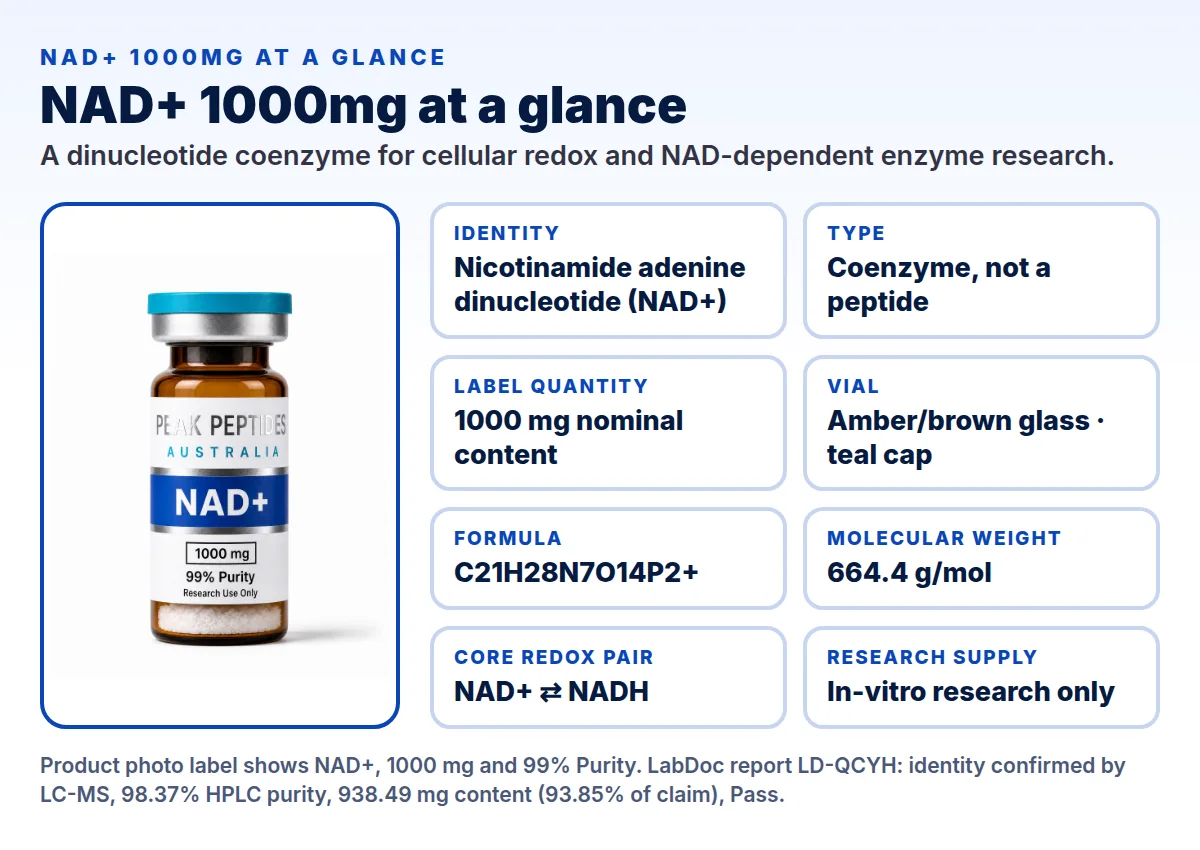
NAD+ 1000mg at a glance
Name
Nicotinamide adenine dinucleotide (NAD+)
Also called
NAD plus, oxidised NAD, Nadide, DPN and diphosphopyridine nucleotide
What it is
A dinucleotide coenzyme, not a peptide, used in redox and NAD-dependent enzyme research
Core redox pair
NAD+ accepts electrons to form NADH; NADH transfers reducing power onward
Chemical formula
C21H28N7O14P2+ · PubChem CID 5893 · 664.4 g/mol
CAS number
53-84-9
Research systems
Cellular redox chemistry, glycolysis, electron transport, sirtuins, PARPs and CD38
What you get
Nominal 1000 mg NAD+ in an amber/brown glass vial with teal cap
3 mL = 333.33 mg/mL · 5 mL = 200 mg/mL · 10 mL = 100 mg/mL
Prepared-solution storage
2–8 °C, away from light
Dispatch
Same-day from Victoria for in-stock orders once payment is confirmed, tracked Australia Post Express
NAD+ is a coenzyme, not a peptide
NAD+ means nicotinamide adenine dinucleotide in its oxidised form. A peptide is a chain of amino acids. NAD+ is instead a dinucleotide coenzyme: two nucleotide-like parts joined by phosphate groups. It can appear beside peptide materials in a research catalogue, but that placement does not make it a peptide or a receptor-active peptide.
The NAD+/NADH pair carries electrons
NAD+ accepts a hydride, which is a hydrogen atom carrying two electrons, and becomes NADH. NADH can then donate that reducing power to other reactions. This redox pair is studied in glycolysis, fatty-acid oxidation, the citric-acid cycle and electron transport. The plus sign describes the oxidised chemical form; it is not a product-grade claim.
NAD+ also supports enzyme-system research
NAD+ is a cofactor or substrate for many enzymes. Key examples are sirtuins, poly(ADP-ribose) polymerases, called PARPs, and CD38. Those systems are studied in cellular signalling, DNA-damage responses, calcium signalling and stress biology. A pathway role is not the same thing as a therapeutic outcome from a particular product.
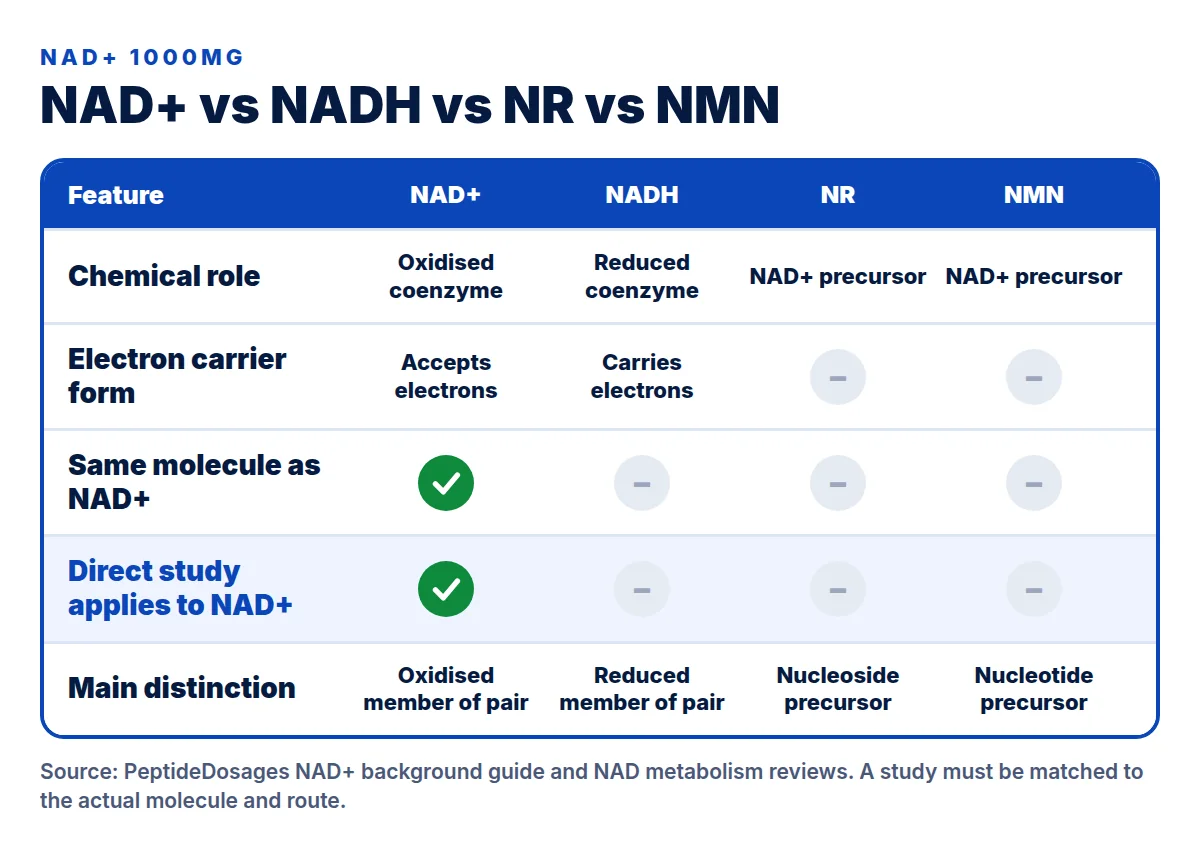
NAD+, NADH, NR and NMN are different
NADH is the reduced partner of NAD+. Nicotinamide riboside, or NR, and nicotinamide mononucleotide, or NMN, are precursors used by cells to make NAD+. They are not alternative names for direct NAD+. A paper on an oral NR or NMN product is not a direct-NAD+ study and cannot be converted into an equivalent result for this research material.
What the 1000 mg vial label means
The label identifies nominal total NAD+ content. Concentration changes with the final laboratory volume. The accompanying chart shows that 3 mL gives 333.33 mg/mL, 5 mL gives 200 mg/mL and 10 mL gives 100 mg/mL.
Direct human NAD+ evidence has a narrow scope
A 2019 pilot followed eight men receiving 750 mg NAD+ by supervised intravenous infusion over six hours, alongside three saline controls. It measured plasma and urine NAD-related metabolites. It was not designed to test energy, cognition, lifespan or a general therapeutic outcome. Route and material matter when reading NAD-related research.
LabDoc report LD-QCYH for this sample
LabDoc report LD-QCYH received the sample on 16 October 2026 and tested it on 26 October 2026. It records confirmed identity by LC-MS, 98.37% HPLC purity, 938.49mg HPLC content or 93.85% of the 1000mg label claim, and an overall Pass.
Amber glass protects a light-sensitive research material
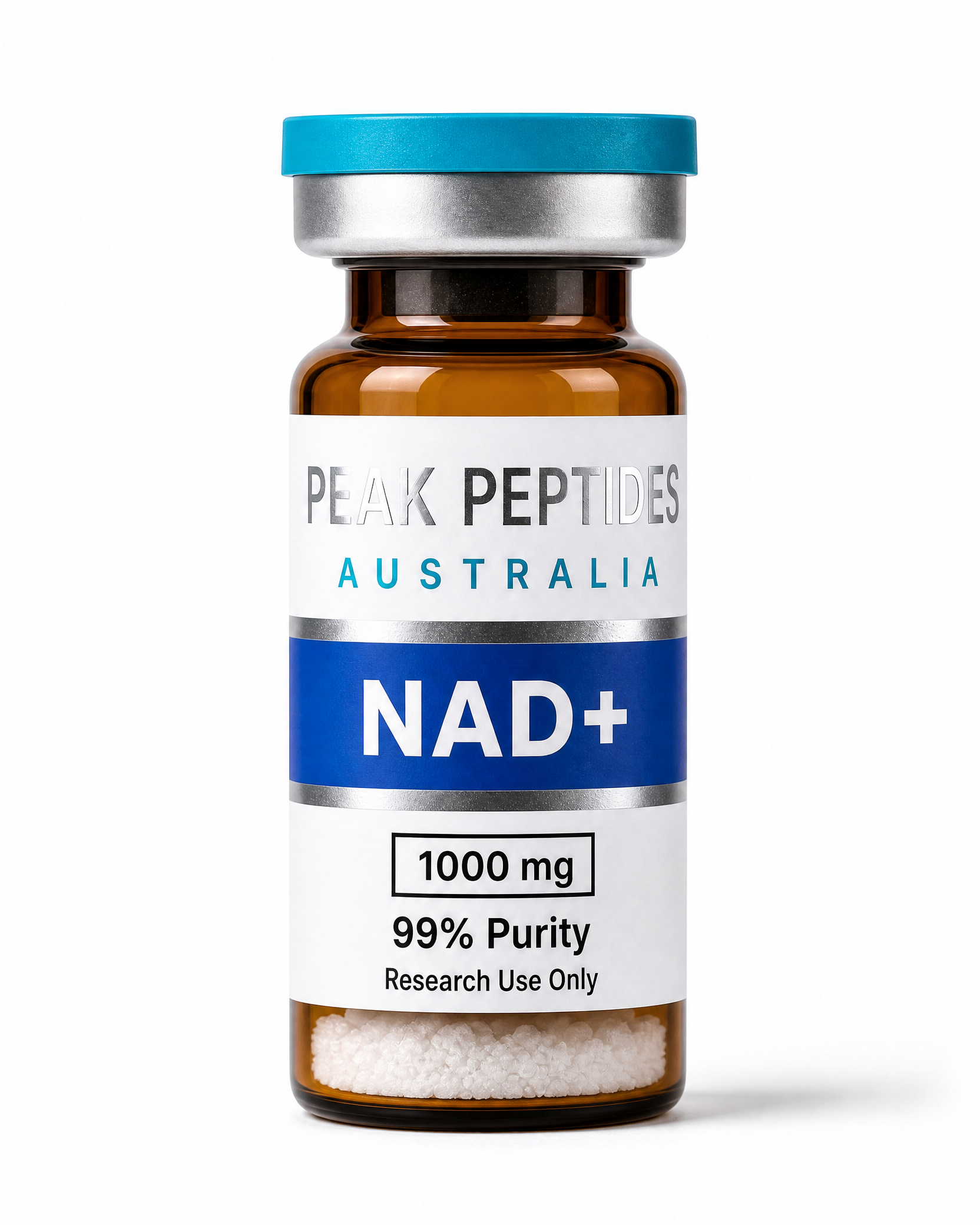
The real product photograph shows an amber/brown glass vial with a teal cap, royal-blue NAD+ label band, 1000 mg box and 99% Purity line. Keep the unopened powder dry in the fridge at 2–8 °C in the dark, or at −20 °C long-term. Once mixed with BAC water, keep it upright at 2–8 °C, away from light, and use within about 4 weeks (28 days). Never freeze it. Write the date and strength on the vial.
NAD+ is nicotinamide adenine dinucleotide in its oxidised form. It is a coenzyme: a small molecule that helps enzymes carry out chemical reactions. It is not a peptide. Peptides are made from amino-acid chains, while NAD+ is a dinucleotide built from a nicotinamide-containing nucleotide and an adenine-containing nucleotide linked through phosphate groups.
The NAD+ name is often used loosely online, so it helps to separate the molecule from the format. NAD+ is the chemical identity. NADH is its reduced partner. NR and NMN are precursors used in NAD metabolism. A product label showing NAD+ 1000mg refers to the direct oxidised coenzyme, not to a generic "NAD product" and not to an oral NR or NMN preparation.
The real vial image on this page is an amber/brown glass container with a teal cap. Its label reads NAD+, carries a boxed 1000 mg strength, says 99% Purity and states Research Use Only. It is supplied for in-vitro research only, not for human or animal use.
NAD+ 1000mg is an amber-vial research coenzyme for cellular redox and enzyme-system work, not a peptide.
How does NAD+ work in cellular research?
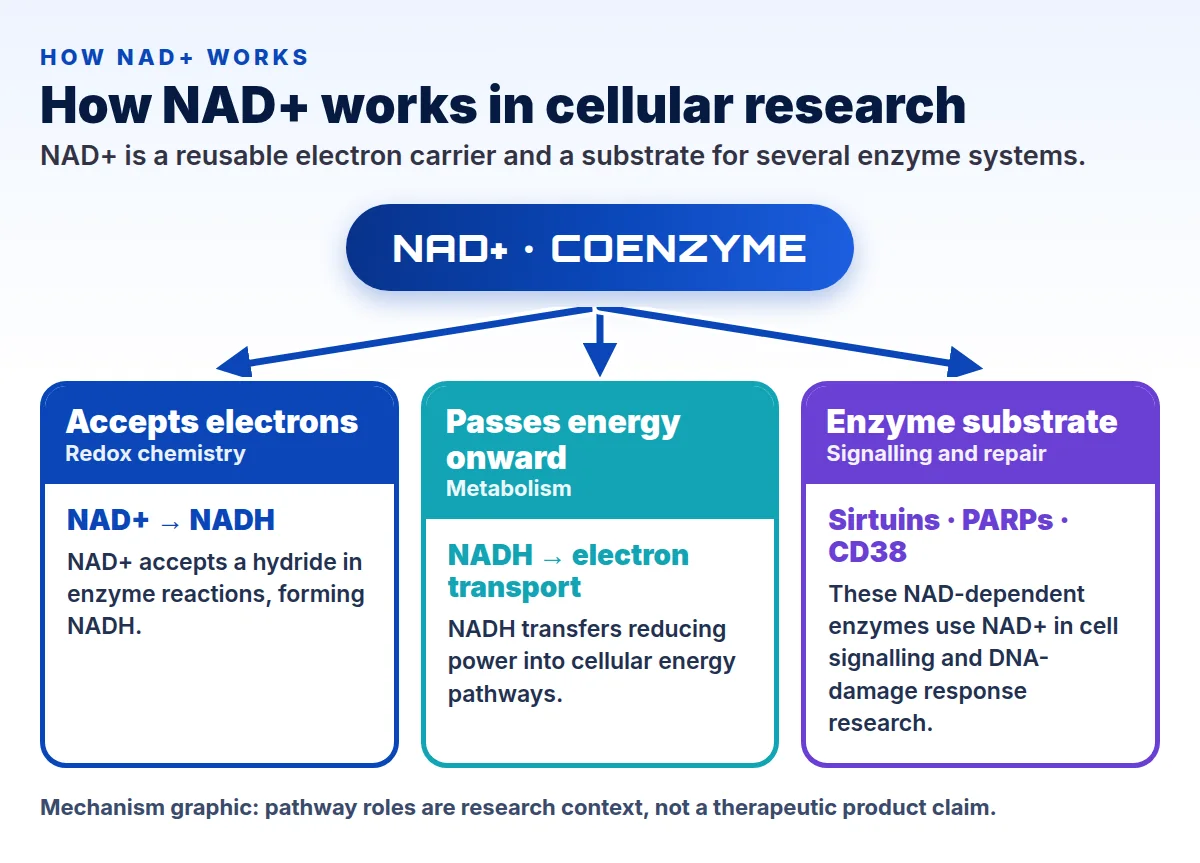
NAD+ works as an electron carrier. In a redox reaction, one molecule loses electrons while another gains them. NAD+ can accept a hydride and become NADH. NADH can later give those electrons to another reaction. This reversible relationship is written as NAD+ ⇄ NADH.
That chemistry is why NAD+ appears in research on glycolysis, glutaminolysis, fatty-acid oxidation, the citric-acid cycle and electron transport. In broad terms, it helps move reducing power through metabolic reactions that support ATP production. The result in an experiment depends on the enzyme, substrate, cell type and conditions actually tested.
NAD+ has a second role beyond electron transfer. Sirtuins, PARPs and CD38 consume or use NAD+ in reactions linked to signalling, DNA-damage response and calcium-related biology. These are strong reasons to study the molecule in cells and biochemical systems. They do not make a pathway diagram a clinical benefit claim for a vial.
Redox role: NAD+ accepts electrons and becomes NADH.
Metabolic role: NADH transfers reducing power into downstream cellular reactions.
Enzyme role: sirtuins, PARPs and CD38 use NAD+ in distinct reactions.
Research rule: match a claim to the molecule, model, route and endpoint that were actually studied.
NAD+ is both a redox coenzyme and a substrate for several important cellular enzyme systems.
What did NAD+ research find?
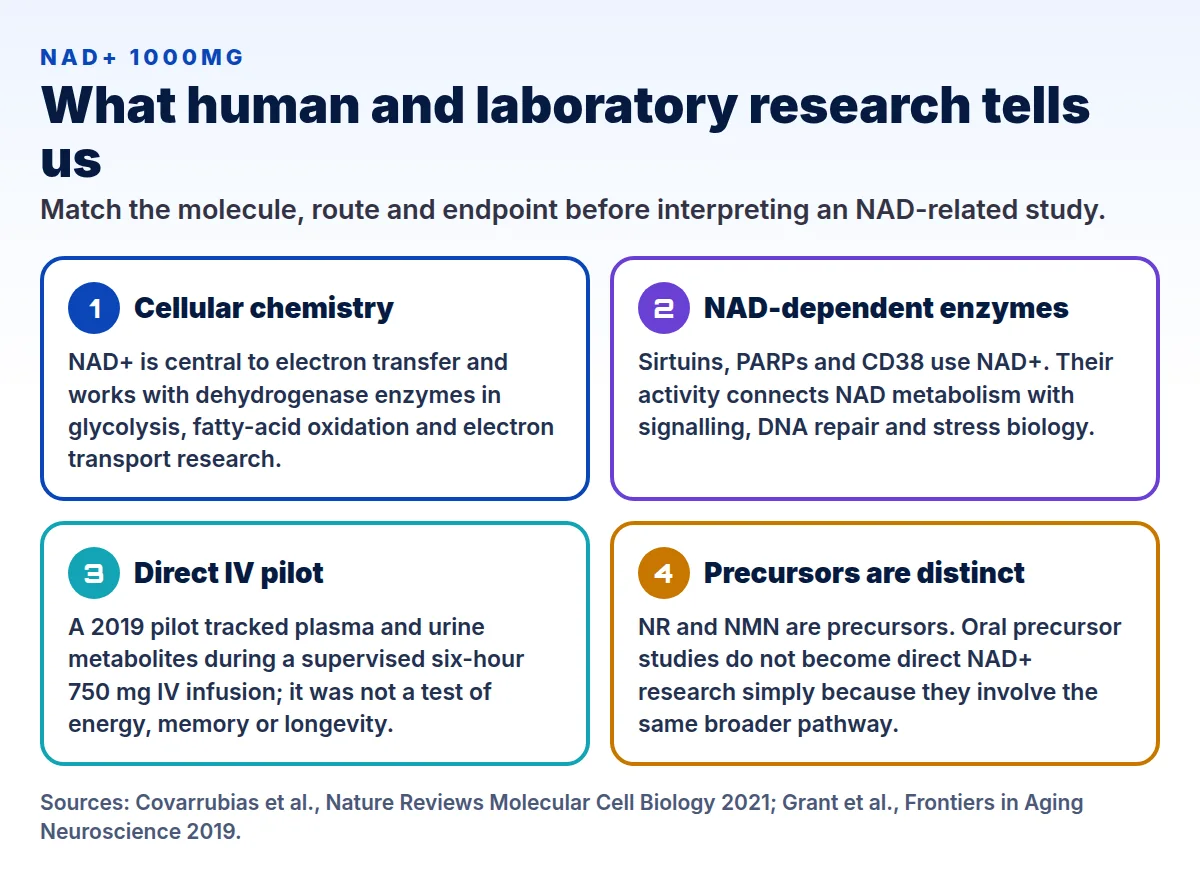
The best-supported starting point is cellular chemistry. Reviews describe NAD+ as a major hydride acceptor in redox reactions and as a cofactor or substrate for NAD-dependent enzymes. Those findings support work on metabolism, redox state, DNA-damage responses and cellular signalling. They do not show that every way of supplying an NAD-related material produces the same outcome.
Grant and colleagues ran a pilot with eight male participants receiving a 750 mg NAD+ intravenous infusion over six hours and three saline controls. The investigators measured plasma and urine NAD-related metabolites. Plasma NAD+ was higher at the end of infusion, and no adverse events were recorded during the six-hour observation. Fatigue, memory change, lifespan and a general wellness effect were outside the study’s scope.
A systematic review of NAD and NADH clinical studies included varied conditions and interventions. Much public discussion also relies on oral NR or NMN research. NR and NMN are precursors, not direct NAD+. A reliable reading of any study therefore starts with four checks: which molecule was used, how it was delivered, who or what was studied, and which endpoint was measured.
The strongest page-level distinction is between NAD+ cellular biology, direct NAD+ studies and studies of NAD+ precursors.
NAD-related evidence: what each source type can answer
NAD-related evidence: what each source type can answer
Research type
What it studied
What it can support on this page
Biochemistry and cell research
NAD+ redox reactions and NAD-dependent enzymes
Mechanism and laboratory research context
2019 direct NAD+ IV pilot
Eight NAD+ participants, three saline controls, six-hour observation
Measured NAD-related metabolites during that supervised infusion
NR or NMN human studies
Oral NAD+ precursors
Evidence about the actual precursor and its endpoint, not direct NAD+
Product-specific analytical report
This NAD+ 1000mg sample (LabDoc LD-QCYH)
Identity confirmed by LC-MS, 98.37% HPLC purity, 938.49mg content
Direct NAD+ and precursor research are kept separate because the molecule and experimental format differ.
NAD+ vs NADH vs NR vs NMN
NAD+ and NADH are the two redox forms of the same dinucleotide pair. NAD+ is the oxidised electron-accepting form. NADH is the reduced form after electron acceptance. The distinction is central in enzyme assays, metabolic readouts and any discussion of NAD+/NADH balance.
NR and NMN are related but different molecules. They are precursors in NAD metabolism, not labels for direct NAD+. Their absorption, conversion and experimental evidence must be read in their own right. A rise in a blood marker after an oral precursor is not the same experiment as adding NAD+ to a cell system or measuring metabolites during a supervised direct-NAD+ infusion.
The comparison matters because search results often mix the four names. The practical rule is simple: do not substitute molecules. Match the study, the product name, the experimental route and the measured outcome before treating a result as relevant.
NAD+ is the oxidised coenzyme; NADH is the reduced partner; NR and NMN are precursors. These are different compounds.
Plain-English NAD-family comparison
Plain-English NAD-family comparison
Name
What it is
How it relates to NAD+
NAD+
Oxidised nicotinamide adenine dinucleotide
The direct coenzyme in this listing; accepts electrons to form NADH
NADH
Reduced nicotinamide adenine dinucleotide
The electron-carrying partner formed after NAD+ is reduced
NR
Nicotinamide riboside
A nucleoside precursor used in NAD metabolism
NMN
Nicotinamide mononucleotide
A nucleotide precursor used in NAD metabolism
The terms belong to the same broad metabolic area but do not identify the same research intervention.
NAD+ chemical identity and the vial label
PubChem lists NAD+ under CID 5893. Its formula is C21H28N7O14P2+ and its molecular weight is 664.4 g/mol. Common chemical names include NAD(+), nicotinamide-adenine-dinucleotide and Nadide. Its CAS number is 53-84-9. These identifiers help separate a chemical identity record from marketing shorthand.
The product photo is the practical label check for this item. It shows amber/brown glass, a teal cap and the Peak Peptides Australia label design. The royal-blue band reads NAD+. The boxed strength reads 1000 mg. The lower lines read 99% Purity and Research Use Only. Confirming that sequence is a simple way to make sure the vial being handled matches the listing.
The 1000 mg statement is a nominal quantity. Concentration depends on the documented laboratory final volume.
The supplied vial image verifies the required amber glass, NAD+ label band and 1000 mg strength.
LabDoc result, approval status and Australian supply
This listing is backed by LabDoc report LD-QCYH. LabDoc received the NAD+ sample on 16 October 2026 and tested it on 26 October 2026. It records identity confirmed by LC-MS, 98.37% purity by HPLC and 938.49mg measured content by HPLC against the 1000mg label claim, which is 93.85% of that claim. The overall assessment is Pass. The batch field reads “Not stated”, so the report describes the tested sample.
NAD+ 1000mg is not a TGA-approved therapeutic good and is not an approved medicine. It is supplied for in-vitro research only. The FDA has separately cautioned compounders that food-grade NAD+ is not suitable for sterile drug compounding without appropriate processing because of contamination and endotoxin risk. That official warning reinforces the difference between laboratory research material and a sterile therapeutic product.
Peak Peptides Australia dispatches in-stock orders from Victoria on the same day once payment is confirmed. Parcels travel through tracked Australia Post Express and a tracking number is emailed. The listing is research material, so ordering, handling and documentation should stay aligned with its research-only status.
LabDoc report LD-QCYH: identity confirmed by LC-MS, 98.37% HPLC purity, 938.49mg HPLC content (93.85% of claim), Pass.
The vial photo shows 99% Purity; the signed report and a link to LabDoc’s own record are on the Quality page.
The Australian Register of Therapeutic Goods is the official database for therapeutic goods supplied in Australia.
This listing is not a TGA-approved therapeutic good and is not an approved medicine.
Step-by-step guide · About 10 minutes
How to prepare NAD+ 1000mg (step-by-step with photos)
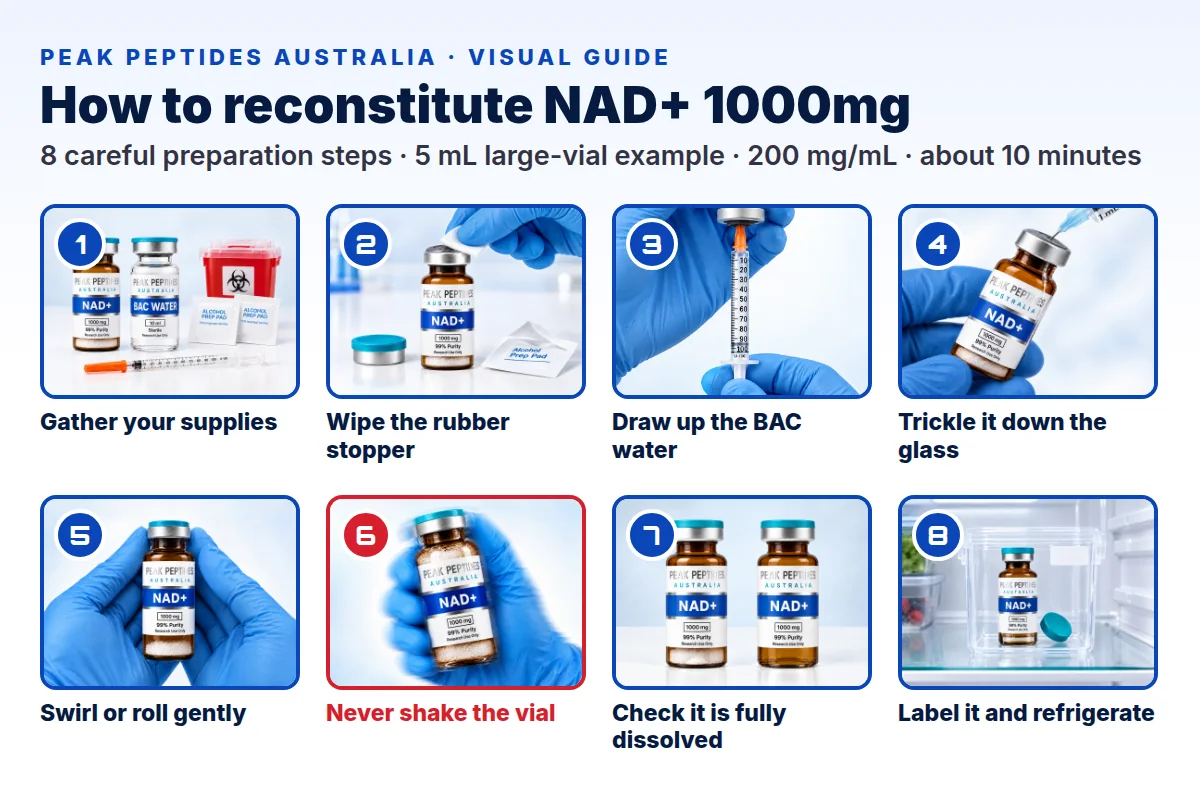
NAD+ 1000mg is presented as dry material in a large amber glass vial. Preparation means dissolving the labelled quantity into a documented final laboratory volume so concentration can be calculated. The photo guide uses a 5 mL BAC-water example because it gives 200 mg/mL and is more practical for a large vial; the chart also shows 3 mL and 10 mL alternatives. Follow the product label, lot documentation and your laboratory procedure for solvent choice, sterility and stability.
The photo-led NAD+ 1000mg preparation sequence: clean handling, slow transfer, gentle mixing, inspection, labelling and light-protected refrigeration.
What you need
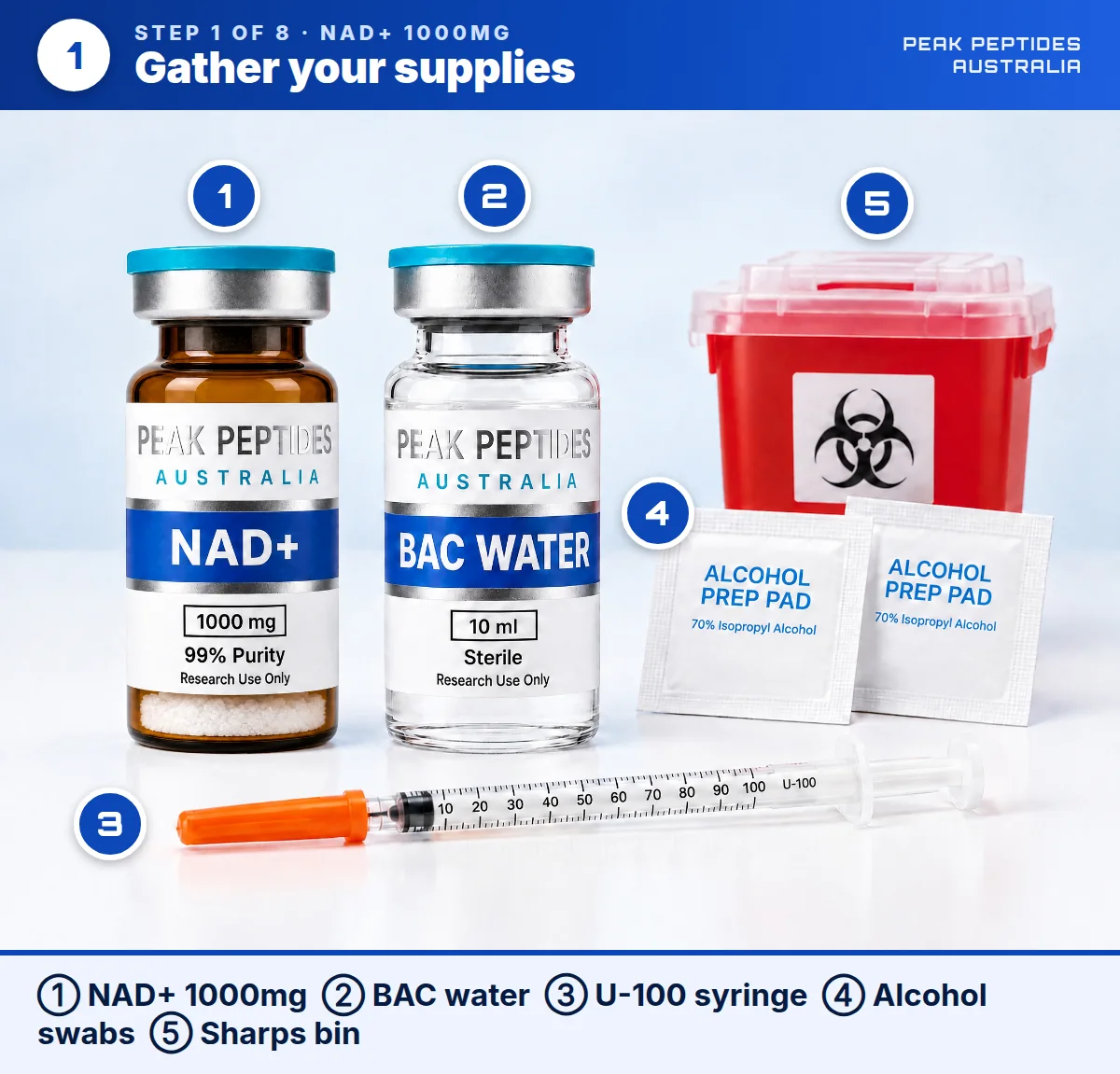
NAD+ 1000mg vialAmber/brown glass vial labelled NAD+, 1000 mg, 99% Purity and Research Use Only.
Bacteriostatic waterThe concentration chart uses BAC water as its calculation solvent.
Sterile transfer syringe or deviceA 3 mL or 5 mL sterile device suits large-vial preparation; a 1 mL U-100 syringe holds 100 units or 1 mL per fill.
Alcohol swabsFor cleaning accessible rubber stoppers before a controlled laboratory transfer.
Label and laboratory recordRecord the compound name, final volume, calculated concentration, preparation date, lot and storage condition.
Sharps containerUse an approved sharps container for safe disposal of used needles or transfer equipment.
How much BAC water for NAD+ 1000mg?
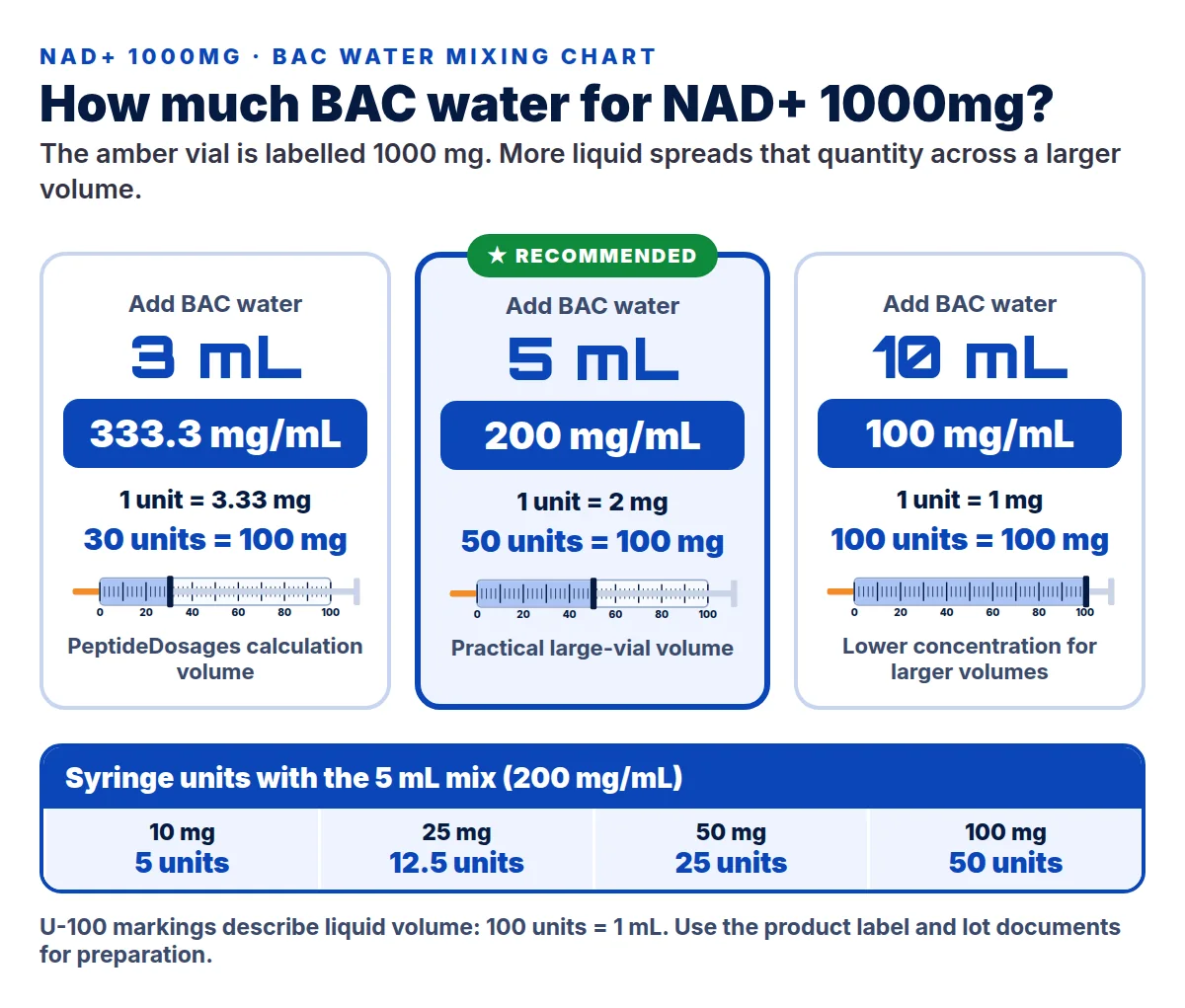
The nominal 1000 mg amount stays the same whichever final volume is recorded. Liquid volume changes concentration only. The large-vial chart shows 3 mL, 5 mL and 10 mL options. PeptideDosages uses 3 mL as a published calculation model, which gives 333.33 mg/mL. This page also shows 5 mL, giving 200 mg/mL, and 10 mL, giving 100 mg/mL, as practical large-volume concentration options.
The 5 mL option is highlighted because it produces clean round numbers: 200 mg/mL, so 0.01 mL on a U-100 scale represents 2 mg. For that mix, 10 units represents 20 mg, 25 units represents 50 mg, 50 units represents 100 mg and 100 units represents 200 mg.
Use the full formula in the lab record: concentration equals nominal milligrams divided by final millilitres. To convert a selected amount to U-100 markings, divide the amount by mg/mL and multiply by 100. Check the final volume, syringe type and procedure rather than transferring numbers from a different concentration.
NAD+ 1000mg concentration chart: 3 mL gives 333.33 mg/mL, 5 mL gives 200 mg/mL and 10 mL gives 100 mg/mL.
5 mL is highlighted because it gives the simplest numbers.
Syringe units with the 5 mL mix (200 mg/mL)
Syringe units with the 5 mL mix (200 mg/mL)
Amount
Units on a U-100 syringe
Volume
10 mg
5 units
0.05 mL
25 mg
12.5 units
0.125 mL
50 mg
25 units
0.25 mL
100 mg
50 units
0.5 mL
The 8 steps
1Step 1: Gather your supplies
Set out the NAD+ 1000mg amber vial, the documented diluent, a suitable sterile transfer device, alcohol swabs, a label and a sharps container on a clean laboratory surface. Confirm that the vial shows the royal-blue NAD+ band and boxed 1000 mg label. Record the proposed final volume before beginning.
2Step 2: Wipe the rubber stopper
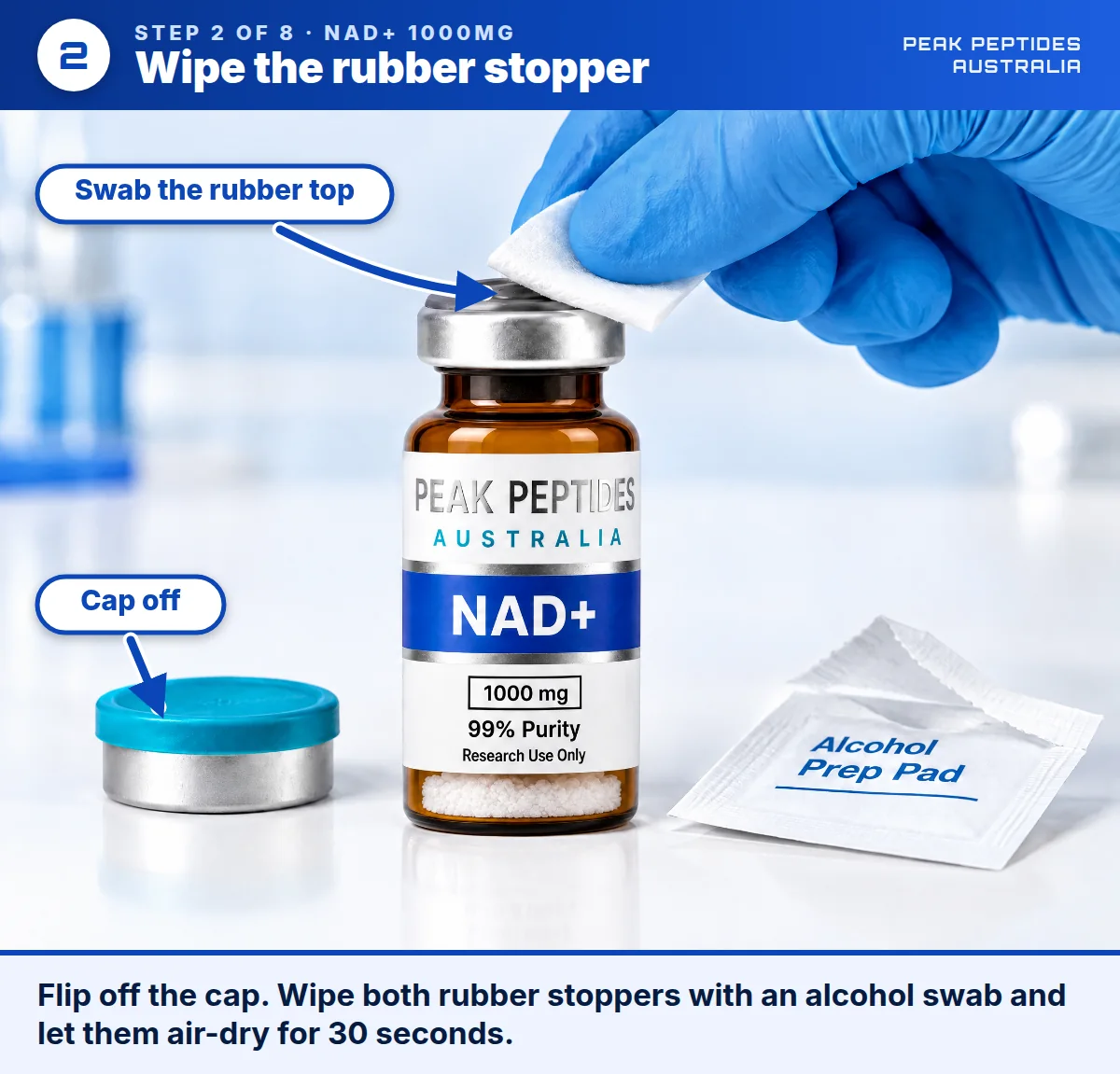
Remove the flip-off cap if present. Wipe the accessible rubber stopper and the diluent stopper with separate alcohol swabs, then allow them to air-dry. Do not touch a cleaned stopper. This reduces avoidable contamination during a controlled laboratory transfer and keeps the handling sequence easy to document.
3Step 3: Draw up the BAC water
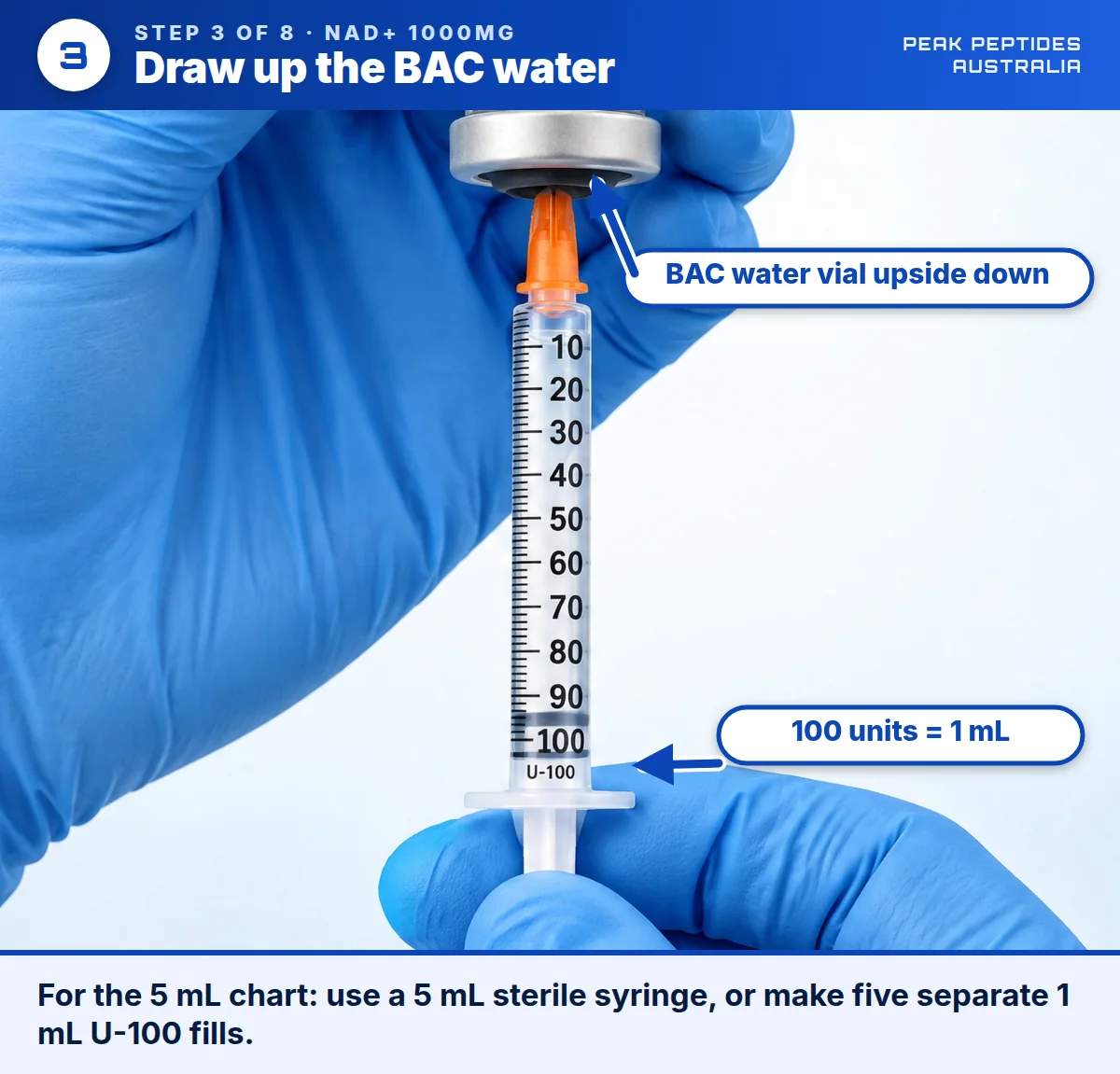
Measure the documented laboratory volume using an appropriate sterile transfer device. For the highlighted 5 mL concentration chart, use a 5 mL device or several separate 1 mL U-100 fills; each full U-100 fill is 1 mL or 100 units. Remove visible air from the measured liquid before transfer.
4Step 4: Trickle it down the glass
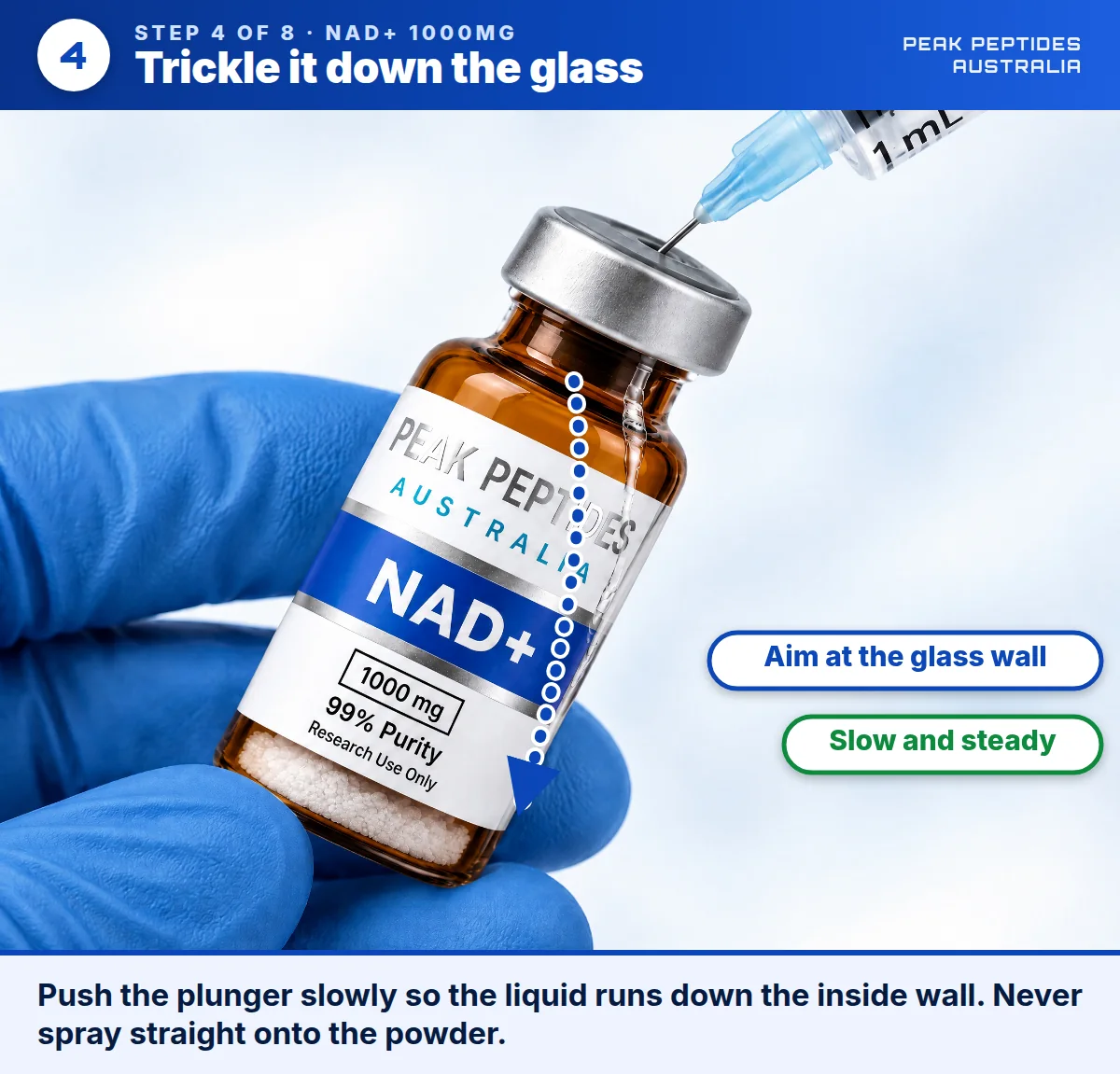
Place the transfer tip so liquid runs slowly down the inside wall of the amber NAD+ vial instead of hitting dry material directly. Add the recorded volume steadily. Gentle wall-directed addition helps avoid unnecessary foam and makes it easier to observe whether the material dissolves evenly during the next step.
5Step 5: Swirl or roll gently
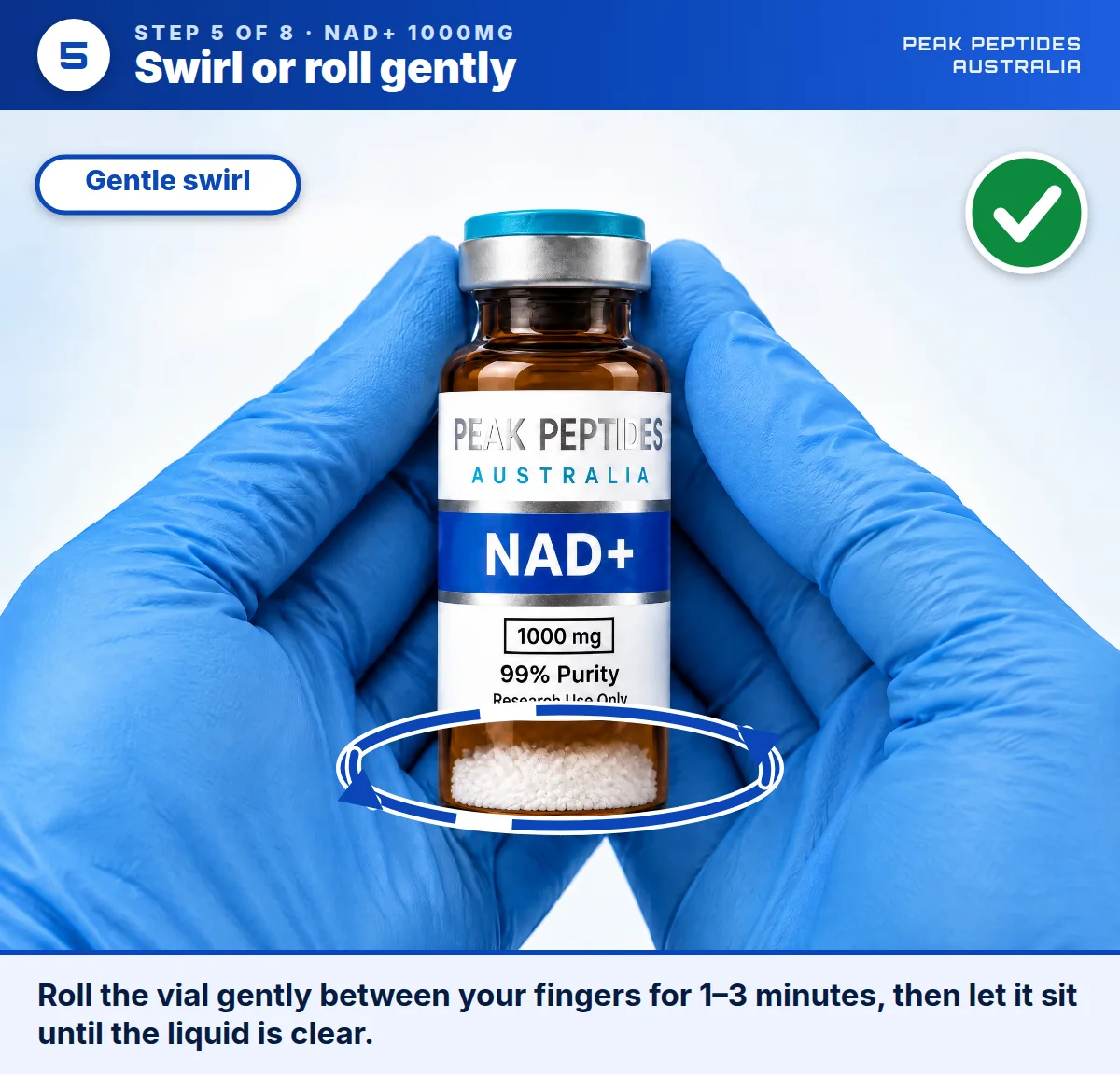
Roll the sealed amber vial gently between your fingers or swirl it in slow circles. Let the liquid contact all of the dry material and allow time for it to dissolve. Avoid vigorous agitation. Record any unexpected appearance, including persistent clumps, colour change or particles, according to the applicable laboratory procedure.
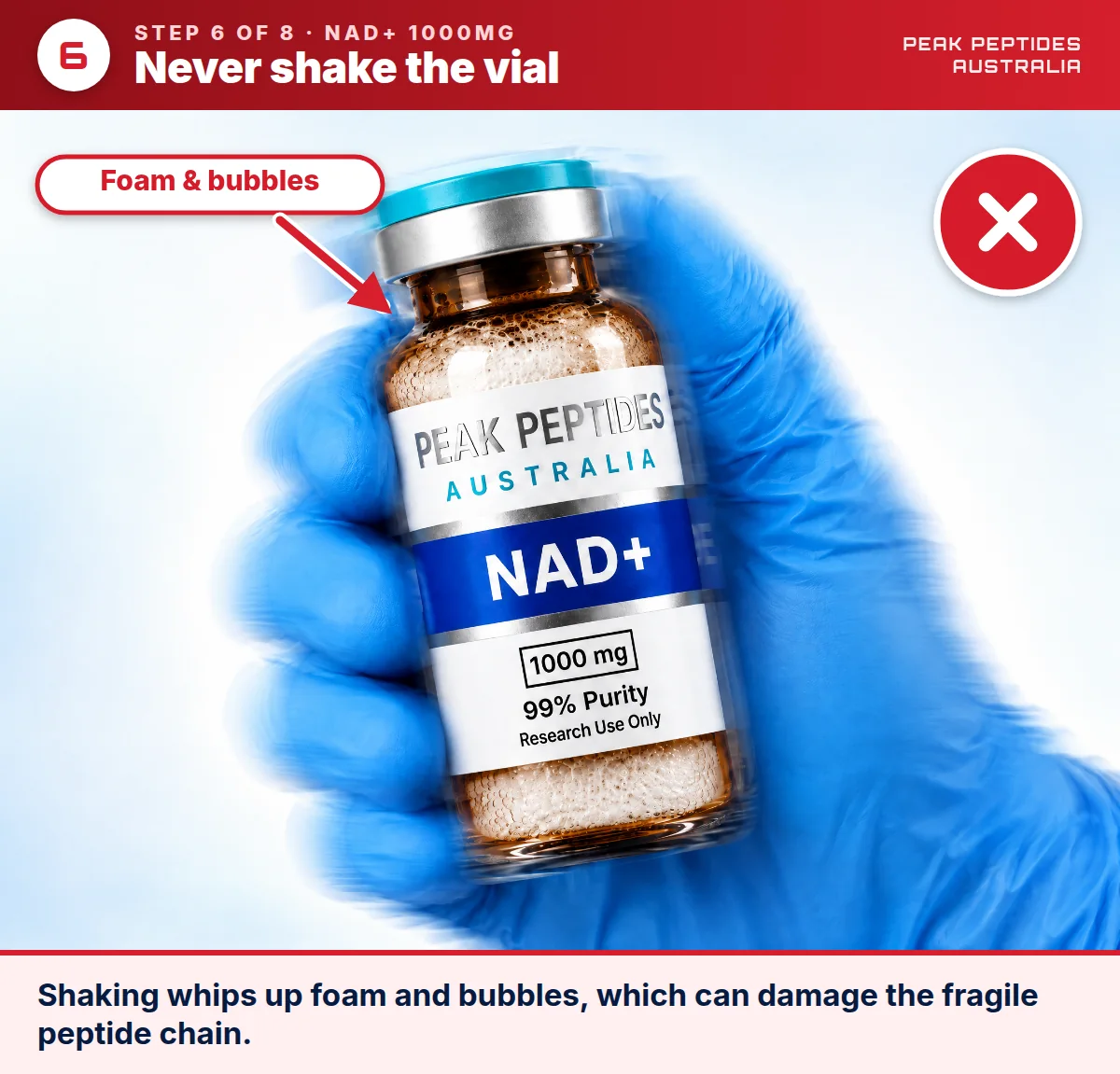
6Step 6: Never shake the vial
Do not shake the vial. Fast shaking can create foam and bubbles, which makes visual inspection harder and can change how quickly material appears to dissolve. If bubbles form, stand the vial upright and allow them to settle before inspecting the solution again under good light.
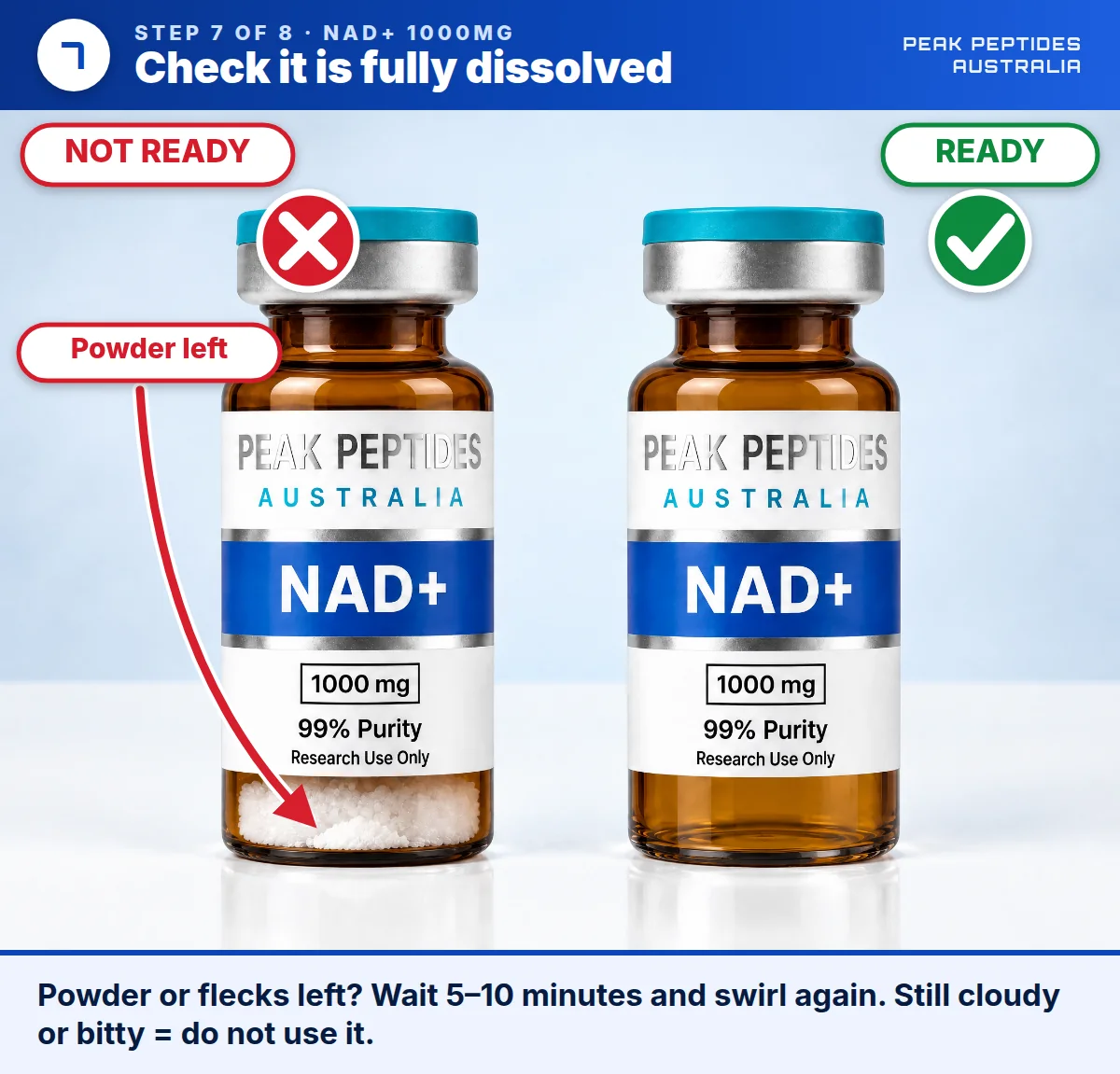
7Step 7: Check it is fully dissolved
Inspect the vial against a light background. For a clear-solution method, the liquid should be clear and free of visible dry material, flecks or cloudiness. If material remains, allow more time and swirl gently again. Persistent cloudiness, discolouration or particles should be handled through the laboratory quality procedure.
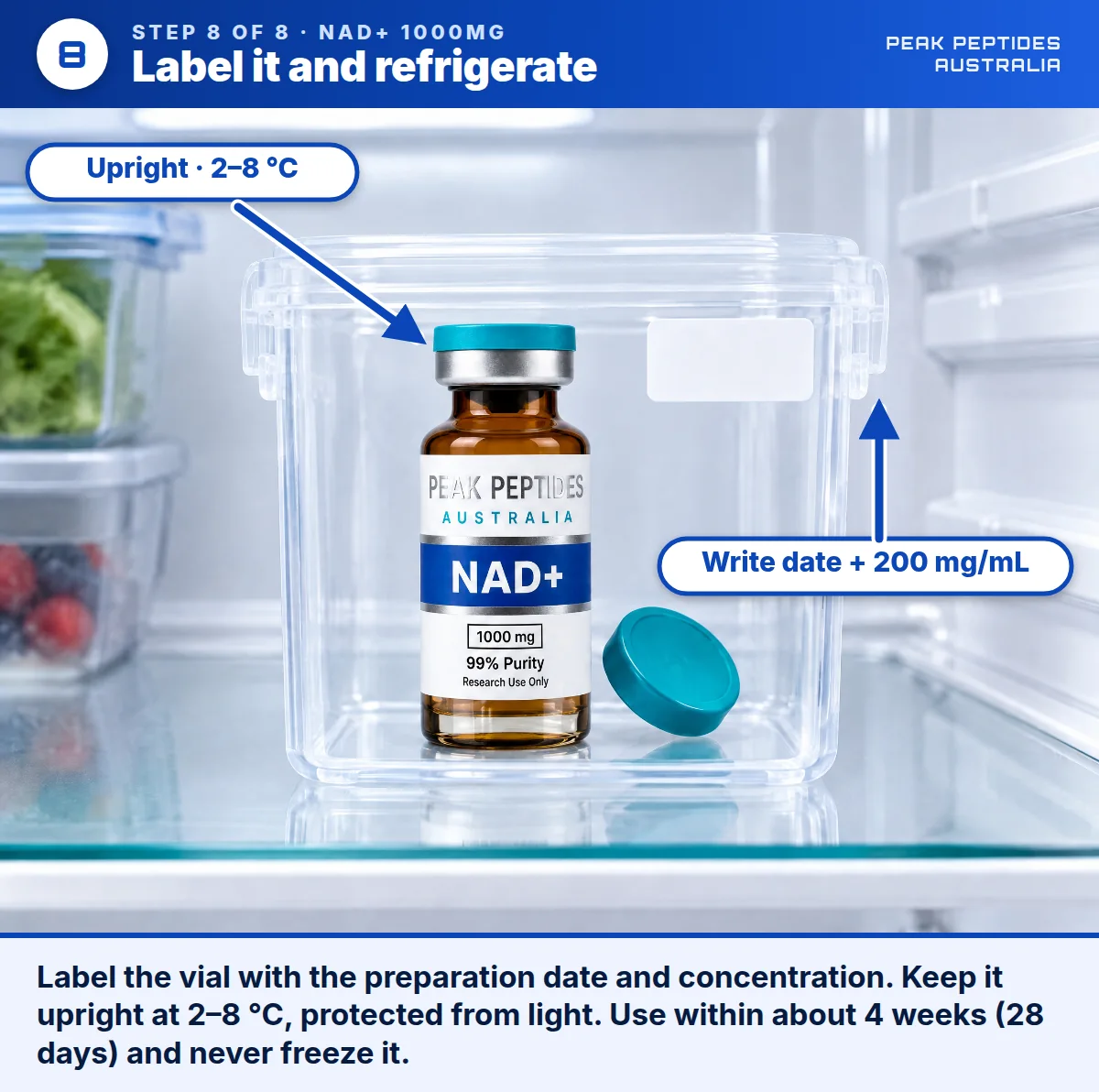
8Step 8: Label it and refrigerate
Label the container with NAD+, final volume, calculated concentration, preparation date, lot and the responsible laboratory record. Once mixed, keep it upright at 2–8 °C, away from light, use it within about 4 weeks (28 days) and never freeze it.
How to store NAD+ 1000mg
NAD+ 1000mg storage guide
NAD+ 1000mg storage guide
Form
Where to keep it
Controlling record
Sealed NAD+ research vial
Dry, protected from light, within the labelled temperature range
Product label and lot documentation
Prepared NAD+ research solution
Refrigerated at 2–8 °C and protected from light
Within about 4 weeks (28 days)
Prepared solution with visible change
Quarantine from the intended assay pending quality review
Laboratory quality procedure
Long-term storage question
Do not apply a universal interval or freeze/thaw rule from another material
Within about 4 weeks (28 days)
After mixing with BAC water, keep the vial upright in the fridge at 2–8 °C, away from light. Use within about 4 weeks (28 days) and never freeze it. Write the date and strength on the vial.
NAD+ 1000mg FAQs — Research, Preparation & Australian Supply
What is NAD+ 1000mg?
NAD+ 1000mg is a research vial labelled with 1000 mg nominal nicotinamide adenine dinucleotide in the oxidised NAD+ form. NAD+ is a coenzyme used in cellular redox reactions and NAD-dependent enzyme research. It is supplied for in-vitro research only.
Is NAD+ 1000mg a peptide?
No. NAD+ is a coenzyme rather than a peptide. Peptides are chains of amino acids, while NAD+ is a dinucleotide molecule that carries electrons in redox reactions and is used by NAD-dependent enzyme systems. Catalogue placement beside peptides does not change its chemical identity.
What does NAD+ stand for?
NAD+ stands for nicotinamide adenine dinucleotide in its oxidised form. It is also called NAD plus, oxidised nicotinamide adenine dinucleotide, Nadide or diphosphopyridine nucleotide. The plus sign indicates the oxidised member of the NAD+/NADH redox pair.
What is NAD+ used for in research?
NAD+ is used to investigate cellular redox chemistry, metabolic pathways and enzymes that consume or require NAD+. Research commonly examines glycolysis, electron transport, sirtuins, PARPs and CD38. The research question, assay, model and actual chemical form determine what a result means.
How does NAD+ work in cells?
NAD+ accepts electrons in enzyme reactions and becomes NADH. NADH then transfers reducing power into other metabolic reactions, including electron transport. NAD+ is also a substrate or cofactor for sirtuins, PARPs and CD38, which links it with cellular signalling and DNA-damage-response research.
What is the difference between NAD+ and NADH?
NAD+ is the oxidised electron-accepting form. NADH is the reduced form produced after NAD+ accepts a hydride. They operate as a redox pair, so a study should state which form was used, measured or changed. NADH is not simply another name for NAD+.
Are NAD+, NR and NMN interchangeable?
No. NR and NMN are NAD+ precursors, whereas NAD+ is the coenzyme itself. They have different chemical structures, transport and metabolism. Results from an oral NR or NMN study cannot be treated as direct evidence for NAD+ in a different material, route or experimental format.
What is the molecular formula of NAD+?
PubChem identifies NAD+ as C21H28N7O14P2+ with a molecular weight of 664.4 g/mol. PubChem CID 5893 lists NAD(+), nicotinamide-adenine-dinucleotide and Nadide among its names.
What did the direct human NAD+ study find?
A 2019 pilot gave eight male participants a supervised 750 mg intravenous NAD+ infusion over six hours and compared them with three saline controls. It recorded higher plasma NAD+ at the end of infusion and measured related metabolites. It did not test a general energy, memory or longevity outcome.
Were side effects reported in NAD+ research?
In the small six-hour 2019 IV pilot, no adverse events were observed during the study. That finding is limited to its supervised setting and small sample. Separately, the FDA reports adverse events with some NAD+ injectable drugs linked to excessive endotoxin levels, which is a sterile-product quality issue.
Does NAD+ 1000mg have a half-life?
This page does not state a single half-life for the vial. NAD+ handling depends on the molecule, biological compartment, route, assay and experimental system. A useful research record should name the material and conditions rather than applying a general half-life number to every NAD+ experiment.
What does 1000mg mean on this NAD+ vial?
The 1000 mg label is the nominal total quantity identified for this research listing. Once a laboratory chooses a final volume, concentration is calculated as total milligrams divided by that volume in millilitres.
How much BAC water does the NAD+ 1000mg chart show?
The chart shows 3 mL, 5 mL and 10 mL concentration options for the large 1000 mg vial. PeptideDosages uses 3 mL as a calculation example. This page highlights 5 mL as a practical large-vial volume, while 10 mL produces a lower concentration for laboratory measurements.
What concentration is NAD+ 1000mg with 5 mL?
A 1000 mg quantity in a 5 mL final volume calculates to 200 mg/mL. On a U-100 syringe, which marks 100 units per mL, one unit represents 0.01 mL and therefore 2 mg at that concentration.
What concentration is NAD+ 1000mg with 10 mL?
A 1000 mg quantity in a 10 mL final volume calculates to 100 mg/mL. On a U-100 syringe, one unit is 0.01 mL and holds 1 mg at that concentration. The amount of NAD+ in the vial does not change; more liquid only spreads it across more volume.
How many units are 100 mg of NAD+ with the 5 mL chart?
At 200 mg/mL, 100 mg corresponds to 0.5 mL. On a U-100 syringe, 0.5 mL is 50 units. This is a concentration conversion for research measurement.
How many mg are in 10 units of NAD+ with the 5 mL chart?
The 5 mL chart produces 200 mg/mL. Ten U-100 units equal 0.10 mL, so 10 units hold 20 mg at that concentration. Confirm the final volume and the syringe scale before using any calculation in a laboratory record.
How do I prepare NAD+ 1000mg for laboratory research?
Use a clean workspace, appropriate laboratory equipment and the controlling product and lot documents. The photo guide shows stopper cleaning, slow liquid addition down the container wall, gentle swirling, visual inspection, labelling and refrigerated light-protected storage.
Can I use tap water to prepare NAD+?
No. Tap water is not a controlled laboratory diluent. The supplied preparation chart is built around bacteriostatic water concentration maths. Use sterile bacteriostatic water, as shown in the mixing chart on this page.
What if NAD+ does not dissolve clearly?
Allow the material time to dissolve and swirl gently rather than shaking. Inspect the solution under good light. Reject solutions with persistent cloudiness, discolouration or visible particles. Use the relevant lot record and laboratory procedure to assess whether the prepared solution is suitable for the intended assay.
Should prepared NAD+ be cloudy?
A preparation intended for a clear-solution method should be visually clear and free of visible particles. Cloudiness or particles can indicate incomplete dissolution, contamination or a mismatch with the clear-solution method. Record the observation and follow the relevant laboratory quality procedure.
How should NAD+ 1000mg be stored?
Keep sealed material dry, protected from light and within the product label’s temperature conditions. PeptideDosages advises refrigeration at 2–8 °C and light protection after preparation. Keep mixed material upright, never freeze it and use it within about 4 weeks (28 days). Write the date and strength on the vial.
Can prepared NAD+ be frozen?
Never freeze a prepared NAD+ solution mixed with BAC water. Keep it upright in the fridge at 2–8 °C, away from light, and use it within about 4 weeks (28 days). Stability depends on the exact material, solvent, concentration, container and laboratory procedure.
Is NAD+ 1000mg approved by the TGA or FDA as a medicine?
No. This NAD+ 1000mg listing is not a TGA-approved therapeutic good and is supplied for in-vitro research only. The FDA has also warned that food-grade NAD+ is unsuitable for sterile drug compounding without appropriate processing. This research listing is not an approved medicine.
Can I buy NAD+ 1000mg online in Australia?
NAD+ 1000mg can be ordered through the Peak Peptides Australia catalogue when it is available under the site’s live controls. In-stock orders receive same-day dispatch from Victoria once payment is confirmed, travel by tracked Australia Post Express, and receive a tracking number by email.
How fast is NAD+ 1000mg dispatched in Australia?
For in-stock orders, Peak Peptides Australia uses same-day dispatch from Victoria once payment is confirmed. Parcels travel with tracked Australia Post Express and the tracking number is emailed. Delivery timing depends on the carrier network and the destination, while dispatch status is confirmed at the time of order.
How do I know this NAD+ research sample is genuine?
Start by matching the physical vial to the product image: amber/brown glass, teal cap, royal-blue NAD+ band, boxed 1000 mg and 99% Purity wording. Then compare it with LabDoc report LD-QCYH, which records LC-MS-confirmed identity for the tested NAD+ sample. The report can be checked on LabDoc’s own website.
How is NAD+ 1000mg independently verified?
LabDoc report LD-QCYH records confirmed identity by LC-MS, 98.37% purity by HPLC and 938.49mg measured content by HPLC, which is 93.85% of the 1000mg label claim. The sample was received on 16 October 2026, tested on 26 October 2026 and given an overall Pass.
What should a NAD+ COA show?
A useful certificate of analysis identifies the tested material, names the analytical methods, records identity, purity and content results, and gives a traceable verification route. For this vial, LD-QCYH reports identity by LC-MS and purity and content by HPLC, and the report ID can be looked up on labdoc.org.