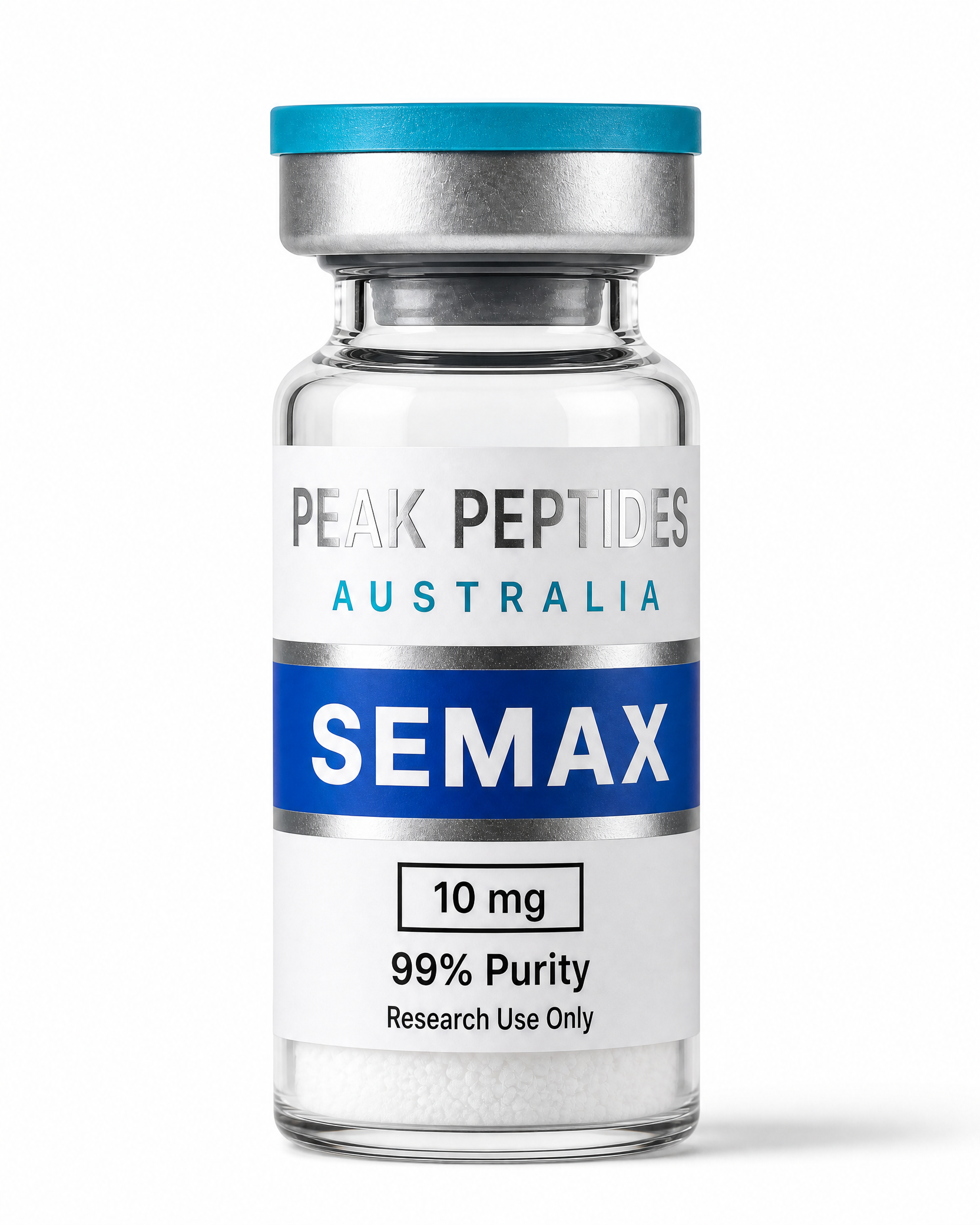
Semax 10mg is a freeze-dried synthetic heptapeptide investigated in neurotrophin signalling, BDNF expression and TrkB-related research. LabDoc report LD-Z6HZ confirms identity by LC-MS and records 99.69% HPLC purity in the tested sample. In-stock orders receive same-day dispatch from Victoria after payment confirmation, with tracked Australia Post Express shipping Australia-wide.
Product Specifications
Full NameSemax (MEHFPGP)
Vial Size10mg
Purity99.69% HPLC (LD-Z6HZ sample)
Legal Disclaimer
This product is sold strictly for in-vitro laboratory research purposes only. It is not a therapeutic good, is not approved by the TGA, and is not intended for human or animal consumption, injection, or any diagnostic or therapeutic use.
ACTH(4–7)-Pro-Gly-Pro · neurotrophin signalling research
Semax 10mg — What It Is, Research Findings & How to Prepare It
Semax is a synthetic seven-amino-acid peptide with the sequence Met-Glu-His-Phe-Pro-Gly-Pro, shortened to MEHFPGP. It is also called ACTH(4–7)-Pro-Gly-Pro because its first four residues correspond to the ACTH 4–7 fragment and it ends in Pro-Gly-Pro. Researchers study Semax in neural signalling, including BDNF, a neurotrophin protein, and TrkB, one of BDNF’s receptors. This listing is a nominal 10mg vial of freeze-dried research material, not the registered Russian nasal-drop medicine and not a ready-to-use nasal spray. This page separates the published lab and imaging findings from what the tested vial documentation proves, compares Semax with Selank, and gives measurement-only preparation maths. Peak Peptides Australia supplies Semax 10mg for in-vitro research only.
Also referred to in research or catalogue references as Semax, Semax peptide, MEHFPGP, Met-Glu-His-Phe-Pro-Gly-Pro, ACTH (4-7)-Pro-Gly-Pro, ACTH(4-7)PGP, ACTH 4-7 PGP, Semaks, 80714-61-0, H-Met-Glu-His-Phe-Pro-Gly-Pro-OH.
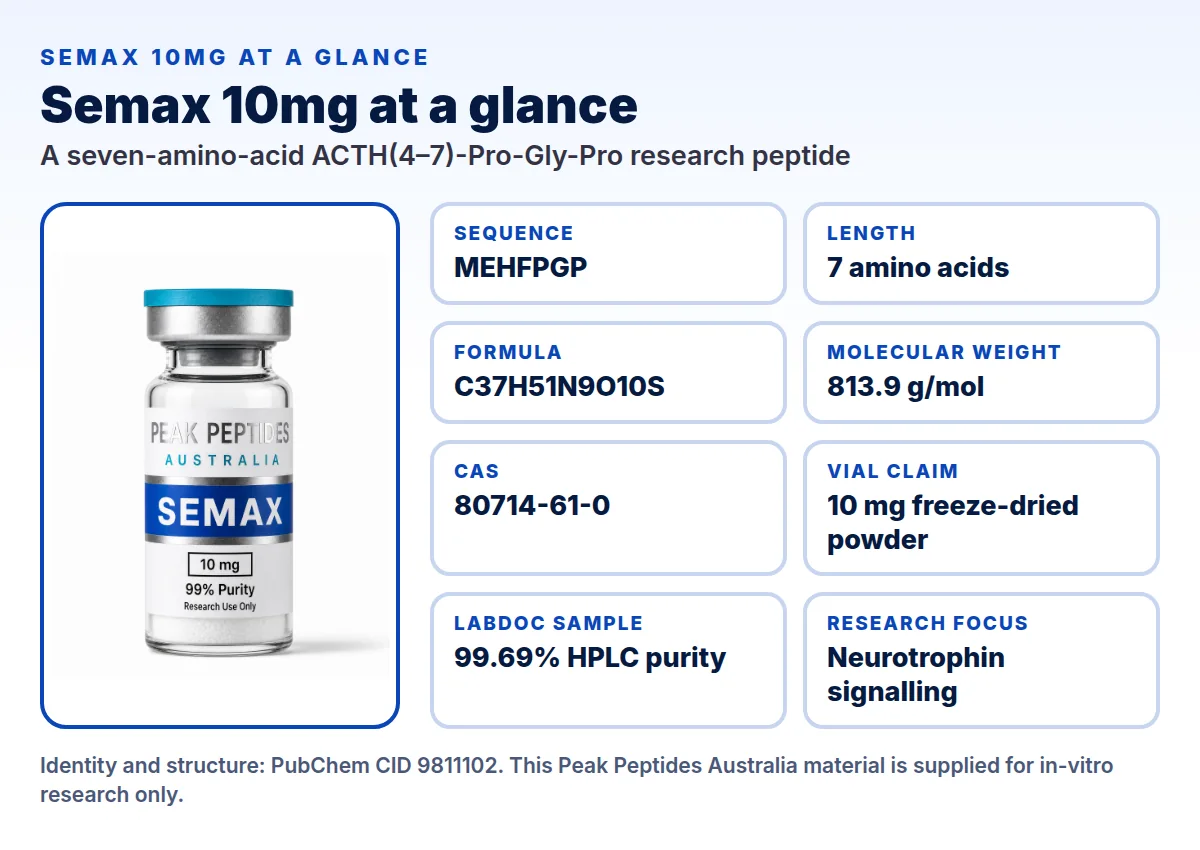
Semax 10mg at a glance
Name
Semax; ACTH(4–7)-Pro-Gly-Pro
Sequence
MEHFPGP — Met-Glu-His-Phe-Pro-Gly-Pro
Length
7 amino acids (a heptapeptide)
Formula
C37H51N9O10S
Molecular weight
813.9 g/mol
CAS number
80714-61-0
Research focus
Neurotrophin signalling, BDNF, TrkB and neural gene expression
Russia
Registered nasal-drop medicine in 0.1% and 1% formulations
This vial
Nominal 10mg freeze-dried Semax research material
Lab report
LD-Z6HZ · identity confirmed by LC-MS · 99.69% HPLC purity
Measured content
9.42mg in the tested sample · 94.2% of label claim
Simple measurement reference
2 mL BAC water = 5 mg/mL; 20 U-100 units = 1 mg
Supply status
In-vitro research only; not a ready-made nasal product
Dispatch
Same-day from Victoria for in-stock orders once payment is confirmed, tracked Australia Post Express, tracking number emailed
A seven-amino-acid ACTH-derived peptide
Semax is the heptapeptide ACTH(4–7)-Pro-Gly-Pro. Its one-letter sequence is MEHFPGP: methionine, glutamic acid, histidine, phenylalanine, proline, glycine and proline. PubChem lists formula C37H51N9O10S, molecular weight 813.9 g/mol and CAS number 80714-61-0.
What Semax is studied for
Semax research examines neurotrophin signalling, nervous-system gene expression and functional brain-network measurements. BDNF means brain-derived neurotrophic factor, a protein involved in nerve-cell signalling. TrkB is a receptor through which BDNF sends signals. These are research endpoints, not a claim that this laboratory vial improves memory, focus or attention.
BDNF and TrkB findings in rat research
A 2006 rat hippocampus study measured a 1.4-fold increase in BDNF protein, a 1.6-fold increase in TrkB phosphorylation, a threefold increase in exon III BDNF messenger RNA and a twofold increase in TrkB messenger RNA after one intranasal Semax exposure. These are model-specific molecular findings.
A separate post-ischaemia gene-expression result
In a rat permanent middle cerebral artery occlusion model, Semax enhanced Bdnf, TrkC and TrkA transcription in cortex at three hours after occlusion. The same paper reported later changes in Nt-3 and Ngf transcription. The study measured RNA expression in a defined injury model; it did not test this 10mg vial.
A small healthy-volunteer imaging study
A 2018 resting-state fMRI study included 24 healthy volunteers: 14 in the Semax group and 10 in the placebo group. It reported a greater volume of the rostral default-mode-network subcomponent in the Semax group. Functional connectivity is an imaging measurement, not a general clinical benefit claim.
Semax is not Selank
Semax and Selank are both seven-amino-acid peptides but they have different sequences and research histories. Semax is MEHFPGP and is derived from ACTH(4–7)-Pro-Gly-Pro. Selank is TKPRPGP, a tuftsin analogue. They are not substitutes, and their measured findings should not be transferred from one molecule to the other.
Registered medicine in Russia, research material here
Semax is registered as a drug in Russia and is available there as 0.1% and 1% nasal drops. The Russian reference product contains a manufactured liquid formulation with preservative and its own labelled instructions. This Peak Peptides Australia 10mg vial is a different, freeze-dried material supplied for in-vitro research only; it is not a TGA-approved therapeutic good or an FDA-approved medicine.
Independent Semax 10mg sample analysis
LabDoc report LD-Z6HZ, tested 10 September 2026, records identity confirmed by LC-MS, 99.69% purity by HPLC and 9.42mg measured content against a 10mg label claim. The report records 94.2% of label claim, 0.31% related impurities and an overall Pass assessment. Its batch field is not stated.
Semax is a synthetic heptapeptide: a short molecule made from seven amino acids. Its full sequence is Met-Glu-His-Phe-Pro-Gly-Pro, written in one-letter form as MEHFPGP. PubChem lists Semax as ACTH (4-7), Pro-Gly-Pro-, with formula C37H51N9O10S, molecular weight 813.9 g/mol and CAS number 80714-61-0.
The name ACTH(4–7)-Pro-Gly-Pro describes the sequence. The first four amino acids match the 4–7 fragment of adrenocorticotropic hormone, or ACTH. Semax then has a Pro-Gly-Pro tail. It is not full-length ACTH and is not a hormone replacement product.
Semax research commonly focuses on neurotrophin signalling. Neurotrophins are proteins that help researchers study nerve-cell signalling and responses. The two terms that appear most often are BDNF, short for brain-derived neurotrophic factor, and TrkB, a receptor that responds to BDNF signalling. This Peak Peptides Australia vial contains freeze-dried research material, not the Russian nasal-drop medicine described in registered-product instructions.
Semax is a seven-amino-acid peptide with the sequence MEHFPGP; this listing is a nominal 10mg freeze-dried research vial.
How is Semax studied in neural signalling research?
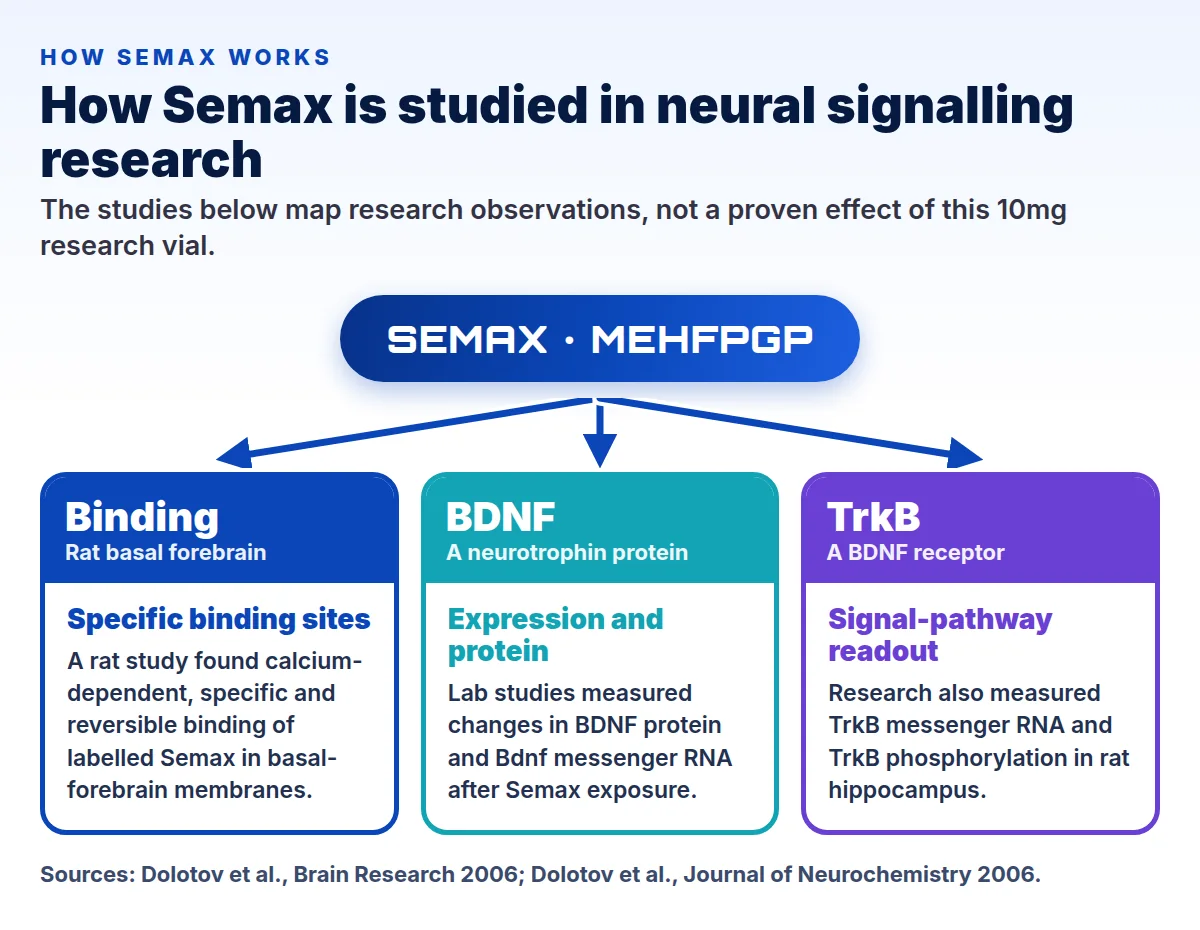
Semax is studied through defined laboratory endpoints rather than a single confirmed receptor label. A 2006 rat basal-forebrain paper found that tritium-labelled Semax binding to isolated membranes was time-dependent, specific and reversible. The authors reported calcium dependence and measured a dissociation constant as part of the binding experiment.
The same research area follows BDNF and TrkB. BDNF is a protein involved in neuron signalling and plasticity. TrkB is a receptor protein that receives BDNF-related signals. Studies can measure BDNF protein, Bdnf messenger RNA, TrkB messenger RNA or TrkB phosphorylation. Each endpoint captures a different part of a signalling pathway.
That distinction matters. A change in messenger RNA records gene transcription. A change in protein records an amount of the protein. Phosphorylation is a chemical change used as a signal-pathway readout. None of those measurements converts this separate 10mg research vial into a medical product or establishes a personal outcome.
Specific binding: a labelled-molecule experiment in rat basal-forebrain membranes.
BDNF protein: a measured neurotrophin-protein endpoint.
Bdnf and TrkB messenger RNA: measurements of transcription-related output.
TrkB phosphorylation: a measured pathway-activation readout in the rat hippocampus study.
The graphic maps what published experiments measured: binding, BDNF-related outcomes and TrkB-related readouts.
What did Semax research find?
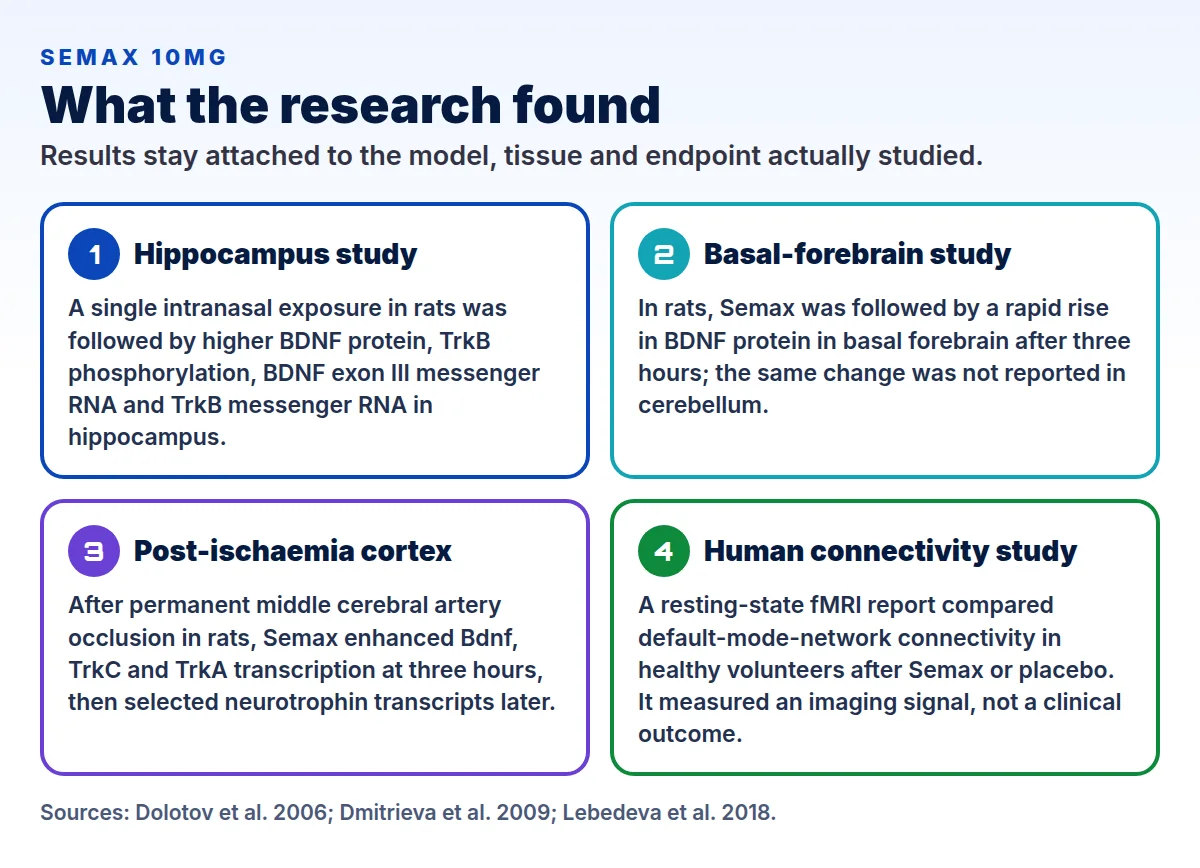
Semax research has produced molecular, transcript and brain-imaging findings. The strongest way to read those papers is to keep each result with its model, tissue, formulation and endpoint. A rat hippocampus result does not answer the same question as a human resting-state fMRI result.
In the 2006 hippocampus study, a single intranasal Semax exposure in rats was followed by maximum increases of 1.4-fold in BDNF protein and 1.6-fold in TrkB phosphorylation. The paper also reported a threefold rise in exon III BDNF messenger RNA and a twofold rise in TrkB messenger RNA. These values are direct measurements in rat hippocampus after the reported exposure.
A different 2009 paper studied rats after permanent middle cerebral artery occlusion. In cortex, Semax enhanced Bdnf, TrkC and TrkA transcription three hours after occlusion, with later changes in Nt-3 and Ngf transcription. This is a defined post-ischaemia model and gene-expression study, rather than a general test of cognition.
The human imaging paper published in 2018 studied 24 healthy volunteers by resting-state fMRI. It compared the topography of the default mode network before and after the study preparation or placebo. The authors reported a greater volume of the rostral, medial-frontal-cortex default-mode-network subcomponent in the Semax group. This is an imaging-network observation, not a clinical efficacy measure.
The published findings span rat molecular studies, a rat post-ischaemia transcription model and a small human fMRI experiment.
Selected Semax research findings and what each study actually measured
Selected Semax research findings and what each study actually measured
Greater volume of rostral default-mode-network subcomponent in Semax group
Panikratova et al. 2020
52 healthy participants
Resting-state functional connectivity
General and specific Semax and Selank effects in right amygdala–right temporal-cortex connectivity
Each row reports the study’s own model and endpoint. These findings do not test the Semax 10mg product vial.
Semax vs Selank: what is the difference?
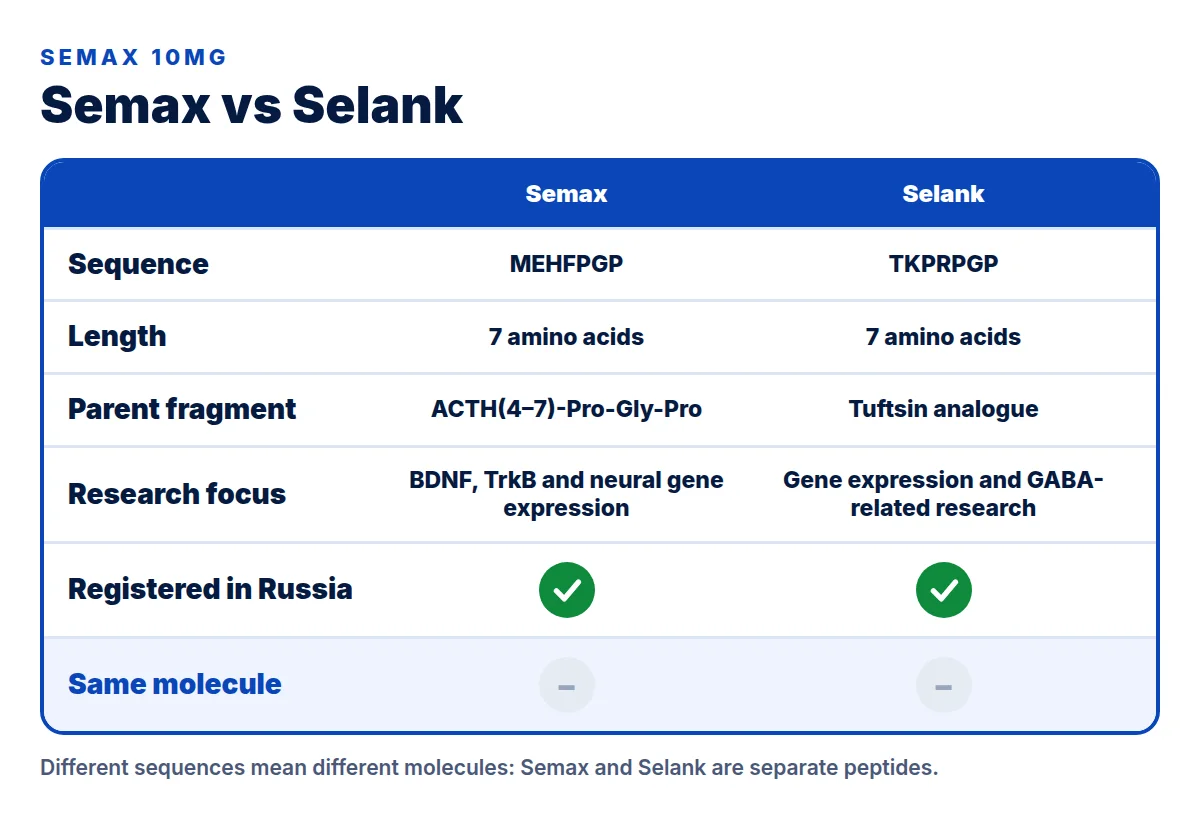
Semax and Selank are different peptides. Both contain seven amino acids, but a matching length does not make their chemistry or research literature interchangeable. Semax is MEHFPGP. Selank is TKPRPGP. Semax is described as ACTH(4–7)-Pro-Gly-Pro, while Selank is described as a tuftsin analogue.
The research emphases differ too. Semax papers commonly discuss BDNF, TrkB, neurotrophin-gene expression and neural network measurements. Selank studies include gene-expression work and GABA-related research. A 2020 resting-state fMRI paper assessed both molecules and placebo in 52 healthy participants, finding both general and molecule-specific functional-connectivity effects.
Both Semax and Selank are listed as Russian-developed peptide medicines in a 2022 review of peptide biopharmaceuticals in Russia. That does not make the two molecules equivalent. Compare sequence, test documentation and the exact experimental result before referring to either material in a research context.
Both are seven-residue peptides, but Semax and Selank have different sequences and different research identities.
Semax compared with Selank
Semax compared with Selank
Feature
Semax
Selank
Sequence
MEHFPGP
TKPRPGP
Chemical description
ACTH(4–7)-Pro-Gly-Pro
Tuftsin analogue
Number of amino acids
7
7
Research examples
BDNF, TrkB, neural gene expression
Gene expression and GABA-related research
Same molecule?
No
No
Peak Peptides listing
Semax 10mg
Selank 10mg
Peptides with the same number of amino acids can have different sequences, structures and experiment results.
What is the Semax peptide sequence?
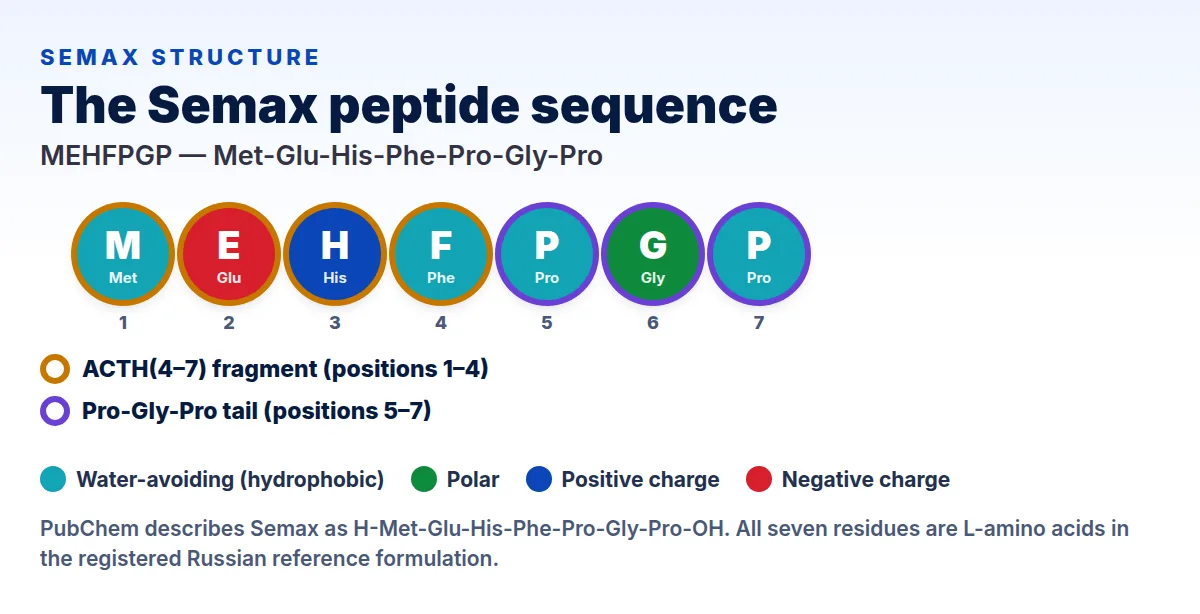
Semax has the sequence MEHFPGP. Read left to right, that means methionine, glutamic acid, histidine, phenylalanine, proline, glycine and proline. PubChem gives the systematic biological description H-Met-Glu-His-Phe-Pro-Gly-Pro-OH. The sequence is short enough to display each building block directly.
The first four residues, Met-Glu-His-Phe, correspond to the ACTH 4–7 sequence. The last three, Pro-Gly-Pro, are commonly written PGP. That is the origin of the name ACTH(4–7)-Pro-Gly-Pro. The Russian product reference describes the registered formulation’s amino acids as L-forms.
Sequence is not the same as vial content. Sequence identifies the intended molecule. A content test measures how much peptide is in a submitted sample, while HPLC purity measures the proportion resolved as the intended main component. LC-MS is used to confirm molecular identity by mass.
Semax is MEHFPGP: the four-residue ACTH(4–7) fragment followed by Pro-Gly-Pro.
Independent lab test for this Semax 10mg vial
Semax 10mg is backed by LabDoc report LD-Z6HZ. The report was tested on 10 September 2026 and records identity confirmed by LC-MS, 99.69% purity by HPLC and 9.42mg measured content against the product’s 10mg label claim. It records 94.2% of label claim, 0.31% related impurities and an overall Pass assessment.
These fields mean different things. LC-MS, short for liquid chromatography–mass spectrometry, identifies the analysed molecule by its mass. HPLC, short for high-performance liquid chromatography, separates material so the laboratory can report purity. The content result estimates the amount of peptide measured in the submitted vial sample. A purity percentage does not replace a content measurement.
LabDoc lists the batch field as not stated. The report describes the submitted Semax sample reported under LD-Z6HZ. Read the signed report through the LabDoc verification link and compare its report ID with the product page when checking its analytical details.
Report ID: LD-Z6HZ.
Test date: 10 September 2026.
Identity: confirmed by LC-MS.
Purity: 99.69% by HPLC.
Measured content: 9.42mg against a nominal 10mg claim.
Related impurities: 0.31%; overall assessment: Pass.
Buying Semax 10mg in Australia
Peak Peptides Australia supplies Semax 10mg as in-vitro research material. It is a nominal 10mg freeze-dried vial, not a manufactured nasal-drop medicine, nasal spray, pre-filled device or therapeutic good. The Russian Semax medicine and this product have different formulations, packaging and regulatory contexts.
Same-day dispatch from Victoria applies to in-stock orders once payment is confirmed. Orders are sent by tracked Australia Post Express and the tracking number is emailed. The product page’s LabDoc section identifies report LD-Z6HZ, and the quality page explains how to inspect verification documentation.
For laboratory concentration calculations, the BAC water chart below expresses the vial amount as mg per mL and U-100 syringe units. The research vial and the Russian registered nasal-drop product are different products.
Step-by-step guide · About 10 minutes
How to prepare Semax 10mg for laboratory measurement (step-by-step with photos)
Semax 10mg arrives as dry, freeze-dried powder. In laboratory work, reconstitution means adding a selected sterile solvent so the powder forms a clear solution that can be measured. The 2 mL BAC-water reference mix shown here gives 5 mg/mL, so 20 U-100 syringe units correspond to 1 mg. The registered Russian Semax drops are a separate preserved liquid formulation.
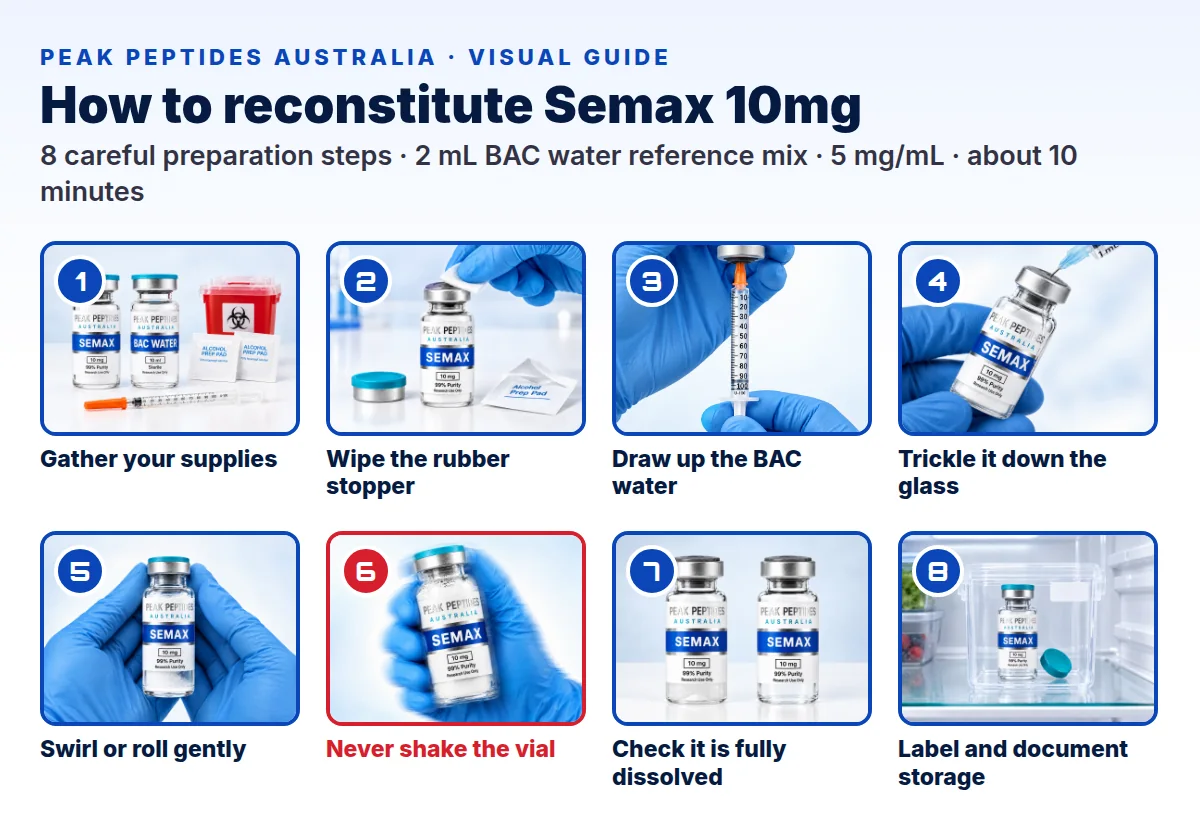
The handling sequence at a glance: clean work, slow solvent addition, gentle swirling and a clear-solution check.
What you need
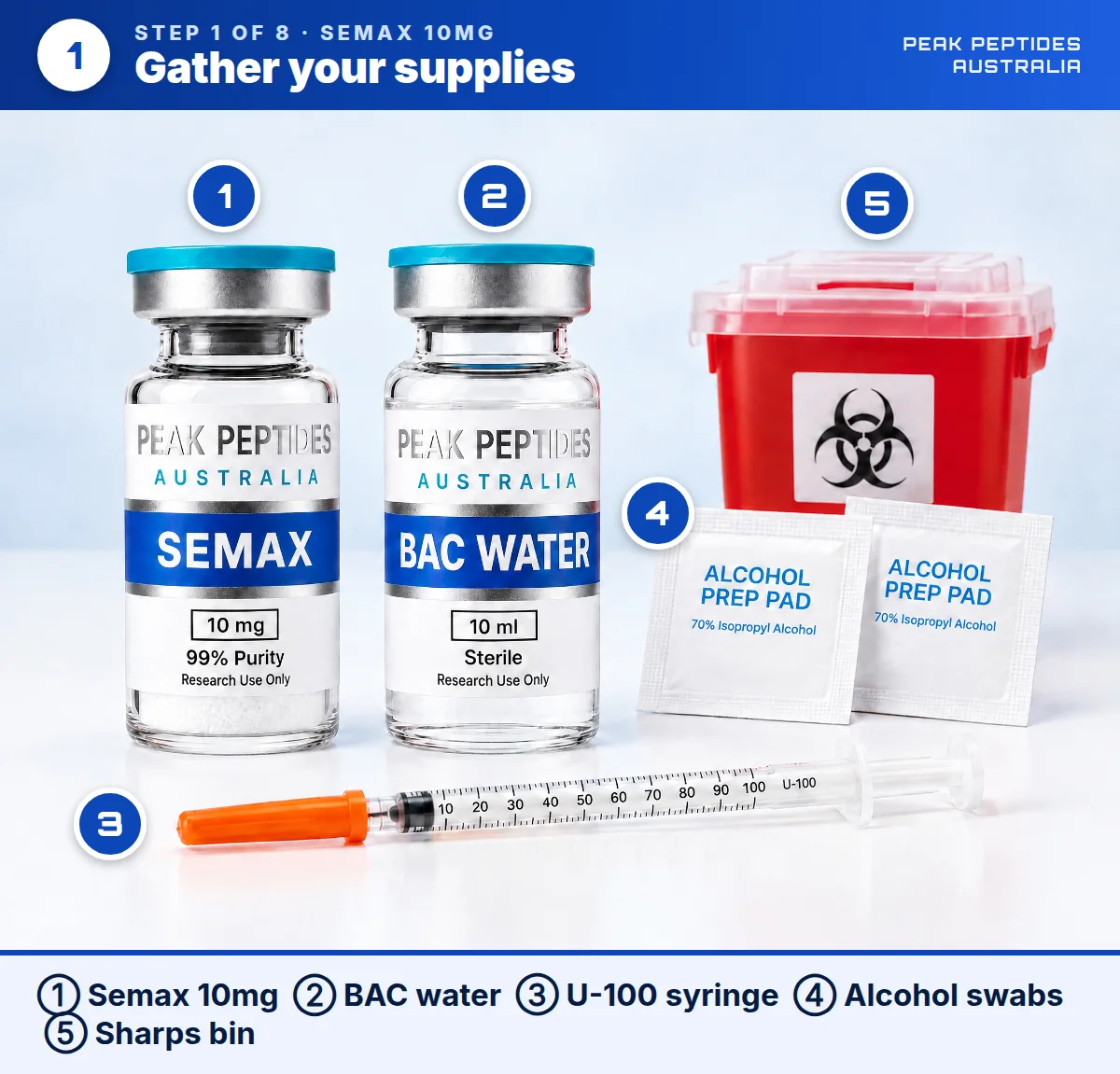
Semax 10mg vialNominal 10mg freeze-dried Semax research material in a sealed glass vial.
Bacteriostatic waterA sterile preserved water option used here only for concentration-reference maths.
1 mL U-100 syringeA measurement tool: 100 units equals 1 mL and 1 unit equals 0.01 mL.
Alcohol swabsFor cleaning vial rubber stoppers before a documented laboratory preparation.
Sharps containerFor safe disposal of used needles in the laboratory workflow.
How much BAC water for Semax 10mg?
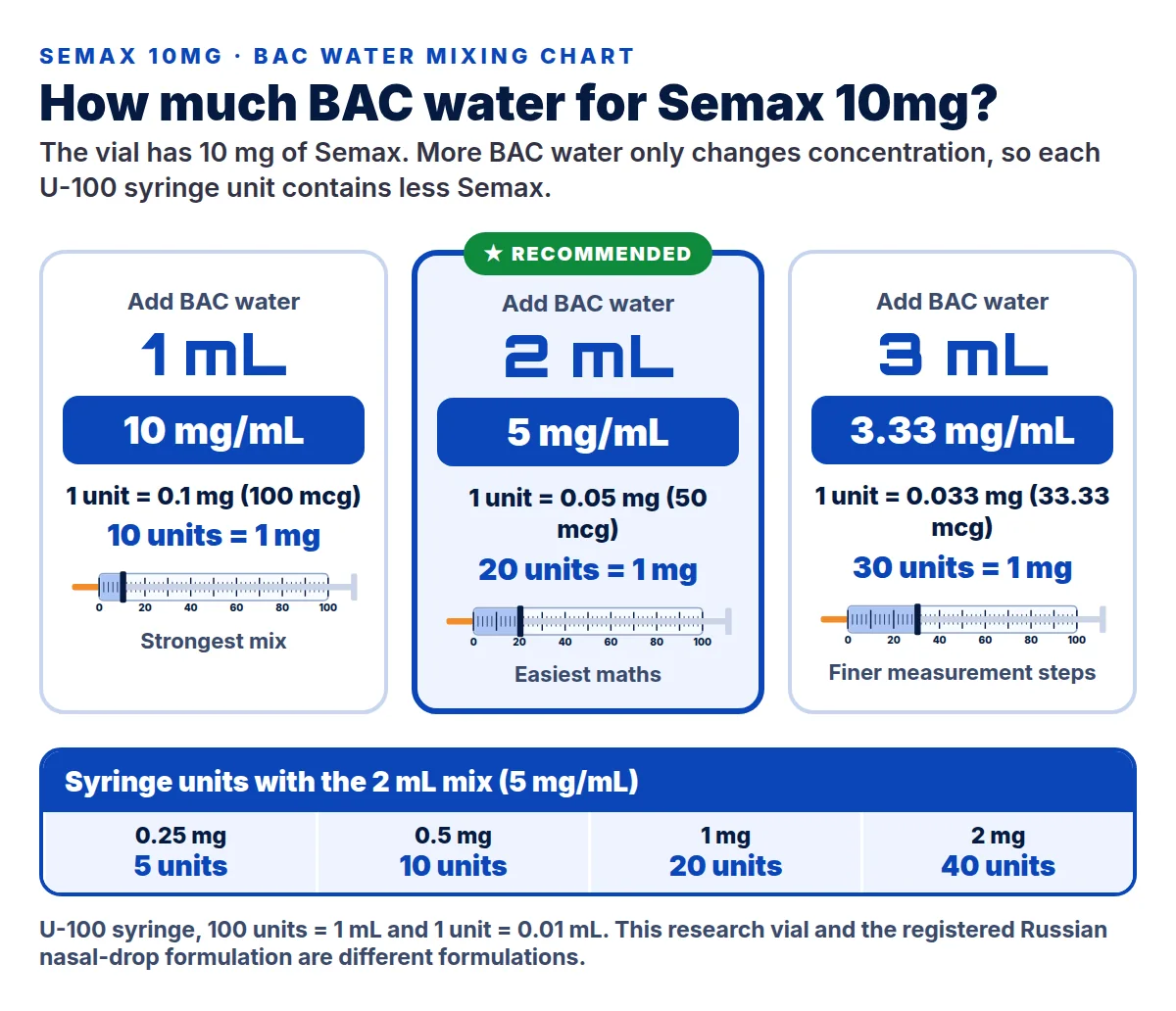
A Semax vial labelled 10mg has the same nominal peptide amount whatever final volume is selected. Adding more solvent changes concentration, not the amount of Semax. The chart uses a U-100 syringe solely as a volume scale: 100 units is 1 mL and one unit is 0.01 mL.
For the 2 mL reference mix, 10mg divided by 2 mL equals 5 mg/mL. Therefore 0.10 mL, or 10 units, contains 0.5 mg and 0.20 mL, or 20 units, contains 1 mg. A 1 mL final volume is 10 mg/mL, while a 3 mL final volume is 3.33 mg/mL. These values are laboratory concentration conversions only.
A 2 mL reference mix gives 5 mg/mL; U-100 units are a volume conversion.
2 mL is highlighted because it gives the simplest numbers.
Syringe units with the 2 mL mix (5 mg/mL)
Syringe units with the 2 mL mix (5 mg/mL)
Amount
Units on a U-100 syringe
Volume
0.25 mg
5 units
0.05 mL
0.5 mg
10 units
0.1 mL
1 mg
20 units
0.2 mL
2 mg
40 units
0.4 mL
The 8 steps
1Step 1: Gather your supplies
Place the Semax 10mg vial, selected solvent, a new 1 mL U-100 syringe, alcohol swabs and a sharps container on a clean laboratory surface. Record the vial identifier and planned final volume before starting. The vial is freeze-dried research material, not a ready-made nasal product.
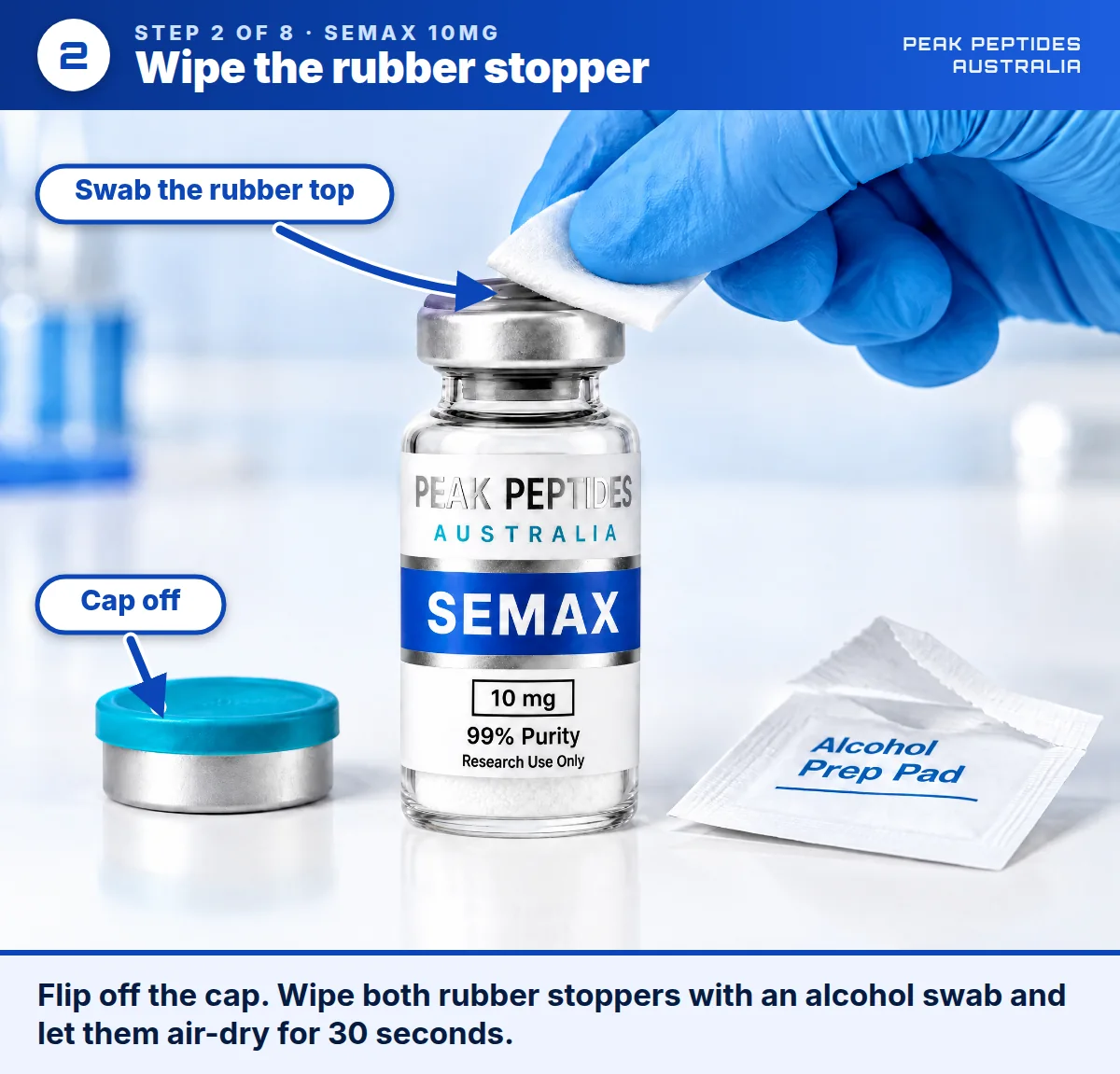
2Step 2: Wipe the rubber stopper
Remove the flip-off caps without touching the rubber stoppers. Wipe the Semax vial stopper and solvent-vial stopper with fresh alcohol swabs, then let both surfaces air-dry for about 30 seconds. Do not touch a cleaned stopper before the transfer step.
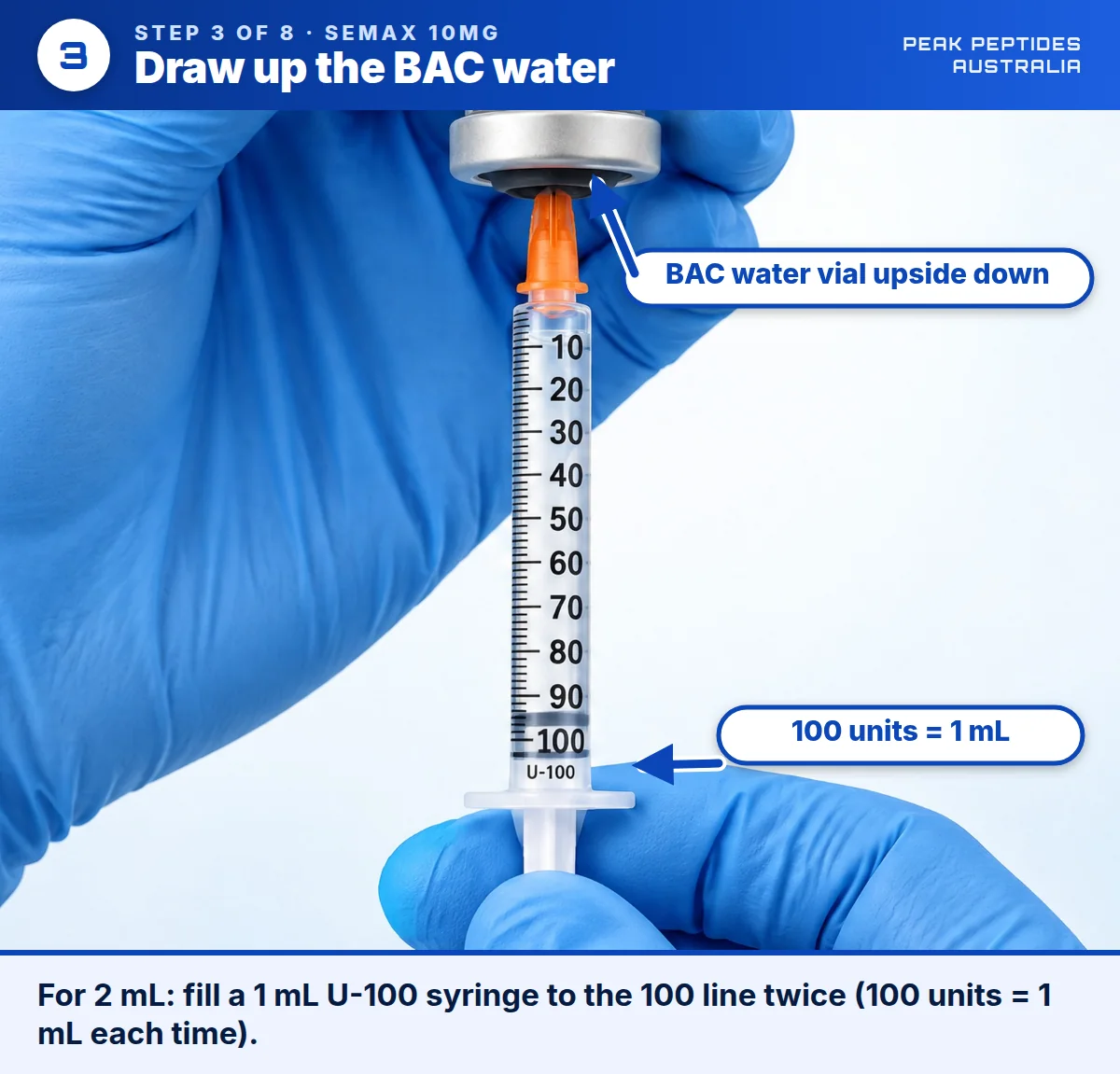
3Step 3: Draw up the BAC water
Use a new U-100 syringe to draw the required solvent volume. On this scale, the 100-unit mark is 1 mL. The 2 mL reference mix needs two separate 1 mL draws. Remove visible air bubbles before transfer and record the actual final volume used.
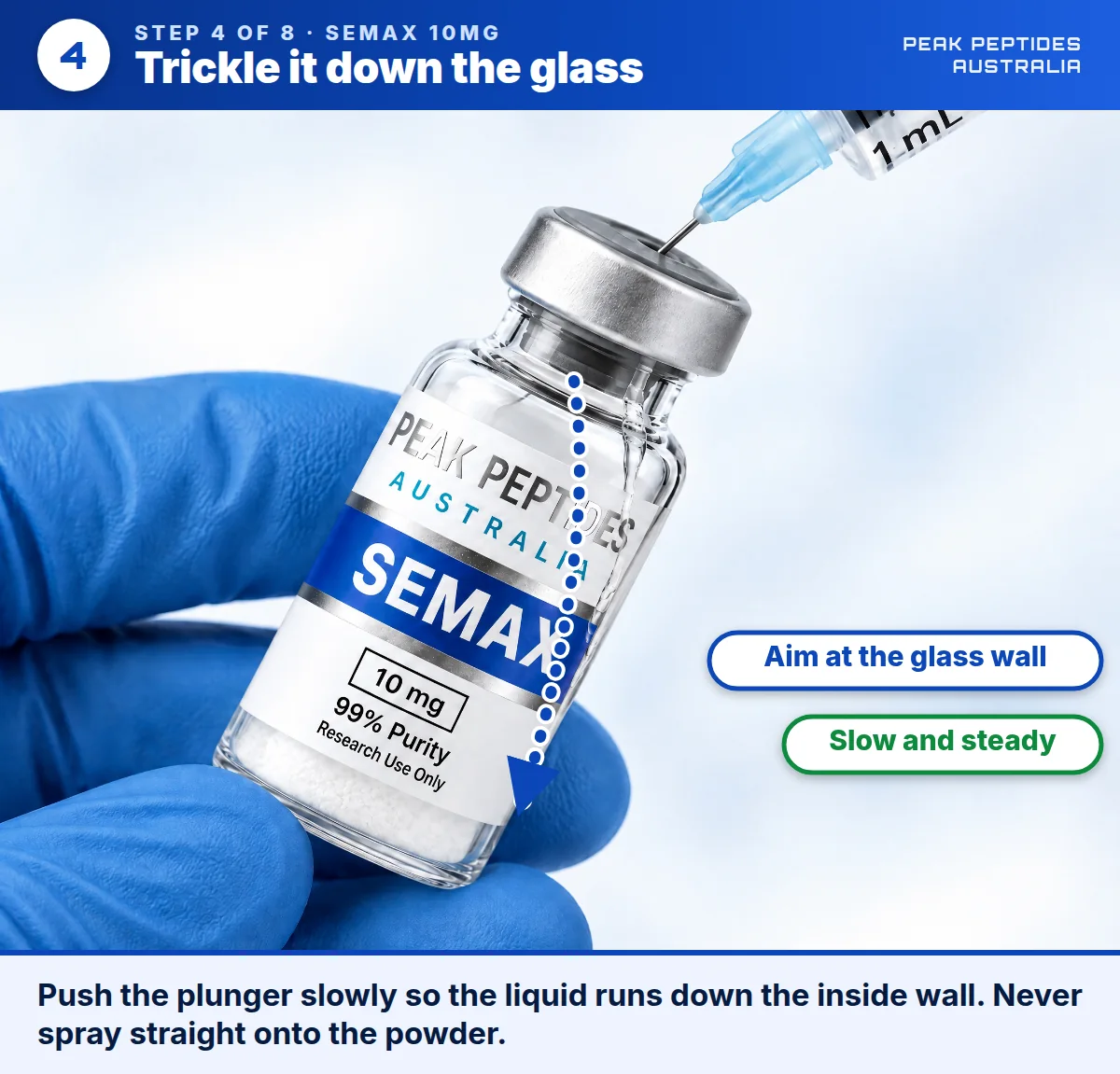
4Step 4: Trickle it down the glass
Insert the needle through the Semax stopper with the vial angled so the tip rests against the inside glass wall. Add liquid slowly down the glass rather than directing a fast stream at the freeze-dried cake. Repeat the measured transfer until the chosen final volume has been added.
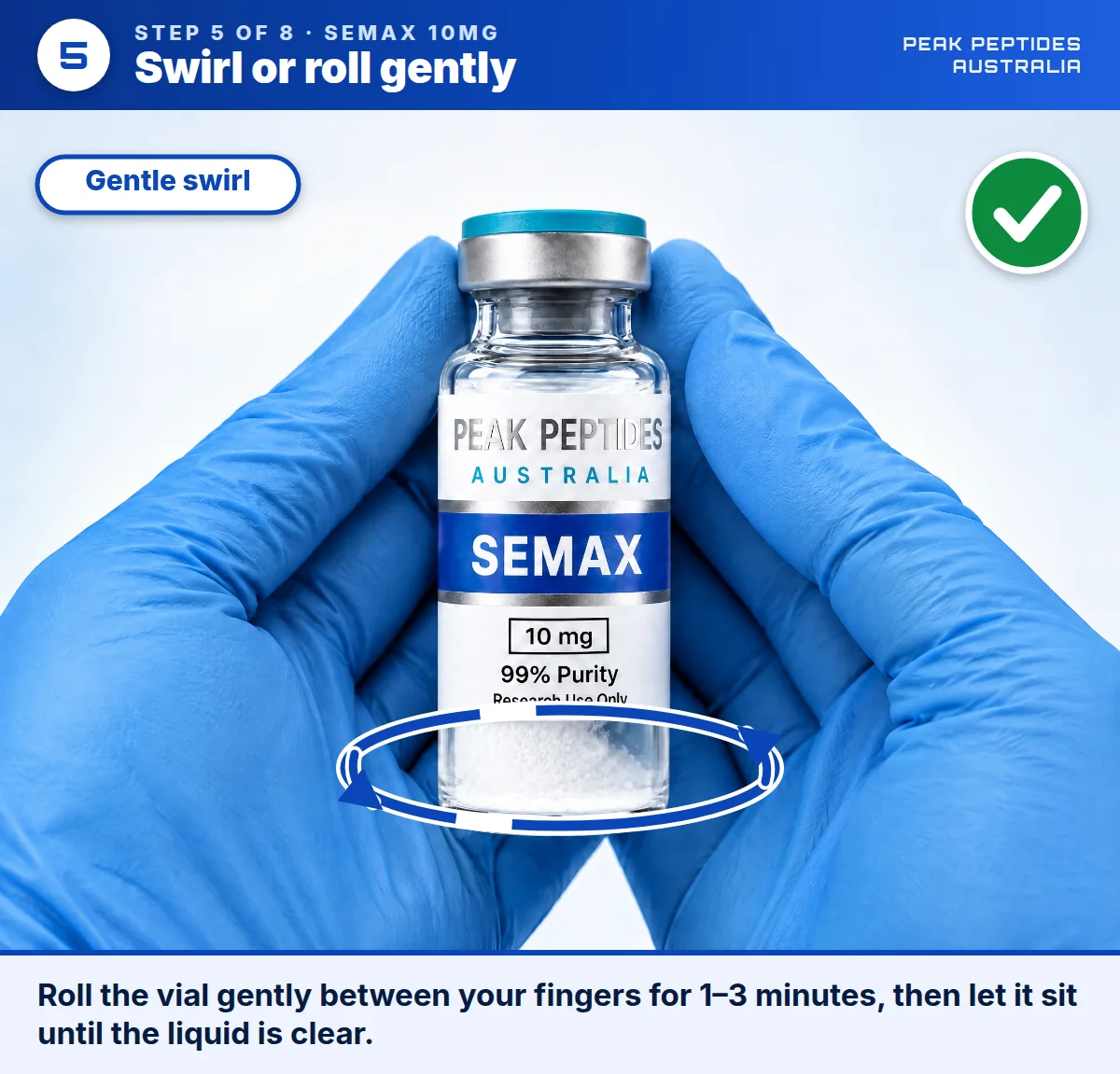
5Step 5: Swirl or roll gently
Gently roll the Semax vial between gloved fingers or swirl it in slow circles. A little undissolved white material can remain at first. Let it stand and swirl again as needed. Gentle movement keeps foam down and makes it easier to inspect whether all visible material has dissolved.
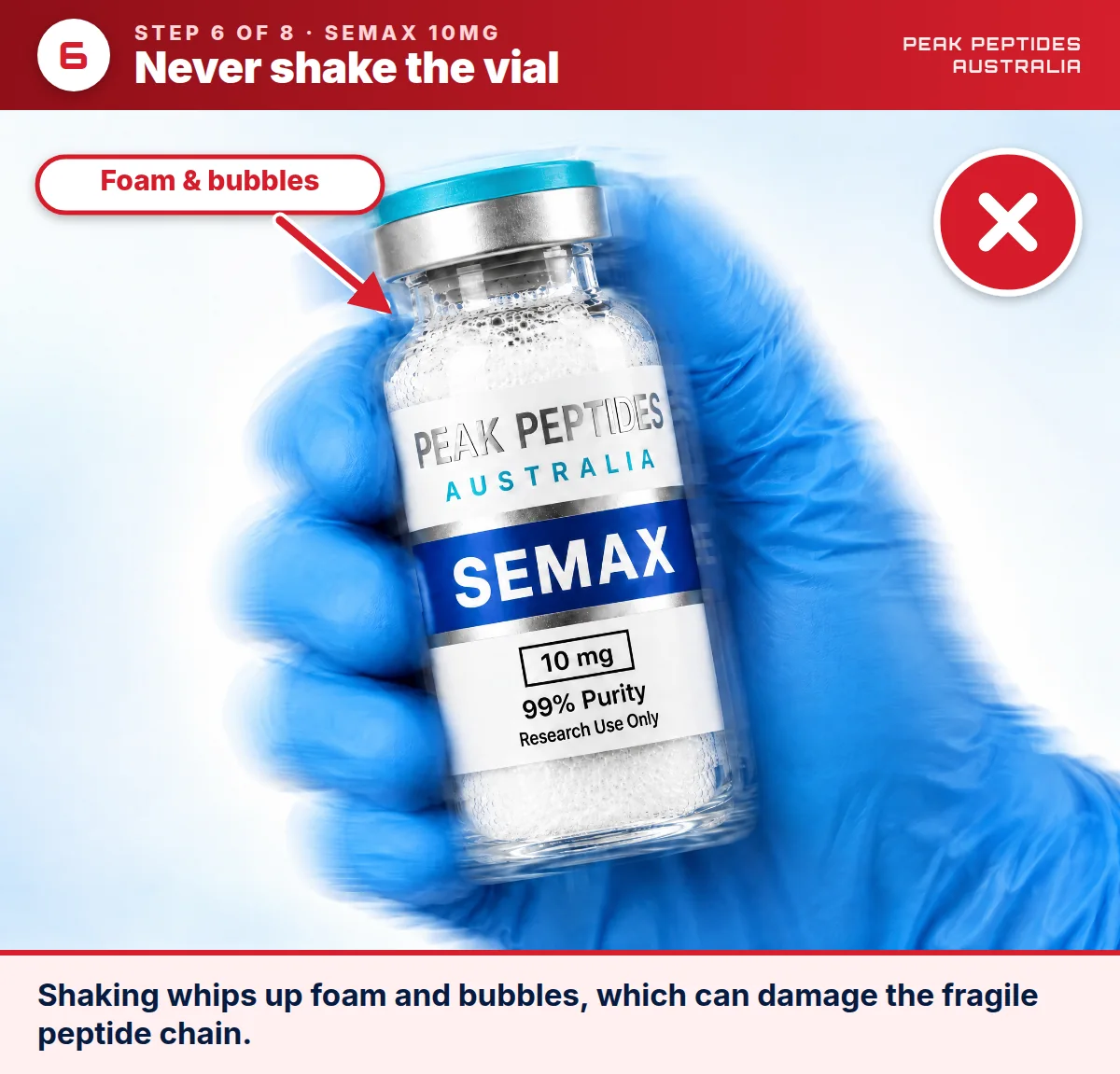
6Step 6: Never shake the vial
Do not shake the vial. Shaking produces foam and bubbles, which interfere with checking clarity and can stress a peptide solution. If bubbles form, leave the vial upright until they settle, then inspect it again under good light.
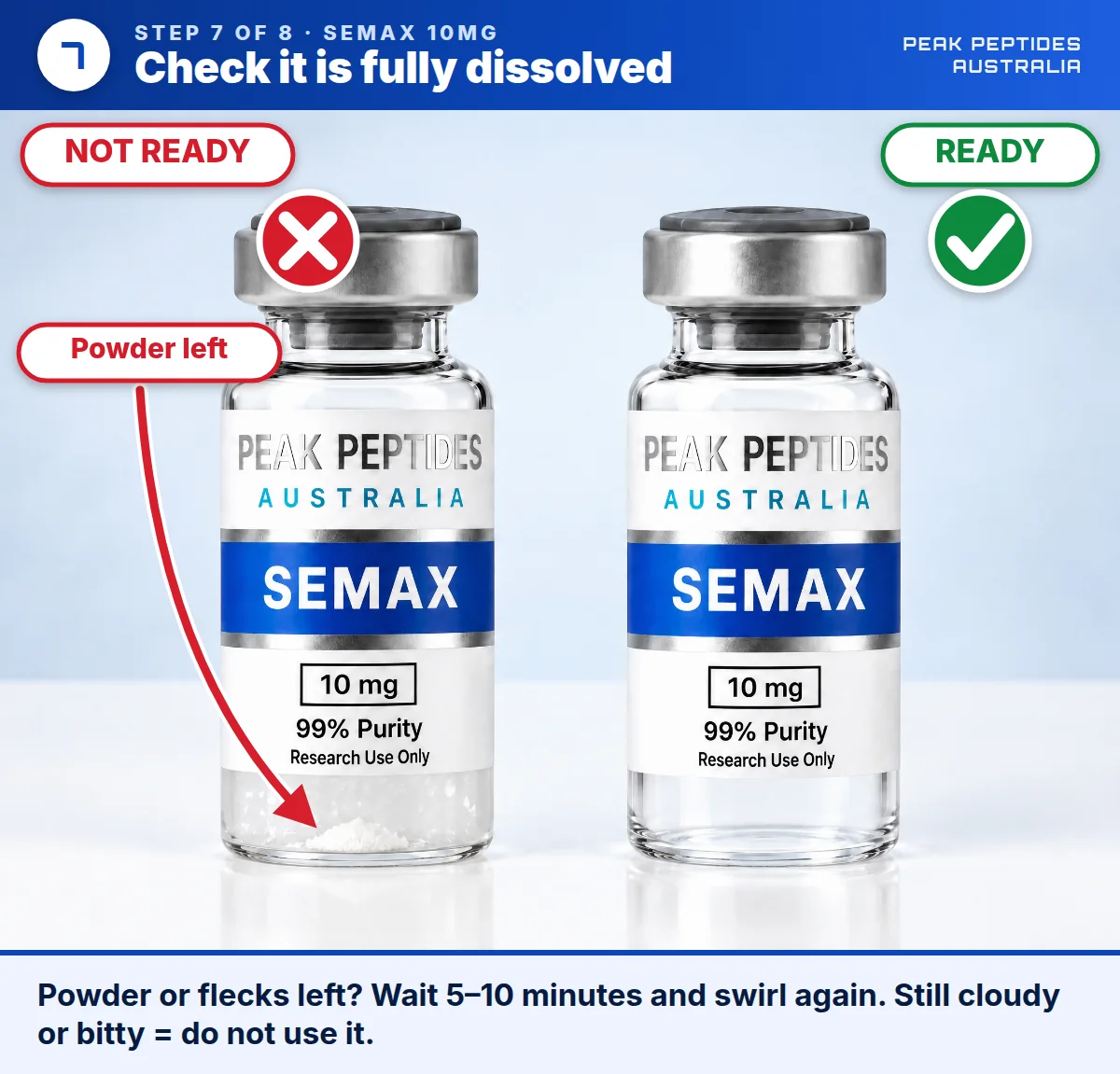
7Step 7: Check it is fully dissolved
Hold the Semax vial against a light background. A finished laboratory solution should look clear, with no visible powder, particles or cloudiness. If material remains, let the vial stand for five to 10 minutes and swirl again. A preparation that stays cloudy or contains particles should not be used.
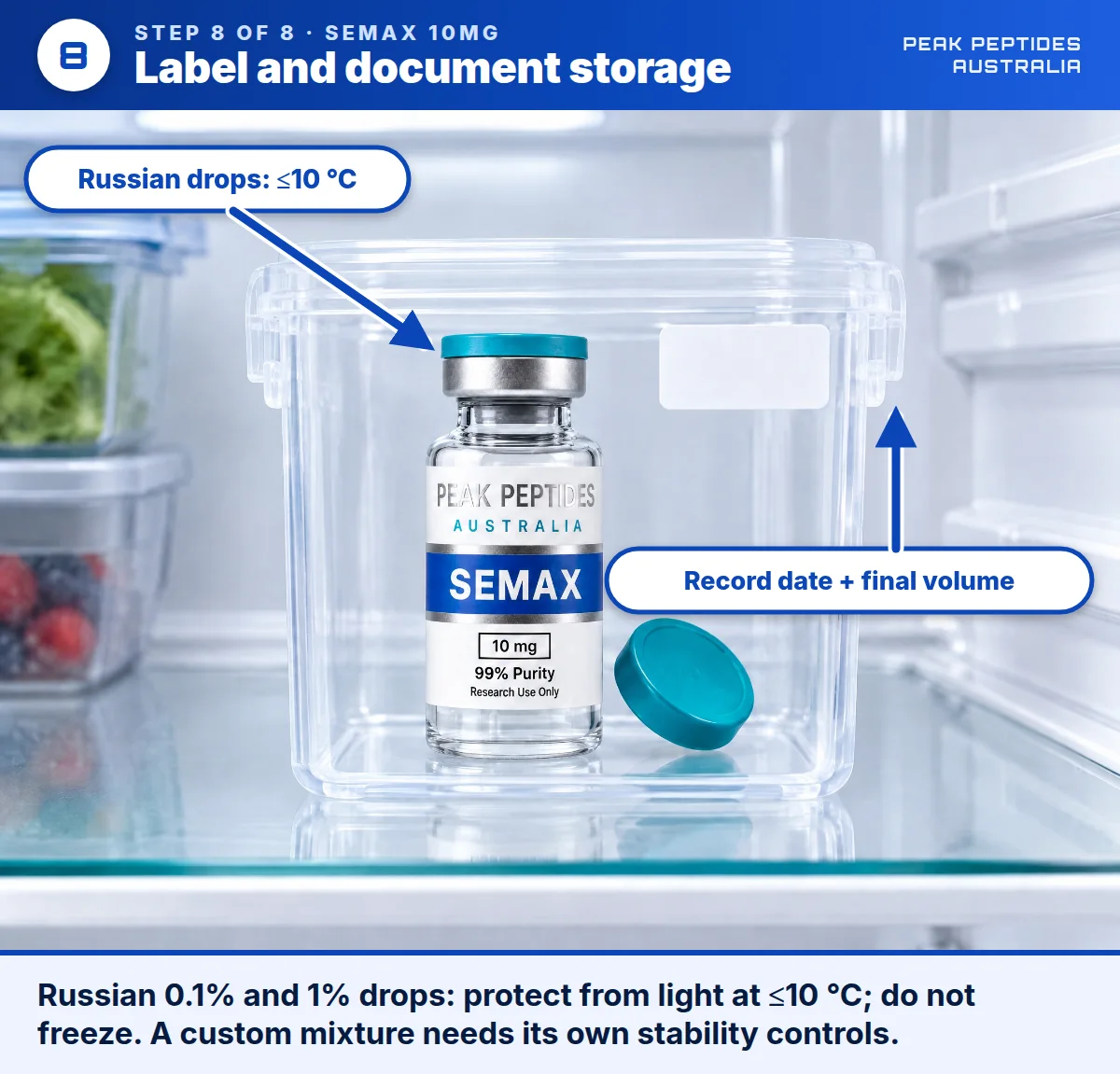
8Step 8: Label and document storage
Label the vial with preparation date, final volume, calculated concentration, solvent and storage condition. The registered Russian Semax nasal-drop product is protected from light, stored at no more than 10 °C and not frozen. Once mixed with BAC water, keep the vial upright at 2–8 °C, away from light, use within about 4 weeks (28 days) and never freeze it.
Semax storage: keep formulations separate
Storage context for Semax research material and the separate registered Russian medicine
Storage context for Semax research material and the separate registered Russian medicine
Material
When
Storage direction
Important distinction
Sealed Semax 10mg research vial
Before laboratory preparation
Follow supplier-documented conditions and protect from light
Freeze-dried research material; not a ready-made medicine
Russian Semax nasal drops
Registered 0.1% or 1% manufactured liquid
Protected from light, no more than 10 °C, do not freeze
A distinct preserved formulation with its own product instructions
Custom BAC-water laboratory mixture
After preparation
Within about 4 weeks (28 days)
No reviewed source gives a shelf life for a custom Semax mixture
Any prepared research solution
During documentation
Record solvent, final volume, concentration, date and storage condition
A recorded preparation is traceable; an unlabelled vial is not
The Russian product’s storage rule is for that finished medicine; this 10mg vial is a freeze-dried research powder.
Semax is a synthetic heptapeptide, meaning it contains seven amino acids. Its sequence is Met-Glu-His-Phe-Pro-Gly-Pro, or MEHFPGP. It is also named ACTH(4–7)-Pro-Gly-Pro because it contains an ACTH-derived fragment followed by Pro-Gly-Pro.
What is Semax used for in research?
Semax is studied in neurotrophin signalling, BDNF expression, TrkB-related pathways, neural gene expression and resting-state functional-connectivity experiments. Those studies measure defined molecular or imaging endpoints.
How does Semax work in research studies?
The mechanism is still mapped through experimental endpoints. Rat work has measured specific binding in basal-forebrain membranes, changes in BDNF protein and Bdnf messenger RNA, plus changes in TrkB messenger RNA and TrkB phosphorylation. Researchers use those measurements to study neurotrophin-related signalling.
What did Semax studies find about BDNF and TrkB?
In one rat hippocampus study, a single intranasal Semax exposure was followed by higher BDNF protein, higher TrkB phosphorylation, threefold higher exon III BDNF messenger RNA and twofold higher TrkB messenger RNA. The findings describe that rat model, tissue and time point.
What did Semax research find after cerebral ischaemia in rats?
In rats after permanent middle cerebral artery occlusion, Semax enhanced Bdnf, TrkC and TrkA transcription in cortex at three hours. The authors also reported selected later changes in Nt-3 and Ngf transcription. This was a post-ischaemia gene-expression experiment, not a human outcome study.
What did the human Semax fMRI study measure?
The 2018 study used resting-state fMRI in 24 healthy volunteers, with 14 assigned Semax and 10 placebo. It measured default-mode-network topography before and after intranasal study preparation. The reported result was a larger rostral default-mode-network subcomponent in the Semax group.
What side effects were reported in Semax studies?
The Russian reference instructions for its manufactured nasal drops list slight nasal-mucosa irritation with prolonged use. That statement belongs to that preserved liquid medicine, not to this freeze-dried research vial. The FDA briefing notes that clinical safety information for Semax free base and acetate is insufficient to characterise a clinical safety profile.
What is the half-life of Semax?
No verified human half-life is stated for Semax free base or Semax acetate in the sources reviewed. The FDA’s 2026 briefing states that it could not find human pharmacokinetic studies for those forms through any route. Do not attach a claimed half-life to this research vial.
Is Semax the same as Selank?
No. Semax and Selank are different seven-amino-acid peptides. Semax is MEHFPGP and is an ACTH(4–7)-Pro-Gly-Pro peptide; Selank is TKPRPGP and a tuftsin analogue. They have distinct structures, sample reports and experimental literature.
What did the Semax versus Selank connectivity study find?
A 2020 resting-state fMRI study assessed Semax, Selank and placebo in 52 healthy participants. It reported both general and specific connectivity effects between the right amygdala and right temporal cortex. It was a brain-connectivity experiment, not a product-interchangeability study.
Is Semax approved by the TGA or FDA?
No. This Semax 10mg research vial is not a TGA-approved therapeutic good and is not an FDA-approved medicine. Semax is registered as a medicine in Russia, where the reference product is available as 0.1% and 1% nasal drops; that Russian registration does not approve this Australian research vial.
Can I buy Semax 10mg online in Australia?
Peak Peptides Australia supplies Semax 10mg online as in-vitro research material. Same-day dispatch from Victoria applies to in-stock orders once payment is confirmed, with tracked Australia Post Express and a tracking number emailed. It is not supplied as a therapeutic product or ready-made nasal spray.
How fast is Semax shipping in Australia?
For in-stock orders, Peak Peptides Australia uses same-day dispatch from Victoria once payment is confirmed. The parcel travels by tracked Australia Post Express, and the tracking number is emailed. Transit time after dispatch is determined by Australia Post and the delivery destination.
How do I know my Semax sample is real?
Check the label, the product identity and an independently verifiable report. For this listing, LabDoc report LD-Z6HZ records LC-MS identity confirmation, HPLC purity and measured content for the submitted Semax sample. Open the report at labdoc.org and check that its report ID matches LD-Z6HZ.
How is the Semax 10mg sample verified?
LabDoc LD-Z6HZ was tested on 10 September 2026. It records identity confirmed by LC-MS, 99.69% purity by HPLC and 9.42mg measured content against a 10mg label claim. It records 94.2% of label claim, 0.31% related impurities and an overall Pass assessment.
Why does the Semax report show 9.42mg against a 10mg claim?
The 10mg figure is the vial’s nominal label claim, while 9.42mg is the measured content of the submitted sample. LabDoc expresses that result as 94.2% of label claim. Measured content, HPLC purity and LC-MS identity are separate analytical results and answer different questions.
How much BAC water for Semax 10mg?
For measurement reference, 1 mL gives 10 mg/mL, 2 mL gives 5 mg/mL and 3 mL gives 3.33 mg/mL. The 2 mL reference mix makes the maths simple: 20 U-100 syringe units correspond to 1 mg.
How many units is 1 mg of Semax?
It depends on final volume. With a 10mg vial brought to 1 mL, 1 mg is 10 units on a U-100 syringe. At 2 mL, 1 mg is 20 units. At 3 mL, 1 mg is 30 units. These are volume conversions only.
How many mg are in 10 units of Semax?
With the 2 mL reference mix, the concentration is 5 mg/mL and 10 U-100 syringe units equal 0.10 mL, so they contain 0.5 mg. At 1 mL, 10 units equal 1 mg; at 3 mL, 10 units equal about 0.33 mg.
How do I reconstitute Semax 10mg?
For a laboratory solution, use the photo guide: work cleanly, swab both stoppers, draw the chosen solvent volume, let liquid run down the vial wall, then swirl rather than shake. The liquid should be clear before documentation and storage. This research vial is not a ready-made nasal medicine.
Can I use sterile water or tap water instead of BAC water?
Do not use tap water for a laboratory preparation. Plain sterile water and BAC water differ because BAC water contains a preservative. The registered Russian Semax drops are a different manufactured formulation containing purified water and methylparaben. Select solvent and controls that match the in-vitro method.
What if Semax powder does not dissolve?
Let the vial stand, then swirl gently again. Do not shake it, because shaking creates foam and makes visual checking harder. A prepared solution should be clear and free of visible particles before it is logged for laboratory work. Persistent cloudiness or particles mean the preparation should not be used.
Should reconstituted Semax be cloudy?
No. A visually acceptable laboratory solution is clear and free of particles. Cloudiness, flakes or material settled at the bottom shows that the powder has not fully dissolved or that the preparation has been compromised. Record the observation and do not treat a cloudy solution as fully prepared.
How long does reconstituted Semax last?
The sources reviewed do not state a shelf life for a custom BAC-water Semax research mixture. Stability depends on the complete formulation, solvent, container and microbiological controls. The registered Russian 0.1% and 1% nasal-drop product is a different preserved formulation and cannot supply a shelf life for this vial.
How should Semax powder be stored before preparation?
Keep the sealed research vial under its supplier-documented conditions and protect it from light. The registered Russian nasal-drop reference product is stored protected from light at no more than 10 °C and not frozen, but that instruction applies to its manufactured liquid formulation rather than this freeze-dried vial.
Can reconstituted Semax be frozen?
Keep Semax mixed with BAC water upright in the fridge at 2–8 °C, away from light. Use within about 4 weeks (28 days), never freeze it, and write the date and strength on the vial. The registered Russian nasal-drop instructions explicitly say not to freeze that manufactured product.
What does a Semax COA show?
A certificate of analysis records test results for a submitted sample. LD-Z6HZ gives three key results: LC-MS identity confirmation, 99.69% HPLC purity and 9.42mg measured content. It also records 0.31% related impurities, 94.2% of label claim and a Pass assessment.
Is Semax 10mg a ready-made nasal spray?
No. Semax 10mg is a freeze-dried research vial, not a manufactured nasal-drop bottle, nasal pump or ready-to-use medicine. Published intranasal Semax papers and the Russian product instructions concern defined liquid formulations and delivery devices, not this separately supplied research material.