A 28-amino-acid peptide
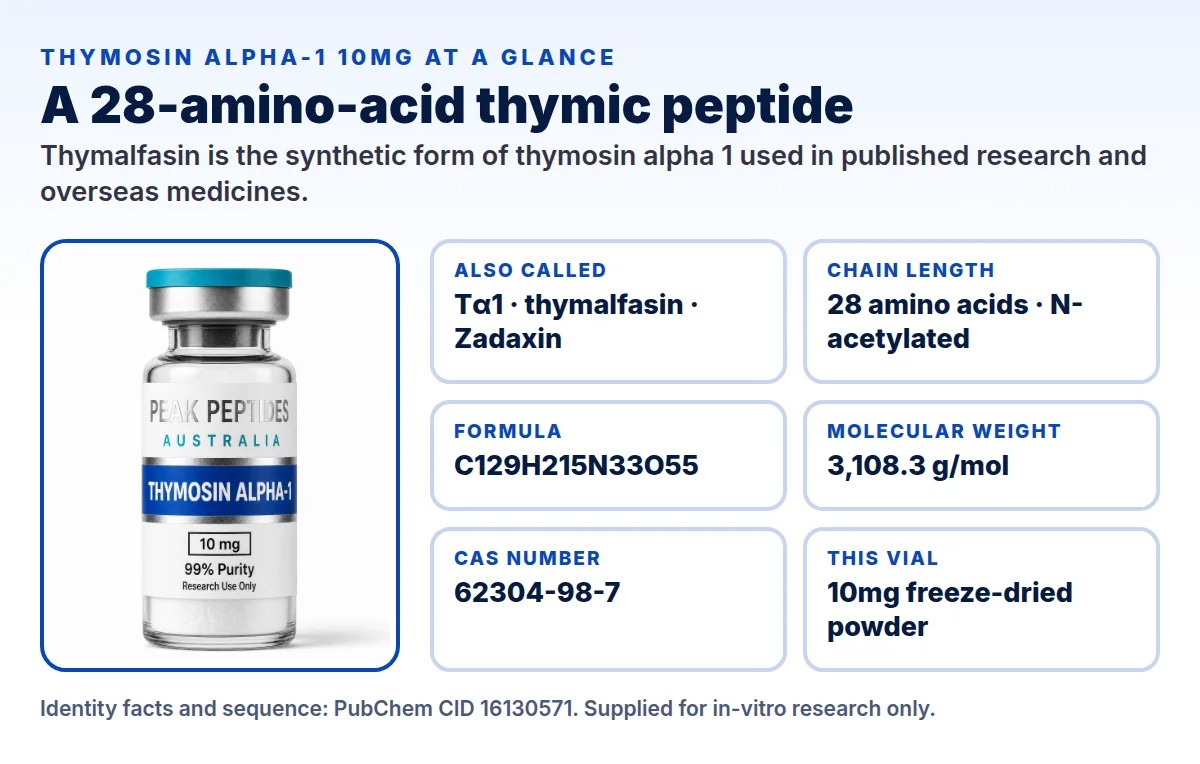
Thymosin Alpha-1, or Tα1, is an N-acetylated chain of 28 amino acids. PubChem lists the synthetic form as thymalfasin, with the sequence SDAAVDTSSEITTKDLKEKKEVVEEAEN, formula C129H215N33O55 and molecular weight 3,108.3 g/mol.
Thymosin Alpha-1 (Thymic Peptide)
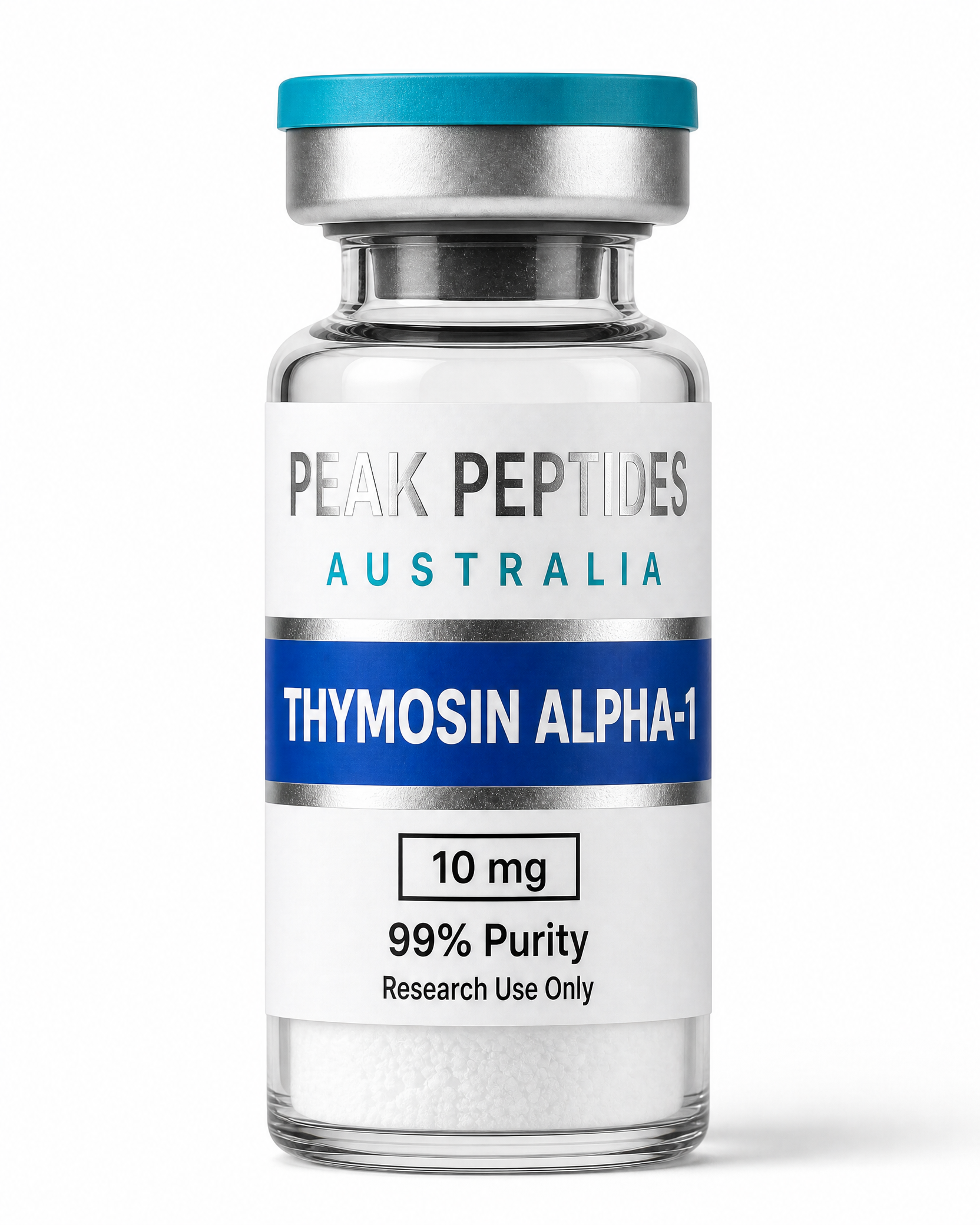
Thymosin Alpha-1 10mg is a freeze-dried, 28-amino-acid peptide also called Tα1 or thymalfasin. It is examined in immune-signalling research involving dendritic cells, T cells, natural-killer cells and Toll-like-receptor pathways. This vial is backed by LabDoc report LD-J82K, which records confirmed LC-MS identity, 99.67% HPLC purity and 9.4mg measured content. In-stock orders receive same-day dispatch from Victoria after payment confirmation, with tracked Australia Post Express shipping Australia-wide.
This product is sold strictly for in-vitro laboratory research purposes only. It is not intended for human or animal consumption, injection, or any diagnostic or therapeutic use.
Thymosin Alpha-1 10mg · immune-signalling research guide
Thymosin Alpha-1 is a 28-amino-acid peptide found naturally in thymus tissue; the synthetic version is called thymalfasin. It is studied for the way it changes communication between immune cells, including dendritic cells, T cells, natural-killer cells and Toll-like-receptor pathways. This 10mg vial contains freeze-dried powder and is supported by LabDoc report LD-J82K. That report records confirmed LC-MS identity, 99.67% HPLC purity and 9.4mg measured content for the submitted sample. This page explains the molecule, published research, its difference from TB-500, its regulatory status, and the measurement maths for a 3 mL BAC-water preparation. Peak Peptides Australia supplies this material for in-vitro research only.
Also referred to in research or catalogue references as Thymosin alpha 1, Thymosin alpha1, Thymosin α1, Tα1, Thymalfasin, Thymosin Alpha-1, Thymosin alpha-1, TA1 peptide, TA-1, Thymosin A1, Thymalfasin 10mg, Thymosin Alpha-1 10mg, Zadaxin, 62304-98-7.
Thymosin Alpha-1, or Tα1, is an N-acetylated chain of 28 amino acids. PubChem lists the synthetic form as thymalfasin, with the sequence SDAAVDTSSEITTKDLKEKKEVVEEAEN, formula C129H215N33O55 and molecular weight 3,108.3 g/mol.
Thymalfasin is the synthetic form of Thymosin Alpha-1. Zadaxin is a trade name for a finished thymalfasin medicine marketed in some countries. A trade-name medicine is not the same product as this freeze-dried research vial.
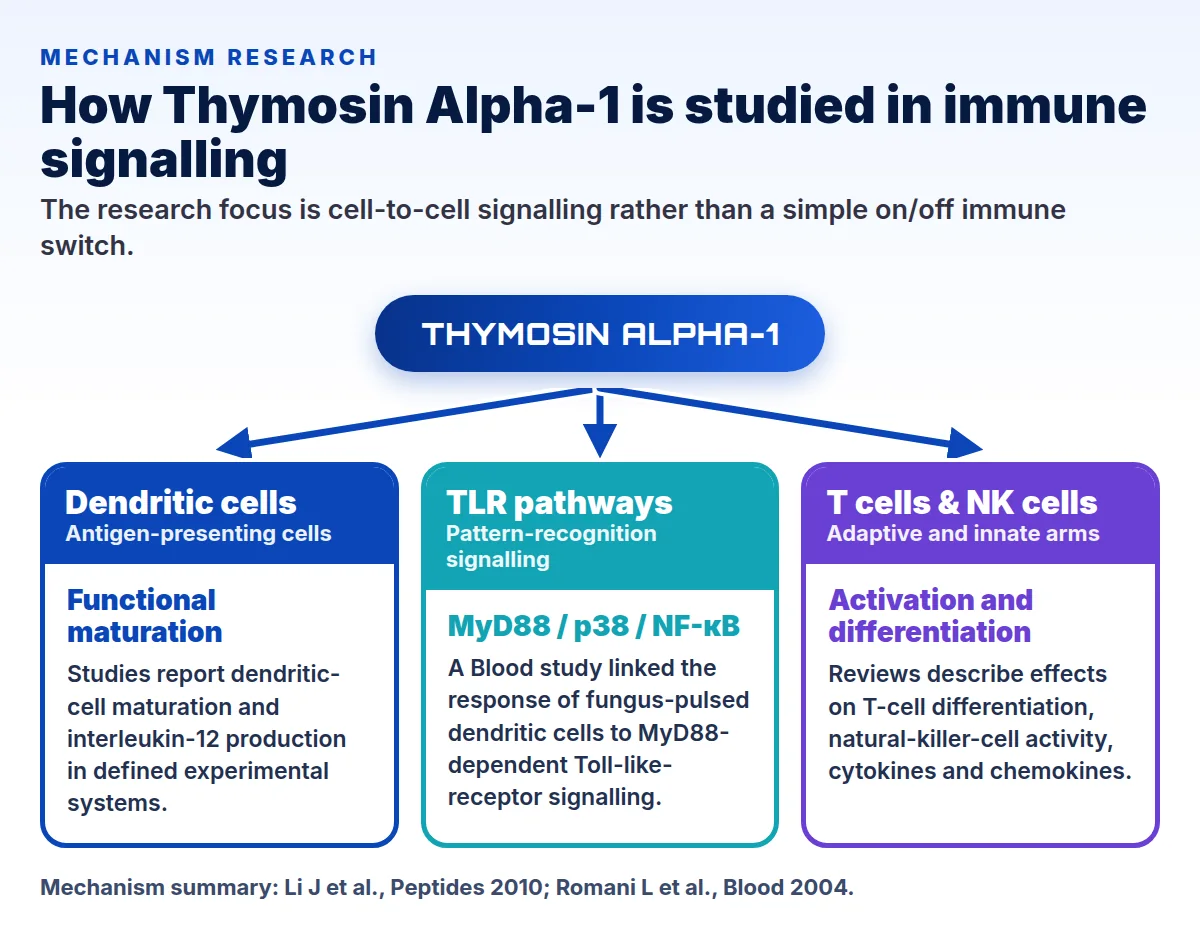
Published work examines dendritic-cell maturation, T-cell differentiation, natural-killer-cell activity, cytokines and chemokines. One mechanistic study linked a dendritic-cell response to MyD88-dependent Toll-like-receptor signalling, p38 MAPK and NF-κB.
A clinical pharmacokinetic study reported a Thymosin Alpha-1 elimination half-life of less than 3 hours. A separate review reported a serum half-life of about 2 hours. Those figures describe the studied medicine formulations, not the stability of dry powder in this vial.
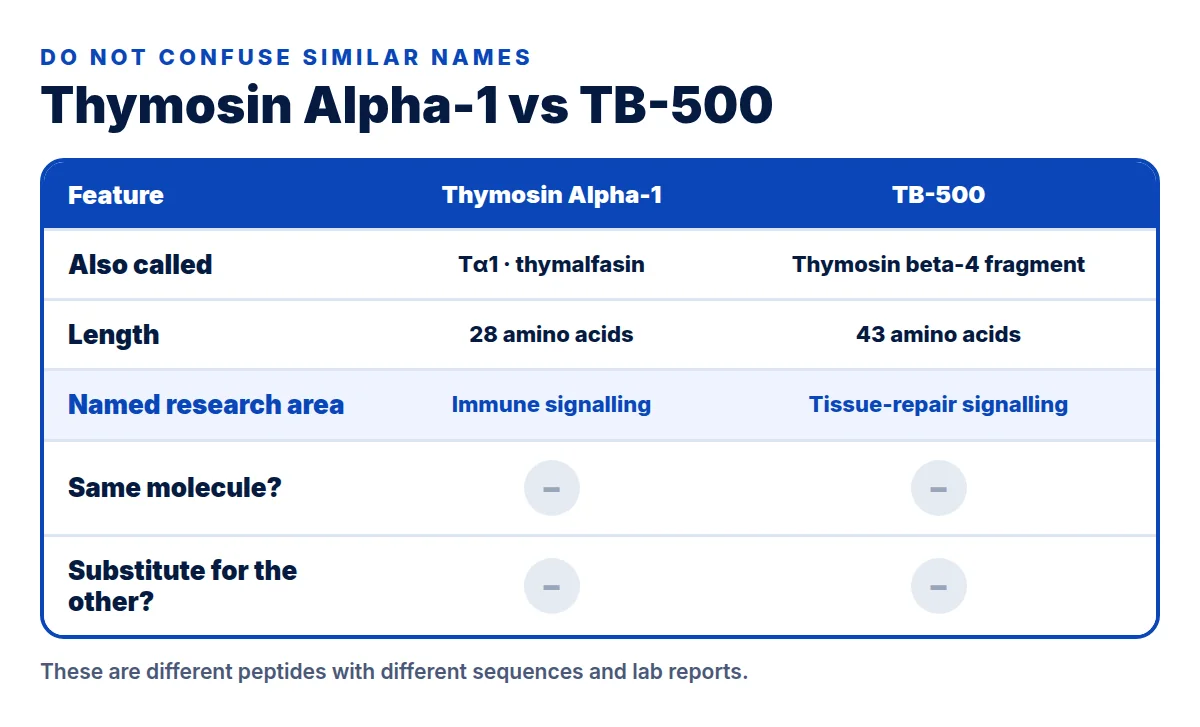
Thymosin Alpha-1 is not thymosin beta-4 and is not TB-500. Thymosin Alpha-1 has 28 amino acids; the PubChem thymosin beta-4 record has a 43-residue sequence. Similar names do not make their sequences, analytical results or research questions interchangeable.
LabDoc report LD-J82K, tested 11 September 2026, lists confirmed identity by LC-MS, 99.67% purity by HPLC and 9.4mg HPLC content against the 10mg label claim. The report’s overall assessment is Pass.
LC-MS confirms the molecular identity of the submitted sample; HPLC measures purity and content. The report batch is recorded as “Not stated”.
FDA says it has approved no drug products containing Tα1. FDA material also records that foreign marketed products, including Zadaxin, are approved in other countries. A search of the Australian Register of Therapeutic Goods did not return a thymalfasin medicine listing, so this research vial is not a TGA-approved medicine.
Thymosin Alpha-1 is a short, lab-made version of a peptide associated with thymus tissue. A peptide is a chain of amino acids, the small building blocks that also make up proteins. Tα1 has 28 of them and begins with an acetyl group, a small chemical cap attached to its first amino acid.
The synthetic molecule is called thymalfasin. PubChem lists thymalfasin, Thymosin Alpha-1, thymosin alpha1 and Zadaxin as names connected with this chemical identity. Its sequence is SDAAVDTSSEITTKDLKEKKEVVEEAEN, its formula is C129H215N33O55 and its molecular weight is 3,108.3 g/mol.
The 10mg on this vial is the stated total amount of freeze-dried material. It is not a concentration because no liquid has been added yet. Concentration is calculated only after a measured final volume is selected. Peak Peptides Australia supplies this material for in-vitro research only.
Thymosin Alpha-1 is studied as an immune-response modulator. Researchers examine how it changes signals exchanged by immune cells. The key questions are which cells respond, through which pathway, and which measurable endpoint changes in a defined model.
Dendritic cells are a major research focus. They capture material from their environment and present it to T cells, helping shape later immune responses. In a 2004 Blood study, thymosin alpha 1 induced functional maturation and interleukin-12 production by fungus-pulsed dendritic cells through p38 MAPK and NF-κB pathways involving MyD88-dependent Toll-like-receptor signalling.
Reviews also describe experiments involving T-cell differentiation, natural-killer-cell activity, cytokines and chemokines. These are different parts of the immune system and their results belong to the experimental model in which they were measured. The diagram keeps those research paths distinct.
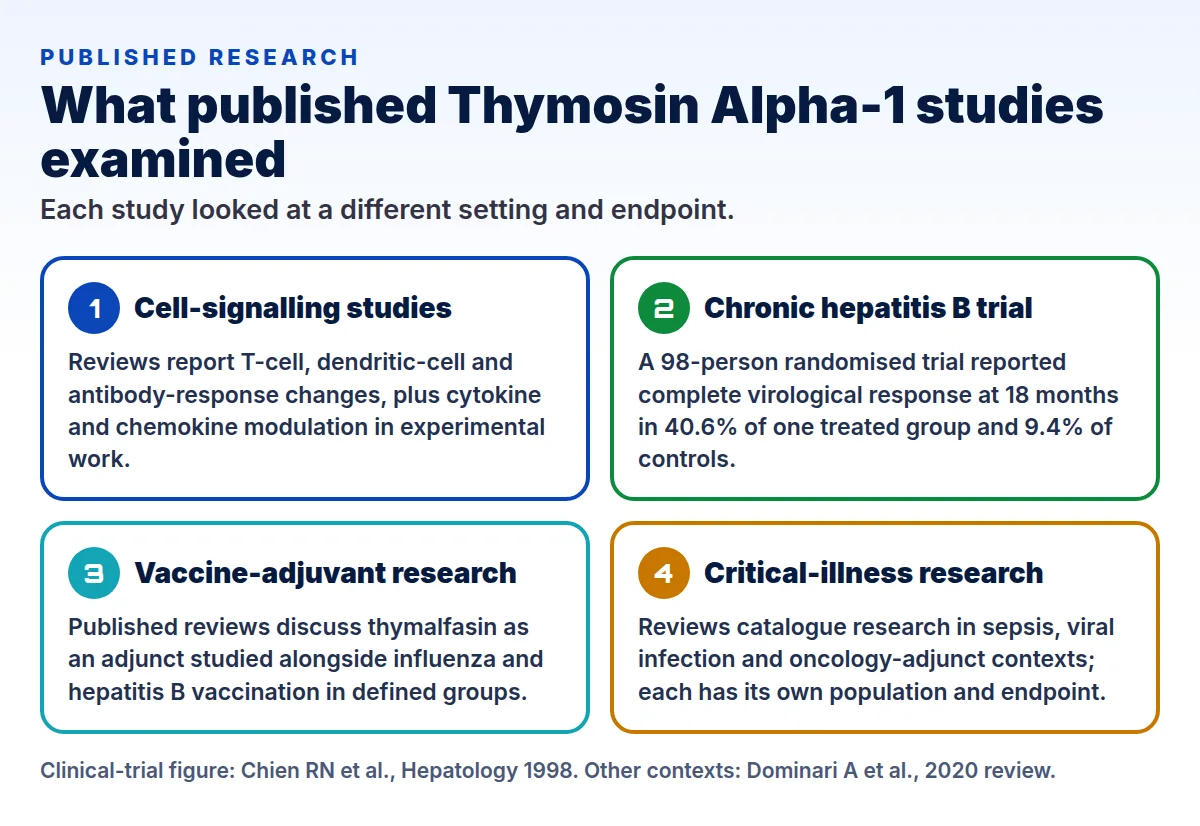
Thymosin Alpha-1 research has covered laboratory mechanisms and several clinical settings. It is important to keep those settings separate. A cell-signalling result does not answer a clinical question, and a result in one illness does not automatically apply to another illness or to a separately supplied research vial.
One early randomised chronic-hepatitis-B trial enrolled 98 people in three groups. At 18 months after enrolment, complete virological response was reported in 40.6% of one thymosin-alpha-1 group, 26.5% of another treated group and 9.4% of the untreated control group. The study also reported no significant side effects. That is a specific historical trial result, not a general product claim.
The much larger 2025 TESTS trial enrolled 1,106 adults with sepsis in 22 centres in China. In the modified intention-to-treat analysis, 28-day mortality was 23.4% with thymosin alpha 1 and 24.1% with placebo; the authors found no clear evidence that it reduced 28-day all-cause mortality. Reporting both kinds of study helps show why endpoints and study setting matter.
| Setting | Design or source | What was reported | How to read it |
|---|---|---|---|
| Dendritic-cell signalling | Blood 2004 mechanistic study | Functional maturation and interleukin-12 production through p38 MAPK, NF-κB and MyD88-dependent Toll-like-receptor signalling | Mechanism finding in a defined experimental system |
| Chronic hepatitis B | 98-person randomised trial | 18-month complete virological response: 40.6% in one treated group, 26.5% in another, 9.4% in controls | Historical disease-specific clinical result |
| Sepsis | TESTS Phase 3 trial, 1,106 enrolled | 28-day mortality: 23.4% thymosin alpha 1 versus 24.1% placebo | The trial found no clear mortality difference |
| Immune-cell activity | Peptides 2010 review | T-cell, dendritic-cell and antibody-response effects; cytokine and chemokine modulation discussed | Review of mixed laboratory and clinical literature |
Each line concerns a separate study design and endpoint. None is a result for this specific 10mg research vial.
Thymosin Alpha-1 and TB-500 are different peptide identities. The shared word “thymosin” is not enough to treat them as related samples, substitutes or a single research topic. Their amino-acid chains are different, their biological literature is different and their analytical reports must be kept separate.
Thymosin Alpha-1 is a 28-amino-acid peptide with the thymalfasin identity. TB-500 is associated with thymosin beta-4 nomenclature. The PubChem thymosin beta-4 record has a 43-residue sequence and a molecular weight of 4,963 g/mol, compared with 3,108.3 g/mol for thymalfasin.
For practical research documentation, identify the peptide by its full name, sequence or recognised chemical record rather than relying on a shared family-style name. The comparison graphic is an identity check: it does not suggest that the materials should be combined or used interchangeably.
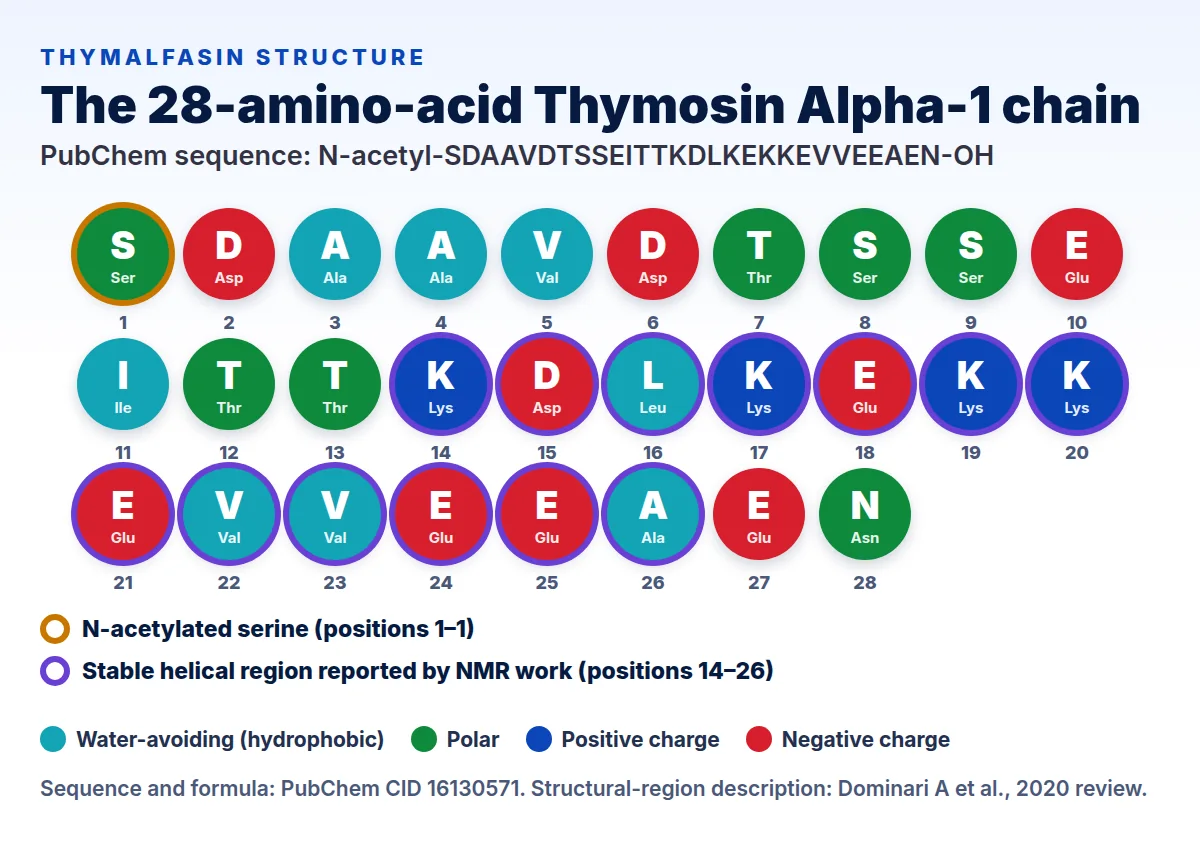
A sequence is the ordered list of amino-acid building blocks in a peptide. PubChem gives thymalfasin as N-acetyl-SDAAVDTSSEITTKDLKEKKEVVEEAEN-OH. The “N-acetyl” part means the first serine residue has an acetyl group attached at the N-terminal end of the chain.
The chain is rich in acidic amino acids, especially aspartate (D) and glutamate (E), and also contains positively charged lysine (K). That composition is part of the molecule’s chemical identity. It is useful for matching an identity reference or planning analytical work; it does not by itself predict a laboratory outcome.
A review describing NMR work reports a distorted helical configuration with a stable alpha-helical region around residues 14 to 26 and two N-terminal beta turns. The sequence graphic maps all 28 positions so the structural statement can be read alongside the actual amino-acid chain.
This listing is linked to LabDoc report LD-J82K. The report records testing on 11 September 2026 and names the submitted sample Thymosin Alpha-1. It records a 10mg manufacturer claim, 9.4mg content by HPLC, 99.67% purity by HPLC, confirmed identity by LC-MS and an overall Pass assessment.
The three measurements answer different questions. LC-MS identity testing checks the molecule’s mass pattern against the expected identity. HPLC purity measures the proportion of the chromatographic signal attributed to the target material. HPLC content measures the amount found in the submitted vial against its stated nominal quantity.
The scope matters too. LD-J82K lists its batch as “Not stated”. The report is evidence for the submitted sample, not a statement that every current or future vial has the same content, purity or identity result. It also does not report sterility, endotoxin, stability, clinical safety or suitability for administration. Open the report identifier on LabDoc to inspect the primary record.
Thymosin Alpha-1 has two very different contexts that should not be blurred. Thymalfasin is the synthetic molecule discussed in scientific literature, and branded finished products such as Zadaxin are marketed in some countries. This page concerns a freeze-dried research vial supplied for in-vitro research only.
FDA states that it has approved no drug products containing Tα1. In the same material, the agency notes foreign marketed products such as Zadaxin are approved in other countries and says that foreign approval is separate from FDA approval. An FDA advisory transcript also says Tα1 is not approved in the United States, Japan or Europe except Italy.
In Australia, the ARTG is the TGA register used to search medicines that can be supplied within Australia. An ARTG search for thymalfasin did not return a thymalfasin medicine listing. Accordingly, this product is not presented as a TGA-approved medicine. For in-stock orders, Peak Peptides Australia uses same-day dispatch from Victoria once payment is confirmed, tracked Australia Post Express, with the tracking number emailed.
Step-by-step guide · About 10 minutes
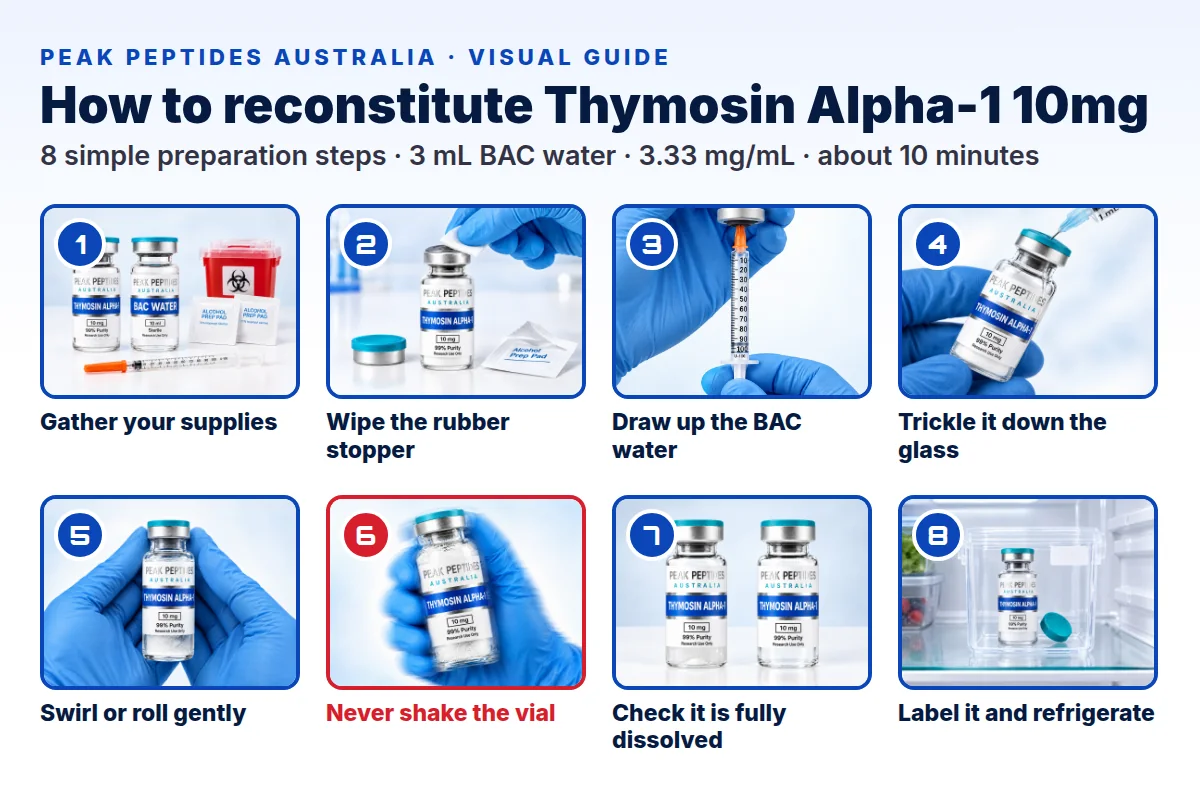
Thymosin Alpha-1 10mg is supplied as a dry, freeze-dried powder. Reconstitution means adding BAC water so the powder becomes a clear liquid with a known concentration. The PeptideDosages 10mg reference uses 3 mL, which gives 3.33 mg/mL. On a U-100 syringe, 100 units equals 1 mL, so this preparation places 1 mg in 30 units. The visual sequence below takes about 10 minutes and focuses on clean handling, slow liquid transfer and a clear final preparation.
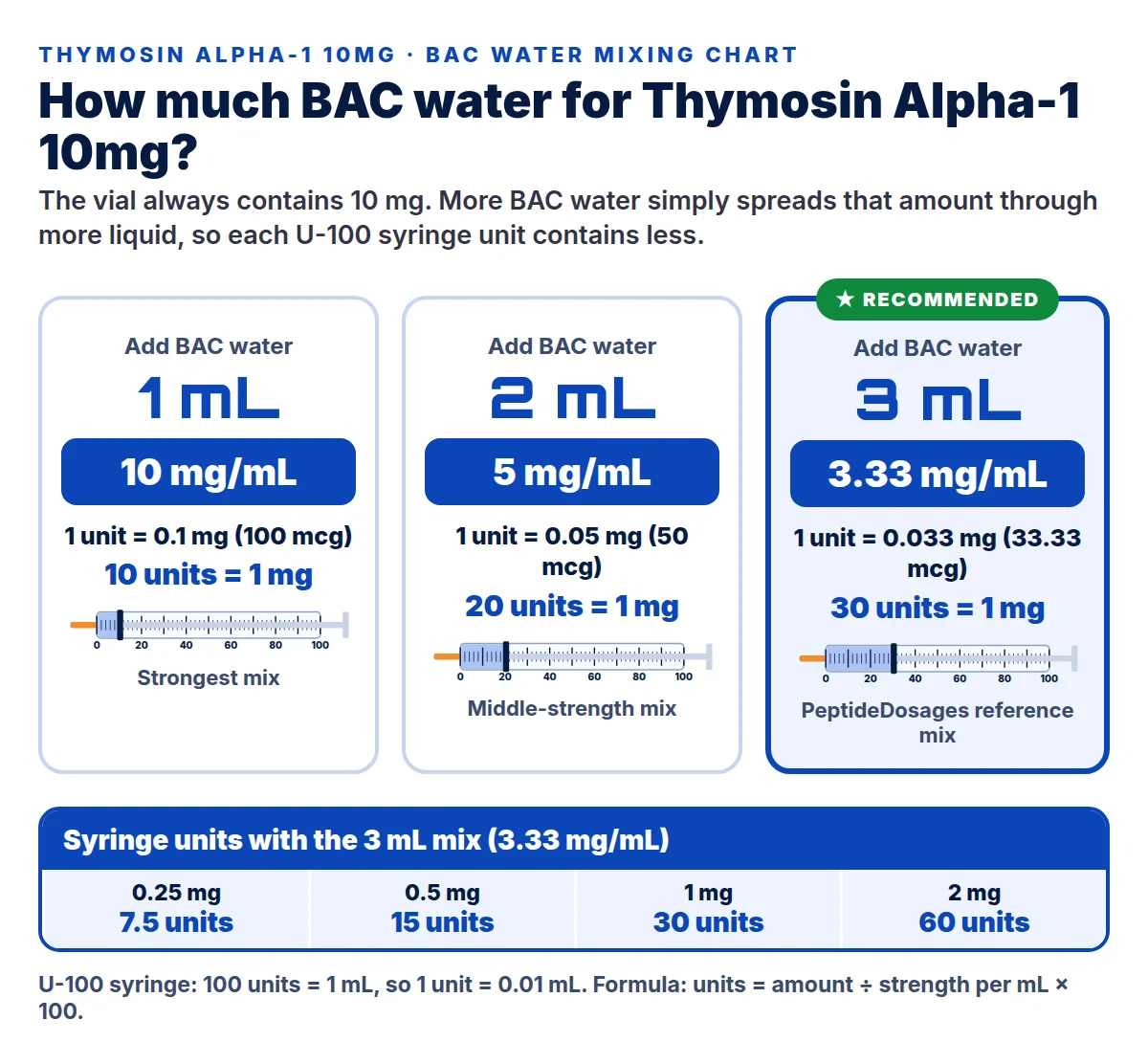
The vial’s total is 10mg regardless of the final liquid volume. Adding more BAC water spreads the same material through more liquid, lowering the concentration per millilitre and per U-100 syringe unit. The concentration formula is total milligrams divided by final millilitres.
PeptideDosages uses 3 mL as its reference for a Thymosin Alpha-1 10mg vial. That gives 3.33 mg/mL: 1 U-100 unit holds 0.033 mg (33.33 mcg), 10 units holds 0.33 mg and 30 units holds 1 mg. The chart also shows the 1 mL and 2 mL alternatives. Formula: units = amount ÷ mg per mL × 100.
| BAC water added | Strength | 1 unit holds | Units for 1 mg | Whole vial |
|---|---|---|---|---|
| 1 mL | 10 mg/mL | 0.1 mg (100 mcg) | 10 units | 100 units |
| 2 mL | 5 mg/mL | 0.05 mg (50 mcg) | 20 units | 200 units |
| 3 mL | 3.33 mg/mL | 0.033 mg (33.33 mcg) | 30 units | 300 units |
3 mL is highlighted because it gives the simplest numbers.
| Amount | Units on a U-100 syringe | Volume |
|---|---|---|
| 0.25 mg | 7.5 units | 0.075 mL |
| 0.5 mg | 15 units | 0.15 mL |
| 1 mg | 30 units | 0.3 mL |
| 2 mg | 60 units | 0.6 mL |
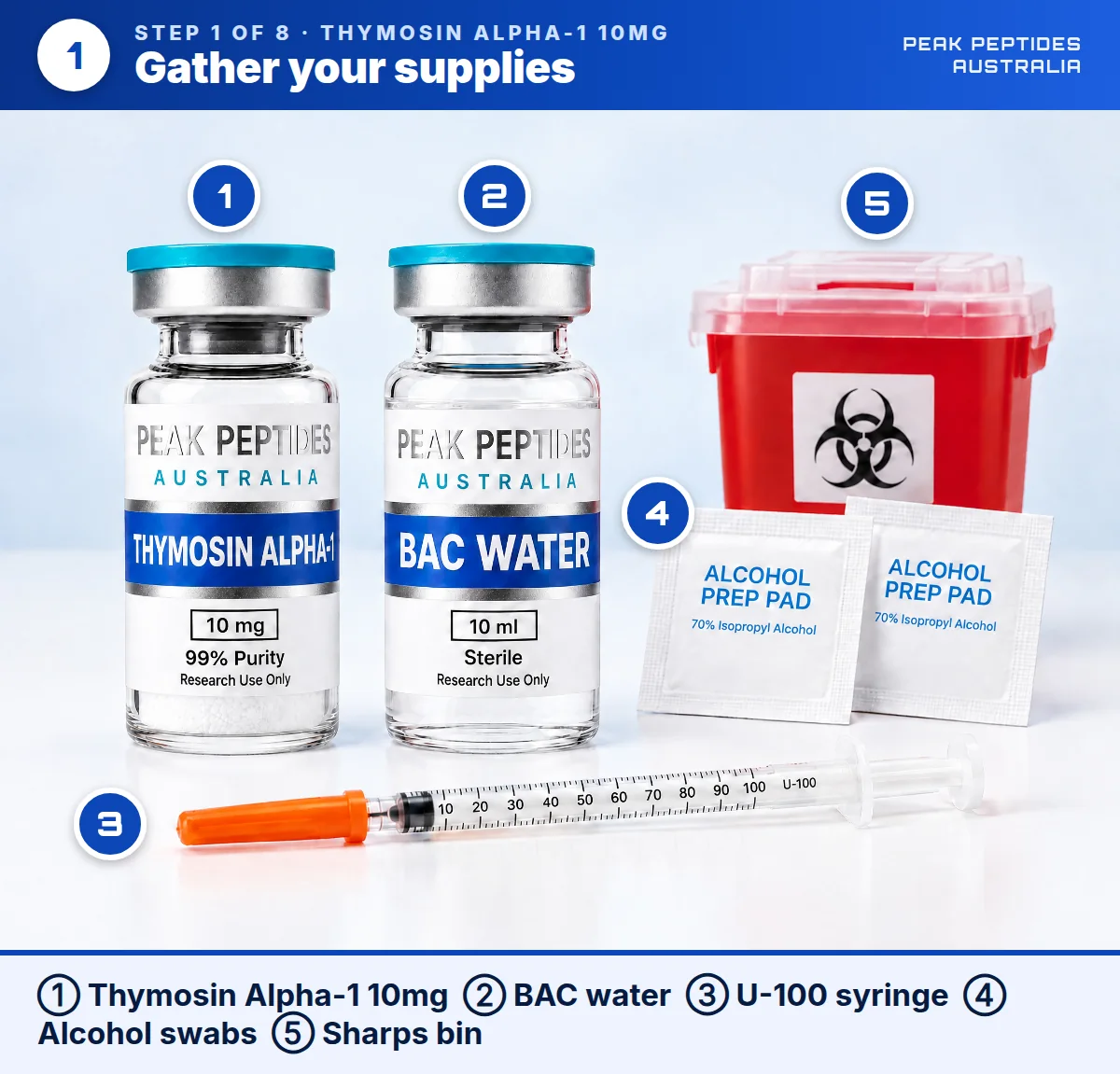
Lay out the Thymosin Alpha-1 10mg vial, BAC water, a new 1 mL U-100 syringe, alcohol swabs and a sharps container on a clean, stable surface. Wash hands and confirm the vial label, strength and powder appearance before starting. If refrigerated, allow the sealed vial to sit briefly at room temperature before preparation.
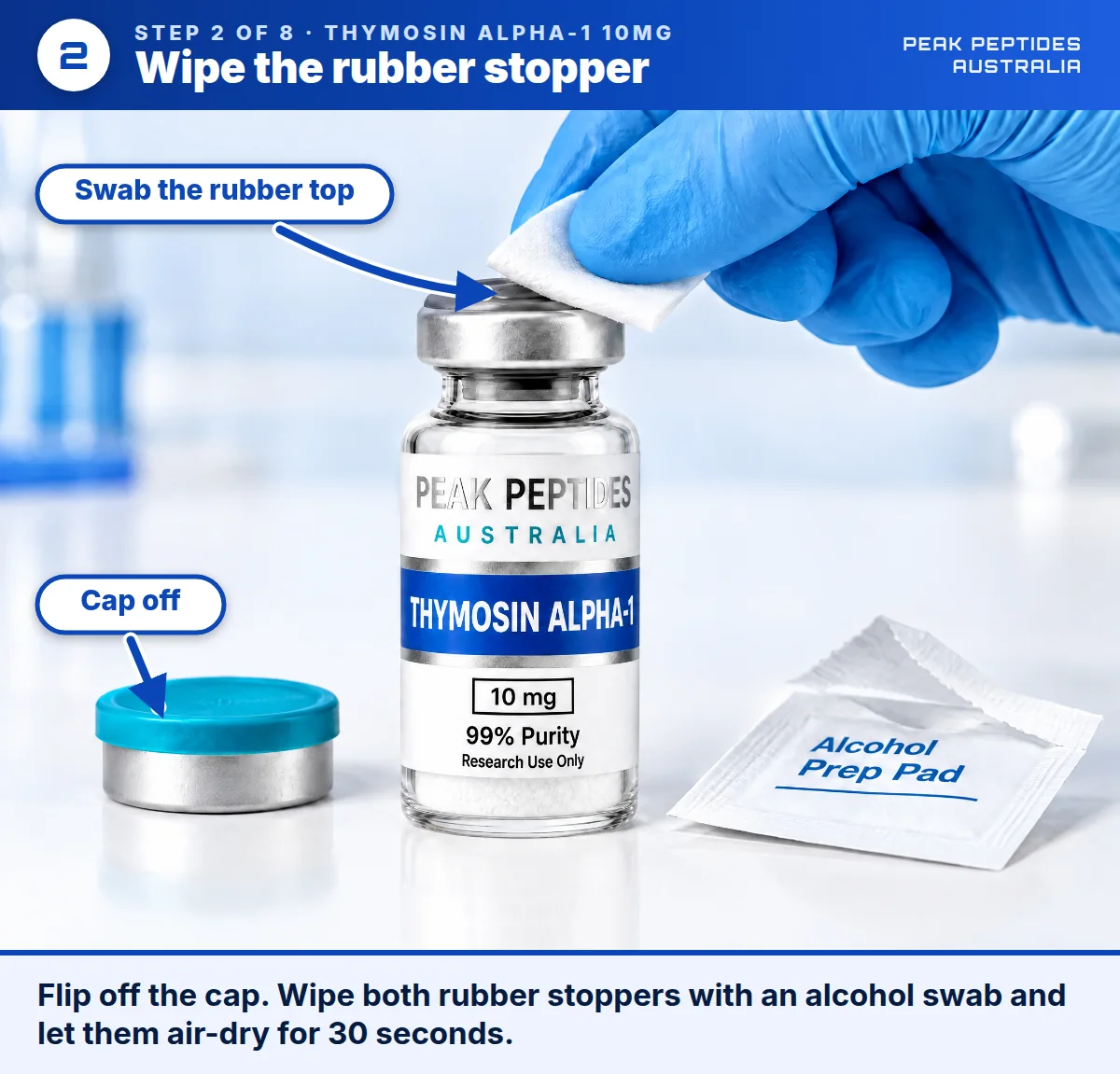
Remove the flip-off caps without touching the rubber stoppers. Use a fresh alcohol swab on each stopper and allow the surfaces to air-dry for about 30 seconds. Once cleaned, avoid placing fingers or other objects onto the stopper. This helps keep the liquid-transfer surface clean.
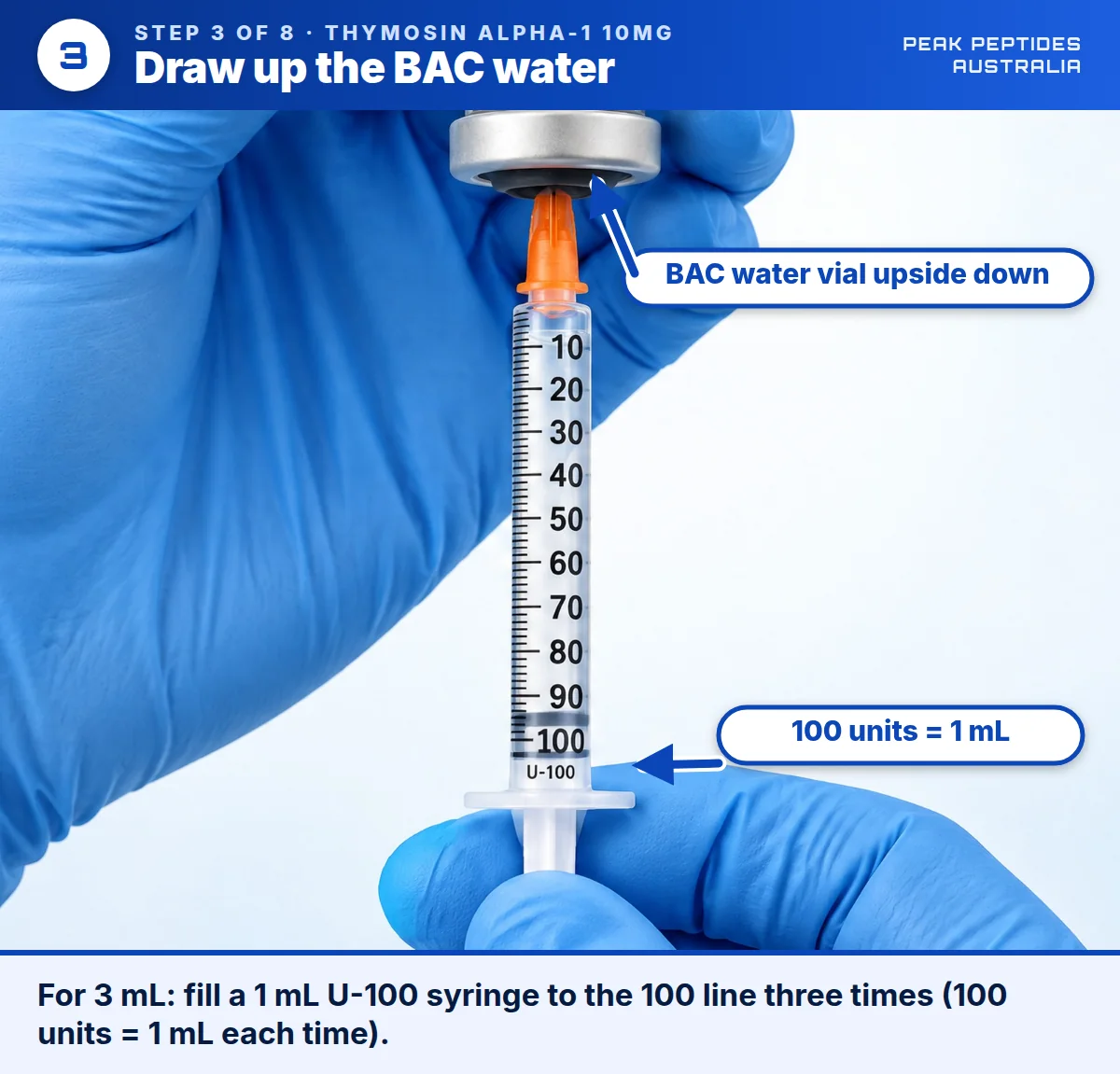
For the 3 mL reference preparation, use the U-100 syringe to measure 1 mL of BAC water three times. A full 1 mL U-100 syringe reaches the 100-unit line. Check for large air bubbles and confirm the liquid level against the syringe markings before each slow transfer.
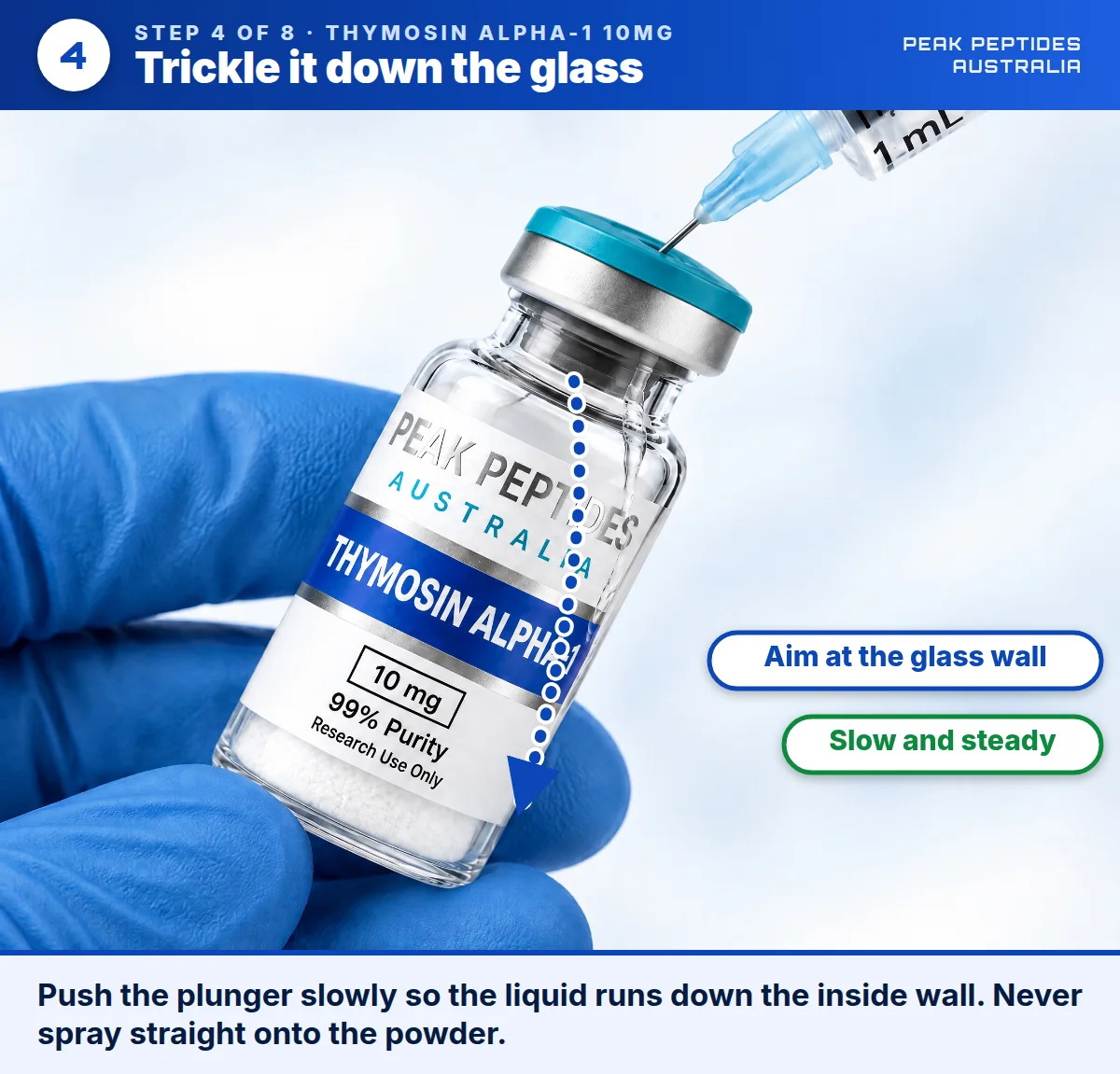
Angle the Thymosin Alpha-1 vial so the liquid can travel down the inside glass wall. Transfer BAC water slowly rather than directing a hard stream at the powder. Repeat the measured transfer until the 3 mL total is reached. Gentle liquid contact helps limit foaming and keeps the powder settled.
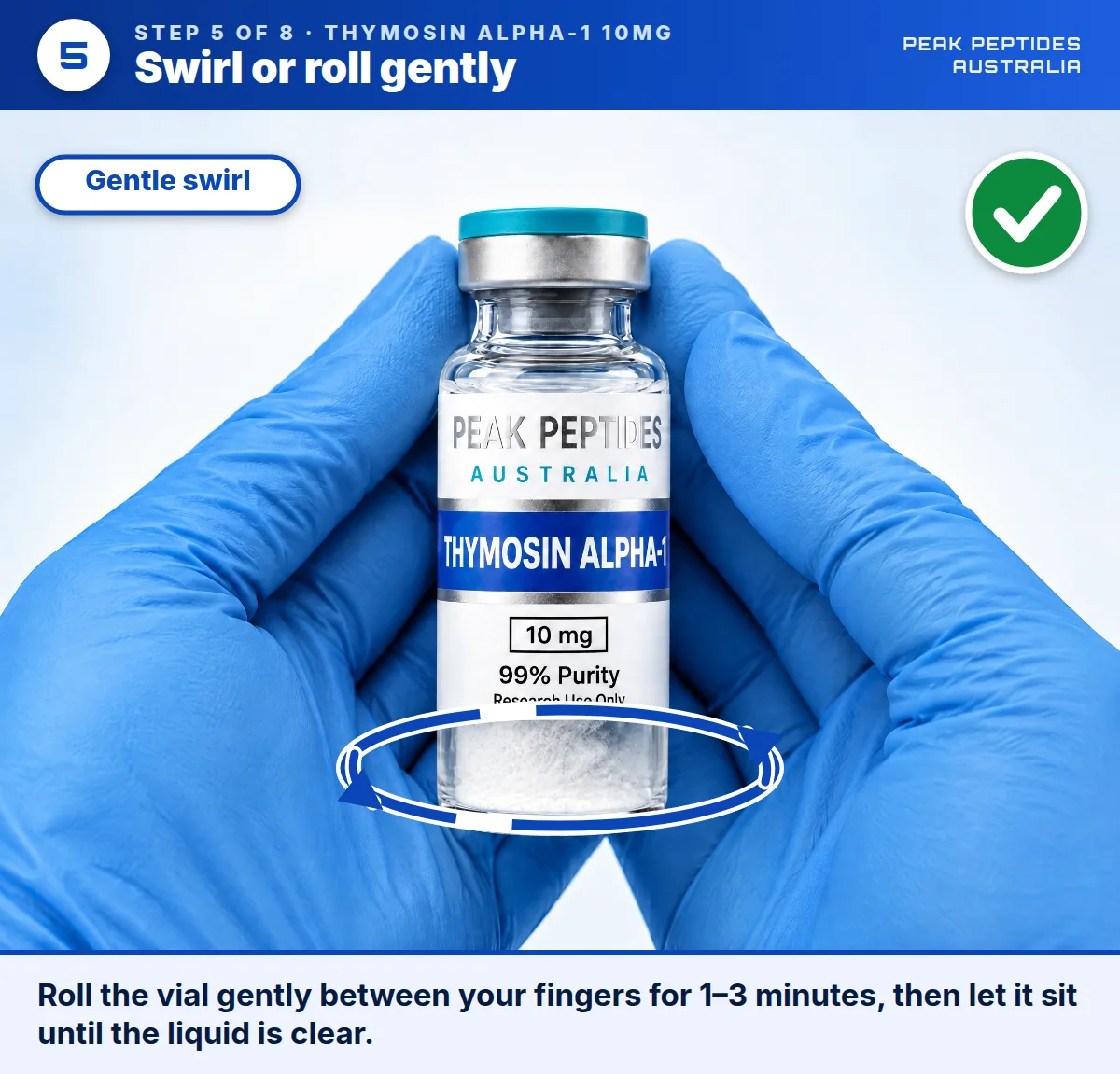
Gently swirl the vial in slow circles or roll it between the fingers. Allow time for the freeze-dried material to take up liquid and dissolve. Small remnants can settle at the bottom at first, so pause and repeat a gentle swirl rather than forcing rapid agitation. The goal is a fully clear preparation.
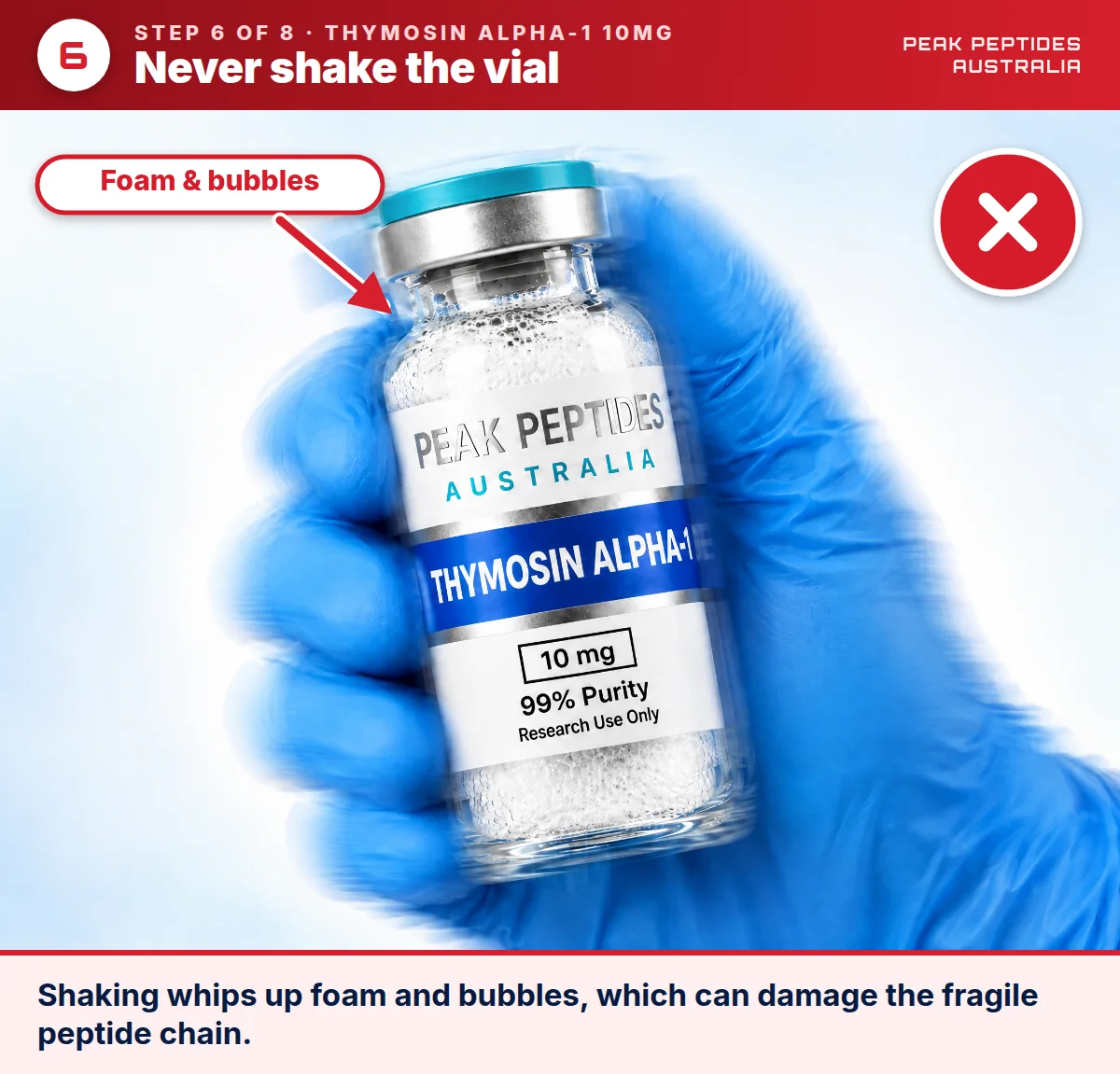
Do not shake the vial. Vigorous shaking creates foam and bubbles, making the clarity check harder and placing unnecessary mechanical stress on the peptide preparation. If foam appears, stand the vial upright and wait for it to settle. Return to slow swirling only if undissolved material remains visible.
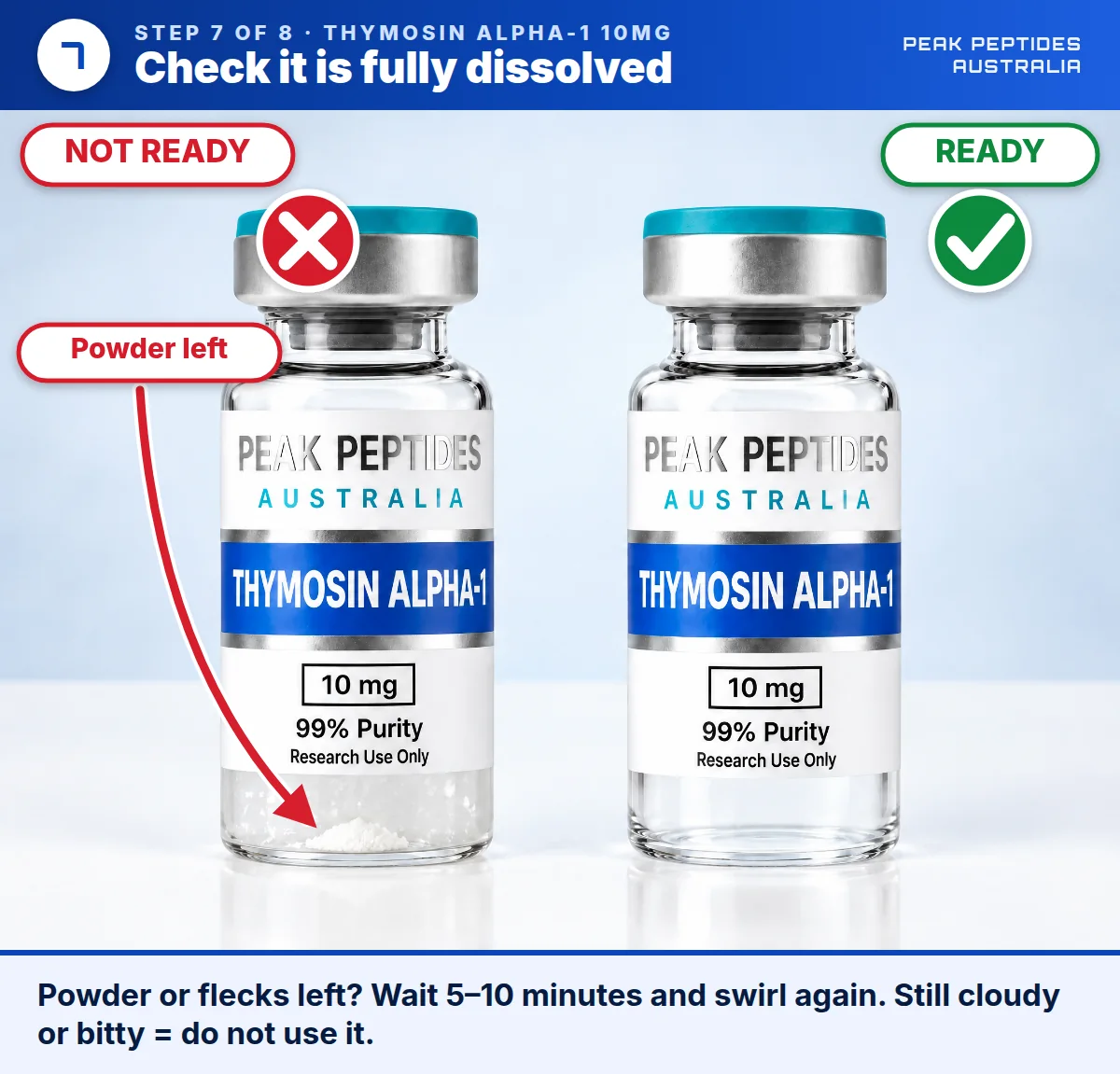
Hold the vial against good light and inspect the liquid. A finished Thymosin Alpha-1 preparation should appear clear and colourless, without powder, flecks or cloudiness. If particles remain, allow 5–10 minutes, then swirl gently again. Persistent cloudiness or visible particles means the preparation should be reviewed rather than used.
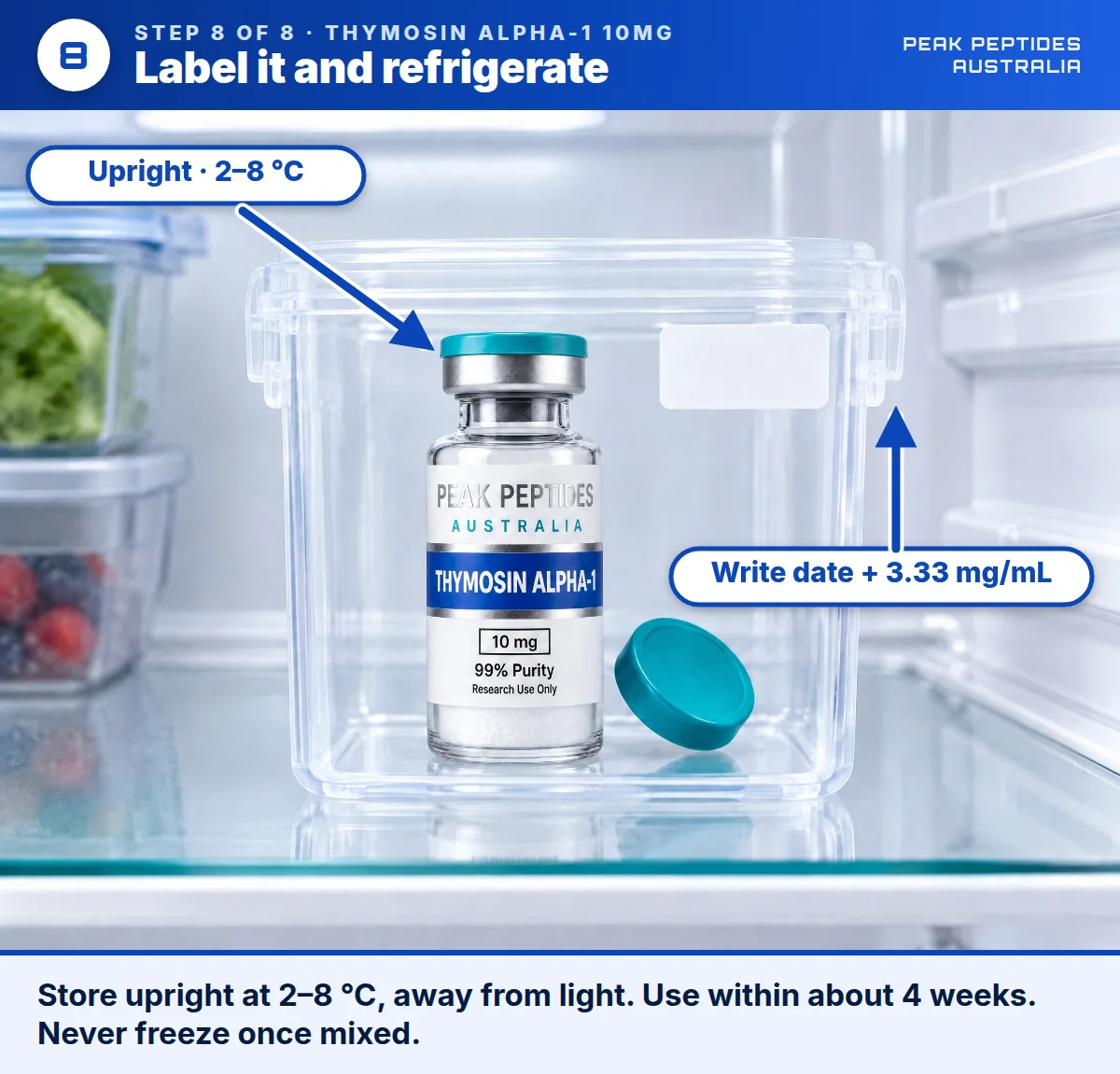
Write the preparation date and concentration on the vial or storage container. For the 3 mL reference, the concentration is 3.33 mg/mL. Store the vial upright at 2–8 °C, away from light. The handling convention on this page is about 4 weeks after preparation; do not freeze once mixed.
| State | Temperature | Light and position | Handling note |
|---|---|---|---|
| Unopened freeze-dried vial | 2–8 °C | Keep sealed and protected from light | Avoid unnecessary temperature cycling |
| Longer-term dry storage | −20 °C | Keep sealed and protected from light | PeptideDosages lists freezer storage for lyophilised material |
| BAC-water preparation | 2–8 °C | Upright and away from light | About 4 weeks in this page’s handling convention |
| Mixed vial | Do not freeze | Avoid freeze-thaw handling | Label with preparation date and concentration |
Once mixed with BAC water, keep it upright in the fridge at 2–8 °C, away from light. Use it within about 4 weeks (28 days) and never freeze it. Write the date and strength on the vial.
Thymosin Alpha-1 is a 28-amino-acid, N-acetylated peptide originally isolated from thymus tissue. The synthetic form is called thymalfasin. Research examines how it changes signalling among immune cells, including dendritic cells, T cells and natural-killer cells.
Thymalfasin is the synthetic form of Thymosin Alpha-1. PubChem lists thymalfasin, Thymosin Alpha-1 and Zadaxin among its synonyms. The term identifies the molecule; it does not make separate suppliers, formulations or research vials analytically equivalent.
Zadaxin is a brand name used for a finished thymalfasin medicine in some countries. Thymalfasin is the synthetic molecular form of Thymosin Alpha-1. This 10mg listing is a freeze-dried research sample, not a Zadaxin finished medicine.
Thymosin Alpha-1 research examines immune signalling. Published studies and reviews discuss dendritic-cell maturation, T-cell differentiation, natural-killer-cell activity, cytokines, chemokines and Toll-like-receptor pathways. Clinical research has also examined defined hepatitis, sepsis, vaccine-adjuvant and oncology-adjunct settings.
Thymosin Alpha-1 is studied as an immune-response modulator. In a dendritic-cell study, it induced functional maturation and interleukin-12 production through p38 MAPK, NF-κB and MyD88-dependent Toll-like-receptor signalling. Reviews also describe effects on T-cell and natural-killer-cell activity.
Findings depend on the research setting. A 98-participant chronic-hepatitis-B randomised trial reported complete virological response at 18 months in 40.6% of one treated group and 9.4% of controls. In the 1,106-person TESTS sepsis trial, 28-day mortality was 23.4% versus 24.1%, with no clear difference.
FDA briefing material says local irritation, redness or discomfort at the administration site were the most common reported reactions in clinical studies it reviewed. The 2025 TESTS trial reported no statistically significant difference in measured safety outcomes between its groups. These findings belong to studied medicine formulations, not this research vial.
Published pharmacokinetic sources put the serum half-life at about 2 hours, with a clinical study reporting an elimination half-life under 3 hours. Those figures describe how studied medicine formulations behaved in people. They do not describe dry-vial storage life or a universal laboratory preparation time.
No. Thymosin Alpha-1 is a 28-amino-acid peptide also called thymalfasin. TB-500 is associated with thymosin beta-4 nomenclature, and the PubChem thymosin beta-4 record has a 43-residue sequence. Their identity records, research literature and lab reports must be assessed separately.
FDA states that it has approved no drug products containing Tα1. Foreign marketed thymalfasin medicines, including Zadaxin, are approved in some countries. The Australian Register of Therapeutic Goods search did not return a thymalfasin medicine listing, so this research vial is not a TGA-approved medicine.
Thymosin Alpha-1 10mg can be ordered online from Peak Peptides Australia when available. It is supplied for in-vitro research only. In-stock orders receive same-day dispatch from Victoria once payment is confirmed, sent by tracked Australia Post Express with the tracking number emailed.
For in-stock orders, dispatch is the same day from Victoria once payment is confirmed. Orders travel by tracked Australia Post Express, and the tracking number is emailed. Delivery time after dispatch depends on the Australia Post network and destination.
Start with independent analytical evidence that names the material and methods. This sample has LabDoc report LD-J82K. It records confirmed LC-MS identity, 99.67% HPLC purity and 9.4mg HPLC content. Check the report at labdoc.org and match the report information to the product.
LabDoc report LD-J82K was tested on 11 September 2026. It records confirmed identity by LC-MS, 99.67% purity by HPLC and 9.4mg content by HPLC against a 10mg label claim. The report lists no batch, so its findings apply to the submitted sample.
LD-J82K is an independent report for a submitted Thymosin Alpha-1 sample. It lists 9.4mg measured content, 99.67% purity and confirmed identity, with an overall Pass assessment. No batch is listed.
PeptideDosages uses 3 mL BAC water as its reference preparation for a 10mg vial. That produces 3.33 mg/mL. The supplied chart also shows 1 mL at 10 mg/mL and 2 mL at 5 mg/mL. Changing liquid volume changes concentration, not the total 10mg amount.
With the 3 mL preparation shown on this page, the strength is 3.33 mg/mL, so 1 mg corresponds to 30 units on a U-100 syringe, or 0.30 mL. With 2 mL, 1 mg corresponds to 20 units; with 1 mL, it is 10 units.
With the 3 mL preparation, 10 U-100 units equals 0.10 mL and holds 0.33 mg, or 33.33 mcg. With 2 mL, 10 units holds 0.5 mg. With 1 mL, 10 units holds 1 mg.
Prepare a clean workspace, wipe vial stoppers, measure BAC water and introduce it slowly down the inside glass wall. Gently swirl or roll until the liquid is clear; do not shake. The eight labelled photos below show the handling sequence and the 3 mL chart provides the measurement maths.
Do not use tap or distilled water for laboratory preparation. The page’s calculation chart and photo sequence use bacteriostatic water. Plain sterile water lacks the preservative used in bacteriostatic water, so it does not support the same retained-storage convention.
Let the vial stand for 5–10 minutes, then swirl gently again. Do not shake it. The finished liquid should look clear and colourless. Persistent cloudiness, particles or visible powder after gentle mixing are reasons to stop and review the laboratory preparation.
No. The preparation check in this guide uses a clear, colourless liquid as the finished visual standard. Cloudiness, flecks or undissolved material means the powder has not fully dissolved or the preparation may have been compromised.
Once mixed with BAC water, keep the vial upright in the fridge at 2–8 °C, away from light, and use it within about 4 weeks (28 days). Never freeze it. Write the date and strength on the vial. PeptideDosages also advises following any product-specific use-by instruction.
Store the unopened freeze-dried vial at 2–8 °C, protected from light and unnecessary temperature cycling. PeptideDosages also lists freezer storage at −20 °C for lyophilised Thymosin Alpha-1. Keep the vial sealed until a laboratory preparation is required.
Do not freeze a mixed vial in the handling approach shown here. Keep it upright in the refrigerator at 2–8 °C and protect it from light. The visual guide uses refrigeration rather than freeze-thaw handling once BAC water has been added.
A certificate of analysis records what a laboratory tested and by which method. For LD-J82K, LC-MS confirmed identity and HPLC reported 99.67% purity plus 9.4mg content. A report should be read for its tested sample, methods, date and traceable report identifier.
Scientific background reference
Thymosin Alpha-1 sources and further reading
Science sections summarise the published studies listed above. Test results for this product come from its own lab report.