Epithalon (Epitalon) 10mg is a lyophilised AEDG tetrapeptide studied in telomere biology and circadian-signalling research. This batch is documented by LabDoc for identity, purity and content. In-stock orders receive same-day dispatch from Victoria after payment confirmation, with tracked Australia Post Express shipping Australia-wide.
Product Specifications
Full NameEpithalon (Epitalon / AEDG)
Vial Size10mg nominal
Purity98.2% HPLC (LD-U2Y8 sample)
Legal Disclaimer
This product is sold strictly for in-vitro laboratory research purposes only. It is not intended for human or animal consumption, injection, or any diagnostic or therapeutic use. Analytical results cover the tested sample only and do not establish sterility, clinical safety or a therapeutic benefit.
Epithalon / Epitalon · AEDG tetrapeptide research
Epithalon 10mg — What It Is, Research Findings & Reconstitution Guide
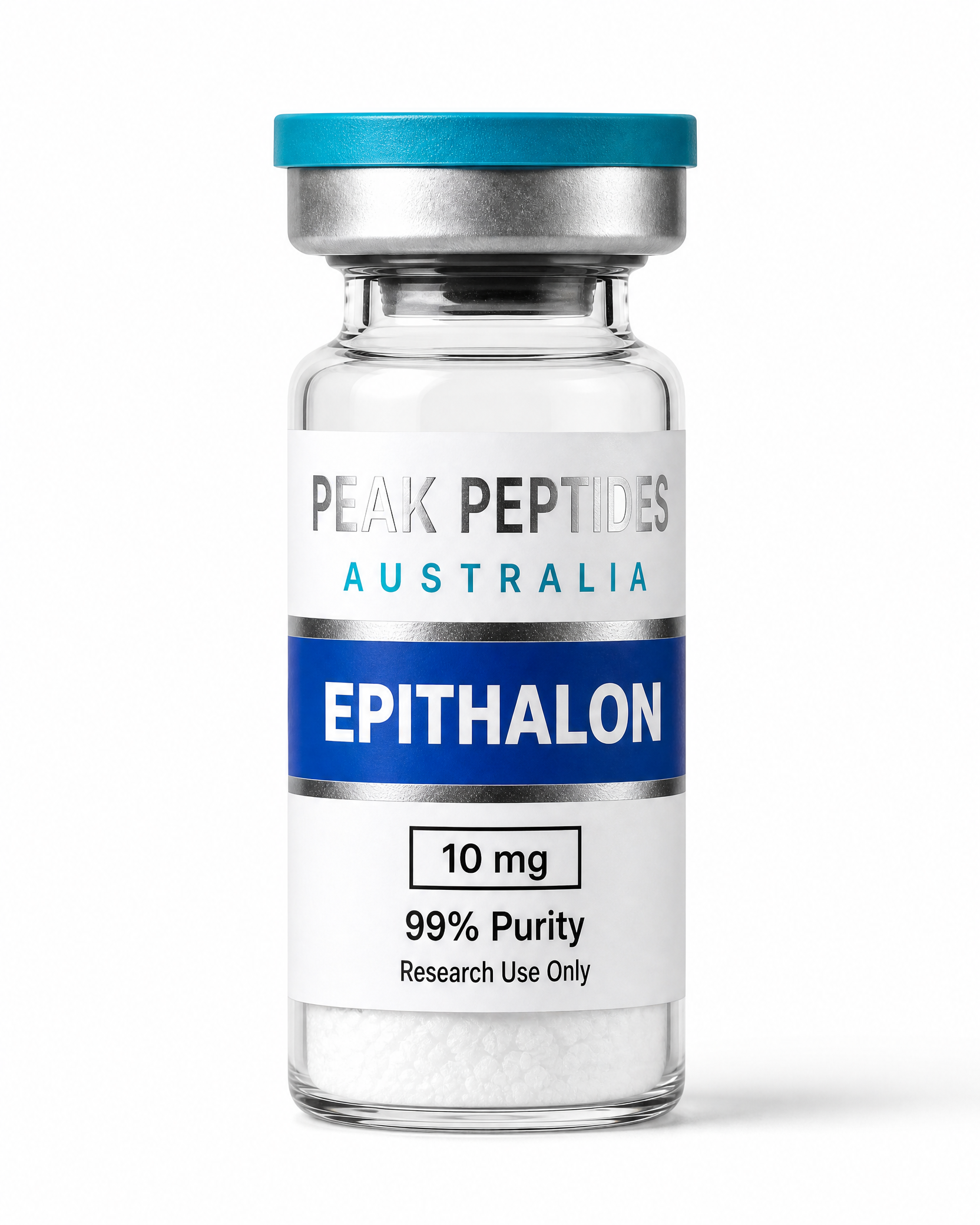
Epithalon, also called Epitalon or Epithalone, is a defined synthetic tetrapeptide with the sequence Ala–Glu–Asp–Gly (AEDG). Researchers study it in cultured cells for telomerase activity and telomere length, and in circadian research for melatonin-related biomarkers and clock-gene expression. It is not the same material as Epithalamin, a broader pineal-tissue preparation. Each vial is labelled with a nominal 10mg of lyophilised powder and this sample is supported by LabDoc report LD-U2Y8. Below, find the exact molecular identity, a plain-English map of the research, the batch test results, an AEDG sequence visual and an 8-step BAC-water preparation guide. Peak Peptides Australia supplies this material for in-vitro research only, not for human or laboratory-organism use.
Also referred to in research or catalogue references as Epitalon, Epithalone, AEDG tetrapeptide, Epithalon peptide, Epitalon peptide, Ala-Glu-Asp-Gly, AEDG peptide, 307297-39-8.
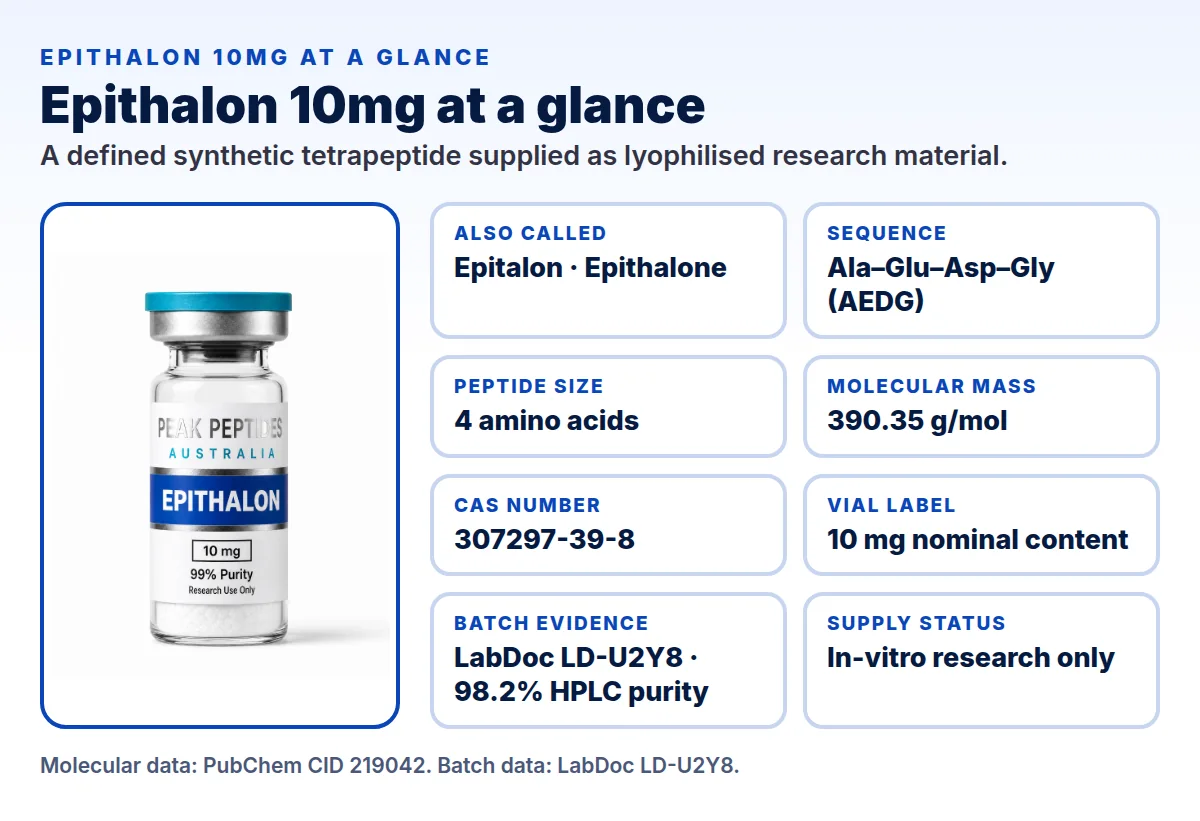
Epithalon 10mg at a glance
Name
Epithalon (also called Epitalon or Epithalone)
What it is
A defined synthetic tetrapeptide, not a pineal-tissue extract
Sequence
Ala–Glu–Asp–Gly (AEDG)
Chemical identity
PubChem CID 219042 · CAS 307297-39-8
Formula and size
C14H22N4O9 · 390.35 g/mol · 4 amino acids
Research areas
Telomerase and telomere cell research; circadian biomarker research
What studies found
Proven human life extension, rejuvenation or insomnia treatment
Vial label
Nominal 10mg lyophilised powder
Batch report
LabDoc LD-U2Y8 · 28 September 2026 · overall assessment Pass
Upright at 2–8 °C, dark, avoid freeze–thaw; photo guide uses about 4 weeks
Dispatch
Same-day from Victoria for in-stock orders after payment confirmation, tracked Australia Post Express
A defined four-amino-acid molecule
Epithalon is the synthetic tetrapeptide Ala–Glu–Asp–Gly, shortened to AEDG. PubChem lists Epitalon, Epithalon and Epithalone as names for the same defined compound, with PubChem CID 219042, formula C14H22N4O9 and molecular weight 390.35 g/mol. Four amino acids is a very short peptide sequence, which makes identity testing especially important.
Epithalon is not Epithalamin
Epithalamin is a pineal-tissue-derived preparation, whereas Epithalon is a defined AEDG tetrapeptide. Some ageing literature examines Epithalamin, or combines preparations. A result for that broader preparation is not automatically a result for a vial containing defined Epithalon. This page identifies which material and endpoint each study used.
The main cell-research question
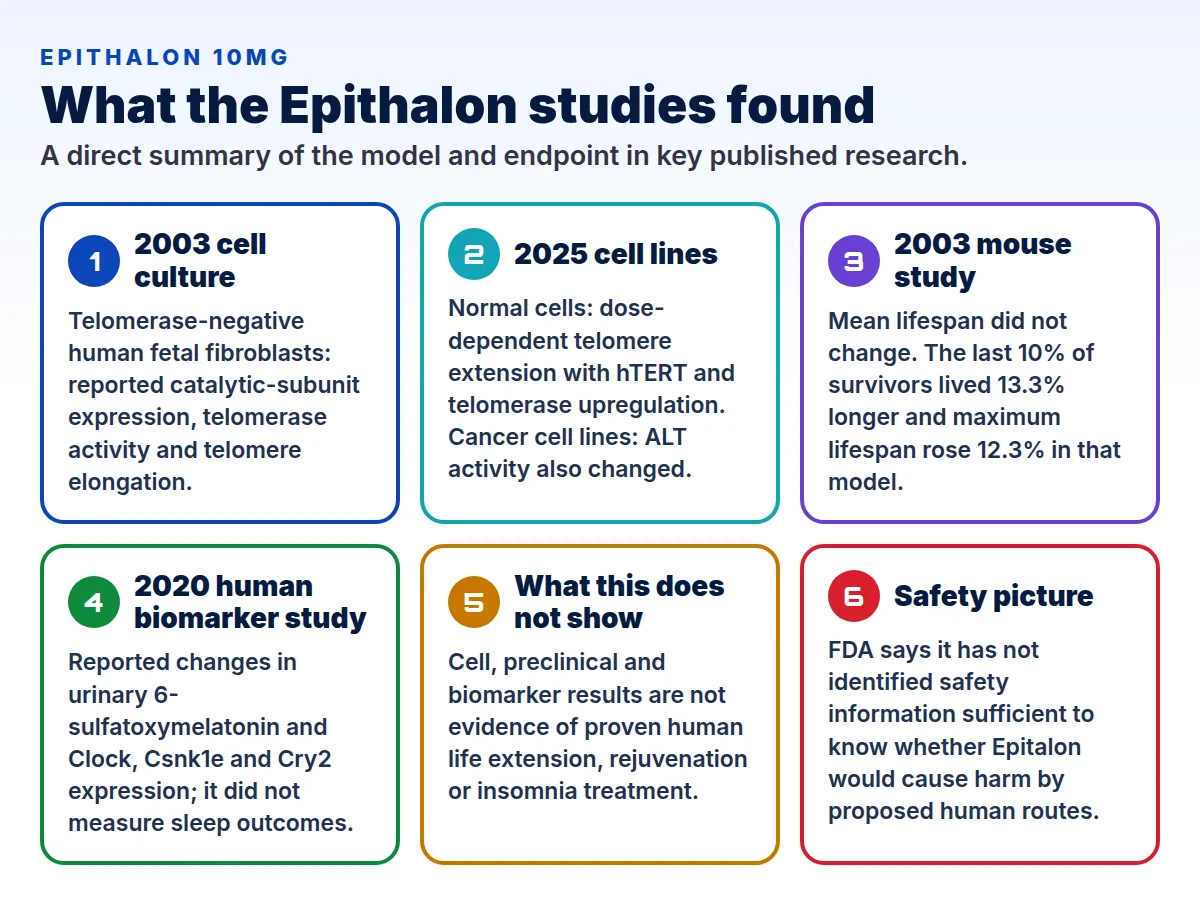
Telomeres are protective DNA–protein structures at chromosome ends. Telomerase is an enzyme involved in maintaining them. A 2003 cell-culture study reported that Epithalon added to telomerase-negative human fetal fibroblasts induced catalytic-subunit expression, telomerase activity and telomere elongation. That is a cultured-cell finding, not a human rejuvenation finding.
A newer telomere study adds detail
In a 2025 study, normal human epithelial and fibroblast cell lines showed dose-dependent telomere-length extension alongside hTERT and telomerase upregulation. The same paper reported alternative lengthening of telomeres, called ALT, in breast-cancer cell lines. It is a mechanistic cell-line study.
Circadian research measures biomarkers
Circadian biology studies the timing of biological processes across the day and night. A 2020 human study reported changes in urinary 6-sulfatoxymelatonin and in expression of Clock, Csnk1e and Cry2 genes in people with reduced melatonin-producing function. The study measured biomarkers and gene expression, not sleep quality or insomnia treatment.
Read lifespan endpoints precisely
A 2003 preclinical Swiss-derived SHR mouse study found no change in mean lifespan. It reported a 13.3% increase in the lifespan of the last 10% of survivors and a 12.3% increase in maximum lifespan in that model. Mean lifespan, longest-survivor lifespan and human longevity are different endpoints; this page keeps them separate.
Independent evidence for this batch
LabDoc report LD-U2Y8, tested 28 September 2026, records confirmed identity by LC-MS, 98.2% purity by HPLC and 9.34mg measured content against a 10mg label claim. That is 93.4% of the nominal claim, with 1.8% related impurities recorded. Identity, purity and content are separate tests.
What the 10mg label means
The label states a nominal total mass of lyophilised Epithalon powder in the vial. It is not a prescribed personal amount and it is not a liquid concentration. After laboratory preparation, concentration depends on final volume. The BAC-water chart below shows only concentration and measurement maths for a 10mg nominal vial.
Epithalon is a synthetic tetrapeptide — a chain of four amino acids — with the sequence Ala–Glu–Asp–Gly. The short name AEDG simply takes the one-letter abbreviation for each amino acid in sequence. You will also see Epitalon and Epithalone; PubChem records those as synonyms for the same defined compound, PubChem CID 219042.
The molecule is small: PubChem lists formula C14H22N4O9 and molecular weight 390.35 g/mol. A label name alone cannot prove that a vial contains the intended molecule. That is why an independent identity result matters. For this batch, LabDoc report LD-U2Y8 records identity confirmed by LC-MS, a mass-spectrometry method that checks the molecule’s mass signature.
Epithalon grew out of pineal-peptide research, but it is not the same as Epithalamin. Epithalamin is a wider preparation derived from pineal tissue. Epithalon is a defined AEDG sequence. Keeping that difference clear prevents a study of one preparation from being misrepresented as a study of the other. This product is supplied as lyophilised research material for in-vitro work only.
Epithalon 10mg is a defined AEDG tetrapeptide with batch-specific LabDoc documentation.
How is Epithalon studied?
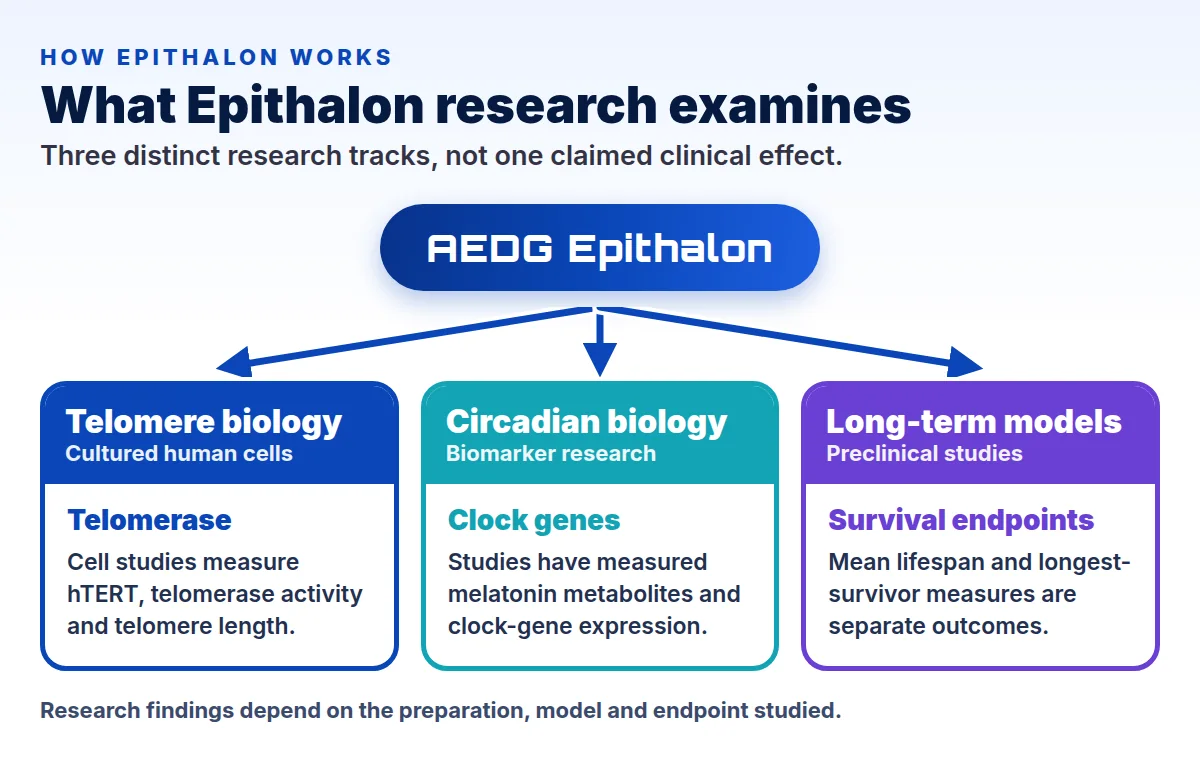
Epithalon research follows three main tracks. The first is telomere biology. Telomeres sit at the ends of chromosomes, and telomerase is an enzyme involved in their maintenance. In cell experiments, researchers can measure telomerase activity, hTERT expression and telomere length directly. That lets them ask a mechanistic question about cells outside the body.
The second track is circadian biology. Circadian rhythms are daily timing patterns. Researchers have measured melatonin-related biomarkers and the expression of genes involved in the molecular clock. A biomarker is a measurable signal; it is not the same thing as a clinical sleep result. The third track is longer-term preclinical work, where different survival measurements can be compared within one model.
These tracks do not collapse into one outcome. A cultured-cell result does not become a human lifespan result, and a change in a urinary melatonin metabolite does not become a demonstrated treatment for insomnia. The most useful way to read an Epithalon paper is to identify the exact preparation, model and endpoint before drawing a conclusion.
Epithalon research covers separate telomere, circadian and preclinical questions.
What did Epithalon research find?
The original 2003 cell-culture paper added Epithalon to telomerase-negative human fetal fibroblasts. Its abstract reported expression of the telomerase catalytic subunit, enzymatic telomerase activity and telomere elongation. These were laboratory measurements in cultured human-derived cells. They do not show that a person’s telomeres lengthen or that a person becomes biologically younger.
A 2025 Biogerontology paper examined normal epithelial and fibroblast cell lines, as well as breast-cancer cell lines. In the normal cell lines, the authors reported dose-dependent telomere-length extension through hTERT and telomerase upregulation. In the cancer cell lines, they reported changes involving ALT, or alternative lengthening of telomeres. The paper has a published correction record, so it is important to use the corrected scientific record when reviewing its figures.
The often-cited 2003 Swiss-derived SHR mouse study illustrates why endpoint wording matters. It reported no change in mean lifespan. It also reported a 13.3% longer lifespan in the last 10% of survivors and a 12.3% higher maximum lifespan in that model. The table below keeps those findings in their own columns rather than turning them into a general longevity claim.
A 2020 human paper reported a 1.7-fold rise in urinary 6-sulfatoxymelatonin, plus clock-gene-expression changes in the studied group. The endpoints were biomarkers and gene expression. It did not measure sleep quality, sleep duration or insomnia resolution. That direct wording is more informative than assigning the study a broader claim it did not test.
Key Epithalon results, labelled by model and measured endpoint.
Selected Epithalon research: model, endpoint and direct finding
Selected Epithalon research: model, endpoint and direct finding
Study
Model
Endpoint measured
Direct finding
Khavinson et al. 2003
Telomerase-negative human fetal fibroblast culture
Reported induction of catalytic-subunit expression, telomerase activity and telomere elongation
Al-Dulaimi et al. 2025
Normal epithelial and fibroblast cell lines
Telomere length, hTERT and telomerase
Reported dose-dependent telomere extension with hTERT and telomerase upregulation
Anisimov et al. 2003
Female Swiss-derived SHR mouse model
Mean, last-10% and maximum lifespan
Mean lifespan unchanged; last 10% +13.3%; maximum +12.3%
Ivko et al. 2020
People with reduced melatonin-producing function
Urinary 6-sulfatoxymelatonin and clock-gene expression
Reported biomarker and Clock, Csnk1e and Cry2 expression changes
Models and endpoints differ.
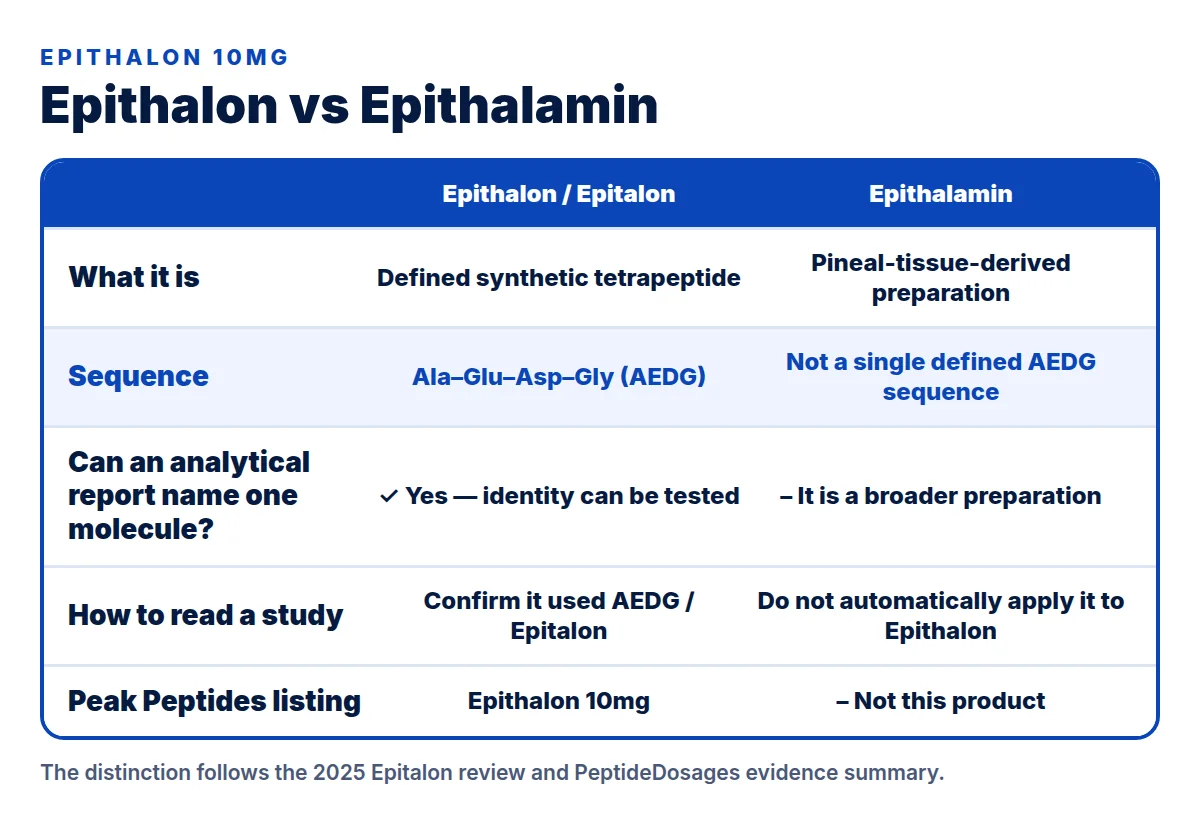
Epithalon vs Epithalamin: why the distinction matters
Epithalon and Epithalamin are often grouped together because both appear in pineal-peptide literature. They are different compounds. Epithalon is the synthetic, defined tetrapeptide AEDG. It can be described by a sequence, a formula, a molecular weight and a discrete LC-MS identity test. Epithalamin is a broader pineal-tissue preparation rather than a single AEDG molecule.
This matters when reading a paper. First identify exactly what was tested. If the study used Epithalamin, a mixture or a combination of materials, it should not be represented as proof for an AEDG-only preparation. If a study used Epitalon or Epithalon, check the model and the endpoint next. A carefully labelled comparison keeps the evidence useful rather than flattening different materials into one headline.
Peak Peptides Australia’s Epithalon 10mg listing is for the defined AEDG material. LabDoc LD-U2Y8 refers to Epithalon (Epitalon) and provides analytical information on the submitted sample. That is different from asserting any result for every historical pineal-peptide preparation.
Epithalon is defined AEDG; Epithalamin is a different broader preparation.
Reading Epithalon and Epithalamin research correctly
Reading Epithalon and Epithalamin research correctly
Question
Epithalon / Epitalon
Epithalamin
Material
Defined synthetic tetrapeptide
Pineal-tissue-derived preparation
Sequence
Ala–Glu–Asp–Gly (AEDG)
Not a single defined AEDG sequence
Analytical identity
Can be assessed as one molecular target
Broader preparation requires its own characterisation
How to apply a study
Confirm AEDG / Epitalon was the material tested
Do not automatically apply results to Epithalon
The comparison identifies different research materials; it does not rank them or imply interchangeable effects.
Epithalon structure: the AEDG sequence
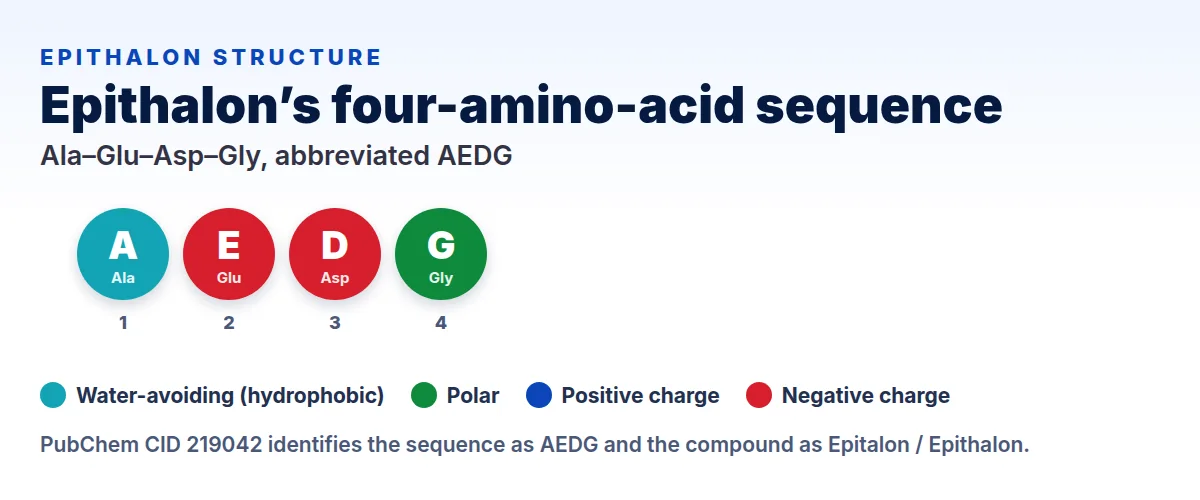
Epithalon’s sequence is Ala–Glu–Asp–Gly. In one-letter peptide notation, that is AEDG: alanine, glutamic acid, aspartic acid and glycine. PubChem identifies the compound as H-Ala-Glu-Asp-Gly-OH and lists its average molecular weight as 390.35 g/mol. This short, defined sequence is why Epithalon can be clearly distinguished from a tissue-derived preparation.
The sequence graphic reads from left to right. It is an identity aid, not a biological pathway. A sequence tells you the order of amino-acid building blocks. It does not by itself predict a human effect, stability in every solvent, or a personal amount. Those are separate questions that need their own data.
For batch documentation, an LC-MS identity result complements the expected sequence and mass. In LD-U2Y8, identity is marked confirmed. The same report separately records 98.2% purity by HPLC and 9.34mg measured content. Reading all three results together gives a more complete picture of the tested sample.
Epithalon is the four-amino-acid sequence Ala–Glu–Asp–Gly, abbreviated AEDG.
Independent lab test for this Epithalon 10mg vial
This product is accompanied by LabDoc report LD-U2Y8. The report identifies the sample as Epithalon (Epitalon), with a 10mg strength claim. It records a sample-received date of 09 September 2026 and a test date of 28 September 2026. The overall assessment listed in the supplied documentation is Pass.
The identity check is LC-MS, short for liquid chromatography–mass spectrometry. The report records identity as Confirmed. Its HPLC result is 98.2% purity, with 1.8% related impurities. HPLC is a separation method that reports the proportion accounted for by the target material under the reported test conditions.
Content is a third, separate number. LD-U2Y8 reports 9.34mg measured content against the nominal 10mg label claim, or 93.4% of nominal. The report provides evidence for that submitted sample’s identity, purity and content. It does not claim to establish sterility, biological potency, clinical safety or suitability for administration. Open the LabDoc record to inspect the report identifier directly.
Content: 9.34mg measured against a nominal 10mg claim · 93.4% of nominal.
Buying Epithalon 10mg in Australia
Epithalon 10mg can be ordered online from Peak Peptides Australia when it is in stock. Same-day dispatch from Victoria applies to in-stock orders once payment is confirmed. Orders are sent with tracked Australia Post Express and the tracking number is emailed. This wording describes the current dispatch process, not a delivery-time guarantee.
The page has been built around research traceability: a clear name and AEDG sequence, a batch-specific LabDoc report, direct explanation of what the published studies measured, a comparison that avoids conflating Epithalon with Epithalamin, and visual preparation information. Need related material? Bacteriostatic water, the reconstitution calculator and the quality pages are linked below.
Epithalon 10mg is supplied for in-vitro research only. It is not a TGA-approved or FDA-approved medicine.
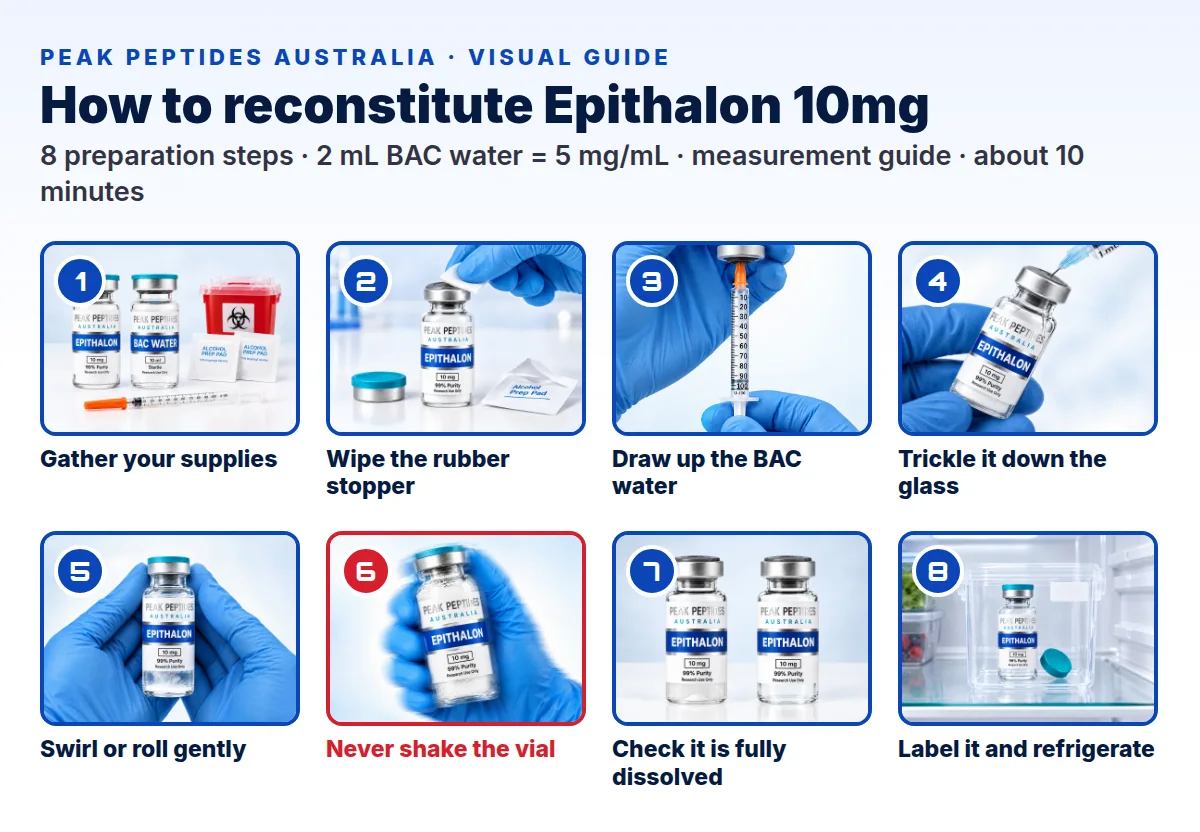
Step-by-step guide · About 10 minutes
How to reconstitute Epithalon 10mg (step-by-step with photos)
Epithalon 10mg arrives as dry, freeze-dried powder. Reconstitution means adding bacteriostatic water so the material becomes a clear solution whose concentration can be measured. The PeptideDosages 10mg reference uses 2 mL, which produces 5 mg/mL and simple concentration maths. This eight-step visual guide is for laboratory preparation and takes about 10 minutes. The same careful handling applies whichever volume your method specifies.
The full Epithalon 10mg preparation sequence at a glance.
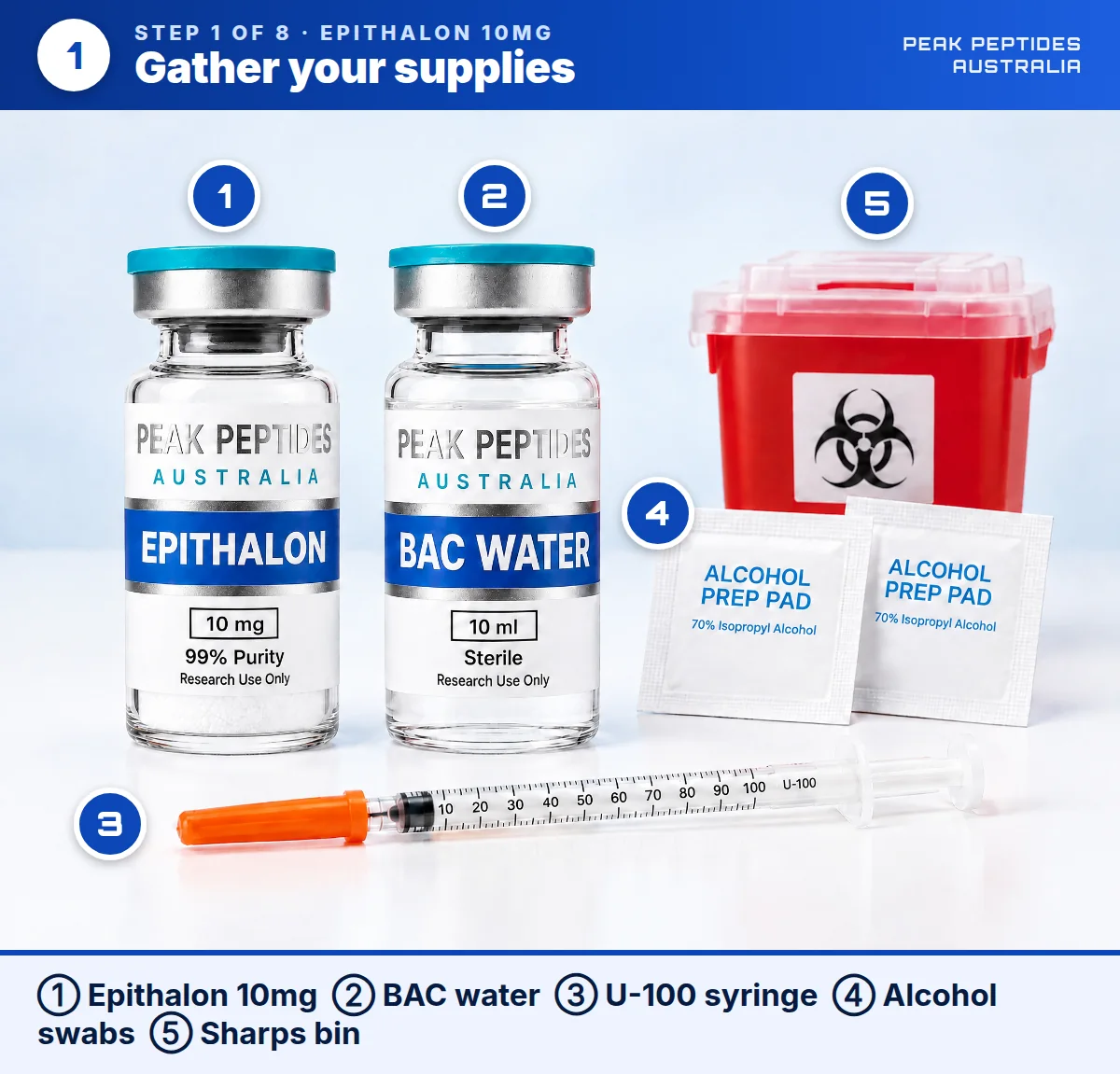
What you need
Epithalon 10mg vialNominal 10mg lyophilised Epithalon powder in a sealed glass vial.
1 mL U-100 syringeA volume-measurement tool: 100 units equals 1 mL.
Alcohol swabsFor wiping vial stoppers and allowing them to air-dry before preparation.
Sharps containerFor disposal of used sharps in laboratory handling.
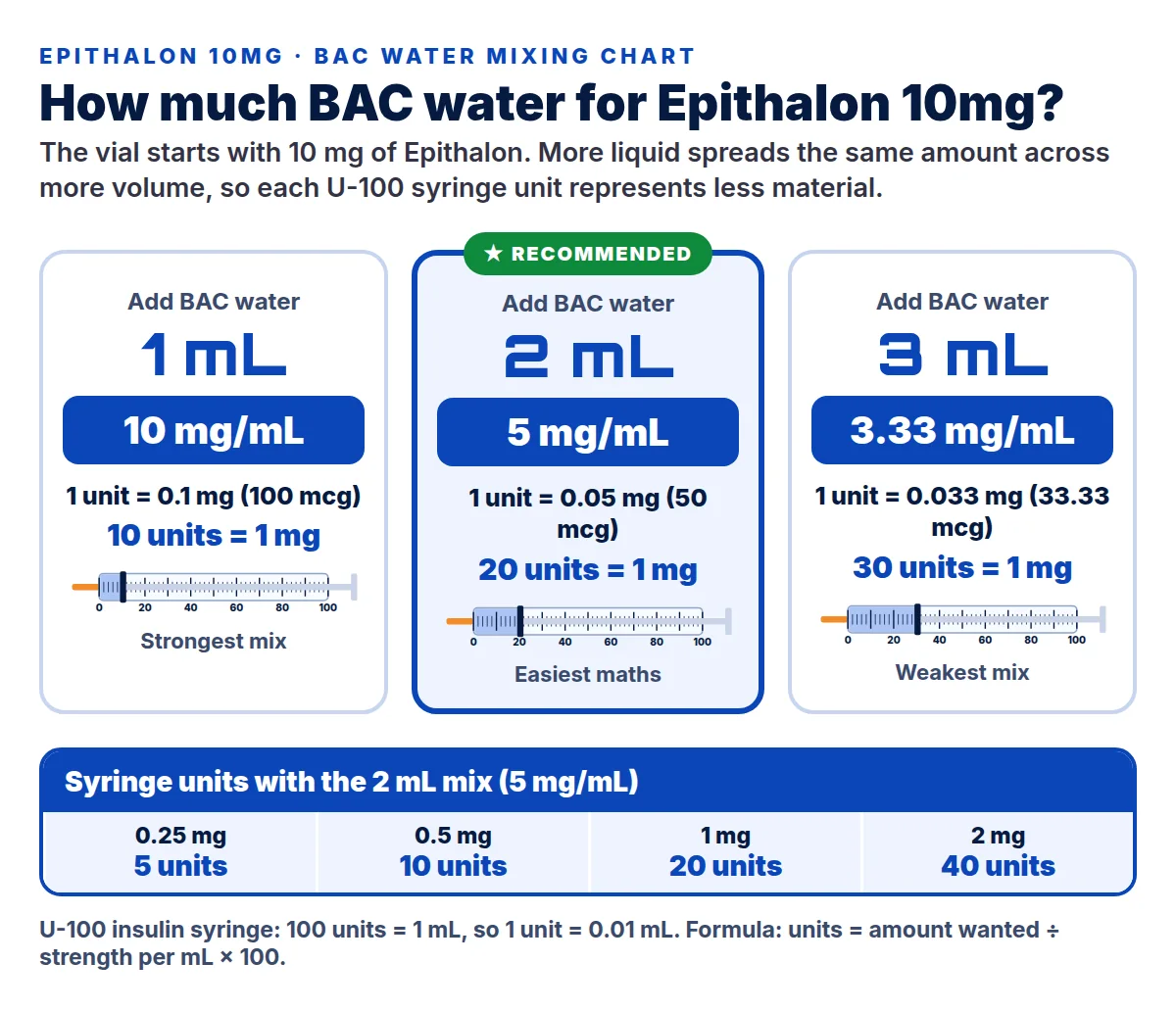
How much BAC water to add to Epithalon 10mg
The nominal 10mg in the vial does not change when final volume changes. Adding more BAC water spreads the same nominal amount across more liquid. That lowers the concentration and lowers the amount represented by each U-100 syringe unit. The PeptideDosages 10mg reference uses 2 mL, making a 5 mg/mL concentration.
With 2 mL, 10 units is 0.10 mL and represents 0.5 mg; 20 units is 0.20 mL and represents 1 mg. With 1 mL, the concentration is 10 mg/mL, so 10 units represents 1 mg. With 3 mL, the concentration is 3.33 mg/mL, so 30 units represents 1 mg.
For a nominal 10mg vial, 2 mL BAC water produces 5 mg/mL and clear U-100 measurement maths.
2 mL is highlighted because it gives the simplest numbers.
Syringe units with the 2 mL mix (5 mg/mL)
Syringe units with the 2 mL mix (5 mg/mL)
Amount
Units on a U-100 syringe
Volume
0.25 mg
5 units
0.05 mL
0.5 mg
10 units
0.1 mL
1 mg
20 units
0.2 mL
2 mg
40 units
0.4 mL
The 8 steps
1Step 1: Gather your supplies
Set out the Epithalon 10mg vial, bacteriostatic water, a new 1 mL U-100 syringe, alcohol swabs and a sharps container on a clean, stable work surface. Check the vial label and report identifier before preparation. If a refrigerated vial is cold, let it equilibrate while sealed so moisture does not condense inside when opened.
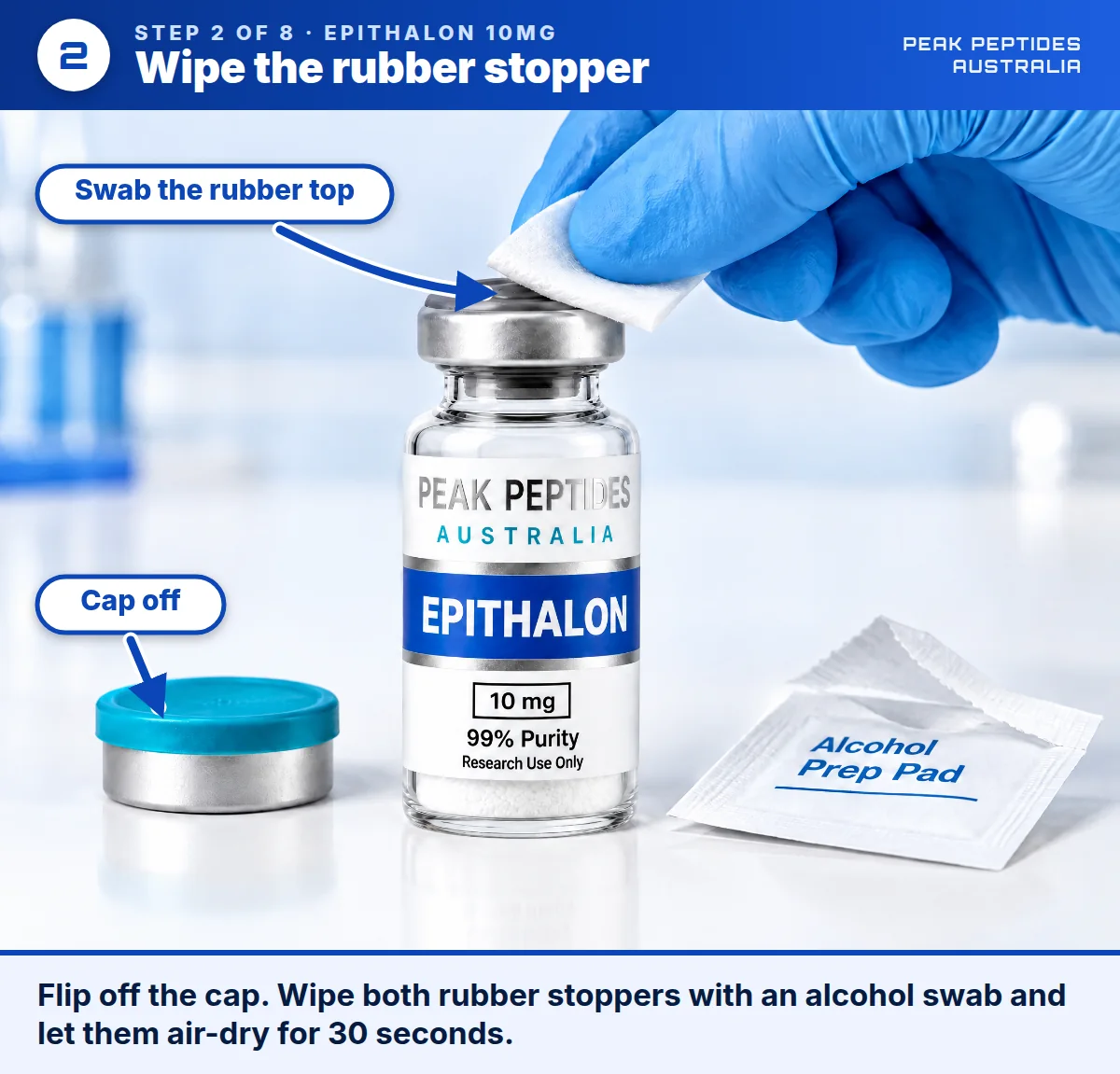
2Step 2: Wipe the rubber stopper
Remove the flip-off cap from the Epithalon vial and the bacteriostatic water vial. Wipe each exposed rubber stopper with a fresh alcohol swab. Let both stoppers air-dry for about 30 seconds before continuing. Avoid touching the prepared stopper surfaces after they have been wiped.
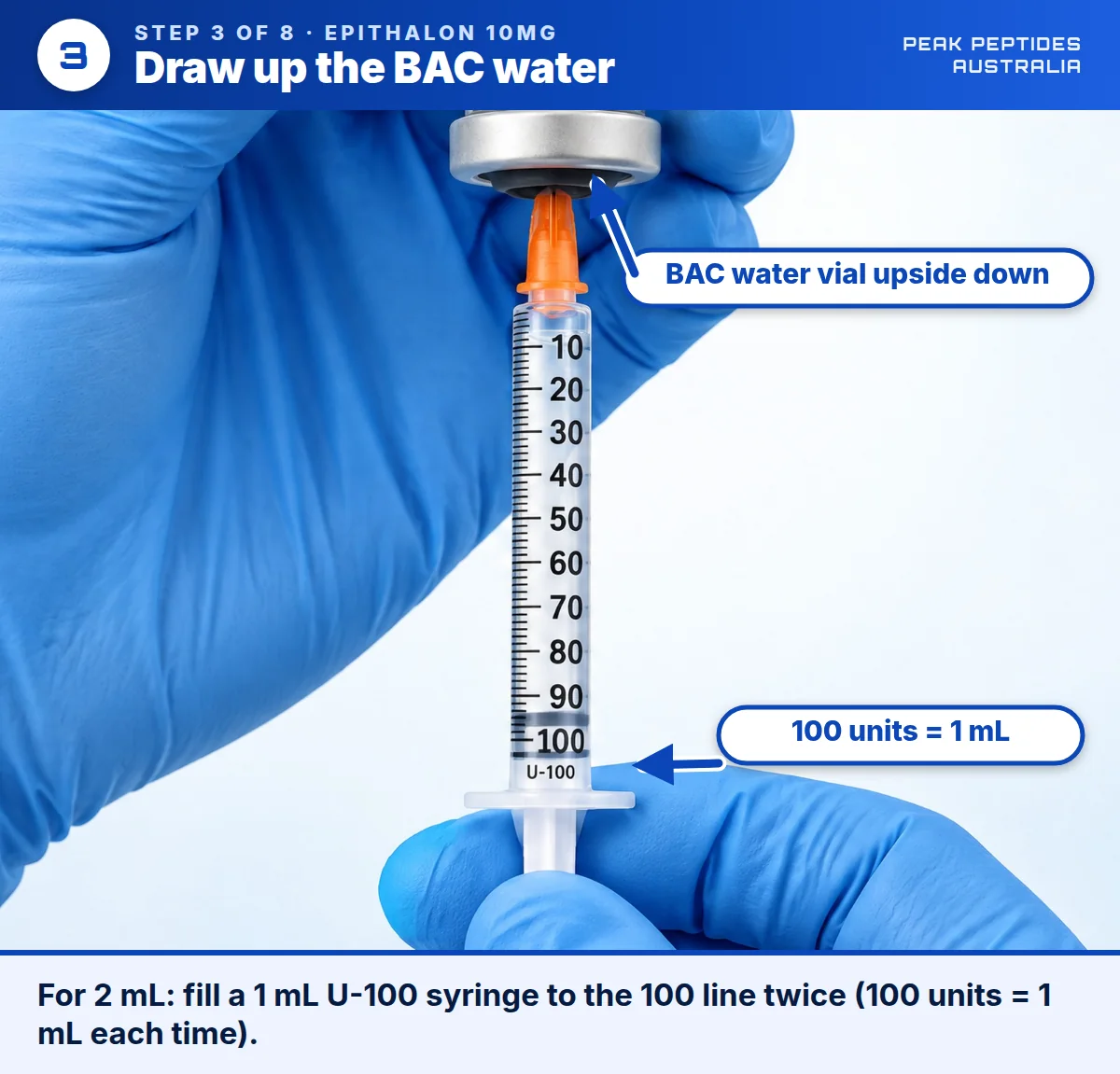
3Step 3: Draw up the BAC water
Use the syringe as a volume-measurement tool to draw bacteriostatic water. A 1 mL U-100 syringe holds 100 units, so a 2 mL preparation requires two 1 mL draws. Keep the vial upside down while drawing to help maintain the chosen measurement and remove visible air bubbles before transferring liquid.
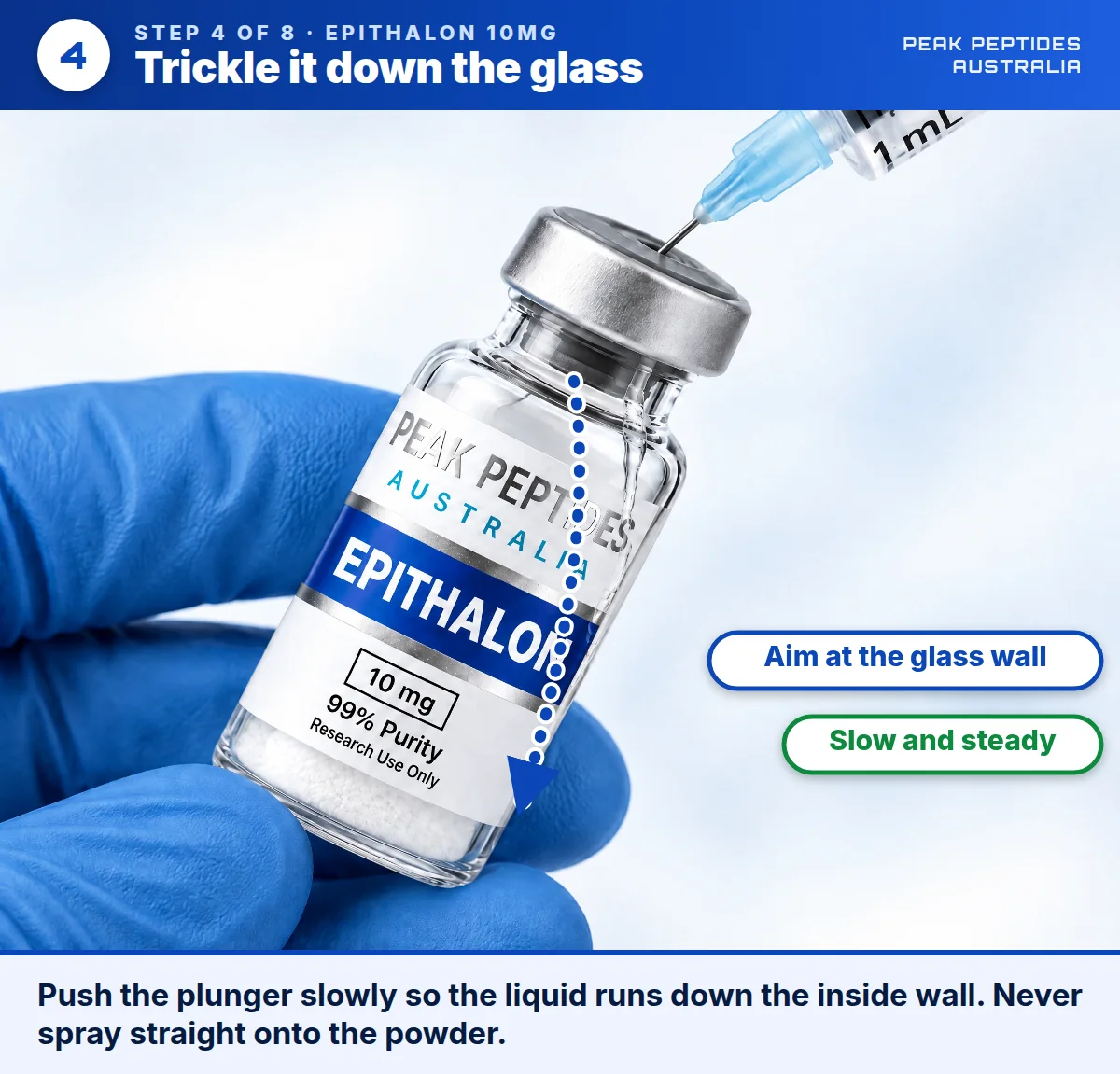
4Step 4: Trickle it down the glass
Insert the needle through the Epithalon stopper at an angle so the tip is against the inner glass wall. Depress the plunger slowly and let the liquid travel down the wall. Do not force a fast stream directly onto the powder. Repeat the transfer until the selected final volume has been added.
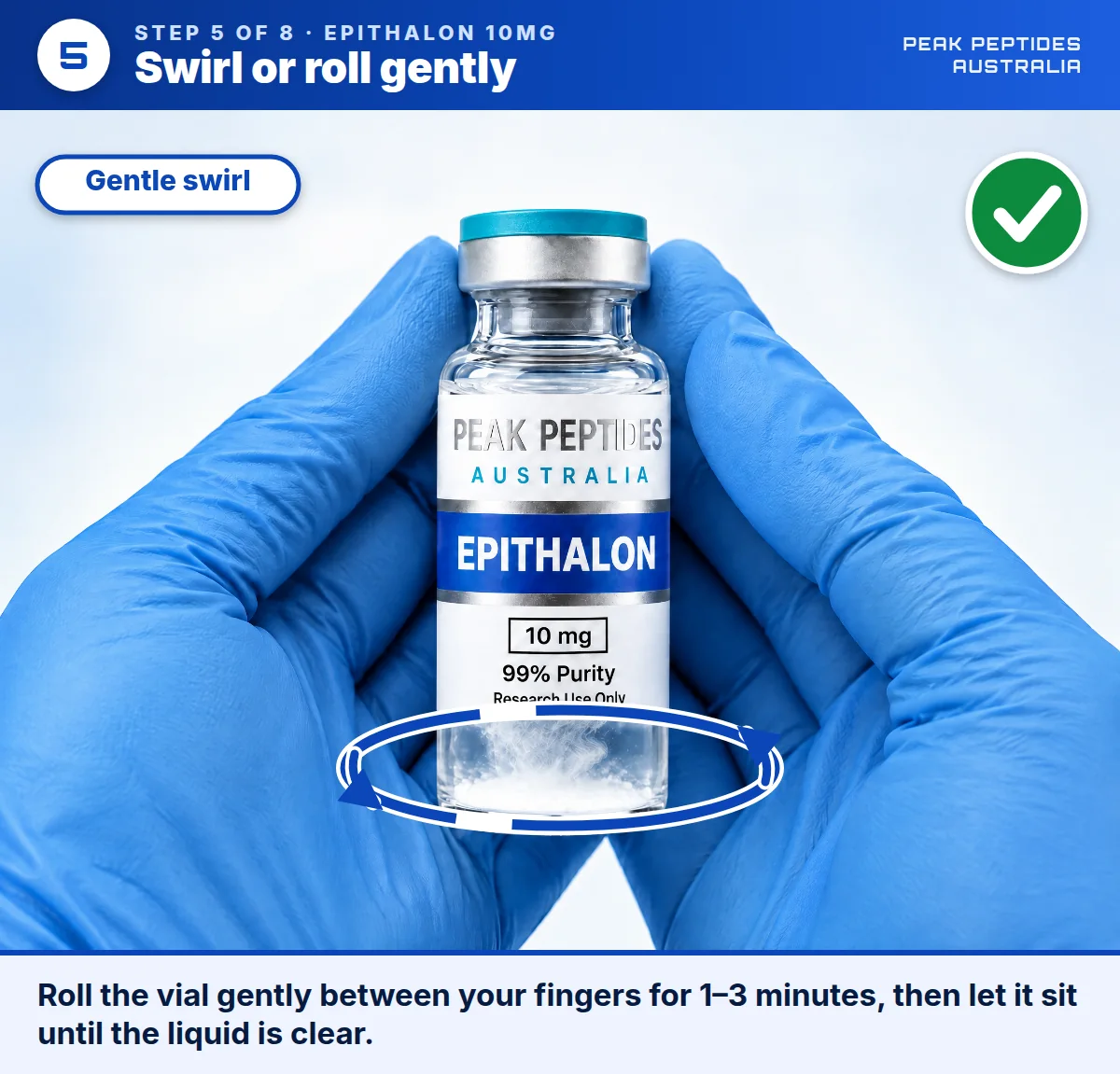
5Step 5: Swirl or roll gently
Roll the Epithalon vial slowly between gloved fingers or swirl it in gentle circles. Give the powder time to dissolve rather than using force. A small amount of undissolved white material can remain briefly at the bottom; continue with gentle movement and allow the vial to stand until it clears.
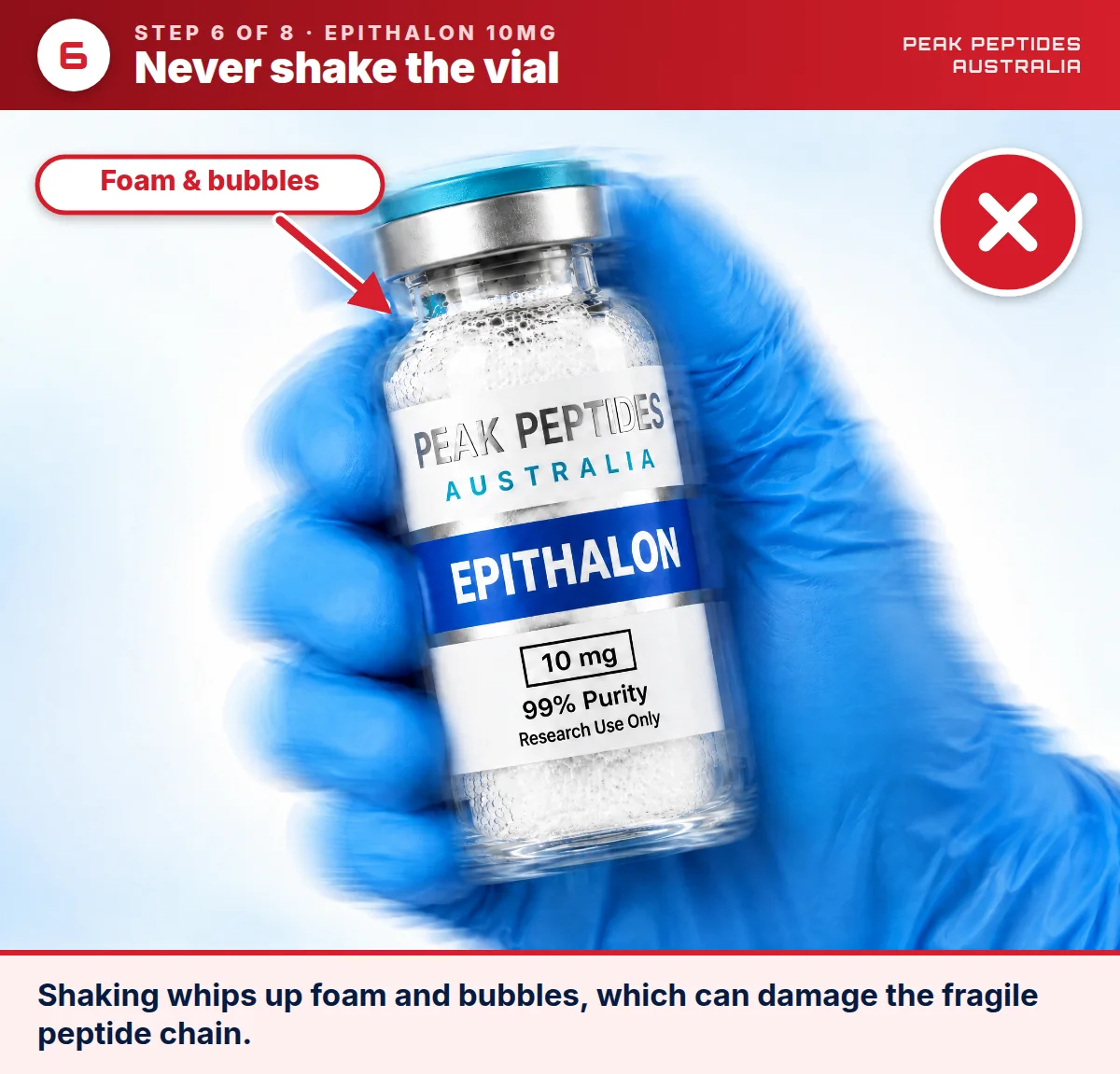
6Step 6: Never shake the vial
Do not shake the vial. Vigorous shaking creates foam and bubbles, making the clarity check harder and changing the handling condition of a peptide solution. If foam appears, place the vial upright and allow it to settle. Return to slow swirling only after the visible bubbles have dispersed.
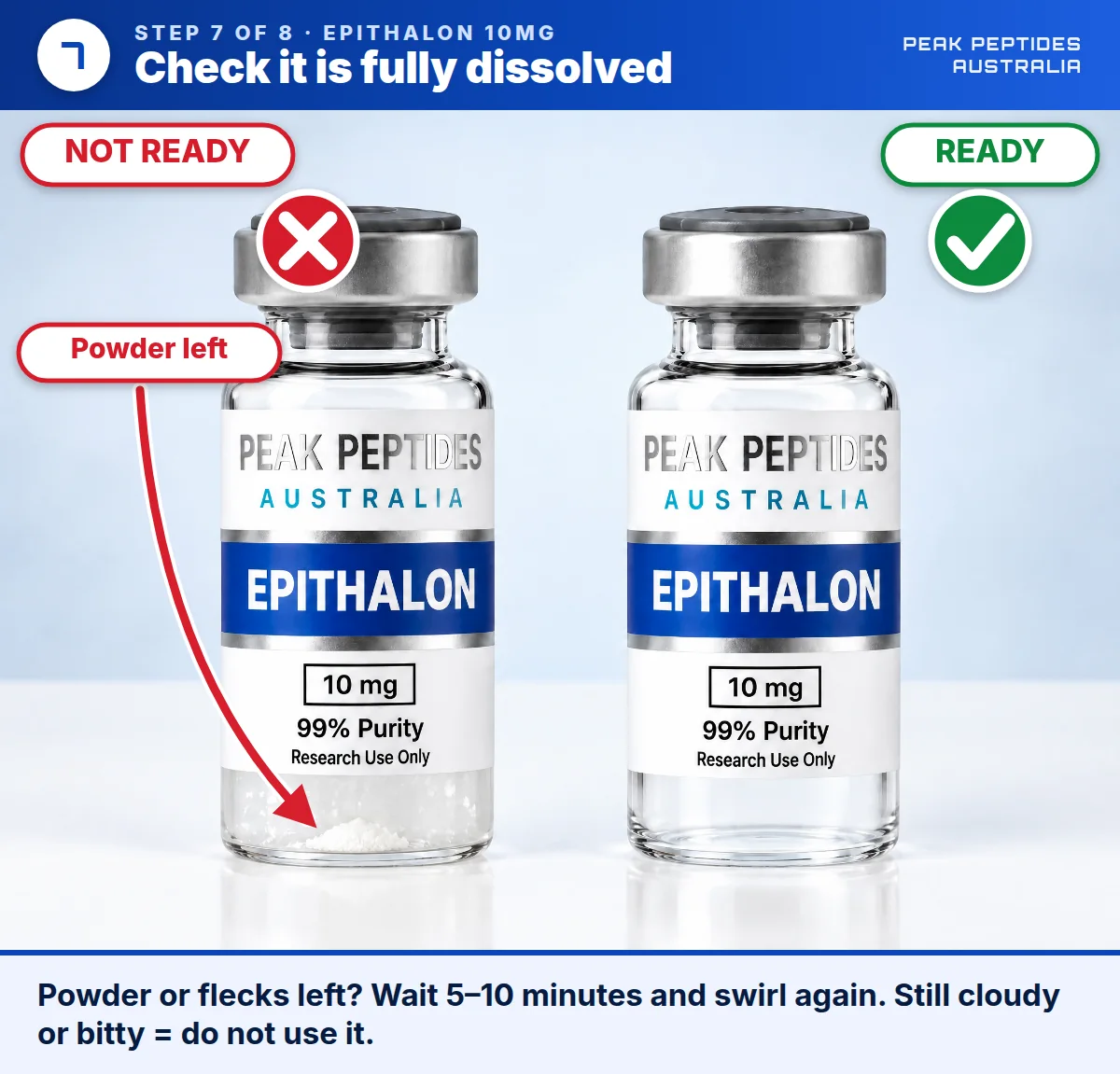
7Step 7: Check it is fully dissolved
Hold the vial against good light and inspect the liquid. A finished preparation is clear, without visible powder, flecks or cloudiness. If material remains at the bottom, let the vial rest for 5–10 minutes and swirl gently again. If cloudiness or particles persist, treat the preparation as unsuitable for the intended work.
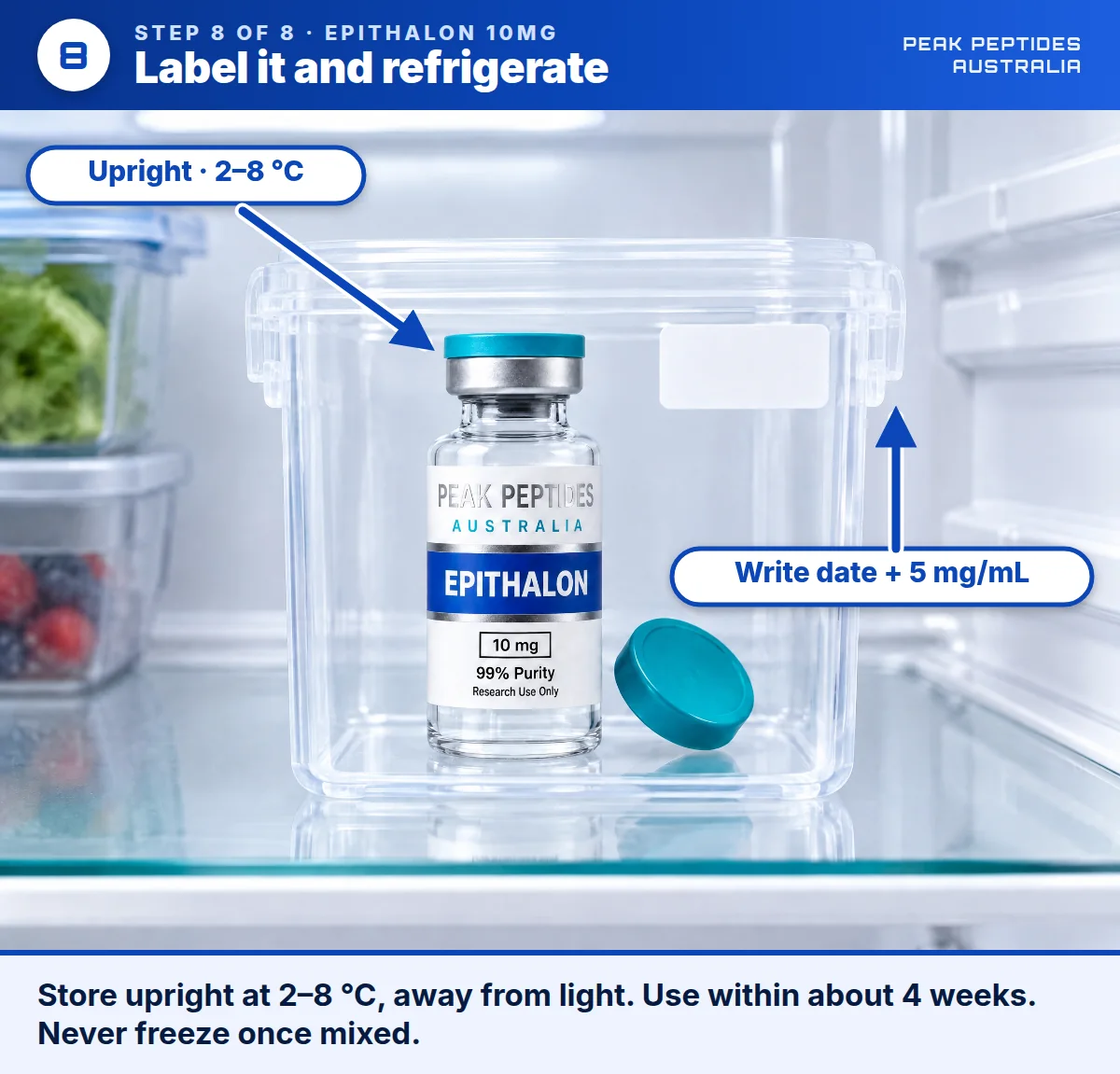
8Step 8: Label it and refrigerate
Label the vial with the preparation date and final concentration, such as 5 mg/mL for a 2 mL final volume. Once mixed with BAC water, store it upright in the fridge at 2–8 °C, away from light. Use it within about 4 weeks (28 days) and never freeze it.
Epithalon storage and handling
Storage and handling checkpoints for Epithalon research material
Storage and handling checkpoints for Epithalon research material
Material state
Handling point
Why it matters
Sealed lyophilised powder
Keep dry, out of light and in the fridge at 2–8 °C, or in the freezer at −20 °C for long-term storage.
Until the printed expiry
Vial before opening
Allow a cold vial to equilibrate while sealed before opening.
Helps minimise moisture condensation in the vial.
Prepared with BAC water
Store upright, dark and refrigerated at 2–8 °C.
Keeps the mixed peptide stable.
Prepared solution
Never freeze once mixed; avoid freeze–thaw cycles.
Freezing and thawing damages the dissolved peptide.
Prepared-vial timing
Within about 4 weeks (28 days) with BAC water.
Write the mixing date on the vial so you know when 4 weeks is up.
LabDoc measures identity, purity and content.
Epithalon 10mg FAQs — Research, Lab Test & Preparation
What is Epithalon?
Epithalon, also called Epitalon or Epithalone, is a synthetic tetrapeptide with the sequence Ala–Glu–Asp–Gly, abbreviated AEDG. Researchers investigate it in telomere biology and circadian-signalling work. PubChem identifies it as a defined four-amino-acid compound rather than a pineal-tissue extract.
Are Epithalon and Epitalon the same peptide?
Yes. Epithalon and Epitalon are common names for the defined AEDG tetrapeptide; Epithalone is another spelling. The product and its LabDoc report use Epithalon (Epitalon). Check the sequence, LC-MS identity result and report identifier rather than relying on a name alone.
Is Epithalon the same as Epithalamin?
No. Epithalon is the defined synthetic AEDG tetrapeptide. Epithalamin is a broader pineal-tissue-derived preparation. Papers about Epithalamin, or combinations that include it, cannot automatically be used as evidence for a defined Epithalon vial.
What is Epithalon used for in research?
Epithalon is studied for telomerase activity and telomere length in cultured cells, and for circadian biomarkers such as melatonin metabolites and clock-gene expression. Researchers also examine ageing-related endpoints in preclinical models. Those are distinct research questions, not a single established clinical use.
How does Epithalon work in cell research?
In telomerase-negative human fetal fibroblast culture, a 2003 paper reported catalytic-subunit expression, telomerase activity and telomere elongation after Epithalon was added. A 2025 cell-line study reported hTERT and telomerase upregulation in normal cells. These findings describe laboratory mechanisms, not a proven human outcome.
What did the 2025 Epitalon telomere study find?
The 2025 Biogerontology study reported dose-dependent telomere-length extension in normal epithelial and fibroblast cell lines with hTERT and telomerase upregulation. It also reported alternative lengthening of telomeres, or ALT, in breast-cancer cell lines. The work was performed in cell lines, not as a human clinical trial.
Does Epithalon research prove anti-ageing or longer human life?
No. Cultured-cell telomere measurements, preclinical survival endpoints and human circadian biomarkers answer different questions. The 2003 mouse study found no change in mean lifespan and reported longer survival among its last 10% of survivors.
What did the circadian Epithalon study measure?
A 2020 paper reported urinary 6-sulfatoxymelatonin and clock-gene-expression changes in people with reduced melatonin-producing function. The endpoints included Clock, Csnk1e and Cry2 expression. It was a biomarker and gene-expression study; it did not measure sleep quality or show an insomnia treatment effect.
What side effects have been reported for Epithalon?
No dependable side-effect frequency can be quoted from the available research record. FDA says it has not identified safety information for proposed human routes sufficient to know whether Epitalon would cause harm, and identifies potential immunogenicity concerns from aggregation and peptide-related impurities in compounded products.
What is the half-life of Epithalon?
No human half-life figure has been published in the main Epithalon sources. Epithalon research centres on cell, biomarker and animal findings, covered in the sections above.
Is Epithalon approved by the TGA or FDA?
No. FDA’s 2026 evaluation says neither Epitalon free base nor Epitalon acetate is a component of an FDA-approved drug. Epithalon is not a TGA-approved medicine in Australia. This material is supplied for in-vitro research only, not as a therapeutic product.
Can I buy Epithalon 10mg online in Australia?
Epithalon 10mg can be ordered online from Peak Peptides Australia when it is in stock. Same-day dispatch from Victoria applies to in-stock orders once payment is confirmed. Orders travel by tracked Australia Post Express and the tracking number is emailed. The material is supplied for in-vitro research only.
How fast is Epithalon shipping in Australia?
In-stock orders receive same-day dispatch from Victoria once payment is confirmed. They are sent by tracked Australia Post Express, and the tracking number is emailed. Delivery timing after dispatch depends on the Australia Post network and destination.
How do I know an Epithalon sample is real?
Use a traceable independent report that identifies the submitted material and records identity, purity and content as separate measurements. This sample is linked to LabDoc report LD-U2Y8. It records LC-MS identity confirmation, HPLC purity and measured content, which can be checked through the official LabDoc batch link.
How is this Epithalon 10mg sample verified?
LabDoc report LD-U2Y8 was tested on 28 September 2026. It records confirmed identity by LC-MS, 98.2% purity by HPLC, 1.8% related impurities and 9.34mg measured content against a nominal 10mg claim. The report’s overall assessment is Pass and the content result is 93.4% of nominal.
What does 98.2% HPLC purity mean?
HPLC purity describes the proportion measured as the target material in the tested sample under that analytical method. LD-U2Y8 records 98.2% purity and 1.8% related impurities. It is different from the content result, which measures mass in the vial, and different again from LC-MS identity confirmation.
What does 9.34mg measured content mean?
The label claim is 10mg, while LabDoc LD-U2Y8 measured 9.34mg of peptide content in the submitted sample. That equals 93.4% of the nominal claim. Content is not the same measure as 98.2% HPLC purity, and neither result on its own establishes sterility or biological potency.
How much BAC water for Epithalon 10mg?
The PeptideDosages 10mg reference uses 2 mL of bacteriostatic water, producing 5 mg/mL. The chart on this page also shows 1 mL and 3 mL so the concentration maths is visible: 1 mL produces 10 mg/mL, while 3 mL produces 3.33 mg/mL. The nominal vial amount remains 10mg.
How many units is 1 mg of Epithalon?
It depends on final volume. With 2 mL in a nominal 10mg vial, the concentration is 5 mg/mL and 1 mg equals 20 units on a U-100 syringe. With 1 mL, 1 mg equals 10 units. With 3 mL, 1 mg equals 30 units.
How many mg are in 10 units of Epithalon?
With the 2 mL mix, 10 units equals 0.5 mg because the concentration is 5 mg/mL. With 1 mL, 10 units equals 1 mg. With 3 mL, 10 units equals about 0.33 mg. A U-100 syringe has 100 units per mL, so each unit is 0.01 mL.
How do I reconstitute Epithalon 10mg?
For laboratory preparation, wipe the vial stopper, draw the chosen volume of bacteriostatic water, then guide it slowly down the inside wall of the vial. Swirl or roll gently until clear rather than shaking. The eight photo cards below show the clean handling sequence and the final visual check.
Can I use sterile or tap water instead of BAC water?
Do not use tap or distilled water. The chart and photo guide on this page use bacteriostatic water which is the standard mixing liquid for a 10mg Epitalon vial. Once mixed, keep it upright at 2–8 °C, away from light, use within about 4 weeks (28 days) and never freeze it.
What if Epithalon powder does not dissolve?
Let the vial stand for 5–10 minutes, then swirl gently again. Do not shake it. The finished liquid should be clear, without visible powder, flecks or cloudiness. If particles or cloudiness remain after gentle mixing, treat the preparation as unsuitable for the intended research work.
Should reconstituted Epithalon be cloudy?
No. The visual guide treats a completely clear liquid as the finished appearance. Cloudiness, visible particles or powder remaining at the bottom means the material is not fully dissolved or has a handling issue. The side-by-side Step 7 image shows the difference between powder remaining and clear liquid.
How long does reconstituted Epithalon last?
Mixed Epitalon should be kept in the fridge at 2–8 °C. Once mixed with BAC water, keep it upright, away from light, use it within about 4 weeks (28 days) and never freeze it. Write the date and strength on the vial.
How should I store Epithalon powder before mixing?
Keep the sealed lyophilised vial dry in the fridge at 2–8 °C, protected from light, or in the freezer at −20 °C for long-term storage. Let a cold vial equilibrate before opening to reduce moisture condensation.
Can reconstituted Epithalon be frozen?
Avoid freeze–thaw cycles once it is mixed. Keep the mixed vial upright in the fridge at 2–8 °C and never freeze it. Repeated freezing and thawing can change the handling condition of a peptide solution.
What does an Epithalon COA or LabDoc report show?
A useful report separates identity, purity and content. For Epithalon 10mg, LD-U2Y8 records LC-MS identity confirmation, 98.2% HPLC purity, 1.8% related impurities and 9.34mg measured content. These results document the submitted sample.