Long Arginine 3-IGF-1 (Insulin-like Growth Factor-1 LR3)
IGF-1 LR3 1mg is a freeze-dried Long R3 IGF-I research vial for IGF-system and cell-signalling work. Manufacturer-grade Long R3 instructions specify 0.6% acetic acid, rather than BAC water, for a 1 mg/mL stock. Peak Peptides Australia supplies this material for in-vitro research only. In-stock orders receive same-day dispatch from Victoria after payment confirmation, with tracked Australia Post Express shipping Australia-wide.
Long R3 IGF-I · 1mg research vial
IGF-1 LR3 1mg — What It Is, Research Findings & How to Reconstitute It
IGF-1 LR3, also called Long R3 IGF-I or Long Arg3 IGF-I, is an engineered analogue of insulin-like growth factor 1 used in cell-signalling and IGF-system research. It is an 83-amino-acid protein: native IGF-1 has 70 amino acids, while Long R3 adds a 13-amino-acid N-terminal extension and replaces glutamic acid at position 3 with arginine. Those changes reduce interaction with IGF-binding proteins in the cited experiments, making LR3 useful for asking specific questions about receptor signalling and binding-protein context. Each vial is labelled with a nominal 1 mg quantity. The manufacturer-grade Long R3 preparation instructions use 100 mM acetic acid, also called 0.6% acetic acid, to make a 1 mg/mL stock; BAC water is not the manufacturer-specified solvent for this material. Peak Peptides Australia supplies this material for in-vitro research only.
Also referred to in research or catalogue references as IGF-1 LR3, IGF 1 LR3, IGF1 LR3, IGF-1 LR3 1mg, IGF-1 LR3 1 mg, Long R3 IGF-I, Long R3 IGF-1, Long Arg3 IGF-I, Long Arginine 3-IGF-1, LR3 IGF-I, LR3IGF-I.
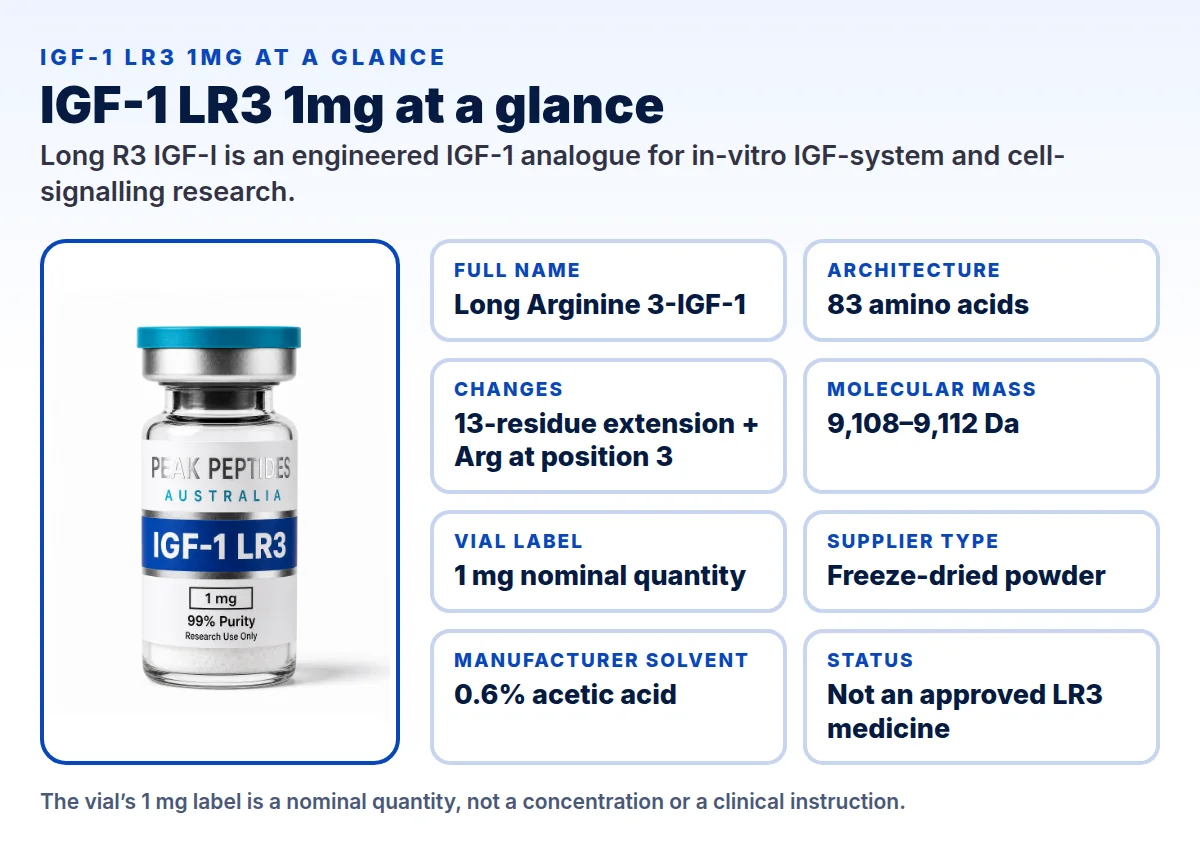
IGF-1 LR3 1mg at a glance
Name
IGF-1 LR3 — Long R3 IGF-I / Long Arg3 IGF-I
What it is
An engineered analogue of human insulin-like growth factor 1 for IGF-system and cell-signalling research
Structure
83 amino acids: 70-amino-acid IGF-1 sequence, 13-residue N-terminal extension and Arg at position 3
Molecular weight
9,108–9,112 Da for manufacturer-grade LONG R3 IGF-I
What LR3 changes
Reduced IGF-binding-protein affinity in cited experiments; relative activity depends on the model
Nominal vial quantity
1 mg freeze-dried powder
Specified solvent
100 mM acetic acid, also called 0.6% acetic acid; not BAC water
Manufacturer reference stock
1 mL 0.6% acetic acid = 1 mg/mL; 1 U-100 unit = 10 mcg
Research finding
Relative activity was higher in L6 myoblasts but lower in chicken embryo fibroblasts in the 1992 comparison
Medicine status
No approved IGF-1 LR3 medicine; Increlex is the distinct medicine mecasermin
Quality documentation
No product-specific LabDoc report published
Storage reference
Manufacturer-grade lyophilised and reconstituted LONG R3: re-capped at 2–8 °C
Dispatch
Same-day from Victoria for in-stock orders once payment is confirmed, tracked Australia Post Express; tracking emailed
An 83-amino-acid IGF-1 analogue
Long R3 IGF-I has 83 amino acids. It combines the 70-amino-acid human IGF-1 sequence with a 13-amino-acid N-terminal extension, and it has arginine instead of glutamic acid at position 3. The manufacturer datasheet lists a molecular weight of 9,108–9,112 Da.
Why “LR3” changes the research question
The Long R3 design changes the analogue’s interaction with IGF-binding proteins. In the 1992 comparison study, the altered interaction tracked with stronger protein- and DNA-synthesis responses in L6 myoblasts, but not in every cell system. That makes LR3 a tool for studying context, not a fixed potency multiplier.
What the cell experiment found
Francis and colleagues found that Long [Arg3]-IGF-I was more potent than native IGF-I in L6 rat myoblasts for protein and DNA synthesis and for reducing protein breakdown. In chicken embryo fibroblasts, which did not release detectable IGF-binding proteins, it was less potent than native IGF-I.
Preclinical findings are not fitness claims
A seven-day guinea-pig infusion changed fractional organ weights without significantly changing overall weight gain or carcass composition. A four-day pig infusion reduced average daily gain and food intake.
Use 0.6% acetic acid, not BAC water
Manufacturer-grade LONG R3 IGF-I instructions specify 100 mM acetic acid to prepare lyophilised material at 1 mg/mL. That concentration is 0.6% acetic acid by weight per volume. The 1 mL reference mix in this guide therefore makes 1 mg/mL; it is not a BAC-water formulation.
What the 1mg label means
The 1 mg figure is the nominal quantity on this vial. Concentration depends on the volume of the correct solvent added: 1 mL produces a 1 mg/mL stock.
Not mecasermin or growth hormone
IGF-1 LR3 is not human growth hormone and it is not the prescription medicine Increlex. Increlex contains mecasermin, recombinant human IGF-1, and the TGA approved it for a specific paediatric growth-failure indication. That approval and its prescribing information do not apply to the different LR3 analogue.
Quality evidence for this listing
No product-specific LabDoc report is published for this listing. The vial label states 99% Purity. The Quality page provides independent evidence when a report identifies the tested sample.
Sport status and medicine status
IGF-1 LR3 is not an approved medicine. In the 2026 World Anti-Doping Agency Prohibited List, IGF-1, mecasermin and IGF-1 analogues are prohibited at all times under growth factors and growth-factor modulators.
IGF-1 LR3 is a lab-made analogue of insulin-like growth factor 1, also called Long R3 IGF-I or Long Arg3 IGF-I. It is designed for IGF-system and cell-culture research. IGF-1 LR3, growth hormone and the prescription medicine mecasermin are different compounds.
The “Long” part describes an added 13-amino-acid sequence at the N-terminus. The “R3” part means arginine replaces the amino acid glutamic acid at position 3 of the human IGF-1 sequence. Native IGF-1 is 70 amino acids long; LR3 is 83 amino acids long. The manufacturer-grade molecular-weight range is 9,108–9,112 Da.
These structural changes are used to investigate an important part of the IGF system: IGF-binding proteins. The original analogue study showed that relative response depended on the cell system and its binding-protein environment. That is the useful research question; it is not a promise of the same biological effect in every model or in people.
IGF-1 LR3 1mg is an 83-amino-acid research analogue. The 1 mg label is a nominal quantity, and the manufacturer-grade solvent reference is 0.6% acetic acid.
How does IGF-1 LR3 work in cell research?
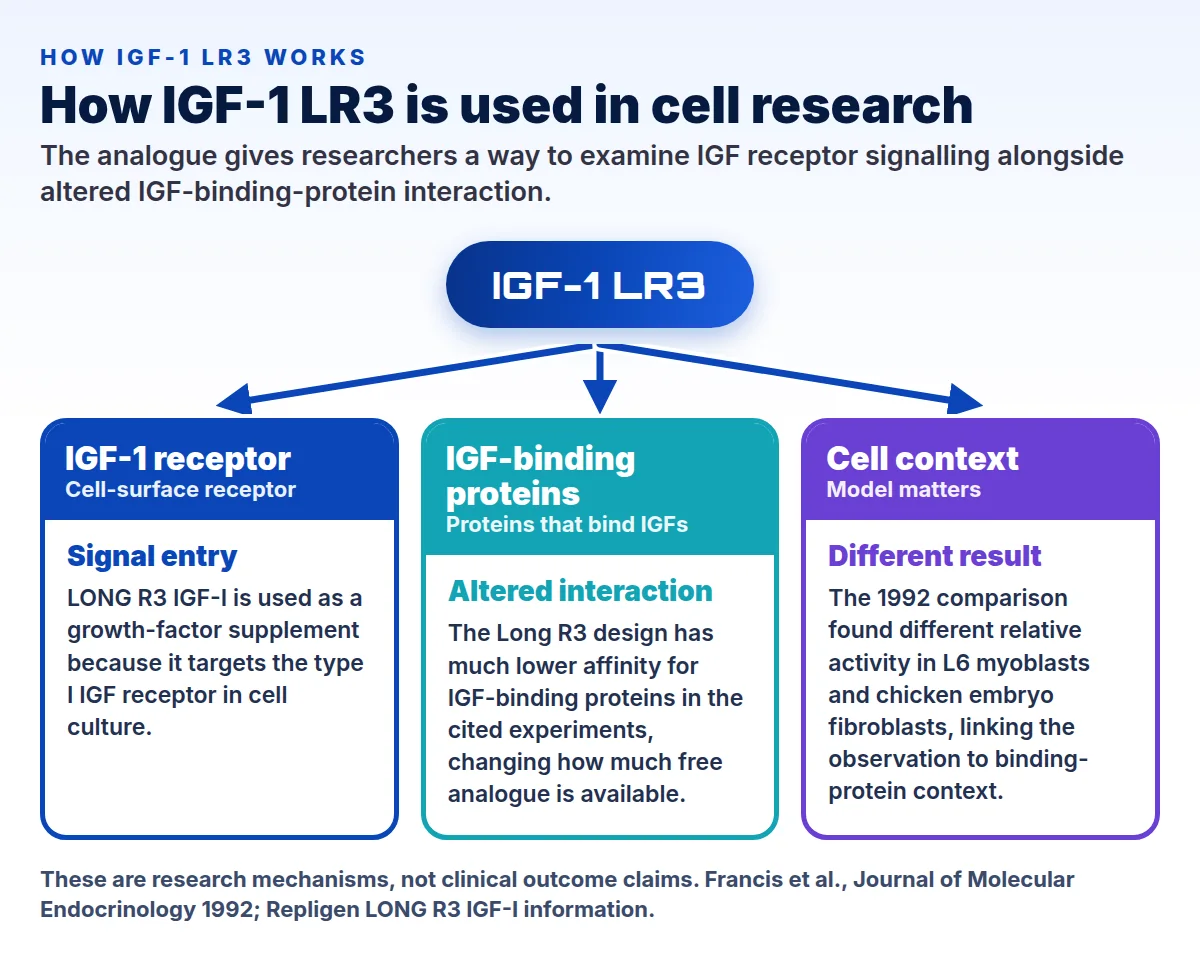
IGF-1 LR3 is used to examine type I IGF receptor signalling and the role of IGF-binding proteins. A receptor is a protein on or in a cell that receives a molecular signal. IGF-binding proteins are proteins that bind IGF molecules and can change their availability in the surrounding system.
Manufacturer information describes LONG R3 IGF-I as a cell-culture growth-factor supplement that targets the type I IGF receptor. Its altered binding-protein interaction matters because free ligand and receptor access are not the same thing in every medium or cell line. The 1992 study tested exactly that distinction rather than treating LR3 as an across-the-board stronger version of IGF-1.
In cells that released detectable IGF-binding proteins, Long [Arg3]-IGF-I ranked above native IGF-I for the studied biological responses. In chicken embryo fibroblasts that did not release detectable binding proteins, it was less potent. Researchers can use that contrast to design assays around receptor, binding-protein and culture-medium context.
IGF-1 receptor: the cell-surface target used in signalling and cell-culture experiments.
IGF-binding proteins: binding partners that affect how IGF ligands behave in a biological system.
Cell and medium context: the same analogue can produce different relative results in different test systems.
Research focus: receptor signalling and availability, not a fixed “times stronger” multiplier.
LR3 lets researchers examine IGF receptor signalling alongside altered IGF-binding-protein interaction; the observed response is model dependent.
What did published IGF-1 LR3 research find?
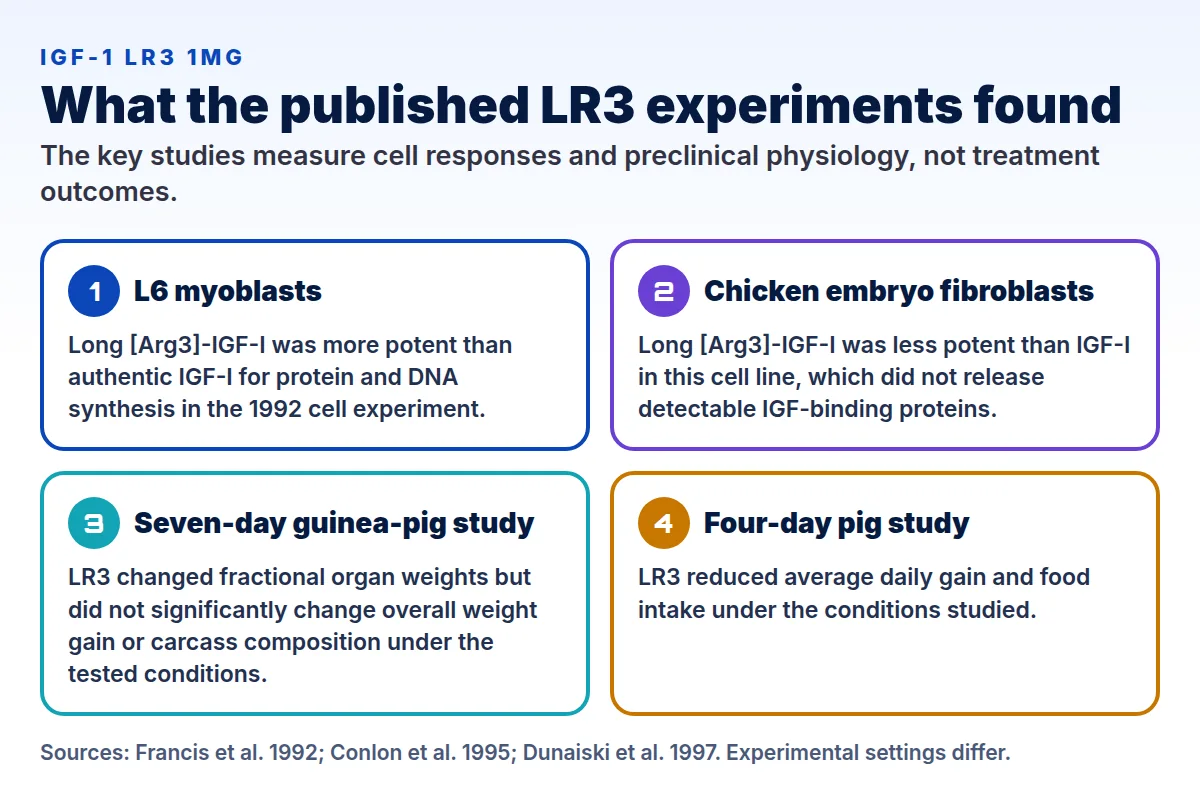
IGF-1 LR3 research has to be read by model. The core 1992 paper compared engineered IGF-I fusion analogues with authentic IGF-I in several cell systems. In L6 rat myoblasts, all the tested analogues were more potent than authentic IGF-I for protein and DNA synthesis and for reducing protein breakdown. Long [Arg3]-IGF-I ranked first among the analogues in cell lines that released detectable IGF-binding proteins.
The finding changed in chicken embryo fibroblasts. These cells did not release detectable IGF-binding proteins into the medium, and Long [Arg3]-IGF-I was less potent than IGF-I. That direct contrast is why the paper is more useful than a simple potency slogan: it ties the observed result to binding-protein and receptor context.
The preclinical papers also prevent a simplistic conclusion. In guinea pigs, seven days of LR3 changed fractional organ weights but did not significantly alter overall weight gain or carcass composition. In pigs, four days of LR3 lowered average daily gain and food intake. None of these studies is a controlled human trial of muscle, recovery, ageing or treatment outcomes.
Published LR3 results differ across cell and preclinical settings. The studies are evidence about their own models, not clinical claims.
Selected Long R3 IGF-I experiments and what they measured
Selected Long R3 IGF-I experiments and what they measured
Study setting
What researchers measured
Reported finding
What it does not show
L6 rat myoblasts, Francis et al. 1992
Protein and DNA synthesis; protein breakdown
Long [Arg3]-IGF-I was more potent than authentic IGF-I in this cell system
A human muscle outcome
Chicken embryo fibroblasts, Francis et al. 1992
Relative potency in cells without detectable IGFBP secretion
Long [Arg3]-IGF-I was less potent than IGF-I
A universal LR3 potency ratio
Guinea-pig infusion, Conlon et al. 1995
Growth, carcass composition and fractional organ weights
Several fractional organ weights changed; overall growth and carcass composition did not significantly change
A fitness or recovery result
Pig infusion, Dunaiski et al. 1997
Average daily gain, food intake and circulating factors
Average daily gain and food intake decreased under the study conditions
A human treatment outcome
“More potent” and “less potent” describe the measured response in the named study system. They are not dose conversions or predictions for a different model.
IGF-1 LR3 vs native IGF-1 vs mecasermin
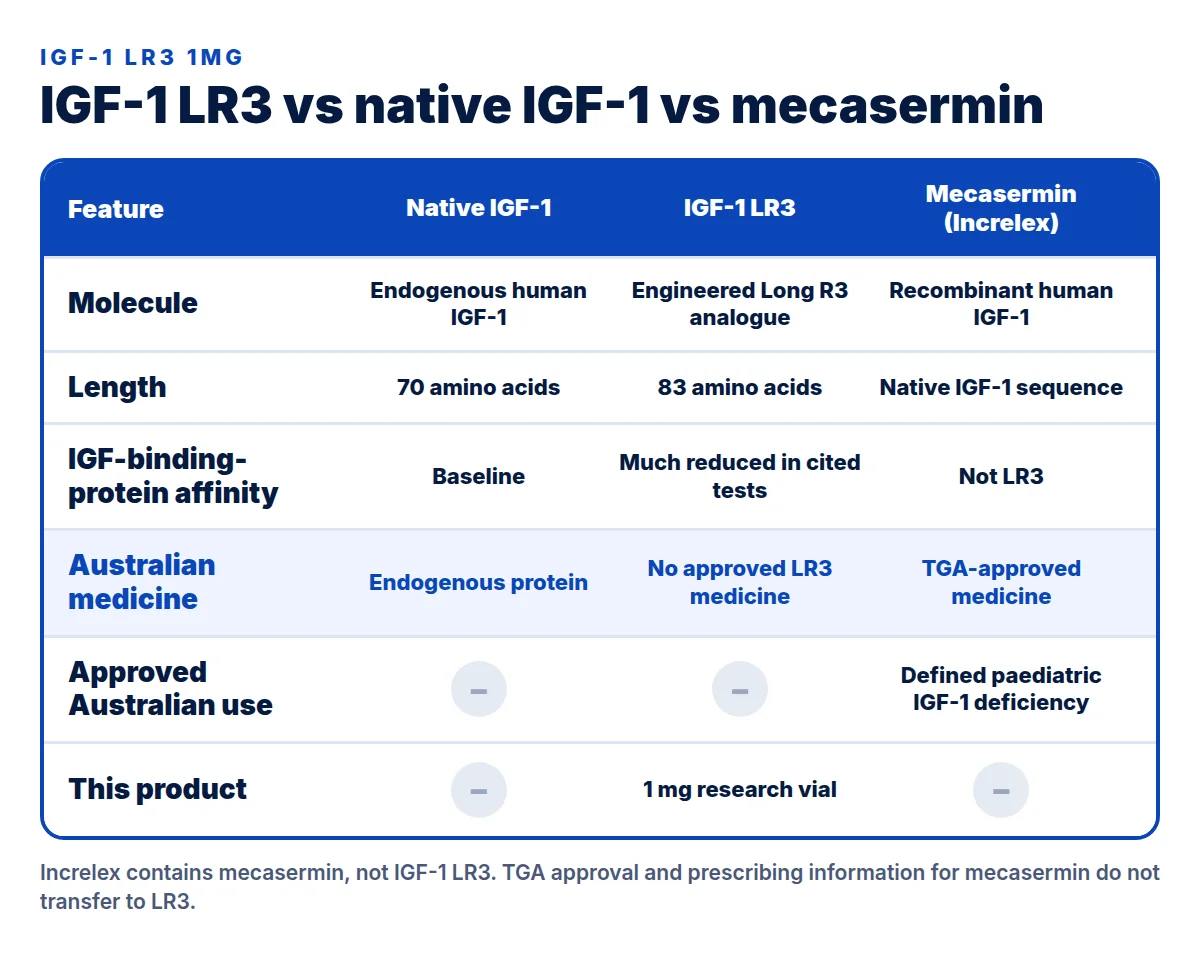
Native IGF-1, IGF-1 LR3 and mecasermin are related but different compounds. Native IGF-1 is the 70-amino-acid human protein. IGF-1 LR3 is the engineered 83-amino-acid Long R3 analogue. Mecasermin is recombinant human IGF-1, sold as the prescription medicine Increlex, and is different from the LR3 analogue.
The practical difference is important in research and regulation. LR3 was designed to change binding-protein interaction. Mecasermin retains the native IGF-1 identity used in a specific prescription medicine. The TGA approval for Increlex covers a defined paediatric growth-failure indication for mecasermin; it does not approve IGF-1 LR3 or transfer clinical directions to the LR3 research product.
The comparison also avoids a common naming error. Long R3 is not a blend of IGF-1 and growth hormone, and it is not simply a higher-strength version of a mecasermin vial. The structures, intended product formats and source documents differ.
Mecasermin is a distinct recombinant human IGF-1 medicine. Its TGA approval does not apply to the engineered IGF-1 LR3 research analogue.
Key distinction between IGF-1 LR3 and mecasermin
Key distinction between IGF-1 LR3 and mecasermin
Question
IGF-1 LR3 1mg listing
Increlex / mecasermin
What is it?
Engineered Long R3 IGF-I analogue
Recombinant human IGF-1
Structure
83 amino acids, 13-residue extension and Arg3 change
Native human IGF-1 sequence
Binding-protein focus
Much reduced affinity in cited Long R3 experiments
Not the Long R3 analogue
Medicine status in Australia
No approved IGF-1 LR3 medicine
TGA-approved for a defined paediatric indication
Can one product’s directions be used for the other?
No
No
TGA approval, product formulation and clinical information for mecasermin cannot be transferred to Long R3 IGF-I.
Quality evidence, medicine status and sport status
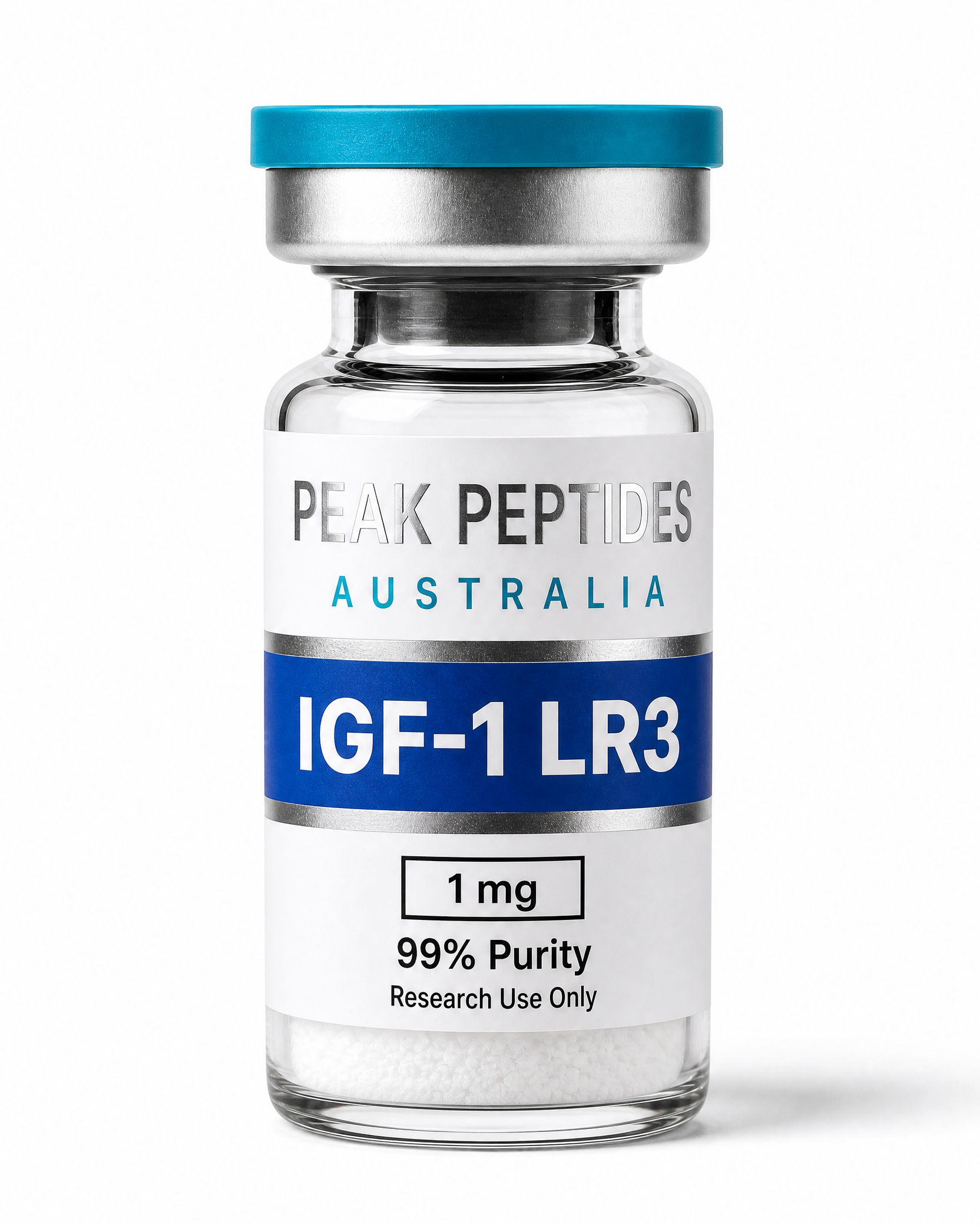
IGF-1 LR3 1mg has no product-specific LabDoc report published at the time of this page. The vial photo shows a 1 mg label and “99% Purity”. The Quality page lists available documentation, including the material, supplier, report identifier and stated methods.
A certificate of analysis can support the limited questions it actually tested. For a protein research material, useful documentation might name the sample and lot and report identity, purity, content, biological activity, endotoxin or appearance. It cannot turn a different molecule into LR3, establish a clinical use, or verify an untested vial simply because the labels look similar.
IGF-1 LR3 is not an approved medicine. The official Australian record for Increlex identifies mecasermin as the active ingredient and approves it for defined paediatric severe primary IGF-1 deficiency. The 2026 WADA list separately places IGF-1, mecasermin and their analogues in the prohibited growth-factor class at all times.
Product-specific LabDoc: none published for this listing.
Quality check: match any report to the named tested sample, rather than relying on a similar product name.
TGA medicine record: Increlex is mecasermin, not IGF-1 LR3.
WADA: IGF-1 and its analogues are prohibited at all times.
Buying IGF-1 LR3 1mg in Australia
Peak Peptides Australia supplies IGF-1 LR3 1mg for in-vitro research only. The page gives the product’s alternative research names, a distinction from mecasermin, published-model findings, a 0.6% acetic-acid stock reference and an eight-step visual handling guide.
For in-stock orders, dispatch is the same day from Victoria once payment is confirmed. Orders are sent by tracked Australia Post Express, and the tracking number is emailed.
The useful comparison products listed on this page are separate growth-hormone-axis research entries. Tesamorelin, Sermorelin and CJC-1295 NO DAC have different structures, nominal quantities, evidence bases and handling information. A related listing does not make products interchangeable or support combining them.
Step-by-step guide · About 10 minutes
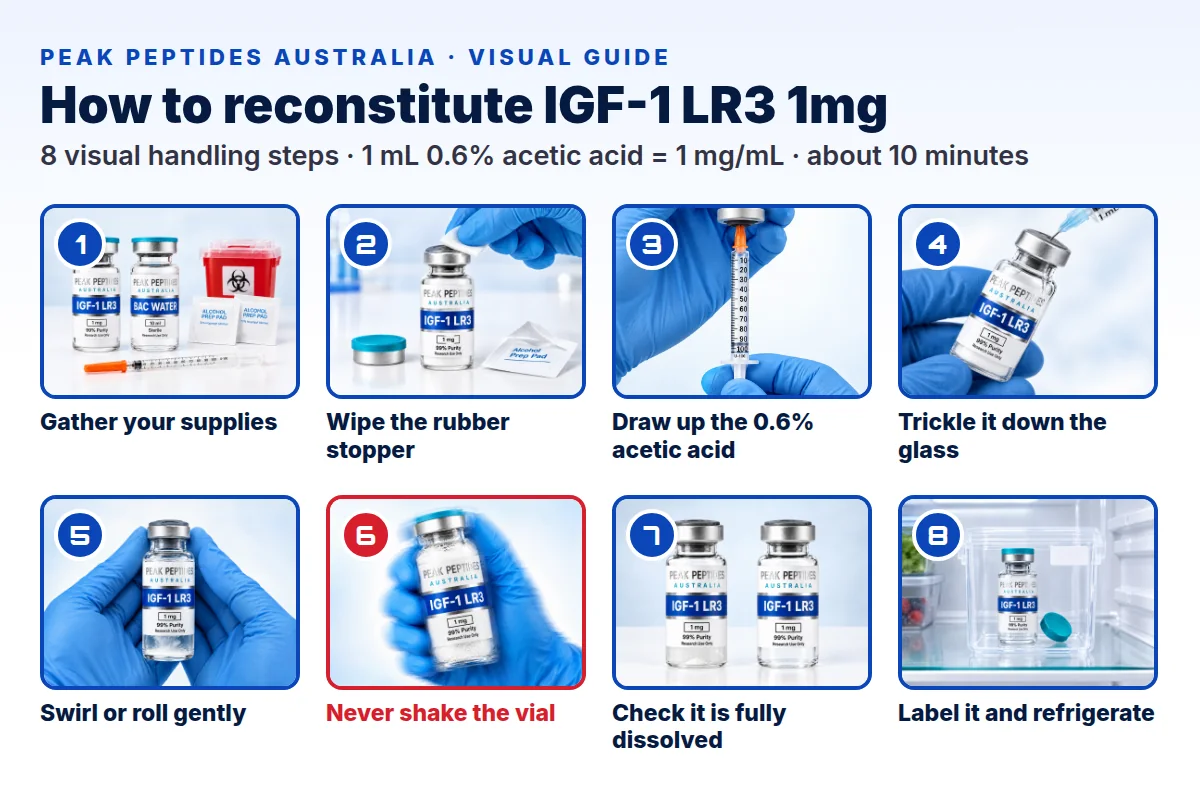
How to reconstitute IGF-1 LR3 1mg (8-step visual guide)
IGF-1 LR3 1mg is supplied as freeze-dried material. For manufacturer-grade LONG R3 IGF-I, reconstitution means making a research stock with 100 mM acetic acid, also called 0.6% acetic acid — not BAC water. The manufacturer reference is 1 mL for a 1 mg/mL stock. The sequence below is a visual handling guide for in-vitro research: prepare a clean workspace, use the specified solvent, avoid forceful agitation, inspect the finished solution and keep the container re-capped at 2–8 °C. It takes about 10 minutes.
The visual sequence uses the manufacturer-grade 0.6% acetic-acid reference, not a BAC-water formulation.
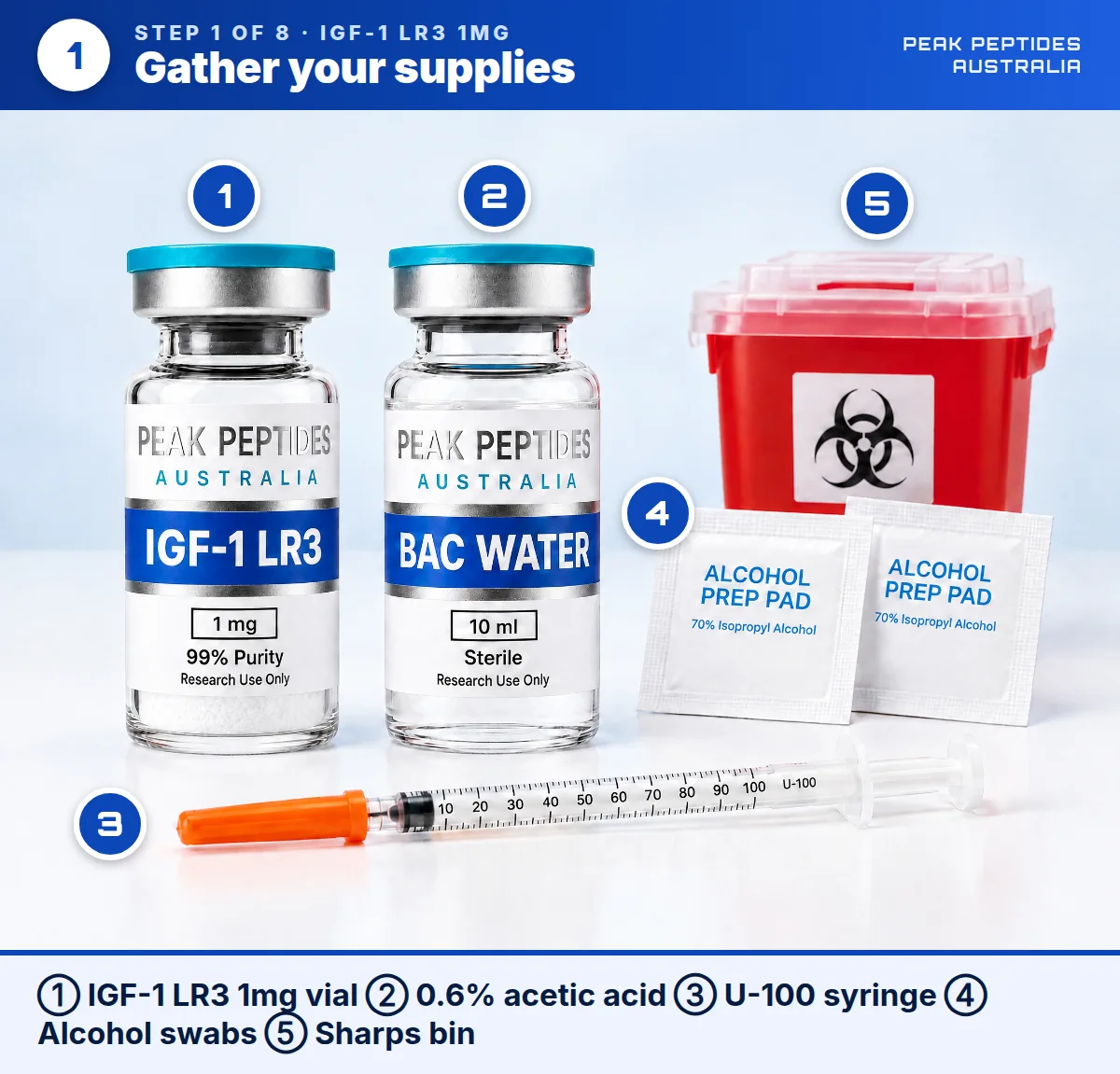
What you need
IGF-1 LR3 1mg vialFreeze-dried research material in a sealed glass vial with a nominal 1 mg label claim.
0.6% acetic acid100 mM acetic acid, the manufacturer-specified solvent for a 1 mg/mL LONG R3 IGF-I stock; not BAC water.
1 mL U-100 syringeA volume-marked transfer tool. U-100 markings give 100 units per 1 mL for concentration arithmetic.
Alcohol swabsFor preparing vial stoppers before transfer; allow the surface to air-dry.
Low-protein-binding filterThe manufacturer describes PVDF or PES 0.22 µm filtration for Long R3 material where filtration is required.
Sharps containerFor safe disposal of used sharp transfer equipment.
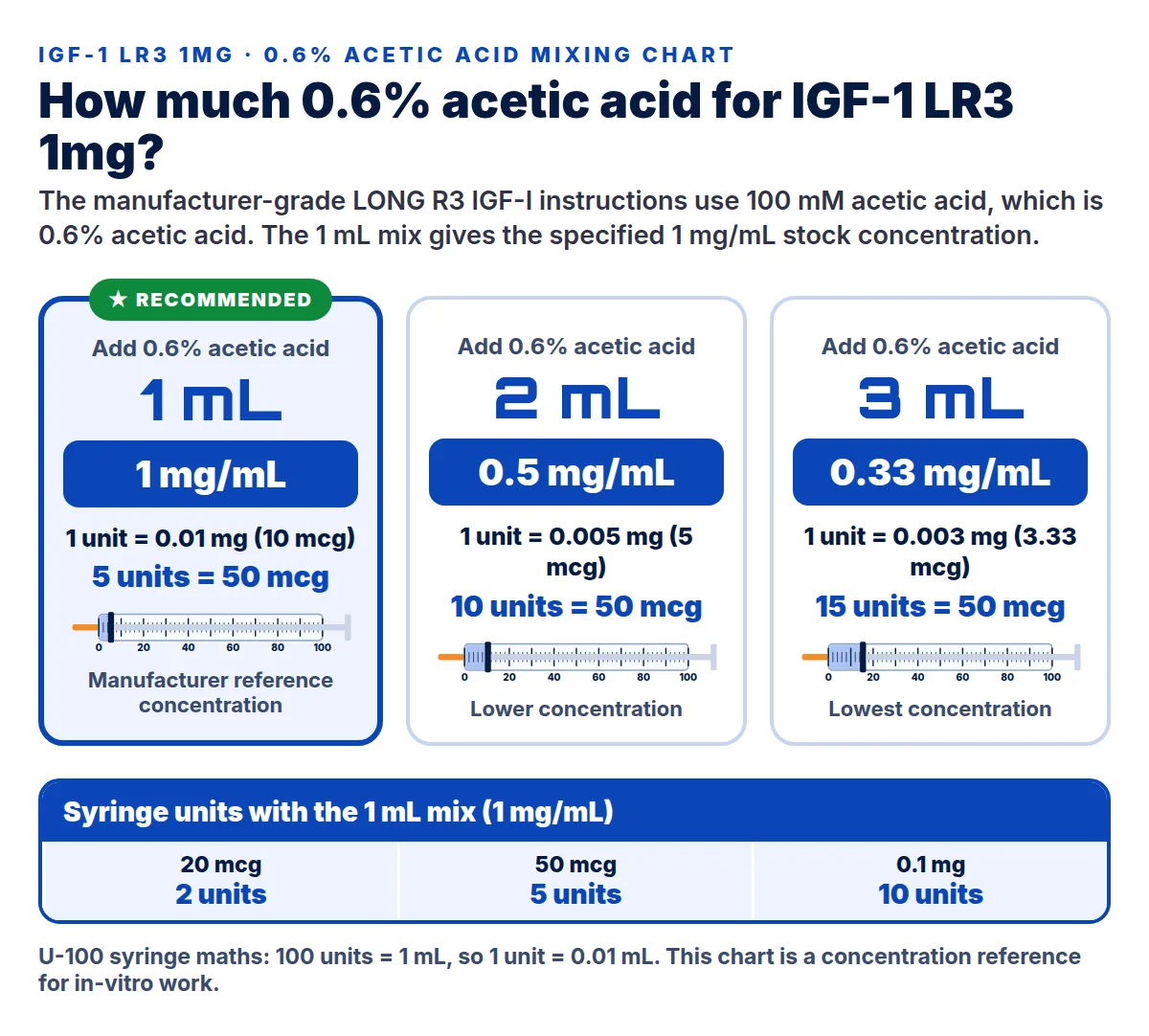
How much 0.6% acetic acid to add to IGF-1 LR3 1mg
The manufacturer-grade Long R3 IGF-I preparation specifies 100 mM acetic acid, also called 0.6% acetic acid, rather than BAC water. Its reference stock concentration is 1 mg/mL or higher. For a nominal 1 mg vial, 1 mL of 0.6% acetic acid makes 1 mg/mL, so every U-100 unit holds 0.01 mg (10 mcg).
The total nominal quantity stays 1 mg whichever chart volume is used. With 2 mL, the concentration is 0.5 mg/mL and 10 units equals 50 mcg. With 3 mL, it is 0.33 mg/mL and 15 units equals 50 mcg. These are volume-and-concentration conversions for in-vitro work. The formula is: units = amount wanted ÷ concentration per mL × 100.
For the manufacturer reference, do not replace the specified acetic-acid solvent with BAC water, tap water, distilled water, saline or cell-culture medium. The manufacturer explicitly advises against dissolving Long R3 powder directly in culture medium.
The highlighted 1 mL mix follows the manufacturer-grade 1 mg/mL Long R3 IGF-I reference concentration.
1 mL is highlighted because it gives the simplest numbers.
Syringe units with the 1 mL mix (1 mg/mL)
Syringe units with the 1 mL mix (1 mg/mL)
Amount
Units on a U-100 syringe
Volume
20 mcg
2 units
0.02 mL
50 mcg
5 units
0.05 mL
0.1 mg
10 units
0.1 mL
The 8 steps
1Step 1: Gather your supplies
Set out the IGF-1 LR3 1mg vial, 0.6% acetic acid, a new volume-marked 1 mL U-100 syringe, alcohol swabs and a sharps container on a clean workspace. Confirm the vial identity and the solvent before opening anything. The Long R3 manufacturer reference uses 0.6% acetic acid, not BAC water.
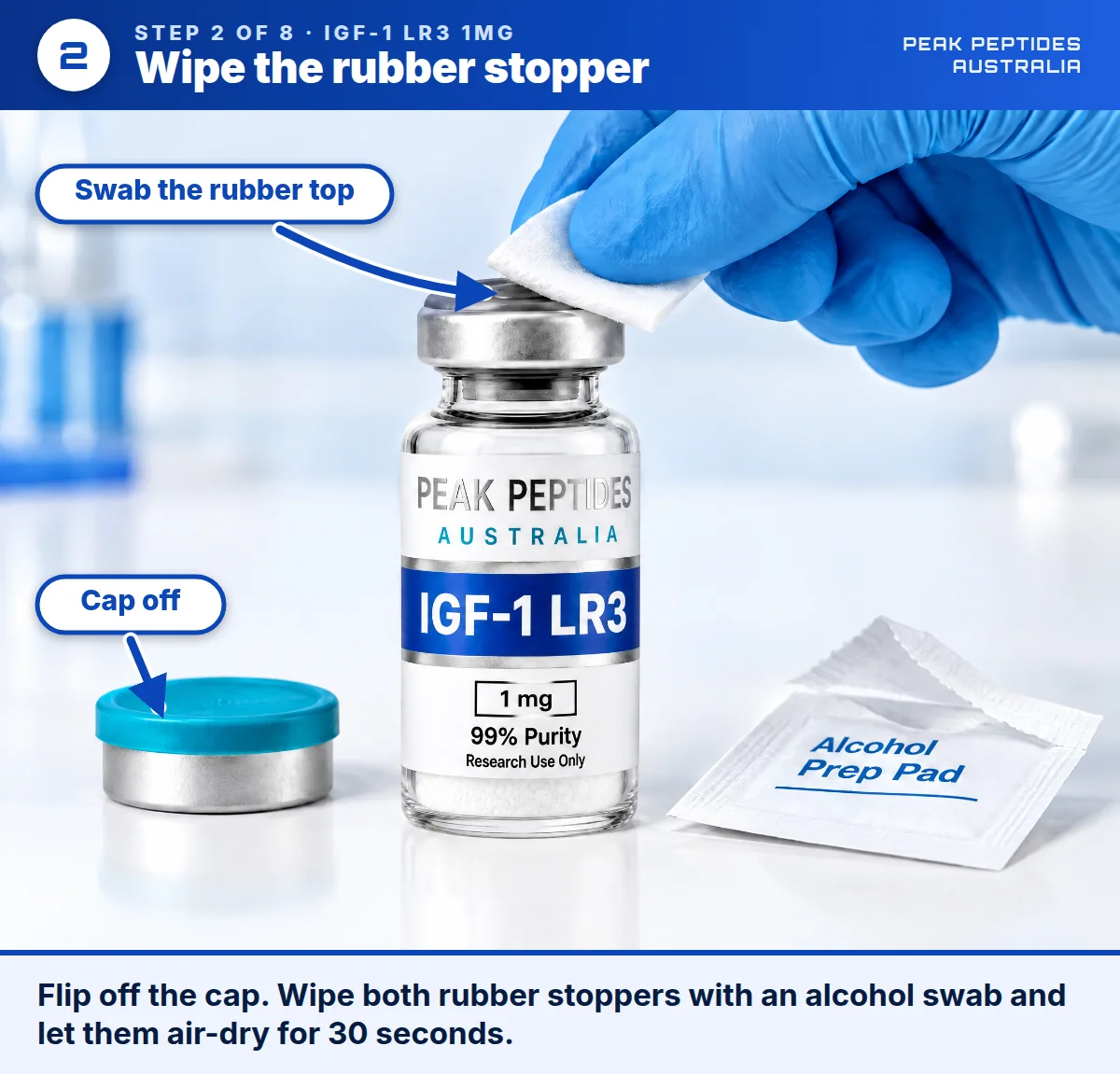
2Step 2: Wipe the rubber stopper
Remove the flip-off cap from the IGF-1 LR3 vial without disturbing the rubber stopper. Wipe the stopper with a fresh alcohol swab and let it air-dry for about 30 seconds. Keep the prepared surface clear of hands and other contact while setting up the transfer.
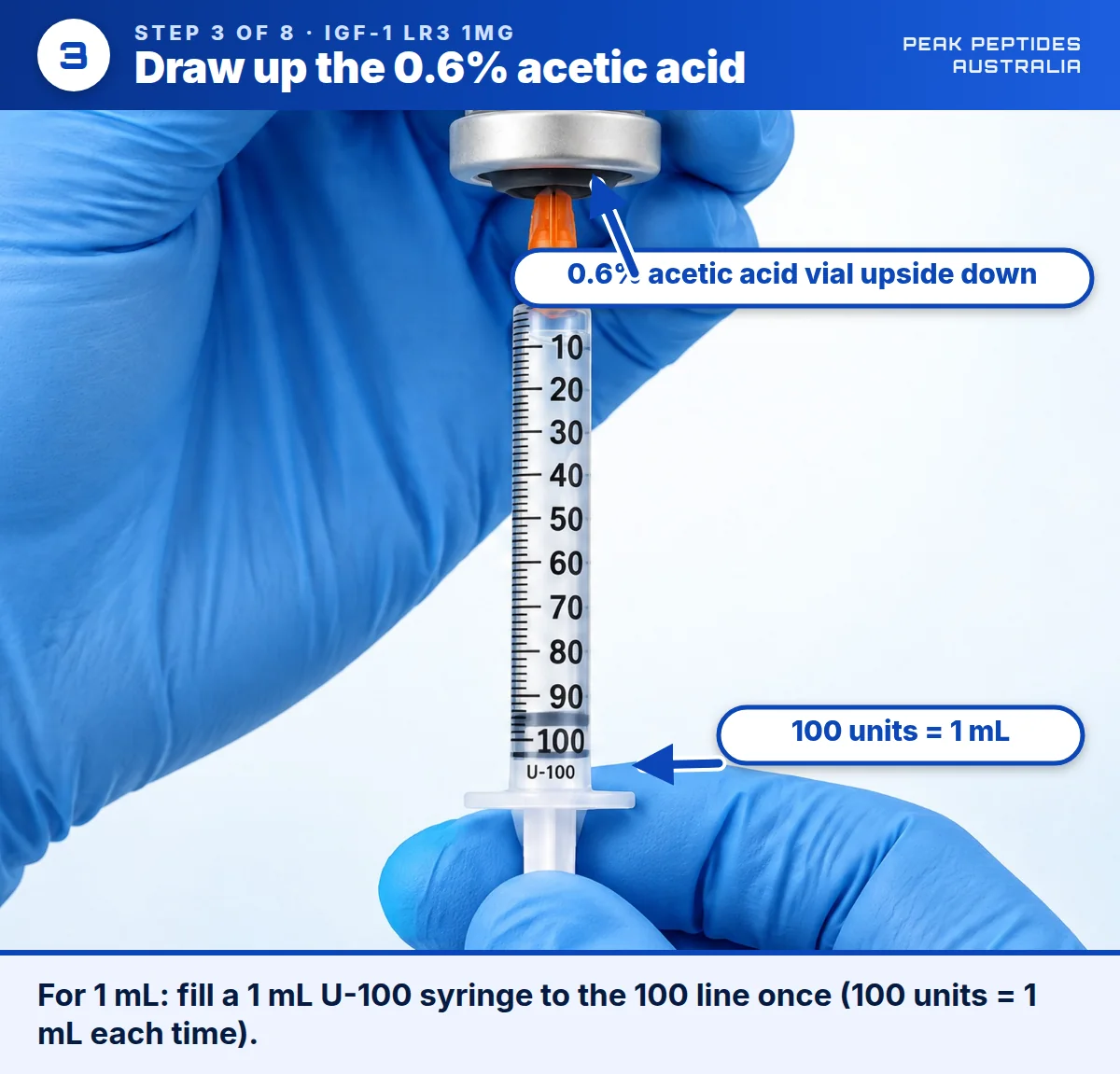
3Step 3: Draw up the 0.6% acetic acid
Measure the manufacturer reference volume: 1 mL of 0.6% acetic acid. On a 1 mL U-100 syringe, 100 units equals 1 mL. Check the liquid level at eye height and remove large bubbles before transfer. This measured volume makes a nominal 1 mg/mL stock from the 1 mg vial.
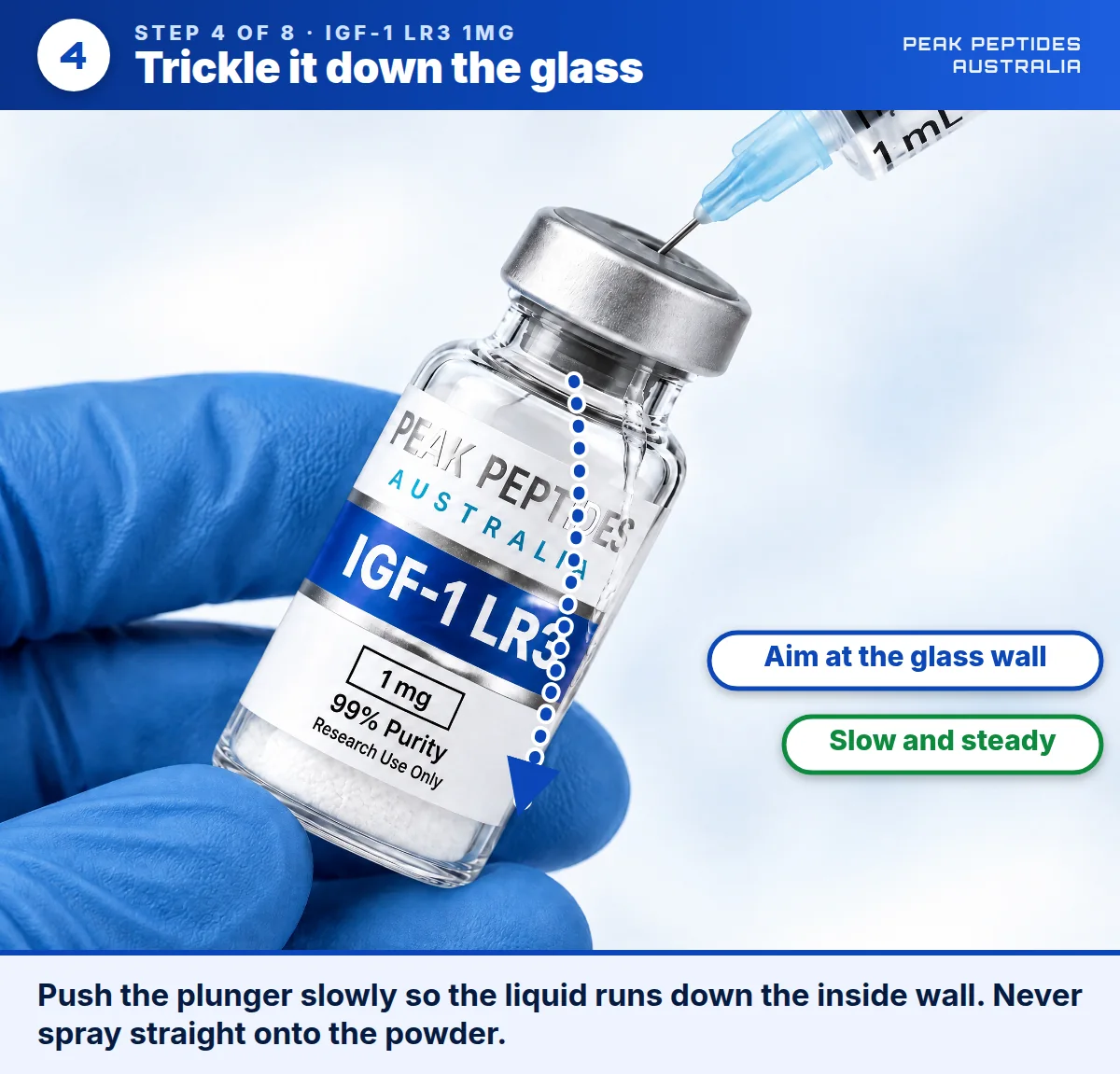
4Step 4: Trickle it down the glass
Transfer the 0.6% acetic acid slowly into the IGF-1 LR3 vial, directing the stream against the inside glass wall rather than forcefully into the freeze-dried cake. Slow addition reduces splashing and unnecessary agitation. Keep the measured volume and solvent recorded so the finished concentration remains traceable.
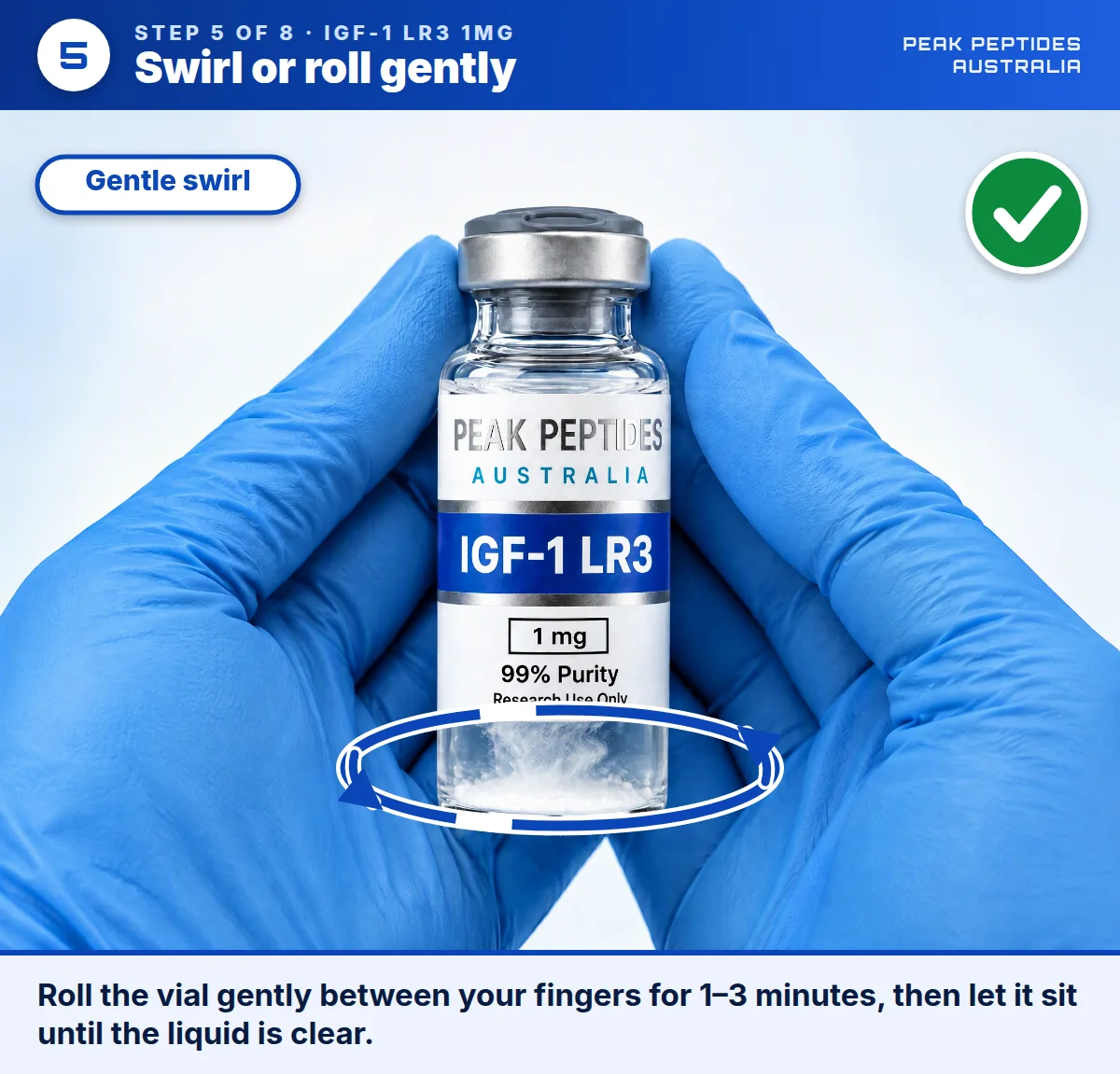
5Step 5: Swirl or roll gently
Mix by gentle swirling or rolling until the material is completely dissolved. The Long R3 manufacturer instructions call for thorough mixing; avoid vigorous shaking because it creates foam and unnecessary mechanical stress. Leave the vial to stand briefly if a small amount of powder remains, then use the permitted gentle motion again.
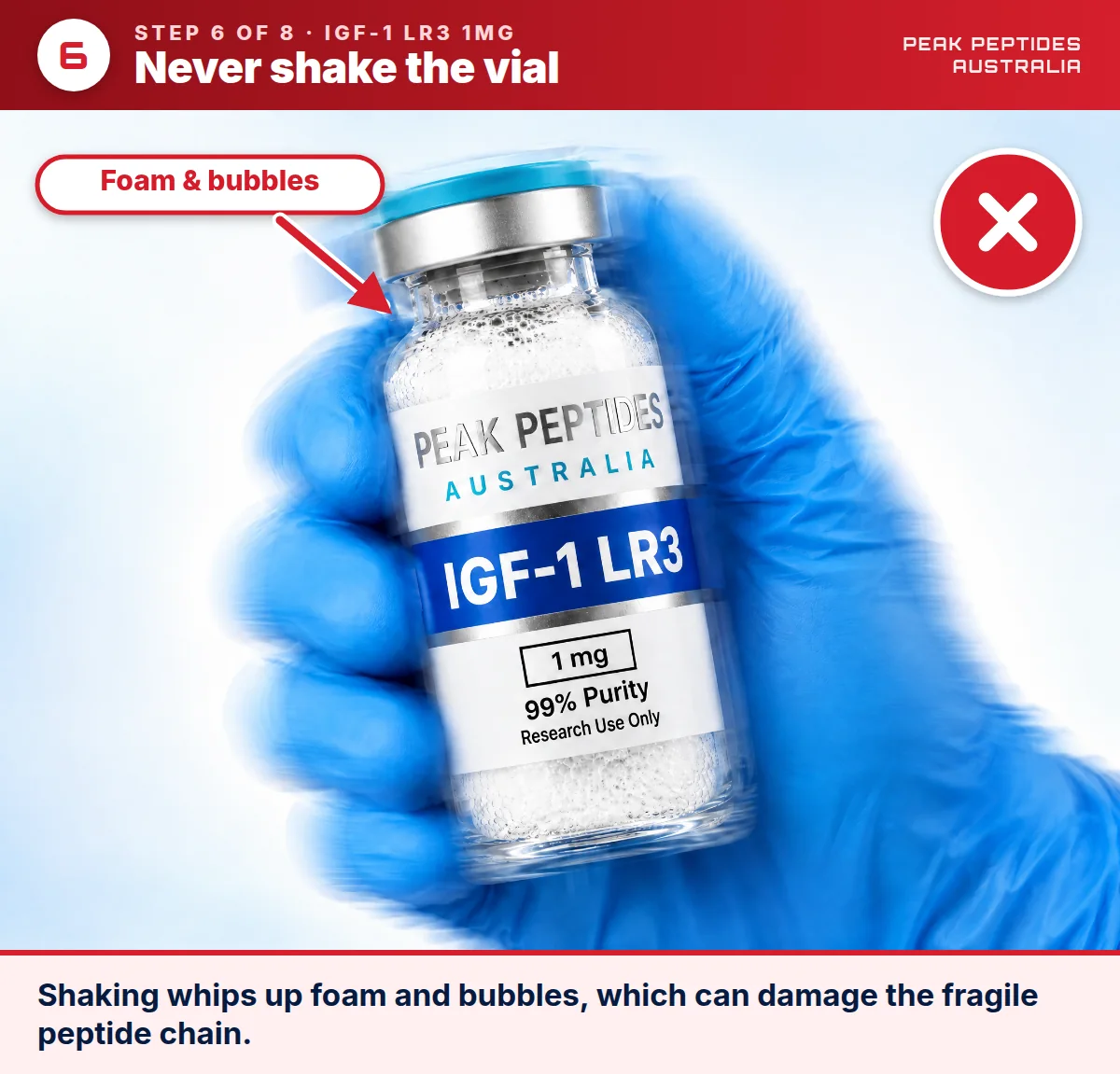
6Step 6: Never shake the vial
Do not shake the vial unless product-specific instructions require it. Vigorous shaking can create foam, bubbles and interface stress that can contribute to particles in susceptible protein formulations. If foam appears, stop agitating and let the vial stand while you compare it with the expected product appearance.
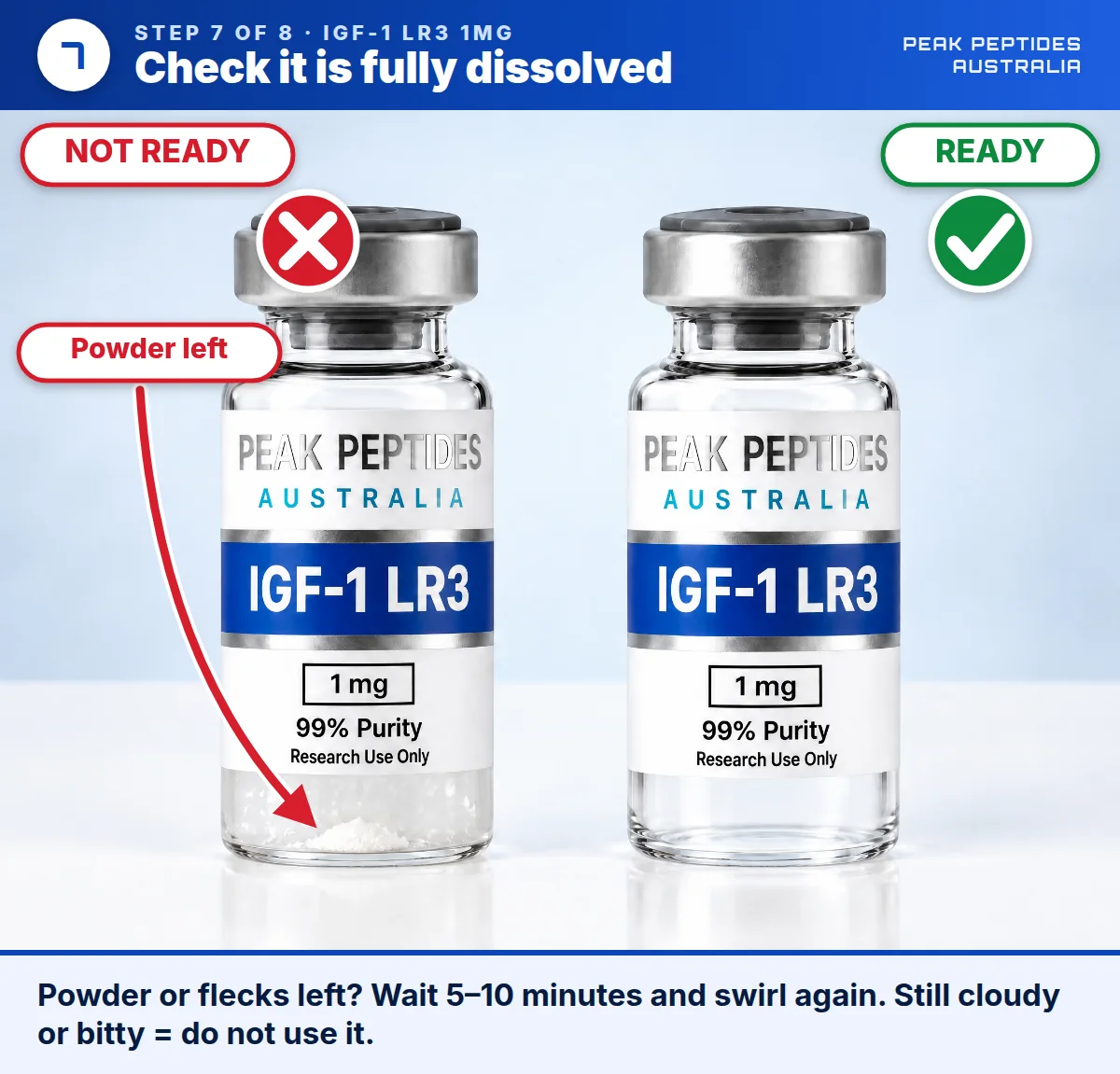
7Step 7: Check it is fully dissolved
Inspect the finished solution in good light. Look for complete dissolution and for unexpected particles, persistent cloudiness, colour change, leakage or stopper damage. If you notice any of these issues, isolate the vial and seek the relevant handling guidance rather than adding extra solvent or filtering the solution.
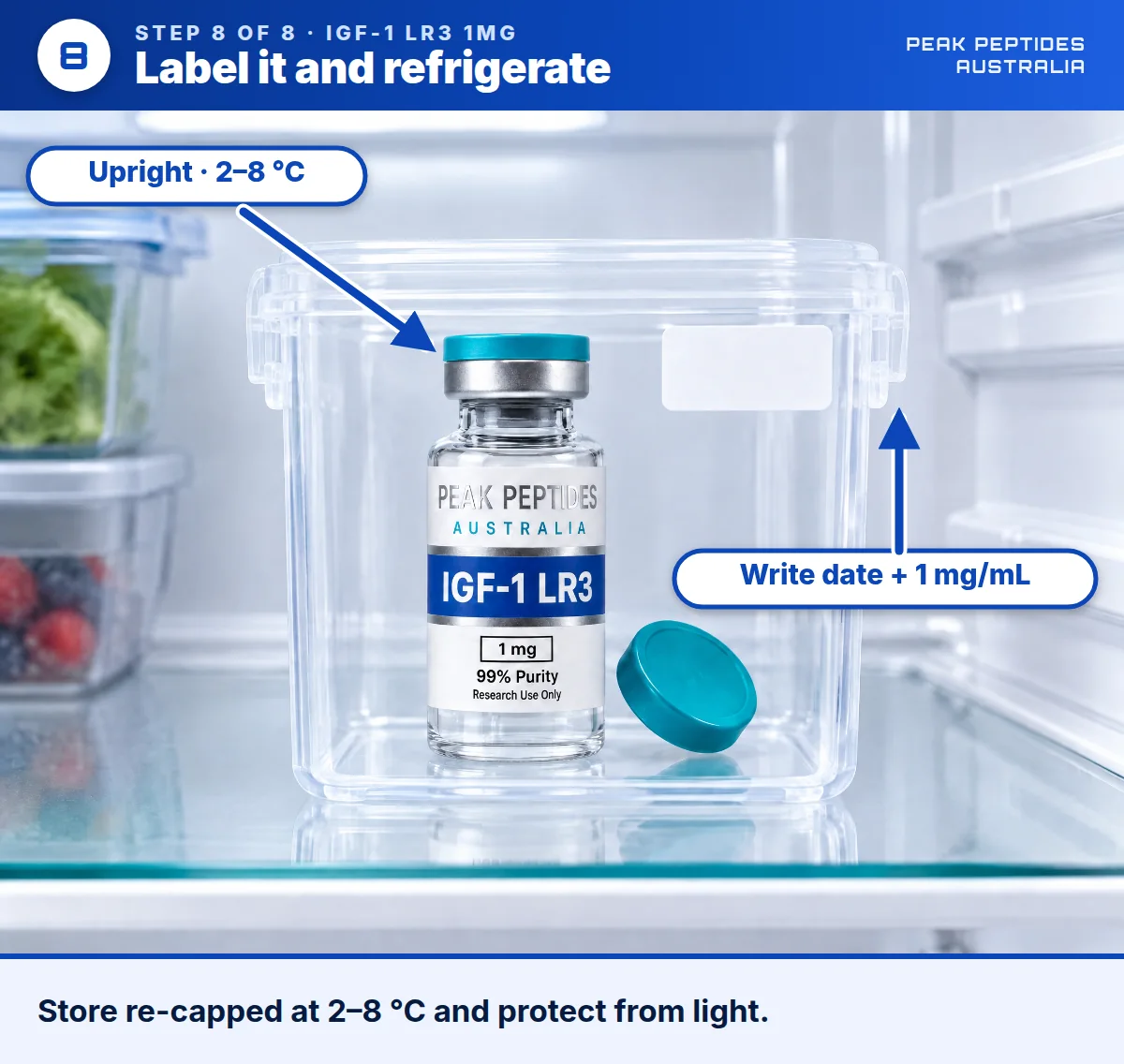
8Step 8: Label it and refrigerate
Label the vial with the preparation date, 0.6% acetic-acid solvent, volume added and resulting concentration. Re-cap the original vial and store it at 2–8 °C, protected from light. Manufacturer information warns that acetic acid can evaporate if the vial is not properly sealed, changing the concentration over time.
How to store IGF-1 LR3
Manufacturer-grade LONG R3 IGF-I storage reference
Manufacturer-grade LONG R3 IGF-I storage reference
Form
Storage reference
Source-supported note
Lyophilised LONG R3 IGF-I
2–8 °C, protected from light
Manufacturer datasheet reports five-year stability when properly stored
Reconstituted LONG R3 IGF-I
Re-capped in the original vial at 2–8 °C
Manufacturer warns that volatile acetic acid can evaporate if the vial is not properly sealed
Aliquoted manufacturer-grade stock
2–8 °C in LoBind tubes for aliquots
Manufacturer FAQ describes up to 12 months under those stated conditions
Mixed in 0.6% acetic acid
Re-capped and upright at 2–8 °C, away from light
Never freeze; avoid freeze–thaw cycles
This table reports manufacturer-grade LONG R3 IGF-I handling information. Record the preparation date, solvent, volume and concentration, then use the exact storage period for the supplied formulation.
IGF-1 LR3 1mg is a freeze-dried research vial labelled with a nominal 1 mg quantity of Long R3 IGF-I. Long R3 IGF-I is an engineered insulin-like growth factor 1 analogue used to investigate IGF-system signalling, receptor activity and IGF-binding-protein interactions in laboratory systems.
What other names are used for IGF-1 LR3?
IGF-1 LR3 is also written IGF 1 LR3, IGF1 LR3, Long R3 IGF-I, Long R3 IGF-1, Long Arg3 IGF-I, Long Arginine 3-IGF-1 and LR3IGF-I. These are naming and spacing variants for the same engineered IGF-1 analogue.
How is IGF-1 LR3 different from native IGF-1?
Native human IGF-1 has 70 amino acids. Long R3 IGF-I has an added 13-amino-acid N-terminal extension and arginine at position 3 in place of glutamic acid, giving an 83-amino-acid analogue. Those changes alter IGF-binding-protein interaction in the cited experiments.
How does IGF-1 LR3 work in cell research?
IGF-1 LR3 is used to study signalling through the type I IGF receptor while changing interaction with IGF-binding proteins. The manufacturer describes LONG R3 IGF-I as a cell-culture growth-factor supplement that directly targets the type I IGF receptor. The observed response still depends on the cell model and culture conditions.
Why do IGF-binding proteins matter for IGF-1 LR3 research?
IGF-binding proteins bind IGF ligands and affect their availability in a biological system. The original Long Arg3 comparison found that relative activity changed between cells that secreted detectable binding proteins and cells that did not. That result lets researchers test binding-protein context rather than assume a universal potency ratio.
What did the 1992 Long Arg3 IGF-I study find?
In L6 rat myoblasts, Long [Arg3]-IGF-I was more potent than authentic IGF-I for stimulating protein and DNA synthesis and reducing protein breakdown. In chicken embryo fibroblasts that did not release detectable IGF-binding proteins, Long [Arg3]-IGF-I was less potent than IGF-I.
Does IGF-1 LR3 research prove muscle growth or recovery in people?
No. The core LR3 evidence includes cell experiments and preclinical infusion studies, not controlled human outcome trials for muscle growth, injury recovery, anti-ageing or fat loss. A protein-synthesis result in a cultured cell or a physiological change in a preclinical model is not a proven fitness outcome in people.
What did the guinea-pig Long R3 study find?
In a seven-day guinea-pig infusion experiment, Long R3 IGF-I increased the fractional weight of adrenals, gut, kidneys and spleen. The same study did not find a significant change in overall body-weight gain, feed intake, feed conversion efficiency or carcass composition under its tested conditions.
What did the pig Long R3 study find?
In a four-day pig infusion experiment, Long [R3] IGF-I decreased average daily gain and food intake under the study conditions. The paper also reported lower circulating IGFBP-3, IGF-I and insulin concentrations. It is a preclinical finding, not a human performance result.
Is IGF-1 LR3 the same as growth hormone?
No. IGF-1 LR3 is an analogue of insulin-like growth factor 1, while growth hormone is a different hormone. They belong to related growth biology but have different structures, receptors and research questions.
Is IGF-1 LR3 the same as mecasermin or Increlex?
No. Increlex is the prescription medicine mecasermin, a recombinant human IGF-1 product. IGF-1 LR3 is a different engineered analogue with an N-terminal extension and an Arg3 substitution. TGA approval and prescribing information for mecasermin do not apply to this LR3 research vial.
Is IGF-1 LR3 approved by the TGA or FDA?
No approved medicine is IGF-1 LR3. The TGA-approved IGF medicine Increlex contains mecasermin, not LR3, and has a defined paediatric indication. A 2020 FDA compounding warning letter also listed IGF1-LR3 among substances that were not components of FDA-approved human drugs in that regulatory context.
Is IGF-1 LR3 prohibited in sport?
Yes. The 2026 World Anti-Doping Agency Prohibited List places insulin-like growth factor 1, mecasermin and its analogues under S2.3, growth factors and growth-factor modulators. The class is prohibited at all times.
Can I buy IGF-1 LR3 1mg online in Australia?
IGF-1 LR3 1mg can be ordered online from Peak Peptides Australia when available. In-stock orders receive same-day dispatch from Victoria once payment is confirmed, sent with tracked Australia Post Express and a tracking number emailed to you. This material is supplied for in-vitro research only.
How fast is dispatch for IGF-1 LR3 in Australia?
For in-stock orders, Peak Peptides Australia dispatches from Victoria on the same day once payment is confirmed. Orders travel with tracked Australia Post Express, and the tracking number is emailed. Carrier delivery timing depends on the destination and Australia Post’s service conditions.
Does the 1mg label state a concentration or a dose?
No. The 1 mg label states a nominal quantity of freeze-dried material in the vial. It is neither a concentration nor a human dose. If 1 mL of the manufacturer-specified 0.6% acetic acid is added, the resulting reference stock concentration is 1 mg/mL.
Should IGF-1 LR3 be reconstituted with BAC water or 0.6% acetic acid?
Use 0.6% acetic acid for the manufacturer-grade Long R3 reference preparation. The supplier documentation specifies 100 mM acetic acid, which equals approximately 0.6% acetic acid by weight per volume, to achieve 1 mg/mL. BAC water is not the specified solvent for that Long R3 material.
How much 0.6% acetic acid is used for a 1mg IGF-1 LR3 vial?
The manufacturer-grade reference is 1 mL of 0.6% acetic acid for 1 mg/mL. The chart also shows the maths for 2 mL and 3 mL: these make 0.5 mg/mL and 0.33 mg/mL respectively. More solvent changes concentration; it does not change the nominal 1 mg quantity.
How many units are 50 mcg of IGF-1 LR3 with the 1 mL mix?
With the 1 mL reference mix, the concentration is 1 mg/mL, or 10 mcg per U-100 syringe unit. Therefore 50 mcg equals 5 units, which is 0.05 mL. This is concentration arithmetic for in-vitro measurement.
How many mcg are in 10 U-100 units of IGF-1 LR3 with the 1 mL mix?
With 1 mg in 1 mL, the stock is 1 mg/mL. A U-100 syringe unit is 0.01 mL, so 10 units is 0.1 mL and contains 0.1 mg, or 100 mcg. This is a measurement conversion only.
How do I reconstitute IGF-1 LR3 1mg?
For the manufacturer-grade Long R3 reference method, clean the vial stopper, add 1 mL of 0.6% acetic acid slowly, and mix until completely dissolved. The manufacturer advises a 1 mg/mL stock and thorough dissolution. The photo guide shows the handling sequence and concentration maths for in-vitro work.
Should reconstituted IGF-1 LR3 be clear?
Inspect the solution in good light and compare it with the product description. Persistent cloudiness, particles, unexpected colour, leakage or stopper damage are reasons to isolate the vial and obtain product-specific guidance.
What if the powder does not dissolve?
Confirm that the correct solvent and measured volume were used, then mix gently rather than shaking forcefully. Do not add extra liquid to dissolve the powder because that changes the concentration. Keep the vial aside and follow product-specific instructions if it remains undissolved.
Why should the vial not be shaken?
Vigorous shaking can create foam, interfaces and mechanical stress. General peptide-handling guidance notes that these stresses can contribute to visible or subvisible particles in susceptible formulations. The Long R3 manufacturer instructions require complete mixing, while the photo guide uses gentle rolling rather than vigorous agitation.
How should freeze-dried IGF-1 LR3 be stored?
Manufacturer documentation for lyophilised LONG R3 IGF-I specifies storage at 2–8 °C and reports five-year stability under those conditions. Protect the vial from light and follow the exact product label and handling information for the supplied material.
How should reconstituted IGF-1 LR3 be stored?
Manufacturer documentation says reconstituted LONG R3 IGF-I should be re-capped in its original vial at 2–8 °C. It also says the volatile acetic acid solution can evaporate if the vial is not sealed. Record the solvent, volume, concentration and preparation date, then follow the storage period for the exact formulation.
Can reconstituted IGF-1 LR3 be frozen?
The Long R3 manufacturer instructions specify refrigerated storage after reconstitution. General handling guidance warns that freeze–thaw stress can destabilise protein formulations.
Is there a LabDoc report for IGF-1 LR3 1mg?
No product-specific LabDoc report is published for this listing. Check that the available Quality and COA documentation names the tested material and sample.
What should a COA show for an IGF-1 LR3 research sample?
A useful certificate of analysis identifies the sample and lot, names the testing laboratory, and reports the methods and results that were actually measured. Depending on the assay, this can include identity, purity, content, impurities, appearance or endotoxin. A COA is evidence for its named sample, not for every vial with a similar label.