Modified Growth Hormone Releasing Hormone (No DAC)
CJC-1295 NO DAC 10mg is a nominal 10 mg Modified GRF (1-29) research vial, also called Mod GRF 1-29. It is distinct from albumin-binding, long-acting CJC-1295 with DAC. LabDoc report LD-AYN4 records LC-MS identity confirmation, 99.38% HPLC purity and 9.13 mg measured content for the tested sample. In-stock orders receive same-day dispatch from Victoria after payment confirmation, with tracked Australia Post Express shipping Australia-wide.
Product Specifications
Full NameModified Growth Hormone Releasing Hormone Analog
Vial Size10mg
Purity99.38% HPLC (LD-AYN4, 9.13mg sample)
Legal Disclaimer
This product is sold strictly for in-vitro laboratory research purposes only. It is not a therapeutic good, is not approved by the TGA, and is not intended for human or animal consumption, injection, or any diagnostic or therapeutic use.
CJC-1295 NO DAC · 10mg research vial · Updated 24 October 2026
CJC-1295 NO DAC 10mg is a modified growth hormone-releasing hormone (GHRH) analogue supplied as a nominal 10 mg freeze-dried research vial. It is also called Modified GRF (1-29) or Mod GRF 1-29. The words NO DAC are essential: this is not the albumin-binding, long-acting DAC compound that appears in the frequently cited human CJC-1295 studies. That means the DAC study’s half-life and outcomes cannot be copied onto this product. This page separates those materials clearly, explains the GHRH pathway in plain English, compares related listings, records the independent LabDoc result for this sample, and provides a visual concentration worksheet with BAC water. Peak Peptides Australia supplies this material for in-vitro research only, not for human or animal use.
Also referred to in research or catalogue references as CJC-1295 NO DAC, CJC-1295 no DAC, CJC 1295 no DAC, CJC1295 NO DAC, Modified GRF (1-29), Modified GRF 1-29, Mod GRF 1-29, Mod GRF(1-29), CJC-1295 without DAC, CJC 1295 without DAC, CJC-1295 no DAC 10mg.
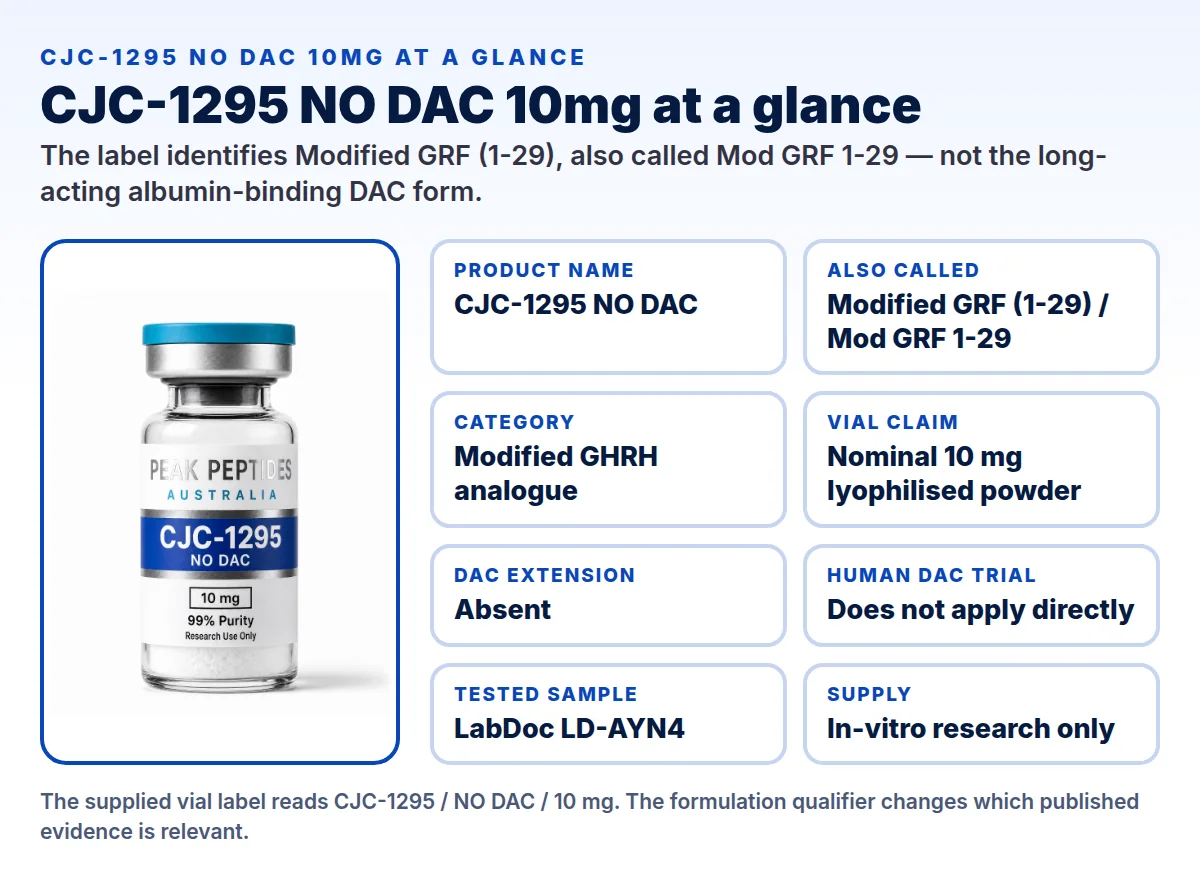
CJC-1295 NO DAC 10mg at a glance
Name on the vial
CJC-1295 NO DAC
Also called
Modified GRF (1-29), Mod GRF 1-29, CJC-1295 without DAC
What it is
A modified growth hormone-releasing hormone analogue for GHRH-pathway research
What it is not
Not growth hormone and not the albumin-binding DAC version
DAC extension
Absent — this is the NO DAC formulation
Vial claim
Nominal 10 mg lyophilised powder
LabDoc sample
LD-AYN4 · sample CJC-1295 (no DAC) · tested 11 September 2026
Identity result
Confirmed by LC-MS
Purity result
99.38% by HPLC · 0.62% related impurities
Content result
9.13 mg by HPLC · 91.3% of 10 mg label claim
Easiest chart maths
2 mL illustrative BAC-water chart = 5 mg/mL nominal concentration
Regulatory status
Not TGA or FDA approved; supplied for in-vitro research only
Dispatch
Same-day from Victoria for in-stock orders after payment confirmation, tracked Australia Post Express
NO DAC means Modified GRF (1-29)
CJC-1295 NO DAC is commonly used for Modified GRF (1-29), also written Mod GRF 1-29. It is a modified GHRH analogue. The supplied label makes the formulation clear: CJC-1295 with NO DAC underneath. That qualifier is not a minor label detail; it decides which research can be compared honestly.
It is not growth hormone
GHRH is a signalling hormone made in the hypothalamus. It acts on GHRH receptors in the anterior pituitary, which is part of the system that releases growth hormone. CJC-1295 NO DAC is described as an upstream GHRH-pathway analogue, not as growth hormone itself and not as a proven health, recovery or performance product.
Why the DAC version is different
DAC is a chemical extension that lets the long-acting CJC-1295 compound bind to albumin, a blood protein. The primary DAC paper describes a reactive group and albumin association that extended time in circulation. This NO DAC product does not include that albumin-binding extension.
Do not transfer the human DAC trial
The 2006 placebo-controlled study examined long-acting CJC-1295 in healthy adults. It reported hormone measurements and an estimated 5.8–8.1 day half-life for that long-acting compound. PeptideDosages and the FDA both distinguish the non-DAC and DAC materials, so those figures do not describe this CJC-1295 NO DAC vial.
Nominal 10 mg, independently tested sample
The 10 mg label is the vial’s nominal mass claim, not a concentration. LabDoc report LD-AYN4 for the tested sample named CJC-1295 (no DAC), dated 11 September 2026, records LC-MS identity confirmed, 99.38% HPLC purity, 9.13 mg content by HPLC and an overall Pass. That report applies to the tested sample only.
What the lab methods show
LC-MS, or liquid chromatography–mass spectrometry, checks the molecule’s identity by mass. HPLC, or high-performance liquid chromatography, separates the sample to measure purity and content. The report records 0.62% related impurities alongside the 99.38% purity result. Its batch field is stated as Not stated.
Related listings are not substitutes
Ipamorelin works through a GHRP-like receptor pathway in the original pharmacology research. Sermorelin and tesamorelin are separate GHRH analogues. Muscle Blend is a separate two-component listing: nominal 5 mg CJC-1295 NO DAC plus 5 mg ipamorelin. None is another name for this individual 10 mg vial.
Australian regulatory status
CJC-1295 is not a TGA-approved medicine and is not included on the ARTG as a medicine. The TGA lists CJC-1295 among examples of unapproved peptide products and states that unapproved peptide products have not been evaluated by the TGA for safety, quality or effectiveness. The FDA also does not list CJC-1295 as an FDA-approved drug.
CJC-1295 NO DAC is a modified growth hormone-releasing hormone analogue. In plain English, it is a short lab-made peptide related to the body’s GHRH signal. The name most often used for the non-DAC material is Modified GRF (1-29), also written Mod GRF 1-29. The vial shown here is labelled CJC-1295 with NO DAC underneath and a nominal 10 mg strength.
The name needs to be read in full. CJC-1295 is also used in research literature for an albumin-binding, long-acting compound. That compound includes DAC, an added chemical group designed to attach to albumin in blood. This product does not carry that extension. The two materials share part of a name but are not a single interchangeable item.
CJC-1295 NO DAC is not growth hormone. GHRH sits upstream of growth hormone in the body’s signalling system. For that reason, a description of receptor signalling is not evidence of a clinical result, a performance result or a reason to transfer results from another peptide. This vial is supplied for in-vitro research only.
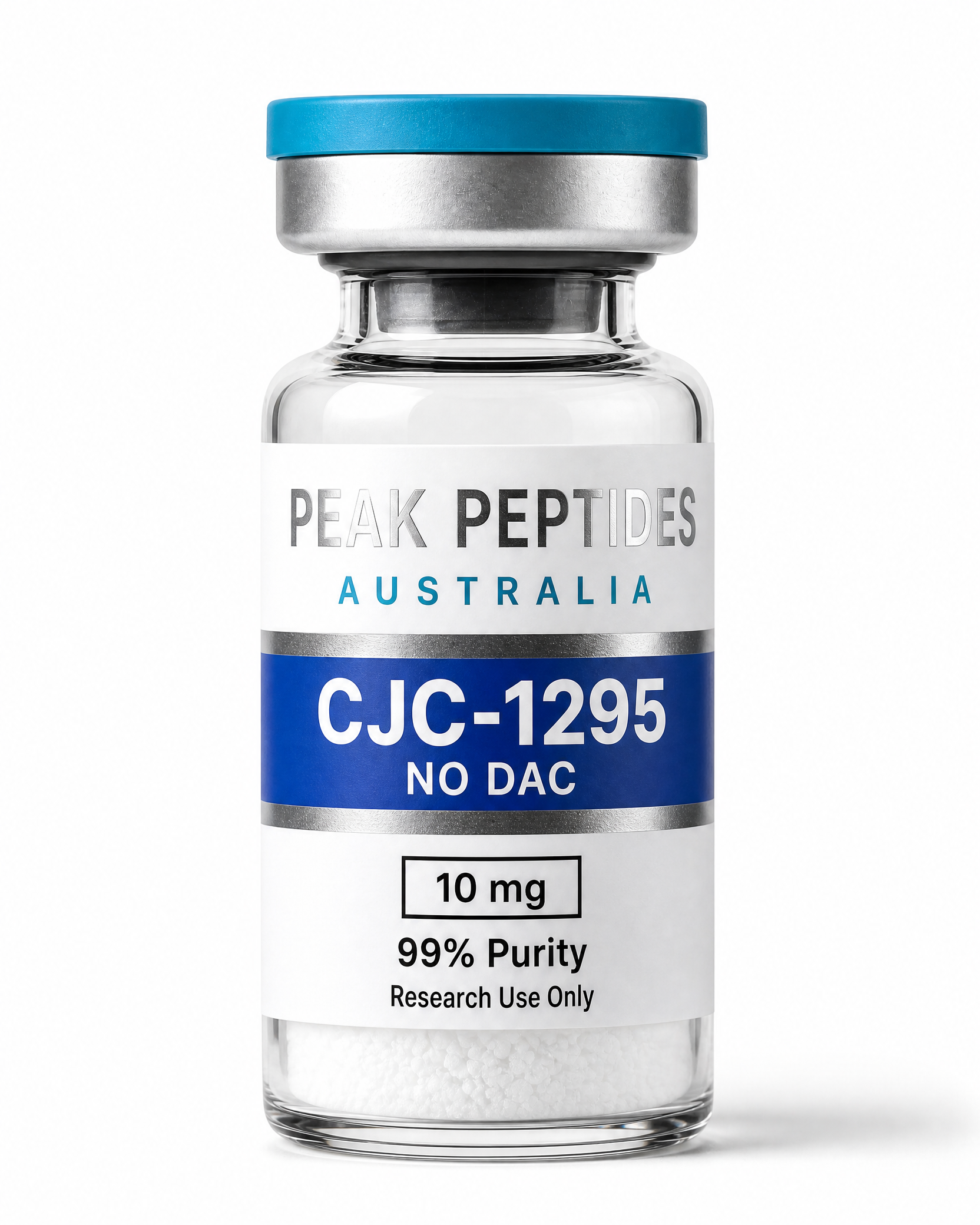
The supplied product label says CJC-1295 / NO DAC / 10 mg. Read the formulation qualifier before comparing research.
How does CJC-1295 NO DAC relate to the GHRH pathway?
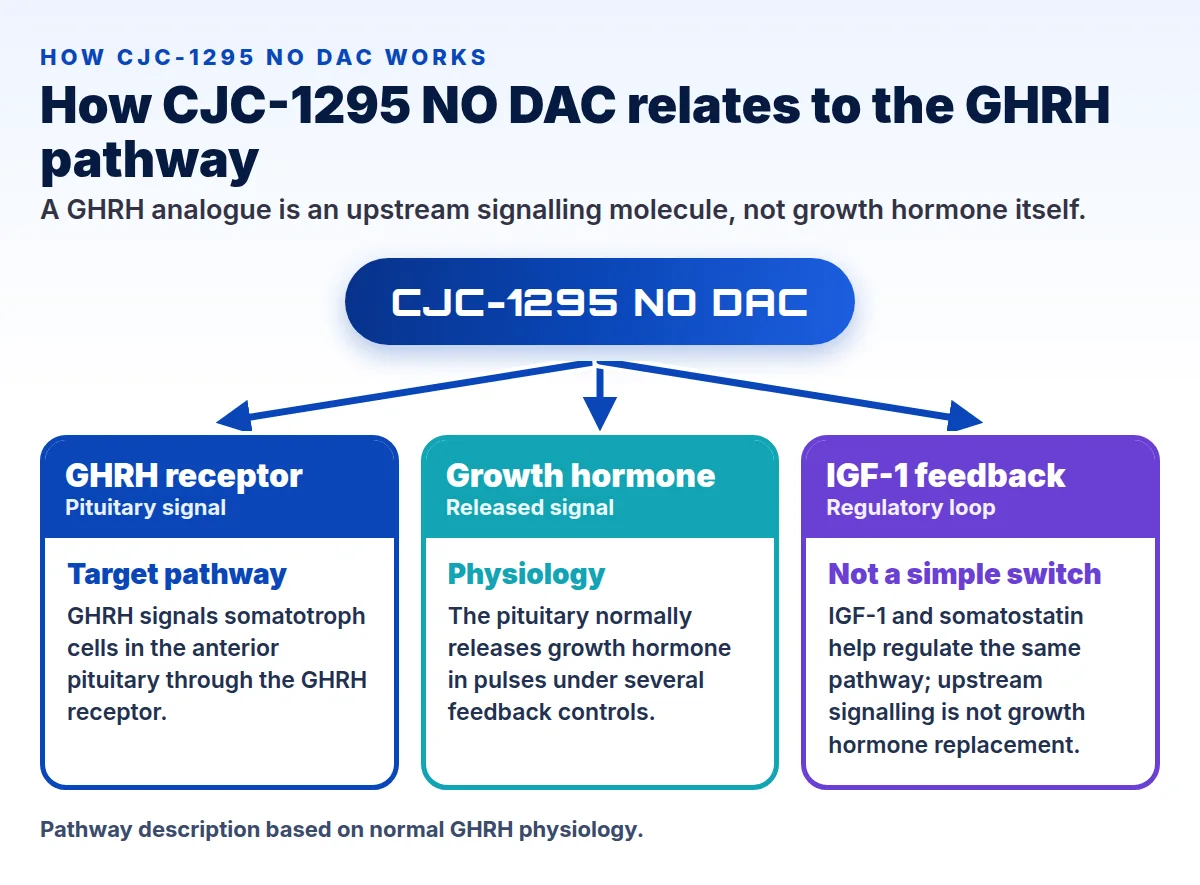
CJC-1295 NO DAC is described as a GHRH-pathway analogue. GHRH means growth hormone-releasing hormone. In normal physiology, GHRH released from the hypothalamus reaches the anterior pituitary and activates GHRH receptors on specialised cells called somatotrophs. Those cells are part of the system that releases growth hormone.
This pathway has checks and balances. Somatostatin acts as an inhibitory signal, while IGF-1 contributes feedback to the wider growth-hormone system. Growth-hormone secretion also varies naturally over time. The useful research distinction is straightforward: an upstream GHRH analogue is not the same molecule as growth hormone itself.
That mechanism explains why CJC-1295 NO DAC is discussed in receptor and pituitary-signalling research. The diagram shows the relationship as more than a simple on/off switch.
CJC-1295 NO DAC is an upstream GHRH-pathway analogue, not growth hormone itself.
What did research find, and what belongs to the DAC form?
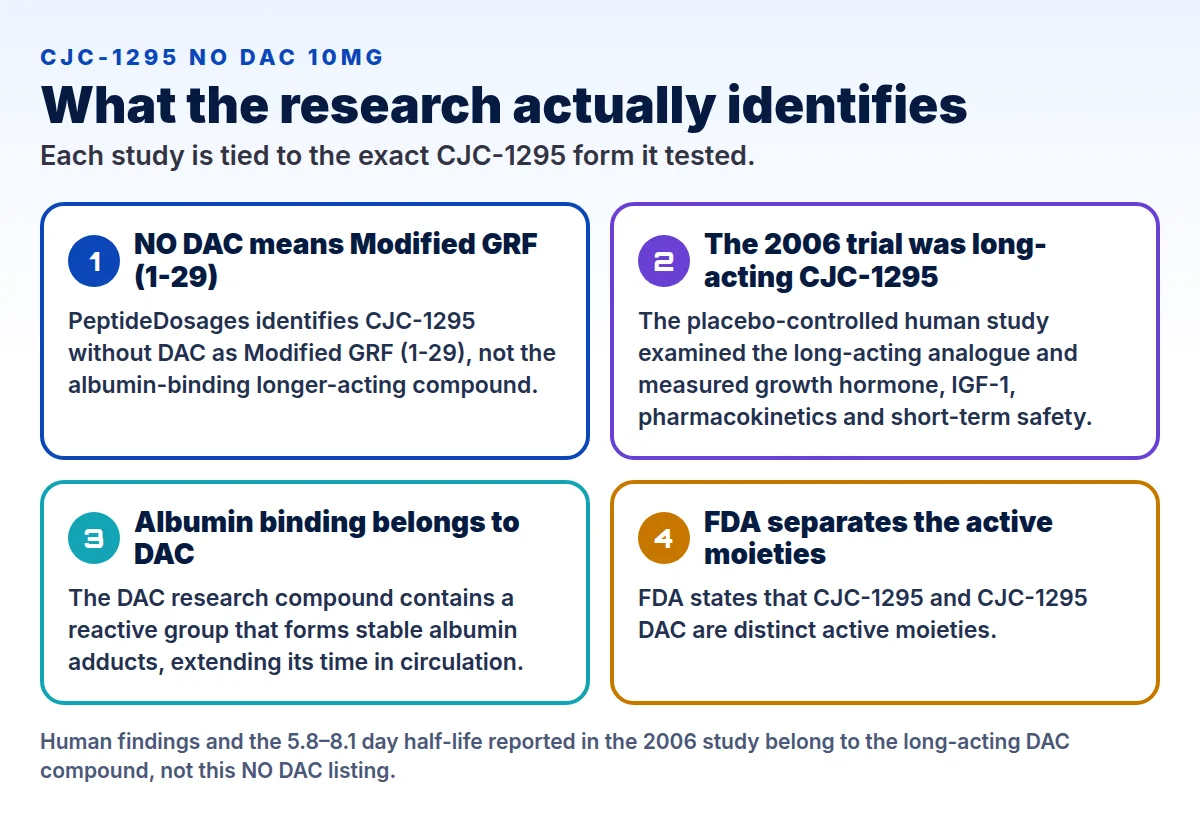
The best-known human CJC-1295 publication is not a study of CJC-1295 NO DAC. Teichman and colleagues published two randomised, placebo-controlled trials in healthy adults in 2006. The paper calls its material a long-acting GHRH analogue and reports measured growth hormone and IGF-1 concentrations, pharmacokinetics and short-term safety across 28- and 49-day trials.
After a single study exposure, that long-acting material produced dose-related increases in mean growth hormone for six or more days and mean IGF-1 for 9–11 days. The reported estimated half-life was 5.8–8.1 days. Those numbers are real findings for the trial’s long-acting CJC-1295, but they are not findings for this NO DAC vial.
The reason is structural. The earlier primary research describes the DAC compound as a modified GHRH1-29 core with a reactive group. That group forms stable albumin adducts and accounts for the extended presence in circulation. FDA’s later review treats CJC-1295 and CJC-1295 DAC as distinct active moieties. This page keeps the DAC trial in its own column.
The central research finding for this page is formulation awareness: NO DAC and DAC evidence must stay separate.
What the commonly cited CJC-1295 human study can and cannot support for this page
What the commonly cited CJC-1295 human study can and cannot support for this page
Question
Answer
Which material was studied?
Long-acting CJC-1295, not the NO DAC formulation listed here
Who was studied?
Healthy adults in two randomised, placebo-controlled trials
What was measured?
Growth hormone, IGF-1, pharmacokinetics and short-term safety
What half-life was reported?
5.8–8.1 days for the long-acting study compound
Does that establish NO DAC timing or outcomes?
No — the formulations are distinct
Source: Teichman et al., 2006; formulation distinction supported by FDA and the primary DAC research.
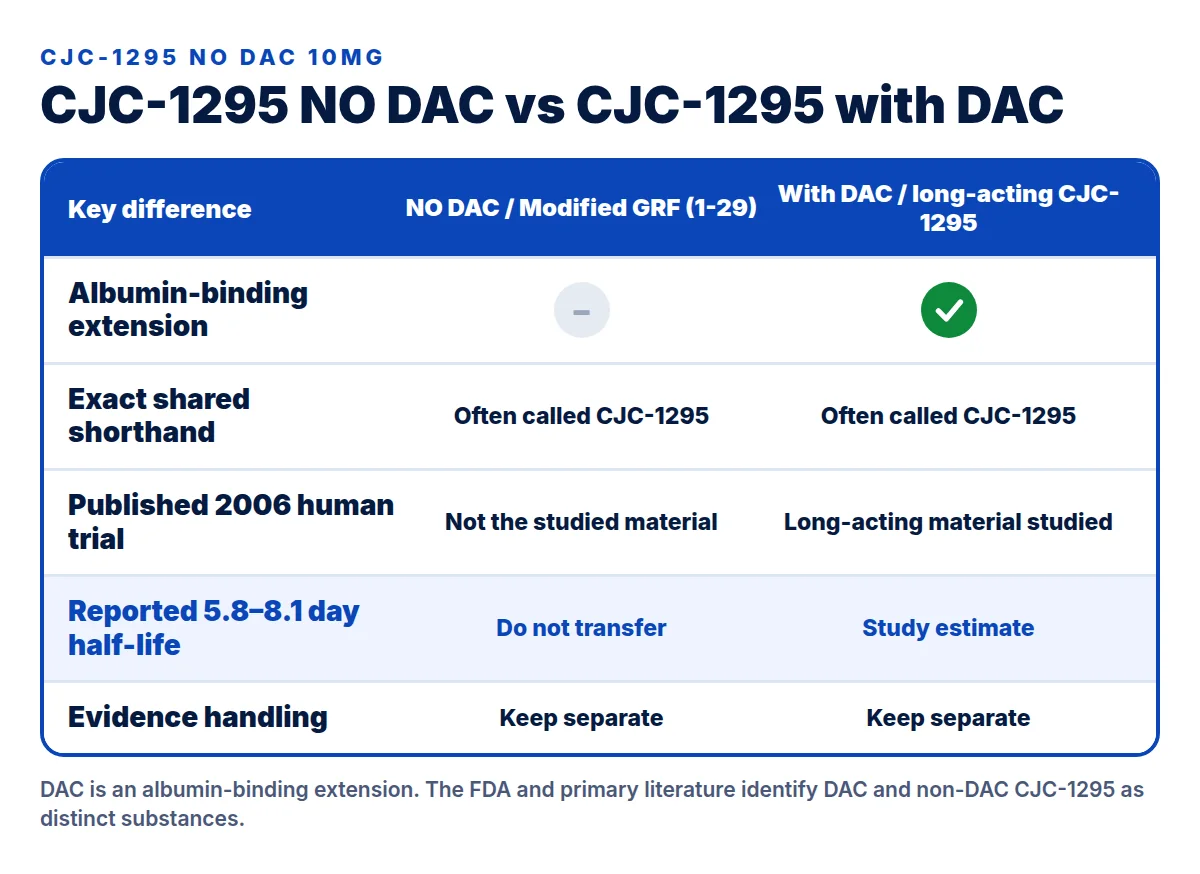
CJC-1295 NO DAC vs CJC-1295 with DAC
CJC-1295 NO DAC and CJC-1295 with DAC are different research materials. The important difference is not simply that one name is longer. DAC, short for drug affinity complex, is the albumin-binding extension used in the long-acting compound. Albumin is a large blood protein. The added group was designed so the DAC peptide could form a stable association with it.
The primary DAC study showed an albumin-linked CJC-1295 immunoreactive species in the circulation after administration in preclinical work. The later human study of long-acting CJC-1295 reported the multi-day half-life figures that are often repeated online. Those figures belong beside DAC, not beside Modified GRF (1-29).
The distinction also changes how a reader handles online claims. A human result, safety finding, concentration, half-life or interval reported for DAC should be labelled as DAC evidence. It should not be presented as proof for this NO DAC vial. The comparison graphic is deliberately simple: the two materials share a label family, but the albumin-binding extension and the matching evidence do not.
DAC adds the albumin-binding feature. The 2006 long-acting study and its half-life estimate belong to the DAC material.
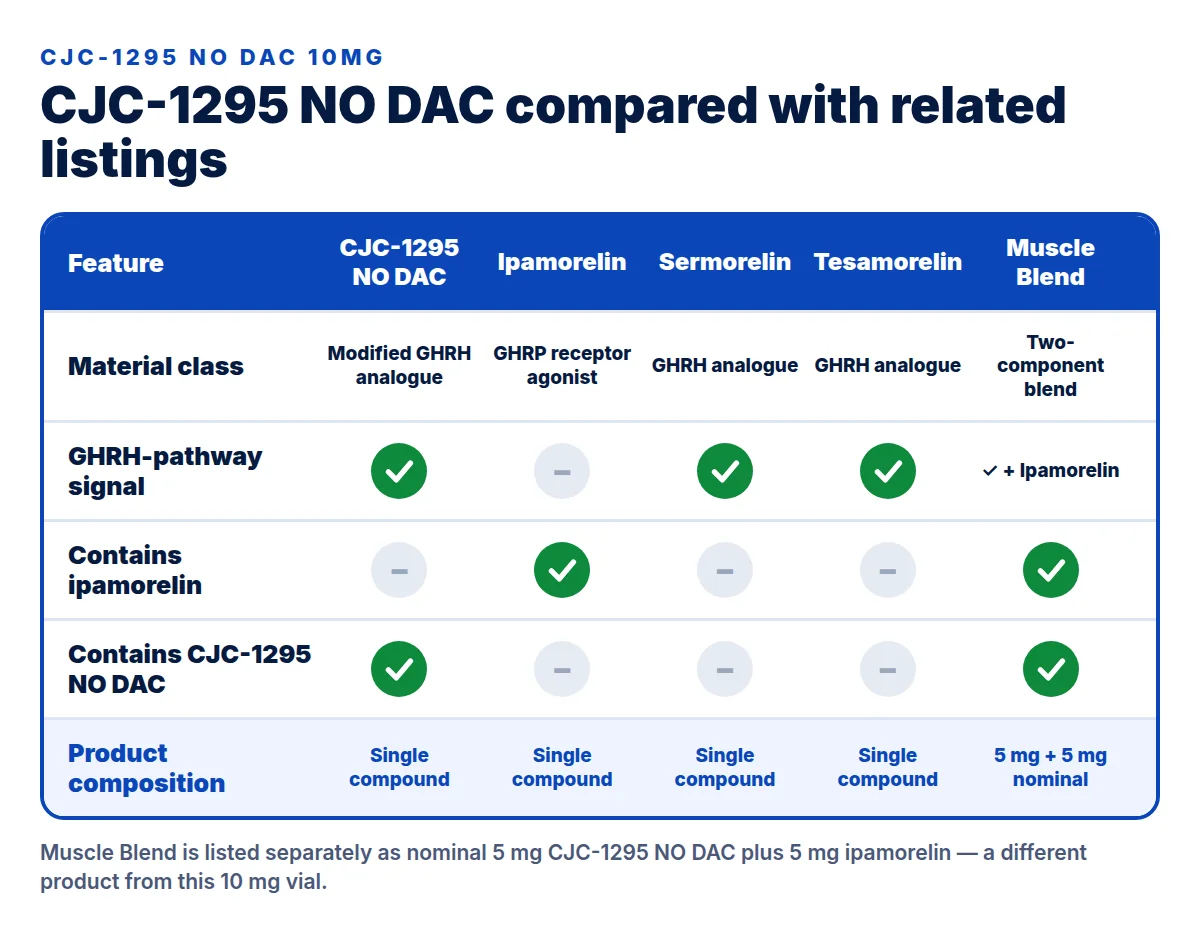
CJC-1295 NO DAC vs Ipamorelin, Sermorelin, Tesamorelin and Muscle Blend
CJC-1295 NO DAC, ipamorelin, sermorelin and tesamorelin are often grouped together because they are discussed around growth-hormone signalling. They are not names for the same molecule. CJC-1295 NO DAC is identified here as Modified GRF (1-29), a modified GHRH analogue. Sermorelin and tesamorelin are separate GHRH analogues with their own product identity and evidence base.
Ipamorelin has a different starting point. The original pharmacology paper describes it as a growth-hormone secretagogue acting through a GHRP-like receptor pathway. That does not make it interchangeable with a GHRH analogue. It does explain why a two-component listing can pair the two distinct materials while still needing its own composition and sample documentation.
Muscle Blend is that separate listing. Its stated composition is nominal 5 mg CJC-1295 NO DAC plus 5 mg ipamorelin. This individual CJC-1295 NO DAC vial instead has a nominal 10 mg single-compound label. A blend’s component ratio, arithmetic and test evidence should be read as blend-specific, not copied onto an individual vial.
Related products sit in different categories. Muscle Blend contains two nominal components, while this page is for the individual CJC-1295 NO DAC vial.
Practical identity check for related Peak Peptides Australia listings
Practical identity check for related Peak Peptides Australia listings
Separate single-compound listing; original pharmacology describes a GHRP-like receptor pathway
Sermorelin 10mg
Separate GHRH analogue listing
Tesamorelin 10mg
Separate GHRH analogue listing
Muscle Blend
Separate dual-component listing: nominal 5 mg CJC-1295 NO DAC plus 5 mg ipamorelin
Read every listing, formulation qualifier and analytical document separately.
Independent lab test for this CJC-1295 NO DAC 10mg sample
This product has a public LabDoc verification record. Report LD-AYN4 names the sample CJC-1295 (no DAC), gives the report date and analysis date as 11 September 2026, and identifies Peak Peptides Australia as the company and origin. The report’s batch entry is Not stated, which is reported here exactly rather than filled in from another source.
For that tested sample, LabDoc records identity confirmed by LC-MS, 99.38% purity by HPLC and 9.13 mg content by HPLC against the 10 mg manufacturer claim. It also lists 91.3% of label claim, 0.62% related impurities and an overall assessment of Pass. These are analytical findings for the tested sample, not an invented guarantee for every current or future vial.
The method names answer different questions. LC-MS checks molecular identity by combining chromatography with mass analysis. HPLC separates compounds in the submitted material to quantify purity and content. The report itself states that it covers the tested sample only and that LabDoc does not sell, supply or endorse products or suppliers.
Report ID: LD-AYN4
Sample: CJC-1295 (no DAC)
Date tested: 11 September 2026
Identity: confirmed by LC-MS
Purity: 99.38% by HPLC
Content: 9.13 mg by HPLC against a 10 mg claim
Related impurities: 0.62%
Batch: Not stated
Overall assessment: Pass
CJC-1295 NO DAC in Australia: status and dispatch
CJC-1295 is not an approved medicine in Australia. The TGA’s April 2026 safety advisory identifies CJC-1295 among examples of unapproved peptide products. The TGA defines unapproved peptide products as goods not included in the Australian Register of Therapeutic Goods and says these products have not been evaluated by the TGA for safety, quality or effectiveness.
The US position is also clear. Drugs@FDA is the FDA database for approved drugs, and CJC-1295 is not listed as an FDA-approved drug. The FDA’s compounding review separates CJC-1295 and CJC-1295 DAC into distinct active moieties. It also notes limited clinical data and safety concerns for CJC-1295-related substances.
Peak Peptides Australia supplies this material for in-vitro research only. Same-day dispatch from Victoria for in-stock orders once payment is confirmed, tracked Australia Post Express, tracking number emailed. Product availability and carrier delivery timing are separate from the research identity and analytical documentation described above.
Step-by-step guide · About 10 minutes
How to reconstitute CJC-1295 NO DAC 10mg (visual handling guide)
CJC-1295 NO DAC 10mg arrives as a dry, freeze-dried powder. Reconstitution means dissolving it with a compatible sterile diluent so the resulting concentration can be calculated. The illustrated 2 mL BAC-water example gives 5 mg/mL from the nominal 10 mg label claim. PeptideDosages states that compatible diluent, volume and storage conditions must be verified for the exact formulation before preparation. Allow about 10 minutes for the visual workflow.
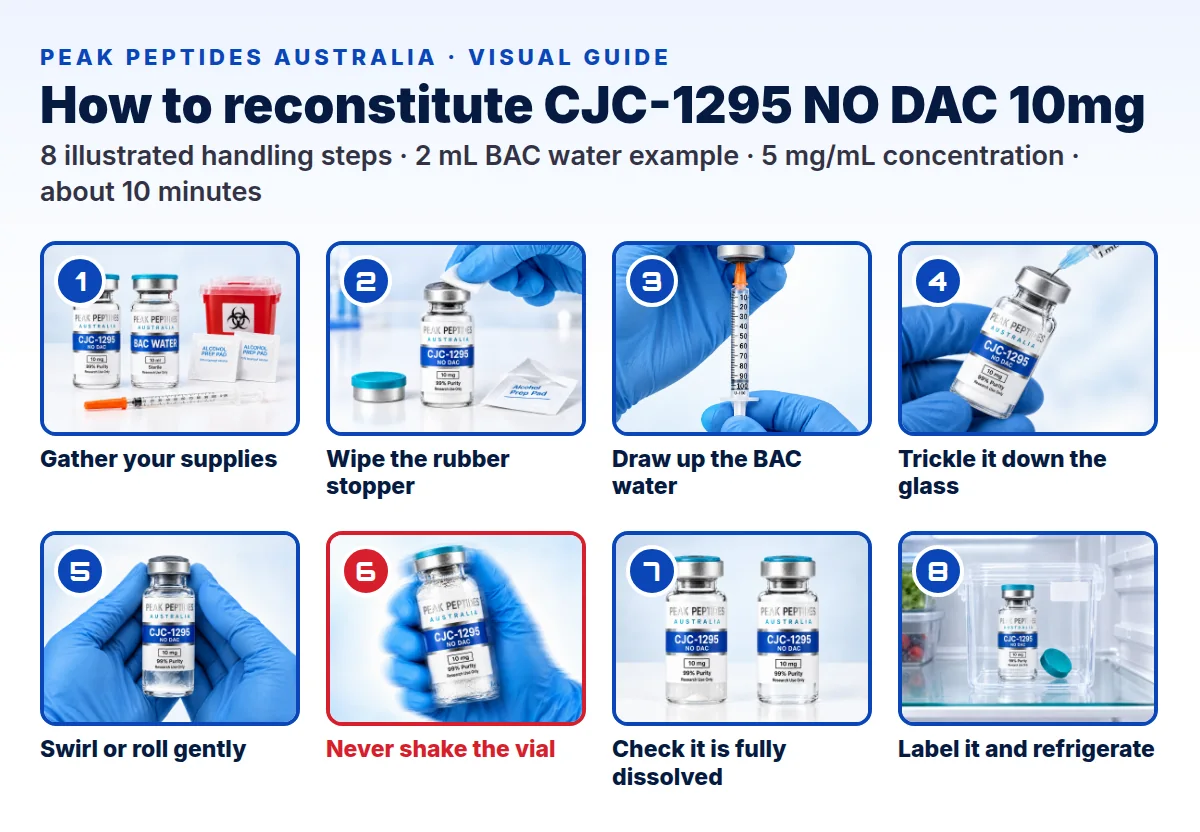
An eight-step general handling workflow for CJC-1295 NO DAC 10mg.
What you need
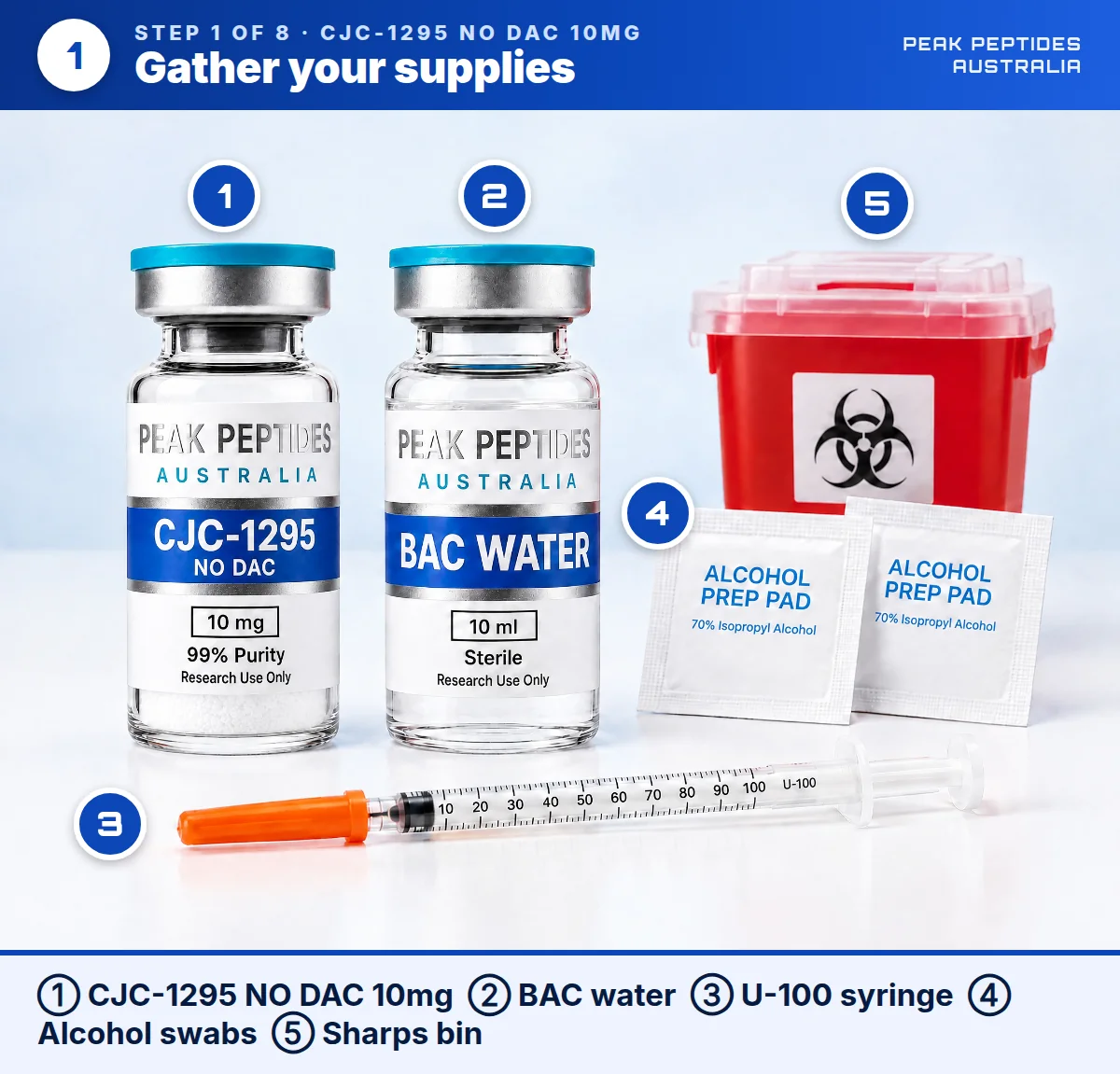
CJC-1295 NO DAC 10mg vialThe labelled freeze-dried research vial; inspect the sealed cap, stopper and powder before use.
Compatible sterile diluentBAC water is used for the concentration worksheet only where compatibility is confirmed for the specific formulation.
1 mL U-100 syringeA U-100 scale represents volume: 100 units equals 1 mL and one unit equals 0.01 mL.
Alcohol swabsUse fresh swabs to disinfect rubber stoppers and let the surface dry before entry.
Clean label and markerRecord the preparation date, diluent and concentration calculation.
Sharps containerPlace used sharps into an appropriate container immediately after laboratory handling.
How much BAC water for CJC-1295 NO DAC 10mg?
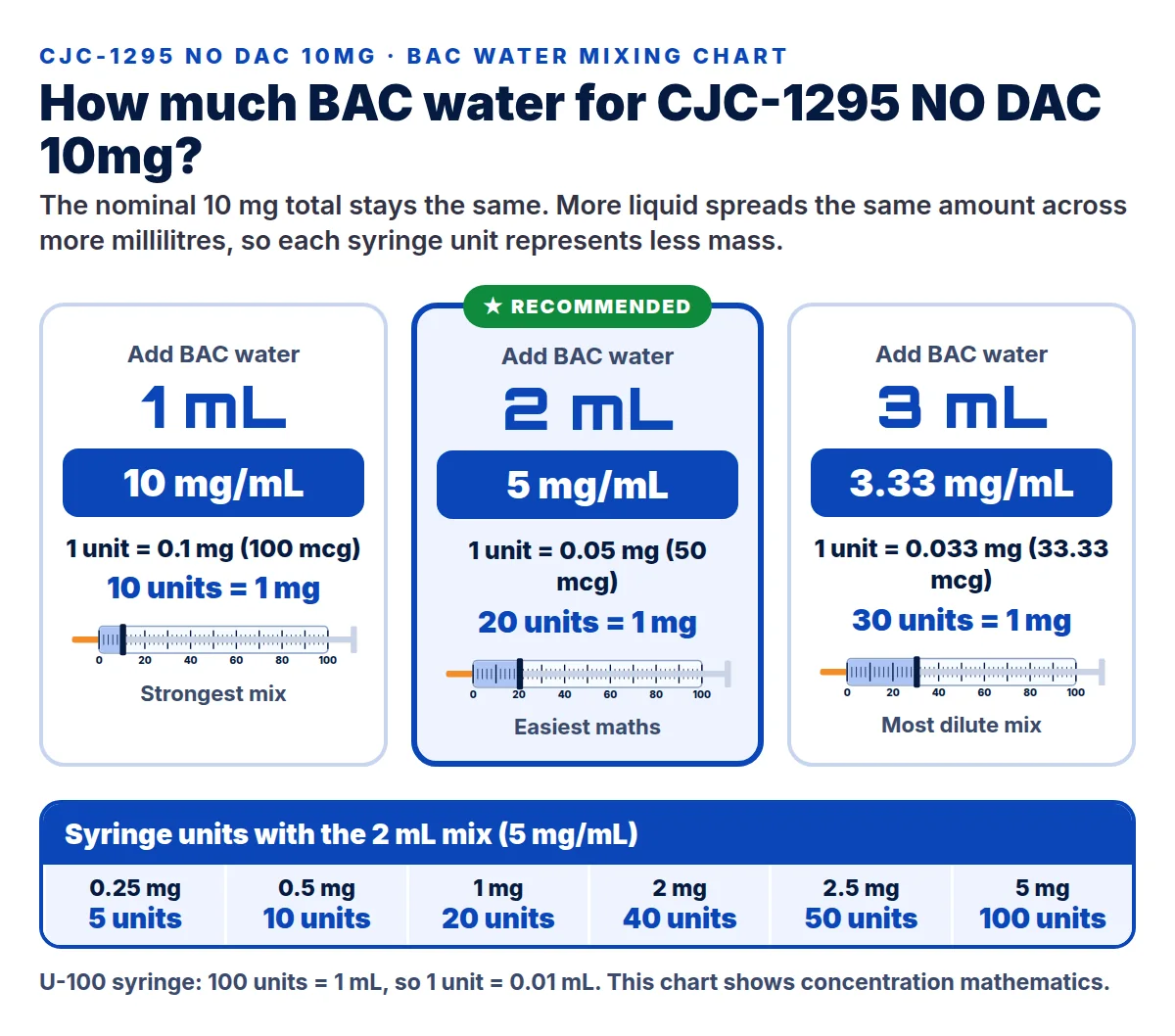
The nominal vial total remains 10 mg in every example. Liquid volume changes concentration, not the amount of labelled material in the vial. With 1 mL, the nominal concentration is 10 mg/mL. With 2 mL, it is 5 mg/mL. With 3 mL, it is 3.33 mg/mL.
The highlighted 2 mL example is simple arithmetic: at 5 mg/mL, 0.20 mL corresponds to 1 mg of nominal vial content. On a U-100 scale, 0.20 mL aligns with 20 units. PeptideDosages notes that diluent compatibility, vial capacity and mixing volume are formulation-specific.
Use the formula concentration = nominal vial amount divided by liquid volume. For a U-100 volume scale, units = required mass divided by concentration per mL, then multiplied by 100. Check the exact formulation’s qualified instructions before preparing any solution.
Nominal concentration maths for a 10 mg vial. The 2 mL example makes the clearest U-100 volume conversion.
CJC-1295 NO DAC 10mg reconstitution chart (U-100 syringe, 1 unit = 0.01 mL)
CJC-1295 NO DAC 10mg reconstitution chart (U-100 syringe, 1 unit = 0.01 mL)
BAC water added
Strength
1 unit holds
Units for 1 mg
Whole vial
1 mL
10 mg/mL
0.1 mg (100 mcg)
10 units
100 units
2 mL
5 mg/mL
0.05 mg (50 mcg)
20 units
200 units
3 mL
3.33 mg/mL
0.033 mg (33.33 mcg)
30 units
300 units
2 mL is highlighted because it gives the simplest concentration maths.
Syringe units with the 2 mL mix (5 mg/mL)
Syringe units with the 2 mL mix (5 mg/mL)
Amount
Units on a U-100 syringe
Volume
0.25 mg
5 units
0.05 mL
0.5 mg
10 units
0.1 mL
1 mg
20 units
0.2 mL
2 mg
40 units
0.4 mL
2.5 mg
50 units
0.5 mL
5 mg
100 units
1 mL
The 8 steps
1Step 1: Gather your supplies
Set out the labelled CJC-1295 NO DAC 10mg vial, compatible sterile diluent, a new appropriately sized syringe, fresh alcohol swabs, a label and a sharps container on a clean laboratory surface. Read the product label and qualified formulation instructions first. Inspect the vial for a sealed stopper, intact crimp and dry powder before opening.
2Step 2: Wipe the rubber stopper
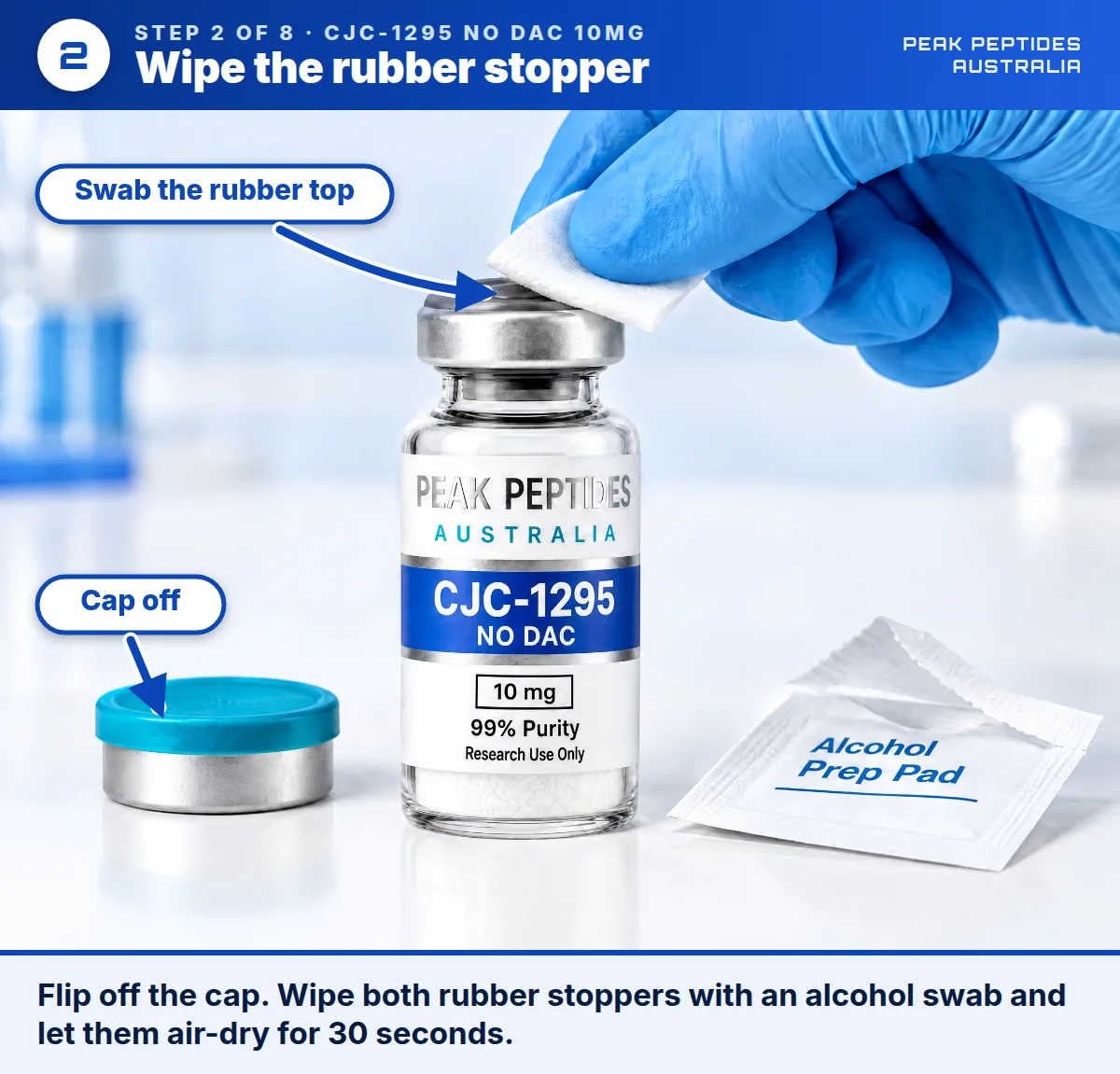
Remove the flip-off cap without touching the rubber stopper. Disinfect the stopper with a fresh alcohol swab and allow it to air-dry. Treat the diluent vial stopper the same way. Do not touch either cleaned surface afterwards. This follows standard septum handling intended to reduce avoidable contamination during vial entry.
3Step 3: Draw up the BAC water
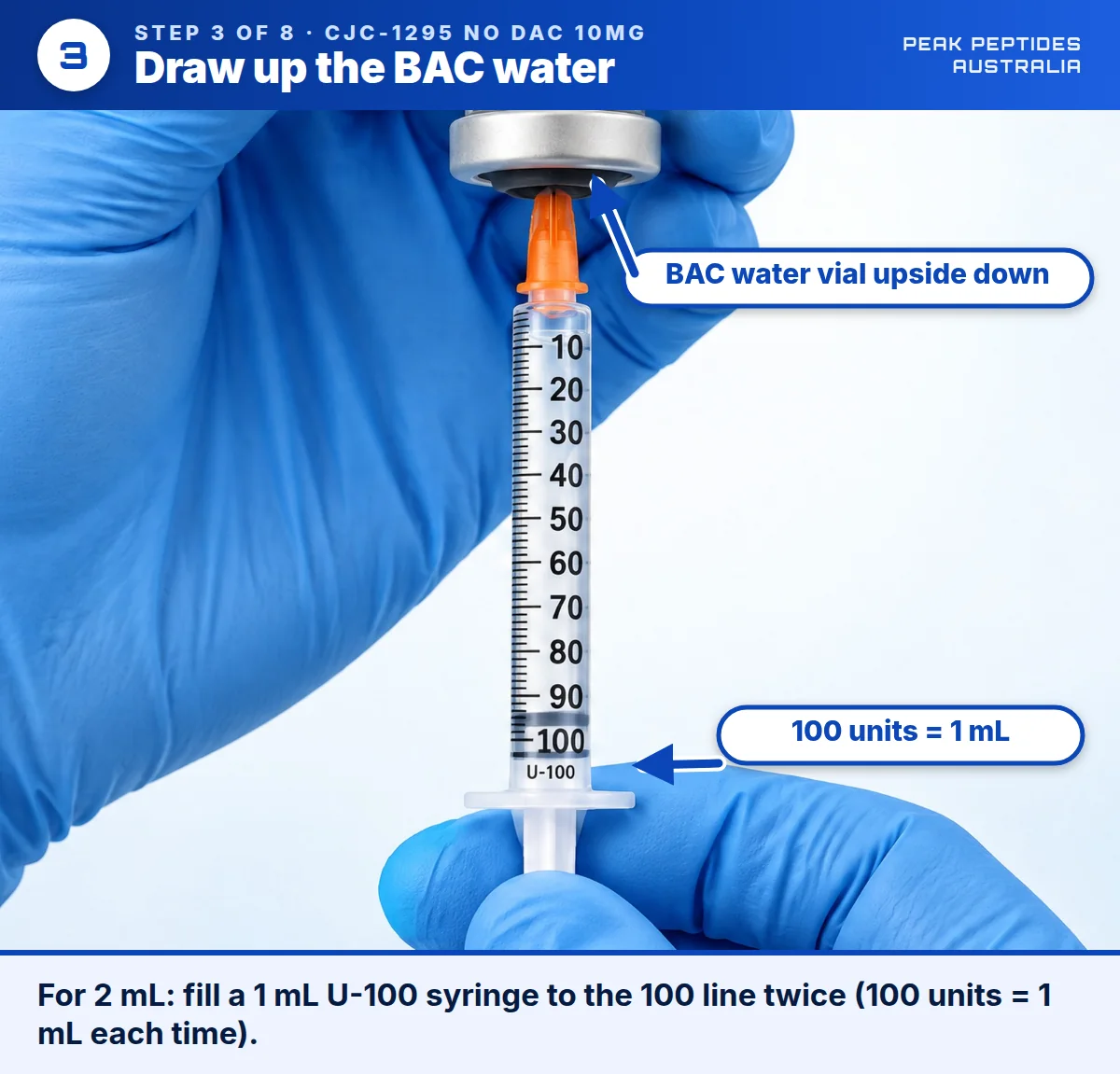
Use the syringe’s printed volume scale to measure the required BAC water volume. On a U-100 syringe, 100 units equals 1 mL. For the illustrated 2 mL concentration example, two separate 1 mL measurements are needed.
4Step 4: Trickle it down the glass
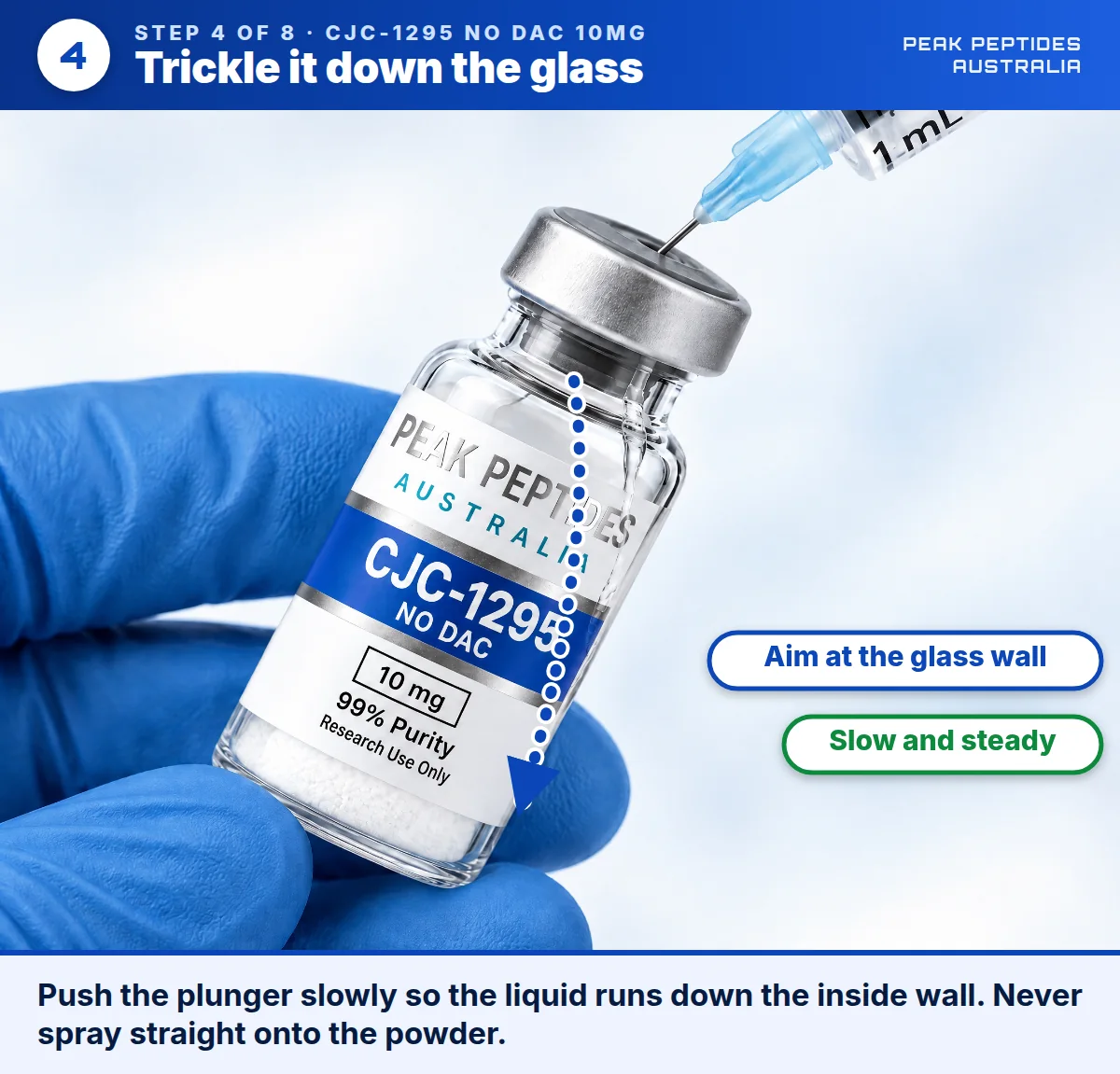
Insert the needle without touching the cleaned stopper area. Add liquid slowly and aim the stream toward the inside glass wall where the formulation’s instructions permit this approach. Avoid forceful addition directly onto the dry material. For a 2 mL worksheet example, repeat the measured addition until the full 2 mL has been transferred.
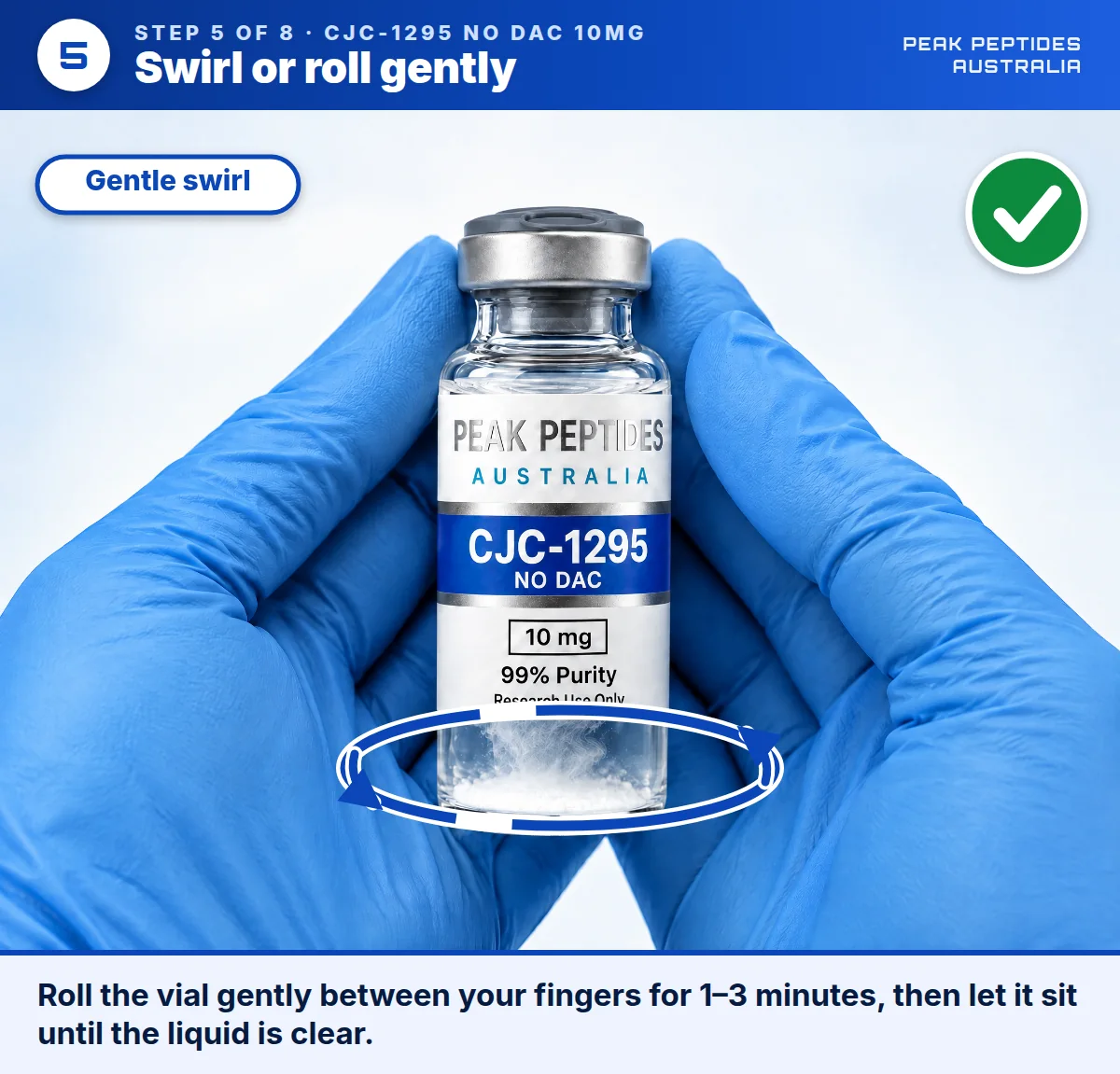
5Step 5: Swirl or roll gently
Use a gentle swirl or roll only when it matches the formulation’s handling instructions. The image shows a little dry material still at the bottom while the vial is moved carefully. Vigorous movement can create bubbles or particles in peptide solutions. Give the material time to dissolve rather than forcing it with a hard shake.
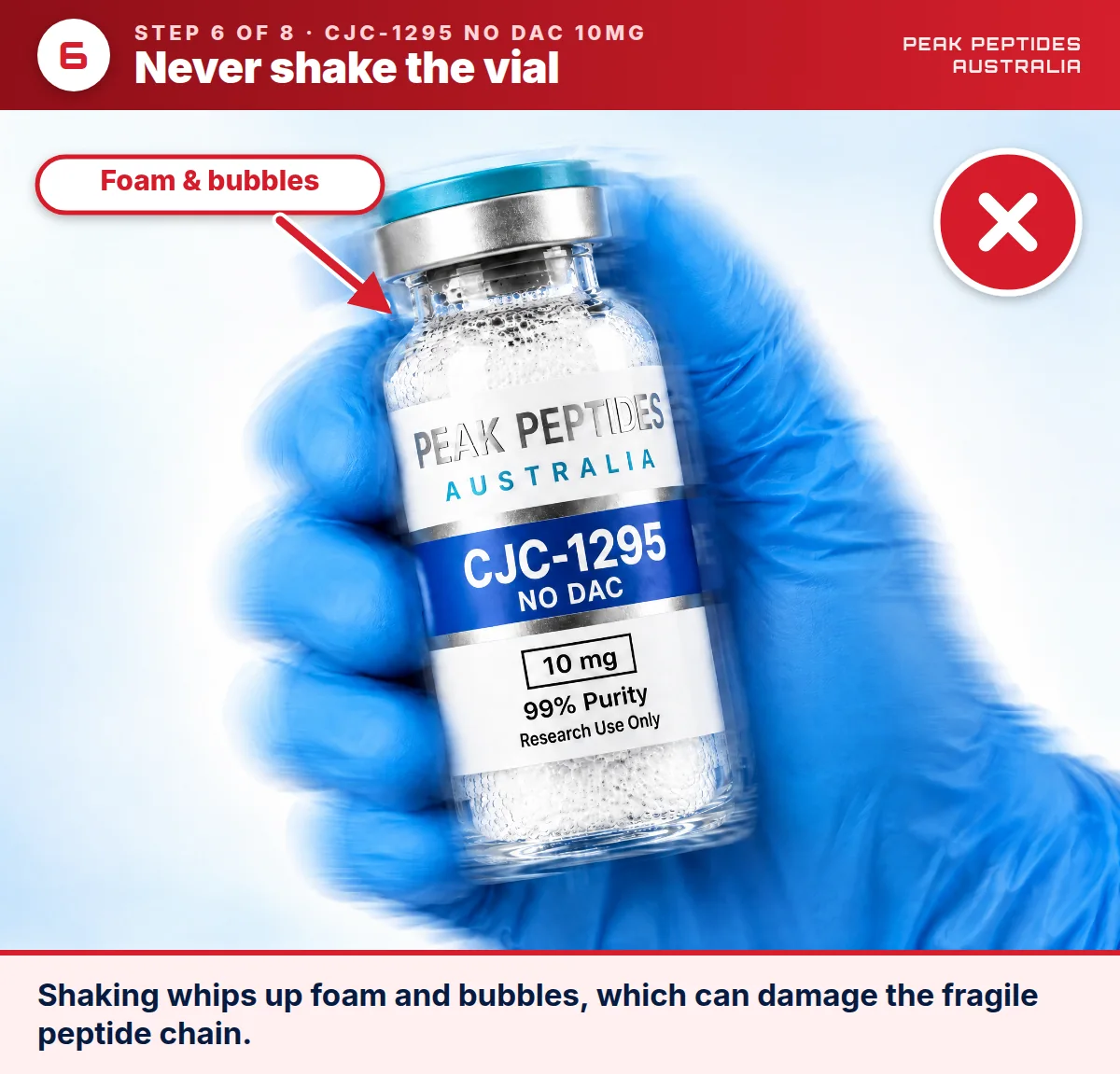
6Step 6: Never shake the vial
Do not shake the vial vigorously. The visual shows why: shaking can create foam and bubbles. General peptide-handling guidance favours gentle mixing where appropriate because mechanical stress can contribute to particle formation. If bubbles appear, set the vial upright and allow them to settle before carrying out a visual inspection.
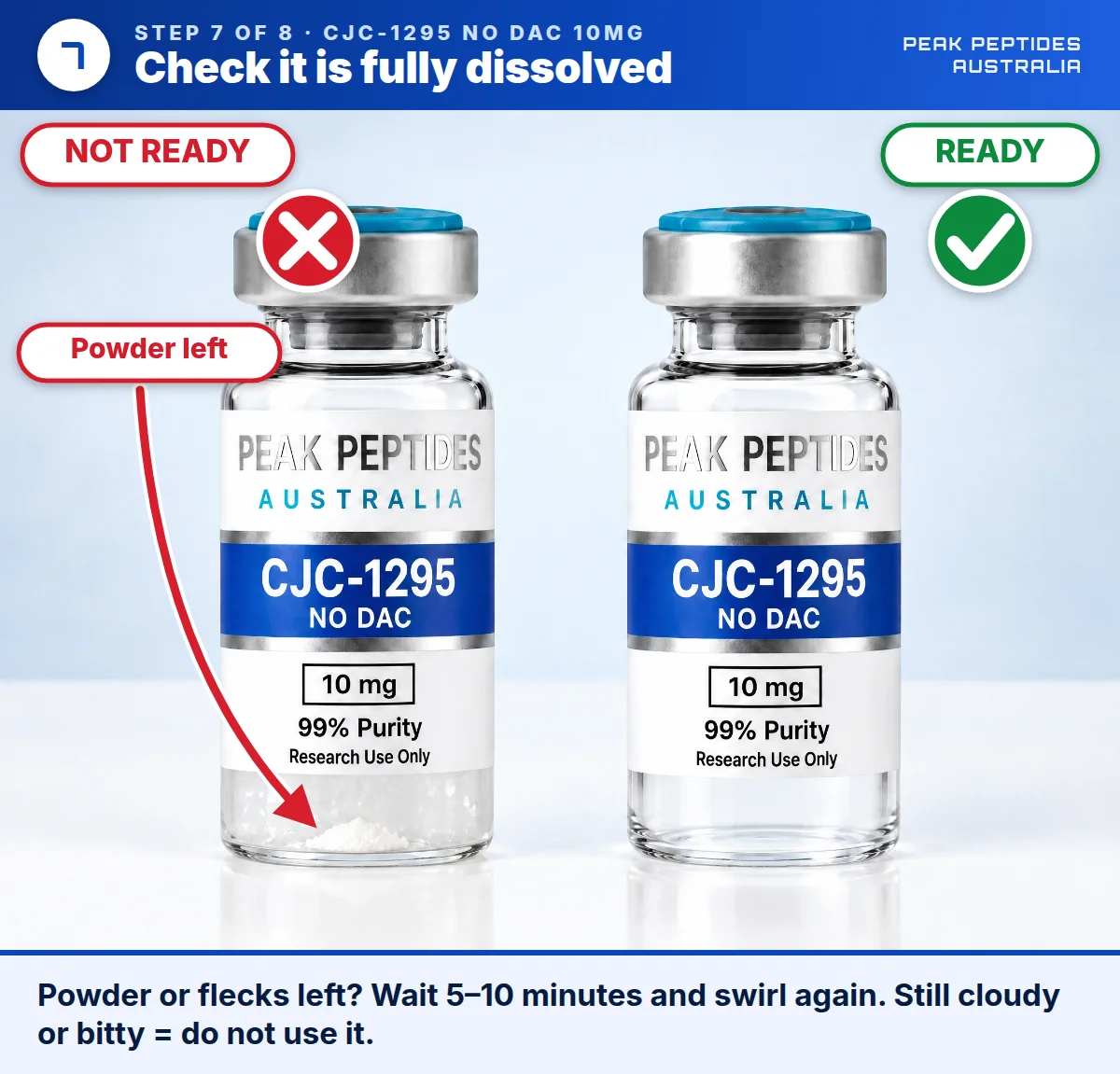
7Step 7: Check it is fully dissolved
Inspect the solution under good light. Compare it with the product description and look for undissolved material, visible particles, unexpected cloudiness, colour change, leakage or stopper damage. The two-vial image shows the difference between visible powder remaining and a clear appearance. Do not treat appearance alone as proof of identity, sterility or potency.
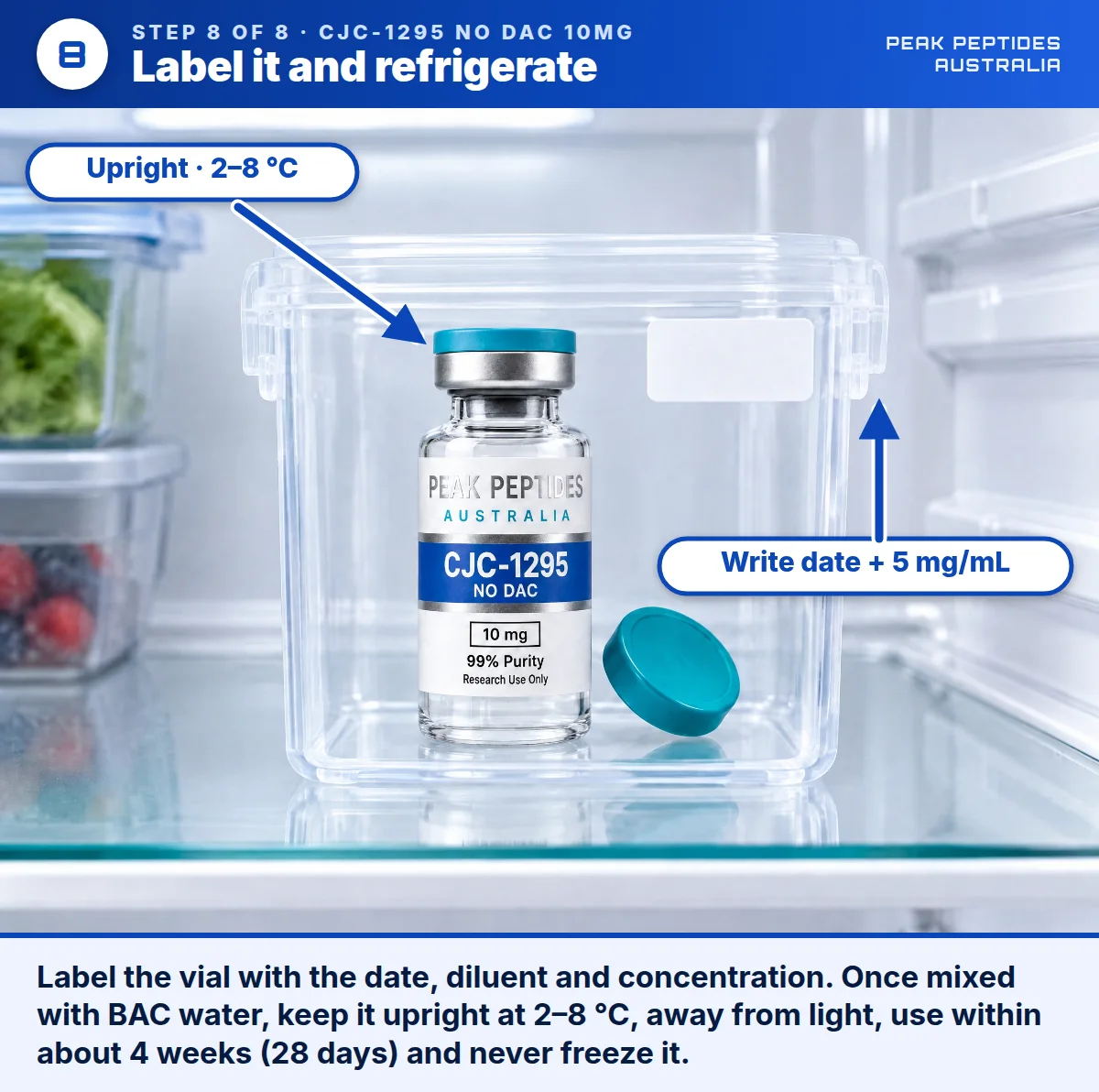
8Step 8: Label it and refrigerate
Label the vial with the preparation date, diluent and calculated concentration. Once mixed with BAC water, keep it upright in the fridge at 2–8 °C, away from light, use it within about 4 weeks (28 days) and never freeze it. The general storage visual shows an upright vial protected in a container.
How to store CJC-1295 NO DAC
CJC-1295 NO DAC 10mg storage principles
CJC-1295 NO DAC 10mg storage principles
Form
Handling principle
Time period
Sealed lyophilised powder
Keep sealed and dry in the fridge at 2–8 °C, protected from light (freezer −20 °C for long-term).
Within about 4 weeks (28 days)
Sealed powder during transport
Avoid heat, moisture and direct light exposure
Within about 4 weeks (28 days)
Reconstituted solution
Keep upright in the fridge at 2–8 °C, away from light; use within about 4 weeks (28 days). Never freeze.
Within about 4 weeks (28 days)
Reconstituted solution
Never freeze it once mixed.
Within about 4 weeks (28 days)
Any vial with particles, cloudiness, colour change, leakage or damaged closure
Keep upright at 2–8 °C; use within about 4 weeks (28 days).
Do not rely on a generic storage chart
Light, moisture, temperature cycling and time in solution can affect peptide quality. Once mixed with BAC water, keep upright at 2–8 °C, away from light. Use within about 4 weeks (28 days); never freeze.
CJC-1295 NO DAC 10mg FAQs — Clear Answers
What is CJC-1295 NO DAC?
CJC-1295 NO DAC is a modified growth hormone-releasing hormone analogue. It is commonly called Modified GRF (1-29) or Mod GRF 1-29. It is a research material for studying the GHRH signalling pathway and is supplied here for in-vitro research only.
What does NO DAC mean on CJC-1295?
NO DAC means this product does not have the drug-affinity-complex extension used by the separately identified long-acting CJC-1295 DAC compound. That DAC extension binds albumin. The two forms are different compounds.
Is CJC-1295 NO DAC the same as Modified GRF (1-29)?
Yes. CJC-1295 without DAC usually refers to Modified GRF (1-29), also written Mod GRF 1-29. Use the NO DAC qualifier whenever comparing sources, listings or analytical reports, because CJC-1295 by itself can refer to the distinct DAC-bearing form.
Is CJC-1295 NO DAC the same as CJC-1295 with DAC?
No. The DAC compound has an albumin-binding extension; CJC-1295 NO DAC does not. FDA describes the non-DAC and DAC active moieties as distinct. They have different pharmacokinetic findings and evidence.
Is CJC-1295 NO DAC growth hormone?
No. CJC-1295 NO DAC is a modified GHRH analogue, whereas growth hormone is the hormone released by the pituitary. GHRH acts upstream at a receptor on pituitary cells. Calling it a GHRH-pathway material does not turn it into growth hormone.
How does CJC-1295 NO DAC work in research?
CJC-1295 NO DAC is used to study GHRH signalling. In normal physiology, GHRH signals receptors on pituitary somatotroph cells, which are involved in growth-hormone release. Somatostatin and IGF-1 feedback help regulate the same system, so it is not a simple one-way switch.
What did the CJC-1295 human study find?
The 2006 study examined long-acting CJC-1295, not CJC-1295 NO DAC. It was a randomised, placebo-controlled study in healthy adults that measured growth hormone, IGF-1, pharmacokinetics and short-term safety over 28 and 49 days. It did not test this NO DAC vial.
What is the half-life of CJC-1295 NO DAC?
This page does not assign a human half-life to CJC-1295 NO DAC because the widely quoted 5.8–8.1 day estimate belongs to the long-acting albumin-binding DAC compound. PeptideDosages specifically warns against presenting a short-form value as if it came from that DAC trial.
What side effects have been reported for CJC-1295?
FDA notes that available clinical data are limited and lists concerns about immunogenicity and peptide-related impurities for CJC-1295. Its safety summary identifies reports including increased heart rate and systemic vasodilatory reaction. This does not create a precise rate for CJC-1295 NO DAC, which is a distinct material.
Is CJC-1295 NO DAC approved by the TGA or FDA?
No. CJC-1295 is not an approved medicine on the Australian Register of Therapeutic Goods, and it is not an FDA-approved drug. The TGA names CJC-1295 as an example of an unapproved peptide product that has not been evaluated by the TGA for safety, quality or effectiveness.
Can I buy CJC-1295 NO DAC 10mg online in Australia?
CJC-1295 NO DAC 10mg is listed by Peak Peptides Australia as a research product. Same-day dispatch from Victoria for in-stock orders once payment is confirmed, tracked Australia Post Express, tracking number emailed. It is supplied for in-vitro research only.
How fast is CJC-1295 NO DAC dispatch in Australia?
Same-day dispatch from Victoria for in-stock orders once payment is confirmed, tracked Australia Post Express, tracking number emailed. Carrier transit timing depends on the Australia Post service and destination after the parcel is dispatched.
How do I know this CJC-1295 NO DAC sample is documented?
Check the public LabDoc report. LD-AYN4 identifies the tested sample as CJC-1295 (no DAC), lists Peak Peptides Australia as the company and records the test date, identity, purity, content and overall assessment. LabDoc states that its result covers the tested sample only.
What does LabDoc report LD-AYN4 show?
LabDoc LD-AYN4, tested 11 September 2026, records identity confirmed by LC-MS, 99.38% purity by HPLC and 9.13 mg content by HPLC against a 10 mg manufacturer claim. It also lists 91.3% of label claim, 0.62% related impurities, Pass overall assessment and batch Not stated.
What does 10 mg mean on CJC-1295 NO DAC?
10 mg is the product’s nominal mass claim for the freeze-dried vial. It is not a concentration. Concentration appears only after a compatible liquid and volume are specified. The tested LD-AYN4 sample measured 9.13 mg against the 10 mg claim.
How much BAC water for CJC-1295 NO DAC 10mg?
The chart shows concentration maths for 1 mL, 2 mL and 3 mL of BAC water. With a nominal 10 mg vial, those calculate to 10 mg/mL, 5 mg/mL and 3.33 mg/mL.
How many units is 1 mg with the 2 mL CJC-1295 NO DAC chart?
With the illustrative 2 mL chart, the nominal 10 mg total calculates to 5 mg/mL. On a U-100 syringe, 1 mg therefore occupies 0.20 mL, which aligns with 20 units. This is a volume conversion only and depends entirely on that 2 mL example.
How many mg are in 10 units with the 2 mL CJC-1295 NO DAC chart?
With the illustrative 2 mL chart, 10 units equals 0.10 mL. At 5 mg/mL, that volume contains 0.5 mg of nominal vial content. With 1 mL or 3 mL of liquid, the amount represented by the same 10-unit marking changes.
How do I reconstitute CJC-1295 NO DAC 10mg?
The photo guide shows a general laboratory sequence: prepare clean supplies, disinfect rubber stoppers, measure the compatible diluent, add it slowly, mix gently, inspect the solution, label the vial and store it upright in the fridge at 2–8 °C, away from light.
Can I use tap water or distilled water instead of BAC water?
No. Tap water and consumer distilled water are not sterile diluents for this purpose. PeptideDosages explains that bacteriostatic water, sterile water and saline are different diluents; compatibility depends on the individual formulation, its preservative sensitivity and its instructions.
What if the CJC-1295 NO DAC powder does not dissolve?
Avoid forceful shaking. Allow the vial to stand, handle it gently and inspect it under good light. Discard the solution if you see persistent cloudiness, particles, unexpected colour, leakage or stopper damage.
Should reconstituted CJC-1295 NO DAC be cloudy?
A solution should be inspected for visible particles, unexpected cloudiness or colour change against the product description. Appearance alone cannot prove identity, sterility or potency, but persistent cloudiness or particles are not a reason to assume the material is suitable.
How long does reconstituted CJC-1295 NO DAC last?
Once mixed with BAC water, keep it upright in the fridge at 2–8 °C, away from light. Use it within about 4 weeks (28 days) and never freeze it. Write the date and strength on the vial.
How should I store CJC-1295 NO DAC powder?
Keep the sealed freeze-dried vial dry and dark at 2–8 °C (−20 °C for long-term storage). PeptideDosages explains that storage life depends on the peptide, formulation, container and conditions.
Can I freeze reconstituted CJC-1295 NO DAC?
The PeptideDosages storage guide says freezing a reconstituted peptide can damage its structure. Once mixed with BAC water, keep it upright in the fridge at 2–8 °C, away from light, use it within about 4 weeks (28 days) and never freeze it.
What does a COA or LabDoc report show?
A sample report records what a laboratory measured for the submitted sample. LD-AYN4 records identity by LC-MS, purity and content by HPLC, the test date and overall assessment. A laboratory result is sample-specific; it does not automatically prove the same values for every future vial.
How is CJC-1295 NO DAC different from ipamorelin?
CJC-1295 NO DAC is a modified GHRH analogue. The original ipamorelin pharmacology paper describes a different, GHRP-like receptor pathway. They are different molecules and should not be considered equivalent. Muscle Blend combines nominal CJC-1295 NO DAC and ipamorelin as separate components.
How is CJC-1295 NO DAC different from sermorelin and tesamorelin?
Sermorelin and tesamorelin are separate GHRH analogues, not alternative names for CJC-1295 NO DAC or Modified GRF (1-29). Product names, structures, analytical documentation and published evidence need to be checked one by one; a GHRH-pathway label does not make the products interchangeable.
What is in Muscle Blend compared with this CJC-1295 NO DAC vial?
This listing is a single-compound nominal 10 mg CJC-1295 NO DAC vial. Muscle Blend is a different listing containing nominal 5 mg CJC-1295 NO DAC plus 5 mg ipamorelin. Its composition, concentration arithmetic and sample evidence must be assessed separately.