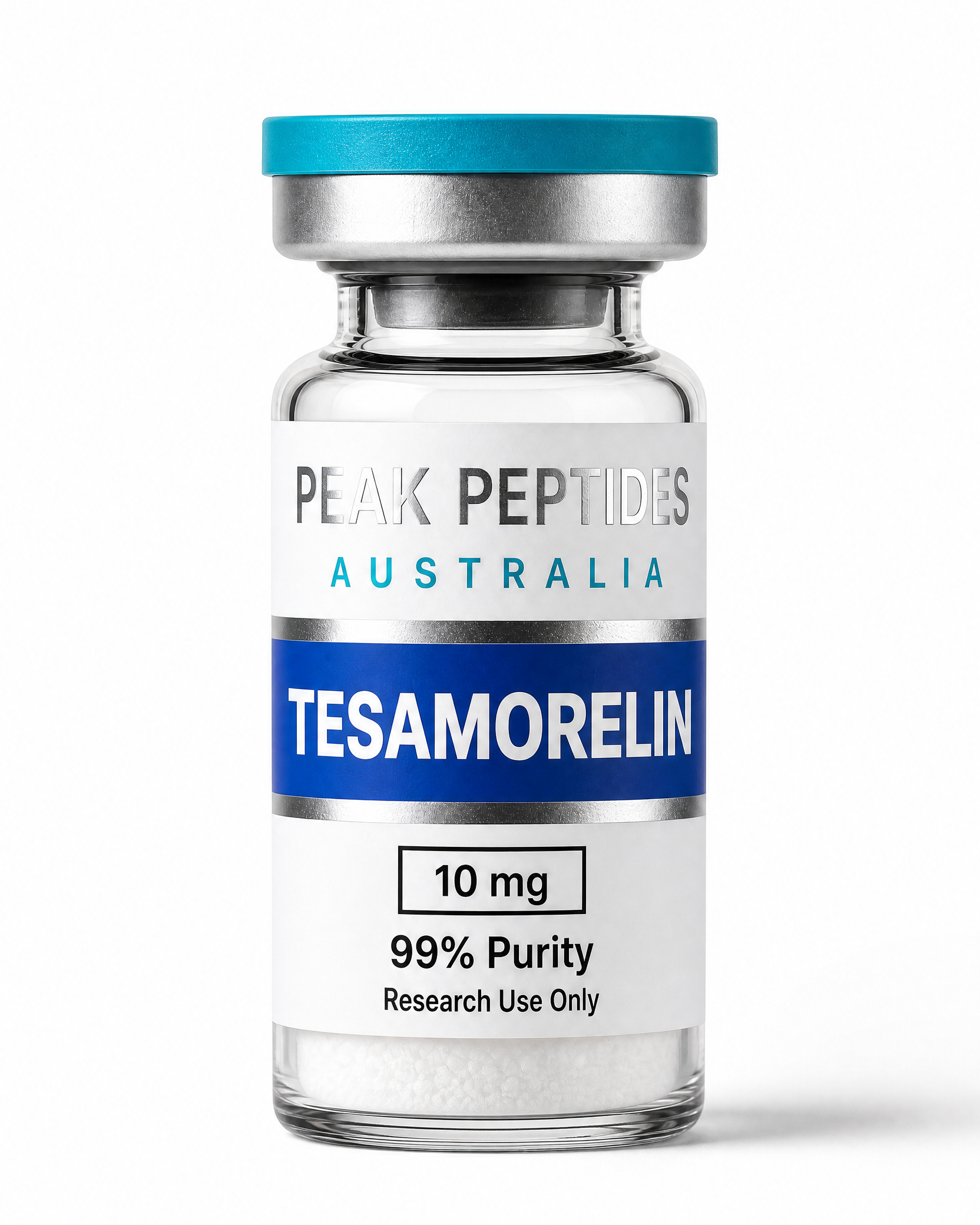
Tesamorelin 10mg is a synthetic growth hormone-releasing hormone (GHRH) analogue for pituitary-signalling research. This freeze-dried research sample is supported by a LabDoc report for identity, purity and content. In-stock orders receive same-day dispatch from Victoria after payment confirmation, with tracked Australia Post Express shipping Australia-wide.
Product Specifications
Full NameTesamorelin (GHRH Analog)
Vial Size10mg
Purity99.61% HPLC (LD-SHXT, 9.16mg sample)
Legal Disclaimer
This product is sold strictly for in-vitro laboratory research purposes only. It is not intended for human or animal consumption, injection, or any diagnostic or therapeutic use.
GHRH analogue · 10mg research vial · LabDoc verified
Tesamorelin 10mg — What It Is, Research Findings & How to Reconstitute It
Tesamorelin is a synthetic analogue of growth hormone-releasing hormone, usually shortened to GHRH. It is also known by the research code TH9507. GHRH is the signalling peptide that tells the pituitary gland to release growth hormone; tesamorelin follows that same receptor pathway and clinical studies measured changes in growth hormone and IGF-1. This vial has a 10mg label claim and contains freeze-dried powder for research. Its tested sample is documented by LabDoc report LD-SHXT: identity confirmed by LC-MS, 99.61% purity by HPLC and 9.16mg measured content. This page separates the published evidence for FDA-approved EGRIFTA formulations from this separate 10mg research vial, compares Tesamorelin with Sermorelin and CJC-1295 NO DAC, and gives a clear 8-step BAC-water mixing guide. Peak Peptides Australia supplies it for in-vitro research only.
Also referred to in research or catalogue references as Tesamorelin, TH9507, TH-9507, Tesamorelin 10mg, Tesamorelin 10 mg, Tesamorelin peptide, Tesamorelin GHRH analogue, GHRH(1-44).
3 mL BAC water = about 3.33 mg/mL; 30 units = 1 mg
Powder storage
Refrigerated at 2–8 °C, protected from light
Dispatch
Same-day from Victoria for in-stock orders once payment is confirmed, tracked Australia Post Express
A 44-amino-acid GHRH analogue
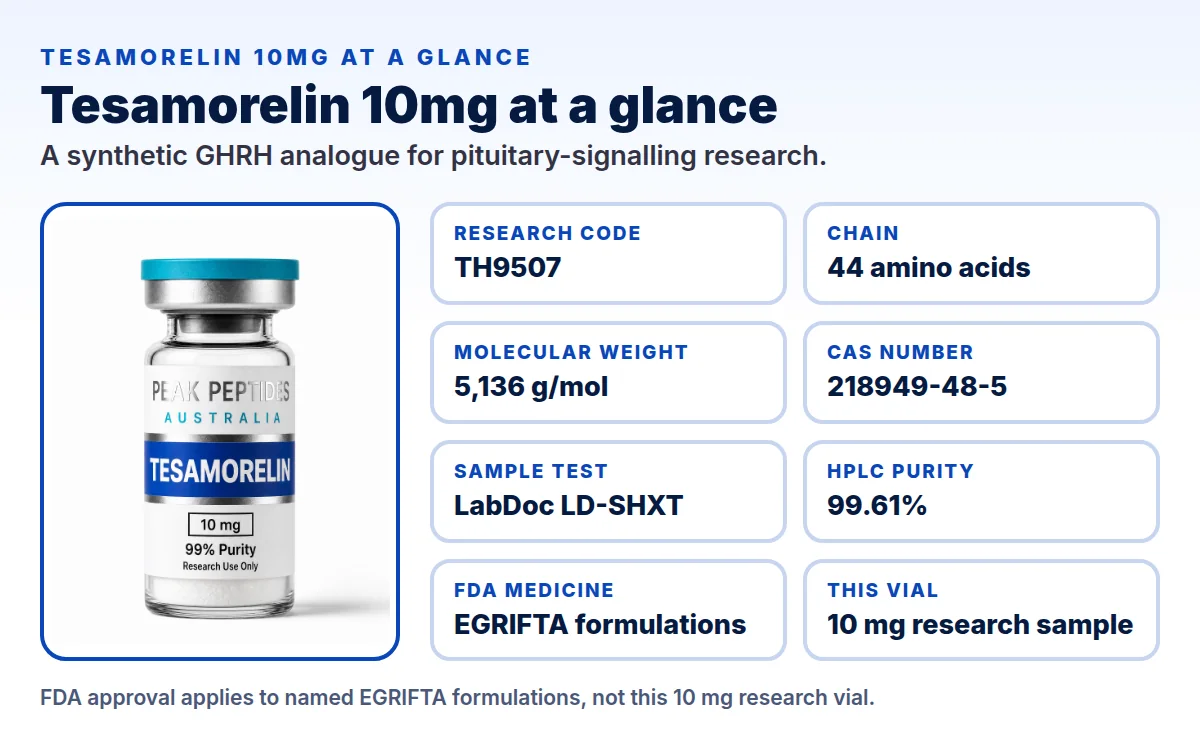
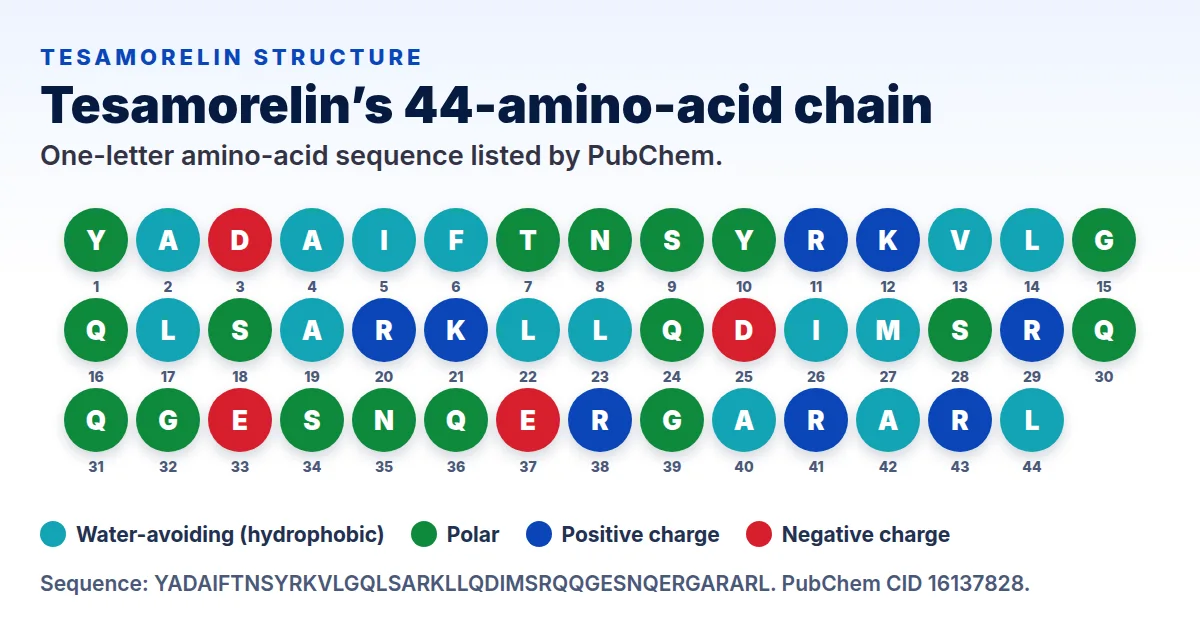
Tesamorelin is a synthetic 44-amino-acid analogue of growth hormone-releasing hormone. PubChem lists the sequence YADAIFTNSYRKVLGQLSARKLLQDIMSRQQGESNQERGARARL, molecular formula C221H366N72O67S, molecular weight 5,136 g/mol and CAS number 218949-48-5.
A pituitary-signalling research molecule
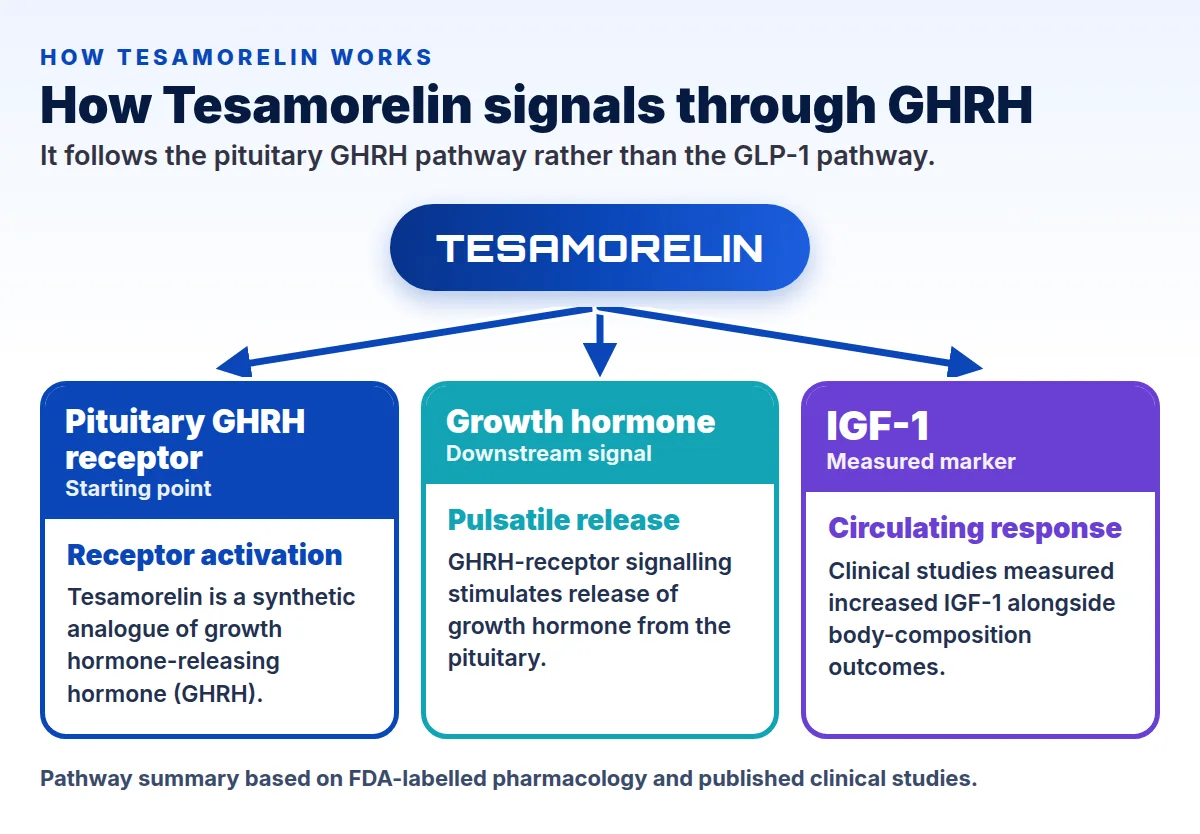
Tesamorelin acts through the pituitary GHRH receptor, which stimulates growth-hormone release and increases IGF-1. It is not a GLP-1 compound and it is not a direct growth-hormone preparation. IGF-1 is insulin-like growth factor 1, a downstream blood marker measured in the clinical studies.
What the main studies actually measured
The pivotal studies enrolled adults with HIV receiving antiretroviral treatment and excess abdominal fat. Researchers used CT scans to measure visceral adipose tissue: deep fat around abdominal organs. That is different from total body-weight change or a general body-fat claim.
A verified FDA medicine exists — but it is not this vial
Tesamorelin is FDA-approved in the United States as EGRIFTA formulations for reducing excess abdominal fat in adults with HIV-associated lipodystrophy. The FDA states that EGRIFTA is not indicated for weight-loss management. EGRIFTA WR and EGRIFTA SV have their own labelled strengths, supplied diluents, mixing instructions and storage rules; those directions do not transfer to this 10mg research vial.
Independent LabDoc evidence for this sample
LabDoc report LD-SHXT, tested 23 September 2026, records confirmed identity by LC-MS, 99.61% purity by HPLC and 9.16mg HPLC content against the 10mg claim (91.6%). The report’s overall assessment is Pass and its batch field states ‘Not stated’. These findings describe the tested sample.
3 mL is the PeptideDosages reference mix
PeptideDosages uses 3 mL bacteriostatic water for a 10mg Tesamorelin vial, giving about 3.33 mg per mL. On a U-100 syringe, where 100 units is 1 mL, 1 mg measures 30 units and 10 units represents about 0.33 mg.
Related GHRH listings, different compounds
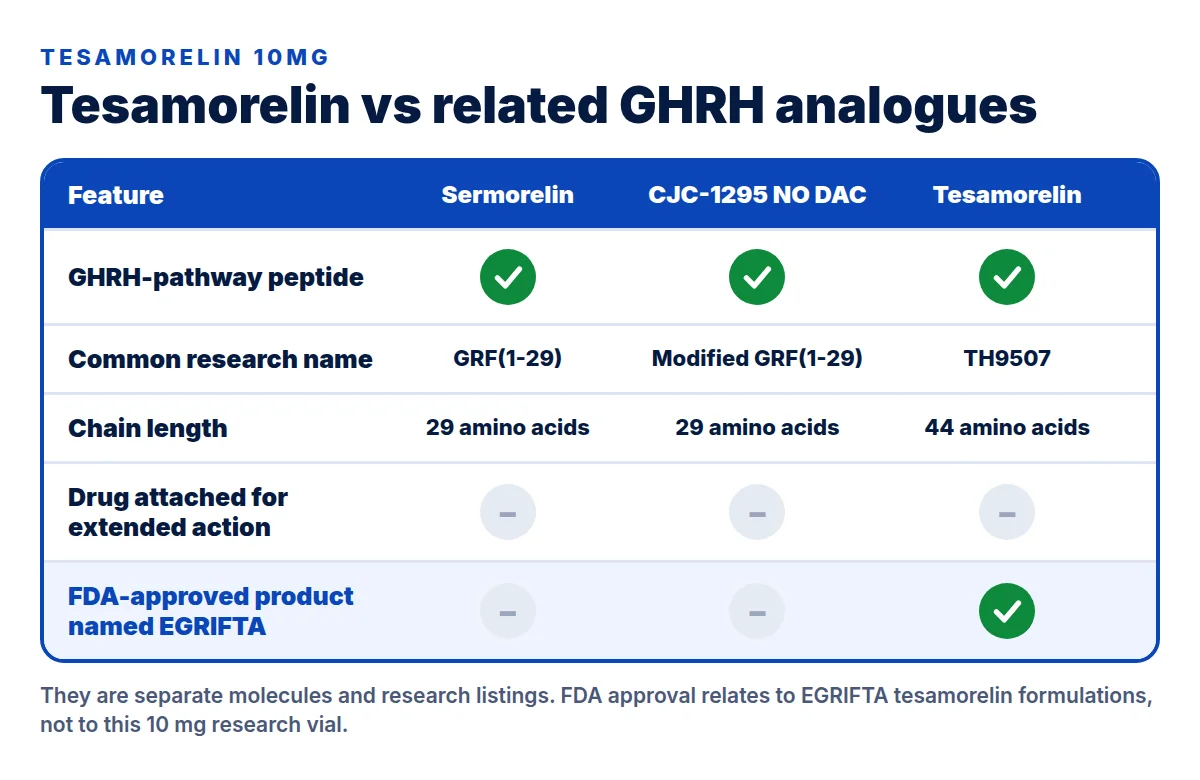
Sermorelin, CJC-1295 NO DAC and Tesamorelin are distinct GHRH-pathway peptides. Sermorelin and CJC-1295 NO DAC are commonly described as 29-amino-acid GRF(1-29) analogues, while Tesamorelin is a 44-amino-acid molecule. A comparison does not make their quantities, handling or research findings interchangeable.
Dispatch from Victoria
Same-day dispatch from Victoria for in-stock orders once payment is confirmed, tracked Australia Post Express, with a tracking number emailed. Tesamorelin 10mg is supplied for in-vitro research only.
Tesamorelin is a lab-made version of growth hormone-releasing hormone, or GHRH. GHRH is a peptide signal made by the hypothalamus. It tells the pituitary gland to release growth hormone in pulses. Tesamorelin was developed under the code TH9507 and is a 44-amino-acid GHRH analogue.
The molecule is not a GLP-1 peptide, not a direct growth-hormone preparation and not a blend. It works at the GHRH receptor. That places it in the pituitary growth-hormone and IGF-1 research pathway. IGF-1 is insulin-like growth factor 1, a blood marker that rises downstream of growth-hormone signalling.
There is an important name-versus-formulation distinction. Tesamorelin names the active peptide. EGRIFTA WR and EGRIFTA SV are named FDA-approved medicine formulations containing Tesamorelin. Their vial strengths, supplied diluents, mixing instructions and storage systems differ from each other and from this separate 10mg research vial.
Tesamorelin 10mg: identity, tested-sample evidence and the key boundary between this research vial and FDA EGRIFTA formulations.
How does Tesamorelin work?
Tesamorelin is a GHRH analogue. In plain English, it resembles the body’s signal for the pituitary gland to release growth hormone. It binds the GHRH receptor in the pituitary rather than acting directly as growth hormone itself.
The downstream sequence is pituitary GHRH receptor, growth-hormone release, then increased IGF-1. The FDA EGRIFTA label and the Phase 3 studies both describe increased IGF-1. In the pooled Phase 3 analysis, mean IGF-I increased by 108 ng/mL in the Tesamorelin group versus a 7 ng/mL decrease with placebo at week 26.
This mechanism also explains why the evidence needs careful reading. The clinical studies were performed in defined groups of adults with HIV receiving antiretroviral therapy and excess abdominal fat. A result in that setting is not a general claim about total body weight, cardiovascular outcomes or another Tesamorelin format.
GHRH receptor: the pituitary receptor that receives the growth-hormone-releasing signal.
Growth hormone: the immediate downstream hormone released in pulses after GHRH signalling.
IGF-1: insulin-like growth factor 1, a circulating marker measured in Tesamorelin trials and FDA-labelled medicine monitoring.
Tesamorelin follows the GHRH-to-growth-hormone-to-IGF-1 signalling path.
What did the clinical studies find?
Tesamorelin’s principal clinical evidence comes from adults with HIV receiving antiretroviral treatment and excess abdominal fat. The central outcome was visceral adipose tissue, often shortened to VAT. VAT is deep abdominal fat around internal organs. Researchers measured it by CT scan, which is different from looking at total kilograms on a scale.
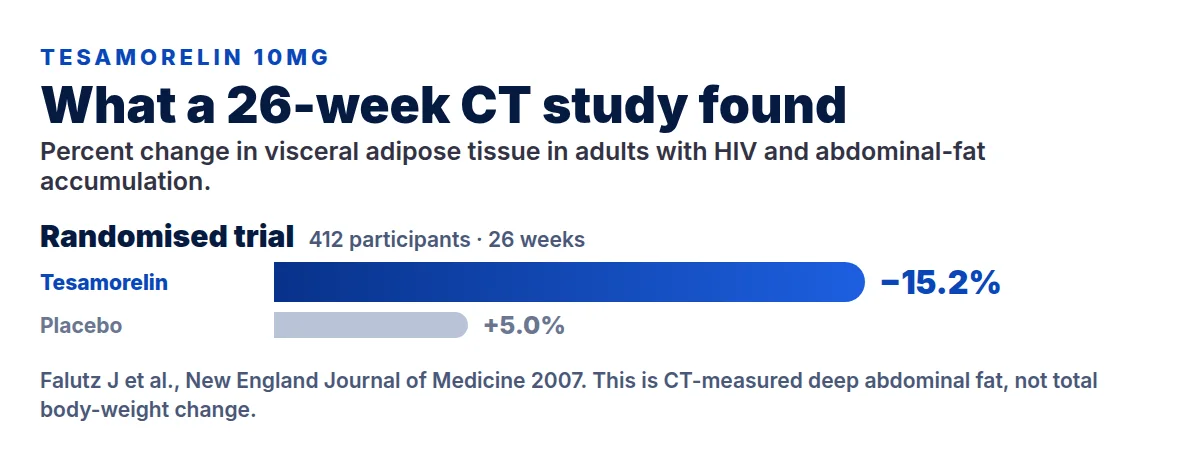
In the 2007 New England Journal of Medicine study, 412 adults were followed for 26 weeks. CT-measured visceral adipose tissue decreased 15.2% in the Tesamorelin group and increased 5.0% in the placebo group. Triglycerides fell by 50 mg/dL in the Tesamorelin group and increased by 9 mg/dL with placebo; IGF-1 increased 81.0% versus a 5.0% decrease.
A pooled Phase 3 analysis combined two studies with 806 participants. At week 26 it reported a −15.4% treatment effect for CT-measured VAT. In the group that continued Tesamorelin to week 52, VAT was −17.5% from the original baseline. The same study reported no significant change in abdominal subcutaneous fat, which is the fat under the skin.
Smaller liver-fat research was also conducted in HIV-defined populations. A six-month randomised study of 50 people reported a −42 cm² treatment effect for VAT and a −2.9% net effect in liver fat. A later 12-month study of 61 people with HIV and fatty liver reported a −4.1% absolute effect in hepatic fat fraction versus placebo. These studies report specific CT and MRI outcomes in selected participants.
In a 26-week HIV study, the primary result was a CT-measured change in deep abdominal fat, not a body-weight percentage.
Selected Tesamorelin clinical findings — study populations and outcomes
Selected Tesamorelin clinical findings — study populations and outcomes
Study
Who was studied
Length
Main reported result
Falutz et al., NEJM 2007
412 adults with HIV and abdominal-fat accumulation
26 weeks
VAT −15.2% with Tesamorelin; +5.0% with placebo
Falutz et al., JCEM 2010 pooled Phase 3
806 antiretroviral-treated adults with HIV and excess abdominal fat
26 weeks plus extension
VAT treatment effect −15.4% at week 26; continued group −17.5% from baseline at week 52
Stanley et al., JAMA 2014
50 antiretroviral-treated adults with HIV and abdominal-fat accumulation
6 months
VAT treatment effect −42 cm²; liver-fat net effect −2.9%
Stanley et al., Lancet HIV 2019
61 people with HIV and fatty liver
12 months
Hepatic-fat-fraction effect −4.1 percentage points versus placebo
VAT means visceral adipose tissue: deep abdominal fat measured by imaging. These outcomes are not total body-weight results.
Tesamorelin vs Sermorelin vs CJC-1295 NO DAC
Tesamorelin, Sermorelin and CJC-1295 NO DAC are all discussed in relation to the GHRH pathway, but they are different molecules. The likeness is useful for research classification; it does not make their sequences, quantities, concentration charts or published findings interchangeable.
Sermorelin is the amidated 29-amino-acid N-terminal GRF(1-29) segment. CJC-1295 NO DAC is generally described as Modified GRF(1-29) without the DAC component that is used for albumin binding in CJC-1295 with DAC. Tesamorelin is a longer 44-amino-acid analogue and is the molecule developed as TH9507.
The strongest clinical evidence and FDA product status in this comparison belongs to Tesamorelin as named EGRIFTA formulations. The FDA’s approval is formulation-specific: a generic 10mg research vial, Sermorelin and CJC-1295 NO DAC are not FDA-approved.
Related GHRH-pathway molecules remain separate peptides with separate research and product contexts.
Key identity differences between related GHRH-pathway listings
Key identity differences between related GHRH-pathway listings
Feature
Sermorelin
CJC-1295 NO DAC
Tesamorelin
Common research name
GRF(1-29)
Modified GRF(1-29)
TH9507
Peptide length
29 amino acids
29 amino acids
44 amino acids
DAC albumin-binding component
No
No
No
FDA product named EGRIFTA
No
No
Yes — formulation-specific Tesamorelin medicine
A research comparison is not a claim of equivalence or a suggestion to combine products.
Tesamorelin structure: a 44-amino-acid sequence
Tesamorelin is a single peptide chain of 44 amino acids. PubChem lists its one-letter sequence as YADAIFTNSYRKVLGQLSARKLLQDIMSRQQGESNQERGARARL. The letters are the standard short codes for the amino-acid building blocks in order from one end of the chain to the other.
PubChem records the molecular formula C221H366N72O67S and a molecular weight of 5,136 g/mol for Tesamorelin. The page also lists TH9507 and the CAS number 218949-48-5 as identifiers. These identity facts help distinguish Tesamorelin from the shorter GRF(1-29) analogues used for related GHRH-pathway research.
A sequence tells you the molecule’s identity. This listing also identifies a tested sample through LabDoc report LD-SHXT, which separately records LC-MS identity, HPLC purity and HPLC content.
The full 44-amino-acid Tesamorelin sequence as listed by PubChem.
Independent lab test for this Tesamorelin 10mg sample
This Tesamorelin 10mg listing is supported by LabDoc report LD-SHXT. The report records a Tesamorelin lyophilised-powder sample tested on 23 September 2026. Its identity result is confirmed by liquid chromatography–mass spectrometry, usually written LC-MS. LC-MS separates material and checks molecular mass, helping a laboratory identify the molecule in the tested sample.
The report records 99.61% purity by high-performance liquid chromatography, or HPLC, and 0.39% related impurities. HPLC is the method used to separate the main peptide peak from related peaks in a sample. It also records 9.16mg HPLC content against the 10mg label claim, equal to 91.6% of that claim.
The report’s overall assessment is Pass. Its batch field is ‘Not stated’. These are the analytical results for the tested sample identified in report LD-SHXT. Open the LabDoc link on this page or the Quality page to check the report ID, test date and results directly.
Identity: confirmed by LC-MS.
Purity: 99.61% by HPLC.
Related impurities: 0.39% by HPLC.
Content: 9.16mg by HPLC against a 10mg claim, or 91.6%.
Date tested: 23 September 2026.
Report: LabDoc LD-SHXT, overall assessment Pass.
Buying Tesamorelin 10mg in Australia
Tesamorelin 10mg is available online from Peak Peptides Australia as a research material. Same-day dispatch from Victoria applies to in-stock orders once payment is confirmed. Parcels are sent by tracked Australia Post Express, and the tracking number is emailed after dispatch.
This listing is supplied for in-vitro research only. The page provides concentration and syringe-unit maths, photo-based handling information and the test report for the named sample. It does not convert an FDA EGRIFTA label, a clinical-study method or a related GHRH listing into an instruction for this separate vial.
Researchers comparing GHRH-pathway materials can see the dedicated Sermorelin and CJC-1295 NO DAC pages, along with bacteriostatic water and the reconstitution calculator. Each listing has its own quantity, identity and quality context.
Step-by-step guide · About 10 minutes
How to reconstitute Tesamorelin 10mg (step-by-step with photos)
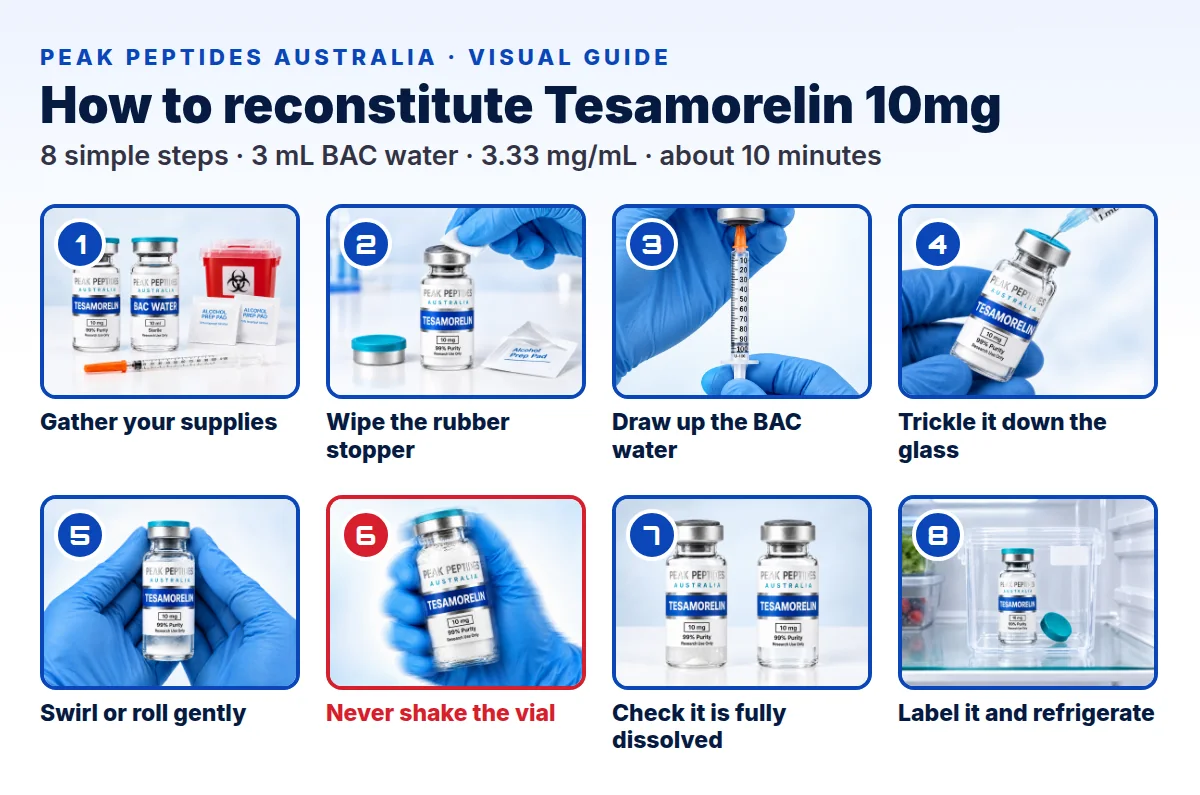
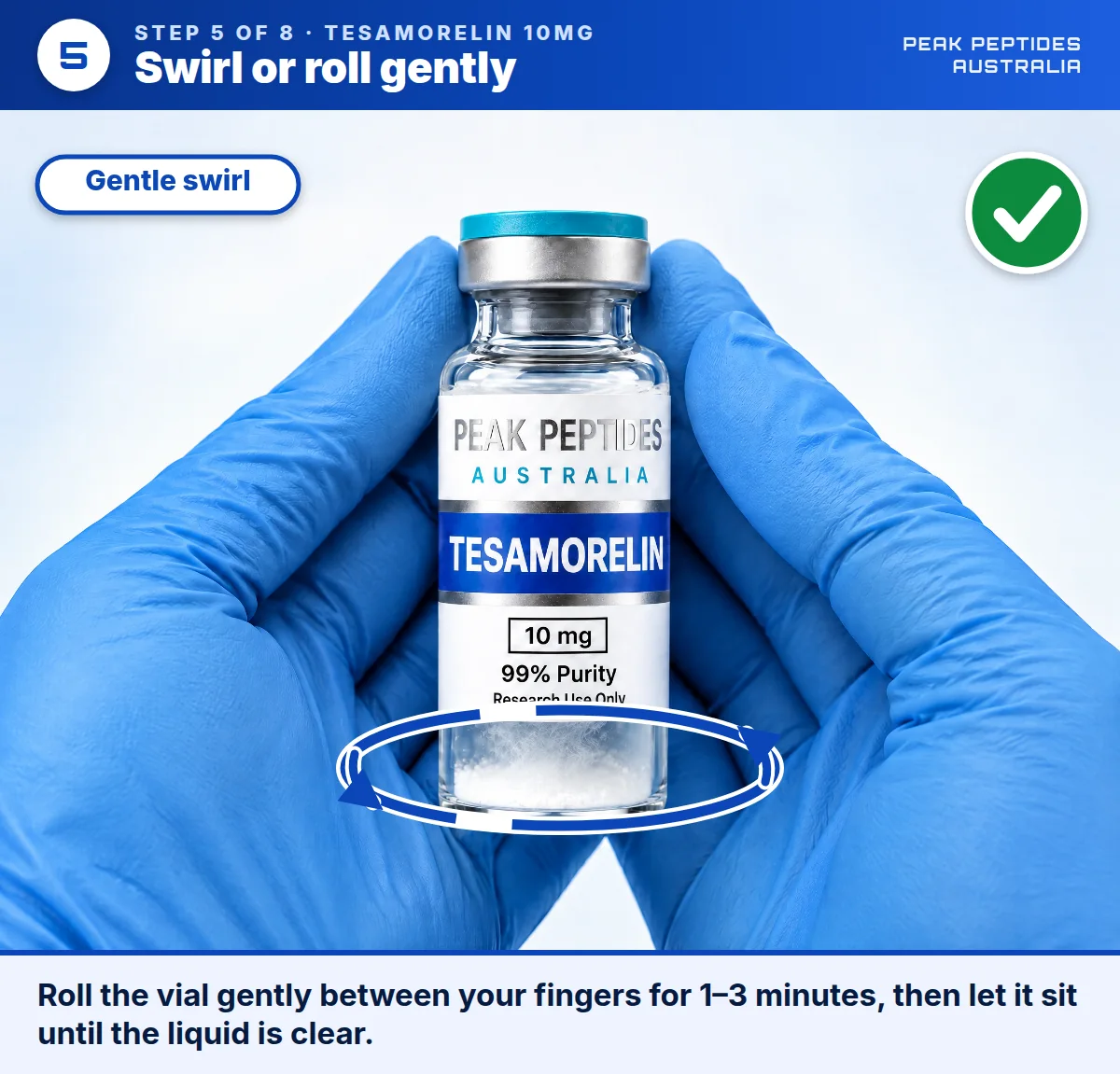
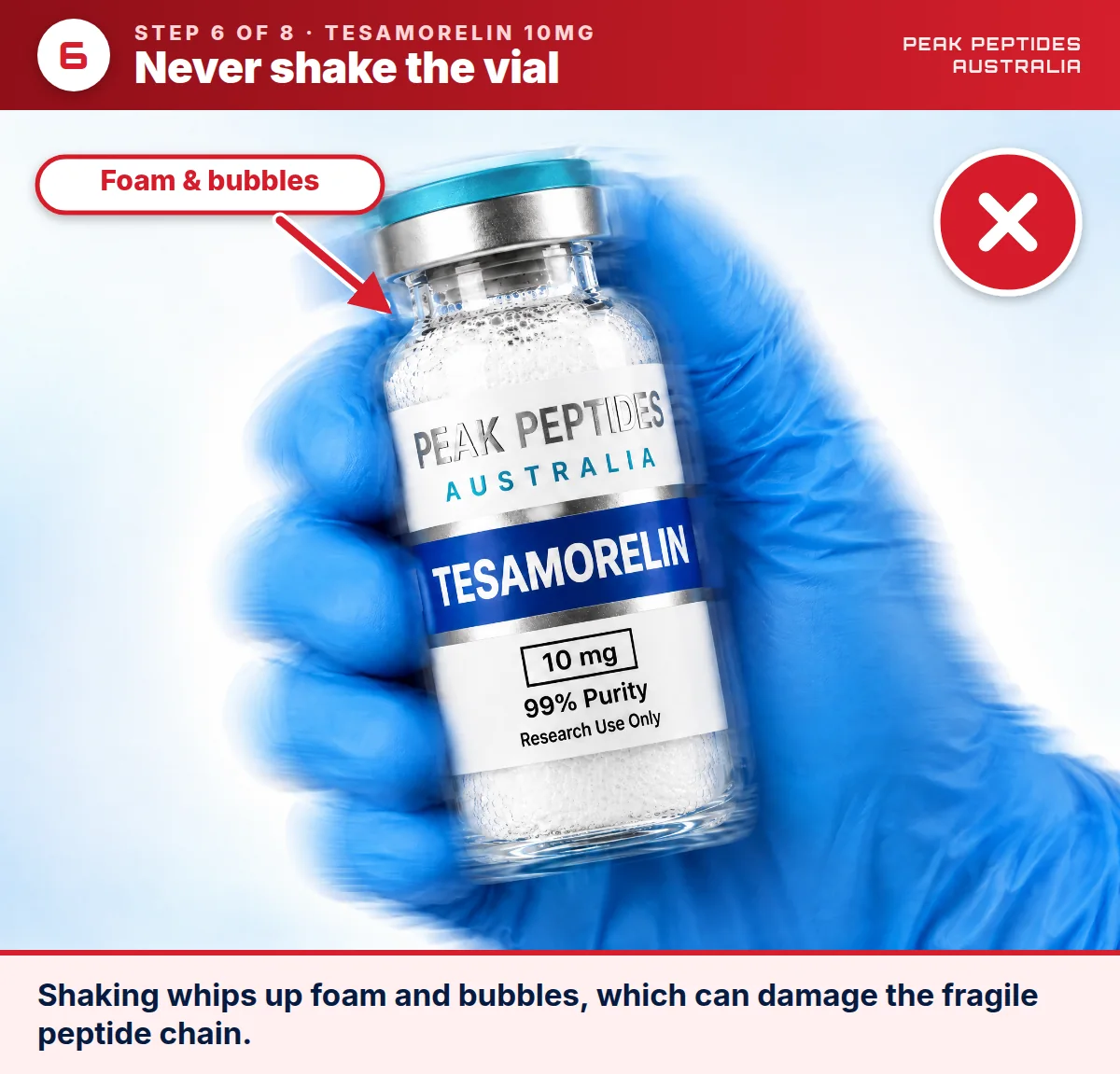
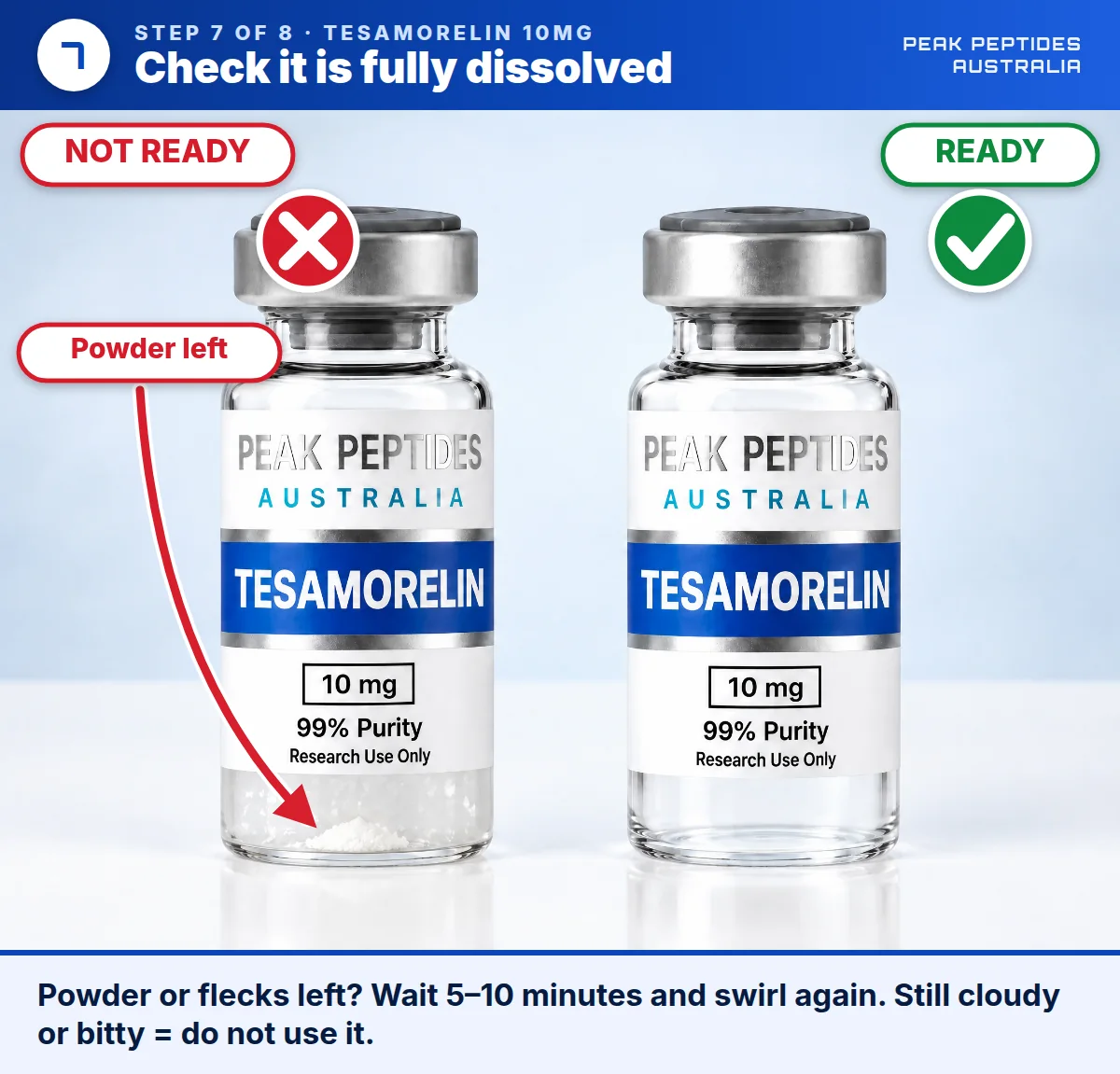
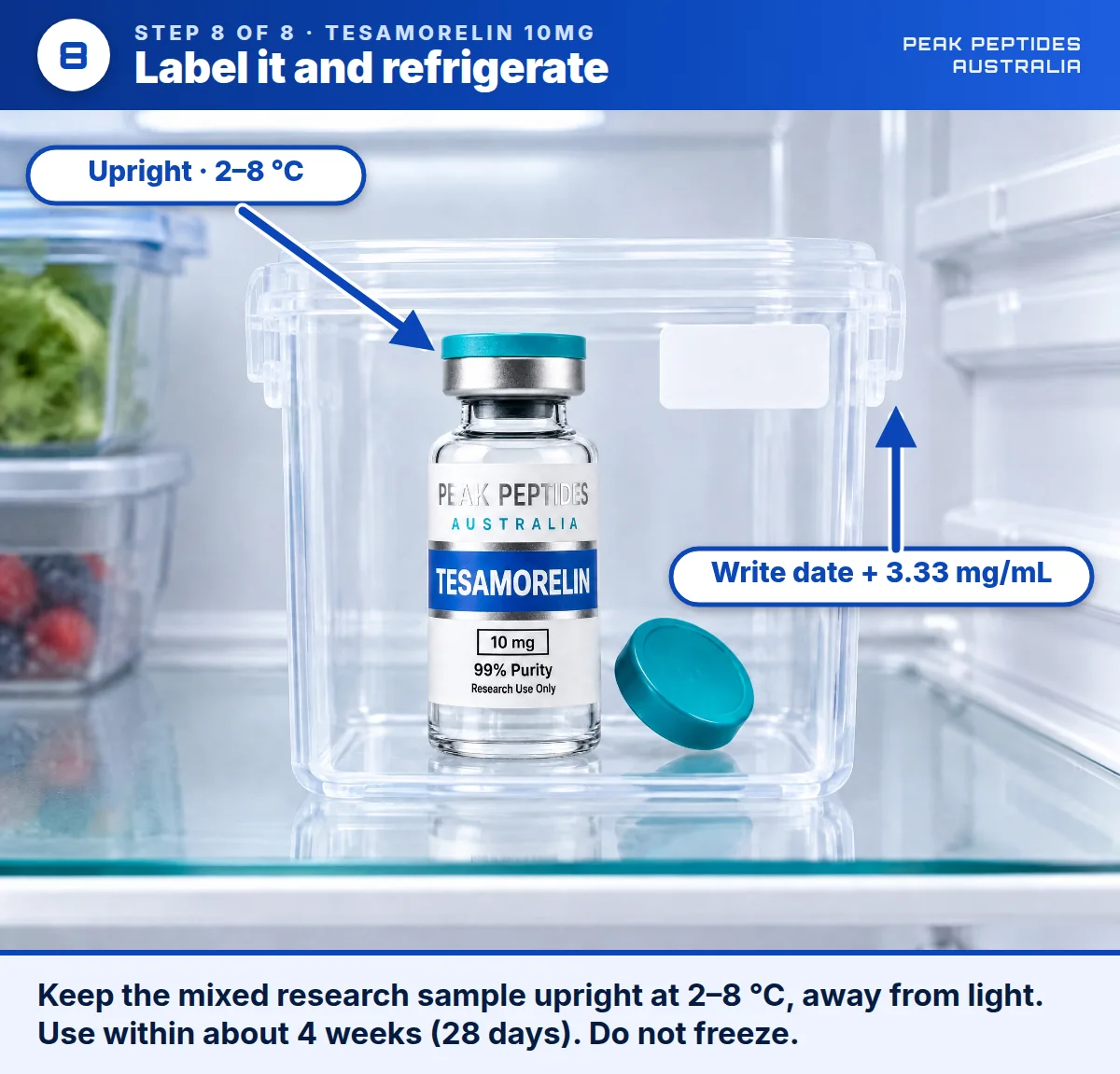
Tesamorelin 10mg arrives as freeze-dried powder. Reconstitution means adding bacteriostatic (BAC) water so the powder becomes a clear liquid for research measurement. PeptideDosages uses 3 mL BAC water as its reference mix for a 10mg vial, giving about 3.33 mg/mL. That makes 1 mg equal to 30 units on a U-100 syringe. The chart shows measurement maths for a research sample. The eight photos show a clean, gentle mixing process.
The full Tesamorelin 10mg reconstitution sequence in eight visual steps.
What you need
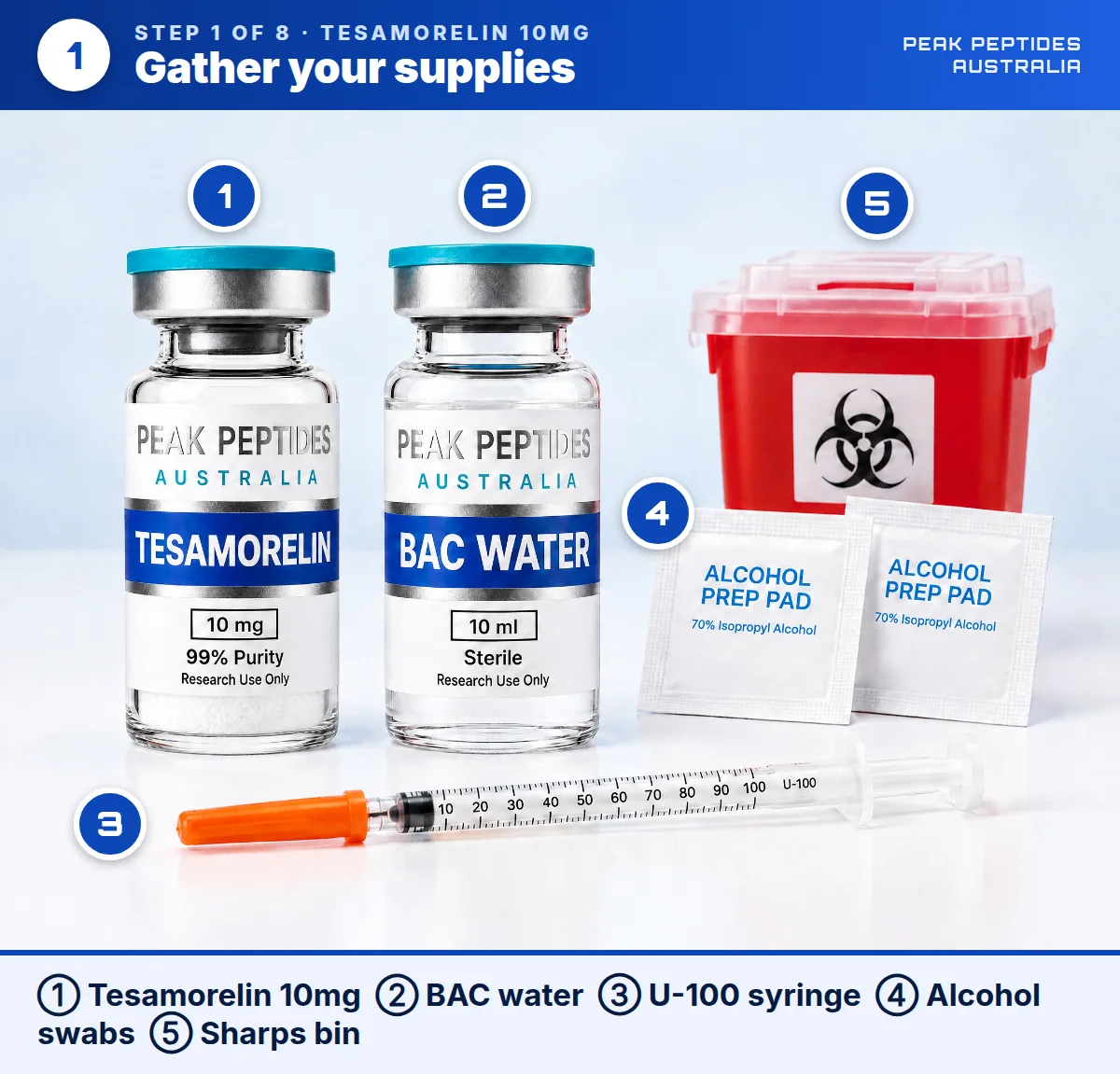
Tesamorelin 10mg vialFreeze-dried research sample in a sealed glass vial.
Bacteriostatic waterPeptideDosages uses BAC water for its 10mg-vial reference mix.
1 mL U-100 insulin syringeA U-100 syringe has 100 volume units per 1 mL.
Alcohol swabsFor wiping rubber stoppers before handling.
Sharps containerFor disposal of used needles and syringes.
How much BAC water to add to Tesamorelin 10mg
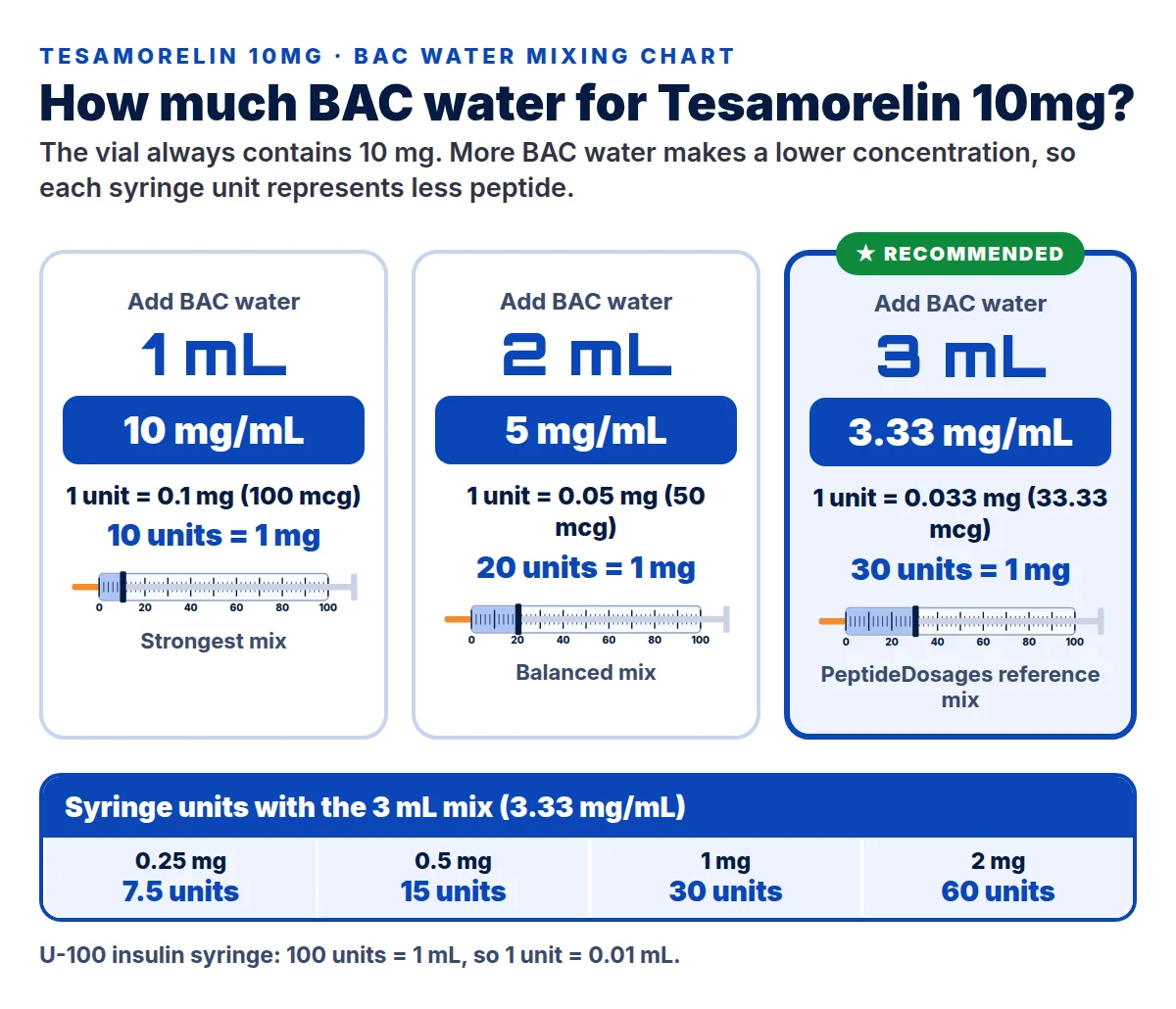
The vial’s quantity remains 10mg whatever volume is chosen. Water changes concentration, not the amount of Tesamorelin. Less water makes each syringe unit contain more peptide; more water makes each unit contain less. The formula is units = amount wanted ÷ strength per mL × 100.
PeptideDosages uses 3 mL BAC water as its Tesamorelin 10mg reference mix. That gives about 3.33 mg/mL. With that mix, one U-100 unit holds about 0.033 mg (33 mcg), 10 units hold about 0.33 mg and 30 units hold 1 mg. For comparison, 2 mL gives 5 mg/mL and 20 units for 1 mg; 1 mL gives 10 mg/mL and 10 units for 1 mg.
Tesamorelin 10mg mixing chart: the PeptideDosages reference mix of 3 mL gives about 3.33 mg/mL.
3 mL is highlighted because it gives the simplest numbers.
Syringe units with the 3 mL mix (3.33 mg/mL)
Syringe units with the 3 mL mix (3.33 mg/mL)
Amount
Units on a U-100 syringe
Volume
0.25 mg
7.5 units
0.075 mL
0.5 mg
15 units
0.15 mL
1 mg
30 units
0.3 mL
2 mg
60 units
0.6 mL
The 8 steps
1Step 1: Gather your supplies
Place the Tesamorelin 10mg vial, BAC water, a new 1 mL U-100 syringe, alcohol swabs and a sharps container on a clean, well-lit surface. Check that each vial is intact. If the vial has been refrigerated, allow it to sit briefly until the exterior is dry and easy to handle.
2Step 2: Wipe the rubber stopper
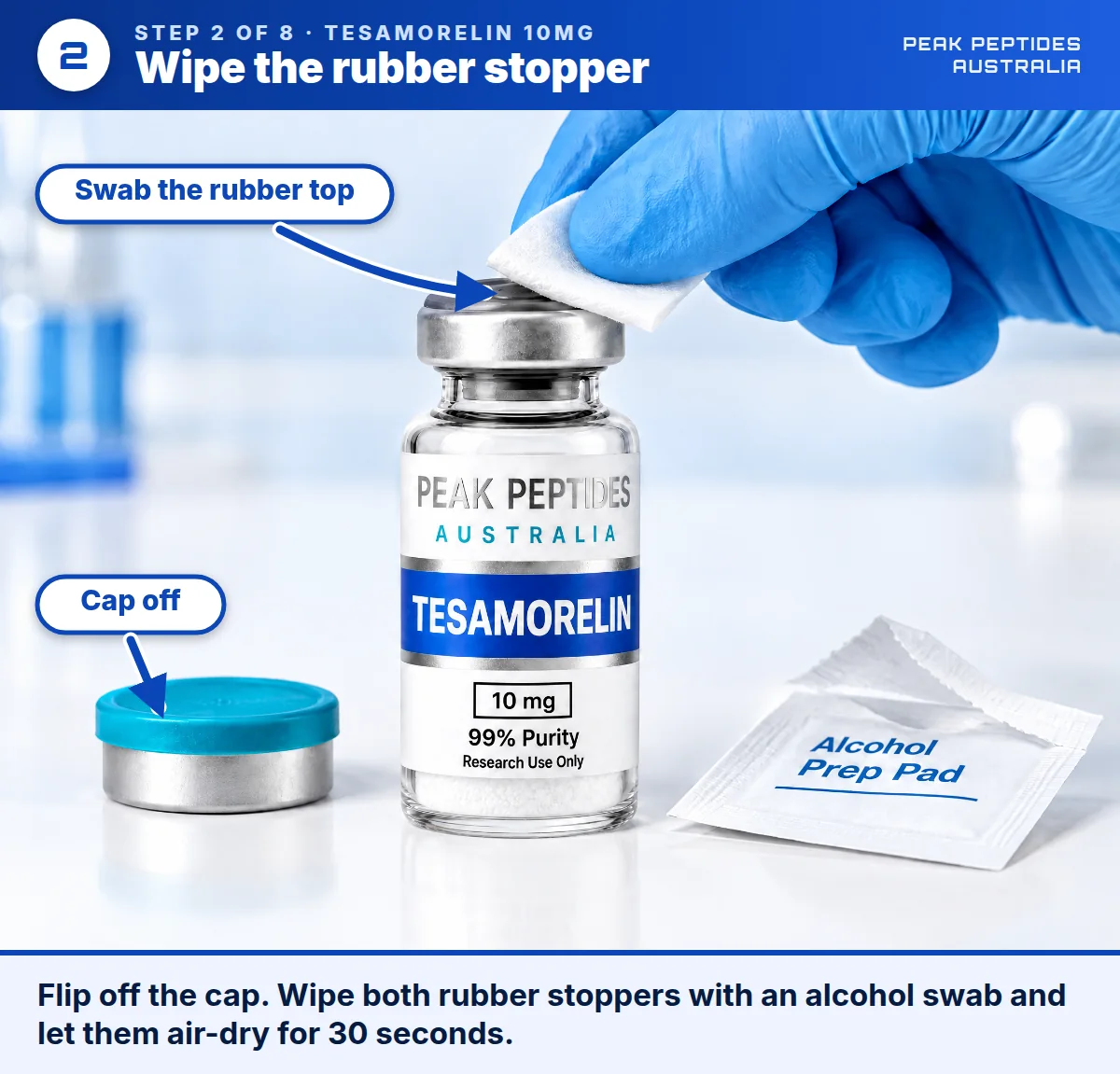
Remove the flip-off caps to expose the rubber stoppers. Use a fresh alcohol swab on each stopper and let the surfaces air-dry for about 30 seconds. Avoid touching the cleaned rubber after wiping it. Clean, dry stoppers reduce the chance of introducing visible contamination while handling the vials.
3Step 3: Draw up the BAC water
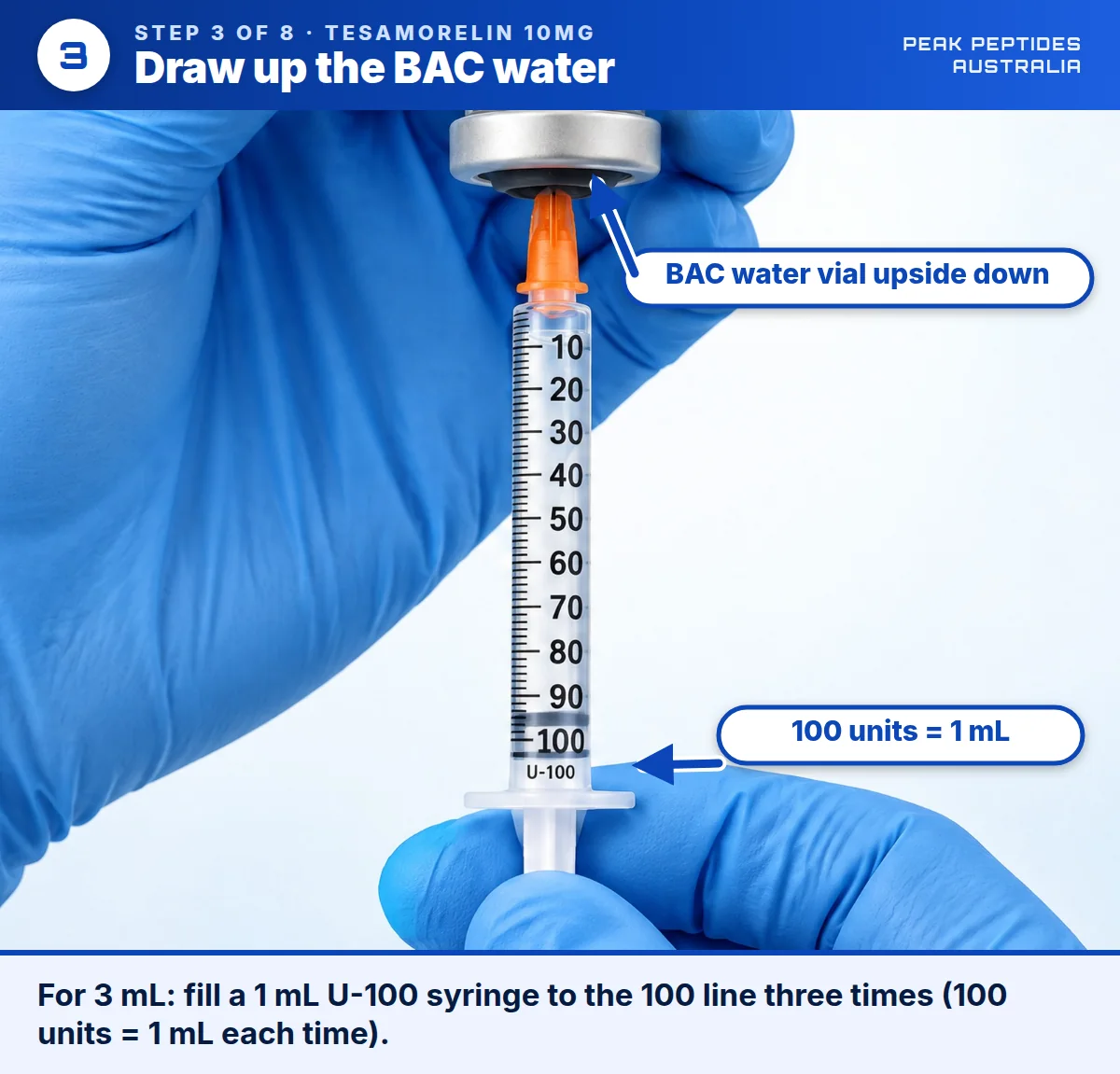
Use a new U-100 syringe to draw BAC water. A 1 mL U-100 syringe is marked to 100 units, so the 100 line equals 1 mL. The 3 mL reference mix uses three separate 1 mL draws. Check the syringe for large air bubbles before moving to the powder vial.
4Step 4: Trickle it down the glass
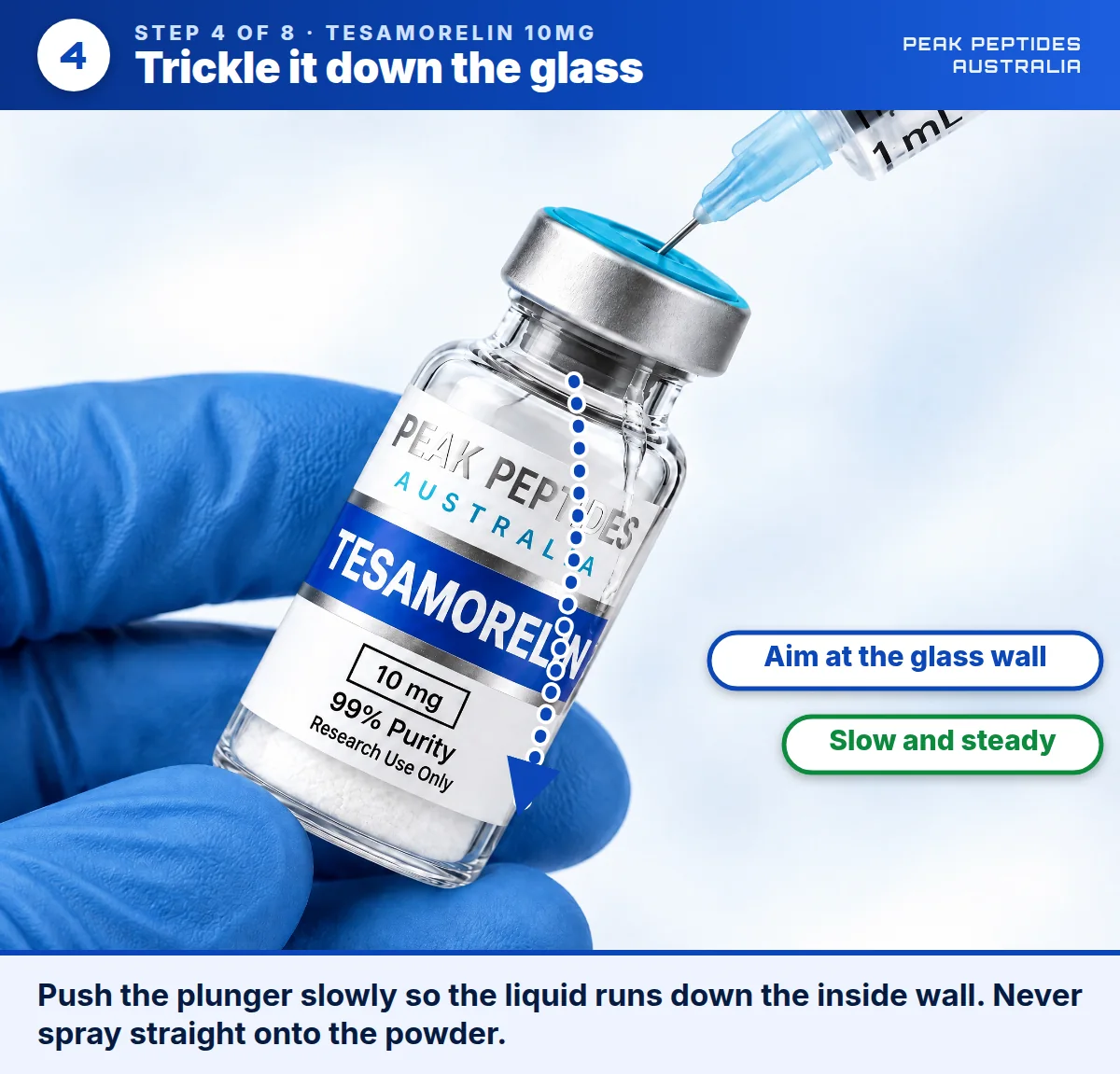
Insert the needle through the Tesamorelin stopper at an angle, with the tip aimed against the inside glass wall. Press the plunger slowly so the BAC water runs down the wall instead of striking the powder directly. Repeat the draw-and-trickle process until the selected total volume is in the vial.
5Step 5: Swirl or roll gently
Gently roll the vial between your fingers or swirl it in slow circles. This helps the freeze-dried material dissolve without whipping air into the liquid. A small amount of powder can remain at first. Give the sample time to settle and dissolve rather than forcing the process with fast movement.
6Step 6: Never shake the vial
Do not shake the vial. Hard shaking creates foam and bubbles, making the visual check harder and treating the peptide solution roughly. If bubbles appear, place the vial upright and allow them to settle. Gentle swirling is the mixing action shown in the photo guide and FDA-labelled EGRIFTA directions.
7Step 7: Check it is fully dissolved
Hold the vial under good light. The finished liquid should be clear and colourless, without powder, flecks or cloudiness. If powder remains, wait 5–10 minutes and swirl gently again. Do not treat a visibly cloudy sample or one with particles as fully dissolved; the clear-vial photo shows the endpoint to look for.
8Step 8: Label it and refrigerate
Write the mixing date and the final concentration on the vial or container. For the 3 mL reference mix, the concentration is about 3.33 mg/mL. Keep the mixed research sample upright in the fridge at 2–8 °C and away from light. Use it within about 4 weeks (28 days). Do not freeze it.
How to store Tesamorelin 10mg
Tesamorelin storage guide — distinguish the research vial from EGRIFTA medicine formulations
Tesamorelin storage guide — distinguish the research vial from EGRIFTA medicine formulations
Form
Where to keep it
How long
Freeze-dried 10mg vial
Fridge, 2–8 °C, in the dark
Until the printed expiry
Mixed with BAC water
Fridge, 2–8 °C, upright and away from light; never freeze
About 4 weeks (28 days)
EGRIFTA SV (prescription medicine)
Its own single-dose system
Follows its own label, not a rule for this vial
EGRIFTA WR (prescription medicine)
Room temperature after mixing
7 days under its 2025 FDA label, not a rule for this vial
Once mixed with BAC water, keep the vial upright in the fridge at 2–8 °C, away from light. Use within about 4 weeks (28 days), never freeze it, and write the date and strength on the vial.
Tesamorelin 10mg FAQs — Plain-English Answers
What is Tesamorelin?
Tesamorelin is a synthetic analogue of growth hormone-releasing hormone, or GHRH. It is also called TH9507 in published research. It activates the pituitary GHRH pathway, which stimulates growth-hormone release and increases IGF-1, a downstream growth-factor marker.
What is Tesamorelin 10mg?
Tesamorelin 10mg is a freeze-dried research vial carrying a nominal 10mg label claim. The amount on the label is the vial’s total claimed peptide quantity. Peak Peptides Australia supplies this listing for in-vitro research only.
What is TH9507?
TH9507 is a research code for Tesamorelin. The pooled Phase 3 publication calls the study molecule Tesamorelin (TH9507) and describes it as a growth hormone-releasing factor analogue. TH-9507 is the common hyphenated search variant.
How does Tesamorelin work?
Tesamorelin acts at the growth hormone-releasing hormone receptor in the pituitary gland. That signal stimulates pulsatile growth-hormone release and raises IGF-1. This is a GHRH pathway, not the GLP-1 pathway used by medicines such as semaglutide.
What did Tesamorelin studies find?
In a 26-week randomised study of 412 adults with HIV and abdominal-fat accumulation, CT-measured visceral adipose tissue fell 15.2% with Tesamorelin and rose 5.0% with placebo. The outcome was deep abdominal fat, not a 15.2% body-weight result.
What did the pooled Phase 3 studies find?
A pooled analysis of two Phase 3 studies included 806 antiretroviral-treated adults with HIV and excess abdominal fat. At week 26, the reported treatment effect on CT-measured visceral adipose tissue was −15.4%, and participants continuing Tesamorelin maintained a visceral-fat reduction through week 52.
What did the liver-fat studies find?
A six-month study in 50 antiretroviral-treated adults with HIV and abdominal-fat accumulation reported a −42 cm² treatment effect for visceral fat and a −2.9% net effect for liver fat. A separate 12-month HIV-and-fatty-liver study reported a −4.1% absolute hepatic-fat-fraction effect versus placebo.
Is Tesamorelin a weight-loss medicine?
The FDA label says EGRIFTA, the named Tesamorelin medicine, is not indicated for weight-loss management and has a weight-neutral effect. The approved indication is reduction of excess abdominal fat in adults with HIV-associated lipodystrophy. That is distinct from general weight-loss claims.
What side effects were reported for FDA-labelled Tesamorelin?
The EGRIFTA SV label lists arthralgia, injection-site redness or itching, limb pain, peripheral oedema and muscle pain among the most commonly reported reactions. It also warns about elevated IGF-1, fluid retention, glucose intolerance or diabetes, hypersensitivity and injection-site reactions. Those label data concern FDA medicine formulations, not this research vial.
Is Tesamorelin FDA-approved?
Yes. The FDA has approved EGRIFTA formulations containing Tesamorelin for reduction of excess abdominal fat in adults with HIV-associated lipodystrophy. The FDA label specifies that EGRIFTA WR and EGRIFTA SV are not substitutable, and its approval does not apply to this separate Tesamorelin 10mg research vial.
Is Tesamorelin 10mg TGA-approved in Australia?
Tesamorelin 10mg on this page is supplied for in-vitro research only and is not a TGA-approved medicine. EGRIFTA is an FDA-approved US medicine with formulation-specific instructions.
Is Tesamorelin the same as EGRIFTA?
Tesamorelin is the active peptide. EGRIFTA is the name of specific FDA-approved finished medicine formulations containing Tesamorelin. EGRIFTA SV is a 2mg single-dose formulation and EGRIFTA WR is an 11.6mg multidose formulation; their supplied components and labelled instructions are different from this research vial.
Is Tesamorelin the same as Sermorelin?
No. Both are GHRH-pathway peptides, but they are different molecules. Sermorelin is a 29-amino-acid GRF(1-29) analogue, while Tesamorelin is a 44-amino-acid GHRH analogue. Each has its own structure and its own research.
Tesamorelin vs CJC-1295 NO DAC: what is the difference?
Tesamorelin and CJC-1295 NO DAC are distinct GHRH-pathway peptides. Tesamorelin is a 44-amino-acid molecule also known as TH9507. CJC-1295 NO DAC is commonly described as Modified GRF(1-29) without the DAC albumin-binding component. Do not transfer concentration maths, research results or handling assumptions between them.
Can I buy Tesamorelin 10mg online in Australia?
Tesamorelin 10mg can be ordered online from Peak Peptides Australia when it is available. Same-day dispatch from Victoria applies to in-stock orders once payment is confirmed, sent by tracked Australia Post Express with a tracking number emailed. It is supplied for in-vitro research only.
How fast is Tesamorelin dispatched in Australia?
In-stock orders receive same-day dispatch from Victoria once payment is confirmed. They are sent by tracked Australia Post Express, and the tracking number is emailed. Carrier delivery times are set by Australia Post after dispatch.
How is this Tesamorelin 10mg sample verified?
LabDoc report LD-SHXT was tested on 23 September 2026. It records identity confirmed by LC-MS, 99.61% purity by HPLC and 9.16mg HPLC content against the 10mg claim, which is 91.6% of the claim. The report’s overall assessment is Pass.
What does LabDoc LD-SHXT show?
LD-SHXT is the independent report for the tested Tesamorelin lyophilised-powder sample. It records LC-MS identity as confirmed, 99.61% HPLC purity, 0.39% related impurities and 9.16mg HPLC content. The batch field is recorded as ‘Not stated’.
How do I know a Tesamorelin sample is real?
Look for a report that identifies the tested material and gives a verifiable report ID, identity method, purity method and content result. This page links LabDoc report LD-SHXT, which states confirmed identity by LC-MS, 99.61% HPLC purity and 9.16mg measured content for its tested sample.
How much BAC water for Tesamorelin 10mg?
PeptideDosages uses 3 mL of bacteriostatic water as its reference mix for a 10mg Tesamorelin vial. That makes about 3.33 mg per mL. The chart also shows 1 mL and 2 mL concentration options, but the quantity of peptide in the vial stays 10mg.
How many units is 1 mg of Tesamorelin?
It depends on the final concentration. With the 3 mL reference mix, the concentration is about 3.33 mg/mL and 1 mg measures 30 units on a U-100 syringe. With 2 mL, 1 mg is 20 units; with 1 mL, it is 10 units.
How many mg are in 10 units of Tesamorelin?
With the 3 mL reference mix, 10 units on a U-100 syringe represents about 0.33 mg of Tesamorelin. With a 2 mL mix, 10 units represents 0.5 mg. With a 1 mL mix, 10 units represents 1 mg.
How do I reconstitute Tesamorelin 10mg?
Prepare a clean surface, wipe the rubber stoppers, draw BAC water into a new U-100 syringe and let the water run slowly down the inside vial wall. Swirl gently rather than shaking. The liquid should be clear and colourless. Write the date and strength on the vial. Keep it upright at 2–8 °C, away from light, use within about 4 weeks (28 days) and never freeze it.
Can I use sterile or tap water instead of BAC water?
Do not use tap or distilled water. PeptideDosages uses bacteriostatic water in its 10mg-vial reference mix. Once mixed with BAC water, keep it upright in the fridge at 2–8 °C, away from light, use it within about 4 weeks (28 days) and never freeze it. FDA EGRIFTA products have their own supplied diluents and directions.
What if Tesamorelin powder does not dissolve?
Let the vial stand for 5–10 minutes, then swirl gently again. Do not shake, because shaking creates foam. Inspect the liquid under good light: a prepared sample should be clear and colourless with no visible particles. Do not use a sample that remains cloudy or contains particles.
Should reconstituted Tesamorelin be cloudy?
No. The FDA labels for EGRIFTA formulations say the prepared solution should be clear and colourless without particulate matter. For this research guide, visible cloudiness, flecks or undissolved material means the vial has not reached the visual endpoint shown in the photo guide.
How should Tesamorelin powder be stored before mixing?
PeptideDosages states that a lyophilised 10mg Tesamorelin vial is kept refrigerated at 2–8 °C and protected from light. Keep the vial in a closed, light-protective container.
Can mixed Tesamorelin be frozen?
No. PeptideDosages storage guidance says to refrigerate the reconstituted vial, protected from light. The current EGRIFTA WR label says not to freeze after mixing and gives a formulation-specific seven-day room-temperature rule. Keep this 10mg research vial upright at 2–8 °C, away from light; use within about 4 weeks (28 days).
How long does reconstituted Tesamorelin last?
Tesamorelin mixed with bacteriostatic water: refrigerate upright at 2–8 °C, away from light; use within about 4 weeks (28 days), never freeze. PeptideDosages refers to product stability information. EGRIFTA formulations have different labelled storage systems and periods.
What does a Tesamorelin COA show?
A certificate of analysis records what a laboratory measured in a specific sample. For Tesamorelin 10mg, LabDoc LD-SHXT records the sample identity result by LC-MS, purity by HPLC, related impurities and measured content. A good report can be checked through its report ID and source link.