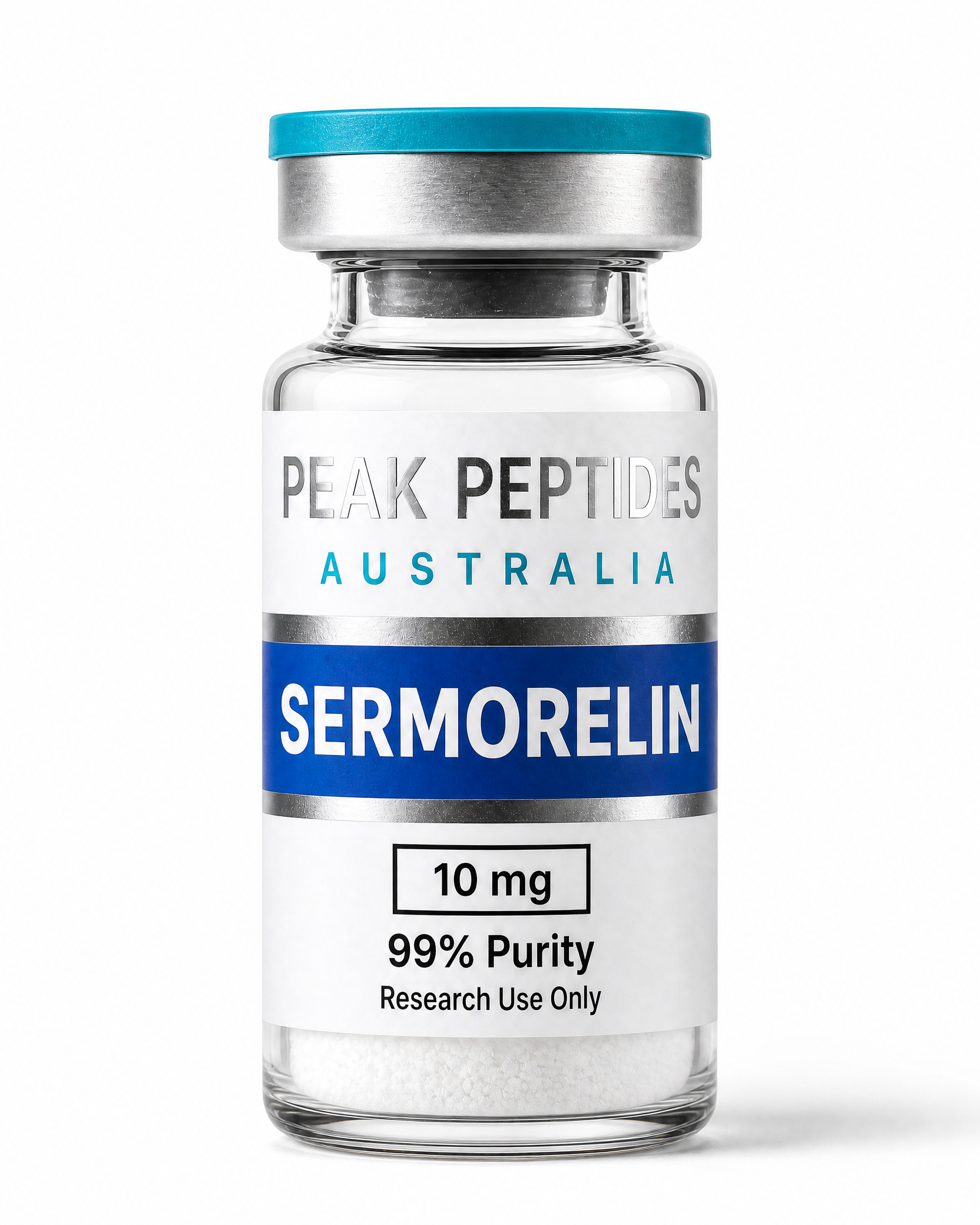
Sermorelin 10mg is a GHRH(1-29)-NH2 research peptide for examining anterior-pituitary and growth-hormone signalling. In-stock orders receive same-day dispatch from Victoria after payment confirmation, with tracked Australia Post Express shipping Australia-wide.
GHRH(1-29)-NH2 · anterior-pituitary signalling research
Sermorelin 10mg — What It Is, Research Findings & How to Reconstitute It
Sermorelin is a synthetic, amidated 29-amino-acid version of the active opening section of human growth hormone-releasing hormone, often written GHRH(1-29)-NH2 or GRF(1-29)-NH2. It is used in research that examines how a GHRH signal reaches the anterior pituitary and prompts measured growth-hormone release. Sermorelin is not human growth hormone: it acts upstream of that hormone. This 10mg listing contains a nominal 10 mg freeze-dried vial and is supplied for in-vitro research only, not for human or animal use. Below you can find its Geref medicine history, the published human findings, a clear comparison with Tesamorelin and CJC-1295 NO DAC, the exact 29-residue sequence, a 3 mL BAC-water concentration chart, and an eight-step photo guide.
Also referred to in research or catalogue references as Sermorelin, Sermoreline, GHRH(1-29)-NH2, GRF(1-29)-NH2, Growth hormone-releasing factor (1-29) amide, Sermorelin peptide, Sermorelin 10mg, Sermorelin 10 mg, Sermorelin acetate, Geref, GHRH 1-29, GRF 1-29.
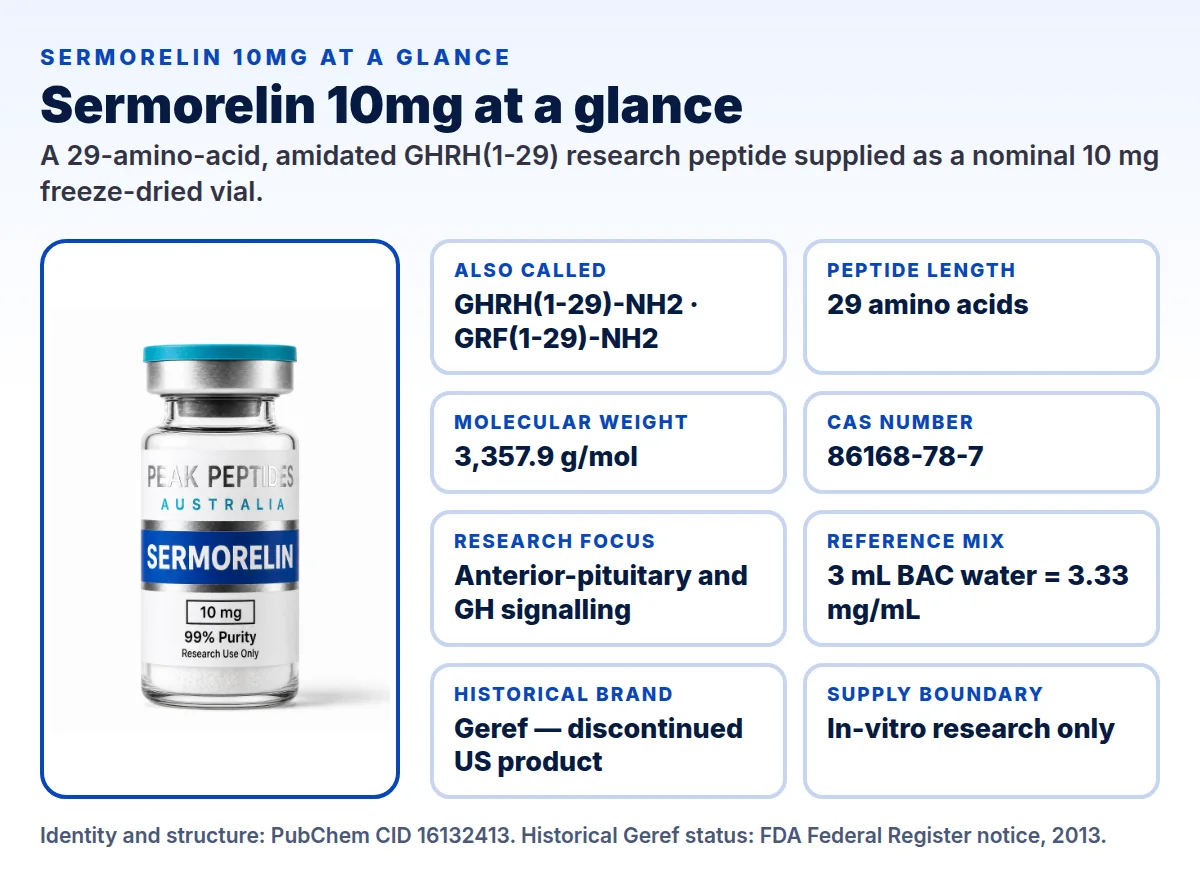
Sermorelin 10mg at a glance
Name
Sermorelin — GHRH(1-29)-NH2 / GRF(1-29)-NH2
What it is
An amidated 29-amino-acid fragment of human growth hormone-releasing hormone
Sequence
YADAIFTNSYRKVLGQLSARKLLQDIMSR-NH2
Formula and molecular weight
C149H246N44O42S · 3,357.9 g/mol
CAS number
86168-78-7
Research focus
GHRH-responsive anterior-pituitary and growth-hormone signalling
Reported plasma half-life
6.2 minutes for parent GRF(1-29)-amide after intravenous administration in one pharmacokinetic paper
Historical US brand
Geref — discontinued in 2008; approvals withdrawn effective 18 June 2009
Nominal vial amount
10 mg freeze-dried material
PeptideDosages reference mix
3 mL BAC water = 3.33 mg/mL; 30 U-100 units = 1 mg
Sample documentation
No product-specific LabDoc report published; see available Quality/COA documentation
Storage handling
Refrigerate at 2–8 °C and protect from light; do not freeze mixed material
Sport status
WADA S2.2.4 growth hormone-releasing factor — prohibited at all times
Dispatch
Same-day from Victoria for in-stock orders once payment is confirmed, tracked Australia Post Express
The active 29-amino-acid GHRH fragment
Sermorelin is GHRH(1-29)-NH2: the amidated first 29 building blocks of human growth hormone-releasing hormone. PubChem lists the sequence as YADAIFTNSYRKVLGQLSARKLLQDIMSR, formula C149H246N44O42S, molecular weight 3,357.9 g/mol and CAS number 86168-78-7.
It signals upstream of growth hormone
Sermorelin is not somatropin or human growth hormone. It reproduces a GHRH signal that acts at the anterior pituitary. In a healthy-volunteer physiology study, GHRH(1-29)-NH2 produced a measurable growth-hormone response after intravenous or intranasal administration.
Its plasma presence is short
A pharmacokinetic paper reported a 6.2-minute half-life for the parent growth hormone-releasing factor(1-29)-amide after intravenous administration in the tested model. A half-life describes how quickly the molecule leaves circulation; it is not the same thing as the duration of the growth-hormone signal.
Formerly approved as Geref in the United States
Specific sermorelin acetate Geref products were FDA-approved: a diagnostic ampoule in 1990 and 0.5 mg and 1.0 mg vials for children with idiopathic growth-hormone deficiency in 1997. EMD Serono discontinued them in 2008; FDA withdrew both approvals effective 18 June 2009. In 2013 FDA found they were not withdrawn for safety or effectiveness reasons.
A paediatric study has a defined result
In a 1996 multicentre open-label study, 110 prepubertal children with growth-hormone deficiency entered and 86 were analysed for efficacy. Mean annualised height velocity changed from 4.1 cm/year at baseline to 8.0 at six months and 7.2 at 12 months. That result belongs to the tested childhood population and Geref-era study material.
Different from Tesamorelin and CJC-1295 NO DAC
Tesamorelin is a separate, stabilised 44-amino-acid GHRH analogue. CJC-1295 NO DAC is also a separate 29-amino-acid modified GRF(1-29) molecule. Their study findings, molecular details, labelled amounts and Quality/COA records do not transfer to Sermorelin.
Nominal 10mg is vial quantity
The 10mg label describes the nominal total material in this listing. With the 3 mL BAC-water reference mix used by PeptideDosages, the calculated concentration is 3.33 mg/mL; a U-100 syringe marking is a volume marking, so one unit is 0.01 mL and represents about 0.033 mg.
No product-specific LabDoc report is published
This listing has no product-specific LabDoc report. The available Quality/COA documentation is on the Quality page. A certificate covers the tested material, method, report details and supplier linkage.
Sermorelin is a lab-made copy of the active opening portion of human growth hormone-releasing hormone, or GHRH. The complete human GHRH molecule has 44 amino acids. Sermorelin consists of the first 29, with an amide group at the end. That is why its scientific names include GHRH(1-29)-NH2 and GRF(1-29)-NH2.
A peptide is a short chain of amino acids, the small building blocks used to make proteins and hormones. Sermorelin’s one-letter sequence is YADAIFTNSYRKVLGQLSARKLLQDIMSR. PubChem identifies the material as C149H246N44O42S, with a computed molecular weight of 3,357.9 g/mol and CAS number 86168-78-7.
This listing identifies a nominal 10 mg Sermorelin research vial. Nominal means the quantity named on the label. It does not replace sample-specific analytical evidence, establish a clinical presentation or make a result from a published study apply to the vial. Peak Peptides Australia supplies the material for in-vitro research only.
Sermorelin 10mg at a glance — identity, structure, research setting and concentration reference.
How does Sermorelin work?
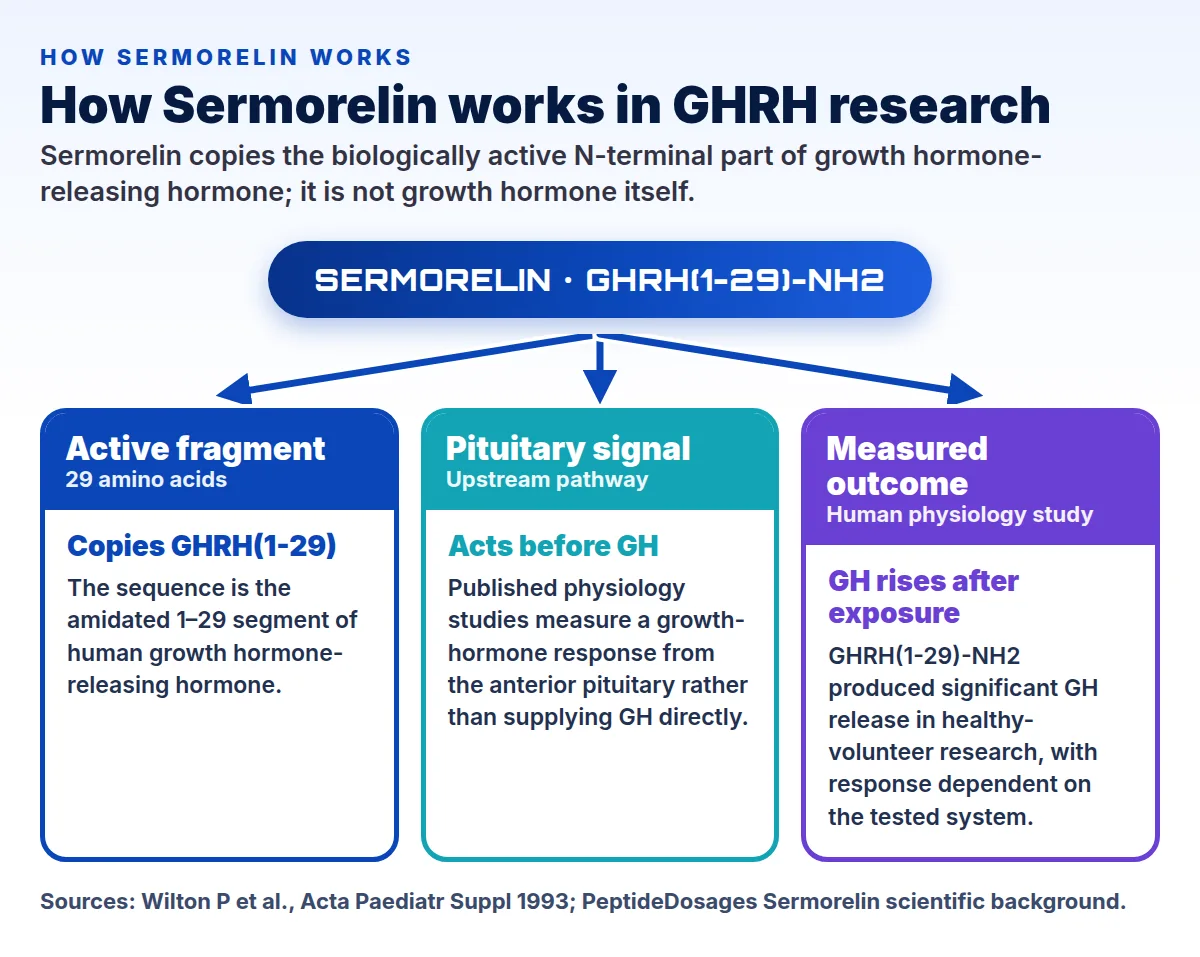
Sermorelin works by copying a GHRH signal. GHRH is made in the hypothalamus, an area of the brain that communicates with the anterior pituitary. The anterior pituitary is a small gland that releases several hormones. Sermorelin is therefore upstream of growth hormone rather than being growth hormone itself.
In a human physiology study, researchers administered GHRH(1-29)-NH2 to 30 healthy men and measured growth hormone in blood. The lowest intravenous amount tested produced significant growth-hormone release. The peptide was rapidly eliminated after intravenous administration, but growth-hormone levels stayed elevated for about three hours in that experiment.
The key research distinction is between a pathway signal and a final outcome. A rise in measured growth hormone shows that the tested GHRH–pituitary pathway responded in that setting. It does not turn Sermorelin into human growth hormone or prove a separate body-composition, performance, sleep or anti-ageing outcome.
GHRH signal: the hypothalamic message represented by Sermorelin.
Anterior pituitary: the responding gland in the GHRH–growth-hormone pathway.
Growth hormone: the downstream hormone measured in the cited physiology study.
IGF-1: a later hormone-axis marker that can be measured separately in research.
Sermorelin copies a GHRH signal that acts before growth hormone in the anterior-pituitary pathway.
What did published Sermorelin studies find?
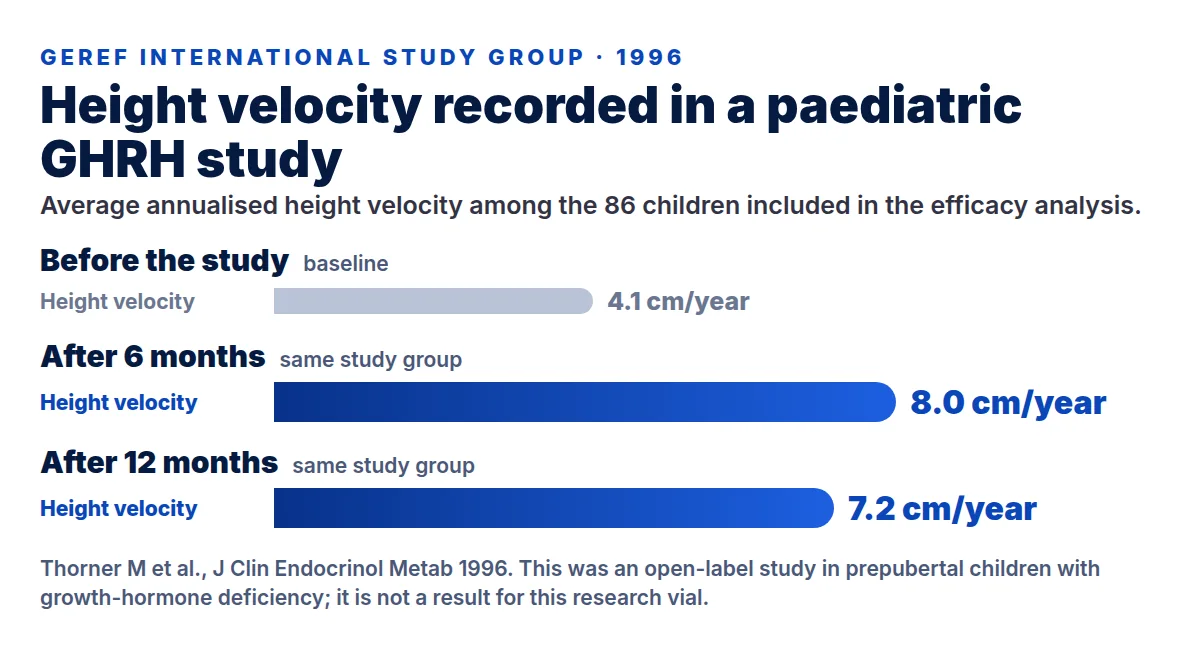
The clearest historical result for Sermorelin itself comes from Geref-era paediatric research. In a 1996 multicentre open-label study, 110 previously untreated prepubertal children with growth-hormone deficiency received GHRH(1-29) for up to one year. Eighty-six children were included in the efficacy analysis. Their average annualised height velocity was 4.1 cm/year before the study, 8.0 cm/year at six months and 7.2 cm/year at 12 months.
Those numbers belong to a specific group: prepubertal children with diagnosed growth-hormone deficiency using the study material and conditions reported by the authors. They are not a result for this 10 mg research vial, an estimate for adults, or a measurement that can be moved to a different molecule.
A separate six-month controlled study of growth hormone-releasing hormone in 89 healthy older adults reported improvements in several cognitive-test measures, including WAIS-R performance IQ and picture arrangement. That paper studied GHRH and cognition in its own population.
The table keeps the paediatric evidence easy to read while preserving its setting. Reporting the study population, duration and endpoint matters because results for height velocity, hormone levels and cognitive tests answer different questions.
Annualised height velocity reported in the 1996 open-label paediatric GHRH study; it is not a result for this research vial.
Selected published human research involving Sermorelin or GHRH
Selected published human research involving Sermorelin or GHRH
Study
Who was studied
Length
What was measured
Reported finding
Thorner et al., 1996
110 prepubertal children with growth-hormone deficiency; 86 in efficacy analysis
Up to 12 months
Annualised height velocity
4.1 cm/year at baseline; 8.0 at six months; 7.2 at 12 months
Wilton et al., 1993
30 healthy men aged 19–43 years
Physiology experiment
Growth-hormone response and pharmacokinetics
Significant GH release after intravenous GHRH(1-29)-NH2; peptide rapidly eliminated
Vitiello et al., 2006
89 healthy older adults
Six months
Cognitive-test performance
Improvements reported in several tests, including performance IQ
Each row identifies the study population and endpoint. None is a test report for the Sermorelin 10mg research listing.
Sermorelin vs Tesamorelin vs CJC-1295 NO DAC
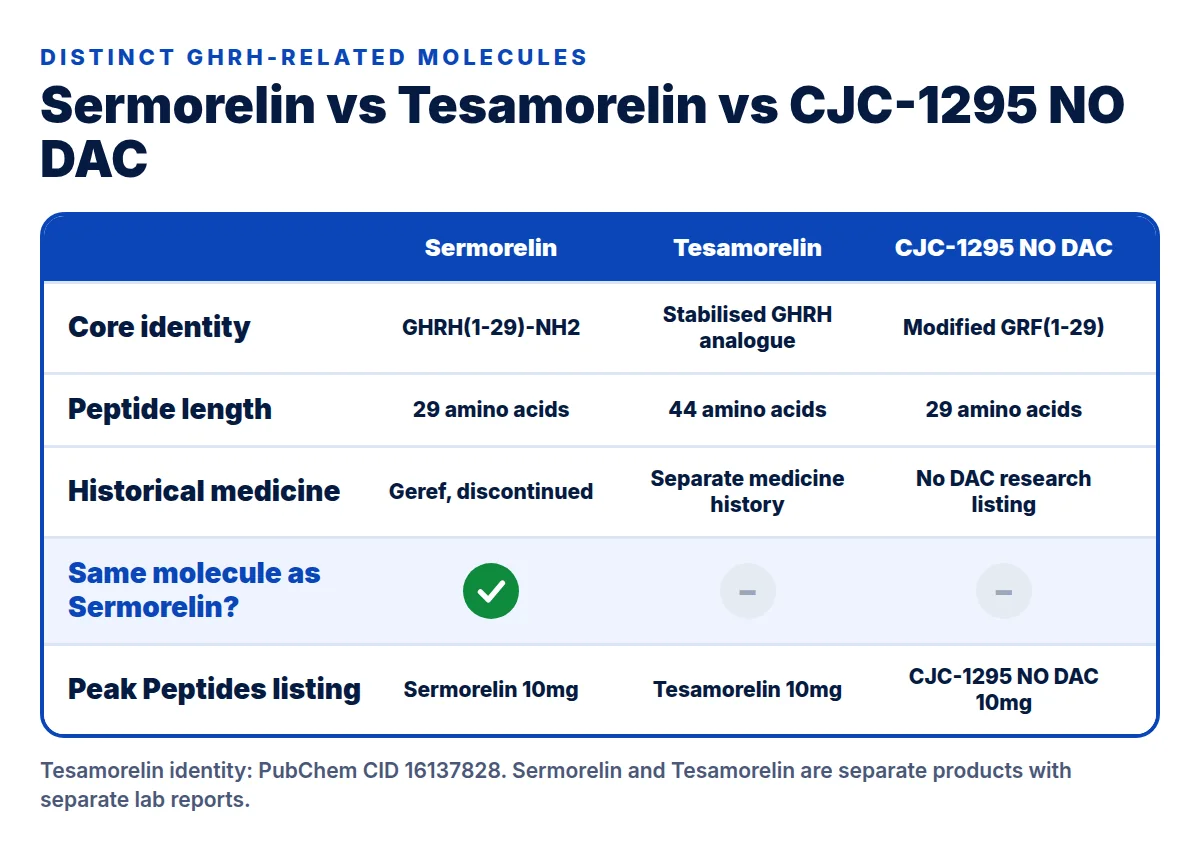
Sermorelin, Tesamorelin and CJC-1295 NO DAC are often grouped together because each appears in GHRH-related research. They are not the same molecule. A comparison is useful only when it keeps the exact molecule and evidence attached to the correct name.
Sermorelin is the amidated GHRH(1-29) fragment. Tesamorelin is a stabilised 44-amino-acid GHRH analogue. PubChem lists Tesamorelin as 5,136 g/mol and shows a 44-residue sequence, compared with Sermorelin’s 3,357.9 g/mol and 29-residue sequence. The added length and stabilisation mean milligram quantities and study findings cannot be swapped.
CJC-1295 NO DAC is commonly described as modified GRF(1-29). It is separate from Sermorelin despite the same 29-amino-acid length. The ‘NO DAC’ name distinguishes it from a longer-acting albumin-binding form; it does not make it Sermorelin. Keep product labels, sequence, formulation and analytical reports tied to the material actually studied.
Three distinct GHRH-related molecules. Similar research area does not make their data or sample documents interchangeable.
Key molecular distinction between related product listings
Key molecular distinction between related product listings
Feature
Sermorelin
Tesamorelin
CJC-1295 NO DAC
Scientific identity
GHRH(1-29)-NH2
Stabilised GHRH analogue
Modified GRF(1-29)
Length
29 amino acids
44 amino acids
29 amino acids
Same molecule as Sermorelin?
Yes
No
No
Peak Peptides listing
Sermorelin 10mg
Tesamorelin 10mg
CJC-1295 NO DAC 10mg
Compare evidence within a named molecule; do not carry a result, nominal amount, storage assumption or analytical report across listings.
Sermorelin sequence, formula and molecular identity
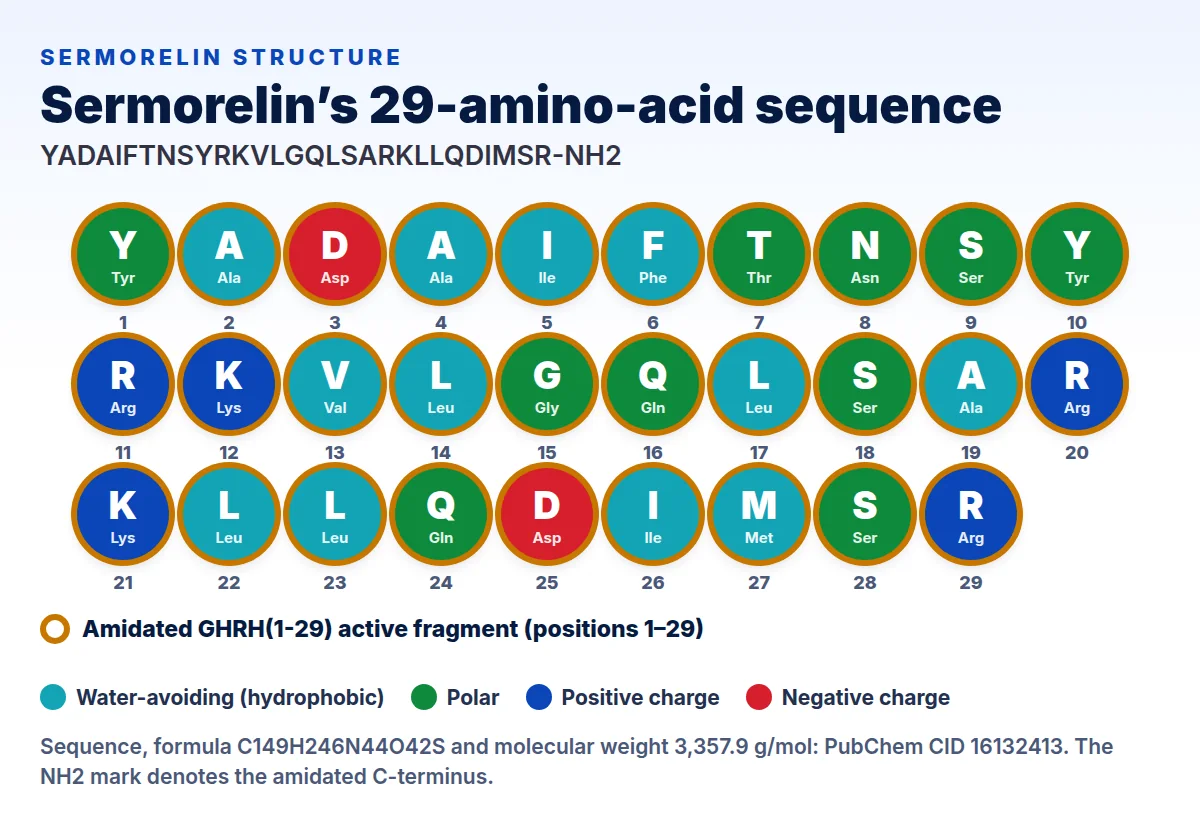
Sermorelin’s sequence is YADAIFTNSYRKVLGQLSARKLLQDIMSR-NH2. The letters stand for amino acids: for example, Y is tyrosine, A is alanine, D is aspartic acid and R is arginine. The ending NH2 means the final arginine has an amidated C-terminus, a defining part of the named molecule.
PubChem lists the free-base molecular formula as C149H246N44O42S, the molecular weight as 3,357.9 g/mol and CAS number 86168-78-7. The acetate salt is a related record and is not something this product listing establishes for the supplied vial. Chemical names, salt forms and measured product content are separate pieces of information.
Sequence information is useful for identity research. It does not replace a sample-specific identity result. When an analytical report is available, LC-MS is commonly used to compare mass information and HPLC is commonly used to report purity; those methods and their result belong to the sample that the laboratory received.
The 29 residues that define Sermorelin, with the amidated C-terminus marked as NH2.
Geref history, sample documentation and Australian context
Sermorelin has a specific regulatory history in the United States. FDA records identify Geref Sermorelin acetate diagnostic ampoules as initially approved in 1990 and 0.5 mg and 1.0 mg Geref vials as initially approved in 1997 for children with growth failure from idiopathic growth-hormone deficiency. EMD Serono notified FDA in 2008 that it was discontinuing these products. FDA withdrew the two approvals effective 18 June 2009.
The historical record is precise: it does not say that Geref was stopped for safety or effectiveness reasons. In 2013 FDA reviewed the withdrawal and determined that the Geref products were not withdrawn from sale for reasons of safety or effectiveness. It also does not make a current research vial an approved medicine, a replica of the historical presentation or a substitute for its records.
In Australia, the TGA says the Australian Register of Therapeutic Goods, or ARTG, is the public database of therapeutic goods approved for legal supply. This Sermorelin 10mg listing is not presented as an FDA- or TGA-approved medicine and is supplied for in-vitro research only. The WADA Prohibited List includes Sermorelin among growth hormone-releasing factors under S2.2.4, prohibited at all times.
No product-specific LabDoc report is published for this listing. The Quality page provides available Quality/COA documentation. Check that any report names the material tested, identifies the laboratory method and connects to the relevant supplier.
1990: Geref diagnostic Sermorelin acetate ampoule initially approved in the United States.
1997: Geref 0.5 mg and 1.0 mg Sermorelin acetate vials initially approved for a defined paediatric indication.
2008: EMD Serono notified FDA that it was discontinuing Geref products.
18 June 2009: FDA withdrawal of the relevant Geref approvals became effective.
2013: FDA determined Geref was not withdrawn for safety or effectiveness reasons.
Current listing: supplied for in-vitro research only; no product-specific LabDoc report published.
Step-by-step guide · About 10 minutes
How to reconstitute Sermorelin 10mg (step-by-step with photos)
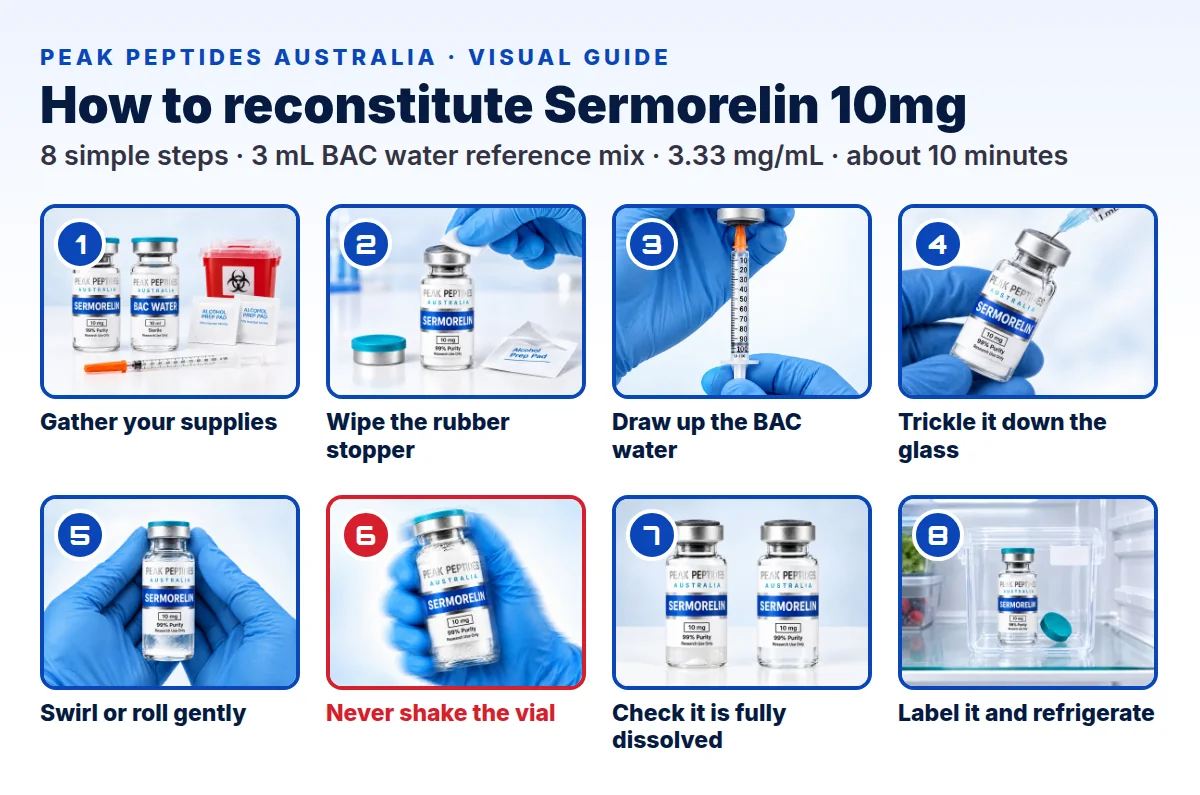
Sermorelin 10mg is shown as freeze-dried material. Reconstitution means adding a measured liquid so the powder becomes a clear solution for laboratory measurement. PeptideDosages uses 3 mL of bacteriostatic (BAC) water as its Sermorelin 10mg concentration example. That makes 3.33 mg/mL, where 30 U-100 syringe units equal 1 mg. Follow the eight visual handling steps below and keep the product-specific label or quality information with the vial.
The full Sermorelin 10mg handling sequence at a glance — eight clear steps.
What you need
Sermorelin 10mg vialNominal 10 mg freeze-dried material in a sealed glass vial. Preserve the label with the sample record.
Bacteriostatic waterThe solvent used in PeptideDosages’ 3 mL Sermorelin 10mg calculation example.
1 mL U-100 syringeA volume-measuring tool: 100 units equals 1 mL and 1 unit equals 0.01 mL.
Alcohol swabsFor wiping each rubber stopper before the preparation process.
Clean work surfaceA stable, uncluttered area helps keep labels, vials and measured volumes easy to inspect.
Sharps containerA puncture-resistant container for used sharp equipment in a laboratory handling process.
How much BAC water to add to Sermorelin 10mg
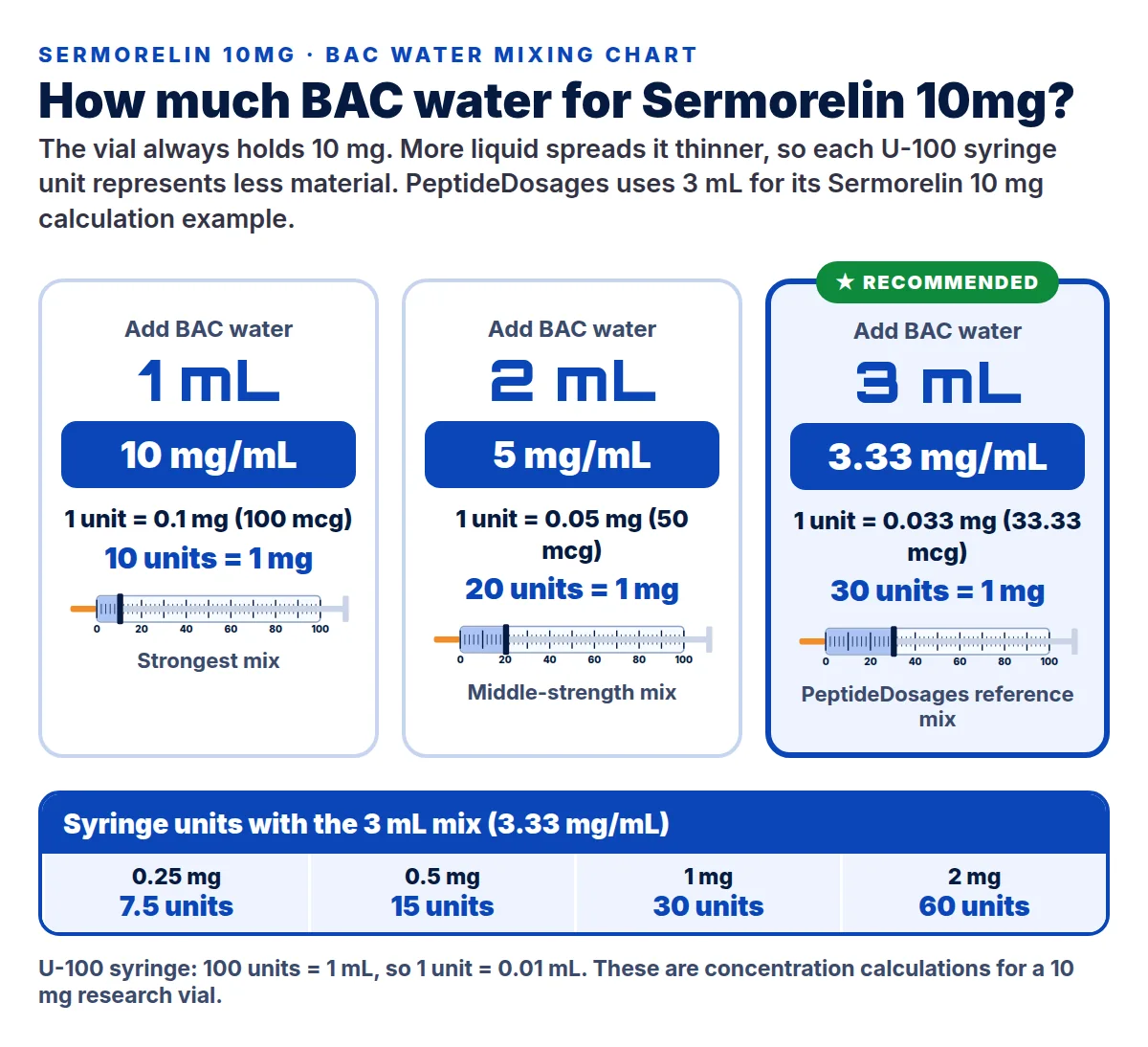
The vial’s nominal 10 mg stays the same whichever liquid volume is used. More BAC water creates a lower concentration, so each U-100 unit represents less material. Less BAC water creates a higher concentration. The chart uses 1 mL, 2 mL and the 3 mL PeptideDosages reference mix so the arithmetic can be checked at a glance.
With 3 mL, the concentration is 3.33 mg/mL. A U-100 syringe has 100 units per mL, so one unit is 0.01 mL and contains about 0.033 mg, or 33.33 mcg. At that concentration, 0.25 mg is 7.5 units, 0.5 mg is 15 units, 1 mg is 30 units and 2 mg is 60 units. With 2 mL, 1 mg is 20 units; with 1 mL, 1 mg is 10 units.
Sermorelin 10mg concentration arithmetic — the 3 mL PeptideDosages reference mix gives 3.33 mg/mL and 30 units per 1 mg.
3 mL is highlighted because it gives the simplest numbers.
Syringe units with the 3 mL mix (3.33 mg/mL)
Syringe units with the 3 mL mix (3.33 mg/mL)
Amount
Units on a U-100 syringe
Volume
0.25 mg
7.5 units
0.075 mL
0.5 mg
15 units
0.15 mL
1 mg
30 units
0.3 mL
2 mg
60 units
0.6 mL
The 8 steps
1Step 1: Gather your supplies
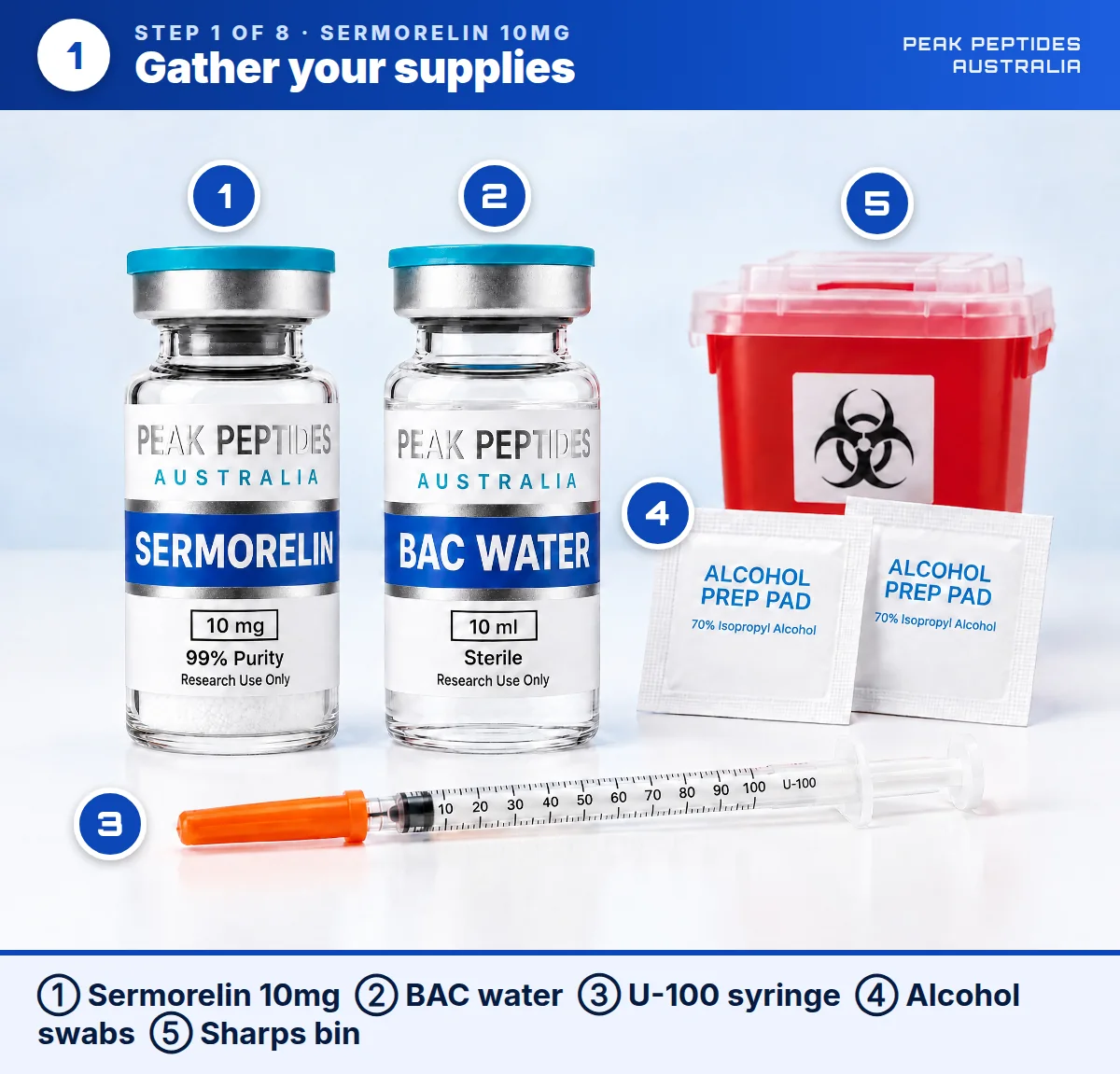
Place the Sermorelin 10mg vial, BAC water, a new 1 mL U-100 syringe, alcohol swabs and a sharps container on a clean work surface. Keep the product label and preparation record visible. The photo shows the materials used in the 3 mL reference-mix example; make sure all containers are intact before starting.
2Step 2: Wipe the rubber stopper
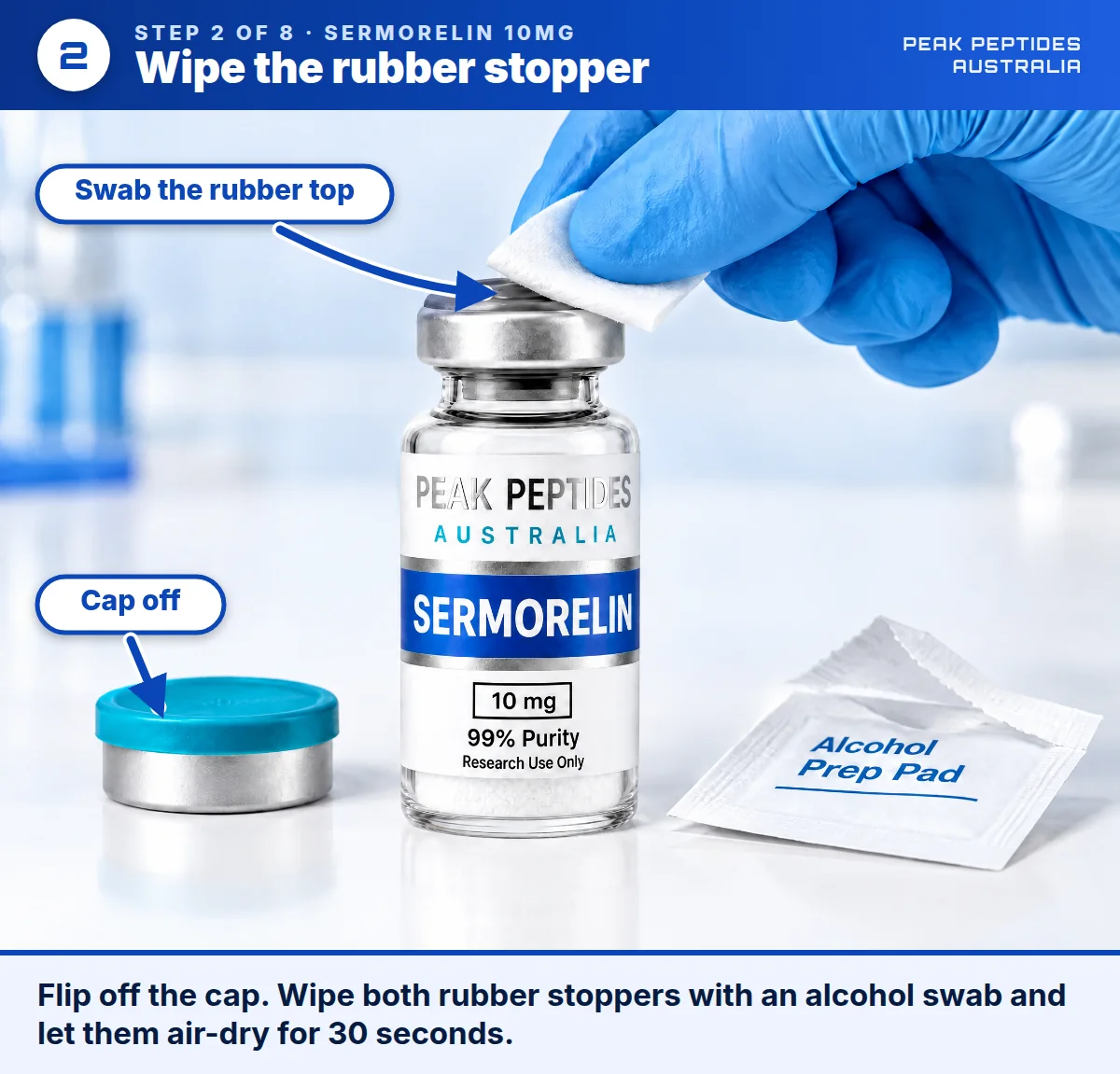
Remove the flip-off cap if present, then wipe the rubber stopper of the Sermorelin vial and the BAC-water vial with fresh alcohol swabs. Let the stoppers air-dry for about 30 seconds. Avoid touching the cleaned rubber surfaces after swabbing, and keep the removed cap beside the vial rather than on the stopper.
3Step 3: Draw up the BAC water
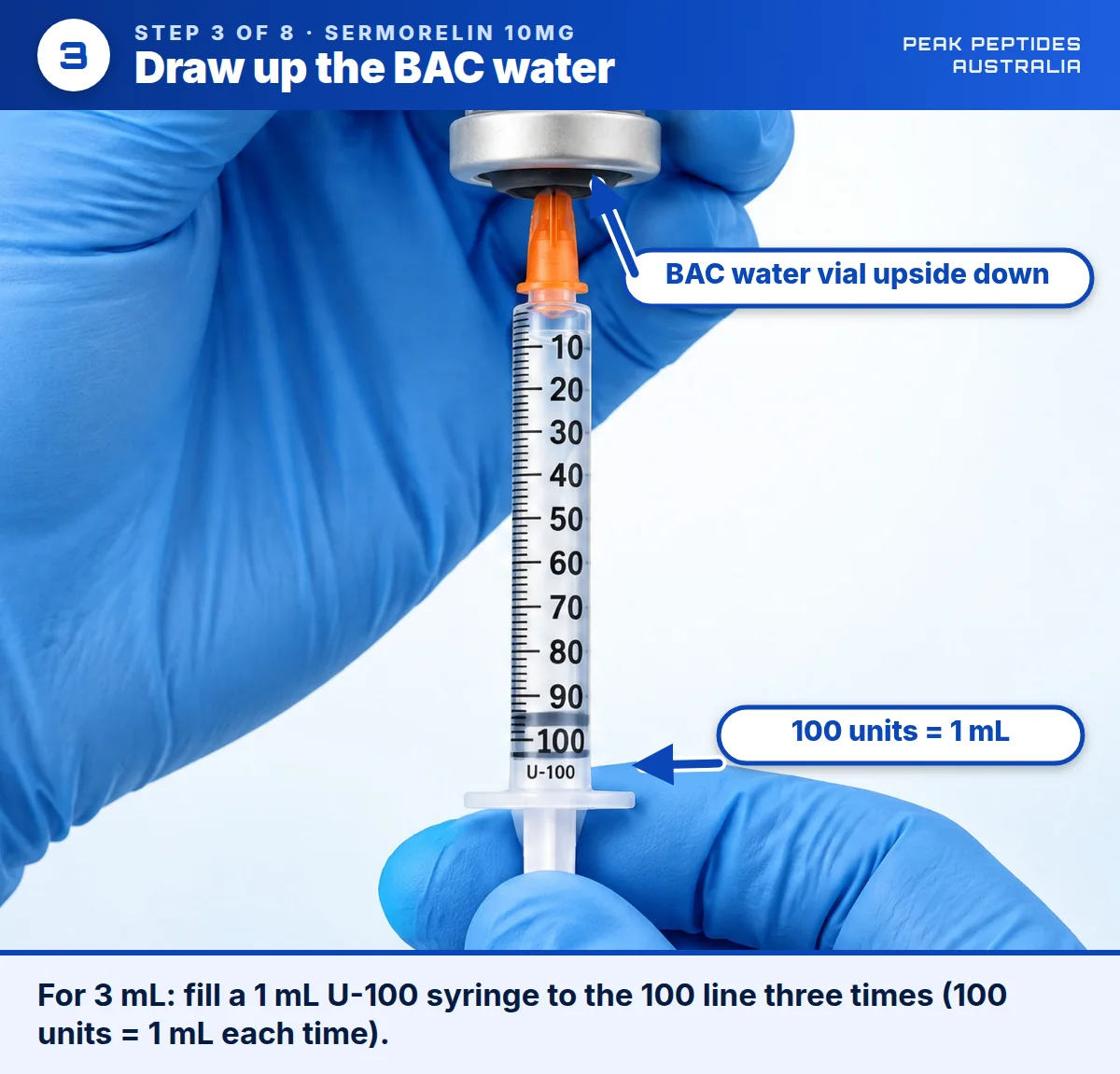
Use the U-100 syringe to measure BAC water. The 3 mL reference mix requires three separate 1 mL fills because a standard 1 mL U-100 syringe holds 100 units, which equals 1 mL. Check for air bubbles and verify the volume line each time; the syringe unit marks describe liquid volume, not peptide activity.
4Step 4: Trickle it down the glass
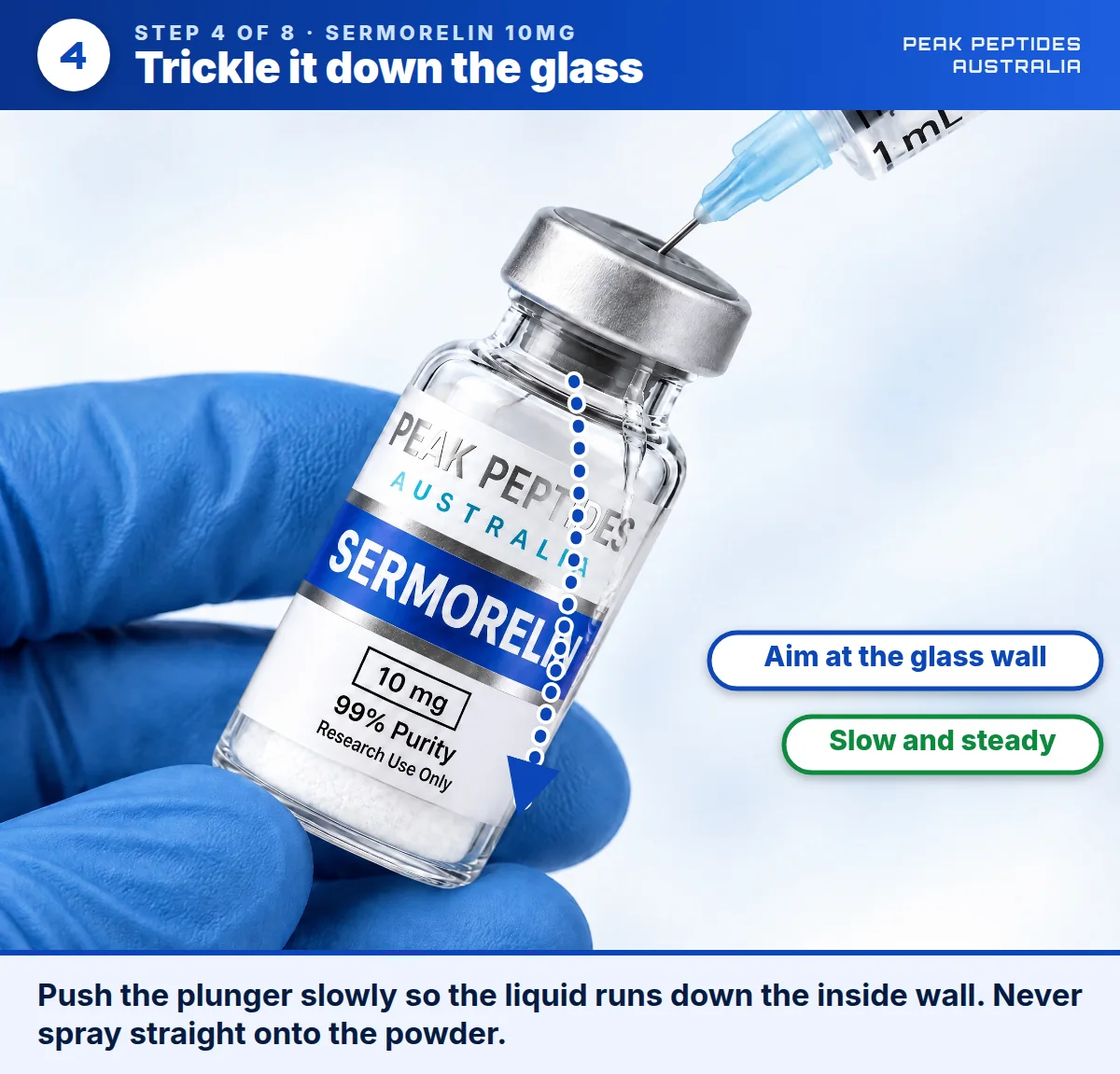
Angle the Sermorelin vial so the needle tip rests against the inside wall. Press the plunger slowly and let the liquid travel down the glass instead of directing a hard stream onto the freeze-dried material. Repeat the measured transfer until the intended final volume is reached, keeping the vial label visible for the record.
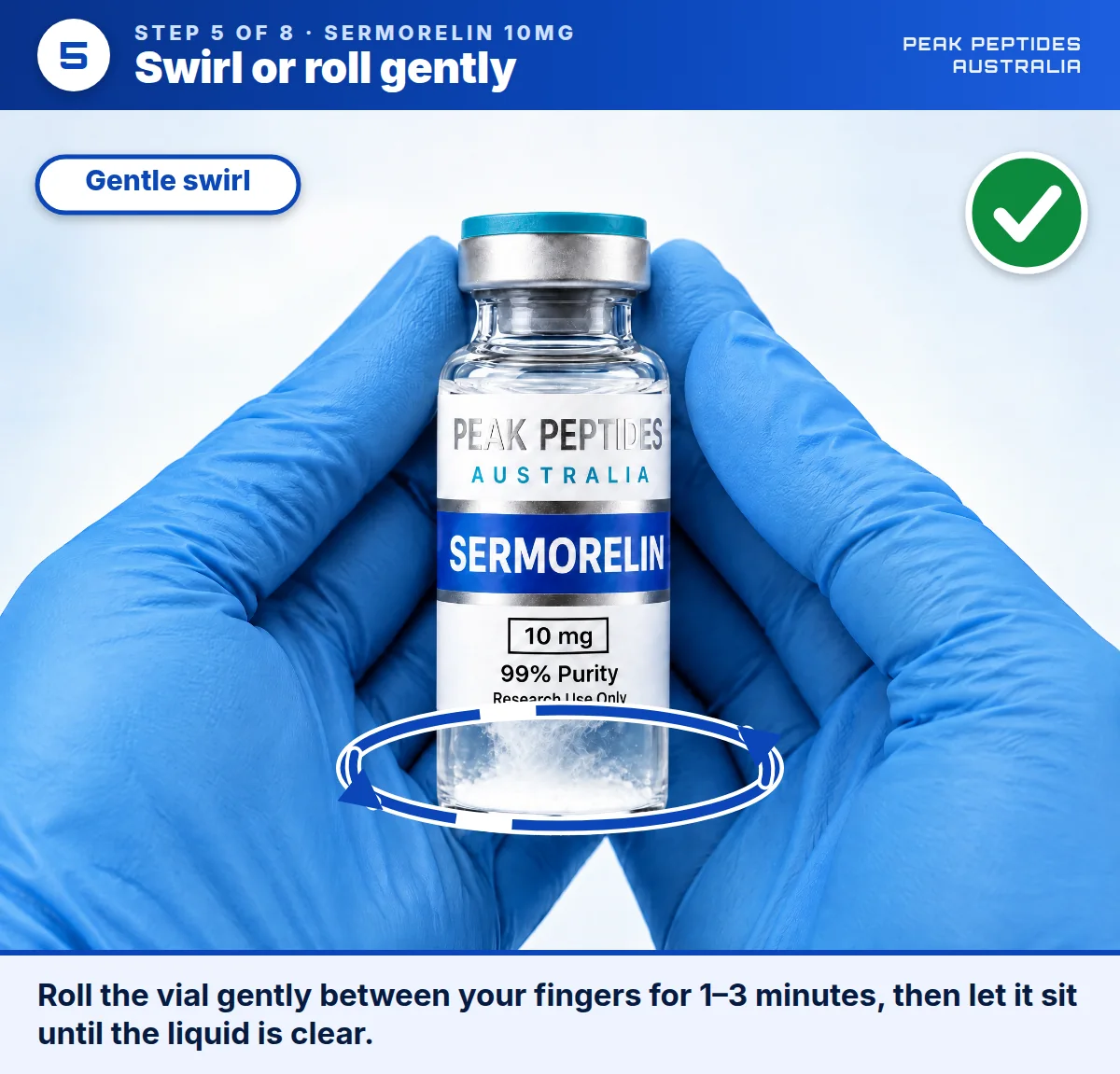
5Step 5: Swirl or roll gently
Gently roll the vial between your fingers or swirl it in slow circles. The movement wets the remaining material without vigorous agitation. Let the vial stand briefly if powder remains at the bottom, then repeat the gentle motion. Record the appearance instead of assuming that all powder has dissolved immediately.
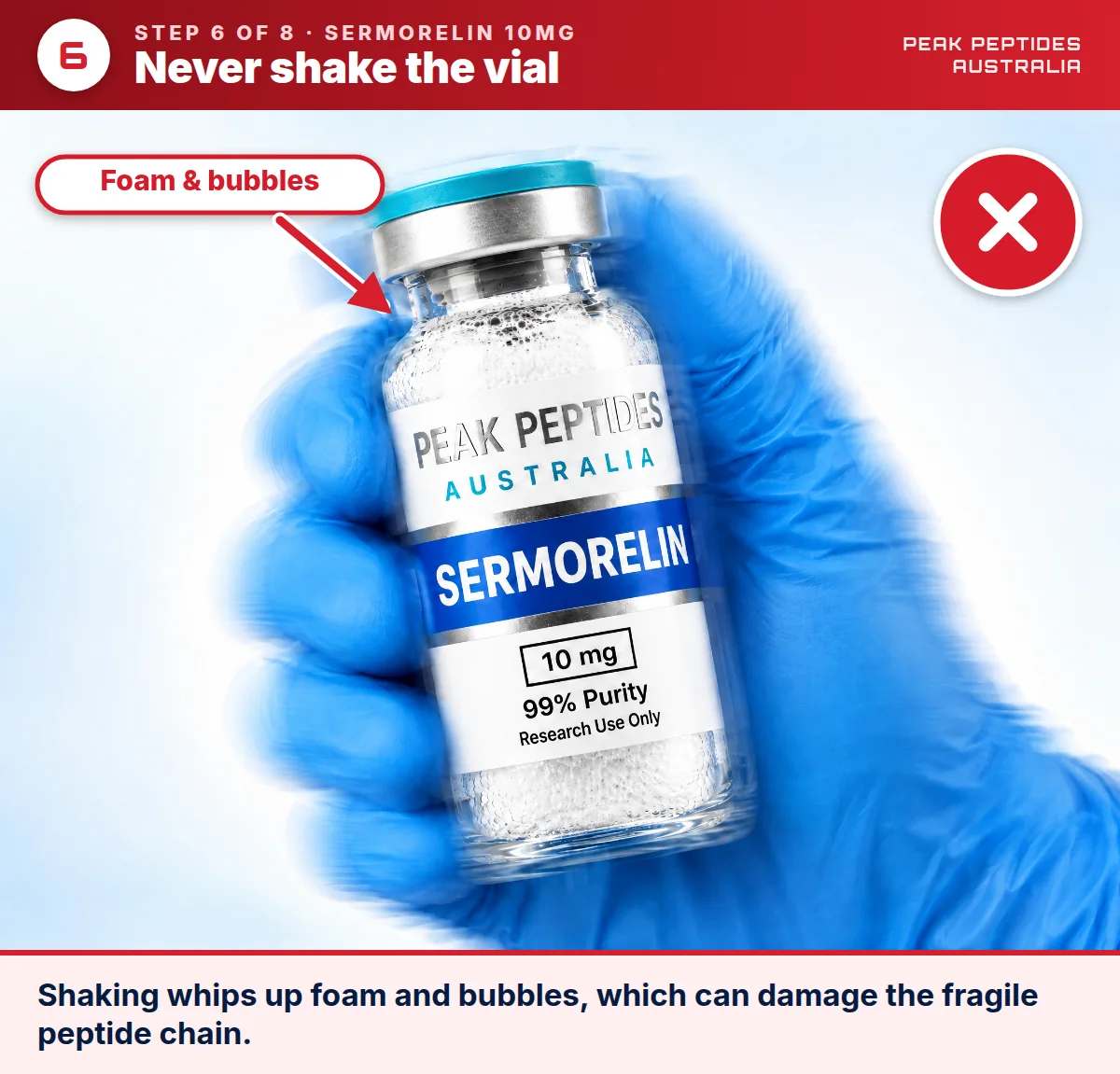
6Step 6: Never shake the vial
Do not shake the vial. The photo shows why this is a poor handling method: fast shaking produces foam and bubbles that make a clear visual check harder. If foam appears, keep the vial upright and allow bubbles to settle before inspecting the liquid again. Gentle rolling is the controlled alternative shown in the previous step.
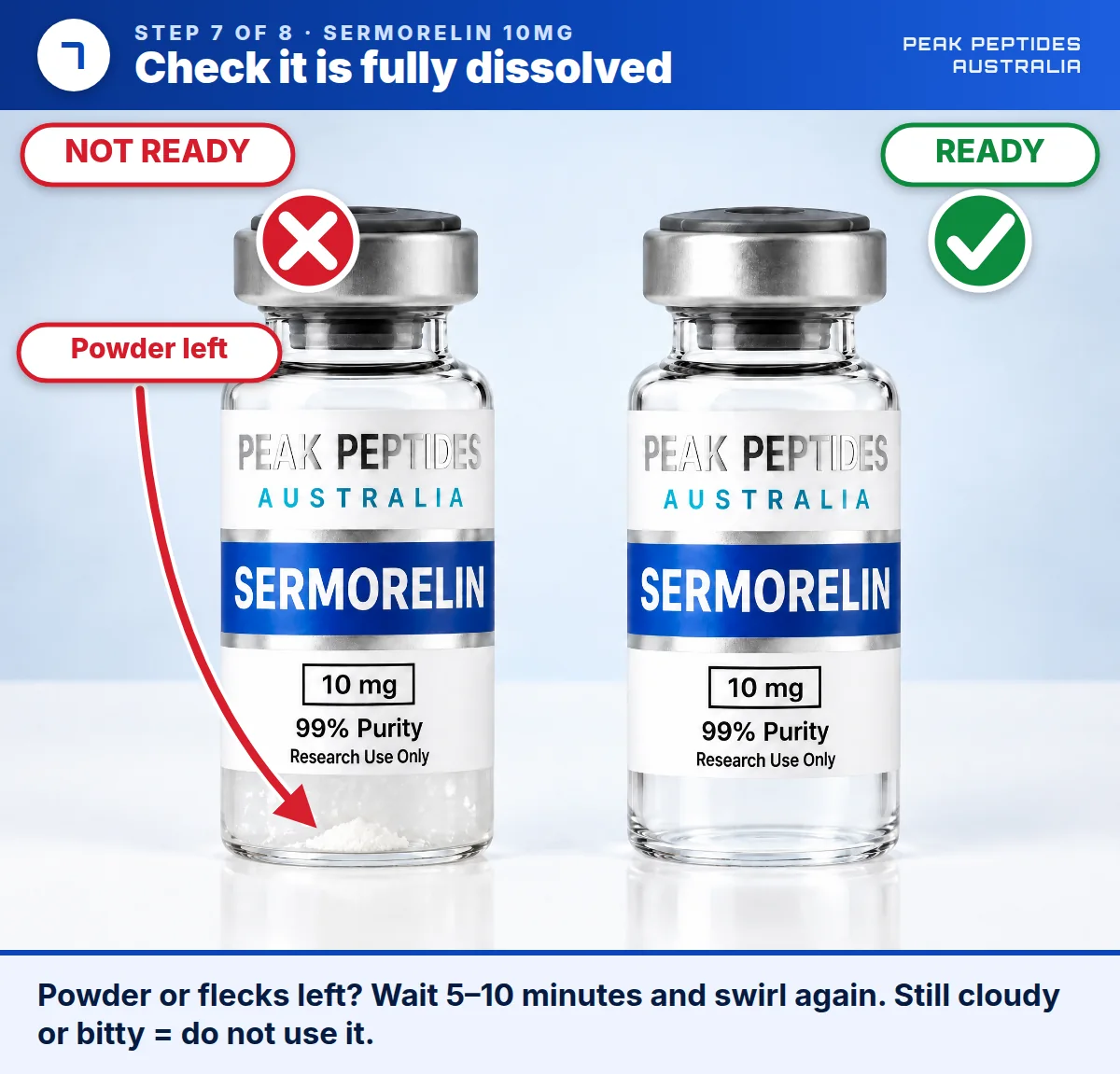
7Step 7: Check it is fully dissolved
Hold the vial against a clear background and inspect it under good light. The target visual state is clear liquid without visible powder, flecks or cloudiness. If powder remains, leave the vial to stand for five to ten minutes and swirl gently again. Record a persistent cloudy or particulate appearance rather than treating it as fully dissolved.
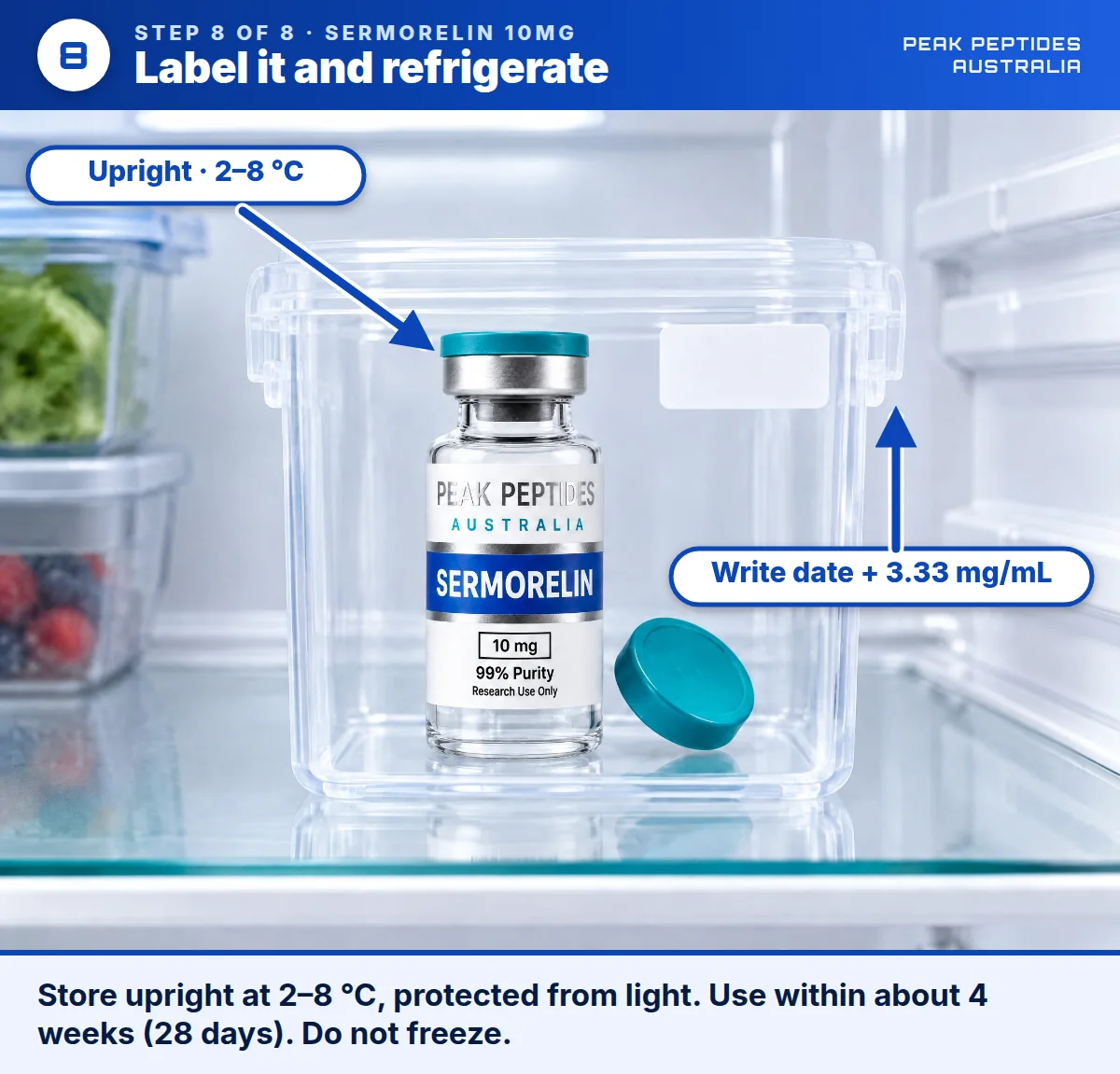
8Step 8: Label it and refrigerate
Write the preparation date and calculated concentration on the vial. For the 3 mL reference mix, the concentration is 3.33 mg/mL. Store the vial upright in the fridge at 2–8 °C, away from light, use it within about 4 weeks (28 days) and never freeze it.
How to store Sermorelin
Sermorelin handling and storage guide
Sermorelin handling and storage guide
Form
Where to keep it
What to record
Unopened labelled vial
Refrigerated at 2–8 °C and protected from light
Keep product label, batch details and available Quality/COA material together
Vial during preparation
Clean, stable work surface with label visible
Final measured liquid volume and calculated concentration
Mixed preparation
Upright in a refrigerator at 2–8 °C, protected from light
Preparation date and use within about 4 weeks (28 days)
Mixed preparation
Do not freeze
Any cloudiness, particles or handling observation
PeptideDosages directs refrigeration at 2–8 °C. Once mixed with BAC water, keep Sermorelin 10mg upright in the fridge at 2–8 °C, away from light, use within about 4 weeks (28 days) and never freeze it.
Sermorelin 10mg FAQs — Your Questions Answered
What is Sermorelin?
Sermorelin is a synthetic, amidated 29-amino-acid peptide that matches the biologically active GHRH(1-29) fragment of human growth hormone-releasing hormone. It is also called GHRH(1-29)-NH2 or GRF(1-29)-NH2 and is studied for anterior-pituitary and growth-hormone signalling.
What is Sermorelin 10mg used for in research?
Sermorelin 10mg is used for research examining GHRH-responsive pituitary signalling, measured growth-hormone output and downstream hormone-axis questions. The 10mg label identifies the nominal quantity in the vial.
How does Sermorelin work?
Sermorelin copies the active N-terminal 1–29 part of GHRH. GHRH is a signal from the hypothalamus that acts on the anterior pituitary. In the physiology studies cited on this page, GHRH(1-29)-NH2 prompted measurable growth-hormone release rather than supplying growth hormone itself.
Is Sermorelin the same as human growth hormone?
No. Sermorelin is a GHRH fragment that acts upstream at the anterior pituitary. Human growth hormone, also called somatropin, is the separate downstream hormone. They have different chemical identities, study evidence, labelled milligrams and sample documentation.
What did studies find for Sermorelin?
A 1996 multicentre open-label study in prepubertal children with growth-hormone deficiency reported mean height velocity of 4.1 cm/year before the study, 8.0 after six months and 7.2 after 12 months among 86 participants in the efficacy analysis. This is a paediatric Geref-era result, not a result for this research vial.
What did human physiology studies find?
A clinical study in 30 healthy men found that GHRH(1-29)-NH2 caused significant growth-hormone release after intravenous administration. The paper reports that the peptide was rapidly eliminated while growth-hormone levels remained elevated for about three hours. These are measured physiology findings in that study setting.
What side effects were reported in historical Sermorelin material?
The Mayo Clinic monograph for historical Sermorelin medicine lists pain, redness or swelling at the injection site as more common reactions. It lists dizziness, flushing, headache and sleepiness as less common reactions. Those entries describe a prescription-medicine monograph, not a quality or safety finding for this research vial.
What is the half-life of Sermorelin?
A pharmacokinetic paper reports a 6.2-minute half-life for parent growth hormone-releasing factor(1-29)-amide after intravenous administration in the tested model. Half-life describes disappearance from circulation. It should not be converted into an assumed experimental schedule or storage period.
Was Sermorelin FDA-approved?
Specific Sermorelin acetate products were formerly FDA-approved under the Geref name. FDA records show a diagnostic product approved in 1990 and paediatric growth-hormone-deficiency vials approved in 1997. The manufacturer discontinued them in 2008, and FDA withdrew the approvals effective 18 June 2009.
Why was Geref discontinued?
FDA records state that EMD Serono notified the agency in 2008 that it was discontinuing the Geref products and requested withdrawal of the relevant approvals. FDA’s 2013 determination states that the products were not withdrawn from sale for reasons of safety or effectiveness.
Is Sermorelin 10mg an FDA- or TGA-approved medicine?
No. Historical Geref approval does not make this current Sermorelin 10mg research listing an FDA- or TGA-approved medicine. The TGA describes the ARTG as Australia’s public database of therapeutic goods approved for legal supply. This material is supplied for in-vitro research only.
Is Sermorelin prohibited in sport?
Yes. WADA places Sermorelin under S2.2.4, growth hormone-releasing factors, alongside GHRH and its analogues. The S2 category is prohibited at all times under the current WADA Prohibited List. This status is separate from the product’s research-use supply boundary.
How is Sermorelin different from Tesamorelin?
Sermorelin is the amidated 29-amino-acid GHRH(1-29) fragment. Tesamorelin is a separate stabilised GHRH analogue with 44 amino acids; PubChem lists it at 5,136 g/mol, compared with 3,357.9 g/mol for Sermorelin. Findings for one molecule should not be relabelled as findings for the other.
How is Sermorelin different from CJC-1295 NO DAC?
Sermorelin is GHRH(1-29)-NH2. CJC-1295 NO DAC is a distinct modified GRF(1-29) research molecule. Both have 29 amino acids and are discussed in GHRH-related research.
Can I buy Sermorelin 10mg online in Australia?
Sermorelin 10mg can be ordered online from Peak Peptides Australia when available. Same-day dispatch from Victoria for in-stock orders once payment is confirmed, tracked Australia Post Express, with the tracking number emailed. It is supplied for in-vitro research only.
How fast is Sermorelin shipping in Australia?
Same-day dispatch from Victoria for in-stock orders once payment is confirmed, tracked Australia Post Express, with the tracking number emailed. Carrier transit time depends on the Australia Post network and destination. The page does not promise a specific delivery date.
How do I know a Sermorelin sample is real?
Match the product label, product name, nominal amount and supplier details, then read evidence that applies to the actual sample. Identity testing commonly uses LC-MS and purity testing commonly uses HPLC, but a report for a different product does not verify this Sermorelin 10mg vial.
Is there a LabDoc report for Sermorelin 10mg?
No product-specific LabDoc report is currently published for this listing. Review available Quality/COA documentation on the Quality page. A report needs to identify the material tested, the analytical method and the connection to the supplier.
What does 10mg mean on the Sermorelin vial?
The 10mg label is the nominal total quantity stated for the vial listing. Laboratory concentration is calculated from material quantity and the final measured liquid volume.
How much BAC water for Sermorelin 10mg?
PeptideDosages presents 3 mL of bacteriostatic water as its Sermorelin 10mg calculation example. That produces 3.33 mg/mL. The chart also shows the arithmetic for 1 mL and 2 mL: 10 mg/mL and 5 mg/mL respectively. Changing water changes concentration, not the nominal 10 mg total.
How many units is 1 mg of Sermorelin?
With the 3 mL reference mix, the calculated concentration is 3.33 mg/mL, so 1 mg corresponds to 30 units on a U-100 syringe, or 0.30 mL. With 2 mL, 1 mg corresponds to 20 units; with 1 mL, it corresponds to 10 units.
How many mg are in 10 units of Sermorelin?
With the 3 mL reference mix, 10 U-100 units equal 0.10 mL and represent about 0.33 mg, or 33.33 mcg per unit. With a 2 mL mix, 10 units represent 0.5 mg; with a 1 mL mix, 10 units represent 1 mg.
How do I reconstitute Sermorelin 10mg?
The visual guide shows the handling sequence: gather clean supplies, wipe the rubber stoppers, draw BAC water, let it run down the vial wall, swirl gently, do not shake, check for a fully clear liquid, then label and refrigerate. The 3 mL chart is a concentration calculation example.
Can I use sterile or tap water instead of BAC water?
Tap water is not a sterile laboratory diluent. PeptideDosages uses bacteriostatic water in its Sermorelin 10mg calculation example. A batch-specific method, product label or Quality/COA documentation governs whether another solvent is appropriate for a defined laboratory procedure.
What if Sermorelin powder does not dissolve?
Let the vial stand for five to ten minutes, then swirl or roll it gently again. Do not shake it. The visual check is simple: a properly dissolved preparation should be clear and without visible powder, flecks or cloudiness. If particles remain, record the observation.
Should reconstituted Sermorelin be cloudy?
No. In the handling guide, the ready state is a clear liquid with no visible powder, flecks or cloudiness. Cloudiness can mean the material has not fully dissolved or another handling issue is present. Compare the vial against a clear background in good light before recording the result.
How long does mixed Sermorelin last?
Once mixed with BAC water, keep the vial upright in the fridge at 2–8 °C, away from light, and use it within about 4 weeks (28 days). Never freeze it. Write the date and strength on the vial.
How should Sermorelin powder be stored before mixing?
Keep the unopened material in the fridge at 2–8 °C, away from light, consistent with the PeptideDosages handling page. Keep the original label and protect the vial from contamination. Follow any more specific conditions in the product packaging or Quality/COA information.
Can reconstituted Sermorelin be frozen?
No. Keep the mixed Sermorelin vial upright in the fridge at 2–8 °C, protected from light. Use it within about 4 weeks (28 days) and never freeze it.
What does a COA show for a peptide sample?
A certificate of analysis records what a laboratory tested and how it tested it. Useful details can include sample identity, analytical method, purity result, observed mass, report date and supplier link. It only supports the tested sample, so a COA for another product cannot establish the identity of Sermorelin 10mg.