CJC-1295 NO DAC (5mg) + Ipamorelin (5mg) GH Research Stack
Muscle Blend 10mg is a two-peptide research vial labelled with CJC-1295 NO DAC (5mg) and Ipamorelin (5mg). LabDoc report LD-MQQ4 records 99.45% HPLC purity for the whole vial, with both compounds confirmed by LC-MS. In-stock orders receive same-day dispatch from Victoria after payment confirmation, with tracked Australia Post Express shipping Australia-wide.
Product Specifications
Full NameCJC-1295 NO DAC (5mg) + Ipamorelin (5mg) GH Research Stack
Vial SizeCJC-1295 NO DAC (5mg) + Ipamorelin (5mg)
Purity99.45% HPLC (LD-MQQ4, whole-blend sample)
Legal Disclaimer
This product is sold strictly for in-vitro laboratory research purposes only. It is not intended for human or animal consumption, injection, or any diagnostic or therapeutic use.
Muscle Blend 10mg · CJC-1295 NO DAC + Ipamorelin research
Muscle Blend 10mg — What It Contains, Research Background & Reconstitution
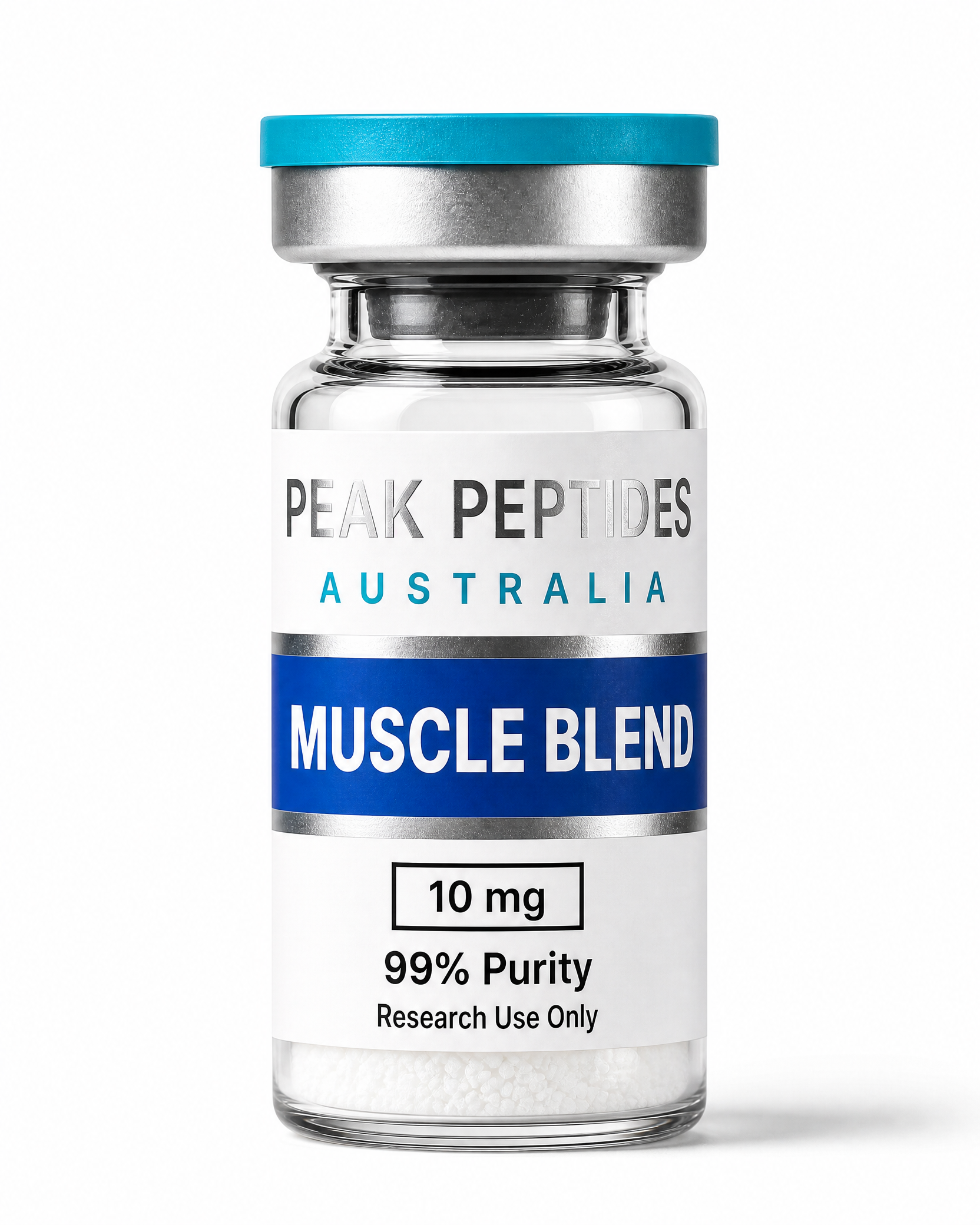
Muscle Blend 10mg is a labelled two-peptide research blend containing CJC-1295 NO DAC 5mg plus Ipamorelin 5mg. CJC-1295 NO DAC is commonly called Modified GRF (1-29), a growth hormone-releasing hormone analogue without the albumin-binding DAC extension. Ipamorelin is a synthetic five-amino-acid growth hormone secretagogue studied through a different, GHRP-like receptor pathway. The blend puts two distinct signalling pathways in one vial. This page covers what the label says and what the individual-component studies found. LabDoc report LD-MQQ4 tested this listing’s sample: 99.45% HPLC purity for the whole vial, both compounds confirmed by LC-MS, 4.66mg CJC and 4.61mg Ipamorelin measured, an overall Pass. An earlier Janoshik report, #135350, is also on the Quality page. Muscle Blend is supplied for in-vitro research only.
Also referred to in research or catalogue references as CJC-1295 NO DAC + Ipamorelin, CJC-1295/Ipamorelin blend, CJC IPA blend, CJC 1295 NO DAC Ipamorelin, CJC-1295 no DAC and Ipamorelin, CJC Ipamorelin 5mg 5mg blend, Modified GRF 1-29 Ipamorelin blend, Muscle Blend peptide.
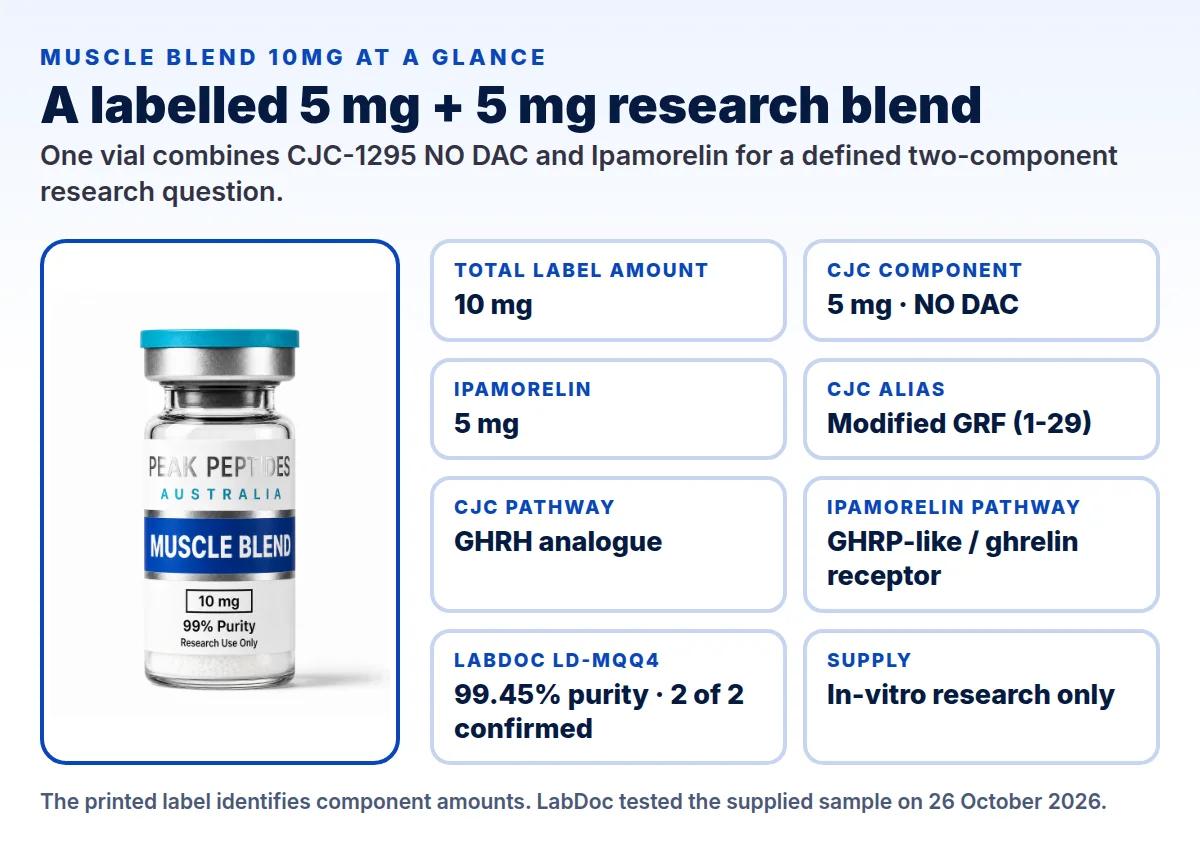
Muscle Blend 10mg at a glance
Product
Muscle Blend 10mg
Labelled composition
CJC-1295 NO DAC 5mg + Ipamorelin 5mg
Total label amount
10mg across two named peptides
CJC-1295 NO DAC
Commonly called Modified GRF (1-29); GHRH analogue without DAC
CJC-1295 is identified by the TGA as an unapproved peptide product
FDA status
Evaluated CJC-1295 and Ipamorelin forms are not components of FDA-approved drugs
Source-reference mix
3 mL BAC water = 3.33 mg/mL total blend; 0.167 mg of each component per 10 units
Storage after mixing
Upright in the fridge at 2–8 °C, protected from light; avoid freeze–thaw
Dispatch
Same-day from Victoria for in-stock orders once payment is confirmed, tracked Australia Post Express
A defined 5mg + 5mg blend
Muscle Blend is labelled as 5mg CJC-1295 NO DAC and 5mg Ipamorelin, a 10mg total. It is a blend of two named peptides, not a new single molecule and not growth hormone itself. The equal label amounts identify the formulation; they do not show equal receptor activity or an equal biological response.
NO DAC is essential wording
CJC-1295 NO DAC usually refers to Modified GRF (1-29). It does not carry the albumin-binding drug-affinity-complex extension used by CJC-1295 DAC. The long-acting CJC-1295 research should not be relabelled as evidence for the NO DAC component or for this blend.
Two component pathways
CJC-1295 NO DAC is framed as a growth hormone-releasing hormone, or GHRH, analogue. Ipamorelin is a growth hormone secretagogue studied through a GHRP-like, ghrelin-receptor pathway. Those are distinct routes into growth-hormone signalling, which is the component-level rationale for examining the pair.
What Ipamorelin studies found
Foundational lab work reported that Ipamorelin released growth hormone through a GHRP-like receptor pathway in pituitary-cell and preclinical experiments. A controlled healthy-volunteer study measured a short, single growth-hormone response after intravenous Ipamorelin. Those studies did not test Muscle Blend.
What the CJC-1295 study tested
The widely cited 2006 CJC-1295 study tested a long-acting, albumin-binding GHRH analogue in healthy adults. It measured growth hormone and IGF-1 pharmacology. It did not test CJC-1295 NO DAC, Ipamorelin, or the 5mg + 5mg Muscle Blend formulation.
LabDoc report LD-MQQ4 for this blend
LabDoc report LD-MQQ4 received the sample on 16 October 2026 and tested it on 26 October 2026. It records 99.45% HPLC purity for the whole vial and LC-MS identity confirmed for 2 of 2 compounds. Measured content: CJC 4.66mg and Ipamorelin 4.61mg (92.2% of its 5mg claim). Overall: Pass. Earlier Janoshik report #135350 measured Ipamorelin 5.65mg and CJC-1295 (Mod GRF 1-29) 4.82mg.
Not an approved medicine
The TGA identifies CJC-1295 among unapproved peptide products, meaning it has not been included in the ARTG and has not been evaluated by the TGA for safety, quality or effectiveness. FDA’s 2024 reviews say neither the evaluated CJC-1295 forms nor Ipamorelin forms are components of an FDA-approved drug.
Storage and handling at a glance
Keep dry freeze-dried material cold, dark and protected from moisture. After adding BAC water, keep the clear solution upright in the fridge at 2–8 °C and away from light. The photo guide uses a 3 mL reference volume because it is the volume on the preferred blend source.
Muscle Blend 10mg is a labelled two-peptide research material: 5mg CJC-1295 NO DAC plus 5mg Ipamorelin. It places two distinct component identities in a single vial. It is not a single new molecule, not growth hormone and not a regulated clinical formulation.
CJC-1295 NO DAC is commonly used for Modified GRF (1-29), a modified growth hormone-releasing hormone analogue. Ipamorelin is a synthetic pentapeptide classed as a growth hormone secretagogue. The label’s equal component quantities make the formulation easy to describe, but they do not mean that the two components have the same receptor effect or persistence.
Peak Peptides Australia supplies this material for in-vitro research only. The useful research question is narrow: what happens when a GHRH-analogue component and a GHRP-like component are examined together under a defined method? That question is not answered by the product name alone.
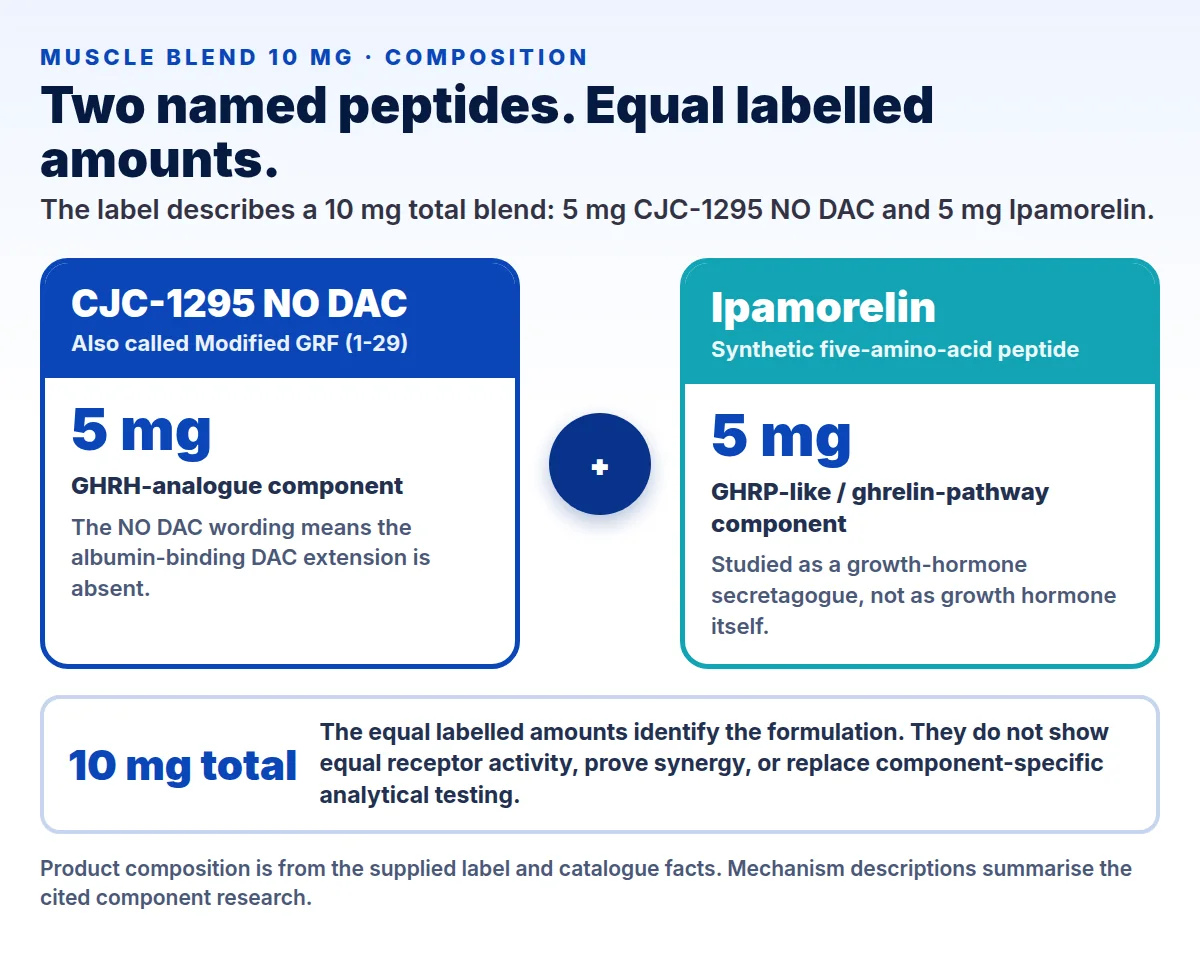
Muscle Blend is labelled as a 10mg total blend: 5mg CJC-1295 NO DAC and 5mg Ipamorelin.
Muscle Blend composition: CJC-1295 NO DAC 5mg + Ipamorelin 5mg
Muscle Blend contains two named components rather than one combined chemical identity. The label states 5mg CJC-1295 NO DAC and 5mg Ipamorelin. CJC-1295 NO DAC is the component also described as Modified GRF (1-29); the wording NO DAC must remain attached to that component because it distinguishes it from the long-acting DAC form.
Ipamorelin is a synthetic five-amino-acid peptide. Its five-milligram label amount is separate from the CJC-1295 NO DAC amount, even though both are in the same vial. On the 3 mL reference chart, every 10 syringe units represents the same calculated amount of each labelled component: 0.167 mg each.
A 5mg + 5mg composition is a formulation statement. It does not create a new clinical indication, show that both components are equally active, or prove that the pair has a synergistic result. Component identity and component-specific batch evidence remain essential for a blend.
The bespoke blend breakdown keeps the two labelled components distinct while showing the 10mg total.
How do the Muscle Blend components work?
Muscle Blend combines two components studied through different growth-hormone signalling routes. Growth hormone-releasing hormone, abbreviated GHRH, is a natural pituitary signal. A GHRH analogue is a peptide designed to interact with that signalling system. CJC-1295 NO DAC is discussed in this context as a Modified GRF (1-29) analogue.
Ipamorelin is described as a growth hormone secretagogue. In the foundational pharmacology study, GHRP and GHRH antagonists distinguished a GHRP-like receptor route for Ipamorelin-driven growth-hormone release. This is separate from the GHRH pathway used to frame the CJC-1295 NO DAC component.
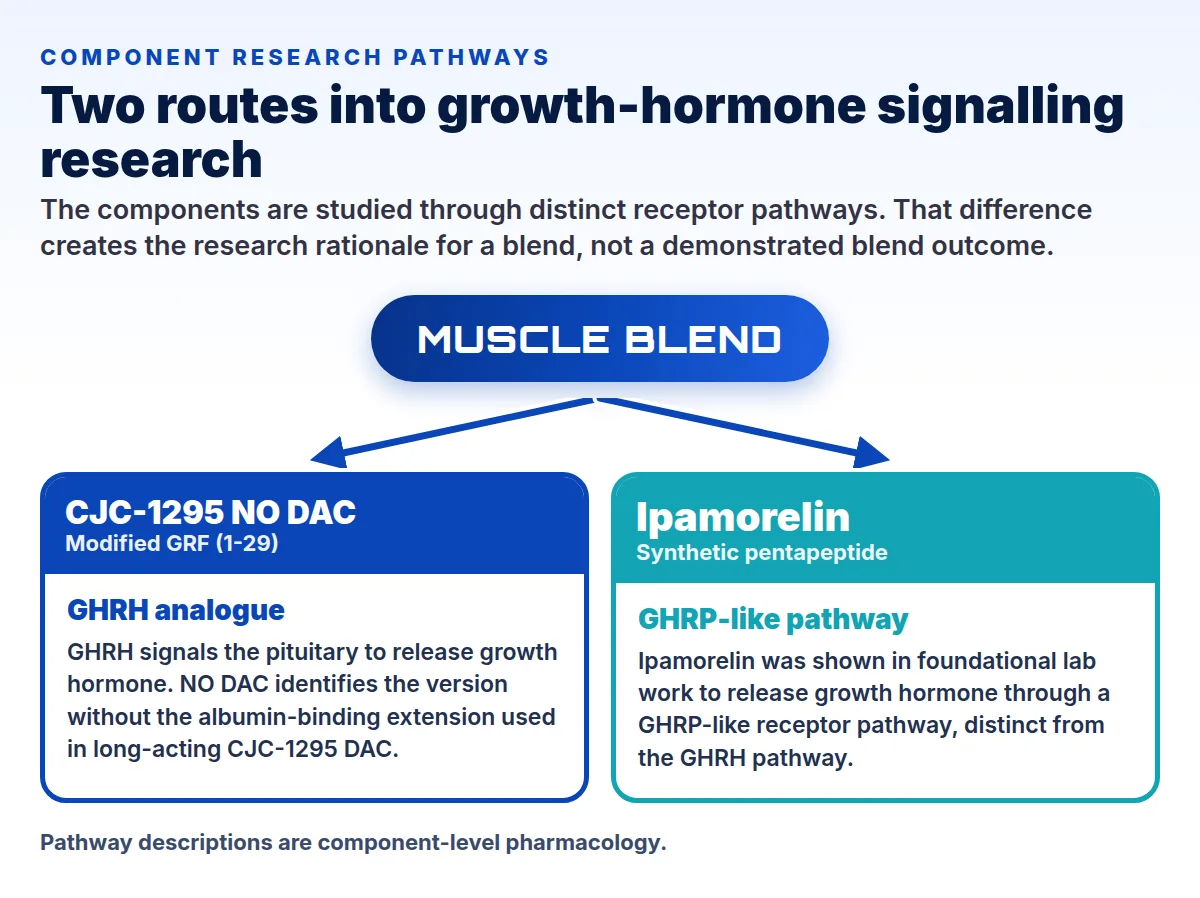
Two pathways can make a useful laboratory comparison. The mechanism image is a map of the component research context.
CJC-1295 NO DAC — a GHRH-analogue research identity, commonly called Modified GRF (1-29).
Ipamorelin — a synthetic growth hormone secretagogue examined through a GHRP-like receptor pathway.
Muscle Blend — the defined 5mg + 5mg combination; pathway complementarity is a research premise, not an outcome result.
The components are described through distinct GHRH and GHRP-like signalling routes.
What did the research find for the components?
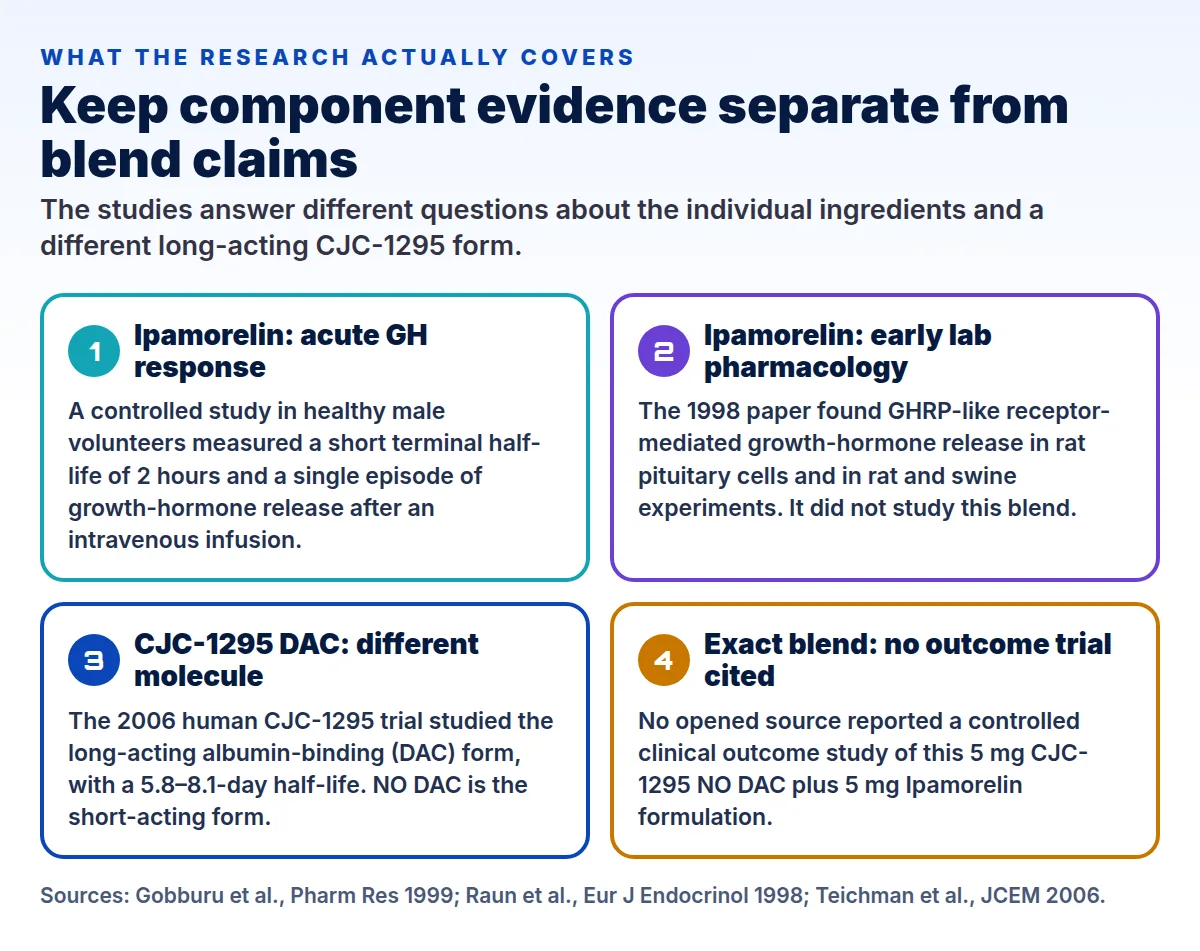
The available literature is clearer for the individual components than for the exact blend. Raun and colleagues reported that Ipamorelin released growth hormone through a GHRP-like receptor pathway in rat pituitary-cell work and in preclinical experiments. The paper’s selective-hormone observations belong to those study systems; they are not a result for Muscle Blend.
Gobburu and colleagues then studied intravenous Ipamorelin in healthy male volunteers. The study measured an episodic growth-hormone response and a terminal half-life of about 2 hours. It was a short-term pharmacokinetic and pharmacodynamic experiment, not a muscle, recovery, sleep or body-composition trial and not a test of the combination.
The much-cited Teichman CJC-1295 trial is equally important to label correctly. It studied a long-acting albumin-binding CJC-1295 analogue, with a reported 5.8–8.1-day half-life. The trial’s molecule is the DAC form, so those kinetics and results cannot be transferred to CJC-1295 NO DAC or to a CJC-1295 NO DAC/Ipamorelin blend.
The strongest page claim is also the simplest: component evidence and long-acting DAC evidence are not evidence for the exact blend.
What the opened component research did and did not examine
What the opened component research did and did not examine
Evidence source
What was studied
Directly applies to Muscle Blend?
Raun et al., 1998
Ipamorelin receptor pharmacology in pituitary-cell and preclinical systems
No — component study only
Gobburu et al., 1999
Intravenous Ipamorelin pharmacokinetics and growth-hormone response in healthy men
No — component study only
Teichman et al., 2006
Long-acting albumin-binding CJC-1295 pharmacology in healthy adults
No — DAC formulation, not NO DAC
Exact 5mg + 5mg formulation
No controlled outcome study identified in the opened sources
No direct clinical outcome result to claim
A study of a component or of CJC-1295 DAC should not be presented as a study of CJC-1295 NO DAC plus Ipamorelin.
CJC-1295 NO DAC vs CJC-1295 DAC: why the difference matters
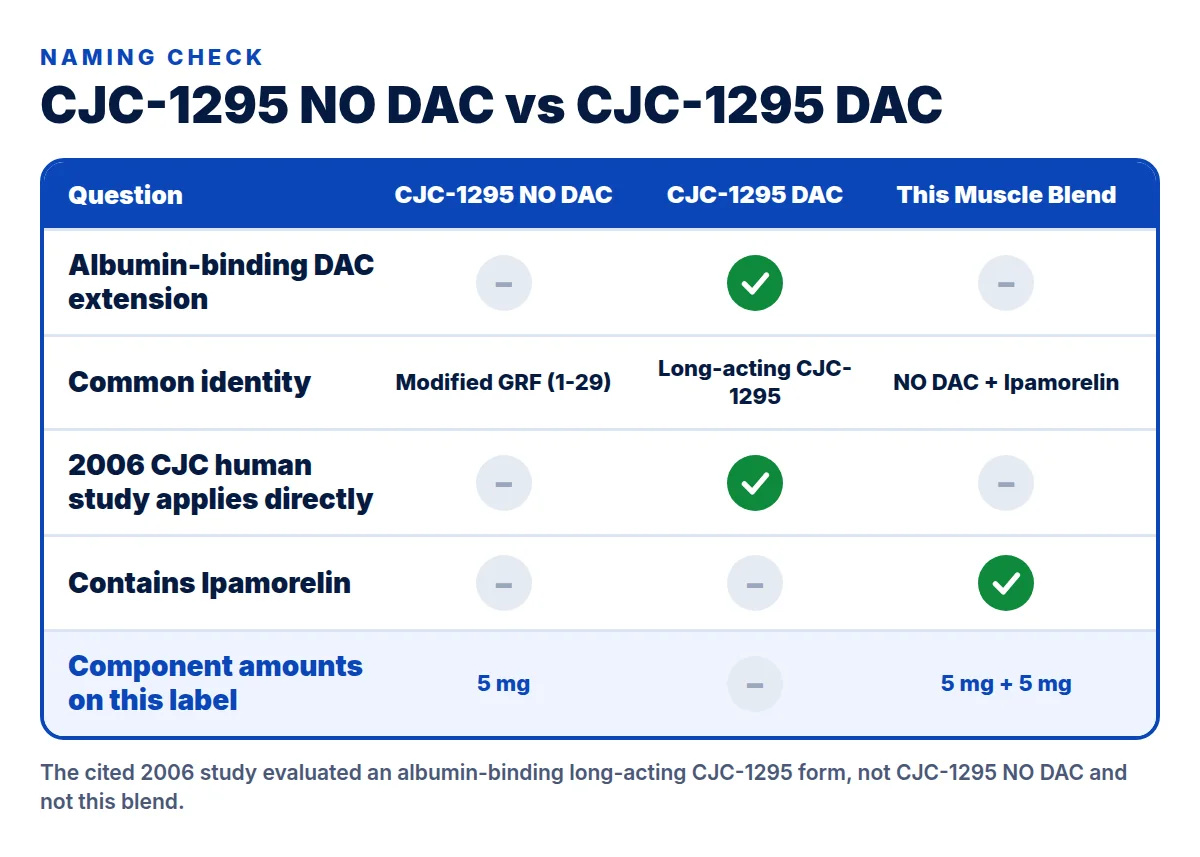
The near-identical names are a common source of confusion. DAC means drug affinity complex. In the longer-acting CJC-1295 compound, this extension binds to albumin, a blood protein, and changes the molecule’s exposure. CJC-1295 NO DAC does not include that albumin-binding extension.
This distinction matters because the landmark 2006 CJC-1295 trial measured a long-acting GHRH analogue. It reported a 5.8–8.1-day estimated half-life in that DAC study. Calling the Muscle Blend component ‘CJC-1295’ without NO DAC would blur the identity and invite an inaccurate transfer of results.
FDA’s 2024 review explicitly separates CJC-1295 free base and acetate from CJC-1295 with DAC forms. For research records, the label should therefore be read as CJC-1295 NO DAC 5mg plus Ipamorelin 5mg, not as a long-acting CJC-1295 DAC product.
CJC-1295 NO DAC, CJC-1295 DAC and Muscle Blend are different products.
Identity check for the CJC-1295 component
Identity check for the CJC-1295 component
Question
CJC-1295 NO DAC
CJC-1295 DAC
Albumin-binding DAC extension
Absent
Present
Common description
Modified GRF (1-29)
Long-acting CJC-1295
2006 CJC human study
Did not study this form
Studied this long-acting form
Applies to Muscle Blend
Component identity only
No
The presence or absence of DAC changes which evidence can be responsibly connected to a component name.
LabDoc test for this Muscle Blend sample
This listing is backed by LabDoc report LD-MQQ4. LabDoc received the sample, named CJC-1295 + Ipamorelin, on 16 October 2026 and tested it on 26 October 2026. It records 99.45% purity by HPLC for the whole vial and LC-MS identity confirmed for both compounds. The overall assessment is Pass.
The report measures each compound separately. CJC measured 4.66mg; LabDoc lists its label claim and percentage of claim as “Not stated”. Ipamorelin measured 4.61mg against a 5mg claim, which is 92.2%. The 10mg on the label is the combined total of the two 5mg components, not a single measured figure, and the batch field reads “Not stated”.
An earlier Janoshik report, #135350, analysed on 1 June 2026, measured Ipamorelin at 5.65 mg and CJC-1295 (Mod GRF 1-29) at 4.82 mg. Both reports, the signed LabDoc PDF and a direct link to LabDoc’s own record are on the Quality page.
LabDoc report: LD-MQQ4, sample received 16 October 2026, tested 26 October 2026.
Whole-vial purity: 99.45% by HPLC; identity: 2 of 2 compounds confirmed by LC-MS; overall Pass.
CJC: 4.66mg measured (claim “Not stated” on the report). Ipamorelin: 4.61mg measured, 92.2% of 5mg.
Muscle Blend 10mg is supplied by Peak Peptides Australia for in-vitro research only. When an order is in stock, dispatch is the same day from Victoria once payment is confirmed. It is sent by tracked Australia Post Express and the tracking number is emailed.
The regulatory context should remain clear. The TGA’s 2026 safety advisory names CJC-1295 as an example of an unapproved peptide product and says unapproved peptide products have not been evaluated by the TGA for safety, quality or effectiveness. It also states that a research-use-only label does not change regulatory status.
For a matched laboratory record, select the product by its complete label: Muscle Blend 10mg, CJC-1295 NO DAC 5mg plus Ipamorelin 5mg. Do not substitute CJC-1295 DAC, an Ipamorelin-only vial, or another supplier’s blend when interpreting the batch evidence or concentration chart on this page.
Step-by-step guide · About 10 minutes
How to reconstitute Muscle Blend 10mg (step-by-step with photos)
Muscle Blend 10mg is supplied as dry, freeze-dried material. Reconstitution means dissolving that material in bacteriostatic (BAC) water to make a clear, measurable laboratory solution. The preferred blend reference uses a 3 mL BAC-water volume, giving 3.33 mg/mL total blend. This page’s visual guide follows that reference volume and takes about 10 minutes. The chart shows concentration maths for the labelled CJC-1295 NO DAC 5mg plus Ipamorelin 5mg formulation.
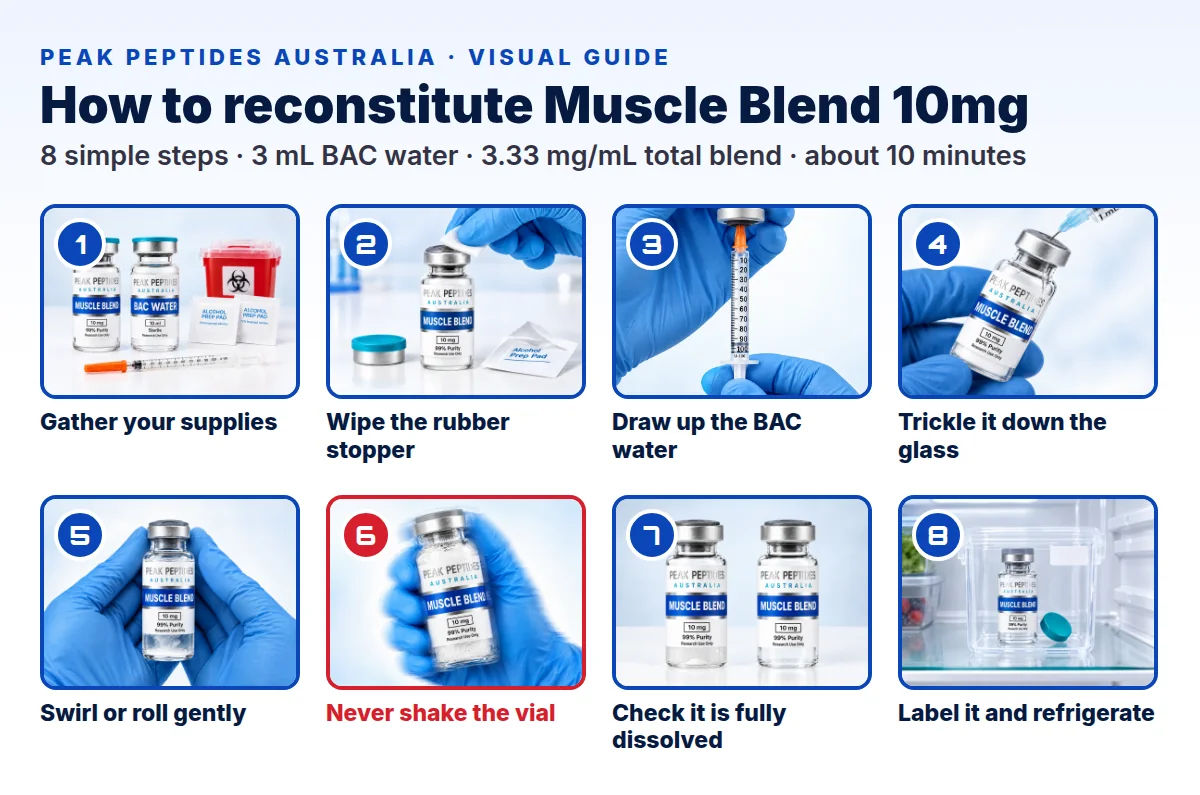
The full Muscle Blend 10mg laboratory preparation sequence in eight visual steps.
What you need
Muscle Blend 10mg vialLabelled CJC-1295 NO DAC 5mg plus Ipamorelin 5mg, supplied as freeze-dried material.
Bacteriostatic waterThe chart and visual guide use BAC water as the named solvent.
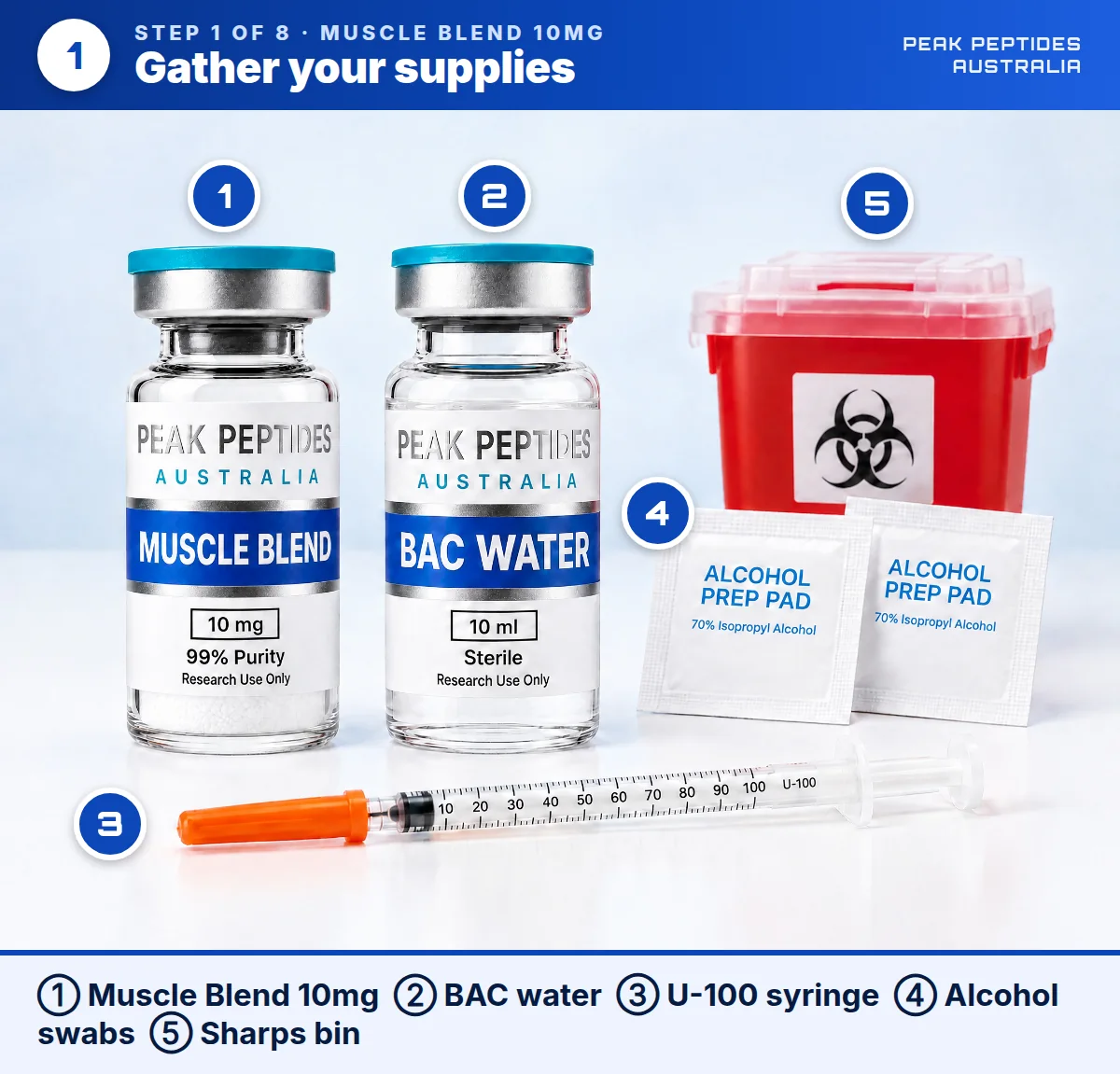
1 mL U-100 syringeA U-100 scale is 100 units per mL, so 1 unit is 0.01 mL.
Alcohol swabsFor cleaning the rubber stoppers before laboratory handling.
Sharps containerFor disposal of used needles after the preparation task.
How much BAC water to add to Muscle Blend 10mg
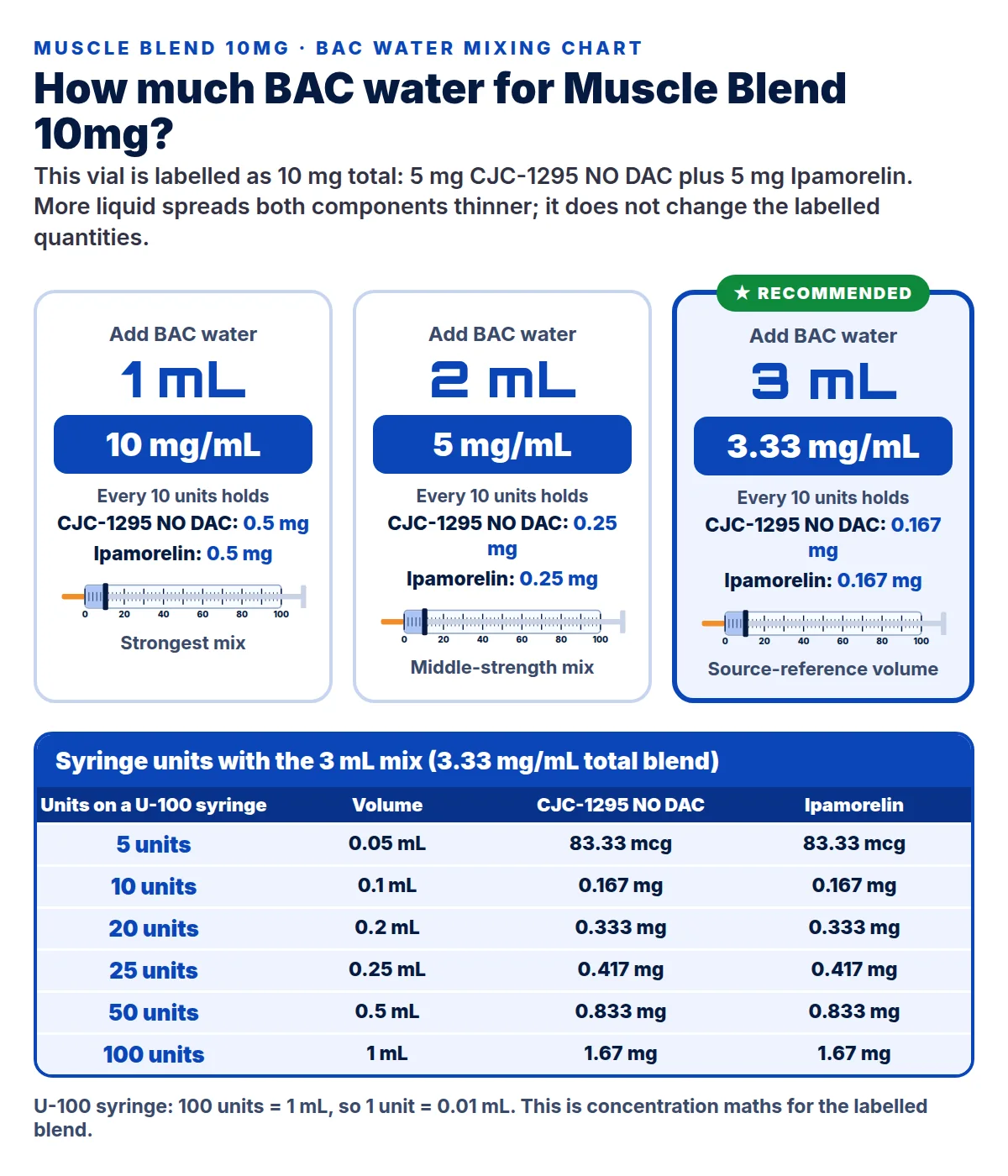
The vial label describes 10mg total material: 5mg CJC-1295 NO DAC plus 5mg Ipamorelin. The component quantities remain the same when the volume changes. More BAC water makes a lower concentration; less makes a higher concentration. The source-reference volume is 3 mL, producing 3.33 mg/mL total blend.
At the 3 mL mix, 10 units on a U-100 syringe equals 0.1 mL and represents 0.167 mg CJC-1295 NO DAC plus 0.167 mg Ipamorelin. At 2 mL, 10 units represents 0.25 mg of each component. At 1 mL, it represents 0.5 mg of each component. These are label-based concentration calculations only.
The 3 mL source-reference mix gives 3.33 mg/mL total blend and 0.167 mg of each labelled component per 10 units.
3 mL is highlighted because it gives the simplest numbers.
Syringe units with the 3 mL mix (3.33 mg/mL total blend)
Syringe units with the 3 mL mix (3.33 mg/mL total blend)
Units on a U-100 syringe
Volume
CJC-1295 NO DAC
Ipamorelin
5 units
0.05 mL
83.33 mcg
83.33 mcg
10 units
0.1 mL
0.167 mg
0.167 mg
20 units
0.2 mL
0.333 mg
0.333 mg
25 units
0.25 mL
0.417 mg
0.417 mg
50 units
0.5 mL
0.833 mg
0.833 mg
100 units
1 mL
1.67 mg
1.67 mg
The 8 steps
1Step 1: Gather your supplies
Place the sealed Muscle Blend 10mg vial, BAC water, a new 1 mL U-100 syringe, alcohol swabs and a sharps container on a clean laboratory surface. Confirm the vial label reads MUSCLE BLEND and 10 mg before opening it. If cold, let the closed vial come to room temperature first so surface condensation does not enter the vial.
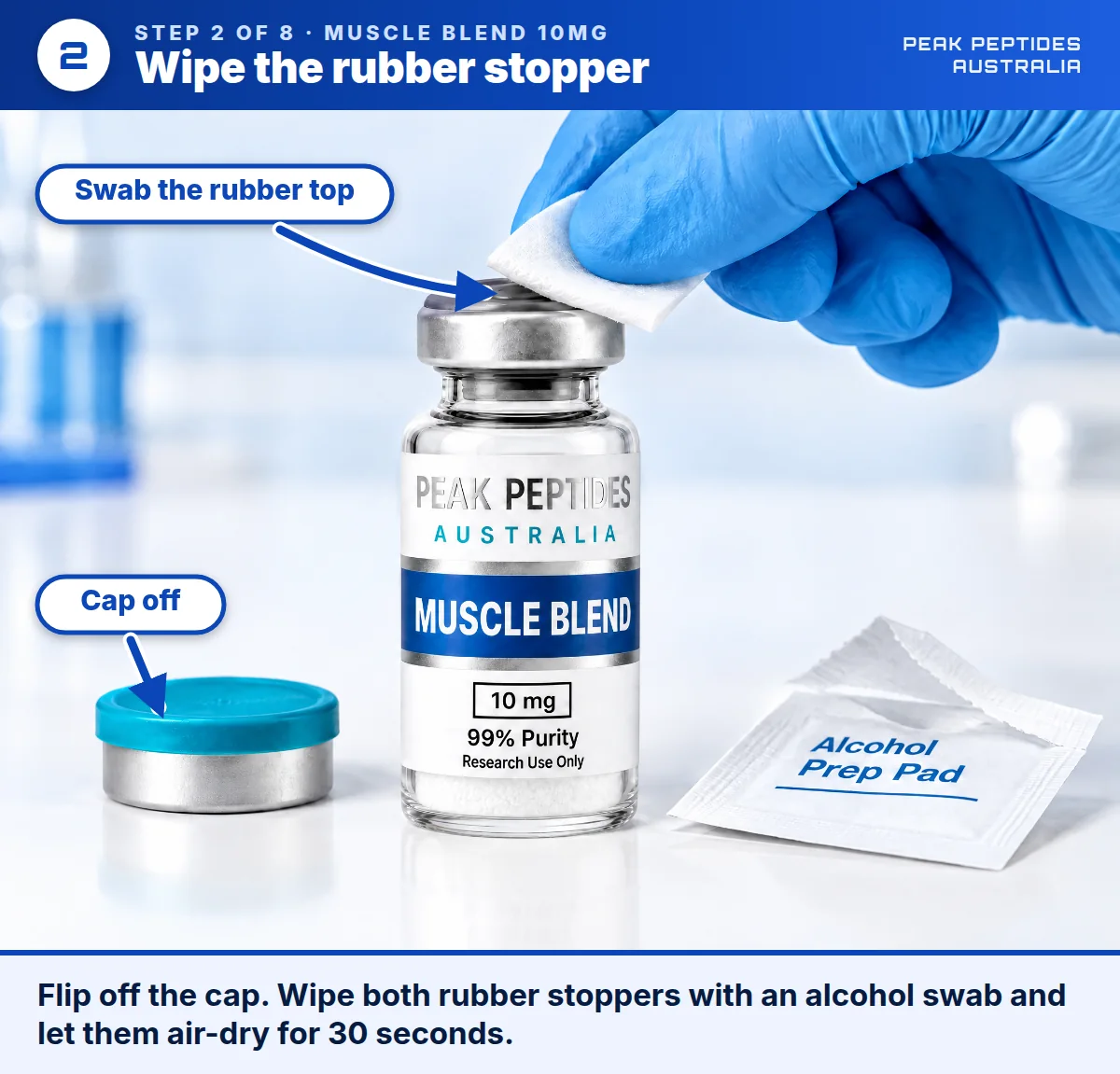
2Step 2: Wipe the rubber stopper
Remove the plastic flip-off caps without touching the rubber stoppers. Use a fresh alcohol swab on each stopper and allow them to air-dry for about 30 seconds. Once clean, do not touch the stopper surface. This keeps the vial top ready for the BAC-water transfer in the next steps.
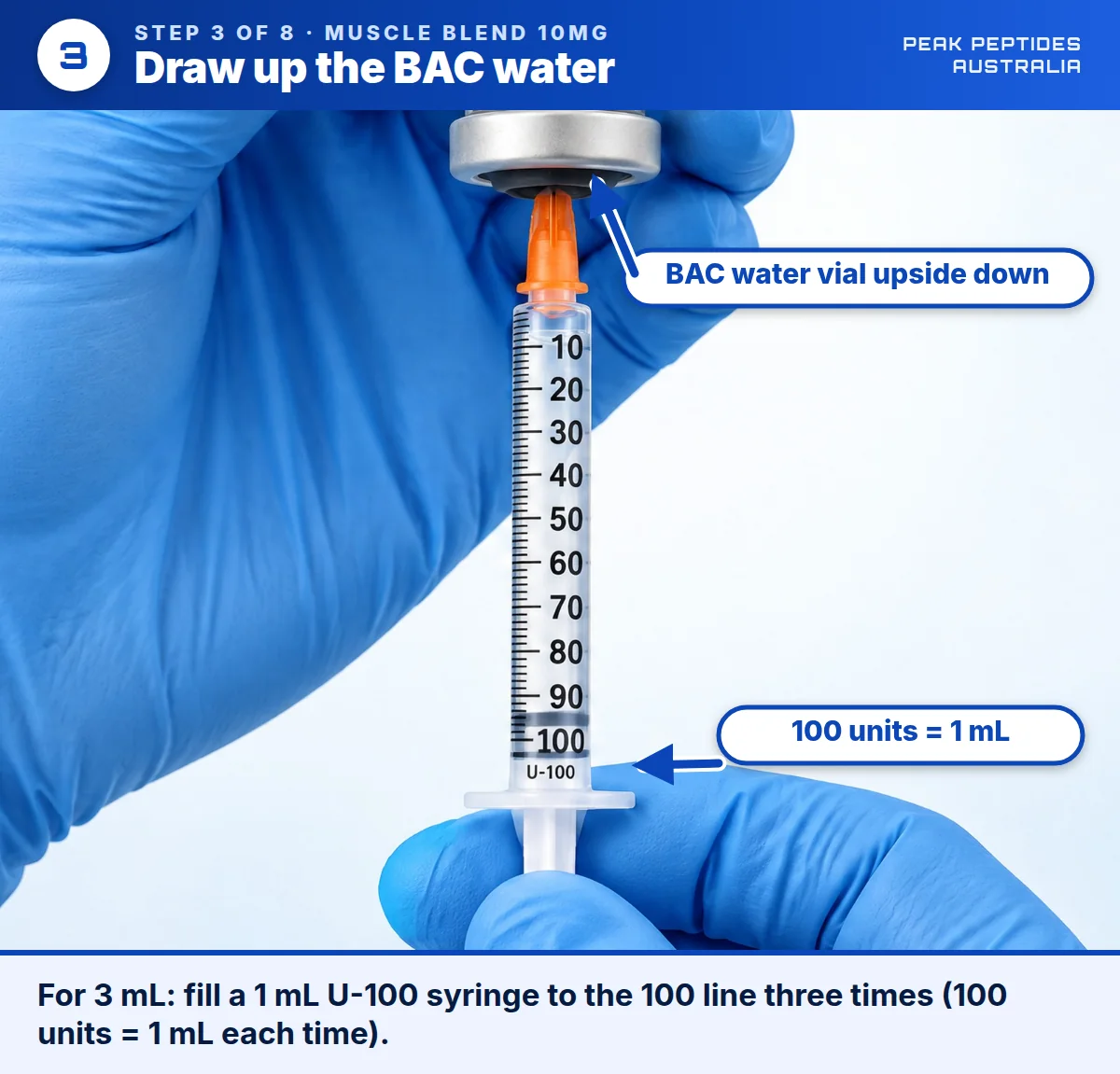
3Step 3: Draw up the BAC water
For the 3 mL source-reference volume, use a new 1 mL U-100 syringe to collect BAC water three separate times. A full 1 mL syringe is 100 units. Keep the BAC-water vial inverted while drawing, work slowly, and remove obvious air bubbles before transferring the liquid to the Muscle Blend vial.
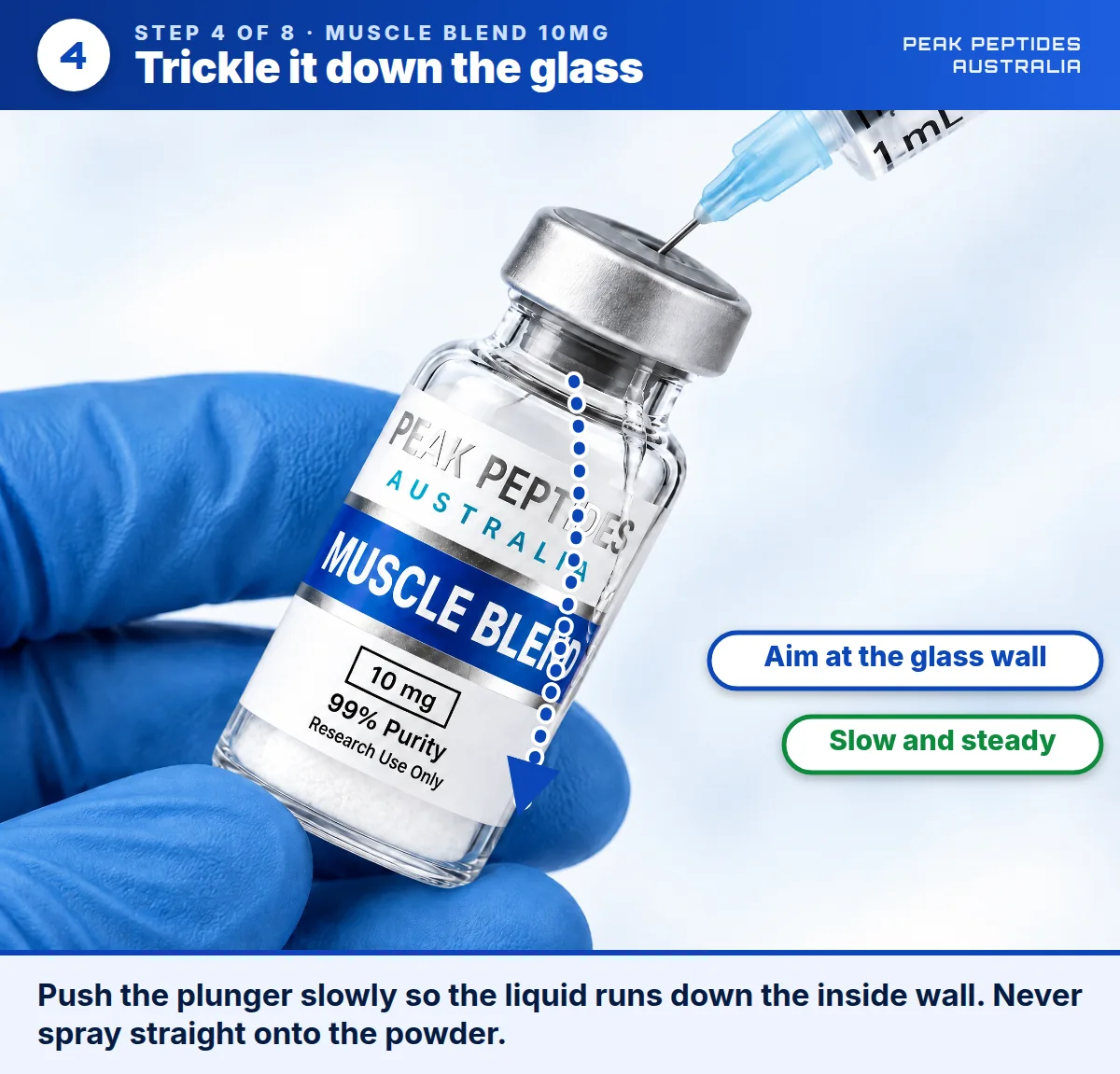
4Step 4: Trickle it down the glass
Insert the needle through the Muscle Blend stopper at an angle so the tip meets the inside glass wall. Press slowly and let the BAC water run down the side rather than jetting directly onto the freeze-dried material. Repeat the transfer until the selected volume has been added, using the same gentle glass-wall approach each time.
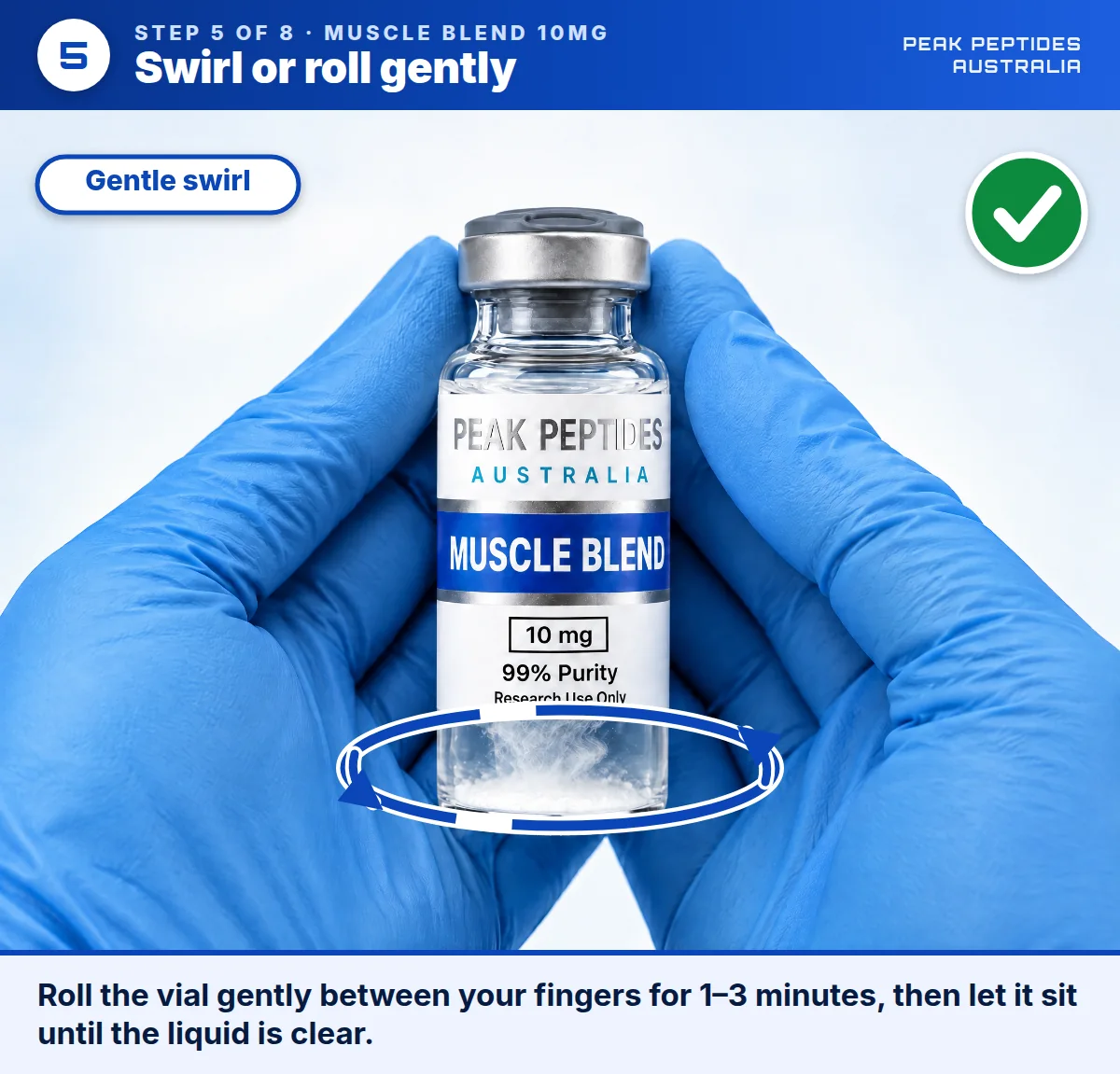
5Step 5: Swirl or roll gently
Roll the vial between your fingers or swirl it in slow circles for one to three minutes. A small amount of undissolved white material may remain at first. Let the vial stand briefly, then swirl again. Gentle movement helps the material dissolve while avoiding the foam that comes from vigorous shaking.
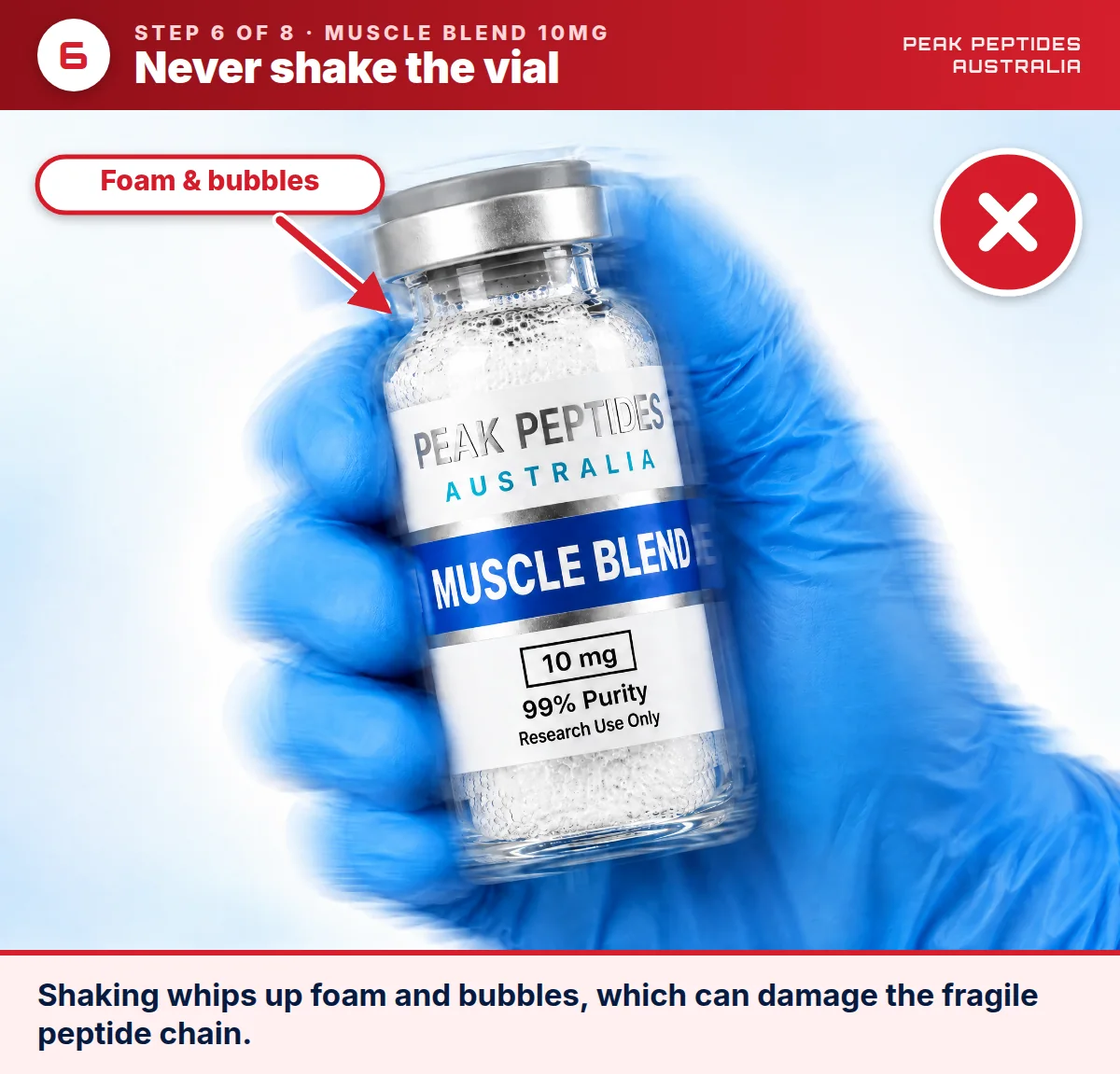
6Step 6: Never shake the vial
Do not shake the vial. Shaking produces foam and bubbles, which makes it harder to inspect whether the solution is clear and can stress a peptide preparation. If bubbles appear, stand the vial upright and wait for them to settle before returning to a slow, gentle swirl.
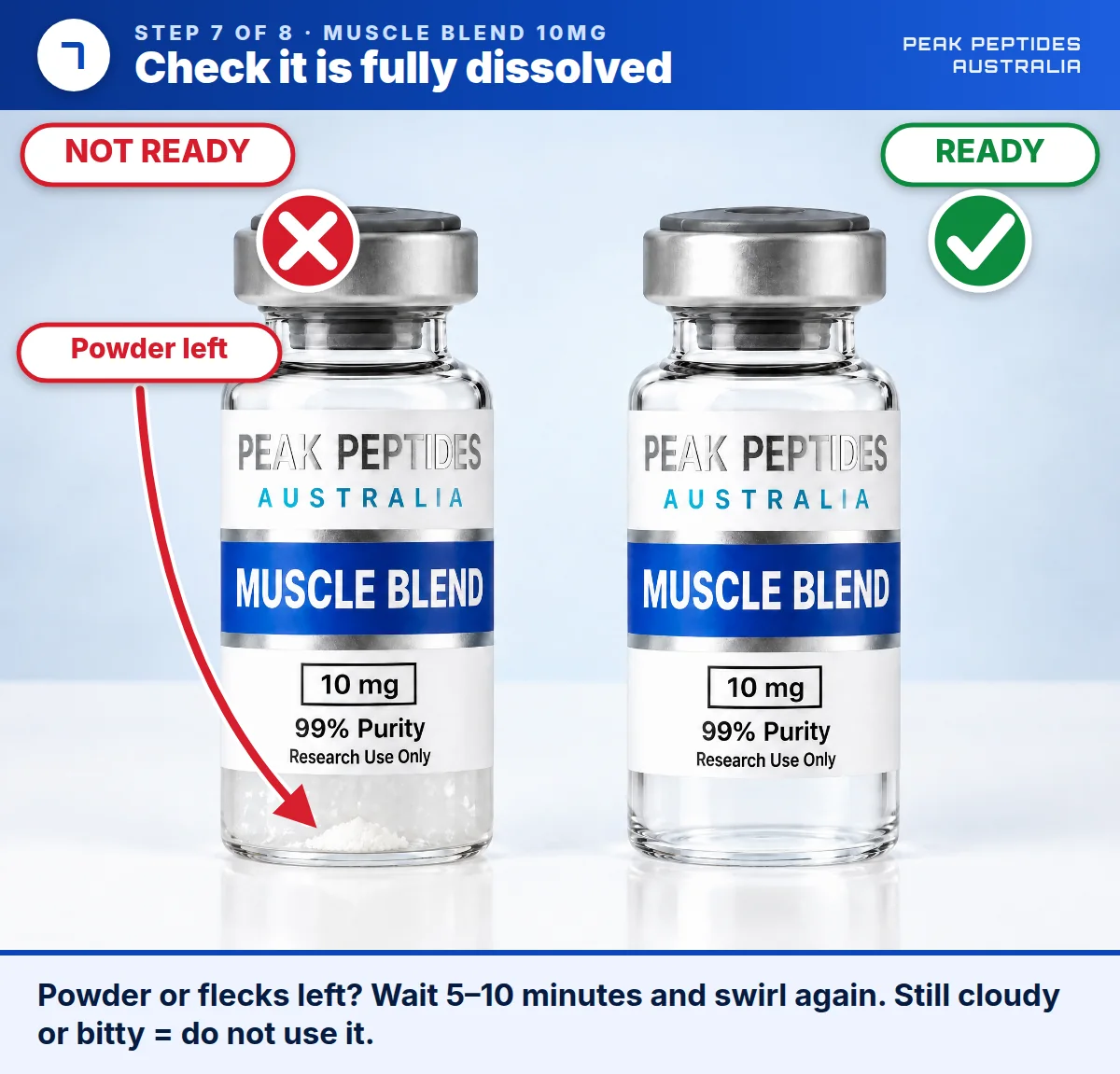
7Step 7: Check it is fully dissolved
Hold the vial against a light background. The solution should be clear, with no visible powder, flecks or cloudiness. If material remains at the bottom, wait five to ten minutes and swirl gently again. Do not mark the preparation as complete while it still has visible undissolved material or particulate cloudiness.
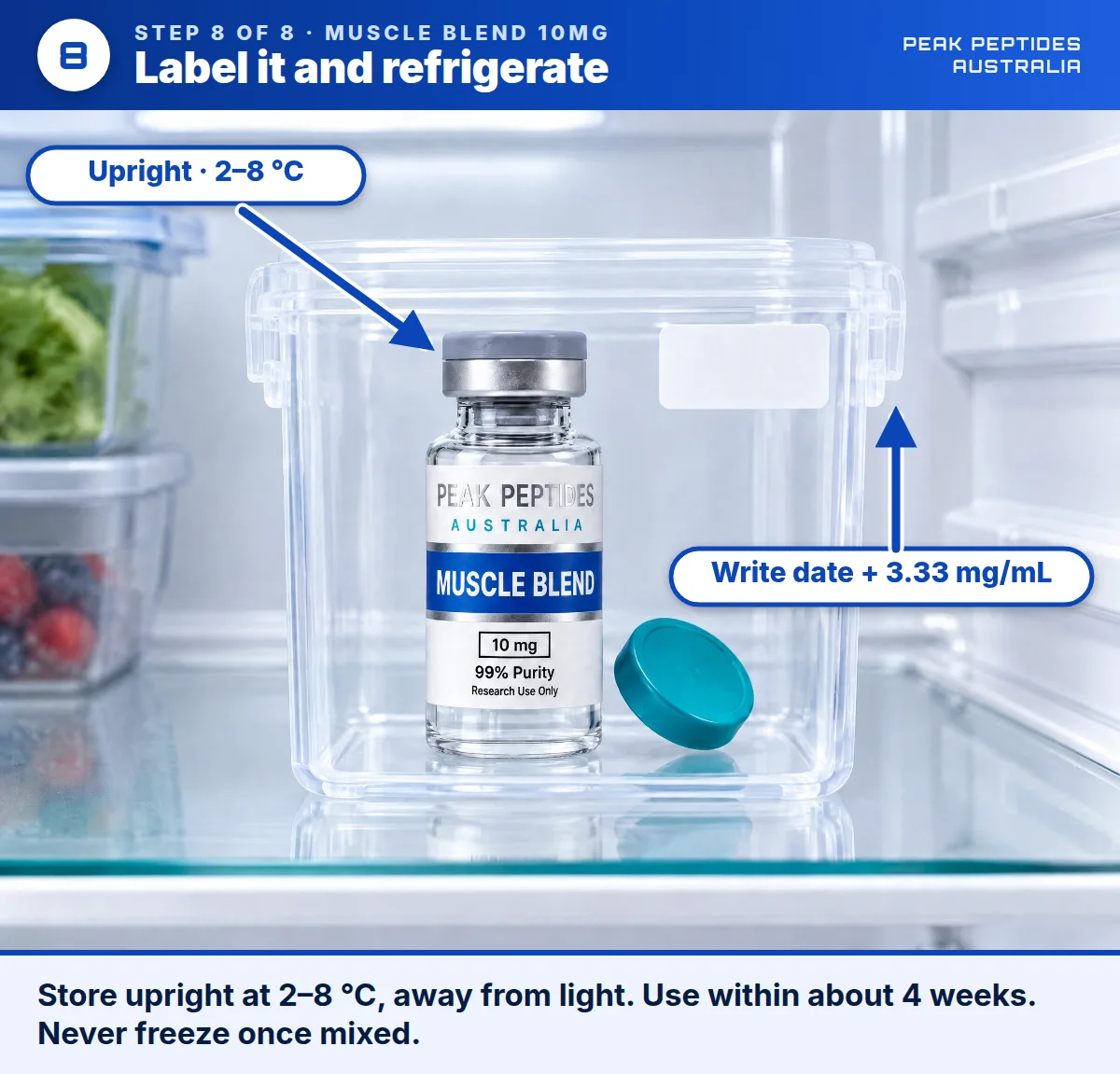
8Step 8: Label it and refrigerate
Record the preparation date and calculated concentration on the storage container. For the 3 mL reference mix, the total blend concentration is 3.33 mg/mL. Keep the sealed vial upright, dark and refrigerated at 2–8 °C. The visual guide uses an ordinary BAC-water handling window of about four weeks and avoids freezing after mixing.
Muscle Blend 10mg storage guide
Storage and visual-handling summary for Muscle Blend 10mg
Storage and visual-handling summary for Muscle Blend 10mg
Stage
Handling
What to check
Freeze-dried vial
Keep cold, dry and protected from light; the preferred blend reference states −20 °C for lyophilised material.
Cap intact; no moisture exposure.
During preparation
Keep the work surface clean and direct BAC water down the glass wall slowly.
Avoid foam and do not shake.
After mixing
Store upright in the fridge at 2–8 °C, dark and sealed.
Solution should be clear and free of particles.
Mixed-vial handling window
The page’s BAC-water visual guide uses about 4 weeks.
Record date and concentration; use exact-material stability data where available.
Freezing after mixing
Avoid freeze–thaw cycles.
Do not use the freezer as the mixed-vial storage method.
The preferred CJC-1295 NO DAC + Ipamorelin source specifies frozen lyophilised storage and refrigeration at 2–8 °C after reconstitution. The clear-solution visual check is a handling checkpoint, not an analytical identity or purity test.
Muscle Blend 10mg FAQs — CJC-1295 NO DAC + Ipamorelin
What is Muscle Blend 10mg?
Muscle Blend 10mg is a two-peptide research vial labelled with 5mg CJC-1295 NO DAC and 5mg Ipamorelin. CJC-1295 NO DAC is commonly identified as Modified GRF (1-29), while Ipamorelin is a synthetic growth hormone secretagogue. It is supplied for in-vitro research only.
What does Muscle Blend contain?
Muscle Blend contains CJC-1295 NO DAC 5mg plus Ipamorelin 5mg, for a 10mg total label amount. The two 5mg figures identify the labelled component quantities.
What is Muscle Blend also called?
Common search names include CJC-1295 NO DAC + Ipamorelin, CJC-1295/Ipamorelin blend, CJC IPA blend and CJC 1295 NO DAC Ipamorelin. Modified GRF (1-29) is an alias for the CJC-1295 NO DAC component only, not a second name for the whole blend.
Is CJC-1295 NO DAC the same as CJC-1295 DAC?
No. CJC-1295 NO DAC lacks the albumin-binding DAC extension found in long-acting CJC-1295 DAC. FDA treats the non-DAC and DAC forms as different active moieties. The published long-acting CJC-1295 trial is not a trial of CJC-1295 NO DAC or of Muscle Blend.
Is CJC-1295 NO DAC the same as Modified GRF (1-29)?
CJC-1295 NO DAC is commonly used to describe Modified GRF (1-29), a modified 29-amino-acid GHRH analogue without the DAC extension. On this page, that name refers only to the CJC component. Muscle Blend remains a two-component formulation because it also contains Ipamorelin.
What is Muscle Blend used for in research?
Muscle Blend is used to frame research questions about a GHRH-analogue component alongside a GHRP-like or ghrelin-pathway component. Muscle Blend and growth hormone are different compounds.
How does Muscle Blend work?
The two ingredients are studied through different signalling pathways. CJC-1295 NO DAC is described as a GHRH analogue, while Ipamorelin is studied as a GHRP-like growth hormone secretagogue. Combining pathway descriptions explains the research premise.
What did Ipamorelin studies find?
A 1998 pharmacology paper reported GHRP-like receptor-mediated growth-hormone release in pituitary-cell and preclinical work. In a 1999 healthy-volunteer study, intravenous Ipamorelin produced a single growth-hormone response and had a reported terminal half-life of about 2 hours. Neither study tested Muscle Blend.
What did CJC-1295 studies find?
A 2006 randomised study of long-acting CJC-1295 in healthy adults measured sustained, dose-dependent rises in growth hormone and IGF-1. That product carried an albumin-binding DAC extension. CJC-1295 NO DAC, Ipamorelin, and the Muscle Blend vial are different from the product studied.
Does Muscle Blend research prove muscle growth or recovery?
No. Muscle Blend is a product name, not a measured result. A component-level growth-hormone signal is not a study of muscle mass, strength, recovery, injury healing, body composition or sleep. No opened source reported a controlled outcome study of the exact 5mg CJC-1295 NO DAC plus 5mg Ipamorelin blend.
What side effects were reported in Muscle Blend studies?
No opened source reported a controlled safety study of this exact Muscle Blend formulation. FDA’s component reviews identify concerns relevant to peptide products, including aggregation, peptide-related impurities and immune reactions. Those agency concerns are not a component-specific side-effect rate for this particular vial.
What is the half-life of Muscle Blend?
An exact half-life for the supplied CJC-1295 NO DAC plus Ipamorelin blend should not be borrowed from another formulation. The opened 1999 Ipamorelin infusion study reported a terminal half-life of about 2 hours. The 5.8–8.1-day CJC-1295 figure belongs to a long-acting DAC compound, not NO DAC.
Is Muscle Blend approved by the TGA or FDA?
No. The TGA lists CJC-1295 as an example of an unapproved peptide product, so it is not included in the ARTG or evaluated by the TGA for safety, quality or effectiveness. FDA’s 2024 reviews state that the evaluated CJC-1295 and Ipamorelin forms are not components of FDA-approved drugs.
Can I buy Muscle Blend online in Australia?
Muscle Blend can be ordered online from Peak Peptides Australia for in-vitro research when available. In-stock orders receive same-day dispatch from Victoria once payment is confirmed, sent tracked with Australia Post Express, and the tracking number is emailed. The material is not presented as a clinical formulation.
How fast is Muscle Blend shipping in Australia?
For in-stock orders, Peak Peptides Australia provides same-day dispatch from Victoria once payment is confirmed. Parcels are sent by tracked Australia Post Express and a tracking number is emailed. Transit timing depends on the destination and Australia Post’s network after dispatch.
How do I know my Muscle Blend sample is real?
Check that the vial label matches the item name and strength, then compare it with LabDoc report LD-MQQ4. That report confirmed both compounds, CJC and Ipamorelin, by LC-MS in the tested sample and can be checked on LabDoc’s own website. A report for a different product is not evidence for Muscle Blend.
How is the Muscle Blend sample verified?
LabDoc report LD-MQQ4 records 99.45% HPLC purity for the whole vial and LC-MS identity confirmed for 2 of 2 compounds. HPLC content was 4.66mg for CJC and 4.61mg for Ipamorelin, which is 92.2% of Ipamorelin’s 5mg claim. LabDoc lists the CJC claim as “Not stated”. Overall assessment: Pass.
How much BAC water for Muscle Blend 10mg?
The preferred blend source uses 3 mL BAC water for a 10mg total blend, which gives 3.33 mg/mL total. The chart also shows the concentration maths for 1 mL and 2 mL. At 3 mL, 10 units on a U-100 syringe represents 0.167 mg of each labelled component.
How many units is 1 mg of Muscle Blend?
With the 3 mL reference mix, the total blend concentration is 3.33 mg/mL. One milligram of total blend is 30 units on a U-100 syringe, or 0.3 mL. Because the label is 5mg plus 5mg, that total corresponds to 0.5 mg CJC-1295 NO DAC and 0.5 mg Ipamorelin.
How much CJC-1295 NO DAC and Ipamorelin are in 10 units?
With the 3 mL reference mix, 10 units equals 0.1 mL and contains 0.167 mg CJC-1295 NO DAC plus 0.167 mg Ipamorelin according to the label-based mixing chart. At 2 mL, 10 units represents 0.25 mg of each component; at 1 mL, 0.5 mg each.
How do I reconstitute Muscle Blend 10mg?
Use a clean laboratory surface, alcohol swabs, BAC water and a new U-100 syringe. After swabbing both stoppers, direct the liquid slowly down the vial wall, then roll or swirl the vial rather than shaking it. The solution should be clear before cold storage. The eight-step photo guide shows the sequence.
Can I use sterile water or tap water instead of BAC water?
Tap water is not a sterile laboratory solvent. Plain sterile water and bacteriostatic water are not the same: bacteriostatic water contains a preservative, while sterile water does not. The page chart and storage guidance are specifically framed around BAC water, so they should not be transferred to another solvent.
What if Muscle Blend powder does not dissolve?
Allow the vial to stand for 5–10 minutes, then roll or swirl it gently again. Do not shake it. Check the vial against light before refrigeration. If visible powder, flecks or cloudiness remains after gentle mixing and standing, do not treat the solution as fully dissolved.
Should reconstituted Muscle Blend be cloudy?
No. The final liquid should appear clear, without visible powder, flecks or cloudiness. A clear appearance does not replace analytical verification, but it is the practical visual check used in the reconstitution guide. If the liquid remains cloudy or particulate, it has not passed that visual check.
How long does reconstituted Muscle Blend last?
The visual guide uses about 4 weeks (28 days) as the BAC-water handling window. Once mixed, keep the vial upright in the fridge at 2–8 °C, away from light, and never freeze it. The preferred blend source says to refrigerate after reconstitution and avoid freeze–thaw.
How should I store Muscle Blend powder before mixing?
Keep the freeze-dried vial dry, cold and out of light. The preferred blend reference states that lyophilised material is stored frozen at −20 °C, while FDA’s Ipamorelin review discusses reported stability below −18 °C. Prevent moisture exposure and keep the material record with the sample.
Can I freeze reconstituted Muscle Blend?
Do not freeze a mixed vial under the handling approach shown here. The preferred blend source says to refrigerate the reconstituted material at 2–8 °C and avoid freeze–thaw cycles. Repeated freezing and thawing is not part of the page’s visual storage workflow.
What does a COA show for a peptide blend?
A useful certificate of analysis identifies the tested material, states the test method and reports a result for each component. LD-MQQ4 does this for Muscle Blend: one purity figure for the whole vial, then a separate identity and content row for CJC and for Ipamorelin. Compare every report with the exact product.
What did Janoshik report #135350 measure?
Janoshik report #135350, analysed on 1 June 2026 and listed on the Quality page, measured Ipamorelin at 5.65 mg and CJC-1295 (Mod GRF 1-29) at 4.82 mg. It is an earlier sample. The current LabDoc report, LD-MQQ4, tested a sample received on 16 October 2026.