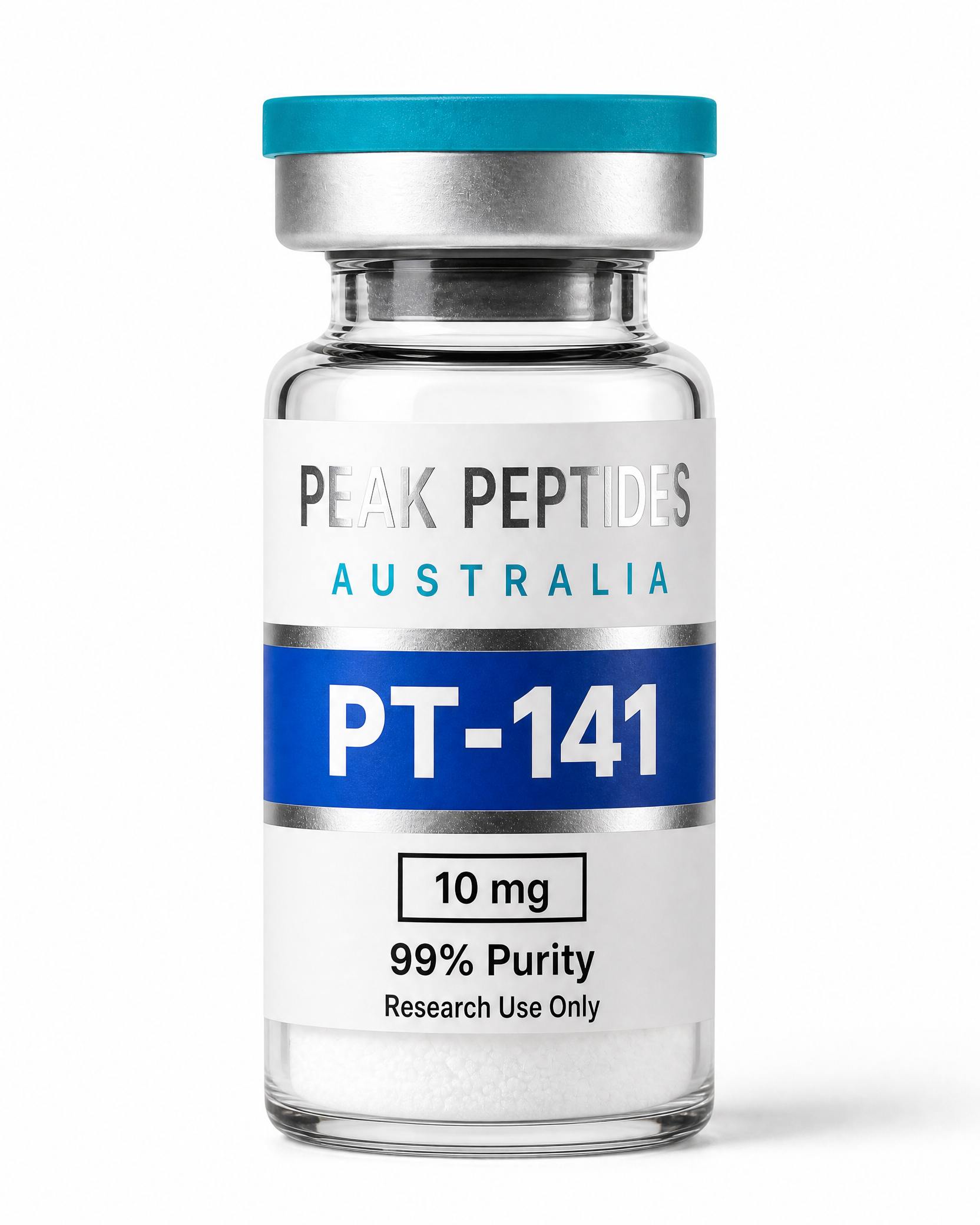
PT-141 10mg (bremelanotide) is a freeze-dried cyclic melanocortin peptide for MC3R, MC4R and central nervous system signalling research. This nominal 10mg research vial is backed by LabDoc report LD-YZY4 for LC-MS identity, HPLC purity and measured content. In-stock orders receive same-day dispatch from Victoria after payment confirmation, with tracked Australia Post Express shipping Australia-wide.
This product is sold strictly for in-vitro laboratory research purposes only. It is not intended for human or animal consumption, injection, or any diagnostic or therapeutic use. Independently tested by LabDoc (report LD-YZY4): 99.45% HPLC purity, 9.54mg measured content and identity confirmed by LC-MS.
Bremelanotide · melanocortin receptor signalling research
PT-141 10mg — What It Is, Research Findings & Reconstitution Guide
PT-141, also called bremelanotide, is a synthetic cyclic peptide made from seven amino-acid building blocks. It is a melanocortin receptor agonist: an agonist is a molecule that activates a receptor. Researchers use bremelanotide to examine melanocortin receptor signalling, particularly MC3R and MC4R pathways in the central nervous system. Each sealed vial is labelled with a nominal 10 mg of freeze-dried powder. This page explains its structure, what the clinical research on FDA-formulated bremelanotide found, how PT-141 differs from Melanotan II and Oxytocin, and how to prepare a research solution using bacteriostatic water. LabDoc report LD-YZY4 records LC-MS-confirmed identity, 99.45% HPLC purity and 9.54 mg measured content for this listing. Peak Peptides Australia supplies this material for in-vitro research only, not as a therapeutic product or clinical formulation.
Also referred to in research or catalogue references as Bremelanotide, PT141, PT-141, PT 141, Bremelanotide peptide, Bremelanotide acetate, PT141 peptide, PT-141 peptide, CAS 189691-06-3, Vyleesi active ingredient.
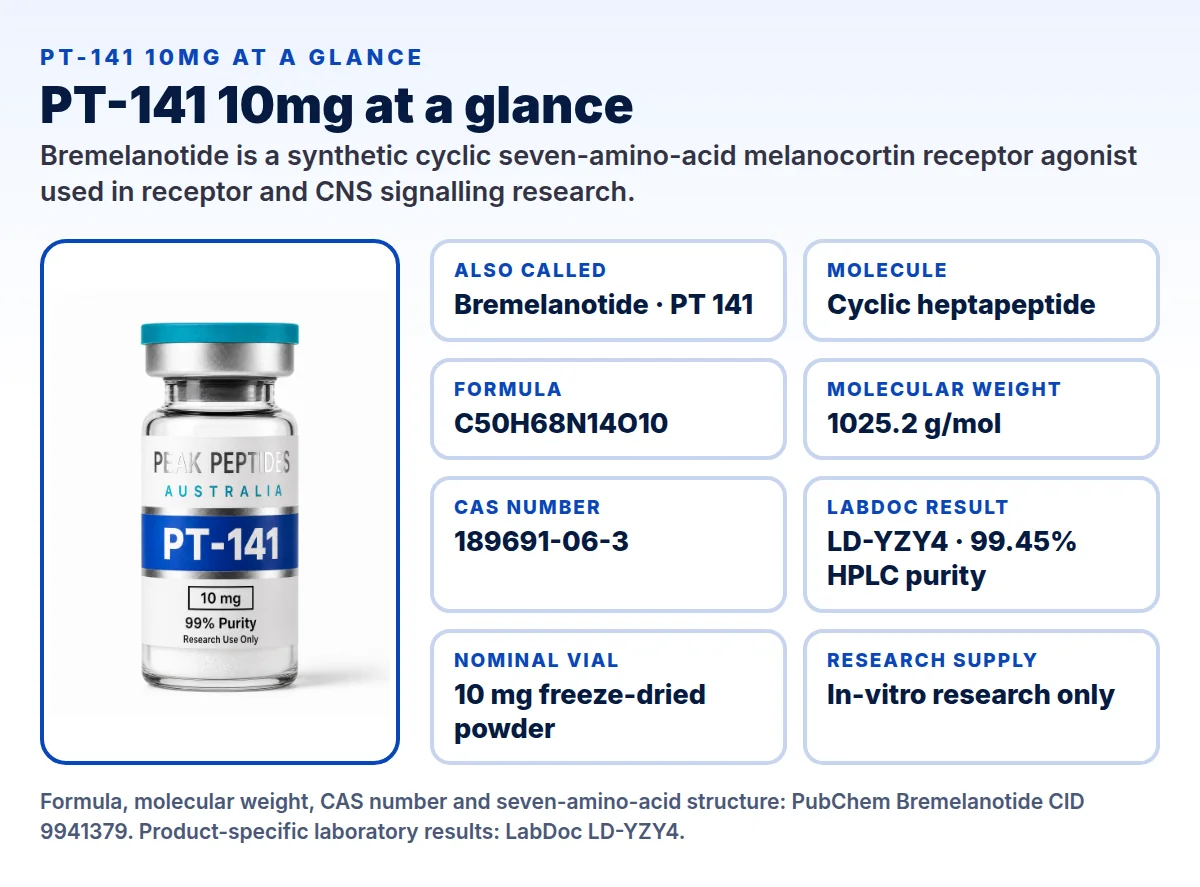
PT-141 10mg at a glance
Name
PT-141 (bremelanotide)
Also called
PT 141, PT141, bremelanotide peptide
What it is
Synthetic cyclic heptapeptide and melanocortin receptor agonist
Research context
MC3R, MC4R and central nervous system signalling
Formula
C50H68N14O10 · 1025.2 g/mol
CAS number
189691-06-3
Structure
Seven building blocks in a cyclic lactam peptide
FDA context
Bremelanotide is the active ingredient in US FDA-approved Vyleesi; this vial is not Vyleesi
3 mL BAC water = approximately 3.33 mg/mL · 30 U-100 units = 1 mg
Mixed-solution storage
Refrigerate at 2–8 °C, dark and upright; avoid freeze–thaw
Dispatch
Same-day from Victoria for in-stock orders after payment confirmation, tracked Australia Post Express
PT-141 is bremelanotide
PT-141 is the research name for bremelanotide. PubChem identifies bremelanotide as a cyclic heptapeptide: a seven-building-block peptide folded into a ring by a lactam bond. Its formula is C50H68N14O10, its molecular weight is 1025.2 g/mol, and its CAS number is 189691-06-3.
A melanocortin receptor agonist
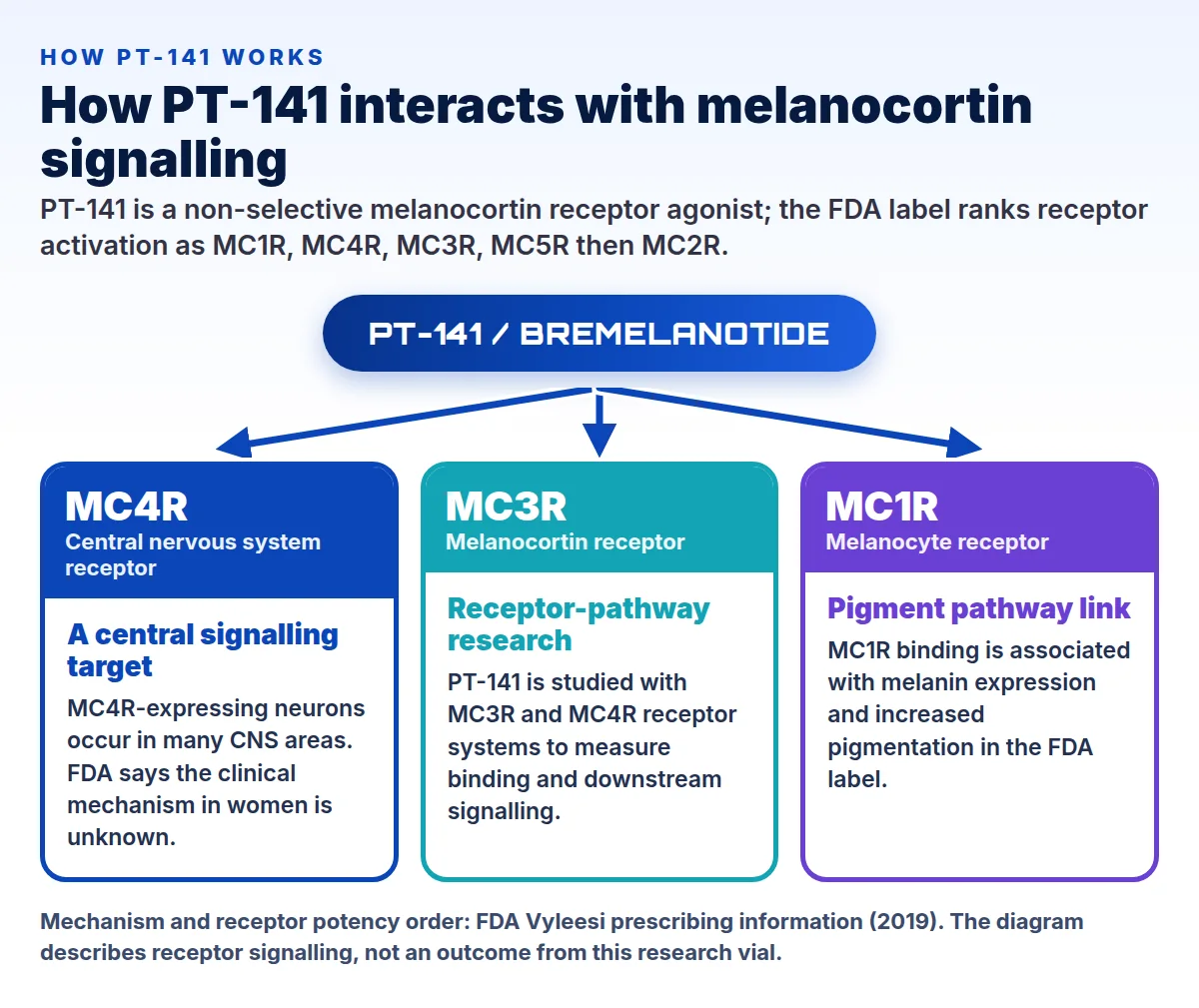
PT-141 activates melanocortin receptors. The FDA label describes bremelanotide as non-selective across several subtypes, with a potency order of MC1R, MC4R, MC3R, MC5R and MC2R. MC3R and MC4R experiments are the main receptor-signalling context for PT-141 research.
Not testosterone and not a GLP peptide
PT-141 is neither testosterone nor a GLP-1, GIP or glucagon peptide. It has a different molecular structure and works through melanocortin receptors rather than hormone-replacement or incretin receptors. Milligram labels, research methods and findings cannot be transferred between these separate compounds.
FDA-approved bremelanotide exists as Vyleesi
Bremelanotide is an active ingredient in Vyleesi, an FDA-approved US prescription autoinjector. The approval is for acquired, generalised hypoactive sexual desire disorder in premenopausal women, with stated limitations. This lyophilised 10 mg research vial is not Vyleesi and is not a ready-to-use prescription formulation.
What Phase 3 studies found
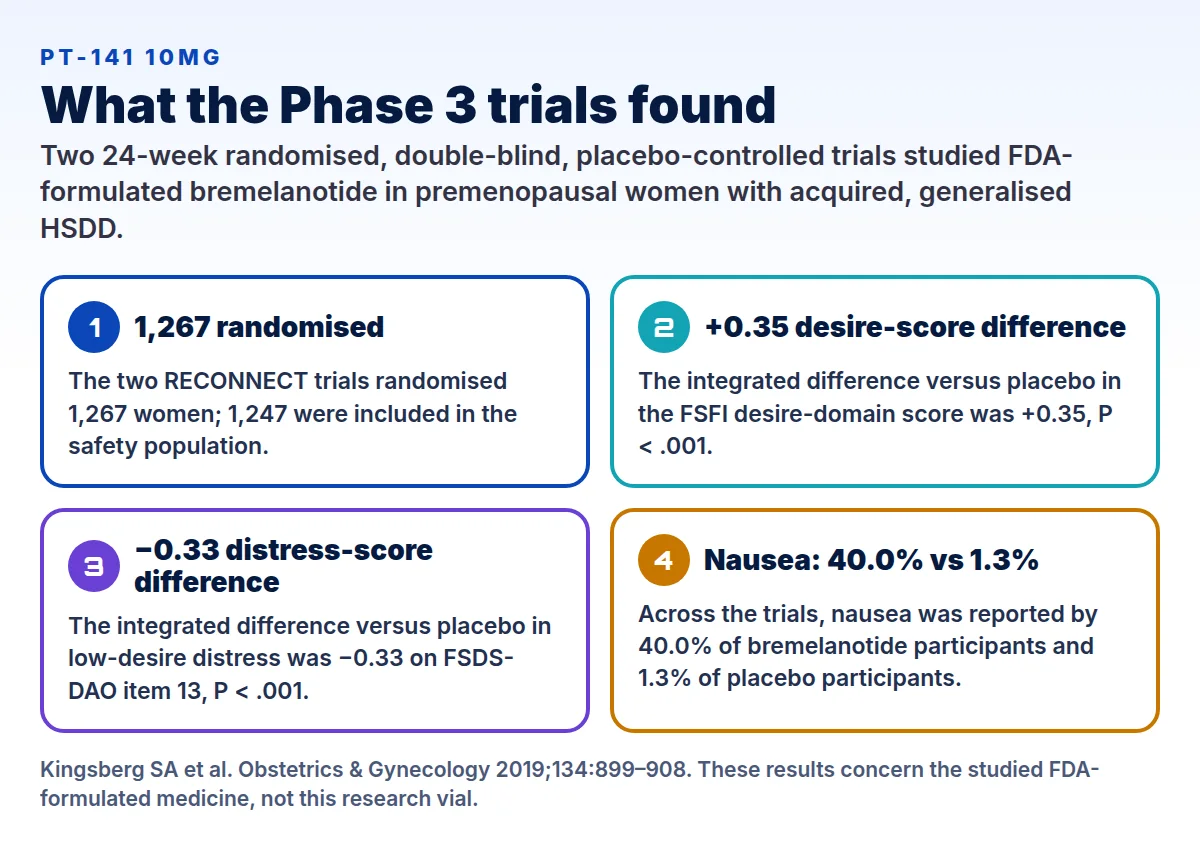
Two 24-week randomised, double-blind Phase 3 trials studied FDA-formulated bremelanotide in 1,267 premenopausal women with acquired, generalised hypoactive sexual desire disorder. Compared with placebo, the integrated analysis recorded a +0.35 difference in sexual-desire score and a −0.33 difference in low-desire distress score.
Reported trial safety findings
In the Phase 3 trials, nausea, flushing and headache occurred more often with FDA-formulated bremelanotide than with placebo. Nausea was reported by 40.0% of bremelanotide participants and 1.3% of placebo participants. These are findings from a specified prescription-product programme, not characterisation of this research vial.
Independent LabDoc evidence for this vial
LabDoc report LD-YZY4 tested PT-141 (bremelanotide) received on 16 October 2026 and tested on 21 October 2026. It records identity confirmed by LC-MS, 99.45% purity by HPLC, and 9.54 mg measured content by HPLC against the 10 mg claim (95.4%). The overall assessment is Pass.
Historical Janoshik record
The Quality page also lists an earlier Janoshik PT-141 report, Task #135357 dated 1 June 2026. It records 8.51 mg PT-141 and 99.901% purity. That is a separate historical report, not a substitute for the current LabDoc LD-YZY4 batch evidence.
3 mL is the published 10 mg reference mix
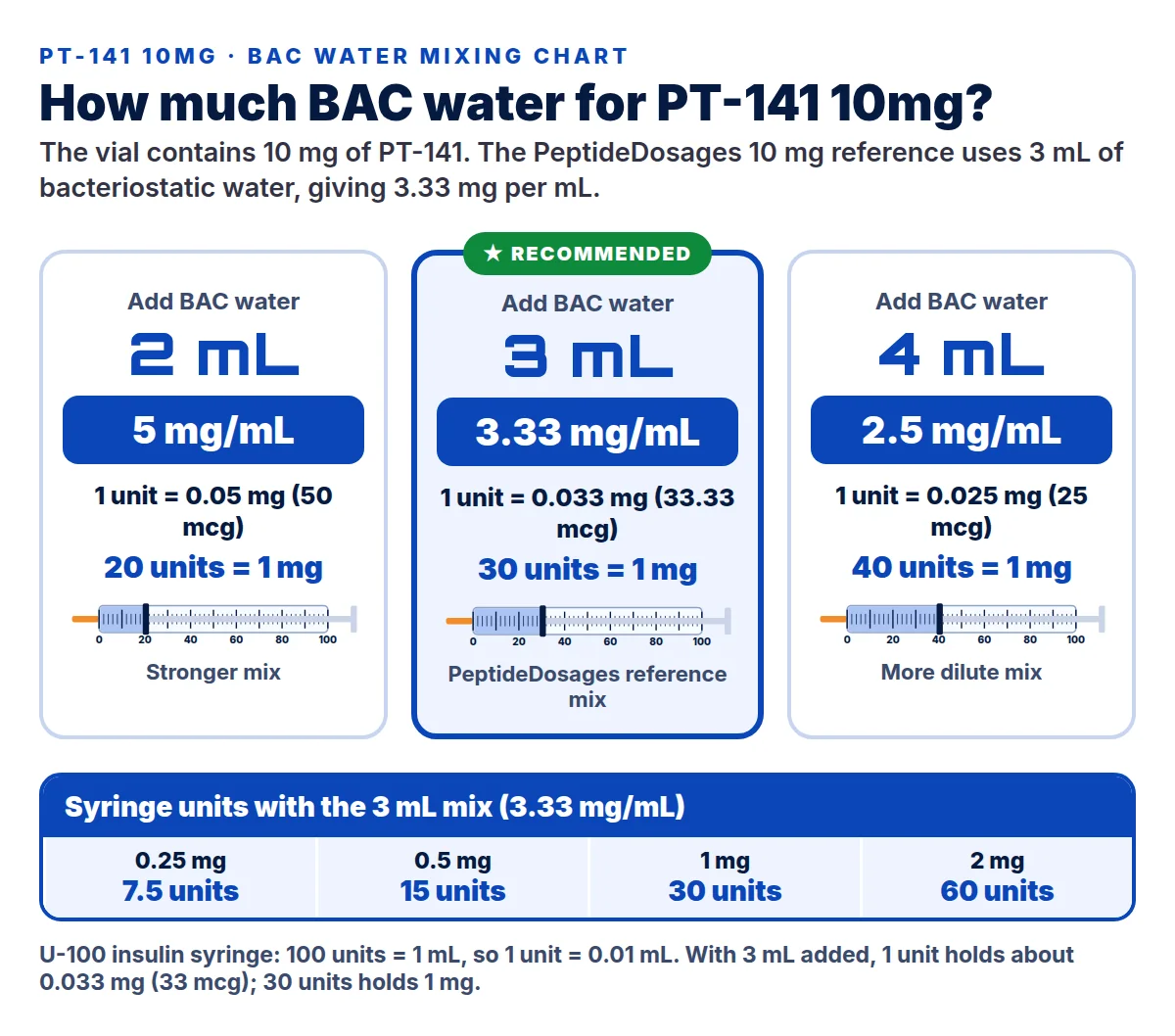
The PeptideDosages 10 mg PT-141 reference adds 3 mL bacteriostatic water, making approximately 3.33 mg/mL. On a U-100 syringe, 100 units equals 1 mL, so this mixture contains about 0.033 mg (33 mcg) in each unit and 1 mg in 30 units.
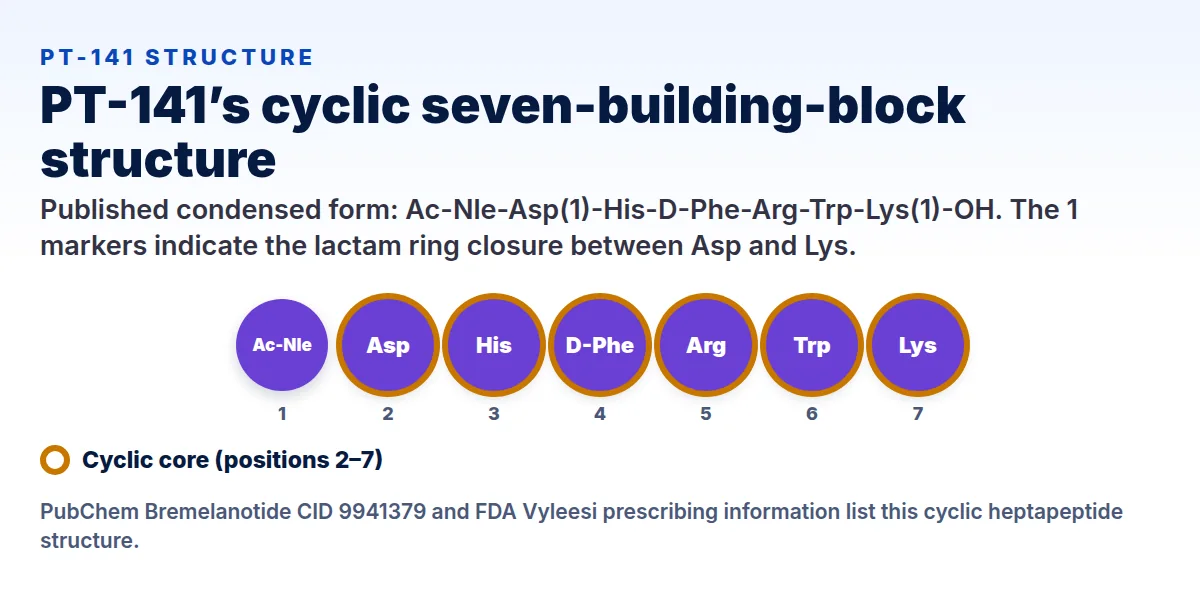
PT-141 is bremelanotide, a lab-made cyclic peptide built from seven amino-acid units. A cyclic peptide has a chain that loops back on itself; in bremelanotide, the structure uses a lactam link between the Asp and Lys positions. PubChem gives the condensed form as Ac-Nle-Asp(1)-His-D-Phe-Arg-Trp-Lys(1)-OH.
PT-141 is a melanocortin receptor agonist. An agonist activates a receptor, which is a protein that receives a chemical signal and triggers a response inside a cell. The FDA description of bremelanotide lists activation across melanocortin receptor subtypes, with particular research interest in MC3R and MC4R pathways.
This listing is a nominal 10 mg freeze-dried research vial. It is not a ready-made solution, not testosterone and not an incretin or GLP peptide. The molecule’s name, a research-vial label and a clinical product are separate concepts.
PT-141 is bremelanotide: a cyclic seven-building-block melanocortin peptide supplied here for in-vitro research.
How does PT-141 work in melanocortin receptor research?
PT-141 works by activating melanocortin receptors. The FDA label calls bremelanotide a non-selective melanocortin receptor agonist and gives this potency order: MC1R, MC4R, MC3R, MC5R and MC2R. This is a receptor-family description, not a claim that every receptor produces the same result in every system.
MC4R and MC3R are especially relevant to PT-141 research. MC4R-expressing neurons occur in many central nervous system areas. In an assay, researchers can measure whether a known amount of PT-141 changes receptor activation or a downstream signal such as cyclic AMP under controlled conditions. The result belongs to the cell type, receptor construct, concentration and assay method used.
The same FDA label notes that MC1R is expressed on melanocytes, where binding leads to melanin expression and increased pigmentation. This helps explain why receptor selectivity matters. A melanocortin receptor agonist can activate multiple related receptors, so a clear research question and controlled readout are important when comparing pathway activity.
MC4R — a melanocortin receptor expressed in many central nervous system areas.
MC3R — a related melanocortin receptor used in receptor-binding and signalling studies.
MC1R — a melanocyte receptor linked by the FDA label to melanin expression and pigmentation.
Cyclic AMP — a common intracellular messenger that can be measured after receptor activation.
PT-141 activates melanocortin receptors; the diagram separates MC4R and MC3R signalling research from MC1R pigment-pathway context.
What did bremelanotide clinical studies find?
Bremelanotide has been studied as a specific prescription formulation, not as a generic description of every material carrying the same ingredient name. The strongest published pivotal evidence is the RECONNECT programme: two identical 24-week, randomised, double-blind, placebo-controlled Phase 3 trials in premenopausal women with acquired, generalised hypoactive sexual desire disorder.
The programme randomised 1,267 participants and included 1,247 in the safety population. Compared with placebo, the integrated analysis reported a statistically significant +0.35 difference in the Female Sexual Function Index desire-domain score and a −0.33 difference in a low-desire distress score. In the dynamic responder analysis, 58.3% and 58.2% of bremelanotide participants met the trial’s responder definition in the two studies, compared with 36.1% and 35.4% on placebo.
The studies also report the treatment-emergent events seen with the tested prescription product. Nausea, flushing and headache occurred more often than with placebo. Nausea was reported by 40.0% of bremelanotide participants and 1.3% of placebo participants. The FDA label also records transient blood-pressure increases, reduced heart rate and focal hyperpigmentation as safety considerations for Vyleesi. These figures and observations must stay attached to the FDA-formulated medicine and trial population, not this 10 mg research vial.
Pivotal-trial findings for the studied FDA-formulated bremelanotide product, presented separately from this research vial.
Bremelanotide Phase 3 RECONNECT programme — key published findings
Bremelanotide Phase 3 RECONNECT programme — key published findings
Measure
Published result
What it means
Design
Two 24-week randomised, double-blind, placebo-controlled trials
The studies compared the specified bremelanotide prescription product with placebo.
Participants
1,267 randomised; 1,247 safety population
Premenopausal women with acquired, generalised hypoactive sexual desire disorder.
Desire endpoint
+0.35 versus placebo, integrated analysis; P < .001
Difference in the FSFI desire-domain score.
Distress endpoint
−0.33 versus placebo, integrated analysis; P < .001
Difference in the low-desire distress endpoint.
Nausea
40.0% bremelanotide vs 1.3% placebo
Reported treatment-emergent event in the Phase 3 programme.
Source: Kingsberg SA et al., Obstetrics & Gynecology, 2019. These data refer to the trial formulation and population.
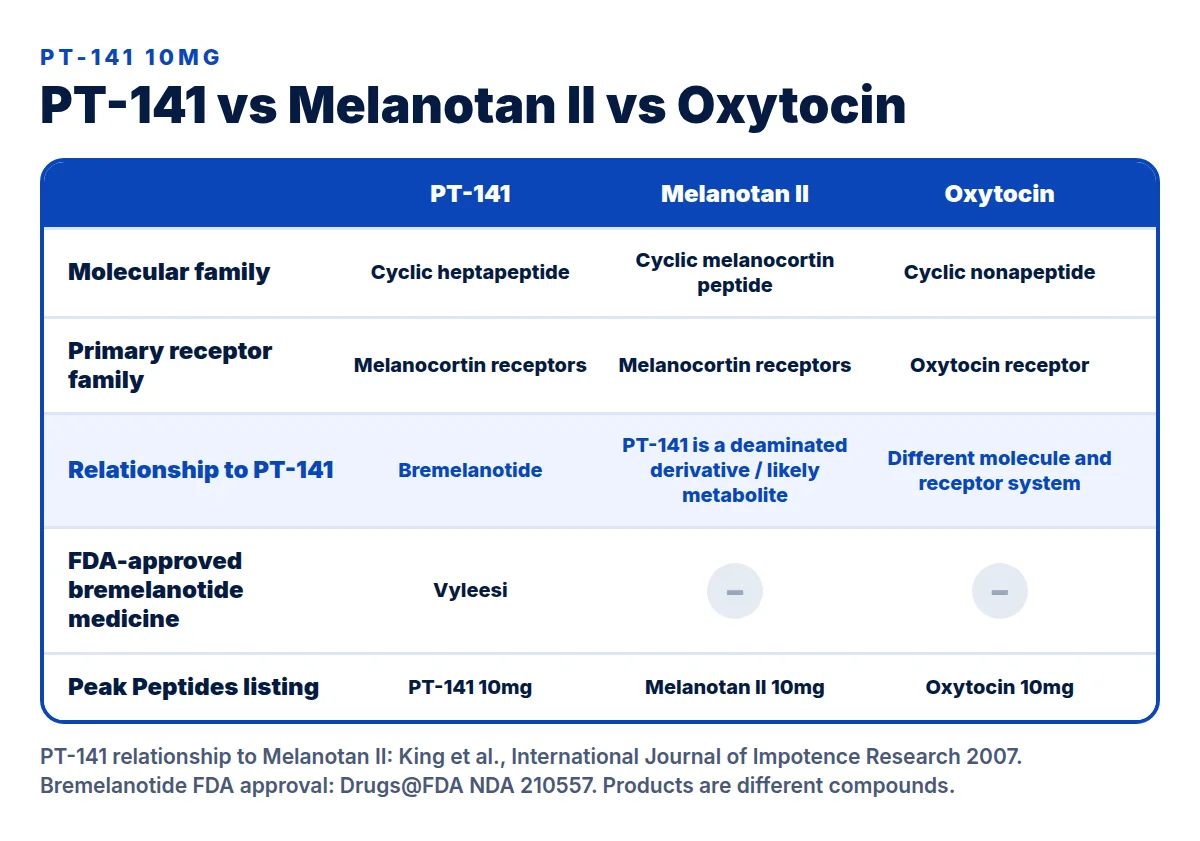
PT-141 vs Melanotan II vs Oxytocin
PT-141 and Melanotan II are related in the melanocortin literature, but they are not the same molecule. A review of melanocortin peptide research describes PT-141 as a deaminated derivative and likely metabolite of Melanotan II. PT-141 is bremelanotide, with its own cyclic-heptapeptide structure, CAS number and regulatory history.
Oxytocin is different again. It belongs to an oxytocin-receptor signalling system rather than the melanocortin receptor family. It is therefore not a substitute for PT-141 in a receptor assay and should not be assigned PT-141’s identity report, concentration calculations or trial findings. Similar discussion topics around central signalling do not make compounds pharmacologically identical.
The clearest way to compare peptides is by molecular identity, receptor family, the exact material tested and the experimental endpoint. That is why the table below focuses on these practical distinctions rather than treating product labels as equivalents. Peak Peptides Australia lists all three research products separately.
PT-141 is related to Melanotan II in the melanocortin literature, while Oxytocin belongs to a different receptor system.
Research-context comparison: PT-141, Melanotan II and Oxytocin
Research-context comparison: PT-141, Melanotan II and Oxytocin
Feature
PT-141 (bremelanotide)
Melanotan II
Oxytocin
Molecular family
Cyclic heptapeptide
Cyclic melanocortin peptide
Cyclic peptide with a different signalling system
Primary receptor family
Melanocortin receptors
Melanocortin receptors
Oxytocin receptor system
Relationship to PT-141
Bremelanotide / PT-141
PT-141 is described as a deaminated derivative and likely metabolite
Different molecule and receptor family
FDA-approved bremelanotide medicine
Vyleesi active ingredient
Not bremelanotide
Not bremelanotide
Peak Peptides listing
PT-141 10mg
Melanotan II 10mg
Oxytocin 10mg
The comparison describes molecular and receptor context. Products are distinct compounds.
PT-141 structure: a cyclic heptapeptide
PT-141 is a cyclic heptapeptide, meaning it contains seven amino-acid building blocks in a ring-shaped structure. PubChem and the FDA label describe its condensed sequence as Ac-Nle-Asp(1)-His-D-Phe-Arg-Trp-Lys(1)-OH. ‘Ac’ means an acetyl group at one end; Nle is norleucine; D-Phe is D-phenylalanine; and the paired 1 markers show the lactam closure between Asp and Lys.
Its molecular formula is C50H68N14O10 and its free-base molecular weight is 1025.2 g/mol. Formula and mass are useful identity anchors for a reference material, but they are not replacement tests for the supplied vial. LC-MS compares the sample’s mass signature against the expected molecule, while HPLC separates and estimates the main peptide peak and related material.
For this product, LabDoc LD-YZY4 provides the product-specific check: it records an LC-MS identity confirmation, 99.45% HPLC purity and 9.54 mg measured content. These are distinct measurements. A high purity percentage measures the relative main-peptide proportion in the tested material; measured content asks how much peptide was found in the vial.
Bremelanotide’s seven building blocks and cyclic core, using the published condensed structure notation.
Independent lab tests for this PT-141 10mg listing
The current product-specific record is LabDoc report LD-YZY4. LabDoc received the PT-141 (bremelanotide) sample on 16 October 2026 and tested it on 21 October 2026. The report gives an overall Pass and records identity confirmed by LC-MS, 99.45% purity by HPLC, and 9.54 mg measured content by HPLC against the 10 mg label claim. The measured content is therefore 95.4% of the nominal label claim.
Each result answers a different question. LC-MS identity confirmation checks whether the material matches the expected molecular identity. HPLC purity estimates the proportion of the main peptide peak in the tested material. Measured content tests the amount found in that sample. The report covers the tested sample and does not test sterility, so the page does not make a sterility claim.
There is also a historical quality record: the site Quality page lists Janoshik Task #135357, dated 1 June 2026, with 8.51 mg PT-141 and 99.901% purity. It predates the LabDoc result and is reported separately. Use the direct LabDoc link to verify LD-YZY4, and the Quality page to view the historical Janoshik entry.
LabDoc report ID: LD-YZY4.
Sample received: 16 October 2026; tested: 21 October 2026.
Identity: confirmed by LC-MS.
Purity: 99.45% by HPLC.
Measured content: 9.54 mg by HPLC, 95.4% of the 10 mg claim.
Historical separate record: Janoshik Task #135357, 8.51 mg and 99.901% purity on 1 June 2026.
Neither the LabDoc summary nor this page claims a sterility result.
Buying PT-141 10mg in Australia
PT-141 10mg can be ordered online from Peak Peptides Australia as a laboratory research material. In-stock orders receive same-day dispatch from Victoria once payment is confirmed. They travel by tracked Australia Post Express and the tracking number is emailed after dispatch. This page states the dispatch method without representing a delivery date, because carrier timing differs by destination and network conditions.
Use the material record when comparing products: check the vial label, report ID, analytical method, purity result and measured content. The current report for this listing is LabDoc LD-YZY4. The Quality page also records historical Janoshik Task #135357 separately. A traceable report gives a researcher much more useful information than a purity claim with no test method or verification path.
PT-141 10mg is supplied for in-vitro research only. It is a nominal 10 mg freeze-dried research vial, not a clinical or prescription presentation. The US FDA approval for Vyleesi applies to its named prescription autoinjector product and does not confer approval on this different research-vial format.
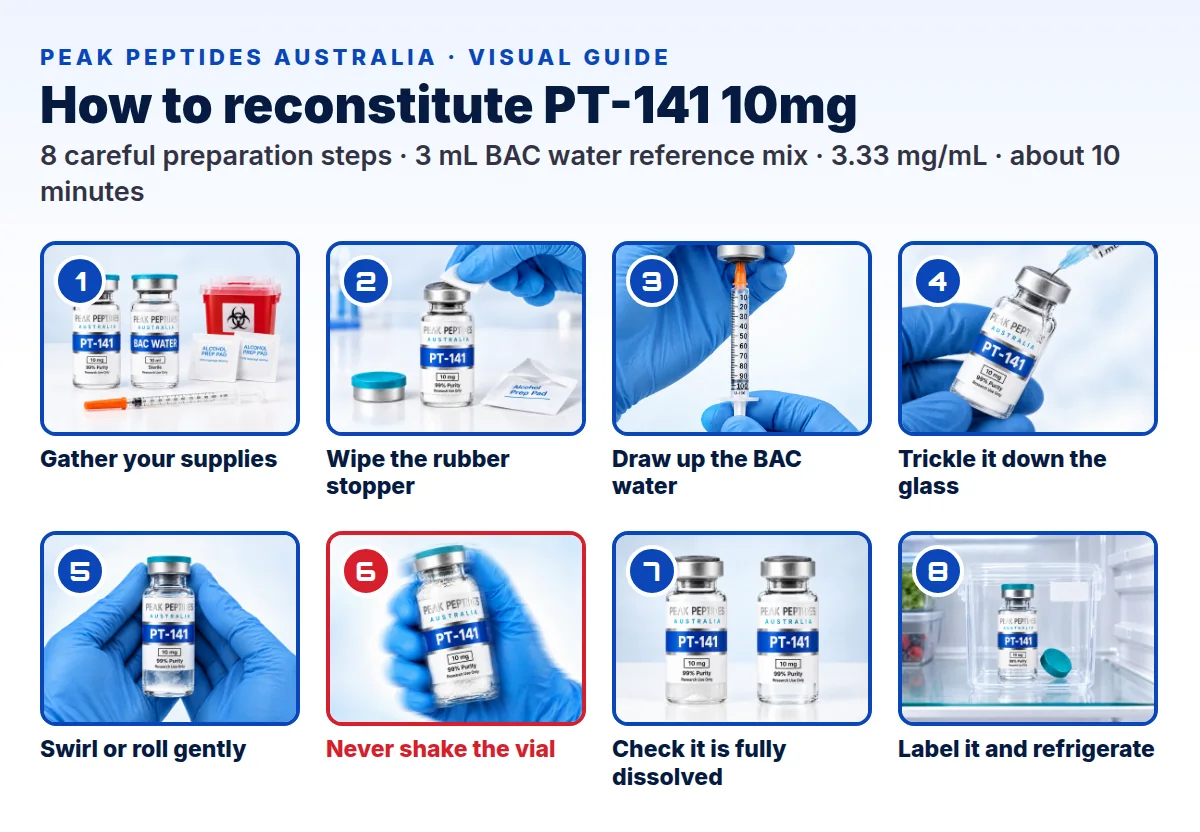
Step-by-step guide · About 10 minutes
How to reconstitute PT-141 10mg (step-by-step with photos)
PT-141 10mg arrives as freeze-dried powder. Reconstitution means adding bacteriostatic water to make a clear, measurable research solution. PeptideDosages uses 3 mL bacteriostatic water as its 10 mg PT-141 reference, which makes approximately 3.33 mg/mL. The eight preparation steps below show careful stopper cleaning, slow addition down the glass wall, gentle swirling and cold storage. Record the final concentration and preparation date in the laboratory record.
PT-141 reconstitution at a glance: clean, add slowly, swirl gently, confirm clarity and refrigerate.
What you need
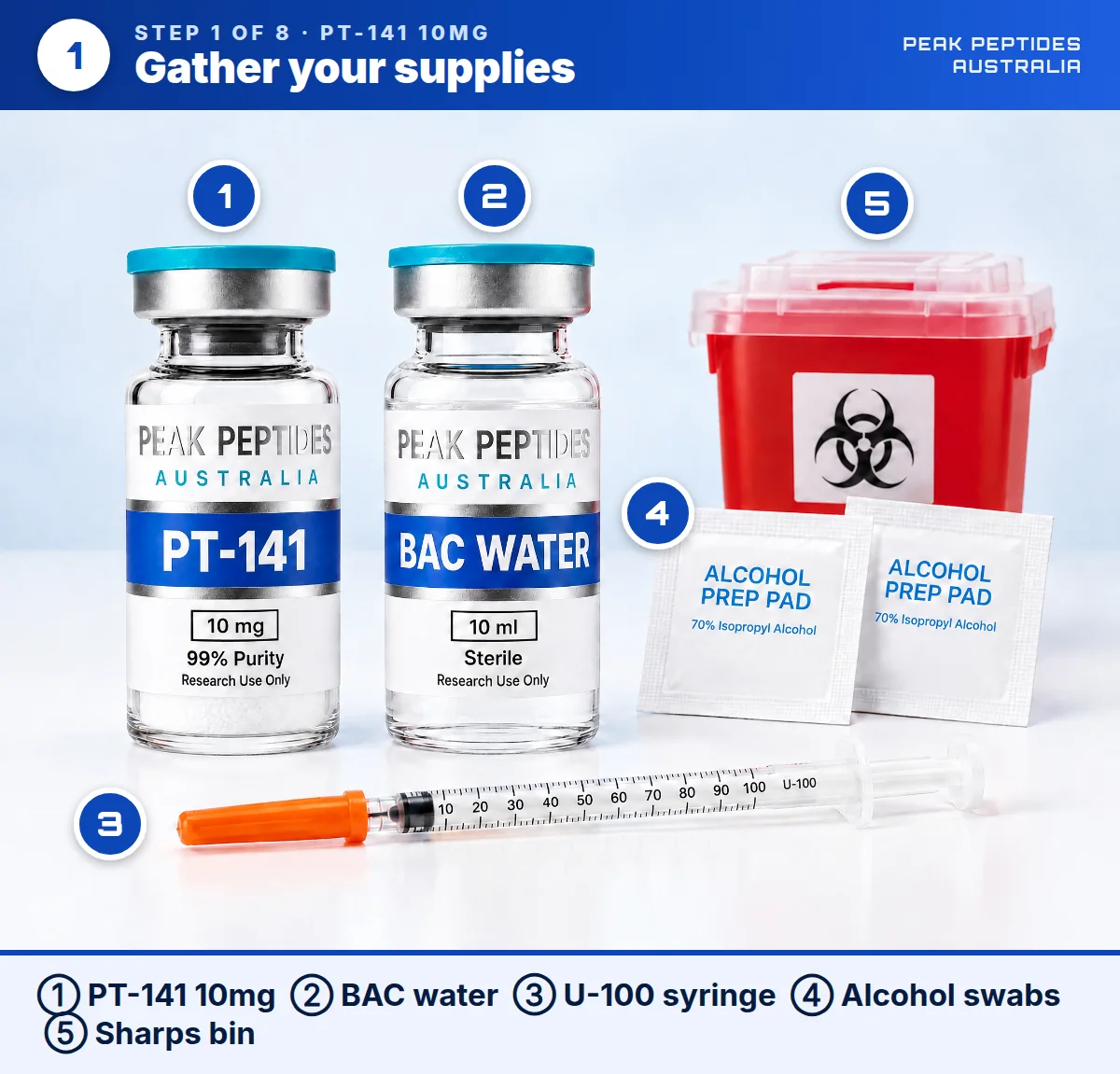
PT-141 10mg vialNominal 10 mg freeze-dried bremelanotide powder in a sealed glass vial.
Bacteriostatic waterThe PeptideDosages PT-141 reference uses bacteriostatic water as the diluent.
1 mL U-100 syringeA measurement tool: 100 units equals 1 mL, and 1 unit equals 0.01 mL.
Alcohol swabsFor cleaning the rubber stoppers before preparation.
Sharps containerFor safe disposal of used needles.
How much BAC water to add to PT-141 10mg
The peptide amount in the vial stays at 10 mg on the nominal label whichever water volume is chosen. More bacteriostatic water makes a more dilute solution, so each U-100 unit contains less material. The PeptideDosages 10 mg PT-141 reference uses 3 mL, giving approximately 3.33 mg/mL and a direct conversion of 30 units for 1 mg.
The chart also shows two alternatives. With 2 mL, the strength is 5 mg/mL: 1 unit holds 0.05 mg and 20 units hold 1 mg. With 4 mL, the strength is 2.5 mg/mL: 1 unit holds 0.025 mg and 40 units hold 1 mg. The calculation is units = amount wanted ÷ strength per mL × 100.
PT-141 10mg mixing chart: the published 3 mL reference gives approximately 3.33 mg/mL and 30 units for 1 mg.
3 mL is highlighted because it gives the simplest numbers.
Syringe units with the 3 mL mix (3.33 mg/mL)
Syringe units with the 3 mL mix (3.33 mg/mL)
Amount
Units on a U-100 syringe
Volume
0.25 mg
7.5 units
0.075 mL
0.5 mg
15 units
0.15 mL
1 mg
30 units
0.3 mL
2 mg
60 units
0.6 mL
The 8 steps
1Step 1: Gather your supplies
Set out the PT-141 10mg vial, bacteriostatic water, a new 1 mL U-100 syringe, alcohol swabs and a sharps container on a clean laboratory surface. Check the vial label and record the material identifier. Let a refrigerated vial sit briefly before opening so condensation is less likely to form.
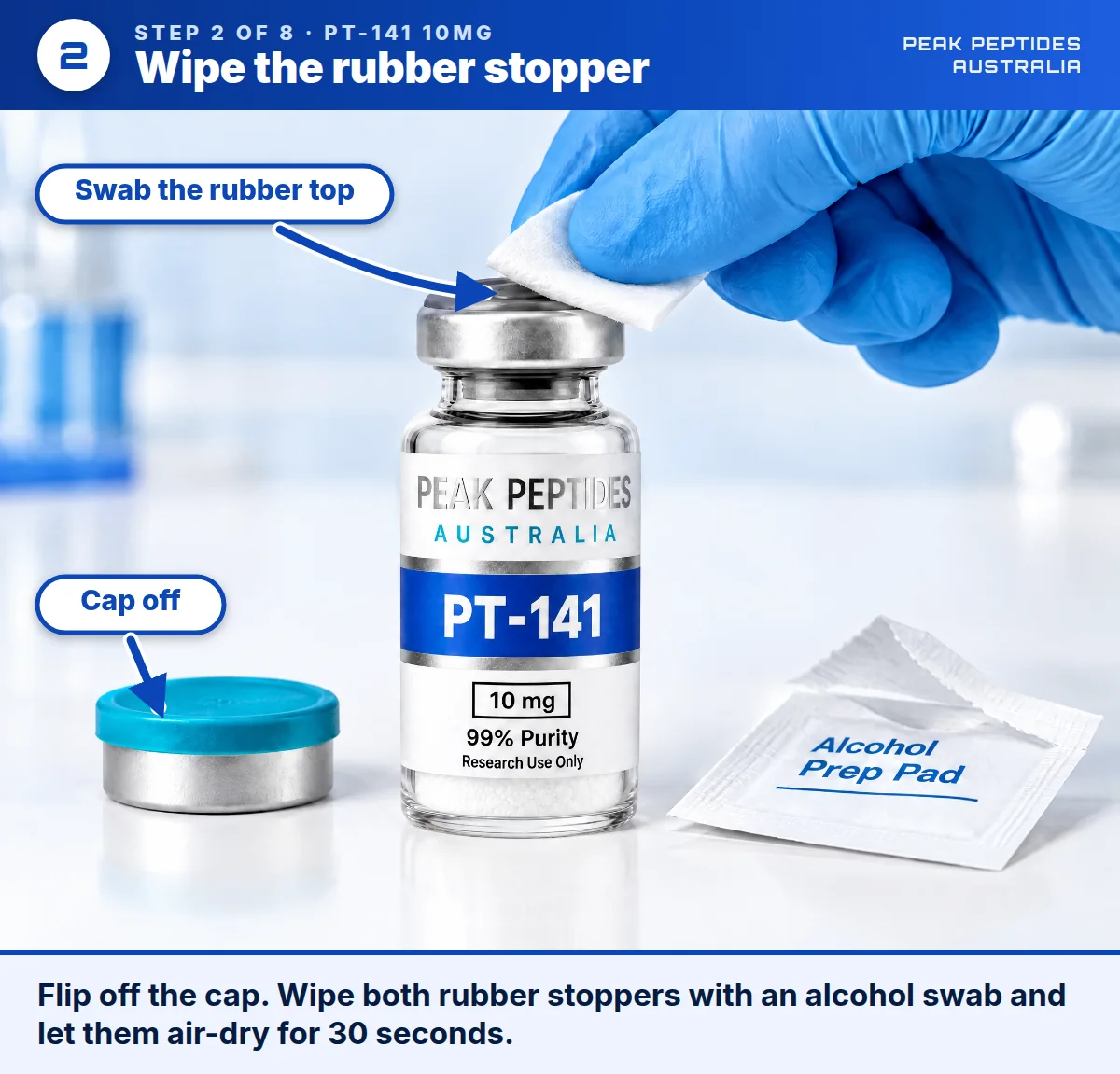
2Step 2: Wipe the rubber stopper
Remove the flip-off caps if present. Use a fresh alcohol swab on each rubber stopper and allow both surfaces to air-dry for about 30 seconds. Keep the cleaned stopper surfaces clear of fingers, benches and other objects after swabbing. This keeps the preparation workflow controlled from the first contact point.
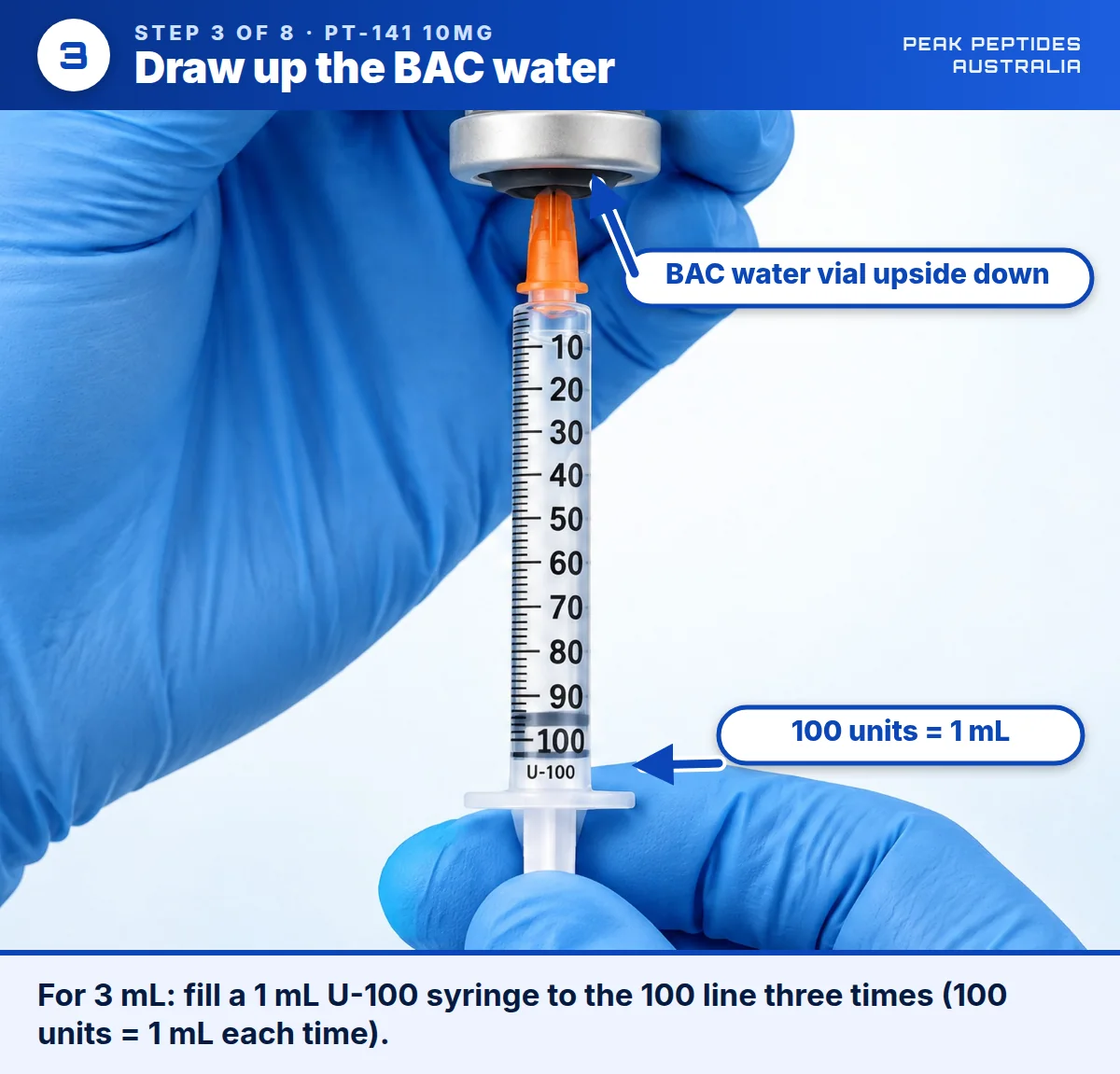
3Step 3: Draw up the BAC water
For the 3 mL reference mixture, draw a measured 1 mL volume of bacteriostatic water into the U-100 syringe. A 1 mL U-100 syringe holds 100 units. Remove visible air bubbles before transferring the liquid. Repeat the measured draw until the full planned preparation volume is ready.
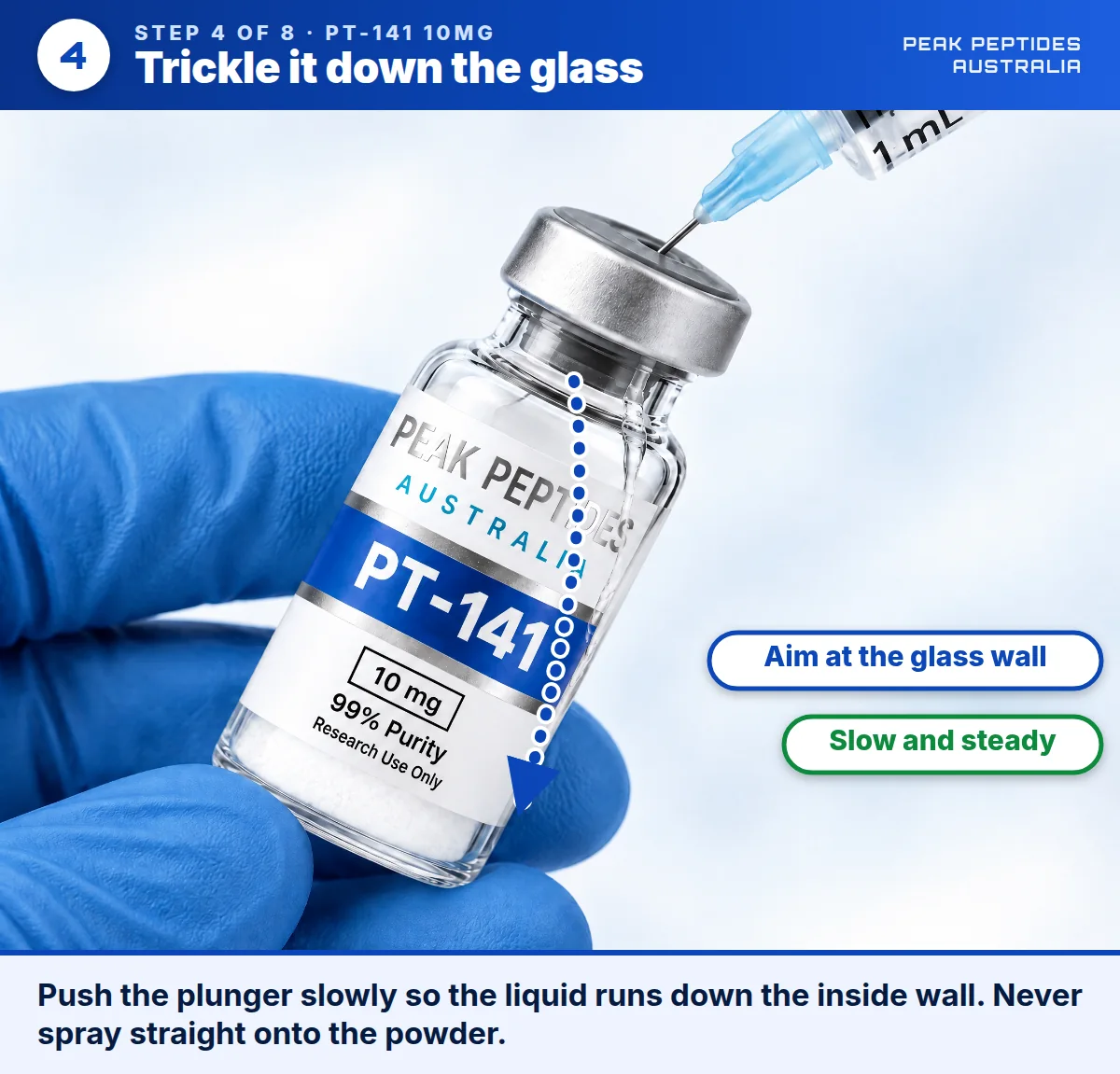
4Step 4: Trickle it down the glass
Place the needle through the PT-141 stopper at an angle so the tip meets the inner glass wall. Press slowly and let the liquid run down the wall rather than striking the freeze-dried powder directly. For the 3 mL reference, repeat the measured transfer until 3 mL total has been added.
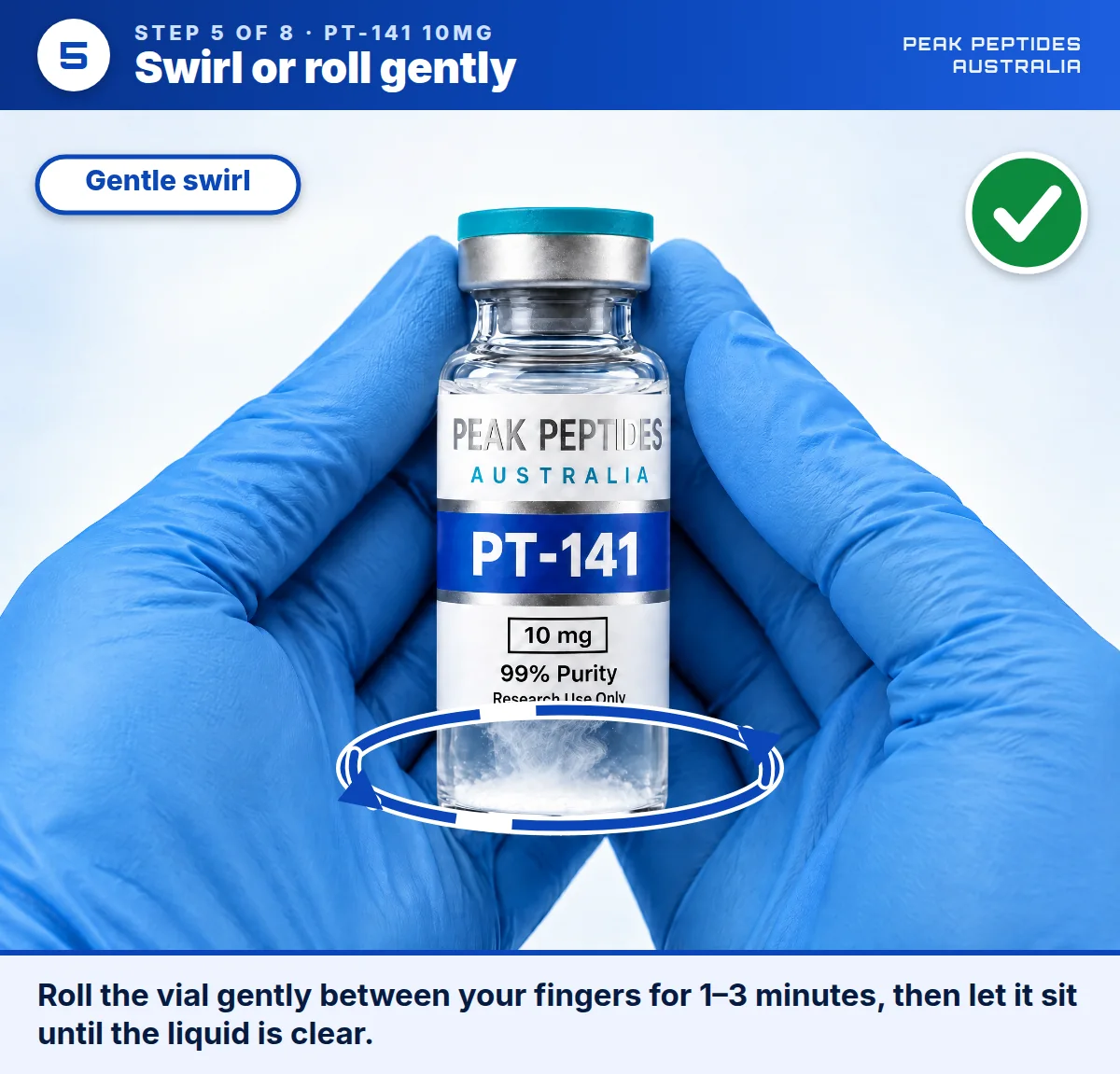
5Step 5: Swirl or roll gently
Roll the PT-141 vial between gloved fingers or swirl it in slow circles. The powder should wet and dissolve gradually. Gentle movement limits foam and gives the solution time to clear. Continue only until the visible material has dispersed; do not force the process with rapid movement.
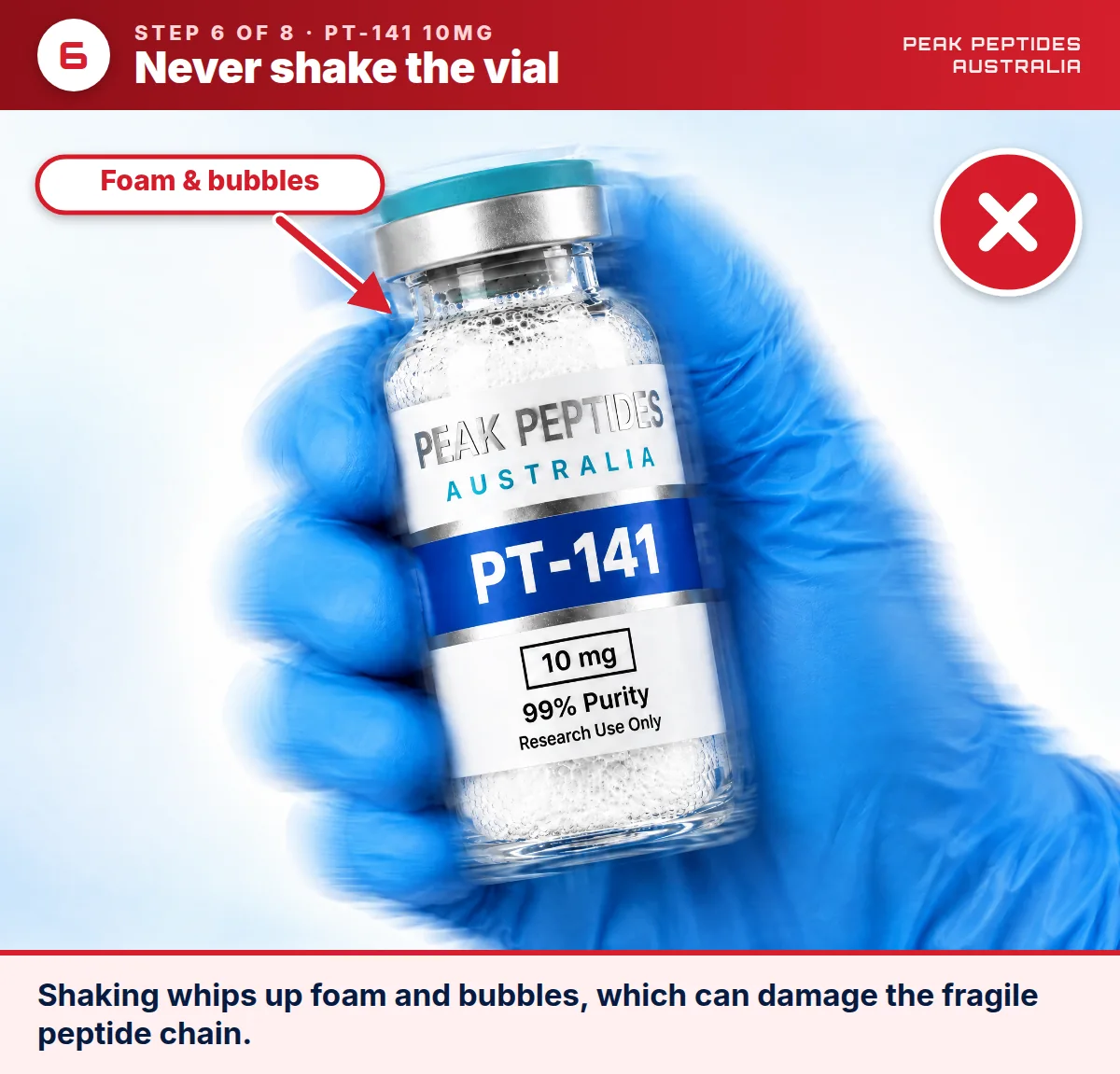
6Step 6: Never shake the vial
Do not shake the vial. Vigorous shaking can create foam and bubbles, making clarity harder to inspect and stressing a peptide preparation. If foam appears, stand the vial upright and allow it to settle before checking the solution again. Gentle swirling is the controlled alternative shown in the previous step.
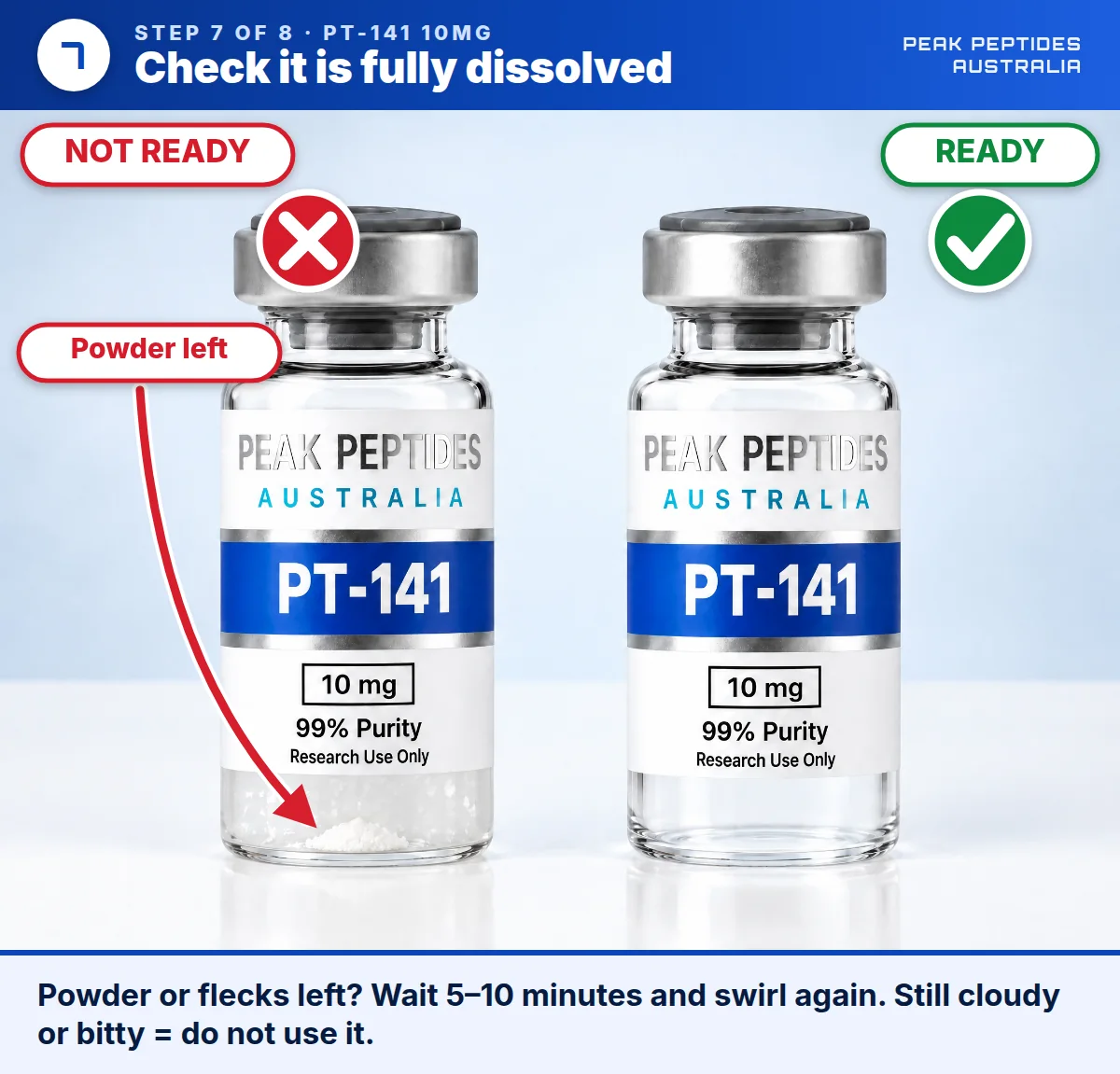
7Step 7: Check it is fully dissolved
Hold the PT-141 vial against a well-lit plain background. A finished solution should be clear and free of visible powder, flecks or cloudiness. If material remains at the base, let the vial rest and swirl gently again. A solution that remains cloudy or contains visible particles should not be recorded as fully dissolved.
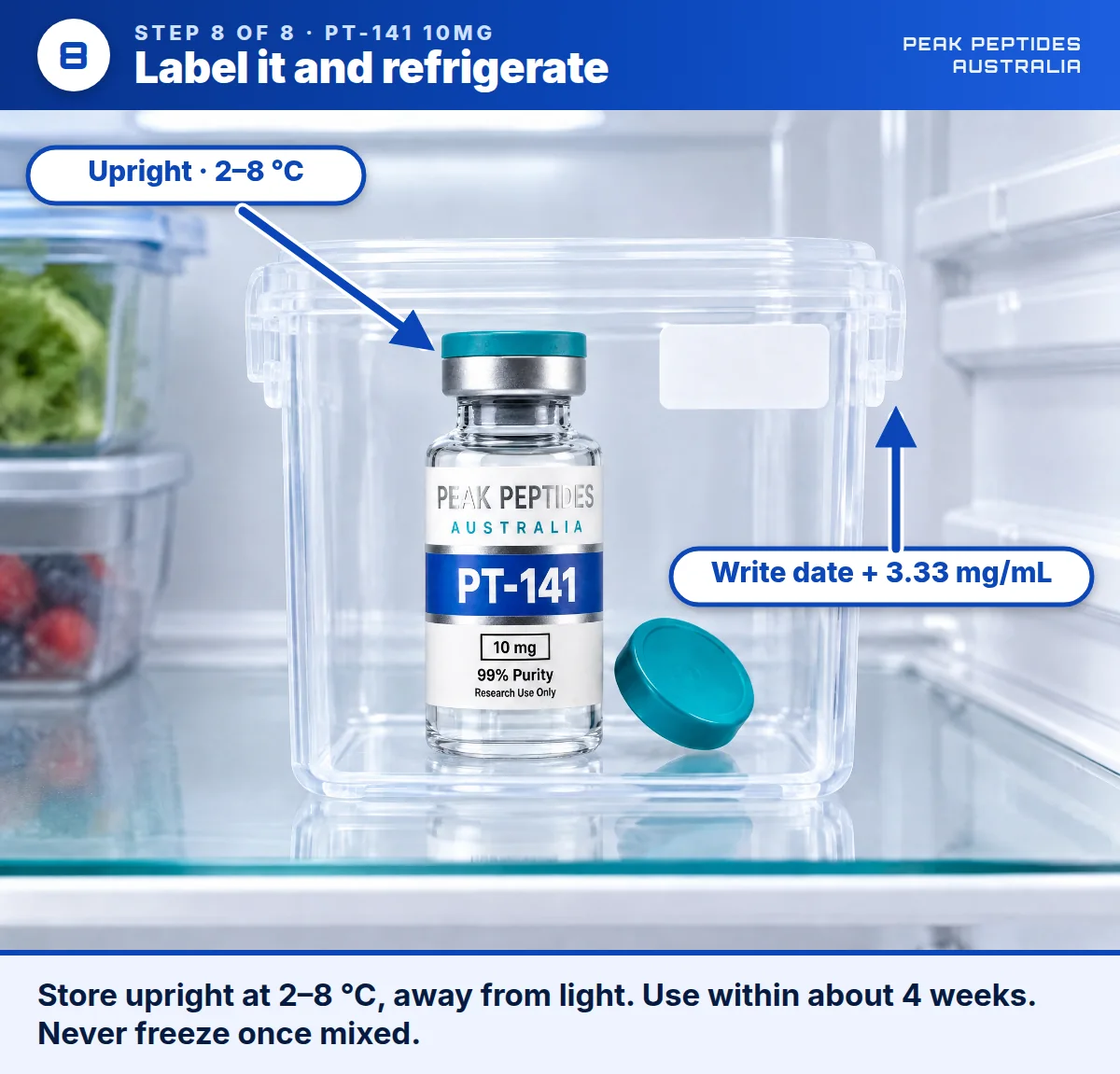
8Step 8: Label it and refrigerate
Record the preparation date, final volume and calculated concentration on the vial or its laboratory record. Store the mixed PT-141 upright in the refrigerator at 2–8 °C, protected from light. PeptideDosages advises avoiding freeze–thaw cycles after reconstitution; the general BAC-water handling convention shown here is about four weeks refrigerated.
How to store PT-141
PT-141 storage and handling guide
PT-141 storage and handling guide
Form
Where to keep it
Key handling point
Unopened freeze-dried powder
−20 °C, dry and dark
PeptideDosages lists this long-term lyophilised storage condition; minimise moisture exposure.
Unopened freeze-dried powder
Protected from light and condensation
Keep the sealed vial dry and maintain its material record.
Mixed PT-141 solution
Refrigerator, 2–8 °C, upright and dark
PeptideDosages lists refrigeration after reconstitution.
Mixed PT-141 solution
Refrigerator only
Avoid freeze–thaw cycles; the general BAC-water handling convention shown here is about four weeks.
Mixed PT-141 solution
Freezer
Do not freeze after mixing.
Write the preparation date, final volume and calculated concentration in the laboratory record. Keep the vial away from light and avoid repeated temperature changes.
PT-141 is the research name for bremelanotide, a synthetic cyclic peptide with seven amino-acid building blocks. It is a melanocortin receptor agonist studied in MC3R, MC4R and central nervous system signalling systems. PT-141 is not testosterone, not a GLP peptide and not a blend.
What is bremelanotide?
Bremelanotide is the non-proprietary name for the molecule also known as PT-141. PubChem lists it as a cyclic heptapeptide with formula C50H68N14O10, molecular weight 1025.2 g/mol and CAS number 189691-06-3. The names PT-141, PT141 and bremelanotide describe the same molecule.
What is PT-141 used for in research?
PT-141 is used in melanocortin receptor and central nervous system signalling research. Experiments can examine receptor binding, receptor activation, cyclic AMP signalling and related pathway responses under defined laboratory conditions. This listing is supplied for in-vitro research only, so published clinical findings should not be assigned to this lyophilised research vial.
How does PT-141 work?
PT-141 activates melanocortin receptors. The FDA label describes bremelanotide as a non-selective melanocortin receptor agonist and ranks activation potency as MC1R, MC4R, MC3R, MC5R and MC2R. MC4R-expressing neurons are found in many central nervous system areas; the FDA says the clinical mechanism in women is unknown.
What are MC3R and MC4R?
MC3R and MC4R are melanocortin receptor subtypes. They are cell-surface receptors that respond to melanocortin signalling molecules and can be studied with assays that measure receptor activation and downstream signals. PT-141 is commonly discussed in MC3R and MC4R research because it acts as a melanocortin receptor agonist.
What did the bremelanotide Phase 3 trials find?
Two 24-week randomised, double-blind, placebo-controlled Phase 3 trials enrolled 1,267 premenopausal women with acquired, generalised hypoactive sexual desire disorder. The integrated analysis found statistically significant placebo-adjusted changes of +0.35 in the FSFI desire-domain score and −0.33 in the low-desire distress score. These results concern the specified prescription formulation studied in the trials.
What side effects were reported in bremelanotide studies?
The FDA label identifies nausea, flushing, injection-site reactions, headache and vomiting as common adverse reactions for Vyleesi. In the two Phase 3 trials, nausea was reported by 40.0% of bremelanotide participants versus 1.3% of placebo participants. The label also reports transient blood-pressure increases and focal hyperpigmentation. These findings do not characterise this research vial.
What is the half-life of bremelanotide?
The FDA prescribing information reports an approximate 2.7-hour mean terminal half-life after a single subcutaneous administration of Vyleesi, with a reported range of 1.9 to 4.0 hours. That pharmacokinetic figure belongs to the FDA-formulated product and administration route studied, not to an untested preparation made from this research vial.
Is PT-141 the same as Melanotan II?
No. PT-141 and Melanotan II are distinct cyclic melanocortin peptides. A published review describes PT-141 as a deaminated derivative and likely metabolite of Melanotan II. PT-141 has its own bremelanotide identity, structure and research record. Each compound has its own vial labels, laboratory reports and research findings.
How is PT-141 different from Oxytocin?
PT-141 is a cyclic melanocortin receptor agonist, while Oxytocin is a different peptide that signals through the oxytocin receptor system. The two molecules have different structures, receptor families and research contexts. A shared discussion of central signalling does not make their experimental methods, concentrations or findings interchangeable.
Is PT-141 testosterone or a GLP peptide?
No. PT-141 is neither testosterone nor a GLP peptide. PT-141 is bremelanotide, a cyclic melanocortin receptor agonist. Testosterone-related work involves steroid-hormone signalling, while GLP research concerns incretin or glucagon pathways. Each compound needs its own identity test, concentration calculation and evidence base.
Is bremelanotide FDA approved?
Yes. The FDA approved Vyleesi, a prescription bremelanotide acetate autoinjector, on 21 June 2019. Its US indication is acquired, generalised hypoactive sexual desire disorder in premenopausal women, with stated limitations. This nominal 10 mg lyophilised research vial is not Vyleesi, not an FDA prescription autoinjector and not a therapeutic formulation.
Is PT-141 approved by the TGA in Australia?
No. This PT-141 10mg listing is supplied as an in-vitro research material, not as a TGA-approved therapeutic good. The TGA describes the Australian Register of Therapeutic Goods as its public database for therapeutic goods supplied in Australia. The existence of US-approved Vyleesi does not make this research vial a TGA-approved medicine.
Can I buy PT-141 10mg online in Australia?
PT-141 10mg can be ordered online from Peak Peptides Australia when available. In-stock orders receive same-day dispatch from Victoria once payment is confirmed, travel by tracked Australia Post Express, and have a tracking number emailed. The material is supplied for in-vitro research only and is not a prescription formulation.
How fast is PT-141 shipping in Australia?
For in-stock PT-141 orders, Peak Peptides Australia uses same-day dispatch from Victoria once payment is confirmed. Parcels travel with tracked Australia Post Express and the tracking number is emailed. Carrier transit time depends on the destination and the Australia Post network, while dispatch and tracking are the store commitments stated here.
How do I know PT-141 is real?
Start with an independent report that names the tested material, identifies the analytical method and can be verified. For this listing, LabDoc LD-YZY4 records LC-MS-confirmed identity, 99.45% HPLC purity and 9.54 mg measured content. The Quality page also records the separate historical Janoshik Task #135357. Compare report details with the exact vial label and supplier record.
How is this PT-141 10mg sample verified?
LabDoc report LD-YZY4 tested PT-141 (bremelanotide) on 21 October 2026 after receiving the sample on 16 October 2026. It records identity confirmed by LC-MS, 99.45% purity by HPLC, 9.54 mg measured content by HPLC and an overall Pass. The report covers the tested sample; it does not test sterility.
What did Janoshik report #135357 show for PT-141?
Peak Peptides Australia’s Quality page lists historical Janoshik Task #135357 for PT-141, dated 1 June 2026. The page records 8.51 mg PT-141 and 99.901% purity. It is a separate historical report from current LabDoc LD-YZY4, so the two reports should be read as separate analyses rather than combined into one result.
What does 10mg mean on the PT-141 vial?
The 10 mg label is the nominal total mass stated for the freeze-dried vial. For laboratory preparation, concentration depends on the measured amount and the final measured solution volume. LabDoc LD-YZY4 measured 9.54 mg in its tested sample.
How much BAC water for PT-141 10mg?
PeptideDosages uses 3 mL bacteriostatic water as its 10 mg PT-141 reference, giving approximately 3.33 mg/mL. This page also shows the exact mathematics for 2 mL and 4 mL alternatives. The peptide mass stays the same; changing water volume changes concentration and U-100 syringe-unit conversion.
How many units is 1 mg of PT-141?
With the 3 mL reference mixture, the strength is approximately 3.33 mg/mL, so 1 mg is 30 units on a U-100 syringe. With 2 mL, the strength is 5 mg/mL and 1 mg is 20 units. With 4 mL, the strength is 2.5 mg/mL and 1 mg is 40 units.
How many mg are in 10 units of PT-141?
The answer depends on the final water volume. With 3 mL added to a 10 mg vial, 10 U-100 units equal approximately 0.33 mg. With a 2 mL mixture, 10 units equal 0.5 mg. With a 4 mL mixture, 10 units equal 0.25 mg.
How do I reconstitute PT-141 10mg?
For laboratory preparation, clean the vial stoppers, draw the measured bacteriostatic water, then let the liquid run slowly down the inside wall of the PT-141 vial. Swirl gently until the solution is fully clear; do not shake. Label the final concentration and preparation date, then keep the mixed vial upright at 2–8 °C away from light.
Can I use sterile or tap water instead of bacteriostatic water?
Do not use tap water for peptide preparation. The PT-141 reference guide uses bacteriostatic water, which contains a preservative. Plain sterile water has no preservative and is not a substitute for a stored multi-use preparation. Use laboratory materials and record the diluent, final volume and preparation date in the experiment record.
What if PT-141 powder does not dissolve?
Let the vial stand briefly, then roll or swirl it gently again. Do not shake it, because shaking creates foam and can stress a peptide solution. A fully prepared PT-141 solution should be clear and free of visible powder or particles. If cloudiness or particles remain, record the observation and do not treat the solution as fully dissolved.
Should reconstituted PT-141 be cloudy?
No. The finished PT-141 preparation should appear clear and free of visible particles. A cloudy solution, floating material or powder remaining at the base means the material has not fully dissolved or has changed during handling. The photo guide separates a vial with visible residual powder from a fully clear vial for this reason.
How long does reconstituted PT-141 last?
The PeptideDosages reference says to refrigerate reconstituted PT-141 at 2–8 °C and avoid freeze–thaw cycles. Once mixed with bacteriostatic (BAC) water, keep the vial upright in the fridge at 2–8 °C, away from light, use it within about 4 weeks (28 days) and never freeze it. Write the preparation date and strength on the vial.
How should PT-141 powder be stored before mixing?
PeptideDosages lists lyophilised PT-141 storage at −20 °C in dry, dark conditions and recommends minimising moisture exposure. Keep the sealed vial protected from light and condensation. The dry powder and a reconstituted solution have different handling needs, so keep preparation records separate from the unopened-vial storage record.
Can reconstituted PT-141 be frozen?
Do not freeze a PT-141 solution after it has been mixed. The PeptideDosages guide advises avoiding freeze–thaw cycles for reconstituted PT-141. Keep the prepared vial in the refrigerator at 2–8 °C, protected from light and upright. Repeated temperature cycling can change the condition of a peptide solution.
What does a PT-141 COA show?
A certificate of analysis records the results for a tested sample. Useful peptide records identify the material and show the analytical method, purity and measured amount. LabDoc LD-YZY4 reports LC-MS identity confirmation, HPLC purity of 99.45% and 9.54 mg measured content. A purity figure does not substitute for a sterility test.