Oxytocin 10mg is a nine-amino-acid neuropeptide hormone research material for studying the oxytocin receptor (OXTR), neuroendocrine signalling and peptide structure. LabDoc report LD-AKXA confirms identity by LC-MS, 99.68% purity by HPLC and 9.5mg measured content for the tested vial. In-stock orders receive same-day dispatch from Victoria after payment confirmation, with tracked Australia Post Express shipping Australia-wide.
Product Specifications
Full NameOxytocin (Neuropeptide Hormone)
Vial Size10mg
Purity99.68% HPLC (LD-AKXA, 9.50mg sample)
Legal Disclaimer
This product is sold strictly for in-vitro laboratory research purposes only. It is not intended for human or animal consumption, injection, or any diagnostic or therapeutic use.
Oxytocin · OXTR and neuroendocrine signalling research
Oxytocin 10mg — What It Is, OXTR Signalling & Reconstitution Guide
Oxytocin, also called OXT, is a nine-amino-acid peptide hormone. Its sequence is Cys–Tyr–Ile–Gln–Asn–Cys–Pro–Leu–Gly–NH2, with a disulfide bond joining the two cysteines to make a six-residue ring. In research, oxytocin is used to examine the oxytocin receptor (OXTR), a cell-surface receptor that links binding to intracellular signalling. This page explains the molecule’s structure, its established endocrine context, what cell-signalling studies show, and how it differs from PT-141. It also includes LabDoc report LD-AKXA, a BAC-water measurement chart and an eight-step photo guide. Peak Peptides Australia supplies this Oxytocin 10mg material for in-vitro research only, not for human use.
Also referred to in research or catalogue references as Oxytocin peptide, OXT, oxytocin nonapeptide, Oxytocin 10mg, Oxytocin 10 mg, OXT peptide, oxytocin hormone peptide, Cys-Tyr-Ile-Gln-Asn-Cys-Pro-Leu-Gly-NH2.
3 mL BAC water = 3.33 mg/mL from the nominal 10mg label quantity
Prepared-material storage
Keep upright at 2–8 °C, away from light; use within about 4 weeks (28 days). Never freeze.
Dispatch
Same-day from Victoria for in-stock orders once payment is confirmed, tracked Australia Post Express, tracking number emailed
A nine-residue peptide with a ring
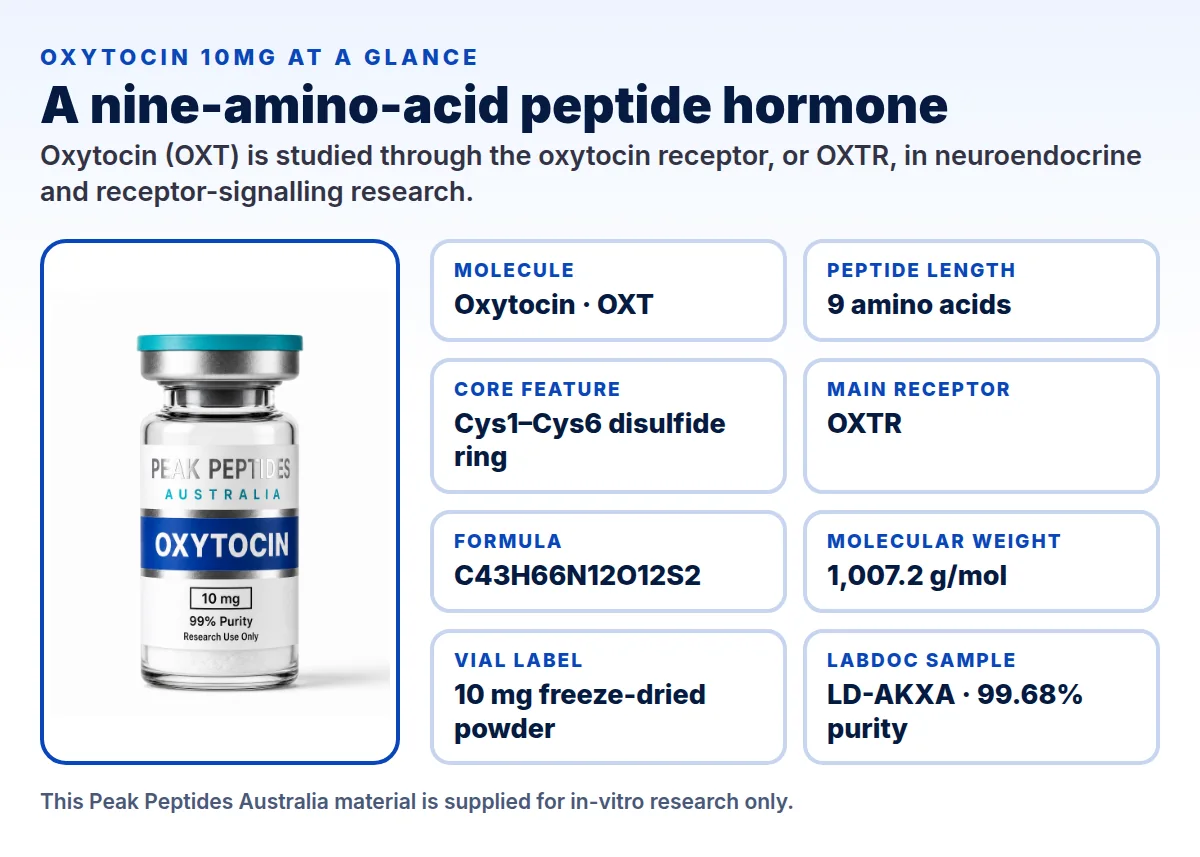
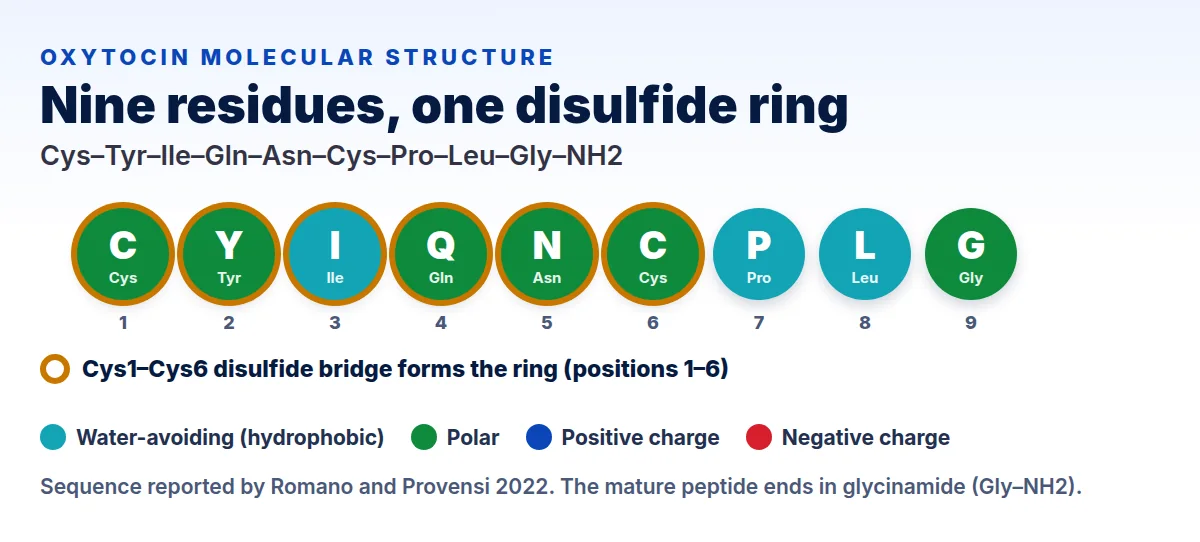
Oxytocin is a nonapeptide: a chain of nine amino acids. Its published sequence is Cys–Tyr–Ile–Gln–Asn–Cys–Pro–Leu–Gly–NH2. Cysteine 1 and cysteine 6 form a disulfide bridge, giving the molecule a ring-shaped section. PubChem lists formula C43H66N12O12S2 and molecular weight 1,007.2 g/mol.
One named primary receptor: OXTR
Oxytocin binds the oxytocin receptor, abbreviated OXTR. OXTR is a G-protein-coupled receptor, meaning receptor binding passes a signal into the cell through G proteins. It is reported in both central and peripheral tissues, so it is a useful target for receptor localisation, binding and signalling assays.
A measurable cell-signalling route
In a studied signalling route, OXTR couples to Gq/11 proteins, which activate phospholipase C. This enzyme generates IP3, a small messenger that can release calcium from internal stores. In cultured lacrimal-gland myoepithelial cells, oxytocin increased intracellular calcium in a concentration-dependent manner.
Endocrine context explains the research interest
Oxytocin is made mainly in the hypothalamus. Magnocellular oxytocin neurons project to the posterior pituitary, from where oxytocin reaches the bloodstream. Its established physiological roles include uterine contraction and milk ejection. Researchers also study its broader neuroendocrine and neural-signalling roles under defined experimental conditions.
Oxytocin is not PT-141
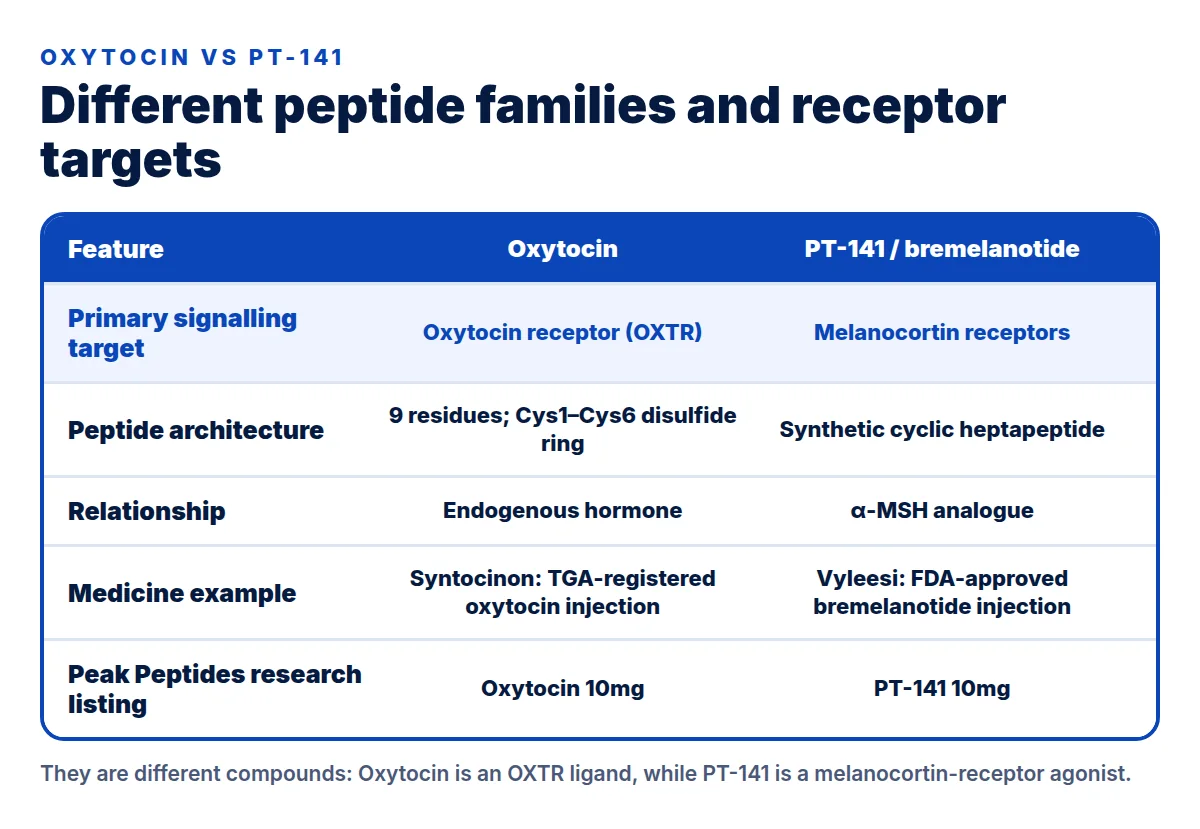
Oxytocin and PT-141 are different peptide molecules with different primary receptor targets. Oxytocin is an OXTR ligand and a nine-residue endogenous hormone. PT-141, also called bremelanotide, is a synthetic cyclic heptapeptide that acts on melanocortin receptors. Their sequences, assay targets and regulated medicine examples differ.
Oxytocin is an approved medicine in a different format
Oxytocin is an approved medicine when supplied as a registered finished product. The TGA ARTG lists SYNTOCINON oxytocin 10 IU/1 mL injection ampoule as a registered medicine, ARTG ID 13383. That sterile, regulated injection is not the same product as this 10mg freeze-dried research material.
Independent LabDoc evidence for this vial
LabDoc report LD-AKXA records a tested Peak Peptides Australia Oxytocin vial labelled 10mg. The report shows 9.5mg content by HPLC, equal to 95% of the label claim; 99.68% purity by HPLC; and identity confirmed by LC-MS. LabDoc records the sample received on 09 September 2026 and tested on 19 October 2026, with an overall Pass.
What the 10mg label means
The 10mg label is the nominal total quantity printed on the vial, not a ready-made concentration. A concentration appears only after a measured preparation volume is chosen. The chart below gives measurement maths based on the 10mg label claim, while the LabDoc result separately records 9.5mg content for the vial it tested.
Oxytocin is a naturally occurring peptide hormone and neuropeptide. The mature molecule contains nine amino-acid building blocks, so its scientific shorthand is nonapeptide. Its standard sequence is Cys–Tyr–Ile–Gln–Asn–Cys–Pro–Leu–Gly–NH2. The two cysteine residues make a disulfide bond, joining positions 1 and 6 into a six-residue ring. That compact ring-and-tail design is one of the easiest ways to recognise oxytocin structurally.
The molecule is also called OXT. PubChem records its molecular formula as C43H66N12O12S2 and its molecular weight as 1,007.2 g/mol. These chemical details distinguish oxytocin from superficially similar short peptides. The name Oxytocin 10mg on this listing refers to the nominal material quantity printed on the vial; it is not a concentration and it is not a finished medicine presentation.
In physiology, oxytocin is synthesised mainly in the hypothalamus. Magnocellular cells project to the posterior pituitary, from which oxytocin is released into the bloodstream. Its established endocrine context includes uterine contraction and milk ejection. Those known roles explain why the molecule remains important in neuroendocrine and receptor-signalling research. This product is supplied for in-vitro research only.
Oxytocin 10mg in one view: a nine-amino-acid OXTR ligand, nominal 10mg vial quantity and independent LabDoc verification.
How does Oxytocin work through OXTR?
Oxytocin works in an assay by binding the oxytocin receptor, OXTR. OXTR is a class-A G-protein-coupled receptor: it sits on the outside of a cell and translates a binding event into signalling inside the cell. Reviews describe OXTR across central and peripheral tissues, which is why oxytocin can be studied in more than one tissue or cell-system setting.
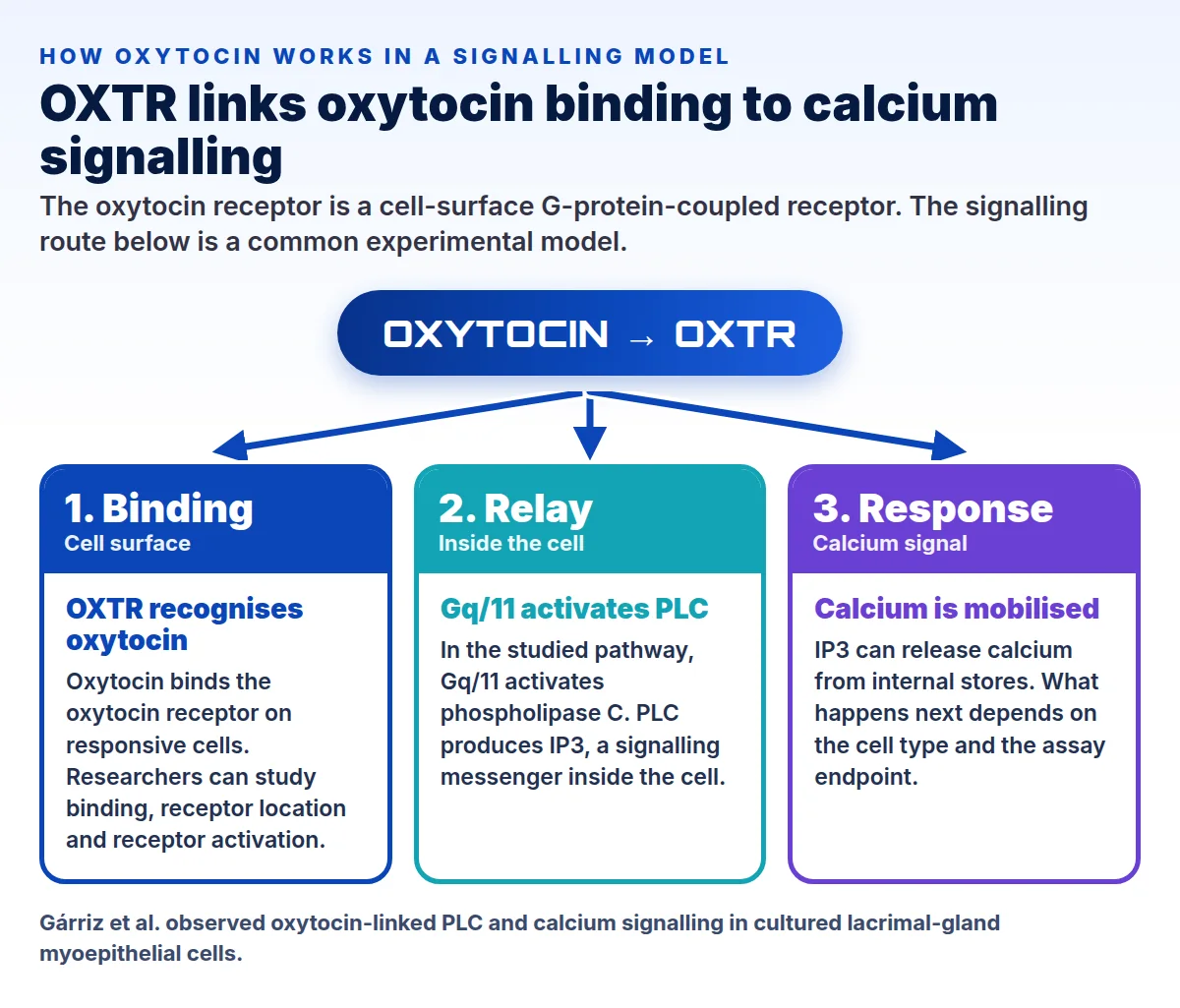
A well-characterised pathway begins with OXTR coupling to the Gq/11 family of G proteins. Gq/11 activates phospholipase C, often shortened to PLC. PLC cleaves a membrane lipid to form IP3, an intracellular messenger. IP3 can bind its receptor on internal cell stores and release calcium into the cell. Calcium-sensitive methods can then measure part of the response.
In a 2021 cultured-cell study, oxytocin raised intracellular calcium in lacrimal-gland myoepithelial cells in a concentration-dependent way. Blocking IP3-mediated calcium release reduced the calcium signal and blocked the measured contraction in that system. This is a direct example of an OXTR-to-calcium experiment, not a universal result for every cell type.
OXTR binding: oxytocin attaches to its named cell-surface receptor.
Gq/11 relay: the activated receptor can signal through Gq/11 proteins.
PLC and IP3: phospholipase C produces IP3, which carries the message inside the cell.
Calcium readout: IP3 can mobilise intracellular calcium, a measurable assay endpoint.
A common OXTR assay model: oxytocin binding can connect to PLC, IP3 and intracellular calcium signalling.
What does Oxytocin research examine?
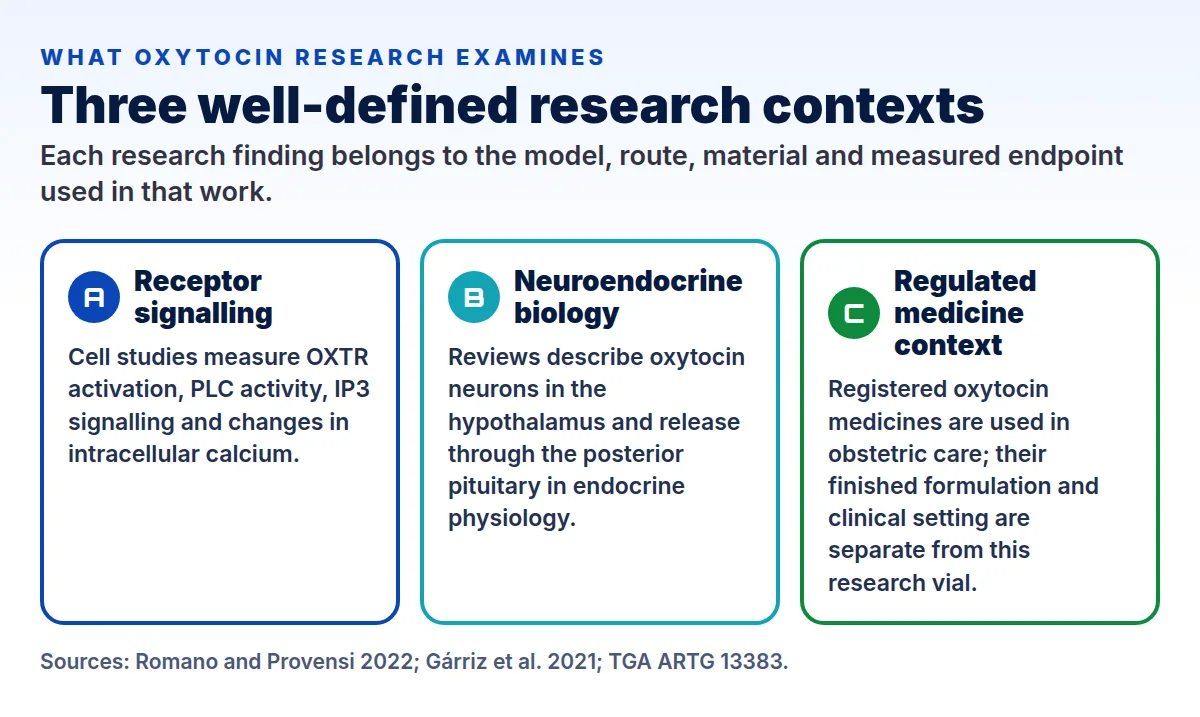
Oxytocin research begins with questions that can be tested clearly. At a receptor level, a laboratory can examine OXTR binding, receptor location at the cell surface, receptor internalisation or downstream messenger activity. At a cell-signalling level, PLC activation, IP3 generation and calcium mobilisation provide specific, measurable endpoints.
At the endocrine level, published reviews describe the link between hypothalamic oxytocin neurons, the posterior pituitary and circulating hormone. This biology provides context for studies of uterine and mammary tissue. It also supports research into how a short peptide hormone coordinates signals between the nervous system and peripheral tissues.
Published research extends to social processing, feeding, stress pathways and other neuroendocrine questions. The useful way to read these studies is to keep the route, formulation, sample, model and outcome next to the finding. A nasal formulation, a regulated oxytocin injection and a freeze-dried research vial are different experimental materials. Sharing the word oxytocin does not make their findings interchangeable.
Oxytocin research spans molecular signalling, neuroendocrine physiology and the distinct context of regulated oxytocin medicines.
Oxytocin research contexts and clear assay questions
Oxytocin research contexts and clear assay questions
Research context
What is examined
Example measurable endpoint
Receptor pharmacology
OXTR binding and receptor activation
Binding or signalling response
Cell signalling
Gq/11, PLC, IP3 and calcium pathway activity
Intracellular calcium change
Neuroendocrine biology
Hypothalamic production and posterior-pituitary release context
Hormone or tissue-signalling measure
Molecular structure
Nine-residue sequence and Cys1–Cys6 disulfide ring
Identity or structure confirmation
The endpoint must always be read with the cell system, material and method used in the study.
Oxytocin vs PT-141: what is the difference?
Oxytocin and PT-141 are both peptide products, but they are not the same type of molecule. Oxytocin is the endogenous nine-residue hormone that binds OXTR. PT-141 is the former research name for bremelanotide, a synthetic cyclic heptapeptide related to alpha-melanocyte-stimulating hormone. Its target family is the melanocortin-receptor family, not OXTR.
The difference matters in every experimental design decision. Oxytocin’s defining structural feature is its Cys1–Cys6 disulfide ring. Bremelanotide is a cyclic heptapeptide with a different sequence and receptor pharmacology. An OXTR binding or calcium assay tests a different question from a melanocortin-receptor assay.
Both molecules also have separate regulated-medicine references. The TGA lists Syntocinon, an oxytocin injection, on the ARTG. The FDA label for Vyleesi identifies bremelanotide as a melanocortin receptor agonist. Neither regulated medicine is the same product as a freeze-dried research vial.
Oxytocin is an OXTR ligand; PT-141 is a melanocortin-receptor agonist. Their research settings are distinct.
Oxytocin compared with PT-141 / bremelanotide
Oxytocin compared with PT-141 / bremelanotide
Feature
Oxytocin
PT-141 / bremelanotide
Core identity
Endogenous peptide hormone
Synthetic alpha-MSH analogue
Peptide architecture
Nine residues; Cys1–Cys6 disulfide ring
Cyclic heptapeptide
Primary receptor family
Oxytocin receptor, OXTR
Melanocortin receptors
Research focus
OXTR, neuroendocrine and calcium signalling
Melanocortin receptor pharmacology
Peak Peptides listing
Oxytocin 10mg
PT-141 10mg
The molecules have different sequences, receptor families and research uses.
Oxytocin structure: sequence and disulfide ring
Oxytocin is small enough to show its entire sequence without abbreviation: Cys–Tyr–Ile–Gln–Asn–Cys–Pro–Leu–Gly–NH2. The amide at the glycine end is part of the mature peptide. The two cysteine side chains join by a disulfide bond, making a cyclic section from residues 1 through 6.
The ring is not a decorative feature. It shapes the molecule’s three-dimensional arrangement and contributes to recognition by its receptor. Researchers examining identity, analogue design or structure–activity relationships use the published sequence and disulfide placement as essential reference points.
A molecular formula and molecular weight provide another identity check. PubChem lists oxytocin as C43H66N12O12S2 with molecular weight 1,007.2 g/mol. For this product, the independent identity result is also recorded in LabDoc report LD-AKXA, which states that LC-MS identity was confirmed for the tested sample.
Oxytocin’s complete nine-residue sequence, with the Cys1–Cys6 bridge that forms its ring.
Independent lab test for this Oxytocin 10mg vial
Oxytocin 10mg is backed by LabDoc report LD-AKXA. The report identifies the sample as oxytocin lyophilised powder in a vial from Peak Peptides Australia, with a 10mg label claim. It records sample received on 09 September 2026, analysis on 19 October 2026 and report compilation on 21 October 2026. The batch field is recorded as Not stated.
The tested sample recorded 9.5mg content by HPLC, equal to 95% of the 10mg label claim. HPLC purity was 99.68%. LC-MS identity was confirmed. The overall assessment was Pass. HPLC separates components in a sample, which lets the laboratory report both purity and content. LC-MS measures mass information that supports molecular identity.
The report applies to the sample LabDoc tested. It is not a statement about a different vial, and it does not convert a research material into a regulated medicine. Keeping the vial label, order record and LD-AKXA report together provides a clear research-material record. The direct verification page is linked below and on the Quality page.
Report ID: LD-AKXA.
Identity: confirmed by LC-MS.
Purity: 99.68% by HPLC.
Content: 9.5mg by HPLC, 95% of the 10mg label claim.
Test date: 19 October 2026.
Overall assessment: Pass.
Buying Oxytocin 10mg in Australia
Oxytocin 10mg can be ordered online from Peak Peptides Australia when available. Same-day dispatch from Victoria applies for in-stock orders once payment is confirmed, sent by tracked Australia Post Express. The tracking number is emailed after dispatch. This page gives the product’s research background, lab verification and visual preparation information in one place.
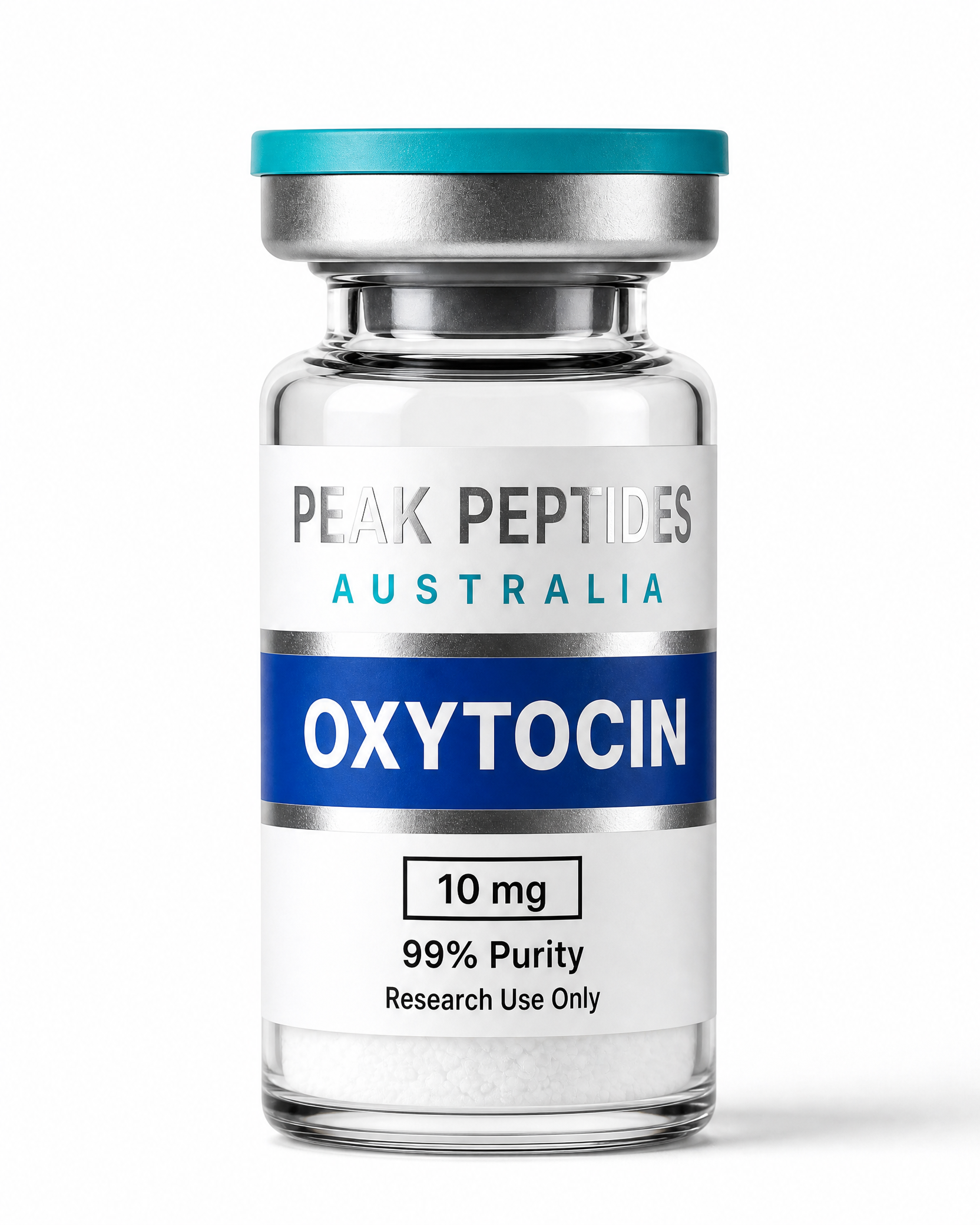
The strength on the front label is 10mg and the royal-blue band reads OXYTOCIN. LabDoc report LD-AKXA provides an independent record for a tested sample: identity confirmed by LC-MS, 99.68% purity by HPLC and 9.5mg content by HPLC. Use the LabDoc report ID and direct verification page when matching research records.
Need a mixing chart or supplies? The page includes a 3 mL BAC-water reference mix from PeptideDosages, a measurement chart, visual preparation steps and links to bacteriostatic water, the site calculator and Quality page. Oxytocin 10mg is supplied for in-vitro research only.
Step-by-step guide · About 10 minutes
How to reconstitute Oxytocin 10mg (step-by-step with photos)
Oxytocin 10mg arrives as freeze-dried powder. Reconstitution means adding a measured preparation liquid so the powder dissolves into a clear solution that can be measured. PeptideDosages describes 3 mL bacteriostatic water for a nominal 10mg oxytocin vial, giving about 3.33 mg/mL. This photo guide uses that reference volume for measurement maths. It takes about 10 minutes. Keep the process clean. Once mixed, keep it upright at 2–8 °C, away from light. Use within about 4 weeks (28 days); never freeze. Write the date and strength on the vial.
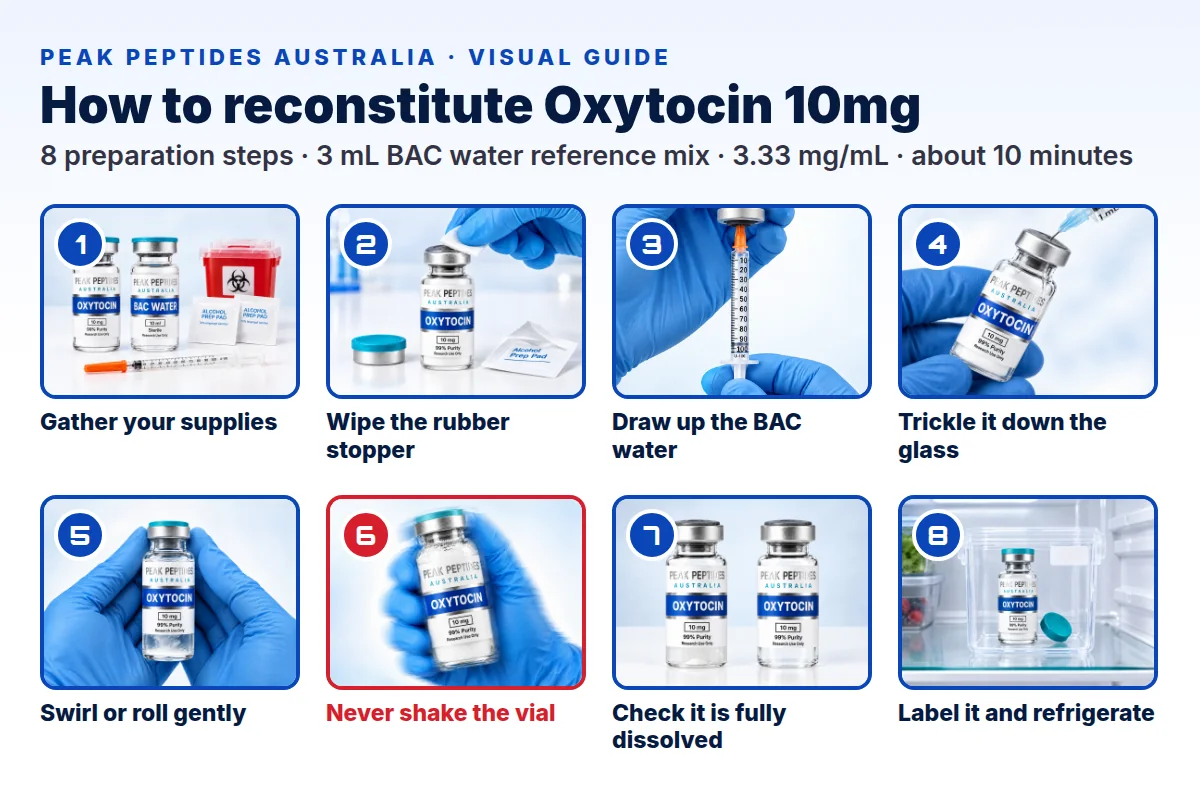
The Oxytocin 10mg preparation process at a glance — eight visual checks from clean supplies to labelled cold storage.
What you need
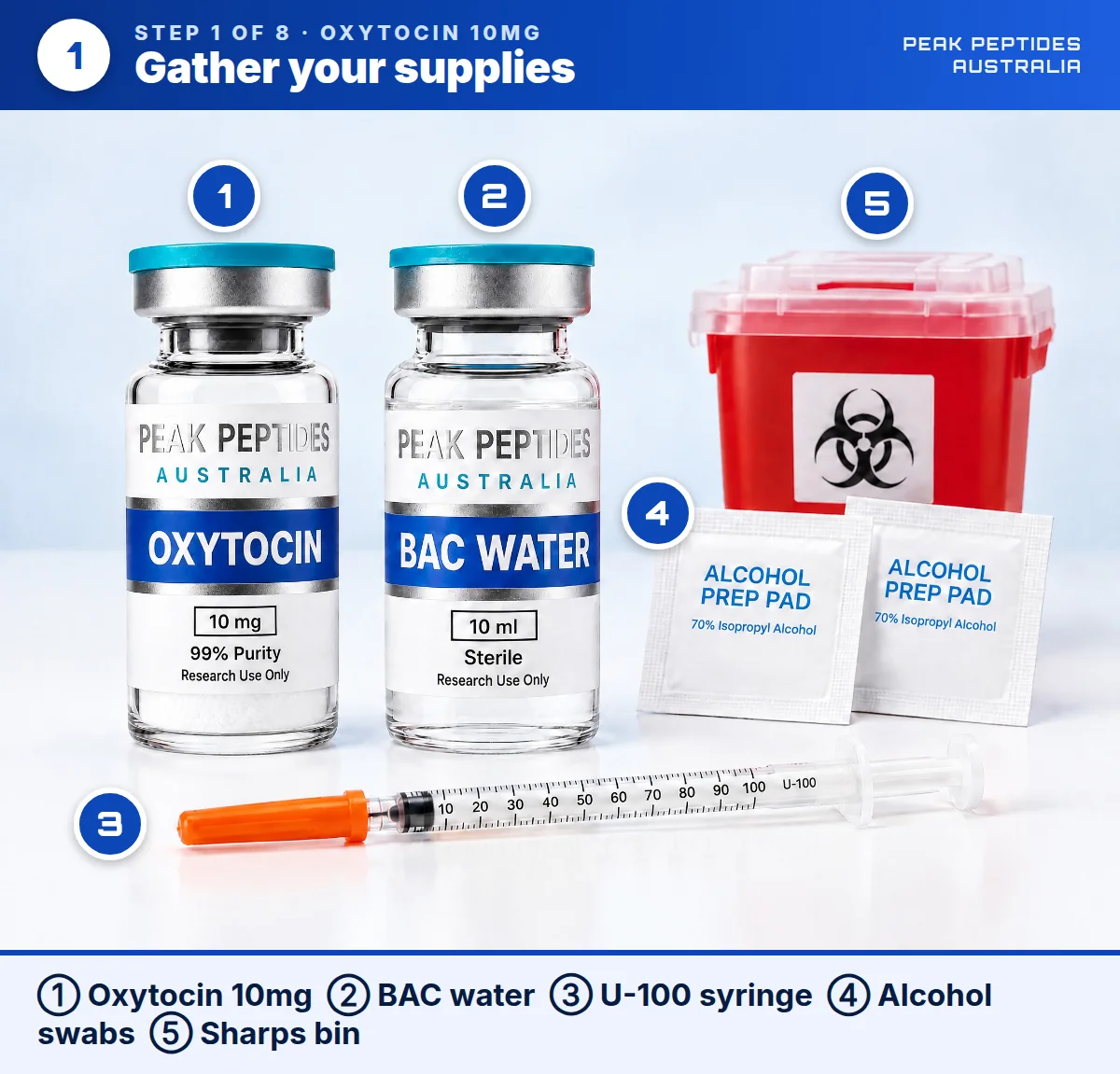
Oxytocin 10mg vialNominal 10mg freeze-dried oxytocin powder in a sealed clear-glass vial.
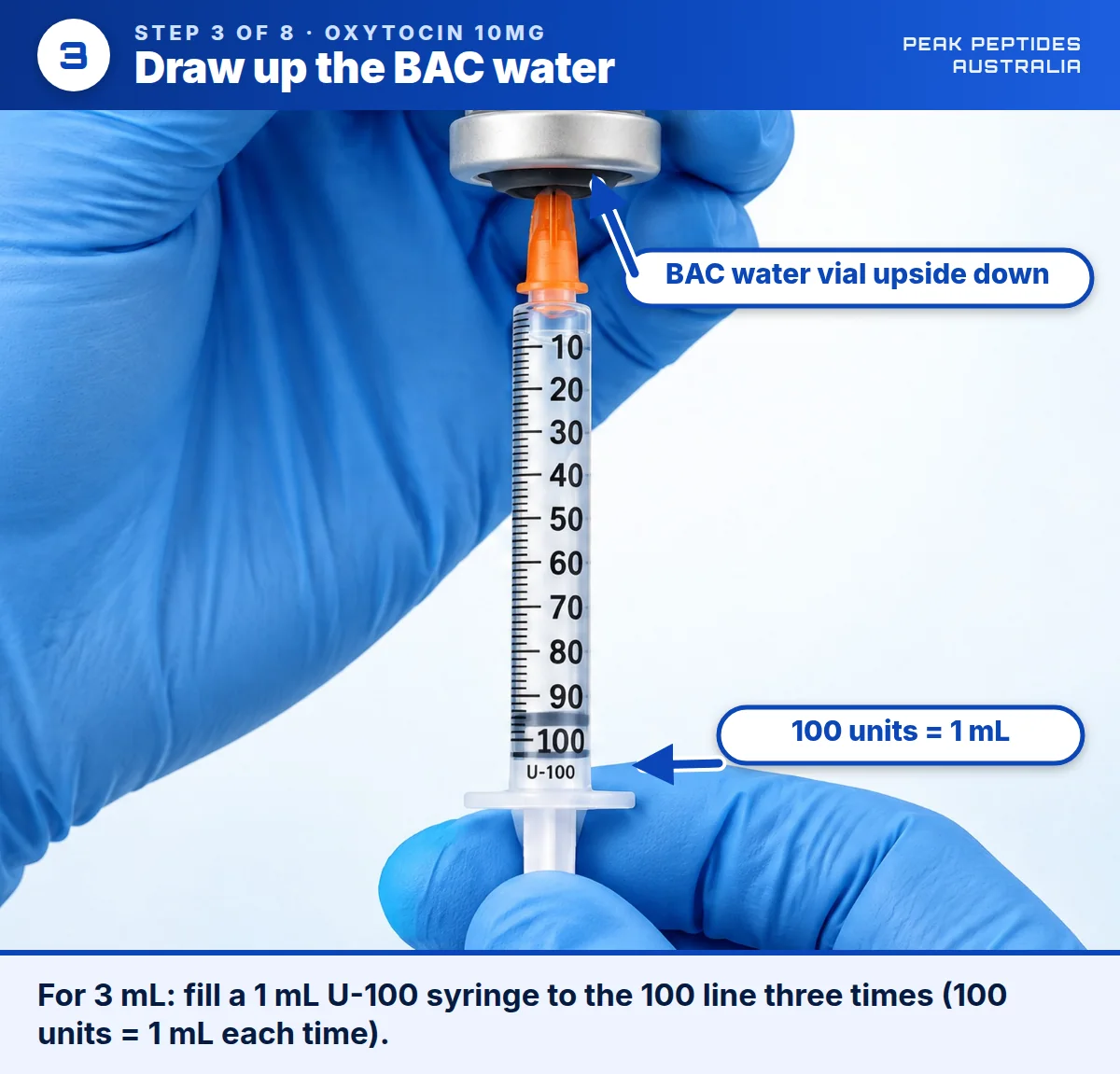
1 mL U-100 syringeA volume-marked syringe: 100 units equals 1 mL. Three full 1 mL draws make the 3 mL reference volume.
Alcohol swabsFor cleaning the rubber stoppers before preparation.
Sharps containerFor safe disposal of used needles.
How much BAC water to add to Oxytocin 10mg
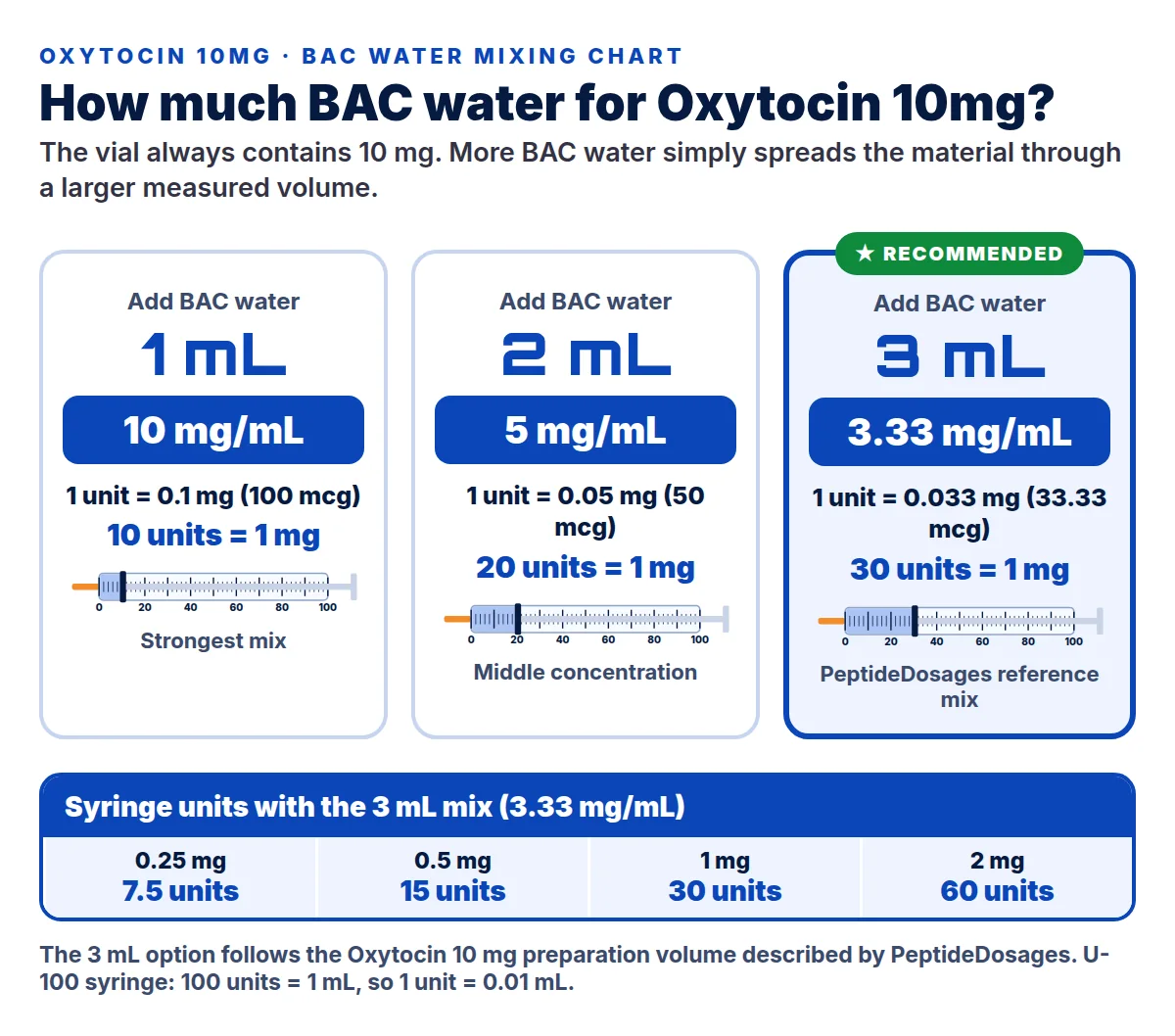
The amount printed on the vial stays 10mg in the chart’s nominal calculation whichever preparation volume is selected. The volume changes the concentration. PeptideDosages describes 3 mL bacteriostatic water for a 10mg oxytocin preparation, yielding about 3.33 mg/mL. That reference is highlighted here.
At the 3 mL reference mix, 1 mL contains 3.33 mg and one U-100 unit, which is 0.01 mL, contains about 0.033 mg or 33 mcg. Ten units hold about 0.33 mg and 30 units correspond to 1 mg. The 1 mL and 2 mL columns show alternative concentration maths based on the same nominal label amount.
Oxytocin 10mg BAC-water chart. The 3 mL column is the recommended mix.
3 mL is highlighted because it gives the simplest numbers.
Syringe units with the 3 mL mix (3.33 mg/mL)
Syringe units with the 3 mL mix (3.33 mg/mL)
Amount
Units on a U-100 syringe
Volume
0.25 mg
7.5 units
0.075 mL
0.5 mg
15 units
0.15 mL
1 mg
30 units
0.3 mL
2 mg
60 units
0.6 mL
The 8 steps
1Step 1: Gather your supplies
Place the Oxytocin 10mg vial, bacteriostatic water, a new 1 mL U-100 syringe, alcohol swabs and a sharps container on a clean work surface. Check the Oxytocin label and vial condition first. For the PeptideDosages reference mix, the total measured BAC-water volume is 3 mL.
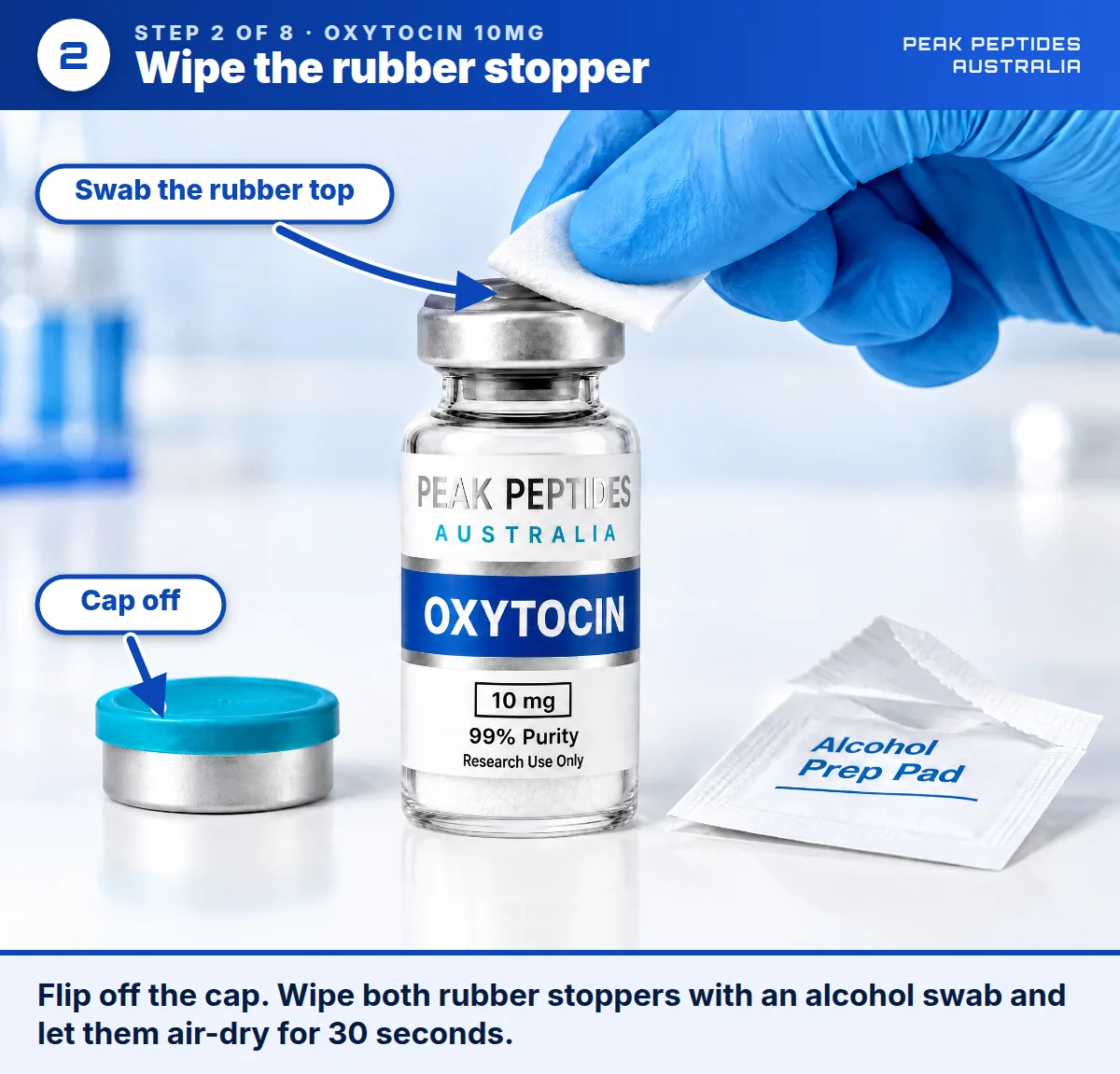
2Step 2: Wipe the rubber stopper
Remove the flip-off caps. Wipe the rubber stopper on the Oxytocin vial and the stopper on the BAC-water vial with fresh alcohol swabs. Let both surfaces air-dry for about 30 seconds. Do not touch a cleaned stopper before the next step.
3Step 3: Draw up the BAC water
Use a new 1 mL U-100 syringe to draw bacteriostatic water. One full 1 mL draw reaches the 100-unit line. The 3 mL reference volume requires three separate 1 mL draws. Remove obvious air bubbles before transferring the measured liquid.
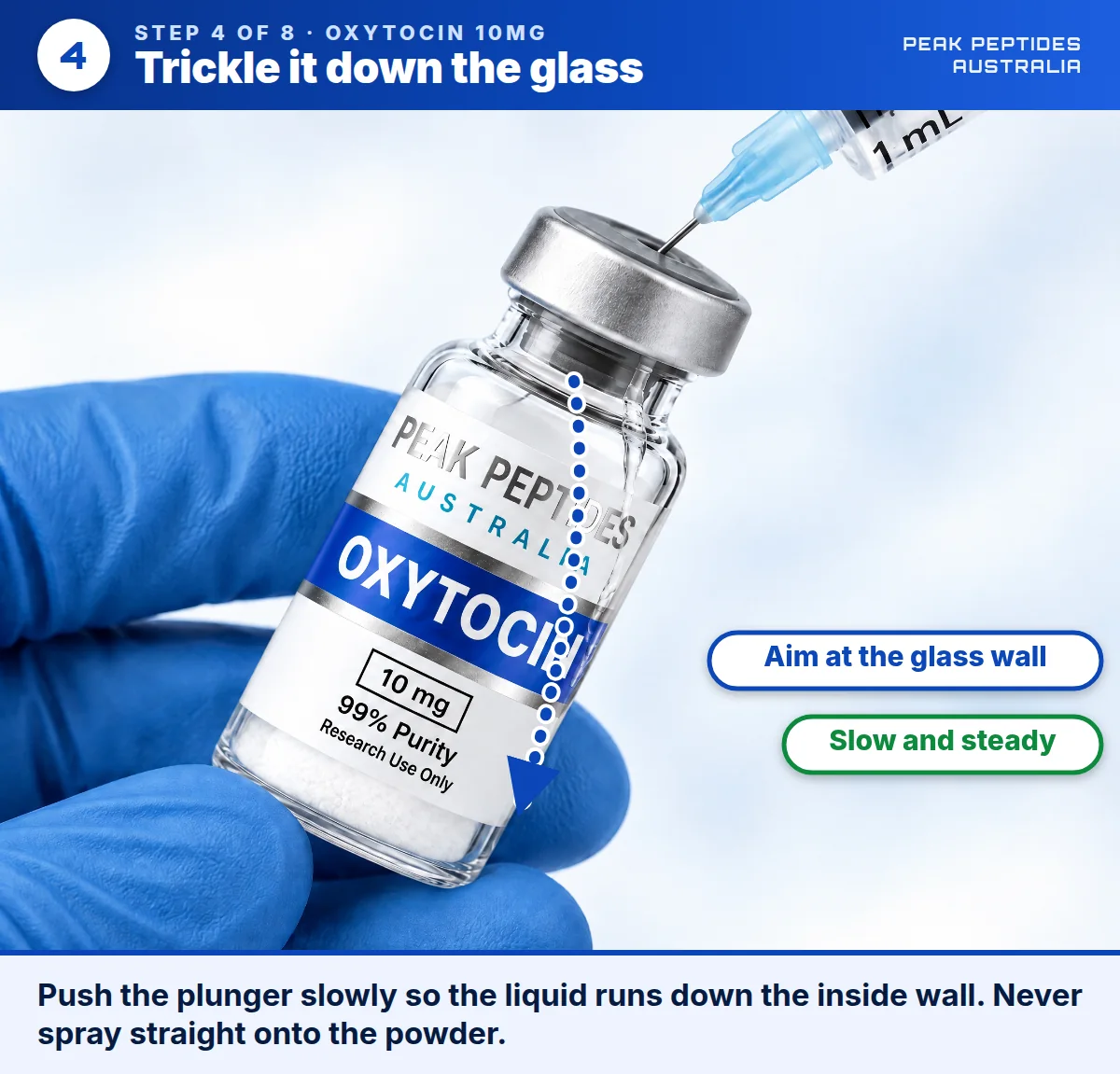
4Step 4: Trickle it down the glass
Angle the Oxytocin vial so the needle tip reaches the inside glass wall. Press the plunger slowly so the liquid runs down the wall rather than striking the powder directly. Repeat the measured transfer until the full 3 mL reference volume has been added.
5Step 5: Swirl or roll gently
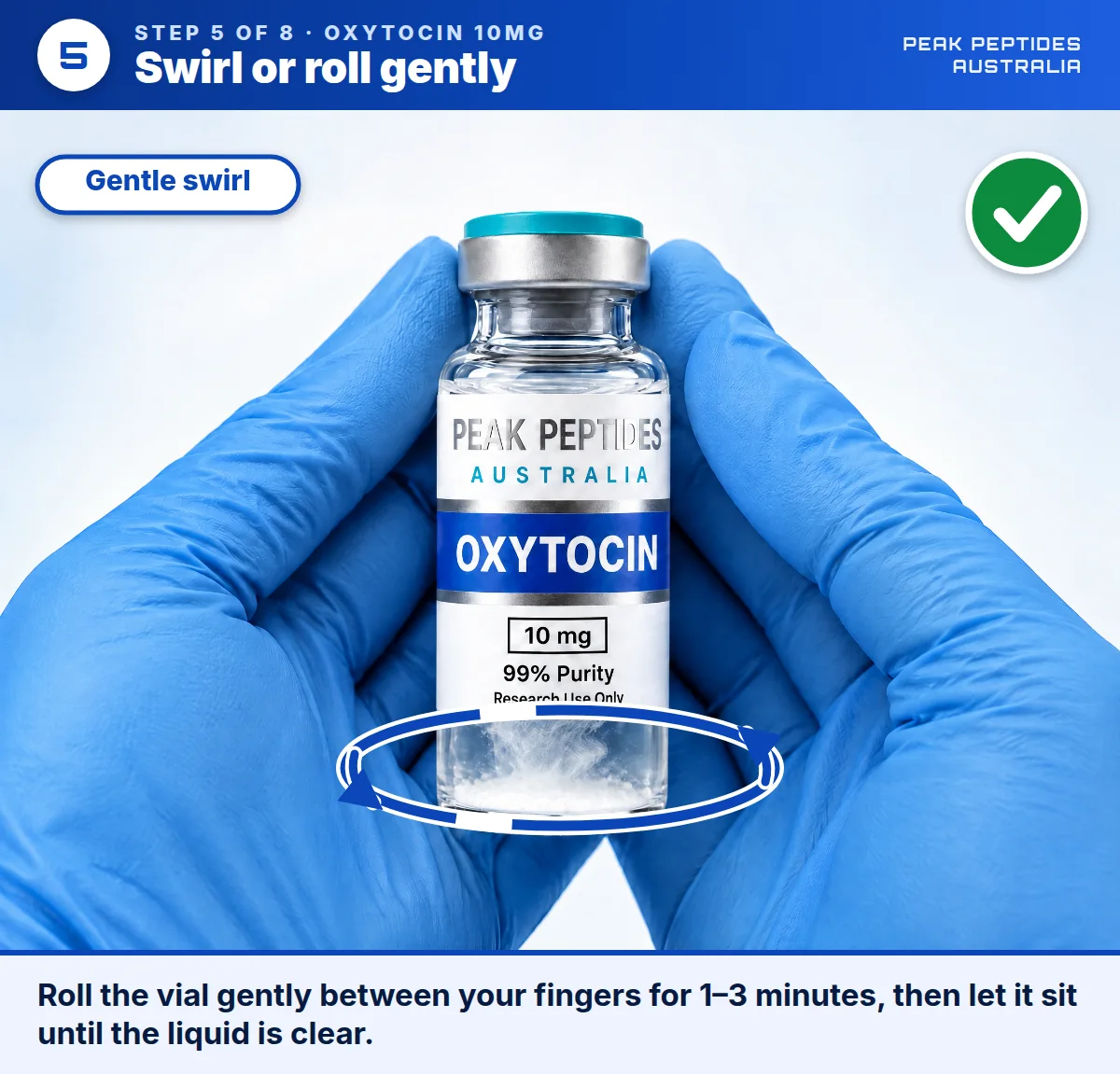
Roll the vial carefully between your fingers or swirl it in slow circles. Give the powder time to meet the liquid and dissolve. Gentle movement avoids unnecessary foam while allowing the solution to become uniform. A little undissolved material can remain initially.
6Step 6: Never shake the vial
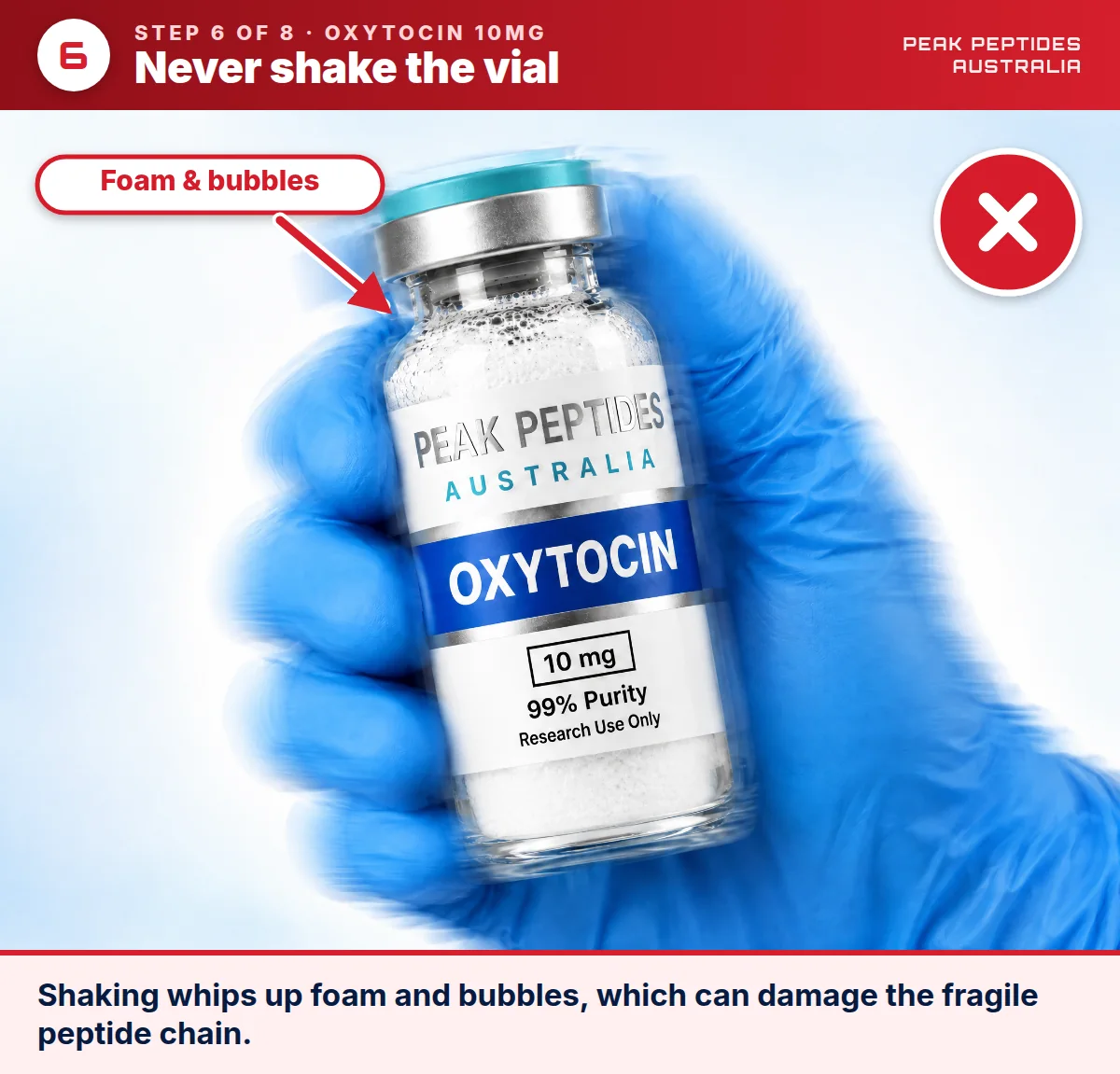
Do not shake the vial. Shaking can whip bubbles and foam into the liquid, making the visual check less clear and creating unnecessary agitation. If foam appears, stand the vial upright and allow the bubbles to settle before checking whether the material is fully dissolved.
7Step 7: Check it is fully dissolved
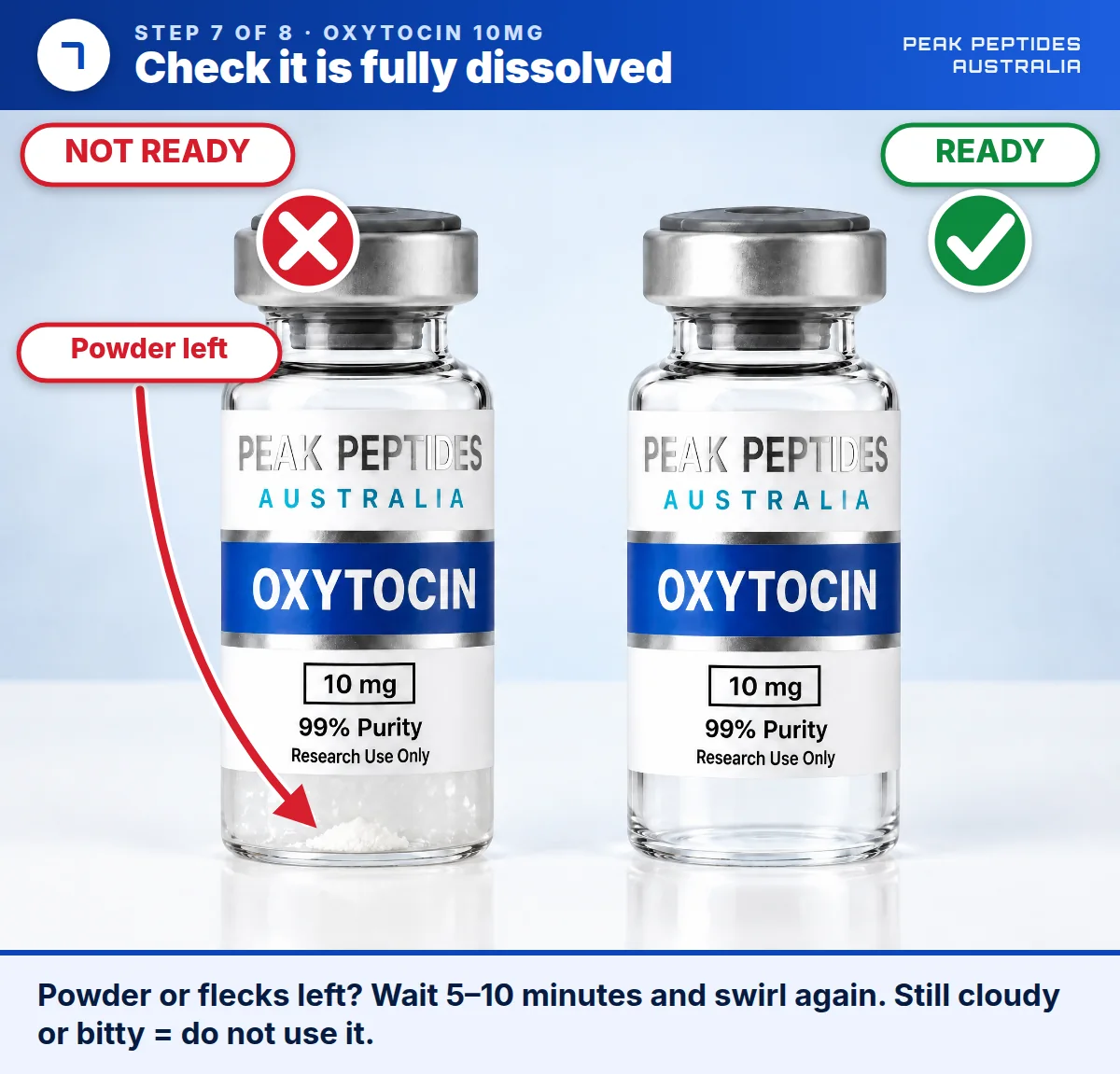
Hold the vial to the light and inspect the solution. The prepared liquid should be clear, with no remaining powder, cloudiness, discolouration or visible particles. If material remains, allow more standing time and swirl gently again. Do not treat a cloudy or particle-containing solution as fully dissolved.
8Step 8: Label it and refrigerate
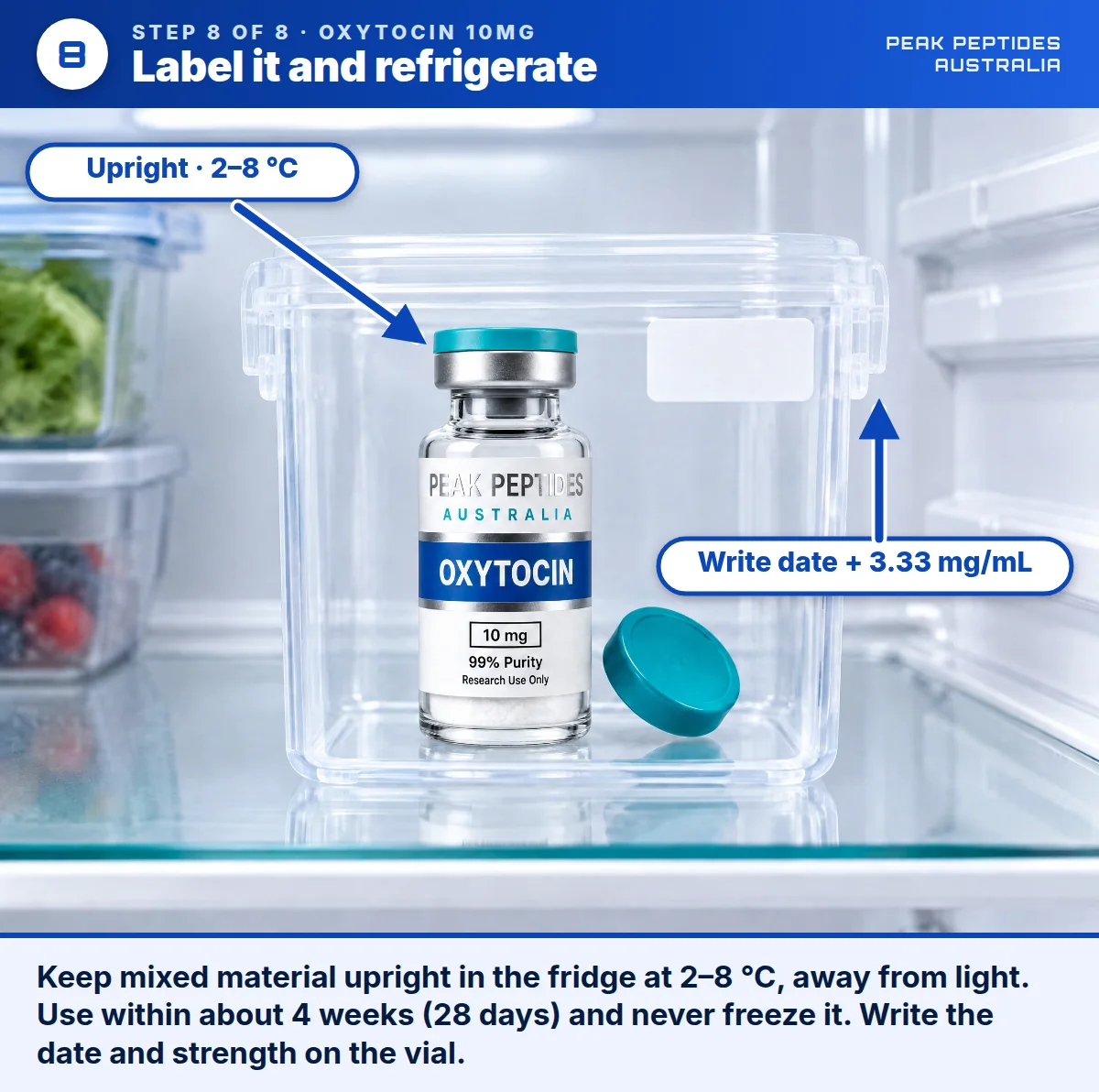
Write the preparation date and nominal concentration on the vial. Once mixed with BAC water, keep it upright in the fridge at 2–8 °C, away from light. Use it within about 4 weeks (28 days) and never freeze it.
Oxytocin 10mg storage at a glance
Storage points from the PeptideDosages Oxytocin 10mg guide
Storage points from the PeptideDosages Oxytocin 10mg guide
Material state
Temperature
Key handling point
Lyophilised powder
2–8 °C or −20 °C
Protect from light and moisture; the exact vial label takes priority
Prepared material
2–8 °C
Protect from light, record preparation date and use within about 4 weeks (28 days)
Visual condition
Inspect before use
Do not use a cloudy, discoloured or particle-containing solution
These storage points come from PeptideDosages. Once mixed with BAC water, keep it upright in the fridge at 2–8 °C, away from light, use it within about 4 weeks (28 days) and never freeze it. Write the date and strength on the vial.
Oxytocin 10mg is a freeze-dried research vial containing the peptide hormone oxytocin, also called OXT. Oxytocin is a nine-amino-acid molecule studied through the oxytocin receptor, OXTR, in receptor-signalling and neuroendocrine research. This Peak Peptides Australia material is supplied for in-vitro research only.
What is oxytocin also called?
Oxytocin is commonly shortened to OXT. Search terms include oxytocin peptide, oxytocin nonapeptide and OXT peptide. Its mature sequence is Cys–Tyr–Ile–Gln–Asn–Cys–Pro–Leu–Gly–NH2, which is another useful scientific search identifier.
Why is oxytocin called a nonapeptide?
Oxytocin is called a nonapeptide because it has nine amino-acid residues. The two cysteine residues are joined by a disulfide bridge between positions 1 and 6. This bridge creates a ring-shaped part of the molecule, while the remaining residues form a short tail.
What is the oxytocin receptor or OXTR?
OXTR is the oxytocin receptor. It sits at the cell surface and belongs to the G-protein-coupled receptor family. When oxytocin binds OXTR, the receptor can activate intracellular signalling pathways. Researchers use OXTR systems to study binding, receptor expression and downstream cell responses.
How does oxytocin work in a cell-signalling assay?
A common model is oxytocin binding OXTR, followed by Gq/11 activation and phospholipase C signalling. Phospholipase C generates IP3, which can release calcium stored inside the cell. The measurable response depends on the cell type, experimental setup and endpoint.
What have oxytocin cell studies found?
In cultured lacrimal-gland myoepithelial cells, oxytocin increased intracellular calcium in a concentration-dependent manner. The study linked the response to phospholipase C and IP3-mediated calcium release. That finding describes this laboratory cell model; it does not turn a research vial into a clinical product.
What is oxytocin used for in research?
Oxytocin research examines OXTR binding, G-protein signalling, calcium mobilisation and neuroendocrine biology. Published work also explores social processing, feeding, stress responses and other neural pathways. Each finding belongs to the exact route, formulation, model and endpoint used in that study.
Is Oxytocin 10mg the same as Syntocinon?
No. Syntocinon is a TGA-registered oxytocin 10 IU/1 mL injection ampoule, ARTG ID 13383. It is a finished regulated medicine. Oxytocin 10mg on this page is a freeze-dried research material, so its presentation, manufacture, controls and intended use are different.
Is oxytocin an approved medicine in Australia?
Yes, oxytocin exists as an approved medicine in Australia. The TGA ARTG lists SYNTOCINON oxytocin 10 IU/1 mL injection ampoule as a registered medicine. This Oxytocin 10mg research vial is not that registered finished medicine and is supplied for in-vitro research only.
Is this Oxytocin 10mg vial TGA approved?
No. This listing is a research material, not a TGA-registered finished medicine. The TGA registration cited on this page applies to Syntocinon oxytocin 10 IU/1 mL injection ampoule, not to this freeze-dried 10mg research vial.
How is Oxytocin 10mg different from PT-141?
Oxytocin is a nine-residue OXTR ligand with a Cys1–Cys6 disulfide ring. PT-141, or bremelanotide, is a synthetic cyclic heptapeptide and a melanocortin-receptor agonist. They have different molecular structures, receptor targets and research questions.
What does the 10mg label mean?
The 10mg label is the nominal total material quantity stated on the vial. It is not a liquid concentration. Concentration depends on the final measured preparation volume. LabDoc report LD-AKXA separately measured 9.5mg content for the tested vial, equal to 95% of its 10mg label claim.
How do I know this Oxytocin sample is real?
Use an independent report that identifies the tested material and records methods and results. Oxytocin 10mg is backed by LabDoc report LD-AKXA. It records identity confirmed by LC-MS, 99.68% purity by HPLC and 9.5mg content by HPLC for the tested Peak Peptides Australia sample.
How is the Oxytocin 10mg sample verified?
LabDoc report LD-AKXA lists the sample as lyophilised oxytocin powder in a vial with a 10mg label claim. It records sample received 09 September 2026, test date 19 October 2026, 9.5mg HPLC content, 99.68% HPLC purity, LC-MS identity confirmed and an overall Pass.
What does the Oxytocin LabDoc report show?
The report separates three checks. LC-MS identity testing confirms the tested peptide identity. HPLC purity measures the proportion reported as oxytocin, 99.68%. HPLC content measures material in the tested vial, 9.5mg or 95% of the 10mg label claim.
Can I buy Oxytocin 10mg online in Australia?
Oxytocin 10mg can be ordered online from Peak Peptides Australia when available. Same-day dispatch from Victoria applies for in-stock orders once payment is confirmed, using tracked Australia Post Express. The tracking number is emailed. This material is supplied for in-vitro research only.
How fast is Oxytocin shipping in Australia?
Same-day dispatch from Victoria applies for in-stock orders once payment is confirmed. Orders travel by tracked Australia Post Express and the tracking number is emailed. Carrier delivery time depends on the destination and carrier network after dispatch.
How much BAC water for Oxytocin 10mg?
PeptideDosages describes 3 mL bacteriostatic water for a 10mg oxytocin preparation, giving 3.33 mg/mL from the nominal 10mg label amount. The chart also shows 1 mL and 2 mL options as measurement maths. More water changes concentration, not the amount printed on the vial.
How many units is 1 mg of Oxytocin with 3 mL BAC water?
Using the nominal 10mg label amount with 3 mL BAC water gives 3.33 mg/mL. One milligram corresponds to 30 units on a U-100 syringe, or 0.30 mL.
How many mg are in 10 units of Oxytocin with 3 mL BAC water?
With a nominal 10mg amount prepared to 3 mL, the concentration is 3.33 mg/mL. Ten U-100 units are 0.10 mL, so they hold about 0.33 mg, or 333 mcg. This is preparation arithmetic based on the label claim.
How do I reconstitute Oxytocin 10mg?
Wipe the vial stopper and BAC-water stopper with alcohol swabs, then let them air-dry. Draw the measured BAC water, let it run slowly down the inside wall of the vial and swirl gently until clear. The eight-step photo guide shows the process and measurement setup.
Can I use sterile or tap water instead of BAC water?
Do not use tap water. PeptideDosages describes bacteriostatic water for the 10mg preparation. Once mixed, keep it upright in the fridge at 2–8 °C, away from light, use within about 4 weeks (28 days) and never freeze it.
What if the Oxytocin powder does not dissolve?
Allow time for the powder to contact the liquid, then swirl or roll the vial gently. Do not shake it, because shaking creates foam. If the liquid remains cloudy or has visible particles after gentle mixing and standing, do not treat it as fully dissolved.
Should reconstituted Oxytocin be cloudy?
No. PeptideDosages states that the prepared solution should not be used if it is cloudy, discoloured or contains visible particles. Check its appearance, write the date and strength on the vial, and keep it upright at 2–8 °C, away from light. Use within about 4 weeks (28 days); never freeze it.
How long does reconstituted Oxytocin last?
PeptideDosages says prepared oxytocin should be refrigerated at 2–8 °C and protected from light. Once mixed with BAC water, keep it upright, use it within about 4 weeks (28 days) and never freeze it. Write the date and strength on the vial.
How should I store Oxytocin powder before mixing?
PeptideDosages states that lyophilised oxytocin can be refrigerated at 2–8 °C or frozen at −20 °C, while the exact product label takes priority. Keep the vial protected from light and moisture. Avoid repeated freeze–thaw handling once material has been prepared.
Can prepared Oxytocin be frozen?
PeptideDosages advises avoiding repeated freeze–thaw cycles for prepared material. Once mixed with BAC water, keep it upright in the fridge at 2–8 °C, away from light, use it within about 4 weeks (28 days) and never freeze it. Write the date and strength on the vial.
What is a COA for Oxytocin?
A certificate of analysis records test information for a sample. Useful entries include the identity method, purity method, content result, test date, label claim and report identifier. For this sample, LabDoc LD-AKXA records LC-MS identity, HPLC purity and HPLC content, with a Pass assessment.