Research Use Only. For laboratory research use only. Not for human or animal consumption.
Delta Sleep-Inducing Peptide
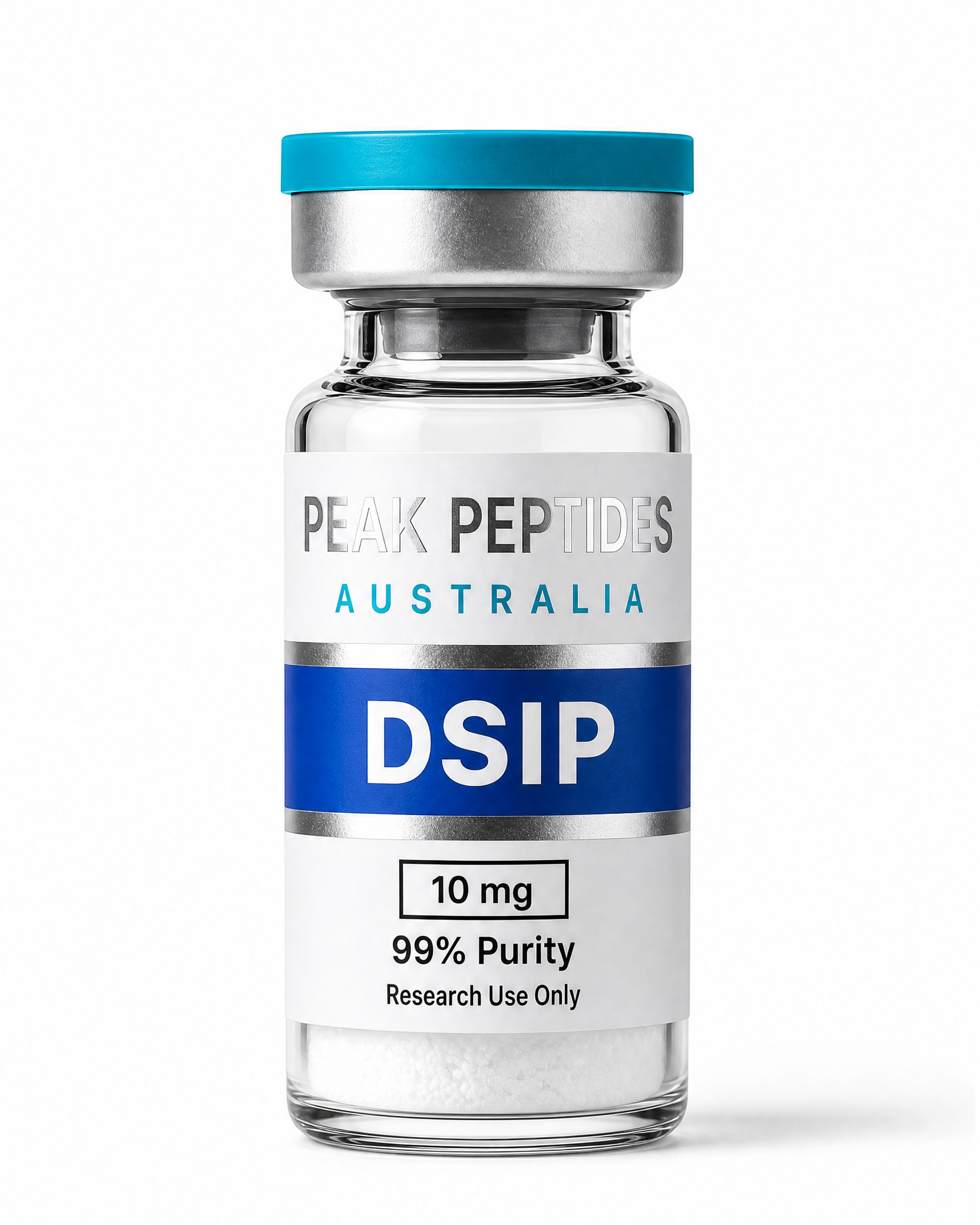
DSIP 10mg is a lyophilised delta sleep-inducing peptide research vial containing a defined nine-amino-acid sequence. This supplied sample is backed by LabDoc report LD-H89L, which confirms identity by LC-MS, records 99.45% HPLC purity and measures 9.22mg content. The page includes a photo reconstitution guide, BAC water concentration chart and clear research context. In-stock orders receive same-day dispatch from Victoria after payment confirmation, with tracked Australia Post Express shipping Australia-wide.
Product Specifications
Full NameDelta Sleep-Inducing Peptide
Vial Size10mg
Purity99.45% HPLC (LD-H89L, 9.22mg sample)
Legal Disclaimer
This product is sold strictly for in-vitro laboratory research purposes only. It is not intended for human or animal consumption, injection, or any diagnostic or therapeutic use.
Nonapeptide · historical sleep-physiology research · LabDoc verified
DSIP 10mg — What It Is, Historical Research & How to Reconstitute It
DSIP is delta sleep-inducing peptide, a defined chain of nine amino acids with the sequence Trp-Ala-Gly-Gly-Asp-Ala-Ser-Gly-Glu. It is also called emideltide. The name comes from early sleep-physiology research, including a rabbit experiment that reported increased delta EEG activity after a direct brain infusion. Later small human studies reported mixed sleep measurements, rather than one settled clinical outcome. This DSIP 10mg vial is lyophilised powder supplied for in-vitro research only. LabDoc report LD-H89L records LC-MS identity confirmed, 99.45% HPLC purity and 9.22mg HPLC content for the submitted sample. This guide explains the molecule, what the historical research actually found, how DSIP differs from Epithalon and Selank, and how to make a 3 mL BAC water concentration for laboratory measurement using the photo guide.
Also referred to in research or catalogue references as Delta sleep-inducing peptide, DSIP peptide, DSIP, DSIP 10mg, DSIP 10 mg, Delta sleep inducing peptide, Delta sleep-inducing peptide 10mg, Emideltide, DSIP nonapeptide, WAGGDASGE, 62568-57-4.
DSIP 10mg at a glance
Full name
Delta sleep-inducing peptide
Also called
DSIP, emideltide, DSIP nonapeptide
What it is
A defined nine-amino-acid research peptide with historical sleep-physiology research
Sequence
Trp-Ala-Gly-Gly-Asp-Ala-Ser-Gly-Glu (WAGGDASGE)
Formula and size
C35H48N10O15 · 848.8 g/mol · 9 amino acids
Chemical identifiers
CAS 62568-57-4 · PubChem CID 68816
Research picture
Older studies reported mixed sleep measurements; DSIP has no confirmed receptor pathway
3 mL BAC water = about 3.33 mg/mL nominal concentration
After mixing
Refrigerate at 2–8 °C, protect from light and avoid repeated freeze–thaw cycles
Dispatch
Same-day from Victoria for in-stock orders after payment confirmation, tracked Australia Post Express
A defined 9-amino-acid nonapeptide
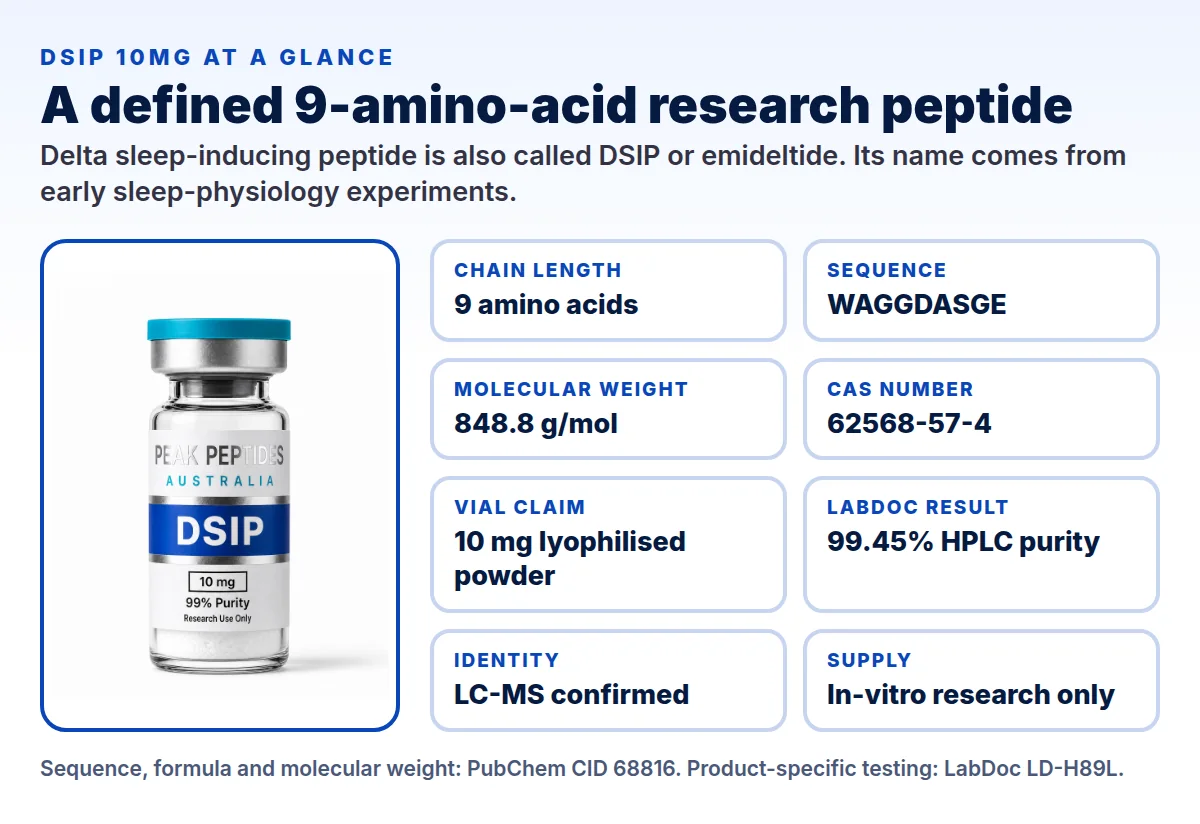
DSIP means delta sleep-inducing peptide. It is a nonapeptide: a chain of nine amino acids in a fixed order, Trp-Ala-Gly-Gly-Asp-Ala-Ser-Gly-Glu, also written WAGGDASGE. PubChem lists DSIP under the synonym emideltide, with formula C35H48N10O15, molecular weight 848.8 g/mol and CAS number 62568-57-4.
Why the name refers to sleep research
The 1978 sequence paper isolated DSIP from rabbit cerebral venous-blood dialysate after experimental thalamic stimulation. In a double-blind rabbit experiment, synthetic DSIP increased mean delta EEG activity by 35% in the neocortex and limbic cortex against controls. That historical result explains the name; it is not a clinical sleep claim for this vial.
Historical human studies gave mixed results
Small intravenous studies measured sleep latency, time asleep, sleep efficiency, sleep stages and subjective sleep quality. A 1981 six-volunteer crossover study reported more sleep during a 130-minute observation window. A 1987 controlled insomnia study judged the observed improvement of little clinical significance. In a 1992 double-blind study of 16 people with chronic insomnia, objective sleep efficiency and latency improved, while subjective sleep quality did not.
No confirmed receptor pathway
DSIP is not a receptor-defined peptide like many modern research compounds. A 2006 review reported that a DSIP gene, precursor protein and possible related receptor had not been isolated, and described the natural occurrence and biological activity of DSIP as obscure. That is why the guide separates reported study observations from strong mechanism claims.
What the 10mg label means
10mg is the nominal total quantity on one lyophilised-powder vial. It is not a concentration. Concentration appears only after a known liquid volume is added. In the 3 mL BAC water example used by the PeptideDosages DSIP 10mg research reference, the nominal concentration is 3.33 mg/mL, so 1 U-100 syringe unit represents about 0.033 mg (33 mcg).
Independent sample result: LabDoc LD-H89L
LabDoc report LD-H89L records a DSIP sample received on 9 September 2026 and tested on 28 September 2026. It records identity confirmed by LC-MS, 99.45% purity by HPLC, 9.22mg HPLC content against the 10mg label claim, 92.2% of claim, 0.55% related impurities and an overall Pass assessment. The report lists no batch.
Identity, purity and content answer different questions
LC-MS checks the molecular identity by mass. HPLC purity measures the proportion of tested material attributed to DSIP, while HPLC content estimates how much DSIP was measured in the submitted vial. These results apply to the sample recorded in LD-H89L.
Regulatory status in Australia and the United States
DSIP is not an FDA-approved medicine, and no DSIP or emideltide medicine appeared in the Australian Register of Therapeutic Goods result reviewed for this guide. FDA’s 2026 emideltide briefing states that emideltide free base and acetate are not components of an FDA-approved drug. This material is supplied for in-vitro research only.
DSIP is delta sleep-inducing peptide, a synthetic form of a nine-amino-acid sequence first characterised in the 1970s. Its one-letter sequence is WAGGDASGE; its full sequence is Trp-Ala-Gly-Gly-Asp-Ala-Ser-Gly-Glu. A peptide sequence is the order of amino-acid building blocks, so the order is part of the molecule’s identity. DSIP is also called emideltide, as listed in PubChem and FDA material.
DSIP is a small molecule by peptide standards. PubChem records a molecular formula of C35H48N10O15 and molecular weight of 848.8 g/mol. It is not a blend, not an abbreviation for a category of products, and not another name for Epithalon or Selank. Those are separate short peptides with different sequences.
The name can give the wrong first impression. Delta sleep-inducing peptide describes the history of the research finding, rather than a settled therapeutic effect. This product page therefore says what DSIP is, reports what each historical study measured, and keeps the research material separate from an approved sleep medicine. DSIP 10mg is supplied for in-vitro research only.
DSIP 10mg in one view: a defined nine-amino-acid chain, a nominal 10mg vial and sample-specific LabDoc results.
How did DSIP become a sleep-research peptide?
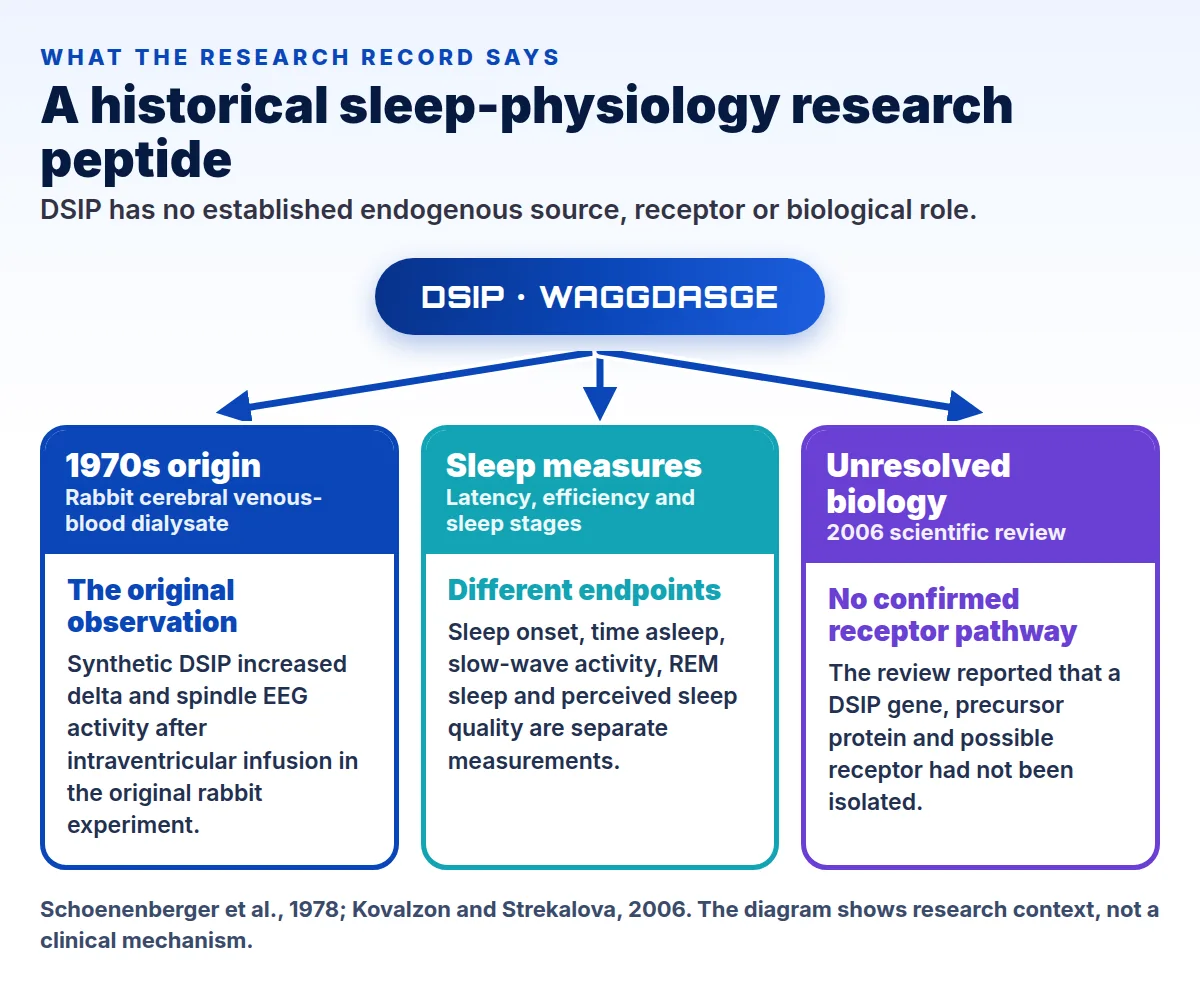
DSIP became associated with sleep after a 1978 paper reported a peptide isolated from rabbit cerebral venous-blood dialysate following experimental stimulation of a thalamic area. The researchers determined the nine-amino-acid sequence, synthesised the peptide and tested it under double-blind conditions. In that experiment, synthetic DSIP raised mean delta EEG activity by 35% in two measured brain regions compared with controls.
An EEG records electrical activity in the brain. Delta activity is one type of slow brain-wave signal. A change in delta EEG activity is a specific experimental measurement. It is not the same thing as proving better sleep quality, improved daytime function or a treatment effect. This distinction becomes important when reading later DSIP studies because each measured a different part of sleep.
The biological pathway is not confirmed. A 2006 review stated that a DSIP gene, precursor protein and possible related receptor had not been isolated. It also described the natural occurrence and biological activity of DSIP as obscure. This is why claims that DSIP works through a named receptor are not used on this page.
DSIP’s sleep association comes from historical physiology research.
What did DSIP research find?
The human literature is historical, small and varied. That matters because sleep is not one measurement. Sleep latency is time taken to fall asleep. Sleep efficiency is the share of time in bed spent asleep. Total sleep time, slow-wave sleep, REM sleep, awakenings, perceived restfulness and daytime performance are also separate outcomes. A finding on one cannot stand in for all the others.
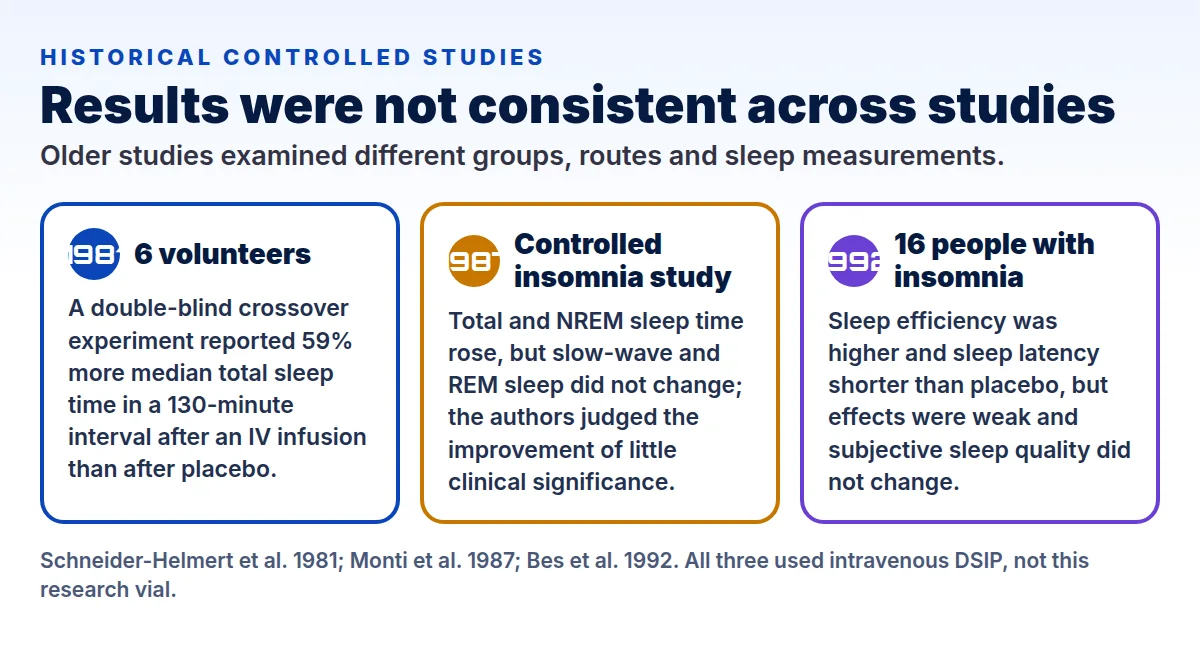
In 1981, a double-blind crossover experiment in six volunteers reported 59% more median total sleep time within a 130-minute observation interval after intravenous DSIP than after placebo. The same report described shorter sleep onset and better sleep efficiency on the following night. It is an early, tightly controlled signal from a very small group, not a finding that establishes an outcome for a different preparation or route.
The later controlled reports are important context. In a 1987 double-blind crossover study of people with chronic insomnia, total and non-REM sleep time increased, but slow-wave sleep and REM sleep did not change. The authors concluded that the observed sleep improvement had little clinical significance. A 1992 double-blind study of 16 people found higher objective sleep efficiency and shorter sleep latency with DSIP than placebo, yet stated that the effects were weak and subjective sleep quality did not change. The authors concluded that short-term treatment was not likely to offer major therapeutic benefit.
An open 1984 study in seven people described improved sleep during follow-up. Because it had no placebo comparison, it does not answer the same question as a double-blind controlled study. Taken together, the historical record is useful for sleep-physiology research, while it does not support turning the DSIP name into a simple sleep claim.
Three historical controlled-study snapshots show why sleep measurements must be read separately rather than compressed into one claim.
Selected historical DSIP studies and what each reported
Selected historical DSIP studies and what each reported
Observed sleep during 130 minutes and subsequent-night measures
59% more median total sleep time than placebo in the observation window; report also described shorter sleep onset and better efficiency later that night
Monti et al., 1987
Double-blind crossover; people with chronic insomnia; intravenous DSIP
Polysomnographic sleep stages and waking measures
Total and non-REM sleep time increased, but slow-wave and REM sleep were unchanged; authors judged the improvement of little clinical significance
Bes et al., 1992
Double-blind matched-pairs study; 16 people with chronic insomnia; intravenous DSIP
Objective and subjective sleep quality plus tiredness
Higher sleep efficiency and shorter latency than placebo, with weak effects; subjective sleep quality did not change
Study routes and materials are identified to explain the published work.
DSIP vs Epithalon vs Selank
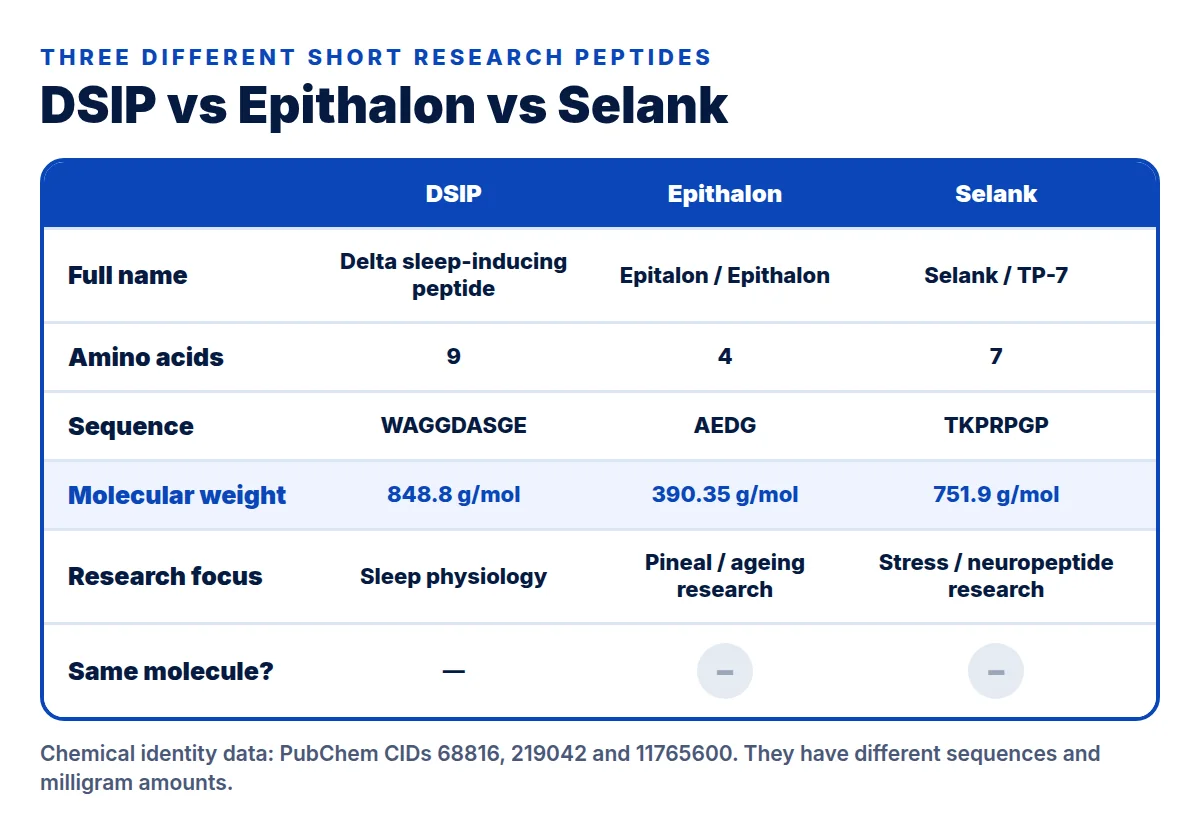
DSIP, Epithalon and Selank are sometimes grouped together because all are short peptides used in research discussions. They are different compounds. The clearest difference is structural: DSIP has nine amino acids, Epithalon has four and Selank has seven. A different sequence means a different molecule, with a different molecular weight and a different analytical identity.
DSIP is the historical sleep-physiology peptide WAGGDASGE. Epithalon, also written Epitalon, is the tetrapeptide AEDG. Selank, also called TP-7, is the heptapeptide TKPRPGP and is described in a 2003 comparative paper as part of the tuftsin family. Neither name is a substitute for a sequence or a test result.
The research areas also differ. DSIP literature centres on sleep measurements and neuroendocrine questions. Epithalon is often discussed in pineal and ageing research. Selank literature includes stress and neuropeptide research. Milligram amounts do not convert from one peptide to another, and a LabDoc identity result for DSIP does not verify a different peptide.
DSIP, Epithalon and Selank are distinct short peptides with different sequences, sizes and research contexts.
Structural comparison: DSIP, Epithalon and Selank
Structural comparison: DSIP, Epithalon and Selank
DSIP
Epithalon
Selank
Amino-acid chain
9 amino acids
4 amino acids
7 amino acids
Sequence
WAGGDASGE
AEDG
TKPRPGP
Molecular weight
848.8 g/mol
390.35 g/mol
751.9 g/mol
Research context
Sleep physiology and neuroendocrine research
Pineal and ageing research
Stress and tuftsin-family neuropeptide research
Same molecule as DSIP?
—
No
No
Sequences and molecular weights identify molecules.
DSIP sequence and structure
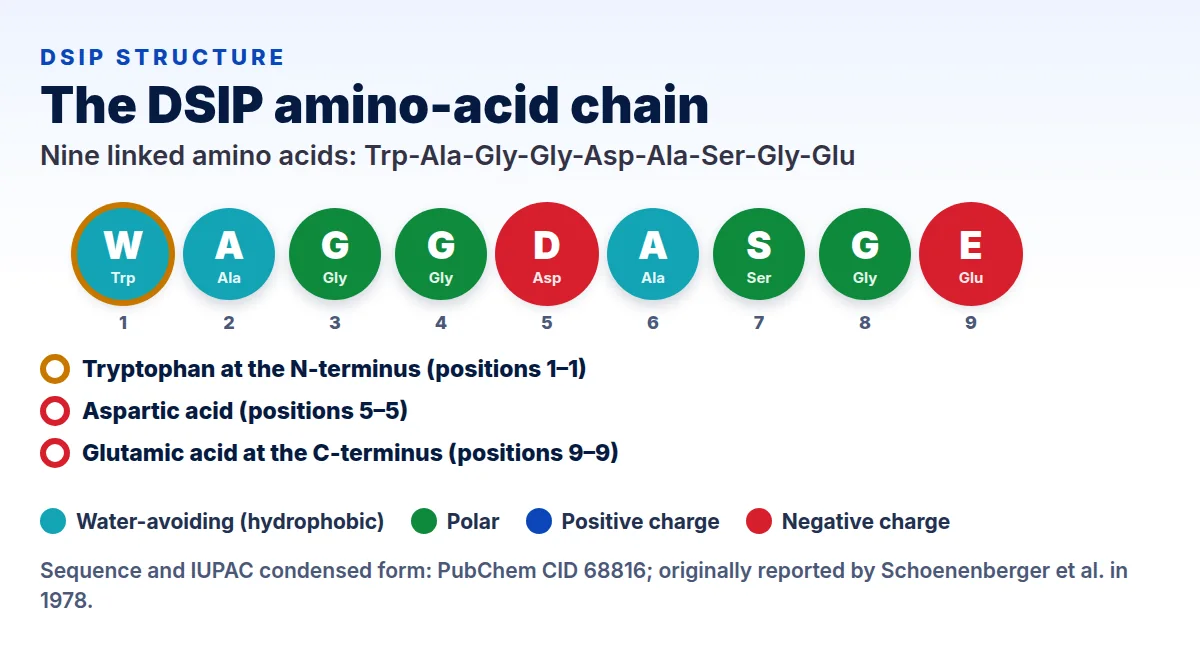
DSIP’s identity starts with its sequence. Reading from the N-terminus to the C-terminus, it is Trp-Ala-Gly-Gly-Asp-Ala-Ser-Gly-Glu. In one-letter notation that becomes WAGGDASGE. The first position is tryptophan, positions three, four and eight are glycine, and the chain ends in glutamic acid.
This detail matters because closely related-looking peptides can have different activity or analytical behaviour. The original 1978 paper noted that the pure alpha-aspartyl DSIP peptide was active in its rabbit experiment, while the beta-Asp isomer was not. An isomer contains the same broad components arranged differently; the study is a useful illustration of why full molecular identity is more informative than a broad product label.
For this DSIP 10mg sample, LabDoc LD-H89L records identity confirmed by LC-MS. LC-MS compares the material against its expected molecular mass. It is a strong identity check for the submitted sample, while it does not measure every handling or biological property of the vial.
DSIP is one defined nine-amino-acid chain: WAGGDASGE. Sequence order is part of molecular identity.
Independent LabDoc test for this DSIP 10mg sample
DSIP 10mg is backed by LabDoc report LD-H89L. The report records a submitted DSIP lyophilised-powder sample received on 9 September 2026 and tested on 28 September 2026. It lists the batch as not stated. LC-MS identity was confirmed, HPLC purity was 99.45%, and HPLC content was 9.22mg against the 10mg label claim. The report’s overall assessment is Pass.
These terms answer different questions. Identity by LC-MS asks whether the tested material matches DSIP by mass. Purity by HPLC measures the proportion attributed to DSIP in the tested material; LD-H89L records 0.55% related impurities alongside 99.45% purity. Content measures the amount found in the submitted vial; LD-H89L records 9.22mg, or 92.2% of the nominal 10mg claim.
The report is a sample-specific analytical record. You can verify the report ID directly at labdoc.org before evaluating the page’s product-specific claims.
Identity: LC-MS confirmed DSIP for the submitted sample.
Purity: 99.45% by HPLC, with 0.55% related impurities recorded.
Content: 9.22mg by HPLC against the nominal 10mg label claim, or 92.2% of claim.
Date tested: 28 September 2026; sample received: 9 September 2026; batch: not stated.
Assessment: Pass.
Buying DSIP 10mg in Australia
DSIP 10mg can be ordered online from Peak Peptides Australia when it is available. In-stock orders receive same-day dispatch from Victoria once payment is confirmed, sent by tracked Australia Post Express, with a tracking number emailed. This page sets out what DSIP is, what the product-specific LabDoc record contains and how the chart’s laboratory measurement maths works.
The vial is supplied for in-vitro research only. The TGA’s Australian Register of Therapeutic Goods is the official register for therapeutic goods that can be supplied within Australia; no DSIP or emideltide medicine appeared in the ARTG search reviewed for this guide. FDA’s 2026 emideltide briefing similarly states that the free base and acetate forms are not components of an FDA-approved drug.
For a transparent product check, open LabDoc report LD-H89L and compare the report ID, identity method, purity and measured content with the facts quoted above. For measurement work, add bacteriostatic water separately if required and use the photo reconstitution guide and calculator to keep the volume arithmetic clear.
Step-by-step guide · About 10 minutes
How to reconstitute DSIP 10mg (step-by-step with photos)
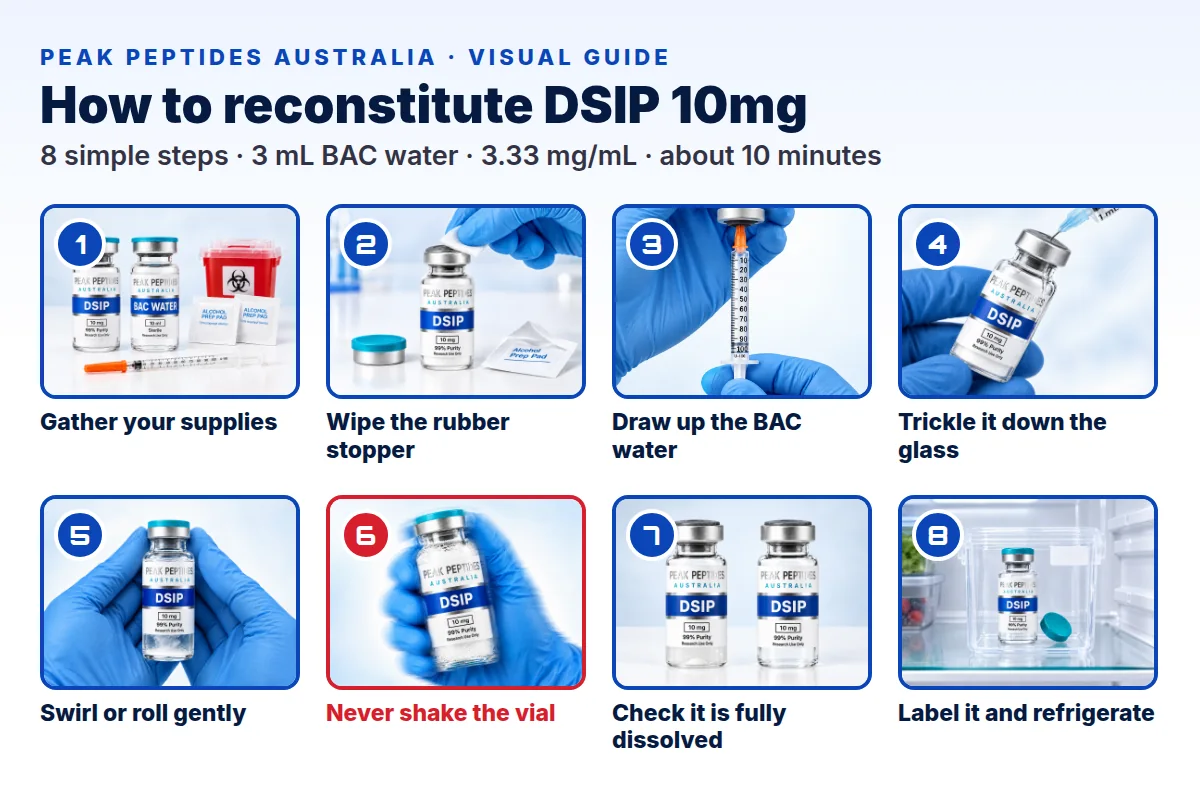
DSIP 10mg arrives as dry, lyophilised powder. Reconstitution means adding BAC water so the powder becomes a clear solution that can be measured by volume in a laboratory setting. The DSIP 10mg PeptideDosages research reference uses a 3 mL final volume, which gives a nominal concentration of about 3.33 mg/mL. The 8-step visual sequence below shows that concentration example. It takes about 10 minutes and uses gentle handling throughout.
The DSIP 10mg visual reconstitution sequence: eight clear steps from supplies to refrigerated storage.
What you need
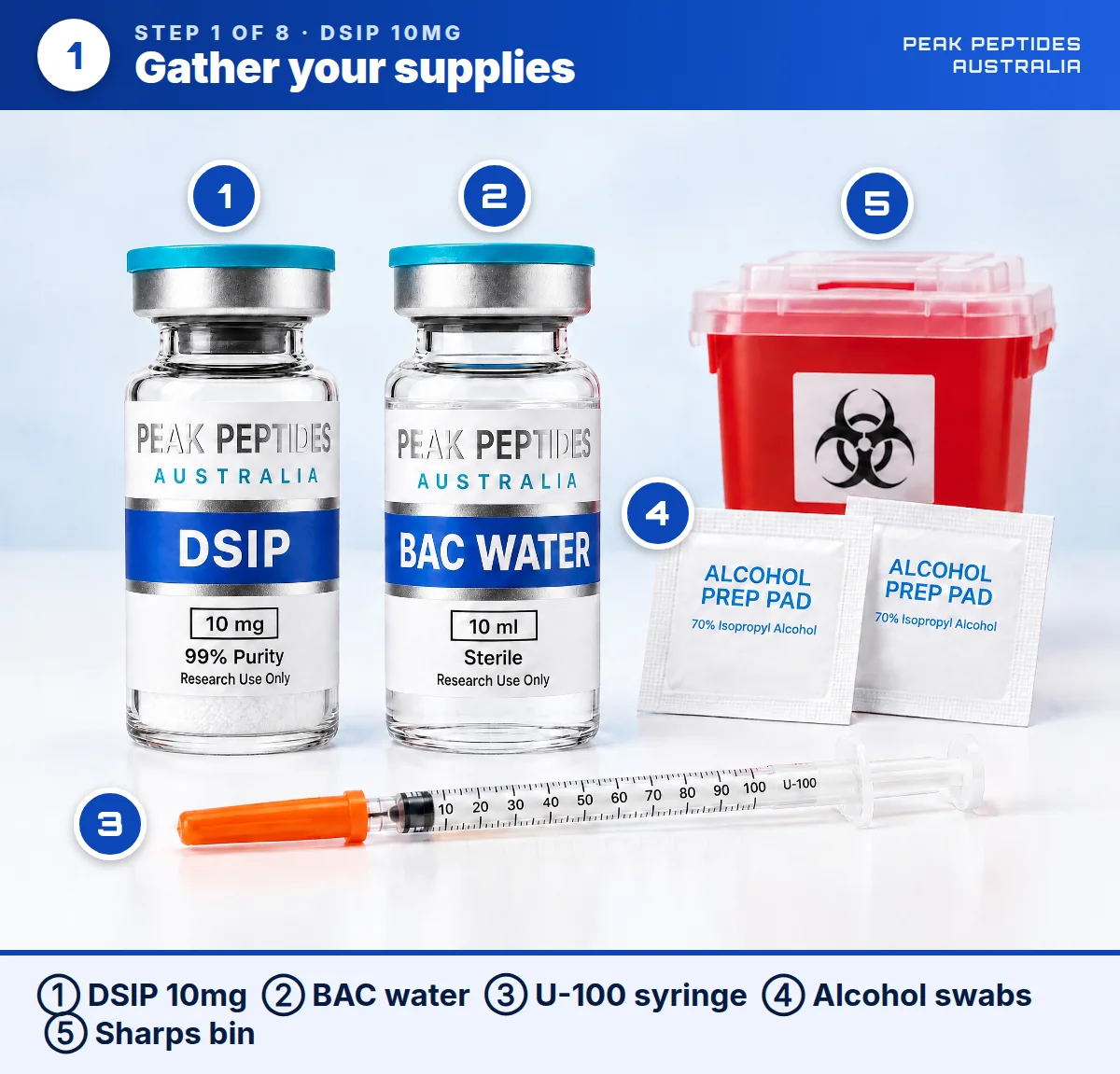
DSIP 10mg vialNominal 10mg lyophilised DSIP powder in a sealed glass vial.
Bacteriostatic waterThe PeptideDosages DSIP 10mg reference uses BAC water for its 3 mL concentration example.
1 mL U-100 syringeA U-100 syringe measures volume: 100 units equals 1 mL and 1 unit equals 0.01 mL.
Alcohol swabsUse fresh swabs to clean the rubber stoppers before handling.
Sharps containerUse a suitable container for used needles and related sharps.
How much BAC water to add to DSIP 10mg
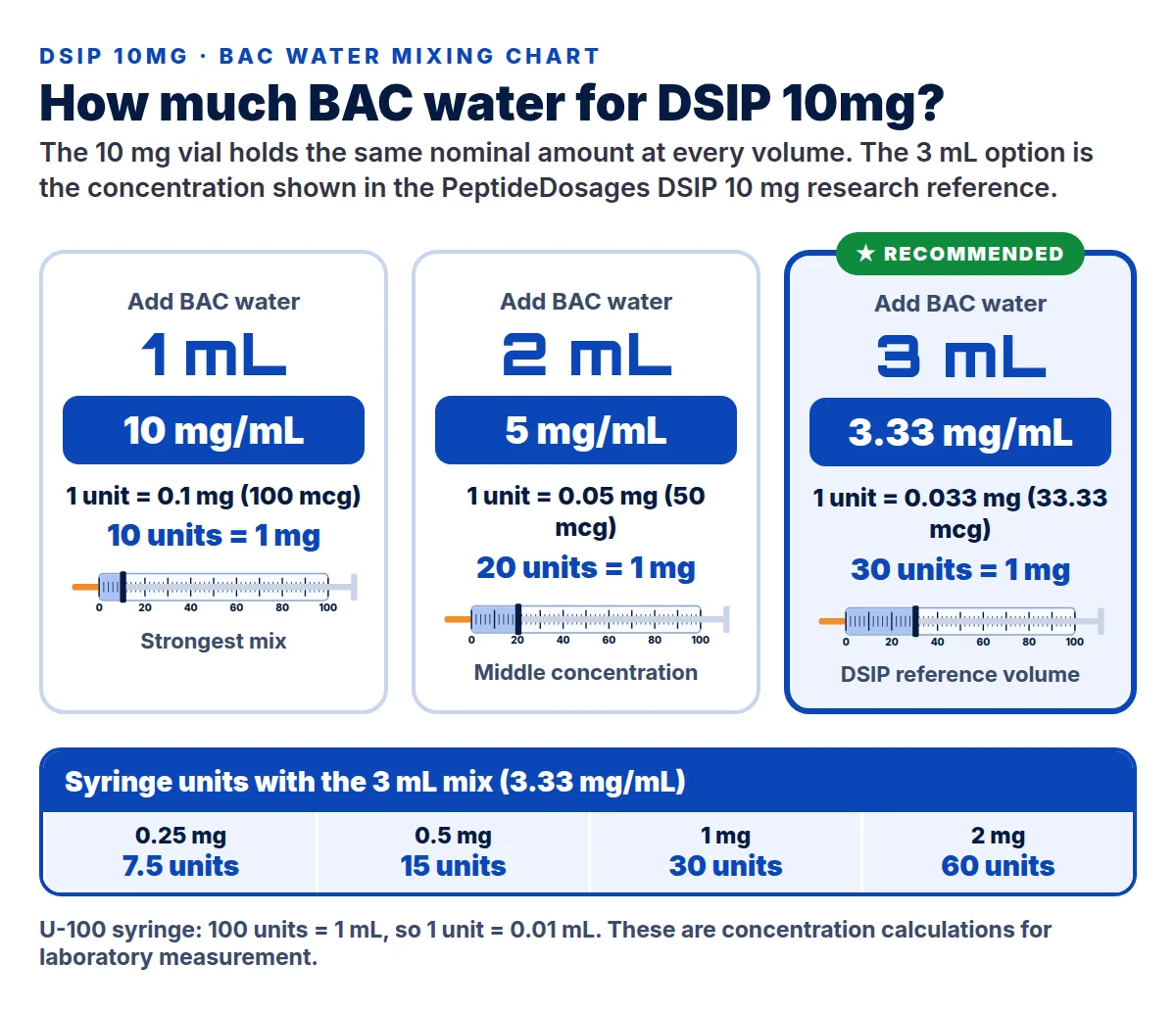
A vial’s nominal 10mg amount stays the same at every liquid volume. Adding more BAC water does not add more DSIP; it changes how much nominal DSIP is present in each millilitre and each U-100 volume marking. The concentration chart below compares 1 mL, 2 mL and the 3 mL reference volume used by PeptideDosages for DSIP 10mg.
At 3 mL, a nominal 10mg vial is 3.33 mg/mL. One U-100 unit is 0.01 mL and holds about 0.033 mg, or 33 mcg. Ten units therefore hold about 0.33 mg, 15 units hold 0.5 mg, 30 units hold 1 mg and 60 units hold 2 mg. Formula: units = amount wanted ÷ mg per mL × 100.
DSIP 10mg concentration chart: the 3 mL reference volume gives about 3.33 mg/mL and 30 units per 1 mg.
3 mL is highlighted because it gives the simplest numbers.
Syringe units with the 3 mL mix (3.33 mg/mL)
Syringe units with the 3 mL mix (3.33 mg/mL)
Amount
Units on a U-100 syringe
Volume
0.25 mg
7.5 units
0.075 mL
0.5 mg
15 units
0.15 mL
1 mg
30 units
0.3 mL
2 mg
60 units
0.6 mL
The 8 steps
1Step 1: Gather your supplies
Lay out the DSIP 10mg vial, BAC water, a new 1 mL U-100 syringe, alcohol swabs and a sharps container on a clean surface. Check that the vial label reads DSIP and 10 mg. Let a cold vial sit briefly until it reaches room temperature before handling the powder.
2Step 2: Wipe the rubber stopper
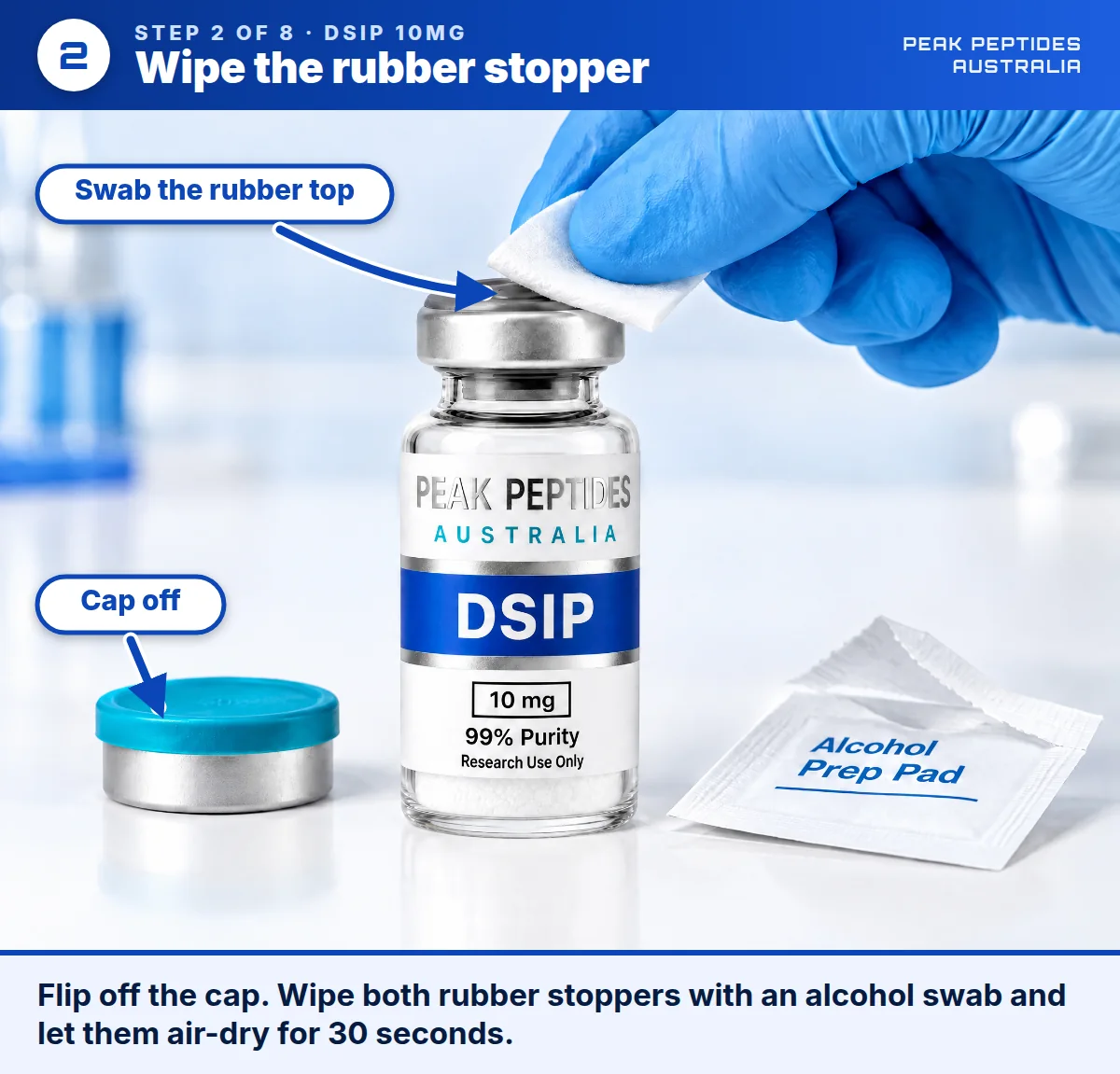
Remove the flip-off cap from the DSIP vial and from the BAC water vial. Wipe each rubber stopper with a fresh alcohol swab, then allow the surfaces to air-dry for about 30 seconds. Once clean, keep hands and other items away from the stopper surfaces.
3Step 3: Draw up the BAC water
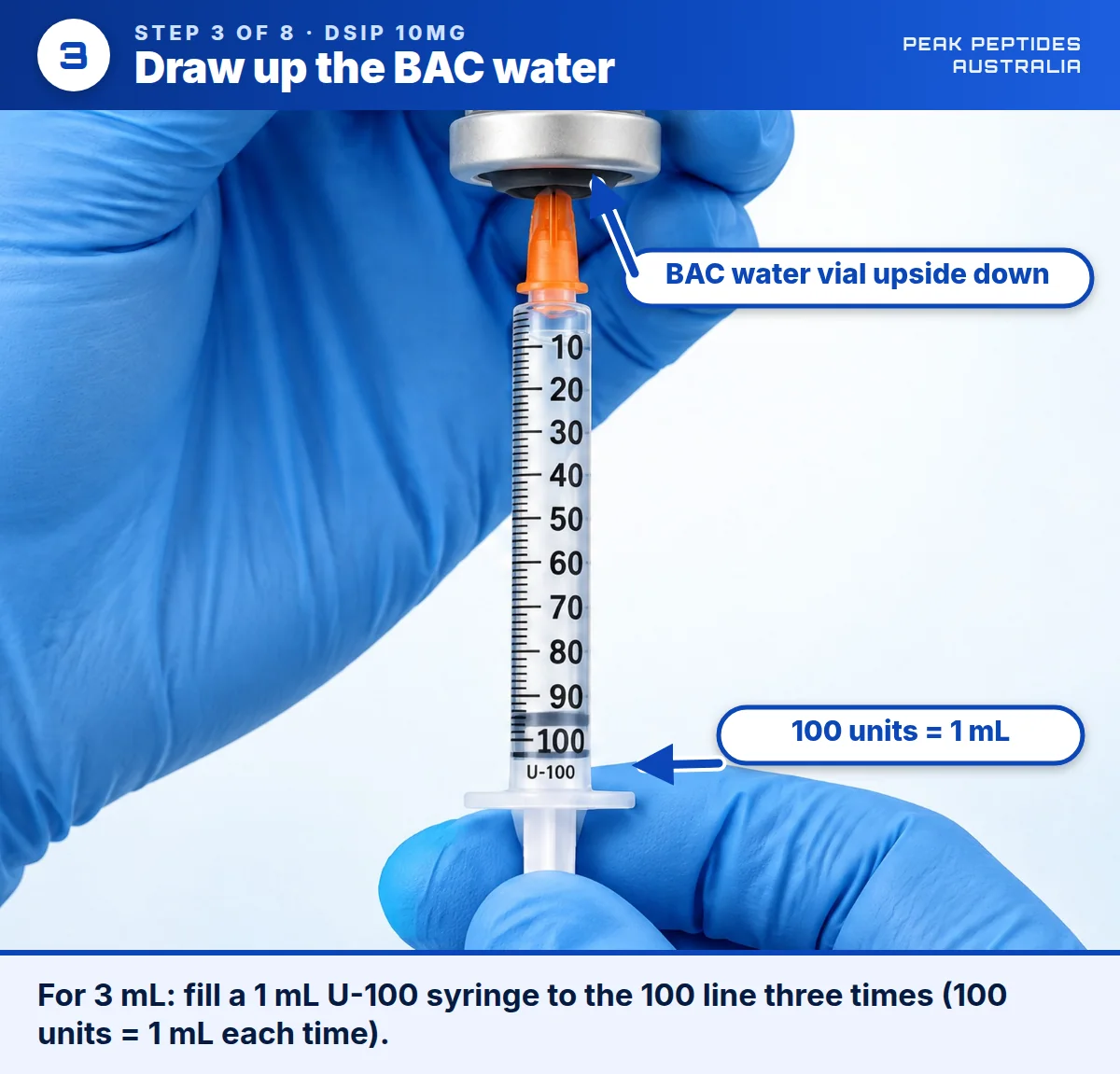
Draw 1 mL of BAC water to the 100-unit line of a U-100 syringe. One full U-100 syringe holds 1 mL. The 3 mL DSIP reference mix needs this 1 mL draw repeated three times, with the water transferred slowly on each pass.
4Step 4: Trickle it down the glass
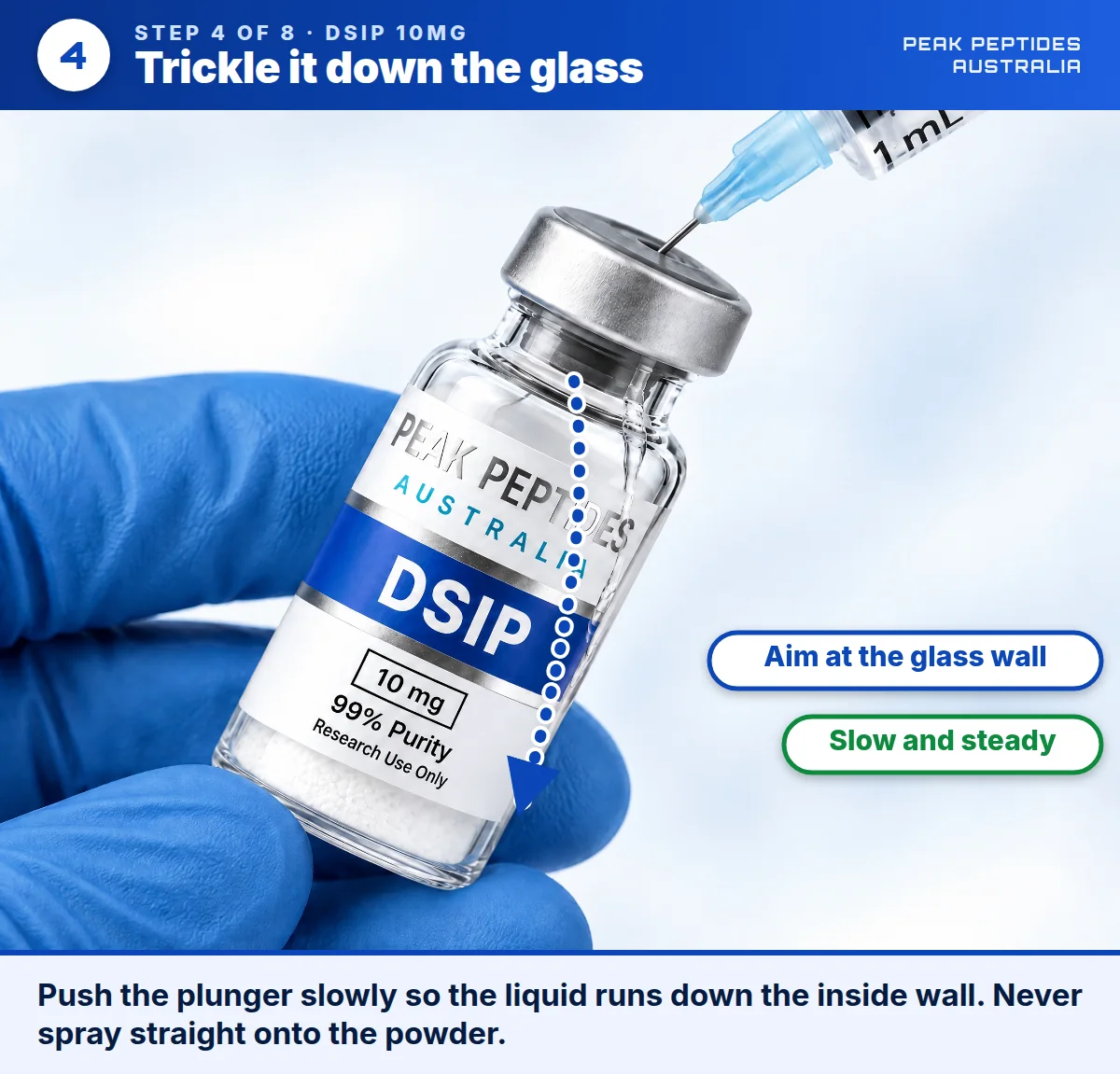
Place the needle through the DSIP vial stopper at an angle, with the tip near the inner glass wall. Press slowly so the BAC water runs down the wall rather than landing directly on the powder. Repeat the draw-and-trickle sequence until the 3 mL reference volume has been transferred.
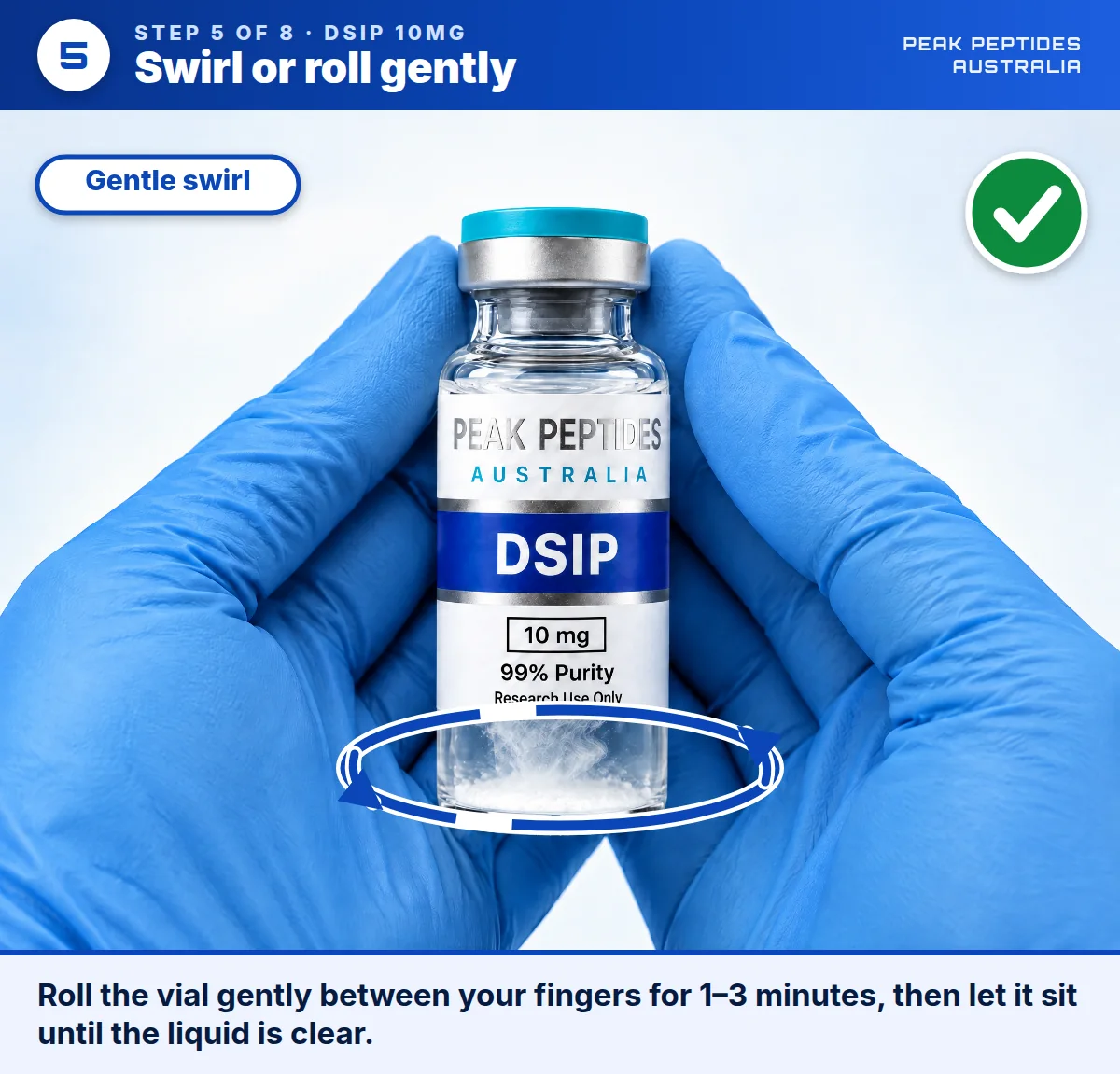
5Step 5: Swirl or roll gently
Gently roll the DSIP vial between fingers or move it in slow circles. The goal is to allow the powder to dissolve without making foam. Some powder can remain at the bottom while the liquid first clears around it, so give it time and use slow movement only.
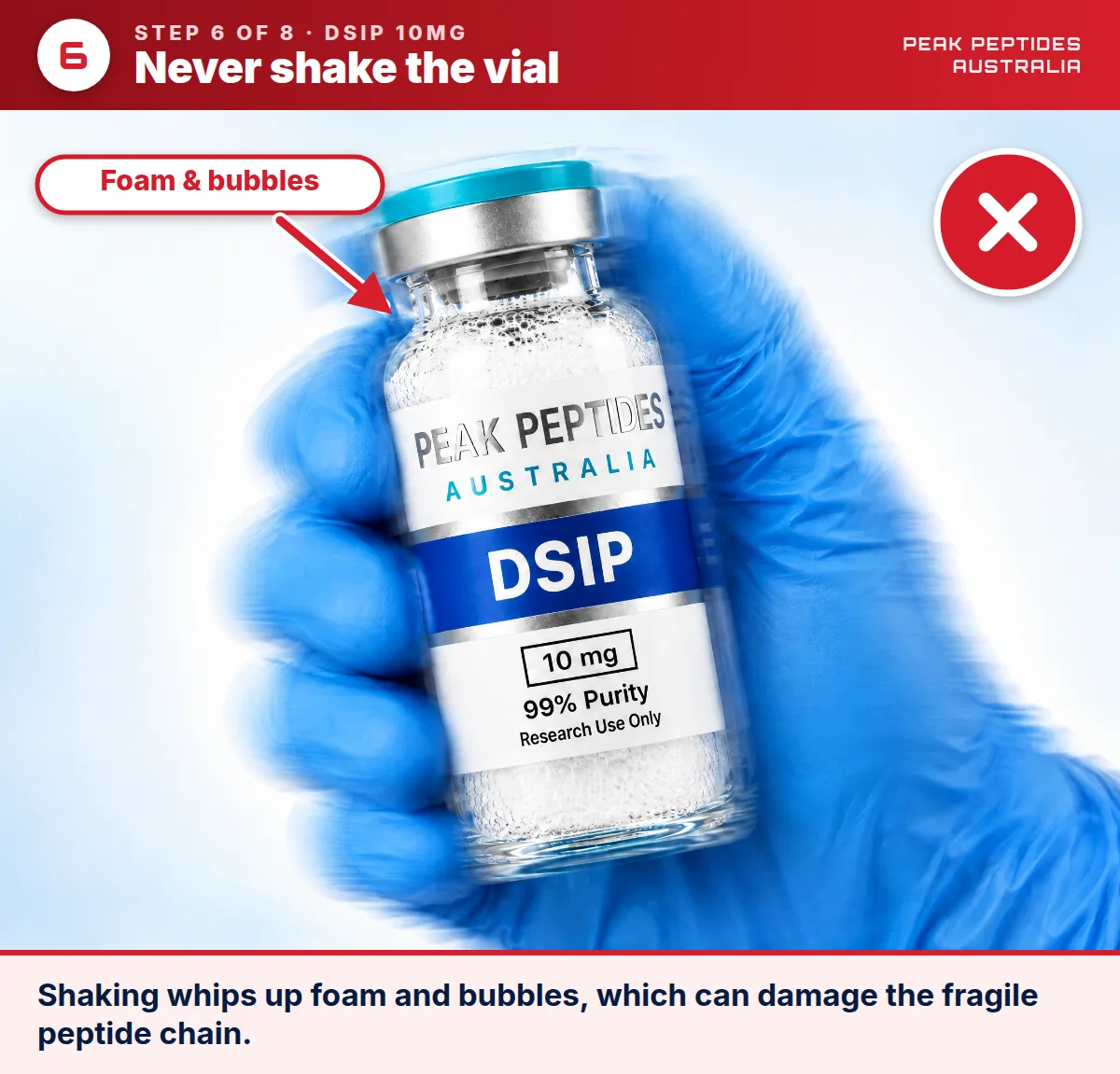
6Step 6: Never shake the vial
Do not shake the DSIP vial. Shaking creates foam and bubbles, which makes the clear-solution check harder and is unnecessary for gentle peptide handling. If foam appears after accidental shaking, place the vial upright and allow bubbles to settle before looking for remaining powder or cloudiness.
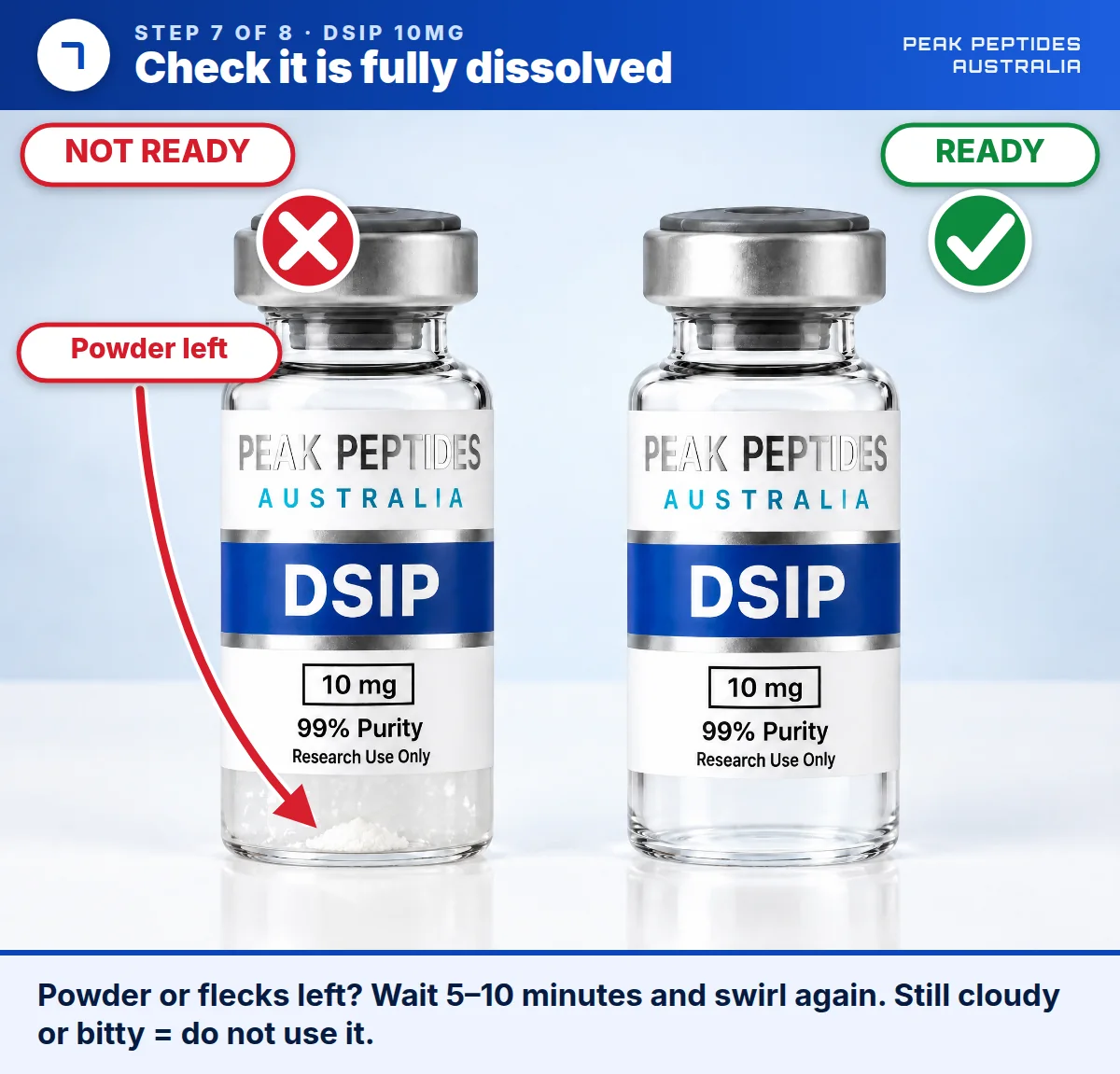
7Step 7: Check it is fully dissolved
Hold the DSIP vial against good light and inspect it. The liquid should look clear, without visible powder, flecks or cloudiness. If powder remains, let the vial stand for 5–10 minutes and swirl gently again. Do not rely on the concentration chart if the solution stays cloudy or contains particles.
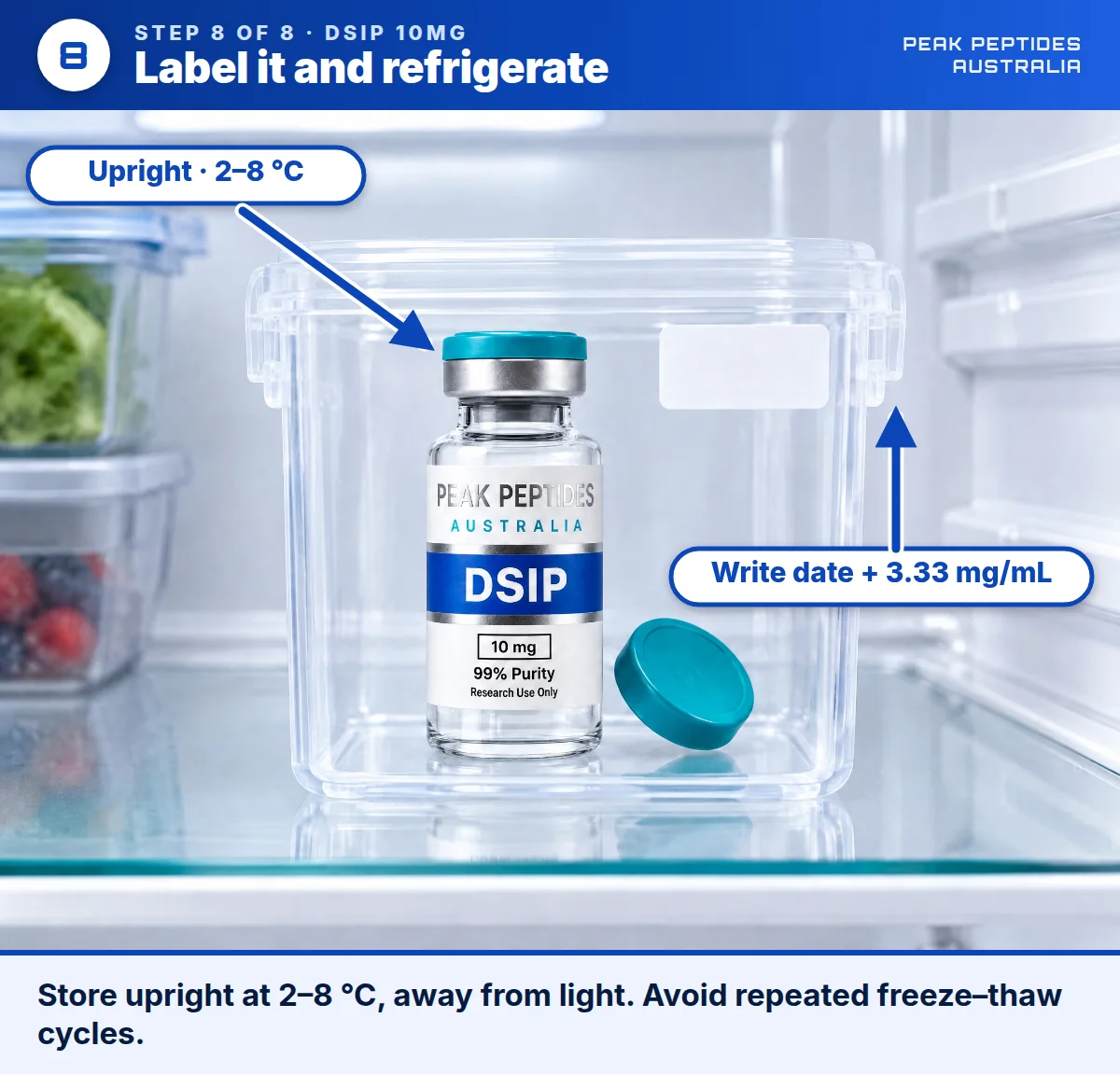
8Step 8: Label it and refrigerate
Write the preparation date and nominal concentration on the storage label. For the 3 mL reference mix, write 3.33 mg/mL. Keep the vial upright in a refrigerator at 2–8 °C, protect it from light and avoid repeated freeze–thaw cycles, as described in the DSIP reference guide.
DSIP 10mg storage: powder and mixed solution
DSIP 10mg storage notes used in this guide
DSIP 10mg storage notes used in this guide
State
Reference condition
Why it matters
Unmixed lyophilised powder
−20 °C in the PeptideDosages DSIP 10mg reference; protect from light
The reference lists frozen storage for lyophilised DSIP and advises avoiding freeze–thaw cycles.
Mixed DSIP reference solution
Refrigerate at 2–8 °C and protect from light
The PeptideDosages DSIP 10mg reference gives this condition after reconstitution.
Repeated freeze–thaw
Avoid
The reference specifically advises avoiding repeated freeze–thaw cycles.
Once mixed with BAC water, keep it upright in the fridge at 2–8 °C, away from light. Use it within about 4 weeks (28 days), never freeze it, and write the date and strength on the vial.
DSIP means delta sleep-inducing peptide. It is a defined nonapeptide, meaning a chain of nine amino acids, with the sequence Trp-Ala-Gly-Gly-Asp-Ala-Ser-Gly-Glu. It is also known as emideltide and DSIP nonapeptide.
What is DSIP used for in research?
DSIP is used in sleep-physiology and neuroendocrine research. Historical work examined EEG activity, sleep timing, sleep stages, sleep efficiency and related biological questions.
What does delta sleep-inducing peptide mean?
The name comes from early experiments that reported increased delta EEG activity after synthetic DSIP was administered directly in a rabbit study. Delta EEG activity is a brain-wave measurement associated with deep stages of sleep, not a guarantee of better sleep overall.
How does DSIP work?
DSIP does not have a confirmed receptor pathway. A 2006 scientific review reported that the DSIP gene, precursor protein and possible related receptor had not been isolated. It is best described as an experimental peptide with an unresolved biological mechanism.
What did DSIP studies find?
Historical studies produced different findings. A 1981 six-volunteer study reported more observed sleep after intravenous DSIP. A 1987 controlled study found no change in slow-wave or REM sleep and judged improvement of little clinical significance. A 1992 study found weak objective changes without changed subjective sleep quality.
Was DSIP studied in people?
Yes. Small studies from the 1980s and early 1990s tested intravenous DSIP in volunteers and people with chronic insomnia. They used short observation periods and assessed separate endpoints such as latency, efficiency, sleep stages and perceived sleep quality.
What side effects were reported in DSIP studies?
FDA’s 2026 emideltide briefing describes transient headache, nausea and vertigo, plus cases of hypotension, in older intravenous withdrawal-study reports. FDA noted that withdrawal symptoms complicate interpretation and found no clinical safety data for the nominated subcutaneous preparations.
What is DSIP’s half-life?
No DSIP half-life is stated on this page because the opened authoritative sources did not supply a defensible value for this molecule and formulation. A half-life figure from a different salt, route or product would not reliably describe this lyophilised research vial.
Is DSIP the same as Epithalon?
No. DSIP is a nine-amino-acid peptide with sequence WAGGDASGE and molecular weight 848.8 g/mol. Epithalon, also called Epitalon, is a four-amino-acid peptide with sequence AEDG and molecular weight 390.35 g/mol. They are distinct molecules.
Is DSIP the same as Selank?
No. DSIP is the nine-amino-acid peptide WAGGDASGE. Selank, also called TP-7, is a separate seven-amino-acid tuftsin-family peptide with sequence TKPRPGP. Their structures, research questions and analytical identities are different.
Is DSIP approved by the TGA or FDA?
No. DSIP is not an FDA-approved medicine. FDA’s 2026 emideltide briefing states that emideltide free base and acetate are not components of an FDA-approved drug. No DSIP or emideltide medicine appeared in the ARTG search reviewed for this page.
Can I buy DSIP 10mg online in Australia?
DSIP 10mg can be ordered online from Peak Peptides Australia when it is available. It is supplied for in-vitro research only. In-stock orders receive same-day dispatch from Victoria once payment is confirmed, tracked Australia Post Express, with a tracking number emailed.
How fast is DSIP shipping in Australia?
For in-stock orders, dispatch is the same day from Victoria once payment is confirmed. Orders travel by tracked Australia Post Express and a tracking number is emailed. This is the dispatch arrangement for the research product, not a statement of Australia Post delivery timing.
How do I know a DSIP sample is real?
Start with an independent report that identifies the tested substance and names the test methods. The DSIP 10mg sample on this page is linked to LabDoc LD-H89L, which records LC-MS identity confirmation, HPLC purity and HPLC content for the submitted sample.
How is this DSIP 10mg sample verified?
LabDoc report LD-H89L records the submitted DSIP vial as LC-MS identity confirmed, 99.45% HPLC purity and 9.22mg HPLC content against the 10mg claim. It was received on 9 September 2026 and tested on 28 September 2026; batch was not stated.
Why does the LabDoc report show 9.22mg rather than 10mg?
The 10mg figure is the nominal label claim. LD-H89L measured 9.22mg by HPLC for the submitted sample, reported as 92.2% of the claim. Content is separate from the report’s 99.45% purity result and its LC-MS identity confirmation.
What does 99.45% HPLC purity mean for DSIP?
It means LabDoc measured 99.45% purity by HPLC in the submitted DSIP sample. This is different from content: LD-H89L separately measured 9.22mg content. Neither result establishes sterility, endotoxin status, long-term stability or suitability for administration.
How much BAC water for DSIP 10mg?
The PeptideDosages DSIP 10mg research reference uses 3 mL of BAC water, giving about 3.33 mg/mL from a nominal 10mg vial. The chart also shows the arithmetic for 1 mL and 2 mL volumes. Liquid volume changes concentration, not the nominal amount in the vial.
How many units is 1 mg of DSIP with a 3 mL mix?
With a nominal 10mg vial mixed to 3 mL, the concentration is 3.33 mg/mL. On a U-100 syringe, 1 mg is 30 units, which is 0.30 mL.
How many mg are in 10 units of DSIP with a 3 mL mix?
With the 3 mL mix, the nominal concentration is 3.33 mg/mL. Ten units on a U-100 syringe equal 0.10 mL and hold about 0.33 mg, or 333 mcg. A U-100 unit is a volume marking, not an international unit of DSIP.
How do I reconstitute DSIP 10mg?
Prepare a clean surface, wipe the vial stoppers with alcohol swabs, draw BAC water, and let it run slowly down the inside wall of the DSIP vial. Swirl gently rather than shake. Once clear, label the vial and refrigerate it. The eight images below show the sequence.
Can I use sterile or tap water instead of BAC water for DSIP?
Do not use tap water. The DSIP 10mg research reference uses bacteriostatic water for its concentration example. Plain sterile water and bacteriostatic water are different materials, so a storage period calculated for one cannot simply be transferred to the other.
What if DSIP powder does not dissolve?
Let the vial stand for 5–10 minutes, then swirl gently again. Do not shake it. If powder, flecks or cloudiness remain after that, the concentration calculation should not be relied on. The photo guide shows the difference between powder left and a clear vial.
Should reconstituted DSIP be cloudy?
No. The reconstitution guide uses completely clear liquid as the visual check before refrigeration. Visible cloudiness, particles or undissolved powder mean the vial has not reached that clear state, so the measurement chart should not be used for that solution.
How long does reconstituted DSIP last?
The PeptideDosages DSIP 10mg reference says to refrigerate the reconstituted solution at 2–8 °C, protect it from light and avoid repeated freeze–thaw cycles. Once mixed with BAC water, keep it upright, use it within about 4 weeks (28 days) and never freeze it.
How should DSIP powder be stored before mixing?
The PeptideDosages DSIP 10mg reference lists −20 °C storage for lyophilised DSIP and advises avoiding freeze–thaw cycles. Keep the vial protected from light.
Can you freeze reconstituted DSIP?
The PeptideDosages DSIP 10mg reference advises avoiding repeated freeze–thaw cycles after reconstitution. For its concentration example, it specifies storage at 2–8 °C away from light. This page therefore shows refrigerated storage rather than a freeze–thaw routine.
What does a DSIP COA or LabDoc report show?
A report can identify the submitted sample, record methods and provide analytical results. LD-H89L records LC-MS identity confirmation, 99.45% HPLC purity, 9.22mg HPLC content and a Pass assessment. It does not turn a research material into an approved medicine or prove biological effect.